

The DOI matches its Crossref record; 169 of the 180 references it cites were found in a registry or an index; 5 of the 164 sources its claims cite were checked for support.
Iron as a Central Player and Promising Target in Cancer Progression
Open accessAbstract
Iron is an essential element for virtually all organisms. On the one hand, it facilitates cell proliferation and growth. On the other hand, iron may be detrimental due to its redox abilities, thereby contributing to free radical formation, which in turn may provoke oxidative stress and DNA damage. Iron also plays a crucial role in tumor progression and metastasis due to its major function in tumor cell survival and reprogramming of the tumor microenvironment. Therefore, pathways of iron acquisition, export, and storage are often perturbed in cancers, suggesting that targeting iron metabolic pathways might represent opportunities towards innovative approaches in cancer treatment. Recent evidence points to a crucial role of tumor-associated macrophages (TAMs) as a source of iron within the tumor microenvironment, implying that specifically targeting the TAM iron pool might add to the efficacy of tumor therapy. Here, we provide a brief summary of tumor cell iron metabolism and updated molecular mechanisms that regulate cellular and systemic iron homeostasis with regard to the development of cancer. Since iron adds to shaping major hallmarks of cancer, we emphasize innovative therapeutic strategies to address the iron pool of tumor cells or cells of the tumor microenvironment for the treatment of cancer.
Overview
AI snapshot
Written from the paper’s full text.
TL;DR
This review argues that iron metabolism is reprogrammed in cancer to support proliferation, survival, metastasis, and tumor microenvironment crosstalk, with tumor-associated macrophages acting as iron donors. It highlights therapeutic opportunities including hepcidin/FPN modulation, Tf/TfR targeting, iron chelators, and ferroptosis induction, while noting major clinical validation gaps.
Key findings
- Iron is essential but redox-active; the Fenton reaction produces hydroxyl radicals, causing DNA strand breaks and protein/lipid modifications, while iron-dependent lipid peroxidation drives ferroptosis via glutathione depletion and GPX4 inactivation.
- Cancer cells often increase iron uptake/storage and decrease export: high TfR1, FTL, and IRP-2 correlate with poor prognosis, higher tumor grade, and chemoresistance; low FPN correlates with worse survival, whereas higher FPN correlates with better outcome. Anemia is detected in approximately 40–70% of all cancer patients, linked to TNF-α/IL-6 and iron restriction.
- Tumor-associated macrophages can adopt an iron-release/donor phenotype, including via Lcn-2 and independently of FPN, supporting tumor cell proliferation and growth; anti-inflammatory macrophages show CD163/CD91, HO-1, upregulated FPN, and reduced FT. Excess heme or iron may shift macrophages toward a pro-inflammatory, anti-tumoral phenotype.
- Therapeutic strategies discussed include targeting hepcidin (antibodies/aptamers, BMP/SMAD, IL-6/STAT3), FPN stabilizers, anti-TfR antibodies and drug conjugates, ferritin nanocages, Lcn-2/siderophore pathways, iron chelators (DFO, DFX, Triapine, VLX600), and ferroptosis inducers; no iron chelator used clinically for iron overload has been approved for cancer.
Methods
- Narrative review; no primary experimental data or systematic search is described. It synthesizes published literature on tumor cell iron metabolism, systemic iron homeostasis, TAM biology, and iron-targeting therapies.
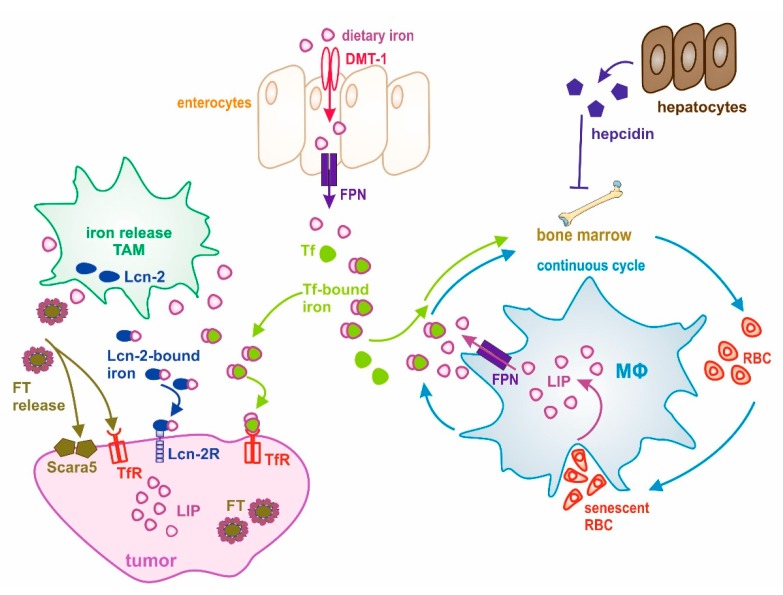
- Main analysis is thematic and descriptive, citing mechanistic studies, animal models, and clinical trials; it includes a summary table of pre-clinical studies and clinical trials (Table 1) and a scheme of tumor iron exploitation (Figure 1).
Limitations
- Stated: prospective clinical data for targeting hepcidin are still missing; lack of long-term follow-up studies in cancer patients makes efficacy and safety difficult to predict; no clinically used iron chelator has obtained approval for the cancer setting; targeting iron in the tumor microenvironment remains largely unexplored.
- Stated: mechanisms of Lcn-2 iron handling remain unclear, including how tumor cells selectively take up iron-loaded versus iron-free Lcn-2.
- Evident: as a narrative review, it does not use a systematic search, risk-of-bias assessment, or quantitative synthesis, so conclusions depend on the selected cited literature.
Model-written summary. Check it against the paper before relying on it.
Integrity signals
Registry
Cites
Statistics
Figures
Verification
Claims the paper makes
98 Not checked yet · 31 Own interpretation · 3 No basis given · 1 Supported · 1 Partly supported · accuracy not yet measured
Every source the paper cites for this claim was checked and supports it.
In the paper
“These findings were corroborated by a variety of studies showing ferritin expression mainly in the stromal compartment of tumor tissue [26,27].”
§ Iron as a Central Player and Promising Target in Cancer Progression > 3. Iron in the Tumor Microenvironment—Role of Tumor-Associated Macrophages
What the sources say
- Supportedcites [26] Rossiello, 1984, Distribution of ferritin, transferrin and lactoferrin in breast carcinoma tissue, J. Clin. Pathol. source
The Discussion and conclusions report that ferritin staining was mostly observed in connective stroma and macrophages surrounding neoplastic tissue, and seldom in neoplastic cells. The Results (pp. 53–54) describe strong stromal staining in the breast carcinoma cases studied. (LLM, conf=0.93)
- Supportedcites [27] Jezequel, 2012, Validation of tumor-associated macrophage ferritin light chain as a prognostic biomarker in node-negative breast cancer tumors: A multicentric 2004 national PHRC study, Int. J. Cancer source
The Immunohistochemistry section states that ferritin light chain (FTL) immunostaining was almost exclusively observed in tumor stroma. The Figure 1 caption also identifies FTL expression in the tumor’s stromal compartment. These passages support the claim for the breast tumors studied. (LLM, conf=0.94)
plain- Asserted: passes — The authors put it forward as true.
- Checkable: passes — It can be checked against evidence.
- Load-bearing: unclear — It is unclear whether the paper’s conclusions depend on it.
- Based: passes — The paper gives a reason why it holds.
- Supported
The cited sources support only part of this claim — read each source’s verdict below.
In the paper
“Interestingly, also higher organisms such as fungi or mammals are able of producing this type of iron-scavenging molecules [120,121,122].”
§ Iron as a Central Player and Promising Target in Cancer Progression > 4. Strategies to Target Iron Trafficking in the Tumor Microenvironment
What the sources say
- Partly supportedcites [120] Bao, 2010, Iron traffics in circulation bound to a siderocalin (Ngal)-catechol complex, Nat. Chem. Biol. sourceExperimental — accuracy not yet measured
The Discussion (page not provided) says mammalian cells synthesize low-molecular-weight iron chelators and identifies catechols as metabolites that bind and transport iron. The cited paper does not address fungi producing such molecules, so it supports the mammalian example but not the fungal one. (LLM, conf=0.85)
- Supportedcites [121] Devireddy, 2010, A mammalian siderophore synthesized by an enzyme with a bacterial homolog involved in enterobactin production, Cell source
The Results section identifies an iron-binding component of a mammalian siderophore in mouse cells and reports that knocking down the murine enzyme BDH2 eliminates detectable siderophore-associated 2,5-DHBA. This supports the mammalian part of the claim. The paper does not establish siderophore production by fungi; that part is not attributed specifically to this source among the three citations. (LLM, conf=0.91)
- Partly supportedcites [122] Schrettl, 2007, Distinct roles for intra- and extracellular siderophores during Aspergillus fumigatus infection, PLoS Pathog. sourceExperimental — accuracy not yet measured
The Introduction says that the fungus A. fumigatus produces several siderophores. But the Discussion states that siderophore-biosynthesis pathways are absent in mammals, contradicting the mammal part of the claim. Page numbers are not provided in our copy. (LLM, conf=0.91)
plain- Asserted: passes — The authors put it forward as true.
- Checkable: passes — It can be checked against evidence.
- Load-bearing: unclear — It is unclear whether the paper’s conclusions depend on it.
- Based: passes — The paper gives a reason why it holds.
- Partly supported
In the paper
“Under these conditions, TAM expressed higher levels of the high-affinity iron-binding protein lipocalin-2 (Lcn-2).”
§ Iron as a Central Player and Promising Target in Cancer Progression > 3. Iron in the Tumor Microenvironment—Role of Tumor-Associated Macrophages
What the sources say
- Not checked yetcites [66] Mertens, 2018, Macrophage-derived lipocalin-2 transports iron in the tumor microenvironment, Oncoimmunology source
plaincorrelational- Asserted: passes — The authors put it forward as true.
- Checkable: passes — It can be checked against evidence.
- Load-bearing: passes — The paper’s conclusions depend on it.
- Based: passes — The paper gives a reason why it holds.
In the paper
“Recently, we provided evidence that TAM adopt an iron-release phenotype due to their interaction with dying tumor cells, whereby iron availability was increased within the tumor microenvironment [66].”
§ Iron as a Central Player and Promising Target in Cancer Progression > 3. Iron in the Tumor Microenvironment—Role of Tumor-Associated Macrophages
What the sources say
- Not checked yetcites [66] Mertens, 2018, Macrophage-derived lipocalin-2 transports iron in the tumor microenvironment, Oncoimmunology source
plaindirect- Asserted: passes — The authors put it forward as true.
- Checkable: passes — It can be checked against evidence.
- Load-bearing: passes — The paper’s conclusions depend on it.
- Based: passes — The paper gives a reason why it holds.
In the paper
“Upon intracellular reduction, (TC3-S)2 is converted to the thiol chelator TC3-SH, which re-programmed macrophages from an iron release to and iron sequestration phenotype [72].”
§ Iron as a Central Player and Promising Target in Cancer Progression > 5. Novel Iron Chelation-Based Treatment Strategies
What the sources say
- Not checked yetcites [72] Mertens, C., Akam, E.A., Rehwald, C., Brune, B., Tomat, E., and Jung, M. (2016). Intracellular Iron Chelation Modulates the Macrophage Iron Phenotype with Consequences on Tumor Progression. PLoS ONE, 11. source
plaindirect- Asserted: passes — The authors put it forward as true.
- Checkable: passes — It can be checked against evidence.
- Load-bearing: passes — The paper’s conclusions depend on it.
- Based: passes — The paper gives a reason why it holds.
In the paper
“While the majority of studies so far focused on mechanisms promoted by tumor cell-derived Lcn-2, recent data from our group suggest that stromal Lcn-2 promoted metastasis by enhancing EMT and lymphangiogenesis [133].”
§ Iron as a Central Player and Promising Target in Cancer Progression > 4. Strategies to Target Iron Trafficking in the Tumor Microenvironment
What the sources say
- Not checked yetcites [133] Jung, 2016, Lipocalin 2 from macrophages stimulated by tumor cell-derived sphingosine 1-phosphate promotes lymphangiogenesis and tumor metastasis, Sci. Signal. source
hedgeddirect- Asserted: passes — The authors put it forward as true.
- Checkable: passes — It can be checked against evidence.
- Load-bearing: passes — The paper’s conclusions depend on it.
- Based: passes — The paper gives a reason why it holds.
In the paper
“This is a distinct type of cell death compared to apoptosis, necrosis, or autophagy [5].”
§ Iron as a Central Player and Promising Target in Cancer Progression > 1. Iron and Cancer
What the sources say
- Not checked yetcites [5] Lu, 2017, The Role of Ferroptosis in Cancer Development and Treatment Response, Front. Pharmacol. source
plain- Asserted: passes — The authors put it forward as true.
- Checkable: passes — It can be checked against evidence.
- Load-bearing: unclear — It is unclear whether the paper’s conclusions depend on it.
- Based: passes — The paper gives a reason why it holds.
In the paper
“The malignant cancer phenotype is often found in association with a deregulated iron homeostasis, particularly the expression of iron-regulated genes that fuel their higher metabolic iron demands needed for division, growth, and survival [10].”
§ Iron as a Central Player and Promising Target in Cancer Progression > 1. Iron and Cancer
What the sources say
- Not checked yetcites [10] Kwok, 2002, The iron metabolism of neoplastic cells: Alterations that facilitate proliferation?, Crit. Rev. Oncol. Hematol. source
plaincorrelational- Asserted: passes — The authors put it forward as true.
- Checkable: passes — It can be checked against evidence.
- Load-bearing: passes — The paper’s conclusions depend on it.
- Based: passes — The paper gives a reason why it holds.
In the paper
“They inhibit erythropoiesis due to iron restriction in the reticuloendothelial system [18].”
§ Iron as a Central Player and Promising Target in Cancer Progression > 1. Iron and Cancer
What the sources say
- Not checked yetcites [18] Buck, 2009, Linking anemia to inflammation and cancer: The crucial role of TNFalpha, Biochem. Pharmacol. source
plaindirect- Asserted: passes — The authors put it forward as true.
- Checkable: passes — It can be checked against evidence.
- Load-bearing: unclear — It is unclear whether the paper’s conclusions depend on it.
- Based: passes — The paper gives a reason why it holds.
In the paper
“During ferroptosis, a lethal metabolic imbalance arises from glutathione depletion, which inactivates the lipid repair enzyme glutathione-dependent peroxidase 4, GPX4, with the subsequent accumulation of lipid peroxides [6].”
§ Iron as a Central Player and Promising Target in Cancer Progression > 1. Iron and Cancer
What the sources say
- Not checked yetcites [6] NaveenKumar, 2018, The Role of Reactive Oxygen Species and Ferroptosis in Heme-Mediated Activation of Human Platelets, ACS Chem. Biol. source
plaindirect- Asserted: passes — The authors put it forward as true.
- Checkable: passes — It can be checked against evidence.
- Load-bearing: passes — The paper’s conclusions depend on it.
- Based: passes — The paper gives a reason why it holds.
- It may state two separate claims as one. 39
- Probably not a substantial claim. 15
In the paper
“Lcn-2 turned out to export iron from TAM, while depletion of the established iron exporter FPN did not alter their iron release capacity [66].”
§ Iron as a Central Player and Promising Target in Cancer Progression > 3. Iron in the Tumor Microenvironment—Role of Tumor-Associated Macrophages
What the sources say
- Not checked yetcites [66] Mertens, 2018, Macrophage-derived lipocalin-2 transports iron in the tumor microenvironment, Oncoimmunology source
plaindirect- Asserted: passes — The authors put it forward as true.
- Checkable: passes — It can be checked against evidence.
- Load-bearing: passes — The paper’s conclusions depend on it.
- Based: passes — The paper gives a reason why it holds.
It may state two separate claims as one.
In the paper
“Furthermore, cancer-induced anemia as well as inflammation-associated anemia is characterized by reduced erythropoiesis [17].”
§ Iron as a Central Player and Promising Target in Cancer Progression > 1. Iron and Cancer
What the sources say
- Not checked yetcites [17] Nemeth, 2014, Anemia of inflammation, Hematol. Oncol. Clin. N. Am. source
plaincorrelational- Asserted: passes — The authors put it forward as true.
- Checkable: passes — It can be checked against evidence.
- Load-bearing: unclear — It is unclear whether the paper’s conclusions depend on it.
- Based: passes — The paper gives a reason why it holds.
It may state two separate claims as one.
None of the sources cited for this claim have been checked yet.
In the paper
“Binding of IRPs to IREs in the 5’-UTR attenuates translation, whereas binding to IREs in the 3’-UTR stabilizes respective mRNAs and fosters translation.”
§ Iron as a Central Player and Promising Target in Cancer Progression > 2. Iron Metabolism in Cancer Cells
What the sources say
plaindirect- Asserted: passes — The authors put it forward as true.
- Checkable: passes — It can be checked against evidence.
- Load-bearing: passes — The paper’s conclusions depend on it.
- Based: passes — The paper gives a reason why it holds.
It may state two separate claims as one.
In the paper
“Senescent RBCs are taken up by monocytes in the bloodstream and transported to both liver and spleen.”
§ Iron as a Central Player and Promising Target in Cancer Progression > 1. Iron and Cancer
What the sources say
- Not checked yetcites [24] Theurl, 2016, On-demand erythrocyte disposal and iron recycling requires transient macrophages in the liver, Nat. Med. source
plaindirect- Asserted: passes — The authors put it forward as true.
- Checkable: passes — It can be checked against evidence.
- Load-bearing: unclear — It is unclear whether the paper’s conclusions depend on it.
- Based: passes — The paper gives a reason why it holds.
It may state two separate claims as one.
None of the sources cited for this claim have been checked yet.
In the paper
“Apparently, the expression of different iron-regulated genes such as the transferrin receptor (TfR1) [25], ferritin light chain (FTL) [26,27], and the iron regulatory protein (IRP)-2 [28] in tumor cells correlated with a poor prognosis, a higher tumor grade, and increased chemoresistance.”
§ Iron as a Central Player and Promising Target in Cancer Progression > 1. Iron and Cancer
What the sources say
- Not checked yetcites [25] Green, 2017, Transferrin receptor 1 upregulation in primary tumor and downregulation in benign kidney is associated with progression and mortality in renal cell carcinoma patients, Oncotarget source
- Not checked yetcites [26] Rossiello, 1984, Distribution of ferritin, transferrin and lactoferrin in breast carcinoma tissue, J. Clin. Pathol. source
- Not checked yetcites [27] Jezequel, 2012, Validation of tumor-associated macrophage ferritin light chain as a prognostic biomarker in node-negative breast cancer tumors: A multicentric 2004 national PHRC study, Int. J. Cancer source
- Not checked yetcites [28] Wang, 2014, IRP2 regulates breast tumor growth, Cancer Res. source
hedgedcorrelational- Asserted: passes — The authors put it forward as true.
- Checkable: passes — It can be checked against evidence.
- Load-bearing: passes — The paper’s conclusions depend on it.
- Based: passes — The paper gives a reason why it holds.
It may state two separate claims as one.
In the paper
“DNA polymerases and helicases contain iron-sulfur groups that rely on iron as essential co-factors [7].”
§ Iron as a Central Player and Promising Target in Cancer Progression > 1. Iron and Cancer
What the sources say
- Not checked yetcites [7] Netz, 2011, Eukaryotic DNA polymerases require an iron-sulfur cluster for the formation of active complexes, Nat. Chem. Biol. source
plaindirect- Asserted: passes — The authors put it forward as true.
- Checkable: passes — It can be checked against evidence.
- Load-bearing: fails — The paper’s conclusions may not depend on it.
- Based: passes — The paper gives a reason why it holds.
Probably not a substantial claim. The paper’s conclusions may not depend on it.
In the paper
“Here, iron is crucial in remodeling the extracellular matrix and increasing the motility and invasion of cancer cells [13].”
§ Iron as a Central Player and Promising Target in Cancer Progression > 1. Iron and Cancer
What the sources say
- Not checked yetcites [13] Miklasova, 2015, Iron, inflammation and invasion of cancer cells, Clujul. Med.
plaindirect- Asserted: passes — The authors put it forward as true.
- Checkable: passes — It can be checked against evidence.
- Load-bearing: passes — The paper’s conclusions depend on it.
- Based: passes — The paper gives a reason why it holds.
It may state two separate claims as one.
A conclusion the paper draws from its own results — it cites no other source for it, so there is none to check. The quote shows it is in the paper.
In the paper
“Thus, when iron is high, mRNAs of TfR and DMT-1 are unstable and get degraded, which ultimately decreases iron uptake and transport.”
§ Iron as a Central Player and Promising Target in Cancer Progression > 2. Iron Metabolism in Cancer Cells
plaindirect- Asserted: passes — The authors put it forward as true.
- Checkable: passes — It can be checked against evidence.
- Load-bearing: unclear — It is unclear whether the paper’s conclusions depend on it.
- Based: passes — The paper gives a reason why it holds.
It may state two separate claims as one.
In the paper
“Interestingly, accumulation of iron-recycling macrophages was exclusively observed in the liver, thus identifying the liver as the main organ for RBC recycling.”
§ Iron as a Central Player and Promising Target in Cancer Progression > 1. Iron and Cancer
What the sources say
- Not checked yetcites [24] Theurl, 2016, On-demand erythrocyte disposal and iron recycling requires transient macrophages in the liver, Nat. Med. source
plaindirect- Asserted: passes — The authors put it forward as true.
- Checkable: passes — It can be checked against evidence.
- Load-bearing: unclear — It is unclear whether the paper’s conclusions depend on it.
- Based: passes — The paper gives a reason why it holds.
It may state two separate claims as one.
In the paper
“Thereby, excess iron that is not utilized, can be stored in the iron storage protein FT and can later be accessed by ferritinophagy [34].”
§ Iron as a Central Player and Promising Target in Cancer Progression > 2. Iron Metabolism in Cancer Cells
What the sources say
- Not checked yetcites [34] Donfrancesco, 1990, Effects of a single course of deferoxamine in neuroblastoma patients, Cancer Res.
plaindirect- Asserted: passes — The authors put it forward as true.
- Checkable: passes — It can be checked against evidence.
- Load-bearing: unclear — It is unclear whether the paper’s conclusions depend on it.
- Based: passes — The paper gives a reason why it holds.
It may state two separate claims as one.
None of the sources cited for this claim have been checked yet.
In the paper
“As a result, iron is potentially mutagenic by causing DNA strand breaks, which provokes cellular transformations, or induces protein as well as lipid modifications within malignant cells.”
§ Iron as a Central Player and Promising Target in Cancer Progression > 1. Iron and Cancer
What the sources say
- Not checked yetcites [1] Inoue, 1987, Hydroxyl radical production and human DNA damage induced by ferric nitrilotriacetate and hydrogen peroxide, Cancer Res.
- Not checked yetcites [2] Tymoszuk, 2018, Iron in the Tumor Microenvironment-Connecting the Dots, Front. Oncol. source
- Not checked yetcites [3] Thanan, 2012, Inflammation-induced protein carbonylation contributes to poor prognosis for cholangiocarcinoma, Free Radic. Biol. Med. source
hedgedconditional- Asserted: passes — The authors put it forward as true.
- Checkable: passes — It can be checked against evidence.
- Load-bearing: passes — The paper’s conclusions depend on it.
- Based: passes — The paper gives a reason why it holds.
It may state two separate claims as one.
A conclusion the paper draws from its own results — it cites no other source for it, so there is none to check. The quote shows it is in the paper.
In the paper
“Therefore, pathways of iron acquisition, export, and storage are often perturbed in cancers, suggesting that targeting iron metabolic pathways might represent opportunities towards innovative approaches in cancer treatment.”
§ Iron as a Central Player and Promising Target in Cancer Progression > Abstract
hedgedconditional- Asserted: passes — The authors put it forward as true.
- Checkable: fails — It may be too vague to check against evidence.
- Load-bearing: passes — The paper’s conclusions depend on it.
- Based: passes — The paper gives a reason why it holds.
Probably not a substantial claim. It may be too vague to check against evidence.
None of the sources cited for this claim have been checked yet.
In the paper
“In addition, cellular iron availability not only controls mitochondrial respiration, but also affects citric acid cycle enzymes [8,9].”
§ Iron as a Central Player and Promising Target in Cancer Progression > 1. Iron and Cancer
What the sources say
- Not checked yetcites [8] Oexle, 1999, Iron-dependent changes in cellular energy metabolism: Influence on citric acid cycle and oxidative phosphorylation, Biochim. Biophys. Acta source
- Not checked yetcites [9] Volani, 2017, Dietary iron loading negatively affects liver mitochondrial function, Metallomics source
plaindirect- Asserted: passes — The authors put it forward as true.
- Checkable: passes — It can be checked against evidence.
- Load-bearing: unclear — It is unclear whether the paper’s conclusions depend on it.
- Based: passes — The paper gives a reason why it holds.
It may state two separate claims as one.
In the paper
“Therefore, the Tf/TfR system not only enhances iron uptake, but also provokes tumor cell survival [31].”
§ Iron as a Central Player and Promising Target in Cancer Progression > 2. Iron Metabolism in Cancer Cells
What the sources say
- Not checked yetcites [31] Jian, 2011, Src regulates Tyr(20) phosphorylation of transferrin receptor-1 and potentiates breast cancer cell survival, J. Biol. Chem. source
plaindirect- Asserted: passes — The authors put it forward as true.
- Checkable: passes — It can be checked against evidence.
- Load-bearing: passes — The paper’s conclusions depend on it.
- Based: passes — The paper gives a reason why it holds.
It may state two separate claims as one.
A conclusion the paper draws from its own results — it cites no other source for it, so there is none to check. The quote shows it is in the paper.
In the paper
“As a result, RBC recycling and iron storage in liver and spleen are compromised and erythropoiesis is significantly reduced, finally provoking anemia.”
§ Iron as a Central Player and Promising Target in Cancer Progression > 1. Iron and Cancer
plaindirect- Asserted: passes — The authors put it forward as true.
- Checkable: passes — It can be checked against evidence.
- Load-bearing: passes — The paper’s conclusions depend on it.
- Based: passes — The paper gives a reason why it holds.
It may state two separate claims as one.
In the paper
“These observations were recently underlined by Marques et al., describing an “iron utilization” phenotype of tumor cells, whereas tumor-infiltrating macrophages and lymphocytes represented an “iron donor” phenotype [50].”
§ Iron as a Central Player and Promising Target in Cancer Progression > 3. Iron in the Tumor Microenvironment—Role of Tumor-Associated Macrophages
What the sources say
- Not checked yetcites [50] Marques, O., Porto, G., Rema, A., Faria, F., Cruz Paula, A., Gomez-Lazaro, M., Silva, P., Martins da Silva, B., and Lopes, C. (2016). Local iron homeostasis in the breast ductal carcinoma microenvironment. BMC Cancer, 16. source
plain- Asserted: passes — The authors put it forward as true.
- Checkable: passes — It can be checked against evidence.
- Load-bearing: unclear — It is unclear whether the paper’s conclusions depend on it.
- Based: passes — The paper gives a reason why it holds.
It may state two separate claims as one.
None of the sources cited for this claim have been checked yet.
In the paper
“Interestingly, extracellular FT stimulates proliferation of breast cancer cells independently of the iron content, acting as an inflammatory effector mechanism to directly support tumorigenesis [38,39,40].”
§ Iron as a Central Player and Promising Target in Cancer Progression > 2. Iron Metabolism in Cancer Cells
What the sources say
- Not checked yetcites [38] Mallon, 2000, The basic pathology of human breast cancer, J. Mammary Gland Biol. Neoplasia source
- Not checked yetcites [39] Mantovani, 2008, Cancer-related inflammation, Nature source
- Not checked yetcites [40] Alkhateeb, 2013, Ferritin stimulates breast cancer cells through an iron-independent mechanism and is localized within tumor-associated macrophages, Breast Cancer Res. Treat. source
plaindirect- Asserted: passes — The authors put it forward as true.
- Checkable: passes — It can be checked against evidence.
- Load-bearing: unclear — It is unclear whether the paper’s conclusions depend on it.
- Based: passes — The paper gives a reason why it holds.
It may state two separate claims as one.
In the paper
“In invasive tumor areas, iron export via FPN is lower compared to normal tissue, with the notion that FPN expression in carcinomas inversely correlated with patient survival and disease outcome [42].”
§ Iron as a Central Player and Promising Target in Cancer Progression > 2. Iron Metabolism in Cancer Cells
What the sources say
- Not checked yetcites [42] Pinnix, 2010, Ferroportin and iron regulation in breast cancer progression and prognosis, Sci. Transl. Med. source
hedgedcorrelational- Asserted: passes — The authors put it forward as true.
- Checkable: passes — It can be checked against evidence.
- Load-bearing: passes — The paper’s conclusions depend on it.
- Based: passes — The paper gives a reason why it holds.
It may state two separate claims as one.
In the paper
“As alternatively activated macrophages scavenge senescent and/or apoptotic cells [68], they play an important role in tissue repair, regeneration, resolution of inflammation, and iron recycling.”
§ Iron as a Central Player and Promising Target in Cancer Progression > 3. Iron in the Tumor Microenvironment—Role of Tumor-Associated Macrophages
What the sources say
- Not checked yetcites [68] Gregory, 2004, The macrophage and the apoptotic cell: An innate immune interaction viewed simplistically?, Immunology source
plaindirect- Asserted: passes — The authors put it forward as true.
- Checkable: passes — It can be checked against evidence.
- Load-bearing: unclear — It is unclear whether the paper’s conclusions depend on it.
- Based: passes — The paper gives a reason why it holds.
It may state two separate claims as one.
None of the sources cited for this claim have been checked yet.
In the paper
“Interestingly, large amounts of hepcidin are found both within the tumor microenvironment and systemically in cancer patients [73,74,75,76].”
§ Iron as a Central Player and Promising Target in Cancer Progression > 3. Iron in the Tumor Microenvironment—Role of Tumor-Associated Macrophages
What the sources say
- Not checked yetcites [73] Tesfay, 2015, Hepcidin regulation in prostate and its disruption in prostate cancer, Cancer Res. source
- Not checked yetcites [74] Miller, 2011, An iron regulatory gene signature predicts outcome in breast cancer, Cancer Res. source
- Not checked yetcites [75] Vela, 2018, Differential regulation of hepcidin in cancer and non-cancer tissues and its clinical implications, Exp. Mol. Med. source
- Not checked yetcites [76] Zhang, 2014, Disordered hepcidin-ferroportin signaling promotes breast cancer growth, Cell Signal. source
plain- Asserted: passes — The authors put it forward as true.
- Checkable: passes — It can be checked against evidence.
- Load-bearing: unclear — It is unclear whether the paper’s conclusions depend on it.
- Based: passes — The paper gives a reason why it holds.
It may state two separate claims as one.
In the paper
“The FPN efflux system represents one of the key mechanisms to adjust the iron amount in the body and to affect the ratio of stored and released iron [41].”
§ Iron as a Central Player and Promising Target in Cancer Progression > 2. Iron Metabolism in Cancer Cells
What the sources say
- Not checked yetcites [41] Donovan, 2005, The iron exporter ferroportin/Slc40a1 is essential for iron homeostasis, Cell Metab. source
plaindirect- Asserted: passes — The authors put it forward as true.
- Checkable: passes — It can be checked against evidence.
- Load-bearing: passes — The paper’s conclusions depend on it.
- Based: passes — The paper gives a reason why it holds.
It may state two separate claims as one.
In the paper
“In contrast, anti-inflammatory macrophages are predisposed to iron export and the distribution of iron to the extracellular space, whereas iron storage is reduced.”
§ Iron as a Central Player and Promising Target in Cancer Progression > 3. Iron in the Tumor Microenvironment—Role of Tumor-Associated Macrophages
What the sources say
- Not checked yetcites [67] Recalcati, 2010, Differential regulation of iron homeostasis during human macrophage polarized activation, Eur. J. Immunol. source
plaincorrelational- Asserted: passes — The authors put it forward as true.
- Checkable: passes — It can be checked against evidence.
- Load-bearing: unclear — It is unclear whether the paper’s conclusions depend on it.
- Based: passes — The paper gives a reason why it holds.
It may state two separate claims as one.
In the paper
“In addition, macrophages are capable of ferritin secretion, whereby tumor growth is promoted [40].”
§ Iron as a Central Player and Promising Target in Cancer Progression > 3. Iron in the Tumor Microenvironment—Role of Tumor-Associated Macrophages
What the sources say
- Not checked yetcites [40] Alkhateeb, 2013, Ferritin stimulates breast cancer cells through an iron-independent mechanism and is localized within tumor-associated macrophages, Breast Cancer Res. Treat. source
plaindirect- Asserted: passes — The authors put it forward as true.
- Checkable: passes — It can be checked against evidence.
- Load-bearing: unclear — It is unclear whether the paper’s conclusions depend on it.
- Based: passes — The paper gives a reason why it holds.
It may state two separate claims as one.
In the paper
“The iron-release phenotype is associated with upregulation of the iron exporter FPN, while the iron storage protein FT is downregulated [67].”
§ Iron as a Central Player and Promising Target in Cancer Progression > 3. Iron in the Tumor Microenvironment—Role of Tumor-Associated Macrophages
What the sources say
- Not checked yetcites [67] Recalcati, 2010, Differential regulation of iron homeostasis during human macrophage polarized activation, Eur. J. Immunol. source
plaincorrelational- Asserted: passes — The authors put it forward as true.
- Checkable: passes — It can be checked against evidence.
- Load-bearing: passes — The paper’s conclusions depend on it.
- Based: passes — The paper gives a reason why it holds.
It may state two separate claims as one.
None of the sources cited for this claim have been checked yet.
In the paper
“Levels of hepcidin are increased during inflammation and decreased by iron insufficiency and erythropoiesis [45,46,47].”
§ Iron as a Central Player and Promising Target in Cancer Progression > 2. Iron Metabolism in Cancer Cells
What the sources say
- Not checked yetcites [45] Ganz, 2003, Hepcidin, a key regulator of iron metabolism and mediator of anemia of inflammation, Blood source
- Not checked yetcites [46] Nemeth, 2009, The role of hepcidin in iron metabolism, Acta Haematol. source
- Not checked yetcites [47] Darshan, 2009, Interacting signals in the control of hepcidin expression, Biometals source
plaindirect- Asserted: passes — The authors put it forward as true.
- Checkable: passes — It can be checked against evidence.
- Load-bearing: unclear — It is unclear whether the paper’s conclusions depend on it.
- Based: passes — The paper gives a reason why it holds.
It may state two separate claims as one.
A conclusion the paper draws from its own results — it cites no other source for it, so there is none to check. The quote shows it is in the paper.
In the paper
“Such naturally occurring structures are advantageous over synthetically ones due to their low toxicity and negligible immune responses.”
§ Iron as a Central Player and Promising Target in Cancer Progression > 4. Strategies to Target Iron Trafficking in the Tumor Microenvironment
plaindirect- Asserted: passes — The authors put it forward as true.
- Checkable: passes — It can be checked against evidence.
- Load-bearing: fails — The paper’s conclusions may not depend on it.
- Based: fails — The paper may give no reason why it holds.
Probably not a substantial claim. The paper’s conclusions may not depend on it. The paper may give no reason why it holds.
None of the sources cited for this claim have been checked yet.
In the paper
“Several studies in humans suggest Lcn-2 as a pro-tumorigenic factor in breast cancer, correlating with a decreased survival and reduced responsiveness to neoadjuvant chemotherapy [126,127].”
§ Iron as a Central Player and Promising Target in Cancer Progression > 4. Strategies to Target Iron Trafficking in the Tumor Microenvironment
What the sources say
- Not checked yetcites [126] Wenners, A.S., Mehta, K., Loibl, S., Park, H., Mueller, B., Arnold, N., Hamann, S., Weimer, J., Ataseven, B., and Darb-Esfahani, S. (2012). Neutrophil gelatinase-associated lipocalin (NGAL) predicts response to neoadjuvant chemotherapy and clinical outcome in primary human breast cancer. PLoS ONE, 7. source
- Not checked yetcites [127] Yang, 2013, Lipocalin 2 is a novel regulator of angiogenesis in human breast cancer, FASEB J. source
hedgedcorrelational- Asserted: passes — The authors put it forward as true.
- Checkable: passes — It can be checked against evidence.
- Load-bearing: unclear — It is unclear whether the paper’s conclusions depend on it.
- Based: passes — The paper gives a reason why it holds.
It may state two separate claims as one.
In the paper
“However, no direct correlation of synergistically blocking the IL-6 and IL-8 receptors and hepcidin expression or the effect on cancer-related anemia was reported in this study.”
§ Iron as a Central Player and Promising Target in Cancer Progression > 4. Strategies to Target Iron Trafficking in the Tumor Microenvironment
What the sources say
- Not checked yetcites [85] Jayatilaka, 2017, Synergistic IL-6 and IL-8 paracrine signalling pathway infers a strategy to inhibit tumour cell migration, Nat. Commun. source
plain- Asserted: passes — The authors put it forward as true.
- Checkable: passes — It can be checked against evidence.
- Load-bearing: fails — The paper’s conclusions may not depend on it.
- Based: passes — The paper gives a reason why it holds.
Probably not a substantial claim. The paper’s conclusions may not depend on it.
In the paper
“Since FT assembles into spherical cage-like structures and has the potential to reversibly disassemble within cells, it represents an attractive target for nanostructure research in the cancer context [114].”
§ Iron as a Central Player and Promising Target in Cancer Progression > 4. Strategies to Target Iron Trafficking in the Tumor Microenvironment
What the sources say
- Not checked yetcites [114] Truffi, 2016, Ferritin nanocages: A biological platform for drug delivery, imaging and theranostics in cancer, Pharmacol. Res. source
plain- Asserted: passes — The authors put it forward as true.
- Checkable: passes — It can be checked against evidence.
- Load-bearing: unclear — It is unclear whether the paper’s conclusions depend on it.
- Based: passes — The paper gives a reason why it holds.
It may state two separate claims as one.
None of the sources cited for this claim have been checked yet.
In the paper
“Phase I trials provided promising results, without any indication of major side effects in patients [97,98].”
§ Iron as a Central Player and Promising Target in Cancer Progression > 4. Strategies to Target Iron Trafficking in the Tumor Microenvironment
What the sources say
- Not checked yetcites [97] Brooks, 1995, Phase Ia trial of murine immunoglobulin A antitransferrin receptor antibody 42/6, Clin. Cancer Res.
- Not checked yetcites [98] Taetle, 1986, Mechanisms of growth inhibition by anti-transferrin receptor monoclonal antibodies, Cancer Res.
plain- Asserted: passes — The authors put it forward as true.
- Checkable: passes — It can be checked against evidence.
- Load-bearing: unclear — It is unclear whether the paper’s conclusions depend on it.
- Based: passes — The paper gives a reason why it holds.
It may state two separate claims as one.
In the paper
“Siderophores are small, low-molecular-mass iron-binding ligands known from iron acquisition mechanisms used by bacteria [119].”
§ Iron as a Central Player and Promising Target in Cancer Progression > 4. Strategies to Target Iron Trafficking in the Tumor Microenvironment
What the sources say
- Not checked yetcites [119] Saha, 2016, Microbial siderophores and their potential applications: A review, Environ. Sci. Pollut. Res. Int. source
plain- Asserted: passes — The authors put it forward as true.
- Checkable: passes — It can be checked against evidence.
- Load-bearing: fails — The paper’s conclusions may not depend on it.
- Based: passes — The paper gives a reason why it holds.
Probably not a substantial claim. The paper’s conclusions may not depend on it.
In the paper
“Another consideration is the uptake of secreted FT by the TfR [113].”
§ Iron as a Central Player and Promising Target in Cancer Progression > 4. Strategies to Target Iron Trafficking in the Tumor Microenvironment
What the sources say
- Not checked yetcites [113] Li, 2010, Binding and uptake of H-ferritin are mediated by human transferrin receptor-1, Proc. Natl. Acad. Sci. USA source
plaindirect- Asserted: passes — The authors put it forward as true.
- Checkable: passes — It can be checked against evidence.
- Load-bearing: fails — The paper’s conclusions may not depend on it.
- Based: passes — The paper gives a reason why it holds.
Probably not a substantial claim. The paper’s conclusions may not depend on it.
In the paper
“Neutrophils from Lcn-2–/– animals do not migrate to sites of infection and do no longer respond to chemotactic stimuli [124], which however can be reverted by the addition of recombinant Lcn-2 [125].”
§ Iron as a Central Player and Promising Target in Cancer Progression > 4. Strategies to Target Iron Trafficking in the Tumor Microenvironment
What the sources say
- Not checked yetcites [124] Liu, 2013, Impaired neutrophil function in 24p3 null mice contributes to enhanced susceptibility to bacterial infections, J. Immunol. source
plain- Asserted: passes — The authors put it forward as true.
- Checkable: passes — It can be checked against evidence.
- Load-bearing: unclear — It is unclear whether the paper’s conclusions depend on it.
- Based: passes — The paper gives a reason why it holds.
It may state two separate claims as one.
In the paper
“These observations are somehow mirrored when macrophages are exposed to hemolytic RBCs during e.g., sickle cell anemia [78]. Based on the heme-induced polarization shift, macrophages acquire a more pro-inflammatory phenotype and exacerbate tissue damage [78].”
§ Iron as a Central Player and Promising Target in Cancer Progression > 3. Iron in the Tumor Microenvironment—Role of Tumor-Associated Macrophages
What the sources say
- Not checked yetcites [78] Vinchi, 2016, Hemopexin therapy reverts heme-induced proinflammatory phenotypic switching of macrophages in a mouse model of sickle cell disease, Blood source
plaindirect- Asserted: passes — The authors put it forward as true.
- Checkable: passes — It can be checked against evidence.
- Load-bearing: unclear — It is unclear whether the paper’s conclusions depend on it.
- Based: passes — The paper gives a reason why it holds.
It may state two separate claims as one.
A conclusion the paper draws from its own results — it cites no other source for it, so there is none to check. The quote shows it is in the paper.
In the paper
“It needs also consideration that cancer cells might have evolved alternative strategies to take up iron trough hitherto-unappreciated transport proteins.”
§ Iron as a Central Player and Promising Target in Cancer Progression > 4. Strategies to Target Iron Trafficking in the Tumor Microenvironment
hedgedconditional- Asserted: passes — The authors put it forward as true.
- Checkable: passes — It can be checked against evidence.
- Load-bearing: fails — The paper’s conclusions may not depend on it.
- Based: fails — The paper may give no reason why it holds.
Probably not a substantial claim. The paper’s conclusions may not depend on it. The paper may give no reason why it holds.
None of the sources cited for this claim have been checked yet.
In the paper
“Another aspect of Lcn-2 during infectious diseases is its ability to control neutrophil function [124,125].”
§ Iron as a Central Player and Promising Target in Cancer Progression > 4. Strategies to Target Iron Trafficking in the Tumor Microenvironment
What the sources say
plaindirect- Asserted: passes — The authors put it forward as true.
- Checkable: passes — It can be checked against evidence.
- Load-bearing: fails — The paper’s conclusions may not depend on it.
- Based: passes — The paper gives a reason why it holds.
Probably not a substantial claim. The paper’s conclusions may not depend on it.
In the paper
“A recent study proposes that bacterial siderophores do not only serve as iron scavengers to limit bacterial growth, but are also able to support the host’s iron homeostasis [123].”
§ Iron as a Central Player and Promising Target in Cancer Progression > 4. Strategies to Target Iron Trafficking in the Tumor Microenvironment
What the sources say
- Not checked yetcites [123] Qi, 2018, Microbial Siderophore Enterobactin Promotes Mitochondrial Iron Uptake and Development of the Host via Interaction with ATP Synthase, Cell source
hedgeddirect- Asserted: passes — The authors put it forward as true.
- Checkable: passes — It can be checked against evidence.
- Load-bearing: fails — The paper’s conclusions may not depend on it.
- Based: passes — The paper gives a reason why it holds.
Probably not a substantial claim. The paper’s conclusions may not depend on it. It may state two separate claims as one.
None of the sources cited for this claim have been checked yet.
In the paper
“Lcn-2 might accomplish such a role due to its ability to scavenge iron-loaded siderophores [117,118].”
§ Iron as a Central Player and Promising Target in Cancer Progression > 4. Strategies to Target Iron Trafficking in the Tumor Microenvironment
What the sources say
- Not checked yetcites [117] Behnsen, J., and Raffatellu, M. (2016). Siderophores: More than Stealing Iron. MBio, 7. source
- Not checked yetcites [118] Smith, 2007, Iron metabolism at the host pathogen interface: Lipocalin 2 and the pathogen-associated iroA gene cluster, Int. J. Biochem. Cell Biol. source
hedgedconditional- Asserted: passes — The authors put it forward as true.
- Checkable: passes — It can be checked against evidence.
- Load-bearing: passes — The paper’s conclusions depend on it.
- Based: passes — The paper gives a reason why it holds.
Probably not a substantial claim.
A conclusion the paper draws from its own results — it cites no other source for it, so there is none to check. The quote shows it is in the paper.
In the paper
“The problem may arise that maturing erythroid cells would severely be affected by anti-TfR antibodies, which, in turn, may disturb erythropoiesis and cause anemia.”
§ Iron as a Central Player and Promising Target in Cancer Progression > 4. Strategies to Target Iron Trafficking in the Tumor Microenvironment
hedgedconditional- Asserted: passes — The authors put it forward as true.
- Checkable: passes — It can be checked against evidence.
- Load-bearing: passes — The paper’s conclusions depend on it.
- Based: passes — The paper gives a reason why it holds.
It may state two separate claims as one.
None of the sources cited for this claim have been checked yet.
In the paper
“It can be envisioned that a higher reducing environment in cancer cells, compared to the surrounding tissue, makes reductive activation an attractive strategy to enhance cancer cell specificity [153,154], owing to higher amounts of reduced glutathione compared to healthy, neighboring cells [69].”
§ Iron as a Central Player and Promising Target in Cancer Progression > 5. Novel Iron Chelation-Based Treatment Strategies
What the sources say
- Not checked yetcites [153] Akam, 2014, Intracellular reduction/activation of a disulfide switch in thiosemicarbazone iron chelators, Metallomics source
- Not checked yetcites [154] Chang, 2013, Disulfide/thiol switches in thiosemicarbazone ligands for redox-directed iron chelation, Dalton Trans. source
- Not checked yetcites [69] Apte, 2010, Both Nramp1 and DMT1 are necessary for efficient macrophage iron recycling, Exp. Hematol. source
hedgedconditional- Asserted: passes — The authors put it forward as true.
- Checkable: passes — It can be checked against evidence.
- Load-bearing: passes — The paper’s conclusions depend on it.
- Based: passes — The paper gives a reason why it holds.
It may state two separate claims as one.
A conclusion the paper draws from its own results — it cites no other source for it, so there is none to check. The quote shows it is in the paper.
In the paper
“Because of the stability of disulfide linkages in blood plasma, an advantage of the prochelator strategy is their potential supplementation at high doses, which may foster their uptake by tumor cells, while avoiding unwanted side effects in plasma.”
§ Iron as a Central Player and Promising Target in Cancer Progression > 5. Novel Iron Chelation-Based Treatment Strategies
hedgedconditional- Asserted: passes — The authors put it forward as true.
- Checkable: passes — It can be checked against evidence.
- Load-bearing: passes — The paper’s conclusions depend on it.
- Based: passes — The paper gives a reason why it holds.
It may state two separate claims as one.
A conclusion the paper draws from its own results — it cites no other source for it, so there is none to check. The quote shows it is in the paper.
In the paper
“These strategies may also be exerted to achieve selectivity in targeting the iron pool of tumor cells.”
§ Iron as a Central Player and Promising Target in Cancer Progression > 5. Novel Iron Chelation-Based Treatment Strategies
hedgedconditional- Asserted: passes — The authors put it forward as true.
- Checkable: passes — It can be checked against evidence.
- Load-bearing: fails — The paper’s conclusions may not depend on it.
- Based: passes — The paper gives a reason why it holds.
Probably not a substantial claim. The paper’s conclusions may not depend on it.
None of the sources cited for this claim have been checked yet.
In the paper
“This type of cell death was recently shown to be executed via the tumor suppressor p53 [162,163], suggesting a natural anti-tumor role of ferroptosis.”
§ Iron as a Central Player and Promising Target in Cancer Progression > 5. Novel Iron Chelation-Based Treatment Strategies
What the sources say
hedgeddirect- Asserted: passes — The authors put it forward as true.
- Checkable: passes — It can be checked against evidence.
- Load-bearing: unclear — It is unclear whether the paper’s conclusions depend on it.
- Based: passes — The paper gives a reason why it holds.
It may state two separate claims as one.
A conclusion the paper draws from its own results — it cites no other source for it, so there is none to check. The quote shows it is in the paper.
In the paper
“Considering that macrophages constitute a major infiltrate in solid tumors and taking their pivotal role in iron metabolism into account, these immune cells are likely a worthwhile target in anti-cancer strategies.”
§ Iron as a Central Player and Promising Target in Cancer Progression > 5. Novel Iron Chelation-Based Treatment Strategies
hedgedconditional- Asserted: passes — The authors put it forward as true.
- Checkable: passes — It can be checked against evidence.
- Load-bearing: passes — The paper’s conclusions depend on it.
- Based: passes — The paper gives a reason why it holds.
Probably not a substantial claim. It may state two separate claims as one.
None of the sources cited for this claim have been checked yet.
In the paper
“Corroborating the role of Lcn-2, expression of Lcn-2R is also indicative for a poor prognosis, and a reduced survival rate but increased invasion in several cancer entities [131,132].”
§ Iron as a Central Player and Promising Target in Cancer Progression > 4. Strategies to Target Iron Trafficking in the Tumor Microenvironment
What the sources say
- Not checked yetcites [131] Autelitano, F., Loyaux, D., Roudieres, S., Deon, C., Guette, F., Fabre, P., Ping, Q., Wang, S., Auvergne, R., and Badarinarayana, V. (2014). Identification of novel tumor-associated cell surface sialoglycoproteins in human glioblastoma tumors using quantitative proteomics. PLoS ONE, 9. source
- Not checked yetcites [132] Miyamoto, 2011, Immunohistochemical detection of a specific receptor for lipocalin2 (solute carrier family 22 member 17, SLC22A17) and its prognostic significance in endometrial carcinoma, Exp. Mol. Pathol. source
plaincorrelational- Asserted: passes — The authors put it forward as true.
- Checkable: passes — It can be checked against evidence.
- Load-bearing: passes — The paper’s conclusions depend on it.
- Based: passes — The paper gives a reason why it holds.
It may state two separate claims as one.
In the paper
“Akam et al. explored glucose-conjugated thiosemicarbazone prochelators in colon carcinoma [157], proving enhanced prochelator accumulation in malignant cells.”
§ Iron as a Central Player and Promising Target in Cancer Progression > 5. Novel Iron Chelation-Based Treatment Strategies
What the sources say
- Not checked yetcites [157] Akam, 2016, Targeting Iron in Colon Cancer via Glycoconjugation of Thiosemicarbazone Prochelators, Bioconjug. Chem. source
boosteddirect- Asserted: passes — The authors put it forward as true.
- Checkable: passes — It can be checked against evidence.
- Load-bearing: unclear — It is unclear whether the paper’s conclusions depend on it.
- Based: passes — The paper gives a reason why it holds.
It may state two separate claims as one.
A conclusion the paper draws from its own results — it cites no other source for it, so there is none to check. The quote shows it is in the paper.
In the paper
“Fundamental to successfully approach chelation therapy in cancer will be the capacity to target iron selectively in malignant cells without affecting normal tissue or the extracellular space.”
§ Iron as a Central Player and Promising Target in Cancer Progression > 5. Novel Iron Chelation-Based Treatment Strategies
plainconditional- Asserted: passes — The authors put it forward as true.
- Checkable: passes — It can be checked against evidence.
- Load-bearing: passes — The paper’s conclusions depend on it.
- Based: passes — The paper gives a reason why it holds.
Probably not a substantial claim.
A conclusion the paper draws from its own results — it cites no other source for it, so there is none to check. The quote shows it is in the paper.
In the paper
“Chelators derived from bacterial siderophores (e.g., DFO) or other high-affinity scaffolds (e.g., Triapine) lack the required selectivity and thus are not designed to target specifically the higher iron demand of malignant cancer cells, which generally show normal or low systemic iron levels.”
§ Iron as a Central Player and Promising Target in Cancer Progression > 5. Novel Iron Chelation-Based Treatment Strategies
plaindirect- Asserted: passes — The authors put it forward as true.
- Checkable: passes — It can be checked against evidence.
- Load-bearing: passes — The paper’s conclusions depend on it.
- Based: passes — The paper gives a reason why it holds.
It may state two separate claims as one.
In the paper
“More recently, high-throughput screening identified an iron chelating agent as a promising drug candidate for colon cancer (VLX600) [140], which entered a Phase I clinical trial (identifier: NCT02222363) for refractory advanced solid tumors.”
§ Iron as a Central Player and Promising Target in Cancer Progression > 5. Novel Iron Chelation-Based Treatment Strategies
What the sources say
- Not checked yetcites [140] Zhang, 2014, Induction of mitochondrial dysfunction as a strategy for targeting tumour cells in metabolically compromised microenvironments, Nat. Commun. source
plain- Asserted: passes — The authors put it forward as true.
- Checkable: passes — It can be checked against evidence.
- Load-bearing: unclear — It is unclear whether the paper’s conclusions depend on it.
- Based: passes — The paper gives a reason why it holds.
It may state two separate claims as one.
A conclusion the paper draws from its own results — it cites no other source for it, so there is none to check. The quote shows it is in the paper.
In the paper
“While most studies aim at targeting iron in tumor cells, approaches to addressing iron chelation in cells of the tumor microenvironment is still lacking.”
§ Iron as a Central Player and Promising Target in Cancer Progression > 5. Novel Iron Chelation-Based Treatment Strategies
plain- Asserted: passes — The authors put it forward as true.
- Checkable: passes — It can be checked against evidence.
- Load-bearing: passes — The paper’s conclusions depend on it.
- Based: fails — The paper may give no reason why it holds.
Probably not a substantial claim. The paper may give no reason why it holds.
A conclusion the paper draws from its own results — it cites no other source for it, so there is none to check. The quote shows it is in the paper.
In the paper
“While most of the current chelator-based intervention strategies focus on tumor cells, targeting iron in the tumor microenvironment has not been explored significantly.”
§ Iron as a Central Player and Promising Target in Cancer Progression > 5. Novel Iron Chelation-Based Treatment Strategies
plain- Asserted: passes — The authors put it forward as true.
- Checkable: passes — It can be checked against evidence.
- Load-bearing: passes — The paper’s conclusions depend on it.
- Based: fails — The paper may give no reason why it holds.
Probably not a substantial claim. The paper may give no reason why it holds.
In the paper
“The use of disulfide bonds as the activation switch of iron prochelators showed encouraging results in vitro, as iron coordination only occurs following intracellular disulfide reduction, leading to the formation of high-affinity tridentate thiolate chelators [153].”
§ Iron as a Central Player and Promising Target in Cancer Progression > 5. Novel Iron Chelation-Based Treatment Strategies
What the sources say
- Not checked yetcites [153] Akam, 2014, Intracellular reduction/activation of a disulfide switch in thiosemicarbazone iron chelators, Metallomics source
plaindirect- Asserted: passes — The authors put it forward as true.
- Checkable: passes — It can be checked against evidence.
- Load-bearing: passes — The paper’s conclusions depend on it.
- Based: passes — The paper gives a reason why it holds.
It may state two separate claims as one.
The paper relies on this without support.
Iron is essential for virtually all organisms.
“Iron is an essential element for virtually all organisms.”
The paper relies on this without support.
Iron is a growth-limiting factor for virtually all organisms.
“Iron is the most abundant element by mass on the Earth and is a growth-limiting factor for virtually all organisms.”
The paper relies on this without support.
There is no excretory route for excess iron.
“Considering the poor bioavailability of iron, the interplay of different proteins involved in iron import, storage, and export has to be tightly regulated, as there is no excretory route for excess iron.”
The paper relies on this without support.
Findings from mouse models of cancer translate to human cancer.
“Mice fed a low-iron diet prior to implanting tumor cells showed significantly delayed tumor growth [22].”
The paper relies on this without support.
In vitro findings about iron handling translate to in vivo tumor behavior.
“This iron-donating macrophage phenotype was directly linked to enhanced tumor cell proliferation and growth, both in vitro and in vivo [64,66,67,70,71,72].”
Claims other papers make about this one
Each is checked against this paper’s own text: does it say what the citing paper says it does?
In the citing paper
“However, in the context of the tumor microenvironment (TME), the situation is quite complicated as M2 TAMs (tumor-infiltrating macrophages) which are “iron-releasing” will support tumor growth while M1 “iron-retaining” limit tumor progression (Jung et al., 2019).”
From The Role of Iron Regulation in Immunometabolism and Immune-Related Disease (2019) · cites this paper as Jung et al., 2019
Self-check
Percentages, sums and reported differences re-computed from the paper’s own numbers.
Each contradiction between two passages listed here was confirmed by an independent check.
Rated minor: it would not touch a result — a value no result rests on, a p-value that stays on the same side of the significance level, or a conflict that is clerical, resolved elsewhere in the paper, or outside its own findings.
In the paper
§ Iron as a Central Player and Promising Target in Cancer Progression > 2. Iron Metabolism in Cancer Cells
“FPN expression in carcinomas inversely correlated with patient survival and disease outcome [42].”
§ Iron as a Central Player and Promising Target in Cancer Progression > 2. Iron Metabolism in Cancer Cells
“an increased expression of FPN in tumor cells correlated with better patient outcome”
Citations
Cites
Ferroptosis: An Iron-Dependent Form of Nonapoptotic Cell Death
Dixon, S. J., Lemberg, K. M., Lamprecht, M. R., Skouta, R., Zaitsev, E. M., Gleason, C. E., Patel, D. N., Bauer, A. J., Cantley, A. M., Yang, W. S., et al. (2012) · Cell · doi:10.1016/j.cell.2012.03.042 · Cited by 18,691 · cited 1×
“Accumulation of iron-dependent lipid modifications promotes a specific form of cell death, known as ferroptosis [4].”
BackgroundMantovani, A., Allavena, P., Sica, A., & Balkwill, F. (2008) · Nature · doi:10.1038/nature07205 · Cited by 11,399
Cancer Immunoediting: Integrating Immunity’s Roles in Cancer Suppression and Promotion
Schreiber, R. D., Old, L. J., & Smyth, M. J. (2011) · Science · doi:10.1126/science.1203486 · Cited by 6,474 · cited 2×
“Outgrowth is supported as tumor cells often evade im une recognition or even acquire an immunosuppressive phenotype [54].”
BackgroundTargeting Hypoxia-Inducible Factors for the Treatment of Anemia in Chronic Kidney Disease Patients
Locatelli, F., Fishbane, S. N., Block, G. A., & Macdougall, I. C. (2017) · American Journal of Nephrology · doi:10.1159/000455166 · Cited by 4,836
Hepcidin Regulates Cellular Iron Efflux by Binding to Ferroportin and Inducing Its Internalization
Nemeth, E., Tuttle, M. S., Powelson, J., Vaughn, M. B., Donovan, A., Ward, D. M., Ganz, T., & Kaplan, J. (2004) · Science · doi:10.1126/science.1104742 · Cited by 4,803 · cited 1×
“Tissue sequestration and systemic iron levels are regulated by hepcidin, by controlling FPN-facilitated iron release into the plasma of all cells that handle iron, including intestinal enterocytes, hepatocytes, and macrophages [44].”
BackgroundFerroptosis as a p53-mediated activity during tumour suppression
Jiang, L., Kon, N., Li, T., Wang, S.-J., Su, T., Hibshoosh, H., Baer, R., & Gu, W. (2015) · Nature · doi:10.1038/nature14344 · Cited by 3,398 · cited 1×
“shown to be executed via the tumor suppressor p53 [162,163], suggesting a natural anti-tumor role of ferroptosis.”
BackgroundTwo to tango: Regulation of Mammalian iron metabolism
Hentze, M. W., Muckenthaler, M. U., Galy, B., & Camaschella, C. (2010) · Cell · doi:10.1016/j.cell.2010.06.028 · Cited by 2,120 · cited 1×
“When intracellular iron is low, IRPs interact with conserved iron-responsive elements (IREs) in the untranslated regions (UTRs) of central genes accounting for iron homeostasis [32,33].”
BackgroundImmunosuppressive networks in the tumour environment and their therapeutic relevance
Zou, W. (2005) · Nature Reviews Cancer · doi:10.1038/nrc1586 · Cited by 2,057 · cited 1×
“tumor cells and tumor-infiltrating immune cells, the latter ones are educated to a tumor-supportive, anti-inflammatory phenotype that significantly promotes tumor neovascularization, metastasis, growth and survival [55].”
BackgroundDependency of a therapy-resistant state of cancer cells on a lipid peroxidase pathway
Viswanathan, V. S., Ryan, M. J., Dhruv, H. D., Gill, S., Eichhoff, O. M., Seashore-Ludlow, B., Kaffenberger, S. D., Eaton, J. K., Shimada, K., Aguirre, A. J., et al. (2017) · Nature · doi:10.1038/nature23007 · Cited by 2,011
Drug-tolerant persister cancer cells are vulnerable to GPX4 inhibition
Hangauer, M. J., Viswanathan, V. S., Ryan, M. J., Bole, D., Eaton, J. K., Matov, A., Galeas, J., Dhruv, H. D., Berens, M. E., Schreiber, S. L., et al. (2017) · Nature · doi:10.1038/nature24297 · Cited by 1,799
Cited by
Sorted by citations
Kumthekar, P., Ko, C. H., Paunesku, T., Dixit, K., Sonabend, A. M., Bloch, O. G., Tate, M. C., Schwartz, M. A., Zuckerman, L., Lezon, R., et al. (2021) · Science Translational Medicine · doi:10.1126/scitranslmed.abb3945 · Cited by 368
“The majority of Au was found associated with the Zn-rich vasculature (XFM maps of RBCs show particularly high Zn, although this element is also found in leukocytes and plasma), as well as in Fe-positive cells, in particular tumor-associated macrophages, which represent a critical source of Fe within the tumor microenv…”
BackgroundThe Role of Iron Regulation in Immunometabolism and Immune-Related Disease
Cronin, S. J. F., Woolf, C. J., Weiss, G., & Penninger, J. M. (2019) · Frontiers in Molecular Biosciences · doi:10.3389/fmolb.2019.00116 · Cited by 299
“However, in the context of the tumor microenvironment (TME), the situation is quite complicated asM2 TAMs (tumor-infiltratingmacrophages) which are “iron-releasing” will support tumor growth while M1 “iron-retaining” limit tumor progression (Jung et al., 2019).”
BackgroundAltered Iron Metabolism and Impact in Cancer Biology, Metastasis, and Immunology
Brown, R. A. M., Richardson, K. L., Kabir, T. D., Trinder, D., Ganß, R., & Leedman, P. J. (2020) · Frontiers in Oncology · doi:10.3389/fonc.2020.00476 · Cited by 284
Targeting iron metabolism in cancer therapy
Morales, M., & Xue, X. (2021) · Theranostics · doi:10.7150/thno.59092 · Cited by 262
“which consequently demands a greater amount of iron and results in dysregulated levels of key proteins involved in iron metabolism [38, 39].”
BackgroundMolecular and Cellular Functions of CTLA-4
Coillie, S. V., Wiernicki, B., & Xu, J. (2020) · Advances in experimental medicine and biology · doi:10.1007/978-981-15-3266-5_2 · Cited by 259
High-dose intravenous vitamin C, a promising multi-targeting agent in the treatment of cancer
Böttger, F., Vallés‐Martí, A., Cahn, L., & Jiménez, C. R. (2021) · Journal of Experimental & Clinical Cancer Research · doi:10.1186/s13046-021-02134-y · Cited by 223
The Role of Iron in Cancer Progression
Guo, Q., Li, L., Hou, S., Yuan, Z., Li, C., Zhang, W., Zheng, L., & Li, X. (2021) · Frontiers in Oncology · doi:10.3389/fonc.2021.778492 · Cited by 150
“, the catalytic subunit of replicative DNA polymerases, DNA helicase and ribonucleotide reductase), and iron-dependent signaling (3, 4).”
BackgroundSalnikow, K. (2021) · Seminars in Cancer Biology · doi:10.1016/j.semcancer.2021.04.001 · Cited by 141
Markowitsch, S. D., Schupp, P., Lauckner, J., Vakhrusheva, O., Slade, K. S., Mager, R., Efferth, T., Haferkamp, A., & Juengel, E. (2020) · Cancers · doi:10.3390/cancers12113150 · Cited by 129
“Iron has been identified as central player in cancer progression [39].”
BackgroundThe Multifaceted Role of Heme in Cancer
Fiorito, V., Chiabrando, D., Petrillo, S., Bertino, F., & Tolosano, E. (2020) · Frontiers in Oncology · doi:10.3389/fonc.2019.01540 · Cited by 129
“Other than being synthesized, heme can also be imported inside the cell by three main importers: (1) the solute carrier family 46 member 1 (SLC46A1 or HCP1), a folate importer able to transport also heme, (2) the feline leukemia virus subgroup C receptor family member 2 (FLVCR2), and (3) the solute carrier family 48me…”
BackgroundFan, Y., Liu, B., Chen, F., Song, Z., Han, B., Meng, Y., Hou, J., Cao, P., Chang, Y., & Tan, K. (2021) · Frontiers in Immunology · doi:10.3389/fimmu.2021.612144 · Cited by 84
Iron Metabolism in Cancer Progression
Forciniti, S., Greco, L., Grizzi, F., Malesci, A., & Laghi, L. (2020) · International Journal of Molecular Sciences · doi:10.3390/ijms21062257 · Cited by 107
YTHDF1-enhanced iron metabolism depends on TFRC m 6 A methylation
Ye, J., Wang, Z., Chen, X., Jiang, X., Dong, Z., Hu, S., Li, W., Liu, Y., Liao, B., Han, W., et al. (2020) · Theranostics · doi:10.7150/thno.51231 · Cited by 100
“Ultimately, imported iron enters the bioactive LIP for proliferation and metabolic purposes [10].”
BackgroundThe NRF2/KEAP1 Axis in the Regulation of Tumor Metabolism: Mechanisms and Therapeutic Perspectives
Panieri, E., Telkoparan‐Akillilar, P., Süzen, S., & Saso, L. (2020) · Biomolecules · doi:10.3390/biom10050791 · Cited by 102
Metabolism and polarization regulation of macrophages in the tumor microenvironment
Wang, J., Mi, S., Ding, M., Li, X., & Yuan, S. (2022) · Cancer Letters · doi:10.1016/j.canlet.2022.215766 · Cited by 98
Iron Metabolism in the Tumor Microenvironment—Implications for Anti-Cancer Immune Response
Sacco, A., Battaglia, A. M., Botta, C., Aversa, I., Mancuso, S., Costanzo, F. S., & Biamonte, F. (2021) · Cells · doi:10.3390/cells10020303 · Cited by 102
“M2 TAMs, which are “iron-releasing”, appear to sustain cancer growth while “iron-retaining” M1 (potentially) limit tumor progression [155].”
BackgroundCrosstalk between Macrophages, T Cells, and Iron Metabolism in Tumor Microenvironment
Shen, L., Zhou, Y., He, H., Chen, W., Lenahan, C., Li, X., Deng, Y., Shao, A., & Huang, J. (2021) · Oxidative Medicine and Cellular Longevity · doi:10.1155/2021/8865791 · Cited by 92
“Meanwhile, immune cells modify the polarization state to modulate iron metabolism at both local tumor and systemic levels [105].”
BackgroundReceptor-Targeted Nanomedicine for Cancer Therapy
Prajapati, A., Rangra, S., Patil, R., Desai, N., Jyothi, V. G. S. S., Salave, S., Amate, P., Benival, D. M., & Kommineni, N. (2024) · Receptors · doi:10.3390/receptors3030016 · Cited by 101
“Upregulation of transferrin receptors is often associated with poor prognosis in cancer patients [71].”
BackgroundHeme-Derived Metabolic Signals Dictate Immune Responses
Canesin, G., Hejazi, S. M., Swanson, K. D., & Wegiel, B. (2020) · Frontiers in Immunology · doi:10.3389/fimmu.2020.00066 · Cited by 91
“Recent data indicated a crucial role of tumor-associated macrophages (TAMs)-derived iron within the tumor microenvironment in disease progression, implying that HO-1 expressed in these cells plays profound roles in modulating tumor microenvironment and promoting metastasis (135).”
BackgroundNew Insights into Iron Deficiency Anemia in Children: A Practical Review
Moscheo, C., Licciardello, M., Samperi, P., Spina, M. L., Cataldo, A. D., & Russo, G. M. (2022) · Metabolites · doi:10.3390/metabo12040289 · Cited by 111
Iron and hepcidin mediate human colorectal cancer cell growth
Sornjai, W., Long, F. N. V., Pion, N., Pasquer, A., Saurin, J., Marcel, V., Diaz, J., Mertani, H. C., & Smith, D. R. (2020) · Chemico-Biological Interactions · doi:10.1016/j.cbi.2020.109021 · Cited by 66
Flipside of the Coin: Iron Deficiency and Colorectal Cancer
Aksan, A., Farrag, K., Aksan, S., Schroeder, O., & Stein, J. M. (2021) · Frontiers in Immunology · doi:10.3389/fimmu.2021.635899 · Cited by 74
“Iron homeostasis (23, 44, 45) and the role of iron in the initiation, progression and therapy of cancer have already been comprehensively reviewed in numerous publications (9, 10, 12, 13, 46).”
BackgroundThe role of iron homeostasis and iron-mediated ROS in cancer.
Ying, J., Lu, Z.-B., Fu, L., Tong, Y., Wang, Z., Li, W., & Mou, X. (2021) · PubMed · Cited by 85
Latest Advances in Targeting the Tumor Microenvironment for Tumor Suppression
Laplagne, C., Domagala, M., Naour, A. L., Quémerais, C., Hamel, D., Fournié, J., Couderc, B. C., Bousquet, C., Ferrand, A., & Poupot, M. (2019) · International Journal of Molecular Sciences · doi:10.3390/ijms20194719 · Cited by 82
“TAMs also represent a strong source of iron, which is essential to tumor development [28].”
BackgroundNrf2 Mediates Metabolic Reprogramming in Non-Small Cell Lung Cancer
Zhao, J., Xu, L., Meng, D., Zeng, L., Zhuang, R., Huang, S., Lv, W., & Hu, J. (2020) · Frontiers in Oncology · doi:10.3389/fonc.2020.578315 · Cited by 73
Emerging Mechanisms and Targeted Therapy of Ferroptosis in Neurological Diseases and Neuro-oncology
Wang, Y., Tang, B., Zhu, J., Yu, J., Hui, J., Xia, S., & Ji, J. (2022) · International Journal of Biological Sciences · doi:10.7150/ijbs.72251 · Cited by 69
“Altered iron metabolism is thought to be a marker of cancer [65].”
BackgroundRevelation of Proteomic Indicators for Colorectal Cancer in Initial Stages of Development
Kopylov, A. T., Stepanov, A. A., Malsagova, K. A., Soni, D., Евгеньевич, К. Н., Enikeev, D. V., Potoldykova, N. V., Лисица, А. В., & Kaysheva, A. L. (2020) · Molecules · doi:10.3390/molecules25030619 · Cited by 64
An insight into the risk factors of brain tumors and their therapeutic interventions
Rasheed, S., Rehman, K., & Akash, M. S. H. (2021) · Biomedicine & Pharmacotherapy · doi:10.1016/j.biopha.2021.112119 · Cited by 80
Iron-dependent trafficking of 5-lipoxygenase and impact on human macrophage activation
Dufrusine, B., Di Francesco, A., Oddi, S., Scipioni, L., Angelucci, C. B., D'Addario, C., Serafini, M., Häfner, A.-K., Steinhilber, D., Maccarrone, M., et al. (2019) · Frontiers in Immunology · doi:10.3389/fimmu.2019.01347 · Cited by 63
Yarosz, E. L., Ye, C., Kumar, A., Black, C., Choi, E., Seo, Y. A., & Chang, C. (2020) · The Journal of Immunology · doi:10.4049/jimmunol.1901399 · Cited by 63
“Macrophage-mediated iron uptake has also been highlighted as a key mechanism of nutrient sequestration from tumor cells during the immune response to cancer (26).”
BackgroundDeferasirox (ExJade): An FDA-Approved AIEgen Platform with Unique Photophysical Properties
Sedgwick, A. C., Yan, K.-C., Mangel, D. N., et al. (2021) · Journal of the American Chemical Society · doi:10.1021/jacs.0c11641 · Cited by 63
Hachey, A. C., Havrylyuk, D., & Glazer, E. C. (2021) · Current Opinion in Chemical Biology · doi:10.1016/j.cbpa.2021.01.016 · Cited by 61
Iron imbalance in cancer: Intersection of deficiency and overload
Basak, T., & Kanwar, R. K. (2022) · Cancer Medicine · doi:10.1002/cam4.4761 · Cited by 60
Huang, C., Chen, L., Chen, G. L., Chao, T., & Wang, C. (2022) · International Journal of Molecular Sciences · doi:10.3390/ijms231911092 · Cited by 54
“Considering that tumor cells generally have a higher demand for iron to support their proliferation [7,8], and that the liver is the primary organ for the storage of excess iron, the concept of inducing ferroptosis and triggering HCC cell death has drawn much attention.”
BackgroundSize Matters in the Cytotoxicity of Polydopamine Nanoparticles in Different Types of Tumors
Nieto, C., Vega, M. A., Enrique, J., Marcelo, G., & del Valle, E. M. M. (2019) · Cancers · doi:10.3390/cancers11111679 · Cited by 52
“Treatment with them almost had no affect on HS5 cellular viability, possibly because tumor cells present high intracellular iron levels [25,26].”
BackgroundWang, Y., Qiu, S., Wang, H., Cui, J., Tian, X., Miao, Y., Zhang, C., Cao, L., Ma, L., Xu, X., et al. (2021) · Frontiers in Cell and Developmental Biology · doi:10.3389/fcell.2021.719187 · Cited by 48
Park, J. A., Wang, L., & Cheung, N. V. (2021) · Journal of Hematology & Oncology · doi:10.1186/s13045-021-01156-5 · Cited by 50
Iron deficiency screening is a key issue in chronic inflammatory diseases: A call to action
Cacoub, P., Choukroun, G. J., Solal, A. C., Luporsi, É., Peyrin‐Biroulet, L., Peoc’h, K., Andrieu, V., Lasocki, S., Puy, H., & Trochu, J. (2022) · Journal of Internal Medicine · doi:10.1111/joim.13503 · Cited by 51
Piccolo, M., Ferraro, M. G., Iazzetti, F., Santamaria, R., & Irace, C. (2024) · Cancers · doi:10.3390/cancers16061220 · Cited by 59
Understanding Metal Dynamics Between Cancer Cells and Macrophages: Competition or Synergism?
Serra, M., Columbano, A., Ammarah, U., Mazzone, M., & Menga, A. (2020) · Frontiers in Oncology · doi:10.3389/fonc.2020.00646 · Cited by 49
Iron at the Interface of Hepatocellular Carcinoma
Paganoni, R., Lechel, A., & Spasić, M. V. (2021) · International Journal of Molecular Sciences · doi:10.3390/ijms22084097 · Cited by 48
Nascimento, C. S., Alves, É. A. R., de Melo, C. P., Corrêa‐Oliveira, R., & Calzavara-Silva, C. E. (2021) · Nanomedicine · doi:10.2217/nnm-2021-0255 · Cited by 48
Heme: The Lord of the Iron Ring
Voltarelli, V. A., de Souza, R. W. A., Miyauchi, K., Hauser, C. J., & Otterbein, L. E. (2023) · Antioxidants · doi:10.3390/antiox12051074 · Cited by 50
Role of Iron in the Molecular Pathogenesis of Diseases and Therapeutic Opportunities
Abbasi, U., Abbina, S., Gill, A., Takuechi, L. E., & Kizhakkedathu, J. N. (2021) · ACS Chemical Biology · doi:10.1021/acschembio.1c00122 · Cited by 48
Dual role of heme iron in cancer; promotor of carcinogenesis and an inducer of tumour suppression
Gamage, S. M. K., Lee, K. T., Dissabandara, L., Lam, A. K.-Y., & Gopalan, V. (2021) · Experimental and Molecular Pathology · doi:10.1016/j.yexmp.2021.104642 · Cited by 44
Osteosarcoma in Children: Not Only Chemotherapy
Argenziano, M., Tortora, C., Pota, E., Paola, A. D., Martino, M. D., Leva, C. D., Pinto, D., & Rossi, F. (2021) · Pharmaceuticals · doi:10.3390/ph14090923 · Cited by 48
Metal ion chelation of poly(aspartic acid): From scale inhibition to therapeutic potentials
Adelnia, H., Sirous, F., Blakey, I., et al. (2022) · International Journal of Biological Macromolecules · doi:10.1016/j.ijbiomac.2022.12.256 · Cited by 44
Extracellular Citrate Fuels Cancer Cell Metabolism and Growth
Haferkamp, S., Drexler, K., Federlin, M., Schlitt, H. J., Berneburg, M., Adamski, J., Gaumann, A. K. A., Geissler, E. K., Ganapathy, V., Parkinson, E. K., et al. (2020) · Frontiers in Cell and Developmental Biology · doi:10.3389/fcell.2020.602476 · Cited by 44
“Cancer cells reprogram iron-regulatory pathways to increase iron uptake (Jung et al., 2019).”
BackgroundNanomedicine targets iron metabolism for cancer therapy
Lin, L., Chen, H., Zhao, R., Zhu, M., & Nie, G. (2021) · Cancer Science · doi:10.1111/cas.15250 · Cited by 43
The role of the NDRG1 in the pathogenesis and treatment of breast cancer
Zhao, X., & Richardson, D. R. (2023) · Biochimica et Biophysica Acta (BBA) - Reviews on Cancer · doi:10.1016/j.bbcan.2023.188871 · Cited by 34
Identification of Iron Metabolism-Related Genes as Prognostic Indicators for Lower-Grade Glioma
Xu, S., Wang, Z., Ye, J., Mei, S., & Zhang, J. (2021) · Frontiers in Oncology · doi:10.3389/fonc.2021.729103 · Cited by 36
Alnuwaysir, R. I. S., Beverborg, N. G., Hoes, M. F., Markousis‐Mavrogenis, G., Gomez, K. F. A., van der Wal, H. H., Cleland, J. G. F., Dickstein, K., Lang, C. C., Ng, L. L., et al. (2021) · European Journal of Heart Failure · doi:10.1002/ejhf.2393 · Cited by 42
Synthetic Peroxides Promote Apoptosis of Cancer Cells by Inhibiting P‐Glycoprotein ABCB5
Yaremenko, I. A., Coghi, P. S., Prommana, P., Qiu, C., Radulov, P. S., Qu, Y. Q., Belyakova, Y. Y., Zanforlin, E., Kokorekin, V. A., Wu, Y. Y. J., et al. (2020) · ChemMedChem · doi:10.1002/cmdc.202000042 · Cited by 42
Understanding the Novel Approach of Nanoferroptosis for Cancer Therapy
Sheikh, A., Kesharwani, P., Almalki, W. H., Almujri, S. S., Dai, L., Chen, Z., Sahebkar, A., & Gao, F. (2024) · Nano-Micro Letters · doi:10.1007/s40820-024-01399-0 · Cited by 48
Role of endolysosome function in iron metabolism and brain carcinogenesis
Halcrow, P. W., Lynch, M. L., Geiger, J. D., & Ohm, J. E. (2021) · Seminars in Cancer Biology · doi:10.1016/j.semcancer.2021.06.013 · Cited by 40
Morales-Valencia, J., Lau, L., Martí-Nin, T., Özerdem, U., & David, G. (2022) · Oncogene · doi:10.1038/s41388-022-02433-4 · Cited by 42
“Iron facilitates tumorigenesis by driving cell proliferation [42].”
BackgroundLiang, J., Li, L., Tian, H., Wang, Z., Liu, G., Duan, X., Guo, M., Liu, J., Zhang, W., Nice, E. C., et al. (2023) · Small · doi:10.1002/smll.202303073 · Cited by 39
Current roles of metals in arming sonodynamic cancer therapy
Chen, Z., Wu, X., Liang, J., & Chao, H. (2024) · Coordination Chemistry Reviews · doi:10.1016/j.ccr.2024.216169 · Cited by 39
Chen, F., Han, B., Meng, Y., Han, Y., Liu, B., Zhang, B., Chang, Y., Cao, P., Fan, Y., & Tan, K. (2021) · Aging · doi:10.18632/aging.203427 · Cited by 41
“A growing body of research indicates that the expression levels of iron homeostasisassociated genes have been recognized as prognostic predictors and therapeutic targets for many cancers [24, 25].”
BackgroundRah, B., Farhat, N. M., Hamad, M. A., & Muhammad, J. S. (2023) · Clinical and Experimental Medicine · doi:10.1007/s10238-023-01047-8 · Cited by 40
“Collectively, these studies suggest that inhibiting iron trafficking by targeting the FPN–hepcidin axis could be an excellent strategy for preventing primary liver tumorigenesis [26].”
BackgroundTuning the Solid- and Solution-State Fluorescence of the Iron-Chelator Deferasirox
Hu, X., Sedgwick, A. C., Mangel, D. N., Shang, Y., Steinbrueck, A., Yan, K., Zhu, L., Snelson, D. W., Sen, S., Chau, C. V., et al. (2022) · Journal of the American Chemical Society · doi:10.1021/jacs.2c01155 · Cited by 37
Wigner, P., Zieliński, K. W., Łabieniec-Watała, M., Marczak, A., & Szwed, M. (2021) · Scientific Reports · doi:10.1038/s41598-021-84146-4 · Cited by 36
“Discussion The loss of DOX therapeutic efficacy during conventional breast cancer treatment is strictly related to: (1) development of drug resistance; (2) heterogeneity of the cancer tissue; and (3) high rates of mutations and selection during carcinogenesis22.”
BackgroundCancer Cells Resistance Shaping by Tumor Infiltrating Myeloid Cells
Domagala, M., Laplagne, C., Leveque, E., Laurent, C., Fournié, J., Espinosa, É., & Poupot, M. (2021) · Cancers · doi:10.3390/cancers13020165 · Cited by 36
“TAMs also represent a strong source of iron, which is essential in tumor cell division, growth, and survival, and motility through the remodeling of the extracellular matrix [55].”
BackgroundMagri, S., Musca, B., Pinton, L., Orecchini, E., Belladonna, M. L., Orabona, C., Bonaudo, C., Volpin, F., Ciccarino, P., Baro, V., et al. (2022) · International Journal of Cancer · doi:10.1002/ijc.34270 · Cited by 34
“Given macrophages' critical function in iron homeostasis, it is not surprising that such cells play a role in the context of TME, where neoplastic cells have a high demand for iron to support their proliferation, and they tend to adopt an iron-releasing phenotype.(8,9) As a result, iron metabolism appears to be dysreg…”
BackgroundLipocalin-2: A Nurturer of Tumor Progression and a Novel Candidate for Targeted Cancer Therapy
Živalj, M., Ginderachter, J. A. V., & Stijlemans, B. (2023) · Cancers · doi:10.3390/cancers15215159 · Cited by 35
“…and ROS production; (iii) divalent metal transporter 1 (DMT1), which allows for intracellular iron transport from the endosome to the cytosol; (iv) ferritin (FT), which is essential for iron storage; and (v) ferroportin (FPN), which is the sole iron exporter regulated by hepcidin [42–45].”
BackgroundEdlow, A. G., Guedj, F., Sverdlov, D., Pennings, J. L. A., & Bianchi, D. W. (2019) · Frontiers in Neuroscience · doi:10.3389/fnins.2019.01335 · Cited by 30
Schnetz, M., Meier, J. K., Rehwald, C., Mertens, C., Urbschat, A., Tomat, E., Akam, E. A., Baer, P. C., Roos, F. C., Brüne, B., et al. (2020) · Cancers · doi:10.3390/cancers12030530 · Cited by 32
“Nevertheless, a detailed knowledge of the effects of chelators within the tumor microenvironment (and on potential iron sources thereof) is still lacking [43].”
BackgroundSelf-citationChen, F., Fan, Y., Hou, J., Liu, B., Zhang, B., Shang, Y., Chang, Y.-Z., Cao, P., & Tan, K. (2021) · Aging · doi:10.18632/aging.203512 · Cited by 33
“Most cancer cells need a relatively high concentration of cellular iron to ensure their rapid proliferation and growth [7, 8].”
Repolarization of Unbalanced Macrophages: Unmet Medical Need in Chronic Inflammation and Cancer
Degboé, Y., Poupot, R., & Poupot, M. (2022) · International Journal of Molecular Sciences · doi:10.3390/ijms23031496 · Cited by 33
Role of dietary iron revisited: in metabolism, ferroptosis and pathophysiology of cancer.
Pandrangi, S. L., Chittineedi, P., Chikati, R., Lingareddy, J. R., Nagoor, M., & Ponnada, S. K. (2022) · PubMed · Cited by 34
Hamdy, N. Μ., Eskander, G., & Basalious, E. B. (2022) · International Journal of Nanomedicine · doi:10.2147/ijn.s386037 · Cited by 31
“With an increased tumor cell proliferation rate, there has been an increased demand for iron.(83) Tf acts like a (taxi) which transports iron ions to Tf receptors (TfRs) placed on the tumor cell surface (garage) as depicted in Figure 5A.”
BackgroundStrategies to Interfere with Tumor Metabolism through the Interplay of Innate and Adaptive Immunity
Mora, J., Mertens, C., Meier, J. K., Fuhrmann, D. C., Brüne, B., & Jung, M. (2019) · Cells · doi:10.3390/cells8050445 · Cited by 27
“The relationship between these different MΦ polarization programs both in terms of iron metabolism and the MΦ activation status were previously reviewed in [117,118].”
BackgroundSelf-citationNieto, C., Vega, M. A., & del Valle, E. M. M. (2021) · International Journal of Molecular Sciences · doi:10.3390/ijms22063161 · Cited by 29
“In this way, the import, storage and export pathways of Fe, which are tightly regulated in healthy cells (with no excretory route for excess Fe), are perturbed in tumors to maintain increased Fe levels in these tissues [7].”
BackgroundHarnessing microbial iron chelators to develop innovative therapeutic agents
Ribeiro, M., Sousa, C. A., & Simões, M. V. (2021) · Journal of Advanced Research · doi:10.1016/j.jare.2021.10.010 · Cited by 31
“This iron overload plays a vital role in cancer advancement, either by promotion of tumor development, cell proliferation, and metastatic cascade or by involvement in redox reactions responsible to catalyze the generation of ROS and boost oxidative stress [107,109].”
BackgroundNascimento, C. S., Castro, F., Domingues, M., Lage, A. C. P., Alves, É. A. R., Junior, R. D. J. O., de Melo, C. P., Calzavara-Silva, C. E., & Sarmento, B. F. C. C. (2023) · International Journal of Pharmaceutics · doi:10.1016/j.ijpharm.2023.122866 · Cited by 29
Tumor-associated macrophages derived from cancer stem cells
Osman, A., Oze, M., Afify, S. M., Hassan, G., El‐Ghlban, S., Nawara, H. M., Fu, X., Zahra, M. H., Seno, A., Winer, I. S., et al. (2020) · Acta Histochemica · doi:10.1016/j.acthis.2020.151628 · Cited by 29
Combined detection of CA15-3, CEA, and SF in serum and tissue of canine mammary gland tumor patients
Fan, Y., Ren, X., Liu, X., Shi, D., Xu, E., Wang, S., & Liu, Y. (2021) · Scientific Reports · doi:10.1038/s41598-021-85029-4 · Cited by 28
Thiosemicarbazone Derivatives Developed to Overcome COTI-2 Resistance
Pósa, V., Stefanelli, A., Nunes, J. H. B., et al. (2022) · Cancers · doi:10.3390/cancers14184455 · Cited by 28
“Regarding cancer, TSCs were originally developed with the aim of targeting the enhanced demand for iron of the fast-dividing malignant cells [2].”
BackgroundUnderstanding the Potential and Risk of Bacterial Siderophores in Cancer
Pita-Grisanti, V., Chasser, K. M., Sobol, T., & Cruz‐Monserrate, Z. (2022) · Frontiers in Oncology · doi:10.3389/fonc.2022.867271 · Cited by 29
Zhu, T., Xiao, Z., Yuan, H., Hu, T., Chen, T., Chen, Q., Chen, M., Jiankun, Y., Zhou, Q.-Z., Guo, W., et al. (2022) · Frontiers in Oncology · doi:10.3389/fonc.2022.929838 · Cited by 25
“An increasing number of studies reported that the maladjustment of iron homeostasis is the representative metabolic hallmark of cancer cells, and iron is essential for tumor occurrence, development, and metastasis (7, 18).”
BackgroundFenton Reaction in vivo and in vitro. Possibilities and Limitations
Muranov, K. O. (2024) · Biochemistry (Moscow) · doi:10.1134/s0006297924140074 · Cited by 26
“And excessive level of biogenic iron is associated with numerous pathological processes including inflammation [101], neurodegeneration [102], neuroinflammation [103], and even cancer [104].”
Iron Oxide Nanoparticles for Visualization of Prostate Cancer in MRI
Kader, A., Kaufmann, J. O., Mangarova, D. B., Möckel, J., Brangsch, J., Adams, L. C., Zhao, J., Reimann, C., Saatz, J., Traub, H., et al. (2022) · Cancers · doi:10.3390/cancers14122909 · Cited by 25
“Targeted iron metabolization could be an innovative approach to treat cancer [42].”
BackgroundIron metabolism: an emerging therapeutic target underlying the anti-cancer effect of quercetin
Yin, M., Liu, Y., & Chen, Y. (2021) · Free Radical Research · doi:10.1080/10715762.2021.1898604 · Cited by 23
“Furthermore, a growing body of research has strengthened the existence of iron homeostasis imbalance in cancer [1,25,26].”
BackgroundIron Overload and Breast Cancer: Iron Chelation as a Potential Therapeutic Approach
Islam, S., Hoque, N., Nasrin, N., Hossain, M., Rizwan, F., Biswas, K., Asaduzzaman, M., Rahman, S. M. A., Hoskin, D. W., Sultana, S., et al. (2022) · Life · doi:10.3390/life12070963 · Cited by 24
Özkan, E., & Bakar‐Ates, F. (2022) · Life Sciences · doi:10.1016/j.lfs.2022.121222 · Cited by 26
Assessment of the Impact of Trace Essential Metals on Cancer Development
Górska, A., Markiewicz-Gospodarek, A., Trubalski, M., Żerebiec, M., Poleszak, J., & Markiewicz, R. (2024) · International Journal of Molecular Sciences · doi:10.3390/ijms25136842 · Cited by 30
“…promoting Iron is essential in the advancement and spread of tumours, primarily because of its critical role in promoting the survival of tumour cells and restructuring the microenvironment within the tumour [66]. survival of tumour cells and restructuring microenvironment within the tumour [66].”
BackgroundThe oxygen puzzle in FLASH radiotherapy: A comprehensive review and experimental outlook
Scarmelotto, A., Delprat, V., Michiels, C., Lucas, S., & Heuskin, A. (2024) · Clinical and Translational Radiation Oncology · doi:10.1016/j.ctro.2024.100860 · Cited by 28
“Excessive iron levels are associated with tumorigenesis and are hallmarks of cancer [160 – 163].”
BackgroundChaber, R., Helwich, E., Lauterbach, R., Mastalerz–Migas, A., Matysiak, M. J., Peregud-Pogorzelski, J. W., Styczyński, J., Szczepański, T., & Jackowska, T. (2024) · Nutrients · doi:10.3390/nu16213623 · Cited by 37
“For this reason, caution should be exercised and excessive and unnecessary iron supplementation should be avoided [216–218].”
Summers, K. L., Dolgova, N. V., Gagnon, K. B., Sopasis, G. J., James, A. K., Lai, B. C. H., Sylvain, N. J., Harris, H. H., Nichol, H. K., George, G. N., et al. (2020) · Metallomics · doi:10.1039/d0mt00222d · Cited by 21
Antineoplastic behavior of polydopamine nanoparticles prepared in different water/alcohol media
Nieto, C., Marcelo, G., Vega, M. A., & del Valle, E. M. M. (2020) · Colloids and Surfaces B Biointerfaces · doi:10.1016/j.colsurfb.2020.111506 · Cited by 26
“In addition, since cancer cells have a greater iron-dependence than normal cells [14, 15], the viability of the latter was not so reduced by the PD NPs cytotoxicity mediated by their Fe3+-loading capacity.”
BackgroundInterplay Between m6A RNA Methylation and Regulation of Metabolism in Cancer
Mobet, Y., Liu, X., Liu, T., Yu, J., & Yi, P. (2022) · Frontiers in Cell and Developmental Biology · doi:10.3389/fcell.2022.813581 · Cited by 24
“Therefore, pathways that acquire, export, or store iron are often perturbed in cancer (Jung et al., 2019).”
BackgroundLiang, Y., He, J., Chen, X., Yin, L., Yuan, Q., Zeng, Q., Zu, X., & Shen, Y. (2023) · International Journal of Biological Sciences · doi:10.7150/ijbs.86039 · Cited by 28
“Hepcidin (a liver-expressed antimicrobial peptide) was found to be a major regulator of iron metabolism, and its expression was associated with IL-6 signal transduction and transcriptional activator STAT3 signaling pathways, suggesting that hepcidin could be directly targeted using a neutralizing antibody approach to…”
BackgroundBadran, O., Cohen, I., & Bar‐Sela, G. (2024) · Cancers · doi:10.3390/cancers16244156 · Cited by 26
Iron Deposition and Ferroptosis in the Spleen in a Murine Model of Acute Radiation Syndrome
Rittase, W. B., Slaven, J. E., Suzuki, Y., Muir, J. M., Lee, S., Rusnak, M., Brehm, G. V., Bradfield, D. T., Symes, A. J., & Day, R. M. (2022) · International Journal of Molecular Sciences · doi:10.3390/ijms231911029 · Cited by 23
“Lipocalin-2 participates in the regulation of iron homeostasis [36,37] and safely sequesters and transports iron [35,36].”
BackgroundRole of iron biomarkers and iron intakes in lung cancer risk: A systematic review and meta-analysis
Wang, Q., Cui, Q., Gao, J., & Xing, R. (2022) · Journal of Trace Elements in Medicine and Biology · doi:10.1016/j.jtemb.2022.127060 · Cited by 21
Iron elevates mesenchymal and metastatic biomarkers in HepG2 cells
Mehta, K. J., & Sharp, P. (2020) · Scientific Reports · doi:10.1038/s41598-020-78348-5 · Cited by 19
M2 Macrophage-Derived Exosomal Ferritin Heavy Chain Promotes Colon Cancer Cell Proliferation
Cui, Z., Li, W., Wang, Y., Zhao, M., Liu, K., Yang, Y., Teng, S., Zhang, N., Min, L., Li, P., et al. (2022) · Biological Trace Element Research · doi:10.1007/s12011-022-03488-w · Cited by 22
“1 3 growth and even promote tumor metastasis [37, 38].”
BackgroundEbrahimi, B., Viswanadhapalli, S., Pratap, U. P., Rahul, G., Yang, X., Venkata, P. P., Drel, V. R., Santhamma, B., Konda, S., Li, X., et al. (2024) · npj Precision Oncology · doi:10.1038/s41698-024-00612-y · Cited by 20
“…by two-way ANOVA followed by Uncorrected Fisher ’ s LSD. Numerical source data for ( b – e , g – n ) and uncropped Western blot images for ( a ) are provided. ns not signi fi cant; * p < 0.05, ** p < 0.01, *** p < 0.001, **** p < 0.0001. antioxidantdefensesystemleadstoferroptoticcelldeath 51 – 53 .”
MethodInfluentialModulating Nrf2 to control lipid peroxidation and ferroptosis: implications for cancer management
Tunc, R., Ateş, İ., Yılmaz, B., Medoro, A., Davinelli, S., Süzen, S., & Saso, L. (2025) · Frontiers in Oncology · doi:10.3389/fonc.2025.1701249 · Cited by 21
“These include in fl ammation, neurodegeneration, neuroin fl ammation, and even cancer (25, 26).”
Hacıoğlu, C., Kar, F., Davran, F., & Tuncer, C. (2023) · Environmental Toxicology · doi:10.1002/tox.23797 · Cited by 19
“metabolism-related genes and proteins to maintain their high iron demand.(44) Therefore, understanding the role of iron in cancer cells is crucial for developing effective therapies that target the iron metab-”
BackgroundRetracted
Metadata
- Authors
- Jung, M., Mertens, C., Tomat, E., & Brüne, B.
- Affiliations
- Goethe University Frankfurt (DE)
- University of Arizona (US)
- Corresponding author
- Brüne, Bernhard
- Venue
- International Journal of Molecular Sciences
- Publisher
- MDPI AG
- Published
- 2019-01-11
- Volume
- 20
- Issue
- 2
- Pages
- 273
- ISSN
- 1422-0067 (ISSN-L)
- PMC
- PMC6359419
- OpenAlex
- W2910083100
- Semantic Scholar
- 714cc6f101914382c4609796c780897112029c2e
- Cited by
- 268
- References
- 180
- Citations by year
- 2026: 12 · 2025: 32 · 2024: 32 · 2023: 39 · 2022: 58 · 2021: 50 · 2020: 33 · 2019: 12
- FWCI
- 6.08
- Type
- journal article
- Language
- en
- Open access
- gold
- dx.doi.org
- Licence
- Locations
- International Journal of Molecular Sciences (publishedVersion, cc-by)
- Europe PMC (PubMed Central) (publishedVersion, other-oa)
- PubMed Central (publishedVersion, cc-by)
- PubMed (publishedVersion)
- DOAJ (DOAJ: Directory of Open Access Journals) (submittedVersion)
- Publikationsdatenbank der Fraunhofer-Gesellschaft (Fraunhofer-Gesellschaft) (submittedVersion, other-oa)
- Fraunhofer-Publica (Fraunhofer-Gesellschaft) (submittedVersion)
- Publication Server of Goethe University Frankfurt am Main (Goethe University Frankfurt) (submittedVersion, cc-by)
- Funders
- Deutsche Forschungsgemeinschaft (SFB815)
- Wilhelm Sander-Stiftung (2017.130.1)
- National Institutes of Health (GM127646)
- Topics
- Health Sciences › Medicine › Hematology › Iron Metabolism and Disorders
- Life Sciences › Biochemistry, Genetics and Molecular Biology › Cancer Research › Ferroptosis and cancer prognosis
- Life Sciences › Immunology and Microbiology › Immunology › Immune cells in cancer
- Keywords
- iron metabolism, tumor progression, tumor microenvironment, tumor-associated macrophages, iron homeostasis, oxidative stress, metastasis, iron acquisition, iron export, iron storage, cancer therapy, redox biology
- MeSH terms
- Antineoplastic Agents, DNA Damage, Humans, Iron, Neoplasms, Biomarkers, Tumor, Gene Expression Regulation, Neoplastic, Oxidative Stress, Disease Progression, Metabolic Networks and Pathways, Tumor Microenvironment
About these checks
Registry, retraction, Cites and statistics results are computed, not judged, with one exception: a printed reference that no index lists is read once by a model before it counts as a citation error. Claims are extracted by a model and kept only when their quote appears verbatim in the text; each cited source is then checked, with a model’s help, for whether it says what the claim relies on. Those verdicts can be wrong — read the claim’s quote and the cited source before relying on one.
A language model drew the claims from the paper on 2026-10-07, under version 3 of the claim definition (model deepseek-v4.1-flash, prompt extract-v3).
A second model labelled each claim on 2026-10-07 (model jev-1.13-20260917, definition revision gold-guideline-v0.2).
Cited sources are checked with a language model’s help (gpt-6-sol).
Statistics and arithmetic are recomputed, not judged.
Confidence bands are shown only for fields calibrated on our annotated test set. None is calibrated yet, so no band is shown.
What counts as a claim ›How we measure confidence ›How we check this ›
Are you an author, or do you see a problem with this page? Request a review
