

The DOI matches its Crossref record; 80 of the 81 references it cites were found in a registry or an index; none of the 109 sources its claims cite is checked for support yet.
Impact of Think-Aloud on Eye-Tracking: A Comparison of Concurrent and Retrospective Think-Aloud for Research on Decision-Making in the Game Environment
Open accessAbstract
Simulations and games bring the possibility to research complex processes of managerial decision-making. However, this modern field requires adequate methodological procedures. Many authors recommend the use of a combination of concurrent think-aloud (CTA) or retrospective think-aloud (RTA) with eye-tracking to investigate cognitive processes such as decision-making. Nevertheless, previous studies have little or no consideration of the possible differential impact of both think-aloud methods on data provided by eye-tracking. Therefore, the main aim of this study is to compare and assess if and how these methods differ in terms of their impact on eye-tracking. The experiment was conducted for this purpose. Participants were 14 managers who played a specific simulation game with CTA use and 17 managers who played the same game with RTA use. The results empirically prove that CTA significantly distorts data provided by eye-tracking, whereas data gathered when RTA is used, provide independent pieces of evidence about the participants’ behavior. These findings suggest that RTA is more suitable for combined use with eye-tracking for the purpose of the research of decision-making in the game environment.
Overview
CoChat Summary
TL;DR
In a between-subjects experiment with managers playing FactOrEasy, concurrent think-aloud (CTA) significantly distorted eye-tracking data, whereas retrospective think-aloud (RTA) did not. The authors conclude RTA is more suitable for combined use with eye-tracking in game-based decision-making research.
Key findings
- CTA (14 managers) and RTA (17 managers) showed no significant differences in game performance: net cash t(48) = −0.447, p = 0.657; overall standings U = 632, p = 0.844; bankruptcies z = 0.512, p < 0.610.
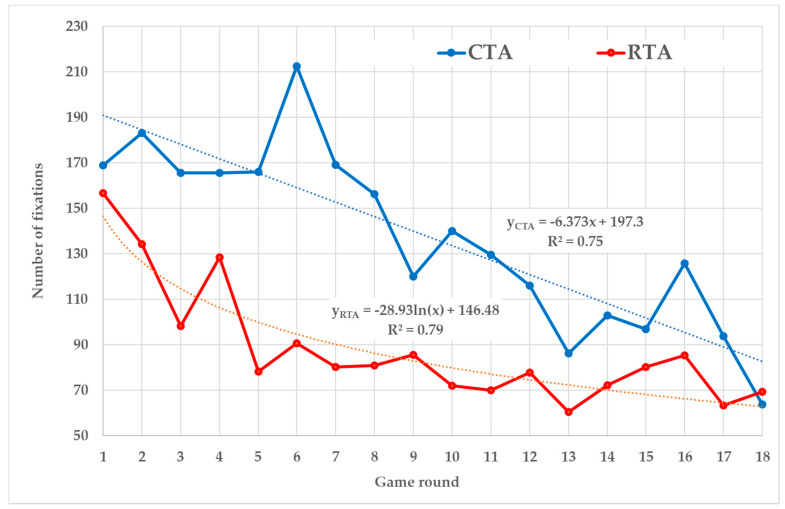
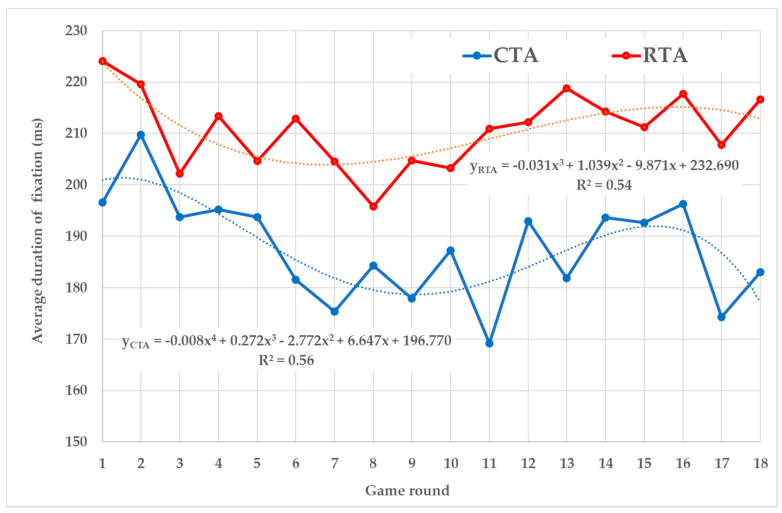
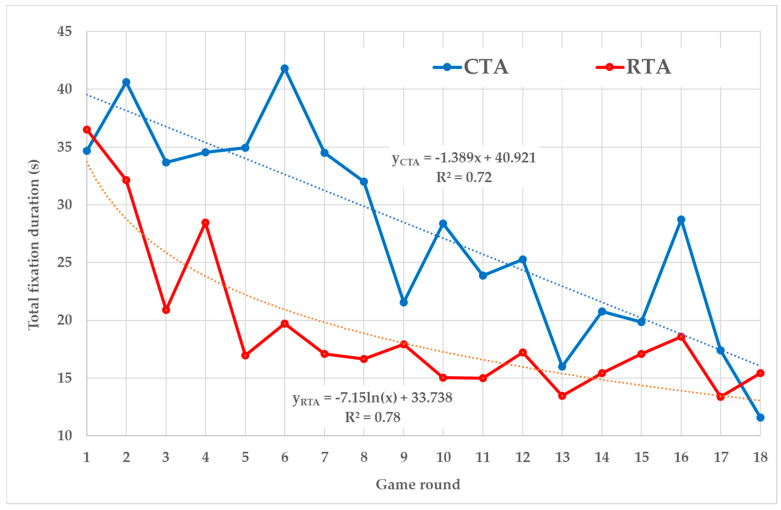
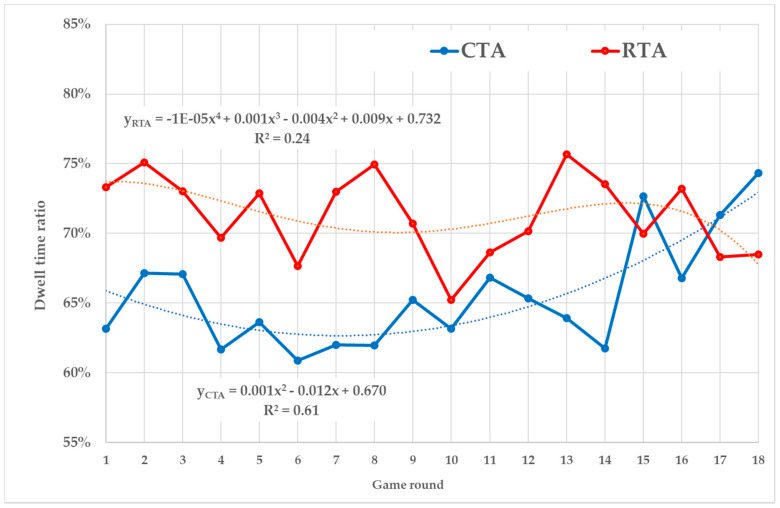
- Overall eye-tracking: number of fixations and total fixation duration were higher for CTA than RTA (p < 0.001); average fixation duration and dwell time ratio were lower for CTA than RTA (p < 0.001).
- Over game rounds, CTA had more fixations than RTA in all rounds except the last; CTA trend was linear (R² = 0.75) with a decrease of 6.37 fixations per round, while RTA trend was logarithmic (R² = 0.79) with faster decrease in early rounds.
- Verbal data: CTA verbalized AOI content in 89.1% of cases vs. RTA in 72.4%; omitted information was 27.2% for RTA vs. 10.4% for CTA (valid information z = 8.988, p < 0.001; omitted information z = 9.095, p < 0.001); unidentified information was CTA 0.5%, RTA 0.4%, with no fabricated information found.
Methods
- Between-subjects lab experiment: 34 managers initially, 3 excluded; final CTA n = 14 (9 men, 5 women, average age 34.8 years), RTA n = 17 (14 men, 3 women, average age 30.7 years). Participants played the FactOrEasy simulation game individually; CTA verbalized concurrently, RTA verbalized at the end of each round.
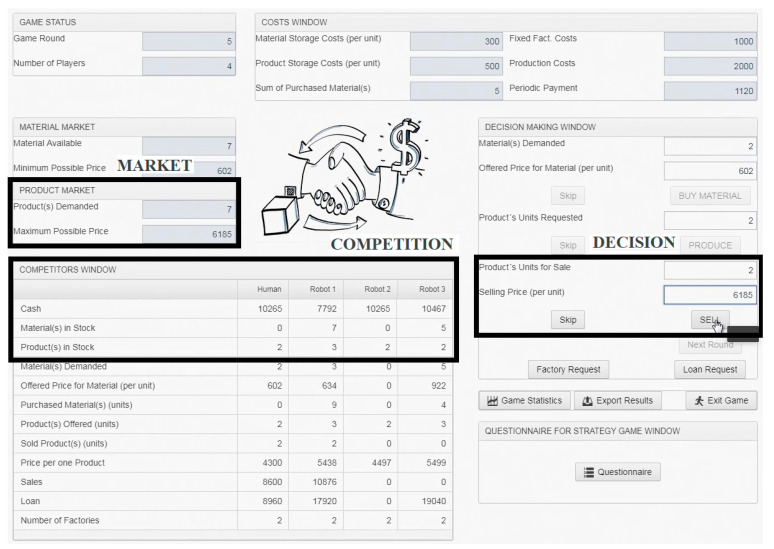
- Eye-tracking used a Tobii X2-60 with 5-point calibration; analysis focused on the Product Sale phase segments (288 CTA, 329 RTA) using number of fixations, average and total fixation duration, and a custom dwell time ratio.
- Statistical comparisons used Shapiro-Wilk for normality, t-test/Mann-Whitney for game results, Mann-Whitney for eye-tracking metrics, and Z-test for proportions for bankruptcy and verbalization categories.
Limitations
- Paper states: results are limited to the specific FactOrEasy game; different games may produce different eye-tracking results. The study provides only a basic assessment of verbal protocols, with no accurate text coding of transcripts, and does not draw conclusions about specific decision-making processes or skills.
- Paper states: CTA prompts were moved to the end of game rounds and RTA verbalizations occurred at the end of each round without replaying recordings, adaptations that may affect comparability.
- Evident: final groups were small (14 and 17 managers) with uneven gender distribution, limiting generalizability; additionally, after the 18th round less than half of CTA segments were included, and the authors consider explanatory power in later rounds low.
Model-written summary. Check it against the paper before relying on it.
Integrity signals
Registry
Cites
Statistics
Figures
Verification
Claims the paper makes
0 Valid · 3 Not valid · 43 Not checked · 124 Own results and interpretations
A result the paper reports from its own data — it cites no other source for it, so there is none to check. The quote shows it is in the paper.
In the paper
“No statistically significant difference was found between the “net cash” (t(48) = −0.447; p = 0.657), the player’s overall standing (U = 632; p = 0.844), and the number of bankruptcies (z = 0.512; p < 0.610).”
§ Impact of Think-Aloud on Eye-Tracking: A Comparison of Concurrent and Retrospective Think-Aloud for Research on Decision-Making in the Game Environment > 3. Results > 3.1. Comparison of Game Results Achieved by RTA and CTA Players
plain- Asserted: passes — The authors put it forward as true.
- Checkable: passes — It can be checked against evidence.
- Load-bearing: passes — The paper’s conclusions depend on it.
- Based: passes — The paper gives a reason why it holds.
- Rests on an assumption not shown here.
A result the paper reports from its own data — it cites no other source for it, so there is none to check. The quote shows it is in the paper.
In the paper
“No statistically significant difference was found between the “net cash” (t(48) = −0.447; p = 0.657), the player’s overall standing (U = 632; p = 0.844), and the number of bankruptcies (z = 0.512; p < 0.610).”
§ Impact of Think-Aloud on Eye-Tracking: A Comparison of Concurrent and Retrospective Think-Aloud for Research on Decision-Making in the Game Environment > 3. Results > 3.1. Comparison of Game Results Achieved by RTA and CTA Players
plain- Asserted: passes — The authors put it forward as true.
- Checkable: passes — It can be checked against evidence.
- Load-bearing: unclear — It is unclear whether the paper’s conclusions depend on it.
- Based: passes — The paper gives a reason why it holds.
- Rests on an assumption not shown here.
A result the paper reports from its own data — it cites no other source for it, so there is none to check. The quote shows it is in the paper.
In the paper
“The number of fixations and total fixation duration are higher for CTA than for RTA (p < 0.001).”
§ Impact of Think-Aloud on Eye-Tracking: A Comparison of Concurrent and Retrospective Think-Aloud for Research on Decision-Making in the Game Environment > 3. Results > 3.2. Overall Comparison of the Impact of CTA and RTA on Eye-Tracking
plain- Asserted: passes — The authors put it forward as true.
- Checkable: passes — It can be checked against evidence.
- Load-bearing: passes — The paper’s conclusions depend on it.
- Based: passes — The paper gives a reason why it holds.
- Rests on an assumption not shown here.
A result the paper reports from its own data — it cites no other source for it, so there is none to check. The quote shows it is in the paper.
In the paper
“No statistically significant difference was found between these two categories (unidentified information: z = 0.189; p = 0.85, fabricated information: z and p are not available).”
§ Impact of Think-Aloud on Eye-Tracking: A Comparison of Concurrent and Retrospective Think-Aloud for Research on Decision-Making in the Game Environment > 3. Results > 3.4. Comparison of the Data Gathered by CTA and RTA
plain- Asserted: passes — The authors put it forward as true.
- Checkable: passes — It can be checked against evidence.
- Load-bearing: unclear — It is unclear whether the paper’s conclusions depend on it.
- Based: passes — The paper gives a reason why it holds.
- Rests on an assumption not shown here.
87 more claims
Create a free account to see all 170 claims and to verify the 109 references still open.
- It may state two separate claims as one. 50
- Probably not a substantial claim. 36
Self-check
Percentages, sums and reported differences re-computed from the paper’s own numbers.
Each contradiction between two passages listed here was confirmed by an independent check.
Rated minor: it would not touch a result — a value no result rests on, a p-value that stays on the same side of the significance level, or a conflict that is clerical, resolved elsewhere in the paper, or outside its own findings.
In the paper
§ Impact of Think-Aloud on Eye-Tracking: A Comparison of Concurrent and Retrospective Think-Aloud for Research on Decision-Making in the Game Environment > 3. Results > 3.3. Comparison of the Impact of CTA and RTA on Eye-Tracking over Time (in the Game Progress)
“The CTA group has a lower total fixation duration than the RTA group in all rounds, except the first and the last one.”
§ Impact of Think-Aloud on Eye-Tracking: A Comparison of Concurrent and Retrospective Think-Aloud for Research on Decision-Making in the Game Environment > 4. Discussion > 4.2. Comparison of the Impact of CTA and RTA on Eye-Tracking over Time (in the Game Progress)
“CTA brings higher values of the number of fixations and total fixation duration during the opening rounds than RTA.”
Citations
Cites
Eye movements in reading and information processing: 20 years of research
Rayner, K. (1998) · Psychological Bulletin · doi:10.1037/0033-2909.124.3.372 · Cited by 7,979
A theory of reading: From eye fixations to comprehension.
Just, M. A., & Carpenter, P. A. (1980) · Psychological Review · doi:10.1037/0033-295x.87.4.329 · Cited by 3,887
Protocol Analysis: Verbal Reports as Data
Ericsson, K. A., & Simon, H. A. (1993) · doi:10.7551/mitpress/5657.001.0001 · Cited by 3,537
Rayner, K. (2009) · Quarterly Journal of Experimental Psychology · doi:10.1080/17470210902816461 · Cited by 2,682
Attention and choice: A review on eye movements in decision making
Orquin, J. L., & Mueller Loose, S. (2013) · Acta Psychologica · doi:10.1016/j.actpsy.2013.06.003 · Cited by 940
Knowledge management, decision-making style and organizational performance
Abubakar, A. M., Elrehail, H., Alatailat, M. A., & Elçi, A. (2019) · Journal of Innovation & Knowledge · doi:10.1016/j.jik.2017.07.003 · Cited by 856
Thinking aloud: reconciling theory and practice
Boren, T., & Ramey, J. (2000) · IEEE Transactions on Professional Communication · doi:10.1109/47.867942 · Cited by 808
Gegenfurtner, A., Lehtinen, E., & Säljö, R. (2011) · Educational Psychology Review · doi:10.1007/s10648-011-9174-7 · Cited by 715
A review of using eye-tracking technology in exploring learning from 2000 to 2012
Lai, M.-L., Tsai, M.-J., Yang, F.-Y., Hsu, C.-Y., Liu, T.-C., Lee, S. W.-Y., Lee, M.-H., Chiou, G.-L., Liang, J.-C., & Tsai, C.-C. (2013) · Educational Research Review · doi:10.1016/j.edurev.2013.10.001 · Cited by 626
Varieties of knowledge elicitation techniques
Cooke, N. J. (1994) · International Journal of Human-Computer Studies · doi:10.1006/ijhc.1994.1083 · Cited by 579
Serious Games: Mechanisms and Effects
(2009) · doi:10.4324/9780203891650 · Cited by 505
van Gog, T., Paas, F., van Merriënboer, J. J. G., & Witte, P. (2005) · Journal of Experimental Psychology: Applied · doi:10.1037/1076-898x.11.4.237 · Cited by 359
The Think-Aloud Controversy in Second Language Research
Bowles, M. A. (2010) · Routledge eBooks · doi:10.4324/9780203856338 · Cited by 330
Gidlöf, K., Wallin, A., Dewhurst, R., & Holmqvist, K. (2013) · Journal of Eye Movement Research · doi:10.16910/jemr.6.1.3 · Cited by 211
The use of eye movements in the study of multimedia learning
Hyönä, J. (2010) · Learning and Instruction · doi:10.1016/j.learninstruc.2009.02.013 · Cited by 211
The Dynamics of Decision Making in Risky Choice: An Eye-Tracking Analysis
Fiedler, S., & Glöckner, A. (2012) · Frontiers in Psychology · doi:10.3389/fpsyg.2012.00335 · Cited by 197
Reflecting on the think‐aloud method for evaluating e‐learning
Cotton, D., & Gresty, K. (2006) · British Journal of Educational Technology · doi:10.1111/j.1467-8535.2005.00521.x · Cited by 191
The Handbook of Translation and Cognition
Schwieter, J. W., & Ferreira, A. (2017) · Wiley eBooks · doi:10.1002/9781119241485 · Cited by 185
Eye tracking in Educational Science: Theoretical frameworks and research agendas
Jarodzka, H., Holmqvist, K., & Gruber, H. (2017) · Journal of Eye Movement Research · doi:10.16910/jemr.10.1.3 · Cited by 142
Gerjets, P., Kammerer, Y., & Werner, B. (2011) · Learning and Instruction · doi:10.1016/j.learninstruc.2010.02.005 · Cited by 139
Process-Tracing Methods in Decision Making: On Growing Up in the 70s
Schulte‐Mecklenbeck, M., Johnson, J. G., Böckenholt, U., Goldstein, D. G., Russo, J. E., Sullivan, N. J., & Willemsen, M. C. (2017) · Current Directions in Psychological Science · doi:10.1177/0963721417708229 · Cited by 138
Cooke, L. (2010) · IEEE Transactions on Professional Communication · doi:10.1109/tpc.2010.2052859 · Cited by 128
The validity of the stimulated retrospective think-aloud method as measured by eye tracking
Guan, Z., Lee, S., Cuddihy, E., & Ramey, J. (2006) · Proceedings of the SIGCHI Conference on Human Factors in Computing Systems · doi:10.1145/1124772.1124961 · Cited by 123
Taylor, K. L., & Dionne, J.-P. (2000) · Journal of Educational Psychology · doi:10.1037/0022-0663.92.3.413 · Cited by 108
Differences in eye movements while viewing images with various levels of restorativeness
Franěk, M., Šefara, D., Petružálek, J., Cabal, J., & Myška, K. (2018) · Journal of Environmental Psychology · doi:10.1016/j.jenvp.2018.05.001 · Cited by 98
Gender-based eye movement differences in passive indoor picture viewing: An eye-tracking study
Sargezeh, B. A., Tavakoli, N., & Daliri, M. R. (2019) · Physiology & Behavior · doi:10.1016/j.physbeh.2019.03.023 · Cited by 95
Zeike, S. J., Choi, K., Lindert, L., & Pfaff, H. (2019) · International Journal of Environmental Research and Public Health · doi:10.3390/ijerph16101746 · Cited by 91
Eye tracking measures of uncertainty during perceptual decision making
Brunyé, T. T., & Gardony, A. L. (2017) · International Journal of Psychophysiology · doi:10.1016/j.ijpsycho.2017.07.008 · Cited by 87
Gero, J. S., & Tang, H.-H. (2001) · Design Studies · doi:10.1016/s0142-694x(00)00030-2 · Cited by 77
Investigating the Information-Seeking Processes of Adolescents
Branch, J. L. (2000) · Library & Information Science Research · doi:10.1016/s0740-8188(00)00051-7 · Cited by 74
Managers and their not-so rational decisions
Certo, S. T., Connelly, B. L., & Tihanyi, L. (2008) · Business Horizons · doi:10.1016/j.bushor.2007.11.002 · Cited by 74
Eye tracking to investigate cue processing in medical decision-making: A scoping review
Al-Moteri, M. O., Symmons, M., Plummer, V., & Cooper, S. (2017) · Computers in Human Behavior · doi:10.1016/j.chb.2016.09.022 · Cited by 70
An analysis of process-tracing research on consumer decision-making
Zuschke, N. (2020) · Journal of Business Research · doi:10.1016/j.jbusres.2019.01.028 · Cited by 68
Lisińska-Kuśnierz, M., & Krupa, M. (2020) · Buildings · doi:10.3390/buildings10020020 · Cited by 67
Lee, J. Y., Donkers, J., Jarodzka, H., & van Merriënboer, J. J. G. (2019) · Computers in Human Behavior · doi:10.1016/j.chb.2019.05.035 · Cited by 65
Miguel, N. P., Lage, J. C., & Galindez, A. M. (2020) · Sustainability · doi:10.3390/su12031014 · Cited by 64
Using think-aloud protocol in self-regulated reading research
Hu, J., & Gao, X. (. (2017) · Educational Research Review · doi:10.1016/j.edurev.2017.09.004 · Cited by 59
Towards a Joint Local Energy Transition Process in Urban Districts: The GO2Zero Simulation Game
Bekebrede, G., van Bueren, E., & Wenzler, I. (2018) · Sustainability · doi:10.3390/su10082602 · Cited by 59
Peute, L. W. P., de Keizer, N. F., & Jaspers, M. W. M. (2015) · Journal of Biomedical Informatics · doi:10.1016/j.jbi.2015.02.006 · Cited by 57
Effect of Think-Aloud Instruction on Elementary Students’ Comprehension Monitoring Abilities
Baumann, J. F., Seifert-Kessell, N., & Jones, L. A. (1992) · Journal of Reading Behavior · doi:10.1080/10862969209547770 · Cited by 56
Eye‐tracking Social Preferences
Jiang, T., Potters, J., & Funaki, Y. (2016) · Journal of Behavioral Decision Making · doi:10.1002/bdm.1899 · Cited by 54
Decision moving window: using interactive eye tracking to examine decision processes
Franco‐Watkins, A. M., & Johnson, J. G. (2011) · Behavior Research Methods · doi:10.3758/s13428-011-0083-y · Cited by 53
Concurrent versus Retrospective Verbal Protocol for Comparing Window Usability
Bowers, V. A., & Snyder, H. L. (1990) · Proceedings of the Human Factors Society Annual Meeting · doi:10.1177/154193129003401720 · Cited by 53
Online Learners’ Reading Ability Detection Based on Eye-Tracking Sensors
Zhan, Z., Zhang, L., Hu, M. Y., & Fong, P. S. W. (2016) · Sensors · doi:10.3390/s16091457 · Cited by 52
Quantitative Analysis of Relationship Between Visual Attention and Eye-Hand Coordination
Kővári, A., Katona, J., & Costescu, C. A. (2020) · Acta Polytechnica Hungarica · doi:10.12700/aph.17.2.2020.2.5 · Cited by 51
Elling, S., Lentz, L., & de Jong, M. (2012) · IEEE Transactions on Professional Communication · doi:10.1109/tpc.2012.2206190 · Cited by 48
Evaluating municipal websites: A methodological comparison of three think-aloud variants
van den Haak, M. J., de Jong, M. D. T., & Schellens, P. J. (2009) · Government Information Quarterly · doi:10.1016/j.giq.2007.11.003 · Cited by 44
Serious Games for Assessment: Welcome to the Jungle.
Kato, P. M., & de Klerk, S. (2017) · Cited by 43
SimCity in Infrastructure Management Education
Arnold, U., Söbke, H., & Reichelt, M. (2019) · Education Sciences · doi:10.3390/educsci9030209 · Cited by 42
Sharma, K., Leftheriotis, I., & Giannakos, M. N. (2020) · Sensors · doi:10.3390/s20071964 · Cited by 42
Anson, C. M., & Schwegler, R. A. (2012) · College Composition and Communication · doi:10.58680/ccc201220864 · Cited by 39
Tracing risky decisions for oneself and others: The role of intuition and deliberation
Barrafrem, K., & Hausfeld, J. (2019) · Journal of Economic Psychology · doi:10.1016/j.joep.2019.102188 · Cited by 39
Aitken, L. M., Marshall, A., Elliott, R., & McKinley, S. (2011) · International Journal of Nursing Studies · doi:10.1016/j.ijnurstu.2010.07.014 · Cited by 37
Eye-tracking Evaluation of Weather Web Maps
Popelka, S., Vondráková, A., & Hujnakova, P. (2019) · ISPRS International Journal of Geo-Information · doi:10.3390/ijgi8060256 · Cited by 37
Gogg, T., & Mott, J. R. A. (1993) · Winter Simulation Conference · doi:10.1145/256563.256571 · Cited by 36
More Dynamic Than You Think: Hidden Aspects of Decision-Making
Robinson, J., Sinclair, M., Tobias, J. M., & Choi, E. (2017) · Administrative Sciences · doi:10.3390/admsci7030023 · Cited by 36
Manzanares, M. C. S., Rodríguez, J. J., Sánchez, R. M., Yáñez, M. J. Z., & Cerezo, R. (2020) · Sustainability · doi:10.3390/su12051970 · Cited by 34
An Analysis of Attention to Student—Adaptive Hints in an Educational Game
Muir, M., & Conati, C. (2012) · Lecture Notes in Computer Science · doi:10.1007/978-3-642-30950-2_15 · Cited by 33
Evaluation of the Cartographical Quality of Urban Plans by Eye-Tracking
Burian, J., Popelka, S., & Beitlová, M. (2018) · ISPRS International Journal of Geo-Information · doi:10.3390/ijgi7050192 · Cited by 33
Alshammari, T., Alhadreti, O., & Mayhew, P. (2015) · UEA Digital Repository (University of East Anglia) · Cited by 32
Serious Games are a Serious Tool for Team Research
Coovert, M. D., Winner, J. L., Bennett, W., & Howard, D. (2017) · International Journal of Serious Games · doi:10.17083/ijsg.v4i1.141 · Cited by 32
Evaluation of Eye-Movement Metrics ina Software DebbugingTask using GP3 Eye Tracker
Kővári, A., Katona, J., & Costescu, C. A. (2020) · Acta Polytechnica Hungarica · doi:10.12700/aph.17.2.2020.2.4 · Cited by 31
Process matters—The relevance of the decision making process for divestiture outcomes
Thywissen, C., Pidun, U., & zu Knyphausen‐Aufseß, D. (2017) · Long Range Planning · doi:10.1016/j.lrp.2017.04.002 · Cited by 29
Tanner, S. A., McCarthy, M. B., & O'Reilly, S. J. (2019) · Appetite · doi:10.1016/j.appet.2018.11.015 · Cited by 28
Evaluation of Concurrent Thinking Aloud Using Eye-tracking Data
Rhenius, D., & Deffner, G. (1990) · Proceedings of the Human Factors Society Annual Meeting · doi:10.1177/154193129003401719 · Cited by 27
Observing Pictures and Videos of Creative Products: An Eye Tracking Study
Berni, A., Maccioni, L., & Borgianni, Y. (2020) · Applied Sciences · doi:10.3390/app10041480 · Cited by 27
Exploring two methods of usability testing: concurrent versus retrospective think-aloud protocols
van den Haak, M. J., & de Jong, M. D. T. (2003) · IEEE International Professional Communication Conference, 2003. IPCC 2003. Proceedings. · doi:10.1109/ipcc.2003.1245501 · Cited by 24
Cueing Retrospective Verbal Reports in Usability Testing Through Eye-Movement Replay
Eger, N., Ball, L. J., Stevens, R., & Dodd, J. (2007) · Electronic Workshops in Computing · doi:10.14236/ewic/hci2007.13 · Cited by 20
E-Learning Systems, Environments and Approaches: Theory and Implementation
Isaias, P. T., Spector, J. M., Ifenthaler, D., & Sampson, D. G. (2015) · Springer eBooks · doi:10.1007/978-3-319-05825-2 · Cited by 20
(2019) · Acta Polytechnica Hungarica · doi:10.12700/aph.16.2.2019.2.9 · Cited by 17
Balling, L. W. (2017) · Fachsprache · doi:10.24989/fs.v35i1-2.1340 · Cited by 16
Getting access to what goes on in people's heads? reflections on the think-aloud technique
Nielsen, J., Clemmensen, T., & Yssing, C. (2002) · Nordic Conference on Human-Computer Interaction · doi:10.1145/572021.572033 · Cited by 15
Hercegfi, K., Komlódi, A., Köles, M., & Tóvölgyi, S. (2019) · Maryland Shared Open Access Repository (USMAI Consortium) · doi:10.13016/m2wtjd-3l91 · Cited by 13
Interactive Plants: Multisensory Visual-Tactile Interaction Enhances Emotional Experience
Yamauchi, T., Seo, J., & Sungkajun, A. (2018) · Mathematics · doi:10.3390/math6110225 · Cited by 12
TRAKTEXT: Investigating writing processes using eye-tracking technology
Hacker, D. J., Keener, M. C., & Kircher, J. (2017) · Methodological Innovations · doi:10.1177/2059799116689574 · Cited by 9
Eye Movement Analysis of Digital Learning Content for Educational Innovation
Liu, X., Zhang, X., Chen, W.-W., & Yuan, S. (2020) · Sustainability · doi:10.3390/su12062518 · Cited by 8
Olsen, A., Smolentzov, L., & Strandvall, T. (2010) · Electronic Workshops in Computing · doi:10.14236/ewic/hci2010.8 · Cited by 7
Kim, B., Dong, Y., Kim, S., & Lee, K.-P. (2007) · Lecture Notes in Computer Science · doi:10.1007/978-3-540-73287-7_15 · Cited by 7
Using eye-tracking to for analyzing case study materials
Berger, T. (2019) · The International Journal of Management Education · doi:10.1016/j.ijme.2019.05.002 · Cited by 7
Towards game-based management decision support: using serious games to improve the decision process
Grund, C. K., & Meier, M. C. (2023) · OPUS (Augsburg University) · Cited by 2
Research works printed but not linked: 7
- Prokop, 2019, Evaluation of managerial and decision-making skills of small-scale farmers, Agrarian Perspectives XXVIII, Business Scale in Relation to Economics, Proceedings of the 28th International Scientific Conference, Prague, Czech Republic, 18–19 September 2019, Volume 28, 218
- Holmqvist, K., Nystrom, M., Andersson, R., Dewhurst, R., Jarodzka, H., and van de Weijer, J. (2015). Eye Tracking: A Comprehensive Guide to Methods and Measures, Oxford University Press. First Published in Paperback.
- Russo, J.E. (2011). Eye fixations as a process trace. A Handbook of Process Tracing Methods for Decision Research: A Critical Review and User’s Guide, Psychology Press.
- Preece, J., Rogers, Y., Sharp, H., Benyon, D., Holland, S., and Carey, T. (1994). Human-Computer Interaction, Addison-Wesley Longman Ltd.
- Švec, V., Pavlicek, J., Ticha, I., and Kreckova, J. (2016, January 2–3). FactOrEasy (c): ART AND CRAFT OF MANAGEMENT?. Proceedings of the 13th International Conference Efficiency and Responsibility in Education, Prague, Czech Republic.
- Prokop, M., and Švec, V. (2018, January 7–8). Flawless Managers: Myth or Reality?. Proceedings of the 15th International Conference Efficiency and Responsibility in Education 2018 (ERIE), Prague, Czech Republic.
- Švec, V., Flegl, M., Pavlicek, J., Prokop, M., and Kreckova, J. (2017, January 8–9). Factoreasy (r): Do Students Take a Risk?. Proceedings of the 14th International Conference Efficiency and Responsibility in Education 2017 (ERIE), Prague, Czech Republic.
Cited by
Prompt engineering as a new 21st century skill
Federiakin, D. A., Molerov, D., Zlatkin‐Troitschanskaia, O., & Maur, A. (2024) · Frontiers in Education · doi:10.3389/feduc.2024.1366434 · Cited by 231
Eye tracking in physics education research: A systematic literature review
Hahn, L., & Klein, P. (2022) · Physical Review Physics Education Research · doi:10.1103/physrevphyseducres.18.013102 · Cited by 92
Eye Tracking Research in Cartography: Looking into the Future
Krassanakis, V., & Cybulski, P. (2021) · ISPRS International Journal of Geo-Information · doi:10.3390/ijgi10060411 · Cited by 47
Concurrent or Retrospective Thinking Aloud in Usability Tests: A Meta-Analytic Review
Hertzum, M. (2024) · ACM Transactions on Computer-Human Interaction · doi:10.1145/3665327 · Cited by 41
The Think-Aloud Method for Evaluating the Usability of a Regional Atlas
Vaníček, T., & Popelka, S. (2023) · ISPRS International Journal of Geo-Information · doi:10.3390/ijgi12030095 · Cited by 37
Metadata
- Authors
- Prokop, M., Pilař, L., & Tichá, I.
- Affiliations
- Czech University of Life Sciences Prague (CZ)
- Corresponding author
- Prokop, Michal
- Venue
- Sensors
- Publisher
- MDPI AG
- Published
- 2020-05-12
- Volume
- 20
- Issue
- 10
- Pages
- 2750
- ISSN
- 1424-8220 (ISSN-L)
- PMC
- PMC7294419
- OpenAlex
- W3024223677
- Cited by
- 48
- References
- 81
- Citations by year
- 2026: 6 · 2025: 9 · 2024: 10 · 2023: 11 · 2022: 5 · 2021: 5 · 2020: 2
- FWCI
- 3.46
- Type
- journal article
- Language
- en
- Open access
- gold
- dx.doi.org
- Licence
- Locations
- Sensors (publishedVersion, cc-by)
- PubMed (publishedVersion)
- PubMed Central (publishedVersion, cc-by)
- DOAJ (DOAJ: Directory of Open Access Journals) (submittedVersion, cc-by-sa)
- Funders
- IGA PEF CZU (CULS) Prague (2019A0001)
- Topics
- Physical Sciences › Computer Science › Human-Computer Interaction › Gaze Tracking and Assistive Technology
- Social Sciences › Human Factors and Ergonomics › Human-Automation Interaction and Safety
- Social Sciences › Decision Sciences › General Decision Sciences › Decision-Making and Behavioral Economics
- Keywords
- think-aloud, concurrent think-aloud, retrospective think-aloud, eye tracking, management decision-making, simulation games, data distortion, cognitive processes, methodological procedures
- MeSH terms
- Eye-Tracking Technology, Decision Making, Games, Experimental, Humans
About these checks
Registry, retraction, Cites and statistics results are computed, not judged, with one exception: a printed reference that no index lists is read once by a model before it counts as a citation error. Claims are extracted by a model and kept only when their quote appears verbatim in the text; each cited source is then checked, with a model’s help, for whether it says what the claim relies on. Those verdicts can be wrong — read the claim’s quote and the cited source before relying on one.
A language model drew the claims from the paper on 2026-11-14, under version 3 of the claim definition (model deepseek-v4.1-flash, prompt extract-v3).
A second model labelled each claim on 2026-11-14 (model jev-1.13-20260917, definition revision gold-guideline-v0.2).
Statistics and arithmetic are recomputed, not judged.
Confidence bands are shown only for fields calibrated on our annotated test set. None is calibrated yet, so no band is shown.
What counts as a claim ›How we measure confidence ›How we check this ›
Are you an author, or do you see a problem with this page? Request a review
Data sources
Bibliographic data: Semantic Scholar, OpenAlex, Crossref.
Contains information from the Semantic Scholar Academic Graph Datasets, made available under the ODC Attribution License (ODC-BY 1.0).
Semantic Scholar’s data is described in: Kinney, R., et al. (2023). The Semantic Scholar Open Data Platform. arXiv:2301.10140.
