

Emotional eating in women with generalized anxiety disorder
Open accessThe DOI matches its Crossref record; 89 of the 89 references it cites were found in a registry or an index; none of the 102 sources its claims cite is checked for support yet.
Abstract
Introduction: Individuals diagnosed with generalized anxiety disorder (GAD) seek pleasurable foods to avoid their negative emotional experiences. Ineffective regulation of negative emotions may be a risk factor for emotional eating (EE), leading to suffering, dysfunctional behaviors, and weight gain. Objectives: The aim of this study is to understand the relationship between emotional dysregulation and EE, investigating potential mediators such as the intensity of the worry, avoidance of internal experiences, mindfulness, and self-compassion in female patients with anxiety. Methods: In this cross-sectional study, participants from a randomized clinical trial diagnosed with GAD answered the following instruments at baseline: the Difficulties in Emotion Regulation Scale (DERS), the Three Factor Eating Questionnaire (TFEQ-R21), the Penn State Worry Questionnaire (PSWQ), the Action and Acceptance Questionnaire (AAQ), the Five Facet Mindfulness Questionnaire (FFMQ), and the Self-Compassion Scale (SCS). We estimated Pearson correlation coefficients and performed mediation analyses. Results: We evaluated 51 female individuals, 34 of whom completed all the questionnaires. Our data showed that EE was positively correlated with emotional dysregulation (r = 0.593; p < 0.001), worry trait (r = 0.402; p = 0.018), and avoidance of internal experiences (r = 0.565; p < 0.001), whereas it was negatively correlated with self-compassion (r =-0.590; p < 0.001) and mindful state (r =-0.383; p = 0.026). Moreover, we demonstrated that self-compassion mediates the relationship between emotional dysregulation and EE (ab product estimate = 0.043, 95% confidence interval [95%CI] 0.003-0.084). Conclusion: Our findings contribute to the literature by identifying psychological factors that could mediate the association between emotional dysregulation and EE, enabling identification of more effective eating behavior intervention targets for patients with GAD. © 2023, Sociedade de Psiquiatria do Rio Grande do Sul. All rights reserved.
Overview
CoChat Summary
TL;DR
In 51 women with generalized anxiety disorder, emotional eating was associated with greater emotion dysregulation, worry, and avoidance, and with lower self-compassion and mindfulness. Self-compassion was the only tested mediator of the emotion dysregulation–emotional eating link.
Key findings
- Of the 51 female patients with GAD, 34 completed all questionnaires; the median age was 29 years (IQR 19 to 60), mean BMI was 27.9 (SD 6.86), and 65% had excess weight.
- Emotional eating (EE) was positively correlated with emotional dysregulation (r = 0.593; p < 0.001), worry trait (r = 0.402; p = 0.018), and avoidance of internal experiences (r = 0.565; p < 0.001).
- EE was negatively correlated with self-compassion (r = -0.590; p < 0.001) and mindful state (r = -0.383; p = 0.026).
- In mediation analysis, self-compassion significantly mediated the relationship between emotional dysregulation and EE (ab = 0.043, 95% CI 0.003–0.084), and the paper states this mediation accounted for 33.4% of the total effect.
Methods
- Cross-sectional analysis of baseline data from participants in a randomized clinical trial of a mindfulness intervention in community-diagnosed GAD patients.
- Sample: women over 18 with primary GAD; 51 were evaluated and 34 had complete questionnaire data. Recruitment was through local media; diagnosis was screened with GAD-7 and confirmed with MINI.
- Main measures were DERS, TFEQ-R21 (EE), PSWQ, AAQ, FFMQ, SCS, plus anthropometrics; analyses used Pearson correlations and bootstrapped mediation analysis in Jamovi, with two-tailed significance at p < 0.05.
Limitations
- The paper explicitly states the main limitations were the cross-sectional design and small sample size.
- The authors also note that multiple testing requires caution in interpretation.
- Evident from the text: 17 of 51 participants were excluded for missing data, leaving 34 complete cases, which may limit precision and generalizability.
Model-written summary. Check it against the paper before relying on it.
Integrity signals
Registry
Cites
Statistics
Figures
Verification
Claims the paper makes
0 Valid · 0 Not valid · 55 Not checked · 22 Own results and interpretations
A result the paper reports from its own data — it cites no other source for it, so there is none to check. The quote shows it is in the paper.
In the paper
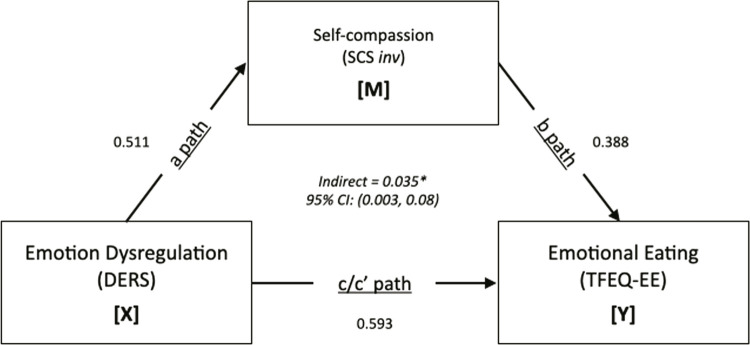
“The mediation analysis for the relationship between DERS and EE only showed significant results when SCS inv was the mediator (Figure 1).”
§ Emotional eating in women with generalized anxiety disorder > Results > Mediation analysis
plain- Asserted: passes — The authors put it forward as true.
- Checkable: passes — It can be checked against evidence.
- Load-bearing: passes — The paper’s conclusions depend on it.
- Based: passes — The paper gives a reason why it holds.
A result the paper reports from its own data — it cites no other source for it, so there is none to check. The quote shows it is in the paper.
In the paper
“Our data showed that EE was positively correlated with emotional dysregulation (r = 0.593; p < 0.001), worry trait (r = 0.402; p = 0.018), and avoidance of internal experiences (r = 0.565; p < 0.001)”
- Also stated in: § Bivariate correlation analysis · plain
“EE was positively correlated with DERS (Pearson’s r = 0.593; p < 0.001; 95%CI 0.776-0.319), PSWQ (Pearson’s r = 0.402; p = 0.018; 95%CI 0.652-0.074), and AAQ (Pearson’s r = 0.565; p < 0.001; 95%CI 0.758-0.281)”
§ Emotional eating in women with generalized anxiety disorder > Abstract > Results
plainstates an associationn = 51 ·- Asserted: passes — The authors put it forward as true.
- Checkable: passes — It can be checked against evidence.
- Load-bearing: passes — The paper’s conclusions depend on it.
- Based: passes — The paper gives a reason why it holds.
- Also stated in: § Bivariate correlation analysis · plain
A result the paper reports from its own data — it cites no other source for it, so there is none to check. The quote shows it is in the paper.
In the paper
“whereas it was negatively correlated with self-compassion (r = -0.590; p < 0.001) and mindful state (r = -0.383; p = 0.026)”
- Also stated in: § Bivariate correlation analysis · plain
“and FFMQ (Pearson’s r = -0.383; p = 0.026; 95%CI -0.051 to -0.638)”
§ Emotional eating in women with generalized anxiety disorder > Abstract > Results
plainstates an associationn = 51 ·- Asserted: passes — The authors put it forward as true.
- Checkable: passes — It can be checked against evidence.
- Load-bearing: passes — The paper’s conclusions depend on it.
- Based: passes — The paper gives a reason why it holds.
- Also stated in: § Bivariate correlation analysis · plain
A result the paper reports from its own data — it cites no other source for it, so there is none to check. The quote shows it is in the paper.
In the paper
“whereas it was negatively correlated with self-compassion (r = -0.590; p < 0.001)”
- Also stated in: § Bivariate correlation analysis · plain
“and negatively correlated with SCS (Pearson’s r = -0.590; p < 0.001; 95%CI -0.314 to -0.774)”
§ Emotional eating in women with generalized anxiety disorder > Abstract > Results
plainstates an associationn = 51 ·- Asserted: passes — The authors put it forward as true.
- Checkable: passes — It can be checked against evidence.
- Load-bearing: passes — The paper’s conclusions depend on it.
- Based: passes — The paper gives a reason why it holds.
- Also stated in: § Bivariate correlation analysis · plain
A result the paper reports from its own data — it cites no other source for it, so there is none to check. The quote shows it is in the paper.
In the paper
“Our data showed that EE was positively correlated with emotional dysregulation (r = 0.593; p < 0.001), worry trait (r = 0.402; p = 0.018)”
- Also stated in: § Bivariate correlation analysis · plain
“EE was positively correlated with DERS (Pearson’s r = 0.593; p < 0.001; 95%CI 0.776-0.319), PSWQ (Pearson’s r = 0.402; p = 0.018; 95%CI 0.652-0.074)”
§ Emotional eating in women with generalized anxiety disorder > Abstract > Results
plainstates an associationn = 51 ·- Asserted: passes — The authors put it forward as true.
- Checkable: passes — It can be checked against evidence.
- Load-bearing: passes — The paper’s conclusions depend on it.
- Based: passes — The paper gives a reason why it holds.
- Also stated in: § Bivariate correlation analysis · plain
14 more claims
Create a free account to see all 77 claims and to verify the 74 references still open.
- Borderline: one of the tests for a substantial claim is unclear. 1
- Probably not a substantial claim. 52
- It may state two separate claims as one. 29
Citations
Cites
Preacher, K. J., & Hayes, A. F. (2008) · Behavior Research Methods · doi:10.3758/brm.40.3.879 · Cited by 34,117 · cited 1×
“Path c quantifies this effect, called the total effect of X on Y. 59 Path a represents the causal effect of the independent variable on the proposed mediator, M. Path b represents the causal effect of the mediator on the dependent variable, controlling for the independent variable, whereas path c′…”
BackgroundUsing Self-Report Assessment Methods to Explore Facets of Mindfulness
Baer, R. A., Smith, G. T., Hopkins, J., Krietemeyer, J., & Toney, L. (2006) · Assessment · doi:10.1177/1073191105283504 · Cited by 7,511
Introduction to mediation, moderation, and conditional process analysis :
Hayes, A. F., & names (2015) · Cited by 7,004
Emotion-regulation strategies across psychopathology: A meta-analytic review
Aldao, A., Nolen-Hoeksema, S., & Schweizer, S. (2010) · Clinical Psychology Review · doi:10.1016/j.cpr.2009.11.004 · Cited by 6,686
Acceptance and commitment therapy: model, processes and outcomes
Hayes, S. C., Luoma, J. B., Bond, F. W., Masuda, A., & Lillis, J. (2006) · Behaviour Research and Therapy · doi:10.1016/j.brat.2005.06.006 · Cited by 6,587 · cited 1×
“47 Five Facet Mindfulness Questionnaire (FFMQ) According to the authors of the FFMQ, mindfulness is a multifaceted construct with five distinct facets.”
MethodThe Development and Validation of a Scale to Measure Self-Compassion
NEFF, K. D. (2003) · Self and Identity · doi:10.1080/15298860309027 · Cited by 6,436
Development and validation of the Penn State Worry Questionnaire
Meyer, T. J., Miller, M. L., Metzger, R. L., & Borkovec, T. D. (1990) · Behaviour Research and Therapy · doi:10.1016/0005-7967(90)90135-6 · Cited by 5,099
The three-factor eating questionnaire to measure dietary restraint, disinhibition and hunger
Stunkard, A. J., & Messick, S. (1985) · Journal of Psychosomatic Research · doi:10.1016/0022-3999(85)90010-8 · Cited by 4,687
The global prevalence of common mental disorders: a systematic review and meta-analysis 1980–2013
Steel, Z., Marnane, C., Iranpour, C., Chey, T., Jackson, J. W., Patel, V., & Silove, D. (2014) · International Journal of Epidemiology · doi:10.1093/ije/dyu038 · Cited by 2,846 · cited 1×
“Since GAD occurs twice as often in female patients 39 and the risk for eating disorders is also higher in women, 40 we aimed to investigate the relationship between emotional dysregulation and EE in women, evaluating potential mediators of this association.”
BackgroundA pilot study and randomized controlled trial of the mindful self-compassion program
Neff, K. D., & Germer, C. K. (2013) · Journal of Clinical Psychology · doi:10.1002/jclp.21923 · Cited by 2,253
Measuring experiential avoidance: A preliminary test of a working model
Hayes, S. C., Strosahl, K., Wilson, K. G., Bissett, R. T., Pistorello, J., Toarmino, D., Polusny, M. A., Dykstra, T. A., Batten, S. V., Bergan, J., et al. (2004) · The Psychological Record · doi:10.1007/bf03395492 · Cited by 2,140
Leon, R. L. (1974) · Journal of the American Academy of Child Psychiatry · doi:10.1016/s0002-7138(09)61341-8 · Cited by 2,081
Exploring compassion: A meta-analysis of the association between self-compassion and psychopathology
MacBeth, A., & Gumley, A. (2012) · Clinical Psychology Review · doi:10.1016/j.cpr.2012.06.003 · Cited by 1,838
Gilbert, P., & Procter, S. (2006) · Clinical Psychology & Psychotherapy · doi:10.1002/cpp.507 · Cited by 1,822 · cited 1×
“15,96,97 The main limitations of our study are its cross-sectional design and the small sample size.”
BackgroundLeary, M. R., Tate, E. B., Adams, C. E., Batts Allen, A., & Hancock, J. (2007) · Journal of Personality and Social Psychology · doi:10.1037/0022-3514.92.5.887 · Cited by 1,728
Relationship between stress, eating behavior, and obesity
Torres, S. J., & Nowson, C. A. (2007) · Nutrition · doi:10.1016/j.nut.2007.08.008 · Cited by 1,622
The origins and nature of compassion focused therapy
Gilbert, P. (2014) · British Journal of Clinical Psychology · doi:10.1111/bjc.12043 · Cited by 1,593 · cited 1×
“28,29 33-35 There is an association between self-compassion and health behaviors such as healthy eating and physical activity.”
BackgroundThe neural bases of emotion regulation
Etkin, A., Büchel, C., & Gross, J. J. (2015) · Nature Reviews Neuroscience · doi:10.1038/nrn4044 · Cited by 1,244
Self‐Compassion Versus Global Self‐Esteem: Two Different Ways of Relating to Oneself
Neff, K. D., & Vonk, R. (2009) · Journal of Personality · doi:10.1111/j.1467-6494.2008.00537.x · Cited by 1,234 · cited 1×
“32 It also breaks the negative cycle of shame, dissatisfaction with body image, and the drive for thinness in women with and without eating disorders.”
BackgroundMechanisms of mindfulness: emotion regulation following a focused breathing induction
Arch, J. J., & Craske, M. G. (2006) · Behaviour Research and Therapy · doi:10.1016/j.brat.2005.12.007 · Cited by 1,005
Haedt-Matt, A. A., & Keel, P. K. (2011) · Psychological Bulletin · doi:10.1037/a0023660 · Cited by 799 · cited 1×
“73,74 Adults who endorsed the highest levels of EE were 13.38 times more likely to be overweight or obese than subjects who endorsed low levels of EE.”
BackgroundInfluentialEmotional influences on food choice: Sensory, physiological and psychological pathways
Leigh Gibson, E. (2006) · Physiology & Behavior · doi:10.1016/j.physbeh.2006.01.024 · Cited by 781 · cited 1×
“71 This environment-reactive behavior is influenced by learning and experience 72 and, in a similar way, some individuals with GAD paired pleasurable eating stimulus with a negative emotional experience.”
BackgroundGariepy, G., Nitka, D., & Schmitz, N. (2010) · International Journal of Obesity · doi:10.1038/ijo.2009.252 · Cited by 753 · cited 1×
“21 During the coronavirus disease 2019 (COVID-19) pandemic, it seems that anxiety rates in the general population may have been more than three times higher.”
BackgroundGeneralized anxiety disorder: prevalence, burden, and cost to society
Wittchen, H.-U. (2002) · Depression and Anxiety · doi:10.1002/da.10065 · Cited by 733 · cited 1×
“18 GAD is a prevalent and disabling disorder 19 and is associated with eating disorders 20 and obesity.”
BackgroundGender difference in the prevalence of eating disorder symptoms
Striegel‐Moore, R. H., Rosselli, F., Perrin, N., DeBar, L., Wilson, G. T., May, A., & Kraemer, H. C. (2009) · International Journal of Eating Disorders · doi:10.1002/eat.20625 · Cited by 667 · cited 1×
“Since GAD occurs twice as often in female patients 39 and the risk for eating disorders is also higher in women, 40 we aimed to investigate the relationship between emotional dysregulation and EE in women, evaluating potential mediators of this association.”
BackgroundSmall, D. M., Jones-Gotman, M., & Dagher, A. (2003) · NeuroImage · doi:10.1016/s1053-8119(03)00253-2 · Cited by 632
Mindfulness and its relationship to emotional regulation
Hill, C. L. M., & Updegraff, J. A. (2012) · Emotion · doi:10.1037/a0026355 · Cited by 580
Guendelman, S., Medeiros, S., & Rampes, H. (2017) · Frontiers in Psychology · doi:10.3389/fpsyg.2017.00220 · Cited by 577 · cited 1×
“23-27 Self-compassion has been described as the non-judgmental acceptance of one’s own suffering, whilst also directing kindness towards one-self.”
BackgroundEmotion regulation model in binge eating disorder and obesity - a systematic review
Leehr, E. J., Krohmer, K., Schag, K., Dresler, T., Zipfel, S., & Giel, K. E. (2015) · Neuroscience & Biobehavioral Reviews · doi:10.1016/j.neubiorev.2014.12.008 · Cited by 560 · cited 1×
“63 Moreover, EE is associated with emotion dysregulation 64 and increased weight gain.”
BackgroundMindfulness‐based interventions for obesity‐related eating behaviours: a literature review
O'Reilly, G. A., Cook, L., Spruijt‐Metz, D., & Black, D. S. (2014) · Obesity Reviews · doi:10.1111/obr.12156 · Cited by 547 · cited 1×
“83 However, we did not find a mediation effect via mindful state in our study.”
BackgroundEffects of daily hassles and eating style on eating behavior.
O'Connor, D. B., Jones, F., Conner, M., McMillan, B., & Ferguson, E. (2008) · Health Psychology · doi:10.1037/0278-6133.27.1.s20 · Cited by 507
Inwood, E., & Ferrari, M. (2018) · Applied Psychology: Health and Well-Being · doi:10.1111/aphw.12127 · Cited by 483
Conceptual and methodological issues in the assessment of shame and guilt
Tangney, J. P. (1996) · Behaviour Research and Therapy · doi:10.1016/0005-7967(96)00034-4 · Cited by 439 · cited 1×
“67,91,92 Shame was strongly associated with unhealthy eating and with eating disorders.”
BackgroundPrevalence of anxiety in the COVID-19 pandemic: An updated meta-analysis of community-based studies
Santabárbara, J., Lasheras, I., Lipnicki, D. M., Bueno-Notivol, J., Pérez-Moreno, M., López-Antón, R., De la Cámara, C., Lobo, A., & Gracia-García, P. (2021) · Progress in Neuro-Psychopharmacology and Biological Psychiatry · doi:10.1016/j.pnpbp.2020.110207 · Cited by 426 · cited 1×
“22 The negative emotions experienced in GAD impair eating behavior, but there are very few studies evaluating the relationships between GAD, eating behavior, and body weight.”
BackgroundSelf-compassion, body image, and disordered eating: A review of the literature
Braun, T. D., Park, C. L., & Gorin, A. (2016) · Body Image · doi:10.1016/j.bodyim.2016.03.003 · Cited by 384
Self-compassion, affect, and health-promoting behaviors.
Sirois, F. M., Kitner, R., & Hirsch, J. K. (2015) · Health Psychology · doi:10.1037/hea0000158 · Cited by 357 · cited 1×
“36 In addition, in a sample of university students, self-compassion had a negative correlation with consumption of sugar and fat (associated with isolation and over-identification).”
BackgroundSelf-compassion as an emotion regulation strategy in major depressive disorder
Diedrich, A., Grant, M., Hofmann, S. G., Hiller, W., & Berking, M. (2014) · Behaviour Research and Therapy · doi:10.1016/j.brat.2014.05.006 · Cited by 339 · cited 1×
“28,29 33-35 There is an association between self-compassion and health behaviors such as healthy eating and physical activity.”
BackgroundEmotional Eating and Weight in Adults: A Review
Frayn, M., & Knäuper, B. (2018) · Current Psychology · doi:10.1007/s12144-017-9577-9 · Cited by 307
Koenders, P. G., & van Strien, T. (2011) · Journal of Occupational & Environmental Medicine · doi:10.1097/jom.0b013e31823078a2 · Cited by 297 · cited 2×
“75 EE is predictive of weight gain over time 12 and of difficulty in losing weight.”
BackgroundFerreira, C., Pinto-Gouveia, J., & Duarte, C. (2013) · Eating Behaviors · doi:10.1016/j.eatbeh.2013.01.005 · Cited by 293 · cited 1×
“90 Shame is a self-conscious emotion involving negative self-evaluation compounded by a desire to escape.”
BackgroundEmotional eating as a mediator between depression and weight gain
van Strien, T., Konttinen, H., Homberg, J. R., Engels, R. C. M. E., & Winkens, L. H. H. (2016) · Appetite · doi:10.1016/j.appet.2016.02.034 · Cited by 277 · cited 1×
“9,12,65,66 Studies suggest that emotion dysregulation is independently related to eating in response to aversive events in adults with obesity.”
BackgroundGoossens, L., Braet, C., Van Vlierberghe, L., & Mels, S. (2009) · European Eating Disorders Review · doi:10.1002/erv.892 · Cited by 270 · cited 1×
“3,62 Higher levels of EE were related to more severe neuroticism (e.g., anxiety and depression) in a treatment-seeking sample of adults with obesity.”
BackgroundGianini, L. M., White, M. A., & Masheb, R. M. (2013) · Eating Behaviors · doi:10.1016/j.eatbeh.2013.05.008 · Cited by 263 · cited 2×
“63 Moreover, EE is associated with emotion dysregulation 64 and increased weight gain.”
BackgroundGuerrieri, R., Nederkoorn, C., & Jansen, A. (2008) · International Journal of Obesity · doi:10.1038/sj.ijo.0803770 · Cited by 233 · cited 1×
“78 The skills that mindfulness fosters seem to increase self-regulation, improving awareness of emotions and sensations, 79-82 which may be important for improving eating behaviors.”
BackgroundHemmingsson, E. (2014) · Obesity Reviews · doi:10.1111/obr.12197 · Cited by 233
Impact of moods and social context on eating behavior
Patel, K. A., & Schlundt, D. G. (2001) · Appetite · doi:10.1006/appe.2000.0385 · Cited by 229 · cited 1×
“8 Furthermore, EE was identified as an independent risk factor for weight gain in a 4-year follow-up of Korean twins.”
BackgroundPerceptions of emotional eating behavior. A qualitative study of college students
Bennett, J., Greene, G., & Schwartz-Barcott, D. (2013) · Appetite · doi:10.1016/j.appet.2012.09.023 · Cited by 228 · cited 1×
“6,7 A previous study reported that EE is more common in obese individuals than in normal weight individuals.”
BackgroundCamilleri, G. M., Méjean, C., Kesse-Guyot, E., Andreeva, V. A., Bellisle, F., Hercberg, S., & Péneau, S. (2014) · The Journal of Nutrition · doi:10.3945/jn.114.193177 · Cited by 204 · cited 1×
“69,70 Individuals with sweet craving had higher rates of uncontrolled eating and EE whereas anxiety symptoms are independently associated with sweet craving.”
BackgroundPsychological Determinants of Emotional Eating in Adolescence
Nguyen-Rodriguez, S. T., Unger, J. B., & Spruijt-Metz, D. (2009) · Eating Disorders · doi:10.1080/10640260902848543 · Cited by 202
Mindfulness, Eating Behaviours, and Obesity: A Review and Reflection on Current Findings
Mantzios, M., & Wilson, J. C. (2015) · Current Obesity Reports · doi:10.1007/s13679-014-0131-x · Cited by 187
Moderation of distress-induced eating by emotional eating scores
van Strien, T., Herman, C. P., Anschutz, D. J., Engels, R. C. M. E., & de Weerth, C. (2012) · Appetite · doi:10.1016/j.appet.2011.10.005 · Cited by 179 · cited 1×
“9,12,65,66 Studies suggest that emotion dysregulation is independently related to eating in response to aversive events in adults with obesity.”
BackgroundMindfulness and Weight Loss: A Systematic Review
Olson, K. L., & Emery, C. F. (2015) · Psychosomatic Medicine · doi:10.1097/psy.0000000000000127 · Cited by 170
Ozier, A. D., Kendrick, O. W., Leeper, J. D., Knol, L. L., Perko, M., & Burnham, J. (2008) · Journal of the American Dietetic Association · doi:10.1016/j.jada.2007.10.011 · Cited by 169 · cited 1×
“75 EE is predictive of weight gain over time 12 and of difficulty in losing weight.”
BackgroundEddy, K. T., Tanofsky‐Kraff, M., Thompson‐Brenner, H., Herzog, D. B., Brown, T. A., & Ludwig, D. S. (2007) · Behaviour Research and Therapy · doi:10.1016/j.brat.2007.03.017 · Cited by 162
High-restrained eaters only overeat when they are also impulsive
Jansen, A., Nederkoorn, C., van Baak, L., Keirse, C., Guerrieri, R., & Havermans, R. (2009) · Behaviour Research and Therapy · doi:10.1016/j.brat.2008.10.016 · Cited by 158 · cited 1×
“68 Emotional eaters report greater consumption of sweet and high fat foods and more frequent snacking as compared to non-emotional eaters.”
BackgroundFarrow, C. V., Haycraft, E., & Blissett, J. M. (2015) · The American Journal of Clinical Nutrition · doi:10.3945/ajcn.114.103713 · Cited by 145 · cited 1×
“60,61 Anxiety seems to be associated with EE behaviors.”
BackgroundMantzios, M., & Wilson, J. C. (2014) · Psychology & Health · doi:10.1080/08870446.2013.863883 · Cited by 137 · cited 1×
“According to Mantzios et al., 84 Self-compassion plays important roles in losing and maintaining weight, 86-89 besides helping to develop more motivation and positive behaviors related to food.”
MethodHall, P. A. (2012) · Health Psychology · doi:10.1037/a0025407 · Cited by 135
Self-Compassionate Reactions to Health Threats
Terry, M. L., Leary, M. R., Mehta, S., & Henderson, K. (2013) · Personality and Social Psychology Bulletin · doi:10.1177/0146167213488213 · Cited by 123
Sultson, H., Kukk, K., & Akkermann, K. (2017) · Appetite · doi:10.1016/j.appet.2017.05.035 · Cited by 123
Weight and shape overconcern and emotional eating in binge eating disorder
Eldredge, K. L., & Agras, W. S. (1996) · International Journal of Eating Disorders · doi:10.1002/(sici)1098-108x(199601)19:1<73::aid-eat9>3.0.co;2-t · Cited by 112
Adaptation of the Self-Compassion Scale for use in Brazil: Evidences of construct validity
Souza, L. K., & Hutz, C. S. (2016) · Temas em Psicologia · doi:10.9788/tp2016.1-11 · Cited by 101
Braden, A., Flatt, S. W., Boutelle, K. N., Strong, D., Sherwood, N. E., & Rock, C. L. (2016) · Journal of Behavioral Medicine · doi:10.1007/s10865-016-9728-8 · Cited by 84 · cited 1×
“76 Jones et al. 4 presented a mediation model in which higher levels of emotion dysregulation were associated with higher reported levels of EE, which in turn were related to higher BMI in adult smokers.”
BackgroundMantzios, M., & Giannou, K. (2014) · Applied Psychology Health and Well-Being · doi:10.1111/aphw.12023 · Cited by 82
Brewer, J. A., Ruf, A., Beccia, A. L., Essien, G. I., Finn, L. M., Lutterveld, R. V., & Mason, A. E. (2018) · Frontiers in Psychology · doi:10.3389/fpsyg.2018.01418 · Cited by 82
Validity evidence of the brazilian version of the five facet mindfulness questionnaire (FFMQ)
Barros, V. V. D., Kozasa, E. H., Souza, I. C. W. D., & Ronzani, T. M. (2014) · Psicologia: Teoria e Pesquisa · doi:10.1590/s0102-37722014000300009 · Cited by 81
Haedt‐Matt, A. A., Keel, P. K., Racine, S. E., Burt, S. A., Hu, J. Y., Boker, S., Neale, M., & Klump, K. L. (2014) · International Journal of Eating Disorders · doi:10.1002/eat.22247 · Cited by 78
Mantzios, M., Egan, H., Hussain, M., Keyte, R., & Bahia, H. (2018) · Eating and Weight Disorders - Studies on Anorexia, Bulimia and Obesity · doi:10.1007/s40519-018-0548-4 · Cited by 73 · cited 1×
“37 Brewer et al. 38 suggest that self-compassion improves the relationship with food through the self-regulatory mechanism by moderating possible negative responses to failures and encouraging individuals to act from internal perceptions rather than extrinsic reward mechanisms.”
BackgroundEmotion Regulation: Definition and Relevance for Mental Health
Berking, M., & Whitley, B. (2014) · Springer eBooks · doi:10.1007/978-1-4939-1022-9_2 · Cited by 71 · cited 1×
“15,96,97 The main limitations of our study are its cross-sectional design and the small sample size.”
BackgroundChildhood anxiety associated with low BMI in women with anorexia nervosa
Dellava, J. E., Thornton, L. M., Hamer, R. M., Strober, M., Plotnicov, K., Klump, K. L., Brandt, H., Crawford, S., Fichter, M. M., Halmi, K. A., et al. (2010) · Behaviour Research and Therapy · doi:10.1016/j.brat.2009.09.009 · Cited by 64 · cited 1×
“18 GAD is a prevalent and disabling disorder 19 and is associated with eating disorders 20 and obesity.”
BackgroundSainsbury, K., Evans, E. H., Pedersen, S., Marques, M. M., Teixeira, P. J., Lähteenmäki, L., Stubbs, R. J., Heitmann, B. L., & Sniehotta, F. F. (2019) · Eating and Weight Disorders - Studies on Anorexia Bulimia and Obesity · doi:10.1007/s40519-018-0487-0 · Cited by 64 · cited 1×
“17 A meta-analysis of emotion regulation across different psychopathologies reported that individuals diagnosed with generalized anxiety disorder (GAD) presented deficits in emotion regulation related to emotional clarity, understanding, reactivity, and acceptance.”
BackgroundChildhood experiences of being bullied and teased in the eating disorders
Sweetingham, R., & Waller, G. (2008) · European Eating Disorders Review · doi:10.1002/erv.839 · Cited by 61 · cited 1×
“67,93,94 Liu et al. 95 suggested that when shame was elicited in healthy women, they ate a higher number of snacks than women in whom shame was not elicited.”
BackgroundSung, J., Lee, K., & Song, Y.-M. (2009) · Eating and Weight Disorders - Studies on Anorexia, Bulimia and Obesity · doi:10.1007/bf03327806 · Cited by 53 · cited 2×
“9,12,65,66 Studies suggest that emotion dysregulation is independently related to eating in response to aversive events in adults with obesity.”
BackgroundKeller, C., & Siegrist, M. (2015) · Appetite · doi:10.1016/j.appet.2014.11.024 · Cited by 49
Penaforte, F. R. D. O., Minelli, M. C. S., Anastácio, L. R., & Japur, C. C. (2019) · Psychiatry Research · doi:10.1016/j.psychres.2018.11.070 · Cited by 48 · cited 1×
“71 This environment-reactive behavior is influenced by learning and experience 72 and, in a similar way, some individuals with GAD paired pleasurable eating stimulus with a negative emotional experience.”
BackgroundMantzios, M., & Egan, H. (2018) · Health Psychology Report · doi:10.5114/hpr.2018.73052 · Cited by 45 · cited 1×
“According to Mantzios et al., 84 Self-compassion plays important roles in losing and maintaining weight, 86-89 besides helping to develop more motivation and positive behaviors related to food.”
MethodCastillo, C., Macrini, L., Cheniaux, E., & Landeira-Fernandez, J. (2010) · The Spanish journal of psychology · doi:10.1017/s113874160000398x · Cited by 43 · cited 1×
“44 Action and Acceptance Questionnaire (AAQ) This scale measures avoidance of internal experiences 45 and is validated for Portuguese-Brazilian populations.”
BackgroundEmotional expression and body dissatisfaction
Hayaki, J., Friedman, M. A., & Brownell, K. D. (2002) · International Journal of Eating Disorders · doi:10.1002/eat.1111 · Cited by 43 · cited 1×
“67,93,94 Liu et al. 95 suggested that when shame was elicited in healthy women, they ate a higher number of snacks than women in whom shame was not elicited.”
BackgroundHussein, M., Egan, H., & Mantzios, M. (2017) · Sage Open · doi:10.1177/2158244017704685 · Cited by 41 · cited 1×
“According to Mantzios et al., 84 Self-compassion plays important roles in losing and maintaining weight, 86-89 besides helping to develop more motivation and positive behaviors related to food.”
MethodFerrell, E. L., Watford, T. S., & Braden, A. (2020) · Appetite · doi:10.1016/j.appet.2019.104450 · Cited by 39 · cited 1×
“14,15 Facets of emotion dysregulation may contribute to development of EE 16 and have been linked to weight gain.”
BackgroundIndividual determinants of emotional eating: A simultaneous investigation
Mantau, A., Hattula, S., & Bornemann, T. (2018) · Appetite · doi:10.1016/j.appet.2018.07.015 · Cited by 38 · cited 1×
“4 Mantau et al. 77 investigated determinants of EE and showed that biological determinants (e.g., weight status) were less important than psychological (i.e., restrained eating) and situational (i.e., stress) factors in explaining food choice in response to a negative affective state.”
BackgroundFisher, N. R., Mead, B. R., Lattimore, P., & Malinowski, P. (2017) · Appetite · doi:10.1016/j.appet.2017.07.019 · Cited by 34
The role of shame in emotional eating
Wong, M., & Qian, M. (2016) · Eating Behaviors · doi:10.1016/j.eatbeh.2016.07.004 · Cited by 27 · cited 4×
“64 EE is considered a learned behavior 67 and emotions become a trigger for eating impulsivity.”
BackgroundInfluentialJones, J., Kauffman, B. Y., Rosenfield, D., Smits, J. A. J., & Zvolensky, M. J. (2019) · Eating Behaviors · doi:10.1016/j.eatbeh.2019.05.003 · Cited by 26 · cited 2×
“4 Mantau et al. 77 investigated determinants of EE and showed that biological determinants (e.g., weight status) were less important than psychological (i.e., restrained eating) and situational (i.e., stress) factors in explaining food choice in response to a negative affective state.”
BackgroundCosta, M. D. A., Gonçalves, F. G., Tatton-Ramos, T., Fonseca, N. K. D. O. D., Schwinn, J. K., Alves, S. G., Salum, G. A., & Manfro, G. G. (2021) · Psychotherapy and Psychosomatics · doi:10.1159/000511880 · Cited by 26 · cited 1×
“41 Individuals were recruited to participate in this study through a local media advertisement.”
MethodSelf-citationInteroceptive reliance as a major determinant of emotional eating in adult obesity
Willem, C., Nandrino, J.-L., Doba, K., Roussel, M., Triquet, C., Verkindt, H., Pattou, F., & Gandolphe, M.-C. (2021) · Journal of Health Psychology · doi:10.1177/1359105320903093 · Cited by 22
Brace, A., & Yeomans, M. R. (2015) · Eating Behaviors · doi:10.1016/j.eatbeh.2015.12.001 · Cited by 21 · cited 1×
“78 The skills that mindfulness fosters seem to increase self-regulation, improving awareness of emotions and sensations, 79-82 which may be important for improving eating behaviors.”
BackgroundTime Devours Things: How Impulsivity and Time Affect Temporal Decisions in Pathological Gamblers
Grecucci, A., Giorgetta, C., Rattin, A., Guerreschi, C., Sanfey, A. G., & Bonini, N. (2014) · PLoS ONE · doi:10.1371/journal.pone.0109197 · Cited by 20
(1971) · PubMed
Research works printed but not linked: 1
- [95]Liu Parenting style and disordered eating: the mediating role of shame Dissertation Beijing Peking University 2015
Cited by
Huang, W., Chen, B., & Hu, C. (2025) · Frontiers in Public Health · doi:10.3389/fpubh.2025.1663474 · Cited by 52
Dymek, A., Zielińska, M., Englert-Bator, A., Dereń, K., & Łuszczki, E. (2025) · Nutrients · doi:10.3390/nu17172835 · Cited by 19
“A study by Fonseca et al. found that in women with GAD, EE severity correlates with increased worry, avoidance of internal sensations, difficulty regu-Nutrients lating emotions, low levels of self-compassion, and reduced attentiveness [179].”
Socio-emotional balance and emotional eating: a perspective from a systematic literature review
Hernández-Flórez, N., Klimenko, O., González, A. L. O., Cantillo-Acosta, L., Pazos-Alfonso, J. C., & Saavedra, E. V. (2023) · Revista Estudios Psicológicos · doi:10.35622/j.rep.2023.04.004 · Cited by 4
dos Santos, J. V. L., Praxedes, D. R. S., de Carvalho, S. A. M., Ferro, D. C., Carnaúba, R. T. L., Lopes, N. G. D. S., Macêna, M. D. L., Júnior, A. E. D. S., de Melo, I. S. V., & Bueno, N. B. (2025) · Nutrire · doi:10.1186/s41110-025-00361-3 · Cited by 2
Insights on eating behaviors among adult females in Jordan: A national survey study
Sweiss, K., Naser, A. Y., & Alsharif, A. A. (2025) · Medicine · doi:10.1097/md.0000000000044073 · Cited by 2
“[34,35] Also, our study found that the mean food avoidance sub-scale score was 38.1 ± 6.2 (which is equivalent to 63.5% of the maximum attainable score), demonstrating more positive attitude towards foods avoidance.”
Influential
Metadata
- Authors
- Fonseca, N. K. D. O. D., Costa, M. D. A., Gosmann, N. P., Molle, R. D., Gonçalves, F. G., Silva, A. C., Rodrigues, Y., Silveira, P. P., & Manfro, G. G.
- Affiliations
- Universidade Federal do Rio Grande do Sul (BR)
- McGill University (CA)
- Douglas Mental Health University Institute (CA)
- ORCID
- Venue
- Trends in Psychiatry and Psychotherapy
- Publisher
- EDITORA SCIENTIFIC
- Published
- 2023
- Volume
- 45
- Pages
- e20210399-e20210399
- ISSN
- 2237-6089 (ISSN-L)
- 2238-0019
- PMC
- PMC10597384
- OpenAlex
- W4213319084
- Cited by
- 13
- References
- 87
- Citations by year
- 2026: 3 · 2025: 8 · 2023: 1
- FWCI
- 2.28
- Type
- journal article
- Language
- en
- Open access
- diamond
- doi.org
- Licence
- cc-by
- Locations
- Trends in Psychiatry and Psychotherapy (publishedVersion, cc-by)
- PubMed Central (publishedVersion, cc-by)
- PubMed (publishedVersion)
- LA Referencia (Red Federada de Repositorios Institucionales de Publicaciones Científicas) (submittedVersion, cc-by-nc-sa)
- DOAJ (DOAJ: Directory of Open Access Journals) (submittedVersion, cc-by-sa)
- eScholarship@McGill (McGill) (submittedVersion, cc-by-nc)
- Funders
- Coordenação de Aperfeiçoamento de Pessoal de Nível Superior
- Conselho Nacional de Desenvolvimento Científico e Tecnológico (478820/2010, PPS-478820/2010)
- Hospital de Clínicas de Porto Alegre
- Fundação Instituto de Pesquisas Econômicas
- Topics
- Social Sciences › Psychology › Clinical Psychology › Eating Disorders and Behaviors
- Social Sciences › Psychology › Experimental and Cognitive Psychology › Anxiety, Depression, Psychometrics, Treatment, Cognitive Processes
- Health Sciences › Nursing › Nutrition and Dietetics › Nutrition, Health and Food Behavior
- Keywords
- emotional eating, generalized anxiety disorder, emotional dysregulation, self-compassion, mindfulness, worry, mediation, women, dietary habits
- MeSH terms
- Anxiety, Anxiety Disorders, Cross-Sectional Studies, Emotions, Feeding Behavior, Female, Humans
About these checks
Registry, retraction, Cites and statistics results are computed, not judged, with one exception: a printed reference that no index lists is read once by a model before it counts as a citation error. Claims are extracted by a model and kept only when their quote appears verbatim in the text; each cited source is then checked, with a model’s help, for whether it says what the claim relies on. Those verdicts can be wrong — read the claim’s quote and the cited source before relying on one.
A language model drew the claims from the paper on 2026-10-11, under version 3 of the claim definition (model deepseek-v4.1-flash, prompt extract-v3).
A second model labelled each claim on 2026-10-11 (model jev-1.13-20260917, definition revision gold-guideline-v0.2).
Statistics and arithmetic are recomputed, not judged.
Confidence bands are shown only for fields calibrated on our annotated test set. None is calibrated yet, so no band is shown.
What counts as a claim ›How we measure confidence ›How we check this ›
Are you an author, or do you see a problem with this page? Request a review
Data sources
Bibliographic data: Semantic Scholar, OpenAlex, Crossref.
Contains information from the Semantic Scholar Academic Graph Datasets, made available under the ODC Attribution License (ODC-BY 1.0).
Semantic Scholar’s data is described in: Kinney, R., et al. (2023). The Semantic Scholar Open Data Platform. arXiv:2301.10140.
