

Reversal of type 2 diabetes: normalisation of beta cell function in association with decreased pancreas and liver triacylglycerol
Open accessThe DOI matches its Crossref record; 52 of the 52 references it cites were found in a registry or an index.
Abstract
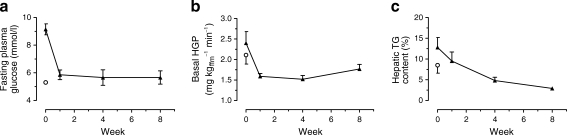
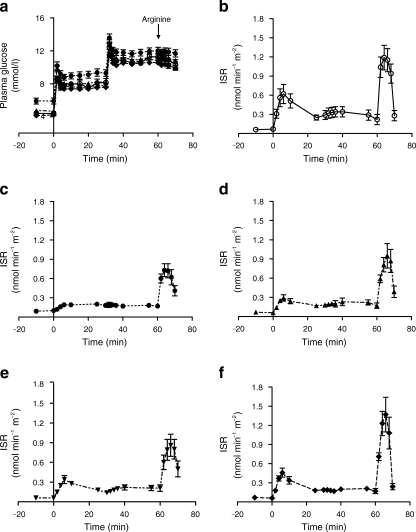
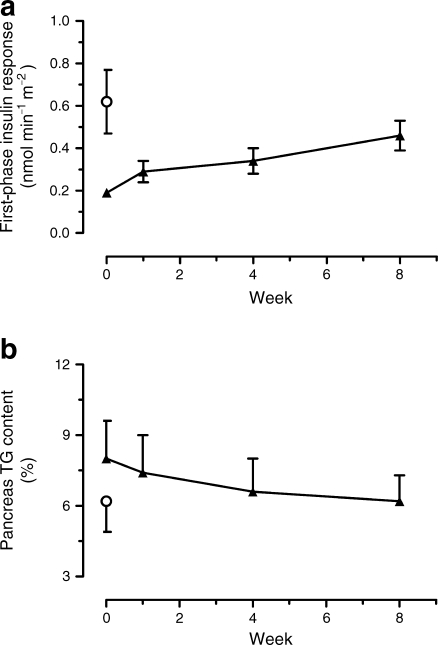
AIMS/HYPOTHESIS: Type 2 diabetes is regarded as inevitably progressive, with irreversible beta cell failure. The hypothesis was tested that both beta cell failure and insulin resistance can be reversed by dietary restriction of energy intake. METHODS: Eleven people with type 2 diabetes (49.5 ± 2.5 years, BMI 33.6 ± 1.2 kg/m(2), nine male and two female) were studied before and after 1, 4 and 8 weeks of a 2.5 MJ (600 kcal)/day diet. Basal hepatic glucose output, hepatic and peripheral insulin sensitivity and beta cell function were measured. Pancreas and liver triacylglycerol content was measured using three-point Dixon magnetic resonance imaging. An age-, sex- and weight-matched group of eight non-diabetic participants was studied. RESULTS: After 1 week of restricted energy intake, fasting plasma glucose normalised in the diabetic group (from 9.2 ± 0.4 to 5.9 ± 0.4 mmol/l; p = 0.003). Insulin suppression of hepatic glucose output improved from 43 ± 4% to 74 ± 5% (p = 0.003 vs baseline; controls 68 ± 5%). Hepatic triacylglycerol content fell from 12.8 ± 2.4% in the diabetic group to 2.9 ± 0.2% by week 8 (p = 0.003). The first-phase insulin response increased during the study period (0.19 ± 0.02 to 0.46 ± 0.07 nmol min(-1) m(-2); p < 0.001) and approached control values (0.62 ± 0.15 nmol min(-1) m(-2); p = 0.42). Maximal insulin response became supranormal at 8 weeks (1.37 ± 0.27 vs controls 1.15 ± 0.18 nmol min(-1) m(-2)). Pancreatic triacylglycerol decreased from 8.0 ± 1.6% to 6.2 ± 1.1% (p = 0.03). CONCLUSIONS/INTERPRETATION: Normalisation of both beta cell function and hepatic insulin sensitivity in type 2 diabetes was achieved by dietary energy restriction alone. This was associated with decreased pancreatic and liver triacylglycerol stores. The abnormalities underlying type 2 diabetes are reversible by reducing dietary energy intake.
Overview
The claims and statistics of this paper haven’t been checked yet.
Free: it reads the open-access text and checks the first 5 claims that cite a source we can check. Create a free account to check every claim.
Integrity signals
Registry
Cites
Statistics
Figures
Verification
Claims the paper makes
The claims and statistics of this paper haven’t been checked yet.
Free: it reads the open-access text and checks the first 5 claims that cite a source we can check. Create a free account to check every claim.
Claims other papers make about this one
Each is checked against this paper’s own text: does it say what the citing paper says it does?
The source backs part of the claim, not all of it — or backs it for a different population, condition or comparison.
In the citing paper
“Previously considered permanent and demanding life-long drug treat ment, type 2 diabetes is now recognised to be a potentially reversible consequence of excessive or abnormal accumulation of body fat (ie, the disease process of obesity). 5”
From 5-year follow-up of the randomised Diabetes Remission Clinical Trial (DiRECT) of continued support for weight loss maintenance in the UK: an extension study (2024) · cites this paper as [5]
Experimental — accuracy not yet measuredThe source backs part of the claim, not all of it — or backs it for a different population, condition or comparison.
In the citing paper
“During an intensive weight loss programme, or early after bariatric surgery, there are already significant improvements in hepatic and muscle insulin sensitivity, and pancreatic first-phase insulin secretion, with rapid loss of ectopic fat from skeletal muscle and liver [2, 3, 6].”
From Diets for weight management in adults with type 2 diabetes: an umbrella review of published meta-analyses and systematic review of trials of diets for diabetes remission (2022) · cites this paper as [6]
Experimental — accuracy not yet measuredThe source backs part of the claim, not all of it — or backs it for a different population, condition or comparison.
In the citing paper
“the twin cycle mechanism, driven by a damaging but reversible accumulation of ectopic fat within the liver and pancreas in susceptible individuals, has now been consistently observed. 6-8”
From Durability of a primary care-led weight-management intervention for remission of type 2 diabetes: 2-year results of the DiRECT open-label, cluster-randomised trial (2019) · cites this paper as [6]
Experimental — accuracy not yet measuredThe source backs part of the claim, not all of it — or backs it for a different population, condition or comparison.
In the citing paper
“Type 2 diabetes is strongly related to weight gain in adult life and accumulation of excess fat within the liver and pancreas.”
From Primary care-led weight management for remission of type 2 diabetes (DiRECT): an open-label, cluster-randomised trial (2018) · cites this paper as [4]
Experimental — accuracy not yet measuredThe cited source says what the claim attributes to it.
In the citing paper
“Although lifestyle interventions393 and weight loss394 reverse T2DM in early stages, when insulin is still secreted, T2DM patients may become dependent on anti-diabetic drugs in later stages.”
From Pancreatic regulation of glucose homeostasis. (2016) · cites this paper as [394]
9 more claims about this paper
Create a free account to see every claim other papers make about this one.
Self-check
Percentages, sums and reported differences re-computed from the paper’s own numbers.
The self-check needs the paper’s full text.
Citations
Cites
The metabolic phenotype in obesity: Fat mass, body fat distribution, and adipose tissue function
Goossens, G. H. (2017) · Obesity Facts · doi:10.1159/000471488 · Cited by 8,481
Turner, R. C., Fox, C., Matthews, McElroy, H. H., Cull, C. A., Holman, R. R., Neil, P., Hadden, D. R., Wright, D., Manley, E., et al. (1998) · The Lancet · Cited by 8,419
Glucose clamp technique: a method for quantifying insulin secretion and resistance.
DeFronzo, R. A., Tobin, J. D., & Andres, R. (1979) · American Journal of Physiology-Endocrinology and Metabolism · doi:10.1152/ajpendo.1979.237.3.e214 · Cited by 7,425 · cited 2×
“An isoglycaemic–hyperinsulinaemic clamp (insulin infusion rate 40 mU m min) was initiated at 0 min [14].”
Methodβ-Cell Deficit and Increased β-Cell Apoptosis in Humans With Type 2 Diabetes
Butler, A. E., Janson, J., Bonner-Weir, S., Ritzel, R., Rizza, R. A., & Butler, P. C. (2003) · Diabetes · doi:10.2337/diabetes.52.1.102 · Cited by 4,011 · cited 1×
“The underlying changes in beta cell function have been well described [3, 4], and beta-cell mass decreases steadily during the course of type 2 diabetes [5, 6].”
BackgroundGupta, A., & Uribarri, J. (2016) · Hormone Research in Paediatrics · doi:10.1159/000444053 · Cited by 4,006
Kahn, S. E. (2003) · Diabetologia · doi:10.1007/s00125-002-1009-0 · Cited by 2,166 · cited 1×
“The underlying changes in beta cell function have been well described [3, 4], and beta-cell mass decreases steadily during the course of type 2 diabetes [5, 6].”
BackgroundWeyer, C., Bogardus, C., Mott, D. M., & Pratley, R. E. (1999) · Journal of Clinical Investigation · doi:10.1172/jci7231 · Cited by 1,940 · cited 2×
“Absence of rapid insulin secretion in response to a rise in plasma glucose is the hallmark of type 2 diabetes [3, 21], and the decline in beta cell function determines the progression towards a need for insulin therapy [2].”
BackgroundU.K. Prospective Diabetes Study Group (1995) · Diabetes · doi:10.2337/diab.44.11.1249 · Cited by 1,923
Szczepaniak, L. S., Nurenberg, P., Leonard, D., Browning, J. D., Reingold, J. S., Grundy, S., Hobbs, H. H., & Dobbins, R. L. (2005) · American Journal of Physiology-Endocrinology and Metabolism · doi:10.1152/ajpendo.00064.2004 · Cited by 1,562 · cited 1×
“It continued to decline throughout the intervention period to reach the normal range for non-obese individuals [20] (2.”
Background
Cited by
Items 901–1,000 of 1,001
Haschka, S. J., Gar, C., Potzel, A. L., Sacco, V., Kern-Matschilles, S., Benz, I., Then, C., Seißler, J., & Lechner, A. (2022) · Cureus · doi:10.7759/cureus.23916 · Cited by 1
Pathophysiologie und Prävention des Typ-2-Diabetes
Martin, S., Kempf, K., & Röhling, M. (2019) · Der Diabetologe · doi:10.1007/s11428-019-0483-7 · Cited by 1
Formuladiäten bei der Behandlung des Typ-2-Diabetes
Martin, S., & Kempf, K. (2014) · Der Diabetologe · doi:10.1007/s11428-013-1112-5 · Cited by 1
Richter, L. R., Albert, B. I., Zhang, L., Ostropolets, A., Zitsman, J. L., Fennoy, I., Albers, D. J., & Hripcsak, G. M. (2022) · Frontiers in Physiology · doi:10.3389/fphys.2022.923704 · Cited by 4
“The extent to which function can be rescued after progression to T2DM is modifiable to some degree (Lim et al., 2011; Pajvani and Accili, 2015; Taylor et al., 2019; Richter et al., 2020; Holst and Madsbad, 2021; Bartolomé et al., 2022).”
BackgroundCultural Practices Doing Harm to Diabetes Management: A Physician-Patient’s Perspective
(2022) · International Journal of Diabetes & Metabolic Disorders · doi:10.33140/ijdmd.07.02.20 · Cited by 1
Ocimum sanctum: Antioxidative efficacy in type 2 diabetes and its associated complications
Olofinsan, K. A., Erukainure, O. L., & Islam, M. S. (2024) · Elsevier eBooks · doi:10.1016/b978-0-323-95719-9.00003-3 · Cited by 1
Tian, X., Tang, Y., Hu, R., Ye, J., Chen, H., & Wu, J. (2024) · Frontiers in Endocrinology · doi:10.3389/fendo.2024.1341531 · Cited by 4
Сергеевич, Ш. А., Малых, О. Л., Габдрахмановна, Г. В., Михайловна, Ц. Т., Panov, V. G., Zhdanov, A., & Леонидович, Ш. П. (2023) · Vrach · doi:10.29296/25877305-2023-03-02 · Cited by 1
Similar early metabolic changes induced by dietary weight loss or bariatric surgery
Taylor, R. (2024) · Diabetologia · doi:10.1007/s00125-024-06268-4 · Cited by 1
“In people with or without type 2 diabetes, the major metabolic change following calorie restriction has been shown to be a rapid and complete resolution of liver insulin resistance [6, 7, 9, 10], caused by a rapid decrease in intra-hepatic fat at the onset of negative calorie balance [7, 9].”
Self-citationPreserving insulin function in diabetes: a case report
Oota, M. (2024) · Journal of Medical Case Reports · doi:10.1186/s13256-024-04714-w · Cited by 1
“A total of 40% (12/30) of patients diagnosed with diabetes less than 10 years prior reversed their condition, and 6 months later, they remained diabetes-free [5–7].”
BackgroundRojas‐Juárez, R., Rodríguez‐Castelán, J., Cuatecontzi‐Fuentes, I., Méndez-Tepepa, M., Cruz‐Lumbreras, R., Rodríguez‐Antolín, J., Arroyo-Helguera, O. E., & Cuevas‐Romero, E. (2024) · The Anatomical Record · doi:10.1002/ar.25590 · Cited by 1
“The pancreas can accumulate TAG and cholesterol (Lim et al., 2011).”
Troshina, E. A., Bogdanova, V. O., & Umarkhadzhieva, Z.-S. R. (2025) · Obesity and metabolism · doi:10.14341/omet13180 · Cited by 1
Guan, M., Cui, S., Song, H., Hu, H., & Hu, B. (2025) · BMC Nephrology · doi:10.1186/s12882-025-04377-9 · Cited by 3
“This ectopic lipid buildup disrupts normal insulin signaling pathways in these tissues, contributing to systemic IR and impaired glucose homeostasis [57].”
Cardiovascular Effects of Weight Loss
Menzies, K. E., Savage, P. D., & Ades, P. A. (2011) · Current Cardiovascular Risk Reports · doi:10.1007/s12170-011-0211-3 · Cited by 1
Thom, G., & Lean, M. E. J. (2016) · Clinical Obesity · doi:10.1111/cob.12172 · Cited by 2
“reliably normalizes β-cell function and hepatic insulin sensitivity by reducing liver and pancreatic fat, thus correcting the metabolic abnormalities underlying pre-diabetes and T2DM (30,31).”
BackgroundInfluentialMargaret McCartney: Promising miracle diet fixes isn’t fair on anyone
McCartney, M. (2017) · BMJ · doi:10.1136/bmj.j4226 · Cited by 1
Dietary Interventions for Weight Loss and Essential Aspects of Nutrition Post–Bariatric Surgery
Barnard, J., Snowdon, D., & Hewitson, L. (2017) · Elsevier eBooks · doi:10.1016/b978-0-323-48559-3.00030-0 · Cited by 2
Effects of MGB on Type 2 Diabetes in Lower BMI Patients
Mahdy, T., & Gado, W. (2018) · Springer eBooks · doi:10.1007/978-3-319-76177-0_14 · Cited by 1
Treatment of fatty pancreas: Acalypha indica Linn. extract as an alternative to simvastatin
Maulidina, A. A., & Farida, S. N. (2019) · AIP conference proceedings · doi:10.1063/1.5139362 · Cited by 4
Multifactorial assessment in patients presenting with fall
Myint, Y., Khin, K. L. S., Khine, M. T., & Win, M. T. (2019) · Clinical Medicine · doi:10.7861/clinmedicine.19-2-s37 · Cited by 1
Treatments for Improving Psychological Health in PCOS
Barry, J. A. (2019) · Springer eBooks · doi:10.1007/978-3-030-30290-0_8 · Cited by 2
The Gut and Type 2 Diabetes Mellitus
Boyce, S. (2020) · Springer eBooks · doi:10.1007/978-3-030-28803-7_42 · Cited by 1
Forget polypharmacy for type 2 diabetes! Weight management is a better investment
Lean, M. E. J., McCombie, L., & Xin, Y. (2020) · Nephrology Dialysis Transplantation · doi:10.1093/ndt/gfaa250 · Cited by 1
“The way that weight gain causes T2D, by overloading susceptible people’s body fat stores until the excess fat starts to fill up and damage the liver and pancreas, had been established by detailed metabolic studies at Newcastle University: a 15-kg weight loss removed that ectopic fat [5].”
BackgroundImpact of Metabolic Surgery on Type-2 Diabetes Remission
Baiocchi, C. D. A. F., & de Sá, D. A. R. (2020) · Current Diabetes Reviews · doi:10.2174/1573399817999201214224920 · Cited by 2
Who will benefit from bariatric surgery for diabetes? A protocol for an observational cohort study
Kenkre, J. S., Ahmed, A., Purkayastha, S., Malallah, K., Bloom, S. R., Blakemore, A. I. F., Prevost, A. T., & Tan, T. (2021) · BMJ Open · doi:10.1136/bmjopen-2020-042355 · Cited by 3
Advances in the Prevention and Management of Obesity and Eating Disorders
Sainsbury, A., & da Luz, F. Q. (2018) · MDPI eBooks · doi:10.3390/books978-3-03842-854-1 · Cited by 1
Genes and lifestyle: Which of the two is more relevant in driving NAFLD progression?
Marchesini, G., & Taylor, R. (2021) · Digestive and Liver Disease · doi:10.1016/j.dld.2021.08.011 · Cited by 1
Self-citationKurian, J., Mavathur, R. N., & Deo, G. (2021) · Journal of Diabetology · doi:10.4103/jod.jod_68_20 · Cited by 2
Moschonis, G., Livingstone, K. M., & Biesiekierski, J. R. (2019) · MDPI eBooks · doi:10.3390/books978-3-03921-446-4 · Cited by 1
Type 2 diabetes: the problem and the solution
Taylor, R. (2022) · British Journal of Diabetes · doi:10.15277/bjd.2022.366 · Cited by 1
Self-citationBousahba, I., David, J., Castelli, F. A., Chollet, C., Ouzia, S., Fenaille, F., Rémond, D., Poupin, N., & Polakof, S. (2022) · Journal of Physiology and Biochemistry · doi:10.1007/s13105-022-00940-2 · Cited by 2
Obesity-Associated Comorbidities: Health Consequences
Adebibe, M., & Coppack, S. W. (2023) · Springer eBooks · doi:10.1007/978-3-030-60596-4_4 · Cited by 1
One Anastomosis Gastric Bypass Surgery: Consequences Over Diabetic Parameters
Singh, A., Ahmad, R., Sinha, S., Haq, M. A., Narwaria, M., Sharma, A. D., Haque, M., Kumar, S., & Sanghani, N. (2024) · Bangladesh Journal of Medical Science · doi:10.3329/bjms.v23i1.70666 · Cited by 1
“Multiple studies reported a reduction in fat content in the liver following bariatric surgery with the improvement of sensitivity of hepatic cells to insulin, resulting in fasting blood glucose level improvement 7 days following the surgery 23-29 .”
BackgroundNadeem, N., Nadeem, F., Khalid, S., Hussain, H., Munir, M., Khan, A., Yahya, I., Gondal, Z., Lutfi, N., Siddique, M., et al. (2020) · International Journal of Biosciences (IJB) · doi:10.12692/ijb/17.2.285-304 · Cited by 1
Longitudinal associations between periodontitis and glycated haemoglobin
Shearer, D. M. (2016) · Otago University Research Archive (University of Otago) · Cited by 1
The reversibility of type 2 diabetes
Steven, S. (2016) · Cited by 1
Mete, R., Georgousopoulou, E. N., Mellor, D. D., Khoo, J. J. C., Cheong, M., Leeds, A., Allan, K., Avery, A., Hart, K., Muir, A., et al. (2017) · Wiley eBooks · doi:10.1002/9781118857991.ch4 · Cited by 2
Online structured education for people newly diagnosed with type 2 diabetes
Poduval, S. (2019) · UCL Discovery (University College London) · Cited by 1
Hodson, K. K. (2019) · Cited by 1
Clinical Presentations of Diabetes
Lim, E. L., & Taylor, R. (2016) · Wiley eBooks · doi:10.1002/9781118924853.ch22 · Cited by 1
Self-citationLyngbæk, M. P. P., Legaard, G. E., Nielsen, N. S., Durrer, C. G., Almdal, T., Lund, M. A. V., Liebetrau, B., Ewertsen, C., Lauridsen, C. A., Solomon, T. P. J., et al. (2023) · medRxiv · doi:10.1101/2023.06.04.23290749 · Cited by 2
“(FFM) or lean body mass from the total weight loss [6, 7, 10].”
BackgroundOnyango, J. O., & Kiarie, R. (2024) · Research Square · doi:10.21203/rs.3.rs-4270600/v1 · Cited by 2
Diabetes management by primary health care nurses in Auckland: A cross-sectional study
Daly, B. M. (2012) · ResearchSpace (University of Auckland) · Cited by 2
Hussain, A. T. (2014) · Cited by 1
Ning, F. (2013) · Helda - University of Helsinki Institutional Repository
Relations Among Type 2 Diabetes, Arterial Stiffness and Cognitive Functioning
Dore, G. A. (2013) · DigitalCommons (California Polytechnic State University)
Mellberg, C. (2014) · DiVA at Umeå University (Umeå University)
Smoking during pregnancy and child mental health and wellbeing : evidence, policy and practice
Vanderbloemen, L. (2013) · White Rose eTheses Online (University of Leeds, The University of Sheffield, University of York)
Danby, F. W. (2014) · Wiley eBooks · doi:10.1002/9781118272343.ch4
Medical Assessment and Preparation of Patients Undergoing Bariatric Surgery
Bun, W., & Taheri, S. (2012) · InTech eBooks · doi:10.5772/32798
“One study showed remission of type 2 diabetes in obese patient after 8 weeks of VLED (Lim, Hollingsworth et al. 2011).”
BackgroundInfluentialPathophysiologie und Prävention des Typ-2-Diabetes
Martin, S. (2015) · Der Diabetologe · doi:10.1007/s11428-015-1340-y
Bariatric surgery and diabetes remission: how far have we progressed?
Singh, A. K., & Kota, S. K. (2015) · Expert Review of Endocrinology & Metabolism · doi:10.1586/17446651.2015.1073586
“It is believed that calorie restriction in early postoperative period would decrease intra-hepatic fat content and might be playing a crucial role in improving early hepatic insulin sensitivity while improvement in peripheral insulin sensitivity is only observed after substantial weight loss following RYGB [72,73].”
BackgroundFunctional Nutrition: Food as a Medical Therapy
Boham, E. W. (2014) · Alternative and Complementary Therapies · doi:10.1089/act.2014.20403
Search for molecular and metabolic mechanisms contributing to impaired β-cell function
Malmgren, S. (2012) · Lund University Publications (Lund University)
Liu, X. (2014) · UKnowledge (University of Kentucky)
Cardoso, M. H. (2013) · Revista Portuguesa de Endocrinologia Diabetes e Metabolismo · doi:10.1016/j.rpedm.2013.10.003
The illness with no ‘tail’: how foreign-born UK Chinese understand and manage Type 2 diabetes
Eng, S. (2012) · ORCA Online Research @Cardiff (Cardiff University)
New treatments for type 2 diabetes
Cascales, L. (2012) · Medical Writing · doi:10.1179/2047480612z.00000000066
“Interestingly, dietary changes produce spectacular improvements in the insulin sensitivity of T2D patients, challenging the paradigm that T2D is a chronic disease.(28)”
BackgroundMechanism of Metabolic Improvement After Bariatric Surgery
Kim, S. H. (2013) · Journal of Korean Diabetes · doi:10.4093/jkd.2013.14.2.79
Telemedizinisches Lifestlye Coaching zur Prävention und Behandlung von chronischen Volkserkrankungen
Martin, S. (2015) · Xpert.press · doi:10.1007/978-3-662-43782-7_50
Bromocriptine for type 2 diabetes mellitus
Ooi, C. P., & Loke, S. C. (2013) · Cochrane Database of Systematic Reviews · doi:10.1002/14651858.cd010319
RetractedA review of the current nutritional guidelines for diabetes
Mellor, D. D., & Phillips, A. (2012) · Practice Nursing · doi:10.12968/pnur.2012.23.5.234 · Cited by 1
Calorie Restriction: The Natural Way of Slowing Down Aging
Nauli, A. M. (2013) · Journal of Biosafety & Health Education · doi:10.4172/2332-0893.1000e103
Diabetes and Endocrinology Symposium: thinner, fitter, faster
McManus, F. (2012) · The Journal of the Royal College of Physicians of Edinburgh · doi:10.1177/147827152012420401001
Bowen, M. J. (2015) · University Library - University of Saskatchewan (University of Saskatchewan)
A Review on Sarcopenic Obesity: A Rising Epidemic
Dasgupta, P. (2015) · Research Publications (Maastricht University) · Cited by 4
Kan diabetes mellitus type 2 genezen?
Huls, M., van Dijk, M., & Boesten, M. (2015) · TvPO · doi:10.1007/s12503-015-0081-0
Towards a personalised diagnosis of type 2 diabetes
Mack, D. R. (2013)
Treatments for Type 2 Diabetes; a Focus on DPP4 Inhibitors
TOMKIN, G. H. (2014) · Pharmaceutical Regulatory Affairs Open Access · doi:10.4172/2167-7689.1000114
Gewichtssenkende Medikamente in der Diabetologie
Aberle, J. (2015) · Der Diabetologe · doi:10.1007/s11428-015-0004-2
“Die Bedeutung der Adipositas zeigt sich auch darin, dass ein bereits bestehender Typ-2-DM in den ersten 3–4 Jahren derErkrankungdurcheinenveränderten Lebensstil und eine Körpergewichtssenkung zum Sistieren gebracht, sozusagen geheilt werden, kann [3].”
BackgroundNeue Aspekte zur Krankheitsentstehung
Kempf, K., & Martin, S. (2014) · Info Diabetologie · doi:10.1007/s15034-014-0596-4
Molecular Regulators of Metabolism and Cardiometabolic Disease
Sukmawati, I. R., & Wijaya, A. (2012) · The Indonesian Biomedical Journal · doi:10.18585/inabj.v4i3.173 · Cited by 1
Bariatric Surgery or Medical Therapy for Obesity
Frontoni, S., Malandrucco, I., & Bonadonna, R. C. (2012) · New England Journal of Medicine · doi:10.1056/nejmc1206633
QUESTION AND ANSWER Open Access
Kupfer, D. J. (2013)
Clinical management of hyperglycaemia in type 2 diabetes
Matthews, D. R. (2015) · Wiley eBooks · doi:10.1002/9781119121725.ch13
Firoozjah, O. A. (2016) · Journal of Minimally Invasive Surgical Sciences · doi:10.17795/minsurgery-34802
Epidemiology, aetiology and pathogenesis of type 2 diabetes
Matthews, D. R. (2015) · Wiley eBooks · doi:10.1002/9781119121725.ch12
Killick, J. (2016) · Aston Publications Explorer (Aston University) · doi:10.48780/publications.aston.ac.uk.00028815
Schofield, C. J. (2011) · OpenGrey (Institut de l'Information Scientifique et Technique)
Metabolische Chirurgie oder konservative Maßnahmen zur Behandlung adipöser Typ 2-Diabetiker?
Jahn, U., Schubert, T., Schlepp, S., & Deuber, H. J. (2016) · Wiener Medizinische Wochenschrift · doi:10.1007/s10354-016-0532-4
KAHL, S. (2017) · Der Diabetologe · doi:10.1007/s11428-016-0187-1
“Nichtsdestotrotzdeuten die Ergebnisse darauf hin, dass eine VLEDbeiadipösenKindernund Jugendlichenmit Typ-2-Diabetes einemögliche Therapieoption bietet und sogar zu einer Reversion des Typ-2-Diabetes führen kann, wie dies auch für Erwachsene beschrieben wurde [2].”
BackgroundThe role of gut hormones on food intake and carbohydrate tolerance
Tharakan, G. (2016) · Spiral (Imperial College London) · doi:10.25560/41846
“(mean percentage weight loss of 15±1%) with concomitant improvements in fasting glucose, hepatic insulin sensitivity and plasma lipids relative to non diabetic controls(15).”
BackgroundLifestyle and cardio-metabolic health
Cassidy, S. (2016)
Gesunder Lebensstil muss in jeder Krankheitsphase auf den Therapieplan!
Martin, S. (2017) · Info Diabetologie · doi:10.1007/s15034-017-1091-5
“lorie diet“ (VLCD) von 600 kcal eine komplette Remission des Diabetes erreichten [23].”
BackgroundFormuladiäten zum Abnehmen bei Typ-2-Diabetes – sinnvolle Strategie oder verzichtbar?
Martin, S. (2017) · Der Diabetologe · doi:10.1007/s11428-017-0244-4
Proton magnetic resonance spectroscopy: Pancreas fat analysis
Johnson, N. A. (2016) · e-publications@bond (Bond University) · doi:10.4225/57/5a2f3baeebe75
“A “fatty pancreas” may contribute significantly to the underlying cardiovascular and metabolic dysfunction observed in obesity and related type 2 diabetes (2,3), including beta cell dysfunction (4,5), and diet intervention alone or in combination with bariatric surgery, may reduce pancreas fat and improve pancreatic f…”
BackgroundPostprandial Metabolic and Appetite Responses Following Whey Protein Supplementation at Breakfast
Allerton, D. M. (2016) · Northumbria Research Link (Northumbria University)
Der Magenbypass — eine Chance auf Diabetesremission mit Haken und Ösen
Franke-Ullmann, G., & Simon, M. (2017) · Info Diabetologie · doi:10.1007/s15034-017-0974-9
Why Low-Calorie Diets Might be Good for Your Brain in More Than One Way?
Dalgaard, J. (2017) · Current Trends in Biomedical Engineering & Biosciences · doi:10.19080/ctbeb.2017.05.555668
Bile Acids and FGF19 in the Remission of Type 2 Diabetes After Sleeve Gastrectomy and Gastric Bypass
Nemati, R. (2017) · Tuwhera (Auckland University of Technology) · Cited by 1
New Approach to Type 2 Diabetes Reversal in Obesity
Steven, S. (2017) · Elsevier eBooks · doi:10.1016/b978-0-323-48559-3.00024-5
Buchmann, M. (2016) · eDiss (Georg-August-Universität Göttingen) · doi:10.53846/goediss-5933
Fernandes, G. (2017) · Digital Library of Theses and Dissertations (Universidade de São Paulo) · doi:10.11606/d.5.2017.tde-29112017-091214 · Cited by 1
Comment on: resolution of type 2 diabetes after sleeve gastrectomy: a two-step hypothesis
Rogers, A. M. (2018) · Surgery for Obesity and Related Diseases · doi:10.1016/j.soard.2018.01.023
Multigene Assays: The Changing Paradigm of Personalized Medicine in Breast Cancer
Gaur, G. (2017) · MOJ Cell Science & Report · doi:10.15406/mojcsr.2017.04.00097
Klinische Remission des Typ-2-Diabetes durch Diät und Lebensstilinterventionen
Martin, S. (2018) · Diabetes aktuell · doi:10.1055/s-0043-125113
“2337/dc17‐0303 [3] Lim EL, Hollingsworth KG, Aribisala BS et al.”
BackgroundInfluentialClose, A.-F. (2017) · ERA: Education and Research Archive (University of Alberta) · doi:10.7939/r33f4m242 · Cited by 1
Wie rückt man dem Zucker ohne Medikamente zu Leibe?
Martin, S. (2018) · Info Diabetologie · doi:10.1007/s15034-018-1311-7 · Cited by 1
Metadata
- Authors
- Lim, E. L., Hollingsworth, K. G., Aribisala, B. S., Chen, M. J., Mathers, J. C., & Taylor, R.
- Affiliations
- Newcastle University (GB)
- Corresponding author
- Taylor, R.
- Venue
- Diabetologia
- Published
- 2011-06-09
- Volume
- 54
- Issue
- 10
- Pages
- 2506-2514
- ISSN
- 0012-186X (ISSN-L)
- 1432-0428
- PMC
- PMC3168743
- OpenAlex
- W2127283831
- Cited by
- 1,164
- References
- 51
- Citations by year
- 2026: 46 · 2025: 60 · 2024: 65 · 2023: 77 · 2022: 109 · 2021: 102 · 2020: 81 · 2019: 77 · 2018: 86 · 2017: 90 · 2016: 77 · 2015: 82 · 2014: 60 · 2013: 77 · 2012: 64
- FWCI
- 68.35
- Type
- journal article
- Language
- en
- Open access
- hybrid
- doi.org
- Licence
- cc-by-nc
- Locations
- Diabetologia (publishedVersion, cc-by-nc)
- Europe PMC (PubMed Central) (publishedVersion, cc-by-nc)
- PubMed Central (publishedVersion, cc-by-nc)
- PubMed (publishedVersion)
- IRIS Research product catalog (Sapienza University of Rome) (submittedVersion)
- Edinburgh Research Explorer (University of Edinburgh) (submittedVersion, other-oa)
- Newcastle University ePrints (Newcastle Univesity) (cc-by-nc)
- Topics
- Health Sciences › Medicine › Endocrinology, Diabetes and Metabolism › Pancreatic function and diabetes
- Health Sciences › Medicine › Endocrinology, Diabetes and Metabolism › Diabetes Treatment and Management
- Health Sciences › Medicine › Endocrinology, Diabetes and Metabolism › Diabetes, Cardiovascular Risks, and Lipoproteins
- Keywords
- type 2 diabetes remission, beta-cell function, caloric restriction, dietary restriction, hepatic insulin sensitivity, hepatic glucose production, liver triacylglycerol, first-phase insulin response, insulin resistance, fasting blood glucose, pancreatic fat content, hepatic fat content, weight loss interventions
- MeSH terms
- Adult, Aged, Blood Glucose, Body Composition, Body Weight, Diabetes Mellitus, Type 2, Female, Glycated Hemoglobin, Humans, Liver, Male, Middle Aged, Pancreas, Triglycerides, Insulin-Secreting Cells
About these checks
Registry, retraction, Cites and statistics results are computed, not judged, with one exception: a printed reference that no index lists is read once by a model before it counts as a citation error. Claims are extracted by a model and kept only when their quote appears verbatim in the text; each cited source is then checked, with a model’s help, for whether it says what the claim relies on. Those verdicts can be wrong — read the claim’s quote and the cited source before relying on one.
Statistics and arithmetic are recomputed, not judged.
Confidence bands are shown only for fields calibrated on our annotated test set. None is calibrated yet, so no band is shown.
What counts as a claim ›How we measure confidence ›How we check this ›
Are you an author, or do you see a problem with this page? Request a review
Data sources
Bibliographic data: Semantic Scholar, OpenAlex, Crossref.
Contains information from the Semantic Scholar Academic Graph Datasets, made available under the ODC Attribution License (ODC-BY 1.0).
Semantic Scholar’s data is described in: Kinney, R., et al. (2023). The Semantic Scholar Open Data Platform. arXiv:2301.10140.
