

Reversal of type 2 diabetes: normalisation of beta cell function in association with decreased pancreas and liver triacylglycerol
Open accessThe DOI matches its Crossref record; 52 of the 52 references it cites were found in a registry or an index.
Abstract
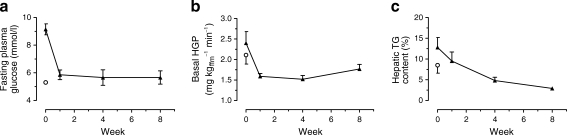
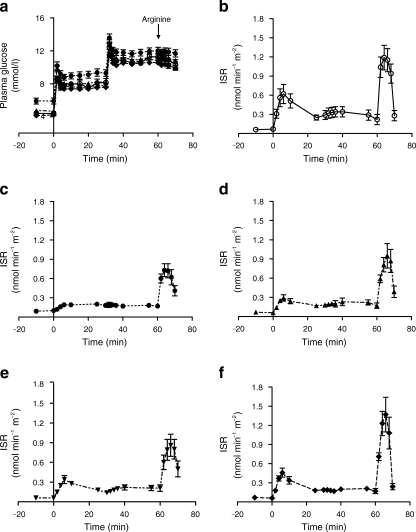
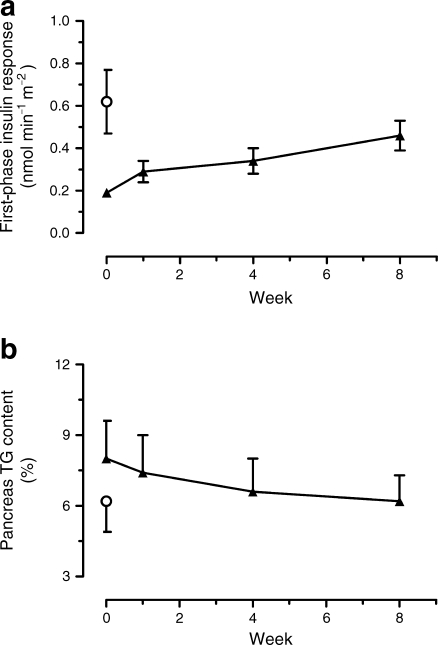
AIMS/HYPOTHESIS: Type 2 diabetes is regarded as inevitably progressive, with irreversible beta cell failure. The hypothesis was tested that both beta cell failure and insulin resistance can be reversed by dietary restriction of energy intake. METHODS: Eleven people with type 2 diabetes (49.5 ± 2.5 years, BMI 33.6 ± 1.2 kg/m(2), nine male and two female) were studied before and after 1, 4 and 8 weeks of a 2.5 MJ (600 kcal)/day diet. Basal hepatic glucose output, hepatic and peripheral insulin sensitivity and beta cell function were measured. Pancreas and liver triacylglycerol content was measured using three-point Dixon magnetic resonance imaging. An age-, sex- and weight-matched group of eight non-diabetic participants was studied. RESULTS: After 1 week of restricted energy intake, fasting plasma glucose normalised in the diabetic group (from 9.2 ± 0.4 to 5.9 ± 0.4 mmol/l; p = 0.003). Insulin suppression of hepatic glucose output improved from 43 ± 4% to 74 ± 5% (p = 0.003 vs baseline; controls 68 ± 5%). Hepatic triacylglycerol content fell from 12.8 ± 2.4% in the diabetic group to 2.9 ± 0.2% by week 8 (p = 0.003). The first-phase insulin response increased during the study period (0.19 ± 0.02 to 0.46 ± 0.07 nmol min(-1) m(-2); p < 0.001) and approached control values (0.62 ± 0.15 nmol min(-1) m(-2); p = 0.42). Maximal insulin response became supranormal at 8 weeks (1.37 ± 0.27 vs controls 1.15 ± 0.18 nmol min(-1) m(-2)). Pancreatic triacylglycerol decreased from 8.0 ± 1.6% to 6.2 ± 1.1% (p = 0.03). CONCLUSIONS/INTERPRETATION: Normalisation of both beta cell function and hepatic insulin sensitivity in type 2 diabetes was achieved by dietary energy restriction alone. This was associated with decreased pancreatic and liver triacylglycerol stores. The abnormalities underlying type 2 diabetes are reversible by reducing dietary energy intake.
Overview
The claims and statistics of this paper haven’t been checked yet.
Free: it reads the open-access text and checks the first 5 claims that cite a source we can check. Create a free account to check every claim.
Integrity signals
Registry
Cites
Statistics
Figures
Verification
Claims the paper makes
The claims and statistics of this paper haven’t been checked yet.
Free: it reads the open-access text and checks the first 5 claims that cite a source we can check. Create a free account to check every claim.
Claims other papers make about this one
Each is checked against this paper’s own text: does it say what the citing paper says it does?
The source backs part of the claim, not all of it — or backs it for a different population, condition or comparison.
In the citing paper
“Previously considered permanent and demanding life-long drug treat ment, type 2 diabetes is now recognised to be a potentially reversible consequence of excessive or abnormal accumulation of body fat (ie, the disease process of obesity). 5”
From 5-year follow-up of the randomised Diabetes Remission Clinical Trial (DiRECT) of continued support for weight loss maintenance in the UK: an extension study (2024) · cites this paper as [5]
Experimental — accuracy not yet measuredThe source backs part of the claim, not all of it — or backs it for a different population, condition or comparison.
In the citing paper
“During an intensive weight loss programme, or early after bariatric surgery, there are already significant improvements in hepatic and muscle insulin sensitivity, and pancreatic first-phase insulin secretion, with rapid loss of ectopic fat from skeletal muscle and liver [2, 3, 6].”
From Diets for weight management in adults with type 2 diabetes: an umbrella review of published meta-analyses and systematic review of trials of diets for diabetes remission (2022) · cites this paper as [6]
Experimental — accuracy not yet measuredThe source backs part of the claim, not all of it — or backs it for a different population, condition or comparison.
In the citing paper
“the twin cycle mechanism, driven by a damaging but reversible accumulation of ectopic fat within the liver and pancreas in susceptible individuals, has now been consistently observed. 6-8”
From Durability of a primary care-led weight-management intervention for remission of type 2 diabetes: 2-year results of the DiRECT open-label, cluster-randomised trial (2019) · cites this paper as [6]
Experimental — accuracy not yet measuredThe source backs part of the claim, not all of it — or backs it for a different population, condition or comparison.
In the citing paper
“Type 2 diabetes is strongly related to weight gain in adult life and accumulation of excess fat within the liver and pancreas.”
From Primary care-led weight management for remission of type 2 diabetes (DiRECT): an open-label, cluster-randomised trial (2018) · cites this paper as [4]
Experimental — accuracy not yet measuredThe cited source says what the claim attributes to it.
In the citing paper
“Although lifestyle interventions393 and weight loss394 reverse T2DM in early stages, when insulin is still secreted, T2DM patients may become dependent on anti-diabetic drugs in later stages.”
From Pancreatic regulation of glucose homeostasis. (2016) · cites this paper as [394]
9 more claims about this paper
Create a free account to see every claim other papers make about this one.
Self-check
Percentages, sums and reported differences re-computed from the paper’s own numbers.
The self-check needs the paper’s full text.
Citations
Cites
The metabolic phenotype in obesity: Fat mass, body fat distribution, and adipose tissue function
Goossens, G. H. (2017) · Obesity Facts · doi:10.1159/000471488 · Cited by 8,481
Turner, R. C., Fox, C., Matthews, McElroy, H. H., Cull, C. A., Holman, R. R., Neil, P., Hadden, D. R., Wright, D., Manley, E., et al. (1998) · The Lancet · Cited by 8,419
Glucose clamp technique: a method for quantifying insulin secretion and resistance.
DeFronzo, R. A., Tobin, J. D., & Andres, R. (1979) · American Journal of Physiology-Endocrinology and Metabolism · doi:10.1152/ajpendo.1979.237.3.e214 · Cited by 7,425 · cited 2×
“An isoglycaemic–hyperinsulinaemic clamp (insulin infusion rate 40 mU m min) was initiated at 0 min [14].”
Methodβ-Cell Deficit and Increased β-Cell Apoptosis in Humans With Type 2 Diabetes
Butler, A. E., Janson, J., Bonner-Weir, S., Ritzel, R., Rizza, R. A., & Butler, P. C. (2003) · Diabetes · doi:10.2337/diabetes.52.1.102 · Cited by 4,011 · cited 1×
“The underlying changes in beta cell function have been well described [3, 4], and beta-cell mass decreases steadily during the course of type 2 diabetes [5, 6].”
BackgroundGupta, A., & Uribarri, J. (2016) · Hormone Research in Paediatrics · doi:10.1159/000444053 · Cited by 4,006
Kahn, S. E. (2003) · Diabetologia · doi:10.1007/s00125-002-1009-0 · Cited by 2,166 · cited 1×
“The underlying changes in beta cell function have been well described [3, 4], and beta-cell mass decreases steadily during the course of type 2 diabetes [5, 6].”
BackgroundWeyer, C., Bogardus, C., Mott, D. M., & Pratley, R. E. (1999) · Journal of Clinical Investigation · doi:10.1172/jci7231 · Cited by 1,940 · cited 2×
“Absence of rapid insulin secretion in response to a rise in plasma glucose is the hallmark of type 2 diabetes [3, 21], and the decline in beta cell function determines the progression towards a need for insulin therapy [2].”
BackgroundU.K. Prospective Diabetes Study Group (1995) · Diabetes · doi:10.2337/diab.44.11.1249 · Cited by 1,923
Szczepaniak, L. S., Nurenberg, P., Leonard, D., Browning, J. D., Reingold, J. S., Grundy, S., Hobbs, H. H., & Dobbins, R. L. (2005) · American Journal of Physiology-Endocrinology and Metabolism · doi:10.1152/ajpendo.00064.2004 · Cited by 1,562 · cited 1×
“It continued to decline throughout the intervention period to reach the normal range for non-obese individuals [20] (2.”
Background
Cited by
Items 101–200 of 1,001
Kowalski, G. M., & Bruce, C. R. (2014) · American Journal of Physiology-Endocrinology and Metabolism · doi:10.1152/ajpendo.00165.2014 · Cited by 154
“Furthermore, the normalization of glycemic control in T2D individuals after short-term calorie restriction was associated with an improvement in hepatic glucose metabolism, whereas muscle remained insulin resistant (111).”
BackgroundClinical trial demonstrates exercise following bariatric surgery improves insulin sensitivity
Coen, P. M., Tanner, C. J., Helbling, N. L., Dubis, G. S., Hames, K. C., Xie, H., Eid, G. M., Stefanovic-Racic, M., Toledo, F. G. S., Jakicic, J. M., et al. (2015) · Journal of Clinical Investigation · doi:10.1172/jci78016 · Cited by 150
American Diabetes Association (2019) · Diabetes Care · doi:10.2337/dc19-s008 · Cited by 149
Effects of Bariatric Surgery on Glucose Homeostasis and Type 2 Diabetes
Bradley, D., Magkos, F., & Klein, S. (2012) · Gastroenterology · doi:10.1053/j.gastro.2012.07.114 · Cited by 152
Q&A: insulin secretion and type 2 diabetes: why do β-cells fail?
Cantley, J., & Ashcroft, F. M. (2015) · BMC Biology · doi:10.1186/s12915-015-0140-6 · Cited by 192
“Improvement in insulin secretion after intensive insulin treatment has been reported [56,57], and a very low-calorie diet can improve insulin action, β-cell function and glucose homeostasis in T2D patients [55].”
American Diabetes Association (2020) · Diabetes Care · doi:10.2337/dc20-s008 · Cited by 148
Heiskanen, M. A., Motiani, K. K., Mari, A., Saunavaara, V., Eskelinen, J.-J., Virtanen, K. A., Koivumäki, M., Löyttyniemi, E., Nuutila, P., Kalliokoski, K. K., et al. (2018) · Diabetologia · doi:10.1007/s00125-018-4627-x · Cited by 142
“Lim et al studied the effects of dietary energy restriction in type 2 diabetes at different time points over 8 weeks, showing that although liver fat content decreased rapidly, the decrease in pancreatic fat content and improvement in beta cell function took longer to occur [47].”
BackgroundPancreatic Steatosis and Its Relationship to β-Cell Dysfunction in Humans
Szczepaniak, L. S., Victor, R. G., Mathur, R., Nelson, M. D., Szczepaniak, E. W., Tyer, N., Chen, I., Unger, R. H., Bergman, R. N., & Lingvay, I. (2012) · Diabetes Care · doi:10.2337/dc12-0701 · Cited by 140
Cuthbertson, D. J., Shojaee-Moradie, F., Sprung, V. S., Jones, H., Pugh, C. J. A., Richardson, P., Kemp, G. J., Barrett, M., Jackson, N. C., Thomas, E. L., et al. (2016) · Clinical Science · doi:10.1042/cs20150447 · Cited by 138
The Diabetes Remission Clinical Trial (DiRECT): protocol for a cluster randomised trial
Leslie, W. S., Ford, I., Sattar, N., Hollingsworth, K. G., Adamson, A., Sniehotta, F. F., McCombie, L., Brosnahan, N., Ross, H., Mathers, J. C., et al. (2016) · BMC Family Practice · doi:10.1186/s12875-016-0406-2 · Cited by 132
“Liver and pancreas fat will be quantified using 3-point Dixon MR scanning [16].”
BackgroundMethodInfluentialSelf-citationIncidence of Remission in Adults With Type 2 Diabetes: The Diabetes & Aging Study
Karter, A. J., Nundy, S., Parker, M. M., Moffet, H. H., & Huang, E. S. (2014) · Diabetes Care · doi:10.2337/dc14-0874 · Cited by 132
“, diagnosis) (26), as well as the multitude of factors that influence the natural history of b-cell function and mass (8,27,28).”
BackgroundObesity and Pancreatic Cancer: Overview of Epidemiology and Potential Prevention by Weight Loss
Xu, M., Jung, X., Hines, O. J., Eibl, G., & Chen, Y. (2018) · Pancreas · doi:10.1097/mpa.0000000000000974 · Cited by 129
“Lim et al found that among patients with T2DM who underwent a very low calorie diet or gastric bypass surgery, the hepatic fat content decreased rapidly in parallel with improved hepatic insulin sensitivity and normalization of fasting plasma glucose levels within 7 days.(71) Bariatric surgery also improves intestinal…”
BackgroundResearch progress on the hypoglycemic activity and mechanisms of natural polysaccharides
Xue, H., Hao, Z., Gao, Y., Cai, X. D., Tang, J., Liao, X., & Tan, J. (2023) · International Journal of Biological Macromolecules · doi:10.1016/j.ijbiomac.2023.126199 · Cited by 131
Epigenetic programming, early life nutrition and the risk of metabolic disease
Block, T., & El-Osta, A. (2017) · Atherosclerosis · doi:10.1016/j.atherosclerosis.2017.09.003 · Cited by 130
Robertson, M. D., Wright, J. W., Loizon, E., Debard, C., Vidal, H., Shojaee-Moradie, F., Russell-Jones, D., & Umpleby, A. M. (2012) · The Journal of Clinical Endocrinology & Metabolism · doi:10.1210/jc.2012-1513 · Cited by 126
Effect of Vildagliptin on Hepatic Steatosis
Macauley, M., Hollingsworth, K. G., Smith, F. E., Thelwall, P. E., Al-Mrabeh, A., Schweizer, A., Foley, J. E., & Taylor, R. (2015) · The Journal of Clinical Endocrinology & Metabolism · doi:10.1210/jc.2014-3794 · Cited by 128
Self-citationYip, S., Plank, L. D., & Murphy, R. (2013) · Obesity Surgery · doi:10.1007/s11695-013-1030-z · Cited by 145
“This may be explained by the contribution of acute caloric restriction in achieving early T2D remission in both GBP and SG [27] and shortened bowel transit times [28] leading to increased incretin hormones.”
BackgroundExercise and ectopic fat in type 2 diabetes: A systematic review and meta-analysis
Sabag, A., Way, K. L., Keating, S. E., Sultana, R. N., O’Connor, H. T., Baker, M. K., Chuter, V. H., George, J., & Johnson, N. A. (2017) · Diabetes & Metabolism · doi:10.1016/j.diabet.2016.12.006 · Cited by 123
Quantitative proton MR techniques for measuring fat
Hu, H. H., & Kan, H. E. (2013) · NMR in Biomedicine · doi:10.1002/nbm.3025 · Cited by 125
Al-Mrabeh, A., Hollingsworth, K. G., Shaw, J. A. M., McConnachie, A., Sattar, N., Lean, M. E. J., & Taylor, R. (2020) · The Lancet Diabetes & Endocrinology · doi:10.1016/s2213-8587(20)30303-x · Cited by 122
“Studies over the last decade have revealed the mechanisms underlying weight loss induced remission of T2DM (12,15).”
BackgroundMethodInfluentialSelf-citationAltered Volume, Morphology and Composition of the Pancreas in Type 2 Diabetes
Macauley, M., Percival, K., Thelwall, P. E., Hollingsworth, K. G., & Taylor, R. (2015) · PLOS ONE · doi:10.1371/journal.pone.0126825 · Cited by 119
“However, we have previously reported an excellent inter-scan Bland-Altman coefficient [17] and the 3-point Dixon method used gives almost identical absolute measurements of intra-pancreatic triglyceride compared to those obtained by the centre with the largest experience of measurement using magnetic resonance spectro…”
BackgroundMethodSelf-citationConsensus report: definition and interpretation of remission in type 2 diabetes
Riddle, M. C., Cefalu, W. T., Evans, P. H., Gerstein, H. C., Nauck, M. A., Oh, W. K., Rothberg, A. E., le Roux, C. W., Rubino, F., Schauer, P., et al. (2021) · Diabetologia · doi:10.1007/s00125-021-05542-z · Cited by 127
Self-citationSteven, S., & Taylor, R. (2015) · Diabetic Medicine · doi:10.1111/dme.12722 · Cited by 122
Self-citationAn assessment by the Statin Diabetes Safety Task Force: 2014 update
Maki, K. C., Ridker, P. M., Brown, W. V., Grundy, S. M., & Sattar, N. (2014) · Journal of Clinical Lipidology · doi:10.1016/j.jacl.2014.02.012 · Cited by 119
Gaborit, B., Abdesselam, I., Kober, F., Jacquier, A., Ronsin, O., Emungania, O., Lesavre, N., Alessi, M., Martin, J., Bernard, M., et al. (2014) · International Journal of Obesity · doi:10.1038/ijo.2014.126 · Cited by 132
Benefit of lifestyle-based T2DM prevention is influenced by prediabetes phenotype
Campbell, M. D., Sathish, T., Zimmet, P., Thankappan, K. R., Oldenburg, B. F., Owens, D. R., Shaw, J. E., & Tapp, R. J. (2020) · Nature Reviews Endocrinology · doi:10.1038/s41574-019-0316-1 · Cited by 135
The Treatment of Type 2 Diabetes
Pfeiffer, A. F. H., & Klein, H. H. (2014) · Deutsches Ärzteblatt international · doi:10.3238/arztebl.2014.0069 · Cited by 209
American Diabetes Association (2018) · Diabetes Care · doi:10.2337/dc18-s007 · Cited by 117
Rapid improvement in diabetes after gastric bypass surgery
Lingvay, I., Guth, E., Islam, A., & Livingston, E. (2013) · Diabetes Care · doi:10.2337/dc12-2316 · Cited by 116
“In another study of patients with type 2 diabetes, a 600-calorie/day diet normalized plasma glucose levels and hepatic glucose output within 1 week (12).”
BackgroundEnergy balance and metabolic changes with sodium‐glucose co‐transporter 2 inhibition
Rajeev, S. P., Cuthbertson, D. J., & Wilding, J. P. H. (2016) · Diabetes, Obesity and Metabolism · doi:10.1111/dom.12578 · Cited by 116
“A significant undesirable side effect of some agents, however, is weight gain, and drugs that cause weight loss are preferable to physicians and patients, especially given the evidence that lifestyle intervention [5] or metabolic surgery can improve glycaemic control or even induce T2DM remission.”
BackgroundKlement, R. J., & Fink, M. K. (2016) · Oncogenesis · doi:10.1038/oncsis.2016.2 · Cited by 125
Insulin translates unfavourable lifestyle into obesity
Kolb, H., Stumvoll, M., Kramer, W., Kempf, K., & Martin, S. (2018) · BMC Medicine · doi:10.1186/s12916-018-1225-1 · Cited by 113
6. Obesity Management for the Treatment of Type 2 Diabetes
American Diabetes Association (2015) · Diabetes Care · doi:10.2337/dc16-s009 · Cited by 137
“0 mmol/L) in the absence of pharmacological therapy or ongoing procedures (6,7).”
BackgroundLinking the Metabolic State and Mitochondrial DNA in Chronic Disease, Health, and Aging
Picard, M., & Turnbull, D. M. (2013) · Diabetes · doi:10.2337/db12-1203 · Cited by 113
“Dietary restriction alone can also reverse hyperglycemia and restore hepatic function (38).”
BackgroundInsulin-associated weight gain in obese type 2 diabetes mellitus patients: What can be done?
Brown, A., Guess, N., Dornhorst, A., Taheri, S., & Frost, G. (2017) · Diabetes, Obesity and Metabolism · doi:10.1111/dom.13009 · Cited by 113
Spreadbury, I. (2012) · Diabetes, Metabolic Syndrome and Obesity: Targets and Therapy · doi:10.2147/dmso.s33473 · Cited by 111
“some vegetables (510 kcal Optifast with vegetables to a total of 600 kcal per day) was reported to normalize beta-cell function and insulin sensitivity in a small group of type II diabetics (4 years from diagnosis).(107) This represents an intake of acellular carbohydrates of around 237 kcal per day (the liquid diet…”
Malandrucco, I., Pasqualetti, P., Giordani, I., Manfellotto, D., Marco, F. D., Alegiani, F., Sidoti, A. M., Picconi, F., Flaviani, A. D., Frajese, G., et al. (2012) · American Journal of Clinical Nutrition · doi:10.3945/ajcn.111.023697 · Cited by 134
Abdelbasset, W. K., Tantawy, S. A., Kamel, D. M., Alqahtani, B. A., Elnegamy, T. E., Soliman, G. S., & Ibrahim, A. A. (2020) · Medicine · doi:10.1097/md.0000000000019471 · Cited by 108
Abdelbasset, W. K., Tantawy, S. A., Kamel, D. M., Alqahtani, B. A., & Soliman, G. S. (2019) · Medicine · doi:10.1097/md.0000000000014918 · Cited by 109
Steneberg, P., Lindahl, E., Dahl, U., Lidh, E., Straseviciene, J., Backlund, F., Kjellkvist, E., Berggren, E., Lundberg, I., Bergqvist, I., et al. (2018) · JCI Insight · doi:10.1172/jci.insight.99114 · Cited by 108
“restriction on hyperglycemia observed in man (10, 12).”
BackgroundFatty change of the pancreas: the Pandora's box of pancreatology
Petrov, M. S. (2023) · The Lancet. Gastroenterology & hepatology · doi:10.1016/s2468-1253(23)00064-x · Cited by 126
Bruinstroop, E., Dalan, R., Cao, Y., Bee, Y. M., Chandran, K., Cho, L. W., Soh, S. B., Teo, E. K., Toh, S.-A., Leow, M. K. S., et al. (2018) · The Journal of Clinical Endocrinology & Metabolism · doi:10.1210/jc.2018-00475 · Cited by 108
Insulin-sensitive obesity in humans – a ‘favorable fat’ phenotype?
Samocha‐Bonet, D., Chisholm, D. J., Tonks, K. T. T., Campbell, L. V., & Greenfield, J. R. (2012) · Trends in Endocrinology and Metabolism · doi:10.1016/j.tem.2011.12.005 · Cited by 128
Banting Memorial Lecture 2012 Reversing the twin cycles of Type 2 diabetes
Taylor, R. (2013) · Diabetic Medicine · doi:10.1111/dme.12039 · Cited by 107
“Reproduced from Lim et al. (2011) [25].”
BackgroundSelf-citationEmpagliflozin Treatment Is Associated With Improved β-Cell Function in Type 2 Diabetes Mellitus
Al Jobori, H., Daniele, G., Adams, J., Cersosimo, E., Solis-Herrera, C., Triplitt, C., DeFronzo, R. A., & Abdul-Ghani, M. (2018) · The Journal of Clinical Endocrinology & Metabolism · doi:10.1210/jc.2017-01838 · Cited by 103
Type 2 Diabetes Mellitus: A Pathophysiologic Perspective
Westman, E. C. (2021) · Frontiers in Nutrition · doi:10.3389/fnut.2021.707371 · Cited by 125
“Other methods to achieve caloric restriction also have these effects, like calorie-restricted diets and bariatric surgery (24, 25).”
MethodMetabolic Inflammation-Differential Modulation by Dietary Constituents
Lyons, C., Kennedy, E., & Roche, H. (2016) · Nutrients · doi:10.3390/nu8050247 · Cited by 104
Evans, R. A., Frese, M., Romero, J., Cunningham, J. H., & Mills, K. (2017) · American Journal of Clinical Nutrition · doi:10.3945/ajcn.116.145151 · Cited by 112
Ectopic fat, insulin resistance and non-alcoholic fatty liver disease
Byrne, C. D. (2013) · Proceedings of The Nutrition Society · doi:10.1017/s0029665113001249 · Cited by 124
Ji, Y., Yiorkas, A. M., Frau, F., Mook-Kanamori, D., Staiger, H., Thomas, E. L., Atabaki-Pasdar, N., Campbell, A., Tyrrell, J., Jones, S. E., et al. (2019) · Diabetes · doi:10.2337/db18-0708 · Cited by 99
Kelly, J., Karlsen, M., & Steinke, G. (2020) · American Journal of Lifestyle Medicine · doi:10.1177/1559827620930962 · Cited by 97
“23 Thus, consuming low GI foods alone cannot produce remission without an energy deficit.”
BackgroundInfluentialThivolet, C., Vial, G., Cassel, R., Rieusset, J., & Madec, A.-M. (2017) · PLOS ONE · doi:10.1371/journal.pone.0182027 · Cited by 97
The role of dietary sugars, overweight, and obesity in type 2 diabetes mellitus: a narrative review
Veit, M., van Asten, R., Olie, A., & Prinz, P. (2022) · European Journal of Clinical Nutrition · doi:10.1038/s41430-022-01114-5 · Cited by 126
“Body weight reduction due to hypocaloric diets normalized hyperglycemia by improving ß-cell function as well as hepatic IR in subjects having obesity and T2DM [49, 50] and also improved IR in skeletal muscle in young, lean, insulin-resistant subjects by promoting insulin-stimulated muscle glucose uptake [51].”
BackgroundEsterline, R. L., Vaag, A., Oscarsson, J., & Vora, J. (2018) · European Journal of Endocrinology · doi:10.1530/eje-17-0832 · Cited by 98
Bojsen-Møller, K. N., Lundsgaard, A., Madsbad, S., Kiens, B., & Holst, J. J. (2018) · Diabetes · doi:10.2337/db18-0539 · Cited by 102
“Also after energy restriction, a rapid improvement in hepatic insulin action and insulin clearance typically precedes the changes in peripheral insulin sensitivity, where improvements are not observed until substantial weight loss has been obtained (7,44,73).”
BackgroundGoedeke, L., & Shulman, G. I. (2021) · Molecular Metabolism · doi:10.1016/j.molmet.2021.101178 · Cited by 93
Garcia, T. S., Rech, T. H., & Leitão, C. B. (2017) · PLoS ONE · doi:10.1371/journal.pone.0180911 · Cited by 105
Systems biology of personalized nutrition
van Ommen, B., van den Broek, T., de Hoogh, I., van Erk, M., van Someren, E., Rouhani-Rankouhi, T., Anthony, J. C., Hogenelst, K., Pasman, W., Boorsma, A., et al. (2017) · Nutrition Reviews · doi:10.1093/nutrit/nux029 · Cited by 95
Houghton, D., Hardy, T., Stewart, C., Errington, L., Day, C. P., Trenell, M. I., & Avery, L. (2018) · Diabetologia · doi:10.1007/s00125-018-4632-0 · Cited by 94
“Lifestyle behaviour change through a combination of diet and/or physical activity/exercise has been shown to have a significant beneficial impact upon glucose control [55].”
BackgroundAnderson, A. E., Kerr, W. T., Thames, A., Li, T., Xiao, J., & Cohen, M. S. (2016) · Journal of Biomedical Informatics · doi:10.1016/j.jbi.2015.12.006 · Cited by 96
Gong, M., Wen, S., Nguyen, T., Wang, C., Jin, J., & Zhou, L. (2020) · Diabetes, Metabolic Syndrome and Obesity: Targets and Therapy · doi:10.2147/dmso.s232377 · Cited by 92
“Effective management strategies, for instance, weight loss and exercise can improve insulin resistance.(133,134) Additionally, neural mechanisms for glycemic control exist, although they are compromised in type 1 diabetes mellitus (T1DM) and the late stage of T2DM which is termed as hypoglycemia associated autonomic f…”
BackgroundA mathematical model of the pathogenesis, prevention, and reversal of type 2 diabetes
Ha, J., Satin, L. S., & Sherman, A. S. (2016) · Endocrinology · doi:10.1210/en.2015-1564 · Cited by 93
“Acute caloric restriction has been reported to have similar efficacy (24) and to rapidly normalize hepatic glucose production (25).”
BackgroundConsensus Report: Definition and Interpretation of Remission in Type 2 Diabetes
Riddle, M. C., Cefalu, W. T., Evans, P. H., Gerstein, H. C., Nauck, M. A., Oh, W. K., Rothberg, A. E., le Roux, C. W., Rubino, F., Schauer, P., et al. (2022) · The Journal of Clinical Endocrinology & Metabolism · doi:10.1210/clinem/dgab585 · Cited by 92
Self-citationQuantification of intrapancreatic fat in type 2 diabetes by MRI
Al-Mrabeh, A., Hollingsworth, K. G., Steven, S., Tiniakos, D., & Taylor, R. (2017) · PLOS ONE · doi:10.1371/journal.pone.0174660 · Cited by 93
Self-citationAge-related diseases as vicious cycles
Belikov, A. V. (2019) · Ageing Research Reviews · doi:10.1016/j.arr.2018.11.002 · Cited by 90
Newer GLP-1 receptor agonists and obesity-diabetes
Brown, E. E., Cuthbertson, D. J., & Wilding, J. P. H. (2018) · Peptides · doi:10.1016/j.peptides.2017.12.009 · Cited by 111
Varshney, R., Varshney, R., Mishra, R., Gupta, S., Sircar, D., & Roy, P. (2018) · The Journal of Nutritional Biochemistry · doi:10.1016/j.jnutbio.2018.02.017 · Cited by 93
Petersen, K. F., Dufour, S., Morino, K., Yoo, P. S., Cline, G. W., & Shulman, G. I. (2012) · Proceedings of the National Academy of Sciences · doi:10.1073/pnas.1205675109 · Cited by 90
NLA Task Force on Statin Safety - 2014 update
Jacobson, T. A. (2014) · Journal of clinical lipidology · doi:10.1016/j.jacl.2014.03.003 · Cited by 97
Guess, N. D., Dornhorst, A., Oliver, N. S., Bell, J. D., Thomas, E. L., & Frost, G. S. (2015) · Nutrition & Metabolism · doi:10.1186/s12986-015-0033-2 · Cited by 107
“liver and metabolic disease, particularly diabetes [11, 13].”
BackgroundImpact of non‐alcoholic fatty pancreas disease on glucose metabolism
Yu, T., & Wang, C. (2017) · Journal of Diabetes Investigation · doi:10.1111/jdi.12665 · Cited by 97
Mechanisms by which a Very-Low-Calorie Diet Reverses Hyperglycemia in a Rat Model of Type 2 Diabetes
Perry, R. J., Peng, L., Cline, G. W., Wang, Y., Rabin-Court, A., Song, J. D., Zhang, D., Zhang, X.-M., Nozaki, Y., Dufour, S., et al. (2018) · Cell Metabolism · doi:10.1016/j.cmet.2017.10.004 · Cited by 88
“…surgery in reversing T2D in humans (Campos et al., 2010; Henry et al., 1985; Isbell et al., 2010; Jackness et al., 2013; Laferrère et al., 2008; Lim et al., 2011; Plum et al., 2011), suggesting that part or all of the metabolic improvements of bariatric surgery may have little to do with the…”
InfluentialMartin, S., Sorokin, E. P., Thomas, E. L., Sattar, N. A., Cule, M., Bell, J. D., & Yaghootkar, H. (2022) · Diabetes Care · doi:10.2337/dc21-1262 · Cited by 100
“The sequence of events suggest that the disease process may be triggered by deposition of ectopic fat in the pancreas, causing β-cell dysfunction and type 2 diabetes (25).”
BackgroundLeslie, W. S., Taylor, R., Harris, L., & Lean, M. E. J. (2017) · International Journal of Obesity · doi:10.1038/ijo.2016.175 · Cited by 88
Self-citationObesity, metabolic disease and the pancreas—Quantitative imaging of pancreatic fat
Sakai, N. S., Taylor, S. A., & Chouhan, M. D. (2018) · The British Journal of Radiology · doi:10.1259/bjr.20180267 · Cited by 86
Insulin and aging – a disappointing relationship
Kolb, H., Kempf, K., & Martin, S. (2023) · Frontiers in Endocrinology · doi:10.3389/fendo.2023.1261298 · Cited by 101
Diabetes of the exocrine pancreas
Wynne, K., Devereaux, B., & Dornhorst, A. (2019) · Journal of Gastroenterology and Hepatology · doi:10.1111/jgh.14451 · Cited by 87
Bravo, S., Lowndes, J., Sinnett, S., Yu, Z., & Rippe, J. (2013) · Applied Physiology, Nutrition, and Metabolism · doi:10.1139/apnm-2012-0322 · Cited by 86
“) Our study was also of relatively short duration (10 weeks), although other investigators have shown changes in liver fat infiltration in response to various interventions in periods ranging from 4 to 10 weeks (Silbernagel et al. 2011; Lim et al. 2011; de Souza et al. 2012).”
ResultDynamics of glucose-induced insulin secretion in normal human islets
Henquin, J.-C., Dufrane, D., Kerr-Conte, J., & Nenquin, M. (2015) · American Journal of Physiology-Endocrinology and Metabolism · doi:10.1152/ajpendo.00251.2015 · Cited by 88
Polyunsaturated Fatty Acids and Glycemic Control in Type 2 Diabetes
Telle‐Hansen, V. H., Gaundal, L., & Myhrstad, M. C. W. (2019) · Nutrients · doi:10.3390/nu11051067 · Cited by 97
Effects of Periodic Fasting on Fatty Liver Index—A Prospective Observational Study
Drinda, S., Grundler, F., Neumann, T., Lehmann, T., Steckhan, N., Michalsen, A., & Wilhelmi de Toledo, F. (2019) · Nutrients · doi:10.3390/nu11112601 · Cited by 84
“Additionally, periodic fasting does not only induce beneficial effects on lifestyle modification, with a subsequent better adherence to nutritional recommendations and exercise [24], but can also counteract a prediabetes by restoring beta cell function and overcoming insulin resistance [25].”
BackgroundNutritional Recommendations for Individuals with Diabetes
Gray, A., & Threlkeld, R. J. (2015) · Europe PMC (PubMed Central) · Cited by 93
Type 2 diabetes and remission: practical management guided by pathophysiology
Taylor, R. (2021) · Journal of Internal Medicine · doi:10.1111/joim.13214 · Cited by 81
Self-citationJardine, M., Kahleová, H., Levin, S., Ali, Z., Trapp, C., & Barnard, N. D. (2021) · Advances in Nutrition · doi:10.1093/advances/nmab063 · Cited by 98
“Reversal of insulin resistance and β-cell dysfunction with associated reductions in pancreatic and hepatic triacylglycerol stores has been demonstrated in patients with type 2 diabetes with very-low-calorie diets (600 kcal/d) or bariatric surgery (59).”
BackgroundKanat, M., DeFronzo, R. A., & Abdul-Ghani, M. A. (2015) · World Journal of Diabetes · doi:10.4239/wjd.v6.i12.1207 · Cited by 82
Understanding the cause of type 2 diabetes
Taylor, R. (2024) · The Lancet Diabetes & Endocrinology · doi:10.1016/s2213-8587(24)00157-8 · Cited by 98
Self-citationPotthoff, S., Presseau, J., Sniehotta, F. F., Johnston, M., Elovainio, M., & Avery, L. (2017) · Implementation Science · doi:10.1186/s13012-017-0551-6 · Cited by 82
“Whilst poor management of type 2 diabetes can lead to serious complications such as cardiovascular disease [3, 4], there is considerable evidence that successful management can decelerate, halt progression and, in some cases, even reverse the condition through health behaviour change [5].”
Nagi, D., Hambling, C., & Taylor, R. (2019) · British Journal of Diabetes · doi:10.15277/bjd.2019.221 · Cited by 83
“a reduction in the fat content of liver and pancreas, dependent upon beta cell capacity for recovery (8-10).”
BackgroundSelf-citationWilliams, K. J., & Wu, X. (2016) · Atherosclerosis · doi:10.1016/j.atherosclerosis.2016.02.004 · Cited by 88
“Second, caloric or carbohydrate restriction of obese human patients [136, 139, 198-208] or experimentally overfed human subjects [181, 190] produces striking metabolic improvements, also within days, despite tiny, if any, reductions in overall adiposity during such a short period.”
BackgroundJohnston, R., Uthman, O. A., Cummins, E., Clar, C., Royle, P., Colquitt, J. L., Tan, B. K., Clegg, A. J., Shantikumar, S., Court, R. A., et al. (2017) · Health Technology Assessment · doi:10.3310/hta21020 · Cited by 92
“Very-low-calorie diets Taylor et al.(232) from Newcastle have challenged the consensus that diabetes is a progressive irreversible disease, by showing that very-low-calorie diets (600 kcal/day for 8 weeks) can reverse type 2 diabetes by restoring beta cell function and hepatic insulin sensitivity.”
BackgroundTreviño, S., Waalkes, M. P., Hernández, J. A. F., León‐Chávez, B. A., Aguilar‐Alonso, P., & Brambila, E. (2015) · Archives of Biochemistry and Biophysics · doi:10.1016/j.abb.2015.07.010 · Cited by 85
The critical role of oxidative stress in sarcopenic obesity
Gonzalez, A., Simon, F., Achiardi, O., Vilos, C., Cabrera, D., & Cabello-Verrugio, C. (2021) · Oxidative Medicine and Cellular Longevity · doi:10.1155/2021/4493817 · Cited by 79
“Furthermore, in aging, increased intramuscular (myosteatosis) and intrahepatic (liver steatosis) fat deposits induce IR [31, 32].”
BackgroundInsulin Resistance the Link between T2DM and CVD: Basic Mechanisms and Clinical Implications
Abdul‐Ghani, M. A., Jayyousi, A., DeFronzo, R. A., Asaad, N., & Suwaidi, J. M. S. A. (2017) · Current Vascular Pharmacology · doi:10.2174/1570161115666171010115119 · Cited by 82
Dynamic changes of muscle insulin sensitivity after metabolic surgery
Gancheva, S., Ouni, M., Jelenik, T., Koliaki, C., Szendroedi, J., Toledo, F. G. S., Markgraf, D. F., Pesta, D. H., Mastrototaro, L., De Filippo, E., et al. (2019) · Nature Communications · doi:10.1038/s41467-019-12081-0 · Cited by 80
Mechanism of Metabolic Advantages After Bariatric Surgery
Knop, F. K., & Taylor, R. (2013) · Diabetes Care · doi:10.2337/dcs13-2032 · Cited by 77
“At the end of this period, only 3 of 10 subjects retested had returned to a diabetic state based on oral glucose tolerance test criteria despite the weight gain (26).”
BackgroundMethodResultInfluentialSelf-citationvan Ommen, B., Wopereis, S., van Empelen, P., van Keulen, H. M., Otten, W., Kasteleyn, M. J., Molema, J. J. W., de Hoogh, I. M., Chavannes, N. H., Numans, M. E., et al. (2018) · Frontiers in Endocrinology · doi:10.3389/fendo.2017.00381 · Cited by 98
“In contrast, patients with insulin resistance of the liver respond particularly well to VLCD (23).”
InfluentialCalorie restriction for long-term remission of type 2 diabetes
Taylor, R. (2019) · Clinical Medicine · doi:10.7861/clinmedicine.19-1-37 · Cited by 85
Self-citationLiu, H., Liu, J., Liu, J., Xin, S., Lyu, Z., & Fu, X. (2022) · Frontiers in Endocrinology · doi:10.3389/fendo.2022.828581 · Cited by 89
“It has been found that TG/HDL-C ratio is a potential predictive marker for insulin resistance and b-cell dysfunction (25, 26, 31).”
BackgroundJornayvaz, F. R., Lee, H.-Y., Jurczak, M. J., Alves, T. C., Guebre-Egziabher, F., Guigni, B. A., Zhang, D., Samuel, V. T., Silva, J. E., & Shulman, G. I. (2012) · Endocrinology · doi:10.1210/en.2011-1793 · Cited by 76
Martinussen, C., Bojsen-Møller, K. N., Dirksen, C., Jacobsen, S. H., Jørgensen, N. B., Kristiansen, V. B., Holst, J. J., & Madsbad, S. (2015) · American Journal of Physiology-Endocrinology and Metabolism · doi:10.1152/ajpendo.00506.2014 · Cited by 74
Metadata
- Authors
- Lim, E. L., Hollingsworth, K. G., Aribisala, B. S., Chen, M. J., Mathers, J. C., & Taylor, R.
- Affiliations
- Newcastle University (GB)
- Corresponding author
- Taylor, R.
- Venue
- Diabetologia
- Published
- 2011-06-09
- Volume
- 54
- Issue
- 10
- Pages
- 2506-2514
- ISSN
- 0012-186X (ISSN-L)
- 1432-0428
- PMC
- PMC3168743
- OpenAlex
- W2127283831
- Cited by
- 1,164
- References
- 51
- Citations by year
- 2026: 46 · 2025: 60 · 2024: 65 · 2023: 77 · 2022: 109 · 2021: 102 · 2020: 81 · 2019: 77 · 2018: 86 · 2017: 90 · 2016: 77 · 2015: 82 · 2014: 60 · 2013: 77 · 2012: 64
- FWCI
- 68.35
- Type
- journal article
- Language
- en
- Open access
- hybrid
- doi.org
- Licence
- cc-by-nc
- Locations
- Diabetologia (publishedVersion, cc-by-nc)
- Europe PMC (PubMed Central) (publishedVersion, cc-by-nc)
- PubMed Central (publishedVersion, cc-by-nc)
- PubMed (publishedVersion)
- IRIS Research product catalog (Sapienza University of Rome) (submittedVersion)
- Edinburgh Research Explorer (University of Edinburgh) (submittedVersion, other-oa)
- Newcastle University ePrints (Newcastle Univesity) (cc-by-nc)
- Topics
- Health Sciences › Medicine › Endocrinology, Diabetes and Metabolism › Pancreatic function and diabetes
- Health Sciences › Medicine › Endocrinology, Diabetes and Metabolism › Diabetes Treatment and Management
- Health Sciences › Medicine › Endocrinology, Diabetes and Metabolism › Diabetes, Cardiovascular Risks, and Lipoproteins
- Keywords
- type 2 diabetes remission, beta-cell function, caloric restriction, dietary restriction, hepatic insulin sensitivity, hepatic glucose production, liver triacylglycerol, first-phase insulin response, insulin resistance, fasting blood glucose, pancreatic fat content, hepatic fat content, weight loss interventions
- MeSH terms
- Adult, Aged, Blood Glucose, Body Composition, Body Weight, Diabetes Mellitus, Type 2, Female, Glycated Hemoglobin, Humans, Liver, Male, Middle Aged, Pancreas, Triglycerides, Insulin-Secreting Cells
About these checks
Registry, retraction, Cites and statistics results are computed, not judged, with one exception: a printed reference that no index lists is read once by a model before it counts as a citation error. Claims are extracted by a model and kept only when their quote appears verbatim in the text; each cited source is then checked, with a model’s help, for whether it says what the claim relies on. Those verdicts can be wrong — read the claim’s quote and the cited source before relying on one.
Statistics and arithmetic are recomputed, not judged.
Confidence bands are shown only for fields calibrated on our annotated test set. None is calibrated yet, so no band is shown.
What counts as a claim ›How we measure confidence ›How we check this ›
Are you an author, or do you see a problem with this page? Request a review
Data sources
Bibliographic data: Semantic Scholar, OpenAlex, Crossref.
Contains information from the Semantic Scholar Academic Graph Datasets, made available under the ODC Attribution License (ODC-BY 1.0).
Semantic Scholar’s data is described in: Kinney, R., et al. (2023). The Semantic Scholar Open Data Platform. arXiv:2301.10140.
