

Reversal of type 2 diabetes: normalisation of beta cell function in association with decreased pancreas and liver triacylglycerol
Open accessThe DOI matches its Crossref record; 52 of the 52 references it cites were found in a registry or an index.
Abstract
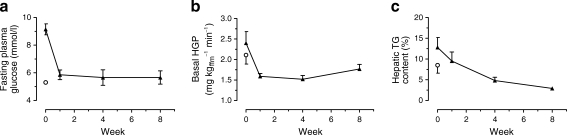
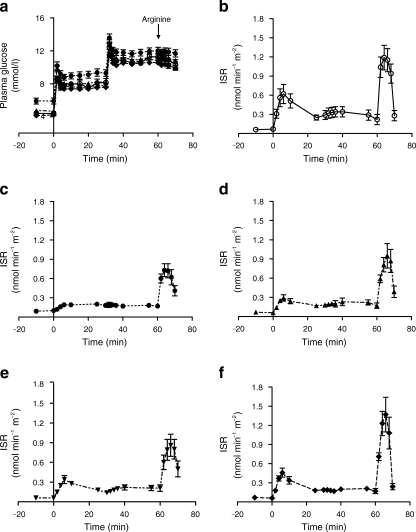
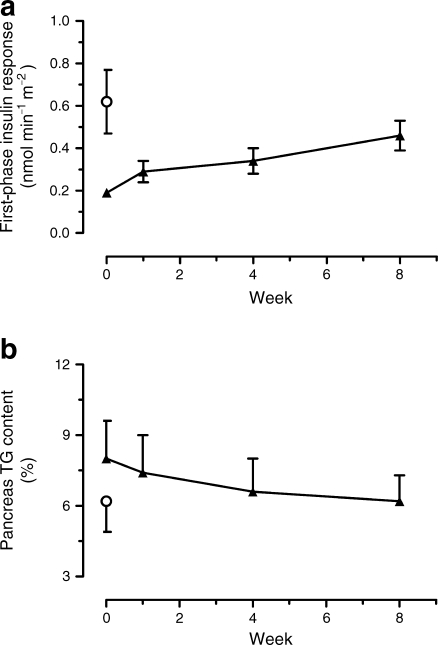
AIMS/HYPOTHESIS: Type 2 diabetes is regarded as inevitably progressive, with irreversible beta cell failure. The hypothesis was tested that both beta cell failure and insulin resistance can be reversed by dietary restriction of energy intake. METHODS: Eleven people with type 2 diabetes (49.5 ± 2.5 years, BMI 33.6 ± 1.2 kg/m(2), nine male and two female) were studied before and after 1, 4 and 8 weeks of a 2.5 MJ (600 kcal)/day diet. Basal hepatic glucose output, hepatic and peripheral insulin sensitivity and beta cell function were measured. Pancreas and liver triacylglycerol content was measured using three-point Dixon magnetic resonance imaging. An age-, sex- and weight-matched group of eight non-diabetic participants was studied. RESULTS: After 1 week of restricted energy intake, fasting plasma glucose normalised in the diabetic group (from 9.2 ± 0.4 to 5.9 ± 0.4 mmol/l; p = 0.003). Insulin suppression of hepatic glucose output improved from 43 ± 4% to 74 ± 5% (p = 0.003 vs baseline; controls 68 ± 5%). Hepatic triacylglycerol content fell from 12.8 ± 2.4% in the diabetic group to 2.9 ± 0.2% by week 8 (p = 0.003). The first-phase insulin response increased during the study period (0.19 ± 0.02 to 0.46 ± 0.07 nmol min(-1) m(-2); p < 0.001) and approached control values (0.62 ± 0.15 nmol min(-1) m(-2); p = 0.42). Maximal insulin response became supranormal at 8 weeks (1.37 ± 0.27 vs controls 1.15 ± 0.18 nmol min(-1) m(-2)). Pancreatic triacylglycerol decreased from 8.0 ± 1.6% to 6.2 ± 1.1% (p = 0.03). CONCLUSIONS/INTERPRETATION: Normalisation of both beta cell function and hepatic insulin sensitivity in type 2 diabetes was achieved by dietary energy restriction alone. This was associated with decreased pancreatic and liver triacylglycerol stores. The abnormalities underlying type 2 diabetes are reversible by reducing dietary energy intake.
Overview
The claims and statistics of this paper haven’t been checked yet.
Free: it reads the open-access text and checks the first 5 claims that cite a source we can check. Create a free account to check every claim.
Integrity signals
Registry
Cites
Statistics
Figures
Verification
Claims the paper makes
The claims and statistics of this paper haven’t been checked yet.
Free: it reads the open-access text and checks the first 5 claims that cite a source we can check. Create a free account to check every claim.
Claims other papers make about this one
Each is checked against this paper’s own text: does it say what the citing paper says it does?
The source backs part of the claim, not all of it — or backs it for a different population, condition or comparison.
In the citing paper
“Previously considered permanent and demanding life-long drug treat ment, type 2 diabetes is now recognised to be a potentially reversible consequence of excessive or abnormal accumulation of body fat (ie, the disease process of obesity). 5”
From 5-year follow-up of the randomised Diabetes Remission Clinical Trial (DiRECT) of continued support for weight loss maintenance in the UK: an extension study (2024) · cites this paper as [5]
Experimental — accuracy not yet measuredThe source backs part of the claim, not all of it — or backs it for a different population, condition or comparison.
In the citing paper
“During an intensive weight loss programme, or early after bariatric surgery, there are already significant improvements in hepatic and muscle insulin sensitivity, and pancreatic first-phase insulin secretion, with rapid loss of ectopic fat from skeletal muscle and liver [2, 3, 6].”
From Diets for weight management in adults with type 2 diabetes: an umbrella review of published meta-analyses and systematic review of trials of diets for diabetes remission (2022) · cites this paper as [6]
Experimental — accuracy not yet measuredThe source backs part of the claim, not all of it — or backs it for a different population, condition or comparison.
In the citing paper
“the twin cycle mechanism, driven by a damaging but reversible accumulation of ectopic fat within the liver and pancreas in susceptible individuals, has now been consistently observed. 6-8”
From Durability of a primary care-led weight-management intervention for remission of type 2 diabetes: 2-year results of the DiRECT open-label, cluster-randomised trial (2019) · cites this paper as [6]
Experimental — accuracy not yet measuredThe source backs part of the claim, not all of it — or backs it for a different population, condition or comparison.
In the citing paper
“Type 2 diabetes is strongly related to weight gain in adult life and accumulation of excess fat within the liver and pancreas.”
From Primary care-led weight management for remission of type 2 diabetes (DiRECT): an open-label, cluster-randomised trial (2018) · cites this paper as [4]
Experimental — accuracy not yet measuredThe cited source says what the claim attributes to it.
In the citing paper
“Although lifestyle interventions393 and weight loss394 reverse T2DM in early stages, when insulin is still secreted, T2DM patients may become dependent on anti-diabetic drugs in later stages.”
From Pancreatic regulation of glucose homeostasis. (2016) · cites this paper as [394]
9 more claims about this paper
Create a free account to see every claim other papers make about this one.
Self-check
Percentages, sums and reported differences re-computed from the paper’s own numbers.
The self-check needs the paper’s full text.
Citations
Cites
The metabolic phenotype in obesity: Fat mass, body fat distribution, and adipose tissue function
Goossens, G. H. (2017) · Obesity Facts · doi:10.1159/000471488 · Cited by 8,481
Turner, R. C., Fox, C., Matthews, McElroy, H. H., Cull, C. A., Holman, R. R., Neil, P., Hadden, D. R., Wright, D., Manley, E., et al. (1998) · The Lancet · Cited by 8,419
Glucose clamp technique: a method for quantifying insulin secretion and resistance.
DeFronzo, R. A., Tobin, J. D., & Andres, R. (1979) · American Journal of Physiology-Endocrinology and Metabolism · doi:10.1152/ajpendo.1979.237.3.e214 · Cited by 7,425 · cited 2×
“An isoglycaemic–hyperinsulinaemic clamp (insulin infusion rate 40 mU m min) was initiated at 0 min [14].”
Methodβ-Cell Deficit and Increased β-Cell Apoptosis in Humans With Type 2 Diabetes
Butler, A. E., Janson, J., Bonner-Weir, S., Ritzel, R., Rizza, R. A., & Butler, P. C. (2003) · Diabetes · doi:10.2337/diabetes.52.1.102 · Cited by 4,011 · cited 1×
“The underlying changes in beta cell function have been well described [3, 4], and beta-cell mass decreases steadily during the course of type 2 diabetes [5, 6].”
BackgroundGupta, A., & Uribarri, J. (2016) · Hormone Research in Paediatrics · doi:10.1159/000444053 · Cited by 4,006
Kahn, S. E. (2003) · Diabetologia · doi:10.1007/s00125-002-1009-0 · Cited by 2,166 · cited 1×
“The underlying changes in beta cell function have been well described [3, 4], and beta-cell mass decreases steadily during the course of type 2 diabetes [5, 6].”
BackgroundWeyer, C., Bogardus, C., Mott, D. M., & Pratley, R. E. (1999) · Journal of Clinical Investigation · doi:10.1172/jci7231 · Cited by 1,940 · cited 2×
“Absence of rapid insulin secretion in response to a rise in plasma glucose is the hallmark of type 2 diabetes [3, 21], and the decline in beta cell function determines the progression towards a need for insulin therapy [2].”
BackgroundU.K. Prospective Diabetes Study Group (1995) · Diabetes · doi:10.2337/diab.44.11.1249 · Cited by 1,923
Szczepaniak, L. S., Nurenberg, P., Leonard, D., Browning, J. D., Reingold, J. S., Grundy, S., Hobbs, H. H., & Dobbins, R. L. (2005) · American Journal of Physiology-Endocrinology and Metabolism · doi:10.1152/ajpendo.00064.2004 · Cited by 1,562 · cited 1×
“It continued to decline throughout the intervention period to reach the normal range for non-obese individuals [20] (2.”
Background
Cited by
Items 201–300 of 1,001
Goedeke, L., Perry, R. J., & Shulman, G. I. (2019) · Annual Review of Pharmacology and Toxicology · doi:10.1146/annurev-pharmtox-010716-104727 · Cited by 77
Unwin, D., Delon, C., Unwin, J., Tobin, S., & Taylor, R. (2023) · BMJ Nutrition, Prevention & Health · doi:10.1136/bmjnph-2022-000544 · Cited by 72
“4 24 29 It is likely that weight loss by any means can induce remission.”
Self-citationSynthesis, In vitro and Docking Studies of New Flavone Ethers as α‐Glucosidase Inhibitors
Imran, S., Taha, M., Ismail, N. H., Kashif, S. M., Rahim, F., Jamil, W., Wahab, H. A., & Khan, K. M. (2015) · Chemical Biology & Drug Design · doi:10.1111/cbdd.12666 · Cited by 78
Cimo, A., Stergiopoulos, E., Cheng, C., Bonato, S., & Dewa, C. S. (2012) · BMC Psychiatry · doi:10.1186/1471-244x-12-24 · Cited by 74
“’s [38] paper suggests that weight loss enabled by restricting calories to 600 kcal/day is an effective method to decrease BMI within the general type II diabetes population (P < 0.”
MethodKhan, J. N., Wilmot, E. G., Leggate, M., Singh, A., Yates, T. E., Nimmo, M. A., Khunti, K., Horsfield, M. A., Biglands, J. D., Clarysse, P., et al. (2014) · European Heart Journal - Cardiovascular Imaging · doi:10.1093/ehjci/jeu121 · Cited by 76
Valabhji, J., Gorton, T., Barron, E., Safazadeh, S., Earnshaw, F., Helm, C., Virr, M., Kernan, J., Crowe, S., Aveyard, P., et al. (2024) · The Lancet Diabetes & Endocrinology · doi:10.1016/s2213-8587(24)00194-3 · Cited by 72
Self-citationRemission of Type 2 Diabetes Mellitus after Bariatric Surgery: Fact or Fiction?
Tsilingiris, D., Koliaki, C. C., & Kokkinos, A. D. (2019) · International Journal of Environmental Research and Public Health · doi:10.3390/ijerph16173171 · Cited by 86
“It could even restore the impaired first phase of insulin secretion, which is an early hallmark in the course of T2DM pathogenesis [23].”
BackgroundDietary strategies for remission of type 2 diabetes: A narrative review
Brown, A. C., McArdle, P., Taplin, J., Unwin, D., Unwin, J., Deakin, T., Wheatley, S. D., Murdoch, C., Malhotra, A., & Mellor, D. D. (2021) · Journal of Human Nutrition and Dietetics · doi:10.1111/jhn.12938 · Cited by 83
Altered promoter methylation of PDK4, IL1 B, IL6, and TNF after Roux-en Y gastric bypass
Kirchner, H., Nylén, C., Laber, S., Barrès, R., Yan, J., Krook, A., Zierath, J. R., & Näslund, E. B. (2014) · Surgery for Obesity and Related Diseases · doi:10.1016/j.soard.2013.12.019 · Cited by 79
“Other studies have shown that a stricter dietary restriction of 500–600 kcal/d has a more profound effect on metabolic health [8,9].”
BackgroundArachidonic and oleic acid exert distinct effects on the DNA methylome
Silva-Martínez, G. A., Rodríguez‐Ríos, D., Alvarado‐Caudillo, Y., Vaquero, A., Esteller, M., Carmona, F. J., Morán, S., Nielsen, F. C., Lindholm, M., Wróbel, K., et al. (2016) · Epigenetics · doi:10.1080/15592294.2016.1161873 · Cited by 79
“Conversely, a low-fat, low-carbohydrate diet can lead to normalization of cell function and insulin resistance in individuals with type 2 diabetes.(75) However,”
BackgroundTaylor, R., Barnes, A. C., Hollingsworth, K. G., Irvine, K. M., Solovyova, A. S., Clark, L., Kelly, T., Martin-Ruiz, C., Romeres, D., Koulman, A., et al. (2023) · Clinical Science · doi:10.1042/cs20230586 · Cited by 71
Self-citationRosenfeld, R. M., Kelly, J. H., Agarwal, M., Aspry, K., Barnett, T., Davis, B. C., Fields, D., Gaillard, T., Gulati, M., Guthrie, G. E., et al. (2022) · American Journal of Lifestyle Medicine · doi:10.1177/15598276221087624 · Cited by 71
Steven, S., Hollingsworth, K. G., Small, P. K., Woodcock, S. A., Pucci, A., Aribasala, B., Al‐Mrabeh, A., Batterham, R. L., & Taylor, R. (2016) · Diabetic Medicine · doi:10.1111/dme.13257 · Cited by 71
Self-citationBi, Y., Zhang, B., Xu, W., Yang, H., Feng, W., Li, C., Tong, G., Li, M., Wang, X., Shen, S., et al. (2014) · Acta Diabetologica · doi:10.1007/s00592-014-0638-3 · Cited by 75
Nutritional basis of type 2 diabetes remission
Taylor, R., Ramachandran, A., Yancy, W. S., & Forouhi, N. G. (2021) · BMJ · doi:10.1136/bmj.n1449 · Cited by 59
Self-citationZhyzhneuskaya, S. V., Al-Mrabeh, A., Peters, C., Barnes, A., Aribisala, B., Hollingsworth, K. G., McConnachie, A., Sattar, N., Lean, M. E. J., & Taylor, R. (2020) · Diabetes Care · doi:10.2337/dc19-0371 · Cited by 70
“The protocol for DiRECT was informed by the Counterpoint study and the early results of the Counterbalance study, which showed no return of first-phase insulin secretion beyond 11 years of diagnosis (15,16).”
BackgroundMethodInfluentialSelf-citationPopulation response to information on reversibility of Type 2 diabetes
Steven, S., Lim, E. L., & Taylor, R. (2013) · Diabetic Medicine · doi:10.1111/dme.12116 · Cited by 69
Self-citationBerman, M. A., Guthrie, N. L., Edwards, K. L., Appelbaum, K. J., Njike, V. Y., Eisenberg, D. M., & Katz, D. L. (2018) · JMIR Diabetes · doi:10.2196/diabetes.9591 · Cited by 67
“This is important because many situations that are not conducive to long-term health can ameliorate glycemic measures in the short term, among them starvation and serious infectious disease [38].”
BackgroundRehackova, L., Araújo‐Soares, V., Adamson, A. J., Steven, S., Taylor, R., & Sniehotta, F. F. (2017) · Diabetic Medicine · doi:10.1111/dme.13426 · Cited by 69
Self-citationChen, C., Liu, L., Lo, K. K.-H., Huang, J., Yu, Y., Huang, Y., & Feng, Y. (2020) · Frontiers in Cardiovascular Medicine · doi:10.3389/fcvm.2020.610322 · Cited by 81
7. Obesity Management for the Treatment of Type 2 Diabetes
American Diabetes Association (2016) · Diabetes Care · doi:10.2337/dc17-s010 · Cited by 90
Increased Hepatic Insulin Clearance After Roux-en-Y Gastric Bypass
Bojsen-Møller, K. N., Dirksen, C., Jørgensen, N. B., Jacobsen, S. H., Hansen, D. L., Worm, D., Naver, L., Kristiansen, V. B., Holst, J. J., & Madsbad, S. (2013) · The Journal of Clinical Endocrinology & Metabolism · doi:10.1210/jc.2013-1286 · Cited by 72
“Short-term calorie restriction in patients with type 2 diabetes improves hepatic insulin sensitivity independently of weight loss (15, 16) and is associated with reductions in liver fat content (17, 18).”
BackgroundMetabolic Mechanisms in Obesity and Type 2 Diabetes: Insights from Bariatric/Metabolic Surgery
Cătoi, A. F., Pârvu, A., Mureşan, A., & Busetto, L. (2015) · Obesity Facts · doi:10.1159/000441259 · Cited by 68
Antoni, R., Johnston, K. L., Collins, A. L., & Robertson, M. D. (2016) · British Journal of Nutrition · doi:10.1017/s0007114515005346 · Cited by 68
Epigenetic mechanisms of macrophage activation in type 2 diabetes
Ahmed, M., de Winther, M. P. J., & den Bossche, J. V. (2016) · Immunobiology · doi:10.1016/j.imbio.2016.08.011 · Cited by 78
Brouwers, B., Schrauwen-Hinderling, V. B., Jelenik, T., Gemmink, A., Sparks, L. M., Havekes, B., Bruls, Y., Dahlmans, D., Roden, M., Hesselink, M. K. C., et al. (2018) · American Journal of Physiology-Endocrinology and Metabolism · doi:10.1152/ajpendo.00266.2017 · Cited by 69
“Contrary, reductions in IHL content following low-calorie diets in people with NAFL were paralleled by improvements in hepatic insulin sensitivity (29, 37).”
BackgroundWhy a d -β-hydroxybutyrate monoester?
Soto-Mota, A., Norwitz, N. G., & Clarke, K. (2020) · Biochemical Society Transactions · doi:10.1042/bst20190240 · Cited by 77
Wu, Y., Min, H., Li, M., Shi, Y., Ma, A., Han, Y., Gan, Y.-D., Guo, X., & Sun, X. (2023) · BMC Public Health · doi:10.1186/s12889-023-16066-z · Cited by 80
A Gut Feeling to Cure Diabetes: Potential Mechanisms of Diabetes Remission after Bariatric Surgery
Cho, Y. M. (2014) · Diabetes & Metabolism Journal · doi:10.4093/dmj.2014.38.6.406 · Cited by 64
“Although the exact mechanism of improved hepatic insulin sensitivity after RYGB is still elusive, decreased intrahepatic fat content may be responsible [54].”
BackgroundAl-Mrabeh, A., Hollingsworth, K. G., Steven, S., & Taylor, R. (2016) · Diabetologia · doi:10.1007/s00125-016-3984-6 · Cited by 64
“the pancreas, as previously described [7].”
MethodSelf-citationType 2 diabetes: one disease, many pathways
Ha, J., & Sherman, A. (2020) · American Journal of Physiology-Endocrinology and Metabolism · doi:10.1152/ajpendo.00512.2019 · Cited by 70
Glucokinase activity in diabetes: too much of a good thing?
Ashcroft, F. M., Lloyd, M., & Haythorne, E. (2022) · Trends in Endocrinology and Metabolism · doi:10.1016/j.tem.2022.12.007 · Cited by 74
Saisho, Y. (2016) · The Review of Diabetic Studies · doi:10.1900/rds.2016.13.132 · Cited by 73
“Lim et al. (2011) [127] T2D: 11 NDM: 8 MRI Dietary energy restriction for 8 weeks decreased pancreatic fat and improved beta-cell function Szczepaniak et al. (2012) [126] NDM: 100 MRS Positive association between pancreatic fat and insulin secretion in black and white, but not Hispanic,…”
MethodTang, W., Xu, Q., Hong, T., Tong, G., Feng, W., Shen, S., Bi, Y., & Zhu, D. (2016) · Diabetes/Metabolism Research and Reviews · doi:10.1002/dmrr.2713 · Cited by 63
“Previous observations also demonstrated that hepatic steatosis was significantly reduced when a similar reduction in body weight was achieved, regardless of lifestyle or dietary intervention, or treatments with exenatide, insulin or pioglitazone [29,41,55,56], also supporting the beneficial effect of weight loss on NA…”
BackgroundCan medical therapy mimic the clinical efficacy or physiological effects of bariatric surgery?
Miras, A. D., & le Roux, C. W. (2014) · International Journal of Obesity · doi:10.1038/ijo.2013.205 · Cited by 64
Type 2 Diabetes: One Disease, Many Pathways
Ha, J., & Sherman, A. (2019) · doi:10.1101/648816 · Cited by 63
Bastin, M., & Andreelli, F. (2019) · Diabetes, Metabolic Syndrome and Obesity: Targets and Therapy · doi:10.2147/dmso.s191438 · Cited by 62
van Raalte, D. H., & Verchere, C. B. (2017) · Diabetes Obesity and Metabolism · doi:10.1111/dom.12935 · Cited by 69
“Also in patients with established T2D, a robust change in diet consisting of 600 kcal/d, leading to a negative energy balance, can quickly improve beta-cell function as measured by hyperglycaemic clamp.(54) This improvement was shown to last for over 6 months in 40% of participants in another study using a very lowcal…”
BackgroundEffect of a low-calorie diet on restoration of normoglycemia in obese subjects with type 2 diabetes
Unnikrishnan, A., Bhatt, A., Choudhari, P., Mahajan, R., Sayyad, M., Pratyush, D., Hasan, I., Javherani, R., Bothale, M., & Purandare, V. (2017) · Indian Journal of Endocrinology and Metabolism · doi:10.4103/ijem.ijem_206_17 · Cited by 61
“It is proposed that this state of acute energy crisis necessitates the utilization of the excess circulating glucose with corresponding improvement in insulin sensitivity as well as beta cell secretory capacity as measured by clamp studies.[2] It also results in the reduction of triglyceride stored in the liver as mea…”
InfluentialRehackova, L., Arnott, B., Araujo‐Soares, V., Adamson, A. A., Taylor, R., & Sniehotta, F. F. (2016) · Diabetic Medicine · doi:10.1111/dme.13005 · Cited by 60
Self-citationGutierrez‐Mariscal, F. M., Cardelo, M. P., de la Cruz, S., Alcala‐Diaz, J. F., Roncero‐Ramos, I., Guler, I., Vals‐Delgado, C., López‐Moreno, A., Luque, R. M., Delgado‐Lista, J., et al. (2021) · Molecular Nutrition & Food Research · doi:10.1002/mnfr.201901290 · Cited by 60
Fumarate Hydratase Deletion in Pancreatic β Cells Leads to Progressive Diabetes
Adam, J., Ramracheya, R., Chibalina, M. V., Ternette, N., Hamilton, A., Tarasov, A. I., Zhang, Q., Rebelato, E., Rorsman, N. J. G., Martín-del-Río, R., et al. (2017) · Cell Reports · doi:10.1016/j.celrep.2017.08.093 · Cited by 61
“This agrees with the report that GSIS is restored in long-term T2D patients following normalization of plasma glucose levels and suppression of hepatic glucose production induced by a low-calorie diet (Lim et al., 2011).”
ResultUmphonsathien, M., Rattanasian, P., Lokattachariya, S., Suansawang, W., Boonyasuppayakorn, K., & Khovidhunkit, W. (2022) · Journal of Diabetes Investigation · doi:10.1111/jdi.13619 · Cited by 58
Pathophysiology of type 2 diabetes in sub-Saharan Africans
Goedecke, J. H., & Mendham, A. E. (2022) · Diabetologia · doi:10.1007/s00125-022-05795-2 · Cited by 250
“Very low energy (very low calorie diets [VLCDs]) and low-carbohydrate diets are associated with reduced insulin secretion [48, 58] and may be more appropriate for populations with hyperinsulinaemia.”
BackgroundStrong and persistent effect on liver fat with a Paleolithic diet during a two-year intervention
Otten, J., Mellberg, C., Ryberg, M., Sandberg, S., Kullberg, J., Lindahl, B., Larsson, C. L., Hauksson, J. B., & Olsson, T. (2016) · International Journal of Obesity · doi:10.1038/ijo.2016.4 · Cited by 67
Podell, B. K., Ackart, D. F., Richardson, M. A., DiLisio, J. E., Pulford, B. E., & Basaraba, R. J. (2017) · Disease Models & Mechanisms · doi:10.1242/dmm.025593 · Cited by 71
“Consistent with this finding in human patients, our guinea-pig model also accumulated triglycerides in the liver (Lim et al., 2011).”
Frankowski, R., Kobierecki, M., Wittczak, A., Różycka-Kosmalska, M., Pietras, T., Sipowicz, K., & Kosmalski, M. (2023) · International Journal of Molecular Sciences · doi:10.3390/ijms24119677 · Cited by 58
Sattar, N., Welsh, P., Leslie, W. S., Thom, G., McCombie, L., Brosnahan, N., Richardson, J., Gill, J. M. R., Crawford, L., & Lean, M. E. J. (2023) · The Lancet Regional Health - Southeast Asia · doi:10.1016/j.lansea.2022.100111 · Cited by 58
“The DiRECT trial con fi rmed earlier suggestions from Counterpoint 19 that ectopic fat, speci fi cally liver fat likely plays a key role in the pathogenesis of T2D and its remission, in line with recent genetic data.”
BackgroundGuess, N. D. (2018) · Nutrients · doi:10.3390/nu10091245 · Cited by 78
“As described above, marked energy restriction and/or weight loss can restore the first-phase insulin response in people with established T2D [45,46,50], but moderate weight loss or physical activity does not appear to [57,58,72–74].”
BackgroundKetogenic diets as treatment of obesity and type 2 diabetes mellitus
Casanueva, F. F., Castellana, M., Bellido, D., Trimboli, P., Castro, A. I., Sajoux, I., Rodríguez-Carnero, G., Gómez-Arbeláez, D., Crujeiras, A. B., & Olmos, M. Á. M. (2020) · Reviews in Endocrine and Metabolic Disorders · doi:10.1007/s11154-020-09580-7 · Cited by 61
Molecular mechanisms of lipotoxicity-induced pancreatic β-cell dysfunction
Benito‐Vicente, A., Jebari‐Benslaiman, S., Galicia-García, U., Larrea, A., Uribe, K. B., & Martín, C. (2021) · International review of cytology · doi:10.1016/bs.ircmb.2021.02.013 · Cited by 65
Cameron, K. M., Miwa, S., Walker, C., & von Zglinicki, T. (2012) · Longevity & Healthspan · doi:10.1186/2046-2395-1-3 · Cited by 55
“Previous data show this is indeed the case with only a short period of DR (ad libitum (AL)-DR crossover), in people with type 2 diabetes [6] and in rodents [7-9].”
BackgroundRöhling, M., Kempf, K., Banzer, W., Berg, A., Braumann, K.-M., Tan, S., Halle, M., McCarthy, D., Pinget, M., Predel, H.-G., et al. (2020) · Nutrients · doi:10.3390/nu12072022 · Cited by 55
Taylor, R., Leslie, W. S., Barnes, A. C., Brosnahan, N., Thom, G., McCombie, L., Sattar, N., Welsh, P., Peters, C., Zhyzhneuskaya, S., et al. (2018) · Diabetologia · doi:10.1007/s00125-017-4503-0 · Cited by 55
“In the early years after diagnosis type 2 diabetes has been shown to be a reversible metabolic condition [1, 2].”
BackgroundResultSelf-citationSteven, S., Carey, P. E., Small, P. K., & Taylor, R. (2015) · Diabetic Medicine · doi:10.1111/dme.12567 · Cited by 55
Self-citationβ- cell dynamics in type 2 diabetes and in dietary and exercise interventions
Lv, C.-A., Sun, Y., Zhang, Z. Y., Aboelela, Z., Qiu, X., & Meng, Z. (2022) · Journal of Molecular Cell Biology · doi:10.1093/jmcb/mjac046 · Cited by 62
Legaard, G. E., Lyngbæk, M. P. P., Almdal, T., Karstoft, K., Bennetsen, S. L., Feineis, C. S., Nielsen, N. S., Durrer, C. G., Liebetrau, B., Nystrup, U., et al. (2023) · Nature Metabolism · doi:10.1038/s42255-023-00799-7 · Cited by 66
“The PP population criteria included (1) completion of the primary outcome assessment (all groups), (2) compliance with the diet protocol defined as being within ±30% of the prescribed energy intake (DCON, MED and HED), and (3) compliance with the exercise training protocol defined as completing ≥70% of the prescribed…”
BackgroundMethodInfluentialJanssen, J. A. M. J. L. (2024) · International Journal of Molecular Sciences · doi:10.3390/ijms25105488 · Cited by 254
“This remission of diabetes was simultaneously associated with a decreased storage of excessive fat in the liver and the pancreas, supporting that most abnormalities underlying type 2 diabetes can be reversed in a short time by reducing dietary energy intake [139].”
BackgroundInfluentialMartins, F. M., Souza, A. D. P., Nunes, P. R. P., Michelin, M. A., Murta, E. F. C., Resende, E. A. M. R., de Oliveira, E. P., & Orsatti, F. L. (2018) · Experimental Gerontology · doi:10.1016/j.exger.2018.02.016 · Cited by 63
“For instance, whereas one week of a diet low in energy (600 kcal) reduces 30% of liver fat content and 35% of fasting glucose (Lim et al., 2011), eight months of aerobic training or COMT reduces 6% or 4%, respectively (Slentz et al.”
BackgroundPasman, W. J., Memelink, R. G., de Vogel-Van den Bosch, J., Begieneman, M. P. V., van den Brink, W. J., Weijs, P. J. M., & Wopereis, S. (2020) · Nutrients · doi:10.3390/nu12102979 · Cited by 52
Isolation and in silico evaluation of antidiabetic molecules of Cynodon dactylon (L.)
Annapurna, H. V., Apoorva, B., Natesan, R., Purushothaman, A. K., Brindha, P., Swaminathan, S., Vijayalakshmi, M., & Arumugam, N. (2012) · Journal of Molecular Graphics and Modelling · doi:10.1016/j.jmgm.2012.10.009 · Cited by 53
Effect of LX4211 on Glucose Homeostasis and Body Composition in Preclinical Models
Powell, D. R., DaCosta, C. M., Smith, M. G., Doree, D. D., Harris, A. L., Buhring, L., Heydorn, W. E., Nouraldeen, A. M., Xiong, W., Yalamanchili, P., et al. (2014) · Journal of Pharmacology and Experimental Therapeutics · doi:10.1124/jpet.114.214304 · Cited by 58
“In rats, the lowest dose tested (0.3 mg/kg) increased UGE, the maximal 24-hour UGE was 5.1 g/d, and the ED50 was estimated to be 0.75 mg/kg (Fig.”
BackgroundInfluentialXin, Y., Davies, A., Briggs, A., McCombie, L., Messow, C. M., Grieve, E., Leslie, W. S., Taylor, R., & Lean, M. E. J. (2020) · Diabetologia · doi:10.1007/s00125-020-05224-2 · Cited by 52
Self-citationProgressing From Metformin to Sulfonylureas or Meglitinides
Grant, J. S., & Graven, L. J. (2016) · Workplace Health & Safety · doi:10.1177/2165079916644263 · Cited by 58
Reversal of type 2 diabetes in youth who adhere to a very-low-energy diet: a pilot study
Gow, M. L., Baur, L. A., Johnson, N. A., Cowell, C. T., & Garnett, S. P. (2016) · Diabetologia · doi:10.1007/s00125-016-4163-5 · Cited by 59
Diabetes and dyslipidemia: characterizing lipoprotein metabolism
TOMKIN, G. H., & Owens, D. (2017) · Diabetes Metabolic Syndrome and Obesity · doi:10.2147/dmso.s115855 · Cited by 63
Hallberg, S. J., Dockter, N. E., Kushner, J. A., & Athinarayanan, S. J. (2019) · Diabetes Obesity and Metabolism · doi:10.1111/dom.13736 · Cited by 56
Normal weight dyslipidemia: Is it all about the liver?
Ipsen, D. H., Tveden‐Nyborg, P., & Lykkesfeldt, J. (2016) · Obesity · doi:10.1002/oby.21443 · Cited by 66
2020 vision – An overview of prospects for diabetes management and prevention in the next decade
Wang, C., Neil, D. L., & Home, P. (2018) · Diabetes Research and Clinical Practice · doi:10.1016/j.diabres.2018.06.007 · Cited by 59
Tian, S., Li, X., Wang, Y., & Lu, Y. (2020) · Food Science & Nutrition · doi:10.1002/fsn3.2040 · Cited by 52
“…National Key Research and Development Program of China, Grant/Award Number: 2019YFC1606400 K E Y W O R D S glucose intolerance, intestinal flora, NAFLD, sulforaphane, type II diabetes lead to damage to islet cells which in turn leads to a decrease in insulin secretion (Lim et al., 2011).”
BackgroundThe dark side of the spoon - glucose, ketones and COVID-19: a possible role for ketogenic diet?
Paoli, A., Gorini, S., & Caprio, M. (2020) · Journal of Translational Medicine · doi:10.1186/s12967-020-02600-9 · Cited by 54
Changes in body composition and metabolic disease risk
Pi-Sunyer, X. (2018) · European Journal of Clinical Nutrition · doi:10.1038/s41430-018-0320-x · Cited by 54
Managing NAFLD in Type 2 Diabetes: The Effect of Lifestyle Interventions, a Narrative Review
Parry, S. A., & Hodson, L. (2020) · Advances in Therapy · doi:10.1007/s12325-020-01281-6 · Cited by 56
Digital Health Coaching for Type 2 Diabetes: Randomized Controlled Trial of Healthy at Home
Azelton, K. R., Crowley, A. P., Vence, N., Underwood, K., Morris, G., Kelly, J., & Landry, M. J. (2021) · Frontiers in Digital Health · doi:10.3389/fdgth.2021.764735 · Cited by 49
“Prior studies achieving T2DM reversal or improvement are often performed in controlled environments and typically focus on aggressive nutrition changes and weight loss (20, 90, 91).”
BackgroundMacauley, M., Smith, F. E., Thelwall, P. E., Hollingsworth, K. G., & Taylor, R. (2015) · Clinical Science · doi:10.1042/cs20140681 · Cited by 50
Self-citationRole of proximal gut exclusion from food on glucose homeostasis in patients with Type 2 diabetes
COHEN, R. V., le Roux, C. W., Papamargaritis, D., Salles, J. E. N., Petry, T. B. Z., Correa, J. L., Pournaras, D. J., Neto, M. G., Martins, B. D. C., Sakai, P., et al. (2013) · Diabetic Medicine · doi:10.1111/dme.12268 · Cited by 53
Improved glucose metabolism after gastric bypass: evolution of the paradigm
Pournaras, D. J., Nygren, J., Hagström-Toft, E., Arner, P., le Roux, C. W., & Thorell, A. (2016) · Surgery for Obesity and Related Diseases · doi:10.1016/j.soard.2016.03.020 · Cited by 48
“First, restriction of caloric intake has been found to improve insulin sensitivity [8].”
BackgroundVerburgh, K. (2015) · Aging Cell · doi:10.1111/acel.12284 · Cited by 48
“Some interventions can slow down the progress of these aging-related diseases or even reverse them, like type 2 diabetes or cardiovascular disease (Lim et al., 2011; De Lorgeril et al., 1994).”
BackgroundKempf, K., Röhling, M., Niedermeier, K., Gärtner, B., & Martin, S. (2018) · Nutrients · doi:10.3390/nu10081022 · Cited by 56
“These results are confirmative regarding other studies with low-calorie diets in patients with a short- and long-duration type 2 diabetes and moderate [14] or poor glycemic control [10,15].”
BackgroundMethodResultInfluentialBoland, B. B., Brown, C., Boland, M. L., Cann, J., Sulikowski, M., Hansen, G., Grønlund, R. V., King, W., Rondinone, C., Trevaskis, J., et al. (2019) · Diabetes · doi:10.2337/db18-0304 · Cited by 47
“There is some precedence for this by improving insulin sensitivity in specific situations, such as gestational diabetes (6), marked calorie restriction (7), or short-term direct inhibition of endogenous insulin secretion in obese T2D (8).”
BackgroundUnwin, D., & Unwin, J. (2014) · Practical Diabetes · doi:10.1002/pdi.1835 · Cited by 44
Determinants of ectopic liver fat in metabolic disease
Bosy‐Westphal, A., Braun, W., Albrecht, V., & Müller, M. J. (2018) · European Journal of Clinical Nutrition · doi:10.1038/s41430-018-0323-7 · Cited by 55
Romano, L., Marchetti, M., Gualtieri, P., Di Renzo, L., Belcastro, M., De Santis, G. L., Perrone, M. A., & De Lorenzo, A. (2019) · Nutrients · doi:10.3390/nu11071526 · Cited by 47
“, it has been shown that a very low calorie diet (VLCD) may be effective in the treatment of obesity and reversal of DMT2 [8,9].”
BackgroundMethodResultInfluential(Anti)Fragility and Convex Responses in Medicine
Taleb, N. N. (2018) · Springer proceedings in complexity · doi:10.1007/978-3-319-96661-8_32 · Cited by 50
“For diabetes, remission or reversal: Taylor (2008) [30], Lim et al. (2011) [31], Boucher et al. (2004) [32]; diabetes management by diet alone, early insights in Wilson et al. (1980) [33].”
BackgroundKowalski, G. M., Kloehn, J., Burch, M. L., Selathurai, A., Hamley, S., Bayol, S. A., Lamon, S., Watt, M. J., Lee, R. S., McConville, M. J., et al. (2014) · Biochimica et Biophysica Acta (BBA) - Molecular and Cell Biology of Lipids · doi:10.1016/j.bbalip.2014.12.002 · Cited by 49
The Role of PYY in Pancreatic Islet Physiology and Surgical Control of Diabetes
Guida, C., Stephen, S., Guitton, R., & Ramracheya, R. D. (2017) · Trends in Endocrinology and Metabolism · doi:10.1016/j.tem.2017.04.005 · Cited by 49
Henquin, J. (2021) · Molecular Metabolism · doi:10.1016/j.molmet.2021.101212 · Cited by 55
“In addition, brief clamping of blood glucose at G8 abolished the first phase response expected from further elevation to G12-G15 [85,86].”
BackgroundSvendsen, P. F., Jensen, F. K., Holst, J. J., Haugaard, S. B., Nilas, L., & Madsbad, S. (2012) · Scandinavian Journal of Clinical and Laboratory Investigation · doi:10.3109/00365513.2012.691542 · Cited by 47
Lagerpusch, M., Bosy-Westphal, A., Kehden, B., Peters, A., & Müller, M. J. (2012) · International Journal of Obesity · doi:10.1038/ijo.2011.211 · Cited by 45
Remission of Type 2 Diabetes with Very Low-Calorie Diets—A Narrative Review
Juray, S., Axen, K. V., & Trasino, S. E. (2021) · Nutrients · doi:10.3390/nu13062086 · Cited by 45
“The normalization of FPG to non-diabetic levels after just 7 days occurred with a modest weight loss of approximately 4% of initial body weight, but a 30% decrease in ectopic pancreatic and hepatic triglyceride [17].”
BackgroundMethodResultInfluentialTranslating aetiological insight into sustainable management of type 2 diabetes
Taylor, R., & Barnes, A. C. (2017) · Diabetologia · doi:10.1007/s00125-017-4504-z · Cited by 49
“Over the past decade the predictions of this twin cycle hypothesis have been tested using as a dynamic tool a low-energy diet [2, 3].”
BackgroundInfluentialSelf-citationRoss, R., Soni, S., & Houle, S. (2020) · Nutrients · doi:10.3390/nu12040891 · Cited by 64
The Role of Beta Cell Recovery in Type 2 Diabetes Remission
Suleiman, M., Marselli, L., Cnop, M., Eizirik, D. L., Luca, C. D., Femia, F. R., Tesi, M., Guerra, S. D., & Marchetti, P. (2022) · International Journal of Molecular Sciences · doi:10.3390/ijms23137435 · Cited by 49
“In early work [31], 11 T2D subjects were examined before and after 1, 4 and 8 weeks of a low-calorie (600 kcal/day) diet.”
BackgroundMethodNeuroendocrine adaptations to bariatric surgery
Dixon, J. B., Lambert, É., & Lambert, G. W. (2015) · Molecular and Cellular Endocrinology · doi:10.1016/j.mce.2015.05.033 · Cited by 49
“In contrast to whole body changes, improvement in hepatic insulin sensitivity occurs early with acute calorie restriction after all bariatric procedures and with very low calorie diets (Isbell et al., 2010; Lim et al., 2011; Pournaras et al., 2010).”
Hippocampal calcium dysregulation at the nexus of diabetes and brain aging
Thibault, O., Anderson, K. L., DeMoll, C., Brewer, L. D., Landfield, P. W., & Porter, N. M. (2013) · European Journal of Pharmacology · doi:10.1016/j.ejphar.2013.07.024 · Cited by 46
“Conversely, it is also recognized that chronic caloric restriction is capable of decreasing insulin resistance and reducing biomarkers of aging (Austad, 1995; Ingram et al., 2004; Keenan et al., 1995; Lim et al., 2011; reviewed in Martin et al., 2006; Mattson, 2000).”
Umphonsathien, M., Prutanopajai, P., Aiam‐O‐Ran, J., Thararoop, T., Karin, A., Kanjanapha, C., Jiamjarasrangsi, W., & Khovidhunkit, W. (2019) · Food Science & Nutrition · doi:10.1002/fsn3.956 · Cited by 44
“In patients with severe obesity (body mass index [BMI] ~30 kg/m2), an improvement in hepatic insulin sensitivity was quickly observed only after a week after VLCD, whereas beta cell defect in insulin secretion was restored later at 8 weeks (Lim et al., 2011).”
BackgroundMethodResultInfluentialHollingsworth, K. G., Higgins, D. M., McCallum, M., Ward, L. J., Coombs, A., & Straub, V. W. (2013) · Magnetic Resonance in Medicine · doi:10.1002/mrm.25072 · Cited by 44
“While there have been numerous applications to fatty liver disease (3,4), this technique is also finding an important role in the monitoring of fat replacement of skeletal muscle in muscular dystrophy (5–8).”
BackgroundSelf-citationMann, L. W., Higgins, D. M., Peters, C. N., Cassidy, S., Hodson, K. K., Coombs, A., Taylor, R., & Hollingsworth, K. G. (2016) · Radiology · doi:10.1148/radiol.2015150320 · Cited by 44
Self-citationLogue, J., Allardice, G., Gillies, M., Forde, L., & Morrison, D. S. (2014) · BMJ Open · doi:10.1136/bmjopen-2013-003747 · Cited by 54
Short-term Effects of Laparoscopic Adjustable Gastric Banding Versus Roux-en-Y Gastric Bypass
Gastaldelli, A., Iaconelli, A., Gaggini, M., Magnone, M. C., Veneziani, A., Rubino, F., & Mingrone, G. (2016) · Diabetes Care · doi:10.2337/dc15-2823 · Cited by 48
“Although previous studies have found that both VLCI (18) and bariatric surgery (37) improve the insulin response to intravenous glucose, this effect was most evident in patients with T2D and/or only after much greater weight loss than Table 2—Metabolic changes after bariatric surgery”
BackgroundResult
Metadata
- Authors
- Lim, E. L., Hollingsworth, K. G., Aribisala, B. S., Chen, M. J., Mathers, J. C., & Taylor, R.
- Affiliations
- Newcastle University (GB)
- Corresponding author
- Taylor, R.
- Venue
- Diabetologia
- Published
- 2011-06-09
- Volume
- 54
- Issue
- 10
- Pages
- 2506-2514
- ISSN
- 0012-186X (ISSN-L)
- 1432-0428
- PMC
- PMC3168743
- OpenAlex
- W2127283831
- Cited by
- 1,164
- References
- 51
- Citations by year
- 2026: 46 · 2025: 60 · 2024: 65 · 2023: 77 · 2022: 109 · 2021: 102 · 2020: 81 · 2019: 77 · 2018: 86 · 2017: 90 · 2016: 77 · 2015: 82 · 2014: 60 · 2013: 77 · 2012: 64
- FWCI
- 68.35
- Type
- journal article
- Language
- en
- Open access
- hybrid
- doi.org
- Licence
- cc-by-nc
- Locations
- Diabetologia (publishedVersion, cc-by-nc)
- Europe PMC (PubMed Central) (publishedVersion, cc-by-nc)
- PubMed Central (publishedVersion, cc-by-nc)
- PubMed (publishedVersion)
- IRIS Research product catalog (Sapienza University of Rome) (submittedVersion)
- Edinburgh Research Explorer (University of Edinburgh) (submittedVersion, other-oa)
- Newcastle University ePrints (Newcastle Univesity) (cc-by-nc)
- Topics
- Health Sciences › Medicine › Endocrinology, Diabetes and Metabolism › Pancreatic function and diabetes
- Health Sciences › Medicine › Endocrinology, Diabetes and Metabolism › Diabetes Treatment and Management
- Health Sciences › Medicine › Endocrinology, Diabetes and Metabolism › Diabetes, Cardiovascular Risks, and Lipoproteins
- Keywords
- type 2 diabetes remission, beta-cell function, caloric restriction, dietary restriction, hepatic insulin sensitivity, hepatic glucose production, liver triacylglycerol, first-phase insulin response, insulin resistance, fasting blood glucose, pancreatic fat content, hepatic fat content, weight loss interventions
- MeSH terms
- Adult, Aged, Blood Glucose, Body Composition, Body Weight, Diabetes Mellitus, Type 2, Female, Glycated Hemoglobin, Humans, Liver, Male, Middle Aged, Pancreas, Triglycerides, Insulin-Secreting Cells
About these checks
Registry, retraction, Cites and statistics results are computed, not judged, with one exception: a printed reference that no index lists is read once by a model before it counts as a citation error. Claims are extracted by a model and kept only when their quote appears verbatim in the text; each cited source is then checked, with a model’s help, for whether it says what the claim relies on. Those verdicts can be wrong — read the claim’s quote and the cited source before relying on one.
Statistics and arithmetic are recomputed, not judged.
Confidence bands are shown only for fields calibrated on our annotated test set. None is calibrated yet, so no band is shown.
What counts as a claim ›How we measure confidence ›How we check this ›
Are you an author, or do you see a problem with this page? Request a review
Data sources
Bibliographic data: Semantic Scholar, OpenAlex, Crossref.
Contains information from the Semantic Scholar Academic Graph Datasets, made available under the ODC Attribution License (ODC-BY 1.0).
Semantic Scholar’s data is described in: Kinney, R., et al. (2023). The Semantic Scholar Open Data Platform. arXiv:2301.10140.
