

Reversal of type 2 diabetes: normalisation of beta cell function in association with decreased pancreas and liver triacylglycerol
Open accessThe DOI matches its Crossref record; 52 of the 52 references it cites were found in a registry or an index.
Abstract
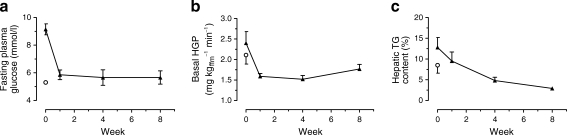
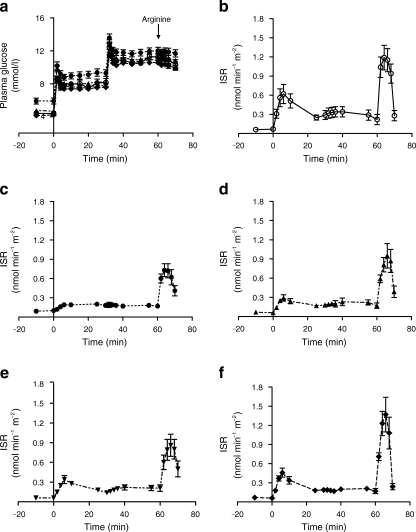
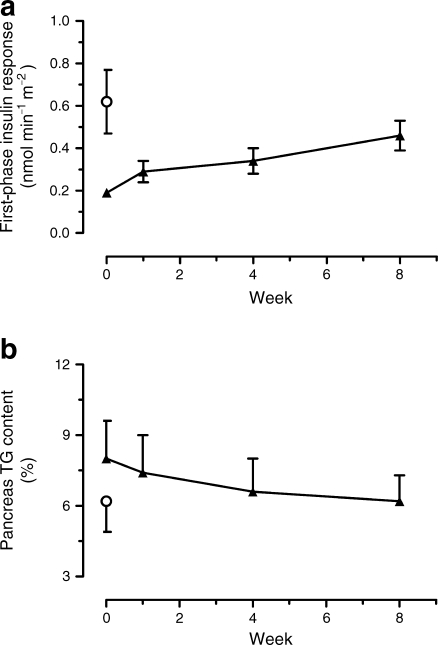
AIMS/HYPOTHESIS: Type 2 diabetes is regarded as inevitably progressive, with irreversible beta cell failure. The hypothesis was tested that both beta cell failure and insulin resistance can be reversed by dietary restriction of energy intake. METHODS: Eleven people with type 2 diabetes (49.5 ± 2.5 years, BMI 33.6 ± 1.2 kg/m(2), nine male and two female) were studied before and after 1, 4 and 8 weeks of a 2.5 MJ (600 kcal)/day diet. Basal hepatic glucose output, hepatic and peripheral insulin sensitivity and beta cell function were measured. Pancreas and liver triacylglycerol content was measured using three-point Dixon magnetic resonance imaging. An age-, sex- and weight-matched group of eight non-diabetic participants was studied. RESULTS: After 1 week of restricted energy intake, fasting plasma glucose normalised in the diabetic group (from 9.2 ± 0.4 to 5.9 ± 0.4 mmol/l; p = 0.003). Insulin suppression of hepatic glucose output improved from 43 ± 4% to 74 ± 5% (p = 0.003 vs baseline; controls 68 ± 5%). Hepatic triacylglycerol content fell from 12.8 ± 2.4% in the diabetic group to 2.9 ± 0.2% by week 8 (p = 0.003). The first-phase insulin response increased during the study period (0.19 ± 0.02 to 0.46 ± 0.07 nmol min(-1) m(-2); p < 0.001) and approached control values (0.62 ± 0.15 nmol min(-1) m(-2); p = 0.42). Maximal insulin response became supranormal at 8 weeks (1.37 ± 0.27 vs controls 1.15 ± 0.18 nmol min(-1) m(-2)). Pancreatic triacylglycerol decreased from 8.0 ± 1.6% to 6.2 ± 1.1% (p = 0.03). CONCLUSIONS/INTERPRETATION: Normalisation of both beta cell function and hepatic insulin sensitivity in type 2 diabetes was achieved by dietary energy restriction alone. This was associated with decreased pancreatic and liver triacylglycerol stores. The abnormalities underlying type 2 diabetes are reversible by reducing dietary energy intake.
Overview
The claims and statistics of this paper haven’t been checked yet.
Free: it reads the open-access text and checks the first 5 claims that cite a source we can check. Create a free account to check every claim.
Integrity signals
Registry
Cites
Statistics
Figures
Verification
Claims the paper makes
The claims and statistics of this paper haven’t been checked yet.
Free: it reads the open-access text and checks the first 5 claims that cite a source we can check. Create a free account to check every claim.
Claims other papers make about this one
Each is checked against this paper’s own text: does it say what the citing paper says it does?
The source backs part of the claim, not all of it — or backs it for a different population, condition or comparison.
In the citing paper
“Previously considered permanent and demanding life-long drug treat ment, type 2 diabetes is now recognised to be a potentially reversible consequence of excessive or abnormal accumulation of body fat (ie, the disease process of obesity). 5”
From 5-year follow-up of the randomised Diabetes Remission Clinical Trial (DiRECT) of continued support for weight loss maintenance in the UK: an extension study (2024) · cites this paper as [5]
Experimental — accuracy not yet measuredThe source backs part of the claim, not all of it — or backs it for a different population, condition or comparison.
In the citing paper
“During an intensive weight loss programme, or early after bariatric surgery, there are already significant improvements in hepatic and muscle insulin sensitivity, and pancreatic first-phase insulin secretion, with rapid loss of ectopic fat from skeletal muscle and liver [2, 3, 6].”
From Diets for weight management in adults with type 2 diabetes: an umbrella review of published meta-analyses and systematic review of trials of diets for diabetes remission (2022) · cites this paper as [6]
Experimental — accuracy not yet measuredThe source backs part of the claim, not all of it — or backs it for a different population, condition or comparison.
In the citing paper
“the twin cycle mechanism, driven by a damaging but reversible accumulation of ectopic fat within the liver and pancreas in susceptible individuals, has now been consistently observed. 6-8”
From Durability of a primary care-led weight-management intervention for remission of type 2 diabetes: 2-year results of the DiRECT open-label, cluster-randomised trial (2019) · cites this paper as [6]
Experimental — accuracy not yet measuredThe source backs part of the claim, not all of it — or backs it for a different population, condition or comparison.
In the citing paper
“Type 2 diabetes is strongly related to weight gain in adult life and accumulation of excess fat within the liver and pancreas.”
From Primary care-led weight management for remission of type 2 diabetes (DiRECT): an open-label, cluster-randomised trial (2018) · cites this paper as [4]
Experimental — accuracy not yet measuredThe cited source says what the claim attributes to it.
In the citing paper
“Although lifestyle interventions393 and weight loss394 reverse T2DM in early stages, when insulin is still secreted, T2DM patients may become dependent on anti-diabetic drugs in later stages.”
From Pancreatic regulation of glucose homeostasis. (2016) · cites this paper as [394]
9 more claims about this paper
Create a free account to see every claim other papers make about this one.
Self-check
Percentages, sums and reported differences re-computed from the paper’s own numbers.
The self-check needs the paper’s full text.
Citations
Cites
The metabolic phenotype in obesity: Fat mass, body fat distribution, and adipose tissue function
Goossens, G. H. (2017) · Obesity Facts · doi:10.1159/000471488 · Cited by 8,481
Turner, R. C., Fox, C., Matthews, McElroy, H. H., Cull, C. A., Holman, R. R., Neil, P., Hadden, D. R., Wright, D., Manley, E., et al. (1998) · The Lancet · Cited by 8,419
Glucose clamp technique: a method for quantifying insulin secretion and resistance.
DeFronzo, R. A., Tobin, J. D., & Andres, R. (1979) · American Journal of Physiology-Endocrinology and Metabolism · doi:10.1152/ajpendo.1979.237.3.e214 · Cited by 7,425 · cited 2×
“An isoglycaemic–hyperinsulinaemic clamp (insulin infusion rate 40 mU m min) was initiated at 0 min [14].”
Methodβ-Cell Deficit and Increased β-Cell Apoptosis in Humans With Type 2 Diabetes
Butler, A. E., Janson, J., Bonner-Weir, S., Ritzel, R., Rizza, R. A., & Butler, P. C. (2003) · Diabetes · doi:10.2337/diabetes.52.1.102 · Cited by 4,011 · cited 1×
“The underlying changes in beta cell function have been well described [3, 4], and beta-cell mass decreases steadily during the course of type 2 diabetes [5, 6].”
BackgroundGupta, A., & Uribarri, J. (2016) · Hormone Research in Paediatrics · doi:10.1159/000444053 · Cited by 4,006
Kahn, S. E. (2003) · Diabetologia · doi:10.1007/s00125-002-1009-0 · Cited by 2,166 · cited 1×
“The underlying changes in beta cell function have been well described [3, 4], and beta-cell mass decreases steadily during the course of type 2 diabetes [5, 6].”
BackgroundWeyer, C., Bogardus, C., Mott, D. M., & Pratley, R. E. (1999) · Journal of Clinical Investigation · doi:10.1172/jci7231 · Cited by 1,940 · cited 2×
“Absence of rapid insulin secretion in response to a rise in plasma glucose is the hallmark of type 2 diabetes [3, 21], and the decline in beta cell function determines the progression towards a need for insulin therapy [2].”
BackgroundU.K. Prospective Diabetes Study Group (1995) · Diabetes · doi:10.2337/diab.44.11.1249 · Cited by 1,923
Szczepaniak, L. S., Nurenberg, P., Leonard, D., Browning, J. D., Reingold, J. S., Grundy, S., Hobbs, H. H., & Dobbins, R. L. (2005) · American Journal of Physiology-Endocrinology and Metabolism · doi:10.1152/ajpendo.00064.2004 · Cited by 1,562 · cited 1×
“It continued to decline throughout the intervention period to reach the normal range for non-obese individuals [20] (2.”
Background
Cited by
Items 601–700 of 1,001
Surgical vs Lifestyle Treatment for Type 2 Diabetes
Ludwig, D. S., Ebbeling, C. B., & Livingston, E. H. (2012) · JAMA · doi:10.1001/2012.jama.10156 · Cited by 13
Liu, C., Li, C., Chen, J., Liu, Y., Cheng, Q., Xiang, X. R., & Chen, G. (2015) · Diabetes & Metabolism · doi:10.1016/j.diabet.2015.09.003 · Cited by 11
Okada, A. K., Teranishi, K., Isas, J. M., Bedrood, S., Chow, R. H.-P., & Langen, R. (2016) · Scientific Reports · doi:10.1038/srep31094 · Cited by 11
Armour, S. L., Anderson, S., Richardson, S. J., Ding, Y., Carey, C., Lyon, J. G., Maheshwari, R. R., Al-Jahdami, N., Krasnogor, N., Morgan, N. G., et al. (2020) · Endocrinology · doi:10.1210/endocr/bqaa011 · Cited by 12
“However, evidence for the rapid restoration of long-term β-cell function in those with T2D following calorie restriction challenges this paradigm (3,4).”
BackgroundInfluentialKatsarou, A. L., Katsilambros, N. L., & Koliaki, C. C. (2021) · Healthcare · doi:10.3390/healthcare9050495 · Cited by 14
“Data of comparative evaluation of IER vs. CER in terms of improving glycemic control in overweight and obese patients with T2DM are limited.”
BackgroundInfluentialTaylor, R. (2011) · Practical Diabetes · doi:10.1002/pdi.1639 · Cited by 12
Self-citationPathogenesis of Type 2 Diabetes Mellitus
DeFronzo, R. A. (2018) · Endocrinology · doi:10.1007/978-3-319-27317-4_8-1 · Cited by 13
Epidemiology of Type 2 Diabetes
Ronald, C. W., & Tong, P. C. Y. (2024) · Wiley eBooks · doi:10.1002/9781119697473.ch5 · Cited by 20
Hara, K., Sakai, Y., Tajiri, Y., & Nomura, M. (2022) · Heliyon · doi:10.1016/j.heliyon.2022.e11012 · Cited by 10
“Possible mechanisms for this beneficial effect of SGLT2i on the diurnal rhythm of RQ could be attributable to the periodic increase of glucagon/insulin ratio which is often observed after intermittent fasting, gastric bypass and exercise [19, 20, 21].”
BackgroundLazaridis, I. I., Bosch, A. J. T., Keller, L., Low, A. J. Y., Tamarelle, J., Moser, S. O., Winter, D. V., Gómez, C., Peterson, C. J., Schneider, R., et al. (2024) · American Journal of Physiology-Endocrinology and Metabolism · doi:10.1152/ajpendo.00327.2023 · Cited by 10
Effects of a Carbohydrate-Restricted Diet on β-Cell Response in Adults With Type 2 Diabetes
Gower, B. A., Goss, A. M., YURCHISHIN, M. L., Deemer, S. E., Sunil, B., & Garvey, W. T. (2024) · The Journal of Clinical Endocrinology & Metabolism · doi:10.1210/clinem/dgae670 · Cited by 12
Remission in Ketosis-Prone Diabetes
Kikani, N. J., & Balasubramanyam, A. (2022) · Endocrinology and Metabolism Clinics of North America · doi:10.1016/j.ecl.2022.06.005 · Cited by 12
Rashid, F., Ahmad, M., Ashfaq, U. A., Al‐Mutairi, A. A., & Al‐Hussain, S. A. (2022) · Drug Design Development and Therapy · doi:10.2147/dddt.s379205 · Cited by 10
Dokpuang, D., Yang, J. Z., Nemati, R., He, K., Plank, L. D., Murphy, R., & Lu, J. (2023) · Diabetes Research and Clinical Practice · doi:10.1016/j.diabres.2023.110775 · Cited by 10
Kim, J., Kim, B., Kim, M. K., Baek, K., Song, K., Han, K., & Kwon, H. (2023) · Diabetes Obesity and Metabolism · doi:10.1111/dom.15345 · Cited by 11
Remission of type 2 diabetes: position statement of the Italian society of diabetes (SID)
Capoccia, D., Leonetti, F., Natali, A., Tricò, D., Perrini, S., Sbraccia, P., Guglielmi, V., & On behalf of the Italian Society of Diabetes (SID) (2024) · Acta Diabetologica · doi:10.1007/s00592-024-02317-x · Cited by 11
“…in patients with obesity and T2D undergoing very low-calorie diet (VLCD), hepatic and pancreatic triglyceride content and blood glucose normalize after just one week, up to complete restoration of the first phase of insulin secretion after 8 weeks without any variation in insulin sensitivity [24].”
BackgroundMossberg, K. E., Pournaras, D. J., Welbourn, R., le Roux, C. W., & Brogren, H. (2016) · Surgery for Obesity and Related Diseases · doi:10.1016/j.soard.2016.03.007 · Cited by 10
“Diet and in particular triglycerides are known to influence the plasma PAI-1 and may be an explanation for the reduced levels [26].”
BackgroundMultiorgan, Multimodality Imaging in Cardiometabolic Disease
Kumar, V., Hsueh, W. A., & Raman, S. V. (2017) · Circulation Cardiovascular Imaging · doi:10.1161/circimaging.117.005447 · Cited by 11
Leiu, K. H., Poppitt, S. D., Miles-Chan, J. L., & Sequeira, I. R. (2022) · Nutrients · doi:10.3390/nu14224873 · Cited by 11
“Individuals with overweight and obesity and diagnosed T2D recruited into a study [68] had ~15% significant decrease in body weight over 8 weeks, as well as the corresponding ~23% decrease in PFC and ~77% decrease in LFC.”
BackgroundInfluentialSathyapalan, T., Coady, A., Kilpatrick, E. S., & Atkin, S. L. (2017) · Endocrine Connections · doi:10.1530/ec-17-0217 · Cited by 11
Advances in managing type 2 diabetes: challenging old paradigms and developing new ones
Sattar, N. A. (2014) · F1000Prime Reports · doi:10.12703/p6-42 · Cited by 13
“Consequently, it should be no surprise to see reversal of diabetes upon major calorie restriction in the short term with use of low-energy liquid diets, when parallel reductions in ectopic fat are evident, particularly in the liver [13].”
BackgroundSandby, K., Krarup, T., Chabanova, E., Geiker, N. R. W., & Magkos, F. (2024) · The Journal of Clinical Endocrinology & Metabolism · doi:10.1210/clinem/dgae572 · Cited by 11
Whelehan, G., Dirks, M. L., West, S., Abdelrahman, D. R., Murton, A. J., Finnigan, T. J. A., Wall, B. T., & Stephens, F. B. (2024) · Diabetes Obesity and Metabolism · doi:10.1111/dom.16100 · Cited by 11
“37,38 It is difficult to elucidate why we did not observe a difference in IS or β -cell function between the high-protein VEG and OMNI diets.”
Burns, L., Cooper, S., Sarmad, S., Funke, G., Mauro, A. D., Gaitanos, G. C., & Tsintzas, K. (2025) · Clinical Nutrition · doi:10.1016/j.clnu.2025.08.004 · Cited by 11
Sommer, J., Dyczmons, J., Grobosch, S., Gontscharuk, V., Vomhof, M., Roden, M., & Icks, A. (2020) · BMJ Open · doi:10.1136/bmjopen-2020-036995 · Cited by 12
Quantifying Remission Probability in Type 2 Diabetes Mellitus
Kalra, S., Bantwal, G., Kapoor, N., Sahay, R. K., Bhattacharya, S., Anne, B., Gopal, R. A., Kota, S. K., Kumar, A., Joshi, A. S., et al. (2021) · Clinics and Practice · doi:10.3390/clinpract11040100 · Cited by 12
“The study concluded that the metabolic derangements underlying T2DM could be potentially reversed by acute dietary restriction on energy intake [33].”
BackgroundEffects of a 3-Week Hospital-Controlled Very-Low-Calorie Diet in Severely Obese Patients
Ožvald, I., Božičević, D., Duh, L., Vrček, I. V., Pavičić, I., Domijan, A., & Milić, M. (2021) · Nutrients · doi:10.3390/nu13124468 · Cited by 11
Tripathi, P., KADAM, N. S., VYAWAHARE, A. R., Kuppusamy, M., & Vijayakumar, V. (2023) · Journal of Family Medicine and Primary Care · doi:10.4103/jfmpc.jfmpc_2282_22 · Cited by 11
“[3] However, more recent evidence suggests that nonsurgical lifestyle interventions such as a very‑low‑calorie diet (VLCD), [4] intermittent fasting, [5] and structured lifestyle modifications could bring about effective T2D remission.”
BackgroundCheckpoint kinase 2 controls insulin secretion and glucose homeostasis
Chong, A. C. N., Vandana, J. J., Jeng, G., Li, G., Meng, Z., Duan, X., Zhang, T., Qiu, Y., Duran‐Struuck, R., Coker, K. E., et al. (2023) · Nature Chemical Biology · doi:10.1038/s41589-023-01466-4 · Cited by 12
“AZD7762 treatment significantly reduced glucagon (GCG) secretion from intact normal human islets, possibly due to the inhibited effects of insulin on glucagon secretion, an observation reported by several groups 18,19 (Extended Data Fig.”
ResultThe application of carbohydrate-reduction in general practice: A medical audit
Hawkins, M. A., Zinn, C., & Delon, C. (2023) · Journal of Metabolic Health · doi:10.4102/jmh.v6i1.86 · Cited by 9
“19,20 It is often argued that a CR approach is not sustainable for weight loss but it should be noted that other weight loss approaches do not appear to be any more sustainable than CR. 21,22 What is clear, however, is that this approach will often work for those who can adopt it.”
BackgroundLow-calorie diets for people with isolated impaired fasting glucose
Sathish, T., Taylor, R., Khunti, K., Tapp, R. J., Raben, A., Zhu, R., Kapoor, N., Narayan, K. M. V., Ali, M. K., & Shaw, J. E. (2024) · Communications Medicine · doi:10.1038/s43856-024-00466-2 · Cited by 10
Self-citationChinese Guidelines for Medical Nutrition Therapy for Patients with Diabetes (2022 Edition).
(2024) · PubMed Central · doi:10.6133/apjcn.202406_33(2).0001 · Cited by 15
Alfieri, C., Molinari, P., Cinque, F., Vettoretti, S., Cespiati, A., Bignamini, D., Nardelli, L., Fracanzani, A. L., Castellano, G., & Lombardi, R. (2024) · International Journal of Molecular Sciences · doi:10.3390/ijms25147728 · Cited by 13
“Higher T1DM prevalence in relatives suggests genetic risk, with human leukocyte antigen (HLA) variants contributing 50–60% of this risk (HLA-I, B*5701, and B*3906) [17].”
BackgroundLyngbæk, M. P. P., Legaard, G. E., Nielsen, N. S., Durrer, C. G., Almdal, T., Lund, M. A. V., Liebetrau, B., Ewertsen, C., Lauridsen, C. A., Solomon, T. P. J., et al. (2024) · Journal of sport and health science/Journal of Sport and Health Science · doi:10.1016/j.jshs.2024.100999 · Cited by 11
Sala, M. L., Kroft, L. J. M., Röell, B., van der Grond, J., Slagboom, P. E., Mooijaart, S. P., Roos, A., & van Heemst, D. (2014) · PLoS ONE · doi:10.1371/journal.pone.0091085 · Cited by 10
“Consistent with the critical role for liver fat in the pathogenesis of hepatic insulin resistance and type 2 diabetes, recent studies showed that caloric restriction rapidly lowers hepatic fat content and improves hepatic insulin sensitivity in type 2 diabetes patients [10,24].”
BackgroundThe hypocaloric diet in type 2 diabetes - déjà vu
Day, C., & Bailey, C. J. (2012) · The British Journal of Diabetes · doi:10.1177/1474651412437503 · Cited by 11
Lautenbach, A., Wernecke, M., Mann, O., Wagner, J., Wolter, S., Stoll, F., & Aberle, J. (2022) · Obesity Surgery · doi:10.1007/s11695-022-06406-0 · Cited by 10
Karera, M. G. D., Wentzel, A., Ishimwe, M. C. S., Gatete, J. D. D., Jagannathan, R., Horlyck-Romanovsky, M., & Sumner, A. E. (2023) · Diabetes Metabolic Syndrome and Obesity · doi:10.2147/dmso.s403054 · Cited by 9
“…Weight Loss ↓11.1±0.7 kg (range 8.1–14.9 kg) ≥9% baseline weight Metabolic Effects ↓Fasting insulin 100% (10/10) had FPG 100 mg/dL. Positive ↓TG ↓Chol ↔HDL Lim et al 2011 Reference:28 United Kingdom Age: 35–65y BMI: 25–45 kg/m2 A1C: 6.5– 9.0% T2D duration 4y Cr 1.7 mg/dL LFT 2.5 times normal…”
InfluentialPolhuis, K. C. M. M., Bouwman, L. I., Vaandrager, L., Soedamah‐Muthu, S. S., & Koelen, M. A. (2019) · Patient Education and Counseling · doi:10.1016/j.pec.2019.10.017 · Cited by 11
The effect of type 2 diabetes diagnosis in the elderly
Gaggero, A. (2020) · Economics & Human Biology · doi:10.1016/j.ehb.2019.100830 · Cited by 14
Little, J. P., & Myette‐Côté, É. (2016) · Diabetes · doi:10.2337/db16-0492 · Cited by 9
“(2) have shown that a very low-calorie diet (;600 kcal/day) rapidly reverses most T2D-related metabolic dysfunction.”
BackgroundAetiology of type 2 diabetes: an experimental medicine odyssey
Taylor, R. (2025) · Diabetologia · doi:10.1007/s00125-025-06428-0 · Cited by 10
“In Counterpoint and all subsequent studies, a 15 kg weight loss brought about identical changes in the underlying mechanisms over the full BMI range studied (27–45 kg/m 2 ) [25, 29, 36, 46].”
Self-citationBad medicine: the way we manage diabetes
Spence, D. (2013) · BMJ · doi:10.1136/bmj.f2695 · Cited by 8
Hjelm, L. (2022) · Clinics in Podiatric Medicine and Surgery · doi:10.1016/j.cpm.2022.05.001 · Cited by 11
Norlin, S., Axelsson, J., Ericsson, M., & Edlund, H. (2023) · Communications Biology · doi:10.1038/s42003-023-05255-6 · Cited by 12
Global research trends of diabetes remission: a bibliometric study
Yang, X. Q., He, Z., Chen, Q., Chen, Y., Chen, G., & Liu, C. (2023) · Frontiers in Endocrinology · doi:10.3389/fendo.2023.1272651 · Cited by 11
“If the aforementioned sequela is attenuated via weight reduction, the natural corollary is the remission of diabetes (34, 42).”
BackgroundHaddow, J. E., Lambert-Messerlian, G. M., Eklund, E. E., Neveux, L. M., & Palomaki, G. E. (2017) · Obstetric Medicine · doi:10.1177/1753495x17733223 · Cited by 8
The Role of Metabolic Surgery in Non-alcoholic Steatohepatitis Improvement
Caravatto, P. P. D. P., & COHEN, R. V. (2017) · Current Atherosclerosis Reports · doi:10.1007/s11883-017-0681-y · Cited by 9
Nguyen, N. N., Singh, R. G., & Petrov, M. S. (2021) · Annals of Nutrition and Metabolism · doi:10.1159/000520068 · Cited by 8
Zalejska–Fiolka, J., Birková, A., Hubková, B., Wielkoszyński, T., Čižmárová, B., Szlachta, B., Fiolka, R., Błaszczyk, U., Wylęgała, A., Kasperczyk, S., et al. (2022) · The Journal of Nutritional Biochemistry · doi:10.1016/j.jnutbio.2022.109021 · Cited by 8
Behbehani, F., Ammori, B. J., New, J. P., Summers, L. K. M., Soran, H., & Syed, A. A. (2014) · QJM · doi:10.1093/qjmed/hcu060 · Cited by 11
Very-low-energy diets for weight loss in patients with kidney disease
Brown, A. C., & Taheri, S. (2018) · Journal of Kidney Care · doi:10.12968/jokc.2018.3.1.14 · Cited by 9
Storck, L. J., Meffert, P. J., Rausch, J., Gärtner, S., Aghdassi, A. A., Kühn, J., Kraft, M., Pietzner, M., Lerch, M. M., & Steveling, A. (2021) · Obesity Facts · doi:10.1159/000511453 · Cited by 9
Zhyzhneuskaya, S. V., & Taylor, R. (2017) · Endocrinology · doi:10.1007/978-3-319-47685-8_21-1 · Cited by 8
Self-citationSingla, R., Gupta, G., Dutta, D., Raizada, N., & Aggarwal, S. (2022) · Diabetes & Metabolic Syndrome Clinical Research & Reviews · doi:10.1016/j.dsx.2022.102452 · Cited by 8
Ishak, A. R., Puspitaningrum, R., Utari, R. D., Ferania, M., Adhiyanto, C., NITTA, T., Susanto, A., Yukio, H., & Yamashiro, Y. (2014) · HAYATI Journal of Biosciences · doi:10.4308/hjb.21.4.159 · Cited by 8
“Type 2 Diabetes Mellitus (T2DM) is a chronic disease of metabolic disorder caused by insulin resistance in target membranes (Lim et al. 2011).”
BackgroundPharmacogenetics and individual responses to treatment of hyperglycemia in type 2 diabetes
Engelbrechtsen, L., Galijatovic, E. A. A., Roepstorff, S., Hansen, T. F., & Vestergaard, H. (2015) · Pharmacogenetics and Genomics · doi:10.1097/fpc.0000000000000160 · Cited by 8
Ekberg, N. R., Catrina, S., & Spégel, P. (2024) · Frontiers in Nutrition · doi:10.3389/fnut.2024.1395745 · Cited by 10
Corrao, S., Falcone, F., Mirarchi, L., Amodeo, S., & Calvo, L. (2025) · Diabetes Therapy · doi:10.1007/s13300-025-01761-4 · Cited by 13
“The reversal of glucolipotoxicity following rapid weight loss seems to restore first-phase insulin secretion and modify inflammatory pathways and metabolic flexibility [35].”
Chakraborty, S., Sophiarani, Y., & Uddin, A. (2021) · Genomics · doi:10.1016/j.ygeno.2021.06.026 · Cited by 7
De la dysfonction du tissu adipeux blanc aux phénotypes anatomocliniques de l’obésité
Ziegler, O., Böhme, P., & Valet, P. (2017) · Obésité · doi:10.1007/s11690-017-0555-z · Cited by 10
Nyamdorj, R. (2012) · BENTHAM SCIENCE PUBLISHERS eBooks · doi:10.2174/978160805361211201010039 · Cited by 8
Storz, M. A., & Küster, O. (2019) · Nutrition and Health · doi:10.1177/0260106019874683 · Cited by 8
Xiang, A. H., Martinez, M. P., Trigo, E., Utzschneider, K. M., Cree‐Green, M., Arslanian, S. A., Ehrmann, D. A., Caprio, S., Mohamed, P., Hwang, D., et al. (2021) · Obesity · doi:10.1002/oby.23174 · Cited by 7
“A very lowcalorie diet in 11 individuals with T2D for 8 weeks showed that liver fat reduction was accompanied with the normalization of hepatic insulin sensitivity and β- cell function (28).”
BackgroundGenome-wide association study of pancreatic fat: The Multiethnic Cohort Adiposity Phenotype Study
Streicher, S. A., Lim, U., Park, S. L., Li, Y., Sheng, X., Hom, V., Xia, L. Y., Pooler, L., Shepherd, J., Loo, L. W. M., et al. (2021) · PLoS ONE · doi:10.1371/journal.pone.0249615 · Cited by 7
Research progress on ncRNAs regulation of mitochondrial dynamics in diabetes
Wu, Y., Lan, H., Zhang, D., Hu, Z., Zhang, J., Li, Z., Xia, P., Tang, X., Cai, X., & Yu, P. (2022) · Journal of Cellular Physiology · doi:10.1002/jcp.30878 · Cited by 7
“…and occurs due to the irreparable IR of insulin secreted by islet β cells; at the same time, reactions caused by long‐term IR can pose obstacles to the normal mitochondrial function and cell signaling pathways, finally leading to the dysfunction and damage of β cells of islets (Lim et al., 2011).”
BackgroundSayda, M. H., Aziz, M. H. A., Gharahdaghi, N., Wilkinson, D. J., Greenhaff, P. L., Phillips, B. E., Smith, K., IDRIS, I. R., & Atherton, P. J. (2022) · Scientific Reports · doi:10.1038/s41598-022-21814-z · Cited by 10
Revised Protein Sparing Diet in Obesity and Type 2 Diabetes Mellitus
Cincione, R. I., Losavio, F., Cibelli, G., Messina, G., Polito, R., Casula, E. P., Cincione, P. P., Amatruda, M., & Limone, P. (2022) · Nutrients · doi:10.3390/nu14245325 · Cited by 7
“Restoring metabolic flexibility is one of the more significant aspects of the revised protein-sparing diet, a keystone for weight reduction and, above all, for reversing diabetes [27,47,50,51,57].”
BackgroundRolland, C., Lula, S., Jenner, C., Dyson, L., Macdonald, I. A., Johnston, K. L., & Broom, J. I. (2013) · Clinical Obesity · doi:10.1111/cob.12029 · Cited by 8
“(40) demonstrated that following a VLCD, the resulting acute negative energy balance reverses T2DM by normalizing both hepatic insulin sensitivity and beta cell function through the reduction of fat in the liver and pancreas.”
BackgroundGiacco, R., Vetrani, C., Griffo, E., & Rivellese, A. A. (2013) · Current Nutrition Reports · doi:10.1007/s13668-013-0063-1 · Cited by 7
Chuah, L. L., & le Roux, C. W. (2013) · PubMed · doi:10.3305/nh.2013.28.sup2.6709 · Cited by 8
“It has also been shown to place type 2 diabetes in remission.(54) The diet has been used preoperatively in many bariatric centres to induce acute weight loss before surgery.”
BackgroundAssociation between Serum Vitamin D Metabolites and Metabolic Function in Healthy Asian Adults
Ding, C., Chan, Z., Chooi, Y. C., Choo, J., Sadananthan, S. A., Michael, N., Velan, S. S., Leow, M. K., & Magkos, F. (2020) · Nutrients · doi:10.3390/nu12123706 · Cited by 7
“As liver fat deposition has been suggested to be an independent predictor of beta-cell function [28,29], we further adjusted for IHTG in our analysis and found that the VDM index remained significantly associated with beta-cell function (data not shown).”
ResultPhysiology Reconfigured: How Does Bariatric Surgery Lead to Diabetes Remission?
Albaugh, V. L., Axelrod, C. L., Belmont, K. P., & Kirwan, J. P. (2022) · Endocrinology and Metabolism Clinics of North America · doi:10.1016/j.ecl.2022.06.003 · Cited by 9
“El Plato del Bien Comer”, ¿evidencia científica o conocimiento transpuesto?
Cano, J. M. M. (2015) · CPU-e Revista de Investigación Educativa · doi:10.25009/cpue.v0i20.1287 · Cited by 10
McDiarmid, S., Harvie, M., Johnson, R., Vyas, A., Aglan, A., Moran, J., Ruane, H., Hulme, A., Sellers, K., & Issa, B. G. (2021) · JMIR Research Protocols · doi:10.2196/21116 · Cited by 7
“Eligible participants were randomized 1:1 to ILED or CLED by a researcher independent of the intervention using a minimization program stratified by BMI ≥34 or <34 kg per m(2) (projected mean value from the counterpoint and counterbalance studies [11,12,15]), sex, duration of diabetes <4 years or ≥4 years, and whether…”
BackgroundMethodGiordani, I., Malandrucco, I., Picconi, F., Longo, S., Flaviani, A. D., Chioma, L., Moscatelli, B., Donno, S., & Frontoni, S. (2013) · Acta Diabetologica · doi:10.1007/s00592-013-0487-5 · Cited by 7
“For instance, a very low calorie diet (VLCD) in patients with type 2 diabetes results in fast (within a few days) and dramatic amelioration of metabolic control, with eventual reversal of the diabetic state [21].”
BackgroundApplying laws of biology to diabetes with emphasis on metabolic syndrome
Houck, P. D., & Oliveira, J. M. F. D. (2013) · Medical Hypotheses · doi:10.1016/j.mehy.2012.11.019 · Cited by 7
“Table 4 [33–37] lists metabolic control mechanisms under the influence of the laws of biology.”
BackgroundWeight loss is the major player in bariatric surgery benefits
Wilding, J. P. H. (2020) · Nature Medicine · doi:10.1038/s41591-020-1117-8 · Cited by 8
Zhyzhneuskaya, S. V., Al‐Mrabeh, A. H., Peters, C., Barnes, A. C., Hollingsworth, K. G., Welsh, P., Sattar, N., Lean, M. E. J., & Taylor, R. (2025) · Diabetic Medicine · doi:10.1111/dme.15462 · Cited by 6
“2,7,8 Therefore, knowledge of return to normal liver fat levels would be valuable in clinical practice, both for motivation and monitoring of interventions.”
Self-citationLakhani, H. A., Biswas, D., Kuruvila, M., Chava, M. S., Raj, K., Varghese, J. T., & Swathi, N. (2025) · Primary care diabetes · doi:10.1016/j.pcd.2025.02.006 · Cited by 7
Dietary Management Tools Improve the Dietary Skills of Patients with T2DM in Communities
Chen, X., Min, H., & Sun, X. (2022) · Nutrients · doi:10.3390/nu14214453 · Cited by 12
Insight on sarcopenic obesity and epicatechin as a promising treatment option
Sabarathinam, S., Dhanasekaran, D., & Ganamurali, N. (2023) · Diabetes & Metabolic Syndrome Clinical Research & Reviews · doi:10.1016/j.dsx.2023.102856 · Cited by 7
Bannon, C. A. M., Meek, C. L., Reimann, F., & Gribble, F. M. (2024) · Peptides · doi:10.1016/j.peptides.2024.171186 · Cited by 7
“Whilst changes in fasting insulin and glucagon with BMI may be attributed to insulin resistance [9,10], a strength of this study is the low number of participants with pre-diabetes and type 2 diabetes within the obese groups, further highlighting that hyperinsulinaemia and hyper-glycaemia are…”
BackgroundCross-sectional imaging of the pancreas in diabetes
Virostko, J. M., & Tirkes, T. (2024) · Abdominal Radiology · doi:10.1007/s00261-024-04310-y · Cited by 8
“Conversely, diet-induced reversal of T2D was accompanied by a decline in pancreatic fat fraction [45].”
Abad-González, Á. L., Martín, S. V., Argente, M., Civera, M., García-Malpartida, K., Juan, C. S., Artero, A., Palmas-Candia, F. X., Perelló-Camacho, E., Salom, C., et al. (2025) · Nutrients · doi:10.3390/nu17030499 · Cited by 8
“Aging also leads to increased body fat, particularly in the abdominal region (visceral fat), as well as the accumulation of fat within skeletal muscles (myo-steatosis) and the liver (hepatic steatosis), all of which exacerbate IR [54,55].”
The Twin Cycle Hypothesis of type 2 diabetes aetiology: From concept to national NHS programme
Taylor, R. (2025) · Experimental Physiology · doi:10.1113/ep092009 · Cited by 7
“Triglyceride) study aimed to test the hypothesis by measuring changes during an 8 week period of 800 kcal/day in not only the main plasma analytes but also the underlying processes and intra-organ fat content (Lim et al., 2011).”
Self-citationLiu, Z., Feng, N., Wang, S., Liu, Y., Wang, J., Tan, Y., Dong, Y., Sun, Z., Du, X., Xu, Y., et al. (2025) · Nutrition Journal · doi:10.1186/s12937-025-01101-z · Cited by 7
“Furthermore, these studies consistently found a significant improvement in insulin sensitivity assessed by homeostasis model assessment, S2 isoglycemic-hyperinsulinemic clamp or insulin tolerance test [9, 10, 23, 24, 26].”
Wael, M., Kandel, M. M., Altabbaa, H., & Elkeleny, M. R. (2025) · Obesity Surgery · doi:10.1007/s11695-025-07930-5 · Cited by 6
“Therefore, food restriction can sensibly explain the rapid postoperative metabolic improvement [32–36].”
Putting insulin resistance into context by dietary reversal of type 2 diabetes
Taylor, R. W. (2017) · The Journal of the Royal College of Physicians of Edinburgh · doi:10.4997/jrcpe.2017.216 · Cited by 9
Self-citationGuess, N. D. (2022) · Diabetes Therapy · doi:10.1007/s13300-022-01220-4 · Cited by 7
Brown, M., & Matveyenko, A. V. (2022) · Frontiers in Endocrinology · doi:10.3389/fendo.2022.842603 · Cited by 11
Obesity-Associated Comorbidities: Health Consequences
Adebibe, M., & Coppack, S. W. (2022) · Springer eBooks · doi:10.1007/978-3-030-54064-7_4-1 · Cited by 6
Liu, W., Lin, C.-H., Tsai, C., Wang, H., Li, S., Liu, T., Tan, A. C., Tsou, H., Tseng, K.-H., & Lin, C. (2023) · Bioengineering · doi:10.3390/bioengineering10010089 · Cited by 7
“Higher liver function test results (ALT) and triglycerides (TG) were also noted in the diabetic group, which might relate to glycogen formation in the liver [26].”
BackgroundHepatokines and Adipokines in Metabolic Syndrome
Mukhuty, A., Mondal, S. A., & Mukhopadhyay, S. (2023) · Annals of the National Academy of Medical Sciences (India) · doi:10.1055/s-0042-1760087 · Cited by 6
Methnani, J., Hajbelgacem, M., Ach, T., Chaieb, F., Sellami, S., Bouslama, A., Zaouali, M., Omezzine, A., & Bouhlel, E. (2023) · Journal of Cardiovascular Pharmacology and Therapeutics · doi:10.1177/10742484231156318 · Cited by 8
“46 Similar pattern of response was also observed in response to prolonged fasting.”
BackgroundMetabolic remission precedes possible weight regain after gastric bypass surgery
Rogova, O., Herzog, K., Al‐Majdoub, M., Miskelly, M. G., Lindqvist, A., Bennet, L., Hedenbro, J., Wierup, N., & Spégel, P. (2023) · Obesity · doi:10.1002/oby.23864 · Cited by 7
“On the other hand, reduced caloric intake has also been implicated, which is supported by studies showing low-calorie diets (LCD) to elicit remission of T2D [7].”
Kurian, J., & Mavathur, R. N. (2023) · Journal of Bodywork and Movement Therapies · doi:10.1016/j.jbmt.2023.08.003 · Cited by 6
Chu, M. P., Klopfenstein, B. J., Krisky, C. M., Urbanski, H. F., Rooney, W. D., Kohama, S. G., & Purnell, J. Q. (2013) · Obesity · doi:10.1002/oby.20339 · Cited by 6
β-Hydroxybutyrate improves β-cell mitochondrial function and survival
Sampson, M., Lathen, D. R., Dallon, B. W., Draney, C., Ray, J. D., Kener, K. B., Parker, B. A., Gibbs, J. L., Gropp, J. S., Tessem, J. S., et al. (2017) · Journal of Metabolic Health · doi:10.4102/jir.v2i1.25 · Cited by 11
Polhuis, K. C. M. M., Vaandrager, L., Koelen, M. A., Geleijnse, J. M., & Soedamah‐Muthu, S. S. (2023) · JMIR Research Protocols · doi:10.2196/40490 · Cited by 8
Metadata
- Authors
- Lim, E. L., Hollingsworth, K. G., Aribisala, B. S., Chen, M. J., Mathers, J. C., & Taylor, R.
- Affiliations
- Newcastle University (GB)
- Corresponding author
- Taylor, R.
- Venue
- Diabetologia
- Published
- 2011-06-09
- Volume
- 54
- Issue
- 10
- Pages
- 2506-2514
- ISSN
- 0012-186X (ISSN-L)
- 1432-0428
- PMC
- PMC3168743
- OpenAlex
- W2127283831
- Cited by
- 1,164
- References
- 51
- Citations by year
- 2026: 46 · 2025: 60 · 2024: 65 · 2023: 77 · 2022: 109 · 2021: 102 · 2020: 81 · 2019: 77 · 2018: 86 · 2017: 90 · 2016: 77 · 2015: 82 · 2014: 60 · 2013: 77 · 2012: 64
- FWCI
- 68.35
- Type
- journal article
- Language
- en
- Open access
- hybrid
- doi.org
- Licence
- cc-by-nc
- Locations
- Diabetologia (publishedVersion, cc-by-nc)
- Europe PMC (PubMed Central) (publishedVersion, cc-by-nc)
- PubMed Central (publishedVersion, cc-by-nc)
- PubMed (publishedVersion)
- IRIS Research product catalog (Sapienza University of Rome) (submittedVersion)
- Edinburgh Research Explorer (University of Edinburgh) (submittedVersion, other-oa)
- Newcastle University ePrints (Newcastle Univesity) (cc-by-nc)
- Topics
- Health Sciences › Medicine › Endocrinology, Diabetes and Metabolism › Pancreatic function and diabetes
- Health Sciences › Medicine › Endocrinology, Diabetes and Metabolism › Diabetes Treatment and Management
- Health Sciences › Medicine › Endocrinology, Diabetes and Metabolism › Diabetes, Cardiovascular Risks, and Lipoproteins
- Keywords
- type 2 diabetes remission, beta-cell function, caloric restriction, dietary restriction, hepatic insulin sensitivity, hepatic glucose production, liver triacylglycerol, first-phase insulin response, insulin resistance, fasting blood glucose, pancreatic fat content, hepatic fat content, weight loss interventions
- MeSH terms
- Adult, Aged, Blood Glucose, Body Composition, Body Weight, Diabetes Mellitus, Type 2, Female, Glycated Hemoglobin, Humans, Liver, Male, Middle Aged, Pancreas, Triglycerides, Insulin-Secreting Cells
About these checks
Registry, retraction, Cites and statistics results are computed, not judged, with one exception: a printed reference that no index lists is read once by a model before it counts as a citation error. Claims are extracted by a model and kept only when their quote appears verbatim in the text; each cited source is then checked, with a model’s help, for whether it says what the claim relies on. Those verdicts can be wrong — read the claim’s quote and the cited source before relying on one.
Statistics and arithmetic are recomputed, not judged.
Confidence bands are shown only for fields calibrated on our annotated test set. None is calibrated yet, so no band is shown.
What counts as a claim ›How we measure confidence ›How we check this ›
Are you an author, or do you see a problem with this page? Request a review
Data sources
Bibliographic data: Semantic Scholar, OpenAlex, Crossref.
Contains information from the Semantic Scholar Academic Graph Datasets, made available under the ODC Attribution License (ODC-BY 1.0).
Semantic Scholar’s data is described in: Kinney, R., et al. (2023). The Semantic Scholar Open Data Platform. arXiv:2301.10140.
