

Reversal of type 2 diabetes: normalisation of beta cell function in association with decreased pancreas and liver triacylglycerol
Open accessThe DOI matches its Crossref record; 52 of the 52 references it cites were found in a registry or an index.
Abstract
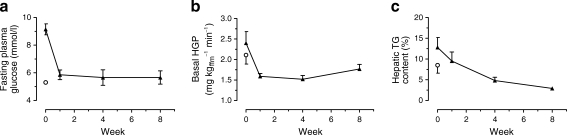
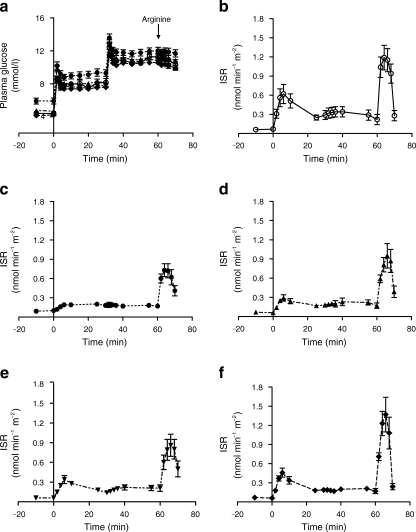
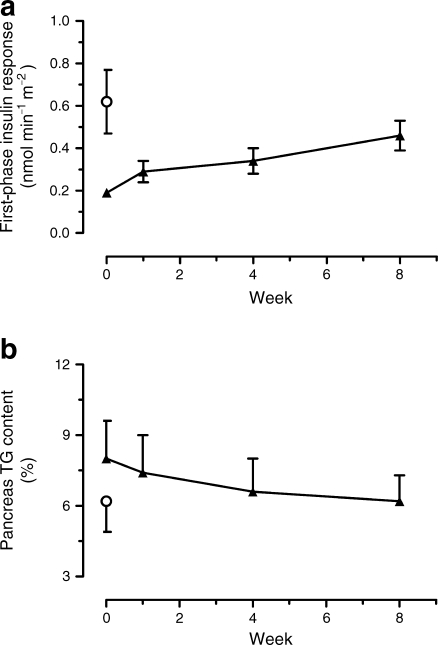
AIMS/HYPOTHESIS: Type 2 diabetes is regarded as inevitably progressive, with irreversible beta cell failure. The hypothesis was tested that both beta cell failure and insulin resistance can be reversed by dietary restriction of energy intake. METHODS: Eleven people with type 2 diabetes (49.5 ± 2.5 years, BMI 33.6 ± 1.2 kg/m(2), nine male and two female) were studied before and after 1, 4 and 8 weeks of a 2.5 MJ (600 kcal)/day diet. Basal hepatic glucose output, hepatic and peripheral insulin sensitivity and beta cell function were measured. Pancreas and liver triacylglycerol content was measured using three-point Dixon magnetic resonance imaging. An age-, sex- and weight-matched group of eight non-diabetic participants was studied. RESULTS: After 1 week of restricted energy intake, fasting plasma glucose normalised in the diabetic group (from 9.2 ± 0.4 to 5.9 ± 0.4 mmol/l; p = 0.003). Insulin suppression of hepatic glucose output improved from 43 ± 4% to 74 ± 5% (p = 0.003 vs baseline; controls 68 ± 5%). Hepatic triacylglycerol content fell from 12.8 ± 2.4% in the diabetic group to 2.9 ± 0.2% by week 8 (p = 0.003). The first-phase insulin response increased during the study period (0.19 ± 0.02 to 0.46 ± 0.07 nmol min(-1) m(-2); p < 0.001) and approached control values (0.62 ± 0.15 nmol min(-1) m(-2); p = 0.42). Maximal insulin response became supranormal at 8 weeks (1.37 ± 0.27 vs controls 1.15 ± 0.18 nmol min(-1) m(-2)). Pancreatic triacylglycerol decreased from 8.0 ± 1.6% to 6.2 ± 1.1% (p = 0.03). CONCLUSIONS/INTERPRETATION: Normalisation of both beta cell function and hepatic insulin sensitivity in type 2 diabetes was achieved by dietary energy restriction alone. This was associated with decreased pancreatic and liver triacylglycerol stores. The abnormalities underlying type 2 diabetes are reversible by reducing dietary energy intake.
Overview
The claims and statistics of this paper haven’t been checked yet.
Free: it reads the open-access text and checks the first 5 claims that cite a source we can check. Create a free account to check every claim.
Integrity signals
Registry
Cites
Statistics
Figures
Verification
Claims the paper makes
The claims and statistics of this paper haven’t been checked yet.
Free: it reads the open-access text and checks the first 5 claims that cite a source we can check. Create a free account to check every claim.
Claims other papers make about this one
Each is checked against this paper’s own text: does it say what the citing paper says it does?
The source backs part of the claim, not all of it — or backs it for a different population, condition or comparison.
In the citing paper
“Previously considered permanent and demanding life-long drug treat ment, type 2 diabetes is now recognised to be a potentially reversible consequence of excessive or abnormal accumulation of body fat (ie, the disease process of obesity). 5”
From 5-year follow-up of the randomised Diabetes Remission Clinical Trial (DiRECT) of continued support for weight loss maintenance in the UK: an extension study (2024) · cites this paper as [5]
Experimental — accuracy not yet measuredThe source backs part of the claim, not all of it — or backs it for a different population, condition or comparison.
In the citing paper
“During an intensive weight loss programme, or early after bariatric surgery, there are already significant improvements in hepatic and muscle insulin sensitivity, and pancreatic first-phase insulin secretion, with rapid loss of ectopic fat from skeletal muscle and liver [2, 3, 6].”
From Diets for weight management in adults with type 2 diabetes: an umbrella review of published meta-analyses and systematic review of trials of diets for diabetes remission (2022) · cites this paper as [6]
Experimental — accuracy not yet measuredThe source backs part of the claim, not all of it — or backs it for a different population, condition or comparison.
In the citing paper
“the twin cycle mechanism, driven by a damaging but reversible accumulation of ectopic fat within the liver and pancreas in susceptible individuals, has now been consistently observed. 6-8”
From Durability of a primary care-led weight-management intervention for remission of type 2 diabetes: 2-year results of the DiRECT open-label, cluster-randomised trial (2019) · cites this paper as [6]
Experimental — accuracy not yet measuredThe source backs part of the claim, not all of it — or backs it for a different population, condition or comparison.
In the citing paper
“Type 2 diabetes is strongly related to weight gain in adult life and accumulation of excess fat within the liver and pancreas.”
From Primary care-led weight management for remission of type 2 diabetes (DiRECT): an open-label, cluster-randomised trial (2018) · cites this paper as [4]
Experimental — accuracy not yet measuredThe cited source says what the claim attributes to it.
In the citing paper
“Although lifestyle interventions393 and weight loss394 reverse T2DM in early stages, when insulin is still secreted, T2DM patients may become dependent on anti-diabetic drugs in later stages.”
From Pancreatic regulation of glucose homeostasis. (2016) · cites this paper as [394]
9 more claims about this paper
Create a free account to see every claim other papers make about this one.
Self-check
Percentages, sums and reported differences re-computed from the paper’s own numbers.
The self-check needs the paper’s full text.
Citations
Cites
The metabolic phenotype in obesity: Fat mass, body fat distribution, and adipose tissue function
Goossens, G. H. (2017) · Obesity Facts · doi:10.1159/000471488 · Cited by 8,481
Turner, R. C., Fox, C., Matthews, McElroy, H. H., Cull, C. A., Holman, R. R., Neil, P., Hadden, D. R., Wright, D., Manley, E., et al. (1998) · The Lancet · Cited by 8,419
Glucose clamp technique: a method for quantifying insulin secretion and resistance.
DeFronzo, R. A., Tobin, J. D., & Andres, R. (1979) · American Journal of Physiology-Endocrinology and Metabolism · doi:10.1152/ajpendo.1979.237.3.e214 · Cited by 7,425 · cited 2×
“An isoglycaemic–hyperinsulinaemic clamp (insulin infusion rate 40 mU m min) was initiated at 0 min [14].”
Methodβ-Cell Deficit and Increased β-Cell Apoptosis in Humans With Type 2 Diabetes
Butler, A. E., Janson, J., Bonner-Weir, S., Ritzel, R., Rizza, R. A., & Butler, P. C. (2003) · Diabetes · doi:10.2337/diabetes.52.1.102 · Cited by 4,011 · cited 1×
“The underlying changes in beta cell function have been well described [3, 4], and beta-cell mass decreases steadily during the course of type 2 diabetes [5, 6].”
BackgroundGupta, A., & Uribarri, J. (2016) · Hormone Research in Paediatrics · doi:10.1159/000444053 · Cited by 4,006
Kahn, S. E. (2003) · Diabetologia · doi:10.1007/s00125-002-1009-0 · Cited by 2,166 · cited 1×
“The underlying changes in beta cell function have been well described [3, 4], and beta-cell mass decreases steadily during the course of type 2 diabetes [5, 6].”
BackgroundWeyer, C., Bogardus, C., Mott, D. M., & Pratley, R. E. (1999) · Journal of Clinical Investigation · doi:10.1172/jci7231 · Cited by 1,940 · cited 2×
“Absence of rapid insulin secretion in response to a rise in plasma glucose is the hallmark of type 2 diabetes [3, 21], and the decline in beta cell function determines the progression towards a need for insulin therapy [2].”
BackgroundU.K. Prospective Diabetes Study Group (1995) · Diabetes · doi:10.2337/diab.44.11.1249 · Cited by 1,923
Szczepaniak, L. S., Nurenberg, P., Leonard, D., Browning, J. D., Reingold, J. S., Grundy, S., Hobbs, H. H., & Dobbins, R. L. (2005) · American Journal of Physiology-Endocrinology and Metabolism · doi:10.1152/ajpendo.00064.2004 · Cited by 1,562 · cited 1×
“It continued to decline throughout the intervention period to reach the normal range for non-obese individuals [20] (2.”
Background
Cited by
Items 301–400 of 1,001
Scragg, J., Avery, L., Cassidy, S., Taylor, G., Haigh, L., Boyle, M., Trenell, M. I., Anstee, Q. M., McPherson, S., & Hallsworth, K. (2020) · Clinical and Translational Gastroenterology · doi:10.14309/ctg.0000000000000231 · Cited by 44
“A large randomized controlled trial of VLCD (DiRECT) conducted in primary care involving patients with T2DM found that 24%of those in the intervention group lost$15 kg and mean body weight fell by 10 kg at 1-year follow-up (17).”
BackgroundInfluentialThe Role of Hepatic Fat Accumulation in Glucose and Insulin Homeostasis—Dysregulation by the Liver
London, A., Lundsgaard, A., Kiens, B., & Bojsen-Møller, K. N. (2021) · Journal of Clinical Medicine · doi:10.3390/jcm10030390 · Cited by 49
Fatty infiltration of the pancreas: a systematic concept analysis
Mahyoub, M. A., Elhoumed, M., Maqul, A. H., Almezgagi, M., Abbas, M. A., Jiao, Y., Wang, J., Alnaggar, M., Zhao, P., & He, S. (2023) · Frontiers in Medicine · doi:10.3389/fmed.2023.1227188 · Cited by 52
Should metabolic surgery be offered in morbidly obese patients with type I diabetes?
Robert, M., Belanger, P., Hould, F., Marceau, S., Tchernof, A., & Biertho, L. D. (2014) · Surgery for Obesity and Related Diseases · doi:10.1016/j.soard.2014.12.016 · Cited by 44
“Several hypotheses have been put forward to explain the reduction of insulin requirements after bariatric surgery even in T1D patients who do not benefit from an increase of endogenous secretion: weight loss resulting in a decrease in insulin resistance, reduced caloric intake due to the restrictive component of the s…”
BackgroundEnergy restriction and potential energy restriction mimetics
Nikolai, S., Pallauf, K., Huebbe, P., & Rimbach, G. H. (2015) · Nutrition Research Reviews · doi:10.1017/s0954422415000062 · Cited by 50
“Interestingly, consuming energyrestricted diets even reversed existing diabetic changes like insulin resistance((41)).”
Medication use for the treatment of diabetes in obese individuals
Wilding, J. P. H. (2017) · Diabetologia · doi:10.1007/s00125-017-4288-1 · Cited by 49
“Short-term studies of energy restriction [4, 5] and longer term data from individuals who have lost weight after bariatric surgery have shown that weight loss can lead to improvement of both insulin resistance and impaired beta cell function.”
BackgroundPedersen, M. G., Tagliavini, A., & Henquin, J. (2019) · American Journal of Physiology-Endocrinology and Metabolism · doi:10.1152/ajpendo.00380.2018 · Cited by 48
“However, arginine (38, 53) and tolbutamide (34) remain able to 551 induce a peak of insulin secretion in diabetic patients, and in islets from diabetic 552 donors in vitro (12), an effect mimicked by KCl-induced depolarization in single 553 diabetic β-cells (10, 17).”
BackgroundBrown, A., & Leeds, A. R. (2019) · Nutrition Bulletin · doi:10.1111/nbu.12372 · Cited by 43
“…islet cells, which, in turn, drives two corresponding metabolic cycles, causing a reduction in hepatic insulin sensitivity and suppression of first phase insulin response (initial release of insulin following nutrient ingestion), respectively (Lim et al. 2011), resulting in the development of T2D.”
BackgroundMethodInfluentialTulipano, G. (2020) · International Journal of Molecular Sciences · doi:10.3390/ijms21228881 · Cited by 50
“Diets lower in carbohydrate and higher in protein content have shown promising results on short-term weight loss and glycemic control [7,57].”
BackgroundJørgensen, S. W., Hjort, L., Gillberg, L., Justesen, L., Madsbad, S., Brøns, C., & Vaag, A. A. (2020) · American Journal of Physiology-Endocrinology and Metabolism · doi:10.1152/ajpendo.00433.2020 · Cited by 43
“A previous study reported concordant improvements of both first-phase insulin secretion as well as exogeneous insulin infusion clamp determined hepatic insulin action after 1 wk of severe calorie restriction in type 2 diabetic patients (36).”
ResultMetabolic Impact of Frailty Changes Diabetes Trajectory
Sinclair, A. J., & Abdelhafiz, A. H. (2023) · Metabolites · doi:10.3390/metabo13020295 · Cited by 47
“Weight loss is known to improve insulin sensitivity in internal organs such as the liver and skeletal muscles and reduce fat deposition in the pancreas, which may also improve insulin secretion from the β-cells [80,81].”
BackgroundAnyiam, O., Phillips, B., Quinn, K., Wilkinson, D., Smith, K., Atherton, P., & Idris, I. (2024) · Clinical Nutrition · doi:10.1016/j.clnu.2024.06.034 · Cited by 40
The role of the beta cell in type 2 diabetes: new findings from the last 5 years
Yau, B., Ghislain, J. J., Kebede, M. A., Hughes, J. W., & Poitout, V. (2025) · Diabetologia · doi:10.1007/s00125-025-06499-z · Cited by 54
“Mechanistically, weight loss reduces liver and pancreatic fat and suppresses beta cell dedifferentiation [81, 82].”
Very Low Carbohydrate Diet Significantly Alters the Serum Metabolic Profiles in Obese Subjects
Gu, Y., Zhao, A., Huang, F., Zhang, Y., Liu, J., Wang, C., Jia, W. P., Xie, G., & Jia, W. (2013) · Journal of Proteome Research · doi:10.1021/pr4008199 · Cited by 46
Nowotny, B., Zahiragic, L., Bierwagen, A., Kabisch, S., Groener, J. B., Nowotny, P., Fleitmann, A. K., Herder, C., Pacini, G., Erlund, I., et al. (2014) · Diabetologia · doi:10.1007/s00125-014-3457-8 · Cited by 45
“Interestingly, we found a marked reduction in HCL after both diets, while hepatic insulin sensitivity was unaltered.”
InfluentialA nonrandomized controlled clinical pilot trial on 8 wk of intermittent fasting (24 h/wk)
Keßler, C. S., Stange, R., Schlenkermann, M., Jeitler, M., Michalsen, A., Selle, A., Raucci, F., & Steckhan, N. (2017) · Nutrition · doi:10.1016/j.nut.2017.08.004 · Cited by 48
Metabolic Effects of Bariatric Surgery
Sinclair, P., Docherty, N. G., & le Roux, C. W. (2018) · Clinical Chemistry · doi:10.1373/clinchem.2017.272336 · Cited by 54
A population-based study of causes of death after endometrial cancer according to major risk factors
Lees, B. F., Hampton, J. M., Trentham‐Dietz, A., Newcomb, P. A., & Spencer, R. J. (2021) · Gynecologic Oncology · doi:10.1016/j.ygyno.2020.12.020 · Cited by 45
Sbraccia, P., D’Adamo, M., & Guglielmi, V. (2021) · Eating and Weight Disorders - Studies on Anorexia Bulimia and Obesity · doi:10.1007/s40519-021-01109-4 · Cited by 50
Al-Mrabeh, A. H. (2021) · Biomedicines · doi:10.3390/biomedicines9020226 · Cited by 46
“In addition, fat content of the pancreas is moderately elevated in T2DM [25,27,157], correlating negatively with pancreas volume [155].”
BackgroundUnderstanding NAFLD: From Case Identification to Interventions, Outcomes, and Future Perspectives
Clayton‐Chubb, D., Kemp, W. W., Majeed, A., Lubel, J. S., Hodge, A., & Roberts, S. K. (2023) · Nutrients · doi:10.3390/nu15030687 · Cited by 48
“Another small study in patients with T2DM showed improvement in diabetic parameters and hepatic fat content [208].”
BackgroundCorezola do Amaral, M. E., Kravets, V., Dwulet, J. M., Farnsworth, N. L., Piscopio, R., Schleicher, W. E., Miranda, J. G., & Benninger, R. K. P. (2020) · American Journal of Physiology-Endocrinology and Metabolism · doi:10.1152/ajpendo.00132.2020 · Cited by 41
Durg, S., Bavage, S., & Shivaram, S. B. (2020) · Phytotherapy Research · doi:10.1002/ptr.6589 · Cited by 43
“…& Sons, Ltd. 1041 activity are more effective than medication in delaying or preventing diabetes, especially in whose who are overweight or with impaired glucose tolerance (Diabetes Prevention Program Research Group, 2009, 2015; Knowler et al., 2002; Lim et al., 2011; Tuomilehto et al., 2001).”
BackgroundTreatment of Diabetes Prior to and after Bariatric Surgery
Thorell, A., & Toft, E. (2012) · Journal of Diabetes Science and Technology · doi:10.1177/193229681200600528 · Cited by 42
Intermittent fasting: a dietary intervention for prevention of diabetes and cardiovascular disease?
Brown, J. E. P., Mosley, M., & Aldred, S. (2013) · The British Journal of Diabetes · doi:10.1177/1474651413486496 · Cited by 54
McCombie, L., Brosnahan, N., Ross, H., Bell‐Higgs, A., Govan, L., & Lean, M. E. J. (2019) · Journal of Human Nutrition and Dietetics · doi:10.1111/jhn.12611 · Cited by 40
Hu, X.-J., Wang, X., & Kong, L. (2013) · Journal of Agricultural and Food Chemistry · doi:10.1021/jf304384b · Cited by 42
Adaptive changes in pancreas post Roux‐en‐Y gastric bypass induced weight loss
Lautenbach, A., Wernecke, M., Riedel, N., Veigel, J., Yamamura, J., Keller, S., Jung, R., Busch, P., Mann, O., Knop, F. K., et al. (2018) · Diabetes/Metabolism Research and Reviews · doi:10.1002/dmrr.3025 · Cited by 42
“lipotoxicity rather than a simple dose response relationship within the pancreas.(34) Few studies have succeeded in predicting beta‐cell function in patients with pancreatic steatosis.”
BackgroundZhang, Y., He, Z., Liu, X., Chen, Z., Sun, J., Wu, Z., Yang, X., Chen, X., Tang, Z., & Wang, K. (2019) · Journal of Functional Foods · doi:10.1016/j.jff.2019.01.037 · Cited by 44
Event-based Failure Prediction: An Extended Hidden Markov Model Approach.
Salfner, F. (2008) · Cited by 48
Chen, Z., Watanabe, R. M., Stram, D. O., Buchanan, T. A., & Xiang, A. H. (2014) · Diabetes Care · doi:10.2337/dc14-1433 · Cited by 42
“A few short-term clinical trials have evaluated the impact of calorie intake on insulin sensitivity (9,29) and b-cell function (11,12).”
BackgroundMurakami, R., Saisho, Y., Watanabe, Y., Inaishi, J., Tsuchiya, T., Kou, K., Sato, S., Kitago, M., Kitagawa, Y., Yamada, T., et al. (2017) · The Journal of Clinical Endocrinology & Metabolism · doi:10.1210/jc.2017-00828 · Cited by 39
Reversal and Remission of T2DM – An Update for Practitioners
Shibib, L., Al-Qaisi, M., Ahmed, A., Miras, A. D., Nott, D., Pelling, M., Greenwald, S. E., & Guess, N. D. (2022) · Vascular Health and Risk Management · doi:10.2147/vhrm.s345810 · Cited by 48
Lipödem – Mythen und Fakten Teil 3
Erbacher, G., & Bertsch, T. (2018) · Phlebologie · doi:10.12687/phleb2421-4-2018 · Cited by 49
“During these eight weeks, the subjects were subjected to a 600 kcal diet (Optifast from Nestle) (79, 80).”
MethodTaylor, R., & Barnes, A. C. (2018) · Diabetic Medicine · doi:10.1111/dme.13851 · Cited by 41
Self-citationLeslie, W. S., Ali, E., Harris, L., Messow, C. M., Brosnahan, N. T., Thom, G., McCombie, E. L., Barnes, A. C., Sattar, N., Taylor, R., et al. (2021) · Diabetologia · doi:10.1007/s00125-021-05471-x · Cited by 37
“The per-protocol withdrawal of antihypertensive medications in DiRECT was informed by observation of postural hypotension necessitating withdrawal of antihypertensive agents [17] and the subsequent early results of omitting all antihypertensive agents [18].”
BackgroundSelf-citationKempf, K., Schloot, N. C., Gärtner, B., Keil, R., Schadewaldt, P., & Martin, S. (2013) · Journal of Human Nutrition and Dietetics · doi:10.1111/jhn.12145 · Cited by 38
Kashyap, A., Mackay, A., Carter, B., Fyfe, C., Johnstone, A. M., & Myint, P. K. (2022) · Nutrients · doi:10.3390/nu14224870 · Cited by 44
“It is important to note that Steven and Taylor [20], Lim [16], Jackness et al.”
BackgroundInfluentialSarathi, V., Kolly, A., Chaithanya, H., & Dwarakanath, C. (2017) · Journal of Natural Science, Biology and Medicine · doi:10.4103/0976-9668.198343 · Cited by 39
“Over 8 week’s period, very low-calorie diet lead to decrease in pancreatic fat and normalization of the first phase insulin secretion.[6] In our study, majority achieved reversal at 3 months after diagnosis.”
BackgroundInfluentialFasting blood glucose levels in patients with different types of diseases
Zhang, Q., Zhao, G., Yang, N., & Zhang, L. (2019) · Progress in molecular biology and translational science · doi:10.1016/bs.pmbts.2019.01.004 · Cited by 50
Muñóz-Hernández, L. L., Márquez-López, Z., Mehta, R., & Aguilar-Salinas, C. A. (2020) · Current Diabetes Reports · doi:10.1007/s11892-020-1295-2 · Cited by 39
Molecular Genetics of Abnormal Redox Homeostasis in Type 2 Diabetes Mellitus
Azarova, I. E., Polonikov, A., & Klyosova, E. Y. (2023) · International Journal of Molecular Sciences · doi:10.3390/ijms24054738 · Cited by 41
“Lim and co‐ authors observed that changes in insulin secretion in T2D are potentially reversible due to beta‐cell re‐differentiation: complete recovery of the first phase of secretion was observed by the eighth week of a hypocaloric diet in 87% of T2D patients with less than four years of disease duration [38].”
BackgroundLipid-induced hepatic insulin resistance
Galbo, T., & Shulman, G. I. (2013) · Aging · doi:10.18632/aging.100585 · Cited by 42
1, 25(OH)2D3 protects β cell against high glucose-induced apoptosis through mTOR suppressing
Yang, Z., Liu, F., Qu, H., Wang, H., Xiao, X., & Deng, H. (2015) · Molecular and Cellular Endocrinology · doi:10.1016/j.mce.2015.07.023 · Cited by 41
Ghosh, A., Dutta, K., Bhatt, S. P., Gupta, R., Tyagi, K., Ansari, I. A., Venugopal, V. K., Mahajan, H., Pandey, R. M., Pandey, S., et al. (2022) · The Journal of Clinical Endocrinology & Metabolism · doi:10.1210/clinem/dgac138 · Cited by 42
Huang, Y., Gusdon, A. M., & Qu, S. (2013) · World Journal of Gastroenterology · doi:10.3748/wjg.v19.i45.8238 · Cited by 39
Valentine, V., Goldman, J. D., & Shubrook, J. H. (2017) · Diabetes Therapy · doi:10.1007/s13300-017-0287-y · Cited by 37
“The progressive nature of T2D means that, eventually, many T2D patients will need exogenous insulin supplementation to maintain glycemic control [18, 19].”
BackgroundMetabolic Effects of Gastric Bypass Surgery: Is It All About Calories?
Herzog, K., Berggren, J., Majdoub, M. A., Balderas, C., Lindqvist, A., Hedenbro, J., Groop, L., Wierup, N., & Spégel, P. (2020) · Diabetes · doi:10.2337/db20-0131 · Cited by 41
“VLCD has a transient effect on T2D with respect to improved fasting plasma glucose, HbA1c, and b-cell function (9,22,23,33).”
BackgroundDiabetes treatment in 2025: can scientific advances keep pace with prevalence?
Shomali, M. E. (2012) · Therapeutic Advances in Endocrinology and Metabolism · doi:10.1177/2042018812465639 · Cited by 40
“…replicate in people, but trials showing a severely restricted diet can improve beta-cell function and insulin sensitivity in patients with a relatively short duration of T2DM suggest that humans, like hibernating mammals, have the capacity for recovering from insulin resistance [Lim et al. 2011].”
BackgroundFormula food‐reducing diets: A new evidence‐based addition to the weight management tool box
Leeds, A. R. (2014) · Nutrition Bulletin · doi:10.1111/nbu.12098 · Cited by 34
Beneficial Effects of an 8-Week, Very Low Carbohydrate Diet Intervention on Obese Subjects
Gu, Y., Yu, H., Li, Y., Ma, X., Lu, J., Yu, W., Xiao, Y., Bao, Y., & Jia, W. (2013) · Evidence-Based Complementary and Alternative Medicine · doi:10.1155/2013/760804 · Cited by 34
Working with Convex Responses: Antifragility from Finance to Oncology
Taleb, N. N., & West, J. (2023) · Entropy · doi:10.3390/e25020343 · Cited by 49
Petry, T. Z., Fabbrini, E., Otoch, J. P., Carmona, M. A., Caravatto, P. P., Salles, J. E., Sarian, T., Correa, J. L., Schiavon, C. A., Patterson, B. W., et al. (2015) · Obesity · doi:10.1002/oby.21190 · Cited by 32
“However, DJBm also induced moderate ( 10%) weight loss, which can improve glucose tolerance, insulin sensitivity, b-cell response to glucose, and glycemic control (14), making it impossible to separate the effect of weight loss itself from UGI tract bypass on the observed benefits in metabolic function.”
BackgroundPujol, J., Christinat, N., Ratinaud, Y., Savoia, C., Mitchell, E. S., & Dioum, E. M. (2018) · Nutrients · doi:10.3390/nu10040473 · Cited by 35
“It has been noted that in some cases of type 2 diabetes and prediabetes, lifestyle interventions such as caloric restriction could be sufficient to improve β-cell function and glucose tolerance [39].”
BackgroundDiet and Obesity-Induced Methylglyoxal Production and Links to Metabolic Disease
Hernandez-Castillo, C., & Shuck, S. C. (2021) · Chemical Research in Toxicology · doi:10.1021/acs.chemrestox.1c00221 · Cited by 38
Kowalski, G. M., Hamley, S., Selathurai, A., Kloehn, J., Souza, D. P. D., O’Callaghan, S., Nijagal, B., Tull, D., McConville, M. J., & Bruce, C. R. (2016) · Scientific Reports · doi:10.1038/srep27541 · Cited by 39
The Flexibility of Ectopic Lipids
Loher, H., Kreis, R., Boesch, C., & Christ, E. (2016) · International Journal of Molecular Sciences · doi:10.3390/ijms17091554 · Cited by 41
Bynoe, K., Unwin, N. C., Taylor, C. G., Murphy, M. M., Bartholomew, L., Greenidge, A., Abed, M. T., Jeyaseelan, S. M., Cobelli, C., Man, C. D., et al. (2019) · Diabetic Medicine · doi:10.1111/dme.14096 · Cited by 38
Self-citationPathogenesis and remission of type 2 diabetes: what has the twin cycle hypothesis taught us?
Al-Mrabeh, A. H. (2020) · Cardiovascular Endocrinology & Metabolism · doi:10.1097/xce.0000000000000201 · Cited by 38
Soto-Mota, A., Norwitz, N. G., Evans, R. D., & Clarke, K. (2021) · Endocrinology Diabetes & Metabolism · doi:10.1002/edm2.300 · Cited by 39
A 4-week high-AGE diet does not impair glucose metabolism and vascular function in obese individuals
Linkens, A. M. A., Houben, A. J. H. M., Niessen, P., Wijckmans, N. E. G., de Goei, E. E. C., den Eynde, M. D. G. V., Scheijen, J. L. J. M., van de Waarenburg, M. P. H., Mari, A., Berendschot, T. T. J. M., et al. (2022) · JCI Insight · doi:10.1172/jci.insight.156950 · Cited by 34
Vasdeki, D., Koufakis, T., Tsamos, G., Busetto, L., Zebekakis, P. E., & Kotsa, K. (2022) · Nutrients · doi:10.3390/nu14224801 · Cited by 33
Gao, X., Yan, D., Zhao, Y., Tao, H., & Zhou, Y. (2015) · Nutrition & Metabolism · doi:10.1186/s12986-015-0028-z · Cited by 36
Zhu, J., Han, J., Liu, L., Liu, Y., Xu, W., Li, X., Yang, L., Gu, Y., Tang, W., Shi, Y., et al. (2023) · Diabetes Research and Clinical Practice · doi:10.1016/j.diabres.2023.110568 · Cited by 35
de Carvalho, L. S. F., Benseñor, I. M., Nogueira, A. C. C., Duncan, B. B., Schmidt, M. I., Blaha, M. J., Toth, P. P., Jones, S. R., Santos, R. D., Lotufo, P. A., et al. (2020) · Diabetologia · doi:10.1007/s00125-020-05322-1 · Cited by 31
Salman, A., Salman, M. A., Marie, M. A. S., Rabiee, A., Helmy, M. Y., Tourky, M. S., Qassem, M. G., Shaaban, H. E., & Sarhan, M. D. (2021) · Scientific Reports · doi:10.1038/s41598-021-85450-9 · Cited by 39
Consensus report: Definition and interpretation of remission in type 2 diabetes
Riddle, M. C., Cefalu, W. T., Evans, P. H., Gerstein, H. C., Nauck, M. A., Oh, W. K., Rothberg, A. E., le Roux, C. W., Rubino, F., Schauer, P. R., et al. (2021) · Diabetic Medicine · doi:10.1111/dme.14669 · Cited by 39
Self-citationHong, S., Park, J. H., Han, K., Lee, C. B., Kim, D. S., & Yu, S. H. (2021) · The Journal of Clinical Endocrinology & Metabolism · doi:10.1210/clinem/dgab714 · Cited by 34
Corbin, L. J., Hughes, D. A., Bull, C. J., Vincent, E. E., Smith, M. L., McConnachie, A., Messow, C., Welsh, P. I., Taylor, R., Lean, M. E. J., et al. (2023) · Diabetologia · doi:10.1007/s00125-023-06019-x · Cited by 34
Self-citationTargeting Glycoproteins as a therapeutic strategy for diabetes mellitus and its complications
Naseri, R., Navabi, S. J., Samimi, Z., Mishra, A. P., Nigam, M., Chandra, H., Olatunde, A., Tijjani, H., Morais‐Urano, R. P., & Farzaei, M. H. (2020) · DARU Journal of Pharmaceutical Sciences · doi:10.1007/s40199-020-00327-y · Cited by 32
“It has been reported that weight loss improves insulin sensitivity [107] and may prevent the accumulation of pancreatic fat [108] .”
BackgroundBariatric Surgery in Type 1 Diabetes Mellitus: A Systematic Review
Mahawar, K. K., de Alwis, N. M. W., Carr, W. R. J., Jennings, N., Schroeder, N., & Small, P. K. (2015) · Obesity Surgery · doi:10.1007/s11695-015-1924-z · Cited by 32
“It is probable that just like patients with T2DM [27], there are multiple underlying mechanisms at play including weight loss [1], altered hormonal milieu, reduction in calorie intake, and reduction in pancreatic and liver triacylglycerol.”
BackgroundImpaired β Cell Function in Chinese Newly Diagnosed Type 2 Diabetes Mellitus with Hyperlipidemia
Ma, Y., Wang, Y., Huang, Q., Ren, Q., Chen, S., Zhang, A., Zhao, L., Zhen, Q., & Peng, Y. (2014) · Journal of Diabetes Research · doi:10.1155/2014/493039 · Cited by 31
Reversing Type 2 Diabetes: The Time for Lifestyle Medicine Has Come!
Lemieux, I. (2020) · Nutrients · doi:10.3390/nu12071974 · Cited by 32
“More recently, other ectopic fat depots such as liver fat and pancreatic fat have also been shown to be closely related to type 2 diabetes [5].”
BackgroundKo, J., Al-Ani, Z., Long, K., Tarrant, C., Skudder‐Hill, L., & Petrov, M. S. (2022) · The American Journal of Gastroenterology · doi:10.14309/ajg.0000000000001951 · Cited by 32
de Ritter, R., Sep, S. J. S., van Greevenbroek, M. M. J., Kusters, Y. H. A. M., Vos, R. C., Bots, M. L., Kooi, M. E., Dagnelie, P. C., Eussen, S. J. P. M., Schram, M. T., et al. (2023) · Diabetologia · doi:10.1007/s00125-023-05880-0 · Cited by 39
“In contrast, men predominately store fat more rapidly as VAT, which is associated with metabolic disturbances and higher risks of type 2 diabetes and CVD [4].”
BackgroundVogt, L., Steveling, A., Meffert, P. J., Kromrey, M., Keßler, R., Hosten, N., Krüger, J., Gärtner, S., Aghdassi, A. A., Mayerle, J. V., et al. (2016) · PLoS ONE · doi:10.1371/journal.pone.0153595 · Cited by 33
“Some studies suggest that pancreas fat contributes to beta-cell dysfunction and possibly to the subsequent development of type 2 diabetes [11,16,20,53].”
BackgroundRoux-en-Y Gastric Bypass Surgery in the Management of Familial Partial Lipodystrophy Type 1
Melvin, A., Adams, C., Flanagan, C., Gaff, L., Gratton, B., Gribble, F. M., Roberts, G. P., Semple, R. K., O’Rahilly, S., Rubino, F., et al. (2017) · The Journal of Clinical Endocrinology & Metabolism · doi:10.1210/jc.2017-01235 · Cited by 29
“The improvement in glycemic control is consistent with that seen in obese individuals with type 2 diabetes who undergo bariatric surgery (4) or who sustain a period of negative energy balance due to intense dietary restriction (5).”
Adenylyl Cyclase Type 5 Deficiency Protects Against Diet-Induced Obesity and Insulin Resistance
Ho, D., Zhao, X., Yan, L., Yuan, C., Zong, H., Vatner, D. E., Pessin, J. E., & Vatner, S. F. (2015) · Diabetes · doi:10.2337/db14-0494 · Cited by 28
“Calorie restriction is an excellent therapeutic approach for diabetic (4) and obese (5) patients, but compliance with this regimen is difficult.”
BackgroundUnwin, D., Haslam, D., & Livesey, G. (2016) · Journal of Metabolic Health · doi:10.4102/jir.v1i1.8 · Cited by 28
Not Control but Conquest: Strategies for the Remission of Type 2 Diabetes Mellitus
Kim, J., & Kwon, H. (2022) · Diabetes & Metabolism Journal · doi:10.4093/dmj.2021.0377 · Cited by 33
“[76] T2DM within 4 years BMI 25–45 kg/m(2) VLCD vs.”
Backgroundvan den Burg, E. L., van Peet, P. G., Schoonakker, M. P., van de Haar, D. E., Numans, M. E., & Pijl, H. (2023) · Nutrition Reviews · doi:10.1093/nutrit/nuad015 · Cited by 34
Neto, M. B., E.B. de Avelar, Jr., Arantes, T. S., Jordão, I., Huss, J. C. D. C., de Souza, T. M. T., Penha, V. A. D. S., da Silva, S. C., de Souza, P. C. A., Tavares, M., et al. (2013) · Biorheology · doi:10.3233/bir-130641 · Cited by 27
“Since erythrocytes are sensitive to biochemical changes in the levels of LDL-C, evaluation of the erythrocyte stability could also be used to evaluate the implications of the fluctuations in lipidemia after interventions like the bariatric surgery [4] and energy-restricted diets [27].”
Kang, T., Boland, B. B., Alarcón, C., Grimsby, J. S., Rhodes, C. J., & Larsen, M. R. (2019) · Journal of Proteome Research · doi:10.1021/acs.jproteome.9b00160 · Cited by 29
Quantitative Magnetic Resonance Imaging of the Pancreas of Individuals With Diabetes
Virostko, J. M. (2020) · Frontiers in Endocrinology · doi:10.3389/fendo.2020.592349 · Cited by 31
“A study of diet-induced reversal of T2D found that diabetes reversal was accompanied by a decline in pancreatic fat fraction (31).”
BackgroundProcesses Underlying Glycemic Deterioration in Type 2 Diabetes: An IMI DIRECT Study
Bizzotto, R., Jennison, C., Jones, A. G., Kurbasic, A., Tura, A., Kennedy, G., Bell, J. D., Thomas, E. L., Frost, G. S., Eriksen, R., et al. (2020) · Diabetes Care · doi:10.2337/dc20-1567 · Cited by 33
Updates in weight loss surgery and gastrointestinal peptides
Svane, M. S., Bojsen-Møller, K. N., Madsbad, S., & Holst, J. J. (2015) · Current Opinion in Endocrinology Diabetes and Obesity · doi:10.1097/med.0000000000000131 · Cited by 32
“Although limited, human data so far do not support surgery-specific effects on hepatic insulin sensitivity, and postoperative changes are likely to be secondary to postoperative calorie restriction and subsequent reductions in liver fat content [18,19].”
BackgroundExploiting genetic variation to improve wheat composition for the prevention of chronic diseases
Shewry, P. R., & Ward, J. L. (2012) · Food and Energy Security · doi:10.1002/fes3.2 · Cited by 30
“It is currently not possible to “cure” type 2 diabetes, although a recent report has suggested that a degree of reversal is possible (Lim et al. 2011).”
BackgroundDigestion and Postprandial Metabolism in the Elderly
Milan, A. M., & Cameron‐Smith, D. (2015) · Advances in food and nutrition research · doi:10.1016/bs.afnr.2015.09.001 · Cited by 33
“…diet have been shown as capable of improving prognosis (Sacks & Katan, 2002), reducing markers of disease progression (Anderson et al., 1988; Schaefer et al., 1996), and even reversing disease diagnosis (Lim et al., 2011; Ornish et al., 1998; Parekh, Petro, Tiller, Feinglos, & Surwit, 1998).”
BackgroundKhaloo, P., Hasheminia, M., Tohidi, M., Abdi, H., Mansournia, M. A., Azizi, F., & Hadaegh, F. (2018) · Nutrition & Metabolism · doi:10.1186/s12986-018-0287-6 · Cited by 29
Delgado, G., Kleber, M. E., Krämer, B. K., Morcos, M., Humpert, P. M., Wiegand, K., Mauldin, A., Kusterer, K., Enghofer, M., März, W., et al. (2018) · Experimental and Clinical Endocrinology & Diabetes · doi:10.1055/a-0677-6068 · Cited by 28
“Lim et al. demonstrated normalisation of beta cell function and hepatic insulin sensitivity with an eight weeks formula diet with only 600 kcal daily in eleven patients with diabetes mellitus [13].”
BackgroundDutta, D., Kumar, M., Shivaprasad, K. S., Kumar, A., & Sharma, M. (2022) · Diabetes & Metabolic Syndrome: Clinical Research & Reviews · doi:10.1016/j.dsx.2022.102539 · Cited by 26
Potential mechanisms by which bariatric surgery improves systemic metabolism
Koshy, A. A., Bobe, A. M., & Brady, M. (2012) · Translational research · doi:10.1016/j.trsl.2012.09.004 · Cited by 30
Grenier–Larouche, T., Carreau, A., & Carpentier, A. C. (2017) · Canadian Journal of Diabetes · doi:10.1016/j.jcjd.2016.10.013 · Cited by 28
Xin, Y., Davies, A., McCombie, L., Briggs, A. H., Messow, C., Grieve, E., Leslie, W. S., Taylor, R., & Lean, M. E. J. (2019) · Diabetic Medicine · doi:10.1111/dme.13981 · Cited by 27
Self-citationPolhuis, K. C. M. M., Vaandrager, L., Soedamah‐Muthu, S. S., & Koelen, M. A. (2020) · International Journal for Equity in Health · doi:10.1186/s12939-020-01194-4 · Cited by 31
Effect of Calorie Restriction and Exercise on Type 2 Diabetes
Shakoor, H. I., Apostolopoulos, V., Feehan, J., Ali, H. I., Ismail, L. C., Dhaheri, A. S. A., & Stojanovska, L. (2021) · PRILOZI · doi:10.2478/prilozi-2021-0010 · Cited by 36
“11 participants with type 2 diabetes 600 kcal/day and habitual level of physical activity 8 weeks Normalization of both beta cell function Normalized Fasting plasma glucose and improve hepatic insulin sensitivity [99]”
BackgroundCastaldo, G., Monaco, L., Castaldo, L., Galdo, G., & Cereda, E. (2016) · International Journal of Food Sciences and Nutrition · doi:10.1080/09637486.2016.1186157 · Cited by 27
Wormgoor, S. G., Dalleck, L. C., Zinn, C., Borotkanics, R., & Harris, N. K. (2018) · Frontiers in Endocrinology · doi:10.3389/fendo.2018.00475 · Cited by 26
“As weight loss needs to be significantly higher [closer to 20% of an individual’s weight (68)] in people living with T2D wanting to achieve remission, strategies to improve the magnitude of sustained weight loss are needed.”
BackgroundEpidemiology, risk factors across the spectrum of age-related metabolic diseases
Deng, X., Wang, P., & Yuan, H. (2020) · Journal of Trace Elements in Medicine and Biology · doi:10.1016/j.jtemb.2020.126497 · Cited by 30
van den Burg, E. L., Schoonakker, M. P., van Peet, P. G., van den Akker-van Marle, E. M., Lamb, H. J., Longo, V. D., Numans, M. E., & Pijl, H. (2024) · Diabetologia · doi:10.1007/s00125-024-06137-0 · Cited by 25
“Limiting dietary intake to approximately 3560 kJ/day (850 kcal/day) for 12–20 weeks, followed by structural support for weight loss maintenance, facilitates disease remission in people with type 2 diabetes [8–10].”
Background
Metadata
- Authors
- Lim, E. L., Hollingsworth, K. G., Aribisala, B. S., Chen, M. J., Mathers, J. C., & Taylor, R.
- Affiliations
- Newcastle University (GB)
- Corresponding author
- Taylor, R.
- Venue
- Diabetologia
- Published
- 2011-06-09
- Volume
- 54
- Issue
- 10
- Pages
- 2506-2514
- ISSN
- 0012-186X (ISSN-L)
- 1432-0428
- PMC
- PMC3168743
- OpenAlex
- W2127283831
- Cited by
- 1,164
- References
- 51
- Citations by year
- 2026: 46 · 2025: 60 · 2024: 65 · 2023: 77 · 2022: 109 · 2021: 102 · 2020: 81 · 2019: 77 · 2018: 86 · 2017: 90 · 2016: 77 · 2015: 82 · 2014: 60 · 2013: 77 · 2012: 64
- FWCI
- 68.35
- Type
- journal article
- Language
- en
- Open access
- hybrid
- doi.org
- Licence
- cc-by-nc
- Locations
- Diabetologia (publishedVersion, cc-by-nc)
- Europe PMC (PubMed Central) (publishedVersion, cc-by-nc)
- PubMed Central (publishedVersion, cc-by-nc)
- PubMed (publishedVersion)
- IRIS Research product catalog (Sapienza University of Rome) (submittedVersion)
- Edinburgh Research Explorer (University of Edinburgh) (submittedVersion, other-oa)
- Newcastle University ePrints (Newcastle Univesity) (cc-by-nc)
- Topics
- Health Sciences › Medicine › Endocrinology, Diabetes and Metabolism › Pancreatic function and diabetes
- Health Sciences › Medicine › Endocrinology, Diabetes and Metabolism › Diabetes Treatment and Management
- Health Sciences › Medicine › Endocrinology, Diabetes and Metabolism › Diabetes, Cardiovascular Risks, and Lipoproteins
- Keywords
- type 2 diabetes remission, beta-cell function, caloric restriction, dietary restriction, hepatic insulin sensitivity, hepatic glucose production, liver triacylglycerol, first-phase insulin response, insulin resistance, fasting blood glucose, pancreatic fat content, hepatic fat content, weight loss interventions
- MeSH terms
- Adult, Aged, Blood Glucose, Body Composition, Body Weight, Diabetes Mellitus, Type 2, Female, Glycated Hemoglobin, Humans, Liver, Male, Middle Aged, Pancreas, Triglycerides, Insulin-Secreting Cells
About these checks
Registry, retraction, Cites and statistics results are computed, not judged, with one exception: a printed reference that no index lists is read once by a model before it counts as a citation error. Claims are extracted by a model and kept only when their quote appears verbatim in the text; each cited source is then checked, with a model’s help, for whether it says what the claim relies on. Those verdicts can be wrong — read the claim’s quote and the cited source before relying on one.
Statistics and arithmetic are recomputed, not judged.
Confidence bands are shown only for fields calibrated on our annotated test set. None is calibrated yet, so no band is shown.
What counts as a claim ›How we measure confidence ›How we check this ›
Are you an author, or do you see a problem with this page? Request a review
Data sources
Bibliographic data: Semantic Scholar, OpenAlex, Crossref.
Contains information from the Semantic Scholar Academic Graph Datasets, made available under the ODC Attribution License (ODC-BY 1.0).
Semantic Scholar’s data is described in: Kinney, R., et al. (2023). The Semantic Scholar Open Data Platform. arXiv:2301.10140.
