

Reversal of type 2 diabetes: normalisation of beta cell function in association with decreased pancreas and liver triacylglycerol
Open accessThe DOI matches its Crossref record; 52 of the 52 references it cites were found in a registry or an index.
Abstract
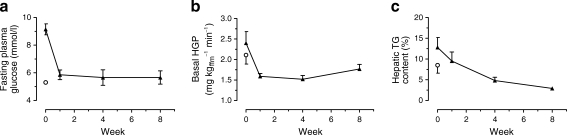
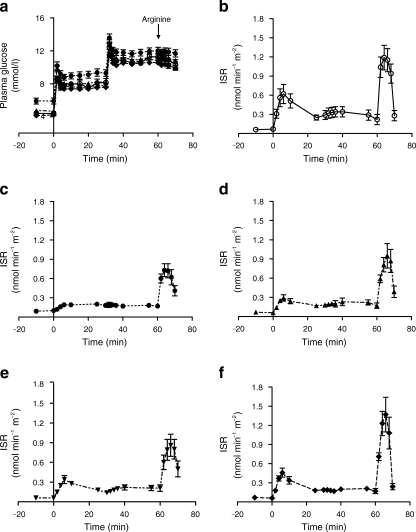
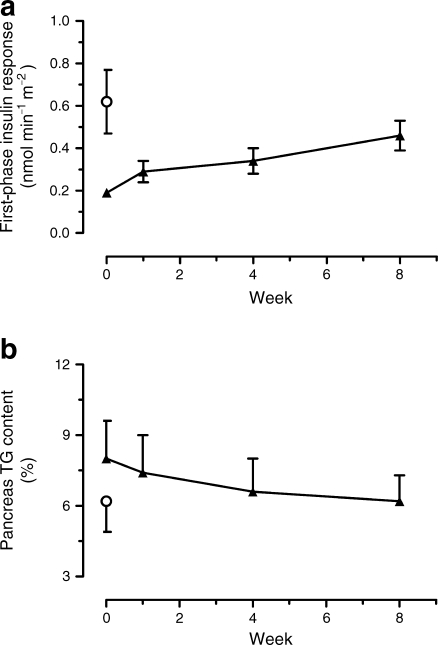
AIMS/HYPOTHESIS: Type 2 diabetes is regarded as inevitably progressive, with irreversible beta cell failure. The hypothesis was tested that both beta cell failure and insulin resistance can be reversed by dietary restriction of energy intake. METHODS: Eleven people with type 2 diabetes (49.5 ± 2.5 years, BMI 33.6 ± 1.2 kg/m(2), nine male and two female) were studied before and after 1, 4 and 8 weeks of a 2.5 MJ (600 kcal)/day diet. Basal hepatic glucose output, hepatic and peripheral insulin sensitivity and beta cell function were measured. Pancreas and liver triacylglycerol content was measured using three-point Dixon magnetic resonance imaging. An age-, sex- and weight-matched group of eight non-diabetic participants was studied. RESULTS: After 1 week of restricted energy intake, fasting plasma glucose normalised in the diabetic group (from 9.2 ± 0.4 to 5.9 ± 0.4 mmol/l; p = 0.003). Insulin suppression of hepatic glucose output improved from 43 ± 4% to 74 ± 5% (p = 0.003 vs baseline; controls 68 ± 5%). Hepatic triacylglycerol content fell from 12.8 ± 2.4% in the diabetic group to 2.9 ± 0.2% by week 8 (p = 0.003). The first-phase insulin response increased during the study period (0.19 ± 0.02 to 0.46 ± 0.07 nmol min(-1) m(-2); p < 0.001) and approached control values (0.62 ± 0.15 nmol min(-1) m(-2); p = 0.42). Maximal insulin response became supranormal at 8 weeks (1.37 ± 0.27 vs controls 1.15 ± 0.18 nmol min(-1) m(-2)). Pancreatic triacylglycerol decreased from 8.0 ± 1.6% to 6.2 ± 1.1% (p = 0.03). CONCLUSIONS/INTERPRETATION: Normalisation of both beta cell function and hepatic insulin sensitivity in type 2 diabetes was achieved by dietary energy restriction alone. This was associated with decreased pancreatic and liver triacylglycerol stores. The abnormalities underlying type 2 diabetes are reversible by reducing dietary energy intake.
Overview
The claims and statistics of this paper haven’t been checked yet.
Free: it reads the open-access text and checks the first 5 claims that cite a source we can check. Create a free account to check every claim.
Integrity signals
Registry
Cites
Statistics
Figures
Verification
Claims the paper makes
The claims and statistics of this paper haven’t been checked yet.
Free: it reads the open-access text and checks the first 5 claims that cite a source we can check. Create a free account to check every claim.
Claims other papers make about this one
Each is checked against this paper’s own text: does it say what the citing paper says it does?
The source backs part of the claim, not all of it — or backs it for a different population, condition or comparison.
In the citing paper
“Previously considered permanent and demanding life-long drug treat ment, type 2 diabetes is now recognised to be a potentially reversible consequence of excessive or abnormal accumulation of body fat (ie, the disease process of obesity). 5”
From 5-year follow-up of the randomised Diabetes Remission Clinical Trial (DiRECT) of continued support for weight loss maintenance in the UK: an extension study (2024) · cites this paper as [5]
Experimental — accuracy not yet measuredThe source backs part of the claim, not all of it — or backs it for a different population, condition or comparison.
In the citing paper
“During an intensive weight loss programme, or early after bariatric surgery, there are already significant improvements in hepatic and muscle insulin sensitivity, and pancreatic first-phase insulin secretion, with rapid loss of ectopic fat from skeletal muscle and liver [2, 3, 6].”
From Diets for weight management in adults with type 2 diabetes: an umbrella review of published meta-analyses and systematic review of trials of diets for diabetes remission (2022) · cites this paper as [6]
Experimental — accuracy not yet measuredThe source backs part of the claim, not all of it — or backs it for a different population, condition or comparison.
In the citing paper
“the twin cycle mechanism, driven by a damaging but reversible accumulation of ectopic fat within the liver and pancreas in susceptible individuals, has now been consistently observed. 6-8”
From Durability of a primary care-led weight-management intervention for remission of type 2 diabetes: 2-year results of the DiRECT open-label, cluster-randomised trial (2019) · cites this paper as [6]
Experimental — accuracy not yet measuredThe source backs part of the claim, not all of it — or backs it for a different population, condition or comparison.
In the citing paper
“Type 2 diabetes is strongly related to weight gain in adult life and accumulation of excess fat within the liver and pancreas.”
From Primary care-led weight management for remission of type 2 diabetes (DiRECT): an open-label, cluster-randomised trial (2018) · cites this paper as [4]
Experimental — accuracy not yet measuredThe cited source says what the claim attributes to it.
In the citing paper
“Although lifestyle interventions393 and weight loss394 reverse T2DM in early stages, when insulin is still secreted, T2DM patients may become dependent on anti-diabetic drugs in later stages.”
From Pancreatic regulation of glucose homeostasis. (2016) · cites this paper as [394]
9 more claims about this paper
Create a free account to see every claim other papers make about this one.
Self-check
Percentages, sums and reported differences re-computed from the paper’s own numbers.
The self-check needs the paper’s full text.
Citations
Cites
The metabolic phenotype in obesity: Fat mass, body fat distribution, and adipose tissue function
Goossens, G. H. (2017) · Obesity Facts · doi:10.1159/000471488 · Cited by 8,481
Turner, R. C., Fox, C., Matthews, McElroy, H. H., Cull, C. A., Holman, R. R., Neil, P., Hadden, D. R., Wright, D., Manley, E., et al. (1998) · The Lancet · Cited by 8,419
Glucose clamp technique: a method for quantifying insulin secretion and resistance.
DeFronzo, R. A., Tobin, J. D., & Andres, R. (1979) · American Journal of Physiology-Endocrinology and Metabolism · doi:10.1152/ajpendo.1979.237.3.e214 · Cited by 7,425 · cited 2×
“An isoglycaemic–hyperinsulinaemic clamp (insulin infusion rate 40 mU m min) was initiated at 0 min [14].”
Methodβ-Cell Deficit and Increased β-Cell Apoptosis in Humans With Type 2 Diabetes
Butler, A. E., Janson, J., Bonner-Weir, S., Ritzel, R., Rizza, R. A., & Butler, P. C. (2003) · Diabetes · doi:10.2337/diabetes.52.1.102 · Cited by 4,011 · cited 1×
“The underlying changes in beta cell function have been well described [3, 4], and beta-cell mass decreases steadily during the course of type 2 diabetes [5, 6].”
BackgroundGupta, A., & Uribarri, J. (2016) · Hormone Research in Paediatrics · doi:10.1159/000444053 · Cited by 4,006
Kahn, S. E. (2003) · Diabetologia · doi:10.1007/s00125-002-1009-0 · Cited by 2,166 · cited 1×
“The underlying changes in beta cell function have been well described [3, 4], and beta-cell mass decreases steadily during the course of type 2 diabetes [5, 6].”
BackgroundWeyer, C., Bogardus, C., Mott, D. M., & Pratley, R. E. (1999) · Journal of Clinical Investigation · doi:10.1172/jci7231 · Cited by 1,940 · cited 2×
“Absence of rapid insulin secretion in response to a rise in plasma glucose is the hallmark of type 2 diabetes [3, 21], and the decline in beta cell function determines the progression towards a need for insulin therapy [2].”
BackgroundU.K. Prospective Diabetes Study Group (1995) · Diabetes · doi:10.2337/diab.44.11.1249 · Cited by 1,923
Szczepaniak, L. S., Nurenberg, P., Leonard, D., Browning, J. D., Reingold, J. S., Grundy, S., Hobbs, H. H., & Dobbins, R. L. (2005) · American Journal of Physiology-Endocrinology and Metabolism · doi:10.1152/ajpendo.00064.2004 · Cited by 1,562 · cited 1×
“It continued to decline throughout the intervention period to reach the normal range for non-obese individuals [20] (2.”
Background
Cited by
Items 501–600 of 1,001
Abdelbasset, W. K., ELSAYED, S. H., Nambi, G. S., Alrawaili, S. M., Elnegamy, T. E., Khalil, M. A., Tantawy, S. A., Soliman, G. S., Ibrahim, A. A., & Kamel, D. M. (2020) · Evidence-based Complementary and Alternative Medicine · doi:10.1155/2020/1923575 · Cited by 19
“Evidence approved that the reduction of IHTG is importantly required to lower insulin resistance and blood glucose levels [29, 30].”
BackgroundRetractedKo, J., Kimita, W., Skudder‐Hill, L., Li, X., Priya, S., Bharmal, S. H., Cho, J., & Petrov, M. S. (2021) · Pancreatology · doi:10.1016/j.pan.2021.01.018 · Cited by 19
Efficacy and Safety of Meal Replacement in Patients With Type 2 Diabetes
Ye, W., Xu, L., Ye, Y., Zeng, F., Lu, X., Li, Y., & Liu, L. (2023) · The Journal of Clinical Endocrinology & Metabolism · doi:10.1210/clinem/dgad273 · Cited by 17
Arrieta, F., Piñera, M., Iglesias, P., Nogales, P., Salinero-Fort, M. Á., Abanades, J. C., Botella-Carretero, J. I., Calañas, A., Balsa, J. A., Zamarrón, I., et al. (2013) · Endocrinología y Nutrición · doi:10.1016/j.endonu.2013.09.002 · Cited by 17
Triglycerides-diabetes association in healthy middle-aged men: Modified by physical fitness?
Skretteberg, P. T., Grytten, A. N., Gjertsen, K., Grundvold, I., Kjeldsen, S. E., Erikssen, J., Mellbin, L., Liestøl, K., Fraser, D. A., Erikssen, G., et al. (2013) · Diabetes Research and Clinical Practice · doi:10.1016/j.diabres.2013.06.001 · Cited by 20
Nemati, R., Lu, J., Tura, A., Smith, G., & Murphy, R. (2016) · Obesity Surgery · doi:10.1007/s11695-016-2323-9 · Cited by 20
Johansson, H.-E., Edholm, D., Kullberg, J., Rosqvist, F., Rudling, M., Straniero, S., Karlsson, F. A., Ahlström, H. K., Sundbom, M., & Risérus, U. (2019) · Nutrition and Diabetes · doi:10.1038/s41387-019-0100-2 · Cited by 18
Liver triacylglycerol content and gestational diabetes: effects of moderate energy restriction
Hodson, K., Dalla Man, C., Smith, F. E., Barnes, A., McParlin, C., Cobelli, C., Robson, S. C., Araújo-Soares, V., & Taylor, R. (2017) · Diabetologia · doi:10.1007/s00125-016-4143-9 · Cited by 16
“This was based on a previous study from our institution in participants with type 2 diabetes as there were no published data on liver triacylglycerol in human pregnancy [5].”
BackgroundMethodSelf-citationJanssen, J. A. M. J. L. (2025) · International Journal of Molecular Sciences · doi:10.3390/ijms26189191 · Cited by 20
“The decrease in pancreatic fat was accompanied by a reversal of type 2 diabetes, normalization of fasting glucose levels, and almost a return to baseline of the first phase insulin response of the pancreas after a glucose load [150].”
Pepa, G. D., Brancato, V., Costabile, G., Salamone, D., Corrado, A., Vitale, M., Cavaliere, C., Mancini, M., Salvatore, M., Luongo, D., et al. (2022) · Diabetes Care · doi:10.2337/dc22-0605 · Cited by 17
High-Intensity Exercise Training for the Prevention of Type 2 Diabetes Mellitus
Rynders, C. A., & WELTMAN, A. L. (2014) · The Physician and Sportsmedicine · doi:10.3810/psm.2014.02.2042 · Cited by 20
Pedersen, L. R., Olsen, R. H., Frederiksen, M. S., Astrup, A. V., Chabanova, E., Hasbak, P., Holst, J. J., Kjær, A., Newman, J. W. I., Walzem, R. L., et al. (2013) · BMC Cardiovascular Disorders · doi:10.1186/1471-2261-13-106 · Cited by 17
“A British study using a very low energy diet (600 kcal) to induce weight loss showed that insulin resistance and beta cell failure could be reversed in diabetic patients [15].”
BackgroundTaylor, R., Valabhji, J., Aveyard, P. N., & Paul, D. (2019) · Diabetic Medicine · doi:10.1111/dme.13892 · Cited by 17
“The resulting Counterpoint study used a very low calorie liquid formula diet, supplemented with non-starchy vegetables [18].”
MethodSelf-citationSaleh, A., Anwar, M. M., Zayed, A. E.-Z., Eldeen, M. E. E., Afifi, G., Alnashiri, H. M., Gomaa, A. M. S., Abd‐Elkareem, M., Abou-Elhamd, A. S., Shaheen, E. S., et al. (2019) · Diabetes Metabolic Syndrome and Obesity · doi:10.2147/dmso.s209856 · Cited by 16
“14,29,30 In our diabetic rat, β -cells succumbed necrotic changes (cytoplasmic vacuolation and nuclear pyknosis) with a subsequent apoptosis and/or autophagy.”
BackgroundJacob, E., & Avery, A. (2021) · Obesity Science & Practice · doi:10.1002/osp4.504 · Cited by 20
Etiology of Obesity, Cancer, and Diabetes
Yasmin, I., Khan, W. A., Naz, S., Iqbal, M. W., Awuchi, C. G., Egbuna, C., Hassan, S., Patrick-Iwuanyanwu, K. C., & Uche, C. Z. (2021) · Springer eBooks · doi:10.1007/978-3-030-72999-8_1 · Cited by 27
Evans, T. S., Hawkes, R. E., Keyworth, C., Newson, L., Radley, D., Hill, A. J., Matu, J., & Ells, L. J. (2022) · British Journal of Diabetes · doi:10.15277/bjd.2022.341 · Cited by 17
The body economic: The case of ‘childhood obesity’
Harrison, E. (2012) · Feminism & Psychology · doi:10.1177/0959353512445357 · Cited by 16
Harveian Oration 2016: Some observations on the causes and consequences of obesity
O’Rahilly, S. (2016) · Clinical Medicine · doi:10.7861/clinmedicine.16-6-551 · Cited by 18
Postoperative Insulin Requirements in Bariatric Surgery
Diemer, D. M., Terry, K. L., Matthews, M., Romich, E., Saran, H., & Lansang, M. C. (2017) · Endocrine Practice · doi:10.4158/ep171901.or · Cited by 16
“It is postulated that the change in anatomy, diet, food absorption (15), incretins (gut-derived hormones) and improved beta cell function (16) lead to the reduction in insulin requirement.”
BackgroundDutta, D., Jaisani, R., Khandelwal, D., Ghosh, S., Malhotra, R. K., & Kalra, S. (2019) · Indian Journal of Endocrinology and Metabolism · doi:10.4103/ijem.ijem_185_19 · Cited by 19
Zhang, Z., He, X., Sun, Y., Li, J., & Sun, J. (2025) · Aging and Disease · doi:10.14336/ad.2025.0233 · Cited by 36
“For instance, intensive dietary modifications have been shown to restore β -cell function and insulin sensitivity partially, implying bidirectional crosstalk between metabolic disturbances and pancreatic aging [104].”
Li, M., Jeeyavudeen, M. S., Arunagirinathan, G., & Pappachan, J. M. (2023) · touchREVIEWS in Endocrinology · doi:10.17925/ee.2023.19.1.7 · Cited by 22
“Overall, these studies indicate that remission of T2DM can be achieved by energy restriction and weight loss of approximately 15 kg in an individual.(34) Energy restriction via LEDs and VLEDs can result in significant weight loss, which is essential and sufficient to reverse T2DM by restoring euglycaemia in the early…”
BackgroundIntrapancreatic fat deposition and nutritional treatment: the role of various dietary approaches
Pepa, G. D., Salamone, D., Testa, R., Bozzetto, L., & Costabile, G. (2023) · Nutrition Reviews · doi:10.1093/nutrit/nuad159 · Cited by 18
Surgical Management of Obesity in Patients with Morbid Obesity and Nonalcoholic Fatty Liver Disease
Dixon, J. B. (2013) · Clinics in Liver Disease · doi:10.1016/j.cld.2013.09.011 · Cited by 16
Diagnosis and management of lipodystrophy: a practical update
Stears, A. J., & Hames, C. (2014) · Clinical Lipidology · doi:10.2217/clp.14.13 · Cited by 17
Bozorgmanesh, M., Hadaegh, F., Sheikholeslami, F. H., Ghanbarian, A., & Azizi, F. (2012) · Cardiovascular Diabetology · doi:10.1186/1475-2840-11-69 · Cited by 16
“New approaches have been shown to reverse diabetes [50], have lower risk of hypoglycemia [51], promote weight loss, and confer decreased CVD risk among diabetic patients.”
BackgroundExercise Ameliorates Endocrine Pancreas Damage Induced by Chronic Cola Drinking in Rats
Losada, M. E. O., González, J., Müller, A., Ottaviano, G., Cao, G., Azzato, F., Ambrosio, G., & Milei, J. (2016) · PLoS ONE · doi:10.1371/journal.pone.0155630 · Cited by 15
“Weight loss is actually an essential factor to improve health status in diabetic patients [17].”
BackgroundEffects of Exercise on Liver Fat and Metabolism in Alcohol Drinkers
Houghton, D., Hallsworth, K., Thoma, C., Cassidy, S., Hardy, T., Heaps, S. E., Hollingsworth, K. G., Taylor, R., Day, C. P., Masson, S., et al. (2017) · Clinical Gastroenterology and Hepatology · doi:10.1016/j.cgh.2017.05.001 · Cited by 16
Self-citationRyder, R. E. J., Irwin, S. P., Burbridge, W., Gandhi, H., Bashir, T., Allden, R. A., Wilson, M., WYRES, M. C., CULL, M. L., Yadagiri, M., et al. (2019) · British Journal of Diabetes · doi:10.15277/bjd.2019.226 · Cited by 16
Holst, J. J., & Madsbad, S. (2021) · Diabetes Therapy · doi:10.1007/s13300-021-01032-y · Cited by 17
“Later, after a major weight loss, skeletal muscle insulin sensitivity will also improve (presumably due to the loss of ectopic fat), and beta-cell function may improve steadily over months [19, 25].”
BackgroundInsulin resistance in diabetes: The promise of using induced pluripotent stem cell technology
Elsayed, A. K., Vimalraj, S., Nandakumar, M., & Abdelalim, E. M. (2021) · World Journal of Stem Cells · doi:10.4252/wjsc.v13.i3.221 · Cited by 17
“FFAs leads to intrapancreatic and intra β-cell accumulation of triglyceride and fat droplets, triggering the β-cell dysfunction and death due to an increase in the inflammation process [120,121].”
BackgroundGiuseppe, G. D., Ciccarelli, G., CEFALO, C. M. A., Cinti, F., Moffa, S., Impronta, F., Capece, U., Pontecorvi, A., Giaccari, A., & Mezza, T. (2021) · Minerva Endocrinology · doi:10.23736/s2724-6507.21.03405-9 · Cited by 17
Targeting the insulin granule for modulation of insulin exocytosis
Yau, B., HOCKING, S. L., Andrikopoulos, S., & Kebede, M. A. (2021) · Biochemical Pharmacology · doi:10.1016/j.bcp.2021.114821 · Cited by 15
Quimby, K. R., Murphy, M. M., Harewood, H. C., Howitt, C., Hambleton, I. R., Jeyaseelan, S. M., GREAVES, N. S., & Sobers, N. (2022) · Implementation Science Communications · doi:10.1186/s43058-022-00255-9 · Cited by 17
“This determination was based on the intervention effectiveness of previous studies which suggested that this paradigm of a very low-calorie diet for in excess of 8-week duration was sufficient to cause the quantity of weight loss needed to induce diabetes remission [12, 13].”
MethodBai, J., Zhang, S., Cao, J., Sun, H., Mang, Z., Shen, W. L., & Li, H. (2022) · Phytomedicine · doi:10.1016/j.phymed.2022.154366 · Cited by 16
Sakai, T., Kusakabe, T., Ebihara, K., Aotani, D., Yamamoto‐Kataoka, S., Zhao, M., Gumbilai, V., Ebihara, C., Aizawa‐Abe, M., Yamamoto, Y., et al. (2014) · American Journal of Physiology-Endocrinology and Metabolism · doi:10.1152/ajpendo.00272.2014 · Cited by 16
“In the pancreas, the reduction of ectopic lipid deposition could improve -cell function such as glucose-stimulated insulin secretion (GSIS) in rodents and humans (22, 39, 46).”
BackgroundInfluentialFive Evidence-Based Lifestyle Habits People With Diabetes Can Use
Chacko, E., & Signore, C. (2020) · Clinical Diabetes · doi:10.2337/cd19-0078 · Cited by 22
“(3) reported that, for patients with type 2 diabetes on a strict low-calorie diet (600 kcal/ day), the fat content of the liver and pancreas decreased, fasting glucose normalized within 1 week, and A1C improved from 7.”
BackgroundInfluentialHyposalivation is prevalent in bariatric patients but improves after surgery
Schwenger, K. J. P., Alghamdi, M. M., Ghorbani, Y., Jackson, T. D., Okrainec, A., & Allard, J. P. (2020) · Surgery for Obesity and Related Diseases · doi:10.1016/j.soard.2020.06.005 · Cited by 18
Factors Affecting Metabolic Outcomes Post Bariatric Surgery: Role of Adipose Tissue
Keshavjee, S., Schwenger, K. J. P., Yadav, J., Jackson, T. D., Okrainec, A., & Allard, J. P. (2021) · Journal of Clinical Medicine · doi:10.3390/jcm10040714 · Cited by 17
Kempf, K., Röhling, M., Banzer, W., Braumann, K. M., Halle, M., Schaller, N., McCarthy, D., Predel, H. G., Schenkenberger, I., Tan, S., et al. (2022) · Nutrients · doi:10.3390/nu14122537 · Cited by 14
Metabolic effects of alternate-day fasting in males with obesity with or without type 2 diabetes
Ingersen, A., Helset, H. R., Calov, M., Chabanova, E., Harreskov, E. G., Jensen, C., HANSEN, C. N., Prats, C., Helge, J. W., Larsen, S., et al. (2022) · Frontiers in Physiology · doi:10.3389/fphys.2022.1061063 · Cited by 16
“The mechanism for improvements in insulin secretion has been attributed to a decrease in intrapancreatic triacylglycerol (Lim et al., 2011; Steven et al., 2016b).”
BackgroundThe effect of macroprudential regulation on banks’ profitability during financial crises
Atta, A. A. B., Mustafa, J. A., Al-Qudah, S. S., Massad, E. M., & Ahmad, A. Y. A. B. (2023) · Corporate Governance and Organizational Behavior Review · doi:10.22495/cgobrv7i2sip4 · Cited by 47
“Lim et al. (2011) investigated the impact of macroprudential instruments in 46 countries, by estimating the impact of individual instrument straining in reducing the pro-cyclicality of financial risks.”
BackgroundKenkre, J. S., Tan, T., & Bloom, S. R. (2013) · Expert Review of Clinical Pharmacology · doi:10.1586/ecp.13.5 · Cited by 17
Klein, S., & Romijn, J. A. (2016) · Elsevier eBooks · doi:10.1016/b978-0-323-29738-7.00036-8 · Cited by 16
Assessing the evidence for weight loss strategies in people with and without type 2 diabetes
Clifton, P. M. (2017) · World Journal of Diabetes · doi:10.4239/wjd.v8.i10.440 · Cited by 18
Nussbaumer, R., Meyer‐Gerspach, A. C., Peterli, R., Peters, T. T. A., Beglinger, C., Chiappetta, S., Drewe, J., & Wölnerhanssen, B. K. (2020) · Obesity Facts · doi:10.1159/000511928 · Cited by 17
Ciardullo, S., Bianconi, E., Zerbini, F., & Perseghin, G. (2021) · Diabetes Research and Clinical Practice · doi:10.1016/j.diabres.2021.108879 · Cited by 14
Noronha, J. C., Thom, G., & Lean, M. E. J. (2022) · Frontiers in Endocrinology · doi:10.3389/fendo.2022.888557 · Cited by 15
“This led to a return of normal beta cell function and hepatic glucose output, in association with marked decreases in pancreatic and liver fat (15).”
BackgroundMethodXu, Z., Zhang, H., Wu, C., Zheng, Y., & Jiang, J. (2022) · Frontiers in Cardiovascular Medicine · doi:10.3389/fcvm.2022.944902 · Cited by 16
Halpern, B., & Mancini, M. C. (2019) · Obesity Reviews · doi:10.1111/obr.12837 · Cited by 14
“The twin‐cycle hypothesis has been tested in a study assessing acute caloric restriction in patients with T2DM.(64) As expected, intrahepatic fat mobilization occurred within days, reducing fasting glycemia and intrahepatic fat content measured by magnetic resonance.”
Yamazaki, H., Wang, J., Tauchi, S., Dohke, M., Hanawa, N., Katanuma, A., Saisho, Y., Kamitani, T., Fukuhara, S., & Yamamoto, Y. (2020) · Clinical Gastroenterology and Hepatology · doi:10.1016/j.cgh.2020.06.032 · Cited by 14
Therapeutic approaches for non-alcoholic steatohepatitis
Gaal, L. F. V., Mertens, J., Francque, S., & Block, C. E. M. D. (2021) · Therapeutic Advances in Endocrinology and Metabolism · doi:10.1177/20420188211034300 · Cited by 16
Pathogenesis of Type 2 Diabetes Mellitus
DeFronzo, R. A. (2018) · Endocrinology · doi:10.1007/978-3-319-45015-5_8 · Cited by 16
The impact of diabetes on labour market outcomes in Mexico: A panel data and biomarker analysis
Seuring, T., Serneels, P. M., & Suhrcke, M. (2019) · Social Science & Medicine · doi:10.1016/j.socscimed.2019.05.051 · Cited by 20
Type 2 diabetes: remission in just a week
Yki‐Järvinen, H. (2011) · Diabetologia · doi:10.1007/s00125-011-2266-6 · Cited by 14
Pathogenesis of type 2 diabetes mellitus
DeFronzo, R. A. (2015) · Wiley eBooks · doi:10.1002/9781118387658.ch25 · Cited by 38
Pancreatic triacylglycerol distribution in type 2 diabetes
Hollingsworth, K. G., Al-Mrabeh, A. H., Steven, S., & Taylor, R. (2015) · Diabetologia · doi:10.1007/s00125-015-3718-1 · Cited by 14
“We have thoroughly assessed over 100 pancreases of people with diabetes and 32 with normal glucose tolerance using our published three-point Dixon method [2].”
MethodSelf-citationDas, S., Sakr, H. F., Sirasanagandla, S. R., Bima, A. I. H., & Elsamanoudy, A. Z. (2022) · Current Diabetes Reviews · doi:10.2174/1573399818666220511121629 · Cited by 15
Feng, S., Wang, J., Peng, Q., Zhang, P., Jiang, Y., Zhang, H., Song, X., Li, Y., Huang, W., Zhang, D., et al. (2024) · Phytomedicine · doi:10.1016/j.phymed.2024.156348 · Cited by 14
Edelman, S. V., Ng‐Mak, D., Fusco, M., Ashton, D. W., Okerson, T. E., Liu, Q., Jin, J., & Dixon, J. B. (2014) · Diabetes Obesity and Metabolism · doi:10.1111/dom.12313 · Cited by 15
“thought to produce the very early improvement in glycaemic control reported following surgery, but several studies have suggested that major calorie restriction provides the same effect [15,28].”
BackgroundMellor, D. D., & Naumovski, N. (2016) · International Journal of Food Science & Technology · doi:10.1111/ijfs.13075 · Cited by 15
Dieta baja en carbohidratos y dieta cetogénica: impacto en enfermedades metabólicas y reproductivas
Moreno-Sepulveda, J. A., & Capponi, M. (2020) · Revista médica de Chile · doi:10.4067/s0034-98872020001101630 · Cited by 24
Guarino, G., Corte, T. D., Strollo, F., & Gentile, S. (2021) · Diabetes & Metabolic Syndrome Clinical Research & Reviews · doi:10.1016/j.dsx.2021.03.032 · Cited by 19
Mohammad, T., de Souza, A. H., Bensellam, M., Chae, H., Jaffredo, M., Close, A.-F., Deglasse, J.-P., Santos, L. R. B., Buémi, A., Mourad, N. I., et al. (2022) · Diabetologia · doi:10.1007/s00125-022-05842-y · Cited by 16
“Indeed, in obese patients with recent type 2 diabetes submitted to severe energy restriction, the remission of diabetes critically depends on rapid restoration of beta cell glucose responsiveness [16, 17].”
BackgroundMid‐Term Remission of Type 2 Diabetes Mellitus After Laparoscopic Roux En‐Y Gastric Bypass
Vasas, P., Al‐Khyatt, W., IDRIS, I. R., Leeder, P. C., Awan, A., Awad, S., & Ahmed, J. (2016) · World Journal of Surgery · doi:10.1007/s00268-016-3609-8 · Cited by 13
“The sudden negative energy balance and consequent reduction in pancreatic and hepatic triacylglycerol accumulation have been shown to restore beta-cell function and normalize first-phase insulin secretion in response to a carbohydrate meal [23].”
BackgroundEctopic fat: a target for cardiometabolic risk management
Gastaldelli, A., & Gaggini, M. (2016) · Expert Review of Cardiovascular Therapy · doi:10.1080/14779072.2016.1256773 · Cited by 14
“In obese and T2D patients, caloric restriction, either after bariatric surgery or very low-calorie diet, has been found effective in reducing the amount of ectopic fat, mainly in liver and pancreas, and in improving fasting and postprandial hyperglycemia [3,14].”
BackgroundVascular endothelial growth factor-B: Impact on physiology and pathology
Zhu, H., Gao, M., Gao, X., & Tong, Y. A. (2017) · Cell Adhesion & Migration · doi:10.1080/19336918.2017.1379634 · Cited by 15
Beta-Cell Function and Failure in Type 2 Diabetes
Popa, S. G., & Mot, M. (2013) · InTech eBooks · doi:10.5772/56467 · Cited by 19
Lima, R. A., Pereira, D. D. C., Luna, R. C. P., Gonçalves, M. D. C. R., Lima, R. D., Filho, M. B., Filizola, R. G., Moraes, R. D., Asciutti, L. S. R., & da Costa, M. L. L. (2015) · International Journal of Environmental Research and Public Health · doi:10.3390/ijerph120404422 · Cited by 19
Åhrén, B. (2015) · Diabetologia · doi:10.1007/s00125-015-3557-0 · Cited by 15
“Potential targets include conventional cell biological signalling processes, a number of which are currently being investigated by promising ongoing studies, such as inhibition of 11β-hydroxysteroid dehydrogenase 1, glucokinase activation, G protein-coupled fatty acid receptor activation, glucagon receptor antagonism…”
BackgroundInfluentialFadini, G. P., Giaccari, A., Broglio, F., Nollino, L., Fattor, B., Anichini, R., Meregalli, G., Avogaro, A., Consoli, A., Aimaretti, G., et al. (2025) · The Lancet Regional Health - Europe · doi:10.1016/j.lanepe.2025.101499 · Cited by 18
Beta‐cell function in type 2 diabetes ( T2DM ): Can it be preserved or enhanced?
Kassem, L. S., Rajpal, A., Barreiro, M. V. E., & Ismail‐Beigi, F. (2023) · Journal of Diabetes · doi:10.1111/1753-0407.13446 · Cited by 17
“74,75 Maintenance of weight loss seems to be an important factor in the sustainability of beta-cell function improvements over time.”
BackgroundInfluentialChimoriya, R., Mitlehner, K., Khoo, C. L., Osuagwu, U. L., Thomson, R. J., Si, L., Lean, M. E. J., Simmons, D. S., & Piya, M. K. (2024) · Journal of Diabetes Research · doi:10.1155/2024/2350551 · Cited by 15
“…of the DiRECT UK study [17], this study demonstrated that T2DM is not necessarily a permanent and progressive condition, and diabetes remission is achievable in many patients with recently diagnosed T2DM, aided by a loss of abnormal ectopic fat accumulation in the liver and pancreas [18, 19, 39].”
BackgroundLannoo, M., Simoens, C., Vangoitsenhoven, R., Gillard, P., D’Hoore, A. J. L., Vadder, M. D., Mertens, A. C., Deleus, E., Steenackers, N., Mathieu, C., et al. (2024) · Scientific Reports · doi:10.1038/s41598-024-59048-w · Cited by 13
Adipocentric Strategy for the Treatment of Type 2 Diabetes Mellitus
Martínez, J. J. G. (2025) · Journal of Clinical Medicine · doi:10.3390/jcm14030678 · Cited by 16
The impact of Roux-en-Y gastric bypass surgery on normal metabolism in a porcine model
Lindqvist, A., Ekelund, M., Garcia‐Vaz, E., Ståhlman, M., Pierzynowski, S. G., Gomez, M. F., Rehfeld, J. F., Groop, L., Hedenbro, J., Wierup, N., et al. (2017) · PLoS ONE · doi:10.1371/journal.pone.0173137 · Cited by 13
Yan, S., Wang, C., Zhao, H., Pan, Y., Wang, H., Guo, Y., Yao, N., Li, B., & Cui, W. (2020) · Food & Function · doi:10.1039/d0fo00287a · Cited by 15
Cai, Z., Chen, Z., Fang, W., Li, W., Huang, Z., Wang, X., Chen, G., Wu, W., Chen, Z., Wu, S., et al. (2021) · Journal of Diabetes Investigation · doi:10.1111/jdi.13536 · Cited by 15
Chicory Inulin: A Versatile Biopolymer with Nutritional and Therapeutic Properties
Malik, B., & Rehman, R. U. (2021) · Springer eBooks · doi:10.1007/978-3-030-58975-2_16 · Cited by 12
The liver-alpha-cell axis after a mixed meal and during weight loss in type 2 diabetes
Otten, J., Stomby, A., Waling, M., Chorell, E., Ryberg, M., Svensson, M., Holst, J. J., & Olsson, T. (2021) · Endocrine Connections · doi:10.1530/ec-21-0171 · Cited by 14
“It is well established that diet-induced weight loss improves hepatic insulin sensitivity in individuals with type 2 diabetes (13).”
de Hoogh, I. M., Pasman, W. J., Boorsma, A., van Ommen, B., & Wopereis, S. (2022) · Biomedicines · doi:10.3390/biomedicines10030643 · Cited by 17
“Moreover, it is known that MIR is best counteracted by physical exercise [18], whereas caloric restriction seems to be effective in reducing HIR [19].”
BackgroundThomsen, M. N., Skytte, M. J., Samkani, A., Astrup, A. V., Fenger, M., Frystyk, J., Hartmann, B., Holst, J. J., Larsen, T. M., Madsbad, S., et al. (2022) · Frontiers in Nutrition · doi:10.3389/fnut.2022.933118 · Cited by 12
Remission of type 2 diabetes: A critical appraisal
Ricci, M., Mancebo-Sevilla, J. J., Cobos-Palacios, L., Sanz‐Cánovas, J., Sampalo, A. L., Hernández-Negrín, H., Velasco, M. Á. P., Perez-Belmonte, L. M., Bernal-López, M. R., & Gómez‐Huelgas, R. (2023) · Frontiers in Endocrinology · doi:10.3389/fendo.2023.1125961 · Cited by 15
“Later it was demonstrated that the reduction of caloric intake and the consequent weight loss led to a decrease in intrahepatic and intrapancreatic fat, which resulted in an improvement in insulin resistance (3).”
BackgroundSleeve gastrectomy causes weight‐loss independent improvements in hepatic steatosis
McGlone, E. R., Siebert, M., Dore, M. H., Hope, D. C. D., Davies, I., Owen, B. M., Khoo, B. C. E., Goldin, R. D., Carling, D., Bloom, S. R., et al. (2023) · Liver International · doi:10.1111/liv.15614 · Cited by 12
Lingvay, I. (2014) · Journal of Diabetes & Metabolism · doi:10.4172/2155-6156.1000348 · Cited by 13
Intestinal and Gastric Origins for Diabetes Resolution After Bariatric Surgery
Andrew, C. A., Umashanker, D., Aronne, L. J., & Shukla, A. P. (2018) · Current Obesity Reports · doi:10.1007/s13679-018-0302-2 · Cited by 14
Nylén, C., Lundell, L. S., Massart, J., Zierath, J. R., & Näslund, E. B. (2018) · American Journal of Physiology-Endocrinology and Metabolism · doi:10.1152/ajpendo.00253.2018 · Cited by 12
“Short-term low-calorie diet is an efficient strategy to induce substantial weight loss and improve insulin sensitivity in obese adults (14, 18, 23).”
BackgroundResultQuimby, K. R., Sobers, N., George, C., GREAVES, N. S., Browman-Jones, F., & Samuels, T. A. (2021) · Implementation Science Communications · doi:10.1186/s43058-021-00196-9 · Cited by 12
Rohner, M., Heiz, R., Feldhaus, S., & Bornstein, S. R. (2021) · Hormone and Metabolic Research · doi:10.1055/a-1510-8896 · Cited by 17
López-Pérez, A. R., Norlin, S., Steneberg, P., Remeseiro, S., Edlund, H., & Hörnblad, A. (2021) · Scientific Reports · doi:10.1038/s41598-021-03567-3 · Cited by 12
Influence of modern antidiabetic therapy on body weight in patients with type 2 diabetes mellitus
Салухов, В. В., Ilyinskaya, Т. A., & Minakov, A. A. (2022) · Endocrinology News Opinions Training · doi:10.33029/2304-9529-2022-11-1-39-52 · Cited by 14
Welsh, P. I., Cezard, G. I., Gill, J. M. R., Wallia, S., Douglas, A., Sheikh, A., Wild, S. H., Tuomilehto, J., McKnight, J. A., Murray, G. D., et al. (2016) · International Journal of Obesity · doi:10.1038/ijo.2016.35 · Cited by 13
The Effects of Intermittent Energy Restriction on Indices of Cardiometabolic Health
Antoni, R., Johnston, K. L., Collins, A. L., & Robertson, M. D. (2014) · Research in Endocrinology · doi:10.5171/2014.459119 · Cited by 18
Mollentze, W. F., Joubert, G., Prins, A., van der Linde, S., Marx, G. M., & Tsie, K. G. (2019) · International Journal of Diabetes in Developing Countries · doi:10.1007/s13410-019-00734-1 · Cited by 11
Conceptual framework and expert guidance on intrapancreatic fat deposition: the Melbourne consensus
Petrov, M. S., Yamazaki, H., Lu, G., Al-Mrabeh, A. H., Luchini, C., Dong, X., Hamada, T., Liu, Y., Oyama, H., Rospleszcz, S., et al. (2026) · Nature Reviews Gastroenterology & Hepatology · doi:10.1038/s41575-026-01224-6 · Cited by 14
Human Beta Cell Functional Adaptation and Dysfunction in Insulin Resistance and Its Reversibility
Klemen, M. S., Kopecký, J., Dolenšek, J., & Stožer, A. (2023) · The Nephron journals/Nephron journals · doi:10.1159/000534667 · Cited by 15
“In advanced T2D, the second phase of insulin secretion is also impaired, but the biphasic pro fi le of insulin secretion can potentially be reversed by acute negative energy balance [24].”
BackgroundBull, C. J., Hazelwood, E., Legge, D., Corbin, L. J., Richardson, T. G., Lee, M. A., Yarmolinsky, J. W., Smith-Byrne, K., Hughes, D. A., Johansson, M., et al. (2024) · EBioMedicine · doi:10.1016/j.ebiom.2024.104977 · Cited by 13
Self-citationImaging evaluation of the pancreas in diabetic patients
Zeng, N., Wang, Y., Cheng, Y., Huang, Z., & Song, B. (2021) · Abdominal Radiology · doi:10.1007/s00261-021-03340-0 · Cited by 11
Kempf, K., Dubois, C., Arnold, M., Amelung, V. E., Leppert, N., Altin, S. V., Vomhof, M., Icks, A., & Martin, S. (2023) · Nutrients · doi:10.3390/nu15183954 · Cited by 13
“(≤6 years) demonstrated a high potential for diabetes remission [8,9], the second hypothesis tested was that participation in TeLIPro would be associated with a higher HbA1c normalisation rate after 12 months in patients with a diabetes duration of <5 years compared to control patients in routine care.”
BackgroundMethodResultInfluential
Metadata
- Authors
- Lim, E. L., Hollingsworth, K. G., Aribisala, B. S., Chen, M. J., Mathers, J. C., & Taylor, R.
- Affiliations
- Newcastle University (GB)
- Corresponding author
- Taylor, R.
- Venue
- Diabetologia
- Published
- 2011-06-09
- Volume
- 54
- Issue
- 10
- Pages
- 2506-2514
- ISSN
- 0012-186X (ISSN-L)
- 1432-0428
- PMC
- PMC3168743
- OpenAlex
- W2127283831
- Cited by
- 1,164
- References
- 51
- Citations by year
- 2026: 46 · 2025: 60 · 2024: 65 · 2023: 77 · 2022: 109 · 2021: 102 · 2020: 81 · 2019: 77 · 2018: 86 · 2017: 90 · 2016: 77 · 2015: 82 · 2014: 60 · 2013: 77 · 2012: 64
- FWCI
- 68.35
- Type
- journal article
- Language
- en
- Open access
- hybrid
- doi.org
- Licence
- cc-by-nc
- Locations
- Diabetologia (publishedVersion, cc-by-nc)
- Europe PMC (PubMed Central) (publishedVersion, cc-by-nc)
- PubMed Central (publishedVersion, cc-by-nc)
- PubMed (publishedVersion)
- IRIS Research product catalog (Sapienza University of Rome) (submittedVersion)
- Edinburgh Research Explorer (University of Edinburgh) (submittedVersion, other-oa)
- Newcastle University ePrints (Newcastle Univesity) (cc-by-nc)
- Topics
- Health Sciences › Medicine › Endocrinology, Diabetes and Metabolism › Pancreatic function and diabetes
- Health Sciences › Medicine › Endocrinology, Diabetes and Metabolism › Diabetes Treatment and Management
- Health Sciences › Medicine › Endocrinology, Diabetes and Metabolism › Diabetes, Cardiovascular Risks, and Lipoproteins
- Keywords
- type 2 diabetes remission, beta-cell function, caloric restriction, dietary restriction, hepatic insulin sensitivity, hepatic glucose production, liver triacylglycerol, first-phase insulin response, insulin resistance, fasting blood glucose, pancreatic fat content, hepatic fat content, weight loss interventions
- MeSH terms
- Adult, Aged, Blood Glucose, Body Composition, Body Weight, Diabetes Mellitus, Type 2, Female, Glycated Hemoglobin, Humans, Liver, Male, Middle Aged, Pancreas, Triglycerides, Insulin-Secreting Cells
About these checks
Registry, retraction, Cites and statistics results are computed, not judged, with one exception: a printed reference that no index lists is read once by a model before it counts as a citation error. Claims are extracted by a model and kept only when their quote appears verbatim in the text; each cited source is then checked, with a model’s help, for whether it says what the claim relies on. Those verdicts can be wrong — read the claim’s quote and the cited source before relying on one.
Statistics and arithmetic are recomputed, not judged.
Confidence bands are shown only for fields calibrated on our annotated test set. None is calibrated yet, so no band is shown.
What counts as a claim ›How we measure confidence ›How we check this ›
Are you an author, or do you see a problem with this page? Request a review
Data sources
Bibliographic data: Semantic Scholar, OpenAlex, Crossref.
Contains information from the Semantic Scholar Academic Graph Datasets, made available under the ODC Attribution License (ODC-BY 1.0).
Semantic Scholar’s data is described in: Kinney, R., et al. (2023). The Semantic Scholar Open Data Platform. arXiv:2301.10140.
