

Reversal of type 2 diabetes: normalisation of beta cell function in association with decreased pancreas and liver triacylglycerol
Open accessThe DOI matches its Crossref record; 52 of the 52 references it cites were found in a registry or an index.
Abstract
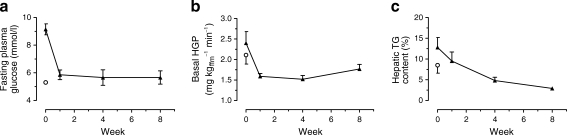
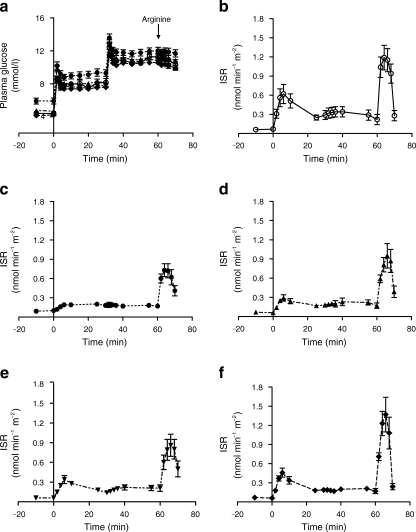
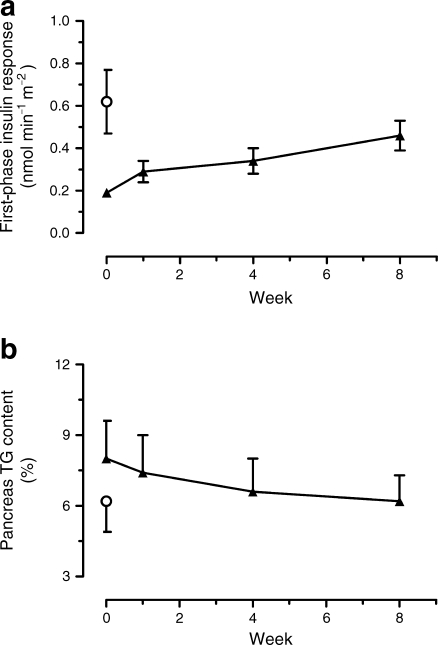
AIMS/HYPOTHESIS: Type 2 diabetes is regarded as inevitably progressive, with irreversible beta cell failure. The hypothesis was tested that both beta cell failure and insulin resistance can be reversed by dietary restriction of energy intake. METHODS: Eleven people with type 2 diabetes (49.5 ± 2.5 years, BMI 33.6 ± 1.2 kg/m(2), nine male and two female) were studied before and after 1, 4 and 8 weeks of a 2.5 MJ (600 kcal)/day diet. Basal hepatic glucose output, hepatic and peripheral insulin sensitivity and beta cell function were measured. Pancreas and liver triacylglycerol content was measured using three-point Dixon magnetic resonance imaging. An age-, sex- and weight-matched group of eight non-diabetic participants was studied. RESULTS: After 1 week of restricted energy intake, fasting plasma glucose normalised in the diabetic group (from 9.2 ± 0.4 to 5.9 ± 0.4 mmol/l; p = 0.003). Insulin suppression of hepatic glucose output improved from 43 ± 4% to 74 ± 5% (p = 0.003 vs baseline; controls 68 ± 5%). Hepatic triacylglycerol content fell from 12.8 ± 2.4% in the diabetic group to 2.9 ± 0.2% by week 8 (p = 0.003). The first-phase insulin response increased during the study period (0.19 ± 0.02 to 0.46 ± 0.07 nmol min(-1) m(-2); p < 0.001) and approached control values (0.62 ± 0.15 nmol min(-1) m(-2); p = 0.42). Maximal insulin response became supranormal at 8 weeks (1.37 ± 0.27 vs controls 1.15 ± 0.18 nmol min(-1) m(-2)). Pancreatic triacylglycerol decreased from 8.0 ± 1.6% to 6.2 ± 1.1% (p = 0.03). CONCLUSIONS/INTERPRETATION: Normalisation of both beta cell function and hepatic insulin sensitivity in type 2 diabetes was achieved by dietary energy restriction alone. This was associated with decreased pancreatic and liver triacylglycerol stores. The abnormalities underlying type 2 diabetes are reversible by reducing dietary energy intake.
Overview
The claims and statistics of this paper haven’t been checked yet.
Free: it reads the open-access text and checks the first 5 claims that cite a source we can check. Create a free account to check every claim.
Integrity signals
Registry
Cites
Statistics
Figures
Verification
Claims the paper makes
The claims and statistics of this paper haven’t been checked yet.
Free: it reads the open-access text and checks the first 5 claims that cite a source we can check. Create a free account to check every claim.
Claims other papers make about this one
Each is checked against this paper’s own text: does it say what the citing paper says it does?
The source backs part of the claim, not all of it — or backs it for a different population, condition or comparison.
In the citing paper
“Previously considered permanent and demanding life-long drug treat ment, type 2 diabetes is now recognised to be a potentially reversible consequence of excessive or abnormal accumulation of body fat (ie, the disease process of obesity). 5”
From 5-year follow-up of the randomised Diabetes Remission Clinical Trial (DiRECT) of continued support for weight loss maintenance in the UK: an extension study (2024) · cites this paper as [5]
Experimental — accuracy not yet measuredThe source backs part of the claim, not all of it — or backs it for a different population, condition or comparison.
In the citing paper
“During an intensive weight loss programme, or early after bariatric surgery, there are already significant improvements in hepatic and muscle insulin sensitivity, and pancreatic first-phase insulin secretion, with rapid loss of ectopic fat from skeletal muscle and liver [2, 3, 6].”
From Diets for weight management in adults with type 2 diabetes: an umbrella review of published meta-analyses and systematic review of trials of diets for diabetes remission (2022) · cites this paper as [6]
Experimental — accuracy not yet measuredThe source backs part of the claim, not all of it — or backs it for a different population, condition or comparison.
In the citing paper
“the twin cycle mechanism, driven by a damaging but reversible accumulation of ectopic fat within the liver and pancreas in susceptible individuals, has now been consistently observed. 6-8”
From Durability of a primary care-led weight-management intervention for remission of type 2 diabetes: 2-year results of the DiRECT open-label, cluster-randomised trial (2019) · cites this paper as [6]
Experimental — accuracy not yet measuredThe source backs part of the claim, not all of it — or backs it for a different population, condition or comparison.
In the citing paper
“Type 2 diabetes is strongly related to weight gain in adult life and accumulation of excess fat within the liver and pancreas.”
From Primary care-led weight management for remission of type 2 diabetes (DiRECT): an open-label, cluster-randomised trial (2018) · cites this paper as [4]
Experimental — accuracy not yet measuredThe cited source says what the claim attributes to it.
In the citing paper
“Although lifestyle interventions393 and weight loss394 reverse T2DM in early stages, when insulin is still secreted, T2DM patients may become dependent on anti-diabetic drugs in later stages.”
From Pancreatic regulation of glucose homeostasis. (2016) · cites this paper as [394]
9 more claims about this paper
Create a free account to see every claim other papers make about this one.
Self-check
Percentages, sums and reported differences re-computed from the paper’s own numbers.
The self-check needs the paper’s full text.
Citations
Cites
The metabolic phenotype in obesity: Fat mass, body fat distribution, and adipose tissue function
Goossens, G. H. (2017) · Obesity Facts · doi:10.1159/000471488 · Cited by 8,481
Turner, R. C., Fox, C., Matthews, McElroy, H. H., Cull, C. A., Holman, R. R., Neil, P., Hadden, D. R., Wright, D., Manley, E., et al. (1998) · The Lancet · Cited by 8,419
Glucose clamp technique: a method for quantifying insulin secretion and resistance.
DeFronzo, R. A., Tobin, J. D., & Andres, R. (1979) · American Journal of Physiology-Endocrinology and Metabolism · doi:10.1152/ajpendo.1979.237.3.e214 · Cited by 7,425 · cited 2×
“An isoglycaemic–hyperinsulinaemic clamp (insulin infusion rate 40 mU m min) was initiated at 0 min [14].”
Methodβ-Cell Deficit and Increased β-Cell Apoptosis in Humans With Type 2 Diabetes
Butler, A. E., Janson, J., Bonner-Weir, S., Ritzel, R., Rizza, R. A., & Butler, P. C. (2003) · Diabetes · doi:10.2337/diabetes.52.1.102 · Cited by 4,011 · cited 1×
“The underlying changes in beta cell function have been well described [3, 4], and beta-cell mass decreases steadily during the course of type 2 diabetes [5, 6].”
BackgroundGupta, A., & Uribarri, J. (2016) · Hormone Research in Paediatrics · doi:10.1159/000444053 · Cited by 4,006
Kahn, S. E. (2003) · Diabetologia · doi:10.1007/s00125-002-1009-0 · Cited by 2,166 · cited 1×
“The underlying changes in beta cell function have been well described [3, 4], and beta-cell mass decreases steadily during the course of type 2 diabetes [5, 6].”
BackgroundWeyer, C., Bogardus, C., Mott, D. M., & Pratley, R. E. (1999) · Journal of Clinical Investigation · doi:10.1172/jci7231 · Cited by 1,940 · cited 2×
“Absence of rapid insulin secretion in response to a rise in plasma glucose is the hallmark of type 2 diabetes [3, 21], and the decline in beta cell function determines the progression towards a need for insulin therapy [2].”
BackgroundU.K. Prospective Diabetes Study Group (1995) · Diabetes · doi:10.2337/diab.44.11.1249 · Cited by 1,923
Szczepaniak, L. S., Nurenberg, P., Leonard, D., Browning, J. D., Reingold, J. S., Grundy, S., Hobbs, H. H., & Dobbins, R. L. (2005) · American Journal of Physiology-Endocrinology and Metabolism · doi:10.1152/ajpendo.00064.2004 · Cited by 1,562 · cited 1×
“It continued to decline throughout the intervention period to reach the normal range for non-obese individuals [20] (2.”
Background
Cited by
Items 801–900 of 1,001
Proinsulin and age in general population.
Ateia, S., Rusu, E., Cristescu, V., Enache, G., Cheţa, D., & Radulian, G. (2013) · PubMed Central · Cited by 3
Genezing van diabetes mellitus type 2?
Huls, M., van Dijk, M., & Boesten, M. (2013) · Huisarts en Wetenschap · doi:10.1007/s12445-013-0040-3 · Cited by 3
Ledford, C. J. W., Fulleborn, S. T., Jackson, J. T., Rogers, T., & Samar, H. (2021) · Health Expectations · doi:10.1111/hex.13245 · Cited by 3
(2018) · Asia-Pacific Biotech News · doi:10.1142/s0219030318000046 · Cited by 3
Type 2 diabetes: prevention and cure?
Pierce, M. B. (2013) · British Journal of General Practice · doi:10.3399/bjgp13x661002 · Cited by 3
Diabetes remission and nonalcoholic fatty pancreas disease
Wu, W. (2024) · World Journal of Diabetes · doi:10.4239/wjd.v15.i7.1390 · Cited by 6
Román-Pintos, L. M., Villegas-Rivera, G., Cardona-Muñóz, E. G., Rodríguez-Carrizález, A. D., Moreno‐Ulloa, A., Rubin, N., & Miranda‐Díaz, A. G. (2018) · InTech eBooks · doi:10.5772/intechopen.72167 · Cited by 4
Obesity and Diabetes Mellitus 2: Interrelated Relative Relationship
Albajy, M. A., & Mihailescu, D. F. (2023) · International Journal of Research and Review · doi:10.52403/ijrr.20230933 · Cited by 3
Durrer, C. G., Islam, H., Cen, H. H., Moya-Garzón, M. D., Lyu, X., McKelvey, S., Singer, J., Batterham, A. M., Long, J. Z., Johnson, J. D., et al. (2024) · Nutrition & Metabolism · doi:10.1186/s12986-024-00807-x · Cited by 2
“When combined with an energy-restricted approach - which rapidly improves liver adiposity, liver insulin sensitivity, and fasting glucose [4] - the resultant reductions in hyperglycemia and liver adiposity could lead to both an alleviation of beta-cell stress and a healthier pattern of hepatokine…”
BackgroundPeter, M., Balaji, M., Varghese, J., Marconi, S. D., Sudhakar, Y., Jebasingh, F., & Venkatesan, P. (2025) · Metabolism Open · doi:10.1016/j.metop.2025.100378 · Cited by 2
“Interventional studies have shown that weight loss-induced decreases in liver and pancreatic fat were associated with improved beta-cell function [20,21].”
Quantification of ectopic fat fractions in type 2 diabetes mellitus using MR-dixon technique
El-Sayed, R., Abo-Elhoda, P. M., Said, N. M., & Sheha, A. S. (2025) · The Egyptian Journal of Radiology and Nuclear Medicine · doi:10.1186/s43055-025-01500-6 · Cited by 2
“The pancreatic steatosis is a potentially reversible condition, significant reductions in pancreatic fat were observed with 8.9% decrease in body weight or a daily caloric intake of 600 kcal [24, 25].”
InfluentialMongkolsucharitkul, P., Chainarongloka, P., Walsri, R., Sajjapanichkul, T., Pumeiam, S., Thearachote, T., Polpuak, P., Phisarn, A., Krobtrakulchai, S., Neelasri, J., et al. (2025) · Family Medicine and Community Health · doi:10.1136/fmch-2025-003631 · Cited by 3
Zinn, C., Campbell, J. L., Fraser, L., Davies, G., Hawkins, M., Currie, O., Cannons, J., Unwin, D., Crofts, C., Stewart, T., et al. (2025) · Nutrients · doi:10.3390/nu17243953 · Cited by 2
Pescari, D., Mihuta, S., Bena, A., Pui, R., Paul, C., & Stoian, D. L. (2026) · Frontiers in Clinical Diabetes and Healthcare · doi:10.3389/fcdhc.2026.1792614 · Cited by 3
“In parallel, accumulation of pancreatic fat has been shown to impair b -cell glucose responsiveness and fi rst-phase insulin secretion, a hallmark defect in T2DM progression (5).”
Janssen, J. A. (2026) · International Journal of Molecular Sciences · doi:10.3390/ijms27052150 · Cited by 2
“This improvement often occurs well before any substantial weight loss has occurred [41–44].”
Ibsen, D. B., Sowah, S. A., Imamura, F., Rolfe, E. D. L., Brage, S., Griffin, S. J., Wareham, N. J., & Forouhi, N. G. (2026) · The Lancet Regional Health - Europe · doi:10.1016/j.lanepe.2026.101651 · Cited by 2
“25 Some studies have suggested that a diet high in monounsaturated fatty acids instead of saturated fat and/or diets high in dietary fibre reduce liver fat.”
Association between Gestational Diabetes and Proinflammatory Cytokine(IL-1β)
Yousif, A. F., Al-Salih, R. M. H., & Nasser, A. H. A. (2021) · Indian Journal of Forensic Medicine & Toxicology · doi:10.37506/ijfmt.v15i4.16677 · Cited by 3
Impact of Obesity on Cardiovascular Disease
Ferguson, L. D., & Sattar, N. A. (2019) · Endocrinology · doi:10.1007/978-3-319-46933-1_25 · Cited by 2
Lim, J. J., Sequeira, I. R., Yip, W. C. Y., Lu, L. W., Miles-Chan, J. L., & Poppitt, S. (2023) · Diabetes Research and Clinical Practice · doi:10.1016/j.diabres.2023.111084 · Cited by 3
Whitfield, P. L., Hall, R. M., Théaude, L., Sixtus, R. P., Kanaan, R., Holley, A. S., Umpleby, A. M., Weatherall, M., ROWLANDS, D. S., & Krebs, J. D. (2024) · PubMed Central · doi:10.6133/apjcn.202406_33(2).0007 · Cited by 6
Sex-specific association between carbohydrate antigen 19–9 and incident type 2 diabetes
Shin, S. H., Chang, Y., & Ryu, S. (2024) · Scientific Reports · doi:10.1038/s41598-024-73404-w · Cited by 3
Zeng, H., Yu, F., Hu, H., Han, Y. Y., Ye, R., & Cao, C. (2025) · Scientific Reports · doi:10.1038/s41598-025-88314-8 · Cited by 3
The Preventive and Therapeutic Effect of Caloric Restriction Therapy on Type 2 Diabetes Mellitus
Xu, S., Chen, G., Li, C., & Liu, C. (2015) · InTech eBooks · doi:10.5772/59281 · Cited by 5
A diagnostic approach for defining idiopathic remitting diabetes: a retrospective cohort study
Babiker, T., Chakera, A. J., Shepherd, M. H., & Hattersley, A. T. (2014) · BMC Endocrine Disorders · doi:10.1186/1472-6823-14-45 · Cited by 3
“In obese patients any remission may be due to increased insulin sensitivity after weight loss [1].”
BackgroundRastogi, D., Gupta, S., Rastogi, R., & Rastogi, R. (2011) · Springer eBooks · doi:10.1007/978-3-642-24565-7_3 · Cited by 3
The Use of Very Low Calorie Diets in the Management of Type 2 Diabetes Mellitus
Wyk, H. V., & Daniels, M. E. (2016) · South African Journal of Clinical Nutrition · doi:10.1080/16070658.2016.1216514 · Cited by 3
A cure for type 2 diabetes: fact or fiction?
Fox, C. F. (2019) · Diabetic Medicine · doi:10.1111/dme.14128 · Cited by 2
Chodari, L., Pourheydar, B., Dariushnejad, H., Jamshidi, S., Khalaji, N., & Ghorbanzadeh, V. (2021) · Brazilian Archives of Biology and Technology · doi:10.1590/1678-4324-2021200037 · Cited by 2
Associations between Obesity and Sleep Quality among Older Adults in a Health Center in Iran
Binazir, M. B. (2021) · Current Research in Diabetes & Obesity Journal · doi:10.19080/crdoj.2021.14.555883 · Cited by 2
Glass, D. R. (2021) · South African Family Practice · doi:10.4102/safp.v63i1.5394 · Cited by 3
Arrieta, F., Piñera, M., Iglesias, P., Nogales, P., Salinero-Fort, M. Á., Abanades, J. C., Botella-Carretero, J. I., Calañas, A., Balsa, J. A., Zamarrón, I., et al. (2014) · Endocrinología y Nutrición (English Edition) · doi:10.1016/j.endoen.2013.09.002 · Cited by 2
Remission of Type 2 Diabetes: How, When, and for Whom?
Salis, S. S., Anjana, R. M., Unnikrishnan, R., Syed, S., & Mohan, V. (2022) · Journal of the Association of Physicians of India · doi:10.5005/japi-11001-0078 · Cited by 4
Zeng, S., Tian, X., Liu, Y., Deng, Y., Chen, J., Su, P. C., Feng, C., Wang, M., & Liu, H. (2023) · International Journal of Diabetes in Developing Countries · doi:10.1007/s13410-023-01196-2 · Cited by 2
“Due to decreased pancreatic and liver triacylglycerol storage, Lim discovered that an 8-week dietary energy restriction alone normalized both β-cell function and hepatic insulin sensitivity in T2DM patients [32].”
BackgroundModelling remission from overweight type 2 diabetes reveals how altering advice may counter relapse
Sweatman, C. Z. W. H. (2024) · Mathematical Biosciences · doi:10.1016/j.mbs.2024.109180 · Cited by 2
Schaefer, E., Lang, A., Kupriyanova, Y., Bódis, K. B., Weber, K. S., Buyken, A. E., Barbaresko, J., Kössler, T., KAHL, S., Zaharia, O., et al. (2024) · Diabetes Obesity and Metabolism · doi:10.1111/dom.15772 · Cited by 2
“43 A recent study on the general population found that the effect of the dietary inflammatory index on MASLD was mediated by changes in BMI by up to 89%.”
Research advances in understanding crosstalk between organs and pancreatic β‐cell dysfunction
Huang, P., Zhu, Y., & Qin, J. (2024) · Diabetes Obesity and Metabolism · doi:10.1111/dom.15787 · Cited by 3
Bennett, K. A., Sutherland, C. D., & Savage, A. (2024) · Obesity Reviews · doi:10.1111/obr.13886 · Cited by 2
Metabolic Effects of Bariatric Surgery: A Focus on Inflammation and Diabetic Kidney Disease
Neff, K., & le Roux, C. W. (2013) · Current Obesity Reports · doi:10.1007/s13679-013-0050-2 · Cited by 3
“This can occur within 1 week of initiating a very low calorie diet, with significant reductions in hepatic insulin resistance as measured by euglycemic-hyperinsulinemic clamp [19].”
InfluentialGrise, D. E., Mcallister, H. M., & Langland, J. (2015) · Global Advances in Health and Medicine · doi:10.7453/gahmj.2014.071 · Cited by 3
Effects of Bariatric Surgery in Type 2 Diabetes Mellitus
Kim, Y., Lee, Y. H., & Kim, C. H. (2014) · The Korean Journal of Obesity · doi:10.7570/kjo.2014.23.4.231 · Cited by 2
Une éducation thérapeutique pour tenter la rémission du diabète de type 2
Lagger, G., Sittarame, F., Chambouleyron, M., Moutet, A. L., Müller‐Pinget, S., Chevalley, C. H., Delétraz, M., Paillard, M., & Golay, A. (2016) · Education thérapeutique du patient - Therapeutic patient education · doi:10.1051/tpe/2016007 · Cited by 4
Hillson, R. (2017) · Practical Diabetes · doi:10.1002/pdi.2087 · Cited by 2
Johnson, E. L., Pfotenhauer, K. M., Bradley, S., Kalyani, R. R., & Shubrook, J. H. (2017) · Journal of Osteopathic Medicine · doi:10.7556/jaoa.2017.086 · Cited by 2
Sane, R., Naik, M., Khair, K., Mahajan, H., Pawar, D., Revandkar, V., & Mandole, R. S. (2018) · International Journal of Current Research and Academic Review · doi:10.20546/ijcrar.2018.611.009 · Cited by 5
Type 2 diabetes remission: How does it work?
Fuat, M. S. A., Zin, F. M., & Yudin, Z. M. (2021) · Malaysian Family Physician · doi:10.51866/cr1026 · Cited by 2
Richardson, K. A., Richardson, L. T., & Bowden, R. G. (2022) · Kidney and Dialysis · doi:10.3390/kidneydial2030037 · Cited by 3
Imaging Techniques for the Assessment of Ectopic Fat in Liver and Skeletal Muscle
Hamilton, G., Middleton, M. S., Heba, E. R., & Sirlin, C. B. (2014) · Springer eBooks · doi:10.1007/978-1-4471-4920-0_4 · Cited by 2
“The latter include diet-induced weight reduction and physical exercise [24–26], bariatric surgery [25], metformin [27, 28], thiazolidinediones [23, 28, 29], omega-3 fatty acids [30], statins [31], and 11β-hydroxysteroid dehydrogenase type 1 inhibitors [32].”
BackgroundRowse, J., Cash, S., Vilsoi, J., & Rose’Meyer, R. B. (2013) · International Journal of Diabetes in Developing Countries · doi:10.1007/s13410-013-0115-5 · Cited by 3
“Type 2 diabetes is regarded as a chronic progressive condition, where treatment can slow its’ progression [15, 16], however, recent studies have demonstrated that both the beta cell function and hepatic insulin activity can be reversed by reducing dietary energy intake [17].”
BackgroundPapamargaritis, D., Tzovaras, G. A., Sioka, E., Zachari, E., KOUKOULIS, G. N., & Zacharoulis, D. (2016) · Surgery for Obesity and Related Diseases · doi:10.1016/j.soard.2016.12.001 · Cited by 3
SHARPP Games for the Education Prevention and Reversion of Chronic Diseases
Chung, C. Y. S., & Sundaram, D. (2018) · Hawaii International Conference on System Sciences (HICSS) · doi:10.24251/hicss.2018.376 · Cited by 3
“For example, recent medical experiments and studies report that the reversal of type-2 diabetes was examined after the appropriate medical interventions with healthy lifestyle adoption [14], [15].”
Bariatric surgery: Is a matter of cutting calories or cutting metabolic regulators?
Belligoli, A., Bettini, S., & Busetto, L. (2018) · Current Opinion in Endocrine and Metabolic Research · doi:10.1016/j.coemr.2018.08.001 · Cited by 2
Ernährungstherapie der nichtalkoholischen Fettleber
Worm, N. (2018) · Ernährung & Medizin · doi:10.1055/a-0636-1743 · Cited by 2
Nonalcoholic Fatty Pancreatic Disease (NAFPD)
Juboori, A. A., Chela, H. K., Samiullah, S., & Tahan, V. (2020) · Springer eBooks · doi:10.1007/978-3-030-53370-0_25 · Cited by 2
Awareness of individuals concerning main causes of diabetes in Kurdistan region
Hadi, P. A. A., & Omer, W. (2022) · International Journal of Health Sciences · doi:10.53730/ijhs.v6ns1.5791 · Cited by 2
“Abnormalities of T2MD seem to be reversible by reducing dietary calorie consumption (Lim et al., 2011).”
BackgroundDiabetes structured education: using technology to transform care
Jones, L. (2018) · Primary Health Care · doi:10.7748/phc.2018.e1459 · Cited by 2
micro RNAs as Therapeutic Agents and Targets
Karolina, D. S., & Jeyaseelan, K. (2013) · Wiley eBooks · doi:10.1002/9781118610749.ch19 · Cited by 2
Diabetes mellitus: the Latin American paradox
Patel, J. V., Alexander, M., & Flinders, P. (2013) · International Journal of Clinical Practice · doi:10.1111/ijcp.12257 · Cited by 2
Sex differences in causes and consequences of type 2 diabetes
de Ritter, R. (2022) · Research Publications (Maastricht University) · doi:10.26481/dis.20220908rr · Cited by 2
Polhuis, K. C. M. M. (2023) · doi:10.18174/631882 · Cited by 5
Clinical Presentations of Diabetes
Lim, E. L., & Taylor, R. (2024) · Wiley eBooks · doi:10.1002/9781119697473.ch24 · Cited by 2
Self-citationAbnormalities of Insulin Secretion and β‐Cell Defects in Type 2 Diabetes
Prato, S. D., Bianchi, C., & Daniele, G. (2024) · Wiley eBooks · doi:10.1002/9781119697473.ch16 · Cited by 5
Li, T., Liyun, W., Zheng, W., & Cao, Z. (2023) · Acta Endocrinologica (Bucharest) · doi:10.4183/aeb.2023.421 · Cited by 2
Assessment of a Diabetes Control Programme in Pune City: Patient Perspectives
Bhere, D., Patel, A., Iparkar, S., Sarkar, A., Kulkarni, B., & Deshpande, P. R. (2024) · Journal of Pharmaceutical and BioSciences · doi:10.4103/jpbsonline.jpbsonline_2_24 · Cited by 1
Jang, M. K., Yoon, S., An, J., Kim, J. S., Kim, M., Lee, J. A., Ko, C. S., & Min, S. H. (2025) · Journal of Clinical Medicine · doi:10.3390/jcm14207284 · Cited by 1
“Subgroup analyses were prespecified according to diabetes status (T2DM vs. non-T2DM) and baseline HSI categories (35–44, 45–54, ≥ 55).”
Li, Q., Wu, Y., Shao, X., Wang, T., Lin, Y., Sun, H., Zhou, S., Liu, H., & Yu, P. (2025) · Journal of Endocrinological Investigation · doi:10.1007/s40618-025-02788-x · Cited by 1
Evidence That Oscillations in Glucose Metabolism Promote Optimal Islet Function
List, B., Whitticar, N. B., Corbin, K. L., & Nunemaker, C. S. (2026) · Metabolites · doi:10.3390/metabo16040264 · Cited by 2
Somboonwong, J., Huchaiyaphum, K., Kulaputana, O., & Prapunwattana, P. (2015) · Asian Biomedicine · doi:10.5372/1905-7415.0901.365 · Cited by 1
“The modulation of energy balance is found to help reverse diabetes by normalizing β cell function and insulin sensitivity in patients with type 2 diabetes [33].”
BackgroundMedicina del estilo de vida: La nueva disciplina global
Cruz-Vargas, J. A. D. L. (2020) · Tradición segunda época · doi:10.31381/tradicion.v0i18.2659 · Cited by 1
Imaging in Precision Medicine for Diabetes
Zaharia, O., Schrauwen‐Hinderling, V. B., & Roden, M. (2022) · Springer eBooks · doi:10.1007/978-3-030-98927-9_4 · Cited by 1
Vihari, J., Sriteja, N., Sahu, S., Das, C., Sahoo, A. K., Swain, B., Vardhan, M. V., Jasthi, L. B., Elika, M., & Thammineni, R. (2023) · Medicine India · doi:10.25259/medindia_7_2022 · Cited by 3
Orexin and pupillary modulation for hunger control
Kosar, S., Bracey, E. F., Grujic, N., Du, Y., Peleg‐Raibstein, D., & Burdakov, D. (2026) · Proceedings of the National Academy of Sciences · doi:10.1101/2025.03.07.642010 · Cited by 1
Anyiam, O., & IDRIS, I. R. (2025) · Expert Review of Endocrinology & Metabolism · doi:10.1080/17446651.2025.2527791 · Cited by 1
“…reduction are well-described, there exists considerable inconsistency regarding the effect of VLCD on IR and BCF. Whilst one group have repeatedly reported improvements in BCF with VLCD [11,36– 38], this is not supported by several other authors that report no significant alterations [39–41].”
InfluentialThe role of high-protein diets in the management of glycaemic control in people with type 2 diabetes
Whelehan, G., & Stephens, F. B. (2025) · Current Opinion in Clinical Nutrition & Metabolic Care · doi:10.1097/mco.0000000000001161 · Cited by 3
VASANTA KUSUMAKARA RASA: A MICRONUTRIENT-RICH RASAYANA FOR MULTI-PRONGED DIABETES MANAGEMENT
Nathgosavi, S., Kadam, S., & Sasi, S. B. (2025) · International Ayurvedic Medical Journal · doi:10.46607/iamj3213082025 · Cited by 1
Role of Circulating Lipids in Mediating the Diabetogenic Effect of Obesity
Wang, Y., Fang, Y., Charchar, F. J., Drummond, G. R., & Sobey, C. G. (2025) · Biomedicines · doi:10.3390/biomedicines14010011 · Cited by 2
“Lim et al. [85] reported that dietary energy restriction led to weight loss and reduced blood glucose levels within one week of intervention.”
Duc, T. Q., Di, K., Khoa, D. D., Quynh, V. T., Huyen, N. T. H., Van, K. N., & Huong, N. T. T. (2026) · Journal of Investigative Medicine · doi:10.1177/10815589251409732 · Cited by 2
“Furthermore, CR is associated with an increase in muscle mitochondrial DNA and improved mitochondrial function, 44 as well as the normalization of pancreatic b -cell function and hepatic insulin sensitivity, 45 further supporting its role in improving glycemic profile.”
Fatty pancreas: Current insights and future perspectives
Okasha, H., Alyouzbaki, A. Z., Tehami, N., & Abdellatef, A. A. (2026) · World Journal of Methodology · doi:10.5662/wjm.v16.i1.109580 · Cited by 1
Poothullil, J. M. (2026) · Medical Hypotheses · doi:10.1016/j.mehy.2026.111926 · Cited by 1
Kimita, W., Ko, J., Skudder‐Hill, L., Shamaitijiang, X., Liu, Y., & Petrov, M. S. (2026) · Diabetes Obesity and Metabolism · doi:10.1111/dom.70606 · Cited by 1
Hu, G., Liu, H., Li, W., Wang, L., Zhang, S., Leng, J., Li, W., Liu, G., Shen, Y., Yang, S., et al. (2026) · Chinese Medical Journal · doi:10.1097/cm9.0000000000004043 · Cited by 3
“…population have suggested that lifestyle interventions may exert their effects through multiple pathways, including reducing insulin resistance, [35,36] improving β -cell function, [37] decreasing visceral obesity [38] and ectopic fat (e.g., hepatic fat), [39] and alleviating systemic inflammation.”
Davies, A., Grieve, E., McCombie, L., McIntosh, A., McConnachie, A., Leslie, W. S., Sattar, N. A., Taylor, R., & Lean, M. E. J. (2026) · Diabetic Medicine · doi:10.1111/dme.70306 · Cited by 1
Self-citationKuri, K. A. C., Viola, V., & Pozzilli, P. (2026) · Diabetes Research and Clinical Practice · doi:10.1016/j.diabres.2026.113389 · Cited by 1
Alufer, L., Ben-Arie, G., Zelicha, H., Tsaban, G., Rinott, E., Kaplan, A., Meir, A. Y., Shelef, I., Kamer, O., Pachter, D., et al. (2026) · American Journal of Clinical Nutrition · doi:10.1016/j.ajcnut.2026.101513 · Cited by 1
Popular diets – what is the evidence?
Hooper, B. (2014) · Nutrition Bulletin · doi:10.1111/nbu.12104 · Cited by 1
Potential mechanisms contributing to gestational diabetes and pre-eclampsia in the obese woman
Sattar, N. A., & Freeman, D. J. (2012) · Cambridge University Press eBooks · doi:10.1017/cbo9780511782466.006 · Cited by 2
Towards a personalised diagnosis of type 2 diabetes
Wild, S. H., & Byrne, C. D. (2013) · The Lancet Diabetes & Endocrinology · doi:10.1016/s2213-8587(13)70010-x · Cited by 1
Preventing the development of type 2 diabetes in women with gestational diabetes
Soma‐Pillay, P. (2012) · UpSpace Institutional Repository (University of Pretoria) · Cited by 2
Plourde, G. (2013) · Clinical Nursing Studies · doi:10.5430/cns.v1n2p38 · Cited by 1
Incretins: new targets for the prevention of diabetes and obesity
Neff, K., & le Roux, C. W. (2013) · Clinical Lipidology · doi:10.2217/clp.12.80 · Cited by 1
Wer keinen Stress hat, ist schon tot…
Walle, H. (2016) · Springer eBooks · doi:10.1007/978-3-658-12395-6_2 · Cited by 1
Nichtmedikamentöse Therapie bei Prädiabetes und Typ-2-Diabetes
Martin, S. (2017) · Der Diabetologe · doi:10.1007/s11428-017-0239-1 · Cited by 1
“Im Jahr 2011 wurde von der Arbeitsgruppe von Ron Taylor in Newcastle, Großbritannien, eine Arbeit publiziert, bei der Patienten mit Typ-2-Diabetes, bei denen diese Erkrankung weniger als 4 Jahre bekannt war, durch eine 8-wöchige Intervention mit einer „very low calorie diet“ (VLCD) von 600 kcal/Tag eine komplette Remi…”
BackgroundNutrichemistry, a means of preventing and healing chronic diseases
Mulengi, J. K. (2017) · Electronic physician · doi:10.19082/5043 · Cited by 1
“Only choosing wise nutrition guidance makes diabetes reversible (10).”
BackgroundWeck, M. (2017) · Diabetologie und Stoffwechsel · doi:10.1055/s-0043-119075 · Cited by 1
“Die Autoren konnten die größte Verbesserung der Insulinsensitivität aufzeigen, wenn der Gewichtsverlust maximal war.”
BackgroundInfluentialFasten als Therapie – Indikationen und klinische Ergebnisse
Lischka, E., & Lischka, N. (2017) · Springer eBooks · doi:10.1007/978-3-662-54475-4_15 · Cited by 2
Remission des Diabetes mellitus Typ 2 durch Gewichtsreduktion
Pavlicek, V. (2018) · Der Diabetologe · doi:10.1007/s11428-018-0301-7 · Cited by 1
TOMKIN, G. H. (2018) · Archives of Diabetes & Obesity · doi:10.32474/ado.2018.01.000105 · Cited by 1
Dietary and Behavioural Interventions in the Management of Obesity
Grace, C., & Brown, A. C. (2019) · Springer eBooks · doi:10.1007/978-3-319-99817-6_55 · Cited by 1
Diyabetli Bireylere Hangi Beslenme Modeli Önerilmeli?
İdiz, C. (2019) · Journal of Nutrition and Dietetics · doi:10.33076/2019.bdd.1314 · Cited by 6
Peters, C. N., Steven, S., & Taylor, R. (2015) · American Diabetes Association eBooks · doi:10.2337/9781580405713.73 · Cited by 1
Self-citationZhyzhneuskaya, S. V., & Taylor, R. (2019) · Endocrinology · doi:10.1007/978-3-319-46933-1_21 · Cited by 3
Self-citation
Metadata
- Authors
- Lim, E. L., Hollingsworth, K. G., Aribisala, B. S., Chen, M. J., Mathers, J. C., & Taylor, R.
- Affiliations
- Newcastle University (GB)
- Corresponding author
- Taylor, R.
- Venue
- Diabetologia
- Published
- 2011-06-09
- Volume
- 54
- Issue
- 10
- Pages
- 2506-2514
- ISSN
- 0012-186X (ISSN-L)
- 1432-0428
- PMC
- PMC3168743
- OpenAlex
- W2127283831
- Cited by
- 1,164
- References
- 51
- Citations by year
- 2026: 46 · 2025: 60 · 2024: 65 · 2023: 77 · 2022: 109 · 2021: 102 · 2020: 81 · 2019: 77 · 2018: 86 · 2017: 90 · 2016: 77 · 2015: 82 · 2014: 60 · 2013: 77 · 2012: 64
- FWCI
- 68.35
- Type
- journal article
- Language
- en
- Open access
- hybrid
- doi.org
- Licence
- cc-by-nc
- Locations
- Diabetologia (publishedVersion, cc-by-nc)
- Europe PMC (PubMed Central) (publishedVersion, cc-by-nc)
- PubMed Central (publishedVersion, cc-by-nc)
- PubMed (publishedVersion)
- IRIS Research product catalog (Sapienza University of Rome) (submittedVersion)
- Edinburgh Research Explorer (University of Edinburgh) (submittedVersion, other-oa)
- Newcastle University ePrints (Newcastle Univesity) (cc-by-nc)
- Topics
- Health Sciences › Medicine › Endocrinology, Diabetes and Metabolism › Pancreatic function and diabetes
- Health Sciences › Medicine › Endocrinology, Diabetes and Metabolism › Diabetes Treatment and Management
- Health Sciences › Medicine › Endocrinology, Diabetes and Metabolism › Diabetes, Cardiovascular Risks, and Lipoproteins
- Keywords
- type 2 diabetes remission, beta-cell function, caloric restriction, dietary restriction, hepatic insulin sensitivity, hepatic glucose production, liver triacylglycerol, first-phase insulin response, insulin resistance, fasting blood glucose, pancreatic fat content, hepatic fat content, weight loss interventions
- MeSH terms
- Adult, Aged, Blood Glucose, Body Composition, Body Weight, Diabetes Mellitus, Type 2, Female, Glycated Hemoglobin, Humans, Liver, Male, Middle Aged, Pancreas, Triglycerides, Insulin-Secreting Cells
About these checks
Registry, retraction, Cites and statistics results are computed, not judged, with one exception: a printed reference that no index lists is read once by a model before it counts as a citation error. Claims are extracted by a model and kept only when their quote appears verbatim in the text; each cited source is then checked, with a model’s help, for whether it says what the claim relies on. Those verdicts can be wrong — read the claim’s quote and the cited source before relying on one.
Statistics and arithmetic are recomputed, not judged.
Confidence bands are shown only for fields calibrated on our annotated test set. None is calibrated yet, so no band is shown.
What counts as a claim ›How we measure confidence ›How we check this ›
Are you an author, or do you see a problem with this page? Request a review
Data sources
Bibliographic data: Semantic Scholar, OpenAlex, Crossref.
Contains information from the Semantic Scholar Academic Graph Datasets, made available under the ODC Attribution License (ODC-BY 1.0).
Semantic Scholar’s data is described in: Kinney, R., et al. (2023). The Semantic Scholar Open Data Platform. arXiv:2301.10140.
