

Towards a unifying, systems biology understanding of large-scale cellular death and destruction caused by poorly liganded iron: Parkinson’s, Huntington’s, Alzheimer’s, prions, bactericides, chemical toxicology and others as examples
Open accessThe DOI matches its Crossref record; 1,761 of the 1,762 references it cites were found in a registry or an index; 25 of the 282 sources its claims cite were checked for support.
Abstract
Exposure to a variety of toxins and/or infectious agents leads to disease, degeneration and death, often characterised by circumstances in which cells or tissues do not merely die and cease to function but may be more or less entirely obliterated. It is then legitimate to ask the question as to whether, despite the many kinds of agent involved, there may be at least some unifying mechanisms of such cell death and destruction. I summarise the evidence that in a great many cases, one underlying mechanism, providing major stresses of this type, entails continuing and autocatalytic production (based on positive feedback mechanisms) of hydroxyl radicals via Fenton chemistry involving poorly liganded iron, leading to cell death via apoptosis (probably including via pathways induced by changes in the NF-κB system). While every pathway is in some sense connected to every other one, I highlight the literature evidence suggesting that the degenerative effects of many diseases and toxicological insults converge on iron dysregulation. This highlights specifically the role of iron metabolism, and the detailed speciation of iron, in chemical and other toxicology, and has significant implications for the use of iron chelating substances (probably in partnership with appropriate anti-oxidants) as nutritional or therapeutic agents in inhibiting both the progression of these mainly degenerative diseases and the sequelae of both chronic and acute toxin exposure. The complexity of biochemical networks, especially those involving autocatalytic behaviour and positive feedbacks, means that multiple interventions (e.g. of iron chelators plus antioxidants) are likely to prove most effective. A variety of systems biology approaches, that I summarise, can predict both the mechanisms involved in these cell death pathways and the optimal sites of action for nutritional or pharmacological interventions.
Overview
CoChat Summary
TL;DR
This review argues that poorly liganded iron, via Fenton/Haber–Weiss chemistry and autocatalytic hydroxyl radical production, is a convergent mechanism in many diseases and toxicant exposures, from neurodegeneration and stroke to sepsis, bactericidal antibiotics, and chemical toxicology. It proposes that iron chelators, especially combined with antioxidants, are rational therapeutic/nutritional interventions and that systems biology can identify optimal multi-target interventions.
Key findings
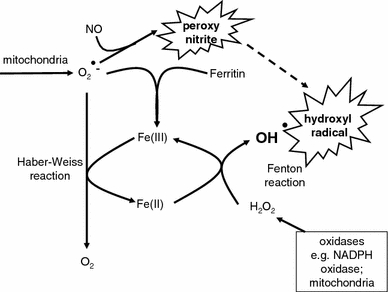
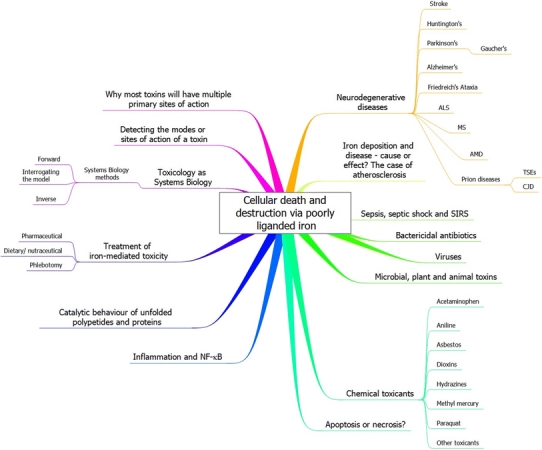
- Across reviewed conditions—stroke, Huntington’s, Parkinson’s, Alzheimer’s, ALS, Friedreich’s ataxia, multiple sclerosis, age-related macular degeneration, prion diseases, atherosclerosis, sepsis/SIRS, bactericidal antibiotics, viral infections, and chemical toxicants—evidence converges on iron dysregulation and Fenton chemistry; the hydroxyl radical is highlighted as the key damaging species rather than “ROS” generally.
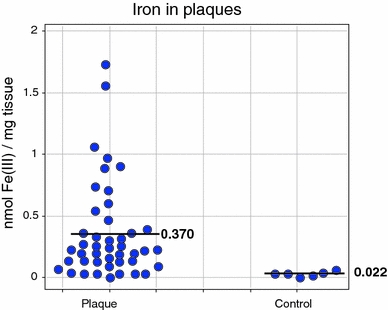
- In atherosclerosis, EPR-detectable iron in plaques was 17-fold greater than in healthy non-atherosclerotic intima controls, with P = 0.0001 (replotted from Stadler et al. 2004); iron levels in plaques also correlate with oxidized proteins.
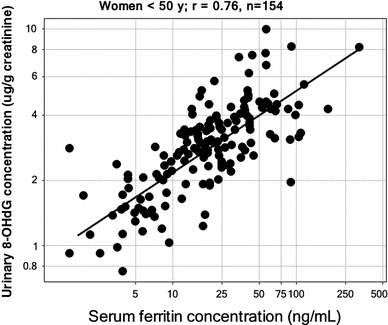
- Serum ferritin concentrations show a very strong relationship with urinary 8-hydroxy-2′-deoxyguanosine, a DNA damage/oxidative stress marker (replotted from Hori et al. 2010), and ferritin levels are widely associated with disease development, severity, or poor outcomes.
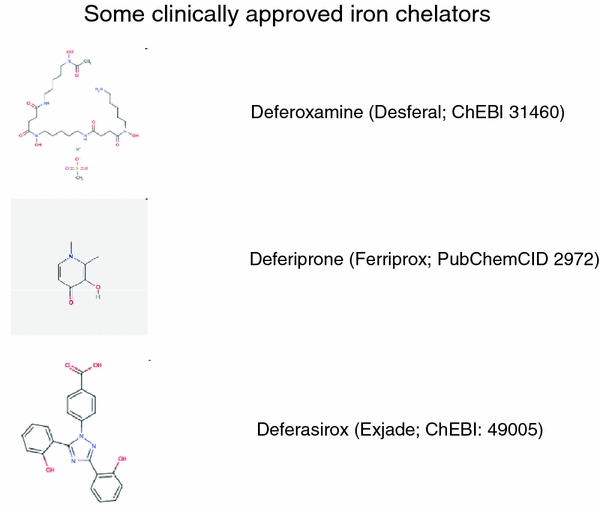
- Bactericidal antibiotics (norfloxacin, ampicillin, kanamycin) use internal iron liberated from iron–sulfur clusters to promote Fenton-mediated hydroxyl radical formation, whereas bacteriostatic antibiotics do not; iron chelators plus antioxidants are especially effective in sepsis models, and approved clinical chelators include deferoxamine, deferiprone, and deferasirox.
Methods
- Narrative literature review; the literature survey at initial submission extended to 14 June 2010, covering diseases, toxicants, and iron biology.
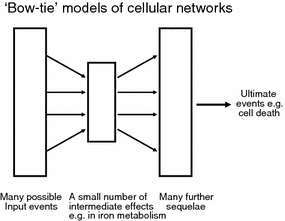
- Systems biology conceptual synthesis: forward and inverse modelling, sensitivity analysis, combinatorial parameter analysis, Bayesian/MCMC and evolutionary methods to infer sites of action, and “bow-tie” network models.
- Replots/digitizes published data (e.g., Hori et al. 2010; Stadler et al. 2004) to illustrate relationships; no new primary experimental data are reported.
Limitations
- The paper states that exact molecular mechanisms, cascades, and networks depend on many other factors; causality is often hard to infer from one-time snapshots; and some direct evidence is lacking—e.g., PrPSc–ferritin complexes have not yet been shown to catalyse OH• production directly, huntingtin inclusion bodies were not demonstrated to catalyse hydroxyl formation, and the extent of causality of iron dysregulation in multiple sclerosis is not yet established.
- Evident from the text: as a review, it synthesizes heterogeneous literature and relies heavily on cited associations, many of which are correlational; no new experimental validation is provided, and the literature coverage ends in mid-2010.
- The paper notes hormesis and dose-dependent interactions complicate simple models; chelator/antibiotic interactions can be dose-dependent and sometimes antagonistic (e.g., deferoxamine was antagonistic to azoles, while deferasirox promoted ciprofloxacin activity against *V. vulnificus*).
Model-written summary of a shortened version of the paper’s full text (it is longer than we read). Check it against the paper before relying on it.
Integrity signals
Registry
Cites
Statistics
Figures
Verification
Claims the paper makes
15 Valid · 1 Not valid · 117 Not checked · 25 Own results and interpretations
At least one cited source doesn’t support this claim or points to a different paper, and none confirmed it — see the verdicts below.
In the paper
“The defect thus leads to the liberation of mitochondrial iron”
§ Towards a unifying, systems biology understanding of large-scale cellular death and destruction caused by poorly liganded iron: Parkinson’s, Huntington’s, Alzheimer’s, prions, bactericides, chemical toxicology and others as examples > Friedreich’s ataxia
What the sources say
- Disputedcites Huang et al. 2009 matched to “Elucidation of the mechanism of mitochondrial iron loading in Friedreich's ataxia by analysis of a mouse mutant” (2009) sourceExperimental — accuracy not yet measured
The Abstract and Discussion describe frataxin deficiency as causing mitochondrial iron accumulation, with reduced release of heme and iron-sulfur clusters from mitochondria—not liberation of mitochondrial iron. The Discussion instead identifies increased liberation of cytoplasmic iron from heme as a contributor to mitochondrial iron uptake. No page numbers are available in our copy. (LLM, conf=0.88)
Checked by a reasoning model — may be wrong.
- Not checked yetcites Popescu et al. 2007 matched to “The chemical form of mitochondrial iron in Friedreich’s ataxia” (2007) source
- Not checked yetcites Richardson et al. 2009a
plainstates a cause- Asserted: passes — The authors put it forward as true.
- Checkable: passes — It can be checked against evidence.
- Load-bearing: passes — The paper’s conclusions depend on it.
- Based: passes — The paper gives a reason why it holds.
- Disputed
The cited sources support only part of this claim — read each source’s verdict below.
In the paper
“body-iron status correlates rather strongly with its production or urinary excretion (Agarwal et al. 2004; Broedbaek et al. 2009; Fujita et al. 2007a, 2009; Gackowski et al. 2002; Hori et al. 2010; Kang et al. 1998; Kuo et al. 2008; Maruyama et al. 2007; Nakano et al. 2003; Toyokuni and Sagripanti 1996; Tuomainen et al. 2007; Valavanidis et al. 2005).”
§ Towards a unifying, systems biology understanding of large-scale cellular death and destruction caused by poorly liganded iron: Parkinson’s, Huntington’s, Alzheimer’s, prions, bactericides, chemical toxicology and others as examples > Introduction
What the sources say
- Could not verifycites Agarwal et al. 2004 matched to “Oxidative stress and renal injury with intravenous iron in patients with chronic kidney disease” (2004) sourceExperimental — accuracy not yet measured
The Laboratory analysis section describes plasma and urinary malondialdehyde (MDA) assays, and the Discussion reports urinary MDA after intravenous iron in patients with chronic kidney disease. Searches for 8-OHdG and 8-hydroxy-2′-deoxyguanosine found no passage measuring that marker or relating its production or urinary excretion to body-iron status. (LLM, conf=0.76)
- Supportedcites Hori et al. 2010 matched to “Body iron store as a predictor of oxidative DNA damage in healthy men and women” (2010) source
The Discussion reports a strong positive association between serum ferritin, a marker of body iron stores, and urinary 8-OHdG in healthy Japanese men and women. The Results also show urinary 8-OHdG increasing across ferritin levels. This supports the claim about urinary excretion, though the cross-sectional study did not directly measure production. (LLM, conf=0.94)
boostedstates an association- Asserted: passes — The authors put it forward as true.
- Checkable: passes — It can be checked against evidence.
- Load-bearing: passes — The paper’s conclusions depend on it.
- Based: passes — The paper gives a reason why it holds.
- Could not verify
Every source the paper cites for this claim was checked and supports it.
In the paper
“Iron metabolism is deranged in gene knockdown models of Huntington’s (Henshall et al. 2009; Lumsden et al. 2007)”
§ Towards a unifying, systems biology understanding of large-scale cellular death and destruction caused by poorly liganded iron: Parkinson’s, Huntington’s, Alzheimer’s, prions, bactericides, chemical toxicology and others as examples > Huntington’s disease
What the sources say
- Supportedcites Henshall et al. 2009 matched to “Selective neuronal requirement for huntingtin in the developing zebrafish” (2009) source
The Introduction (page not supplied) says that an earlier analysis of the huntingtin-knockdown zebrafish model revealed a role for huntingtin in iron homeostasis and transport. The Abstract likewise reports effects of huntingtin reduction on iron transport and homeostasis. The claim does not attribute the original iron findings specifically to this 2009 study. (LLM, conf=0.89)
- Supportedcites Lumsden et al. 2007 matched to “Huntingtin-deficient zebrafish exhibit defects in iron utilization and development” (2007) source
The Abstract reports that huntingtin knockdown in zebrafish reduced hemoglobin production despite iron being present in blood cells, and that bioavailable iron restored production. The Conclusion identifies signs of cellular iron deficiency in the knockdown model despite iron being present. These passages support the claim about disrupted iron handling in a gene-knockdown model relevant to Huntington’s disease. (LLM, conf=0.93)
plainstates an association- Asserted: passes — The authors put it forward as true.
- Checkable: passes — It can be checked against evidence.
- Load-bearing: passes — The paper’s conclusions depend on it.
- Based: passes — The paper gives a reason why it holds.
- Supported
Every source the paper cites for this claim was checked and supports it.
In the paper
“experiments with the iron chelator deferroxamine revealed that the oxidation, localisation and structural organisation of the inclusion bodies formed by mutant htt were indeed irondependent.”
§ Towards a unifying, systems biology understanding of large-scale cellular death and destruction caused by poorly liganded iron: Parkinson’s, Huntington’s, Alzheimer’s, prions, bactericides, chemical toxicology and others as examples > Huntington’s disease
What the sources say
- Supportedcites Firdaus et al. 2006 matched to “Huntingtin inclusion bodies are iron‐dependent centers of oxidative events” (2006) source
The paper's own overview (p. 2) states verbatim that 'Analysis performed in the presence of the iron chelator deferroxamine revealed that the oxidation, localization and structural organization of the inclusion bodies formed by mutant htt were iron-dependent.' The supporting results confirm each element: deferroxamine (5 mM, 24 h) shrank httEx1-103Q inclusions and abolished HE oxidation in COS-7 cells (pp. 7-8, Fig. 6), and redistributed httEx1-43Q-EGFP nuclear inclusions out of the nucleus while reducing their oxidation in PC12 cells (p. 8, Fig. 7); the Discussion (p. 9) restates that chelatable iron was key to formation/structural integrity, localization and the oxidative events. (LLM, conf=0.95)
boostedstates a cause- Asserted: passes — The authors put it forward as true.
- Checkable: passes — It can be checked against evidence.
- Load-bearing: passes — The paper’s conclusions depend on it.
- Based: passes — The paper gives a reason why it holds.
- Supported
The cited sources support only part of this claim — read each source’s verdict below.
In the paper
“(HFE) mutations that cause haemochromatosis increase the susceptibility to AD (Bartzokis et al. 2010; Candore et al. 2003; Combarros et al. 2003; Connor and Lee 2006; Haacke et al. 2005; Kauwe et al. 2010; Lleó et al. 2002; Moalem et al. 2000; Pulliam et al. 2003; Robson et al. 2004; Sampietro et al. 2001), especially when in the presence of the APOE4 allele (Pulliam et al. 2003).”
§ Towards a unifying, systems biology understanding of large-scale cellular death and destruction caused by poorly liganded iron: Parkinson’s, Huntington’s, Alzheimer’s, prions, bactericides, chemical toxicology and others as examples > Alzheimer’s disease
What the sources say
- Not checked yetcites Pulliam et al. 2003 matched to “Association of HFE mutations with neurodegeneration and oxidative stress in Alzheimer's disease and correlation with APOE” (2003) source
- Partly supportedcites Robson et al. 2004 matched to “Synergy between the C2 allele of transferrin and the C282Y allele of the haemochromatosis gene (HFE) as risk factors for developing Alzheimer’s disease” (2004) sourceExperimental — accuracy not yet measured
Robson et al. (2004) do report increased AD risk associated with the haemochromatosis mutation C282Y, and that risk is highest in carriers who also have APOE4 (Abstract; Conclusions: 'tri-carriers of the two iron-related variants plus APOE4 may be at very high risk of AD'). However, the source does not support the unconditional attribution that HFE mutations that cause haemochromatosis increase AD susceptibility: the Abstract states 'each of the two variants was associated with an increased risk of AD only in the presence of the other. Neither allele alone had any effect' (i.e. only with transferrin C2), the Results (Tables 2-4) give C282Y-negative/C2-alone OR 1.3 (NS), and the Results explicitly report 'no association of the HFE H63D variant with AD, or with MCI, either overall or in two-way interaction with either TF C2 or APOE4'. So the second HFE mutation implicated in haemochromatosis is not associated in this paper, and the APOE4 effect is conditional on TF C2 co-carriage rather than on the HFE allele alone. (LLM, conf=0.78)
plainstates a cause- Asserted: passes — The authors put it forward as true.
- Checkable: passes — It can be checked against evidence.
- Load-bearing: unclear — It is unclear whether the paper’s conclusions depend on it.
- Based: passes — The paper gives a reason why it holds.
99 more claims · 11 with their cited sources checked
Create a free account to see all 158 claims and to verify the 250 references still open.
- It may state two separate claims as one. 42
- Probably not a substantial claim. 18
- The quote only partly states this claim. 1
Claims other papers make about this one
Each is checked against this paper’s own text: does it say what the citing paper says it does?
The source backs part of the claim, not all of it — or backs it for a different population, condition or comparison.
In the citing paper
“Chronic increase of such ‘free’ iron forms are associated with pathological conditions and possible complex homeostasis unbalance for this element in cells and tissues, relevant to asbestos toxicity and related diseases181920.”
From The interaction of asbestos and iron in lung tissue revealed by synchrotron-based scanning X-ray microscopy (2013) · cites this paper as [19]
Experimental — accuracy not yet measuredThe cited source says what the claim attributes to it.
In the citing paper
“Concerning this issue, the recent reviews by D. Kell1819 analyse the wide but dispersed literature via a systems biology approach, and indicate that iron that is weakly complexed boosts many biochemical processes leading to a large variety of apparently unrelated diseases.”
From The interaction of asbestos and iron in lung tissue revealed by synchrotron-based scanning X-ray microscopy (2013) · cites this paper as [19]
The cited source says what the claim attributes to it.
In the citing paper
“nominally antioxidant molecules such as ascorbate have complex, multi-electron redox chemistry, and can in fact act as pro-oxidants(502,503), especially in the presence of free Fe(208,213) or Cu(504).”
From The biology of ergothioneine, an antioxidant nutraceutical (2020) · cites this paper as [213]
The cited source says what the claim attributes to it.
In the citing paper
“Due to the presence of high-affinity iron binding and storage proteins, the actual toxicity of iron is restricted to the so called “labile iron pool”.”
From The interaction of asbestos and iron in lung tissue revealed by synchrotron-based scanning X-ray microscopy (2013) · cites this paper as [19]
Citations
Cites
2 retracted
Items 1,001–1,200 of 1,761
Vázquez‐Manrique, R. P., González‐Cabo, P., Ros, S., Aziz, H., Baylis, H. A., & Palau, F. (2006) · The FASEB Journal · doi:10.1096/fj.05-4212fje · Cited by 98
Chelation therapy for neurodegenerative diseases
Bolognin, S., Drago, D., Messori, L., & Zatta, P. (2009) · Medicinal Research Reviews · doi:10.1002/med.20148 · Cited by 97 · cited 6×
“…in Alzheimer’s, for instance, have been known for nearly 20 years (Crapper McLachlan et al. 1991), benefits since observed with other iron chelators (e.g. Amit et al. 2008; Bolognin et al. 2009a; Bush 2008; Liu et al. 2009b, 2010b; Perez and Franz 2010; Smith et al. 2010; Zhang et al. 2009).”
BackgroundInfluentialBonkovsky, H. L., Naishadham, D., Lambrecht, R. W., Chung, R. T., Hoefs, J. C., Nash, S. R., Rogers, T. E., Banner, B. F., Sterling, R. K., Donovan, J. A., et al. (2006) · Gastroenterology · doi:10.1053/j.gastro.2006.08.036 · Cited by 97
Frataxin, Iron–Sulfur Clusters, Heme, ROS, and Aging
Napoli, E., Taroni, F., & Cortopassi, G. A. (2006) · Antioxidants & Redox Signaling · doi:10.1089/ars.2006.8.506 · Cited by 96
Kell, D. B., & King, R. D. (2000) · Trends in biotechnology · doi:10.1016/s0167-7799(99)01407-9 · Cited by 96 · cited 1×
“These are classic data mining methods (e.g. Breiman 2001; Kell and King 2000; Kell and Oliver 2004; Wu et al. 2008) that allow us to discover mechanisms of action that are unknown and/or have not previously been contemplated.”
MethodSelf-citationCappellini, M. D., & Pattoneri, P. (2009) · Annual Review of Medicine · doi:10.1146/annurev.med.60.041807.123243 · Cited by 96
Implications of the Dominant Role of Transporters in Drug Uptake by Cells (Supplementary Material)
Dobson, P. D., Lanthaler, K., Oliver, S. G., & Kell, D. B. (2009) · Current Topics in Medicinal Chemistry · doi:10.2174/156802609787521616 · Cited by 96 · cited 3×
“Like most if not all other xenobiotics (Dobson et al. 2009a; Dobson and Kell 2008; Dobson et al. 2009b; Kell and Dobson 2009), it requires one or more carriers for cellular uptake—in this case, when complexed to L-cysteine, the ‘large amino acid’ transporter (Kanai and Endou 2003; Simmons-Willis et…”
BackgroundSelf-citationInduction of apoptosis by iron deprivation in human leukemic CCRF-CEM cells.
Ru, H., Wereley, J. P., & Chitambar, C. R. (1995) · PubMed · Cited by 96
Nanoparticle and Iron Chelators as a Potential Novel Alzheimer Therapy
Liu, G., Men, P., Perry, G., & Smith, M. A. (2010) · Methods in Molecular Biology · doi:10.1007/978-1-60327-029-8_8 · Cited by 95
Yokoyama, H., Kuroiwa, H., Yano, R., & Araki, T. (2008) · Neurological Sciences · doi:10.1007/s10072-008-0986-2 · Cited by 95
Hereditary hemochromatosis and diabetes mellitus: implications for clinical practice
Utzschneider, K. M., & Kowdley, K. V. (2009) · Nature Reviews Endocrinology · doi:10.1038/nrendo.2009.241 · Cited by 95
Hepatic oxidative DNA damage correlates with iron overload in chronic hepatitis C patients
Fujita, N., Horiike, S., Sugimoto, R., Tanaka, H., Iwasa, M., Kobayashi, Y., Hasegawa, K., Ma, N., Kawanishi, S., Adachi, Y., et al. (2006) · Free Radical Biology and Medicine · doi:10.1016/j.freeradbiomed.2006.11.001 · Cited by 95 · cited 2×
“…et al. 2005), and body-iron status correlates rather strongly with its production or urinary excretion (Agarwal et al. 2004; Broedbaek et al. 2009; Fujita et al. 2007a, 2009; Gac- kowski et al. 2002; Hori et al. 2010; Kang et al. 1998; Kuo et al. 2008; Maruyama et al. 2007; Nakano et al.…”
BackgroundKuo, K.-L., Hung, S.-C., Wei, Y.-H., & Tarng, D.-C. (2008) · Journal of the American Society of Nephrology · doi:10.1681/asn.2007101084 · Cited by 95 · cited 1×
“…or urinary excretion (Agarwal et al. 2004; Broedbaek et al. 2009; Fujita et al. 2007a, 2009; Gac- kowski et al. 2002; Hori et al. 2010; Kang et al. 1998; Kuo et al. 2008; Maruyama et al. 2007; Nakano et al. 2003; Toyokuni and Sagripanti 1996; Tuomainen et al. 2007; Valavanidis et al. 2005).”
BackgroundHigh‐order combination effects and biological robustness
Lehár, J., Krueger, A., Zimmermann, G., & Borisy, A. (2008) · Molecular Systems Biology · doi:10.1038/msb.2008.51 · Cited by 95 · cited 2×
“…bio- chemical pathways—indeed evolution is thought to have selected for robustness to individual parameter changes (Bornholdt and Sneppen 2000; Kitano 2007; Lehár et al. 2008; Morohashi et al. 2002; Stelling et al. 2004; Wagner 2005)—combinations of parameter changes can and do have major effects.”
BackgroundA Perspective on the Scientific, Philosophical, and Policy Dimensions of Hormesis
Hoffmann, G. R. (2009) · Dose-Response · doi:10.2203/dose-response.08-023.hoffmann · Cited by 95 · cited 1×
“…2003; Calabrese and Blain 2005, 2009; Cook and Calabrese 2006; Cox 2009; Gems and Partridge 2008; Gómez-Pinilla 2008; Hadacek et al. 2010; Hayes 2009; Hoffmann 2009; Mattson 2008a, b; Radak et al. 2008; Rattan 2004, 2008; Rattan and Demirovic 2009; Ristow and Zarse 2010; Sørensen et al. 2009), so…”
BackgroundAsbestos induces mitochondrial DNA damage and dysfunction linked to the development of apoptosis
Shukla, A., Jung, M., Stern, M., Fukagawa, N. K., Taatjes, D. J., Sawyer, D., Van Houten, B., & Mossman, B. T. (2003) · American Journal of Physiology-Lung Cellular and Molecular Physiology · doi:10.1152/ajplung.00038.2003 · Cited by 95
Oxidative stress and role of antioxidant supplementation in critical illness.
Mishra, V. (2007) · PubMed · Cited by 94
Lu, C., & Cortopassi, G. (2007) · Archives of Biochemistry and Biophysics · doi:10.1016/j.abb.2006.09.010 · Cited by 94 · cited 1×
“…2006; Haugen et al. 2010; Huang et al. 2008a; Huang et al. 2009; Karlberg et al. 2006; Kondapalli et al. 2008; Lill 2009; Lill and Muhlenhoff 2008; Lu and Cortopassi 2007; MacKenzie et al. 2008; Mandemakers et al. 2007; Marmolino and Acquaviva 2009; Napier et al. 2005; Napoli et al. 2006;…”
BackgroundTayara, N. E. T. E., Delatour, B., Cudennec, C. L., Guégan, M., Volk, A., & Dhénain, M. (2005) · Neurobiology of Disease · doi:10.1016/j.nbd.2005.10.013 · Cited by 94
Simonart, T., Heenen, M., Degraef, C., Andreï, G., Mosselmans, R., Hermans, P., Vooren, J. V., Noël, J., Boelaert, J. R., & Snoeck, R. (2000) · Journal of Investigative Dermatology · doi:10.1046/j.1523-1747.2000.00119.x · Cited by 94 · cited 1×
“…et al. 1995; Jiang et al. 2002; Jin et al. 2007; Koc et al. 2006; Kovář et al. 1997, 2001; Leardi et al. 1998; Lee et al. 2006b, c; Pan et al. 2004; Simonart et al. 2000; Sun et al. 2009; Truksa et al. 2003; Zhang et al. 2003; Zhao et al. 2004) or in excess (e.g. Aljandali et al. 2001; Cozzi…”
Dopaminergic neurotoxicity following pulmonary exposure to manganese-containing welding fumes
Sriram, K., Lin, G. X., Jefferson, A. M., Roberts, J. R., Chapman, R. S., Chen, B. T., Soukup, J. M., Ghio, A. J., & Antonini, J. M. (2010) · Archives of Toxicology · doi:10.1007/s00204-010-0525-9 · Cited by 94
Binding of Yeast Frataxin to the Scaffold for Fe-S Cluster Biogenesis, Isu
Wang, T., & Craig, E. A. (2008) · Journal of Biological Chemistry · doi:10.1074/jbc.m800399200 · Cited by 94
Shin, S. M., & Kim, S. G. (2008) · Molecular Pharmacology · doi:10.1124/mol.108.051128 · Cited by 94 · cited 1×
“…Levenson 2005; Lu et al. 2008; Ma et al. 2009; Messer et al. 2009; Murakami et al. 2006; Natoli et al. 2009; Persson 2005; Polla et al. 2003; Schlawe et al. 2004; Shin and Kim 2009; Shukla et al. 2003; Tenopoulou et al. 2005; Upadhyay and Kamp 2003; Vélez-Pardo et al. 1997; Zhao et al. 1997).”
BackgroundGenomic Computing. Explanatory Analysis of Plant Expression Profiling Data Using Machine Learning
Kell, D. B., Darby, R. M., & Draper, J. (2001) · Plant Physiology · doi:10.1104/pp.126.3.943 · Cited by 93 · cited 1×
“…have proved so for both modelling (Dada and Mendes 2009; Mendes and Kell 1998; Moles et al. 2003; Rodriguez-Fernandez et al. 2006) and other optimisation problems (e.g. Broadhurst et al. 1997; Kell et al. 2001; Knight et al. 2009; O’Hagan et al. 2005, 2007; Platt et al. 2009; Rowe et al. 2010).”
BackgroundSelf-citationValavanidis, A., Vlahoyianni, T., & Fiotakis, K. (2005) · Free Radical Research · doi:10.1080/10715760500188671 · Cited by 93 · cited 1×
“…or urinary excretion (Agarwal et al. 2004; Broedbaek et al. 2009; Fujita et al. 2007a, 2009; Gac- kowski et al. 2002; Hori et al. 2010; Kang et al. 1998; Kuo et al. 2008; Maruyama et al. 2007; Nakano et al. 2003; Toyokuni and Sagripanti 1996; Tuomainen et al. 2007; Valavanidis et al. 2005).”
BackgroundBloodletting: Past and Present
DePalma, R. G., Hayes, V. W., & Zacharski, L. R. (2007) · Journal of the American College of Surgeons · doi:10.1016/j.jamcollsurg.2007.01.071 · Cited by 93
Usuki, F., Yasutake, A., Umehara, F., Tokunaga, H., Matsumoto, M., Eto, K., Ishiura, S., & Higuchi, I. (2001) · Neuroscience Letters · doi:10.1016/s0304-3940(01)01764-5 · Cited by 93
Asthma and oxidant stress: nutritional, environmental, and genetic risk factors.
Greene, L. S. (1995) · Journal of the American College of Nutrition · doi:10.1080/07315724.1995.10718516 · Cited by 93 · cited 1×
“…Bowler 2004; Bowler and Crapo 2002; Boyer and Liu 2004; Chodaczek et al. 2007; Ciencewicki et al. 2008; Comhair and Erzurum 2010; Galli et al. 2008; Greene 1995; Han et al. 2001; Horváth et al. 1998; Jarvis et al. 2005; Kocyigit et al. 2004; Muñoz et al. 2009; Narula et al. 2007; Nemery 1990;…”
BackgroundOlivares, D., Huang, X., Branden, L., Greig, N. H., & Rogers, J. T. (2009) · International Journal of Molecular Sciences · doi:10.3390/ijms10031226 · Cited by 93
Ko, C., Siddaiah, N., Berger, J., Gish, R., Brandhagen, D., Sterling, R. K., Cotler, S. J., Fontana, R. J., McCashland, T. M., Han, S. H. B., et al. (2007) · Liver International · doi:10.1111/j.1478-3231.2007.01596.x · Cited by 93
Metal trafficking: from maintaining the metal homeostasis to future drug design
Ba, L. A., Doering, M., Burkholz, T., & Jacob, C. (2009) · Metallomics · doi:10.1039/b904533c · Cited by 93 · cited 1×
“…Wang and Craig 2008; cf. Seguin, et al. 2010), it is now understood that frataxin is a mitochondrial iron chaperone protein (Atkinson and Winge 2009; Ba et al. 2009; Babady et al. 2007; Bencze et al. 2007; Cavadini et al. 2002; Correia et al. 2008; Gakh et al. 2006; Haugen et al. 2010; Huang et…”
BackgroundNF-κB, inflammation and pancreatic carcinogenesis: NF-κB as a chemoprevention target (Review)
Zhang, Z., & Rigas, B. (2006) · International Journal of Oncology · doi:10.3892/ijo.29.1.185 · Cited by 92
Insights into the Organization of Biochemical Regulatory Networks Using Graph Theory Analyses
Ma'ayan, A. (2009) · Journal of Biological Chemistry · doi:10.1074/jbc.r800056200 · Cited by 92
MRI T2 shortening (‘black T2’) in multiple sclerosis: frequency, location, and clinical correlation
Bakshi, R., Shaikh, Z. A., & Janardhan, V. (2000) · NeuroReport · doi:10.1097/00001756-200001170-00004 · Cited by 92 · cited 1×
“…hydroxyl radicals, and it is thus of much interest that iron dysregulation and/or deposition have indeed been implicated directly (Adams 1988; Bakshi et al. 2000, 2001, 2002, 2008; Bermel et al. 2005; Brass et al. 2006a, b; Ceccarelli et al. 2009, 2010; Chard and Miller 2009; Craelius et al.…”
BackgroundAbnormal Brain Iron Homeostasis in Human and Animal Prion Disorders
Singh, A., Isaac, A. O., Luo, X., Mohan, M. L., Cohen, M. L., Chen, F., Kong, Q., Bartz, J., & Singh, N. (2009) · PLoS Pathogens · doi:10.1371/journal.ppat.1000336 · Cited by 92
Asbestos causes apoptosis in alveolar epithelial cells: Role of iron-induced free radicals
Aljandali, A., Pollack, H., Yeldandi, A., LI, Y., Weitzman, S. A., & Kamp, D. W. (2001) · Journal of Laboratory and Clinical Medicine · doi:10.1067/mlc.2001.114826 · Cited by 92
Colocalization of iron and ceroid in human atherosclerotic lesions
Lee, F.-Y., Lee, T., Pan, C., Huang, A.-L., & Chau, L. (1998) · Atherosclerosis · doi:10.1016/s0021-9150(98)00033-1 · Cited by 92
Millan, M., Sobrino, T., Castellanos, M., Nombela, F., Arenillas, J. F., Riva, E., Cristobo, I., García, M. M., Vivancos, J., Serena, J., et al. (2007) · Stroke · doi:10.1161/01.str.0000251798.25803.e0 · Cited by 92 · cited 1×
“…Schlichter 2008; Kim et al. 2008a; Kobayashi et al. 2008; Lou et al. 2009; Maguire et al. 2007; Mazumdar et al. 2007; Mehdiratta et al. 2008; Millan et al. 2007, 2008; Millerot-Serrurot et al. 2008; Nighoghossian et al. 2008; O’Rourke et al. 2008; Ratan et al. 2008; Ross and Meschia 2009;…”
BackgroundA Metabolite Profiling Approach to Identify Biomarkers of Flavonoid Intake in Humans1–3
Loke, W. M., Jenner, A. M., Proudfoot, J. M., McKinley, A. J., Hodgson, J. M., Halliwell, B. B., & Croft, K. D. (2009) · Journal of Nutrition · doi:10.3945/jn.109.113613 · Cited by 92 · cited 1×
“…Jovanovic and Simic 2000; Kandaswami and Middleton 1994; Kiokias et al. 2008; Korkina and Afanas’ev 1997; Linseisen and Rohrmann 2008; Loke et al. 2009; Manach et al. 2004, 2005a, b; Pérez-Jiménez et al. 2010; Perron and Brumaghim 2009; Perron et al. 2008; Petti and Scully 2009;…”
BackgroundElevated Iron Status Strongly Predicts Mortality in West African Adults With HIV Infection
McDermid, J. M., Jaye, A., Schim van der Loeff, M. F., Todd, J., Bates, C., Austin, S., Jeffries, D., Awasana, A. A., Whittle, H. C., & Prentice, A. M. (2007) · JAIDS Journal of Acquired Immune Deficiency Syndromes · doi:10.1097/qai.0b013e31815b2d4b · Cited by 91 · cited 1×
“…et al. 1999; Debebe et al. 2007; Drakesmith and Prentice 2008; Georgiou et al. 2000; Gordeuk et al. 2001, 2006; Kagu et al. 2007; Ketonen et al. 1996; McDermid et al. 2007; McDermid and Prentice 2006; McDermid et al. Stimulation of respiratory chain Superoxide production Damage to Fe-S cluster”
BackgroundHeme Oxygenase-1 and Carbon Monoxide: Emerging Therapeutic Targets in Inflammation and Allergy
Pae, H.-O., Lee, Y., & Chung, H.-T. (2008) · Recent Patents on Inflammation & Allergy Drug Discovery · doi:10.2174/187221308786241929 · Cited by 91
Atamna, H., Frey, W. H., & Ko, N. (2009) · Archives of Biochemistry and Biophysics · doi:10.1016/j.abb.2009.05.003 · Cited by 90 · cited 1×
“There is a also relationship between the ability to bind haem and neurotoxicity (Atamna 2009; Atamna et al. 2009), and (HFE) mutations that cause haemochromatosis increase the susceptibility to AD (Bartzokis et al. 2010; Candore et al. 2003; Combarros et al. 2003; Connor and Lee 2006; Haacke et al.…”
BackgroundOxidative stress in the pathogenesis of asthma
Bowler, R. P. (2004) · Current Allergy and Asthma Reports · doi:10.1007/s11882-004-0056-7 · Cited by 90
Končić, M. Z., Kremer, D., Grúz, J., Strnad, M., Biševac, G., Kosalec, I., Šamec, D., Piljac‐Žegarac, J., & Karlović, K. (2010) · Food and Chemical Toxicology · doi:10.1016/j.fct.2010.03.021 · Cited by 90
Continuous neurogenesis in the adult brain
Imayoshi, I., Sakamoto, M., Ohtsuka, T., & Kageyama, R. (2009) · Development, Growth & Differentiation · doi:10.1111/j.1440-169x.2009.01094.x · Cited by 89 · cited 1×
“…and increasing evidence (e.g. Abrous et al. 2005; Christie and Cameron 2006; Demir et al. 2009; Fuchs and Gould 2000; Götz and Huttner 2005; Gould 2007; Imayoshi et al. 2009; Leuner et al. 2007; Lledo et al. 2006; Ohnuma and Harris 2003; Taupin 2007; Zhao et al. 2008) for considerable…”
BackgroundPulliam, J. F., Jennings, C. D., Kryscio, R. J., Davis, D. G., Wilson, D., Montine, T. J., Schmitt, F. A., & Markesbery, W. R. (2003) · American Journal of Medical Genetics Part B: Neuropsychiatric Genetics · doi:10.1002/ajmg.b.10069 · Cited by 89 · cited 1×
“…et al. 2010; Candore et al. 2003; Combarros et al. 2003; Connor and Lee 2006; Haacke et al. 2005; Kauwe et al. 2010; Lleó et al. 2002; Moalem et al. 2000; Pulliam et al. 2003; Robson et al. 2004; Sampietro et al. 2001), especially when in the presence of the APOE4 allele (Pulliam et al. 2003).”
BackgroundIncreased serum ferritin levels in amyotrophic lateral sclerosis (ALS) patients
Goodall, G., Haque, S. M., & Morrison, K. E. (2008) · Journal of Neurology · doi:10.1007/s00415-008-0945-0 · Cited by 89 · cited 2×
“…et al. 2009; Baune et al. 2010; Busca et al. 2010; DePalma et al. 2010; Ferrara et al. 2009; Ferrucci et al. 2010; Gamberini et al. 2008; Goodall et al. 2008; Inati et al. 2010; Kaysen 2009; Knovich et al. 2009; Kolberg et al. 2009; Lecube et al. 2008; Lim et al. 2010; Mateo- Gallego…”
BackgroundReview: Ferruginous Bodies: Implications in the Mechanism of Fiber and Particle Toxicity
Ghio, A. J., Churg, A., & Roggli, V. L. (2004) · Toxicologic Pathology · doi:10.1080/01926230490885733 · Cited by 89 · cited 1×
“…Xu et al. 1999; Azad et al. 2008; Bhattacharya et al. 2005; Daghino et al. 2006; Fantauzzi et al. 2010; Fattman et al. 2006; Gazzano et al. 2007; Ghio et al. 2004, 2009; Heintz et al. 2010; Kamp 2009; Knaapen et al. 2004; Liu et al. 2010; Nymark et al. 2008; Panduri et al. 2006; Poser et al.…”
Book Review: Iron and Parkinson’s Disease
Wolozin, B., & Golts, N. (2002) · The Neuroscientist · doi:10.1177/107385840200800107 · Cited by 89
Yoneda, M., Nozaki, Y., Endo, H., Mawatari, H., Iida, H., Fujita, K., Yoneda, K., Takahashi, H., Kirikoshi, H., Inamori, M., et al. (2009) · Digestive Diseases and Sciences · doi:10.1007/s10620-009-0771-y · Cited by 89 · cited 1×
“…et al. 2010; Song et al. 2009; Storey et al. 2009; Sun et al. 2008; Tsimikas et al. 2009; Valenti et al. 2010; Walker et al. 2010; Wang et al. 2010b; Yoneda et al. 2010; Zandman-Goddard and Shoenfeld 2008), though note that most assays are for the protein itself, and not for the full molecule…”
BackgroundTherapeutic approaches to innate immunity: severe sepsis and septic shock
Lolis, E., & Bucala, R. (2003) · Nature Reviews Drug Discovery · doi:10.1038/nrd1153 · Cited by 89 · cited 1×
“…1996; Bone 1996; Davies and Hagen 1997; Gutteridge and Mitchell 1999; Hotchkiss and Karl 2003; Johnson and Mayers 2001; Keel and Trentz 2005; Leithead et al. 2009; Lolis and Bucala 2003; Martin et al. 2003; Nguyen et al. 2006; Protti and Singer 2006; Rittirsch et al. 2008; Ulloa et al. 2009).”
BackgroundIron deprivation‐induced apoptosis in HL‐60 cells
Fukuchi, K., Tomoyasu, S., Tsuruoka, N., & Gomi, K. (1994) · FEBS Letters · doi:10.1016/0014-5793(94)00755-1 · Cited by 89
The Ferroxidase Activity of Yeast Frataxin
Park, S., Gakh, O., Mooney, S. M., & Isaya, G. (2002) · Journal of Biological Chemistry · doi:10.1074/jbc.m206711200 · Cited by 88 · cited 2×
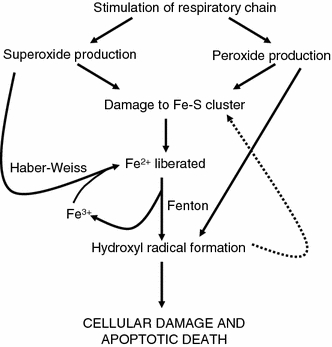
“Fenton chemistry is strongly implicated (Park et al. 2002; Sturm et al. 2005), as the attenuation of H2O2 production (but not of superoxide) (Anderson et al. 2005) ameliorates the disease (Anderson et al. 2008).”
BackgroundChoi, C. J., Kanthasamy, A., Anantharam, V., & Kanthasamy, A. G. (2006) · NeuroToxicology · doi:10.1016/j.neuro.2006.06.004 · Cited by 88 · cited 6×
“…it is worth pointing up the evidence for the role of iron and its metabolic dysregulation in the oxidative stress-mediated aetiology of scrapie (Choi et al. 2006; Fernaeus et al. 2005a; Fernaeus and Land 2005; Gudmundsdóttir et al. 2006; Kim et al. 2000, 2007; Pamplona et al. 2008; Singh et…”
BackgroundInfluentialGazzano, E., Turci, F., Foresti, E., Putzu, M. G., Aldieri, E., Silvagno, F., Lesci, I. G., Tomatis, M., Riganti, C., Romano, C., et al. (2007) · Chemical Research in Toxicology · doi:10.1021/tx600354f · Cited by 88 · cited 1×
“…Graceffa 1984; Xu et al. 1999; Azad et al. 2008; Bhattacharya et al. 2005; Daghino et al. 2006; Fantauzzi et al. 2010; Fattman et al. 2006; Gazzano et al. 2007; Ghio et al. 2004, 2009; Heintz et al. 2010; Kamp 2009; Knaapen et al. 2004; Liu et al. 2010; Nymark et al. 2008; Panduri et al.…”
BackgroundFan, Q.-W., Specht, K. M., Zhang, C., Goldenberg, D. D., Shokat, K. M., & Weiss, W. A. (2003) · PubMed · Cited by 88
Serum ferritin as a serologic marker of activity in systemic lupus erythematosus
Lim, M.-K., Lee, C.-K., Ju, Y.-M., Cho, Y. S., Lee, M.-S., Yoo, B., & Moon, H. (2001) · Rheumatology International · doi:10.1007/s002960000083 · Cited by 87 · cited 1×
“…et al. 2007; He et al. 2007; Hubel et al. 2004; Ishizaka et al. 2005; Jehn et al. 2004, 2007; Kaur et al. 2007; Kiechl et al. 1997; Lee et al. 2006f; Lim et al. 2001; Rayman et al. 2002; Rouault 2006; Salonen et al. 1992; Sheth and Brittenham 2000; Tuomainen et al. 1998; Valenti et al. 2007;…”
Generation of Reactive Oxygen Species by Mitochondrial Complex I: Implications in Neurodegeneration
Fato, R., Bergamini, C., Leoni, S., Strocchi, P., & Lenaz, G. (2008) · Neurochemical Research · doi:10.1007/s11064-008-9747-0 · Cited by 87 · cited 1×
“…liganded (Graf et al. 1984), and in the ferrous form, it can react with hydrogen peroxide (produced by mito- chondria (e.g. Brennan and Kantorow 2009; Fato et al. 2008; Orrenius et al. 2007) or (per)oxidases (Bedard and Krause 2007; Cave et al. 2006) via the Fenton reaction (Goldstein et al. 1993;…”
BackgroundOthman, A. I., El-Missiry, M. A., Amer, M. A., & Arafa, M. (2008) · Life Sciences · doi:10.1016/j.lfs.2008.08.004 · Cited by 87 · cited 1×
“…anthracyclines (including adriamycin/doxorubicin ChEBI 28748) (Ceyssens et al. 2004; Kaiserová et al. 2007; Kotamraju et al. 2002, 2004; Luft 2006; Othman et al. 2008; Šimůnek et al. 2009; Thougaard et al. 2010; Xu et al. 2008), arsenic (De Vizcaya-Ruiz et al. 2009; Fujihara et al. 2009), beer…”
Nitric oxide, peroxynitrite and lipoxygenase in atherogenesis: mechanistic insights
Rubbo, H., & O’Donnell, V. B. (2004) · Toxicology · doi:10.1016/j.tox.2004.11.019 · Cited by 87
Molecular mechanisms of asbestos-induced lung epithelial cell apoptosis
Liu, G., Beri, R., Mueller, A., & Kamp, D. W. (2010) · Chemico-Biological Interactions · doi:10.1016/j.cbi.2010.03.047 · Cited by 87 · cited 2×
“…2006; Fantauzzi et al. 2010; Fattman et al. 2006; Gazzano et al. 2007; Ghio et al. 2004, 2009; Heintz et al. 2010; Kamp 2009; Knaapen et al. 2004; Liu et al. 2010; Nymark et al. 2008; Panduri et al. 2006; Poser et al. 2004; Quinlan et al. 2002; Shannahan et al.; Shukla et al. 2003a, b; Sørensen…”
BackgroundLeBel, C. P., Ali, S. F., & Bondy, S. C. (1992) · Toxicology and Applied Pharmacology · doi:10.1016/0041-008x(92)90292-z · Cited by 87
Neuroprotection by iron chelator against proteasome inhibitor-induced nigral degeneration
Zhang, X., Xie, W., Qu, S., Pan, T., Wang, X., & Le, W. (2005) · Biochemical and Biophysical Research Communications · doi:10.1016/j.bbrc.2005.05.150 · Cited by 87 · cited 5×
“Again (e.g. Berg et al. 2001; Bharath et al. 2002; Buchanan et al. 2002; Bush 2000; Castellani et al. 2002; Double et al. 2000; Good et al. 1998; Gotz et al. 2004; Hirsch and Faucheux 1998; Jellinger 1999; Johnson 2000; Olanow and Arendash 1994; Ostrerova-Golts et al. 2000; Sofic et al. 1991; Wolozin and Golts 2002; A…”
BackgroundInfluentialBerdoukas, V., Chouliaras, G., Moraitis, P., Zannikos, K., Berdoussi, E., & Ladis, V. (2009) · Journal of Cardiovascular Magnetic Resonance · doi:10.1186/1532-429x-11-20 · Cited by 87
Calling International Rescue: knowledge lost in literature and data landslide!
Attwood, T. K., Kell, D. B., McDermott, P., Marsh, J., Pettifer, S. R., & Thorne, D. J. (2009) · Biochemical Journal · doi:10.1042/bj20091474 · Cited by 87
Self-citationIron stores and cerebral veins in MS studied by susceptibility weighted imaging.
Haacke, E. M., Garbern, J. Y., Miao, Y., Habib, C., & Liu, M. (2010) · PubMed · Cited by 86
Oxidative Parameters Differences during Non-Lethal and Lethal Sepsis Development1
Andrades, M., Ritter, C., Moreira, J. C. F., & Dal-Pizzol, F. (2005) · Journal of Surgical Research · doi:10.1016/j.jss.2004.11.008 · Cited by 86 · cited 1×
“…is an important part of the aetiology of sepsis/septic shock—these phenomena are associated with the hyperproduction of ROSs (Abdelrah- man et al. 2005; Andrades et al. 2005; Bulger and Maier 2001; Cadenas and Cadenas 2002; Closa and Folch-Puy 2004; Crimi et al. 2006a, b; Goode and Webster…”
BackgroundPolyamino acids as catalysts in asymmetric synthesis
Porter, M. J., Roberts, S. M., & Skidmore, J. (1999) · Bioorganic & Medicinal Chemistry · doi:10.1016/s0968-0896(99)00144-3 · Cited by 86 · cited 1×
“…of polypeptides and even poly(aminoacids)— whether binding metals (or not)—to exhibit catalytic activities, e.g. poly(leucine) (Carrea et al. 2005; Porter et al. 1999), and how adding metals to polypeptides to make metalloenzymes can have huge effects on their cat- alytic activities (Pierron et…”
BackgroundGilmour, P. S., Brown, D. M., Beswick, P. H., MacNee, W., Rahman, I., & Donaldson, K. (1997) · Environmental Health Perspectives · doi:10.1289/ehp.97105s51313 · Cited by 86 · cited 1×
“…toxic mechanism (Aljandali et al. 2001; Burrows and Muller 1998; Chao et al. 1996; Chen et al. 1996; Dai and Churg 2001; Fubini and Arean 1999; Gilmour et al. 1997; Governa et al. 1999; Gulumian and van Wyk 1987; Hardy and Aust 1995a, b; Hippeli and Elstner 1999; Jaurand 1997; Kamp et al.…”
BackgroundSadrzadeh, S. M. H., & Saffari, Y. (2004) · Pathology Patterns Reviews · doi:10.1309/ew0121lg9n3n1yl4 · Cited by 86
Iron Accumulation in the Substantia Nigra of Patients With Alzheimer Disease and Parkinsonism
Brar, S., Henderson, D., Schenck, J., & Zimmerman, E. A. (2009) · Archives of Neurology · doi:10.1001/archneurol.2008.586 · Cited by 86 · cited 2×
“…et al. 2010; Baudr- exel et al. 2010; Becker 2010; Becker et al. 2010a, b; Berg 2006, 2007; Berg and Hochstrasser 2006; Berg et al. 2006, 2008; Brar et al. 2009; Brown 2009b; Crichton and Ward 2006; Fasano et al. 2006; Friedman et al. 2007, 2009; Ghosh et al. 2010; Hirsch 2009; Jellinger…”
BackgroundA Prochelator Activated by Hydrogen Peroxide Prevents Metal‐Induced Amyloid β Aggregation
Dickens, M. G., & Franz, K. J. (2010) · ChemBioChem · doi:10.1002/cbic.200900597 · Cited by 86
Risk of lung cancer according to mild steel and stainless steel welding
Sørensen, A. R., Thulstrup, A. M., Hansen, J., Ramlau‐Hansen, C. H., Meersohn, A., Skytthe, A., & Bonde, J. P. (2007) · Scandinavian Journal of Work Environment & Health · doi:10.5271/sjweh.1157 · Cited by 86
Metal‐based Neurodegeneration: From Molecular Mechanisms to Therapeutic Strategies
Crichton, R. R., & Ward, R. J. (2005) · Wiley eBooks · doi:10.1002/0470022574 · Cited by 85
Blood Letting in High-Ferritin Type 2 Diabetes
Fernández-Real, J. M., Peñarroja, G., Castro, A., García-Bragado, F., López-Bermejo, A., & Ricart, W. (2002) · Diabetes Care · doi:10.2337/diacare.25.12.2249 · Cited by 85 · cited 2×
“…2007; Bartzokis et al. 2007; Braun et al. 2004; Bugianesi et al. 2004; Chen et al. 2006; Choi et al. 2005; Double et al. 2000; Fargion et al. 2001; Fernández-Real et al. 2002; Ford and Cogswell 1999; Forouhi et al. 2007; He et al. 2007; Hubel et al. 2004; Ishizaka et al. 2005; Jehn et al. 2004,…”
BackgroundProtective effects of flavonoids and two metabolites against oxidative stress in neuronal PC12 cells
Pavlica, S., & Gebhardt, R. (2009) · Life Sciences · doi:10.1016/j.lfs.2009.10.017 · Cited by 85 · cited 1×
“…sequelae of an initial stroke-inducing event (Demougeot et al. 2004; Ferro and Dávalos 2006; Hurn et al. 1995; Kompala et al. 1986; Mu et al. 2005; Patt et al. 1990; Prass et al. 2002; Selim and Ratan 2004; Soloniuk et al. 1992; White et al. 1988; Chen-Roetling et al. 2009; Gu et al. 2009;…”
BackgroundEnhancement of the chemical semantic web through the use of InChI identifiers
Coles, S. J., Day, N. E., Murray-Rust, P., Rzepa, H. S., & Zhang, Y. (2005) · Organic & Biomolecular Chemistry · doi:10.1039/b502828k · Cited by 85
Ritter, C., da Cunha, A. A., Echer, I. C., Andrades, M., Reinke, A., Lucchiari, N., Rocha, J., Streck, E. L., Menna-Barreto, S., Moreira, J. C. F., et al. (2006) · Critical Care Medicine · doi:10.1097/01.ccm.0000199069.19193.89 · Cited by 85 · cited 1×
“Most importantly, anti- oxidants are especially effective when given in combina- tion with iron chelators (Barichello et al. 2007; Ritter et al. 2004, 2006) (see also Bulucu et al. 2009; Cassol et al. 2009; Petronilho et al. 2009; Pinho et al. 2005; Teixeira et al. 2008; Valvassori et al. 2008).”
BackgroundIron accumulation and lipid peroxidation in aging C57BL/6J mice
Massie, H. R., Aiello, V. R., & Banziger, V. (1983) · Experimental Gerontology · doi:10.1016/0531-5565(83)90038-4 · Cited by 85
Freixes, M., Rodríguez, A., Dalfó, E., & Ferrer, I. (2006) · Neurobiology of Aging · doi:10.1016/j.neurobiolaging.2005.10.006 · Cited by 85 · cited 1×
“…Kim et al. 2000, 2007; Pamplona et al. 2008; Singh et al. 2009a, 2010a, b; Wong et al. 2001a, b; Yun et al. 2006), a prion disease of sheep and goats (Bulgin and Melson 2007; Hur et al. 2002) and of CJD (Choi et al. 2006; Freixes et al. 2006; Petersen et al. 2005; Singh et al. 2009a, 2010a, b).”
Karlberg, T., Schagerlöf, U., Gakh, O., Park, S., Ryde, U., Lindahl, M., Leath, K., Garman, E., Isaya, G., & Al-Karadaghi, S. (2006) · Structure · doi:10.1016/j.str.2006.08.010 · Cited by 85 · cited 1×
“…al. 2007; Bencze et al. 2007; Cavadini et al. 2002; Correia et al. 2008; Gakh et al. 2006; Haugen et al. 2010; Huang et al. 2008a; Huang et al. 2009; Karlberg et al. 2006; Kondapalli et al. 2008; Lill 2009; Lill and Muhlenhoff 2008; Lu and Cortopassi 2007; MacKenzie et al. 2008; Mandemakers et…”
BackgroundSuper-washing does not leave single walled carbon nanotubes iron-free
Jurkschat, K., Ji, X., Crossley, A., Compton, R. G., & Banks, C. E. (2006) · The Analyst · doi:10.1039/b615824b · Cited by 84 · cited 1×
“…(ChEBI 3139) (Wu et al. 2004; Yang et al. 2010), C60 fullerenes (Usenko et al. 2008), carbon nanotubes (Murray et al. 2009) (and see Guo et al. 2007; Jurkschat et al. 2007), carbon tetrachloride (Mansour 2000; Ogeturk et al. 2004), organophosphates (Goel et al. 2006), sulphur mustard agents…”
BackgroundLeitch, H. A. (2007) · Leukemia Research · doi:10.1016/s0145-2126(07)70460-5 · Cited by 84
Ossowska, K., Śmiałowska, M., Kuter, K., Wierońska, J., Zięba, B., Wardas, J., Nowak, P., Dąbrowska, J., Bortel, A., Biedka, I., et al. (2006) · Neuroscience · doi:10.1016/j.neuroscience.2006.05.039 · Cited by 84 · cited 1×
“…as expected from the above (and consistent with its structural similarity to the Parkinson-inducing agent MPTP-1-methyl-4-phenyl- 1,2,3,6-tetrahydropyridine, ChEBI 17963), it can induce Parkinson-like symptoms (Kaur et al. 2009; Miller et al. 2009; Ossowska et al. 2006; Peng et al. 2007, 2009).”
Iron metabolism and HIV infection: reciprocal interactions with potentially harmful consequences?
Savarino, A., Pescarmona, G. P., & Boelaert, J. R. (1999) · Cell Biochemistry and Function · doi:10.1002/(sici)1099-0844(199912)17:4<279::aid-cbf833>3.0.co;2-j · Cited by 84
Serum Ferritin Concentration Predicts Mortality in Patients Awaiting Liver Transplantation
Walker, N. M., Stuart, K. A., Ryan, R. J., Desai, S., Saab, S., Nicol, J. A., Fletcher, L. M., & Crawford, D. H. (2010) · Hepatology · doi:10.1002/hep.23537 · Cited by 84 · cited 1×
“…et al. 2009; Sharifi et al. 2008; Skinner et al. 2010; Song et al. 2009; Storey et al. 2009; Sun et al. 2008; Tsimikas et al. 2009; Valenti et al. 2010; Walker et al. 2010; Wang et al. 2010b; Yoneda et al. 2010; Zandman-Goddard and Shoenfeld 2008), though note that most assays are for the protein…”
BackgroundMyelodysplastic Syndromes: Iron Overload Consequences and Current Chelating Therapies
Greenberg, P. L. (2006) · Journal of the National Comprehensive Cancer Network · doi:10.6004/jnccn.2006.0010 · Cited by 84 · cited 1×
“…Taher et al. 2010; Vichinsky et al. 2005) and myelodysplastic syndrome (e.g. Cazzola et al. 2008; Cuijpers et al. 2010; Dreyfus 2008; Gattermann 2008; Greenberg 2006; Greenberg et al. 2008; Jabbour et al. 2009; Jädersten and Hellström-Lindberg 2010; Leitch 2007; Mahesh et al. 2008; Malcovati…”
BackgroundAsbestos-Induced Pulmonary Toxicity: Role of DNA Damage and Apoptosis
Upadhyay, D., & Kamp, D. W. (2003) · Experimental Biology and Medicine · doi:10.1177/153537020322800602 · Cited by 83 · cited 2×
“…Levenson 2005; Lu et al. 2008; Ma et al. 2009; Messer et al. 2009; Murakami et al. 2006; Natoli et al. 2009; Persson 2005; Polla et al. 2003; Schlawe et al. 2004; Shin and Kim 2009; Shukla et al. 2003; Tenopoulou et al. 2005; Upadhyay and Kamp 2003; Vélez-Pardo et al. 1997; Zhao et al. 1997).”
BackgroundNeuronal Apoptosis in Neurodegenerative Diseases: From Basic Research to Clinical Application
Kermer, P., Liman, J., Weishaupt, J. H., & Bähr, M. (2004) · Neurodegenerative Diseases · doi:10.1159/000076665 · Cited by 83
Role of oxidative stress in experimental sepsis and multisystem organ dysfunction
Crimi, E., Sica, V., Slutsky, A. S., Zhang, H., Williams‐Ignarro, S., Ignarro, L. J., & Claudio Napoli, A. (2006) · Free Radical Research · doi:10.1080/10715760600669612 · Cited by 83 · cited 2×
“…the hyperproduction of ROSs (Abdelrah- man et al. 2005; Andrades et al. 2005; Bulger and Maier 2001; Cadenas and Cadenas 2002; Closa and Folch-Puy 2004; Crimi et al. 2006a, b; Goode and Webster 1993; Gutteridge and Mitchell 1999; Horn 1998; Javadi et al. 2005; Lagan et al. 2008; Lemineur et al.…”
BackgroundKANAI, Y., & ENDOU, H. (2003) · The Journal of Toxicological Sciences · doi:10.2131/jts.28.1 · Cited by 83
Friedreich's ataxia: Oxidative stress and cytoskeletal abnormalities
Sparaco, M., Gaeta, L. M., Santorelli, F. M., Passarelli, C., Tozzi, G., Bertini, E., Simonati, A., Scaravilli, F., Taroni, F., Duyckaerts, C. J., et al. (2009) · Journal of the Neurological Sciences · doi:10.1016/j.jns.2009.08.052 · Cited by 83 · cited 1×
“…2009; Napier et al. 2005; Napoli et al. 2006; O’Neill et al. 2005; Pandolfo 2009; Pandolfo and Pastore 2009; Pastore et al. 2007; Reddy 2008; Schagerlöf et al. 2008; Sparaco et al. 2009; Wilson 2006; Zanella et al. 2008) involved in the safe insertion of Fe(II) during the production of Fe–”
BackgroundYKL-40 IDENTIFIED BY PROTEOMIC ANALYSIS AS A BIOMARKER OF SEPSIS
Hattori, N., Oda, S., Sadahiro, T., Nakamura, M., Abe, R., Shinozaki, K., Nomura, F., Tomonaga, T., Matsushita, K., Kodera, Y., et al. (2009) · Shock · doi:10.1097/shk.0b013e31819e2c0c · Cited by 83 · cited 1×
“Note, however, that such methods need careful handling from a statistical point of view (e.g. Altman and Royston 2000; Broadhurst and Kell 2006; Hastie et al. 2001; Ioannidis 2005, 2008).”
BackgroundSow, F. B., Alvarez, G. R., Gross, R. P., Satoskar, A. R., Schlesinger, L. S., Zwilling, B. S., & Lafuse, W. P. (2009) · Journal of Leukocyte Biology · doi:10.1189/jlb.1208719 · Cited by 83 · cited 1×
“…2000; Trachootham et al. 2008, 2009; Valko et al. 2007; Weinberg and Chandel 2009; Wondrak 2009; Xiong et al. 2003) and that there are links between NF-jB and NGAL/lcn2 (Bu et al. 2006; Cowland et al. 2003, 2006, 2008; Karlsen et al. 2010) and/or hepcidin (Sow et al. 2009; Tacchini et al. 2008).”
BackgroundGao, F., Linhartova, L., Johnston, A. M., & Thickett, D. R. (2008) · British Journal of Anaesthesia · doi:10.1093/bja/aem406 · Cited by 83 · cited 2×
“and as are anti-inflammatory statins (Durant et al. 2004; Gao et al. 2008; Kopterides and Falagas 2009).”
BackgroundDrosophila Frataxin: An Iron Chaperone during Cellular Fe−S Cluster Bioassembly
Kondapalli, K. C., Kok, N. M., Dancis, A., & Stemmler, T. L. (2008) · Biochemistry · doi:10.1021/bi800366d · Cited by 82
Berg, D. (2006) · Journal of Neural Transmission · doi:10.1007/s00702-005-0447-5 · Cited by 82 · cited 1×
“…and Golts 2002; Altamura and Muckent- haler 2009; Andersen 2004; Barapatre et al. 2010; Baudr- exel et al. 2010; Becker 2010; Becker et al. 2010a, b; Berg 2006, 2007; Berg and Hochstrasser 2006; Berg et al. 2006, 2008; Brar et al. 2009; Brown 2009b; Crichton and Ward 2006; Fasano et al. 2006;…”
BackgroundSutedja, N. A., Sinke, R. J., van Vught, P. W. J., van der Linden, M. W., Wokke, J. H. J., van Duijn, C. M., Njajou, O. T., van der Schouw, Y. T., Veldink, J. H., & van den Berg, L. H. (2007) · Archives of Neurology · doi:10.1001/archneur.64.1.63 · Cited by 82 · cited 1×
“…Goodall et al. 2008; Jeong et al. 2009; Kasarskis et al. 1995; Mattson 2004; Migliore et al. 2005; Molfino et al. 2009; Qureshi et al. 2008; Reynolds et al. 2007; Sadrzadeh and Saffari 2004; Sayre et al. 2000a; Scott and Orvig 2009; Spasojević et al. 2010; Sutedja et al. 2007; Wang et al. 2004).”
BackgroundLukosz, M., Jakob, S., Büchner, N., Zschauer, T.-C., Altschmied, J., & Haendeler, J. (2010) · Antioxidants & Redox Signaling · doi:10.1089/ars.2009.2609 · Cited by 82 · cited 1×
“…et al. 2006; Gloire and Piette 2009; Ha et al. 2010; Haddad et al. 2000; Hayashi et al. 1993; Janssen-Heininger et al. 2008; Lagan et al. 2008; Lukosz et al. 2010; Nishi et al. 2002; Phillips et al. 2010; Schreck et al. 1991, 1992; Schreck and Baeuerle 1994; Sen and Packer 1996; She et al.…”
BackgroundSullivan, J. L. (2004) · Journal of Laboratory and Clinical Medicine · doi:10.1016/j.lab.2004.10.006 · Cited by 82
Kim, N.-H., Park, S., Jin, J., Kwon, M.-S., Choi, E., Carp, R. I., & Kim, Y. (2000) · Brain Research · doi:10.1016/s0006-8993(00)02907-3 · Cited by 82
Multiple organ dysfunction syndrome: a narrative review
Johnson, D., & Mayers, I. (2001) · Canadian Journal of Anesthesia/Journal canadien d anesthésie · doi:10.1007/bf03028318 · Cited by 82
Justicia, C., Ramos-Cabrer, P., & Hoehn, M. (2008) · Stroke · doi:10.1161/strokeaha.107.503565 · Cited by 82
Genetic mechanisms and modifying factors in hereditary hemochromatosis
Weiss, G. (2010) · Nature Reviews Gastroenterology & Hepatology · doi:10.1038/nrgastro.2009.201 · Cited by 82 · cited 1×
“…and Crampton 2004; Mair and Weiss 2009; Marx 2002; McLaren and Gordeuk 2009; Pantopoulos 2008; Papanikolaou and Pantopoulos 2005; Pietrangelo 2006; Weiss 2010), thalassaemias (e.g. Borgna- Pignatti et al. 2005; Camaschella and Merlini 2005; Cao and Galanello 2010; Cohen et al. 2004;…”
BackgroundBringing metabolic networks to life: integration of kinetic, metabolic, and proteomic data
Liebermeister, W., & Klipp, E. (2006) · Theoretical Biology and Medical Modelling · doi:10.1186/1742-4682-3-42 · Cited by 82
Risk factors in coronary atherosclerosis athero-inflammation: the meeting point
Altman, R. (2003) · Thrombosis Journal · doi:10.1186/1477-9560-1-4 · Cited by 82
Sulfur Mustard Intoxication, Oxidative Stress, and Antioxidants
Naghii, M. R. (2002) · Military Medicine · doi:10.1093/milmed/167.7.573 · Cited by 81
Weinreb, O., Amit, T., & Youdim, M. B. H. (2007) · Free Radical Biology and Medicine · doi:10.1016/j.freeradbiomed.2007.05.011 · Cited by 81
STRECK, E. L., Comim, C. M., Barichello, T., & Quevedo, J. (2008) · Neurochemical Research · doi:10.1007/s11064-008-9671-3 · Cited by 81 · cited 1×
“…2005; Escames et al. 2006; Reynolds et al. 2003), and a variety of suitable antioxidants have shown promise (Bekyarova et al. 2009; Cuzzocrea et al. 2001, 2004; Di Paola et al. 2006; Galley et al. 1997; Mishra 2007; Nathens et al. 2002; Sebai et al. 2009; Streck et al. 2008; Zapelini et al. 2008).”
BackgroundIron‐Containing Nucleoside Analogues with Pronounced Apoptosis‐Inducing Activity
Schlawe, D., Majdalani, A., Velcicky, J., Heßler, E., Wieder, T., Prokop, A., & Schmalz, H. (2004) · Angewandte Chemie International Edition · doi:10.1002/anie.200353132 · Cited by 81
Obesity, Inflammation, and Macrophages
Subramanian, V., & Ferrante, Jr. (2009) · Nestlé Nutrition Institute Workshop Series: Pediatric Program · doi:10.1159/000209979 · Cited by 80
Curcumin reduces the toxic effects of iron loading in rat liver epithelial cells
Messner, D. J., Sivam, G., & Kowdley, K. V. (2009) · Liver International · doi:10.1111/j.1478-3231.2008.01793.x · Cited by 80
Iron Dysregulation and Neurodegeneration: The Molecular Connection
Lee, D. W. (2006) · Molecular Interventions · doi:10.1124/mi.6.2.6 · Cited by 80 · cited 6×
“…and Robinson 2001; Chang et al. 2005; Dávalos, et al. 1994; Demougeot et al. 2004; Ferro and Dávalos 2006; Garoufi et al. 2006; Gillum et al. 1996; Lee et al. 2006e; Marniemi et al. 2005; Mascitelli and Pezzetta 2006; Mehta et al. 2004; Mu et al. 2005; Nakamura et al. 2006; Saxena et al. 2005;…”
BackgroundInfluentialTrace metal regulation of neuronal apoptosis: From genes to behavior
Levenson, C. W. (2005) · Physiology & Behavior · doi:10.1016/j.physbeh.2005.08.010 · Cited by 80
Fargion, S., Fracanzani, A. L., Rossini, A., Borzio, M., Riggio, O., Belloni, G., Bissoli, F., Ceriani, R., Ballare, M., Massari, M., et al. (2002) · The American Journal of Gastroenterology · doi:10.1111/j.1572-0241.2002.05705.x · Cited by 80 · cited 2×
“…et al. 2008; Bassett 2007; Batts 2007; Bonkovsky 2002; Bonkovsky et al. 2006; Desai et al. 2008; Di Marco et al. 2008; Drakesmith and Prentice 2008; Fargion et al. 2002; Ferrara et al. 2009; Franchini et al. 2008; Fujita et al. 2007a, b; Fujita and Takei 2007; Girelli et al. 2009; Gürkan et al.…”
BackgroundAwareness of Hormesis Will Enhance Future Research in Basic and Applied Neuroscience
Mattson, M. P. (2008) · Critical Reviews in Toxicology · doi:10.1080/10408440802026406 · Cited by 80 · cited 1×
“…and Blain 2005, 2009; Cook and Calabrese 2006; Cox 2009; Gems and Partridge 2008; Gómez-Pinilla 2008; Hadacek et al. 2010; Hayes 2009; Hoffmann 2009; Mattson 2008a, b; Radak et al. 2008; Rattan 2004, 2008; Rattan and Demirovic 2009; Ristow and Zarse 2010; Sørensen et al. 2009), so any analysis…”
BackgroundGSK3 and p53 - is there a link in Alzheimer's disease?
Proctor, C. J., & Gray, D. A. (2010) · Molecular Neurodegeneration · doi:10.1186/1750-1326-5-7 · Cited by 80 · cited 1×
“…of appropriate cellular structures and proteins liberates further ‘free’ iron and other reactive oxygen species, thereby effecting positive feedback (also known as ‘vicious cycles’, Lin and Beal 2006; Proctor and Gray 2010; Proctor et al. 2007) that leads to the production of yet further damage.”
BackgroundIron-catalyzed reactions may be responsible for the biochemical and biological effects of asbestos.
Lg, L., & Ae, A. (1991) · PubMed · Cited by 80
Mapping and characterization of iron compounds in Alzheimer's tissue
Collingwood, J., & Dobson, J. (2006) · Journal of Alzheimer's Disease · doi:10.3233/jad-2006-102-308 · Cited by 79
Increased oxidation, glycoxidation, and lipoxidation of brain proteins in prion disease.
Pamplona, R., Naudí, A., Gavín, R., Pastrana, M. A., Sajnani, G., Ilieva, E., del Río, J., Portero-otín, M., Ferrer, I., & Requena, J. (2008) · Free Radical Biology & Medicine · doi:10.1016/j.freeradbiomed.2008.07.009 · Cited by 79
Neema, M., Goldberg‐Zimring, D., Guss, Z. D., Healy, B. C., Guttmann, C. R. G., Houtchens, M. K., Weiner, H. L., Horsfield, M. A., Hackney, D. B., Alsop, D. C., et al. (2009) · NeuroImage · doi:10.1016/j.neuroimage.2009.03.001 · Cited by 79
Suh, K. S., Chon, S., Oh, S., Kim, S. W., Kim, J.-W., Kim, Y. S., & Woo, J. (2009) · Cell Biology and Toxicology · doi:10.1007/s10565-009-9137-7 · Cited by 79
Hurn, P. D., Koehler, R. C., Blizzard, K. K., & Traystman, R. J. (1995) · Stroke · doi:10.1161/01.str.26.4.688 · Cited by 79
Role of MRI in multiple sclerosis II: brain and spinal cord atrophy
Zivadinov, R., & Bakshi, R. (2004) · Frontiers in bioscience · doi:10.2741/1262 · Cited by 79
Urinary excretion of biomarkers of oxidatively damaged DNA and RNA in hereditary hemochromatosis
Broedbaek, K., Poulsen, H. E., Weimann, A., Kom, G. D., Schwedhelm, E., Nielsen, P., & Böger, R. H. (2009) · Free Radical Biology and Medicine · doi:10.1016/j.freeradbiomed.2009.08.004 · Cited by 79
Correlation of iron and zinc levels with lesion depth in newly formed atherosclerotic lesions
Minqin, R., Watt, F., Huat, B. T. K., & Halliwell, B. (2003) · Free Radical Biology and Medicine · doi:10.1016/s0891-5849(02)01427-2 · Cited by 79 · cited 1×
“…al. 2010; Howes et al. 2000; Kallianpur 2005; Kartikasari et al. 2009; Kiechl et al. 1997; Lapenna et al. 2007; Marx et al. 2008; McRae et al. 2009; Minqin et al. 2003; Ramakrishna et al. 2003; Ren et al. 2003; Salonen et al. 1992; Shah and Alam 2003; Sullivan 2007, 2009; You et al. 2003; You and…”
Iron-induced oxidative brain injury after experimental intracerebral hemorrhage
Nakamura, T., Keep, R. F., Hua, Y., Nagao, S., Hoff, J. T., & Xi, G. (2006) · Springer eBooks · doi:10.1007/3-211-30714-1_42 · Cited by 79 · cited 1×
“…Garoufi et al. 2006; Gillum et al. 1996; Lee et al. 2006e; Marniemi et al. 2005; Mascitelli and Pezzetta 2006; Mehta et al. 2004; Mu et al. 2005; Nakamura et al. 2006; Saxena et al. 2005; Selim and Ratan 2004; Switzer et al. 2006; Wagner et al. 2003; Wu et al. 2003; Zuliani et al. 2006; Adams…”
BackgroundBrudevold, R., Hole, T., & Hammerstrøm, J. (2008) · PLoS ONE · doi:10.1371/journal.pone.0003547 · Cited by 78
Desferrioxamine suppresses experimental allergic encephalomyelitis induced by MBP in SJL mice
Pedchenko, T. V., & LeVine, S. M. (1998) · Journal of Neuroimmunology · doi:10.1016/s0165-5728(97)00256-7 · Cited by 78 · cited 1×
“…dysregulation in MS is not yet established, it is highly pertinent that iron chelators have been shown to suppress disease progression in experimental autoimmune encephalomyelitis (EAE), an animal model of multiple sclerosis (Bowern et al. 1984; Mitchell et al. 2007; Pedchenko and LeVine 1998).”
Backgroundvan Oostrom, A. J. H. H. M., van Wijk, J. P. H., & Cabezas, M. C. (2004) · Drugs · doi:10.2165/00003495-200464002-00004 · Cited by 78 · cited 1×
“…and Ferrante 2009; Sullivan 2009; Tan and Lip 2008; Tang et al. 2009; Taqueti et al. 2006; Tedgui and Mallat 2006; van Leuven et al. 2008; van Oostrom et al. 2004; Willerson and Ridker 2004; Young et al. 2002) characterized by the accu- mulation of both oxidised lipids and various fibrous…”
BackgroundOxidative stress and cell death in cells expressing L-ferritin variants causing neuroferritinopathy
Cozzi, A., Rovelli, E., Frizzale, G., Campanella, A., Amendola, M., Arosio, P., & Levi, S. (2010) · Neurobiology of Disease · doi:10.1016/j.nbd.2009.09.009 · Cited by 78
Polyglutamine protein aggregation and toxicity are linked to the cellular stress response
Cowan, K. J. (2003) · Human Molecular Genetics · doi:10.1093/hmg/ddg151 · Cited by 78 · cited 1×
“Some of the polyQ-containing huntingtin proteins can also aggregate to form inclusion bodies, and aggregation and neurodegeneration can in part be related (Chopra et al. 2007; Cowan et al. 2003; Michalik and Van Broeckhoven 2003; Nagai et al. 2003; Wang et al. 2005, 2009; Zhang et al. 2005a).”
BackgroundZarember, K. A., Cruz, A. R., Huang, C.-Y., & Gallin, J. I. (2009) · Antimicrobial Agents and Chemotherapy · doi:10.1128/aac.01547-08 · Cited by 78 · cited 2×
“…iron; surprisingly, the iron chelator deferasirox promoted the antibacterial activity of ciprofloxacin against V. vulnificus (Neupane and Kim 2010), as did deferiprone with various azoles against Aspergillus fumigatus, while deferoxamine was antagonistic to azoles (Zarember et al. 2009).”
BackgroundA network biology approach to aging in yeast
Lorenz, D. R., Cantor, C. R., & Collins, J. J. (2009) · Proceedings of the National Academy of Sciences · doi:10.1073/pnas.0812551106 · Cited by 78 · cited 1×
“A variety of other network infer- encing methods also exist (e.g. Lorenz et al. 2009; Managbanag et al. 2008; Stolovitzky and Califano 2006; Stolovitzky et al. 2009).”
MethodWang, Y., Christley, S., Mjolsness, E., & Xie, X. S. (2010) · BMC Systems Biology · doi:10.1186/1752-0509-4-99 · Cited by 78
Iron as a comorbid factor in chronic viral hepatitis
Bonkovsky, H. L. (2002) · The American Journal of Gastroenterology · doi:10.1111/j.1572-0241.2002.05390.x · Cited by 77 · cited 1×
“…Biagioni 1995; Romeo et al. 2001), hepatitis C (Alavian and Tabatabaei 2009; Alla and Bonkovsky 2005; Ameli et al. 2008; Bassett 2007; Batts 2007; Bonkovsky 2002; Bonkovsky et al. 2006; Desai et al. 2008; Di Marco et al. 2008; Drakesmith and Prentice 2008; Fargion et al. 2002; Ferrara et al.…”
BackgroundLee, H.-R., Bae, I.-H., Park, S.-W., Kim, H.-J., Min, W.-K., Han, J., Kim, K.-T., & Kim, B.-D. (2009) · Molecules and Cells · doi:10.1007/s10059-009-0002-6 · Cited by 77
Factors accounting for high ferritin levels in obesity
Lecube, A., Hernández, C., Pelegrí, D., & Simó, R. (2008) · International Journal of Obesity · doi:10.1038/ijo.2008.154 · Cited by 77
Dopamine and Iron Induce Apoptosis in PC12 Cells
Velez‐Pardo, C., Jimenez Del Rio, M., Verschueren, H., Ebinger, G., & Vauquelin, G. (1997) · Pharmacology & Toxicology · doi:10.1111/j.1600-0773.1997.tb00287.x · Cited by 77
The emerging role of iron dyshomeostasis in the mitochondrial decay of aging
Xu, J., Marzetti, E., Seo, A. Y., Kim, J.-S., Prolla, T. A., & Leeuwenburgh, C. (2010) · Mechanisms of Ageing and Development · doi:10.1016/j.mad.2010.04.007 · Cited by 77 · cited 1×
“…et al. 2008; Kell 2009a; Kujoth et al. 2005; Kurz et al. 2008b; Massie et al. 1983; Napoli et al. 2006; Pfefferbaum et al. 2009; Terman et al. 2010; Xu et al. 2010)—is not the focus of this review, it is reasonable to enquire as to what kind of evidence exists for the mechanism(s) of cell death…”
BackgroundActivation of Caspase Pathways during Iron Chelator-mediated Apoptosis
Greene, B. T., Thorburn, J., Willingham, M. C., Thorburn, A., Planalp, R. P., Brechbiel, M. W., Jennings-Gee, J., Wilkinson, J., Torti, F. M., & Torti, S. V. (2002) · Journal of Biological Chemistry · doi:10.1074/jbc.m110345200 · Cited by 77 · cited 1×
“…effected when iron is ostensibly depleted (e.g. Bergman et al. 2005; Bidle and Bender 2008; Brard et al. 2006; Buss et al. 2003; Fukuchi et al. 1994; Greene et al. 2002; Haq et al. 1995; Hileti et al. 1995; Jiang et al. 2002; Jin et al. 2007; Koc et al. 2006; Kovář et al. 1997, 2001; Leardi et…”
BackgroundHormesis and a Chemical Raison D'ětre for Secondary Plant Metabolites
Hadacek, F., Bachmann, G., Engelmeier, D., & Chobot, V. (2011) · Dose-Response · doi:10.2203/dose-response.09-028.hadacek · Cited by 76 · cited 3×
“…products, whose functions are often unclear but Some clinically approved iron chelators Deferiprone (Ferriprox; PubChemCID 2972) Deferoxamine (Desferal; ChEBI 31460) Deferasirox (Exjade; ChEBI: 49005) that clearly have evolutionary benefits for the host (Hadacek et al. 2010; Kell et al. 1995).”
BackgroundDietary iron overload in the African and hepatocellular carcinoma
Kew, M. C., & Asare, G. A. (2007) · Liver International · doi:10.1111/j.1478-3231.2007.01515.x · Cited by 76 · cited 2×
“…et al. 2009; Thougaard et al. 2010; Xu et al. 2008), arsenic (De Vizcaya-Ruiz et al. 2009; Fujihara et al. 2009), beer brewed in cast iron pots (Kew and Asare 2007), bleomycin (ChEBI 3139) (Wu et al. 2004; Yang et al. 2010), C60 fullerenes (Usenko et al. 2008), carbon nanotubes (Murray et…”
BackgroundGal, S., Zheng, H., Fridkin, M., & Youdim, M. B. H. (2009) · Neurotoxicity Research · doi:10.1007/s12640-009-9070-9 · Cited by 76 · cited 2×
“case of a Parkinson-like disease induced (Blum et al. 2001; Choi et al. 2009; Gal et al. 2009; Yokoyama et al. 2008) by”
BackgroundMolecular and genetic changes in asbestos-related lung cancer
Nymark, P. E. H., Wikman, H., Hienonen-Kempas, T., & Anttila, S. L. (2008) · Cancer Letters · doi:10.1016/j.canlet.2008.02.043 · Cited by 76 · cited 1×
“…al. 2010; Fattman et al. 2006; Gazzano et al. 2007; Ghio et al. 2004, 2009; Heintz et al. 2010; Kamp 2009; Knaapen et al. 2004; Liu et al. 2010; Nymark et al. 2008; Panduri et al. 2006; Poser et al. 2004; Quinlan et al. 2002; Shannahan et al.; Shukla et al. 2003a, b; Sørensen et al. 2007;…”
In Vivo Tracking of Human Mesenchymal Stem Cells in Experimental Stroke
Kim, D., Chun, B. G., Kim, Y.-K., Lee, Y. H., Park, C.-S., Jeon, I., Cheong, C., Hwang, T.-S., Chung, H., Gwag, B. J., et al. (2007) · Cell Transplantation · doi:10.3727/000000007783472381 · Cited by 76
Role of iron and ferritin in TNFα‐induced apoptosis in HeLa cells
Cozzi, A., Levi, S., Corsi, B., Santambrogio, P., Campanella, A., Gerardi, G., & Arosio, P. (2003) · FEBS Letters · doi:10.1016/s0014-5793(03)00114-5 · Cited by 76
Lund, L. G., & Aust, A. E. (1992) · Carcinogenesis · doi:10.1093/carcin/13.4.637 · Cited by 76 · cited 1×
“…Aust 1995a, b; Hippeli and Elstner 1999; Jaurand 1997; Kamp et al. 1992; Kamp and Weitzman 1997, 1999; Kelleher et al. 2000; Levresse et al. 2000; Lund and Aust 1991, 1992; Mossman and Churg 1998; Mossman et al. 1987; Park and Aust 1998; Quinlan et al. 1994; Shatos et al. 1987; Shen et al. 1995;…”
BackgroundThe Treatment of Secondary Hemochromatosis
Gattermann, N. (2009) · Deutsches Ärzteblatt international · doi:10.3238/arztebl.2009.0499 · Cited by 76
Progress in defining the molecular biology of age related macular degeneration
Lotery, A. J., & Trump, D. (2007) · Human Genetics · doi:10.1007/s00439-007-0406-3 · Cited by 76 · cited 1×
“Age-related macular degeneration (AMD) (Rattner and Nathans 2006) is recognised as the leading cause of blindness and visual disability in the elderly in developed countries (Fine 2005; Harvey 2003; Lotery and Trump 2007; Tielsch et al. 1995).”
BackgroundSullivan, J. L. (2003) · American Heart Journal · doi:10.1067/mhj.2003.142 · Cited by 75
SUPEROXIDE ANION OVERPRODUCTION IN SEPSIS: EFFECTS OF VITAMIN E AND SIMVASTATIN
Durant, R., Klouche, K., Delbosc, S., Morena, M., Amigues, L., Beraud, J. J., Canaud, B., & Cristol, J. P. (2004) · Shock · doi:10.1097/01.shk.0000129197.46212.7e · Cited by 75 · cited 2×
“and as are anti-inflammatory statins (Durant et al. 2004; Gao et al. 2008; Kopterides and Falagas 2009).”
BackgroundHuman frataxin: iron and ferrochelatase binding surface
Bencze, K. Z., Yoon, T., Millán-Pacheco, C., Bradley, P. B., Pastor, N., Cowan, J. A., & Stemmler, T. L. (2007) · Chem. Commun. · doi:10.1039/b703195e · Cited by 75
Yngve, A. (2008) · Public Health Nutrition · doi:10.1017/s1368980008004175 · Cited by 75
Ghosh, B., Antonio, T., Reith, M. E. A., & Dutta, A. K. (2010) · Journal of Medicinal Chemistry · doi:10.1021/jm901618d · Cited by 75 · cited 1×
“…and Hochstrasser 2006; Berg et al. 2006, 2008; Brar et al. 2009; Brown 2009b; Crichton and Ward 2006; Fasano et al. 2006; Friedman et al. 2007, 2009; Ghosh et al. 2010; Hirsch 2009; Jellinger 2009; Jimenez- Del-Rio et al. 2010; Kaur and Andersen 2004; Lee and Andersen 2010; Levenson 2003;…”
BackgroundKamp, D. W., Israbian, V. A., Yeldandi, A. V., Panos, R. J., Graceffa, P., & Weitzman, S. A. (1995) · Toxicologic Pathology · doi:10.1177/019262339502300606 · Cited by 75
Genetic Disorders Affecting Proteins of Iron Metabolism: Clinical Implications
Sheth, S., & Brittenham, G. M. (2000) · Annual Review of Medicine · doi:10.1146/annurev.med.51.1.443 · Cited by 75
HFE mutations and Alzheimer's disease
Connor, J. R., & Lee, S. Y. (2006) · Journal of Alzheimer's Disease · doi:10.3233/jad-2006-102-311 · Cited by 74 · cited 4×
“Indeed, the location of iron in plaques has also been observed, for instance, for Alzheimer’s (e.g. Colling- wood et al. 2008; Connor et al. 1992; El Tannir El Tayara et al. 2006; Ghribi et al. 2006; Haacke et al. 2005; Lovell et al. 1998; Morgan et al. 2004; Quintana 2007; Quintana et al. 2006; Sayre et al. 2000b; Sc…”
BackgroundInfluentialRole of iron in atherosclerosis
Shah, S. V., & Alam, M. G. (2003) · American Journal of Kidney Diseases · doi:10.1053/ajkd.2003.50091 · Cited by 74 · cited 1×
“…1997; Lapenna et al. 2007; Marx et al. 2008; McRae et al. 2009; Minqin et al. 2003; Ramakrishna et al. 2003; Ren et al. 2003; Salonen et al. 1992; Shah and Alam 2003; Sullivan 2007, 2009; You et al. 2003; You and Wang 2005; Zacharski et al. 2000; Zacharski and Gerhard 2003) (and zinc is…”
BackgroundCommon Eye Diseases of Elderly People: Identifying and Treating Causes of Vision Loss
Harvey, P. T. (2003) · Gerontology · doi:10.1159/000066507 · Cited by 74
Peng, J., Stevenson, F. F., Oo, M. L., & Andersen, J. K. (2009) · Free Radical Biology and Medicine · doi:10.1016/j.freeradbiomed.2008.10.045 · Cited by 74
Dopamine-Dependent Iron Toxicity in Cells Derived from Rat Hypothalamus
Paris, I., Martinez-Alvarado, P., Cárdenas, S., Perez-Pastene, C., Graumann, R., Fuentes, P., Olea-Azar, C., Caviedes, P., & Segura-Aguilar, J. (2005) · Chemical Research in Toxicology · doi:10.1021/tx0497144 · Cited by 74 · cited 2×
“Why these dopaminergic neurons are especially susceptible is not entirely clear, although dopamine is capable of reacting with iron directly to form a toxic complex (Arreguin et al. 2009; Paris et al. 2005) that probably itself catalyses hydroxyl formation.”
BackgroundLim, Z. Y., Fiaccadori, V., Gandhi, S., Hayden, J., Kenyon, M., Ireland, R. M., Marsh, J. C. W., Ho, A. Y. L., Mufti, G. J., & Pagliuca, A. (2009) · Leukemia Research · doi:10.1016/j.leukres.2009.10.028 · Cited by 74
Kazi, T. G., Afridi, H. I., Kazi, N. G., Jamali, M. K., Arain, M. B., Sarfraz, R. A., Jalbani, N. B., Ansari, R., Shah, A. Q., Memon, A. R., et al. (2008) · Clinica Chimica Acta · doi:10.1016/j.cca.2007.12.004 · Cited by 74 · cited 1×
“…and Muckenthaler 2009; Brewer 2007; Chau 2000; Fernandes de Godoy et al. 2007; Gajda et al. 2008; Halliwell 2009; Horwitz et al. 1998; Kazi et al. 2008; Lee et al. 1998; McRae et al. 2009; Rajendran et al. 2007; Ramakrishna et al. 2003; Roijers et al. 2005; Smith et al. 1992;…”
BackgroundP53 Mediates Amosite Asbestos–Induced Alveolar Epithelial Cell Mitochondria-Regulated Apoptosis
Panduri, V., Surapureddi, S., Soberanes, S., Weitzman, S. A., Chandel, N., & Kamp, D. W. (2006) · American Journal of Respiratory Cell and Molecular Biology · doi:10.1165/rcmb.2005-0352oc · Cited by 74 · cited 2×
“…et al. 2006; Gazzano et al. 2007; Ghio et al. 2004, 2009; Heintz et al. 2010; Kamp 2009; Knaapen et al. 2004; Liu et al. 2010; Nymark et al. 2008; Panduri et al. 2006; Poser et al. 2004; Quinlan et al. 2002; Shannahan et al.; Shukla et al. 2003a, b; Sørensen et al. 2007; Toyokuni 2009a, b;…”
BackgroundLactoferrin Protects Against Acetaminophen-Induced Liver Injury in Mice
Yin, H., Cheng, L., Holt, M., Hail, N., MacLaren, R., & Ju, C. (2010) · Hepatology · doi:10.1002/hep.23476 · Cited by 74 · cited 2×
“Appropriate hydroxyl radical scavengers are also partly protective (Chandrasekaran et al. 2009), while lactoferrin is also protective, although not apparently only via its iron- binding capacity (Yin et al. 2010).”
BackgroundSiderocalins: siderophore-binding proteins of the innate immune system
Clifton, M. C., Corrent, C., & Strong, R. K. (2009) · BioMetals · doi:10.1007/s10534-009-9207-6 · Cited by 74
Computational systems biology of the cell cycle
Csikasz-Nagy, A. (2009) · Briefings in Bioinformatics · doi:10.1093/bib/bbp005 · Cited by 74 · cited 1×
“Thus, while it is better to derive quantitative models (e.g. Coveney and Fowler 2005; Csikasz-Nágy 2009; Kell 2006a, b; Kell and Knowles 2006; Kell and Westerhoff 1986a, b; Milo et al. 2010; Mogilner et al. 2006; Noble 2002, 2006, 2010; Oates et al. 2009; Phillips and Milo 2009; Tomlin and…”
BackgroundPastore, C., Franzese, M., Sica, F., Temussi, P. A., & Pastore, A. (2007) · FEBS Journal · doi:10.1111/j.1742-4658.2007.05946.x · Cited by 73 · cited 2×
“…et al. 2003; Foury 1997; Foury and Cazzalini 1997; Foury and Talibi 2001; González-Cabo et al. 2005; Irazusta et al. 2006, 2008; Knight et al. 1999; Pastore et al. 2007; Vázquez-Manrique et al. 2006; Wang and Craig 2008; cf. Seguin, et al. 2010), it is now understood that frataxin is a…”
BackgroundAdvancements in the pathophysiology of Friedreich’s Ataxia and new prospects for treatments
Babady, N. E., Carelle, N., Wells, R. D., Rouault, T. A., Hirano, M., Lynch, D. R., Delatycki, M. B., Wilson, R. B., Isaya, G., & Puccio, H. (2007) · Molecular Genetics and Metabolism · doi:10.1016/j.ymgme.2007.05.009 · Cited by 73 · cited 2×
“…insertion of a trinucleotide repeat (or occa- sionally a missense mutation) in the gene encoding a pro- tein called frataxin (Adibhatla and Hatcher 2010; Babady et al. 2007; Becker and Richardson 2001; Bencze et al. 2006; Chakravarty 2003; González-Cabo et al. 2009; Palau 2001; Pandolfo 2009;…”
BackgroundLiver iron is a surrogate marker of severe fibrosis in chronic hepatitis C
Guyader, D., de Lajarte‐Thirouard, A., Erdtmann, L., Rakba, N., Jacquelinet, S., Danielou, H., Perrin, M., Jouanolle, A., Brissot, P., & Deugnier, Y. (2006) · Journal of Hepatology · doi:10.1016/j.jhep.2006.09.021 · Cited by 73 · cited 1×
“…et al. 2002; Ferrara et al. 2009; Franchini et al. 2008; Fujita et al. 2007a, b; Fujita and Takei 2007; Girelli et al. 2009; Gürkan et al. 2005; Guyader et al. 2007; Hayashi and Yano 2002; Heathcote 2004; Kaito 2007; Kaito et al. 2006; Kato et al. 2001, 2007; Ko et al. 2007; Mahmoud et al.…”
BackgroundThe Relationship between Hematoma Iron Content and Perihematoma Edema: An MRI Study
Lou, M., Lieb, K., & Selim, M. H. (2009) · Cerebrovascular Diseases · doi:10.1159/000199464 · Cited by 73
Sensitivity analysis and robust experimental design of a signal transduction pathway system
Yue, H., Brown, M., He, F., Jia, J., & Kell, D. B. (2008) · International Journal of Chemical Kinetics · doi:10.1002/kin.20369 · Cited by 73 · cited 1×
“This is the domain of local and global sensitivity analysis (Saltelli et al. 2004, 2008), to which we have made significant contributions (e.g. Lüdtke et al. 2008; Sahle et al. 2008; Yue et al. 2006, 2007, 2008).”
BackgroundSelf-citationSignorini, C., Ciccoli, L., Leoncini, S., Carloni, S., Perrone, S., Comporti, M., Balduini, W., & Buonocore, G. (2009) · Journal of Pineal Research · doi:10.1111/j.1600-079x.2008.00639.x · Cited by 73 · cited 4×
“Melatonin can be protective (Sharma and Haldar 2009).”
BackgroundInfluentialFriedreich's Ataxia, No Changes in Mitochondrial Labile Iron in Human Lymphoblasts and Fibroblasts
Sturm, B., Bistrich, U., Schranzhofer, M., Sarsero, J. P., Rauen, U., Scheiber-Mojdehkar, B., de Groot, H., Ioannou, P., & Petrat, F. (2005) · Journal of Biological Chemistry · doi:10.1074/jbc.m408717200 · Cited by 73
Role of hepatic iron in non‐alcoholic steatohepatitis
Sumida, Y., Yoshikawa, T., & Okanoue, T. (2009) · Hepatology Research · doi:10.1111/j.1872-034x.2008.00442.x · Cited by 73 · cited 1×
“…et al. 2006; Hayashi and Yano 2002; Heathcote 2004; Horwitz and Rosenthal 1999; Hua et al. 2001; Kaito 2007; Kaito et al. 2006; Kato et al. 2001, 2007; Kom et al. 2006; Rajpathak et al. 2009; Sullivan 2009; Sumida et al. 2009; Tanaka et al. 2007, 2009; Toyokuni 2009b; Zacharski et al. 2008).”
Becker, J. S. (2009) · International Journal of Mass Spectrometry · doi:10.1016/j.ijms.2009.10.011 · Cited by 73
Demougeot, C., Van Hoecke, M., Bertrand, N., Prigent-Tessier, A., Mossiat, C., Beley, A., & Marie, C. (2004) · The Journal of Pharmacology and Experimental Therapeutics · doi:10.1124/jpet.104.072744 · Cited by 73 · cited 2×
“…that iron is intimately involved (Armengou and Davalos 2002; Bailey et al. 2006; Bishop and Robinson 2001; Chang et al. 2005; Dávalos, et al. 1994; Demougeot et al. 2004; Ferro and Dávalos 2006; Garoufi et al. 2006; Gillum et al. 1996; Lee et al. 2006e; Marniemi et al. 2005; Mascitelli…”
BackgroundAge-related macular degeneration: a perspective on genetic studies
Patel, N., Adewoyin, T., & Chong, V. N. (2007) · Eye · doi:10.1038/sj.eye.6702844 · Cited by 72
Early markers of renal dysfunction in patients with beta-thalassemia major
Mohkam, M., Shamsian, B. S., Gharib, A., Nariman, S., & Arzanian, M. T. (2008) · Pediatric Nephrology · doi:10.1007/s00467-008-0753-x · Cited by 72 · cited 1×
“…Borgna- Pignatti et al. 2005; Camaschella and Merlini 2005; Cao and Galanello 2010; Cohen et al. 2004; Gattermann 2009; Lam et al. 2008; Li et al. 2010; Mohkam et al. 2008; Peng et al. 2008; Taher et al. 2010; Vichinsky et al. 2005) and myelodysplastic syndrome (e.g. Cazzola et al. 2008; Cuijpers…”
BackgroundUlrich-Merzenich, G. S., Zeitler, H., Vetter, H., & Kraft, K. (2009) · Phytomedicine · doi:10.1016/j.phymed.2008.11.007 · Cited by 72
Pinho, R. A., Silveira, P. C. L., da Silva, L. A., STRECK, E. L., Dal‐Pizzol, F., & Moreira, J. C. F. (2005) · Environmental Research · doi:10.1016/j.envres.2005.03.005 · Cited by 72
Shatos, M. A., Doherty, J. M., Marsh, J. P., & Mossman, B. T. (1987) · Environmental Research · doi:10.1016/s0013-9351(87)80090-7 · Cited by 72
Brain proteins that mind metals: a neurodegenerative perspective
Brown, D. R. (2009) · Dalton Transactions · doi:10.1039/b822135a · Cited by 72 · cited 3×
“…the involvement of poorly liganded iron in a wide variety of neurodegenerative diseases is overwhelming (e.g. Benarroch 2009; Bishop et al. 2010a; Brown 2009a; Friedman et al. 2007; Jellinger 1999; Ke and Qian 2003; Kell 2009a; Lee et al. 2006a; Perez and Franz 2010; Thompson et al. 2001; Youdim…”
BackgroundIron chelators ICL670 and 311 inhibit HIV-1 transcription
Debebe, Z., Ammosova, T., Jerebtsova, M., Kurantsin-Mills, J., Niu, X., Charles, S., Richardson, D. R., Ray, P. E., Gordeuk, V. R., & Nekhai, S. (2007) · Virology · doi:10.1016/j.virol.2007.06.011 · Cited by 72 · cited 1×
“…2003; Valenti et al. 2008; Venturini et al. 2010; Won et al. 2009) and HIV (Boelaert et al. 1996; Butensky James et al. 2009; de Monyé et al. 1999; Debebe et al. 2007; Drakesmith and Prentice 2008; Georgiou et al. 2000; Gordeuk et al. 2001, 2006; Kagu et al. 2007; Ketonen et al. 1996;…”
BackgroundBody iron store as a predictor of oxidative DNA damage in healthy men and women
Hori, A., Mizoue, T., Kasai, H., Kawai, K., Matsushita, Y., Nanri, A., Sato, M., & Ohta, M. (2010) · Cancer Science · doi:10.1111/j.1349-7006.2009.01394.x · Cited by 72
Zanella, I., Derosas, M., Corrado, M., Cocco, E., Cavadini, P., Biasiotto, G., Poli, M., Verardi, R., & Arosio, P. (2007) · Biochimica et Biophysica Acta (BBA) - Molecular Basis of Disease · doi:10.1016/j.bbadis.2007.11.006 · Cited by 72 · cited 1×
“…2009; Napier et al. 2005; Napoli et al. 2006; O’Neill et al. 2005; Pandolfo 2009; Pandolfo and Pastore 2009; Pastore et al. 2007; Reddy 2008; Schagerlöf et al. 2008; Sparaco et al. 2009; Wilson 2006; Zanella et al. 2008) involved in the safe insertion of Fe(II) during the production of Fe–”
BackgroundThe effect of iron overload on in vitro HIV-1 infection
Traoré, H. N., & Meyer, D. (2004) · Journal of Clinical Virology · doi:10.1016/j.jcv.2004.09.011 · Cited by 71 · cited 1×
“…liganded iron can exert a positive feedback leading to the death of cells 2009; Meyer 2006; Northrop-Clewes 2008; Rawat et al. 2008; Savarino et al. 1999; Schreck et al. 1992; Szajerka and Jablecki 2007; Traoré and Meyer 2004, 2007; van Asbeck et al. 2001; Weinberg 2006; Ziegler et al. 2001).”
BackgroundFrataxin: its role in iron metabolism and the pathogenesis of Friedreich's ataxia
Becker, E., & Richardson, D. R. (2001) · The International Journal of Biochemistry & Cell Biology · doi:10.1016/s1357-2725(00)00067-4 · Cited by 71 · cited 2×
“…repeat (or occa- sionally a missense mutation) in the gene encoding a pro- tein called frataxin (Adibhatla and Hatcher 2010; Babady et al. 2007; Becker and Richardson 2001; Bencze et al. 2006; Chakravarty 2003; González-Cabo et al. 2009; Palau 2001; Pandolfo 2009; Patel and Isaya 2001;…”
BackgroundHuntingtin inclusion bodies are iron‐dependent centers of oxidative events
Firdaus, W. J. J., Wyttenbach, A., Giuliano, P., Kretz‐Remy, C., Currie, R. W., & Arrigo, A. (2006) · The FEBS Journal · doi:10.1111/j.1742-4658.2006.05537.x · Cited by 71 · cited 2×
“In an important paper, Firdaus et al. (Firdaus et al. 2006) show that that huntingtin inclusion bodies act as centres of oxi- dative stress and that partially purified inclusion bodies contain large amounts of oxidised proteins.”
BackgroundShamoto‐Nagai, M., Maruyama, W., Yi, H. L., Akao, Y., Tribl, F., Gerlach, M., Osawa, T., Riederer, P. F., & Naoi, M. (2005) · Journal of Neural Transmission · doi:10.1007/s00702-005-0410-5 · Cited by 71
Systems biology standards—the community speaks
Klipp, E., Liebermeister, W., Helbig, A., Kowald, A., & Schaber, J. (2007) · Nature Biotechnology · doi:10.1038/nbt0407-390 · Cited by 71 · cited 1×
“Indeed, it is the very act of doing this that leads one to recognise these kinds of complex problems as problems of systems or network biology (Alon 2006; Klipp et al. 2005; Palsson 2006).”
BackgroundKobayashi, K., Yoshino, F., Takahashi, S., Todoki, K., Maehata, Y., Komatsu, T., Yoshida, K.-I., & Lee, M. (2008) · Anesthesiology · doi:10.1097/aln.0b013e318182a903 · Cited by 71 · cited 1×
“…et al. 2007; Hanson et al. 2009; Heckl 2007; Helal 2008; Jolkkonen et al. 2007; Justicia et al. 2008; Kaushal and Schlichter 2008; Kim et al. 2008a; Kobayashi et al. 2008; Lou et al. 2009; Maguire et al. 2007; Mazumdar et al. 2007; Mehdiratta et al. 2008; Millan et al. 2007,…”
BackgroundHydroxyl radical production in the presence of fibres by a fenton-type reaction
Gulumian, M., & Van Wyk, J. A. (1987) · Chemico-Biological Interactions · doi:10.1016/0009-2797(87)90081-0 · Cited by 71
Heme Regulation in Traumatic Brain Injury: Relevance to the Adult and Developing Brain
Chang, E. F., Claus, C. P., Vreman, H. J., Wong, R. J., & Noble-Haeusslein, L. J. (2005) · Journal of Cerebral Blood Flow & Metabolism · doi:10.1038/sj.jcbfm.9600147 · Cited by 71
Free radical scavenging activity, metal chelation and antioxidant power of some of the Indian spices
Yadav, A. S., & Bhatnagar, D. (2007) · BioFactors · doi:10.1002/biof.5520310309 · Cited by 71
An Open Standard for Chemical Structure Representation: The IUPAC Chemical Identifier
Stein, S. E., Heller, S. R., & Tchekhovskoi, D. V. (2003) · Cited by 71
Logic models of pathway biology
Watterson, S., Marshall, S., & Ghazal, P. (2008) · Drug Discovery Today · doi:10.1016/j.drudis.2008.03.019 · Cited by 70
Lorrain, B., Dangles, O., Génot, C., & Dufour, C. (2009) · Journal of Agricultural and Food Chemistry · doi:10.1021/jf903054e · Cited by 70 · cited 1×
“…2009), on nepetoidin caffeic acid esters (Maioli et al. 2010), on quercetin (ChEBI 16243) (Chobot 2010; Kitagawa et al. 2009; Krukoski et al. 2009; Lorrain et al. 2010; Park et al. 2010; Pavlica and Gebhardt 2010; Smirnova et al. 2009; Terao 2009; Vlachodimitro- poulou et al. 2010) and on…”
BackgroundRelease of iron from ferritin by metabolites of benzene and superoxide radical generating agents
Agrawal, R., Sharma, P. K., & Rao, G. S. (2001) · Toxicology · doi:10.1016/s0300-483x(01)00412-7 · Cited by 70 · cited 1×
“It is known (Agrawal et al. 2001; Atanasova et al. 2004; Ferrali et al. 1997a, b; Fraenkel et al. 2009; Karbownik et al. 2000; Kim et al. 2009; Latunde-Dada et al. 2004; Rokushima et al.2007a, b; Sharma and Haldar 2009; Yamamoto and Kawanishi 1992) to induce haemo- lytic anaemia and iron release…”
Background
Research works printed but not linked: 5
- Collins FS The langage of life 2010 London Profile Books
- Crichton RR Ward RJ Metal-based neurodegeneration 2006 Chichester Wiley/Blackwell
- Oldroyd D The arch of knowledge: an introduction to the history of the philosophy and methodology of science 1986 New York Methuen
- Smith AG Chernova T Disruption of heme synthesis by polyhalogenated aromatics Adv Mol Toxicaol 2009 3 169 218
- Zhang SB Wang Y Liu CL Metal-based therapeutic strategies of neurodegenerative diseases Progr Chem 2009 21 5 903 910
Cited by
Advances in metal-induced oxidative stress and human disease
Jomova, K., & Valko, M. (2011) · Toxicology · doi:10.1016/j.tox.2011.03.001 · Cited by 3,207
“Deferoxamine can bind iron both oxidation states (Kell, 2010).”
BackgroundGraves, D. B. (2012) · Journal of Physics D: Applied Physics · doi:10.1088/0022-3727/45/26/263001 · Cited by 1,518
Targeting Free Radicals in Oxidative Stress-Related Human Diseases
Poprac, P., Jomova, K., Simunkova, M., Kollar, V., Rhodes, C. J., & Valko, M. (2017) · Trends in Pharmacological Sciences · doi:10.1016/j.tips.2017.04.005 · Cited by 1,107
“Signs of increased oxidative stress are apparent in tissue samples taken from patients with AD or PD, with evidence in both diseases for protein modifications induced directly by ROS or indirectly by lipid peroxidation products [51,52].”
BackgroundRedox- and non-redox-metal-induced formation of free radicals and their role in human disease
Valko, M., Jomova, K., Rhodes, C. J., Kuča, K., & Musílek, K. (2016) · Archives of Toxicology · doi:10.1007/s00204-015-1579-5 · Cited by 1,022
“The alterations and damage that occurs at the cellular level, as a consequence of iron overload, seem to be principally related to free radical-mediated damage of cell components (Kell 2010; Fraga and Oteiza 2002).”
BackgroundBioinorganic Chemistry of Alzheimer’s Disease
Kepp, K. P. (2012) · Chemical Reviews · doi:10.1021/cr300009x · Cited by 672
Metadata
- Authors
- Kell, D. B.
- Affiliations
- University of Manchester (GB)
- Corresponding author
- Kell, Douglas B.
- ORCID
- Kell, Douglas B.
- Venue
- Archives of Toxicology
- Published
- 2010-08-17
- Volume
- 84
- Issue
- 11
- Pages
- 825-889
- ISSN
- 0340-5761 (ISSN-L)
- 1432-0738
- PMC
- PMC2988997
- OpenAlex
- W2170442582
- Semantic Scholar
- dfe8cbc5410791c0dc4121f6ce4d1f82e4bb2347
- Cited by
- 361
- References
- 1,762
- Citations by year
- 2026: 7 · 2025: 5 · 2024: 17 · 2023: 7 · 2022: 20 · 2021: 12 · 2020: 23 · 2019: 14 · 2018: 20 · 2017: 20 · 2016: 22 · 2015: 28 · 2014: 31 · 2013: 43 · 2012: 47
- FWCI
- 6.76
- Type
- journal article
- Language
- en
- Open access
- hybrid
- doi.org
- Licence
- other-oa
- Locations
- Archives of Toxicology (publishedVersion, other-oa)
- PubMed Central (publishedVersion, cc-by-nc)
- PubMed (publishedVersion)
- Research Explorer (The University of Manchester) (publishedVersion)
- Funders
- Medical Research Council
- Engineering and Physical Sciences Research Council
- Biotechnology and Biological Sciences Research Council (BB/F018398/1)
- Topics
- Health Sciences › Medicine › Hematology › Iron Metabolism and Disorders
- Life Sciences › Biochemistry, Genetics and Molecular Biology › Molecular Biology › Cell death mechanisms and regulation
- Physical Sciences › Environmental Science › Health, Toxicology and Mutagenesis › Heavy Metal Exposure and Toxicity
- Keywords
- hydroxyl radicals, Fenton reaction, iron dysregulation, iron speciation, iron metabolism, apoptosis, NF-κB, positive feedback, autocatalysis, neurodegenerative diseases, Parkinson's disease, Huntington's disease, Alzheimer's disease, prion disease, bacterial toxins, chemical toxicology, iron chelators, antioxidants, systems biology, degenerative diseases
- MeSH terms
- Alzheimer Disease, Anti-Bacterial Agents, Humans, Huntington Disease, Hydrogen Peroxide, Iron, Iron Chelating Agents, Ligands, Parkinson Disease, Prion Diseases, Apoptosis, Hydroxyl Radical, Oxidative Stress, Systems Biology
About these checks
Registry, retraction, Cites and statistics results are computed, not judged, with one exception: a printed reference that no index lists is read once by a model before it counts as a citation error. Claims are extracted by a model and kept only when their quote appears verbatim in the text; each cited source is then checked, with a model’s help, for whether it says what the claim relies on. Those verdicts can be wrong — read the claim’s quote and the cited source before relying on one.
The claim verdicts this report counts are experimental: their accuracy is not yet measured.
A language model drew the claims from the paper on 2026-10-07, under version 3 of the claim definition (model deepseek-v4.1-flash, prompt extract-v3).
A second model labelled each claim on 2026-10-07 (model jev-1.13-20260917, definition revision gold-guideline-v0.2).
Cited sources are checked with a language model’s help (gpt-6-sol and qwen3.8-omni-flash).
Statistics and arithmetic are recomputed, not judged.
Confidence bands are shown only for fields calibrated on our annotated test set. None is calibrated yet, so no band is shown.
What counts as a claim ›How we measure confidence ›How we check this ›
Are you an author, or do you see a problem with this page? Request a review
Data sources
Bibliographic data: Semantic Scholar, OpenAlex, Crossref.
Contains information from the Semantic Scholar Academic Graph Datasets, made available under the ODC Attribution License (ODC-BY 1.0).
Semantic Scholar’s data is described in: Kinney, R., et al. (2023). The Semantic Scholar Open Data Platform. arXiv:2301.10140.
