

The DOI matches its Crossref record; 103 of the 105 references it cites were found in a registry or an index; 1 of the 81 sources its claims cite were checked for support.
Immunology of Wound Healing
Open accessAbstract
PURPOSE OF REVIEW: Chronic wounds are a tremendous burden on the healthcare system and lead to significant patient morbidity and mortality. Normal cutaneous wound healing occurs through an intricate and delicate interplay between the immune system, keratinocytes, and dermal cells. Each cell type contributes signals that drive the normal phases of wound healing: hemostasis, inflammation, proliferation, and remodeling. This paper reviews how various immunological cell types and signaling molecules influence the way wounds develop, persist, and heal. RECENT FINDINGS: Concurrent with the achievement of hemostasis, neutrophils are the first cells to migrate to the wound bed, brought in by pro-inflammatory signals including IL-8. Their apoptosis and engulfment by macrophages (efferocytosis) provides a key signal to the local immune milieu, including macrophages, to transition to an anti-inflammatory, pro-repair state, where angiogenesis occurs and granulation tissue is laid down. Myofibroblasts, activated through contractile forces and signaling molecules, then drive remodeling, where granulation tissue becomes scar. Unchecked inflammation at this stage can result in abnormal scar formation. SUMMARY: Although the derangement of immune signals at any stage can result in impaired wound healing, recent research has shown that the key transition point lies between the inflammatory and the proliferative phases. This review summarizes the events that facilitate this transition and discusses how this process can be disrupted, leading to chronic, non-healing wounds.
Overview
AI snapshot
Written from the paper’s full text.
TL;DR
This review summarizes immune mechanisms across hemostasis, inflammation, proliferation, and remodeling, arguing that the critical transition from the inflammatory to the proliferative phase often fails in chronic wounds. It highlights neutrophil apoptosis/efferocytosis and macrophage polarization as key drivers of repair.
Key findings
- Chronic wounds in the USA afflict approximately 6.5 million individuals and cost the healthcare system over 25 billion dollars annually; their mortality effect has been reported as comparable to cancer.
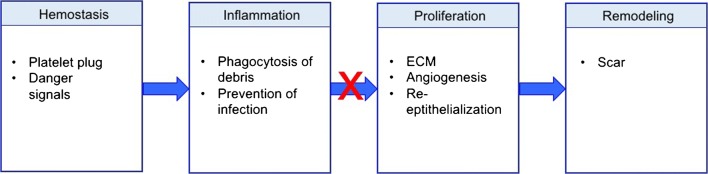
- Normal wound healing is divided into hemostasis (minutes to hours), inflammation (days 1–3), proliferation and repair (days 4–21), and remodeling (days 21–365); the key inflammatory-to-proliferative transition occurs around days 2–5 and often fails in chronic wounds.
- Neutrophils are early responders recruited by IL-8/CXCL8; their apoptosis and macrophage engulfment (efferocytosis) signal a shift to anti-inflammatory, pro-repair macrophages. Persistent neutrophils, NETs, proteases/MMPs, reactive oxygen species, and elevated CXCL8 contribute to chronic, non-healing wounds.
- Anti-inflammatory macrophages promote angiogenesis, granulation tissue, and re-epithelialization via VEGF, TGF-β, PDGF, EGF, KGF, and other signals; impaired pro- to anti-inflammatory macrophage transition—seen with iron overload, hyperglycemia, and hypoxia—stalls healing. Mature scars regain only 80% of initial tensile strength.
Methods
- Narrative review of the literature; no primary data, sample, or statistical analysis are reported.
- Synthesizes immune cell and signaling pathways across the four phases of wound healing, focusing on the inflammatory-to-proliferative transition and chronic wounds.
- Draws on cited animal models, in vitro studies, and human wound observations; no systematic search or meta-analysis is described.
Limitations
- The paper states no limitations.
- Evident from the text: it is a narrative review without systematic search, inclusion criteria, or quality appraisal.
- Evident from the text: many mechanistic conclusions rely on mouse models and in vitro findings, with limited direct human chronic wound data; no original experiments or quantitative synthesis are presented.
Model-written summary. Check it against the paper before relying on it.
Integrity signals
Registry
Cites
Statistics
Figures
Verification
Claims the paper makes
51 Not checked yet · 8 Own interpretation · 6 No basis given · 1 Partly supported · accuracy not yet measured
In the paper
“In impaired models of wound healing, such as diabetes, where infection risk is higher, neutrophils are clearly required [28].”
§ Immunology of Wound Healing > Four Stages of Wound Healing > Inflammation
What the sources say
- Not checked yetcites [28] Wilgus TA, Roy S, McDaniel JC. Neutrophils and wound repair: positive actions and negative reactions. Adv Wound Care. 2013;2(7):379–88. https://doi.org/10.1089/wound.2012.0383 . source
boosteddirect- Asserted: passes — The authors put it forward as true.
- Checkable: passes — It can be checked against evidence.
- Load-bearing: unclear — It is unclear whether the paper’s conclusions depend on it.
- Based: passes — The paper gives a reason why it holds.
- Rests on an assumption: Findings from mouse models of wound healing can be generalized to human wound healing and chronic wounds.
In the paper
“Their influx is mediated by a number of chemical signals, including IL-8, or CXCL8, as mentioned above, and neutrophils have over 30 different receptors that mitigate their migration and activation response [24].”
§ Immunology of Wound Healing > Four Stages of Wound Healing > Inflammation
What the sources say
- Not checked yetcites [24] Futosi K, Fodor S, Mocsai A. Neutrophil cell surface receptors and their intracellular signal transduction pathways. Int Immunopharmacol. 2013;17(3):638–50. https://doi.org/10.1016/j.intimp.2013.06.034 . source
plaindirect- Asserted: passes — The authors put it forward as true.
- Checkable: passes — It can be checked against evidence.
- Load-bearing: unclear — It is unclear whether the paper’s conclusions depend on it.
- Based: passes — The paper gives a reason why it holds.
None of the sources cited for this claim have been checked yet.
In the paper
“normal wound healing can generally be broken down into four over-lapping but distinct steps (Fig. 1). These steps include hemostasis (minutes to hours after injury), inflammation (days 1–3), proliferation and repair (days 4–21), and lastly, wound remodeling (days 21–365) [8, 9].”
§ Immunology of Wound Healing > Introduction
What the sources say
- Not checked yetcites [8] Morton LM, Phillips TJ. Wound healing and treating wounds: differential diagnosis and evaluation of chronic wounds. J Am Acad Dermatol. 2016;74(4):589–605; quiz −6. https://doi.org/10.1016/j.jaad.2015.08.068 . source
- Not checked yetcites [9] Reinke JM, Sorg H. Wound repair and regeneration. Eur Surg Res. 2012;49(1):35–43. https://doi.org/10.1159/000339613 . source
plain- Asserted: passes — The authors put it forward as true.
- Checkable: passes — It can be checked against evidence.
- Load-bearing: passes — The paper’s conclusions depend on it.
- Based: passes — The paper gives a reason why it holds.
In the paper
“chronic wounds demonstrate significantly increased levels of the potent neutrophil chemoattractant, CXCL8 [58].”
§ Immunology of Wound Healing > Four Stages of Wound Healing > Inflammation
What the sources say
- Not checked yetcites [58] Fivenson DP, Faria DT, Nickoloff BJ, Poverini PJ, Kunkel S, Burdick M, et al. Chemokine and inflammatory cytokine changes during chronic wound healing. Wound Repair Regen. 1997;5(4):310–22. https://doi.org/10.1046/j.1524-475X.1997.50405.x . source
boostedcorrelational- Asserted: passes — The authors put it forward as true.
- Checkable: passes — It can be checked against evidence.
- Load-bearing: passes — The paper’s conclusions depend on it.
- Based: passes — The paper gives a reason why it holds.
The paper states this without a source or data behind it here, so there is nothing to check it against. The quote shows it is in the paper.
In the paper
“Platelet activation not only results in hemostasis, but also in the release of growth factors such as platelet-derived growth factor (PDGF) as well as immune mediators that are responsible for activation of the immune system and transition to the inflammatory phase of wound healing.”
§ Immunology of Wound Healing > Four Stages of Wound Healing > Hemostasis
plaindirect- Asserted: passes — The authors put it forward as true.
- Checkable: passes — It can be checked against evidence.
- Load-bearing: unclear — It is unclear whether the paper’s conclusions depend on it.
- Based: passes — The paper gives a reason why it holds.
None of the sources cited for this claim have been checked yet.
In the paper
“mouse models of wound healing have shown that in non-aged, non-impaired models, neutrophil depletion does not negatively affect wound healing as profoundly as macrophage deletion [25–27].”
§ Immunology of Wound Healing > Four Stages of Wound Healing > Inflammation
What the sources say
- Not checked yetcites [25] Leibovich SJ, Ross R. The role of the macrophage in wound repair. A study with hydrocortisone and antimacrophage serum. Am J Pathol. 1975;78(1):71–100.
- Not checked yetcites [26] Pinhal-Enfield G, Ramanathan M, Hasko G, Vogel SN, Salzman AL, Boons GJ, et al. An angiogenic switch in macrophages involving synergy between Toll-like receptors 2, 4, 7, and 9 and adenosine A(2A) receptors. Am J Pathol. 2003;163(2):711–21. https://doi.org/10.1016/s0002-9440(10)63698-x . source
- Not checked yetcites [27] Simpson DM, Ross R. The neutrophilic leukocyte in wound repair a study with antineutrophil serum. J Clin Invest. 1972;51(8):2009–23. https://doi.org/10.1172/jci107007 . source
plaindirect- Asserted: passes — The authors put it forward as true.
- Checkable: passes — It can be checked against evidence.
- Load-bearing: unclear — It is unclear whether the paper’s conclusions depend on it.
- Based: passes — The paper gives a reason why it holds.
- Rests on an assumption: Findings from mouse models of wound healing can be generalized to human wound healing and chronic wounds.
A conclusion the paper draws from its own results — it cites no other source for it, so there is none to check. The quote shows it is in the paper.
In the paper
“New research has illustrated that chronic wounds fail to shift from the inflammatory to the proliferative phase of wound healing”
§ Immunology of Wound Healing > Introduction
boosted- Asserted: passes — The authors put it forward as true.
- Checkable: passes — It can be checked against evidence.
- Load-bearing: passes — The paper’s conclusions depend on it.
- Based: passes — The paper gives a reason why it holds.
A conclusion the paper draws from its own results — it cites no other source for it, so there is none to check. The quote shows it is in the paper.
In the paper
“recent research has shown that the key transition point lies between the inflammatory and the proliferative phases.”
- Also stated in: § Conclusions · plain
“Recent research has shown that the key transition point in wound healing lies between the inflammatory and the proliferative phases.”
§ Immunology of Wound Healing > Abstract > Summary
plain- Asserted: passes — The authors put it forward as true.
- Checkable: passes — It can be checked against evidence.
- Load-bearing: passes — The paper’s conclusions depend on it.
- Based: unclear — It is unclear why the paper says it holds.
- Also stated in: § Conclusions · plain
None of the sources cited for this claim have been checked yet.
In the paper
“the immune system has been found to play a substantial role due to its impact on several repair mechanisms [6, 7].”
§ Immunology of Wound Healing > Introduction
What the sources say
- Not checked yetcites [6] MA S, MJ N. The innate immune system in acute and chronic wounds. Adv Wound Care. 2016;5(2):65–78. https://doi.org/10.1089/wound.2014.0608 . source
- Not checked yetcites [7] Strbo N, Yin N, Stojadinovic O. Innate and adaptive immune responses in wound epithelialization. Adv Wound Care. 2014;3(7):492–501. https://doi.org/10.1089/wound.2012.0435 . source
plaindirect- Asserted: passes — The authors put it forward as true.
- Checkable: passes — It can be checked against evidence.
- Load-bearing: passes — The paper’s conclusions depend on it.
- Based: passes — The paper gives a reason why it holds.
The paper states this without a source or data behind it here, so there is nothing to check it against. The quote shows it is in the paper.
In the paper
“Myofibroblasts, activated through contractile forces and signaling molecules, then drive remodeling, where granulation tissue becomes scar.”
§ Immunology of Wound Healing > Abstract > Recent Findings
plaindirect- Asserted: passes — The authors put it forward as true.
- Checkable: passes — It can be checked against evidence.
- Load-bearing: passes — The paper’s conclusions depend on it.
- Based: unclear — It is unclear why the paper says it holds.
- It may state two separate claims as one. 15
The cited sources support only part of this claim — read each source’s verdict below.
In the paper
“The inflammatory phase overlaps considerably with initial hemostasis, occurring during the first 72 h after tissue injury [16].”
§ Immunology of Wound Healing > Four Stages of Wound Healing > Inflammation
What the sources say
- Partly supportedcites [16] Eming SA, Martin P, Tomic-Canic M. Wound repair and regeneration: mechanisms, signaling, and translation. Sci Transl Med. 2014;6(265):265sr6. https://doi.org/10.1126/scitranslmed.3009337 . sourceExperimental — accuracy not yet measured
The ‘Inflammatory response’ section says that acute wound-healing phases largely overlap and that the early inflammatory response occurs in parallel with hemostasis. It does not specify that the inflammatory phase occurs during the first 72 hours after injury; searches for that timing found no supporting passage in our copy. Page numbers were unavailable. (LLM, conf=0.85)
plaincorrelational- Asserted: passes — The authors put it forward as true.
- Checkable: passes — It can be checked against evidence.
- Load-bearing: unclear — It is unclear whether the paper’s conclusions depend on it.
- Based: passes — The paper gives a reason why it holds.
It may state two separate claims as one.
- Partly supported
In the paper
“Concurrent with the achievement of hemostasis, neutrophils are the first cells to migrate to the wound bed, brought in by pro-inflammatory signals including IL-8.”
§ Immunology of Wound Healing > Abstract > Recent Findings
What the sources say
- Not checked yetcites [31] Baggiolini M, Loetscher P, Moser B. Interleukin-8 and the chemokine family. Int J Immunopharmacol. 1995;17(2):103–8. source
plaindirect- Asserted: passes — The authors put it forward as true.
- Checkable: passes — It can be checked against evidence.
- Load-bearing: unclear — It is unclear whether the paper’s conclusions depend on it.
- Based: passes — The paper gives a reason why it holds.
It may state two separate claims as one.
None of the sources cited for this claim have been checked yet.
In the paper
“Neutrophils represent the most abundant inflammatory cells to infiltrate a new wound and function mainly to remove debris and prevent infection [22, 23].”
§ Immunology of Wound Healing > Four Stages of Wound Healing > Inflammation
What the sources say
- Not checked yetcites [22] Engelhardt E, Toksoy A, Goebeler M, Debus S, Brocker EB, Gillitzer R. Chemokines IL-8, GROalpha, MCP-1, IP-10, and Mig are sequentially and differentially expressed during phase-specific infiltration of leukocyte subsets in human wound healing. Am J Pathol. 1998;153(6):1849–60. source
- Not checked yetcites [23] de Oliveira S, Rosowski EE, Huttenlocher A. Neutrophil migration in infection and wound repair: going forward in reverse. Nat Rev Immunol. 2016;16(6):378–91. https://doi.org/10.1038/nri.2016.49 . source
plaindirect- Asserted: passes — The authors put it forward as true.
- Checkable: passes — It can be checked against evidence.
- Load-bearing: unclear — It is unclear whether the paper’s conclusions depend on it.
- Based: passes — The paper gives a reason why it holds.
It may state two separate claims as one.
In the paper
“NETs have also been detected in excess in diabetic foot wounds and have been shown to delay healing, and inhibition of NETosis and NET function in mouse models of delayed wound healing improves outcomes [59•].”
§ Immunology of Wound Healing > Four Stages of Wound Healing > Inflammation
What the sources say
- Not checked yetcites [59•]
plaindirect- Asserted: passes — The authors put it forward as true.
- Checkable: passes — It can be checked against evidence.
- Load-bearing: passes — The paper’s conclusions depend on it.
- Based: passes — The paper gives a reason why it holds.
It may state two separate claims as one.
- Rests on an assumption: Findings from mouse models of wound healing can be generalized to human wound healing and chronic wounds.
None of the sources cited for this claim have been checked yet.
In the paper
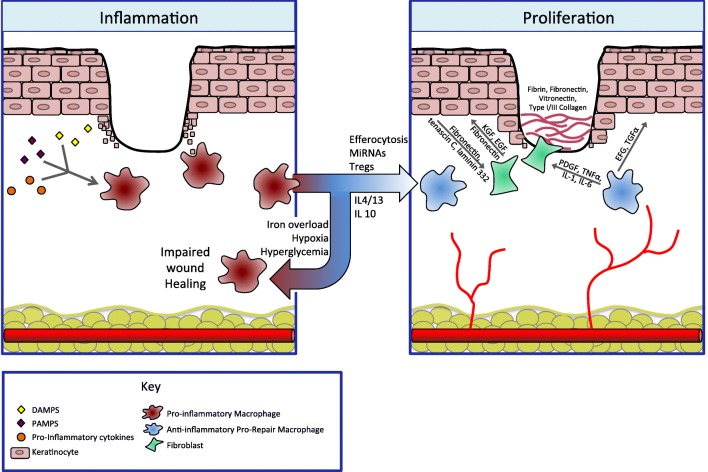
“Macrophages play a critical role in wound healing, and their roles in angiogenesis, fibroplasia, cell proliferation, and transition out of the inflammatory phase is clear (Fig. 2) [25–27, 60].”
§ Immunology of Wound Healing > Four Stages of Wound Healing > Inflammation
What the sources say
- Not checked yetcites [25] Leibovich SJ, Ross R. The role of the macrophage in wound repair. A study with hydrocortisone and antimacrophage serum. Am J Pathol. 1975;78(1):71–100.
- Not checked yetcites [26] Pinhal-Enfield G, Ramanathan M, Hasko G, Vogel SN, Salzman AL, Boons GJ, et al. An angiogenic switch in macrophages involving synergy between Toll-like receptors 2, 4, 7, and 9 and adenosine A(2A) receptors. Am J Pathol. 2003;163(2):711–21. https://doi.org/10.1016/s0002-9440(10)63698-x . source
- Not checked yetcites [27] Simpson DM, Ross R. The neutrophilic leukocyte in wound repair a study with antineutrophil serum. J Clin Invest. 1972;51(8):2009–23. https://doi.org/10.1172/jci107007 . source
- Not checked yetcites [60] Koh TJ, DiPietro LA. Inflammation and wound healing: the role of the macrophage. Expert Rev Mol Med. 2011;13:e23. https://doi.org/10.1017/s1462399411001943 . source
boosteddirect- Asserted: passes — The authors put it forward as true.
- Checkable: passes — It can be checked against evidence.
- Load-bearing: unclear — It is unclear whether the paper’s conclusions depend on it.
- Based: passes — The paper gives a reason why it holds.
It may state two separate claims as one.
In the paper
“After hemostasis is achieved, histamine released by the activated complement cascade causes capillary dilation and leakage, accelerating migration of inflammatory cells into the wound bed and full transition to the inflammatory phase of wound healing [15].”
§ Immunology of Wound Healing > Four Stages of Wound Healing > Hemostasis
What the sources say
- Not checked yetcites [15] Sinno H, Prakash S. Complements and the wound healing cascade: an updated review. Plast Surg Int. 2013;2013:146764–7. https://doi.org/10.1155/2013/146764 . source
plaindirect- Asserted: passes — The authors put it forward as true.
- Checkable: passes — It can be checked against evidence.
- Load-bearing: unclear — It is unclear whether the paper’s conclusions depend on it.
- Based: passes — The paper gives a reason why it holds.
It may state two separate claims as one.
None of the sources cited for this claim have been checked yet.
In the paper
“neutrophil-derived proteases, such as elastase and matrix metalloproteinases (MMPs), can degrade healthy extracellular matrix (ECM), and increased levels of these proteases have been repeatedly detected in chronic wounds [52–56].”
§ Immunology of Wound Healing > Four Stages of Wound Healing > Inflammation
What the sources say
- Not checked yetcites [52] Briggaman RA, Schechter NM, Fraki J, Lazarus GS. Degradation of the epidermal-dermal junction by proteolytic enzymes from human skin and human polymorphonuclear leukocytes. J Exp Med. 1984;160(4):1027–42. source
- Not checked yetcites [53] Grinnell F, Zhu M. Fibronectin degradation in chronic wounds depends on the relative levels of elastase, alpha1-proteinase inhibitor, and alpha2-macroglobulin. J Invest Dermatol. 1996;106(2):335–41. source
- Not checked yetcites [54] Herrick S, Ashcroft G, Ireland G, Horan M, McCollum C, Ferguson M. Up-regulation of elastase in acute wounds of healthy aged humans and chronic venous leg ulcers are associated with matrix degradation. Lab Invest. 1997;77(3):281–8.
- Not checked yetcites [55] Nwomeh BC, Liang HX, Cohen IK, Yager DR. MMP-8 is the predominant collagenase in healing wounds and nonhealing ulcers. J Surg Res. 1999;81(2):189–95. https://doi.org/10.1006/jsre.1998.5495 . source
- Not checked yetcites [56] Pirila E, Korpi JT, Korkiamaki T, Jahkola T, Gutierrez-Fernandez A, Lopez-Otin C, et al. Collagenase-2 (MMP-8) and matrilysin-2 (MMP-26) expression in human wounds of different etiologies. Wound Repair Regen. 2007;15(1):47–57. https://doi.org/10.1111/j.1524-475X.2006.00184.x . source
plaindirect- Asserted: passes — The authors put it forward as true.
- Checkable: passes — It can be checked against evidence.
- Load-bearing: passes — The paper’s conclusions depend on it.
- Based: passes — The paper gives a reason why it holds.
It may state two separate claims as one.
None of the sources cited for this claim have been checked yet.
In the paper
“Platelet degranulation also leads to the release of inflammatory mediators such as interleukin (IL)-8, or CXCL8 (a potent neutrophil chemoattractant), in addition to IL-1α, IL-1β, IL-6, and tumor necrosis factor (TNF)-α, and activates the complement cascade [9, 14].”
§ Immunology of Wound Healing > Four Stages of Wound Healing > Hemostasis
What the sources say
plaindirect- Asserted: passes — The authors put it forward as true.
- Checkable: passes — It can be checked against evidence.
- Load-bearing: unclear — It is unclear whether the paper’s conclusions depend on it.
- Based: passes — The paper gives a reason why it holds.
It may state two separate claims as one.
In the paper
“Dysregulation of any of these events can result in delayed wound healing and the potential to form chronic ulcers and/or excessive scarring [10••].”
§ Immunology of Wound Healing > Introduction
What the sources say
- Not checked yetcites [10••]
plaindirect- Asserted: passes — The authors put it forward as true.
- Checkable: passes — It can be checked against evidence.
- Load-bearing: passes — The paper’s conclusions depend on it.
- Based: passes — The paper gives a reason why it holds.
It may state two separate claims as one.
None of the sources cited for this claim have been checked yet.
In the paper
“Not only do anti-inflammatory, pro-repair macrophages produce VEGF, which promotes vessel sprouting, they also express two transmembrane proteins that have been shown to promote vascular anastomosis [80, 85, 86].”
§ Immunology of Wound Healing > Four Stages of Wound Healing > Proliferation
What the sources say
- Not checked yetcites [80] Brancato SK, Albina JE. Wound macrophages as key regulators of repair: origin, phenotype, and function. Am J Pathol. 2011;178(1):19–25. https://doi.org/10.1016/j.ajpath.2010.08.003 . source
- Not checked yetcites [85] Fantin A, Vieira JM, Gestri G, Denti L, Schwarz Q, Prykhozhij S, et al. Tissue macrophages act as cellular chaperones for vascular anastomosis downstream of VEGF-mediated endothelial tip cell induction. Blood. 2010;116(5):829–40. https://doi.org/10.1182/blood-2009-12-257832 . source
- Not checked yetcites [86] Affolter M, Zeller R, Caussinus E. Tissue remodelling through branching morphogenesis. Nat Rev Mol Cell Biol. 2009;10:831–42. https://doi.org/10.1038/nrm2797 . source
boosteddirect- Asserted: passes — The authors put it forward as true.
- Checkable: passes — It can be checked against evidence.
- Load-bearing: unclear — It is unclear whether the paper’s conclusions depend on it.
- Based: passes — The paper gives a reason why it holds.
It may state two separate claims as one.
In the paper
“Wounds without IL-6 lack an appropriate inflammatory response and demonstrate stunted angiogenesis, collagen accumulation, and re-epithelialization [89].”
§ Immunology of Wound Healing > Four Stages of Wound Healing > Proliferation
What the sources say
- Not checked yetcites [89] Lin ZQ, Kondo T, Ishida Y, Takayasu T, Mukaida N. Essential involvement of IL-6 in the skin wound-healing process as evidenced by delayed wound healing in IL-6-deficient mice. J Leukoc Biol. 2003;73(6):713–21. source
plaindirect- Asserted: passes — The authors put it forward as true.
- Checkable: passes — It can be checked against evidence.
- Load-bearing: unclear — It is unclear whether the paper’s conclusions depend on it.
- Based: passes — The paper gives a reason why it holds.
It may state two separate claims as one.
In the paper
“When the transition from a pro- to an anti-inflammatory macrophage phenotype is impaired, wound healing stalls in the inflammatory phase and a chronic wound results [10••].”
§ Immunology of Wound Healing > Four Stages of Wound Healing > Inflammation
What the sources say
- Not checked yetcites [10••]
plaindirect- Asserted: passes — The authors put it forward as true.
- Checkable: passes — It can be checked against evidence.
- Load-bearing: passes — The paper’s conclusions depend on it.
- Based: passes — The paper gives a reason why it holds.
It may state two separate claims as one.
The paper states this without a source or data behind it here, so there is nothing to check it against. The quote shows it is in the paper.
In the paper
“Additional signals, such as hyperglycemia in the setting of diabetes, hypoxia in the setting of arterial or venous insufficiency, or secondary infection likely also contribute to the persistence of pro-inflammatory macrophages.”
§ Immunology of Wound Healing > Four Stages of Wound Healing > Inflammation
hedgedconditional- Asserted: passes — The authors put it forward as true.
- Checkable: passes — It can be checked against evidence.
- Load-bearing: unclear — It is unclear whether the paper’s conclusions depend on it.
- Based: unclear — It is unclear why the paper says it holds.
It may state two separate claims as one.
A conclusion the paper draws from its own results — it cites no other source for it, so there is none to check. The quote shows it is in the paper.
In the paper
“If wounds fail to transition from the inflammatory phase, pro-inflammatory macrophages persist and non-healing wounds develop.”
§ Immunology of Wound Healing > Conclusions
plaindirect- Asserted: passes — The authors put it forward as true.
- Checkable: passes — It can be checked against evidence.
- Load-bearing: passes — The paper’s conclusions depend on it.
- Based: passes — The paper gives a reason why it holds.
It may state two separate claims as one.
A conclusion the paper draws from its own results — it cites no other source for it, so there is none to check. The quote shows it is in the paper.
In the paper
“Numerous signals are responsible for the transition, most notably the apoptosis and phagocytosis of wound-bed resident neutrophils (efferocytosis).”
§ Immunology of Wound Healing > Conclusions
plaindirect- Asserted: passes — The authors put it forward as true.
- Checkable: passes — It can be checked against evidence.
- Load-bearing: passes — The paper’s conclusions depend on it.
- Based: unclear — It is unclear why the paper says it holds.
It may state two separate claims as one.
The paper relies on this without support.
Findings from mouse models of wound healing can be generalized to human wound healing and chronic wounds.
“mouse models of wound healing have shown that in non-aged, non-impaired models, neutrophil depletion does not negatively affect wound healing as profoundly as macrophage deletion [25–27].”
“in a mouse model of iron overload, local wound macrophages persisted in a pro-inflammatory state with excess production of inducible nitric oxide synthase (iNOS), IL-12, and TNF-α, in addition to free radicals, leading to impaired wound healing [81].”
“inhibition of NETosis and NET function in mouse models of delayed wound healing improves outcomes [59•].”
Claims other papers make about this one
Each is checked against this paper’s own text: does it say what the citing paper says it does?
The source backs part of the claim, not all of it — or backs it for a different population, condition or comparison.
In the citing paper
“Immune regulators promote better surveillance and wound clearance in multiple tissues [75, 76].”
From Rejuvenation of three germ layers tissues by exchanging old blood plasma with saline-albumin (2020) · cites this paper as [75]
Experimental — accuracy not yet measuredIn the citing paper
“Indeed, these cells are known to be irreplaceable partners in a successful wound healing70.”
From Platelets induce increased estrogen production through NF-κB and TGF-β1 signaling pathways in endometriotic stromal cells (2020) · cites this paper as [70]
In the citing paper
“The absence or over-abundance of any of these cell types would derail the normal healing process, leading healing astray and causing pathological healing such as fibrosis70.”
From Platelets induce increased estrogen production through NF-κB and TGF-β1 signaling pathways in endometriotic stromal cells (2020) · cites this paper as [70]
Citations
Cites
Neutrophil Extracellular Traps Kill Bacteria
Brinkmann, V., Reichard, U., Goosmann, C., Fauler, B., Uhlemann, Y., Weiss, D. S., Weinrauch, Y., & Zychlinsky, A. (2004) · Science · doi:10.1126/science.1092385 · Cited by 10,268
Exploring the full spectrum of macrophage activation
Mosser, D. M., & Edwards, J. P. (2008) · Nature Reviews Immunology · doi:10.1038/nri2448 · Cited by 9,144
Pattern Recognition Receptors and Inflammation
Takeuchi, O., & Akira, S. (2010) · Cell · doi:10.1016/j.cell.2010.01.022 · Cited by 8,895
Mizgerd, J. P., Kubo, H., Kutkoski, G. J., Bhagwan, S. D., Scharffetter-Kochanek, K., Beaudet, A. L., & Doerschuk, C. M. (1997) · The Journal of Experimental Medicine · doi:10.1084/jem.186.8.1357 · Cited by 7,332
The chemokine system in diverse forms of macrophage activation and polarization
MANTOVANI, A., SICA, A., SOZZANI, S., ALLAVENA, P., VECCHI, A., & LOCATI, M. (2004) · Trends in Immunology · doi:10.1016/j.it.2004.09.015 · Cited by 6,534
Macrophage plasticity and polarization: in vivo veritas
Sica, A., & Mantovani, A. (2012) · Journal of Clinical Investigation · doi:10.1172/jci59643 · Cited by 6,335
MANTOVANI, A., SOZZANI, S., LOCATI, M., ALLAVENA, P., & SICA, A. (2002) · Trends in Immunology · doi:10.1016/s1471-4906(02)02302-5 · Cited by 5,528
Neutrophil recruitment and function in health and inflammation
Kolaczkowska, E., & Kubes, P. (2013) · Nature Reviews Immunology · doi:10.1038/nri3399 · Cited by 5,472
Monocyte and macrophage heterogeneity
Gordon, S., & Taylor, P. R. (2005) · Nature Reviews Immunology · doi:10.1038/nri1733 · Cited by 5,190
Wound repair and regeneration: Mechanisms, signaling, and translation
Eming, S. A., Martin, P., & Tomic-Canic, M. (2014) · Science Translational Medicine · doi:10.1126/scitranslmed.3009337 · Cited by 3,562
Cited by
Sorted by citations
Items 501–600 of 618
Postnatal outcomes of in utero repair of simple gastroschisis in an ovine model
Byrd, E. A., Anderson, J. E., Lopez, J. M. G., et al. (2025) · Journal of Pediatric Surgery · doi:10.1016/j.jpedsurg.2025.162720 · Cited by 1
Smart dressings and wearable technology: A new era in wound management
Hassani, S., Pakroo, M., Ghafarzadeh, Y., et al. (2025) · Journal of Burns and Wound Research · doi:10.61882/ijbwr.1.3.28 · Cited by 1
“This detection triggers the inflammatory response, drawing immune cells, such as neutrophils, to the wound site [8].”
Aihemaiti, S., Wei, K., Abulimiti, D. ·., et al. (2025) · International Immunopharmacology · doi:10.1016/j.intimp.2025.115791 · Cited by 1
Kumar, Y. S., Megha, A. S., Ramula, M., & Ramachandran, M. (2025) · Journal of Diabetes & Metabolic Disorders · doi:10.1007/s40200-025-01793-4 · Cited by 1
“In healthy wound healing, the inflammatory phase is transient and resolves in a controlled manner, allowing for the progression to the proliferative phase [23].”
Chung, H., Jang, W. Y., Choi, J., & Kim, S. (2025) · Small · doi:10.1002/smll.202511027 · Cited by 1
Wu, M.-S., Shiue, S., Zheng, Q.-Y., Chen, Y.-S., & Lin, H.-Y. (2026) · Tissue Engineering and Regenerative Medicine · doi:10.1007/s13770-025-00786-x · Cited by 2
“The process of wound healing in the skin typically involves complex interactions between immune system cells and skin cells [1, 2].”
Advances in the Role of Adipose Tissue in Promoting Injury Repair and Resist Infection
Duan, X., Li, R., Fu, L., Yang, J., & Zhan, Z. (2026) · Immunity Inflammation and Disease · doi:10.1002/iid3.70341 · Cited by 4
“They manipulate macrophages to recruit keratinocytes and fibroblasts; these macrophages release epidermal growth factor (EGF) and TGF‐α to stimulate keratinocyte migration and proliferation, thereby aiding wound repair [115].”
Lutsenko, A. V., Самотруева, М. А., & Poroyskiy, S. V. (2026) · Сибирский научный медицинский журнал · doi:10.18699/ssmj20250608 · Cited by 1
Shi, Y., Pan, M., Chen, X., Bi, Y., Wei, X., Zheng, F., Xia, H., & He, X. (2026) · Scientific Reports · doi:10.1038/s41598-026-41545-9 · Cited by 2
Shafiei, M., Karimi‐Soflou, R., & Karkhaneh, A. (2026) · International Journal of Biological Macromolecules · doi:10.1016/j.ijbiomac.2026.151861 · Cited by 1
Kumar, D., Kondaveeti, S. B., Singh, T. G., Ali, S. S., Mujtaba, M. A., Awasthi, A., Kaur, J., & Kumar, M. (2026) · Journal of Drug Delivery Science and Technology · doi:10.1016/j.jddst.2026.108426 · Cited by 2
Kalshetti, D., Amin, M., Varsani, R., Narayanan, A., Ciurca, S., Grijalva, I., Lickfeld, A., Lukan, J. K., Schwaitzberg, S. D., & Arany, P. (2026) · Advances in Wound Care · doi:10.1177/21621918261450363 · Cited by 1
Infiltrasi Neutrofil Pada Penyembuhan Luka Insisi Gingiva Tikus Wistar Setelah Pemberian Vitamin D
Hervina, H., Syahriel, D., & Prawira, I. G. N. G. S. (2021) · JBN (Jurnal Bedah Nasional) · doi:10.24843/jbn.2021.v05.i02.p02 · Cited by 1
Park, S. H., Jung, B. Y., Lee, S. Y., et al. (2021) · Annals of Dermatology · doi:10.5021/ad.2021.33.5.440 · Cited by 1
“Their expression induces an alarm signal and activates host defense mechanisms against external stress 17,18 .”
Song, Y., Jo, Y., Sohn, J. E., et al. (2022) · Medicina · doi:10.3390/medicina58030390 · Cited by 1
“Second, hemostasis is followed by inflammation within hours; immune cells such as neutrophils are infiltrated into the site of injury to scavenge bacteria and damaged matrix proteins [7].”
BackgroundPeripheral mononuclear cells composition in platelet-rich fibrin in canines with chronic conditions
Jasinevičiūtė, I., Grigas, J., Žiukaitė, G., Pautienius, A., Razukevičius, D., Žymantienė, J., & Stankevi̇či̇us, A. (2022) · Scientific Reports · doi:10.1038/s41598-022-22487-4 · Cited by 3
Abed, S. M., Essa, R. H., & Yaseen, K. H. (2022) · AIP conference proceedings · doi:10.1063/5.0093648 · Cited by 1
Utami, R. A., Darmawati, S., Kamaruddin, M., et al. (2023) · Advances in health sciences research/Advances in Health Sciences Research · doi:10.2991/978-94-6463-132-6_41 · Cited by 1
An, H. M., Choi, Y. S., Bae, S. K., & Lee, Y. K. (2023) · Medicina · doi:10.3390/medicina59061155 · Cited by 1
“Wound healing consists of hemostasis, inflammation, proliferation, and remodeling; in chronic injuries caused by diabetes or pathogen infection, the transition from inflammation to proliferation is unsuccessful, and healing is delayed [8].”
BackgroundCuturicu, L. L., Macarel, V. C., Rusu, R. A., et al. (2023) · Journal of Engineered Fibers and Fabrics · doi:10.1177/15589250231166113 · Cited by 1
“21 The proliferative stage consists of the epithelization, revascularization, and formation of granulation tissue.”
BackgroundMacrophages in tissue engineering and regeneration
Clark, D. R., Nakamura, M. C., Miclau, T., & Marcucio, R. (2024) · Elsevier eBooks · doi:10.1016/b978-0-12-821754-2.00005-9 · Cited by 1
Sasaki, S., Koike, Y., Jimbo, K., et al. (2024) · Parasitology International · doi:10.1016/j.parint.2024.102990 · Cited by 1
Bhatt, P., Reema, R., & Sankaranarayanan, K. (2025) · Regenerative Engineering and Translational Medicine · doi:10.1007/s40883-025-00410-3 · Cited by 1
“…focusing on the laboratory-scale investigation of plasma-protein interactions, thus enhancing our understanding and paving the way for improved methodologies in developing future medical devices. neutrophils are removed from the wound site for the healing process to continue to another phase [21].”
Peripheral mononuclear cells composition in platelet-rich fibrin in canines with chronic conditionsPreprint
Jasinevičiūtė, I., Grigas, J., Žiukaitė, G., et al. (2022) · Research Square · doi:10.21203/rs.3.rs-1578452/v1 · Cited by 1
Tolstunov, L. (2022) · doi:10.1002/9781119827351.ch1-1 · Cited by 1
Abidin, M. R., Alpan, O., Plassmeyer, M. L., Kozhaya, L., Loizou, D., Dogan, M., Upchurch, Z., Manes, N. P., Nita‐Lazar, A., Unutmaz, D., et al. (2023) · medRxiv · doi:10.1101/2023.12.11.23299743 · Cited by 1
“[ 44–46].”
Tissue repair and stress responses of aged skin epidermis
Wong, W. (2020) · Digital Repository Service (Northeastern University) · doi:10.17760/d20383670
Wijanarko, K. J., Wang, M., & Chow, K. T. (2020) · Royal Society of Chemistry eBooks · doi:10.1039/9781788019958-00303
Lim, J. Y., Choi, Y. S., Lee, H. R., An, H. M., & Lee, Y. K. (2021) · bioRxiv (Cold Spring Harbor Laboratory) · doi:10.1101/2021.05.05.442721
The role of Angiopoietin-like protein 4 in macrophage activation
Wee, J. W. K. (2020) · doi:10.32657/10356/151419
Safety of laser skin resurfacing in immunocompromised and diabetic patients
Campagna, G. A., Homer, N. A., Artymowicz, A., Epstein, A. E., Durairaj, V. D., & Nakra, T. (2021) · European Journal of Plastic Surgery · doi:10.1007/s00238-021-01847-9
Epigenetic insights for wound healing mechanism
Sharma, A. K., Kalonia, A., Shaw, P., & Shukla, S. K. (2021) · Elsevier eBooks · doi:10.1016/b978-0-323-85652-2.00016-6
Gabbiani, G. (2019) · Faculty Opinions – Post-Publication Peer Review of the Biomedical Literature · doi:10.3410/f.736937977.793567771
Seria, E., Galea, G., Grech, G., Tagliaferro, S. S., & Felice, A. E. (2020) · Research Square · doi:10.21203/rs.3.rs-73514/v1
“Expression of the genes encoding IL-8 and transforming growth factor-α (TGFA) involved in the in ammatory phase [25] and the proliferative phase [26] of wound healing was analysed to evaluate how the leucocyte depleted PRP-based skin equivalent, the rTNF administration, and the MSC infusion affect the nal therapeutic…”
Skin Lesion Vitality Assessment for Forensic Science: Current Research and New perspectives
(2022) · Frontiers research topics · doi:10.3389/978-2-83250-060-6
Role of Insulin in Dermatology: Review Article
Ibrahim, H. M., Fahmy, E. A. M., Elsayed, M. M., & Elardi, A. (2022) · The Egyptian Journal of Hospital Medicine · doi:10.21608/ejhm.2022.260867
“Hemostasis is 1 stage of healing after injury ((7)).”
BackgroundNurhidayah, S., Marlinawati, I. T., Winarsih, S., & Nurseta, T. (2022) · Medical Laboratory Technology Journal · doi:10.31964/mltj.v8i1.464
“Neutrophils are one of the most abundant and active cells during the wound healing process (Phillipson et al., 2019) by migrating to the wound area via pro-inflammatory signals (Ellis, Lin, and Tartar, 2018).”
BackgroundInfluentialPhotoprotection and the Science Behind Skin Healing
Amici, J. M., Kérob, D., Passeron, T., & Puig, S. (2022) · EMJ Dermatology · doi:10.33590/emjdermatol/10058317
USO MEDICINAL E APLICAÇÕES DA CORAMA (Kalanchoe pinnata) - UMA REVISÃO INTEGRATIVA
Procópio, M. R. M. D. S., Rodrigues, I. P., Tavares, T. R. P., Lira, C. A. C., Barbosa, K. D. L., Cunha, D. C., Ferreira, A. T., Monteiro, A. I. D. S., dos Santos, Â. M. G., Celestino, M. L. L., et al. (2023) · doi:10.22533/at.ed.45823170123
Kuznetsova, E. K., Анатольевна, М. Е., Kudrevich, Y. V., Dolgushin, I. I., Ziganshin, O. R., & Никушкина, К. В. (2023) · Ural Medical Journal · doi:10.52420/2071-5943-2023-22-1-41-50
Unveiling Macrophage-Biofilm Interactions: Implications for Cellular Metabolism and Wound Healing
Versey, Z. (2023) · Carleton University's Institutional Repository (MacOdrum Library, Carleton University) · doi:10.22215/etd/2023-15377
Applications of Antibacterial Materials with Physiological Responsiveness in Wound Repair
周, 倩. (2023) · Material Sciences · doi:10.12677/ms.2023.134035 · Cited by 1
Garima, Dey, A. D., & Kumar, A. (2023) · Royal Society of Chemistry eBooks · doi:10.1039/9781837671540-00001
Papa, G., Pini, P., Bella, S. D., & Sidoti, G. B. (2023) · Springer eBooks · doi:10.1007/978-3-031-45453-0_33
Incorporating Stem Cells Into Physical Rehabilitation
Gan, Q. F., Leong, P. P., Cheong, S. K., & Foo, C. N. (2024) · Elsevier eBooks · doi:10.1016/b978-0-443-15717-2.00075-5
Adib, Y., Serror, K., & Michel, L. (2024) · EMC - Dermatología · doi:10.1016/s1761-2896(24)49117-6
Susanto, C., Wijaya, C. D., & Turnip, G. L. U. P. (2024) · Jurnal Penelitian Pendidikan IPA · doi:10.29303/jppipa.v10i4.7054
γ-Oryzanol is a Nutritious Food Ingredient for Enhancing Wound HealingPreprint
Liu, Y.-S., Lai, M. C., Hong, T.-Y., et al. (2024) · SSRN Electronic Journal · doi:10.2139/ssrn.4807014
Lima, L. L., Rigon, R. B., d’Ávila, M. A., et al. (2024) · Brazilian Journal of Pharmaceutical Sciences · doi:10.1590/s2175-97902024e23173
Ergün, F. C., & Kars, M. D. (2024) · İstanbul Gelişim Üniversitesi Sağlık Bilimleri Dergisi · doi:10.38079/igusabder.1249634
Shahrbabaki, A. S., Amini, B., Ghorbani, M., et al. (2024) · Research Square · doi:10.21203/rs.3.rs-5471491/v1
Goshchynsky, V. B., Migenko, B., & Migenko, B. O. (2024) · Здобутки клінічної і експериментальної медицини · doi:10.11603/1811-2471.2024.v.i4.15028
(2000) · Time to knit · doi:10.1016/s0246-0319(23)43897-6
de Melo, R. C. G., Mantovanelli, V. R., de Paula, G. A., Ferreira, D. F., Romagna, R. D. A., Monteiro, J. R. B., Santos, M. F. C., Severi, J. A., Resende, J., Boeloni, J. N., et al. (2025) · Chemistry & Biodiversity · doi:10.1002/cbdv.202402710
“The replacement of damaged tissue by vascularized connective tissue restores the functionality and structure of the affected area [44].”
Gylten, J. D., Persons, J. E., Miller, B. J., An, Q., Tanas, M. R., & Chen, S. J. T. (2025) · Biomedicines · doi:10.3390/biomedicines13020344 · Cited by 1
“In general, cutaneous repair and healing are attained through the complex and continuous steps of hemostasis, inflammation, proliferation, and remodeling [18,19].”
Wound healing approaches based on polysaccharide-nanoparticles biocomposites
Concórdio‐Reis, P., Pereira, J. R., Esmail, A., Ramos, K., Araújo, D., & Freitas, F. (2025) · Elsevier eBooks · doi:10.1016/b978-0-443-22027-2.00006-3
(2025) · Elsevier eBooks · doi:10.1016/b978-3-437-21835-4.00116-5
Majdoub, O., Hamdaoui, N., Albishri, S., Boudaya, M., Kallel, C., Jamoussi, K., Aouadi, K., Vita, D. D., Feki, A. E., Kadri, A., et al. (2025) · Waste and Biomass Valorization · doi:10.1007/s12649-025-03006-8 · Cited by 1
Lai, Y., Tsai, K., Hung, C., et al. (2025) · Journal of the Formosan Medical Association · doi:10.1016/j.jfma.2025.05.027
Nanogel: design fabrication and characterization
da Silva, M. D. C. R., Druzian, D. M., Pinheiro, L. D. S. M., da Silva, W. L., & dos Santos, J. H. Z. (2025) · Elsevier eBooks · doi:10.1016/b978-0-443-30016-5.00011-2
On the Use of Coaxial Nanofibers As Wound Dressings and Drug-Delivery Systems in Wound Healing
Николаевна, Р. К., Novosad, Y. A., & Vissarionov, S. V. (2025) · Nanobiotechnology Reports · doi:10.1134/s2635167624602316
Collagen Remodeling of Strattice™ Firm in a Nonhuman Primate Model of Abdominal Wall Repair
Bolden, K., Lombardi, J., Kabaria, N., Stec, E., & Sandor, M. (2025) · Bioengineering · doi:10.3390/bioengineering12080796 · Cited by 1
“The overall elevation in pro-inflammatory cytokine levels was predominated by IL-6 and IL-8, which are major regulators of the acute inflammatory response and play an important role in the transition from the inflammatory to proliferative stage of wound healing [27–29] (Figure 1).”
Medical applications of sericin: A molecular perspective
Wattanavijitkul, T., Cherdchom, S., & Aramwit, P. (2025) · Elsevier eBooks · doi:10.1016/b978-0-443-21736-4.00008-8
Ash, D., Sen, S., Shaw, S., Dutta, A., Kumari, L., & Mukherjee, S. (2025) · Wiley eBooks · doi:10.1002/9781394393145.ch7
Shahrbabaki, A. S., Amini, B., Ghorbani, M., Ghasemi, M., Ganjizadeh, S., khoushehmehr, S. M., Rahmani, A., Azizi, H., & Delnavazi, M. (2025) · Natural Product Communications · doi:10.1177/1934578x251367849
Jin, Y., Lee, Y. H., Kim, D. H., Jin, C., Zhang, X., Yoo, J., Kim, G.-H., Kim, D. H., Oh, T.-I., Jung, Y., et al. (2025) · International Journal of Molecular Sciences · doi:10.3390/ijms26188796
Complications in aesthetic surgery. Possibilities for prevention and treatment
Tsivenko, O., & Somaka, R. A. (2025) · The Journal of V N Karazin Kharkiv National University series Medicine · doi:10.26565/2313-6693-2025-55-06
Nanotechnology in Herbal-Based Wound Care
Selvakumar, P., Manjunath, M., Manjunath, T. C., Rengarajan, C., & Pillai, P. P. P. (2025) · IGI Global eBooks · doi:10.4018/979-8-3373-3977-1.ch011
Jacob Rosarian Joy, S., Vidya, R., & Babu, D. R. (2025) · Chemical Physics Impact · doi:10.1016/j.chphi.2025.100960
Marine-origin natural products to promote wound healing and regeneration
Umeyor, C. E., Kolekar, P., Kumbhar, P., et al. (2025) · Elsevier eBooks · doi:10.1016/b978-0-443-33122-0.00019-2
Zhu, T., Li, H.-Q., Zheng, Z., Wang, T., Zhou, Y.-X., Li, M., Wu, W., Peng, X., & Zhou, Y. (2025) · Journal of Materials Science · doi:10.1007/s10853-025-11867-6
“[4] Each year, millions of people in the world are newly affected by poor wound healing [5–7].”
New advances in pressure ulcer treatment − the promoting effect of biomaterials on drugs
Song, L., Luo, J., Xu, Y., Zhang, Y., Gao, J., Yang, G., & Luo, Y. (2025) · International Journal of Pharmaceutics · doi:10.1016/j.ijpharm.2025.126500
Seria, E., Galea, G., Borg, J., Schembri, K., Grech, G., Tagliaferro, S. S., & Felice, A. (2021) · Figshare · doi:10.6084/m9.figshare.14570435
Zhang, J., He, Z., Xiong, C., Yao, Y., Zhang, C., Yao, W., Yang, S., Li, X., & Han, Y. (2024) · Figshare · doi:10.6084/m9.figshare.26066058
Zhang, J., He, Z., Xiong, C., Yao, Y., Zhang, C., Yao, W., Yang, S., Li, X., & Han, Y. (2024) · Figshare · doi:10.6084/m9.figshare.26066179
Zhang, J., He, Z., Xiong, C., Yao, Y., Zhang, C., Yao, W., Yang, S., Li, X., & Han, Y. (2024) · Figshare · doi:10.6084/m9.figshare.26736195
Liu, A., Long, Y., Li, J., Gu, L., Karim, A., Wang, X., & Gibson, A. L. F. (2021) · Figshare · doi:10.6084/m9.figshare.16650311
Mgwenya, T. N., & Mdluli, P. S. (2025) · IntechOpen eBooks · doi:10.5772/intechopen.1012961
Hydrogels Against Wound Causing Opportunistic Pathogens
Majumder, S., & Sinha, S. N. (2025) · Smart nanomaterials technology · doi:10.1007/978-981-95-0720-7_11
Marine Polysaccharides in Wound Healing
Divya, M., Raju, R. A., & Rekha, M. R. (2026) · Springer eBooks · doi:10.1007/978-981-95-4126-3_11
A Chiral Hydrogel Accelerates Wound Healing via the Lactylation of Ring Finger Protein 123
He, R., Liu, T., Xing, C., Sun, M., Geng, L., Gao, L., Dou, X., Ni, T., Xu, P., Peng, Y., et al. (2026) · ACS Applied Materials & Interfaces · doi:10.1021/acsami.5c21101 · Cited by 2
Healing Beyond the Surface: Regenerative Strategies in Complex Burn Treatment
Schlottmann, F., Kloss, F., Lorbeer, L., et al. (2026) · Stem cell biology and regenerative medicine · doi:10.1007/978-3-032-12442-5_24
Therapeutic Approaches to Treat Hypertrophic Scars
Smith, V. C., Smith, S., & Ozdemir, T. (2026) · Stem cell biology and regenerative medicine · doi:10.1007/978-3-032-12442-5_31
Brieva, P. M., Barlokova, N., Paturi, J., & Borowik, S. (2026) · Dermatology and Therapy · doi:10.1007/s13555-026-01710-4 · Cited by 1
“Laser procedures have emerged as a transformative force in aesthetics, providing precise and controlled methods to address a wide array of concerns, including wrinkles, scars, or pigmentation/discoloration [1, 2].”
Lertwimol, T., Jankam, S., Kitpakornsanti, S., et al. (2026) · ACS Omega · doi:10.1021/acsomega.5c13494
Ahmad, S., Fatima, M., Zulqarnain, M., Javed, Y., Abbas, M. K., & Shad, N. A. (2026) · Nanomedicine Nanotechnology Biology and Medicine · doi:10.1016/j.nano.2026.102938
YILDIRIM, C., Kayır, N., Albayrak, M. G. B., et al. (2026) · Biomedicines · doi:10.3390/biomedicines14040739
“The primary goal of wound management is to promote the orderly progression of these phases and to prevent complications that may lead to chronic or non-healing wounds [1].”
Setiono, S. B. V., Turalaki, G. L. A., & Tallei, T. E. (2026) · Heca Journal of Applied Sciences · doi:10.60084/hjas.v4i1.372
“They exert antimicrobial activity through the release of lytic enzymes, phagocytosis, the formation of neutrophil extracellular traps (NETs), and the secretion of cytokines that sustain inflammatory responses and recruit additional immune cells [188, 189].”
Ballı, S. E. Ü., Bahadır, G. B., Korkmaz, G., et al. (2026) · Journal of Laparoendoscopic & Advanced Surgical Techniques · doi:10.1177/10926429261440382
Huang, L., Su, X., Lin, T., Zou, J., He, X., Qin, W., Wei, S., & Huang, J. (2026) · Nanoscale · doi:10.1039/d5nr05288b
Zafar, R., Pham, T. D., Vakafua, L., Reed, T., & Seyedasli, N. (2026) · Pharmaceuticals · doi:10.3390/ph19050769
“…to fibrosis and wound healing; and type III, which promotes malignant transformation, tumour local invasion, and distal metastasis [1,2,4,8–10,18, Studies across various cancers have implicated the clinical significance of EMT-related markers as therapeutic targets for their association with…”
林, 泽. (2026) · Advances in Clinical Medicine · doi:10.12677/acm.2026.1652016
Mustafa, E. A., Nada, H. G., Eraqi, W. A., Shamma, R. N., Elhifnawi, H. N., & Abdeltawab, N. F. (2026) · Scientific Reports · doi:10.1038/s41598-026-54908-z
Amin, A., de Oliveira, M. S., Nawaz, T., & Ferreira, O. O. (2026) · Pharmaceutics · doi:10.3390/pharmaceutics18060729
“The chronic inflammatory environment results in degradation of the extracellular matrix (ECM) and delayed re-epithelialization [5].”
Mujahid, A., Khan, H. M., Sharif, A., Aslam, M., Hassan, W., Wang, X., Nowaczyk, A., Fijałkowski, Ł., Akhtar, B., & Buyuker, S. (2026) · Elsevier eBooks · doi:10.1016/b978-0-443-45193-5.00008-9
Coman, C.-G., Gardikiotis, I., Solcan, C., Tartau, C. G., Chabot, C., Dodi, G., & Mititelu-Tarțău, L. (2026) · Polymers · doi:10.3390/polym18131621
“Similarly, continued VCAM expression indicates ongoing recruitment and activation of inflammatory cells rather than complete resolution of the inflammatory response [81–84].”
Singkham-in, U., Pedcharat, S., Saisorn, W., et al. (2026) · International Journal of Microbiology · doi:10.1155/ijm/4451708
“The healing process of the open wound is composed of hemostasis, inflammation, proliferation, and remodeling, respectively [35].”
Influential
Metadata
- Authors
- Ellis, S., Lin, E. J., & Tartar, D.
- Affiliations
- University of California, Davis (US)
- Corresponding author
- Tartar, Danielle
- ORCID
- Tartar, Danielle
- Venue
- Current Dermatology Reports
- Published
- 2018-09-28
- Volume
- 7
- Issue
- 4
- Pages
- 350-358
- ISSN
- 2162-4933 (ISSN-L)
- PMC
- PMC6244748
- OpenAlex
- W2892642834
- Semantic Scholar
- 2db5782e12aeaff45400ab4236b744f21a3178e0
- Cited by
- 625
- References
- 105
- Citations by year
- 2026: 65 · 2025: 114 · 2024: 109 · 2023: 90 · 2022: 96 · 2021: 86 · 2020: 44 · 2019: 21
- FWCI
- 4.74
- Type
- journal article
- Language
- en
- Open access
- hybrid
- doi.org
- Licence
- Locations
- Current Dermatology Reports (publishedVersion, cc-by)
- Europe PMC (PubMed Central) (publishedVersion, other-oa)
- PubMed Central (publishedVersion, cc-by)
- PubMed (publishedVersion)
- eScholarship (California Digital Library) (submittedVersion, cc-by)
- Topics
- Health Sciences › Medicine › Surgery › Wound Healing and Treatments
- Health Sciences › Medicine › Dermatology › Dermatologic Treatments and Research
- Health Sciences › Medicine › Hepatology › Liver physiology and pathology
- Keywords
- wound healing, chronic wounds, skin wound healing, neutrophils, efferocytosis, macrophages, interleukin-8, inflammation, angiogenesis, granulation tissue, myofibroblasts, scar formation, keratinocytes, dermal cells, immune signaling
About these checks
Registry, retraction, Cites and statistics results are computed, not judged, with one exception: a printed reference that no index lists is read once by a model before it counts as a citation error. Claims are extracted by a model and kept only when their quote appears verbatim in the text; each cited source is then checked, with a model’s help, for whether it says what the claim relies on. Those verdicts can be wrong — read the claim’s quote and the cited source before relying on one.
A language model drew the claims from the paper on 2026-10-10, under version 3 of the claim definition (model deepseek-v4.1-flash, prompt extract-v3).
A second model labelled each claim on 2026-10-10 (model jev-1.13-20260917, definition revision gold-guideline-v0.2).
Cited sources are checked with a language model’s help (gpt-6-sol).
Statistics and arithmetic are recomputed, not judged.
Confidence bands are shown only for fields calibrated on our annotated test set. None is calibrated yet, so no band is shown.
What counts as a claim ›How we measure confidence ›How we check this ›
Are you an author, or do you see a problem with this page? Request a review
