

The DOI matches its Crossref record; 36 of the 36 references it cites were found in a registry or an index.
Skin Microbiome, Metabolome and Skin Phenome, from the Perspectives of Skin as an Ecosystem
Abstract
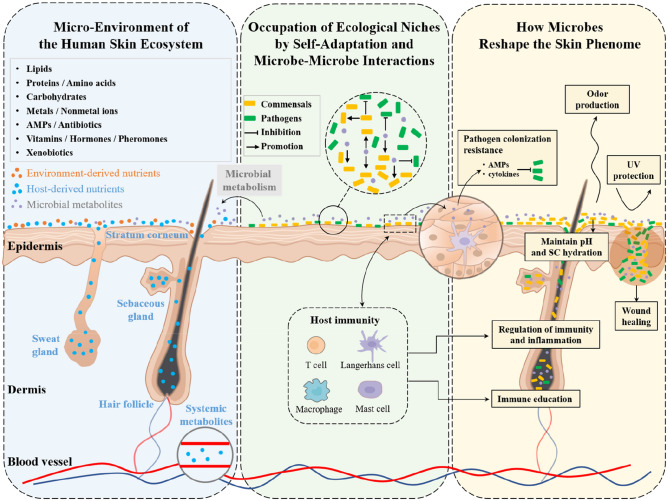
Skin is a complex ecosystem colonized by millions of microorganisms, including bacteria, fungi, and viruses. Skin microbiota is believed to exert critical functions in maintaining host skin health. Profiling the structure of skin microbial community is the first step to overview the ecosystem. However, the community composition is highly individualized and extremely complex. To explore the fundamental factors driving the complexity of the ecosystem, namely the selection pressures, we review the present studies on skin microbiome from the perspectives of ecology. This review summarizes the following: (1) the composition of substances/nutrients in the cutaneous ecological environment that are derived from the host and the environment, highlighting their proposed function on skin microbiota; (2) the features of dominant skin commensals to occupy ecological niches, through self-adaptation and microbe–microbe interactions; (3) how skin microbes, by their structures or bioactive molecules, reshape host skin phenotypes, including skin immunity, maintenance of skin physiology such as pH and hydration, ultraviolet (UV) protection, odor production, and wound healing. This review aims to re-examine the host–microbe interactions from the ecological perspectives and hopefully to give new inspiration to this field.
Overview
The claims and statistics of this paper haven’t been checked yet.
Run the check — free, no account needed. It reads the open-access text and checks the sources it cites.
Integrity signals
Registry
Cites
Statistics
Figures
Verification
Claims the paper makes
The claims and statistics of this paper haven’t been checked yet.
Run the check — free, no account needed. It reads the open-access text and checks the sources it cites.
Claims other papers make about this one
Each is checked against this paper’s own text: does it say what the citing paper says it does?
The source backs part of the claim, not all of it — or backs it for a different population, condition or comparison.
In the citing paper
“The skin is a distinct organ with unique physiological structures and an immune microenvironment, all of which play a crucial role in the design and effectiveness of exosome-based delivery systems [269].”
From Emerging role of exosomes in cancer therapy: progress and challenges (2025) · cites this paper as [269]
Experimental — accuracy not yet measured
Self-check
Percentages, sums and reported differences re-computed from the paper’s own numbers.
The self-check needs the paper’s full text.
Citations
Cites
Byrd, A. L., Belkaid, Y., & Segre, J. A. (2018) · Nature Reviews Microbiology · doi:10.1038/nrmicro.2017.157 · Cited by 2,806
Swanson, K. S., Gibson, G. R., Hutkins, R., Reimer, R. A., Reid, G., Verbeke, K., Scott, K. P., Holscher, H. D., Azad, M. B., Delzenne, N. M., et al. (2020) · Nature Reviews Gastroenterology & Hepatology · doi:10.1038/s41575-020-0344-2 · Cited by 2,196
Topographic diversity of fungal and bacterial communities in human skin
NIH Intramural Sequencing Center Comparative Sequencing Program, Findley, K., Oh, J., Yang, J., Conlan, S., Deming, C., Meyer, J. A., Schoenfeld, D., Nomicos, E., Park, M., et al. (2013) · Nature · doi:10.1038/nature12171 · Cited by 1,206
Innate antimicrobial peptide protects the skin from invasive bacterial infection
Nizet, V., Ohtake, T., Lauth, X., Trowbridge, J., Rudisill, J., Dorschner, R. A., Pestonjamasp, V., Piraino, J., Huttner, K., & Gallo, R. L. (2001) · Nature · doi:10.1038/35106587 · Cited by 1,198
Biogeography and individuality shape function in the human skin metagenome
Program, N. C. S., Oh, J., Byrd, A. L., Deming, C., Conlan, S., Kong, H. H., & Segre, J. A. (2014) · Nature · doi:10.1038/nature13786 · Cited by 1,148
Selection of evolutionarily conserved mucosal-associated invariant T cells by MR1
Treiner, E., Duban, L., Bahram, S., Radosavljevic, M., Wanner, V., Tilloy, F., Affaticati, P., Gilfillan, S., & Lantz, O. (2003) · Nature · doi:10.1038/nature01433 · Cited by 1,139
Nakatsuji, T., Chen, T. H., Narala, S., Chun, K. A., Two, A. M., Yun, T., Shafiq, F., Kotol, P. F., Bouslimani, A., Melnik, A. V., et al. (2017) · Science Translational Medicine · doi:10.1126/scitranslmed.aah4680 · Cited by 1,095
Human commensals producing a novel antibiotic impair pathogen colonization
Zipperer, A., Konnerth, M. C., Laux, C., Berscheid, A., Janek, D., Weidenmaier, C., Burian, M., Schilling, N. A., Slavetinsky, C., Marschal, M., et al. (2016) · Nature · doi:10.1038/nature18634 · Cited by 938
Postler, T. S., & Ghosh, S. (2017) · Cell Metabolism · doi:10.1016/j.cmet.2017.05.008 · Cited by 876 · cited 1×
“The environmental and nutrient conditions define the unique microhabitats for skin microbes (Flowers and Grice 2020), and in turn, these microbes can influence their survival environment (host skin) by stabilizing, mutually beneficial host–microbe interactions (Postler and Ghosh 2017).”
BackgroundCommensal–dendritic-cell interaction specifies a unique protective skin immune signature
Naik, S., Bouladoux, N., Linehan, J. L., Han, S.-J., Harrison, O. J., Wilhelm, C., Conlan, S., Himmelfarb, S., Byrd, A. L., Deming, C., et al. (2015) · Nature · doi:10.1038/nature14052 · Cited by 820
Research works printed but not linked: 250
- Abhishek S, Palamadai Krishnan S (2016) Epidermal differentiation complex: a review on its epigenetic regulation and potential drug targets. Cell J 18:1–6. https://doi.org/10.22074/cellj.2016.3980 · DOI
- Agrawal K, Waller JD, Pedersen TL et al (2018) Effects of stimulation technique, anatomical region, and time on human sweat lipid mediator profiles. Prostaglandins Other Lipid Mediat 134:84–92. https://doi.org/10.1016/j.prostaglandins.2017.09.007 · DOI · Paper page
- Al-Fatimi M, Wurster M, Lindequist U (2016) Chemical composition, antimicrobial and antioxidant activities of the volatile oil of Ganoderma pfeifferi Bres. Medicines. https://doi.org/10.3390/medicines3020010 · DOI
- Ali N, Zirak B, Rodriguez RS et al (2017) Regulatory T cells in skin facilitate epithelial stem cell differentiation. Cell 169:1119–29.e11. https://doi.org/10.1016/j.cell.2017.05.002 · DOI · Paper page
- Allhorn M, Arve S, Brüggemann H et al (2016) A novel enzyme with antioxidant capacity produced by the ubiquitous skin colonizer Propionibacterium acnes. Sci Rep 6:36412. https://doi.org/10.1038/srep36412 · DOI · Paper page
- Angiolella L, Rojas F, Mussin J et al (2020) Biofilm formation, adherence, and hydrophobicity of M. sympodialis, M. globosa, and M. slooffiae from clinical isolates and normal skin virulence factors of M. sympodialis, M. globosa and M. slooffiae. Med Mycol 58:1162–1168. https://doi.org/10.1093/mmy/myaa017 · DOI
- Ansari MN, Nicolaides N, Fu HC (1970) Fatty acid composition of the living layer and stratum corneum lipids of human sole skin epidermis. Lipids 5:838–845. https://doi.org/10.1007/bf02531977 · DOI
- Arezki NR, Williams AC, Cobb AJ et al (2017) Design, synthesis and characterization of linear unnatural amino acids for skin moisturization. Int J Cosmet Sci 39:72–82. https://doi.org/10.1111/ics.12351 · DOI
- Autiero M, Abrescia P, Guardiola J (1991) Interaction of seminal plasma proteins with cell surface antigens: presence of a CD4-binding glycoprotein in human seminal plasma. Exp Cell Res 197:268–271. https://doi.org/10.1016/0014-4827(91)90432-t · DOI
- Badiu DL, Luque R, Dumitrescu E et al (2010) Amino acids from Mytilus galloprovincialis (L.) and Rapana venosa molluscs accelerate skin wounds healing via enhancement of dermal and epidermal neoformation. Protein J 29:81–92. https://doi.org/10.1007/s10930-009-9225-9 · DOI
- Baechle D, Flad T, Cansier A et al (2006) Cathepsin D is present in human eccrine sweat and involved in the postsecretory processing of the antimicrobial peptide DCD-1L. J Biol Chem 281:5406–5415. https://doi.org/10.1074/jbc.M504670200 · DOI
- Bajo-Grañeras R, Sanchez D, Gutierrez G et al (2011) Apolipoprotein D alters the early transcriptional response to oxidative stress in the adult cerebellum. J Neurochem 117:949–960. https://doi.org/10.1111/j.1471-4159.2011.07266.x · DOI
- Baker LB (2019) Physiology of sweat gland function: the roles of sweating and sweat composition in human health. Temperature 6:211–259. https://doi.org/10.1080/23328940.2019.1632145 · DOI · Paper page
- Barresi C, Stremnitzer C, Mlitz V et al (2011) Increased sensitivity of histidinemic mice to UVB radiation suggests a crucial role of endogenous urocanic acid in photoprotection. J Investig Dermatol 131:188–194. https://doi.org/10.1038/jid.2010.231 · DOI
- Bastos MC, Ceotto H, Coelho ML et al (2009) Staphylococcal antimicrobial peptides: relevant properties and potential biotechnological applications. Curr Pharm Biotechnol 10:38–61. https://doi.org/10.2174/138920109787048580 · DOI
- Baumann P, Doudoroff M, Stanier RY (1968) Study of the Moraxella group. I. Genus Moraxella and the Neisseria catarrhalis group. J Bacteriol 95:58–73. https://doi.org/10.1128/jb.95.1.58-73.1968 · DOI
- Belinato JR, Silva E, De Souza DS et al (2019) Rapid discrimination of fungal strains isolated from human skin based on microbial volatile organic profiles. J Chromatogr B Anal Technol Biomed Life Sci 1110–1111:9–14. https://doi.org/10.1016/j.jchromb.2019.02.007 · DOI
- Belkaid Y, Segre JA (2014) Dialogue between skin microbiota and immunity. Science 346:954–959. https://doi.org/10.1126/science.1260144 · DOI · Paper page
- Belkaid Y, Tamoutounour S (2016) The influence of skin microorganisms on cutaneous immunity. Nat Rev Immunol 16:353–366. https://doi.org/10.1038/nri.2016.48 · DOI
- Bengoa AA, Iraporda C, Garrote GL et al (2019) Kefir micro-organisms: their role in grain assembly and health properties of fermented milk. J Appl Microbiol 126:686–700. https://doi.org/10.1111/jam.14107 · DOI · Paper page
- Bhattacharyya AK, Connor WE, Spector AA (1972) Excretion of sterols from the skin of normal and hypercholesterolemic humans. implications for sterol balance studies. J Clin Investig 51:2060–2070. https://doi.org/10.1172/jci107012 · DOI
- Bocheva G, Slominski RM, Slominski AT (2021) The impact of vitamin D on skin aging. Int J Mol Sci. https://doi.org/10.3390/ijms22169097 · DOI
- Bomar L, Brugger SD, Yost BH et al (2016) Corynebacterium accolens releases antipneumococcal free fatty acids from human nostril and skin surface triacylglycerols. Mbio 7:e01725-15. https://doi.org/10.1128/mBio.01725-15 · DOI · Paper page
- Bosch TC, Mcfall-Ngai MJ (2011) Metaorganisms as the new frontier. Zoology 114:185–190. https://doi.org/10.1016/j.zool.2011.04.001 · DOI
- Bouslimani A, Porto C, Rath CM et al (2015) Molecular cartography of the human skin surface in 3D. Proc Natl Acad Sci USA 112:E2120–E2129. https://doi.org/10.1073/pnas.1424409112 · DOI
- Bouslimani A, Da Silva R, Kosciolek T et al (2019) The impact of skin care products on skin chemistry and microbiome dynamics. BMC Biol 17:47. https://doi.org/10.1186/s12915-019-0660-6 · DOI · Paper page
- Boxberger M, Cenizo V, Cassir N et al (2021) Challenges in exploring and manipulating the human skin microbiome. Microbiome 9:125. https://doi.org/10.1186/s40168-021-01062-5 · DOI · Paper page
- Braff MH, Zaiou M, Fierer J et al (2005) Keratinocyte production of cathelicidin provides direct activity against bacterial skin pathogens. Infect Immun 73:6771–6781. https://doi.org/10.1128/iai.73.10.6771-6781.2005 · DOI
- Braun-Falco O, Korting HC (1986) Normal pH value of human skin. Hautarzt 37:126–129
- Brouwer R (1960) The attraction of carbon dioxide excreted by the skin of the arm for malaria mosquitoes. Trop Geogr Med 12:62–66
- Brown SK, Shalita AR (1998) Acne vulgaris. Lancet 351:1871–1876. https://doi.org/10.1016/s0140-6736(98)01046-0 · DOI
- Brown SP, Cornforth DM, Mideo N (2012) Evolution of virulence in opportunistic pathogens: generalism, plasticity, and control. Trends Microbiol 20:336–342. https://doi.org/10.1016/j.tim.2012.04.005 · DOI
- Brüggemann H (2005) Insights in the pathogenic potential of Propionibacterium acnes from its complete genome. Semin Cutan Med Surg 24:67–72. https://doi.org/10.1016/j.sder.2005.03.001 · DOI
- Brüggemann H, Henne A, Hoster F et al (2004) The complete genome sequence of Propionibacterium acnes, a commensal of human skin. Science 305:671–673. https://doi.org/10.1126/science.1100330 · DOI
- Burke RC, Lee TH, Buettner-Janusch V (1966) Free amino acids and water soluble peptides in stratum corneum and skin surface film in human beings. Yale J Biol Med 38:355–373
- Burkhart CG, Burkhart CN, Lehmann PF (1999) Acne: a review of immunologic and microbiologic factors. Postgrad Med J 75:328–331. https://doi.org/10.1136/pgmj.75.884.328 · DOI
- Burkovski A (2018) The role of corynomycolic acids in Corynebacterium-host interaction. Antonie Van Leeuwenhoek 111:717–725. https://doi.org/10.1007/s10482-018-1036-6 · DOI
- Caspers PJ, Lucassen GW, Carter EA et al (2001) In vivo confocal Raman microspectroscopy of the skin: noninvasive determination of molecular concentration profiles. J Investig Dermatol 116:434–442. https://doi.org/10.1046/j.1523-1747.2001.01258.x · DOI
- Celis Ramírez AM, Amézquita A, Cardona Jaramillo JEC et al (2020) Analysis of malassezia lipidome disclosed differences among the species and reveals presence of unusual yeast lipids. Front Cell Infect Microbiol 10:338. https://doi.org/10.3389/fcimb.2020.00338 · DOI
- Chakravortty D, Koide N, Kato Y et al (2000) The inhibitory action of butyrate on lipopolysaccharide-induced nitric oxide production in RAW 264.7 murine macrophage cells. J Endotoxin Res 6:243–247. https://doi.org/10.1177/09680519000060030501 · DOI
- Chamberlain NR, Brueggemann SA (1997) Characterisation and expression of fatty acid modifying enzyme produced by Staphylococcus epidermidis. J Med Microbiol 46:693–697. https://doi.org/10.1099/00222615-46-8-693 · DOI
- Chen X (2018) Current and future technological advances in transdermal gene delivery. Adv Drug Deliv Rev 127:85–105. https://doi.org/10.1016/j.addr.2017.12.014 · DOI
- Chen YE, Fischbach MA, Belkaid Y (2018) Skin microbiota–host interactions. Nature 553:427–436. https://doi.org/10.1038/nature25177 · DOI
- Chen D, He J, Li J et al (2021) Microbiome and metabolome analyses reveal novel interplay between the skin microbiota and plasma metabolites in psoriasis. Front Microbiol 12:643449. https://doi.org/10.3389/fmicb.2021.643449 · DOI
- Choi H, Kim DJ, Nam S et al (2018) Substance P restores normal skin architecture and reduces epidermal infiltration of sensory nerve fiber in TNCB-induced atopic dermatitis-like lesions in NC/Nga mice. J Dermatol Sci 89:248–257. https://doi.org/10.1016/j.jdermsci.2017.11.013 · DOI
- Christensen GJM, Brüggemann H (2014) Bacterial skin commensals and their role as host guardians. Benef Microbes 5:201–215. https://doi.org/10.3920/bm2012.0062 · DOI
- Claesen J, Spagnolo JB, Ramos SF et al (2020) A Cutibacterium acnes antibiotic modulates human skin microbiota composition in hair follicles. Sci Transl Med. https://doi.org/10.1126/scitranslmed.aay5445 · DOI
- Clayton RW, Göbel K, Niessen CM et al (2019) Homeostasis of the sebaceous gland and mechanisms of acne pathogenesis. Br J Dermatol 181:677–690. https://doi.org/10.1111/bjd.17981 · DOI
- Cohn JR, Emmett EA (1978) The excretion of trace metals in human sweat. Ann Clin Lab Sci 8:270–275
- Consolazio CF, Matoush LO, Nelson RA et al (1966) Comparisons of nitrogen, calcium and iodine excretion in arm and total body sweat. Am J Clin Nutr 18:443–448. https://doi.org/10.1093/ajcn/18.6.443 · DOI
- Constante M, Fragoso G, Lupien-Meilleur J et al (2017) Iron supplements modulate colon microbiota composition and potentiate the protective effects of probiotics in dextran sodium sulfate-induced colitis. Inflamm Bowel Dis 23:753–766. https://doi.org/10.1097/mib.0000000000001089 · DOI
- Conwill A, Kuan AC, Damerla R et al (2022) Anatomy promotes neutral coexistence of strains in the human skin microbiome. Cell Host Microbe 30:171–82.e7. https://doi.org/10.1016/j.chom.2021.12.007 · DOI
- Cornbleet T, Klein R, Pace E (1936) Vitamin C content of sweat. Arch Derm Syphilol 34:253–254 · DOI
- Cotterill JA, Cunliffe WJ, Williamson B et al (1972) Age and sex variation in skin surface lipid composition and sebum excretion rate. Br J Dermatol 87:333–340. https://doi.org/10.1111/j.1365-2133.1972.tb07419.x · DOI
- Craig SS, Craig SA, Ganio MS et al (2010) The betaine content of sweat from adolescent females. J Int Soc Sports Nutr 7:3. https://doi.org/10.1186/1550-2783-7-3 · DOI
- Csősz É, Emri G, Kalló G et al (2015) Highly abundant defense proteins in human sweat as revealed by targeted proteomics and label-free quantification mass spectrometry. J Eur Acad Dermatol Venereol 29:2024–2031. https://doi.org/10.1111/jdv.13221 · DOI
- Cui L, Jia Y, Cheng ZW et al (2016) Advancements in the maintenance of skin barrier/skin lipid composition and the involvement of metabolic enzymes. J Cosmet Dermatol 15:549–558. https://doi.org/10.1111/jocd.12245 · DOI
- Dai X, Okazaki H, Hanakawa Y et al (2013) Eccrine sweat contains IL-1alpha, IL-1beta and IL-31 and activates epidermal keratinocytes as a danger signal. PLoS ONE 8:e67666. https://doi.org/10.1371/journal.pone.0067666 · DOI · Paper page
- Dam B (1978) Vitamins and sport. Br J Sports Med 12:74–79 · DOI
- De Breij A, Haisma EM, Rietveld M et al (2012) Three-dimensional human skin equivalent as a tool to study Acinetobacter baumannii colonization. Antimicrob Agents Chemother 56:2459–2464. https://doi.org/10.1128/aac.05975-11 · DOI
- Deangelis YM, Gemmer CM, Kaczvinsky JR et al (2005) Three etiologic facets of dandruff and seborrheic dermatitis: Malassezia fungi, sebaceous lipids, and individual sensitivity. J Investig Dermatol Symp Proc 10:295–297. https://doi.org/10.1111/j.1087-0024.2005.10119.x · DOI · Paper page
- Decréau RA, Marson CM, Smith KE et al (2003) Production of malodorous steroids from androsta-5,16-dienes and androsta-4,16-dienes by Corynebacteria and other human axillary bacteria. J Steroid Biochem Mol Biol 87:327–336. https://doi.org/10.1016/j.jsbmb.2003.09.005 · DOI
- Den Reijer PM, Haisma EM, Lemmens-Den Toom NA et al (2016) Detection of alpha-toxin and other virulence factors in biofilms of Staphylococcus aureus on polystyrene and a human epidermal model. PLoS ONE 11:e0145722. https://doi.org/10.1371/journal.pone.0145722 · DOI
- Diep BA, Gill SR, Chang RF et al (2006) Complete genome sequence of USA300, an epidemic clone of community-acquired meticillin-resistant Staphylococcus aureus. Lancet 367:731–739. https://doi.org/10.1016/s0140-6736(06)68231-7 · DOI · Paper page
- Du B, Bian Z, Xu B (2014) Skin health promotion effects of natural beta-glucan derived from cereals and microorganisms: a review. Phytother Res 28:159–166. https://doi.org/10.1002/ptr.4963 · DOI
- Elpa DP, Chiu HY, Wu SP et al (2021) Skin metabolomics. Trends Endocrinol Metab 32:66–75. https://doi.org/10.1016/j.tem.2020.11.009 · DOI
- Elston CA, Elston DM (2014) Demodex mites. Clin Dermatol 32:739–743. https://doi.org/10.1016/j.clindermatol.2014.02.012 · DOI
- Ezenwa VO, Gerardo NM, Inouye DW et al (2012) Microbiology. Anim Behav Microbiome Sci 338:198–199. https://doi.org/10.1126/science.1227412 · DOI
- Farage MA, Miller KW, Elsner P et al (2008) Functional and physiological characteristics of the aging skin. Aging Clin Exp Res 20:195–200. https://doi.org/10.1007/bf03324769 · DOI
- Feingold KR (2009) The outer frontier: the importance of lipid metabolism in the skin. J Lipid Res 50(Suppl):S417–S422. https://doi.org/10.1194/jlr.R800039-JLR200 · DOI
- Ferrer M, Méndez-García C, Rojo D et al (2017) Antibiotic use and microbiome function. Biochem Pharmacol 134:114–126. https://doi.org/10.1016/j.bcp.2016.09.007 · DOI
- Fischer CL, Drake DR, Dawson DV et al (2012) Antibacterial activity of sphingoid bases and fatty acids against gram-positive and gram-negative bacteria. Antimicrob Agents Chemother 56:1157–1161. https://doi.org/10.1128/aac.05151-11 · DOI
- Flowers L, Grice EA (2020) The skin microbiota: balancing risk and reward. Cell Host Microbe 28:190–200. https://doi.org/10.1016/j.chom.2020.06.017 · DOI
- Fluhr JW, Darlenski R, Surber C (2008) Glycerol and the skin: holistic approach to its origin and functions. Br J Dermatol 159:23–34. https://doi.org/10.1111/j.1365-2133.2008.08643.x · DOI
- Gallo RL, Hooper LV (2012) Epithelial antimicrobial defence of the skin and intestine. Nat Rev Immunol 12:503–516. https://doi.org/10.1038/nri3228 · DOI
- Gannesen AV, Borrel V, Lefeuvre L et al (2019) Effect of two cosmetic compounds on the growth, biofilm formation activity, and surface properties of acneic strains of Cutibacterium acnes and Staphylococcus aureus. Microbiologyopen 8:e00659. https://doi.org/10.1002/mbo3.659 · DOI
- Gariboldi S, Palazzo M, Zanobbio L et al (2008) Low molecular weight hyaluronic acid increases the self-defense of skin epithelium by induction of beta-defensin 2 via TLR2 and TLR4. J Immunol 181:2103–2110. https://doi.org/10.4049/jimmunol.181.3.2103 · DOI
- Garrote GL, Abraham AG, De Antoni GL (2000) Inhibitory power of kefir: the role of organic acids. J Food Prot 63:364–369. https://doi.org/10.4315/0362-028x-63.3.364 · DOI
- Gehring W (2004) Nicotinic acid/niacinamide and the skin. J Cosmet Dermatol 3:88–93. https://doi.org/10.1111/j.1473-2130.2004.00115.x · DOI
- Ginsburg I (2002) Role of lipoteichoic acid in infection and inflammation. Lancet Infect Dis 2:171–179. https://doi.org/10.1016/s1473-3099(02)00226-8 · DOI
- Greene RS, Downing DT, Pochi PE et al (1970) Anatomical variation in the amount and composition of human skin surface lipid. J Investig Dermatol 54:240–247. https://doi.org/10.1111/1523-1747.ep12280318 · DOI · Paper page
- Gribbon EM, Cunliffe WJ, Holland KT (1993) Interaction of Propionibacterium acnes with skin lipids in vitro. J Gen Microbiol 139:1745–1751. https://doi.org/10.1099/00221287-139-8-1745 · DOI
- Grice EA, Dawson TLJ (2017) Host–microbe interactions: Malassezia and human skin. Curr Opin Microbiol 40:81–87. https://doi.org/10.1016/j.mib.2017.10.024 · DOI
- Grice EA, Segre JA (2011) The skin microbiome. Nat Rev Microbiol 9:244–253. https://doi.org/10.1038/nrmicro2537 · DOI · Paper page
- Grice EA, Kong HH, Conlan S et al (2009) Topographical and temporal diversity of the human skin microbiome. Science 324:1190–1192. https://doi.org/10.1126/science.1171700 · DOI · Paper page
- Gum ET, Swanson RA, Alano C et al (2004) Human serum albumin and its N-terminal tetrapeptide (DAHK) block oxidant-induced neuronal death. Stroke 35:590–595. https://doi.org/10.1161/01.Str.0000110790.05859.Da · DOI
- Hall JB, Cong Z, Imamura-Kawasawa Y et al (2018) Isolation and identification of the follicular microbiome: implications for acne research. J Investig Dermatol 138:2033–2040. https://doi.org/10.1016/j.jid.2018.02.038 · DOI
- Han G, Ceilley R (2017) Chronic wound healing: a review of current management and treatments. Adv Ther 34:599–610. https://doi.org/10.1007/s12325-017-0478-y · DOI
- Han Y, Zhang YJ, Wang HX et al (2019) Malassezia furfur promoting growth of Staphylococcus epidermidis by increasing pH when cultured in a lipid-free environment. Chin Med J 132:873–876. https://doi.org/10.1097/cm9.0000000000000152 · DOI
- Hardy BL, Dickey SW, Plaut RD et al (2019) Corynebacterium pseudodiphtheriticum exploits Staphylococcus aureus virulence components in a novel polymicrobial defense strategy. Mbio. https://doi.org/10.1128/mBio.02491-18 · DOI
- Harris-Tryon TA, Grice EA (2022) Microbiota and maintenance of skin barrier function. Science 376:940–945. https://doi.org/10.1126/science.abo0693 · DOI
- Hassan MI, Waheed A, Yadav S et al (2009) Prolactin inducible protein in cancer, fertility and immunoregulation: structure, function and its clinical implications. Cell Mol Life Sci 66:447–459. https://doi.org/10.1007/s00018-008-8463-x · DOI
- Hentati D, Cheffi M, Hadrich F et al (2021) Investigation of halotolerant marine Staphylococcus sp. CO100, as a promising hydrocarbon-degrading and biosurfactant-producing bacterium, under saline conditions. J Environ Manag 277:111480. https://doi.org/10.1016/j.jenvman.2020.111480 · DOI
- Hoiby N, Pers C, Johansen HK et al (2000) Excretion of beta-lactam antibiotics in sweat—a neglected mechanism for development of antibiotic resistance? Antimicrob Agents Chemother 44:2855–2857. https://doi.org/10.1128/aac.44.10.2855-2857.2000 · DOI
- Holland KT, Greenman J, Cunliffe WJ (1979) Growth of cutaneous propionibacteria on synthetic medium; growth yields and exoenzyme production. J Appl Bacteriol 47:383–394. https://doi.org/10.1111/j.1365-2672.1979.tb01198.x · DOI
- Holland KT, Aldana O, Bojar RA et al (1998) Propionibacterium acnes and acne. Dermatology 196:67–68. https://doi.org/10.1159/000017870 · DOI
- Holland C, Mak TN, Zimny-Arndt U et al (2010) Proteomic identification of secreted proteins of Propionibacterium acnes. BMC Microbiol 10:230. https://doi.org/10.1186/1471-2180-10-230 · DOI
- Houpt ER (2005) Microbial inhabitants of humans: their ecology and role in health and disease by Michael Wilson Cambridge, U.K.: Cambridge University Press, 2005. 476 pp., illustrated. $65.00 (cloth). Clin Infect Dis 41:768–868. https://doi.org/10.1086/432586 · DOI
- Howard B, Bascom CC, Hu P et al (2022) Aging-associated changes in the adult human skin microbiome and the host factors that affect skin microbiome composition. J Investig Dermatol 142:1934–46.e21. https://doi.org/10.1016/j.jid.2021.11.029 · DOI
- Hug DH, Dunkerson DD, Hunter JK (1999) The degradation of l-histidine and trans- and cis-urocanic acid by bacteria from skin and the role of bacterial cis-urocanic acid isomerase. J Photochem Photobiol B 50:66–73. https://doi.org/10.1016/s1011-1344(99)00072-x · DOI
- Human Microbiome Project Consortium (2012) Structure, function and diversity of the healthy human microbiome. Nature 486:207–214. https://doi.org/10.1038/nature11234 · DOI · Paper page
- Ianiri G, Heitman J, Scheynius A (2018) The skin commensal yeast Malassezia globosa thwarts bacterial biofilms to benefit the host. J Investig Dermatol 138:1026–1029. https://doi.org/10.1016/j.jid.2018.01.008 · DOI
- Ianiri G, Coelho MA, Ruchti F et al (2020) HGT in the human and skin commensal Malassezia: a bacterially derived flavohemoglobin is required for NO resistance and host interaction. Proc Natl Acad Sci USA 117:15884–15894. https://doi.org/10.1073/pnas.2003473117 · DOI
- Imayama S, Shimozono Y, Hoashi M et al (1994) Reduced secretion of IgA to skin surface of patients with atopic dermatitis. J Allergy Clin Immunol 94:195–200. https://doi.org/10.1016/0091-6749(94)90040-x · DOI
- Iwase T, Uehara Y, Shinji H et al (2010) Staphylococcus epidermidis Esp inhibits Staphylococcus aureus biofilm formation and nasal colonization. Nature 465:346–349. https://doi.org/10.1038/nature09074 · DOI · Paper page
- Jacob S, Mcclintock MK (2000) Psychological state and mood effects of steroidal chemosignals in women and men. Horm Behav 37:57–78. https://doi.org/10.1006/hbeh.1999.1559 · DOI · Paper page
- Janek D, Zipperer A, Kulik A et al (2016) High frequency and diversity of antimicrobial activities produced by nasal staphylococcus strains against bacterial competitors. PLoS Pathog 12:e1005812. https://doi.org/10.1371/journal.ppat.1005812 · DOI
- Jeong S, Ledee DR, Gordon GM et al (2012) Interaction of clusterin and matrix metalloproteinase-9 and its implication for epithelial homeostasis and inflammation. Am J Pathol 180:2028–2039. https://doi.org/10.1016/j.ajpath.2012.01.025 · DOI
- Johansson HJ, Vallhov H, Holm T et al (2018) Extracellular nanovesicles released from the commensal yeast Malassezia sympodialis are enriched in allergens and interact with cells in human skin. Sci Rep 8:9182. https://doi.org/10.1038/s41598-018-27451-9 · DOI
- Johnson TR, Gómez BI, Mcintyre MK et al (2018) The cutaneous microbiome and wounds: new molecular targets to promote wound healing. Int J Mol Sci. https://doi.org/10.3390/ijms19092699 · DOI
- Jokura Y, Ishikawa S, Tokuda H et al (1995) Molecular analysis of elastic properties of the stratum corneum by solid-state 13C-nuclear magnetic resonance spectroscopy. J Investig Dermatol 104:806–812. https://doi.org/10.1111/1523-1747.ep12607005 · DOI
- Juni E (1974) Simple genetic transformation assay for rapid diagnosis of Moraxella osloensis. Appl Microbiol 27:16–24. https://doi.org/10.1128/am.27.1.16-24.1974 · DOI
- Kaneko T, Shiota R, Shibuya S et al (2010) Human external ear canal as the specific reservoir of Malassezia slooffiae. Med Mycol 48:824–827. https://doi.org/10.3109/13693780903514880 · DOI
- Kang BS, Seo JG, Lee GS et al (2009) Antimicrobial activity of enterocins from Enterococcus faecalis SL-5 against Propionibacterium acnes, the causative agent in acne vulgaris, and its therapeutic effect. J Microbiol 47:101–109. https://doi.org/10.1007/s12275-008-0179-y · DOI
- Kao MS, Huang S, Chang WL et al (2017) Microbiome precision editing: using PEG as a selective fermentation initiator against methicillin-resistant Staphylococcus aureus. Biotechnol J. https://doi.org/10.1002/biot.201600399 · DOI
- Kao HJ, Wang YH, Keshari S et al (2021) Propionic acid produced by Cutibacterium acnes fermentation ameliorates ultraviolet B-induced melanin synthesis. Sci Rep 11:11980. https://doi.org/10.1038/s41598-021-91386-x · DOI
- Keshari S, Balasubramaniam A, Myagmardoloonjin B et al (2019) Butyric acid from probiotic Staphylococcus epidermidis in the skin microbiome down-regulates the ultraviolet-induced pro-inflammatory IL-6 cytokine via short-chain fatty acid receptor. Int J Mol Sci. https://doi.org/10.3390/ijms20184477 · DOI
- Khmaladze I, Leonardi M, Fabre S et al (2020) The skin interactome: a holistic, “genome-microbiome-exposome” approach to understand and modulate skin health and aging. Clin Cosmet Investig Dermatol 13:1021–1040. https://doi.org/10.2147/ccid.S239367 · DOI
- Kim SK, Karadeniz F (2012) Biological importance and applications of squalene and squalane. Adv Food Nutr Res 65:223–233. https://doi.org/10.1016/b978-0-12-416003-3.00014-7 · DOI
- Kim H, Lim YJ, Park JH et al (2012) Dietary silk protein, sericin, improves epidermal hydration with increased levels of filaggrins and free amino acids in NC/Nga mice. Br J Nutr 108:1726–1735. https://doi.org/10.1017/s0007114511007306 · DOI
- Kim JH, Son SM, Park H et al (2021a) Taxonomic profiling of skin microbiome and correlation with clinical skin parameters in healthy Koreans. Sci Rep 11:16269. https://doi.org/10.1038/s41598-021-95734-9 · DOI
- Kim SH, Yum HW, Kim SH et al (2021b) Topically applied taurine chloramine protects against UVB-induced oxidative stress and inflammation in mouse skin. Antioxidants. https://doi.org/10.3390/antiox10060867 · DOI
- Kirker KR, Secor PR, James GA et al (2009) Loss of viability and induction of apoptosis in human keratinocytes exposed to Staphylococcus aureus biofilms in vitro. Wound Repair Regen 17:690–699. https://doi.org/10.1111/j.1524-475X.2009.00523.x · DOI
- Kirker KR, James GA, Fleckman P et al (2012) Differential effects of planktonic and biofilm MRSA on human fibroblasts. Wound Repair Regen 20:253–261. https://doi.org/10.1111/j.1524-475X.2012.00769.x · DOI
- Kluytmans J, Van Belkum A, Verbrugh H (1997) Nasal carriage of Staphylococcus aureus: epidemiology, underlying mechanisms, and associated risks. Clin Microbiol Rev 10:505–520. https://doi.org/10.1128/cmr.10.3.505 · DOI · Paper page
- Krejner A, Bruhs A, Mrowietz U et al (2018) Decreased expression of G-protein-coupled receptors GPR43 and GPR109a in psoriatic skin can be restored by topical application of sodium butyrate. Arch Dermatol Res 310:751–758. https://doi.org/10.1007/s00403-018-1865-1 · DOI
- Krogsgård Nielsen C, Kjems J, Mygind T et al (2016) Effects of Tween 80 on growth and biofilm formation in laboratory media. Front Microbiol. https://doi.org/10.3389/fmicb.2016.01878 · DOI
- Kubota H, Mitani A, Niwano Y et al (2012) Moraxella species are primarily responsible for generating malodor in laundry. Appl Environ Microbiol 78:3317–3324. https://doi.org/10.1128/aem.07816-11 · DOI
- Kuehne A, Hildebrand J, Soehle J et al (2017) An integrative metabolomics and transcriptomics study to identify metabolic alterations in aged skin of humans in vivo. BMC Genomics 18:169. https://doi.org/10.1186/s12864-017-3547-3 · DOI
- Laihia JK, Kallio JP, Taimen P et al (2010) Protodynamic intracellular acidification by cis-urocanic acid promotes apoptosis of melanoma cells in vitro and in vivo. J Investig Dermatol 130:2431–2439. https://doi.org/10.1038/jid.2010.151 · DOI
- Lam TH, Verzotto D, Brahma P et al (2018) Understanding the microbial basis of body odor in pre-pubescent children and teenagers. Microbiome 6:213. https://doi.org/10.1186/s40168-018-0588-z · DOI
- Larson PJ, Chong D, Fleming E et al (2021) Challenges in developing a human model system for skin microbiome research. J Investig Dermatol 141:228-231.e4. https://doi.org/10.1016/j.jid.2020.05.096 · DOI · Paper page
- Lee HJ, Lee SH (2014) Epidermal permeability barrier defects and barrier repair therapy in atopic dermatitis. Allergy Asthma Immunol Res 6:276–287. https://doi.org/10.4168/aair.2014.6.4.276 · DOI
- Lee B, Bowden GH, Myal Y (2002) Identification of mouse submaxillary gland protein in mouse saliva and its binding to mouse oral bacteria. Arch Oral Biol 47:327–332. https://doi.org/10.1016/s0003-9969(01)00113-3 · DOI
- Lee DY, Huang CM, Nakatsuji T et al (2009) Histone H4 is a major component of the antimicrobial action of human sebocytes. J Investig Dermatol 129:2489–2496. https://doi.org/10.1038/jid.2009.106 · DOI
- Lee NY, Ibrahim O, Khetarpal S et al (2018) Dermal microflora restoration with ammonia-oxidizing bacteria Nitrosomonas eutropha in the treatment of keratosis pilaris: a randomized clinical trial. J Drugs Dermatol 17:285–288. https://doi.org/10.1001/jamadermatol.2014.2211 · DOI
- Lemoine L, Bayrambey D, Roloff A et al (2021) Commensal-related changes in the epidermal barrier function lead to alterations in the benzo[a]pyrene metabolite profile and its distribution in 3D skin. Mbio 12:e0122321. https://doi.org/10.1128/mBio.01223-21 · DOI
- Leung MHY, Tong X, Bastien P et al (2020) Changes of the human skin microbiota upon chronic exposure to polycyclic aromatic hydrocarbon pollutants. Microbiome 8:100. https://doi.org/10.1186/s40168-020-00874-1 · DOI
- Lew LC, Liong MT (2013) Bioactives from probiotics for dermal health: functions and benefits. J Appl Microbiol 114:1241–1253. https://doi.org/10.1111/jam.12137 · DOI · Paper page
- Lew L-C, Gan C-Y, Liong M-T (2013) Dermal bioactives from lactobacilli and bifidobacteria. Ann Microbiol 63:1047–1055. https://doi.org/10.1007/s13213-012-0561-1 · DOI
- Li H, Goh BN, Teh WK et al (2018a) Skin commensal Malassezia globosa secreted protease attenuates Staphylococcus aureus biofilm formation. J Investig Dermatol 138:1137–1145. https://doi.org/10.1016/j.jid.2017.11.034 · DOI
- Li H, Yao Q, Mariscal AG et al (2018b) Epigenetic control of IL-23 expression in keratinocytes is important for chronic skin inflammation. Nat Commun 9:1420. https://doi.org/10.1038/s41467-018-03704-z · DOI
- Li Z, Xia J, Jiang L et al (2021) Characterization of the human skin resistome and identification of two microbiota cutotypes. Microbiome 9:47. https://doi.org/10.1186/s40168-020-00995-7 · DOI
- Liu X, Zhang X, Zhang J et al (2020) Activation of aryl hydrocarbon receptor in Langerhans cells by a microbial metabolite of tryptophan negatively regulates skin inflammation. J Dermatol Sci 100:192–200. https://doi.org/10.1016/j.jdermsci.2020.10.004 · DOI
- Lo CW, Lai YK, Liu YT et al (2011) Staphylococcus aureus hijacks a skin commensal to intensify its virulence: immunization targeting β-hemolysin and CAMP factor. J Investig Dermatol 131:401–409. https://doi.org/10.1038/jid.2010.319 · DOI
- Loesche M, Gardner SE, Kalan L et al (2017) Temporal stability in chronic wound microbiota is associated with poor healing. J Investig Dermatol 137:237–244. https://doi.org/10.1016/j.jid.2016.08.009 · DOI
- Lousada MB, Lachnit T, Edelkamp J et al (2021) Exploring the human hair follicle microbiome. Br J Dermatol 184:802–815. https://doi.org/10.1111/bjd.19461 · DOI
- Lugg JW, Ellis FP (1954) Some water-soluble vitamins in the sweat of tropically acclimatized European men. Br J Nutr 8:71–77. https://doi.org/10.1079/bjn19540011 · DOI
- Machowinski A, Krämer HJ, Hort W et al (2006) Pityriacitrin—a potent UV filter produced by Malassezia furfur and its effect on human skin microflora. Mycoses 49:388–392. https://doi.org/10.1111/j.1439-0507.2006.01265.x · DOI
- Maclaughlin J, Holick MF (1985) Aging decreases the capacity of human skin to produce vitamin D3. J Clin Investig 76:1536–1538. https://doi.org/10.1172/jci112134 · DOI
- Mcginley KJ, Webster GF, Leyden JJ (1978) Regional variations of cutaneous propionibacteria. Appl Environ Microbiol 35:62–66. https://doi.org/10.1128/aem.35.1.62-66.1978 · DOI
- Mcgrath JA (2008) Filaggrin and the great epidermal barrier grief. Australas J Dermatol 49:67–73. https://doi.org/10.1111/j.1440-0960.2008.00443.x (quiz 73-4) · DOI
- Midorikawa K, Ouhara K, Komatsuzawa H et al (2003) Staphylococcus aureus susceptibility to innate antimicrobial peptides, beta-defensins and CAP18, expressed by human keratinocytes. Infect Immun 71:3730–3739. https://doi.org/10.1128/iai.71.7.3730-3739.2003 · DOI
- Minshall C, Nadal J, Exley C (2014) Aluminium in human sweat. J Trace Elem Med Biol 28:87–88. https://doi.org/10.1016/j.jtemb.2013.10.002 · DOI
- Miskin JE, Farrell AM, Cunliffe WJ et al (1997) Propionibacterium acnes, a resident of lipid-rich human skin, produces a 33 kDa extracellular lipase encoded by gehA. Microbiology 143(Pt 5):1745–1755. https://doi.org/10.1099/00221287-143-5-1745 · DOI
- Moss CW, Wallace PL, Hollis DG et al (1988) Cultural and chemical characterization of CDC groups EO-2, M-5, and M-6, Moraxella (Moraxella) species, Oligella urethralis, Acinetobacter species, and Psychrobacter immobilis. J Clin Microbiol 26:484–492. https://doi.org/10.1128/jcm.26.3.484-492.1988 · DOI
- Murakami M (2011) Lipid mediators in life science. Exp Anim 60:7–20. https://doi.org/10.1538/expanim.60.7 · DOI
- Murakami M, Ohtake T, Dorschner RA et al (2002) Cathelicidin anti-microbial peptide expression in sweat, an innate defense system for the skin. J Investig Dermatol 119:1090–1095. https://doi.org/10.1046/j.1523-1747.2002.19507.x · DOI
- Murphy B, Hoptroff M, Arnold D et al (2021) In-vivo impact of common cosmetic preservative systems in full formulation on the skin microbiome. PLoS ONE 16:e0254172. https://doi.org/10.1371/journal.pone.0254172 · DOI
- Myal Y, Robinson DB, Iwasiow B et al (1991) The prolactin-inducible protein (PIP/GCDFP-15) gene: cloning, structure and regulation. Mol Cell Endocrinol 80:165–175. https://doi.org/10.1016/0303-7207(91)90153-j · DOI
- N’diaye A, Gannesen A, Borrel V et al (2017) Substance P and calcitonin gene-related peptide: key regulators of cutaneous microbiota homeostasis. Front Endocrinol 8:15. https://doi.org/10.3389/fendo.2017.00015 · DOI
- Naik S, Bouladoux N, Wilhelm C et al (2012) Compartmentalized control of skin immunity by resident commensals. Science 337:1115–1119. https://doi.org/10.1126/science.1225152 · DOI · Paper page
- Nakatsuji T, Kao MC, Zhang L et al (2010) Sebum free fatty acids enhance the innate immune defense of human sebocytes by upregulating beta-defensin-2 expression. J Investig Dermatol 130:985–994. https://doi.org/10.1038/jid.2009.384 · DOI · Paper page
- Nakatsuji T, Chen TH, Butcher AM et al (2018) A commensal strain of Staphylococcus epidermidis protects against skin neoplasia. Sci Adv 4:eaao4502. https://doi.org/10.1126/sciadv.aao4502 · DOI
- Natsch A, Gfeller H, Gygax P et al (2003) A specific bacterial aminoacylase cleaves odorant precursors secreted in the human axilla. J Biol Chem 278:5718–5727. https://doi.org/10.1074/jbc.M210142200 · DOI
- Nichols J, Miller AT Jr (1948) Excretion of adrenal corticoids in the sweat. Proc Soc Exp Biol Med 69:448. https://doi.org/10.3181/00379727-69-16751 · DOI
- Nicolaides N (1974) Skin lipids: their biochemical uniqueness. Science 186:19–26. https://doi.org/10.1126/science.186.4158.19 · DOI · Paper page
- Nistor A, Bowden G, Blanchard A et al (2009) Influence of mouse prolactin-inducible protein in saliva on the aggregation of oral bacteria. Oral Microbiol Immunol 24:510–513. https://doi.org/10.1111/j.1399-302X.2009.00543.x · DOI
- Nithya S, Radhika T, Jeddy N (2015) Loricrin—an overview. J Oral Maxillofac Pathol 19:64–68. https://doi.org/10.4103/0973-029x.157204 · DOI
- Notay M, Saric-Bosanac S, Vaughn AR et al (2020) The use of topical Nitrosomonas eutropha for cosmetic improvement of facial wrinkles. J Cosmet Dermatol 19:689–693. https://doi.org/10.1111/jocd.13060 · DOI
- Nunome Y, Tsuda T, Kitagawa K (2010) Determination of fatty acids in human sweat during fasting using GC/MS. Anal Sci 26:917–919. https://doi.org/10.2116/analsci.26.917 · DOI
- O’neill AM, Nakatsuji T, Hayachi A et al (2020) Identification of a human skin commensal bacterium that selectively kills cutibacterium acnes. J Investig Dermatol 140:1619–28.e2. https://doi.org/10.1016/j.jid.2019.12.026 · DOI
- Ohsawa K, Watanabe T, Matsukawa R et al (1984) The possible role of squalene and its peroxide of the sebum in the occurrence of sunburn and protection from the damage caused by U.V. irradiation. J Toxicol Sci 9:151–159. https://doi.org/10.2131/jts.9.151 · DOI · Paper page
- Ong JS, Taylor TD, Yong CC et al (2020) Lactobacillus plantarum USM8613 aids in wound healing and suppresses Staphylococcus aureus infection at wound sites. Probiotics Antimicrob Proteins 12:125–137. https://doi.org/10.1007/s12602-018-9505-9 · DOI
- Ono E, Murota H, Mori Y et al (2018) Sweat glucose and GLUT2 expression in atopic dermatitis: Implication for clinical manifestation and treatment. PLoS ONE 13:e0195960. https://doi.org/10.1371/journal.pone.0195960 · DOI · Paper page
- Paharik AE, Parlet CP, Chung N et al (2017) Coagulase-negative staphylococcal strain prevents Staphylococcus aureus colonization and skin infection by blocking quorum sensing. Cell Host Microbe 22:746–56.e5. https://doi.org/10.1016/j.chom.2017.11.001 · DOI
- Pappas A (2009) Epidermal surface lipids. Dermatoendocrinol 1:72–76. https://doi.org/10.4161/derm.1.2.7811 · DOI · Paper page
- Park JS, Lee EJ, Lee JC et al (2007) Anti-inflammatory effects of short chain fatty acids in IFN-gamma-stimulated RAW 264.7 murine macrophage cells: involvement of NF-kappaB and ERK signaling pathways. Int Immunopharmacol 7:70–77. https://doi.org/10.1016/j.intimp.2006.08.015 · DOI · Paper page
- Park JH, Park GT, Cho IH et al (2011) An antimicrobial protein, lactoferrin exists in the sweat: proteomic analysis of sweat. Exp Dermatol 20:369–371. https://doi.org/10.1111/j.1600-0625.2010.01218.x · DOI
- Petry T, Bury D, Fautz R et al (2017) Review of data on the dermal penetration of mineral oils and waxes used in cosmetic applications. Toxicol Lett 280:70–78. https://doi.org/10.1016/j.toxlet.2017.07.899 · DOI
- Pinto D, Ciardiello T, Franzoni M et al (2021) Effect of commonly used cosmetic preservatives on skin resident microflora dynamics. Sci Rep 11:8695. https://doi.org/10.1038/s41598-021-88072-3 · DOI
- Pistone D, Meroni G, Panelli S et al (2021) A journey on the skin microbiome: pitfalls and opportunities. Int J Mol Sci. https://doi.org/10.3390/ijms22189846 · DOI
- Pochi PE, Strauss JS, Downing DT (1979) Age-related changes in sebaceous gland activity. J Investig Dermatol 73:108–111. https://doi.org/10.1111/1523-1747.ep12532792 · DOI
- Preti G, Wysocki CJ, Barnhart KT et al (2003) Male axillary extracts contain pheromones that affect pulsatile secretion of luteinizing hormone and mood in women recipients. Biol Reprod 68:2107–2113. https://doi.org/10.1095/biolreprod.102.008268 · DOI
- Reithmayer K, Meyer KC, Kleditzsch P et al (2009) Human hair follicle epithelium has an antimicrobial defence system that includes the inducible antimicrobial peptide psoriasin (S100A7) and RNase 7. Br J Dermatol 161:78–89. https://doi.org/10.1111/j.1365-2133.2009.09154.x · DOI
- Ridaura VK, Bouladoux N, Claesen J et al (2018) Contextual control of skin immunity and inflammation by Corynebacterium. J Exp Med 215:785–799. https://doi.org/10.1084/jem.20171079 · DOI
- Rosenberg E, Koren O, Reshef L et al (2007) The role of microorganisms in coral health, disease and evolution. Nat Rev Microbiol 5:355–362. https://doi.org/10.1038/nrmicro1635 · DOI
- Roth RR, James WD (1988) Microbial ecology of the skin. Annu Rev Microbiol 42:441–464. https://doi.org/10.1146/annurev.mi.42.100188.002301 · DOI
- Roux PF, Oddos T, Stamatas G (2022) Deciphering the role of skin surface microbiome in skin health: an integrative multiomics approach reveals three distinct metabolite-microbe clusters. J Investig Dermatol 142:469–479.e5. https://doi.org/10.1016/j.jid.2021.07.159 · DOI
- Sanchez Rodriguez R, Pauli ML, Neuhaus IM et al (2014) Memory regulatory T cells reside in human skin. J Clin Investig 124:1027–1036. https://doi.org/10.1172/jci72932 · DOI
- Sánchez-Suárez J, Coy-Barrera E, Villamil L et al (2020) Streptomyces-derived metabolites with potential photoprotective properties—a systematic literature review and meta-analysis on the reported chemodiversity. Molecules. https://doi.org/10.3390/molecules25143221 · DOI
- Sandby-Møller J, Poulsen T, Wulf HC (2003) Epidermal thickness at different body sites: relationship to age, gender, pigmentation, blood content, skin type and smoking habits. Acta Derm Venereol 83:410–413. https://doi.org/10.1080/00015550310015419 · DOI · Paper page
- Sanford JA, Zhang LJ, Williams MR et al (2016) Inhibition of HDAC8 and HDAC9 by microbial short-chain fatty acids breaks immune tolerance of the epidermis to TLR ligands. Sci Immunol. https://doi.org/10.1126/sciimmunol.aah4609 · DOI · Paper page
- Sanford JA, O’neill AM, Zouboulis CC et al (2019) Short-chain fatty acids from cutibacterium acnes activate both a canonical and epigenetic inflammatory response in human sebocytes. J Immunol 202:1767–1776. https://doi.org/10.4049/jimmunol.1800893 · DOI
- Sardana K, Garg VK (2010) An observational study of methionine-bound zinc with antioxidants for mild to moderate acne vulgaris. Dermatol Ther 23:411–418. https://doi.org/10.1111/j.1529-8019.2010.01342.x · DOI
- Sargent F, Robinson P, Johnson R (1944) Water-soluble vitamins in sweat. J Biol Chem 153:285–294 · DOI
- Sato K, Sato F (1990) Na+, K+, H+, Cl−, and Ca2+ concentrations in cystic fibrosis eccrine sweat in vivo and in vitro. J Lab Clin Med 115:504–511
- Sato K, Kang WH, Saga K et al (1989a) Biology of sweat glands and their disorders. I. Normal sweat gland function. J Am Acad Dermatol 20:537–563. https://doi.org/10.1016/s0190-9622(89)70063-3 · DOI · Paper page
- Sato K, Kang WH, Saga K et al (1989b) Biology of sweat glands and their disorders. II. Disorders of sweat gland function. J Am Acad Dermatol 20:713–726. https://doi.org/10.1016/s0190-9622(89)70081-5 · DOI
- Scharschmidt TC, Vasquez KS, Truong HA et al (2015) A wave of regulatory T cells into neonatal skin mediates tolerance to commensal microbes. Immunity 43:1011–1021. https://doi.org/10.1016/j.immuni.2015.10.016 · DOI · Paper page
200 of 250 shown
Cited by
Sorted by citations
Emerging role of exosomes in cancer therapy: progress and challenges
Li, J., Wang, J., & Chen, Z. (2025) · Molecular Cancer · doi:10.1186/s12943-024-02215-4 · Cited by 297
Self-citationThe human microbiome in clinical translation: from bench to bedside
Bautista, J., Echeverría, C. E., Maldonado-Noboa, I., Ojeda-Mosquera, S., Hidalgo-Tinoco, C., & López-Cortés, A. (2025) · Frontiers in Microbiology · doi:10.3389/fmicb.2025.1632435 · Cited by 55
Metadata
- Authors
- Chen, H., Zhao, Q., Zhong, Q., Duan, C., Krutmann, J., Wang, J., & Xia, J.
- Venue
- Phenomics
- Published
- 2022-10-10
- Volume
- 2
- Issue
- 6
- Pages
- 363-382
- ISSN
- 2730-583X
- 2730-5848
- PMC
- PMC9712873
- Cited by
- 79
- References
- 36
- Language
- en
- Funders
- Chinese Academy of Medical Sciences Initiative for Innovative Medicine (2019-I2M-5-066)
- Natural Science Foundation of Shanghai (2017SHZDZX01)
- the Greater Bay Area Institute of Precision Medicine
About these checks
Registry, retraction, Cites and statistics results are computed, not judged, with one exception: a printed reference that no index lists is read once by a model before it counts as a citation error. Claims are extracted by a model and kept only when their quote appears verbatim in the text; each cited source is then checked, with a model’s help, for whether it says what the claim relies on. Those verdicts can be wrong — read the claim’s quote and the cited source before relying on one.
Statistics and arithmetic are recomputed, not judged.
Confidence bands are shown only for fields calibrated on our annotated test set. None is calibrated yet, so no band is shown.
What counts as a claim ›How we measure confidence ›How we check this ›
Are you an author, or do you see a problem with this page? Request a review
