

Redefining student assessment in AI-infused learning environments: a systematic review of challenges and strategies for academic integrity
Open accessThe DOI matches its Crossref record; 107 of the 108 references it cites were found in a registry or an index; 38 of the 130 sources its claims cite were checked for support.
Abstract
Abstract Integrating Artificial Intelligence (AI) tools, particularly generative AI (GenAI), in higher education is reshaping assessment practices, presenting both challenges and opportunities. While these tools enhance learning, they also raise concerns about academic integrity and the authenticity of student work. Traditional assessments, such as essays and take-home assignments, are increasingly susceptible to AI-assisted plagiarism, necessitating a re-evaluation of assessment strategies. This systematic review, guided by the Preferred Reporting Items for Systematic Reviews and Meta-Analyses (PRISMA) framework, examines educators' challenges in assessing student learning in AI-infused environments. Using Scopus, IEEE Xplore, and ScienceDirect, we identified relevant literature highlighting concerns about originality, critical thinking evaluation, and the quality of student work. Findings underscore the need for AI-resistant, process-based assessments, such as oral exams and multi-stage evaluations, to uphold academic integrity. The study advocates for institutional AI policies and digital literacy programs to promote ethical AI use and mitigate academic misconduct. Additionally, it emphasises a balanced human-AI collaboration in assessments, ensuring that AI enhances rather than replaces student effort. Addressing these challenges can reduce academic misconduct cases, allowing educators to focus on fostering meaningful learning experiences and sustainable educational outcomes.
Overview
CoChat Summary
TL;DR
This systematic review synthesizes 56 studies on how student assessment can be redefined in AI-infused higher education to preserve academic integrity. It identifies AI-enabled dishonesty, over-reliance on AI, and fairness/reliability concerns as key challenges, and recommends AI-resistant, process-based assessments plus institutional policies, digital literacy, and human-AI collaboration.
Key findings
- The review identified six themes across 56 included studies, grouped into challenges—AI-enabled academic dishonesty, over-reliance on AI and diminished critical thinking, and reliability/fairness concerns—and strategies—AI-resistant and process-based assessments, institutional AI policies and digital literacy, and human-AI collaboration for ethical learning.
- AI tools such as ChatGPT make it difficult to distinguish authentic student work from AI-generated content, increase risks of plagiarism and contract cheating, and traditional plagiarism detection tools like Turnitin are reported as ineffective, often yielding false positives or negatives.
- Over-reliance on AI is linked to weakened critical thinking, independent writing, problem-solving, and analytical skills; AI also struggles to assess creativity, critical thinking, and ethical reasoning, and AI-assisted assessments may widen socioeconomic/technological disparities.
- Recommended strategies include oral exams/viva voce, multi-stage and scaffolded assignments, reflective journals, higher-order Bloom’s taxonomy tasks, real-world problem-solving, AI disclosure policies, AI/digital literacy training, and the “Against, Avoid, Adopt, and Explore” (AAAE) framework.
Methods
- Qualitative interpretive systematic review guided by PRISMA and grounded in constructivist learning theory, examining how assessment can be planned, executed, and evaluated credibly in AI-infused environments.
- Searches were conducted in Scopus, IEEE Xplore, and ScienceDirect using a defined search string; inclusion criteria required empirical studies focused on higher education, AI, academic integrity, students/lecturers/institutions, English language, and publication between 2015 and 2025.
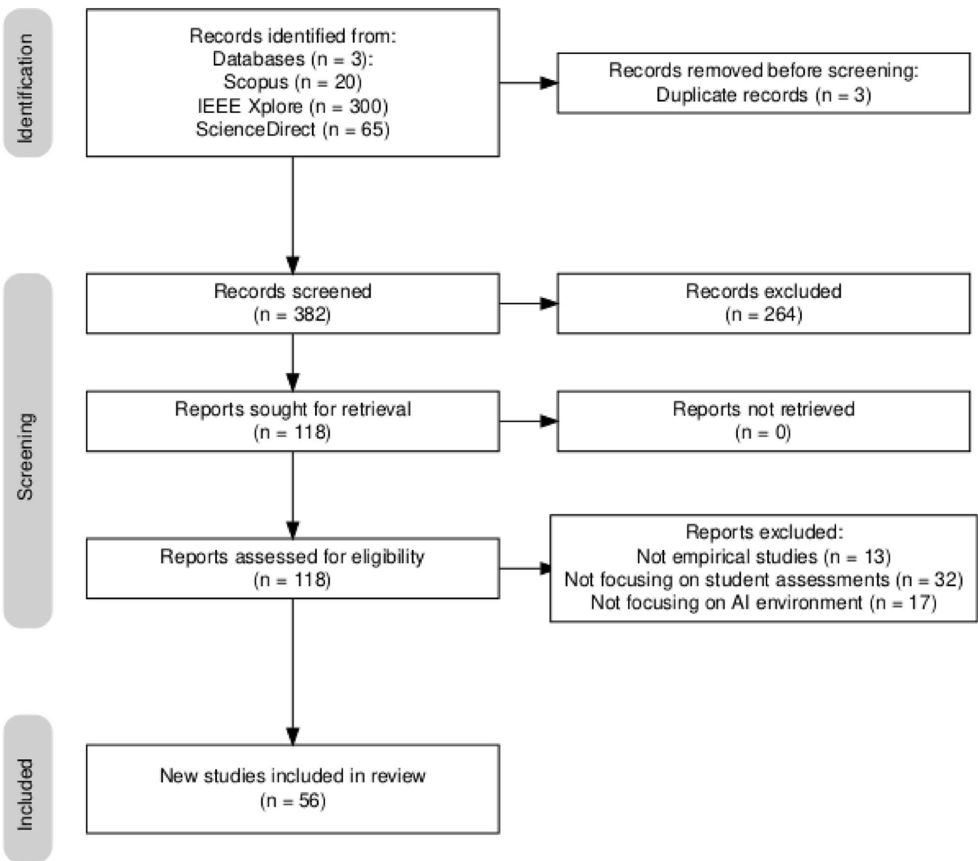
- From 385 initial records, 3 duplicates were removed, 264 excluded after title/abstract screening, 118 full texts assessed, 62 excluded (13 non-empirical, 32 not focused on student assessments, 17 not in an AI context), leaving 56 studies; data were analyzed using inductive thematic analysis following Braun and Clarke’s six steps, with coding in Microsoft Excel and consensus review among authors.
Limitations
- Stated in the paper: the study has an over-reliance on literature, most of which reflects educators’ voices at the forefront of AI-infused teaching challenges; future studies should investigate students’ perspectives.
- Evident from the text: as a systematic review, it generated no new datasets and did not involve human participants; findings depend on the selected databases, search string, and inclusion/exclusion criteria.
- Evident from the text: the review is qualitative and thematic, with no quantitative synthesis or meta-analysis, so effect sizes or prevalence estimates for misconduct are not provided.
Model-written summary. Check it against the paper before relying on it.
Integrity signals
Registry
Cites
Statistics
Figures
Verification
Claims the paper makes
30 Valid · 3 Not valid · 30 Not checked · 34 Own results and interpretations
Every source the paper cites for this claim was checked and supports it.
In the paper
“Traditional assessments, such as essays and take-home assignments, are increasingly susceptible to AI-assisted plagiarism”
What the sources say
- Supportedcites [25] 25. Cotton, D.R.E., Cotton, P.A., Shipway, J.R.: Chatting and cheat -ing: ensuring academic integrity in the era of ChatGPT. Innov. Educ. Teach. Int. 61 , 228-239 (2024) source
The section on assessment challenges says AI essay-writing systems could let students submit essays that are not their own work. The Discussion adds that ChatGPT multiplies existing cheating risks, while the assessment-design section recommends alternatives to conventional essays to make AI use harder. Page numbers are not available in our copy. (LLM, conf=0.87)
plainstates a cause- Asserted: passes — The authors put it forward as true.
- Checkable: passes — It can be checked against evidence.
- Load-bearing: passes — The paper’s conclusions depend on it.
- Based: passes — The paper gives a reason why it holds.
- Supported
The cited sources support only part of this claim — read each source’s verdict below.
In the paper
“Furthermore, con -tract cheating, facilitated by AI writing tools, blurs the line between legitimate assistance and academic misconduct [ 29 ].”
What the sources say
- Partly supportedcites [29] 29. Sweeney, S.: Who wrote this? Essay mills and assessment - con -siderations regarding contract cheating and AI in higher educa -tion. Int. J. Manag. Educ. 21 , 100818 (2023) sourceExperimental — accuracy not yet measured
The Literature review says AI tools and essay mills can leave students struggling to distinguish acceptable work from misconduct. The Conclusion calls for guidelines distinguishing legitimate AI assistance from academic misconduct. But the paper does not say AI writing tools facilitate contract cheating specifically; it defines contract cheating as paying a third party to produce an assessment item and says AI might disrupt that traditional practice. (LLM, conf=0.84)
plainstates a cause- Asserted: passes — The authors put it forward as true.
- Checkable: passes — It can be checked against evidence.
- Load-bearing: passes — The paper’s conclusions depend on it.
- Based: passes — The paper gives a reason why it holds.
- Partly supported
The cited sources support only part of this claim — read each source’s verdict below.
In the paper
“Traditional assessment methods, such as multiple-choice exams, standardised essays, practical assignments, and presentations, are increasingly inadequate in evaluating student learning in AI-infused environments [ 32, 33 ].”
What the sources say
- Not matchedcites [32] 32. Rudolph, J., Tan, S., Tan, S.: ChatGPT: bullshit spewer or the end of traditional assessments in higher education? J. Appl. Learn. Teach. 6 , 342-363 (2023)
Its entry has no title and year that we can search by.
- Partly supportedcites [33] 33. Hargreaves, S.: 'Words are flowing out like endless rain into a paper cup': ChatGPT & law school assessments. Leg. Educ. Rev. 33 , 69 (2023) sourceExperimental — accuracy not yet measured
The Results and Section V describe how generative AI challenges some conventional law-school assessments, particularly essay-based exams, and argue that assessment should adapt. The paper does not establish that the full list of methods in the claim—including practical assignments and presentations—is increasingly inadequate; Section V instead describes clinical, practice-based education as a largely AI-resistant assessment option. Page numbers are unavailable in our copy. (LLM, conf=0.86)
plainstates a cause- Asserted: passes — The authors put it forward as true.
- Checkable: passes — It can be checked against evidence.
- Load-bearing: passes — The paper’s conclusions depend on it.
- Based: passes — The paper gives a reason why it holds.
- Not matched
The cited sources support only part of this claim — read each source’s verdict below.
In the paper
“Studies highlight that AI-generated content challenges conventional plagiarism detection systems, making it difficult to distin -guish between student-authored work and AI-generated responses [ 25 ].”
What the sources say
- Partly supportedcites [25] 25. Cotton, D.R.E., Cotton, P.A., Shipway, J.R.: Chatting and cheat -ing: ensuring academic integrity in the era of ChatGPT. Innov. Educ. Teach. Int. 61 , 228-239 (2024) sourceExperimental — accuracy not yet measured
The section ‘What are the challenges of GPT-3 for assessment in higher education?’ says it can be difficult to distinguish a student’s writing from chatbot responses. But the paper does not establish that conventional plagiarism detection systems generally struggle with AI-generated content: the prevention section recommends such tools, and the Discussion says Turnitin would show high similarity for submissions generated from similar prompts. Page numbers were not available in our copy. (LLM, conf=0.84)
plainstates a cause- Asserted: passes — The authors put it forward as true.
- Checkable: passes — It can be checked against evidence.
- Load-bearing: passes — The paper’s conclusions depend on it.
- Based: passes — The paper gives a reason why it holds.
- Partly supported
The cited sources support only part of this claim — read each source’s verdict below.
In the paper
“Moreover, in some contexts, there is a prevailing cultural perception that the use of AI tools constitutes a form of aca -demic dishonesty [ 82, 83].”
What the sources say
- Not checked — no full text of the sourcecites [82] 82. Margono, H., Saud, M., Falahat, M.: Virtual tutor, digital natives and AI: analyzing the impact of ChatGPT on academia in Indone -sia. Soc. Sci. Humanit. Open 10 , 101069 (2024) source
- Partly supportedcites [83] 83. Axelsson, A., Wallgren, D.T., Verma, U., Cajander, Å., Daniels, M., Eckerdal, A., McDermott, R.: From assistance to miscon -duct: unpacking the complex role of generative AI in student <!-- image --> - learning. In: 2024 IEEE Frontiers in Education Conference (FIE). Instit. Electr.Electron. Eng. Inc., pp 1-8 (2024) sourceExperimental — accuracy not yet measured
The paper’s “Perceptions of Academic Misconduct Involving GenAI” section reports that computing students regard copying AI-generated answers into assignments as cheating. Its “Summary of Results” also says they regard GenAI use for inspiration or understanding as acceptable. The source therefore supports a perception that certain uses are dishonest, but not a prevailing cultural perception that AI-tool use generally is dishonest; page numbers are unavailable in our copy. (LLM, conf=0.83)
plain- Asserted: passes — The authors put it forward as true.
- Checkable: passes — It can be checked against evidence.
- Load-bearing: unclear — It is unclear whether the paper’s conclusions depend on it.
- Based: passes — The paper gives a reason why it holds.
24 more claims · 7 with their cited sources checked
Create a free account to see all 97 claims and to verify the 6 references still open.
- It may state two separate claims as one. 41
- Probably not a substantial claim. 41
Self-check
Percentages, sums and reported differences re-computed from the paper’s own numbers.
Self-check results appear here once an independent check has confirmed them.
Cited works that were retracted
Works this paper cites that were later retracted, from the retraction notices publishers deposit. Major when the notice came out before this paper was published.
A note, not an issue: for example, a cited work that was retracted only after this paper was published, which its authors could not have known.
In the paper
“Mahamuni, AJ., Parminder, Tonpe, SS.: Enhancing educational assessment with artificial intelligence: challenges and opportunities. In: 2024 International Conference on Knowledge Engineering and Communication Systems, ICKECS 2024. Instit. Electr. Electron. Eng. Inc., pp 1–5 (2024)”
Cited work 10.1109/ickecs61492.2024.10616620 · retracted 2026-10-23 · notice 10.1109/ickecs61492.2024.11752940 · this paper published 2025-12-15
Citations
Cites
1 retracted
Mahamuni, A. J., Parminder, & Tonpe, S. S. (2024) · 2024 International Conference on Knowledge Engineering and Communication Systems (ICKECS) · doi:10.1109/ickecs61492.2024.10616620 · Cited by 31
RetractedUsing thematic analysis in psychology
Braun, V., & Clarke, V. (2006) · Qualitative Research in Psychology · doi:10.1191/1478088706qp063oa · Cited by 194,414
On the Dangers of Stochastic Parrots: Can Language Models Be Too Big? 🦜
Bender, E. M., Gebru, T., McMillan-Major, A., & Shmitchell, S. (2021) · Proceedings of the 2021 ACM Conference on Fairness, Accountability, and Transparency · doi:10.1145/3442188.3445922 · Cited by 6,988 · cited 1×
“If not carefully designed, AI grading systems risk perpetuating biases present in training datasets [ 45, 46].”
Chatting and cheating: Ensuring academic integrity in the era of ChatGPT
Cotton, D. R. E., Cotton, P. A., & Shipway, J. R. (2024) · Innovations in Education and Teaching International · doi:10.1080/14703297.2023.2190148 · Cited by 3,087 · cited 2×
“Studies highlight that AI-generated content challenges conventional plagiarism detection systems, making it difficult to distin - guish between student-authored work and AI-generated responses [ 25 ].”
Chatting and Cheating. Ensuring academic integrity in the era of ChatGPT
Cotton, D., Cotton, P., & Shipway, J. R. (2023) · doi:10.35542/osf.io/mrz8h · Cited by 3,079
ChatGPT: Bullshit spewer or the end of traditional assessments in higher education?
(2023) · Journal of Applied Learning & Teaching · doi:10.37074/jalt.2023.6.1.9 · Cited by 1,806 · cited 2×
“Traditional assessment methods, such as multiple-choice exams, standardised essays, practical assignments, and presentations, are increasingly inadequate in evaluating student learning in AI-infused environments [ 32, 33 ].”
Ethical principles for artificial intelligence in education
Nguyen, A., Ngo, H. N., Hong, Y., Dang, B., & Nguyen, B.-P. T. (2023) · Education and Information Technologies · doi:10.1007/s10639-022-11316-w · Cited by 1,228
Li, Y., Dai, J., & Cui, L. (2020) · International Journal of Production Economics · doi:10.1016/j.ijpe.2020.107777 · Cited by 922
Alqahtani, T., Badreldin, H. A., Alrashed, M., Alshaya, A. I., Alghamdi, S. S., bin Saleh, K., Alowais, S. A., Alshaya, O. A., Rahman, I., Al Yami, M. S., et al. (2023) · Research in Social and Administrative Pharmacy · doi:10.1016/j.sapharm.2023.05.016 · Cited by 565
The impact of ChatGPT on higher education
Dempere, J., Modugu, K., Hesham, A., & Ramasamy, L. K. (2023) · Frontiers in Education · doi:10.3389/feduc.2023.1206936 · Cited by 519 · cited 2×
“A balanced approach leveraging AI while upholding ethical standards will ensure meaningful and credible assessments in the AI era [ 30, 38].”
Generative AI tools and assessment: Guidelines of the world's top-ranking universities
Moorhouse, B. L., Yeo, M. A., & Wan, Y. (2023) · Computers and Education Open · doi:10.1016/j.caeo.2023.100151 · Cited by 461 · cited 4×
“Without such policies, institutions risk ethical violations, academic dishonesty, and a lack of uniformity in AI integration within education [ 31 ].”
InfluentialJin, Y., Yan, L., Echeverria, V., Gašević, D., & Martinez-Maldonado, R. (2025) · Computers and Education Artificial Intelligence · doi:10.1016/j.caeai.2024.100348 · Cited by 452
Jin, Y., Yan, L., Echeverria, V., Gašević, D., & Martinez-Maldonado, R. (2024) · arXiv · doi:10.48550/arxiv.2405.11800 · Cited by 447
Developing Formative Assessment in the Classroom: Using action research to explore and modify theory
Torrance, H., & Pryor, J. (2001) · British Educational Research Journal · doi:10.1080/01411920120095780 · Cited by 369 · cited 1×
“Unscheduled and flexible, they are common in apprenticeships and promote progressive learning [ 18].”
Gruenhagen, J. H., Sinclair, P. M., Carroll, J.-A., Baker, P. R. A., Wilson, A., & Demant, D. (2024) · Computers and Education: Artificial Intelligence · doi:10.1016/j.caeai.2024.100273 · Cited by 339
Borrego, M., Karlin, J., McNair, L. D., & Beddoes, K. (2013) · Journal of Engineering Education · doi:10.1002/jee.20023 · Cited by 330 · cited 1×
“Capstone projects exemplify product assessment, reflecting cumulative learning over a course, while simulations can be used in process as - sessments [ 20].”
Employability in higher education: a review of key stakeholders' perspectives
Cheng, M., Adekola, O., Albia, J., & Cai, S. (2022) · Higher Education Evaluation and Development · doi:10.1108/heed-03-2021-0025 · Cited by 251
The current state and impact of Covid‐19 on digital higher education in Germany
Zawacki‐Richter, O. (2021) · Human Behavior and Emerging Technologies · doi:10.1002/hbe2.238 · Cited by 249 · cited 1×
“Process-based assessments, which emphasise the development and docu - mentation of learning over time, help ensure originality and deeper engagement [ 43 ].”
Herrington, J., & Herrington, A. (1998) · Higher Education Research & Development · doi:10.1080/0729436980170304 · Cited by 240
Sokhanvar, Z., Salehi, K., & Sokhanvar, F. (2021) · Studies in Educational Evaluation · doi:10.1016/j.stueduc.2021.101030 · Cited by 231 · cited 2×
“Additionally, there has been a shift towards authentic assessment methods, which have become increasingly crucial as employability is prioritised in today’s job market [ 27].”
Khlaif, Z. N., Ayyoub, A., Hamamra, B., Bensalem, E., Mitwally, M. A. A., Ayyoub, A., Hattab, M. K., & Shadid, F. (2024) · Education Sciences · doi:10.3390/educsci14101090 · Cited by 177
Exploring Relations Between Formative and Summative Assessment
Dolin, J., Black, P., Harlen, W., & Tiberghien, A. (2018) · Contributions from Science Education Research · doi:10.1007/978-3-319-63248-3_3 · Cited by 169 · cited 1×
“Study [ 15] has identified dichotomous poles when discussing types of assessments, and these are: Formative and summative assessments: Formative as - sessments help a learner prepare for the final assess - ment, which is summative and used for grading [ 17].”
Mohebbi, A. (2025) · Cogent Education · doi:10.1080/2331186x.2024.2433814 · Cited by 161 · cited 2×
“A systematic review can synthesise existing literature to understand the topic comprehensively. feedback, guiding students towards ethical writing practices and self-regulated learning [ 37 ].”
Changing education, changing assessment, changing research?
Schuwirth, L. W. T., & Van Der Vleuten, C. P. M. (2004) · Medical Education · doi:10.1111/j.1365-2929.2004.01851.x · Cited by 146 · cited 1×
“Typically found in technical reports or essays, divergent assessments support problem-based learning, fostering critical think - ing and lifelong learning [ 21].”
Vlachopoulos, D., & Makri, A. (2024) · Studies in Educational Evaluation · doi:10.1016/j.stueduc.2024.101425 · Cited by 144 · cited 2×
“Studies on authentic assessment [ 12, 35] are evidence of the current situation and can be applied to improve active engagement and continuous improvement.”
Artificial intelligence-assisted academic writing: recommendations for ethical use
Cheng, A., Calhoun, A., & Reedy, G. (2025) · Advances in Simulation · doi:10.1186/s41077-025-00350-6 · Cited by 140 · cited 1×
“A study by [ 28 ] identified three principal concerns associated with the use of artificial intelligence, particularly large language models.”
Automatic assessment of text-based responses in post-secondary education: A systematic review
Gao, R., Merzdorf, H. E., Anwar, S., Hipwell, M. C., & Srinivasa, A. R. (2024) · Computers and Education: Artificial Intelligence · doi:10.1016/j.caeai.2024.100206 · Cited by 137
Will artificial intelligence drive the advancements in higher education? A tri-phased exploration
Kumar, S., Rao, P., Singhania, S., Verma, S., & Kheterpal, M. (2024) · Technological Forecasting and Social Change · doi:10.1016/j.techfore.2024.123258 · Cited by 131 · cited 2×
“Universities struggle to enforce academic integrity poli - cies due to the lack of robust AI-detection tools [ 87, 88].”
Awidi, I. T. (2024) · Computers and Education Artificial Intelligence · doi:10.1016/j.caeai.2024.100226 · Cited by 127
Redesigning assessments for AI-enhanced learning: a framework for educators in the generative AI era
Khlaif, Z. N., Alkouk, W. A., Salama, N., & Abu Eideh, B. (2025) · Education Sciences · doi:10.3390/educsci15020174 · Cited by 127 · cited 7×
“The "Against, Avoid, Adopt, and Explore" (AAAE) framework proposed by [ 100 ] designing assessments that AI cannot easily complete, such as reflective writing and oral evalu - ations.”
InfluentialRedefining entrepreneurship education in the age of artificial intelligence: An explorative analysis
Vecchiarini, M., & Somià, T. (2023) · The International Journal of Management Education · doi:10.1016/j.ijme.2023.100879 · Cited by 124 · cited 2×
“A structured approach to assessment redesign has led to multi-stage assignments, where students submit drafts before finalising their work [ 70].”
Evangelista, E. D. L. (2025) · Contemporary Educational Technology · doi:10.30935/cedtech/15775 · Cited by 124
Ahmed, Z., Shanto, S. S., Rime, M. H. K., Morol, M. K., Fahad, N., Hossen, M. J., & Abdullah-Al-Jubair, M. (2024) · IEEE Access · doi:10.1109/access.2024.3461874 · Cited by 123 · cited 3×
“The reliance on AI for tasks requiring cognitive engagement results in declining independent reasoning, writing abilities, critical thinking, and analytical skills, making students less prepared for real-world problem-solving scenarios [ 60, 72, 93, 97, 98].”
Lai, C. Y., Cheung, K. Y., Chan, C. S., & Law, K. K. (2024) · Computers and Education: Artificial Intelligence · doi:10.1016/j.caeai.2024.100246 · Cited by 122 · cited 1×
“One of the primary issues is that AI struggles to assess creativity, critical thinking, and ethical reasoning, favour - ing structured and standardised responses over original and interpretative work [ 63 ].”
Kizilcec, R. F., Huber, E., Papanastasiou, E. C., Cram, A., Makridis, C. A., Smolansky, A., Zeivots, S., & Raduescu, C. (2024) · Computers and Education: Artificial Intelligence · doi:10.1016/j.caeai.2024.100269 · Cited by 103
Nguyen, H. M., & Goto, D. (2024) · Education and Information Technologies · doi:10.1007/s10639-024-12495-4 · Cited by 102 · cited 1×
“Proctoring software utilising facial recognition and key - stroke analysis aims to deter cheating in online assessments, though ethical concerns regarding privacy and surveillance remain [ 40, 41 ].”
Evaluating Artificial Intelligence in Education for Next Generation
Joshi, S., Rambola, R. K., & Churi, P. (2021) · Journal of Physics: Conference Series · doi:10.1088/1742-6596/1714/1/012039 · Cited by 102
Graduate Instructors Navigating the AI Frontier: The Role of ChatGPT in Higher Education
Parker, L., Carter, C., Karakas, A., Loper, A. J., & Sokkar, A. (2024) · Computers and Education Open · doi:10.1016/j.caeo.2024.100166 · Cited by 95
Race with the machines: assessing the capability of generative AI in solving authentic assessments
Nguyen Thanh, B., Vo, D. T. H., Nguyen Nhat, M., Pham, T. T. T., Thai Trung, H., & Ha Xuan, S. (2023) · Australasian Journal of Educational Technology · doi:10.14742/ajet.8902 · Cited by 87 · cited 3×
“A study by [ 34] found that generative AI tools, such as ChatGPT-4, Chat - GPT-3.”
Enhancing academic integrity among students in GenAI Era:A holistic framework
Rasul, T., Nair, S., Kalendra, D., Balaji, M. S., Santini, F. D. O., Ladeira, W. J., Rather, R. A., Yasin, N., Rodriguez, R. V., Kokkalis, P., et al. (2024) · The International Journal of Management Education · doi:10.1016/j.ijme.2024.101041 · Cited by 82 · cited 2×
“To address this challenge, some universities have introduced mandatory AI disclosure poli - cies, requiring students to declare their use of AI in assign - ments to promote transparency and accountability [ 56, 69].”
Sweeney, S. (2023) · The International Journal of Management Education · doi:10.1016/j.ijme.2023.100818 · Cited by 78
Machine learning based feedback on textual student answers in large courses
Bernius, J. P., Krusche, S., & Bruegge, B. (2022) · Computers and Education: Artificial Intelligence · doi:10.1016/j.caeai.2022.100081 · Cited by 75 · cited 1×
“Despite these challenges, AI in education presents a promis - ing opportunity for enhancing learning [ 3, 4, 14 ], provided proper safeguards and strategies are implemented to address its potential risks.”
A systematic review on machine learning models for online learning and examination systems
Kaddoura, S., Popescu, D. E., & Hemanth, J. D. (2022) · PeerJ Computer Science · doi:10.7717/peerj-cs.986 · Cited by 75
Salih, S., Husain, O., Hamdan, M., Abdelsalam, S., Elshafie, H., & Motwakel, A. (2025) · Results in Engineering · doi:10.1016/j.rineng.2024.103837 · Cited by 74 · cited 5×
“These policies establish clear governance structures that define acceptable AI use, ensuring that AI tools support learning rather than facilitate misconduct [ 54, 57].”
InfluentialAI-resistant assessments in higher education: Practical insights from faculty training workshops
Awadallah Alkouk, W., & Khlaif, Z. N. (2024) · Frontiers in Education · doi:10.3389/feduc.2024.1499495 · Cited by 68
Malik, A., Khan, M. L., Hussain, K., Qadir, J., & Tarhini, A. (2025) · Interactive Learning Environments · doi:10.1080/10494820.2024.2409407 · Cited by 57 · cited 3×
“There is a fear of superficial learning as students rely too much on AI [ 88 ].”
Balancing AI and academic integrity: what are the positions of academic publishers and universities?
Gulumbe, B. H., Audu, S. M., & Hashim, A. M. (2025) · AI & SOCIETY · doi:10.1007/s00146-024-01946-8 · Cited by 53 · cited 1×
“To further enhance ethical AI integration, universities have begun implementing AI literacy programs for stu - dents and educators [ 108 ].”
Unveiling Generative AI in Higher Education: Insights from Engineering Students and Professors
Guillén-Yparrea, N., & Hernández-Rodríguez, F. (2024) · 2024 IEEE Global Engineering Education Conference (EDUCON) · doi:10.1109/educon60312.2024.10578876 · Cited by 43 · cited 3×
“Excessive dependence on AI tools weakens students' ability to think critically, write independently, and solve problems effec - tively [ 57–59, 86, 89, 90, 94–96 ].”
AI in essay-based assessment: Student adoption, usage, and performance
Smerdon, D. (2024) · Computers and Education: Artificial Intelligence · doi:10.1016/j.caeai.2024.100288 · Cited by 43 · cited 2×
“However, findings remain inconclu - sive, as AI assistance does not necessarily diminish learning outcomes, raising concerns about the long-term effects on student success and assessment credibility [ 76].”
Dimari, A., Tyagi, N., Davanageri, M. B., Kukreti, R., Yadav, R., & Dimari, H. (2024) · International Conference on Knowledge Engineering and Communication Systems (ICKECS) · doi:10.1109/ickecs61492.2024.10616490 · Cited by 42 · cited 1×
“In the field of education, AI's impact has been particularly pronounced in areas such as personalised learning [ 1], Educational practitioners are struggling to keep pace with the rapid, unprecedented rate of technological advance - ments, leaving them uncertain about how to respond and adapt…”
Coates, H., Croucher, G., & Calderon, A. (2025) · Journal of Academic Ethics · doi:10.1007/s10805-025-09639-7 · Cited by 35
A theory of change for student-led academic integrity
Richards, D., Saddiqui, S., White, F., McGuigan, N., & Homewood, J. (2016) · Quality in Higher Education · doi:10.1080/13538322.2016.1265849 · Cited by 34 · cited 1×
“…“proactive”, etc.) [ 109], where punitive models seek to “deter students from com - mitting breaches through the threat of penalties,” and the educative approach aims to “reduce the likelihood of stu - dents committing breaches by providing them with relevant skills and knowledge” [ 110 ].”
ChatGPT and academia on accounting assessments
Abeysekera, I. (2024) · Journal of Open Innovation: Technology, Market, and Complexity · doi:10.1016/j.joitmc.2024.100213 · Cited by 34
Sbaffi, L., & Zhao, X. (2022) · Frontiers in Psychology · doi:10.3389/fpsyg.2022.1009305 · Cited by 31 · cited 1×
“…approaches are the more punitive (“punitive”, “ethical”, etc.) models and the educative mod - els (“educative”, “pedagogical”, “proactive”, etc.) [ 109], where punitive models seek to “deter students from com - mitting breaches through the threat of penalties,” and the educative approach aims to…”
‘Words are Flowing Out Like Endless Rain Into a Paper Cup’: ChatGPT & Law School Assessments
Hargreaves, S. (2023) · Legal Education Review · doi:10.53300/001c.83297 · Cited by 31
‘Words Are Flowing Out Like Endless Rain Into a Paper Cup’: ChatGPT & Law School Assessments
Hargreaves, S. (2023) · doi:10.2139/ssrn.4359407 · Cited by 30
Wang, K. D., Wu, Z., Tufts, L., Wieman, C., Salehi, S., & Haber, N. (2025) · 2025 IEEE Global Engineering Education Conference (EDUCON) · doi:10.1109/educon62633.2025.11016406 · Cited by 28 · cited 2×
“Furthermore, some scholars have called for the expansion of AI literacy training as a means of addressing the challenges posed by inappropriate or uninformed AI use [ 73, 75, 86, 95, 101].”
Virtual Tutor, Digital Natives and AI: Analyzing the impact of ChatGPT on academia in Indonesia
Margono, H., Saud, M., & Falahat, M. (2024) · Social Sciences & Humanities Open · doi:10.1016/j.ssaho.2024.101069 · Cited by 26 · cited 2×
“Moreover, in some contexts, there is a prevailing cultural perception that the use of AI tools constitutes a form of aca - demic dishonesty [ 82, 83].”
Artificial Intelligence (AI) and its Potential Impact on the Future of Higher Education
Bennett, L., & Abusalem, A. (2024) · Athens Journal of Education · doi:10.30958/aje.11-3-2 · Cited by 24 · cited 1×
“AI-powered plagiarism detection tools, such as Turnitin and GPTZero, are increasingly effective in identifying AI-generated content [ 39].”
Unleashing ChatGPT's impact in higher education: Student and faculty perspectives
Rajabi, P., Taghipour, P., Cukierman, D., & Doleck, T. (2024) · Computers in Human Behavior: Artificial Humans · doi:10.1016/j.chbah.2024.100090 · Cited by 21 · cited 4×
“Furthermore, AI-generated responses can include factually incorrect but compelling content, com - promising assessment reliability [ 91].”
InfluentialAbubakar, U., Falade, A. A., & Ibrahim, H. A. (2024) · Advances in Mobile Learning Educational Research · doi:10.25082/amler.2024.02.009 · Cited by 19
Smit, M., Wagner, R. F., & Bond-Barnard, T. J. (2025) · Project Leadership and Society · doi:10.1016/j.plas.2025.100187 · Cited by 19 · cited 2×
“The study found that students are actively using AI for personal and academic purposes [ 92, 93 ].”
Fegade, A., Raut, R., Deshpande, A., Mittal, A., Kaul, N., & Khanna, V. (2023) · 2023 6th International Conference on Contemporary Computing and Informatics (IC3I) · doi:10.1109/ic3i59117.2023.10397917 · Cited by 18 · cited 3×
“This method allows educators to track students’ learning progress and interaction with AI throughout the assessment process, making it more difficult [ 31, 60, 85, 89, 90 ].”
Kangwa, D., Msafiri, M. M., & Fute, A. (2025) · AI and Ethics · doi:10.1007/s43681-025-00689-6 · Cited by 17 · cited 1×
“Our key principle is that authentic assess - ments can enhance critical thinking and preserve academic integrity when paired with the ethical use of AI tools and clear policies [ 49 ].”
Charles, K. A., Yousuf, A., Chua, H. C., Matthews, S., Harnett, J., & Hinton, T. (2025) · European Journal of Pharmacology · doi:10.1016/j.ejphar.2025.177508 · Cited by 17 · cited 2×
“Additionally, AI-assisted assessments may create an unfair academic playing field by benefiting students with better access to AI tools and technology while disadvantag - ing those from underprivileged backgrounds [ 62, 64, 97].”
Matobobo, C., Ncube, P. D. N., Ngesimani, N. L., Dzvapatsva, G. P., & Chinhamo, E. (2025) · 2025 IEEE Global Engineering Education Conference (EDUCON) · doi:10.1109/educon62633.2025.11016317 · Cited by 17 · cited 1×
“Integrating artificial intelligence (AI) into education has significantly transformed teaching, learning, and assess - ment practices [ 23, 24 ].”
Self-citationEvaluation of Generative AI Use to Foster Critical Thinking in Higher Education
Oliva-Córdova, L. M., Álvarez-Icaza, I., & George-Reyes, C. E. (2025) · IEEE Revista Iberoamericana de Tecnologias del Aprendizaje · doi:10.1109/rita.2025.3597848 · Cited by 17 · cited 1×
“The emphasis is on assessments that evaluate the learning process rather than solely focusing on the final product, and continuous feedback [ 60, 71, 77, 83, 90, 96, 104, 105].”
Engineering Educators' Perspectives on the Impact of Generative AI in Higher Education
Dewan, U., Hingle, A., McDonald, N., & Johri, A. (2025) · 2025 IEEE Global Engineering Education Conference (EDUCON) · doi:10.1109/educon62633.2025.11016518 · Cited by 16 · cited 2×
“Furthermore, some scholars have called for the expansion of AI literacy training as a means of addressing the challenges posed by inappropriate or uninformed AI use [ 73, 75, 86, 95, 101].”
Zhang, Y., & Reusch, P. (2025) · 2025 IEEE Global Engineering Education Conference (EDUCON) · doi:10.1109/educon62633.2025.11016490 · Cited by 13 · cited 2×
“Moreover, scholars emphasise the urgent need for policies and regulations that not only regulate the use of AI but also address critical concerns such as data pri - vacy and security [ 64, 72, 77, 81, 107].”
Dhruv, A., Saha, S., Tyagi, S., & Jain, V. (2024) · 2024 2nd International Conference on Advancement in Computation & Computer Technologies (InCACCT) · doi:10.1109/incacct61598.2024.10551108 · Cited by 12 · cited 2×
“Additionally, AI-assisted assessments may create an unfair academic playing field by benefiting students with better access to AI tools and technology while disadvantag - ing those from underprivileged backgrounds [ 62, 64, 97].”
Issa, T., & Hall, M. (2024) · Heliyon · doi:10.1016/j.heliyon.2024.e38759 · Cited by 12 · cited 1×
“In addi - tion, scholars propose designing assessments in ways that make the final outputs less susceptible to direct substitution by AI tools, thereby preserving the integrity and authenticity of student work [ 80 ].”
Bubaš, G., & Čižmešija, A. (2023) · 2023 46th MIPRO ICT and Electronics Convention (MIPRO) · doi:10.23919/mipro57284.2023.10159826 · Cited by 10 · cited 3×
“The use of multimodal assess - ment techniques, including project-based assessments, live problem-solving activities, and peer evaluations, has also been identified as an effective strategy for fostering student accountability and reducing AI misuse [ 85, 103 ].”
Torres, R. C. (2025) · 2025 16th International Conference on E-Education, E-Business, E-Management and E-Learning (IC4e) · doi:10.1109/ic4e65071.2025.11075444 · Cited by 10 · cited 4×
“To address this challenge, some universities have introduced mandatory AI disclosure poli - cies, requiring students to declare their use of AI in assign - ments to promote transparency and accountability [ 56, 69].”
InfluentialExploring ChatGPT Utilization Among Master's Students in Higher Education
Jahani, M., Baruah, B., & Ward, A. (2024) · 2024 21st International Conference on Information Technology Based Higher Education and Training (ITHET) · doi:10.1109/ithet61869.2024.10837601 · Cited by 9 · cited 2×
“…reflective tasks, scaffolded assignments, reflective journals, use of Bloom's Taxonomy higher-order thinking questions, and interactive problem-solving tasks, which require direct student engagement and cannot be easily outsourced to AI [ 56, 65, 67, 70, 73, 79, 89, 94, 97–99, 101, 102 ].”
ChatGPT in Engineering Teaching & Learning: Student and Faculty Perspective
Lukhmanov, Y., Perveen, A., & Tsakalerou, M. (2025) · IEEE Global Engineering Education Conference (EDUCON) · doi:10.1109/educon62633.2025.11016423 · Cited by 9 · cited 1×
“…reflective tasks, scaffolded assignments, reflective journals, use of Bloom's Taxonomy higher-order thinking questions, and interactive problem-solving tasks, which require direct student engagement and cannot be easily outsourced to AI [ 56, 65, 67, 70, 73, 79, 89, 94, 97–99, 101, 102 ].”
Optimizing Student Engagement and Performance usingAI-Enabled Educational Tools
Mirdad, K., Daeli, O. P. M., Septiani, N., Ekawati, A., & Rusilowati, U. (2024) · Journal of Computer Science and Technology Application · doi:10.33050/corisinta.v1i1.22 · Cited by 9
Exploring ChatGPT's Potential and Concerns in Higher Education
Tick, A. (2024) · 2024 IEEE 22nd Jubilee International Symposium on Intelligent Systems and Informatics (SISY) · doi:10.1109/sisy62279.2024.10737595 · Cited by 8 · cited 2×
“The reliance on AI for tasks requiring cognitive engagement results in declining independent reasoning, writing abilities, critical thinking, and analytical skills, making students less prepared for real-world problem-solving scenarios [ 60, 72, 93, 97, 98].”
Pulari, S. R., & Jacob, S. G. (2025) · Procedia Computer Science · doi:10.1016/j.procs.2025.02.122 · Cited by 8 · cited 3×
“The digital divide further widens inequalities in education, content, redesign assessment methods, and integrate AI responsibly into teaching and evaluation processes [ 62, 67].”
Educational Potential of ChatGPT: Teaching Tool for Students’ Competencies Development
Shabunina, V., Sarancha, V., Maslak, V., Shevchenko, O., & Tur, O. (2023) · 2023 IEEE 5th International Conference on Modern Electrical and Energy System (MEES) · doi:10.1109/mees61502.2023.10402380 · Cited by 7 · cited 2×
“Excessive dependence on AI tools weakens students' ability to think critically, write independently, and solve problems effec - tively [ 57–59, 86, 89, 90, 94–96 ].”
Generative AI in Student Essays: English Teachers' Perspectives on Effective Assessment Methods
Lukianenko, V., & Kornieva, Z. (2024) · XLinguae · doi:10.18355/xl.2024.17.04.14 · Cited by 7 · cited 1×
“A balanced approach leveraging AI while upholding ethical standards will ensure meaningful and credible assessments in the AI era [ 30, 38].”
AI vs. Human Writing: Developing a Novel Method for Text Authenticity Detection in Education
Department of Computer Science and Engineering, R. I. O. T., Kalmani, V. H., Adamuthe, A. C., Premnath Gondil, A., Prashant Patil, V., Amar Kore, R., & Mahadev Metkari, V. (2025) · International Journal of Modern Education and Computer Science · doi:10.5815/ijmecs.2025.03.04 · Cited by 7 · cited 2×
“…reflective tasks, scaffolded assignments, reflective journals, use of Bloom's Taxonomy higher-order thinking questions, and interactive problem-solving tasks, which require direct student engagement and cannot be easily outsourced to AI [ 56, 65, 67, 70, 73, 79, 89, 94, 97–99, 101, 102 ].”
Croucher, S. M., & Cronn-Mills, D. (2018) · Understanding Communication Research Methods · doi:10.4324/9781315167664-3 · Cited by 6 · cited 1×
“An interpretive paradigm, therefore, helps to exam - ine and intersect these differing realities within AI-infused environments and to understand how they can be negoti - ated [ 50, 51 ].”
Qorich, M., & El Ouazzani, R. (2025) · Expert Systems with Applications · doi:10.1016/j.eswa.2025.128405 · Cited by 6 · cited 3×
“The reliance on AI for tasks requiring cognitive engagement results in declining independent reasoning, writing abilities, critical thinking, and analytical skills, making students less prepared for real-world problem-solving scenarios [ 60, 72, 93, 97, 98].”
Sandu, N., Karim, S., Wangsa, K., & Singh, P. J. (2025) · 2025 34th Annual Conference of the European Association for Education in Electrical and Information Engineering (EAEEIE) · doi:10.1109/eaeeie65428.2025.11136403 · Cited by 6 · cited 2×
“Moreover, scholars emphasise the urgent need for policies and regulations that not only regulate the use of AI but also address critical concerns such as data pri - vacy and security [ 64, 72, 77, 81, 107].”
Pragmatism, Problem Solving, and Strategies for Engaged Philosophy
Brister, E. (2023) · The International Library of Environmental, Agricultural and Food Ethics · doi:10.1007/978-3-031-37484-5_2 · Cited by 5
From Assistance to Misconduct: Unpacking the Complex Role of Generative AI in Student Learning
Axelsson, A., Wallgren, D. T., Verma, U., Cajander, Å., Daniels, M., Eckerdal, A., & McDermott, R. (2024) · 2024 IEEE Frontiers in Education Conference (FIE) · doi:10.1109/fie61694.2024.10893133 · Cited by 5
Alshamy, A. S., Al-Harthi, A. S. A., & Abdullah, S. (2025) · 2025 International Conference on Smart Applications, Communications and Networking (SmartNets) · doi:10.1109/smartnets65254.2025.11106833 · Cited by 5 · cited 1×
“Moreover, scholars emphasise the urgent need for policies and regulations that not only regulate the use of AI but also address critical concerns such as data pri - vacy and security [ 64, 72, 77, 81, 107].”
Chang, V., Ansari, Y., & Arami, M. (2024) · Proceedings of the 6th International Conference on Finance, Economics, Management and IT Business · doi:10.5220/0012764100003717 · Cited by 4 · cited 4×
“To maintain academic integrity in an AI-infused environ - ment, there is a growing need to redesign assessment prac - tices in ways that emphasise critical thinking and creativity [ 54, 57, 66, 91 ].”
InfluentialMilinković, A., Vuleta, D., & Babić, I. T. (2024) · 2024 47th MIPRO ICT and Electronics Convention (MIPRO) · doi:10.1109/mipro60963.2024.10569274 · Cited by 4 · cited 1×
“The integration of AI tools like ChatGPT and other genera - tive models has significantly impacted academic integrity, making it difficult for educators to differentiate between authentic student work and AI-generated content [ 53, 54, 57, 76–78 ].”
Strachan, R., Oguna, C., & Oruche, U. (2024) · 2024 IEEE Global Engineering Education Conference (EDUCON) · doi:10.1109/educon60312.2024.10578821 · Cited by 4 · cited 1×
“The emphasis is on assessments that evaluate the learning process rather than solely focusing on the final product, and continuous feedback [ 60, 71, 77, 83, 90, 96, 104, 105].”
It's Bad but It's Good: An Exploration of AI Cheating on Higher Educational Students Perspectives
Sholikhah, Z., Pramuka, B. A., Adawiyah, W. R., Yanuar, I., Respati, Y. A., & Pramuka, M. F. (2024) · 2024 IEEE Technology & Engineering Management Conference - Asia Pacific (TEMSCON-ASPAC) · doi:10.1109/temscon-aspac62480.2024.11024673 · Cited by 4 · cited 2×
“Notably, students who depend heavily on AI struggle to construct sentences with the use of AI support, suggesting that these tools risk displacing the development of essential academic skills [ 84].”
Wang, K. D., Wu, Z., Tufts, L., Wieman, C., Salehi, S., & Haber, N. (2024) · arXiv.org · doi:10.48550/arxiv.2412.02653 · Cited by 4
Dzvapatsva, G. P., Risinamhodzi, D. T., & Matobobo, C. (2023) · IEEE Global Engineering Education Conference (EDUCON) · doi:10.1109/educon54358.2023.10125136 · Cited by 3 · cited 1×
“Continuous and final assessments: Continuous assess - ment occurs throughout learning, often using portfolios, as seen in coding boot camps [ 19 ].”
Self-citationSoale, J., & Collins, T. (2023) · The 24th Annual Conference on Information Technology Education · doi:10.1145/3585059.3611413 · Cited by 3 · cited 1×
“These tools allow students to automatically gen - erate essays, reports, and coding solutions, increasing the risk of plagiarism and contract cheating [ 55, 56, 79–81].”
The future of academic integrity in the age of artificial intelligence
Wong, D., Harding, S. P., & Johnson, M. W. (2024) · Graefe s Archive for Clinical and Experimental Ophthalmology · doi:10.1007/s00417-024-06385-1 · Cited by 3 · cited 1×
“A study by [ 42 ] suggests using AI tools to detect AI-generated content.”
A Three-Step Approach to Shift from Assessment Integrity to Assurance of Learning in the Age of AI
Thite, S. D., Danish, N., Florez, G. O., & Rougieux, F. (2024) · 2024 World Engineering Education Forum - Global Engineering Deans Council (WEEF-GEDC) · doi:10.1109/weef-gedc63419.2024.10854944 · Cited by 3 · cited 1×
“The emphasis is on assessments that evaluate the learning process rather than solely focusing on the final product, and continuous feedback [ 60, 71, 77, 83, 90, 96, 104, 105].”
Exploring Student Perspectives on ChatGPT in Higher Education
Shard, Vaidya, P., Koul, S., Arora, A., Sonia, & Jain, P. (2024) · 2024 3rd Edition of IEEE Delhi Section Flagship Conference (DELCON) · doi:10.1109/delcon64804.2024.10866660 · Cited by 3 · cited 1×
“Excessive dependence on AI tools weakens students' ability to think critically, write independently, and solve problems effec - tively [ 57–59, 86, 89, 90, 94–96 ].”
HEIs teachers' and students' current experience of AI introduction in teaching and learning
Pinto, C. M. A., Mendonça, J. M. P., Babo, L., Queirós, R., Cruz, M., & Mascarenhas, D. (2024) · 2024 5th International Conference in Electronic Engineering, Information Technology & Education (EEITE) · doi:10.1109/eeite61750.2024.10654407 · Cited by 2 · cited 2×
“Studies by [ 13 ] highlighted teachers' and stu - dents' growing use of AI, though with differing usage pat - terns and motivations.”
Perceptions of the Use of Generative AI in Higher Education: A Survey of Tanzanian Universities
Maro, S., Kondoro, A., & Mtebe, J. (2025) · 2025 IST-Africa Conference (IST-Africa) · doi:10.23919/ist-africa67297.2025.11060468 · Cited by 2
Discovering Educational Data Mining: An Introduction
Collier, Z., Sukumar, J., & Barmaki, R. (2024) · University of Massachusetts Amherst Libraries · doi:10.7275/pare.2037 · Cited by 2
Navigating AI Adoption: Challenges and Suggested Solutions for College Lecturers
Ahlam, A., Huda, S., Hala, H., Nimer, B., & Wajeeh, D. (2025) · 2025 International Conference on Smart Learning Courses (SCME) · doi:10.1109/scme62582.2025.11104880 · Cited by 2 · cited 3×
“This method allows educators to track students’ learning progress and interaction with AI throughout the assessment process, making it more difficult [ 31, 60, 85, 89, 90 ].”
Experiences with Content Development and Assessment Design in the Era of GenAI
Shailendra, S., Sharma, A., & Kadel, R. (2025) · doi:10.36227/techrxiv.174123195.54300103/v1 · Cited by 1
Guoan, Z., Mengting, P., & Shaobo, W. (2025) · 2025 14th International Conference on Educational and Information Technology (ICEIT) · doi:10.1109/iceit64364.2025.10975838 · Cited by 1
Guo, B., Liu, Y., & Liu, J. (2025) · 2025 5th International Conference on Artificial Intelligence and Education (ICAIE) · doi:10.1109/icaie64856.2025.11158588 · Cited by 1 · cited 3×
“The ability to generate pol - ished AI-driven responses has also contributed to the increasing submission of work that students do not create, thus undermining the authenticity of assessments [ 68, 72, 85, 86].”
El Hassouni, M., Fouad, F., & El Bassim, H. (2025) · 2025 International Conference on Smart Learning Courses (SCME) · doi:10.1109/scme62582.2025.11104909 · Cited by 1 · cited 1×
“Furthermore, some scholars have called for the expansion of AI literacy training as a means of addressing the challenges posed by inappropriate or uninformed AI use [ 73, 75, 86, 95, 101].”
Experiences with Content Development and Assessment Design in the Era of GenAIPreprint
Sharma, A., Shailendra, S., & Kadel, R. W. (2025) · arXiv (Cornell University) · doi:10.48550/arxiv.2503.00081
Krsmanovic, G., Deek, R. A., & Deek, F. P. (2025) · Computer · doi:10.1109/mc.2025.3576936
Research works printed but not linked: 5
- 16. Mohan, R.: Measurement, evaluation and assessment in educa -tion. PHI Learning Pvt. Ltd (2023)
- 50. Gichuru, M.J.: The interpretive research paradigm: a critical review of IS research methodologies. Int J Innov Res Adv Studies 4 , 1-5 (2017)
- 72. Leong, W.Y., Zhang, J.B.: AI on academic integrity and plagia -rism detection. ASM Sci. J. 20 , 75 (2025)
- 106. Panigrahi, H., Naidu, S., Pandey, A., Shaikh, P., Tripathy, A.K.: Handwriting match and AI content detection. Int. J. Syst. Innov. 9 , 75-95 (2025)
- 111. Ghaicha, A.: Theoretical framework for educational assessment: a synoptic review. J. Educ. Pract. 7 , 212-231 (2016) <!-- image --> Publisher's note Springer Nature remains neutral with regard to juris -dictional claims in published maps and institutional affiliations.
Cited by
Aryanti, Sidik, G. T., & Puspitasari, R. (2026) · Primary Jurnal Pendidikan Guru Sekolah Dasar · doi:10.33578/jpfkip.v15i2.214-229 · Cited by 4
“However, successful implementation depends largely on teachers’ professional competence and readiness to adapt to new pedagogical demands (Ncube et al., 2025).”
Educating What AI Cannot: Character and the Future of Higher Education
Grove, M. J., & Harrison, T. (2026) · British Journal of Educational Studies · doi:10.1080/00071005.2026.2678972 · Cited by 4
Assessment futures through teachers’ eyes: a qualitative case study in higher education
Katajavuori, N., Pyörälä, E., Haarala-Muhonen, A., Kallunki, V., Kinnunen, P., & Myyry, L. (2026) · European Journal of Higher Education · doi:10.1080/21568235.2026.2658139 · Cited by 1
Sun, L., & Zheng, Y. (2026) · Journal of Research on Technology in Education · doi:10.1080/15391523.2026.2711656 · Cited by 1
Demirdöken, G., & Kırkgöz, Y. (2026) · Journal of English for Academic Purposes · doi:10.1016/j.jeap.2026.101663
Metadata
- Authors
- Ncube, P. D. N., Dzvapatsva, G. P., Matobobo, C., & Ranga, M. M.
- Affiliations
- Walter Sisulu University (ZA)
- University of Suffolk (GB)
- Corresponding author
- Ncube, Prince D N
- Dzvapatsva, Godwin P
- Matobobo, Courage
- Ranga, Memory M
- Venue
- AI and Ethics
- Published
- 2025-12-15
- Volume
- 6
- Issue
- 1
- ISSN
- 2730-5953 (ISSN-L)
- 2730-5961
- OpenAlex
- W4417341259
- Cited by
- 31
- References
- 74
- Citations by year
- 2026: 31
- FWCI
- 4.78
- Type
- journal article
- Language
- en
- Open access
- hybrid
- doi.org
- Licence
- cc-by
- creativecommons.org/licenses/by/4.0 (tdm)
- creativecommons.org/licenses/by/4.0 (vor)
- Locations
- AI and Ethics (publishedVersion, cc-by)
- Topics
- Social Sciences › Education › Academic integrity and plagiarism
- Social Sciences › Education › Artificial Intelligence in Education
- Social Sciences › Education › Student Assessment and Feedback
- Keywords
- student assessment, generative AI, academic integrity, higher education, process-based assessment, AI policy, digital literacy, human-AI collaboration, academic misconduct
About these checks
Registry, retraction, Cites and statistics results are computed, not judged, with one exception: a printed reference that no index lists is read once by a model before it counts as a citation error. Claims are extracted by a model and kept only when their quote appears verbatim in the text; each cited source is then checked, with a model’s help, for whether it says what the claim relies on. Those verdicts can be wrong — read the claim’s quote and the cited source before relying on one.
The claim verdicts this report counts are experimental: their accuracy is not yet measured.
A language model drew the claims from the paper on 2026-10-10, under version 3 of the claim definition (model deepseek-v4.1-flash, prompt extract-v3).
A second model labelled each claim on 2026-10-10 (model jev-1.13-20260917, definition revision gold-guideline-v0.2).
Cited sources are checked with a language model’s help (gpt-6-sol).
Statistics and arithmetic are recomputed, not judged.
Confidence bands are shown only for fields calibrated on our annotated test set. None is calibrated yet, so no band is shown.
What counts as a claim ›How we measure confidence ›How we check this ›
Are you an author, or do you see a problem with this page? Request a review
Data sources
Bibliographic data: Semantic Scholar, OpenAlex, Crossref.
Contains information from the Semantic Scholar Academic Graph Datasets, made available under the ODC Attribution License (ODC-BY 1.0).
Semantic Scholar’s data is described in: Kinney, R., et al. (2023). The Semantic Scholar Open Data Platform. arXiv:2301.10140.
