

Decreased heart rate variability and its association with increased mortality after acute myocardial infarction
Open accessThe DOI matches its Crossref record; 31 of the 33 references it cites were found in a registry or an index.
Abstract
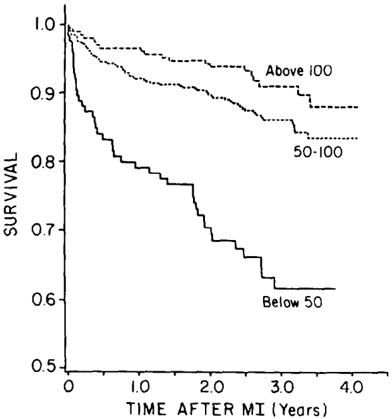
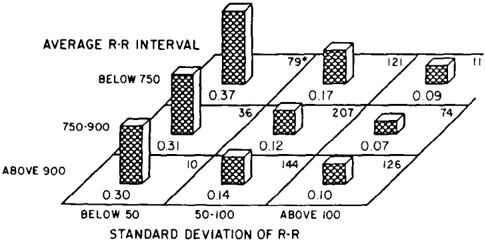
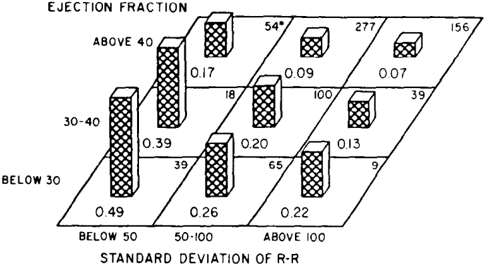
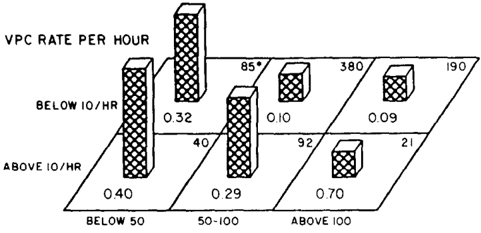
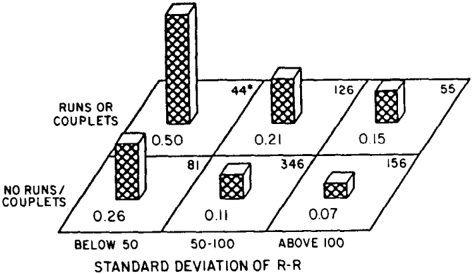
A high degree of heart rate (HR) variability is found in compensated hearts with good function, whereas HR variability can be decreased with severe coronary artery disease, congestive heart failure, aging and diabetic neuropathy. To test the hypothesis that HR variability is a predictor of long-term survival after acute myocardial infarction (AMI), the Holter tapes of 808 patients who survived AMI were analyzed. Heart rate variability was defined as the standard deviation of all normal RR intervals in a 24-hour continuous electrocardiogram recording made 11 +/- 3 days after AMI. In all patients demographic, clinical and laboratory variables were measured at baseline. Mean follow-up time was 31 months. Of all Holter variables measured, HR variability had the strongest univariate correlation with mortality. The relative risk of mortality was 5.3 times higher in the group with HR variability of less than 50 ms than the group with HR variability of more than 100 ms. HR variability remained a significant predictor of mortality after adjusting for clinical, demographic, other Holter features and ejection fraction. A hypothesis to explain this finding is that decreased HR variability correlates with increased sympathetic or decreased vagal tone, which may predispose to ventricular fibrillation.
Overview
The claims and statistics of this paper haven’t been checked yet.
Free: it reads the open-access text and checks the first 5 claims that cite a source we can check. Create a free account to check every claim.
Integrity signals
Registry
Cites
Statistics
Figures
Verification
Claims the paper makes
The claims and statistics of this paper haven’t been checked yet.
Free: it reads the open-access text and checks the first 5 claims that cite a source we can check. Create a free account to check every claim.
Claims other papers make about this one
Each is checked against this paper’s own text: does it say what the citing paper says it does?
The cited source doesn’t support the claim as written.
In the citing paper
“Kleiger et al. (1987) first reported that SDNN ,50 ms was associated with fivefold higher mortality in postmyocardial infarction patients compared to those with SDNN .50 ms.”
From 2017 ISHNE-HRS expert consensus statement on ambulatory ECG and external cardiac monitoring/telemetry (2017) · cites this paper as Kleiger et al. (1987)
Checked by a reasoning model — may be wrong.
Experimental — accuracy not yet measuredThe source backs part of the claim, not all of it — or backs it for a different population, condition or comparison.
In the citing paper
“Decreased HRV values have been consistently reported in post-MI infarction and heart failure patients (Bigger et al., 1992;Kleiger et al., 1987;La Rovere et al., 2003, 2012;Makikallio et al., 2005).”
From 2017 ISHNE-HRS expert consensus statement on ambulatory ECG and external cardiac monitoring/telemetry (2017) · cites this paper as Kleiger et al., 1987
Experimental — accuracy not yet measured
Self-check
Percentages, sums and reported differences re-computed from the paper’s own numbers.
The self-check needs the paper’s full text.
Citations
Cites
Nonparametric Estimation from Incomplete Observations
Kaplan, E. L., & Meier, P. (1992) · Springer Series in Statistics · doi:10.1007/978-1-4612-4380-9_25 · Cited by 45,181
Nonparametric Estimation from Incomplete Observations
Kaplan, E. L., & Meier, P. (1958) · Journal of the American Statistical Association · doi:10.1080/01621459.1958.10501452 · Cited by 39,158
Risk Stratification and Survival after Myocardial Infarction
The Multicenter Postinfarction Research Group (1983) · New England Journal of Medicine · doi:10.1056/nejm198308113090602 · Cited by 1,602
Bigger, J. T., Fleiss, J. L., Kleiger, R., Miller, J. P., & Rolnitzky, L. M. (1984) · Circulation · doi:10.1161/01.cir.69.2.250 · Cited by 1,286
Self-citationThe Electrocardiogram in Population Studies: A Classification System
BLACKBURN, H., KEYS, A., SIMONSON, E., RAUTAHARJU, P., & PUNSAR, S. (1960) · Circulation · doi:10.1161/01.cir.21.6.1160 · Cited by 1,109
Neural Activity and Ventricular Fibrillation
Bleich, H. L., Boro, E. S., Lown, B., & Verrier, R. L. (1976) · New England Journal of Medicine · doi:10.1056/nejm197605202942107 · Cited by 764
Diminished Baroreflex Sensitivity in High Blood Pressure
BRISTOW, J. D., HONOUR, A. J., PICKERING, G. W., SLEIGHT, P., & SMYTH, H. S. (1969) · Circulation · doi:10.1161/01.cir.39.1.48 · Cited by 569
Sudden death in the year following myocardial infarction
Schulze, R. A., Strauss, H. W., & Pitt, B. (1977) · The American Journal of Medicine · doi:10.1016/0002-9343(77)90314-x · Cited by 543
Sinus Arrhythmia in Acute Myocardial Infarction
Wolf, M. M., Varigos, G. A., Hunt, D., & Sloman, J. G. (1978) · Medical Journal of Australia · doi:10.5694/j.1326-5377.1978.tb131339.x · Cited by 486
Moss, A. J., Davis, H. T., DeCamilla, J., & Bayer, L. W. (1979) · Circulation · doi:10.1161/01.cir.60.5.998 · Cited by 466
Self-citation
Research works printed but not linked: 5
- Eckberg, 1972, Defective cardiac parasympathetic responses in patients after myocardial infarction, Am J Cardiol, 285, 877
- Magid, 1983, Low dose atropine reduces ventricular vulnerability in normal and ischemic hearts, J Clin Invest, 31, 261A
- 4. Bigger JT Jr, Coromilas J. How do beta-blocken protect after myocardial York; The Jewish Hospital and St. Luke's Hospital, St. infarction? Ann Intern Med 1964;101:256-256.
- 5. Dibner-Dunlap ME, Eckberg DL, Magid NM. Transcutaneous scopolo- Louis; and University of Arizona Health Science Cen- mine: a potential defense against sudden cardiac death (abstr). J Clin Invest ter, Tucson Medical Center, and St. Joseph's Hospital, 1964;32:473.
- Dibner-Dunlap, 1984, Transcutaneous scopolamine: a potential defense against sudden cardiac death (abstr), J Clin Invest, 32, 473
Cited by
Items 1,001–1,028 of 1,028
Pinter, A., Szatmari Jr, S., Horvath, T., Penzlin, A. I., Barlinn, K., Siepmann, M., & Siepmann, T. (2019) · Neuropsychiatric Disease and Treatment · doi:10.2147/ndt.s200360 · Cited by 53
“Reduced HRV was shown to be an independent risk factor for sudden cardiac death, while increased HRV was associated with reduced cardiac mortality.(72) Moreover, attenuation of HRV has been described in patients with chronic congestive heart failure and in those with hypertension and with dilatative cardiomyopathy.”
BackgroundIncreased pulse-wave velocity in patients with anxiety: implications for autonomic dysfunction
Yeragani, V. K., Tancer, M., Seema, K. P., Josyulab, K., & Desai, N. (2006) · Journal of Psychosomatic Research · doi:10.1016/j.jpsychores.2005.10.011 · Cited by 48
“Decreased HRV is an important predictor of sudden cardiac death in patients with cardiac disease as well as normal subjects [26–28].”
BackgroundFirst Experiences with Reading Primary Literature by Undergraduate Life Science Students
van Lacum, E., Ossevoort, M., Buikema, H., & Goedhart, M. (2012) · International Journal of Science Education · doi:10.1080/09500693.2011.582654 · Cited by 48
“Kleiger, Miller, Bigger, and Moss (1987) , in which the authors test the hypothesis that the degree of heart rate variability can predict long-term survival after a (acute) myocardial infarction.”
BackgroundIliescu, R., Tudorancea, I., Irwin, E. D., & Lohmeier, T. E. (2013) · American Journal of Physiology-Heart and Circulatory Physiology · doi:10.1152/ajpheart.00464.2013 · Cited by 46
Borchini, R., Ferrario, M. M., Bertù, L., Veronesi, G., Bonzini, M., Dorso, M., & Cesana, G. (2014) · International Journal of Occupational Medicine and Environmental Health · doi:10.2478/s13382-014-0289-1 · Cited by 44
“Several studies established that a reduced HRV is a strong and independent predictor of mortality in patients with cardiovascular diseases, and of cardiovascular events in healthy subjects [5–8].”
BackgroundRogers, B., Schaffarczyk, M., Clauß, M., Mourot, L., & Gronwald, T. (2022) · Sensors · doi:10.3390/s22052032 · Cited by 41
Using heart rate profiles during sleep as a biomarker of depression
Saad, M., Ray, L. B., Bujaki, B., Parvaresh, A., Palamarchuk, I., De Koninck, J., Douglass, A., Lee, E. K., Soucy, L. J., Fogel, S., et al. (2019) · BMC Psychiatry · doi:10.1186/s12888-019-2152-1 · Cited by 37
Sharpley, C. F. (2002) · Australian Psychologist · doi:10.1080/00050060210001706686 · Cited by 35
Age-Adjusted Heart Rate Variability as an Index of the Severity and Prognosis of Heart Failure
Soejima, K., Akaishi, M., Meguro, T., Oyamada, K., Yoshikawa, T., Mitamura, H., & Ogawa, S. (2000) · Japanese Circulation Journal · doi:10.1253/jcj.64.32 · Cited by 32
Hypoglossal Nerve Stimulation and Heart Rate Variability: Analysis of STAR Trial Responders
Dedhia, R. C., Shah, A. J., Bliwise, D. L., Quyyumi, A. A., Strollo, P. J., Li, Q., Da Poian, G., & Clifford, G. D. (2019) · Otolaryngology–Head and Neck Surgery · doi:10.1177/0194599818800284 · Cited by 30
Neijts, M., Van Lien, R., Kupper, N., Boomsma, D., Willemsen, G., & de Geus, E. J. C. (2014) · Psychophysiology · doi:10.1111/psyp.12246 · Cited by 29
Advances in modern electrocardiographic equipment for long-term ambulatory monitoring
Heilbron, E. L. (2002) · Cardiac Electrophysiology Review · doi:10.1023/a:1016322218490 · Cited by 28
“The clinical relevance of HRV has been originally demonstrated in 1987, when low HRV was shown to be an independent predictor of mortality in patients after a myocardial infarction [3, 4 ].”
BackgroundSun, K., Roy, A., & Tobin, J. M. (2024) · Journal of Critical Care · doi:10.1016/j.jcrc.2024.154792 · Cited by 28
Hsieh, C.-H., Chen, C.-M., Yang, J.-Y., Lin, Y.-J., Liao, M.-L., & Chueh, K.-H. (2022) · Landscape and Ecological Engineering · doi:10.1007/s11355-021-00480-9 · Cited by 28
Cowan, M. J., Burr, R. L., Narayanan, S. B., Buzaitis, A., Strasser, M., & Busch, S. (1992) · Journal of Electrocardiology · doi:10.1016/0022-0736(92)90109-d · Cited by 23
Heart rate variability and 24-hour minimum heart rate
Burr, R. L., Motzer, S. A., Chen, W., Cowan, M. J., Shulman, R. J., & Heitkemper, M. M. (2006) · Biological Research For Nursing · doi:10.1177/1099800405285268 · Cited by 22
Yuen, A. W. C., & Sander, J. W. (2010) · Epilepsy & Behavior · doi:10.1016/j.yebeh.2010.05.019 · Cited by 22
“Low HRV has been shown to predict mortality and, more specifically, sudden death in conditions other than epilepsy, for example, congestive heart failure, ischemic heart disease [26], and post-myocardial infarction [27].”
BackgroundEffects of cigarette smoking on cardiac autonomic function during dynamic exercise
Mendonca, G. V., Pereira, F. D., & Fernhall, B. (2011) · Journal of Sports Sciences · doi:10.1080/02640414.2011.572991 · Cited by 22
Kim, S.-H., Kim, M.-K., Lee, H.-Y., Kang, H.-J., Kim, Y.-J., & Kim, H.-S. (2011) · European Journal of Clinical Nutrition · doi:10.1038/ejcn.2010.195 · Cited by 21
“Depressed HRV, an indicator of autonomic nervous system impairment, has been shown to be a powerful predictor of sudden cardiac death in postmyocardial infarction patients (Kleiger et al., 1987; Perkiömäki et al., 1997; La Rovere et al., 1998).”
BackgroundInfluentialExtraction and Analysis of features acquired by wearable sensors network
Bellos, C. C., Papadopoulos, A., Rosso, R., & Fotiadis, D. I. (2010) · Proceedings of the 10th IEEE International Conference on Information Technology and Applications in Biomedicine · doi:10.1109/itab.2010.5687761 · Cited by 21
Recovery of Heart Rate Variability and Ventricular Repolarization Indices Following Exercise
Lahiri, M. K., Chicos, A., Bergner, D., Ng, J., Banthia, S., Wang, N. C., Subačius, H., Kadish, A. H., & Goldberger, J. J. (2012) · Annals of Noninvasive Electrocardiology · doi:10.1111/j.1542-474x.2012.00527.x · Cited by 18
Kim, H. B., Nguyen, H. T., Jin, Q., Tamby, S., Gelaf Romer, T., Sung, E., Liu, R., Greenstein, J. L., Suarez, J. I., Storm, C., et al. (2022) · Anaesthesia Critical Care & Pain Medicine · doi:10.1016/j.accpm.2021.101015 · Cited by 18
“Heart rate variability has been linked to cardiovascular disease risk and outcomes but was not previously known to be associated with post-CA neurological outcome (12, 13).”
BackgroundHeart rate turbulence in patients with poorly controlled diabetes mellitus type 2
Bissinger, A., Ruxer, J., Ahmed, R. B., & Lubinski, A. (2014) · Archives of Medical Science · doi:10.5114/aoms.2014.47819 · Cited by 16
“A large longitudinal study proved the initial evidence that HRV was a powerful predictor of cardiac mortality after myocardial infarction [13].”
BackgroundHeart rate dynamics after exercise in cardiac patients with and without type 2 diabetes
Neves, V. (2011) · Frontiers in Physiology · doi:10.3389/fphys.2011.00057 · Cited by 14
“, 2002), or ambulatory heart rate (HR) variability and blood pressure measurements (Pagani et al., 1985; Kleiger et al., 1987; Piira et al., 2011).”
BackgroundMillon, E. M., Lehrer, P. M., & Shors, T. J. (2022) · Applied Psychophysiology and Biofeedback · doi:10.1007/s10484-021-09530-2 · Cited by 11
Nonlinear Analysis of Heart Rate Variability: Fractal and Complexity Measures of Heart Rate Behavior
Perkiömäki, J. S., Mäkikallio, T. H., & Huikuri, H. V. (2000) · Annals of Noninvasive Electrocardiology · doi:10.1111/j.1542-474x.2000.tb00384.x · Cited by 10
Heart Rate Variability as a Measure of Disease State in Irritable Bowel Syndrome
Park, H.-J. (2008) · Asian Nursing Research · doi:10.1016/s1976-1317(08)60024-9 · Cited by 8
Jung, H. W., Kim, H. Y., Kim, J. Y., Cheon, J.-E., Kim, I.-O., Kim, S.-K., Shin, C. H., Yang, S. W., & Lee, Y. A. (2021) · PLOS ONE · doi:10.1371/journal.pone.0246789 · Cited by 5
Metadata
- Authors
- Kleiger, R. E., Miller, J. P., Bigger, J. T., & Moss, A. J.
- Affiliations
- Washington University in St. Louis (US)
- Corresponding author
- Kleiger, Robert E.
- Venue
- The American Journal of Cardiology
- Publisher
- Elsevier BV
- Published
- 1987-02
- Volume
- 59
- Issue
- 4
- Pages
- 256-262
- ISSN
- 0002-9149 (ISSN-L)
- OpenAlex
- W1967900132
- Cited by
- 3,995
- References
- 33
- Citations by year
- 2026: 46 · 2025: 68 · 2024: 72 · 2023: 84 · 2022: 78 · 2021: 107 · 2020: 99 · 2019: 119 · 2018: 97 · 2017: 122 · 2016: 115 · 2015: 130 · 2014: 120 · 2013: 134 · 2012: 106
- FWCI
- 26.78
- Type
- journal article
- Language
- en
- Open access
- hybrid
- doi.org
- Licence
- cc-by-nc-nd
- www.elsevier.com/tdm/userlicense/1.0/ (tdm)
- www.elsevier.com/legal/tdmrep-license (tdm)
- creativecommons.org/licenses/by-nc-nd/4.0/ (vor, 6681 d)
- Locations
- The American Journal of Cardiology (publishedVersion, cc-by-nc-nd)
- PubMed (publishedVersion)
- Funders
- National Heart, Lung, and Blood Institute (HL-22982, HL-70204, RR-00645)
- National Center for Research Resources (RR 00645)
- Topics
- Health Sciences › Medicine › Cardiology and Cardiovascular Medicine › Heart Rate Variability and Autonomic Control
- Health Sciences › Medicine › Cardiology and Cardiovascular Medicine › Cardiac Health and Mental Health
- Health Sciences › Medicine › Cardiology and Cardiovascular Medicine › Acute Myocardial Infarction Research
- Keywords
- heart rate variability, acute myocardial infarction, mortality prediction, long-term survival, sympathetic tone, vagal tone, ventricular fibrillation, Holter monitoring, ejection fraction
- MeSH terms
- Arrhythmias, Cardiac, Electrocardiography, Follow-Up Studies, Heart, Heart Failure, Heart Rate, Heart Ventricles, Humans, Middle Aged, Monitoring, Physiologic, Myocardial Infarction, Prognosis, Risk
About these checks
Registry, retraction, Cites and statistics results are computed, not judged, with one exception: a printed reference that no index lists is read once by a model before it counts as a citation error. Claims are extracted by a model and kept only when their quote appears verbatim in the text; each cited source is then checked, with a model’s help, for whether it says what the claim relies on. Those verdicts can be wrong — read the claim’s quote and the cited source before relying on one.
Statistics and arithmetic are recomputed, not judged.
Confidence bands are shown only for fields calibrated on our annotated test set. None is calibrated yet, so no band is shown.
What counts as a claim ›How we measure confidence ›How we check this ›
Are you an author, or do you see a problem with this page? Request a review
Data sources
Bibliographic data: Semantic Scholar, OpenAlex, Crossref.
Contains information from the Semantic Scholar Academic Graph Datasets, made available under the ODC Attribution License (ODC-BY 1.0).
Semantic Scholar’s data is described in: Kinney, R., et al. (2023). The Semantic Scholar Open Data Platform. arXiv:2301.10140.
