

Discreteness of area and volume in quantum gravity
Open accessThe DOI matches its Crossref record; 60 of the 63 references it cites were found in a registry or an index; 6 of the 14 sources its claims cite were checked for support.
Abstract
We study the operator that corresponds to the measurement of volume, in non-perturbative quantum gravity, and we compute its spectrum. The operator is constructed in the loop representation, via a regularization procedure; it is finite, background independent, and diffeomorphism-invariant, and therefore well defined on the space of diffeomorphism invariant states (knot states). We find that the spectrum of the volume of any physical region is discrete. A family of eigenstates are in one to one correspondence with the spin networks, which were introduced by Penrose in a different context. We compute the corresponding component of the spectrum, and exhibit the eigenvalues explicitly. The other eigenstates are related to a generalization of the spin networks, and their eigenvalues can be computed by diagonalizing finite dimensional matrices. Furthermore, we show that the eigenstates of the volume diagonalize also the area operator. We argue that the spectra of volume and area determined here can be considered as predictions of the loop-representation formulation of quantum gravity on the outcomes of (hypothetical) Planck-scale sensitive measurements of the geometry of space.
Overview
CoChat Summary
TL;DR
Rovelli and Smolin construct a regularized volume operator in loop-representation quantum gravity and compute its spectrum, finding it discrete. They show spin-network states diagonalize both the volume and area operators, yielding explicit discrete area and volume eigenvalues.
Key findings
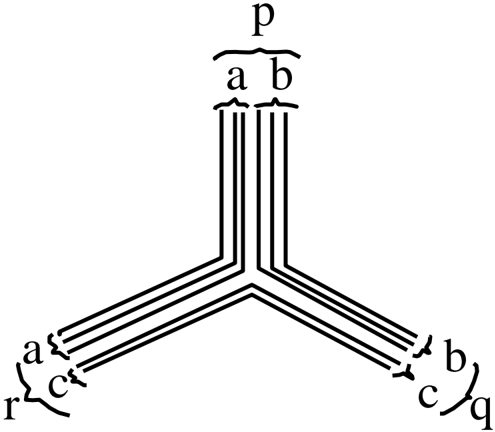
- The volume spectrum is discrete. For trivalent spin networks, the eigenvalue for a region \(R\) is \(V = \frac{1}{4} l_P^3 \sum_i \sqrt{a_i b_i c_i + a_i b_i + a_i c_i + b_i c_i}\), where the sum runs over nodes \(i\) contained in \(R\).
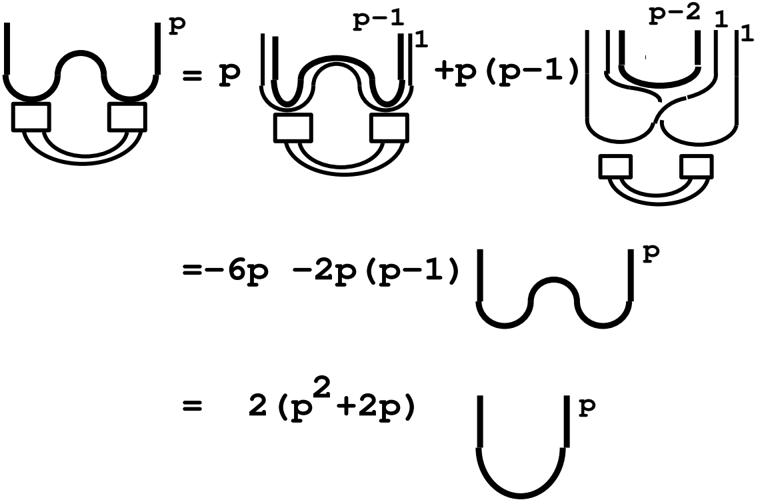
- The full area spectrum is \(A = \frac{1}{2} l_P^2 \sum_l \sqrt{p_l^2 + 2p_l}\), where \(l\) labels spin-network links crossing the surface.
- Spin-network states are eigenstates of the volume operator and also diagonalize the area operator; the two operators commute. Other volume eigenstates are related to a generalization of spin networks, with eigenvalues computable by diagonalizing finite-dimensional matrices.
- The authors argue that, under assumptions about physical fields defining regions and surfaces, Planck-scale measurements of volume or area would yield results in these discrete spectra.
Methods
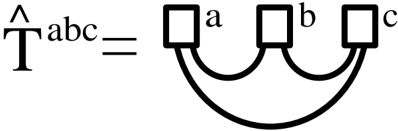
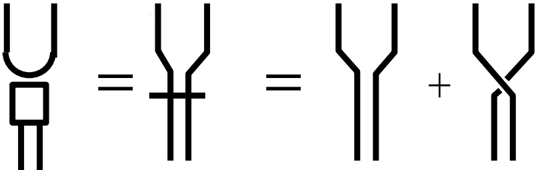
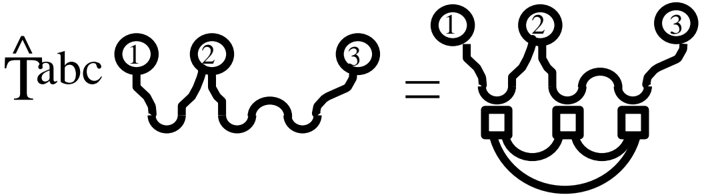
- Theoretical, non-perturbative quantum gravity in the loop representation. The volume operator is constructed via a diffeomorphism-invariant regularization using the three-hand loop observable \(T^{abc}\), partitioning a region into cubic boxes with an arbitrary unphysical flat metric \(g_0\), and taking a weak-operator limit \(L \to 0\).
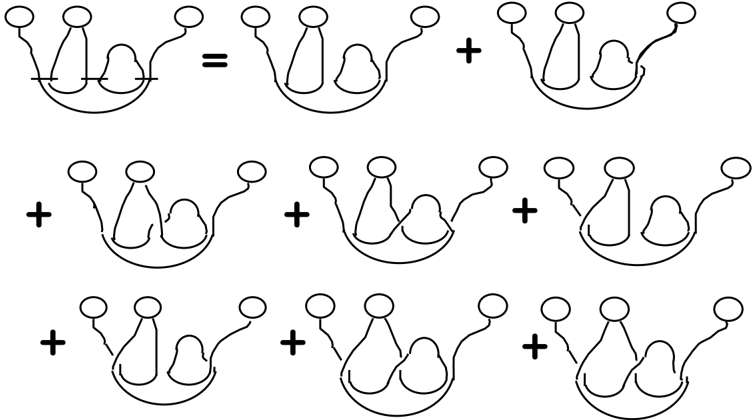
- The action of the volume operator is computed on the spin-network basis, where spin networks are trivalent graphs with positive integer link colors; the area operator is similarly diagonalized.
- No empirical data are used; the analysis is operator construction and spectral diagonalization.
Limitations
- The paper states that the local operator \(\sqrt{\det g}\) is ill-defined, that the regularization introduces an unphysical background metric \(g_0\) (though the operator is claimed independent of it in the limit), that the topology of the limit is delicate, and that diffeomorphism-invariant states lie in \(D_{\max}\) but not in the domain \(D\). It also notes that consistency of the theory is not proven and that quantization may have more than one solution.
- Evident from the provided text: the excerpt is truncated after the proportionality coefficient, so later sections and full derivation details are not available here. The physical interpretation also relies on assumptions about dynamical matter fields defining spatial regions and surfaces.
Model-written summary of a shortened version of the paper’s full text (it is longer than we read). Check it against the paper before relying on it.
Integrity signals
Registry
Cites
Statistics
Figures

Verification
Claims the paper makes
1 Valid · 4 Not valid · 5 Not checked · 18 Own results and interpretations
The sources with a verdict support this claim; the rest weren’t checked yet, have no full text we could read, or their verdicts aren’t rated yet.
In the paper
“Local quantities tend to be divergent or ill-defined in non-trivial generally covariant quantum field theories [3, 4, 11], a fact likely to be related to the non-renormalizability of the perturbative series.”
What the sources say
- Not checked — no full text of the sourcecites [3] matched to “Loop space representation of quantum general relativity” (1990) source
- Supportedcites [4] matched to “Weaving a classical metric with quantum threads” (1992) source
The Abstract says local operators such as the metric at a point may not be well-defined. The discussion of the local metric operator explains that its renormalization obstructs meaningful local geometric operators and says this appears to be a general feature of diffeomorphism-invariant theories. The claim’s separate suggestion about perturbative non-renormalizability is not the part attributed to this citation. (LLM, conf=0.90)
- Could not verifycites [11] matched to “Link Invariants, Holonomy Algebras and Functional Integration” (1993) sourceExperimental — accuracy not yet measured
The Introduction (pp. 1–2) discusses difficulties defining field-theoretic measures, and p. 4 describes regularized Wilson loops. Neither passage says that local quantities tend to diverge or be ill-defined in non-trivial generally covariant quantum field theories. Searches for local observables, divergences, and renormalization found no passage addressing that claim. (LLM, conf=0.73)
hedgedstates an association- Asserted: passes — The authors put it forward as true.
- Checkable: passes — It can be checked against evidence.
- Load-bearing: passes — The paper’s conclusions depend on it.
- Based: passes — The paper gives a reason why it holds.
The cited sources that could be checked couldn’t confirm or dispute this claim.
In the paper
“note for instance that there are other relevant topologies in state space, as the norm topologies defined by the kinematical or diffeomorphism-invariant Hilbert structures [6, 7], which are inequivalent to the one in which the limit (13) is taken.”
What the sources say
- Could not verifycites [6] matched to “Fermions in quantum gravity” (1994) sourceExperimental — accuracy not yet measured
Section 6.2 (pp. 33–34) uses pointwise topology in a model example about limits on knot states, but says a complete scalar product for the loop representation is not yet available. Neither those passages nor the passages found by searching for Hilbert norm topologies establish kinematical or diffeomorphism-invariant norm topologies, or their inequivalence to the topology used for the cited limit. (LLM, conf=0.72)
- Could not verifycites [7] matched to “Spatial infinity as a boundary of spacetime” (1992) sourceExperimental — accuracy not yet measured
The passages in §4, “Asymptotic symmetries” (page not supplied), discuss equivalence of spacetime completions, not topologies on a state space. Searches for Hilbert norm topologies and inequivalent state-space limits found no passage addressing the attributed claim. (LLM, conf=0.76)
plain- Asserted: passes — The authors put it forward as true.
- Checkable: passes — It can be checked against evidence.
- Load-bearing: unclear — It is unclear whether the paper’s conclusions depend on it.
- Based: passes — The paper gives a reason why it holds.
- Could not verify
A result the paper reports from its own data — it cites no other source for it, so there is none to check. The quote shows it is in the paper.
In the paper
“We find that the spectrum of the volume of any physical region is discrete.”
plain- Asserted: passes — The authors put it forward as true.
- Checkable: passes — It can be checked against evidence.
- Load-bearing: passes — The paper’s conclusions depend on it.
- Based: passes — The paper gives a reason why it holds.
A result the paper states — it cites no source for it, so there is none to check. The quote shows it is in the paper.
In the paper
“An unphysical background metric is introduced for the sake of the regularization, but the operator turns out to be independent of this background, in the limit in which the cut-off is removed.”
plain- Asserted: passes — The authors put it forward as true.
- Checkable: passes — It can be checked against evidence.
- Load-bearing: passes — The paper’s conclusions depend on it.
- Based: passes — The paper gives a reason why it holds.
In the paper
“Furthermore, we show here that the spin network states also diagonalize the operator Â[S], introduced in [3], which measures the area of the surface S.”
What the sources say
- Not checked — no full text of the sourcecites [3] matched to “Loop space representation of quantum general relativity” (1990) source
boostedstates an association- Asserted: passes — The authors put it forward as true.
- Checkable: passes — It can be checked against evidence.
- Load-bearing: passes — The paper’s conclusions depend on it.
- Based: passes — The paper gives a reason why it holds.
12 more claims
Create a free account to see all 28 claims and every source verdict.
- It may state two separate claims as one. 5
- Probably not a substantial claim. 5
- The quote only partly states this claim. 1
Claims other papers make about this one
Each is checked against this paper’s own text: does it say what the citing paper says it does?
The source backs part of the claim, not all of it — or backs it for a different population, condition or comparison.
In the citing paper
“In fact, that is why only volume and area operators could be constructed so far [10, 11].”
From A length operator for canonical quantum gravity (1998) · cites this paper as [10]
Experimental — accuracy not yet measuredThe source backs part of the claim, not all of it — or backs it for a different population, condition or comparison.
In the citing paper
“While the kinematics of loop quantum gravity (LQG) [1] is rather well understood [2, 3], its dynamics is not understood as cleanly.”
From Flipped spinfoam vertex and loop gravity (2008) · cites this paper as [4]
Experimental — accuracy not yet measuredThe source backs part of the claim, not all of it — or backs it for a different population, condition or comparison.
In the citing paper
“This problem arises due to the results obtained for the spectra of the geometrical operators and the black hole entropy being proportional to an unphysical parameter, which is called 'Immirzi parameter' [7] and appears as a parameter of a canonical transformation in classical gravity [8,9].”
From SO (4, C )-covariant Ashtekar-Barbero gravity and the Immirzi parameter (2000) · cites this paper as [9]
Experimental — accuracy not yet measuredThe cited source says what the claim attributes to it.
In the citing paper
“The results reported in this letter are obtained in the framework of quantum geometry [4] which does predict a discrete geometry because, e.g., the spectra of geometric operators as area and volume are discrete [5-7].”
From Absence of a Singularity in Loop Quantum Cosmology (2001) · cites this paper as [5]
The cited source says what the claim attributes to it.
In the citing paper
“Basic geometric quantities have been quantized [10][11][12][13][14] and found to have discrete spectra.”
From Loop quantum cosmology: I. Kinematics (2000) · cites this paper as [10]
17 more claims about this paper
Create a free account to see every claim other papers make about this one.
Citations
Cites
New Variables for Classical and Quantum Gravity
Ashtekar, A. (1986) · Physical Review Letters · doi:10.1103/physrevlett.57.2244 · Cited by 1,663
QUANTUM GRAVITY AND MINIMUM LENGTH
GARAY, L. J. (1995) · International Journal of Modern Physics A · doi:10.1142/s0217751x95000085 · Cited by 1,371
String theory beyond the Planck scale
Gross, D. J., & Mende, P. F. (1988) · Nuclear Physics B · doi:10.1016/0550-3213(88)90390-2 · Cited by 1,249
New Hamiltonian formulation of general relativity
Ashtekar, A. (1987) · Physical Review D · doi:10.1103/physrevd.36.1587 · Cited by 1,119
Quantum gravity and minimum length
Garay, L. J. (1994) · LA Referencia (Red Federada de Repositorios Institucionales de Publicaciones Científicas) · Cited by 881
Loop space representation of quantum general relativity
Rovelli, C., & Smolin, L. (1990) · Nuclear Physics B · doi:10.1016/0550-3213(90)90019-a · Cited by 806
Self-citationThe Hagedorn transition and the number of degrees of freedom of string theory
Atick, J. J., & Witten, E. (1988) · Nuclear Physics B · doi:10.1016/0550-3213(88)90151-4 · Cited by 800
The high-energy behavior of string scattering amplitudes
Gross, D. J., & Mende, P. F. (1987) · Physics Letters B · doi:10.1016/0370-2693(87)90355-8 · Cited by 778
Minimum physical length and the generalized uncertainty principle in string theory
Konishi, K., Paffuti, G., & Provero, P. (1990) · Physics Letters B · doi:10.1016/0370-2693(90)91927-4 · Cited by 753
On the nature of quantum geometrodynamics
Wheeler, J. A. (1957) · Annals of Physics · doi:10.1016/0003-4916(57)90050-7 · Cited by 693
Research works printed but not linked: 1
- Ashtekar, 1994, Quantum geometrodynamics and Coherent state transform on the space of connections, Penn. State University preprints
Cited by
Items 101–200 of 1,374
Reconcile Planck-scale discreteness and the Lorentz-Fitzgerald contraction
Rovelli, C., & Speziale, S. (2003) · Physical Review D · doi:10.1103/physrevd.67.064019 · Cited by 136
“[6] C Rovelli, L Smolin, Discreteness of area and volume in quantum gravity, Nucl Phys B442 (1995) 593; Erratum: Nucl Phys B456 (1995) 734.”
BackgroundAN INVITATION TO LOOP QUANTUM GRAVITY
SMOLIN, L. (2004) · Quantum Theory and Symmetries · doi:10.1142/9789812702340_0078 · Cited by 131
“ator that measures angles in the quantum geometry[73] and the lengths of curves in Σ[74]. 21 3. The area, volume and length operators have discrete, finite spectra, valued in terms of the Planck length[64, 65, 66, 74]. There is hence a smallest possible volume, a smallest possible area, and a smallest possible length,…”
BackgroundSelf-citationGauge field theory coherent states (GCS): III. Ehrenfest theorems
Thiemann, T., & Winkler, O. (2001) · Classical and Quantum Gravity · doi:10.1088/0264-9381/18/21/315 · Cited by 133
Causal evolution of spin networks
Markopoulou, F., & Smolin, L. (1997) · Nuclear Physics B · doi:10.1016/s0550-3213(97)80019-3 · Cited by 134
“The kinematical state space consists of diffeomorphism classes of spin networks[11, 12].”
BackgroundSelf-citationGauge field theory coherent states (GCS): IV. Infinite tensor product and thermodynamical limit
Thiemann, T., & Winkler, O. (2001) · Classical and Quantum Gravity · doi:10.1088/0264-9381/18/23/302 · Cited by 130
Black Hole Mass Threshold from Nonsingular Quantum Gravitational Collapse
Bojowald, M., Goswami, R., Maartens, R., & Singh, P. (2005) · Physical Review Letters · doi:10.1103/physrevlett.95.091302 · Cited by 156
Loop quantum cosmology: IV. Discrete time evolution
Bojowald, M. (2001) · Classical and Quantum Gravity · doi:10.1088/0264-9381/18/6/308 · Cited by 128
“Here, one can expect significant departures from the usual minisuperspace quantizations described above, because the volume, which has been used as internal time, is now quantized at least at the kinematical level [12, 13] (note that the parameters a and β above can take all positive values and thus show no volume qua…”
MethodQuantum theory of geometry: III. Non-commutativity of Riemannian structures
Ashtekar, A., Corichi, A., & Zapata, J. A. (1998) · Classical and Quantum Gravity · doi:10.1088/0264-9381/15/10/006 · Cited by 129
Thiemann, T. (1998) · Classical and Quantum Gravity · doi:10.1088/0264-9381/15/5/011 · Cited by 128
LQG propagator from the new spin foams
Bianchi, E., Magliaro, E., & Perini, C. (2009) · Nuclear Physics B · doi:10.1016/j.nuclphysb.2009.07.016 · Cited by 126
“(2) The operator O can be a geometric operator as the area, the volume or the length [36, 37, 38, 39, 40, 41, 42].”
BackgroundDynamical Initial Conditions in Quantum Cosmology
Bojowald, M. (2001) · Physical Review Letters · doi:10.1103/physrevlett.87.121301 · Cited by 125
Loop quantum cosmology: I. Kinematics
Bojowald, M. (2000) · Classical and Quantum Gravity · doi:10.1088/0264-9381/17/6/312 · Cited by 125
“Basic geometric quantities have been quantized [10, 11, 12, 13, 14] and found to have discrete spectra.”
BackgroundQuantum gravity with a positive cosmological constant
Smolin, L. (2002) · arXiv (Cornell University) · doi:10.48550/arxiv.hep-th/0209079 · Cited by 124
“isely and is characterized in terms of spin networks[23], which provide an exact orthonormal basis[24]. • Among the operators which are understood, and which are finite after a regularization procedure[3, 25], are the area of surfaces (such as the boundary, when one is present) and the volume of regions, including the…”
BackgroundSelf-citationVolume Operator in Discretized Quantum Gravity
Loll, R. (1995) · Physical Review Letters · doi:10.1103/physrevlett.75.3048 · Cited by 124
“For the special case of a trivalent graph, Rovelli and Smolin have given a prescription for associating with each labelling of flux lines a unique quantum state, obtained by appropriately (anti)symmetrizing over all possible Wilson loop states sharing the same flux labels [6]: calling temporarily j(l) the occupation n…”
BackgroundMethodResultInfluentialDiffeomorphism Symmetry in Quantum Gravity Models
Dittrich, B. (2009) · Advanced Science Letters · doi:10.1166/asl.2009.1022 · Cited by 123
The semiclassical limit of loop quantum cosmology
Bojowald, M. (2001) · Classical and Quantum Gravity · doi:10.1088/0264-9381/18/18/101 · Cited by 123
Coherent States for Canonical Quantum General Relativity and the Infinite Tensor Product Extension
Sahlmann, H., Thiemann, T., & Winkler, O. (2001) · CERN Document Server (European Organization for Nuclear Research) · Cited by 133
Deformed special relativity and deformed symmetries in a canonical framework
Ghosh, S., & Pal, P. (2007) · Physical review. D. Particles, fields, gravitation, and cosmology/Physical review. D. Particles and fields · doi:10.1103/physrevd.75.105021 · Cited by 119
Quantum Cosmology from Group Field Theory Condensates: a Review
Imperial College London, U., Gielen, S., Sindoni, L., & Max Planck Institute for Gravitational Physics, G. (2016) · Symmetry, Integrability and Geometry: Methods and Applications · doi:10.3842/sigma.2016.082 · Cited by 117
“On the other hand, one of the central results of LQG has been the realisation that, at least at the kinematical level, the spectra of area and volume operators are discrete [126], although whether this implies discreteness for physical states is far from clear [58].”
BackgroundScaling behavior of three-dimensional group field theory
Magnen, J., Noui, K., Rivasseau, V., & Smerlak, M. (2009) · Classical and Quantum Gravity · doi:10.1088/0264-9381/26/18/185012 · Cited by 116
Complexifier coherent states for quantum general relativity
Thiemann, T. (2006) · Classical and Quantum Gravity · doi:10.1088/0264-9381/23/6/013 · Cited by 115
Quantum gravity and spin-1/2 particle effective dynamics
Alfaro, J., Morales-Técotl, H. A., & Urrutia, L. F. (2002) · Physical Review D · doi:10.1103/physrevd.66.124006 · Cited by 115
Simplification of the spectral analysis of the volume operator in loop quantum gravity
Brunnemann, J., & Thiemann, T. (2006) · Classical and Quantum Gravity · doi:10.1088/0264-9381/23/4/014 · Cited by 115
Towards the QFT on curved spacetime limit of QGR: II. A concrete implementation
Sahlmann, H., & Thiemann, T. (2006) · Classical and Quantum Gravity · doi:10.1088/0264-9381/23/3/020 · Cited by 114
“…states are constructed precisely in such a way that the holonomy operators along the edges of γ (s) are well approximated and, as we will explicitly prove in this work, they also approximate very well the volume operator of [37, 38] at least if the graph is six-valent, e.g. of cubic topology.”
BackgroundA spin foam model without bubble divergences
Perez, A., & Rovelli, C. (2001) · Nuclear Physics B · doi:10.1016/s0550-3213(01)00030-x · Cited by 113
SO (4, C )-covariant Ashtekar-Barbero gravity and the Immirzi parameter
Alexandrov, S. (2000) · Classical and Quantum Gravity · doi:10.1088/0264-9381/17/20/307 · Cited by 112
Lewandowski, J. (1997) · Classical and Quantum Gravity · doi:10.1088/0264-9381/14/1/010 · Cited by 112
Loop quantum cosmology: from pre-inflationary dynamics to observations
Ashtekar, A., & Barrau, A. (2015) · Classical and Quantum Gravity · doi:10.1088/0264-9381/32/23/234001 · Cited by 141
“[13] C.”
BackgroundGauge invariant cosmological perturbation equations with corrections from loop quantum gravity
Bojowald, M., Hossain, G. M., Kagan, M. A., & Shankaranarayanan, S. (2009) · Physical review. D. Particles, fields, gravitation, and cosmology/Physical review. D. Particles and fields · doi:10.1103/physrevd.79.043505 · Cited by 125
“In particular, operators for spatial geometry such as the fluxes themselves or areas and volumes acquire discrete spectra [22, 23, 24].”
BackgroundQuantum theory of geometry III: Non-commutativity of Riemannian structuresPreprint
Ashtekar, A., Corichi, R., Zapata, J. A., & México, A. (1998) · Cited by 121
Clock and category: is quantum gravity algebraic?
Crane, L. (1995) · CERN Document Server (European Organization for Nuclear Research) · Cited by 106
Thiemann, T. (2001) · Classical and Quantum Gravity · doi:10.1088/0264-9381/18/17/301 · Cited by 106
GUP-corrected thermodynamics for all black objects and the existence of remnants
Faizal, M., & Khalil, M. M. (2015) · International Journal of Modern Physics A · doi:10.1142/s0217751x15501444 · Cited by 126
Regularization ambiguities in loop quantum gravity
Perez, A. (2006) · Physical Review D · doi:10.1103/physrevd.73.044007 · Cited by 106
On Quantum Statistical Mechanics of a Schwarzschild Black Hole
Krasnov, K. V. (1998) · General Relativity and Gravitation · doi:10.1023/a:1018820916342 · Cited by 106
“Note also, that because of gauge invariance not all sets of spins are allowed [6].”
BackgroundMethodInfluentialOn Quantum Statistical Mechanics of a Schwarzschild Black Hole
Krasnov, K. V. (1996) · arXiv · doi:10.48550/arxiv.gr-qc/9605047 · Cited by 106
Tensorial Methods and Renormalization in Group Field Theories
Carrozza, S. (2014) · Springer Theses · doi:10.1007/978-3-319-05867-2 · Cited by 105
“Indeed, the key prediction of canonical loop quantum gravity is undoubtedly the discreteness of areas and volumes at the kinematical level [29], and this already entails some kind of emergence of continuum space-time.”
Loop quantum cosmology in Bianchi type I models: Analytical investigation
Chiou, D.-W. (2007) · Physical Review D · doi:10.1103/physrevd.75.024029 · Cited by 104
“Following the same strategy (μ-scheme) in [1, 2, 6], we demand this eigenvalue to be be ∆ = 2 √ 3πγl(2)Pl, the area gap of the full theory [27, 28, 29].”
The length operator in Loop Quantum Gravity
Bianchi, E. (2009) · Nuclear Physics B · doi:10.1016/j.nuclphysb.2008.08.013 · Cited by 105
“5The construction we discuss here is based on [5], [26], [1] but does not completely coincide with it.”
BackgroundMethodInfluentialNon-rotating BTZ black hole area spectrum from quasi-normal modes
Setare, M. R. (2004) · Classical and Quantum Gravity · doi:10.1088/0264-9381/21/6/012 · Cited by 113
Coarse graining methods for spin net and spin foam models
Dittrich, B., Eckert, F. C., & Martin-Benito, M. (2012) · New Journal of Physics · doi:10.1088/1367-2630/14/3/035008 · Cited by 103
“This discrete (a priory auxiliary) structure should not be confused with another feature of spin foams, which is often termed ‘Planck scale discreteness’ [12–16], namely that the spectra of (kinematical) geometrical quantum observables, like areas and volumes, are discrete.”
BackgroundPolymer and Fock representations for a scalar field
Ashtekar, A., Lewandowski, J., & Sahlmann, H. (2002) · Classical and Quantum Gravity · doi:10.1088/0264-9381/20/1/103 · Cited by 140
Gauge field theory coherent states (GCS) III: Ehrenfest theorems
Thiemann, T., & Winkler, O. (2001) · Max Planck Institute for Plasma Physics · Cited by 114
Topics in Noncommutative Geometry Inspired Physics
Banerjee, R., Chakraborty, B., Ghosh, S., Mukherjee, P., & Samanta, S. (2009) · Foundations of Physics · doi:10.1007/s10701-009-9349-y · Cited by 118
Quantum deformation of quantum gravity
Major, S., & Smolin, L. (1996) · Nuclear Physics B · doi:10.1016/0550-3213(96)00259-3 · Cited by 103
Self-citationShadow and stability of quantum-corrected black holes
Yang, J., Zhang, C., & Ma, Y. (2023) · The European Physical Journal C · doi:10.1140/epjc/s10052-023-11800-8 · Cited by 132
Reality conditions inducing transforms for quantum gauge field theory and quantum gravity
Thiemann, T. (1996) · Classical and Quantum Gravity · doi:10.1088/0264-9381/13/6/012 · Cited by 102
Quantum spacetime: What do we know?
Rovelli, C. (2001) · Cambridge University Press eBooks · doi:10.1017/cbo9780511612909.005 · Cited by 122
“The spectrum of these operators has been computed and turns out to be discrete (Rovelli and Smolin 1995b, Ashtekar Lewandowski 1997a, 1997b).”
BackgroundSelf-citationSelf-dual black holes in loop quantum gravity: Theory and phenomenology
Modesto, L., & Prémont-Schwarz, I. (2009) · Physical review. D. Particles, fields, gravitation, and cosmology/Physical review. D. Particles and fields · doi:10.1103/physrevd.80.064041 · Cited by 116
Complexifier Coherent States for Quantum General Relativity
Thiemann, T. (2006) · Max Planck Institute for Plasma Physics · Cited by 100
Quantum spin dynamics: VIII. The master constraint
Thiemann, T. (2006) · Classical and Quantum Gravity · doi:10.1088/0264-9381/23/7/003 · Cited by 99
Relation between polymer and Fock excitations
Ashtekar, A., & Lewandowski, J. (2001) · Classical and Quantum Gravity · doi:10.1088/0264-9381/18/18/102 · Cited by 99
Physics on the smallest scales: an introduction to minimal length phenomenology
Sprenger, M., Nicolini, P., & Bleicher, M. (2012) · European Journal of Physics · doi:10.1088/0143-0807/33/4/853 · Cited by 130
Are the spectra of geometrical operators in loop quantum gravity really discrete?
Dittrich, B., & Thiemann, T. (2009) · Journal of Mathematical Physics · doi:10.1063/1.3054277 · Cited by 96
“In particular there exists an area gap [2, 3] but apparently no volume gap [5].”
BackgroundMethodInfluentialAre the spectra of geometrical operators in Loop Quantum Gravity really discrete?
Dittrich, B., & Thiemann, T. (2007) · MPG.PuRe (Max Planck Society) · Cited by 96
“Forget time”: Essay written for the FQXi contest on the Nature of Time
Rovelli, C. (2011) · Foundations of Physics · doi:10.1007/s10701-011-9561-4 · Cited by 147
Self-citationQUANTUM GRAVITY AND HIGHER CURVATURE ACTIONS
BOJOWALD, M., & SKIRZEWSKI, A. (2007) · International Journal of Geometric Methods in Modern Physics · doi:10.1142/s0219887807001941 · Cited by 96
“Operators such as area and volume can be constructed from fluxes alone and inherit the discreteness of spectra [22].”
BackgroundSpectrum of charged black holes—the big fix mechanism revisited
Barvinsky, A. O., Das, S., & Kunstatter, G. (2001) · Classical and Quantum Gravity · doi:10.1088/0264-9381/18/22/310 · Cited by 103
Black Hole Interior from Loop Quantum Gravity
Modesto, L. (2008) · Advances in High Energy Physics · doi:10.1155/2008/459290 · Cited by 121
Projector on physical states in loop quantum gravity
Rovelli, C. (1999) · Physical Review D · doi:10.1103/physrevd.59.104015 · Cited by 95
The complete spectrum of the area from recoupling theory in loop quantum gravity
Frittelli, S., Lehner, L., & Rovelli, C. (1996) · Classical and Quantum Gravity · doi:10.1088/0264-9381/13/11/008 · Cited by 95
Self-citationQuantum geometry with intrinsic local causality
Markopoulou, F., & Smolin, L. (1998) · Physical Review D · doi:10.1103/physrevd.58.084032 · Cited by 95
“This interpretation will be developed in the next section, where we will see that an example in the case of SU(2) is given by the area operator obtained in quantum general relativity [11, 2].”
BackgroundMethodInfluentialSelf-citationRovelli, C. (2013) · Proceedings of 3rd Quantum Gravity and Quantum Geometry School — PoS(QGQGS 2011) · doi:10.22323/1.140.0003 · Cited by 93
“It represents a “granular" space where each node n represents a “grain" or “quantum" of space [50].”
BackgroundSelf-citationSpectra of length and area in (2 1) Lorentzian loop quantum gravity
Freidel, L., Livine, E. R., & Rovelli, C. (2003) · Classical and Quantum Gravity · doi:10.1088/0264-9381/20/8/304 · Cited by 93
Potential Gravitational Wave Signatures of Quantum Gravity
Agulló, I., Cardoso, V., del Río, A., Maggiore, M., & Pullin, J. A. (2021) · Physical Review Letters · doi:10.1103/physrevlett.126.041302 · Cited by 116
Physics on Smallest Scales - An Introduction to Minimal Length Phenomenology
Sprenger, M., Nicolini, P., & Bleicher, M. (2012) · Desy Publications Database (Deutsches Elektronen-Synchrotron DESY) · Cited by 103
Modified dispersion relations and black hole physics
Ling, Y., Hu, B., & Li, X. (2006) · Physical review. D. Particles, fields, gravitation, and cosmology/Physical review. D. Particles and fields · doi:10.1103/physrevd.73.087702 · Cited by 98
Lorentz and CPT invariance violation in high-energy neutrinos
Hooper, D., Morgan, D., & Winstanley, E. (2005) · Physical review. D. Particles, fields, gravitation, and cosmology/Physical review. D. Particles and fields · doi:10.1103/physrevd.72.065009 · Cited by 111
Loop Quantum Gravity and the Meaning of Diffeomorphism Invariance
Rovelli, C., & Gaul, M. (2007) · Lecture Notes in Physics · doi:10.1007/3-540-46634-7_11 · Cited by 89
“f quantized gravity, i.e. in a quantum space–time regime. As will be discussed later, one of the key results obtained so far in loop quantum gravity has been the calculation of the quanta of geometry [7], i.e. the spectra of the quantum analogues to the classical area and volume functionals. Remarkably they turned out…”
BackgroundResultSelf-citationQuantum-reduced loop gravity: Cosmology
Alesci, E., & Cianfrani, F. (2013) · Physical Review D · doi:10.1103/physrevd.87.083521 · Cited by 90
Spectrum of the volume operator in quantum gravity
Loll, R. (1996) · Nuclear Physics B · doi:10.1016/0550-3213(95)00627-3 · Cited by 90
“This, as well as the spectral discreteness of the volume operator, was first pointed out in [2].”
BackgroundLoop quantum gravity: the first 25 years
Rovelli, C. (2011) · Classical and Quantum Gravity · doi:10.1088/0264-9381/28/15/153002 · Cited by 162
Self-citationLoop quantum cosmology: Recent progress
Bojowald, M. (2004) · Pramana · doi:10.1007/bf02705198 · Cited by 102
Anomaly-free cosmological perturbations in effective canonical quantum gravity
Barrau, A., Bojowald, M., Calcagni, G., Grain, J., & Kagan, M. (2015) · Journal of Cosmology and Astroparticle Physics · doi:10.1088/1475-7516/2015/05/051 · Cited by 121
“They have discrete spectra, indicating that space acquires a discrete geometric structure [27, 28].”
BackgroundComplete LQG propagator. II. Asymptotic behavior of the vertex
Alesci, E., & Rovelli, C. (2008) · Physical Review D · doi:10.1103/physrevd.77.044024 · Cited by 89
Self-citationLoop quantum cosmology and inhomogeneities
Bojowald, M. (2006) · CERN Document Server (European Organization for Nuclear Research) · Cited by 88
Thiemann, T. (1998) · Classical and Quantum Gravity · doi:10.1088/0264-9381/15/6/005 · Cited by 88
How far are we from the quantum theory of gravity?
Smolin, L. (2003) · arXiv (Cornell University) · doi:10.48550/arxiv.hep-th/0303185 · Cited by 87
“classical general relativity is actually only a coarse grained approximation to a discrete structure, in which surfaces and regions can have only certain, discrete quantized values of areas and volume[10, 18, 74, 75, 17]. Loop quantum gravity makes specific predictions for the discrete quantum geometry at short distanc…”
BackgroundInfluentialSelf-citationEdge modes of gravity. Part III. Corner simplicity constraints
Freidel, L., Geiller, M., & Pranzetti, D. (2021) · Journal of High Energy Physics · doi:10.1007/jhep01(2021)100 · Cited by 141
“In the time gauge, where nI = (1, 0, 0, 0), this generator is the celebrated LQG flux generator which gets quantized in terms of spin network states [29, 30].”
BackgroundQuantum mechanics of charged black holes
Barvinsky, A. O., Das, S., & Kunstatter, G. (2001) · Physics Letters B · doi:10.1016/s0370-2693(01)00983-2 · Cited by 89
Riello, A. (2013) · Physical Review D · doi:10.1103/physrevd.88.024011 · Cited by 86
“This will be first done in complete generality from an algebraic, rather abstract, point of view, and later given a much more transparent geometric inter9Here, the term “infrared” must be understood as relating to large physical distances; analogously, an “ultraviolet” cut-off, in the sense of a short distance cut-off…”
BackgroundRovelli, C. (2007) · Philosophy of Physics · doi:10.1016/b978-044451560-5/50015-4 · Cited by 86
Wüthrich, C. (2017) · Einstein studies · doi:10.1007/978-1-4939-3210-8_11 · Cited by 100
“These operators, which will be discussed in greater detail in §4.2, turn out to have discrete spectra (Ashtekar and Lewandowski 1997, 1998, 1999; Rovelli and Smolin 1995a,b).”
BackgroundInfluentialQuasinormal modes, black hole entropy, and quantum geometry
Corichi, A. (2003) · Physical review. D. Particles, fields, gravitation, and cosmology/Physical review. D. Particles and fields · doi:10.1103/physrevd.67.087502 · Cited by 88
Stepping out of homogeneity in loop quantum cosmology
Rovelli, C., & Vidotto, F. (2008) · Classical and Quantum Gravity · doi:10.1088/0264-9381/25/22/225024 · Cited by 85
Self-citationLoop quantum cosmology: II. Volume operators
Bojowald, M. (2000) · Classical and Quantum Gravity · doi:10.1088/0264-9381/17/6/313 · Cited by 85
“The momenta conjugate to the connections above are invariant (with respect to the Saction) density-weighted dreibeine given by Eai = √ g0 p I iX a I in terms of left invariant vector fields XI obeying ω I(XJ) = δ I J .”
MethodTowards the QFT on curved spacetime limit of QGR: I. A general scheme
Sahlmann, H., & Thiemann, T. (2006) · Classical and Quantum Gravity · doi:10.1088/0264-9381/23/3/019 · Cited by 84
“As we will see, with respect to coherent states of the type constructed in [10, 11], only cubic graphs will assign correct expectation values to the volume operator if the coefficient 1/(8 · 3”
Loop Quantum Cosmology II: Volume Operators
Bojowald, M. (2000) · RWTH Publications (RWTH Aachen) · Cited by 90
Consistent Loop Quantum CosmologyPreprint
Bojowald, M. (2008) · Cited by 96
Critical Evaluation of Common Claims in Loop Quantum Cosmology
Bojowald, M. (2020) · Universe · doi:10.3390/universe6030036 · Cited by 83
“iscrete structure of space in loop quantum gravity. While loop quantum gravity is a quantum theory of continuum fields, it leads to discrete spectra of geometrical operators such as the spatial volume [19, 20, 21, 22]. The corresponding quantum representation [23, 24] implies that the Hamiltonian constraint cannot be q…”
BackgroundSpherically Symmetric Quantum Geometry: Hamiltonian Constraint
Bojowald, M., & Swiderski, R. (2005) · CERN Document Server (European Organization for Nuclear Research) · Cited by 99
Loop quantum cosmology: III. Wheeler-DeWitt operators
Bojowald, M. (2001) · Classical and Quantum Gravity · doi:10.1088/0264-9381/18/6/307 · Cited by 83
“Loop quantum gravity [1], a program for the canonical quantization of general relativity, has lead to a well-understood theory of quantum geometry [2] predicting discrete spectra for geometrical operators like area or volume [3, 4, 5, 6, 7, 8].”
BackgroundMethodQuantum Deformation of Quantum Gravity
Major, S., & Smolin, L. (1995) · Cited by 79
Self-citationCosmological Applications of Loop Quantum Gravity
Bojowald, M., & Morales-Técotl, H. A. (2004) · Lecture notes in physics · doi:10.1007/978-3-540-40918-2_17 · Cited by 100
The complete spectrum of the area from recoupling theory in loop quantum gravity
Frittelli, S., Lehner, L., & Carlo Rovelli, C. (1996) · CERN Document Server (European Organization for Nuclear Research) · Cited by 82
Self-citationAlgebraic quantum gravity (AQG): II. Semiclassical analysis
Giesel, K., & Thiemann, T. (2007) · Classical and Quantum Gravity · doi:10.1088/0264-9381/24/10/004 · Cited by 108
Quantum field as a quantum cellular automaton: The Dirac free evolution in one dimension
Bisio, A., D’Ariano, G. M., & Tosini, A. (2015) · Annals of Physics · doi:10.1016/j.aop.2014.12.016 · Cited by 81
Loop quantum gravity and the cyclic universe
Bojowald, M., Maartens, R., & Singh, P. (2004) · Physical Review D · doi:10.1103/physrevd.70.083517 · Cited by 81
A new vacuum for loop quantum gravity
Dittrich, B., & Geiller, M. (2015) · Classical and Quantum Gravity · doi:10.1088/0264-9381/32/11/112001 · Cited by 102
“[32] C.”
Spin Foams and Canonical Quantization
Alexandrov, S. Y. (2012) · Symmetry Integrability and Geometry Methods and Applications · doi:10.3842/sigma.2012.055 · Cited by 108
Metadata
- Authors
- Rovelli, C., & Smolin, L.
- Affiliations
- Pennsylvania State University (US)
- Corresponding author
- Smolin, Lee
- ORCID
- Smolin, Lee
- Venue
- Nuclear Physics B
- Publisher
- Elsevier BV
- Published
- 1995-05
- Volume
- 442
- Issue
- 3
- Pages
- 593-619
- ISSN
- 0550-3213 (ISSN-L)
- OpenAlex
- W2104041846
- Semantic Scholar
- 3b85eebc659d3ae5d857e1d141fd5126db507eba
- Cited by
- 1,365
- References
- 63
- Citations by year
- 2026: 40 · 2025: 79 · 2024: 70 · 2023: 38 · 2022: 35 · 2021: 55 · 2020: 31 · 2019: 42 · 2018: 44 · 2017: 40 · 2016: 48 · 2015: 36 · 2014: 43 · 2013: 47 · 2012: 49
- FWCI
- 38.09
- Type
- journal article
- Language
- en
- Open access
- green
- arxiv.org
- Licence
- www.elsevier.com/tdm/userlicense/1.0/ (tdm)
- www.elsevier.com/legal/tdmrep-license (tdm)
- Locations
- Nuclear Physics B (publishedVersion)
- arXiv (Cornell University) (submittedVersion)
- CERN Document Server (European Organization for Nuclear Research) (submittedVersion)
- arXiv (Cornell University)
- Topics
- Physical Sciences › Physics and Astronomy › Nuclear and High Energy Physics › Noncommutative and Quantum Gravity Theories
- Physical Sciences › Physics and Astronomy › Astronomy and Astrophysics › Relativity and Gravitational Theory
- Physical Sciences › Physics and Astronomy › Nuclear and High Energy Physics › Black Holes and Theoretical Physics
- Keywords
- quantum gravity, loop representation, spin networks, volume operator, area operator, diffeomorphism invariance, background independence, Planck-scale geometry, non-perturbative quantum gravity
About these checks
Registry, retraction, Cites and statistics results are computed, not judged, with one exception: a printed reference that no index lists is read once by a model before it counts as a citation error. Claims are extracted by a model and kept only when their quote appears verbatim in the text; each cited source is then checked, with a model’s help, for whether it says what the claim relies on. Those verdicts can be wrong — read the claim’s quote and the cited source before relying on one.
The claim verdicts this report counts are experimental: their accuracy is not yet measured.
A language model drew the claims from the paper on 2026-10-07, under version 3 of the claim definition (model deepseek-v4.1-flash, prompt extract-v3).
A second model labelled each claim on 2026-10-07 (model jev-1.13-20260917, definition revision gold-guideline-v0.2).
Cited sources are checked with a language model’s help (gpt-6-sol).
Statistics and arithmetic are recomputed, not judged.
Confidence bands are shown only for fields calibrated on our annotated test set. None is calibrated yet, so no band is shown.
What counts as a claim ›How we measure confidence ›How we check this ›
Are you an author, or do you see a problem with this page? Request a review
Data sources
Bibliographic data: Semantic Scholar, OpenAlex, Crossref.
Contains information from the Semantic Scholar Academic Graph Datasets, made available under the ODC Attribution License (ODC-BY 1.0).
Semantic Scholar’s data is described in: Kinney, R., et al. (2023). The Semantic Scholar Open Data Platform. arXiv:2301.10140.
