

Discreteness of area and volume in quantum gravity
Open accessThe DOI matches its Crossref record; 60 of the 63 references it cites were found in a registry or an index; 6 of the 14 sources its claims cite were checked for support.
Abstract
We study the operator that corresponds to the measurement of volume, in non-perturbative quantum gravity, and we compute its spectrum. The operator is constructed in the loop representation, via a regularization procedure; it is finite, background independent, and diffeomorphism-invariant, and therefore well defined on the space of diffeomorphism invariant states (knot states). We find that the spectrum of the volume of any physical region is discrete. A family of eigenstates are in one to one correspondence with the spin networks, which were introduced by Penrose in a different context. We compute the corresponding component of the spectrum, and exhibit the eigenvalues explicitly. The other eigenstates are related to a generalization of the spin networks, and their eigenvalues can be computed by diagonalizing finite dimensional matrices. Furthermore, we show that the eigenstates of the volume diagonalize also the area operator. We argue that the spectra of volume and area determined here can be considered as predictions of the loop-representation formulation of quantum gravity on the outcomes of (hypothetical) Planck-scale sensitive measurements of the geometry of space.
Overview
CoChat Summary
TL;DR
Rovelli and Smolin construct a regularized volume operator in loop-representation quantum gravity and compute its spectrum, finding it discrete. They show spin-network states diagonalize both the volume and area operators, yielding explicit discrete area and volume eigenvalues.
Key findings
- The volume spectrum is discrete. For trivalent spin networks, the eigenvalue for a region \(R\) is \(V = \frac{1}{4} l_P^3 \sum_i \sqrt{a_i b_i c_i + a_i b_i + a_i c_i + b_i c_i}\), where the sum runs over nodes \(i\) contained in \(R\).
- The full area spectrum is \(A = \frac{1}{2} l_P^2 \sum_l \sqrt{p_l^2 + 2p_l}\), where \(l\) labels spin-network links crossing the surface.
- Spin-network states are eigenstates of the volume operator and also diagonalize the area operator; the two operators commute. Other volume eigenstates are related to a generalization of spin networks, with eigenvalues computable by diagonalizing finite-dimensional matrices.
- The authors argue that, under assumptions about physical fields defining regions and surfaces, Planck-scale measurements of volume or area would yield results in these discrete spectra.
Methods
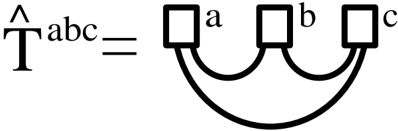
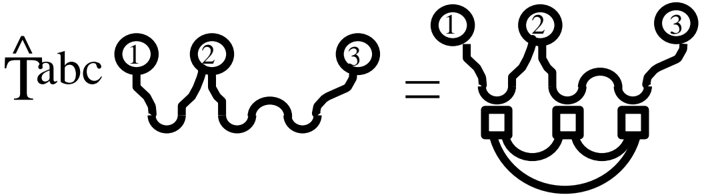
- Theoretical, non-perturbative quantum gravity in the loop representation. The volume operator is constructed via a diffeomorphism-invariant regularization using the three-hand loop observable \(T^{abc}\), partitioning a region into cubic boxes with an arbitrary unphysical flat metric \(g_0\), and taking a weak-operator limit \(L \to 0\).
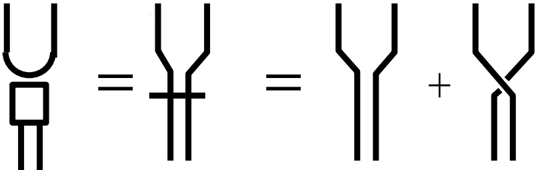
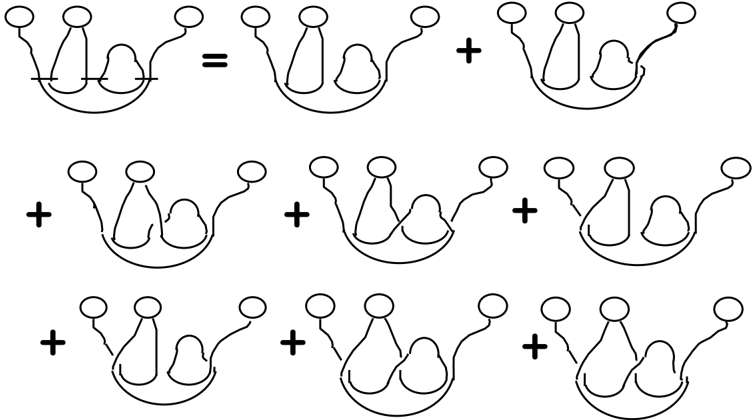
- The action of the volume operator is computed on the spin-network basis, where spin networks are trivalent graphs with positive integer link colors; the area operator is similarly diagonalized.
- No empirical data are used; the analysis is operator construction and spectral diagonalization.
Limitations
- The paper states that the local operator \(\sqrt{\det g}\) is ill-defined, that the regularization introduces an unphysical background metric \(g_0\) (though the operator is claimed independent of it in the limit), that the topology of the limit is delicate, and that diffeomorphism-invariant states lie in \(D_{\max}\) but not in the domain \(D\). It also notes that consistency of the theory is not proven and that quantization may have more than one solution.
- Evident from the provided text: the excerpt is truncated after the proportionality coefficient, so later sections and full derivation details are not available here. The physical interpretation also relies on assumptions about dynamical matter fields defining spatial regions and surfaces.
Model-written summary of a shortened version of the paper’s full text (it is longer than we read). Check it against the paper before relying on it.
Integrity signals
Registry
Cites
Statistics
Figures

Verification
Claims the paper makes
1 Valid · 4 Not valid · 5 Not checked · 18 Own results and interpretations
The sources with a verdict support this claim; the rest weren’t checked yet, have no full text we could read, or their verdicts aren’t rated yet.
In the paper
“Local quantities tend to be divergent or ill-defined in non-trivial generally covariant quantum field theories [3, 4, 11], a fact likely to be related to the non-renormalizability of the perturbative series.”
What the sources say
- Not checked — no full text of the sourcecites [3] matched to “Loop space representation of quantum general relativity” (1990) source
- Supportedcites [4] matched to “Weaving a classical metric with quantum threads” (1992) source
The Abstract says local operators such as the metric at a point may not be well-defined. The discussion of the local metric operator explains that its renormalization obstructs meaningful local geometric operators and says this appears to be a general feature of diffeomorphism-invariant theories. The claim’s separate suggestion about perturbative non-renormalizability is not the part attributed to this citation. (LLM, conf=0.90)
- Could not verifycites [11] matched to “Link Invariants, Holonomy Algebras and Functional Integration” (1993) sourceExperimental — accuracy not yet measured
The Introduction (pp. 1–2) discusses difficulties defining field-theoretic measures, and p. 4 describes regularized Wilson loops. Neither passage says that local quantities tend to diverge or be ill-defined in non-trivial generally covariant quantum field theories. Searches for local observables, divergences, and renormalization found no passage addressing that claim. (LLM, conf=0.73)
hedgedstates an association- Asserted: passes — The authors put it forward as true.
- Checkable: passes — It can be checked against evidence.
- Load-bearing: passes — The paper’s conclusions depend on it.
- Based: passes — The paper gives a reason why it holds.
The cited sources that could be checked couldn’t confirm or dispute this claim.
In the paper
“note for instance that there are other relevant topologies in state space, as the norm topologies defined by the kinematical or diffeomorphism-invariant Hilbert structures [6, 7], which are inequivalent to the one in which the limit (13) is taken.”
What the sources say
- Could not verifycites [6] matched to “Fermions in quantum gravity” (1994) sourceExperimental — accuracy not yet measured
Section 6.2 (pp. 33–34) uses pointwise topology in a model example about limits on knot states, but says a complete scalar product for the loop representation is not yet available. Neither those passages nor the passages found by searching for Hilbert norm topologies establish kinematical or diffeomorphism-invariant norm topologies, or their inequivalence to the topology used for the cited limit. (LLM, conf=0.72)
- Could not verifycites [7] matched to “Spatial infinity as a boundary of spacetime” (1992) sourceExperimental — accuracy not yet measured
The passages in §4, “Asymptotic symmetries” (page not supplied), discuss equivalence of spacetime completions, not topologies on a state space. Searches for Hilbert norm topologies and inequivalent state-space limits found no passage addressing the attributed claim. (LLM, conf=0.76)
plain- Asserted: passes — The authors put it forward as true.
- Checkable: passes — It can be checked against evidence.
- Load-bearing: unclear — It is unclear whether the paper’s conclusions depend on it.
- Based: passes — The paper gives a reason why it holds.
- Could not verify
A result the paper reports from its own data — it cites no other source for it, so there is none to check. The quote shows it is in the paper.
In the paper
“We find that the spectrum of the volume of any physical region is discrete.”
plain- Asserted: passes — The authors put it forward as true.
- Checkable: passes — It can be checked against evidence.
- Load-bearing: passes — The paper’s conclusions depend on it.
- Based: passes — The paper gives a reason why it holds.
A result the paper states — it cites no source for it, so there is none to check. The quote shows it is in the paper.
In the paper
“An unphysical background metric is introduced for the sake of the regularization, but the operator turns out to be independent of this background, in the limit in which the cut-off is removed.”
plain- Asserted: passes — The authors put it forward as true.
- Checkable: passes — It can be checked against evidence.
- Load-bearing: passes — The paper’s conclusions depend on it.
- Based: passes — The paper gives a reason why it holds.
In the paper
“Furthermore, we show here that the spin network states also diagonalize the operator Â[S], introduced in [3], which measures the area of the surface S.”
What the sources say
- Not checked — no full text of the sourcecites [3] matched to “Loop space representation of quantum general relativity” (1990) source
boostedstates an association- Asserted: passes — The authors put it forward as true.
- Checkable: passes — It can be checked against evidence.
- Load-bearing: passes — The paper’s conclusions depend on it.
- Based: passes — The paper gives a reason why it holds.
12 more claims
Create a free account to see all 28 claims and every source verdict.
- It may state two separate claims as one. 5
- Probably not a substantial claim. 5
- The quote only partly states this claim. 1
Claims other papers make about this one
Each is checked against this paper’s own text: does it say what the citing paper says it does?
The source backs part of the claim, not all of it — or backs it for a different population, condition or comparison.
In the citing paper
“In fact, that is why only volume and area operators could be constructed so far [10, 11].”
From A length operator for canonical quantum gravity (1998) · cites this paper as [10]
Experimental — accuracy not yet measuredThe source backs part of the claim, not all of it — or backs it for a different population, condition or comparison.
In the citing paper
“While the kinematics of loop quantum gravity (LQG) [1] is rather well understood [2, 3], its dynamics is not understood as cleanly.”
From Flipped spinfoam vertex and loop gravity (2008) · cites this paper as [4]
Experimental — accuracy not yet measuredThe source backs part of the claim, not all of it — or backs it for a different population, condition or comparison.
In the citing paper
“This problem arises due to the results obtained for the spectra of the geometrical operators and the black hole entropy being proportional to an unphysical parameter, which is called 'Immirzi parameter' [7] and appears as a parameter of a canonical transformation in classical gravity [8,9].”
From SO (4, C )-covariant Ashtekar-Barbero gravity and the Immirzi parameter (2000) · cites this paper as [9]
Experimental — accuracy not yet measuredThe cited source says what the claim attributes to it.
In the citing paper
“The results reported in this letter are obtained in the framework of quantum geometry [4] which does predict a discrete geometry because, e.g., the spectra of geometric operators as area and volume are discrete [5-7].”
From Absence of a Singularity in Loop Quantum Cosmology (2001) · cites this paper as [5]
The cited source says what the claim attributes to it.
In the citing paper
“Basic geometric quantities have been quantized [10][11][12][13][14] and found to have discrete spectra.”
From Loop quantum cosmology: I. Kinematics (2000) · cites this paper as [10]
17 more claims about this paper
Create a free account to see every claim other papers make about this one.
Citations
Cites
New Variables for Classical and Quantum Gravity
Ashtekar, A. (1986) · Physical Review Letters · doi:10.1103/physrevlett.57.2244 · Cited by 1,663
QUANTUM GRAVITY AND MINIMUM LENGTH
GARAY, L. J. (1995) · International Journal of Modern Physics A · doi:10.1142/s0217751x95000085 · Cited by 1,371
String theory beyond the Planck scale
Gross, D. J., & Mende, P. F. (1988) · Nuclear Physics B · doi:10.1016/0550-3213(88)90390-2 · Cited by 1,249
New Hamiltonian formulation of general relativity
Ashtekar, A. (1987) · Physical Review D · doi:10.1103/physrevd.36.1587 · Cited by 1,119
Quantum gravity and minimum length
Garay, L. J. (1994) · LA Referencia (Red Federada de Repositorios Institucionales de Publicaciones Científicas) · Cited by 881
Loop space representation of quantum general relativity
Rovelli, C., & Smolin, L. (1990) · Nuclear Physics B · doi:10.1016/0550-3213(90)90019-a · Cited by 806
Self-citationThe Hagedorn transition and the number of degrees of freedom of string theory
Atick, J. J., & Witten, E. (1988) · Nuclear Physics B · doi:10.1016/0550-3213(88)90151-4 · Cited by 800
The high-energy behavior of string scattering amplitudes
Gross, D. J., & Mende, P. F. (1987) · Physics Letters B · doi:10.1016/0370-2693(87)90355-8 · Cited by 778
Minimum physical length and the generalized uncertainty principle in string theory
Konishi, K., Paffuti, G., & Provero, P. (1990) · Physics Letters B · doi:10.1016/0370-2693(90)91927-4 · Cited by 753
On the nature of quantum geometrodynamics
Wheeler, J. A. (1957) · Annals of Physics · doi:10.1016/0003-4916(57)90050-7 · Cited by 693
Research works printed but not linked: 1
- Ashtekar, 1994, Quantum geometrodynamics and Coherent state transform on the space of connections, Penn. State University preprints
Cited by
Items 301–400 of 1,374
Discrete Spectra of Charged Black Holes
Barvinsky, A. O., Das, S., & Kunstatter, G. (2002) · Foundations of Physics · doi:10.1023/a:1022314632647 · Cited by 51
On the relation between the connection and the loop representation of quantum gravity
Pietri, R. D. (1997) · Classical and Quantum Gravity · doi:10.1088/0264-9381/14/1/009 · Cited by 50
Celada, M., González, D., & Montesinos, M. (2016) · Classical and Quantum Gravity · doi:10.1088/0264-9381/33/21/213001 · Cited by 88
Supersymmetric spin networks and quantum supergravity
Ling, Y., & Smolin, L. (2000) · Physical review. D. Particles, fields, gravitation, and cosmology/Physical review. D. Particles and fields · doi:10.1103/physrevd.61.044008 · Cited by 59
“the discovery that diffeomorphism invariant observables that measure aspects of the spatial geometry such as areas of surfaces and volumes of regions are finite, and have discrete, computatable spectra[2, 3, 4, 11]. This has led to a physical understanding of the spin network states as eigenstates of these geometrical o…”
BackgroundResultInfluentialSelf-citationSEMICLASSICAL BLACK HOLES WITH LARGE N RESCALING AND INFORMATION LOSS PROBLEM
YEOM, D.-H., & ZOE, H. (2011) · International Journal of Modern Physics A · doi:10.1142/s0217751x11053924 · Cited by 50
“imit [19]. The entropy could be exactly matched to the entropy formula in Equation (4) for some extreme cases. Second, in loop quantum gravity, researchers could calculate the quantization of an area [20]. If one wants to calculate the accessible degrees of freedom of a black hole for the outside observer, it should b…”
BackgroundPérez, A. (2015) · Classical and Quantum Gravity · doi:10.1088/0264-9381/32/8/084001 · Cited by 76
Generalized effective description of loop quantum cosmology
Ashtekar, A., & Gupt, B. (2015) · Physical review. D. Particles, fields, gravitation, and cosmology/Physical review. D. Particles and fields · doi:10.1103/physrevd.92.084060 · Cited by 54
Quantum computing and hidden variables
Aaronson, S. (2005) · Physical Review A · doi:10.1103/physreva.71.032325 · Cited by 64
Quantum geometry and thermal radiation from black holes
Krasnov, K. V. (1999) · Classical and Quantum Gravity · doi:10.1088/0264-9381/16/2/018 · Cited by 47
“The quantum states described are eigenstates of the operator [12] measuring the area of B.”
BackgroundGroup Field Theory Condensate Cosmology: An Appetizer
Pithis, A. G. A., & Sakellariadou, M. (2019) · Universe · doi:10.3390/universe5060147 · Cited by 62
Area spectrum and quasinormal modes of black holes
Polychronakos, A. P. (2004) · Physical review. D. Particles, fields, gravitation, and cosmology/Physical review. D. Particles and fields · doi:10.1103/physrevd.69.044010 · Cited by 61
Loop quantum gravity and quanta of space: a primerPreprint
Rovelli, C., & Upadhya, P. (1998) · arXiv (Cornell University) · doi:10.48550/arxiv.gr-qc/9806079 · Cited by 90
Self-citationTurning big bang into big bounce. I. Classical dynamics
Dzierżak, P., Małkiewicz, P., & Piechocki, W. (2009) · Physical review. D. Particles, fields, gravitation, and cosmology/Physical review. D. Particles and fields · doi:10.1103/physrevd.80.104001 · Cited by 53
“(54) As far as we know, the geometrical operators have been considered so far only in the kinematical Hilbert space of the loop quantum gravity [28, 29, 30, 31, 32].”
Background6 Algebraic Quantum Gravity (AQG) II. Semiclassical Analysis
Giesel, K., & Thiemann, T. (2006) · CERN Document Server (European Organization for Nuclear Research) · Cited by 58
Non-minimal couplings, quantum geometry and black-hole entropy
Ashtekar, A., & Corichi, A. (2003) · Classical and Quantum Gravity · doi:10.1088/0264-9381/20/20/310 · Cited by 57
“Quantum geometry, developed in the mid-nineties [9-22], was based on the Hamiltonian framework where triads are canonically conjugate to the gravitational connection and Riemannian geometry can be built from only the gravitational sector of the phase space.”
BackgroundMethodInfluentialEncoding Curved Tetrahedra in Face Holonomies: Phase Space of Shapes from Group-Valued Moment Maps
Haggard, H. M., Han, M., & Riello, A. (2015) · Annales Henri Poincaré · doi:10.1007/s00023-015-0455-4 · Cited by 71
“Since the norm of the flux of the gravitational field carried by one of these lines is associated to the area it carries [9], it is physically meaningful to reinterpret this equation using Minkowski’s theorem.”
MethodGeneralized Wick transform for gravity
Ashtekar, A. (1996) · Physical Review D · doi:10.1103/physrevd.53.r2865 · Cited by 47
Han, M., Huang, Z., Liu, H., & Qu, D. (2022) · Physical review. D/Physical review. D. · doi:10.1103/physrevd.106.044005 · Cited by 56
Non-perturbative solutions for lattice quantum gravity
Loll, R. (1995) · Nuclear Physics B · doi:10.1016/0550-3213(95)00184-t · Cited by 47
Dittrich, B., Goeller, C., Livine, E. R., & Riello, A. (2018) · Nuclear Physics B · doi:10.1016/j.nuclphysb.2018.06.007 · Cited by 49
General relativistic statistical mechanics
Rovelli, C. (2013) · Physical review. D. Particles, fields, gravitation, and cosmology/Physical review. D. Particles and fields · doi:10.1103/physrevd.87.084055 · Cited by 59
Self-citationKumar, R. (2023) · Journal of Cosmology and Astroparticle Physics · doi:10.1088/1475-7516/2023/03/029 · Cited by 61
“In this direction, Loop Quantum Gravity (LQG) turned out to be one of the few successful attempts to understand the quantum nature of gravity [104].”
BackgroundThe strong and weak holographic principlesPreprint
Smolin, L., & Bounds, I. E. (2001) · Cited by 51
Self-citationGaul, M., & Rovelli, C. (2000) · CERN Document Server (European Organization for Nuclear Research) · Cited by 48
Self-citationThe Small Scale Structure of Space-Time: A Bibliographical ReviewPreprint
Gibbs, P. E. (1995) · arXiv (Cornell University) · doi:10.48550/arxiv.hep-th/9506171 · Cited by 61
Isotropic loop quantum cosmology with matter
Bojowald, M., & Hinterleitner, F. (2002) · Physical Review D · doi:10.1103/physrevd.66.104003 · Cited by 45
“) On the other hand, loop quantum cosmology [4] inherits from quantum geometry a discrete structure of geometry [5, 6] which is most relevant at small scales.”
BackgroundMajor, S. A. (1999) · American Journal of Physics · doi:10.1119/1.19175 · Cited by 44
“Thissuggeststhatitisprofitableto study otherm ethodsto m odelspacetim e.Astheabsolutespaceand tim e ofNewton is a usefulconstruct to apply in m any everyday calculations,perhaps continuousspacetim eissim ply usefulasa calculationalsetting fora certain regim e ofphysics.”
BackgroundInhomogeneities, loop quantum gravity corrections, constraint algebra and general covariance
Tibrewala, R. (2014) · Classical and Quantum Gravity · doi:10.1088/0264-9381/31/5/055010 · Cited by 51
“In the quantum theory the spectrum of the corresponding operator is discrete containing zero [20, 21] and therefore the inverse”
BackgroundBF gravity and the Immirzi parameter
Capovilla, R., Montesinos, M., PRIETO, V. A., & Rojas, E. (2001) · CERN Document Server (European Organization for Nuclear Research) · Cited by 43
On the physical Hilbert space of loop quantum cosmology
Noui, K., Perez, A., & Vandersloot, K. (2005) · Physical Review D · doi:10.1103/physrevd.71.044025 · Cited by 43
Critical overview of loops and foams
Alexandrov, S. Y., & Roche, P. (2011) · Physics Reports · doi:10.1016/j.physrep.2011.05.002 · Cited by 62
“Remarkably, only the Ashtekar–Lewandowski version of the volume operator satisfies this condition, whereas the Rovelli–Smolin version turns out to be ruled out.4 Besides, this test allows to fix the scheme dependent constant left undetermined above.”
BackgroundInfluentialEffective constraints of loop quantum gravity
Bojowald, M., Kagan, M. A., Hernández, H. H., & Skirzewski, A. (2007) · Physical review. D. Particles, fields, gravitation, and cosmology/Physical review. D. Particles and fields · doi:10.1103/physrevd.75.064022 · Cited by 49
“V 5/6 v } 2 whose quantization, making use of commutators, differs from the original volume operator (12). If non-Abelian holonomies are used, it would not commute with the full volume 28 operator of [31] or [32]. This clearly shows that the usual quantization ambiguity also applies to what is considered the relevant g…”
BackgroundThe physical boundary Hilbert space and volume operator in the Lorentzian new spin-foam theory
Ding, Y., & Rovelli, C. (2010) · Classical and Quantum Gravity · doi:10.1088/0264-9381/27/20/205003 · Cited by 42
“The kinematics of canonical loop quantum gravity is rather well understood; in particular, the properties of the geometrical operators, including the area and the volume operators[27, 28, 29] are well established.”
BackgroundHilbert space structure of covariant loop quantum gravity
Alexandrov, S. (2002) · Physical Review D · doi:10.1103/physrevd.66.024028 · Cited by 42
Quantum evolution of black hole initial data sets: Foundations
Alesci, E., Bahrami, S., & Pranzetti, D. (2018) · Physical review. D/Physical review. D. · doi:10.1103/physrevd.98.046014 · Cited by 45
“[108] Carlo Rovelli and Lee Smolin, “Discreteness of area and volume in quantum gravity,” Nucl.”
BackgroundMethodDiscreteness corrections and higher spatial derivatives in effective canonical quantum gravity
Bojowald, M., Paily, G. M., & Reyes, J. D. (2014) · Physical review. D. Particles, fields, gravitation, and cosmology/Physical review. D. Particles and fields · doi:10.1103/physrevd.90.025025 · Cited by 42
“Properties of holonomy operators and their conjugate fluxes imply spatial discreteness at a kinematical level [17], and they lead to modifications of the Hamiltonian constraint [18, 19] that have consequences for the dynamics as well as the structure of space-time.”
BackgroundRegularization of the Hamiltonian constraint compatible with the spinfoam dynamics
Alesci, E., & Rovelli, C. (2010) · Physical review. D. Particles, fields, gravitation, and cosmology/Physical review. D. Particles and fields · doi:10.1103/physrevd.82.044007 · Cited by 47
“Its action is described in terms of the ‘grasping’ [27, 26] of any three distinct edges eI , eJ and eK adjacent to vn: a triple grasping operator represented as follows: 1 1 1 (55) It is a three valent node in rep 1 that has three ”free hands” that will be attached to three distinct adjacent edges (eI , eJ , eK) of vn…”
BackgroundMethodSelf-citationDiscrete gravity dynamics from effective spin foams
Asante, S. K., Dittrich, B., & Haggard, H. M. (2021) · Classical and Quantum Gravity · doi:10.1088/1361-6382/ac011b · Cited by 60
A new bound on polymer quantization via an opto-mechanical setup
Khodadi, M., Nozari, K., Dey, S., Bhat, A., & Faizal, M. (2018) · Scientific Reports · doi:10.1038/s41598-018-19181-9 · Cited by 42
“Therefore, we can simply write the displacement operator (6) in terms of these two independent coefficients as”
BackgroundHigh-frequency quasi-normal modes for black holes with generic singularities
Das, S., & Shankaranarayanan, S. (2005) · Classical and Quantum Gravity · doi:10.1088/0264-9381/22/3/l01 · Cited by 41
Algebraic Quantum Gravity (AQG) III. Semiclassical
Giesel, K., & Thiemann, T. (2006) · Max Planck Digital Library · Cited by 40
Matrix elements of Thiemann's Hamiltonian constraint in loop quantum gravity
Borissov, R., Pietri, R. D., & Rovelli, C. (1997) · Classical and Quantum Gravity · doi:10.1088/0264-9381/14/10/008 · Cited by 41
Self-citationBohr-Sommerfeld quantization of space
Bianchi, E., & Haggard, H. M. (2012) · Physical review. D. Particles, fields, gravitation, and cosmology/Physical review. D. Particles and fields · doi:10.1103/physrevd.86.124010 · Cited by 45
“graph contained in the region R. Due to the necessity of a regularization scheme there are dierent proposals for the volume operator at a node. The operator originally proposed by Rovelli and Smolin [2] is V^ RS = sX r<s<t E~ r(E~ s E~ t) ; (2) 1 arXiv:1208.2228v1 [gr-qc] 10 Aug 2012 1 INTRODUCTION 2 where E~ r…”
BackgroundMethodThe dark side of a patchwork universe
Bojowald, M. (2007) · General Relativity and Gravitation · doi:10.1007/s10714-007-0558-4 · Cited by 44
“43 98 v1 [ gr -q c] 3”
BackgroundInfluentialSemi-classical quantization of spacetimes with apparent horizons
Dasgupta, A. (2006) · Classical and Quantum Gravity · doi:10.1088/0264-9381/23/3/007 · Cited by 40
Loop quantum deparametrized Schwarzschild interior and discrete black hole mass
Zhang, C., Ma, Y., Song, S., & Zhang, X. (2022) · Physical review. D/Physical review. D. · doi:10.1103/physrevd.105.024069 · Cited by 44
The strong and weak holographic principles
Smolin, L. (2001) · Nuclear Physics B · doi:10.1016/s0550-3213(01)00049-9 · Cited by 75
“rmation capacity, of the surface is strictly zero. But this is not true, under quite generic assumptions in quantum gravity and supergravity there is a minimal unit of area, which is greater than zero[23, 24, 25]. 8This example is not cosmological, but can easily be made so by inserting the black hole into a cosmologi…”
BackgroundInfluentialSelf-citationHow to construct diffeomorphism symmetry on the lattice
Dittrich, B. (2013) · doi:10.22323/1.140.0012 · Cited by 78
Polymer quantization of the free scalar field and its classical limit
Laddha, A., & Varadarajan, M. (2010) · Classical and Quantum Gravity · doi:10.1088/0264-9381/27/17/175010 · Cited by 50
The century of the incomplete revolution: Searching for general relativistic quantum field theory
Rovelli, C. (2000) · Journal of Mathematical Physics · doi:10.1063/1.533327 · Cited by 39
“The main sequence of the spectrum, restoring physical units, is [1]”
BackgroundInfluentialSelf-citationTowards Loop Quantum Gravity without the Time Gauge
Cianfrani, F., & Montani, G. (2009) · Physical Review Letters · doi:10.1103/physrevlett.102.091301 · Cited by 45
3 Irreducibility of the Ashtekar – Isham – Lewandowski Representation
Sahlmann, H., & Thiemann, T. (2006) · Max Planck Institute for Plasma Physics · Cited by 40
High temperature dimensional reduction in Snyder space
Nozari, K., Hosseinzadeh, V., & Gorji, M. A. (2015) · Physics Letters B · doi:10.1016/j.physletb.2015.09.014 · Cited by 42
Curvature operator for loop quantum gravity
Alesci, E., Assanioussi, M., & Lewandowski, J. (2014) · Physical review. D. Particles, fields, gravitation, and cosmology/Physical review. D. Particles and fields · doi:10.1103/physrevd.89.124017 · Cited by 47
“note that two versions [33, 34] exist in the literature; the one presented in (22) and used in [23] is the Rovelli-Smolin version [33] which is consistent with the external regularization scheme.”
MethodMAGLIARO, E., & PERINI, C. (2013) · International Journal of Modern Physics D · doi:10.1142/s0218271813500016 · Cited by 39
“However, the Barbero-Immirzi parameter is known to affect the quantum theory as it enters the discrete spectra of area and volume operators [14, 15].”
BackgroundMinimal length effects on quantum cosmology and quantum black hole models
Bosso, P., & Obregón, O. (2020) · Classical and Quantum Gravity · doi:10.1088/1361-6382/ab6038 · Cited by 43
“[4] C.”
Discrete spacetime volume for three-dimensional BF theory and quantum gravity
Freidel, L., & Krasnov, K. (1999) · Classical and Quantum Gravity · doi:10.1088/0264-9381/16/2/003 · Cited by 39
“The spectra of operators corresponding to such geometrical quantities as length, area and volume become quantized [2].”
BackgroundGravity, Geometry and the Quantum
Ashtekar, A. (2006) · AIP conference proceedings · doi:10.1063/1.2399563 · Cited by 53
Quasinormal modes prefer supersymmetry?
Ling, Y., & Zhang, H. (2003) · Physical review. D. Particles, fields, gravitation, and cosmology/Physical review. D. Particles and fields · doi:10.1103/physrevd.68.101501 · Cited by 37
Rovelli, C., & Speziale, S. (2006) · Classical and Quantum Gravity · doi:10.1088/0264-9381/23/20/008 · Cited by 38
“In loop quantum gravity (LQG), the geometry of the physical space turns out to be quantized [1, 2].”
BackgroundSelf-citationArea metric gravity and accelerating cosmology
Punzi, R., Schuller, F. P., & Wohlfarth, M. N. R. (2007) · Journal of High Energy Physics · doi:10.1088/1126-6708/2007/02/030 · Cited by 50
“More precisely, the quantization of classical theories based on metric geometry generates, in a number of interesting cases, area metric geometries: back-reacting photons in quantum electrodynamics effectively propagate in an area metric background [3]; the massless states of quantum string theory give rise to the Nev…”
BackgroundRelative Information at the Foundation of Physics
Carlo Rovelli, C. (2015) · The frontiers collection · doi:10.1007/978-3-319-12946-4_7 · Cited by 43
Self-citationMejrhit, K., & Ennadifi, S. E. (2019) · Physics Letters B · doi:10.1016/j.physletb.2019.03.055 · Cited by 44
Outline of a generally covariant quantum field theory and a quantum theory of gravity
Rovelli, C. (1995) · Journal of Mathematical Physics · doi:10.1063/1.531255 · Cited by 37
The volume operator in spherically symmetric quantum geometry
Bojowald, M., & Swiderski, R. (2004) · Classical and Quantum Gravity · doi:10.1088/0264-9381/21/21/009 · Cited by 45
“would be difficult to reconcile with the full volume operator [21] as well as with results in homogeneous models [22, 10, 11].”
ResultNew Constraints for Canonical General RelativityPreprint
Reisenberger, M. (1995) · Cited by 38
Singular inverse square potential in coordinate space with a minimal length
Bouaziz, D., & Birkandan, T. (2017) · Annals of Physics · doi:10.1016/j.aop.2017.10.004 · Cited by 38
On the quasi-position representation in theories with a minimal length
Bosso, P. (2021) · Classical and Quantum Gravity · doi:10.1088/1361-6382/abe758 · Cited by 37
“This expectation is motivated by various approaches to quantum gravity [3–5].”
Canonical Quantum Gravity, Constructive QFT, and Renormalisation
Thiemann, T. (2020) · Frontiers in Physics · doi:10.3389/fphy.2020.548232 · Cited by 42
An Overview on the Nature of the Bounce in LQC and PQM
Barca, G., Giovannetti, E., & Montani, G. (2021) · Universe · doi:10.3390/universe7090327 · Cited by 48
“Note that this result is purely kinematical [7, 8, 90].”
ResultCausal dynamical triangulations and the quest for quantum gravity
Ambjørn, J., Jurkiewicz, J., & Loll, R. (2012) · Cambridge University Press eBooks · doi:10.1017/cbo9780511920998.013 · Cited by 45
On γ -rigid regime of the Bohr–Mottelson Hamiltonian in the presence of a minimal length
Chabab, M., Batoul, A. E., Lahbas, A., et al. (2016) · Physics Letters B · doi:10.1016/j.physletb.2016.05.017 · Cited by 37
Consistent Canonical Quantization of General Relativity in the Space of Vassiliev Invariants
Di Bartolo, C., Gambini, R., Griego, J., & Pullin, J. (2000) · Physical Review Letters · doi:10.1103/physrevlett.84.2314 · Cited by 37
Ultra-high energy neutrino fluxes as a probe for non-standard physics
Bhattacharya, A., Choubey, S., Gandhi, R., & Watanabe, A. (2010) · Journal of Cosmology and Astroparticle Physics · doi:10.1088/1475-7516/2010/09/009 · Cited by 47
Holographic formulation of quantum supergravity
Ling, Y., & Smolin, L. (2001) · Physical Review D · doi:10.1103/physrevd.63.064010 · Cited by 35
“There is a well known non-perturbative procedure to deal with the quantization of the bulk theory in the case of general relativity [6, 7, 8, 9, 10].”
BackgroundMethodInfluentialSelf-citationBarrow fractal entropy and the black hole quasinormal modes
Abreu, É. M. C., & Neto, J. A. (2020) · Physics Letters B · doi:10.1016/j.physletb.2020.135602 · Cited by 42
Black hole entropy, loop gravity, and polymer physics
Bianchi, E. (2011) · Classical and Quantum Gravity · doi:10.1088/0264-9381/28/11/114006 · Cited by 43
Shao, C.-Y., Zhang, C., Zhang, W., & Shao, C.-G. (2024) · Physical review. D/Physical review. D. · doi:10.1103/physrevd.109.064012 · Cited by 48
“Among the various approaches to QG, loop quantum gravity (LQG) has shown great promise with significant advancements made (see, e.g., [1–7] and the references therein).”
LQG propagator: III. The new vertex
Alesci, E., Bianchi, E., & Rovelli, C. (2009) · Classical and Quantum Gravity · doi:10.1088/0264-9381/26/21/215001 · Cited by 36
Self-citationZhang, X. (2023) · Universe · doi:10.3390/universe9070313 · Cited by 53
Rovelli, C., & Speziale, S. (2006) · HAL · Cited by 38
Self-citationInflationary observables in loop quantum cosmology
Bojowald, M., & Calcagni, G. (2011) · MPG.PuRe (Max Planck Society) · Cited by 36
On the role of the Barbero–Immirzi parameter in discrete quantum gravity
Dittrich, B., & Ryan, J. P. (2013) · Classical and Quantum Gravity · doi:10.1088/0264-9381/30/9/095015 · Cited by 52
“In particular the spectra of geometrical operators, notable the area and volume operators [28, 29, 30], turn out to depend on γ and thus show that quantum theories for different values of γ are unitarily inequivalent.”
BackgroundThe Fock space of loopy spin networks for quantum gravity
Charles, C., & Livine, E. R. (2016) · General Relativity and Gravitation · doi:10.1007/s10714-016-2107-5 · Cited by 44
“They are introduced as diagonalizing the area and volume operators, both shown to have discrete spectra [37,38].”
BackgroundA discrete and coherent basis of intertwiners
Freidel, L., & Hnybida, J. (2013) · Classical and Quantum Gravity · doi:10.1088/0264-9381/31/1/015019 · Cited by 44
New Hamiltonian constraint operator for loop quantum gravity
Yang, J., & Ma, Y. (2015) · Physics Letters B · doi:10.1016/j.physletb.2015.10.062 · Cited by 37
“The quantum geometric operators corresponding to area [5, 6], volume [5, 7, 8], length[9–11], ADM energy [12] and quasi-local energy [13], etc.”
BackgroundTriangulated loop quantum cosmology: Bianchi IX universe and inhomogeneous perturbations
Battisti, M. V., Marcianò, A., & Rovelli, C. (2010) · Physical Review D · doi:10.1103/physrevd.81.064019 · Cited by 35
“While the physical basis of this results is explicitly grounded on the physical discreteness of quantum geometry which is predicted [3] by full loop quantum gravity (LQG) [4], the precise relation between LQC and LQG, on the other hand, has not been fully clarified yet [5].”
Self-citationPlebanski theory and covariant canonical formulation
Alexandrov, S. Y., Buffenoir, E., & Roche, P. (2007) · Classical and Quantum Gravity · doi:10.1088/0264-9381/24/11/003 · Cited by 36
Properties of the volume operator in loop quantum gravity: II. Detailed presentation
Brunnemann, J., & Rideout, D. (2008) · Classical and Quantum Gravity · doi:10.1088/0264-9381/25/6/065002 · Cited by 56
“Moreover the latter regularization [13] seems to lead to difficulties when one attempts to reconstruct the action of the electric flux operators from the volume operator [22, 23].”
BackgroundHigh frequency quasi-normal modes for black-holes with generic singularities
Das, S., & Shankaranarayanan, S. (2004) · CERN Document Server (European Organization for Nuclear Research) · Cited by 35
Kratzer’s molecular potential in quantum mechanics with a generalized uncertainty principle
Bouaziz, D. (2015) · Annals of Physics · doi:10.1016/j.aop.2015.01.032 · Cited by 42
Loops Rescue the No-Boundary Proposal
Bojowald, M., & Brahma, S. (2018) · Physical Review Letters · doi:10.1103/physrevlett.121.201301 · Cited by 37
A new look at Lorentz-covariant loop quantum gravity
Geiller, M., Lachièze-Rey, M., & Noui, K. (2011) · Physical review. D. Particles, fields, gravitation, and cosmology/Physical review. D. Particles and fields · doi:10.1103/physrevd.84.044002 · Cited by 37
“Among the most important results related to the study of this quantum algebra [1–3], are the construction of the kinematical Hilbert space, the proof of the uniqueness of the associated representation [28], and the calculation of the spectrum of geometric operators [8, 9].”
BackgroundHigh energy bosons do not propagate
Kurkov, M. A., Lizzi, F., & Vassilevich, D. (2014) · Physics Letters B · doi:10.1016/j.physletb.2014.02.053 · Cited by 39
“In loop quantum gravity it is the area operator which is quantized [5], while an operatorial analysis of spacetime non commutativity in quantum field theory is in [6].”
BackgroundGiesel, K., & Sahlmann, H. (2013) · doi:10.22323/1.140.0002 · Cited by 56
The perturbative Regge-calculus regime of loop quantum gravity
Bianchi, E., & Modesto, L. (2008) · Nuclear Physics B · doi:10.1016/j.nuclphysb.2007.12.011 · Cited by 34
“The problem comes when one realizes that in Loop Quantum Gravity the volume operator [55, 8][57] and the angle operator [101] can be introduced at the kinematical level and their eigenvalues depend on the intertwiners at the nodes, and not simply on the spins on the links.”
BackgroundInfluentialSimple model for quantum general relativity from loop quantum gravity
Rovelli, C. (2011) · Journal of Physics Conference Series · doi:10.1088/1742-6596/314/1/012006 · Cited by 54
“The spectrum of both operators can be computed [32]; it is discrete and it has a minimum step between zero and the lowest non-vanishing eigenvalue.”
BackgroundMethodSelf-citationSmolin, L. (1997) · arXiv (Cornell University) · doi:10.48550/arxiv.gr-qc/9702030 · Cited by 33
“pin networks is in fact the result of a derivation from the continuum theory. Some of these have to do with difficulties of the diffeomorphism regularization procedures that have, so far, been developed [23, 22, 3, 64, 56, 65, 59, 60, 53]. In all of the proposals so far made, a background metric is introduced which is us…”
BackgroundSelf-citationThe Holst spin foam model via cubulations
Baratin, A., Flori, C., & Thiemann, T. (2012) · New Journal of Physics · doi:10.1088/1367-2630/14/10/103054 · Cited by 41
Spin connection of twisted geometry
Haggard, H. M., Rovelli, C., Wieland, W., & Vidotto, F. (2013) · Physical review. D. Particles, fields, gravitation, and cosmology/Physical review. D. Particles and fields · doi:10.1103/physrevd.87.024038 · Cited by 41
“In loop gravity, the quantities determining the 3d geometry of physical space are non-commuting quantum operators [5, 6], therefore a quantum geometry is never a classical geometry (discrete, twisted, polymeric or otherwise): no more than a quantum particle with spin is a classical rotating sphere.”
BackgroundSelf-citation
Metadata
- Authors
- Rovelli, C., & Smolin, L.
- Affiliations
- Pennsylvania State University (US)
- Corresponding author
- Smolin, Lee
- ORCID
- Smolin, Lee
- Venue
- Nuclear Physics B
- Publisher
- Elsevier BV
- Published
- 1995-05
- Volume
- 442
- Issue
- 3
- Pages
- 593-619
- ISSN
- 0550-3213 (ISSN-L)
- OpenAlex
- W2104041846
- Semantic Scholar
- 3b85eebc659d3ae5d857e1d141fd5126db507eba
- Cited by
- 1,365
- References
- 63
- Citations by year
- 2026: 40 · 2025: 79 · 2024: 70 · 2023: 38 · 2022: 35 · 2021: 55 · 2020: 31 · 2019: 42 · 2018: 44 · 2017: 40 · 2016: 48 · 2015: 36 · 2014: 43 · 2013: 47 · 2012: 49
- FWCI
- 38.09
- Type
- journal article
- Language
- en
- Open access
- green
- arxiv.org
- Licence
- www.elsevier.com/tdm/userlicense/1.0/ (tdm)
- www.elsevier.com/legal/tdmrep-license (tdm)
- Locations
- Nuclear Physics B (publishedVersion)
- arXiv (Cornell University) (submittedVersion)
- CERN Document Server (European Organization for Nuclear Research) (submittedVersion)
- arXiv (Cornell University)
- Topics
- Physical Sciences › Physics and Astronomy › Nuclear and High Energy Physics › Noncommutative and Quantum Gravity Theories
- Physical Sciences › Physics and Astronomy › Astronomy and Astrophysics › Relativity and Gravitational Theory
- Physical Sciences › Physics and Astronomy › Nuclear and High Energy Physics › Black Holes and Theoretical Physics
- Keywords
- quantum gravity, loop representation, spin networks, volume operator, area operator, diffeomorphism invariance, background independence, Planck-scale geometry, non-perturbative quantum gravity
About these checks
Registry, retraction, Cites and statistics results are computed, not judged, with one exception: a printed reference that no index lists is read once by a model before it counts as a citation error. Claims are extracted by a model and kept only when their quote appears verbatim in the text; each cited source is then checked, with a model’s help, for whether it says what the claim relies on. Those verdicts can be wrong — read the claim’s quote and the cited source before relying on one.
The claim verdicts this report counts are experimental: their accuracy is not yet measured.
A language model drew the claims from the paper on 2026-10-07, under version 3 of the claim definition (model deepseek-v4.1-flash, prompt extract-v3).
A second model labelled each claim on 2026-10-07 (model jev-1.13-20260917, definition revision gold-guideline-v0.2).
Cited sources are checked with a language model’s help (gpt-6-sol).
Statistics and arithmetic are recomputed, not judged.
Confidence bands are shown only for fields calibrated on our annotated test set. None is calibrated yet, so no band is shown.
What counts as a claim ›How we measure confidence ›How we check this ›
Are you an author, or do you see a problem with this page? Request a review
Data sources
Bibliographic data: Semantic Scholar, OpenAlex, Crossref.
Contains information from the Semantic Scholar Academic Graph Datasets, made available under the ODC Attribution License (ODC-BY 1.0).
Semantic Scholar’s data is described in: Kinney, R., et al. (2023). The Semantic Scholar Open Data Platform. arXiv:2301.10140.
