

The DOI matches its Crossref record; 95 of the 98 references it cites were found in a registry or an index.
A preliminary model of human-animal relationships in the zoo
Open accessAbstract
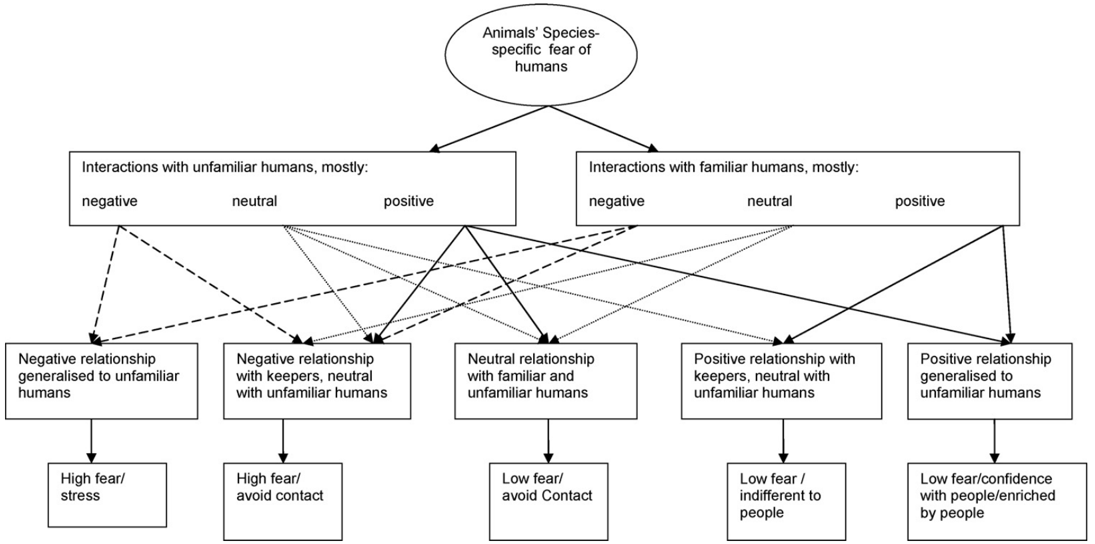
The concept of the human–animal relationship (HAR) is widely used in farm animal research to describe the outcome of the different qualities and quantities of interaction between stockpersons and the animals in their care. Thus, negative, positive or neutral HARs may result from the effect of mostly negative (e.g. rough handling), neutral (e.g. no handling) or positive (e.g. gentle handling) interactions. In this paper the concept is applied to zoo animals in an attempt to provide a model not only of HARs between zoo animals and keepers, but also between zoo animals and unfamiliar people, primarily the visiting public. Behavioural responses of animals to zoo visitors are inconsistent both within and between taxa, and the history of interactions the individual animal has experienced, and hence the HARs it has developed, may be one of the variables that leads to this inconsistency. The model starts, like the farm animal models, with the animals’ fear of humans, which is itself dependent upon species. The subsequent history of interactions the animal experiences, both with familiar and unfamiliar people, then determines the animal's HAR, which in turn influences the way the animal responds to people. There are currently insufficient data to test the model, but predictions of the model are identified here which could be used to test it.
Overview
The claims and statistics of this paper haven’t been checked yet.
Run the check — free, no account needed. It reads the open-access text and checks the sources it cites.
Integrity signals
Registry
Cites
Statistics
Figures
Verification
Claims the paper makes
The claims and statistics of this paper haven’t been checked yet.
Run the check — free, no account needed. It reads the open-access text and checks the sources it cites.
Claims other papers make about this one
Each is checked against this paper’s own text: does it say what the citing paper says it does?
The source backs part of the claim, not all of it — or backs it for a different population, condition or comparison.
In the citing paper
“Limited research has been conducted to examine the effects of visitors on zoo-housed penguins despite penguins being a commonly housed zoo species, especially little penguins (Eudyptula minor) in Australian zoos [3,10,11,12,13,14,15].”
From Effect of Covering a Visitor Viewing Area Window on the Behaviour of Zoo-Housed Little Penguins (Eudyptula minor) (2020) · cites this paper as [13]
Experimental — accuracy not yet measuredThe source backs part of the claim, not all of it — or backs it for a different population, condition or comparison.
In the citing paper
“Hosey [25,30] developed this model based on Hediger’s [33] early suggestion that humans could potentially be significant to animals in one of five ways; as an enemy, prey, a symbiont, an inanimate part of the environment or as a member of the same species.”
From The visitor effect on zoo animals: implications and opportunities for zoo animal welfare (2019) · cites this paper as [25]
Experimental — accuracy not yet measuredThe source backs part of the claim, not all of it — or backs it for a different population, condition or comparison.
In the citing paper
“How an animal perceives human interactions is not only influenced by the nature of the interaction but also by other variables, including previous experience with humans, temperament and motivational state, genetics and species [21,24,25].”
From The visitor effect on zoo animals: implications and opportunities for zoo animal welfare (2019) · cites this paper as [25]
Experimental — accuracy not yet measuredThe cited source says what the claim attributes to it.
In the citing paper
“This model suggests that HARs in zoos can be characterised in three ways: (i) a negative relationship, where the animal is highly fearful of humans and shows avoidance, (ii) a neutral relationship, if interactions with humans have no consequences for the animal and can lead to habituation to humans, or (iii) a positive relationship, where the animal will potentially experience positive emotions”
From The visitor effect on zoo animals: implications and opportunities for zoo animal welfare (2019) · cites this paper as [25]
The cited source says what the claim attributes to it.
In the citing paper
“A model of the HAR for the zoo setting was proposed by Hosey [25], then refined and updated in 2013 [30] and presented by Ward and Sherwen [32].”
From The visitor effect on zoo animals: implications and opportunities for zoo animal welfare (2019) · cites this paper as [25]
The cited source says what the claim attributes to it.
In the citing paper
“As Hosey’s [25] model predicts, the visitor effect studies conducted to date have provided evidence for negative, neutral and positive relationships.”
From The visitor effect on zoo animals: implications and opportunities for zoo animal welfare (2019) · cites this paper as [25]
The cited source says what the claim attributes to it.
In the citing paper
“researchers have highlighted variation in fear of humans across species [25,117,118].”
From The visitor effect on zoo animals: implications and opportunities for zoo animal welfare (2019) · cites this paper as [25]
Self-check
Percentages, sums and reported differences re-computed from the paper’s own numbers.
The self-check needs the paper’s full text.
Citations
Cites
(2007) · Springer eBooks · doi:10.1007/978-3-540-76516-5_4 · Cited by 792
Assessing the human–animal relationship in farmed species: A critical review
Waiblinger, S., Boivin, X., Pedersen, V., Tosi, M.-V., Janczak, A. M., Visser, E. K., & Jones, R. B. (2006) · Applied Animal Behaviour Science · doi:10.1016/j.applanim.2006.02.001 · Cited by 751
Fear and Fearfulness in Animals
Boissy, A. (1995) · The Quarterly Review of Biology · doi:10.1086/418981 · Cited by 747
Farm Animal Behaviour and Welfare
Webster, A. J. F. (1990) · British Veterinary Journal · doi:10.1016/0007-1935(90)90067-d · Cited by 638
Farm Animal Behaviour and Welfare
Fraser, A. F., & Broom, D. M. (1990) · Medical Entomology and Zoology · Cited by 627
Human–animal interactions in livestock production
Hemsworth, P. H. (2003) · Applied Animal Behaviour Science · doi:10.1016/s0168-1591(02)00280-0 · Cited by 537
Wielebnowski, N. C., Fletchall, N., Carlstead, K., Busso, J. M., & Brown, J. L. (2002) · Zoo Biology · doi:10.1002/zoo.10005 · Cited by 344
Domestic animals’ fear of humans and its effect on their welfare
Rushen, J., Taylor, A. A., & de Passillé, A. M. (1999) · Applied Animal Behaviour Science · doi:10.1016/s0168-1591(99)00089-1 · Cited by 331
Housing, Care and Psychological Well-Being of Captive and Laboratory Primates
Segal, E. F. (1990) · Cited by 321
Waiblinger, S., Menke, C., & Coleman, G. J. (2002) · Applied Animal Behaviour Science · doi:10.1016/s0168-1591(02)00155-7 · Cited by 308
Research works printed but not linked: 6
- Keane, C.W., 2005. The effects of zoo visitors on the behaviour of Western Lowland gorillas (Gorilla gorilla gorilla) Citron-Crested (Cacatua sulphurea citrinocristata) and Moluccan Cockatoos (Cacatua moluccensis). Unpublished M.Sc. thesis, Trinity College, University of Dublin, Dublin, Ireland.
- Maki, 1987, The effects of unfamiliar humans on aggression in captive chimpanzee groups, Am. J. Primatol., 12, 358
- Mather, L., 1999. Response of Captive Orang Utans to Human Audiences. Unpublished M. Phil. Thesis, University of Manchester (Bolton Institute), Bolton, UK.
- Perret, 1995, Einfluss von Zoobesuchern auf das verhalten von schimpansen (Pan troglodytes), Der Zool. Garten N. F., 65, 314
- Skyner, 2004, The effect of visitors on the self-injurious behaviour of a male pileated gibbon (Hylobates pileatus), Der Zool. Garten NF, 74, 38
- Wormell, 1996, Pied tamarins Saguinus bicolor bicolor at the Jersey Wildlife Preservation Trust: management, behaviour and reproduction, Dodo, J. Wildl. Preserv. Trusts, 32, 76
Cited by
Sorted by citations
New directions for zoo animal welfare science
Whitham, J. C., & Wielebnowski, N. (2013) · Applied Animal Behaviour Science · doi:10.1016/j.applanim.2013.02.004 · Cited by 273
The visitor effect on zoo animals: implications and opportunities for zoo animal welfare
Sherwen, S. L., & Hemsworth, P. H. (2019) · Animals · doi:10.3390/ani9060366 · Cited by 267
“Hosey [25,30] developed this model based on Hediger’s [33] early suggestion that humans could potentially be significant to animals in one of five ways; as an enemy, prey, a symbiont, an inanimate part of the environment or as a member of the same species.”
BackgroundMethodInfluentialHuman-Animal Interactions, Relationships and Bonds: A Review and Analysis of the Literature
Hosey, G., & Melfi, V. A. (2014) · International Journal of Comparative Psychology · doi:10.46867/ijcp.2014.27.01.01 · Cited by 235
Self-citationClaxton, A. M. (2011) · Applied Animal Behaviour Science · doi:10.1016/j.applanim.2011.03.002 · Cited by 198
Space use as an indicator of enclosure appropriateness: A novel measure of captive animal welfare
Ross, S. R., Schapiro, S. J., Hau, J., & Lukas, K. E. (2009) · Applied Animal Behaviour Science · doi:10.1016/j.applanim.2009.08.007 · Cited by 150
The Public Face of Zoos: Images of Entertainment, Education and Conservation
Carr, N., & Cohen, S. (2011) · Anthrozoös · doi:10.2752/175303711x12998632257620 · Cited by 150
Zoo visitor effect on mammal behaviour: does noise matter?
Quadros, S., Goulart, V. D. L., Passos, L., Vecci, M. A. M., & Young, R. J. (2014) · Applied Animal Behaviour Science · doi:10.1016/j.applanim.2014.04.002 · Cited by 135
Clegg, I. L. K., Borger-Turner, J. L., & Eskelinen, H. C. (2015) · Animal Welfare · doi:10.7120/09627286.24.3.267 · Cited by 129
Lee, H.-S. (2014) · Tourism Management · doi:10.1016/j.tourman.2014.10.006 · Cited by 108
D’Cruze, N., Khan, S., Carder, G., Megson, D., Coulthard, E., Norrey, J., & Groves, G. (2019) · Animals · doi:10.3390/ani9060332 · Cited by 100
Human–Animal Bonds Between Zoo Professionals and the Animals in Their Care
Hosey, G., & Melfi, V. A. (2010) · Zoo Biology · doi:10.1002/zoo.20359 · Cited by 107
Self-citationGreco, B. J., Meehan, C. L., Hogan, J. N., Leighty, K. A., Mellen, J., Mason, G. J., & Mench, J. A. (2016) · PLoS ONE · doi:10.1371/journal.pone.0144276 · Cited by 94
Visitor effects on anxiety in two captive groups of western lowland gorillas
Carder, G., & Semple, S. (2008) · Applied Animal Behaviour Science · doi:10.1016/j.applanim.2008.06.001 · Cited by 92
Bashaw, M. J., Gibson, M. D., Schowe, D. M., & Kucher, A. S. (2016) · Applied Animal Behaviour Science · doi:10.1016/j.applanim.2016.08.003 · Cited by 89
Keeper-Animal Interactions: Differences between the Behaviour of Zoo Animals Affect Stockmanship
Ward, S. J., & Melfi, V. (2015) · PLOS ONE · doi:10.1371/journal.pone.0140237 · Cited by 89
Meehan, C. L., Mench, J. A., Carlstead, K., & Hogan, J. N. (2016) · PLOS ONE · doi:10.1371/journal.pone.0158124 · Cited by 82
Visitor effects on zoo orangutans in two novel, naturalistic enclosures
Choo, Y., Todd, P. A., & Li, D. (2011) · Applied Animal Behaviour Science · doi:10.1016/j.applanim.2011.05.007 · Cited by 79
A comparative approach to the study of Keeper–Animal Relationships in the zoo
Carlstead, K. (2009) · Zoo Biology · doi:10.1002/zoo.20289 · Cited by 94
Hediger revisited: how do zoo animals see us?
Hosey, G. (2013) · Journal of Applied Animal Welfare Science · doi:10.1080/10888705.2013.827916 · Cited by 79
Self-citationAdvances in Applied Zoo Animal Welfare Science
Ward, S. J., Sherwen, S., & Clark, F. E. (2018) · Journal of Applied Animal Welfare Science · doi:10.1080/10888705.2018.1513842 · Cited by 78
Clegg, I. L. K., Rödel, H. G., Boivin, X., & Delfour, F. (2018) · Applied Animal Behaviour Science · doi:10.1016/j.applanim.2018.01.015 · Cited by 83
Zoo Animal Welfare: The Human Dimension
Cole, J., & Fraser, D. (2018) · Journal of Applied Animal Welfare Science · doi:10.1080/10888705.2018.1513839 · Cited by 76
Is training zoo animals enriching?
Melfi, V. A. (2013) · Applied Animal Behaviour Science · doi:10.1016/j.applanim.2013.04.011 · Cited by 78
The implications of husbandry training on zoo animal response rates
Ward, S. J., & Melfi, V. A. (2013) · Applied Animal Behaviour Science · doi:10.1016/j.applanim.2013.05.008 · Cited by 74
Interactive technology and human–animal encounters at the zoo
Webber, S. E., Carter, M., Smith, W., & Vetere, F. (2016) · International Journal of Human-Computer Studies · doi:10.1016/j.ijhcs.2016.05.003 · Cited by 73
Chelluri, G. I., Ross, S. R., & Wagner, K. E. (2013) · Applied Animal Behaviour Science · doi:10.1016/j.applanim.2012.06.008 · Cited by 67
Spooner, S. L., Farnworth, M. J., Ward, S. J., & Whitehouse‐Tedd, K. (2021) · Journal of Zoological and Botanical Gardens · doi:10.3390/jzbg2010004 · Cited by 65
Rose, P. E., Scales, J., & Brereton, J. E. (2020) · Frontiers in Veterinary Science · doi:10.3389/fvets.2020.00236 · Cited by 66
Hosey, G., & Melfi, V. (2015) · Zoo Biology · doi:10.1002/zoo.21182 · Cited by 58
Self-citationHowell, C. P., & Cheyne, S. M. (2018) · Journal of Applied Animal Welfare Science · doi:10.1080/10888705.2018.1500286 · Cited by 63
Rajagopal, T., Archunan, G., & Sekar, M. (2010) · Journal of Applied Animal Welfare Science · doi:10.1080/10888705.2011.527598 · Cited by 60
Brando, S. I. C. A., & Norman, M. (2023) · Animals · doi:10.3390/ani13142247 · Cited by 53
Queiroz, M. B., & Young, R. J. (2018) · Animals · doi:10.3390/ani8080139 · Cited by 43
The visitor effect in petting zoo-housed animals: Aversive or enriching?
Farrand, A., Hosey, G., & Buchanan-Smith, H. M. (2014) · Applied Animal Behaviour Science · doi:10.1016/j.applanim.2013.11.012 · Cited by 42
Self-citationImpacts of COVID-19 on Animals in Zoos: A Longitudinal Multi-Species Analysis
Williams, E., Carter, A. J., Rendle, J., & Ward, S. J. (2021) · Journal of Zoological and Botanical Gardens · doi:10.3390/jzbg2020010 · Cited by 41
Orban, D. A., Siegford, J. M., & Snider, R. J. (2016) · Zoo Biology · doi:10.1002/zoo.21275 · Cited by 48
Collins, C. K., Corkery, I., Haigh, A., McKeown, S., Quirke, T., & O’Riordan, R. M. (2017) · Zoo Biology · doi:10.1002/zoo.21370 · Cited by 45
A Comparison of Zoo Animal Behavior in the Presence of Familiar and Unfamiliar People
Martin, R. A., & Melfi, V. A. (2016) · Journal of Applied Animal Welfare Science · doi:10.1080/10888705.2015.1129907 · Cited by 42
The impact of visitors on non-primate species in zoos: a quantitative review
Williams, E., Hunton, V., Hosey, G., & Ward, S. J. (2023) · Animals · doi:10.3390/ani13071178 · Cited by 38
Self-citationPatel, F., Wemelsfelder, F., & Ward, S. J. (2019) · Animals · doi:10.3390/ani9060381 · Cited by 42
Ozella, L., Anfossi, L., Di Nardo, F., & Pessani, D. (2017) · General and Comparative Endocrinology · doi:10.1016/j.ygcen.2015.12.002 · Cited by 32
van der Meer, E., Botman, S., & Eckhardt, S. (2019) · PLoS ONE · doi:10.1371/journal.pone.0215211 · Cited by 31
Interspecies Interactions Mediated by Technology: An Avian Case Study at the Zoo
Kleinberger, R., Harrington, A. H. K., Yu, L., van Troyer, A., Su, D., Baker, J. M., & Miller, G. (2020) · CHI Conference on Human Factors in Computing Systems · doi:10.1145/3313831.3376858 · Cited by 31
Yam, K. C., Tang, P. M., & Lam, C. (2022) · Personnel Psychology · doi:10.1111/peps.12517 · Cited by 33
Sekar, M., Rajagopal, T., & Archunan, G. (2008) · Journal of Applied Animal Welfare Science · doi:10.1080/10888700802330093 · Cited by 30
Salas, M., Temple, D., Abáigar, T., Cuadrado, M., Delclaux, M., Enseñat, C., Almagro, V., Martínez‐Nevado, E., Quevedo, M. Á., Carbajal, A., et al. (2016) · Zoo Biology · doi:10.1002/zoo.21323 · Cited by 30
Delfour, F., Monreal‐Pawlowsky, T., Vaicekauskaite, R., Pilenga, C., García‐Párraga, D., Rödel, H. G., Caro, N. G., Campos, E. P., & Mercera, B. (2020) · Journal of Zoological and Botanical Gardens · doi:10.3390/jzbg1010004 · Cited by 34
Polgár, Z., Wood, L. A., & Haskell, M. J. (2017) · American Journal of Primatology · doi:10.1002/ajp.22639 · Cited by 32
Chiew, S. J., Butler, K. L., Sherwen, S. L., Coleman, G. J., Melfi, V., Burns, A., & Hemsworth, P. H. (2020) · Animals · doi:10.3390/ani10071224 · Cited by 28
Regaiolli, B., Rizzo, A., Ottolini, G., Petrazzini, M. E. M., Spiezio, C., & Agrillo, C. (2019) · Frontiers in Psychology · doi:10.3389/fpsyg.2019.02220 · Cited by 29
Smith, J. J. (2014) · American Journal of Primatology · doi:10.1002/ajp.22280 · Cited by 29
Hall, K., Bryant, J. L., Staley, M., Whitham, J. C., & Miller, L. J. (2021) · Animal Welfare · doi:10.7120/09627286.30.4.002 · Cited by 28
Boyle, S. A., Berry, N., Cayton, J., Ferguson, S., Gilgan, A., Khan, A. A., Lam, H. B.-L., Leavelle, S. E., Mulder, I. A., Myers, R., et al. (2020) · Animals · doi:10.3390/ani10112108 · Cited by 30
Male mice and cows perceive human emotional chemosignals: a preliminary study
Destrez, A., Costes-Thiré, M., Viart, A.-S., Prost, F., Patris, B., & Schaal, B. (2021) · Animal Cognition · doi:10.1007/s10071-021-01511-6 · Cited by 25
Woolway, E. E., & Goodenough, A. E. (2017) · Zoo Biology · doi:10.1002/zoo.21357 · Cited by 26
Learmonth, M. J., Sherwen, S., & Hemsworth, P. H. (2018) · Zoo Biology · doi:10.1002/zoo.21433 · Cited by 25
The Need for a Convergence of Agricultural/Laboratory and Zoo-based Approaches to Animal Welfare
Ward, S. J., & Hosey, G. (2019) · Journal of Applied Animal Welfare Science · doi:10.1080/10888705.2019.1678038 · Cited by 25
Self-citationMinier, D. E., Tatum, L., Gottlieb, D. H., Cameron, A. N., Snarr, J., Elliot, R., Cook, A., Elliot, K. J., Banta, K. P., Heagerty, A., et al. (2011) · Applied Animal Behaviour Science · doi:10.1016/j.applanim.2011.04.009 · Cited by 29
Ozella, L., Favaro, L., Carnovale, I., & Pessani, D. (2015) · Journal of Applied Animal Welfare Science · doi:10.1080/10888705.2014.977384 · Cited by 24
Blanchett, M., Finegan, E. J., & Atkinson, J. L. (2020) · Animal Behavior and Cognition · doi:10.26451/abc.07.01.05.2020 · Cited by 28
Behavioral Monitoring of Big Cats Involved in ‘Behind-the-Scenes’ Zoo Visitor Tours
Szokalski, M. S., Foster, W. K., & Litchfield, C. A. (2013) · International Journal of Comparative Psychology · doi:10.46867/ijcp.2013.26.01.02 · Cited by 22
Hacker, C. E., Horback, K., & Miller, L. J. (2014) · Applied Animal Behaviour Science · doi:10.1016/j.applanim.2014.12.005 · Cited by 21
Jones, M., Gartland, K. N., & Fuller, G. A. (2021) · Animal Behavior and Cognition · doi:10.26451/abc.08.04.06.2021 · Cited by 20
The Effect of Visitors on Zoo Reptile Behaviour during the COVID-19 Pandemic
Carter, K. C., Keane, I. A. T., Clifforde, L. M., Rowden, L. J., Fieschi‐Méric, L., & Michaels, C. J. (2021) · Journal of Zoological and Botanical Gardens · doi:10.3390/jzbg2040048 · Cited by 22
Webster, K. N., Narayan, E. J., & de Vos, N. (2016) · General and Comparative Endocrinology · doi:10.1016/j.ygcen.2016.07.012 · Cited by 21
Kidd, P., Ford, S., & Rose, P. E. (2022) · Birds · doi:10.3390/birds3010009 · Cited by 22
Current husbandry of red pandas (Ailurus fulgens) in zoos
Eriksson, P., Zidar, J., White, D., Westander, J., & Andersson, M. (2010) · Zoo Biology · doi:10.1002/zoo.20323 · Cited by 21
Escobar-Ibarra, I., Mota‐Rojas, D., Gual‐Sill, F., Sánchez, C. R., Baschetto, F., & Alonso-Spilsbury, M. (2020) · Journal of Animal Behaviour and Biometeorology · doi:10.31893/jabb.21011 · Cited by 26
Rating Methodology, Personality Axes, and Behavioral Plasticity: A Case Study in African Lions
Torgerson-White, L. L., & Bennett, C. L. (2014) · Animal Behavior and Cognition · doi:10.12966/abc.08.02.2014 · Cited by 20
Controlled Deprivation and Enrichment
Mendyk, R. W., & Augustine, L. (2023) · Springer eBooks · doi:10.1007/978-3-030-86012-7_10 · Cited by 19
Personality and Sociality in Captive Tigers (Panthera tigris)
Pastorino, G. Q., Paini, F., Williams, C. L., Faustini, M., & Mazzola, S. (2017) · Annual Research & Review in Biology · doi:10.9734/arrb/2017/38122 · Cited by 19
Does an Animal–Visitor Interactive Experience Drive Conservation Action?
Collins, C. K., McKeown, S., & O’Riordan, R. M. (2021) · Journal of Zoological and Botanical Gardens · doi:10.3390/jzbg2030034 · Cited by 20
Extending Ethnoprimatology: Human–Alloprimate Relationships in Managed Settings
Palmer, A., & Malone, N. (2017) · International Journal of Primatology · doi:10.1007/s10764-017-0006-6 · Cited by 16
Familiarity mediates apes' attentional biases toward human faces
Leinwand, J. G., Fidino, M., Ross, S. R., & Hopper, L. M. (2022) · Proceedings of the Royal Society B Biological Sciences · doi:10.1098/rspb.2021.2599 · Cited by 17
Kleinberger, R. (2023) · Interaction Studies Social Behaviour and Communication in Biological and Artificial Systems · doi:10.1075/is.22044.kle · Cited by 16
Allard, S. M., & Bashaw, M. J. (2018) · Cambridge University Press eBooks · doi:10.1017/9781108183147.010 · Cited by 16
Acaralp-Rehnberg, L. K., Coleman, G. J., Magrath, M. J. L., Melfi, V. A., Fanson, K. V., & Bland, I. M. (2020) · Animals · doi:10.3390/ani10040743 · Cited by 18
Domestic Animal Welfare at the Zoo: The Impact of an Animal Visitor Interaction Program on Chickens
Ramont, M., Leahy, M., & Cronin, K. A. (2021) · Animal Behavior and Cognition · doi:10.26451/abc.08.01.01.2021 · Cited by 16
Effects of Crowd Size, Composition, and Noise Level On Pool Use in a Mixed-Species Penguin Colony
Edes, A. N., Baskir, E. A., Bauman, K. L., Chandrasekharan, N., Macek, M., & Tieber, A. (2021) · Animal Behavior and Cognition · doi:10.26451/abc.08.04.05.2021 · Cited by 18
Zoo Playgrounds: A Source of Enrichment or Stress for a Group of Nearby Cockatoos? A Case Study
Collins, C. K., & Marples, N. M. (2015) · Journal of Applied Animal Welfare Science · doi:10.1080/10888705.2015.1034278 · Cited by 18
Chadwick, C. L. (2014) · University of Salford Institutional Repository (University of Salford) · Cited by 16
Wilson, A., & Phillips, C. J. C. (2021) · Animals · doi:10.3390/ani11092748 · Cited by 15
How do we plan for the zoo exhibit of the future?
Fernandez, E. J., Brereton, J. E., & Coe, J. C. (2023) · Applied Animal Behaviour Science · doi:10.1016/j.applanim.2023.106085 · Cited by 18
Patel, F., Whitehouse‐Tedd, K., & Ward, S. (2019) · Animal Welfare · doi:10.7120/109627286.28.3.247 · Cited by 15
Impacts of Cartoon Animals on Human–Alloanimal Relations
Dydynski, J. M., & Mäekivi, N. (2021) · Anthrozoös · doi:10.1080/08927936.2021.1926718 · Cited by 14
O’Malley, M., Woods, J. M., Byrant, J., & Miller, L. J. (2021) · Animal Behavior and Cognition · doi:10.26451/abc.08.04.02.2021 · Cited by 15
Does the Absence of Zoo Visitors during the COVID-19 Pandemic Impact Gorilla Behavior?
Masman, M., Scarpace, C., Liriano, A., & Margulis, S. W. (2022) · Journal of Zoological and Botanical Gardens · doi:10.3390/jzbg3030027 · Cited by 15
Crawley, J. A. H., Liehrmann, O., dos Santos, D. J. F., Brown, J. L., Nyein, U. K., Aung, H. H., Htut, W., Oo, Z. M., Seltmann, M. W., Webb, J. L., et al. (2020) · Conservation Physiology · doi:10.1093/conphys/coaa116 · Cited by 16
Daigle, C. L., Brown, J. L., Carlstead, K., Pukazhenthi, B. S., Freeman, E. W., & Snider, R. J. (2015) · International Zoo Yearbook · doi:10.1111/izy.12073 · Cited by 13
COMPORTAMENTO EXPLORATÓRIO EM GATOS DOMÉSTICOS (Felis silvestris catus Linnaeus, 1758): UMA REVISÃO
Machado, J. C., & Genaro, G. (2010) · Archives of Veterinary Science · doi:10.5380/avs.v15i2.17199 · Cited by 13
Serres, A., Hao, Y., & Wang, D. (2019) · International Journal of Comparative Psychology · doi:10.46867/ijcp.2019.32.00.08 · Cited by 14
Through the Looking Glass: Effects of Visitors on Primates in Zoos
Edes, A. N., & Hall, K. (2023) · Developments in primatology · doi:10.1007/978-3-031-11736-7_16 · Cited by 12
Assessing the Welfare of Cetacea
Clegg, I. L. K., & Butterworth, A. (2017) · Animal welfare · doi:10.1007/978-3-319-46994-2_12 · Cited by 14
Hacker, C., Miller, L., & Schulte, B. (2018) · Animal Welfare · doi:10.7120/09627286.27.1.055 · Cited by 14
Keeper effect: Animals are more active in the presence of their caretakers
Pacheco, E., Krebs, B. L., & Watters, J. V. (2024) · Zoo Biology · doi:10.1002/zoo.21833 · Cited by 14
Arena, P. C., Bashaw, M. J., Grant, R., Howell, T. J., Silvestre, A. M., & Warwick, C. (2023) · Springer eBooks · doi:10.1007/978-3-030-86012-7_19 · Cited by 11
Wang, W., He, L., Liu, S., Wronski, T., & Hu, D. (2016) · acta ethologica · doi:10.1007/s10211-015-0232-x · Cited by 11
López-Álvarez, J., Sanjorge, Y., Soloaga, S., Crailsheim, D., & Llorente, M. (2019) · Animals · doi:10.3390/ani9060347 · Cited by 11
Delfino, H. C., & Carlos, C. J. (2021) · Journal of Natural History · doi:10.1080/00222933.2021.1978574 · Cited by 12
Metadata
- Authors
- Hosey, G.
- Affiliations
- University of Greater Manchester (GB)
- Corresponding author
- Hosey, Geoff
- ORCID
- Hosey, Geoff
- Venue
- Applied Animal Behaviour Science
- Publisher
- Elsevier BV
- Published
- 2008-02
- Volume
- 109
- Issue
- 2-4
- Pages
- 105-127
- ISSN
- 0168-1591 (ISSN-L)
- OpenAlex
- W2062787023
- Cited by
- 197
- References
- 98
- Citations by year
- 2026: 9 · 2025: 5 · 2024: 10 · 2023: 23 · 2022: 13 · 2021: 23 · 2020: 16 · 2019: 15 · 2018: 12 · 2017: 11 · 2016: 13 · 2015: 10 · 2014: 11 · 2013: 8 · 2012: 1
- FWCI
- 6.30
- Type
- journal article
- Language
- en
- Open access
- hybrid
- doi.org
- Licence
- Locations
- Applied Animal Behaviour Science (publishedVersion, cc-by-nc-nd)
- Topics
- Life Sciences › Agricultural and Biological Sciences › Animal Science and Zoology › Animal Behavior and Welfare Studies
- Life Sciences › Agricultural and Biological Sciences › Animal Science and Zoology › Human-Animal Interaction Studies
- Social Sciences › Education › Animal and Plant Science Education
- Keywords
- human-animal relations, zoo animals, zoo visitors, fear of humans, species differences, zoo animal welfare
About these checks
Registry, retraction, Cites and statistics results are computed, not judged, with one exception: a printed reference that no index lists is read once by a model before it counts as a citation error. Claims are extracted by a model and kept only when their quote appears verbatim in the text; each cited source is then checked, with a model’s help, for whether it says what the claim relies on. Those verdicts can be wrong — read the claim’s quote and the cited source before relying on one.
Statistics and arithmetic are recomputed, not judged.
Confidence bands are shown only for fields calibrated on our annotated test set. None is calibrated yet, so no band is shown.
What counts as a claim ›How we measure confidence ›How we check this ›
Are you an author, or do you see a problem with this page? Request a review
