

The DOI matches its Crossref record; 72 of the 74 references it cites were found in a registry or an index; none of the 107 sources its claims cite is checked for support yet.
Interventions for Adolescent Mental Health: An Overview of Systematic Reviews
Open accessAbstract
Many mental health disorders emerge in late childhood and early adolescence and contribute to the burden of these disorders among young people and later in life. We systematically reviewed literature published up to December 2015 to identify systematic reviews on mental health interventions in adolescent population. A total of 38 systematic reviews were included. We classified the included reviews into the following categories for reporting the findings: school-based interventions (n = 12); community-based interventions (n = 6); digital platforms (n = 8); and individual-/family-based interventions (n = 12). Evidence from school-based interventions suggests that targeted group-based interventions and cognitive behavioral therapy are effective in reducing depressive symptoms (standard mean difference [SMD]: -.16; 95% confidence interval [CI]: -.26 to -.05) and anxiety (SMD: -.33; 95% CI: -.59 to -.06). School-based suicide prevention programs suggest that classroom-based didactic and experiential programs increase short-term knowledge of suicide (SMD: 1.51; 95% CI: .57-2.45) and knowledge of suicide prevention (SMD: .72; 95% CI: .36-1.07) with no evidence of an effect on suicide-related attitudes or behaviors. Community-based creative activities have some positive effect on behavioral changes, self-confidence, self-esteem, levels of knowledge, and physical activity. Evidence from digital platforms supports Internet-based prevention and treatment programs for anxiety and depression; however, more extensive and rigorous research is warranted to further establish the conditions. Among individual- and family-based interventions, interventions focusing on eating attitudes and behaviors show no impact on body mass index (SMD: -.10; 95% CI: -.45 to .25); Eating Attitude Test (SMD: .01; 95% CI: -.13 to .15); and bulimia (SMD: -.03; 95% CI: -.16 to .10). Exercise is found to be effective in improving self-esteem (SMD: .49; 95% CI: .16-.81) and reducing depression score (SMD: -.66; 95% CI: -1.25 to -.08) with no impact on anxiety scores. Cognitive behavioral therapy compared to waitlist is effective in reducing remission (odds ratio: 7.85; 95% CI: 5.31-11.6). Psychological therapy when compared to antidepressants have comparable effect on remission, dropouts, and depression symptoms. The studies evaluating mental health interventions among adolescents were reported to be very heterogeneous, statistically, in their populations, interventions, and outcomes; hence, meta-analysis could not be conducted in most of the included reviews. Future trials should also focus on standardized interventions and outcomes for synthesizing the exiting body of knowledge. There is a need to report differential effects for gender, age groups, socioeconomic status, and geographic settings since the impact of mental health interventions might vary according to various contextual factors.
Overview
AI snapshot
Written from the paper’s full text.
TL;DR
This overview of 38 systematic reviews found that school-based CBT and targeted group interventions reduce depressive and anxiety symptoms, while school-based suicide prevention mainly improves short-term knowledge without changing suicide-related attitudes or behaviors. Digital, community, and individual-/family-based interventions show some promise, but heterogeneity and limited long-term data prevent firm conclusions.
Key findings
- School-based CBT reduced depressive symptoms (SMD: −.16; 95% CI: −.26 to −.05) and anxiety (SMD: −.33; 95% CI: −.59 to −.06); school-based suicide prevention increased short-term knowledge of suicide (SMD: 1.51; 95% CI: .57–2.45) and knowledge of suicide prevention (SMD: .72; 95% CI: .36–1.07), with no evidence of effect on suicide-related attitudes or behaviors.
- Community-based person-plus-environment interventions (SMD: .27; 95% CI: .16–.37) and environment-only interventions (SMD: .38; 95% CI: .15–.60) had significant positive mental health impacts, whereas person-only interventions did not (SMD: .03; 95% CI: −.19 to .25).
- Digital platforms supported Internet-based prevention and treatment programs for anxiety and depression, but the review states more extensive and rigorous research is warranted.
- Among individual-/family-based interventions, eating-attitude/behavior programs showed no impact on BMI (SMD: −.10; 95% CI: −.45 to .25), Eating Attitude Test (SMD: .01; 95% CI: −.13 to .15), or bulimia (SMD: −.03; 95% CI: −.16 to .10); exercise improved self-esteem (SMD: .49; 95% CI: .16–.81) and reduced depression score (SMD: −.66; 95% CI: −1.25 to −.08) with no impact on anxiety; CBT versus waitlist reduced remission (OR: 7.85; 95% CI: 5.31–11.6).
Methods
- Systematic review of literature published up to December 2015, searching Cochrane Library and PubMed for systematic reviews on interventions to prevent and manage mental health disorders in adolescents, defined as ages 11–19 years, with exceptions for reviews also targeting youth aged 15–24 years.
- Included 38 systematic reviews, categorized as school-based (n = 12), community-based (n = 6), digital platforms (n = 8), and individual-/family-based (n = 12); data were extracted independently, pooled effect sizes with 95% CIs were recorded, and review quality was assessed using AMSTAR.
- Meta-analysis could not be conducted in most included reviews because of heterogeneity in populations, interventions, and outcomes.
Limitations
- The paper states its scope was limited to interventions targeting adolescents and youth only, although mental health interventions take a life-course perspective; most evidence came from high-income countries, limiting generalizability to low- and middle-income countries.
- The paper states there was a lack of standardized interventions and outcomes, meta-analysis could not be conducted in most included reviews, and long-term follow-up data were generally unavailable because most studies reported short-term outcomes.
- The paper calls for reporting differential effects by gender, age group, socioeconomic status, and geographic setting; evident from the text, this overview synthesizes other systematic reviews rather than primary trials, and included review quality varied.
Model-written summary. Check it against the paper before relying on it.
Integrity signals
Registry
Cites
Statistics
Figures
Verification
Claims the paper makes
96 Not checked yet · 26 Own result · 9 No basis given · 3 Own method · 2 Own interpretation
A result the paper reports from its own data — it cites no other source for it, so there is none to check. The quote shows it is in the paper.
In the paper
“AMSTAR rating ranged between 5 and 11 with a median score of 7.5.”
§ Interventions for Adolescent Mental Health: An Overview of Systematic Reviews > Results > School-based interventions
plain- Asserted: passes — The authors put it forward as true.
- Checkable: passes — It can be checked against evidence.
- Load-bearing: unclear — It is unclear whether the paper’s conclusions depend on it.
- Based: passes — The paper gives a reason why it holds.
In the paper
“School-based suicide prevention programs suggest that classroom-based didactic and experiential programs increase short-term knowledge of suicide (SMD: 1.51; 95% CI: .57–2.45)”
- Also stated in: § School-based interventions · hedged
“Interventions for primary prevention of suicide in university and other postsecondary educational settings suggest that classroom-based didactic and experiential programs increased short-term knowledge of suicide (SMD: 1.51; 95% CI: .57–2.45)”
§ Interventions for Adolescent Mental Health: An Overview of Systematic Reviews > Abstract
What the sources say
- Not checked yetcites [28] Harrod, 2014, Interventions for primary prevention of suicide in university and other post-secondary educational settings. status and date, Cochrane Database Syst Rev
hedgeddirect- Asserted: passes — The authors put it forward as true.
- Checkable: passes — It can be checked against evidence.
- Load-bearing: passes — The paper’s conclusions depend on it.
- Based: passes — The paper gives a reason why it holds.
- Also stated in: § School-based interventions · hedged
In the paper
“Another review evaluating community-based mental health and behavioral programs for low-income urban youth suggested that person-only interventions had a nonsignificant impact on improving mental health (measured by an aggregate outcome measure; SMD: .03; 95% CI: −.19 to .25)”
§ Interventions for Adolescent Mental Health: An Overview of Systematic Reviews > Results > Community-based interventions
What the sources say
- Not checked yetcites [33] Farahmand, 2012, Community-based mental health and behavioral programs for low-income urban youth: A meta-analytic review, Clin Psychol Sci Pract source
hedged- Asserted: passes — The authors put it forward as true.
- Checkable: passes — It can be checked against evidence.
- Load-bearing: unclear — It is unclear whether the paper’s conclusions depend on it.
- Based: passes — The paper gives a reason why it holds.
In the paper
“with no evidence of an effect on suicide-related attitudes or behaviors.”
- Also stated in: § School-based interventions · hedged
“with no evidence of an effect on participant's suicide-related attitudes or behaviors; however, these findings are limited by the overall low quality [28].”
§ Interventions for Adolescent Mental Health: An Overview of Systematic Reviews > Abstract
What the sources say
- Not checked yetcites [28] Harrod, 2014, Interventions for primary prevention of suicide in university and other post-secondary educational settings. status and date, Cochrane Database Syst Rev
plain- Asserted: passes — The authors put it forward as true.
- Checkable: passes — It can be checked against evidence.
- Load-bearing: passes — The paper’s conclusions depend on it.
- Based: passes — The paper gives a reason why it holds.
- Also stated in: § School-based interventions · hedged
In the paper
“A systematic review on the effectiveness of school nurse implemented mental health screening for adolescents in schools did not find any evidence of existing screening tools to detect mental ill health among adolescents in schools [22].”
§ Interventions for Adolescent Mental Health: An Overview of Systematic Reviews > Results > School-based interventions
What the sources say
- Not checked yetcites [22] Fothergill, 2003, A systematic review on the effectiveness of school nurse implemented mental health screening available for adolescents in schools, J Psychiatr Ment Health Nurs source
plain- Asserted: passes — The authors put it forward as true.
- Checkable: passes — It can be checked against evidence.
- Load-bearing: unclear — It is unclear whether the paper’s conclusions depend on it.
- Based: passes — The paper gives a reason why it holds.
In the paper
“while person plus environmental interventions (SMD: .27; 95% CI: .16–.37)”
§ Interventions for Adolescent Mental Health: An Overview of Systematic Reviews > Results > Community-based interventions
What the sources say
- Not checked yetcites [33] Farahmand, 2012, Community-based mental health and behavioral programs for low-income urban youth: A meta-analytic review, Clin Psychol Sci Pract source
plaindirect- Asserted: passes — The authors put it forward as true.
- Checkable: passes — It can be checked against evidence.
- Load-bearing: passes — The paper’s conclusions depend on it.
- Based: passes — The paper gives a reason why it holds.
In the paper
“A systematic review of 28 school-based prevention and early intervention programs for depression has shown some support for the implementation of depression prevention and early intervention programs in schools [23].”
§ Interventions for Adolescent Mental Health: An Overview of Systematic Reviews > Results > School-based interventions
What the sources say
- Not checked yetcites [23] Calear, 2010, Systematic review of school-based prevention and early intervention programs for depression, J Adolesc
hedgedconditional- Asserted: passes — The authors put it forward as true.
- Checkable: passes — It can be checked against evidence.
- Load-bearing: passes — The paper’s conclusions depend on it.
- Based: passes — The paper gives a reason why it holds.
A result the paper reports from its own data — it cites no other source for it, so there is none to check. The quote shows it is in the paper.
In the paper
“AMSTAR ratings ranged between 4 and 7 with a median score of 5.”
§ Interventions for Adolescent Mental Health: An Overview of Systematic Reviews > Results > Community-based interventions
plain- Asserted: passes — The authors put it forward as true.
- Checkable: passes — It can be checked against evidence.
- Load-bearing: unclear — It is unclear whether the paper’s conclusions depend on it.
- Based: passes — The paper gives a reason why it holds.
In the paper
“and knowledge of suicide prevention (SMD: .72; 95% CI: .36–1.07)”
- Also stated in: § School-based interventions · plain
“and knowledge of suicide prevention (SMD: .72; 95% CI: .36–1.07)”
§ Interventions for Adolescent Mental Health: An Overview of Systematic Reviews > Abstract
What the sources say
- Not checked yetcites [28] Harrod, 2014, Interventions for primary prevention of suicide in university and other post-secondary educational settings. status and date, Cochrane Database Syst Rev
plaindirect- Asserted: passes — The authors put it forward as true.
- Checkable: passes — It can be checked against evidence.
- Load-bearing: passes — The paper’s conclusions depend on it.
- Based: passes — The paper gives a reason why it holds.
- Also stated in: § School-based interventions · plain
In the paper
“Evidence from school-based interventions suggests that targeted group-based interventions and cognitive behavioral therapy are effective in reducing depressive symptoms (standard mean difference [SMD]: −.16; 95% confidence interval [CI]: −.26 to −.05)”
- Also stated in: § School-based interventions · plain
“It was found that CBT delivered to young people in secondary schools can reduce the symptoms of depression (standard mean difference [SMD]: −.16; 95% CI: −.26 to −.05)”
§ Interventions for Adolescent Mental Health: An Overview of Systematic Reviews > Abstract
What the sources say
- Not checked yetcites [24] Kavanagh, 2009
plaindirect- Asserted: passes — The authors put it forward as true.
- Checkable: passes — It can be checked against evidence.
- Load-bearing: passes — The paper’s conclusions depend on it.
- Based: passes — The paper gives a reason why it holds.
- Also stated in: § School-based interventions · plain
- It may state two separate claims as one. 29
- Probably not a substantial claim. 14
- The quote only partly states this claim. 1
A result the paper reports from its own data — it cites no other source for it, so there is none to check. The quote shows it is in the paper.
In the paper
“We found a total of 12 reviews reporting school-based interventions for adolescent mental health, of which one review performed meta-analysis.”
§ Interventions for Adolescent Mental Health: An Overview of Systematic Reviews > Results > School-based interventions
plain- Asserted: passes — The authors put it forward as true.
- Checkable: passes — It can be checked against evidence.
- Load-bearing: unclear — It is unclear whether the paper’s conclusions depend on it.
- Based: passes — The paper gives a reason why it holds.
It may state two separate claims as one.
A result the paper reports from its own data — it cites no other source for it, so there is none to check. The quote shows it is in the paper.
In the paper
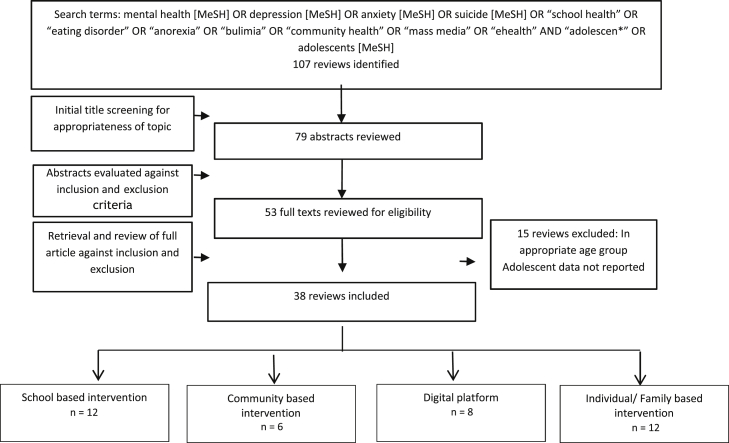
“We classified the included reviews into the following categories for reporting the findings:•School-based interventions (n = 12)•Community-based interventions (n = 6)•Digital platforms (n = 8)•Individual-/family-based interventions (n = 12)”
§ Interventions for Adolescent Mental Health: An Overview of Systematic Reviews > Methods
plain- Asserted: passes — The authors put it forward as true.
- Checkable: passes — It can be checked against evidence.
- Load-bearing: fails — The paper’s conclusions may not depend on it.
- Based: passes — The paper gives a reason why it holds.
Probably not a substantial claim. The paper’s conclusions may not depend on it.
A result the paper reports from its own data — it cites no other source for it, so there is none to check. The quote shows it is in the paper.
In the paper
“We report findings from six systematic reviews evaluating various community-based interventions targeting adolescents and youth; meta-analysis was conducted in two reviews.”
§ Interventions for Adolescent Mental Health: An Overview of Systematic Reviews > Results > Community-based interventions
plain- Asserted: passes — The authors put it forward as true.
- Checkable: passes — It can be checked against evidence.
- Load-bearing: unclear — It is unclear whether the paper’s conclusions depend on it.
- Based: passes — The paper gives a reason why it holds.
It may state two separate claims as one.
In the paper
“A review on school mental health promotion programs based on the findings from 15 studies suggests that an approach focusing on mental health promotion rather than on mental illness prevention is effective in promoting adolescent and youth mental health [18].”
§ Interventions for Adolescent Mental Health: An Overview of Systematic Reviews > Results > School-based interventions
What the sources say
- Not checked yetcites [18] O'Mara, 2013, What do we know about school mental health promotion programmes for children and youth?, Adv Sch Ment Health Promot source
hedgeddirect- Asserted: passes — The authors put it forward as true.
- Checkable: passes — It can be checked against evidence.
- Load-bearing: passes — The paper’s conclusions depend on it.
- Based: passes — The paper gives a reason why it holds.
Probably not a substantial claim.
In the paper
“Due to heterogeneity of design, it was not possible to conduct a meta-analysis, and the studies were examined for effectiveness qualitatively.”
§ Interventions for Adolescent Mental Health: An Overview of Systematic Reviews > Results > School-based interventions
What the sources say
- Not checked yetcites [20] Cheney, 2014, Targeted group-based interventions in schools to promote emotional well-being: A systematic review, Clin child Psychol Psychiatry source
plain- Asserted: passes — The authors put it forward as true.
- Checkable: passes — It can be checked against evidence.
- Load-bearing: unclear — It is unclear whether the paper’s conclusions depend on it.
- Based: passes — The paper gives a reason why it holds.
It may state two separate claims as one.
In the paper
“A review evaluating solution-focused brief therapy in schools has suggested mixed results with some promise in working with students in school settings, specifically for reducing the intensity of students' negative feelings, managing conduct problems, and externalizing behavioral problems [21].”
§ Interventions for Adolescent Mental Health: An Overview of Systematic Reviews > Results > School-based interventions
What the sources say
- Not checked yetcites [21] Kim, 2009, Solution-focused brief therapy in schools: A review of the outcome literature, Child Youth Serv Rev source
hedgedconditional- Asserted: passes — The authors put it forward as true.
- Checkable: passes — It can be checked against evidence.
- Load-bearing: unclear — It is unclear whether the paper’s conclusions depend on it.
- Based: passes — The paper gives a reason why it holds.
It may state two separate claims as one.
In the paper
“Indicated programs, which targeted students exhibiting elevated levels of depression, were found to be the most effective in reducing depressive symptoms with effect sizes ranging from .21 to 1.40.”
§ Interventions for Adolescent Mental Health: An Overview of Systematic Reviews > Results > School-based interventions
What the sources say
- Not checked yetcites [23] Calear, 2010, Systematic review of school-based prevention and early intervention programs for depression, J Adolesc
plaindirect- Asserted: passes — The authors put it forward as true.
- Checkable: passes — It can be checked against evidence.
- Load-bearing: passes — The paper’s conclusions depend on it.
- Based: passes — The paper gives a reason why it holds.
It may state two separate claims as one.
In the paper
“Meta-analysis was not conducted.”
§ Interventions for Adolescent Mental Health: An Overview of Systematic Reviews > Results > School-based interventions
What the sources say
- Not checked yetcites [23] Calear, 2010, Systematic review of school-based prevention and early intervention programs for depression, J Adolesc
plain- Asserted: passes — The authors put it forward as true.
- Checkable: passes — It can be checked against evidence.
- Load-bearing: fails — The paper’s conclusions may not depend on it.
- Based: passes — The paper gives a reason why it holds.
Probably not a substantial claim. The paper’s conclusions may not depend on it.
In the paper
“These findings are based on seven studies while meta-analysis could not be conducted.”
§ Interventions for Adolescent Mental Health: An Overview of Systematic Reviews > Results > School-based interventions
What the sources say
- Not checked yetcites [21] Kim, 2009, Solution-focused brief therapy in schools: A review of the outcome literature, Child Youth Serv Rev source
plain- Asserted: passes — The authors put it forward as true.
- Checkable: passes — It can be checked against evidence.
- Load-bearing: unclear — It is unclear whether the paper’s conclusions depend on it.
- Based: passes — The paper gives a reason why it holds.
It may state two separate claims as one.
A result the paper reports from its own data — it cites no other source for it, so there is none to check. The quote shows it is in the paper.
In the paper
“Our search identified 107 potentially relevant review titles.”
§ Interventions for Adolescent Mental Health: An Overview of Systematic Reviews > Methods
plain- Asserted: passes — The authors put it forward as true.
- Checkable: passes — It can be checked against evidence.
- Load-bearing: fails — The paper’s conclusions may not depend on it.
- Based: passes — The paper gives a reason why it holds.
Probably not a substantial claim. The paper’s conclusions may not depend on it.
In the paper
“However, meta-analysis was not conducted.”
§ Interventions for Adolescent Mental Health: An Overview of Systematic Reviews > Results > Community-based interventions
What the sources say
- Not checked yetcites [31] Waddell, 2007, Preventing mental disorders in children: A systematic review to inform policy-making, Can J Public Health source
plain- Asserted: passes — The authors put it forward as true.
- Checkable: passes — It can be checked against evidence.
- Load-bearing: fails — The paper’s conclusions may not depend on it.
- Based: passes — The paper gives a reason why it holds.
Probably not a substantial claim. The paper’s conclusions may not depend on it.
In the paper
“The interventions used in the studies were diverse, and the research was heterogeneous, and hence overall synthesis of the results was not attempted.”
§ Interventions for Adolescent Mental Health: An Overview of Systematic Reviews > Results > Community-based interventions
What the sources say
- Not checked yetcites [30] Bungay, 2013, The effects of participating in creative activities on the health and well-being of children and young people: A rapid review of the literature, Perspect Public Health source
plaindirect- Asserted: passes — The authors put it forward as true.
- Checkable: passes — It can be checked against evidence.
- Load-bearing: unclear — It is unclear whether the paper’s conclusions depend on it.
- Based: passes — The paper gives a reason why it holds.
It may state two separate claims as one.
In the paper
“Evidence from community-based mental health delivery programs specifically targeting mental health promotion of young people in LMICs suggests positive impacts on mental health outcomes; however, pooled analysis could not be conducted [19].”
§ Interventions for Adolescent Mental Health: An Overview of Systematic Reviews > Results > Community-based interventions
What the sources say
- Not checked yetcites [19] Mason-Jones, 2012, A systematic review of the role of school-based healthcare in adolescent sexual, reproductive, and mental health, Syst Rev source
hedgeddirect- Asserted: passes — The authors put it forward as true.
- Checkable: passes — It can be checked against evidence.
- Load-bearing: unclear — It is unclear whether the paper’s conclusions depend on it.
- Based: passes — The paper gives a reason why it holds.
It may state two separate claims as one.
In the paper
“However, there were mixed results, including differential effects for gender and age groups [19], and effect estimates could not be pooled.”
§ Interventions for Adolescent Mental Health: An Overview of Systematic Reviews > Results > School-based interventions
What the sources say
- Not checked yetcites [19] Mason-Jones, 2012, A systematic review of the role of school-based healthcare in adolescent sexual, reproductive, and mental health, Syst Rev source
plain- Asserted: passes — The authors put it forward as true.
- Checkable: passes — It can be checked against evidence.
- Load-bearing: unclear — It is unclear whether the paper’s conclusions depend on it.
- Based: passes — The paper gives a reason why it holds.
It may state two separate claims as one.
In the paper
“Another review reported from 27 studies that school-based preventive health care is popular with young people and provides important mental health services [19].”
§ Interventions for Adolescent Mental Health: An Overview of Systematic Reviews > Results > School-based interventions
What the sources say
- Not checked yetcites [19] Mason-Jones, 2012, A systematic review of the role of school-based healthcare in adolescent sexual, reproductive, and mental health, Syst Rev source
plain- Asserted: passes — The authors put it forward as true.
- Checkable: passes — It can be checked against evidence.
- Load-bearing: fails — The paper’s conclusions may not depend on it.
- Based: passes — The paper gives a reason why it holds.
Probably not a substantial claim. The paper’s conclusions may not depend on it. It may state two separate claims as one.
In the paper
“However, study populations were limited, and studies either lack clarity regarding who implemented interventions or lack theoretical foundations, process evaluations, or youth viewpoints [18].”
§ Interventions for Adolescent Mental Health: An Overview of Systematic Reviews > Results > School-based interventions
What the sources say
- Not checked yetcites [18] O'Mara, 2013, What do we know about school mental health promotion programmes for children and youth?, Adv Sch Ment Health Promot source
plain- Asserted: passes — The authors put it forward as true.
- Checkable: passes — It can be checked against evidence.
- Load-bearing: unclear — It is unclear whether the paper’s conclusions depend on it.
- Based: passes — The paper gives a reason why it holds.
It may state two separate claims as one.
In the paper
“Some educational interventions showed potential for increasing skills and confidence of primary care staff, but controlled evaluations were rare, and few studies reported the actual change in professional behavior or patient health outcomes [34].”
§ Interventions for Adolescent Mental Health: An Overview of Systematic Reviews > Results > Community-based interventions
What the sources say
- Not checked yetcites [34] Bower, 2001, The treatment of child and adolescent mental health problems in primary care: A systematic review, Fam Pract source
hedgedconditional- Asserted: passes — The authors put it forward as true.
- Checkable: passes — It can be checked against evidence.
- Load-bearing: unclear — It is unclear whether the paper’s conclusions depend on it.
- Based: passes — The paper gives a reason why it holds.
It may state two separate claims as one.
A result the paper reports from its own data — it cites no other source for it, so there is none to check. The quote shows it is in the paper.
In the paper
“AMSTAR rating ranged between 4 and 11 with a median score of 9.”
§ Interventions for Adolescent Mental Health: An Overview of Systematic Reviews > Results > Digital platforms for mental health interventions
plain- Asserted: passes — The authors put it forward as true.
- Checkable: passes — It can be checked against evidence.
- Load-bearing: fails — The paper’s conclusions may not depend on it.
- Based: passes — The paper gives a reason why it holds.
Probably not a substantial claim. The paper’s conclusions may not depend on it. It may state two separate claims as one.
In the paper
“One review reporting the impact of treatment of adolescent mental health disorders in primary care settings suggests some preliminary evidence that treatments by specialist staff working in primary care were effective, although quality of included studies was variable.”
§ Interventions for Adolescent Mental Health: An Overview of Systematic Reviews > Results > Community-based interventions
What the sources say
- Not checked yetcites [34] Bower, 2001, The treatment of child and adolescent mental health problems in primary care: A systematic review, Fam Pract source
hedgeddirect- Asserted: passes — The authors put it forward as true.
- Checkable: passes — It can be checked against evidence.
- Load-bearing: unclear — It is unclear whether the paper’s conclusions depend on it.
- Based: passes — The paper gives a reason why it holds.
It may state two separate claims as one.
None of the sources cited for this claim have been checked yet.
In the paper
“while computerized CBT for mental health suggests that such interventions are cost-effective and often cheaper than usual care [36], [37].”
§ Interventions for Adolescent Mental Health: An Overview of Systematic Reviews > Results > Digital platforms for mental health interventions
What the sources say
- Not checked yetcites [36] Musiat, 2014, Collateral outcomes in e-mental health: A systematic review of the evidence for added benefits of computerized cognitive behavior therapy interventions for mental health, Psychol Med source
- Not checked yetcites [37] Montgomery, 2006, Media-based behavioural treatments for behavioural problems in children, Cochrane Database Syst Rev
hedgeddirect- Asserted: passes — The authors put it forward as true.
- Checkable: passes — It can be checked against evidence.
- Load-bearing: unclear — It is unclear whether the paper’s conclusions depend on it.
- Based: passes — The paper gives a reason why it holds.
It may state two separate claims as one.
In the paper
“Meta-analysis could not be conducted.”
§ Interventions for Adolescent Mental Health: An Overview of Systematic Reviews > Results > School-based interventions
What the sources say
- Not checked yetcites [34] Bower, 2001, The treatment of child and adolescent mental health problems in primary care: A systematic review, Fam Pract source
hedged- Asserted: fails — The authors may not put it forward as true.
- Checkable: passes — It can be checked against evidence.
- Load-bearing: fails — The paper’s conclusions may not depend on it.
- Based: fails — The paper may give no reason why it holds.
Probably not a substantial claim. The authors may not put it forward as true. The paper’s conclusions may not depend on it. The paper may give no reason why it holds. The quote only partly states this claim.
A result the paper reports from its own data — it cites no other source for it, so there is none to check. The quote shows it is in the paper.
In the paper
“We included 12 systematic reviews focusing on individual- or family-based interventions, of which 10 reviews performed meta-analysis.”
§ Interventions for Adolescent Mental Health: An Overview of Systematic Reviews > Results > Individual-/family-based interventions
plain- Asserted: passes — The authors put it forward as true.
- Checkable: passes — It can be checked against evidence.
- Load-bearing: unclear — It is unclear whether the paper’s conclusions depend on it.
- Based: passes — The paper gives a reason why it holds.
It may state two separate claims as one.
In the paper
“The studies were very heterogeneous, statistically, in their populations, interventions, and outcomes, and hence meta-analysis could not be conducted [35].”
§ Interventions for Adolescent Mental Health: An Overview of Systematic Reviews > Results > Digital platforms for mental health interventions
What the sources say
- Not checked yetcites [35] Clement, 2013, Mass media interventions for reducing mental health-related stigma, Cochrane Database Syst Rev
plaindirect- Asserted: passes — The authors put it forward as true.
- Checkable: passes — It can be checked against evidence.
- Load-bearing: unclear — It is unclear whether the paper’s conclusions depend on it.
- Based: passes — The paper gives a reason why it holds.
It may state two separate claims as one.
A result the paper reports from its own data — it cites no other source for it, so there is none to check. The quote shows it is in the paper.
In the paper
“AMSTAR rating ranged between 6 and 11 with a median score of 11.”
§ Interventions for Adolescent Mental Health: An Overview of Systematic Reviews > Results > Individual-/family-based interventions
plain- Asserted: passes — The authors put it forward as true.
- Checkable: passes — It can be checked against evidence.
- Load-bearing: unclear — It is unclear whether the paper’s conclusions depend on it.
- Based: passes — The paper gives a reason why it holds.
It may state two separate claims as one.
In the paper
“These findings are based on 20 studies; however, meta-analysis could not be conducted in this review due to heterogeneity in studies.”
§ Interventions for Adolescent Mental Health: An Overview of Systematic Reviews > Results > Digital platforms for mental health interventions
What the sources say
- Not checked yetcites [38] Clarke, 2015, A systematic review of online youth mental health promotion and prevention interventions, J Youth Adolesc source
plain- Asserted: passes — The authors put it forward as true.
- Checkable: passes — It can be checked against evidence.
- Load-bearing: unclear — It is unclear whether the paper’s conclusions depend on it.
- Based: passes — The paper gives a reason why it holds.
It may state two separate claims as one.
None of the sources cited for this claim have been checked yet.
In the paper
“Three reviews evaluating the acceptability and feasibility of mental health resources among youth suggested that young people regularly use and are generally satisfied with online mental health resources [40], [41], [42].”
§ Interventions for Adolescent Mental Health: An Overview of Systematic Reviews > Results > Digital platforms for mental health interventions
What the sources say
- Not checked yetcites [40] Kauer, 2014, Do online mental health services improve help-seeking for young people? A systematic review, J Med Internet Res source
- Not checked yetcites [41] Martin, 2011, Effectiveness and impact of networked communication interventions in young people with mental health conditions: A systematic review, Patient Educ Couns source
- Not checked yetcites [42] Farrer, 2013, Technology-based interventions for mental health in tertiary students: Systematic review, J Med Internet Res source
hedged- Asserted: passes — The authors put it forward as true.
- Checkable: passes — It can be checked against evidence.
- Load-bearing: unclear — It is unclear whether the paper’s conclusions depend on it.
- Based: passes — The paper gives a reason why it holds.
It may state two separate claims as one.
A result the paper reports from its own data — it cites no other source for it, so there is none to check. The quote shows it is in the paper.
In the paper
“We report findings from eight systematic reviews evaluating impact of digital platforms for mental health disorders. None of the included reviews conducted meta-analysis.”
§ Interventions for Adolescent Mental Health: An Overview of Systematic Reviews > Results > Digital platforms for mental health interventions
plain- Asserted: passes — The authors put it forward as true.
- Checkable: passes — It can be checked against evidence.
- Load-bearing: unclear — It is unclear whether the paper’s conclusions depend on it.
- Based: passes — The paper gives a reason why it holds.
It may state two separate claims as one.
The paper states this without a source or data behind it here, so there is nothing to check it against. The quote shows it is in the paper.
In the paper
“The studies evaluating mental health interventions among adolescents were reported to be very heterogeneous, statistically, in their populations, interventions, and outcomes; hence, meta-analysis could not be conducted in most of the included reviews.”
§ Interventions for Adolescent Mental Health: An Overview of Systematic Reviews > Abstract
plaindirect- Asserted: passes — The authors put it forward as true.
- Checkable: passes — It can be checked against evidence.
- Load-bearing: passes — The paper’s conclusions depend on it.
- Based: passes — The paper gives a reason why it holds.
It may state two separate claims as one.
A result the paper reports from its own data — it cites no other source for it, so there is none to check. The quote shows it is in the paper.
In the paper
“We report findings from a total of 38 systematic reviews with an AMSTAR rating ranging between 7 and 11 and a median score of 8.”
§ Interventions for Adolescent Mental Health: An Overview of Systematic Reviews > Discussion
plain- Asserted: passes — The authors put it forward as true.
- Checkable: passes — It can be checked against evidence.
- Load-bearing: unclear — It is unclear whether the paper’s conclusions depend on it.
- Based: passes — The paper gives a reason why it holds.
It may state two separate claims as one.
A result the paper reports from its own data — it cites no other source for it, so there is none to check. The quote shows it is in the paper.
In the paper
“Evidence from school-based interventions suggests that targeted group-based interventions and CBT were found to be effective in reducing depressive symptoms and anxiety.”
§ Interventions for Adolescent Mental Health: An Overview of Systematic Reviews > Discussion
hedgeddirect- Asserted: passes — The authors put it forward as true.
- Checkable: passes — It can be checked against evidence.
- Load-bearing: passes — The paper’s conclusions depend on it.
- Based: passes — The paper gives a reason why it holds.
It may state two separate claims as one.
The paper states this without a source or data behind it here, so there is nothing to check it against. The quote shows it is in the paper.
In the paper
“Community-based creative activities had some positive effect on behavioral changes, self-confidence, self-esteem, levels of knowledge, and physical activity.”
§ Interventions for Adolescent Mental Health: An Overview of Systematic Reviews > Discussion
plainconditional- Asserted: passes — The authors put it forward as true.
- Checkable: passes — It can be checked against evidence.
- Load-bearing: passes — The paper’s conclusions depend on it.
- Based: passes — The paper gives a reason why it holds.
It may state two separate claims as one.
What the paper did — it cites no source for this, so there is none to check. The quote shows it is in the paper.
In the paper
“After retrieval of the full texts of all the reviews that met the inclusion/exclusion criteria, data from each review were extracted independently into a standardized form.”
§ Interventions for Adolescent Mental Health: An Overview of Systematic Reviews > Methods
plain- Asserted: passes — The authors put it forward as true.
- Checkable: passes — It can be checked against evidence.
- Load-bearing: fails — The paper’s conclusions may not depend on it.
- Based: passes — The paper gives a reason why it holds.
Probably not a substantial claim. The paper’s conclusions may not depend on it.
In the paper
“Distinctive characteristics of low-income, urban schools, and nonschool environments were emphasized as potential explanations for the findings [25].”
§ Interventions for Adolescent Mental Health: An Overview of Systematic Reviews > Results > School-based interventions
What the sources say
- Not checked yetcites [25] Farahmand, 2011, School-based mental health and behavioral programs for low-income, urban youth: A systematic and meta-analytic review, Clin Psychol Sci Pract source
hedgedconditional- Asserted: passes — The authors put it forward as true.
- Checkable: passes — It can be checked against evidence.
- Load-bearing: fails — The paper’s conclusions may not depend on it.
- Based: passes — The paper gives a reason why it holds.
Probably not a substantial claim. The paper’s conclusions may not depend on it.
In the paper
“We assessed and reported the quality of included reviews using the 11-point assessment of the methodological quality of systematic reviews criteria (AMSTAR) [17].”
§ Interventions for Adolescent Mental Health: An Overview of Systematic Reviews > Methods
What the sources say
- Not checked yetcites [17] Shea, 2007, Development of AMSTAR: A measurement tool to assess the methodological quality of systematic reviews, BMC Med Res Methodol source
plain- Asserted: passes — The authors put it forward as true.
- Checkable: passes — It can be checked against evidence.
- Load-bearing: fails — The paper’s conclusions may not depend on it.
- Based: passes — The paper gives a reason why it holds.
Probably not a substantial claim. The paper’s conclusions may not depend on it.
What the paper did — it cites no source for this, so there is none to check. The quote shows it is in the paper.
In the paper
“The abstracts (and the full sources where abstracts are not available) were screened by two abstractors to identify systematic reviews adhering to our objectives. Any disagreements on selection of reviews between these two primary abstractors were resolved by the third reviewer.”
§ Interventions for Adolescent Mental Health: An Overview of Systematic Reviews > Methods
plain- Asserted: passes — The authors put it forward as true.
- Checkable: passes — It can be checked against evidence.
- Load-bearing: fails — The paper’s conclusions may not depend on it.
- Based: passes — The paper gives a reason why it holds.
Probably not a substantial claim. The paper’s conclusions may not depend on it. It may state two separate claims as one.
In the paper
“However, these conclusions are based on several small number of trials reporting poolable data with lack of long-term follow-up data [44].”
§ Interventions for Adolescent Mental Health: An Overview of Systematic Reviews > Results > Individual-/family-based interventions
What the sources say
- Not checked yetcites [44] Ekeland, 2004, Exercise to improve self-esteem in children and young people, Cochrane Database Syst Rev
plain- Asserted: passes — The authors put it forward as true.
- Checkable: passes — It can be checked against evidence.
- Load-bearing: passes — The paper’s conclusions depend on it.
- Based: passes — The paper gives a reason why it holds.
It may state two separate claims as one.
In the paper
“However, there is considerable diversity in the design of trials, making it difficult to compare outcomes across studies [50].”
§ Interventions for Adolescent Mental Health: An Overview of Systematic Reviews > Results > Individual-/family-based interventions
What the sources say
- Not checked yetcites [50] Cox, 2012, Interventions for preventing relapse and recurrence of a depressive disorder in children and adolescents, Cochrane Database Syst Rev
plaindirect- Asserted: passes — The authors put it forward as true.
- Checkable: passes — It can be checked against evidence.
- Load-bearing: unclear — It is unclear whether the paper’s conclusions depend on it.
- Based: passes — The paper gives a reason why it holds.
It may state two separate claims as one.
None of the sources cited for this claim have been checked yet.
In the paper
“Mental health disorders are linked in different ways and levels, exerting a dimensional effect between environmental, genetic factors and other biological mechanisms [55], [56], [57].”
§ Interventions for Adolescent Mental Health: An Overview of Systematic Reviews > Discussion
What the sources say
- Not checked yetcites [55] Polanczyk, 2009, Searching for the developmental origins of mental disorders, Revista de Psiquiatria do Rio Grande do Sul source
- Not checked yetcites [56] Lester, 2012, Behavioral epigenetics and the developmental origins of child mental health disorders, J Dev Orig Health Dis source
- Not checked yetcites [57] Swanson, 2008, Developmental origins of child mental health disorders, J Child Psychol Psychiatry source
plaincorrelational- Asserted: passes — The authors put it forward as true.
- Checkable: passes — It can be checked against evidence.
- Load-bearing: fails — The paper’s conclusions may not depend on it.
- Based: passes — The paper gives a reason why it holds.
Probably not a substantial claim. The paper’s conclusions may not depend on it.
None of the sources cited for this claim have been checked yet.
In the paper
“Evidence suggests that early childhood development (ECD) interventions including stimulation in early childhood, preschool level interventions, and ECD consultations have shown to be effective in improving health behaviors, conduct problems, and social skills and are also low-cost interventions delivered in home and at school [63], [64], [65], [66], [67].”
§ Interventions for Adolescent Mental Health: An Overview of Systematic Reviews > Discussion
What the sources say
- Not checked yetcites [63] Baker-Henningham, 2014, The role of early childhood education programmes in the promotion of child and adolescent mental health in low-and middle-income countries, Int J Epidemiol source
- Not checked yetcites [64] Walker, 2006, Effects of psychosocial stimulation and dietary supplementation in early childhood on psychosocial functioning in late adolescence: Follow-up of randomised controlled trial, BMJ source
- Not checked yetcites [65] D'Onise, 2010, Does attendance at preschool affect adult health? A systematic review, Public Health source
hedged- Asserted: passes — The authors put it forward as true.
- Checkable: passes — It can be checked against evidence.
- Load-bearing: unclear — It is unclear whether the paper’s conclusions depend on it.
- Based: passes — The paper gives a reason why it holds.
It may state two separate claims as one.
What the paper did — it cites no source for this, so there is none to check. The quote shows it is in the paper.
In the paper
“One of the limitations of our review was that the scope of our review was limited to interventions targeting adolescents and youth only; however, mental health interventions take a life course perspective.”
§ Interventions for Adolescent Mental Health: An Overview of Systematic Reviews > Discussion
plain- Asserted: passes — The authors put it forward as true.
- Checkable: passes — It can be checked against evidence.
- Load-bearing: passes — The paper’s conclusions depend on it.
- Based: passes — The paper gives a reason why it holds.
Probably not a substantial claim.
Claims other papers make about this one
Each is checked against this paper’s own text: does it say what the citing paper says it does?
In the citing paper
“this is still largely unexplored in the context of common mental disorders, such as depression, anxiety, substance abuse, and eating disorders [23]”
From Prevention and early intervention in youth mental health: is it time for a multidisciplinary and trans-diagnostic model for care? (2020) · cites this paper as [23]
In the citing paper
“Importantly, the quality of the youth-focused studies for DMH programs is generally low to moderate, which is most often a result of methodological flaws such as intervention heterogeneity in terms of content, dose, settings, or quality [15,38].”
From Use of the Principles of Design Thinking to Address Limitations of Digital Mental Health Interventions for Youth: Viewpoint (2019) · cites this paper as [38]
Self-check
Percentages, sums and reported differences re-computed from the paper’s own numbers.
Each contradiction between two passages listed here was confirmed by an independent check.
Rated minor: it would not touch a result — a value no result rests on, a p-value that stays on the same side of the significance level, or a conflict that is clerical, resolved elsewhere in the paper, or outside its own findings.
In the paper
§ Interventions for Adolescent Mental Health: An Overview of Systematic Reviews > Discussion
“We report findings from a total of 38 systematic reviews with an AMSTAR rating ranging between 7 and 11 and a median score of 8.”
§ Interventions for Adolescent Mental Health: An Overview of Systematic Reviews > Results > Community-based interventions
“AMSTAR ratings ranged between 4 and 7 with a median score of 5.”
Citations
Cites
Development of AMSTAR: A measurement tool to assess the methodological quality of systematic reviews
Shea, B. J., Grimshaw, J. M., Wells, G. A., Boers, M., Andersson, N., Hamel, C., Porter, A. C., Tugwell, P., Moher, D., & Bouter, L. M. (2007) · BMC Medical Research Methodology · doi:10.1186/1471-2288-7-10 · Cited by 4,374
Age of onset of mental disorders: a review of recent literature
Kessler, R. C., Amminger, G. P., Aguilar-Gaxiola, S., Alonso, J., Lee, S., & ??st??n, T. B. (2007) · Current Opinion in Psychiatry · doi:10.1097/yco.0b013e32816ebc8c · Cited by 3,457
Global burden of disease in young people aged 10–24 years: a systematic analysis
Gore, F. M., Bloem, P. J., Patton, G. C., Ferguson, J., Joseph, V., Coffey, C., Sawyer, S. M., & Mathers, C. D. (2011) · The Lancet · doi:10.1016/s0140-6736(11)60512-6 · Cited by 2,301 · cited 1×
“Globally, neuropsychiatric disorders are the leading cause of years lost because of disability among 10- to 24-yearolds, accounting for 45% of years lost because of disabilities [5].”
BackgroundCooney, G. M., Dwan, K., Greig, C. A., Lawlor, D. A., Rimer, J., Waugh, F. R., McMurdo, M., & Mead, G. E. (2013) · Cochrane Database of Systematic Reviews · doi:10.1002/14651858.cd004366.pub6 · Cited by 1,834
Is there an epidemic of child or adolescent depression?
Jane Costello, E., Erkanli, A., & Angold, A. (2006) · Journal of Child Psychology and Psychiatry · doi:10.1111/j.1469-7610.2006.01682.x · Cited by 983 · cited 1×
“The overall prevalence of depression in adolescents is around 6% and that for children (younger than 13 years) is 3% [6].”
BackgroundPrimary prevention mental health programs for children and adolescents: A meta-analytic review
Durlak, J. A., & Wells, A. M. (1997) · American Journal of Community Psychology · doi:10.1023/a:1024654026646 · Cited by 963
Health for the World’s adolescents: A second chance in the second decade
Dick, B., & Ferguson, B. J. (2015) · Journal of Adolescent Health · doi:10.1016/j.jadohealth.2014.10.260 · Cited by 959
Cooney, G. M., Dwan, K., Greig, C. A., Lawlor, D. A., Rimer, J., Waugh, F. R., McMurdo, M., & Mead, G. E. (2014) · Advances in Psychiatric Treatment · doi:10.1192/apt.20.1.2 · Cited by 895
Cognitive behavioural therapy for anxiety disorders in children and adolescents
James, A. C., James, G., Cowdrey, F. A., Soler, A., & Choke, A. (2015) · Cochrane Database of Systematic Reviews · doi:10.1002/14651858.cd004690.pub4 · Cited by 876
Adult mental health disorders and their age at onset
Jones, P. B. (2013) · British Journal of Psychiatry · doi:10.1192/bjp.bp.112.119164 · Cited by 701
Psychopathology Associated With Suicidal Ideation and Attempts Among Children and Adolescents
GOULD, M. S., KING, R., GREENWALD, S., FISHER, P., SCHWAB-STONE, M., KRAMER, R., FLISHER, A. J., GOODMAN, S., CANINO, G., & SHAFFER, D. (1998) · Journal of the American Academy of Child & Adolescent Psychiatry · doi:10.1097/00004583-199809000-00011 · Cited by 600 · cited 2×
“Major depressive disorder (MDD) is one of the leading causes of disability, morbidity, and mortality and is a major risk factor for suicide [7].”
BackgroundBarry, M. M., Clarke, A. M., Jenkins, R., & Patel, V. (2013) · BMC Public Health · doi:10.1186/1471-2458-13-835 · Cited by 569
Self-citationExercise in prevention and treatment of anxiety and depression among children and young people
Larun, L., Nordheim, L. V., Ekeland, E., Hagen, K. B., & Heian, F. (2006) · Cochrane Database of Systematic Reviews · doi:10.1002/14651858.cd004691.pub2 · Cited by 492
Interventions for Adolescent Substance Abuse: An Overview of Systematic Reviews
Das, J. K., Salam, R. A., Arshad, A., Finkelstein, Y., & Bhutta, Z. A. (2016) · Journal of Adolescent Health · doi:10.1016/j.jadohealth.2016.06.021 · Cited by 481
Self-citationFurlong, M., McGilloway, S., Bywater, T., Hutchings, J., Smith, S. M., & Donnelly, M. (2012) · Cochrane Database of Systematic Reviews · doi:10.1002/14651858.cd008225.pub2 · Cited by 454
Weisz, J. R., Kuppens, S., Eckshtain, D., Ugueto, A. M., Hawley, K. M., & Jensen-Doss, A. (2013) · JAMA Psychiatry · doi:10.1001/jamapsychiatry.2013.1176 · Cited by 412
A systematic review of online youth mental health promotion and prevention interventions
Clarke, A. M., Kuosmanen, T., & Barry, M. M. (2015) · Journal of Youth and Adolescence · doi:10.1007/s10964-014-0165-0 · Cited by 381
Global suicide rates among young people aged 15-19.
Wasserman, D., Cheng, Q., & Jiang, G. (2005) · PubMed · Cited by 376
Improving Adolescent Sexual and Reproductive Health: A Systematic Review of Potential Interventions
Salam, R. A., Faqqah, A., Sajjad, N., Lassi, Z. S., Das, J. K., Kaufman, M. E., & Bhutta, Z. A. (2016) · Journal of Adolescent Health · doi:10.1016/j.jadohealth.2016.05.022 · Cited by 368
Self-citationSystematic review of school-based prevention and early intervention programs for depression
Calear, A. L., & Christensen, H. (2010) · Journal of Adolescence · doi:10.1016/j.adolescence.2009.07.004 · Cited by 365
Do online mental health services improve help-seeking for young people? A systematic review
Kauer, S. D., Mangan, C., & Sanci, L. (2014) · Journal of Medical Internet Research · doi:10.2196/jmir.3103 · Cited by 339
Cognitive behavioural therapy for anxiety disorders in children and adolescents
James, A. C., James, G., Cowdrey, F. A., Soler, A., & Choke, A. (2013) · Cochrane Database of Systematic Reviews · doi:10.1002/14651858.cd004690.pub3 · Cited by 337
Mass media interventions for reducing mental health-related stigma
Clement, S., Lassman, F., Barley, E. A., Evans-Lacko, S. E., Williams, P. R., Yamaguchi, S., Slade, M., Rüsch, N., & Thornicroft, G. (2013) · Cochrane Database of Systematic Reviews · doi:10.1002/14651858.cd009453.pub2 · Cited by 331
Exercise to improve self-esteem in children and young people
Ekeland, E., Heian, F., Hagen, K. B., Abbott, J. M., & Nordheim, L. V. (2004) · Cochrane Database of Systematic Reviews · doi:10.1002/14651858.cd003683.pub2 · Cited by 258
Establishing a new journal for systematic review products
Moher, D., Stewart, L., & Shekelle, P. (2012) · Systematic Reviews · doi:10.1186/2046-4053-1-1 · Cited by 245
A SYSTEMATIC REVIEW OF SCHOOL-BASED SUICIDE PREVENTION PROGRAMS
Katz, C., Bolton, J. M., Katz, L. Y., Isaak, C. A., Tilston-Jones, T., Sareen, J., & Swampy Cree Suicide Prevention Team (2013) · Depression and Anxiety · doi:10.1002/da.22114 · Cited by 242
Lubans, D. R., Plotnikoff, R. C., & Lubans, N. J. (2012) · Child and Adolescent Mental Health · doi:10.1111/j.1475-3588.2011.00623.x · Cited by 232
Calear, A. L., & Christensen, H. (2010) · Medical Journal of Australia · doi:10.5694/j.1326-5377.2010.tb03686.x · Cited by 220
Cox, G., Callahan, P., Churchill, R. C., Hunot, V., Merry, S., Parker, A. G., & Hetrick, S. E. (2014) · Cochrane Database of Systematic Reviews · doi:10.1002/14651858.cd008324.pub3 · Cited by 218
Bungay, H., & Vella-Burrows, T. (2013) · Perspectives in Public Health · doi:10.1177/1757913912466946 · Cited by 217
Musiat, P., & Tarrier, N. (2014) · Psychological Medicine · doi:10.1017/s0033291714000245 · Cited by 188
Technology-based interventions for mental health in tertiary students: Systematic review
Farrer, L., Gulliver, A., Chan, J. K., Batterham, P. J., Reynolds, J., Calear, A., Tait, R., Bennett, K., & Griffiths, K. M. (2013) · Journal of Medical Internet Research · doi:10.2196/jmir.2639 · Cited by 188 · cited 1×
“[42] A range of broad technology types including the Internet,”
BackgroundInterventions to Improve Adolescent Nutrition: A Systematic Review and Meta-Analysis
Salam, R. A., Hooda, M., Das, J. K., Arshad, A., Lassi, Z. S., Middleton, P., & Bhutta, Z. A. (2016) · Journal of Adolescent Health · doi:10.1016/j.jadohealth.2016.06.022 · Cited by 176
Self-citationBarlow, J., Smailagic, N., Ferriter, M., Bennett, C., & Jones, H. (2010) · Cochrane Database of Systematic Reviews · doi:10.1002/14651858.cd003680.pub2 · Cited by 173
Interventions for preventing eating disorders in children and adolescents
Pratt, B. M., & Woolfenden, S. R. (2002) · Cochrane Database of Systematic Reviews · doi:10.1002/14651858.cd002891 · Cited by 171
Farahmand, F. K., Grant, K. E., Polo, A. J., Duffy, S. N., & DuBois, D. L. (2011) · Clinical Psychology Science and Practice · doi:10.1111/j.1468-2850.2011.01265.x · Cited by 154
Woolfenden, S. R., Williams, K. J., & Peat, J. K. (2001) · Cochrane Database of Systematic Reviews · doi:10.1002/14651858.cd003015 · Cited by 154
Adolescent Health Interventions: Conclusions, Evidence Gaps, and Research Priorities
Salam, R. A., Das, J. K., Lassi, Z. S., & Bhutta, Z. A. (2016) · Journal of Adolescent Health · doi:10.1016/j.jadohealth.2016.05.006 · Cited by 154
Self-citationMason-Jones, A. J., Crisp, C., Momberg, M., Koech, J., De Koker, P., & Mathews, C. (2012) · Systematic Reviews · doi:10.1186/2046-4053-1-49 · Cited by 145
Solution-focused brief therapy in schools: A review of the outcome literature
Kim, J. S., & Franklin, C. (2009) · Children and Youth Services Review · doi:10.1016/j.childyouth.2008.10.002 · Cited by 143
Walker, S. P., Chang, S. M., Powell, C. A., Simonoff, E., & Grantham-McGregor, S. M. (2006) · BMJ · doi:10.1136/bmj.38897.555208.2f · Cited by 141
Baker‐Henningham, H., Scott, S., Jones, K., & Walker, S. P. (2012) · The British Journal of Psychiatry · doi:10.1192/bjp.bp.111.096834 · Cited by 131
Behavioural therapies versus other psychological therapies for depression
Shinohara, K., Honyashiki, M., Imai, H., Hunot, V., Caldwell, D. M., Davies, P., Moore, T. H., Furukawa, T. A., & Churchill, R. (2013) · Cochrane Database of Systematic Reviews · doi:10.1002/14651858.cd008696.pub2 · Cited by 129
Parent-infant psychotherapy for improving parental and infant mental health
Barlow, J., Bennett, C., Midgley, N., Larkin, S. K., & Wei, Y. (2015) · Cochrane Database of Systematic Reviews · doi:10.1002/14651858.cd010534.pub2 · Cited by 126
The treatment of child and adolescent mental health problems in primary care: a systematic review
Bower, P., Garralda, E., Kramer, T., Harrington, R., & Sibbald, B. (2001) · Family Practice · doi:10.1093/fampra/18.4.373 · Cited by 122
Preventing Mental Disorders in Children: A Systematic Review to Inform Policy-Making
Waddell, C., Hua, J. M., Garland, O. M., Peters, R. D., & McEwan, K. (2007) · Canadian Journal of Public Health · doi:10.1007/bf03403706 · Cited by 112
Stewart-Brown, S. L., & Schrader-Mcmillan, A. (2011) · Health Promotion International · doi:10.1093/heapro/dar056 · Cited by 110
Perry, D. F., Allen, M. D., Brennan, E. M., & Bradley, J. R. (2010) · Early Education and Development · doi:10.1080/10409280903475444 · Cited by 105
Das, J. K., Salam, R. A., Arshad, A. H., Lassi, Z. S., & Bhutta, Z. A. (2016) · Journal of Adolescent Health · doi:10.1016/j.jadohealth.2016.07.005 · Cited by 87
Self-citationHarrod, C. S., Goss, C. W., Stallones, L. F., & DiGuiseppi, C. G. (2014) · Cochrane Database of Systematic Reviews · doi:10.1002/14651858.cd009439.pub2 · Cited by 86
Adolescent Health and Well-Being: Background and Methodology for Review of Potential Interventions
Salam, R. A., Das, J. K., Lassi, Z. S., & Bhutta, Z. A. (2016) · Journal of Adolescent Health · doi:10.1016/j.jadohealth.2016.07.023 · Cited by 86
Self-citationDevelopmental origins of child mental health disorders
Swanson, J. D., & Wadhwa, P. M. (2008) · Journal of Child Psychology and Psychiatry · doi:10.1111/j.1469-7610.2008.02014.x · Cited by 78
Alternatives to inpatient mental health care for children and young people
Shepperd, S., Doll, H., Gowers, S., James, A. C., Fazel, M. S., Fitzpatrick, R. M., & Pollock, J. I. (2009) · Cochrane Database of Systematic Reviews · doi:10.1002/14651858.cd006410.pub2 · Cited by 77
Salam, R. A., Arshad, A. H., Das, J. K., Khan, M. N., Mahmood, W., Freedman, S. B., & Bhutta, Z. A. (2016) · Journal of Adolescent Health · doi:10.1016/j.jadohealth.2016.07.024 · Cited by 76
Self-citationCox, G. R., Callahan, P., Churchill, R., Hunot, V., Merry, S. N., Parker, A. G., & Hetrick, S. E. (2012) · Cochrane Database of Systematic Reviews · doi:10.1002/14651858.cd008324.pub2 · Cited by 70
Baker-Henningham, H. (2014) · International Journal of Epidemiology · doi:10.1093/ije/dyt226 · Cited by 61
A Systematic Review of Evaluated Suicide Prevention Programs Targeting Indigenous Youth
Harlow, A. F., Bohanna, I., & CLOUGH, A. R. (2014) · Crisis · doi:10.1027/0227-5910/a000265 · Cited by 56
Silva, S. D., Parker, A. G., Purcell, R., Callahan, P. M., Liu, P., & Hetrick, S. E. (2013) · Crisis · doi:10.1027/0227-5910/a000190 · Cited by 53
Targeted group-based interventions in schools to promote emotional well-being: A systematic review
Cheney, G., Schlösser, A., Nash, P., & Glover, L. (2014) · Clinical Child Psychology and Psychiatry · doi:10.1177/1359104513489565 · Cited by 49
Cox, G. R., Fisher, C. A., De Silva, S., Phelan, M., Akinwale, O. P., Simmons, M. B., & Hetrick, S. E. (2012) · Cochrane Database of Systematic Reviews · doi:10.1002/14651858.cd007504.pub2 · Cited by 48 · cited 1×
“However, there is considerable diversity in the design of trials, making it difficult to compare outcomes across studies [50].”
BackgroundBehavioral epigenetics and the developmental origins of child mental health disorders
Lester, B. M., Marsit, C. J., Conradt, E., Bromer, C., & Padbury, J. F. (2012) · Journal of Developmental Origins of Health and Disease · doi:10.1017/s2040174412000426 · Cited by 48
Media-based behavioural treatments for behavioural problems in children
Montgomery, P., Bjornstad, G. J., & Dennis, J. A. (2006) · Cochrane Database of Systematic Reviews · doi:10.1002/14651858.cd002206.pub3 · Cited by 47
Farahmand, F. K., Duffy, S. N., Tailor, M. A., DuBois, D. L., Lyon, A. L., Grant, K. E., Zarlinski, J. C., Masini, O., Zander, K. J., & Nathanson, A. M. (2012) · Clinical Psychology Science and Practice · doi:10.1111/j.1468-2850.2012.01283.x · Cited by 42
What do we know about school mental health promotion programmes for children and youth?
O'Mara, L., & Lind, C. (2013) · Advances in School Mental Health Promotion · doi:10.1080/1754730x.2013.811952 · Cited by 40 · cited 1×
“A broad search strategy was used that included a combination of appropriate keywords, medical subject heading, and free text terms; the search was conducted in the Cochrane Library, and PubMed.”
MethodKavanagh, J., Oliver, S. R., Caird, J., Tucker, H., Greaves, A. E., Harden, A., Oakley, A., Lorenc, T., & Thomas, J. (2009) · UCL Discovery (University College London) · Cited by 36
Martin, S., Sutcliffe, P., Griffiths, F., Sturt, J., Powell, J., Adams, A., & Dale, J. (2011) · Patient Education and Counseling · doi:10.1016/j.pec.2010.11.014 · Cited by 36
Em busca das origens desenvolvimentais dos transtornos mentais
Polanczyk, G. V. (2009) · Revista de Psiquiatria do Rio Grande do Sul · doi:10.1590/s0101-81082009000100005 · Cited by 21
Does attendance at preschool affect adult health? A systematic review
D'Onise, K., McDermott, R. A., & Lynch, J. W. (2010) · Public Health · doi:10.1016/j.puhe.2010.05.004 · Cited by 17
Day Therapy Programs for Adolescents with Mental Health Problems: A Systematic Review
Deenadayalan, Y., Kumar, S., Machotka, Z., & Perraton, L. G. (2010) · Internet Journal of Allied Health Sciences and Practice · doi:10.46743/1540-580x/2010.1277 · Cited by 11
FOTHERGILL, A., SATHERLEY, P., & WEBBER, I. (2003) · Journal of Psychiatric and Mental Health Nursing · doi:10.1046/j.1365-2850.2003.00638.x · Cited by 8 · cited 2×
“[22] Screening tools being used by school nurses for the identification of emotional, psychological, and behavioral problems among adolescents in schools.”
MethodBruce, J. (2002) · Evidence-Based Nursing · doi:10.1136/ebn.5.1.12 · Cited by 7
Leo, D. D. (2013) · Crisis · doi:10.1027/0227-5910/a000204 · Cited by 3
Cited by
Sorted by citations
Colizzi, M., Lasalvia, A., & Ruggeri, M. (2020) · International Journal of Mental Health Systems · doi:10.1186/s13033-020-00356-9 · Cited by 727
Interventions for Adolescent Substance Abuse: An Overview of Systematic Reviews
Das, J. K., Salam, R. A., Arshad, A., Finkelstein, Y., & Bhutta, Z. A. (2016) · Journal of Adolescent Health · doi:10.1016/j.jadohealth.2016.06.021 · Cited by 481
Self-citationCampbell, O., Bann, D., & Patalay, P. (2020) · doi:10.1101/2020.06.12.20129312 · Cited by 484
Lehtimaki, S., Martic, J., Wahl, B., Foster, K. T., & Schwalbe, N. (2021) · JMIR Mental Health · doi:10.2196/25847 · Cited by 488
Daly, M. (2021) · Journal of Adolescent Health · doi:10.1016/j.jadohealth.2021.08.026 · Cited by 432
Metadata
- Authors
- Das, J. K., Salam, R. A., Lassi, Z. S., Khan, M. N., Mahmood, W., Patel, V., & Bhutta, Z. A.
- Affiliations
- Aga Khan University (PK)
- The University of Adelaide (AU)
- Ziauddin University (PK)
- London School of Hygiene & Tropical Medicine (GB)
- Corresponding author
- Bhutta, Zulfiqar A.
- ORCID
- Venue
- Journal of Adolescent Health
- Publisher
- Elsevier BV
- Published
- 2016-10
- Volume
- 59
- Issue
- 4
- Pages
- S49-S60
- ISSN
- 1054-139X (ISSN-L)
- PMC
- PMC5026677
- OpenAlex
- W2522424413
- Semantic Scholar
- cfd46f441f93ececdf6663ee72956fdac5b39632
- Cited by
- 528
- References
- 74
- Citations by year
- 2026: 33 · 2025: 57 · 2024: 66 · 2023: 69 · 2022: 81 · 2021: 75 · 2020: 57 · 2019: 42 · 2018: 28 · 2017: 12 · 2016: 8
- FWCI
- 4.37
- Type
- journal article
- Language
- en
- Open access
- hybrid
- doi.org
- Locations
- Journal of Adolescent Health (publishedVersion, cc-by)
- PubMed Central (publishedVersion, cc-by)
- PubMed (publishedVersion)
- LSHTM Research Online (London School of Hygiene and Tropical Medicine) (acceptedVersion)
- eCommons - AKU (Aga Khan University) (submittedVersion)
- Adelaide Research & Scholarship (AR&S) (University of Adelaide) (submittedVersion, cc-by)
- Greater South Information System
- Topics
- Social Sciences › Psychology › Clinical Psychology › Child and Adolescent Psychosocial and Emotional Development
- Social Sciences › Psychology › Applied Psychology › Digital Mental Health Interventions
- Health Sciences › Medicine › Psychiatry and Mental health › Mental Health Treatment and Access
- Keywords
- adolescent mental health, mental health interventions, school-based intervention, community-based intervention, digital mental health platforms, family intervention, cognitive behavioral therapy, depression, anxiety, suicide prevention, eating disorders, bulimia nervosa, physical activity, self-esteem, body mass index, eating attitudes, creative activity, psychotherapy, remission, publication bias
About these checks
Registry, retraction, Cites and statistics results are computed, not judged, with one exception: a printed reference that no index lists is read once by a model before it counts as a citation error. Claims are extracted by a model and kept only when their quote appears verbatim in the text; each cited source is then checked, with a model’s help, for whether it says what the claim relies on. Those verdicts can be wrong — read the claim’s quote and the cited source before relying on one.
A language model drew the claims from the paper on 2026-10-09, under version 3 of the claim definition (model deepseek-v4.1-flash, prompt extract-v3).
A second model labelled each claim on 2026-10-09 (model jev-1.13-20260917, definition revision gold-guideline-v0.2).
Statistics and arithmetic are recomputed, not judged.
Confidence bands are shown only for fields calibrated on our annotated test set. None is calibrated yet, so no band is shown.
What counts as a claim ›How we measure confidence ›How we check this ›
Are you an author, or do you see a problem with this page? Request a review
