

The DOI matches its Crossref record; 39 of the 45 references it cites were found in a registry or an index; 15 of the 40 sources its claims cite were checked for support.
2024 Adult Compendium of Physical Activities: A third update of the energy costs of human activities
Open accessAbstract
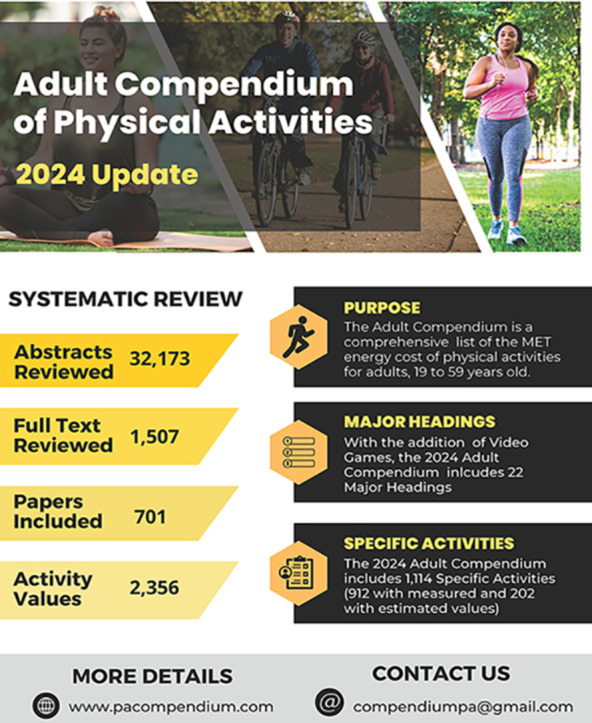
BACKGROUND: The Compendium of Physical Activities was published in 1993 to improve the comparability of energy expenditure values assigned to self-reported physical activity (PA) across studies. The original version was updated in 2000, and again in 2011, and has been widely used to support PA research, practice, and public health guidelines. METHODS: This 2024 update was tailored for adults 19-59 years of age by removing data from those ≥60 years. Using a systematic review and supplementary searches, we identified new activities and their associated measured metabolic equivalent (MET) values (using indirect calorimetry) published since 2011. We replaced estimated METs with measured values when possible. RESULTS: We screened 32,173 abstracts and 1507 full-text papers and extracted 2356 PA energy expenditure values from 701 papers. We added 303 new PAs and adjusted 176 existing MET values and descriptions to reflect the addition of new data and removal of METs for older adults. We added a Major Heading (Video Games). The 2024 Adult Compendium includes 1114 PAs (912 with measured and 202 with estimated values) across 22 Major Headings. CONCLUSION: This comprehensive update and refinement led to the creation of The 2024 Adult Compendium, which has utility across research, public health, education, and healthcare domains, as well as in the development of consumer health technologies. The new website with the complete lists of PAs and supporting resources is available at https://pacompendium.com.
Overview
AI snapshot
Written from the paper’s full text.
TL;DR
The 2024 Adult Compendium of Physical Activities is the third update of the Compendium, providing standardized MET values for 1114 Specific Activity codes across 22 Major Headings for adults aged 19–59 years. It adds 303 new Specific Activity codes, increases measured MET coverage to 912 of 1114 activities (82%), and introduces a new Video games Major Heading.
Key findings
- The 2024 Adult Compendium contains 22 Major Headings and 1114 Specific Activity codes, compared with 821 Specific Activities in the 2011 Compendium.
- Measured MET values now cover 912 PAs (82%) versus 561 of 821 PAs (68%) in 2011; estimated METs comprise 18.5% of the Adult Compendium.
- The update added 303 new Specific Activity codes with measured METs and made 176 changes to MET values or Specific Activity descriptions from the 2011 Compendium.
- The systematic review identified 32,173 abstracts; after removing 10,868 duplicates, 21,137 abstracts were screened, 1507 full-text articles were reviewed, 701 articles were used for data extraction, and 2356 new PA energy expenditure values were incorporated.
Methods
- A research librarian conducted a systematic search for articles and abstracts published from January 2011 through March 2023 using PubMed, Embase, SPORTDiscus, and Scopus, with 22 separate keyword searches pairing Compendium Major Heading activity concepts with energy-cost terms.
- Articles were included if participants had a mean age of 19–59 years, PA energy cost was measured using indirect or direct calorimetry, and articles/abstracts were available in English; exclusions included resting/peak/maximal values only, disability restricting PA, estimated EE from heart rate monitors, motion sensors, or prediction equations, and pregnant or chronic disease participants.
- Data extraction covered participant age and EE data such as METs and VO2; values reported in other units were converted to standard METs using a standardized resting metabolic rate of 3.5 mL/kg/min, and the 2024 Compendium maintained the same 5-digit coding scheme with MET values rounded to 0, 3, 5, and 8.
Limitations
- The paper states that categorizing energy costs of water PAs such as surfing and scuba diving, or live sports such as boxing and American football, remains challenging due to limitations of existing measurement strategies.
- The paper states the 2024 Adult Compendium is intended for non-disabled adults and adults without significant health conditions affecting EE or metabolism, and is limited to adults 19–59 years of age.
- Evident from the text: the Compendium still relies on estimated METs for some Specific Activities, and the paper reports estimated values as 202 in Table 3 but as 207 in the strengths and limitations section, an internal inconsistency in the reported count.
Model-written summary. Check it against the paper before relying on it.
Integrity signals
Registry
Cites
Statistics
Figures
Verification
Claims the paper makes
11 Own interpretation · 11 Own result · 7 No full text of the sources · 6 Partly supported · 6 No basis given · 4 Supported so far · 3 Own method · 2 Sources not found · 1 Supported · 1 Couldn’t confirm · accuracy not yet measured
The sources with a verdict support this claim; the rest weren’t checked yet, have no full text we could read, or their verdicts aren’t rated yet.
In the paper
“RMR is comparatively lower in older adults,20,21”
§ 2024 Adult Compendium of Physical Activities: A third update of the energy costs of human activities > Introduction
What the sources say
- Not checked — no full text of the sourcecites [20] Leal-Martin, 2022, Resting oxygen uptake value of 1 metabolic equivalent of task in older adults: A systematic review and descriptive analysis, Sports Med source
- Supportedcites [21] Pontzer, 2021, Daily energy expenditure through the human life course, Science source
The “Older adults (>60 y)” section reports that basal expenditure begins to decline around age 60 and that adjusted basal expenditure also falls. This supports the claim that resting metabolic rate is comparatively lower in older adults. (LLM, conf=0.93)
plaincorrelational- Asserted: passes — The authors put it forward as true.
- Checkable: passes — It can be checked against evidence.
- Load-bearing: passes — The paper’s conclusions depend on it.
- Based: passes — The paper gives a reason why it holds.
The sources with a verdict support this claim; the rest weren’t checked yet, have no full text we could read, or their verdicts aren’t rated yet.
In the paper
“The need for this additional grouping is based on significant research over the last 15 years that has evaluated a range of video games, from traditional seated handheld controller games27 to interactive gaming requiring upper body28 and lower body movement.29”
§ 2024 Adult Compendium of Physical Activities: A third update of the energy costs of human activities > Discussion > New Major Heading
What the sources say
- Not checked — no full text of the sourcecites [27] Jordan, 2011, Only lower limb controlled interactive computer gaming enables an effective increase in energy expenditure, Eur J Appl Physiol source
- Not checked — no full text of the sourcecites [28] Wu, 2015, Energy expenditure and intensity in healthy young adults during Exergaming, Am J Health Behav source
- Supportedcites [29] Sanders, 2012, Physiologic responses, liking and motivation for playing the same video game on an active versus a traditional, non-active gaming system, Int J Exerc Sci source
Split into 2 atoms — 2 confirmed, 0 partially supported, 0 disputed, 0 misattributed, 0 unverifiable. Expand the claim to see per-atom verdicts.
plaindirect- Asserted: passes — The authors put it forward as true.
- Checkable: passes — It can be checked against evidence.
- Load-bearing: passes — The paper’s conclusions depend on it.
- Based: passes — The paper gives a reason why it holds.
Every source the paper cites for this claim was checked and supports it.
In the paper
“Collectively, the Youth Compendium,19 Adult Compendium, and Older Adult Compendium22 provide MET values for PAs across the lifespan.”
§ 2024 Adult Compendium of Physical Activities: A third update of the energy costs of human activities > Discussion
What the sources say
- Supportedcites [19] Butte, 2018, A Youth Compendium of Physical Activities: Activity codes and metabolic intensities, Med Sci Sports Exerc source
The Discussion states that the Youth Compendium provides METy values for 196 physical activities across four age groups from 6 to 18 years. Citation 19 identifies the Youth Compendium’s contribution to the collective lifespan coverage; it need not establish what the Adult and Older Adult Compendiums contain. (LLM, conf=0.93)
- Supportedcites [22] Willis, 2024, Older Adult Compendium of Physical Activities: Energy costs of human physical activities in adults over 60 years, J Sport Health Sci source
The Introduction describes the Youth Compendium for ages 5–18, the Adult Compendium’s MET values for physical activities, and this paper’s Older Adult Compendium for adults aged 60 and older. Together, these passages support the cited statement that the compendiums provide MET values across the lifespan. (LLM, conf=0.93)
plain- Asserted: passes — The authors put it forward as true.
- Checkable: passes — It can be checked against evidence.
- Load-bearing: unclear — It is unclear whether the paper’s conclusions depend on it.
- Based: passes — The paper gives a reason why it holds.
- Supported
The cited sources support only part of this claim — read each source’s verdict below.
In the paper
“Additionally, significant variation in EE is observed within a game based on the difficulty level, the player's experience, and the effort involved.”
§ 2024 Adult Compendium of Physical Activities: A third update of the energy costs of human activities > Discussion > New Major Heading
What the sources say
- Not checked — no full text of the sourcecites [27] Jordan, 2011, Only lower limb controlled interactive computer gaming enables an effective increase in energy expenditure, Eur J Appl Physiol source
- Not checked — no full text of the sourcecites [28] Wu, 2015, Energy expenditure and intensity in healthy young adults during Exergaming, Am J Health Behav source
- Partly supportedcites [29] Sanders, 2012, Physiologic responses, liking and motivation for playing the same video game on an active versus a traditional, non-active gaming system, Int J Exerc Sci sourceExperimental — accuracy not yet measured
The Results (Gross Heart Rate and V̇O2; page not available) report a significant difference in oxygen consumption when Madden was played on Wii versus PS2, supporting variation between versions of the same game. But the Methods (Protocol; page not available) say all games were played at the least difficult setting, and the paper does not link energy expenditure to difficulty level or player experience. Its discussion of how vigorously participants might play is speculative, not an observed within-game effect of effort. (LLM, conf=0.84)
plaincorrelational- Asserted: passes — The authors put it forward as true.
- Checkable: passes — It can be checked against evidence.
- Load-bearing: passes — The paper’s conclusions depend on it.
- Based: passes — The paper gives a reason why it holds.
The cited sources support only part of this claim — read each source’s verdict below.
In the paper
“Several factors can influence RMR and the EE of PA;38, 39, 40”
§ 2024 Adult Compendium of Physical Activities: A third update of the energy costs of human activities > Discussion > Relative EE and absolute EE
What the sources say
- Partly supportedcites [38] Harris, 1918, A biometric study of human basal metabolism, Proc Natl Acad Sci U S A sourceExperimental — accuracy not yet measured
The Abstract identifies age, weight, stature, sex, food intake, and muscular activity as factors relevant to basal metabolism or its measurement. It does not address factors that influence energy expenditure during physical activity, so that part of the sentence is unsupported by this source. (LLM, conf=0.86)
- Not checked — no full text of the sourcecites [39] Roubenoff, 2000, The effect of gender and body composition method on the apparent decline in lean mass-adjusted resting metabolic rate with age, J Gerontol A Biol Sci Med Sci source
- Not checked — no full text of the sourcecites [40] Herrmann, 2017, The influence of physical characteristics on the resting energy expenditure of youth: A meta-analysis, Am J Hum Biol source
plainconditional- Asserted: passes — The authors put it forward as true.
- Checkable: passes — It can be checked against evidence.
- Load-bearing: passes — The paper’s conclusions depend on it.
- Based: passes — The paper gives a reason why it holds.
- Partly supported
The cited sources support only part of this claim — read each source’s verdict below.
In the paper
“For example, Browning et al.41 reported significantly higher EE (∼8%–15%) in women with obesity (age = 28.5 ± 7.6 years; body mass index = 33.9 ± 3.6 kg/m2) compared to women without obesity (age = 22.8 ± 3.6 years; body mass index = 21.6 ± 2.0 kg/m2) across multiple treadmill speeds and grades.”
§ 2024 Adult Compendium of Physical Activities: A third update of the energy costs of human activities > Discussion > Relative EE and absolute EE
What the sources say
- Partly supportedcites [41] Browning, 2013, Reiser 2nd RF. Obesity does not impair walking economy across a range of speeds and grades, J Appl Physiol (1985) sourceExperimental — accuracy not yet measured
The Results (page not available) report significantly higher gross metabolic rate in participants with obesity across all tested speeds and grades, but the analysis included both women and men rather than reporting this comparison specifically for women. The Results’ approximately 8%–15% figure refers to relative aerobic intensity, not energy expenditure; the Discussion (page not available) reports gross metabolic rate as 35%–50% higher. (LLM, conf=0.90)
plaincorrelational- Asserted: passes — The authors put it forward as true.
- Checkable: passes — It can be checked against evidence.
- Load-bearing: unclear — It is unclear whether the paper’s conclusions depend on it.
- Based: passes — The paper gives a reason why it holds.
- Partly supported
A result the paper reports from its own data — it cites no other source for it, so there is none to check. The quote shows it is in the paper.
In the paper
“Incorporating data from the systematic review added 303 new Specific Activity codes with measured METs (Table 4).”
§ 2024 Adult Compendium of Physical Activities: A third update of the energy costs of human activities > Results
plaindirect- Asserted: passes — The authors put it forward as true.
- Checkable: passes — It can be checked against evidence.
- Load-bearing: passes — The paper’s conclusions depend on it.
- Based: passes — The paper gives a reason why it holds.
A result the paper reports from its own data — it cites no other source for it, so there is none to check. The quote shows it is in the paper.
In the paper
“From these full-text articles, 2356 new PA EE values were incorporated into existing 5-digit Specific Activity codes or used to create new codes.”
§ 2024 Adult Compendium of Physical Activities: A third update of the energy costs of human activities > Results
plain- Asserted: passes — The authors put it forward as true.
- Checkable: passes — It can be checked against evidence.
- Load-bearing: passes — The paper’s conclusions depend on it.
- Based: passes — The paper gives a reason why it holds.
The paper states this without a source or data behind it here, so there is nothing to check it against. The quote shows it is in the paper.
In the paper
“For example, traditional seated handheld controller games are in the new code 22040 (seated, video game, handheld controller; 1.3 METs).”
§ 2024 Adult Compendium of Physical Activities: A third update of the energy costs of human activities > Discussion > New Major Heading
plain- Asserted: passes — The authors put it forward as true.
- Checkable: passes — It can be checked against evidence.
- Load-bearing: unclear — It is unclear whether the paper’s conclusions depend on it.
- Based: passes — The paper gives a reason why it holds.
A result the paper reports from its own data — it cites no other source for it, so there is none to check. The quote shows it is in the paper.
In the paper
“but they now comprise only 18.5% of the Adult Compendium.”
§ 2024 Adult Compendium of Physical Activities: A third update of the energy costs of human activities > Results
plain- Asserted: passes — The authors put it forward as true.
- Checkable: passes — It can be checked against evidence.
- Load-bearing: unclear — It is unclear whether the paper’s conclusions depend on it.
- Based: passes — The paper gives a reason why it holds.
- Probably not a substantial claim. 26
- It may state two separate claims as one. 23
The cited sources support only part of this claim — read each source’s verdict below.
In the paper
“MET-minutes and MET-hours are often used to assess PA dose with various health outcomes.25”
§ 2024 Adult Compendium of Physical Activities: A third update of the energy costs of human activities > Discussion > Utility
What the sources say
- Partly supportedcites [25] LaMonte, 2018, Physical activity and incidence of heart failure in postmenopausal women, JACC Heart Fail sourceExperimental — accuracy not yet measured
The Methods (Physical Activity Assessment; page unavailable) use MET-hours/week to measure physical activity, and the Results relate that measure to heart-failure outcomes. The paper does not establish that MET-minutes are often used or that these measures are used across various health outcomes. (LLM, conf=0.86)
plain- Asserted: passes — The authors put it forward as true.
- Checkable: passes — It can be checked against evidence.
- Load-bearing: fails — The paper’s conclusions may not depend on it.
- Based: passes — The paper gives a reason why it holds.
Probably not a substantial claim. The paper’s conclusions may not depend on it.
- Partly supported
The cited sources support only part of this claim — read each source’s verdict below.
In the paper
“Since RMR changes across the lifespan (dramatically throughout adolescence16,17)”
§ 2024 Adult Compendium of Physical Activities: A third update of the energy costs of human activities > Introduction
What the sources say
- Not checked — no full text of the sourcecites [16] Herrmann, 2017, The influence of physical characteristics on the resting energy expenditure of youth: A meta-analysis, Am J Hum Biol source
- Partly supportedcites [17] Pfeiffer, 2018, Energy cost expression for a Youth Compendium of Physical Activities: Rationale for using age groups, Pediatr Exerc Sci sourceExperimental — accuracy not yet measured
The Introduction says resting energy expenditure per unit of body mass declines with age in children and is higher in children than adults. The Discussion gives a substantial basal metabolic rate difference between an 8-year-old and a 16-year-old. These passages support an age-related change, but they do not establish changes across the entire lifespan or specifically throughout adolescence. (LLM, conf=0.84)
boostedcorrelational- Asserted: passes — The authors put it forward as true.
- Checkable: passes — It can be checked against evidence.
- Load-bearing: passes — The paper’s conclusions depend on it.
- Based: passes — The paper gives a reason why it holds.
It may state two separate claims as one.
The cited sources support only part of this claim — read each source’s verdict below.
In the paper
“Combining questionnaires and device-based measures33 may support public health efforts to further quantify the dose-response of PA and sedentary behaviors for health outcomes, potentially leading to new device-based guidelines for PA and health and guidance for reducing sedentary time throughout the day.14,37”
§ 2024 Adult Compendium of Physical Activities: A third update of the energy costs of human activities > Discussion > New Major Heading
What the sources say
- Partly supportedcites [33] Colley, 2022, How sedentary are Canadian adults? It depends on the measure, Health Rep sourceExperimental — accuracy not yet measured
Split into 2 atoms — 1 confirmed, 1 partially supported, 0 disputed, 0 misattributed, 0 unverifiable. Expand the claim to see per-atom verdicts.
- Partly supportedcites [14] Bull, 2020, World Health Organization 2020 guidelines on physical activity and sedentary behaviour, Br J Sports Med sourceExperimental — accuracy not yet measured
Split into 2 atoms — 1 confirmed, 1 partially supported, 0 disputed, 0 misattributed, 0 unverifiable. Expand the claim to see per-atom verdicts.
- Partly supportedcites [37] Gill, 2023, Potential impact of wearables on physical activity guidelines and interventions: Opportunities and challenges, Br J Sports Med sourceExperimental — accuracy not yet measured
Split into 2 atoms — 0 confirmed, 1 partially supported, 0 disputed, 0 misattributed, 1 unverifiable. Expand the claim to see per-atom verdicts.
hedgedconditional- Asserted: passes — The authors put it forward as true.
- Checkable: fails — It may be too vague to check against evidence.
- Load-bearing: fails — The paper’s conclusions may not depend on it.
- Based: passes — The paper gives a reason why it holds.
Probably not a substantial claim. It may be too vague to check against evidence. The paper’s conclusions may not depend on it. It may state two separate claims as one.
- Partly supported
The cited sources that could be checked couldn’t confirm or dispute this claim.
In the paper
“Since its inception, the Compendium has been used widely to support PA and health research9, 10, 11and to anchor national and international PA guidelines.12, 13, 14”
§ 2024 Adult Compendium of Physical Activities: A third update of the energy costs of human activities > Introduction
What the sources say
- Not matchedcites [9] Jones, 1998, Prevalences of moderate physical activity recommended by the Surgeon General's Report in US adults: National Health Interview Survey, 1990, Arch Family Med
Couldn’t be matched to a paper in Crossref, so it can’t be checked.
- Not checked — no full text of the sourcecites [12] Piepoli, 2017, 2016 European guidelines on cardiovascular disease prevention in clinical practice, Int J Behav Med source
- Could not verifycites [14] Bull, 2020, World Health Organization 2020 guidelines on physical activity and sedentary behaviour, Br J Sports Med sourceExperimental — accuracy not yet measured
The Methods section describes the evidence reviews used to develop the WHO guidelines, but does not say the Compendium was used. Searches for “Compendium of Physical Activities” and MET-related guideline development found definitions of METs in the Introduction, not evidence that the Compendium anchored these or other guidelines. (LLM, conf=0.75)
plaindirect- Asserted: passes — The authors put it forward as true.
- Checkable: passes — It can be checked against evidence.
- Load-bearing: fails — The paper’s conclusions may not depend on it.
- Based: passes — The paper gives a reason why it holds.
Probably not a substantial claim. The paper’s conclusions may not depend on it. It may state two separate claims as one.
- Not matched
The sources with a verdict support this claim; the rest weren’t checked yet, have no full text we could read, or their verdicts aren’t rated yet.
In the paper
“Studies consistently note differences in RMR based on age, sex, height, and body weight or body composition and recommend accounting for these factors to estimate RMR when measured RMR values are unavailable to use as the denominator in computing METs (i.e., relative METs).38,39,42”
§ 2024 Adult Compendium of Physical Activities: A third update of the energy costs of human activities > Discussion > Relative EE and absolute EE
What the sources say
- Supportedcites [38] Harris, 1918, A biometric study of human basal metabolism, Proc Natl Acad Sci U S A source
The passage giving the multiple-regression equations (Abstract) uses sex-specific equations incorporating age, stature, and body weight to predict basal heat production. It says the tables allow the most probable basal metabolism of an unknown subject to be determined. The reference to using that estimate as a MET denominator describes the citing authors’ application, not a recommendation attributed to this paper. (LLM, conf=0.90)
- Not checked — no full text of the sourcecites [39] Roubenoff, 2000, The effect of gender and body composition method on the apparent decline in lean mass-adjusted resting metabolic rate with age, J Gerontol A Biol Sci Med Sci source
- Not checked — no full text of the sourcecites [42] Byrne, 2005, Metabolic equivalent: One size does not fit all, J Appl Physiol (1985) source
boostedcorrelational- Asserted: passes — The authors put it forward as true.
- Checkable: passes — It can be checked against evidence.
- Load-bearing: passes — The paper’s conclusions depend on it.
- Based: passes — The paper gives a reason why it holds.
It may state two separate claims as one.
- Supported
The sources with a verdict support this claim; the rest weren’t checked yet, have no full text we could read, or their verdicts aren’t rated yet.
In the paper
“Kozey et al.43 have proposed a corrected MET to adjust for individual differences in RMR using the Harris-Benedict RMR equation.38”
§ 2024 Adult Compendium of Physical Activities: A third update of the energy costs of human activities > Discussion > Relative EE and absolute EE
What the sources say
- Not checked — no full text of the sourcecites [43] Kozey, 2010, Errors in MET estimates of physical activities using 3.5 mL/kg/min as the baseline oxygen consumption, J Phys Act Health source
- Supportedcites [38] Harris, 1918, A biometric study of human basal metabolism, Proc Natl Acad Sci U S A source
Citation 38 identifies the Harris–Benedict equation used to estimate resting metabolic rate; the separate citation 43 is attached to Kozey et al.'s corrected-MET proposal. The supplied passage (Abstract; page not provided) gives sex-specific equations predicting basal heat production from weight, stature, and age. (LLM, conf=0.92)
plaindirect- Asserted: passes — The authors put it forward as true.
- Checkable: passes — It can be checked against evidence.
- Load-bearing: fails — The paper’s conclusions may not depend on it.
- Based: passes — The paper gives a reason why it holds.
Probably not a substantial claim. The paper’s conclusions may not depend on it.
A result the paper reports from its own data — it cites no other source for it, so there is none to check. The quote shows it is in the paper.
In the paper
“We reviewed 1507 full-text articles, resulting in 701 articles for data extraction.”
§ 2024 Adult Compendium of Physical Activities: A third update of the energy costs of human activities > Results
plaindirect- Asserted: passes — The authors put it forward as true.
- Checkable: passes — It can be checked against evidence.
- Load-bearing: fails — The paper’s conclusions may not depend on it.
- Based: passes — The paper gives a reason why it holds.
Probably not a substantial claim. The paper’s conclusions may not depend on it. It may state two separate claims as one.
A result the paper reports from its own data — it cites no other source for it, so there is none to check. The quote shows it is in the paper.
In the paper
“The 2024 Adult Compendium maintains the same 5-digit coding scheme that contains Major Headings (first 2 digits) and Specific Activity codes (last 3 digits), followed by their associated standard MET value and activity description (Table 1).”
§ 2024 Adult Compendium of Physical Activities: A third update of the energy costs of human activities > Methods > Presentation of the 2024 Adult Compendium
plain- Asserted: passes — The authors put it forward as true.
- Checkable: passes — It can be checked against evidence.
- Load-bearing: fails — The paper’s conclusions may not depend on it.
- Based: passes — The paper gives a reason why it holds.
Probably not a substantial claim. The paper’s conclusions may not depend on it.
A result the paper reports from its own data — it cites no other source for it, so there is none to check. The quote shows it is in the paper.
In the paper
“The systematic review identified 32,173 abstracts.”
§ 2024 Adult Compendium of Physical Activities: A third update of the energy costs of human activities > Results
plain- Asserted: passes — The authors put it forward as true.
- Checkable: passes — It can be checked against evidence.
- Load-bearing: fails — The paper’s conclusions may not depend on it.
- Based: passes — The paper gives a reason why it holds.
Probably not a substantial claim. The paper’s conclusions may not depend on it.
In the paper
“Games with increased effort and complexity and body motion sensing games are assigned Specific Activity code 22200 (active video game, motion sensing game/using upper-body, light-to-moderate effort; 3.0 METs) or Specific Activity code 22360 (conditioning/exercise virtual reality fitness, vigorous-intensity; 9.8 METs).31”
§ 2024 Adult Compendium of Physical Activities: A third update of the energy costs of human activities > Discussion > New Major Heading
What the sources say
- Not checked — no full text of the sourcecites [31] Hu, 2021, Physiological and metabolic requirements, and user-perceived exertion of immersive virtual reality exergaming incorporating an adaptive cable resistance system: An exploratory study, Games Health J source
plain- Asserted: passes — The authors put it forward as true.
- Checkable: passes — It can be checked against evidence.
- Load-bearing: passes — The paper’s conclusions depend on it.
- Based: passes — The paper gives a reason why it holds.
It may state two separate claims as one.
The paper states this without a source or data behind it here, so there is nothing to check it against. The quote shows it is in the paper.
In the paper
“We added 1 new Major Heading (Video games).”
§ 2024 Adult Compendium of Physical Activities: A third update of the energy costs of human activities > Discussion
plain- Asserted: passes — The authors put it forward as true.
- Checkable: passes — It can be checked against evidence.
- Load-bearing: fails — The paper’s conclusions may not depend on it.
- Based: passes — The paper gives a reason why it holds.
Probably not a substantial claim. The paper’s conclusions may not depend on it.
A result the paper reports from its own data — it cites no other source for it, so there is none to check. The quote shows it is in the paper.
In the paper
“The 2024 Adult Compendium contains 22 Major Headings and 1114 Specific Activity codes (Table 2)”
§ 2024 Adult Compendium of Physical Activities: A third update of the energy costs of human activities > Results
plain- Asserted: passes — The authors put it forward as true.
- Checkable: passes — It can be checked against evidence.
- Load-bearing: fails — The paper’s conclusions may not depend on it.
- Based: passes — The paper gives a reason why it holds.
Probably not a substantial claim. The paper’s conclusions may not depend on it. It may state two separate claims as one.
A result the paper reports from its own data — it cites no other source for it, so there is none to check. The quote shows it is in the paper.
In the paper
“After removing duplicates across search databases (n = 10,868 duplicates), 21,137 abstracts were available for screening and review.”
§ 2024 Adult Compendium of Physical Activities: A third update of the energy costs of human activities > Results
plain- Asserted: passes — The authors put it forward as true.
- Checkable: passes — It can be checked against evidence.
- Load-bearing: fails — The paper’s conclusions may not depend on it.
- Based: passes — The paper gives a reason why it holds.
Probably not a substantial claim. The paper’s conclusions may not depend on it.
A result the paper reports from its own data — it cites no other source for it, so there is none to check. The quote shows it is in the paper.
In the paper
“In this update, 912 PAs (82 %) have measured MET values compared to 561 of the 821 PAs (68%) in the 2011 Compendium (Table 3).”
§ 2024 Adult Compendium of Physical Activities: A third update of the energy costs of human activities > Results
plain- Asserted: passes — The authors put it forward as true.
- Checkable: passes — It can be checked against evidence.
- Load-bearing: passes — The paper’s conclusions depend on it.
- Based: passes — The paper gives a reason why it holds.
It may state two separate claims as one.
The paper states this without a source or data behind it here, so there is nothing to check it against. The quote shows it is in the paper.
In the paper
“We also replaced some estimated MET values in the 2011 Compendium with measured values and transferred METs for adults ≥60 years old to the Older Adult Compendium.”
§ 2024 Adult Compendium of Physical Activities: A third update of the energy costs of human activities > Discussion
plain- Asserted: passes — The authors put it forward as true.
- Checkable: passes — It can be checked against evidence.
- Load-bearing: unclear — It is unclear whether the paper’s conclusions depend on it.
- Based: passes — The paper gives a reason why it holds.
It may state two separate claims as one.
The paper states this without a source or data behind it here, so there is nothing to check it against. The quote shows it is in the paper.
In the paper
“The 2024 Adult Compendium of Physical Activities presents the energy costs of 1114 PAs including inactivity, leisure, transportation, sports and conditioning, and in-home and occupational settings.”
§ 2024 Adult Compendium of Physical Activities: A third update of the energy costs of human activities > Abstract
plain- Asserted: passes — The authors put it forward as true.
- Checkable: passes — It can be checked against evidence.
- Load-bearing: passes — The paper’s conclusions depend on it.
- Based: passes — The paper gives a reason why it holds.
It may state two separate claims as one.
The paper states this without a source or data behind it here, so there is nothing to check it against. The quote shows it is in the paper.
In the paper
“Data from over 2000 PAs were identified and included to expand Specific Activity codes, add a new Major Heading, and reduce the frequency of estimated values from 260 in the 2011 update to 207 in this current update.”
§ 2024 Adult Compendium of Physical Activities: A third update of the energy costs of human activities > Discussion > Strengths and limitations
plaindirectn = 2,024- Asserted: passes — The authors put it forward as true.
- Checkable: passes — It can be checked against evidence.
- Load-bearing: passes — The paper’s conclusions depend on it.
- Based: passes — The paper gives a reason why it holds.
It may state two separate claims as one.
In the paper
“A research librarian conducted a comprehensive, systematic search for articles and abstracts published since the 2011 Compendium update,6 specifically from January 2011 through March 2023. Searches were conducted using 4 databases (PubMed, Embase, SPORTDiscus (EBSCOhost), and Scopus). The librarian conducted 22 separate searches”
§ 2024 Adult Compendium of Physical Activities: A third update of the energy costs of human activities > Methods > Search strategy
What the sources say
- Not checked — no full text of the sourcecites [6] Ainsworth, 2011, 2011 Compendium of Physical Activities: A second update of codes and MET values, Med Sci Sports Exerc source
plain- Asserted: passes — The authors put it forward as true.
- Checkable: passes — It can be checked against evidence.
- Load-bearing: passes — The paper’s conclusions depend on it.
- Based: passes — The paper gives a reason why it holds.
Probably not a substantial claim. It may state two separate claims as one.
In the paper
“The first update, published in 2000, included ∼10 years of new data and added 2 Major Headings (Religious activities and Volunteer activities).5”
§ 2024 Adult Compendium of Physical Activities: A third update of the energy costs of human activities > Discussion
What the sources say
- Not checked — no full text of the sourcecites [5] Ainsworth, 2000, Compendium of physical activities: An update of activity codes and MET intensities, Med Sci Sports Exerc source
plain- Asserted: passes — The authors put it forward as true.
- Checkable: passes — It can be checked against evidence.
- Load-bearing: fails — The paper’s conclusions may not depend on it.
- Based: passes — The paper gives a reason why it holds.
Probably not a substantial claim. The paper’s conclusions may not depend on it. It may state two separate claims as one.
In the paper
“The 2018 U.S. PA Guidelines recommend 150–300 min/week of moderate-intensity PA, 75 min/week of vigorous-intensity PA, or a combination of both.”
§ 2024 Adult Compendium of Physical Activities: A third update of the energy costs of human activities > Discussion > Utility
What the sources say
- Not matchedcites [26] 2018
Couldn’t be matched to a paper in Crossref, so it can’t be checked.
plain- Asserted: passes — The authors put it forward as true.
- Checkable: passes — It can be checked against evidence.
- Load-bearing: fails — The paper’s conclusions may not depend on it.
- Based: passes — The paper gives a reason why it holds.
Probably not a substantial claim. The paper’s conclusions may not depend on it.
- Not matched
In the paper
“The Compendium provides a consistent MET value, based whenever possible on published studies of energy cost, for scoring PA questionnaires, allowing for improved comparability across studies.4”
§ 2024 Adult Compendium of Physical Activities: A third update of the energy costs of human activities > Introduction
What the sources say
- Not checked — no full text of the sourcecites [4] Ainsworth, 1993, Compendium of Physical Activities: Classification of energy costs of human physical activities, Med Sci Sports Exerc source
plaindirect- Asserted: passes — The authors put it forward as true.
- Checkable: passes — It can be checked against evidence.
- Load-bearing: passes — The paper’s conclusions depend on it.
- Based: passes — The paper gives a reason why it holds.
It may state two separate claims as one.
What the paper did — it cites no source for this, so there is none to check. The quote shows it is in the paper.
In the paper
“One reviewer (SDH, EAW, BEA, MH, or CLK) independently extracted participant age and EE data (e.g., METs, oxygen uptake (VO2, mL/kg/min)) for identified PAs. A second reviewer (SDH, EAW, or MH) checked the extracted data for accuracy.”
§ 2024 Adult Compendium of Physical Activities: A third update of the energy costs of human activities > Methods > Data extraction
plain- Asserted: passes — The authors put it forward as true.
- Checkable: passes — It can be checked against evidence.
- Load-bearing: fails — The paper’s conclusions may not depend on it.
- Based: passes — The paper gives a reason why it holds.
Probably not a substantial claim. The paper’s conclusions may not depend on it. It may state two separate claims as one.
A conclusion the paper draws from its own results — it cites no other source for it, so there is none to check. The quote shows it is in the paper.
In the paper
“The 2024 Adult Compendium supports these efforts by expanding the range of available Specific Activity codes for sedentary behaviors and PAs, which can be used to quantify PA from self-report methods and provide context to device-based measures.”
§ 2024 Adult Compendium of Physical Activities: A third update of the energy costs of human activities > Discussion > New Major Heading
plaindirect- Asserted: passes — The authors put it forward as true.
- Checkable: passes — It can be checked against evidence.
- Load-bearing: passes — The paper’s conclusions depend on it.
- Based: passes — The paper gives a reason why it holds.
It may state two separate claims as one.
A conclusion the paper draws from its own results — it cites no other source for it, so there is none to check. The quote shows it is in the paper.
In the paper
“The Compendium has maintained relevance for over 30 years, partly due to its evolution as a living document with an expanded and enhanced Specific Activity code list.”
§ 2024 Adult Compendium of Physical Activities: A third update of the energy costs of human activities > Discussion
plainconditional- Asserted: passes — The authors put it forward as true.
- Checkable: passes — It can be checked against evidence.
- Load-bearing: fails — The paper’s conclusions may not depend on it.
- Based: passes — The paper gives a reason why it holds.
Probably not a substantial claim. The paper’s conclusions may not depend on it. It may state two separate claims as one.
A conclusion the paper draws from its own results — it cites no other source for it, so there is none to check. The quote shows it is in the paper.
In the paper
“This intentional separation allows a focused Older Adult Compendium to better reflect this age group's distinctive RMR characteristics.”
§ 2024 Adult Compendium of Physical Activities: A third update of the energy costs of human activities > Discussion
plaindirect- Asserted: passes — The authors put it forward as true.
- Checkable: passes — It can be checked against evidence.
- Load-bearing: passes — The paper’s conclusions depend on it.
- Based: fails — The paper may give no reason why it holds.
Probably not a substantial claim. The paper may give no reason why it holds.
In the paper
“The second update, published in 2011, added over 200 new Specific activities codes and differentiated between measured MET values supported by published research (68% in 2011) and estimated MET values.6”
§ 2024 Adult Compendium of Physical Activities: A third update of the energy costs of human activities > Discussion
What the sources say
- Not checked — no full text of the sourcecites [6] Ainsworth, 2011, 2011 Compendium of Physical Activities: A second update of codes and MET values, Med Sci Sports Exerc source
plain- Asserted: passes — The authors put it forward as true.
- Checkable: passes — It can be checked against evidence.
- Load-bearing: fails — The paper’s conclusions may not depend on it.
- Based: passes — The paper gives a reason why it holds.
Probably not a substantial claim. The paper’s conclusions may not depend on it. It may state two separate claims as one.
In the paper
“This volume of PA is equivalent to ∼500–1000 MET-min/week, which is sufficient to reduce the risks of morbidity and mortality.26”
§ 2024 Adult Compendium of Physical Activities: A third update of the energy costs of human activities > Discussion > Utility
What the sources say
- Not matchedcites [26] 2018
Couldn’t be matched to a paper in Crossref, so it can’t be checked.
plaindirect- Asserted: passes — The authors put it forward as true.
- Checkable: passes — It can be checked against evidence.
- Load-bearing: unclear — It is unclear whether the paper’s conclusions depend on it.
- Based: passes — The paper gives a reason why it holds.
It may state two separate claims as one.
- Not matched
A claim is checked only against the cited paper’s full text, never its abstract, and none is available for its sources.
In the paper
“For example, Nintendo Wii boxing ranges from 2.5 METs during free play30 to over 8.0 METs for vigorous play using an Xbox 360.28”
§ 2024 Adult Compendium of Physical Activities: A third update of the energy costs of human activities > Discussion > New Major Heading
What the sources say
- Not checked — no full text of the sourcecites [30] Naugle, 2019, Improving active gaming's energy expenditure in healthy adults using structured playing instructions for the Nintendo Wii and XBOX Kinect, J Strength Cond Res source
- Not checked — no full text of the sourcecites [28] Wu, 2015, Energy expenditure and intensity in healthy young adults during Exergaming, Am J Health Behav source
plaincorrelational- Asserted: passes — The authors put it forward as true.
- Checkable: passes — It can be checked against evidence.
- Load-bearing: unclear — It is unclear whether the paper’s conclusions depend on it.
- Based: passes — The paper gives a reason why it holds.
It may state two separate claims as one.
What the paper did — it cites no source for this, so there is none to check. The quote shows it is in the paper.
In the paper
“if the database searches identified <1000 articles for an individual search Major Heading (e.g., Music playing), 2 reviewers (SDH, EAW, TVB, MH, CLK, and/or JMS) independently screened all abstracts for eligibility and a third reviewer (SDH or EAW) resolved conflicts.”
§ 2024 Adult Compendium of Physical Activities: A third update of the energy costs of human activities > Methods > Study selection
plain- Asserted: passes — The authors put it forward as true.
- Checkable: passes — It can be checked against evidence.
- Load-bearing: fails — The paper’s conclusions may not depend on it.
- Based: passes — The paper gives a reason why it holds.
Probably not a substantial claim. The paper’s conclusions may not depend on it. It may state two separate claims as one.
What the paper did — it cites no source for this, so there is none to check. The quote shows it is in the paper.
In the paper
“The review methodology was established prior to its initiation.”
§ 2024 Adult Compendium of Physical Activities: A third update of the energy costs of human activities > Methods > Search strategy
plain- Asserted: passes — The authors put it forward as true.
- Checkable: passes — It can be checked against evidence.
- Load-bearing: fails — The paper’s conclusions may not depend on it.
- Based: passes — The paper gives a reason why it holds.
Probably not a substantial claim. The paper’s conclusions may not depend on it.
A claim is checked only against the cited paper’s full text, never its abstract, and none is available for its sources.
In the paper
“The 2024 Adult Compendium of Physical Activities is the third update of the Compendium of Physical Activities, first published in 1993 and previously updated in 2000 and 2011.”
§ 2024 Adult Compendium of Physical Activities: A third update of the energy costs of human activities > Abstract
What the sources say
- Not checked — no full text of the sourcecites [4] Ainsworth, 1993, Compendium of Physical Activities: Classification of energy costs of human physical activities, Med Sci Sports Exerc source
- Not checked — no full text of the sourcecites [5] Ainsworth, 2000, Compendium of physical activities: An update of activity codes and MET intensities, Med Sci Sports Exerc source
- Not checked — no full text of the sourcecites [6] Ainsworth, 2011, 2011 Compendium of Physical Activities: A second update of codes and MET values, Med Sci Sports Exerc source
plain- Asserted: passes — The authors put it forward as true.
- Checkable: passes — It can be checked against evidence.
- Load-bearing: fails — The paper’s conclusions may not depend on it.
- Based: passes — The paper gives a reason why it holds.
Probably not a substantial claim. The paper’s conclusions may not depend on it. It may state two separate claims as one.
A conclusion the paper draws from its own results — it cites no other source for it, so there is none to check. The quote shows it is in the paper.
In the paper
“thus, the Compendium can serve as a starting point for prescribing individual activities but does not reflect precise individual EE values.”
§ 2024 Adult Compendium of Physical Activities: A third update of the energy costs of human activities > Discussion > Relative EE and absolute EE
plain- Asserted: passes — The authors put it forward as true.
- Checkable: passes — It can be checked against evidence.
- Load-bearing: passes — The paper’s conclusions depend on it.
- Based: passes — The paper gives a reason why it holds.
It may state two separate claims as one.
A conclusion the paper draws from its own results — it cites no other source for it, so there is none to check. The quote shows it is in the paper.
In the paper
“Due to the variation in RMR between individuals, relative, standard, and corrected METs understandably differ.”
§ 2024 Adult Compendium of Physical Activities: A third update of the energy costs of human activities > Discussion > Relative EE and absolute EE
plaindirect- Asserted: passes — The authors put it forward as true.
- Checkable: passes — It can be checked against evidence.
- Load-bearing: fails — The paper’s conclusions may not depend on it.
- Based: passes — The paper gives a reason why it holds.
Probably not a substantial claim. The paper’s conclusions may not depend on it.
A conclusion the paper draws from its own results — it cites no other source for it, so there is none to check. The quote shows it is in the paper.
In the paper
“Collectively, the revisions in the 2024 Adult Compendium provide standard MET values for adults to assist researchers, practitioners, and public health specialists in assigning and describing intensity to a wide range of PAs commonly performed in a variety of settings, including inactivity, leisure, transportation, sports and conditioning, and in-home and occupational settings.”
§ 2024 Adult Compendium of Physical Activities: A third update of the energy costs of human activities > Conclusion
plain- Asserted: passes — The authors put it forward as true.
- Checkable: passes — It can be checked against evidence.
- Load-bearing: passes — The paper’s conclusions depend on it.
- Based: passes — The paper gives a reason why it holds.
Probably not a substantial claim.
A conclusion the paper draws from its own results — it cites no other source for it, so there is none to check. The quote shows it is in the paper.
In the paper
“The 2024 Adult Compendium builds upon that utility as a standardized and comprehensive source of broadly described Major Headings and the EE costs associated with 1114 Specific Activity codes.”
§ 2024 Adult Compendium of Physical Activities: A third update of the energy costs of human activities > Conclusion
plaincorrelational- Asserted: passes — The authors put it forward as true.
- Checkable: passes — It can be checked against evidence.
- Load-bearing: passes — The paper’s conclusions depend on it.
- Based: passes — The paper gives a reason why it holds.
Probably not a substantial claim.
A conclusion the paper draws from its own results — it cites no other source for it, so there is none to check. The quote shows it is in the paper.
In the paper
“As with prior versions of the Compendium, the 2024 Adult Compendium is intended for use in non-disabled adults and adults without significant health conditions that affect EE or metabolism (e.g., heart failure patients, patients with chronic obstructive pulmonary disease, pregnant women, adults with Down Syndrome).”
§ 2024 Adult Compendium of Physical Activities: A third update of the energy costs of human activities > Discussion > Strengths and limitations
plain- Asserted: passes — The authors put it forward as true.
- Checkable: passes — It can be checked against evidence.
- Load-bearing: fails — The paper’s conclusions may not depend on it.
- Based: passes — The paper gives a reason why it holds.
Probably not a substantial claim. The paper’s conclusions may not depend on it.
A conclusion the paper draws from its own results — it cites no other source for it, so there is none to check. The quote shows it is in the paper.
In the paper
“For over 30 years, the Compendium has set a global standard used to identify the EE cost of Specific Activity codes ranging from sedentary behaviors to an abundance of PA variations.”
§ 2024 Adult Compendium of Physical Activities: A third update of the energy costs of human activities > Conclusion
plain- Asserted: passes — The authors put it forward as true.
- Checkable: passes — It can be checked against evidence.
- Load-bearing: fails — The paper’s conclusions may not depend on it.
- Based: fails — The paper may give no reason why it holds.
Probably not a substantial claim. The paper’s conclusions may not depend on it. The paper may give no reason why it holds.
A conclusion the paper draws from its own results — it cites no other source for it, so there is none to check. The quote shows it is in the paper.
In the paper
“Categorizing the energy costs of water PAs like surfing and scuba diving or during live sports activities such as boxing, American football, and other team sports continues to be a challenge due to the inherent limitations of existing measurement strategies.”
§ 2024 Adult Compendium of Physical Activities: A third update of the energy costs of human activities > Discussion > Strengths and limitations
plaindirect- Asserted: passes — The authors put it forward as true.
- Checkable: passes — It can be checked against evidence.
- Load-bearing: fails — The paper’s conclusions may not depend on it.
- Based: passes — The paper gives a reason why it holds.
Probably not a substantial claim. The paper’s conclusions may not depend on it.
The paper relies on this without support.
Measured MET values are preferable to estimated MET values for the Compendium.
“continue to replace estimated MET values with measured MET values where available”
“We also replaced some estimated MET values in the 2011 Compendium with measured values”
Self-check
Percentages, sums and reported differences re-computed from the paper’s own numbers.
Each contradiction between two passages listed here was confirmed by an independent check.
Rated minor: it would not touch a result — a value no result rests on, a p-value that stays on the same side of the significance level, or a conflict that is clerical, resolved elsewhere in the paper, or outside its own findings.
In the paper
“Estimated METs have been used when measured METs are unavailable for a Specific Activity (e.g., activities that are unmeasured or challenging to measure, such as surfing, diving, or wrestling), but they now comprise only 18.5% of the Adult Compendium.”
§ 2024 Adult Compendium of Physical Activities: A third update of the energy costs of human activities > Results
Reported 18.5 · recomputed 18.132855
Rated minor: it would not touch a result — a value no result rests on, a p-value that stays on the same side of the significance level, or a conflict that is clerical, resolved elsewhere in the paper, or outside its own findings.
In the paper
§ 2024 Adult Compendium of Physical Activities: A third update of the energy costs of human activities > Discussion > Strengths and limitations
“reduce the frequency of estimated values from 260 in the 2011 update to 207 in this current update.”
§ 2024 Adult Compendium of Physical Activities: A third update of the energy costs of human activities > Results
“| 4 | 2024 | Adult Compendium | 22 | 1114 (912/202) |”
Citations
Cites
World Health Organization 2020 guidelines on physical activity and sedentary behaviour
Bull, F. C., Al-Ansari, S. S., Biddle, S., Borodulin, K., Buman, M. P., Cardon, G., Carty, C., Chaput, J.-P., Chastin, S., Chou, R., et al. (2020) · British Journal of Sports Medicine · doi:10.1136/bjsports-2020-102955 · Cited by 11,657
The Physical Activity Guidelines for Americans
Piercy, K. L., Troiano, R. P., Ballard, R. M., Carlson, S. A., Fulton, J. E., Galuska, D. A., George, S. M., & Olson, R. D. (2018) · JAMA · doi:10.1001/jama.2018.14854 · Cited by 9,755 · cited 1×
“13,14 Most reviewed studies presented PA energy cost data as mL/kg/min or a standard MET using 3.5 mL/kg/min as the denominator.”
MethodInfluentialCompendium of physical activities: an update of activity codes and MET intensities
AINSWORTH, B. E., HASKELL, W. L., WHITT, M. C., IRWIN, M. L., SWARTZ, A. M., STRATH, S. J., O???BRIEN, W. L., BASSETT, D. R., SCHMITZ, K. H., EMPLAINCOURT, P. O., et al. (2000) · Medicine & Science in Sports & Exercise · doi:10.1097/00005768-200009001-00009 · Cited by 8,497
Self-citation2011 Compendium of Physical Activities: A Second Update of Codes and MET Values
AINSWORTH, B. E., HASKELL, W. L., HERRMANN, S. D., MECKES, N., BASSETT, D. R., TUDOR-LOCKE, C., GREER, J. L., VEZINA, J., WHITT-GLOVER, M. C., & LEON, A. S. (2011) · Medicine & Science in Sports & Exercise · doi:10.1249/mss.0b013e31821ece12 · Cited by 6,317
Self-citationCompendium of Physical Activities: Classification of energy costs of human physical activities
AINSWORTH, B. E., HASKELL, W. L., LEON, A. S., JACOBS, D. R., MONTOYE, H. J., SALLIS, J. F., & PAFFENBARGER, R. S. (1993) · Medicine & Science in Sports & Exercise · doi:10.1249/00005768-199301000-00011 · Cited by 4,102
Self-citationPHYSICAL ACTIVITY AS AN INDEX OF HEART ATTACK RISK IN COLLEGE ALUMNI1
PAFFENBARGER, R. S., WING, A. L., & HYDE, R. T. (1978) · American Journal of Epidemiology · doi:10.1093/oxfordjournals.aje.a112608 · Cited by 1,980
A biometric study of human basal metabolism
Harris, J. A., & Benedict, F. G. (1918) · Proceedings of the National Academy of Sciences · doi:10.1073/pnas.4.12.370 · Cited by 1,980 · cited 1×
“38 This adjustment modifies the standard MET to reflect the individual variation in age, sex, height, and body weight.”
A questionnaire for the assessment of leisure time physical activities
Taylor, H. L., Jacobs, D. R., Schucker, B., Knudsen, J., Leon, A. S., & Debacker, G. (1978) · Journal of Chronic Diseases · doi:10.1016/0021-9681(78)90058-9 · Cited by 1,848
Self-citationDevelopment of a Compendium of Energy Expenditures for Youth.
Ridley, K., Ainsworth, B. E., & Olds, T. (2008) · International Journal of Behavioral Nutrition and Physical Activity · doi:10.1186/1479-5868-5-45 · Cited by 622
Self-citationDaily energy expenditure through the human life course
Pontzer, H., Yamada, Y., Sagayama, H., Ainslie, P. N., Andersen, L. F., Anderson, L. J., Arab, L., Baddou, I., Bedu-Addo, K., Blaak, E. E., et al. (2021) · Science · doi:10.1126/science.abe5017 · Cited by 583
Research works printed but not linked: 3
- Jones, 1998, Prevalences of moderate physical activity recommended by the Surgeon General's Report in US adults: National Health Interview Survey, 1990, Arch Family Med, 7, 285
- Balke B. The effect of physical exercise on the metabolic potential, a crucial measure of physical fitness. In: Staley S, Cureton TK, Huelster LJ, Barry AJ, editors. Exercise and fitness. Chicago, IL: The Athletic Institute; 1960;8:141–2.
- Herrmann, 2017, The influence of physical characteristics on the resting energy expenditure of youth: A meta-analysis, Am J Hum Biol, 29, e22944, 10.1002/ajhb.22944 · DOI · Paper page
Cited by
Sorted by citations
Items 101–200 of 478
Xie, J., Jin, M., Guo, J., Guo, H., Cai, X., & Wang, B. (2025) · The Spine Journal · doi:10.1016/j.spinee.2025.07.006 · Cited by 4
Vandecruys, M., Schockaert, G., Coemans, M., et al. (2025) · BMJ Open Sport & Exercise Medicine · doi:10.1136/bmjsem-2025-002481 · Cited by 3
“16 This compendium provides standardised metabolic equivalent of task (MET) values for a wide range of physical activities.”
Ma, M., Sui, T., Shi, L., & Lau, W. C. (2025) · Journal of Affective Disorders · doi:10.1016/j.jad.2025.120512 · Cited by 4
Brains are expensive, but cognition is often cheap
Kondrakiewicz, K., & Nawrocka, J. (2025) · Neuroscience & Biobehavioral Reviews · doi:10.1016/j.neubiorev.2025.106450 · Cited by 6
Yamaoka, K., Ishii, Y., & Terasawa, Y. (2025) · Brain Behavior & Immunity - Health · doi:10.1016/j.bbih.2025.101135 · Cited by 4
“Next, we examined whether physical activity, indexed by total metabolic equivalent of task (MET) values (Ainsworth et al., 2011; Herrmann et al., 2024), was associated with inflammatory markers.”
A Context-Assisted, Semi-Automated Activity Recall Interface Allowing Uncertainty
Le, H., Potter, V., Choube, A., Lakshminarayanan, R., Mishra, V., & Intille, S. S. (2025) · Proceedings of the ACM on Interactive Mobile Wearable and Ubiquitous Technologies · doi:10.1145/3770710 · Cited by 3
“The reported activities are matched to the corresponding MET score from the Compendium of Physical Activity (CPA) [36].”
Huang, H., Chen, X., Wang, Z., & Zhang, Y. (2025) · BMC Cancer · doi:10.1186/s12885-025-15432-x · Cited by 3
“For calculations, we used the 2024 standardized physical activity intensity tables [28].”
Yang, M., Pan, S., Wang, Q., Jiang, Y., Li, X., Fan, X., Zhan, D., & Wang, D. (2025) · BMC Pediatrics · doi:10.1186/s12887-025-06433-7 · Cited by 3
“…according to the reported activity type and target intensity in the original trial, using the standard values from the latest 2024 Compendium of Physical Activities for Adults [38], with the acknowledgment that this is a recognized limitation as a pediatric-specific compendium is not yet available.”
A more detailed park prescription: How does landscape support human health behavior?
Liu, B., Lyu, W., & Yin, Y. (2025) · Frontiers in Public Health · doi:10.3389/fpubh.2025.1696097 · Cited by 3
Khalil, M. H., & Steemers, K. (2026) · Brain Sciences · doi:10.3390/brainsci16010085 · Cited by 3
“These activities, typically exceeding 3.5 METs [97], a threshold reported to increase BDNF levels through a gardening activity compared to a control group [45,98].”
InfluentialXiong, S., Guo, X., Lu, B., & Bai, J. (2026) · Scientific Reports · doi:10.1038/s41598-026-37253-z · Cited by 4
“…PAs discussed in this paper can be roughly categorized into four types based on their metabolic equivalents (MET) and energy consumption levels 21,22 : static activities (e.g., sitting, reading), low-intensity activities (e.g., walking, board games), moderate-intensity activities (e.g., jogging,…”
Jiang, L., Ding, H., Seo, H., & Chun, B. (2025) · EClinicalMedicine · doi:10.1186/s12984-025-01756-z · Cited by 8
“Weekly exercise exposure was summarized in METs-min/week based on reported frequency, duration, and intensity, using standard references, 35–37 and was considered supplementary information to characterize intervention volume.”
Norling, M., Eriksson, N., Westerberg, E., Nygren, I., Norman, K., Hedberg, J., Wong, S. H., Jernelöv, S., Åsenlöf, P., & Punga, A. R. (2026) · Muscle & Nerve · doi:10.1002/mus.70234 · Cited by 3
“The secondary hypothesis was that a digital lifestyle intervention would yield a ≥ 30% reduction in FSS score over the same interval compared with the control group.”
Zhang, Y., Li, D., Tan, Z., & Chen, X. (2026) · Maturitas · doi:10.1016/j.maturitas.2026.108972 · Cited by 5
Ke, Y., Zhao, Y., Bennett, D., Wright, N., Im, P. K., Sun, D., Pei, P., Chen, Y., Yang, L., Avery, D., et al. (2025) · The Innovation · doi:10.1016/j.xinn.2025.100886 · Cited by 5
“Based on the updated 2024 Compendium of Physical Activity 17 (see TableS1fordetailedassignments), metabolicequivalentoftask (MET) wasusedtoassess theintensitylevelofdifferenttypesofactivities,andtheMETofeachactivitywasmultiplied bythefrequencyanddurationofPAtocalculatePAinMET-hoursperday(MET-h/day).”
Álvarez-Salvago, F., Atienzar‐Aroca, S., Pujol-Fuentes, C., Figueroa-Mayordomo, M., Molina-García, C., Gutiérrez-García, P., & Medina-Luque, J. (2025) · Cancers · doi:10.3390/cancers17091574 · Cited by 3
“The assessment included a structured list of specific activities, and energy expenditure was estimated by multiplying the total weekly hours dedicated to each activity by its respective metabolic equivalent of task (MET) value [28], which represents the energy demand of the activity.”
Wang, Z., Aaltonen, S., Teeuwen, R., Milias, V., Peuters, C., Raimbault, B., Palviainen, T., Lumpe, E., Dick, D. M., Salvatore, J. E., et al. (2025) · Health & Place · doi:10.1016/j.healthplace.2025.103495 · Cited by 4
Gurau, T. V., Coman, M., Iordan, D. A., Mușat, C. L., Adam, A. M., Stan, A. M., Balta, A. A. Ș., & Constantin, G. B. (2025) · Balneo and PRM Research Journal · doi:10.12680/balneo.2025.815 · Cited by 5
Urban physical activity for neurogenesis: infrastructure limitations
Khalil, M. H. (2025) · Frontiers in Public Health · doi:10.3389/fpubh.2025.1638934 · Cited by 3
Palacio, E. S., Bravo‐Sànchez, A., Ureña, G. D., & Fraile, J. (2024) · Frontiers in Education · doi:10.3389/feduc.2024.1402373 · Cited by 4
Lundh, H., Arvidsson, D., Greven, C., Fridolfsson, J., Börjesson, M., Boman, C., Lauruschkus, K., Lundqvist, S., Melin, K., & Bernhardsson, S. (2025) · Journal of Activity Sedentary and Sleep Behaviors · doi:10.1186/s44167-025-00072-0 · Cited by 3
Changes in cycling and incidences of functional disability and mortality among older Japanese adults
Tsunoda, K., Nagata, K., Jindo, T., et al. (2025) · Transportation Research Part F Traffic Psychology and Behaviour · doi:10.1016/j.trf.2025.03.006 · Cited by 3
Kołodziejczak, K., Wilhelm, L. O., Diering, L., Zipper, V., Maas, J., Schäfer, T., Pumberger, M., Schmidt, H., Stein, C., & Fleig, L. (2025) · Applied Psychology Health and Well-Being · doi:10.1111/aphw.70080 · Cited by 3
“The models did not converge with LTPA in MET minutes or LTPA duration in raw minutes as predictor variables (either raw or log transformed).”
InfluentialGriffin, S. A., Sheriff, R. S., Dane, K., Myall, K., Simpson, K., Lewis, H., Yeomans, C., Patricios, J., Kemp, S. P. T., Khan, K., et al. (2024) · BMJ Open Sport & Exercise Medicine · doi:10.1136/bmjsem-2024-002164 · Cited by 2
Akamatsu, Y., Ojima, T., Nakanishi, H., et al. (2025) · Geriatrics and gerontology international/Geriatrics & gerontology international · doi:10.1111/ggi.15062 · Cited by 2
“44 Thus, the effect of physical activity at work on HL, for example if it is carried out in a noisy environment, is greater than the effect of leisure-time physical activity.”
Using Metabolic Testing to Personalize Behavioral Obesity Treatment
Epstein, L. H., Apolzan, J. W., Moore, M., Neuwald, N. V., & Faith, M. S. (2025) · Obesity Science & Practice · doi:10.1002/osp4.70065 · Cited by 2
“In general, aerobic exercise will burn more calories than resistance exercise, which can burn more calories per minute than stretching/flexibility exercise [57].”
Gribble, A. K., Hershey, M. S., López‐Gil, J. F., Lan, F., Kales, S. N., Martínez‐González, M. Á., Bes‐Rastrollo, M., & Fernández‐Montero, A. (2025) · Journal of the American Heart Association · doi:10.1161/jaha.124.038664 · Cited by 2
Blood Biomarker-Based Machine Learning Model for Predicting Cognitive Impairment in Stroke Patients
Zhao, Y., Zeng, D., Yu, H., Zheng, Y., Peng, T., Duan, X., & Chen, Y. (2025) · World Neurosurgery · doi:10.1016/j.wneu.2025.124276 · Cited by 2
McCormick, E. M., Peterson, J. T., Santos, J. D. D., et al. (2025) · Therapeutic Advances in Chronic Disease · doi:10.1177/20406223251344763 · Cited by 2
Fei, H., Lv, K., Xu, J., Hao, H., Quan, Y., Shi, J., & Zhang, W. (2025) · Metabolic Syndrome and Related Disorders · doi:10.1177/15578518251363914 · Cited by 2
Cheng, H., Zhou, Z. Y., Wang, H., & Hang, X. (2025) · Psycho-Oncology · doi:10.1002/pon.70222 · Cited by 3
Xie, J., Jin, M., & Wang, B. (2025) · Psychology of sport and exercise · doi:10.1016/j.psychsport.2025.102980 · Cited by 3
Lee, A. S. Y., Yau, D. K. W., Joynt, G. M., & Ho, K. M. (2025) · CHEST Pulmonary · doi:10.1016/j.chpulm.2025.100213 · Cited by 2
“23 Changes in preoperative frailty were reported as Δ CFS, Δ EFT, and Δ 5-m GST.”
Zhang, S., Yang, J., Chen, J., Wang, J., & Liu, G. (2025) · Scientific Reports · doi:10.1038/s41598-025-14648-y · Cited by 2
“Mind-body exercise Mind-body exercise refers to practices that integrate the brain, mind, body, and behavior, emphasizing how psychological factors influence physiological functioning and health 20 .”
Kaerts, M., de Vlam, K., Lories, R. J. U., Neerinckx, B., & Swinnen, T. W. (2025) · RMD Open · doi:10.1136/rmdopen-2025-006110 · Cited by 5
“Thijs Willem Swinnen http://orcid.org/0000-0002-5289-1023”
de Queiroz, R. S., Alves, J. H., Virtuoso, J., Amorim, P. R. D. S., Sebastião, E., de Sousa, M. A. D., Pereira, I. A., Motl, R., & Sasaki, J. (2025) · Multiple Sclerosis and Related Disorders · doi:10.1016/j.msard.2025.106821 · Cited by 2
Loef, B., Proper, K. I., Clevis, M. G. A., van Valkengoed, I. G. M., Nieuwenhuijsen, K., & van Oostrom, S. H. (2025) · Maturitas · doi:10.1016/j.maturitas.2025.108757 · Cited by 3
Discovering environmental health effects of transport scenarios through agent-based simulations
Sonnenschein, T., Scheider, S., de Wit, G. A., Woodcock, J., & Vermeulen, R. C. H. (2025) · Environment International · doi:10.1016/j.envint.2025.109866 · Cited by 4
López‐Gil, J. F., Tremblay, M. S., Bes‐Rastrollo, M., Moreno‐Galarraga, L., Kales, S. N., Martínez‐González, M. Á., & Fernández‐Montero, A. (2025) · Journal of sport and health science/Journal of Sport and Health Science · doi:10.1016/j.jshs.2025.101109 · Cited by 3
Inoue, T., Aoyagi, M., Kuratsubo, R., et al. (2025) · Orthopaedic Journal of Sports Medicine · doi:10.1177/23259671251397547 · Cited by 2
Carretti, G., Tognaccini, A., Baldini, G., Manetti, M., & Marini, M. (2025) · Frontiers in Sports and Active Living · doi:10.3389/fspor.2025.1715484 · Cited by 3
Glaubitz, S., Meyer, S., Loris, J., et al. (2025) · BMC Neurology · doi:10.1186/s12883-025-04590-x · Cited by 2
“Moderate physical activity typically ranges from 3 to 6 METs, while intensive physical activity exceeds 6 METs [24].”
New Insights in Exercise for Arrhythmogenic Cardiomyopathy: A Narrative Review
Aljohar, A., Laksman, Z., Boroditsky, N. D., Moulson, N., & McKinney, J. (2025) · CJC Open · doi:10.1016/j.cjco.2025.12.012 · Cited by 2
“55 The benefit of this approach is its practicality and easy applicability for large-scale research.”
Exercise Volume and Coronary Artery Calcification: A Systematic Review
Ellingson, C. J., Singh, J., Shafiq, M. A., Mehta, N., Sultana, S., Neary, J. P., Zhan, Y., Ahmadi, A. A., Budoff, M. J., & Dehghani, P. (2025) · CJC Open · doi:10.1016/j.cjco.2025.12.009 · Cited by 2
“Based on the Compen-dium of Physical Activities, 20 several assumptions were made to convert studies to a standardized volume measure.”
InfluentialWang, W., Zhide, L., Xiong, J., & Wang, C. (2026) · Journal of Psychosomatic Research · doi:10.1016/j.jpsychores.2026.112519 · Cited by 2
Silva, J. R. G., Neto, A. R., Bertoncello, D., Sasaki, J. E., Marocolo, M., Alves, N. B., Tribess, S., Brito, C. J., & Júnior, J. S. V. (2026) · Journal of Functional Morphology and Kinesiology · doi:10.3390/jfmk11010041 · Cited by 2
“Following data collection, the Metabolic Equivalent of Task (MET) for each reported activity was assigned based on the Compendium of Physical Activities [16].”
Warne, S. J., Brown, L. R., Barker, K., Carstairs, S. A., Cunningham, K. B., Duggal, S., Evans, I., Martin, A., Murray, A. H., Özakinci, G., et al. (2026) · BMC Family Practice · doi:10.1186/s12875-026-03180-1 · Cited by 2
“…accessible advantage is that golf has many forms, whether the traditional 18 hole format, shorter course, or just a driving range, all of which are rated ≥ 3.5 METs (metabolic equivalents of task, where one MET represents the rate of energy expenditure at rest) on the updated MET Com-pendium [36].”
InfluentialLafer, B., Neves, L. M., Vancampfort, D., Stubbs, B., Gonzalez-Pinto, A., Nierenberg, A. A., Olagunju, A. T., Goldstein, B. I., Vieta, E., Koning, E., et al. (2026) · Bipolar Disorders · doi:10.1111/bdi.70164 · Cited by 2
Domain-specific physical activity levels and risk of dementia: a systematic review and meta-analysis
Feter, N., Iso‐Markku, P., Markarian, T., Luong, D. M., Gunnink, J., Schröder, N., Caputo, E. L., Feter, J. S., Nanda, A., Hourihan, S., et al. (2026) · The Lancet Public Health · doi:10.1016/s2468-2667(26)00142-8 · Cited by 3
“28 To limit the influence of implausibly high exposure levels, physical activity was capped at 21 h of moderate intensity activity per week, corresponding to 5040 MET min per week.”
Zhao, Z. (2024) · International Journal of Information and Communication Technology Education · doi:10.4018/ijicte.343521 · Cited by 2
ADULT PHYSICAL ACTIVITY, SEDENTARY BEHAVIOUR AND SLEEP QUALITY IN THE DIGITAL TRANSFORMATION ERA
Fernāte, A., Vazne, Ž., Zuša, A., Bula-Biteniece, I., Dravniece, I., Grants, J., Žīdens, J., & Jakovļeva, M. (2024) · SOCIETY INTEGRATION EDUCATION Proceedings of the International Scientific Conference · doi:10.17770/sie2024vol2.7790 · Cited by 2
“An in-depth study of physical activity among the working age population (18–59 years old) is drawing ever-increasing interest (Herrmann et al., 2024).”
BackgroundLi, Q., Liu, F., Huang, K., Liang, F., Shen, C., Liao, J., Li, J., Yuan, C., Yang, X., Cao, J., et al. (2024) · Chronic Diseases and Translational Medicine · doi:10.1002/cdt3.128 · Cited by 2
Stand-Capable Workstations Reduce Occupational Sedentary Time Among Administrative Workers
Salzar, T. L., Aguilar, K. N., Smith, M. L., Pickens, A., Han, G., Anderson, G., & Benden, M. E. (2024) · IISE Transactions on Occupational Ergonomics and Human Factors · doi:10.1080/24725838.2024.2362720 · Cited by 2
“This sensor tracked all activity during the workday in METs to determine if it was considered sedentary ( 1.5 METs), light (1.6–2.9 METs), moderate (3.0–5.9 METs), or vigorous (6.0+ METs) as outlined in the 2024 Compendium of Physical Activities (Herrmann et al., 2024).”
InfluentialDepression and sedentary behaviour in women with multiple sclerosis
Machado, E. F. A., von Glehn, F., Sasaki, J. E., Tauil, C. B., & de David, A. C. (2024) · Multiple Sclerosis and Related Disorders · doi:10.1016/j.msard.2024.105895 · Cited by 3
Chen, X., Shi, F., Yu, W., He, C., Gou, S., & Fu, P. (2024) · Frontiers in Public Health · doi:10.3389/fpubh.2024.1488558 · Cited by 2
Öğrenme Güçlüğü ve Fiziksel Aktivite Arasındaki İlişkinin İncelenmesi: Geleneksel Derleme
Başkonuş, T., & Soykan, O. (2024) · Spor ve Rekreasyon Araştırmaları Dergisi · doi:10.52272/srad.1594182 · Cited by 2
Shimizu, N., Kanai, M., & Ota, T. (2025) · Physiotherapy Research International · doi:10.1002/pri.70029 · Cited by 3
“Our study found that PAs performed at relatively low intensities, such as reaching, sit‐to‐ stand, and comfortable walking at slow speeds, may be equivalent to those reported in the Compendium of PAs (Herrmann et al. 2024) for ambulatory patients.”
InfluentialEn, J. A. S. J., Ramzi, N. H., Vern, Y. T., & Wong, T. X. (2025) · Sport Sciences for Health · doi:10.1007/s11332-025-01369-y · Cited by 2
“The PAL of the participants was determined by the types and duration of daily physical activity in reference to the metabolic equivalent of tasks (MET) values published in the Adult Compendium of Physical Activities [15].”
Han, J., Han, K., Ki, Y., Song, J.-E., Hwang, D., Kang, J., Yang, H., Park, K. W., Kang, H., Koo, B., et al. (2025) · European Journal of Preventive Cardiology · doi:10.1093/eurjpc/zwaf170 · Cited by 2
Sato, M., Chatham, S. A., Aguiar, E. J., Fedewa, M. V., MacDonald, H. V., Richardson, M. T., Wingo, J. E., & Crombie, K. M. (2025) · European Journal of Psychotraumatology · doi:10.1080/20008066.2025.2492934 · Cited by 2
“In other words, a MET value is a multiple of an individual’s estimated resting energy expenditure (e.g. an individual walking at 3.3 METs is said to be using 3.3 times more energy than at rest) (Ainsworth et al., 2024; Craig et al., 2003; Herrmann et al., 2024).”
InfluentialArumugam, A., Ghannami, Z., Mahallati, M., Al-Shams, H., Ahmed, S., Khaled, H., Hussein, M., Alkalih, H. Y., Montoye, A. H. K., Clevenger, K. A., et al. (2025) · PLoS ONE · doi:10.1371/journal.pone.0324555 · Cited by 2
“The Fibion accuracy (percentage agreement) for activity type classification against direct observation and activity intensity based on the categorization summarized in Table 1 was completed separately for each of the six accelerometer locations [40].”
Zhang, B. H., Dong, B., & Xi, H. (2025) · Building and Environment · doi:10.1016/j.buildenv.2025.113370 · Cited by 2
Pulmonary Alveolar Proteinosis
Bonella, F., & Borie, R. (2025) · Clinics in Chest Medicine · doi:10.1016/j.ccm.2025.07.005 · Cited by 2
Antonopoulou, S., Detopoulou, M., Petsini, F., et al. (2025) · Food & Function · doi:10.1039/d5fo02487k · Cited by 2
Validity of the Pregnancy Physical Activity Questionnaire Short-Form (PPAQ-SF)
Park, S., Marcotte, R. T., STAUDENMAYER, J. W., Sirard, J. R., VanKim, N. A., Pekow, P. S., Strath, S. J., Freedson, P. S., & Chasan‐Taber, L. (2024) · American Journal of Epidemiology · doi:10.1093/aje/kwae382 · Cited by 1
Ashby, J., Mullen, T. P., Smith, P., Rogers, J. P., & Dobbin, N. (2024) · BMJ Open Sport & Exercise Medicine · doi:10.1136/bmjsem-2024-002250 · Cited by 1
“7 Data collected recently by two authors of this protocol (unpub-lished), using a 3-day food diary, RMR-adjusted metabolic equivalent (MET) values 20 and an activity diary, revealed that 45% of academy footballers were in a state of LEA ( 30 kcal·kgFFM -1 ·day -1 ) on all 3 days of the observation…”
Puce, L., Marinelli, L., Currà, A., Mori, L., Schenone, C., Cotellessa, F., Tatarelli, A., Pucci, D., Bragazzi, N. L., & Trompetto, C. (2024) · PLoS ONE · doi:10.1371/journal.pone.0315274 · Cited by 3
A PubMed search filter for efficiently retrieving exercise training studies
Yin, D., Engracia, M. V., Edema, M. K., & Clarke, D. C. (2024) · BMC Medical Research Methodology · doi:10.1186/s12874-024-02414-z · Cited by 2
Open-source code for analysis of the lifetime total physical activity questionnaire (LTPAQ)
Sánchez-Martín, C., Leal‐Martín, J., Rantalainen, T., Rodríguez‐Gómez, I., Alegre, L. M., & Ara, I. (2025) · Heliyon · doi:10.1016/j.heliyon.2025.e42154 · Cited by 1
“The hours dedicated of each activity are multiplied by the assigned METs-based intensity values [13] from the Compendiums of Physical Activities [14 – 17].”
Comparative Validity of Two Thigh-Worn Activity Monitors in Free-Living Conditions
Duhamahoro, J., Lamoureux, N. R., Hibbing, P. R., Taylor, M. A., & Welk, G. J. (2025) · Journal for the Measurement of Physical Behaviour · doi:10.1123/jmpb.2024-0034 · Cited by 1
Huang, S., Ash, G. I., Cao, J., Melkus, G. D., Nam, S., Jeon, S., McMahon, E. B., & Whittemore, R. (2025) · The Journal of Cardiovascular Nursing · doi:10.1097/jcn.0000000000001197 · Cited by 1
Álvarez-Salvago, F., Medina-Luque, J., Pujol-Fuentes, C., Atienzar‐Aroca, S., Molina-García, C., Gutiérrez-García, P., Estornut, C., Jiménez‐García, J. D., Martínez‐Amat, A., & de Diego-Moreno, M. (2025) · Disability and Rehabilitation · doi:10.1080/09638288.2025.2489063 · Cited by 1
“To estimate energy expenditure, the time reported for each activity (in hours per week) was multiplied by a Metabolic Equivalent of Task (MET) value [22].”
Bossan, F. M., dos Anjos, L. A., Ferriolli, E., Pfrimer, K., Caspersen, C. J., & Wahrlich, V. (2025) · Nutrition · doi:10.1016/j.nut.2025.112815 · Cited by 1
Urhan, M., Akanalçı, C., Küçükerdönmez, Ö., Karataş, E., Akder, R. N., Nalçakan, M., & Meseri, R. (2025) · BMC Sports Science Medicine and Rehabilitation · doi:10.1186/s13102-025-01139-w · Cited by 3
“If a MET value specific to wheelchair users was unavailable for a given activity, the corresponding MET value for able-bodied individuals was used instead [24].”
Gari, T., Mezgebe, B., Belayneh, M., et al. (2025) · PLOS Climate · doi:10.1371/journal.pclm.0000452 · Cited by 1
A Preconception Cohort Study of Nicotine Vaping and Incidence of Spontaneous Abortion
Le, A. D., Zhang, C. A., Chen, A. L., Basran, S. S., Seranio, N., Scott, M., Li, S., Hatch, E. E., Rothman, K. J., Wesselink, A. K., et al. (2025) · Nicotine & Tobacco Research · doi:10.1093/ntr/ntaf141 · Cited by 1
Camargo, J. D. D. A. S., Camargo, S. F., de Souza, A. T. B., Freitas, A. A., Nobre, M. L., Sarmento, A. C. A., de Aquino, A. C. Q., Oliveira, A., Serquiz, N., & Gonçalves, A. K. (2025) · Journal of Education and Health Promotion · doi:10.4103/jehp.jehp_1813_24 · Cited by 2
“[16]”
Predicting GPS Use Among Visitors in Capçaleres del Ter i del Freser Natural Park (Catalonia, Spain)
Hamza-Mayora, S., Farías‐Torbidoni, E. I., & Barić, D. (2025) · Tourism and Hospitality · doi:10.3390/tourhosp6030137 · Cited by 1
Ye, Y., Lin, Z., Chen, Y., Tang, L., Tung, T., Chen, C., & Zhang, M. (2025) · Nutrition · doi:10.1016/j.nut.2025.112904 · Cited by 1
Yamaga, Y., Svensson, T., Chung, U., & Svensson, A. K. (2025) · Diabetology & Metabolic Syndrome · doi:10.1186/s13098-025-01816-3 · Cited by 1
“Using step count as a metric for PA may be preferable for strategy development, although METs, which estimate energy expenditure, may also be used as an alternative [32, 33].”
Aiello, E. M., Toffanin, C., Riddell, M. C., Martin, C. K., Patton, S. R., Gal, R. L., & Doyle, F. J. (2025) · Engineering Applications of Artificial Intelligence · doi:10.1016/j.engappai.2025.111758 · Cited by 2
Stevens, C. J., Bobak, C. A., Morrissette, K. J., Thompson, R. C., Lyons, K. D., Wallace, G. M., Emerson, A. J., Conroy, D. E., Williams, D. M., Chamberlin, M. D., et al. (2025) · Psycho-Oncology · doi:10.1002/pon.70225 · Cited by 1
“We imputed additional minutes of activity for 7 activity sessions reported by 7 different participants by determining the intensity level of their reported activity by its listed metabolic equivalent (MET) rate in the 2024 Adult Compendium of Physical Activities [27].”
Indirect AI-Based Estimation of Cardiorespiratory Fitness from Daily Activities Using Wearables
Saldaña-Aristizábal, L., Rivas-Caicedo, J. L., Niño-Tejada, K., & Patarroyo-Montenegro, J. F. (2025) · Electronics · doi:10.3390/electronics14153081 · Cited by 1
Armstrong, M. E. G., Garbutt, J., Jones, T. J., et al. (2025) · NIHR Open Research · doi:10.3310/nihropenres.13857.2 · Cited by 1
“However, the level of physical activity associated with e-scooter use remains unclear 22 .”
Tian, S., Liang, Z., Yu, Y., Che, W., & Wang, X. (2025) · Archives of Physical Medicine and Rehabilitation · doi:10.1016/j.apmr.2025.08.013 · Cited by 1
Schmid, S., Hoo, C. S., Pirkle, C. M., et al. (2025) · Health Promotion International · doi:10.1093/heapro/daaf130 · Cited by 1
“While MET values exist for more than 1200 activities (Herrmann et al. 2024), outrigger canoe paddling has not yet been determined.”
Cannella, F., Algaria, E. A., Brunetti, K., Quondam, S. D., Bottan, D., Cervia, D., & Catalani, E. (2025) · Frontiers in Nutrition · doi:10.3389/fnut.2025.1645102 · Cited by 2
Codella, R., Bisio, A., Bassi, M., Minuto, N., Vichi, E., Gotti, D. J., Ruggeri, P., Maggi, D. C., & Faelli, E. L. (2025) · Journal of Endocrinological Investigation · doi:10.1007/s40618-025-02690-6 · Cited by 1
“The Ainsworth compendium was likewise used to define the type/modality of PA/sports partaken [21 ].”
Liang, Z., Wang, C., Zhang, M., Yu, Y., Hao, F., & Tian, S. (2025) · Seminars in Arthritis and Rheumatism · doi:10.1016/j.semarthrit.2025.152855 · Cited by 1
Energy use per hour is key determinant of future transport energy consumption
Hunter-Batal, M., Fajzel, W., Manaugh, K., Otto, A. R., & Galbraith, E. D. (2025) · Environmental Research Letters · doi:10.1088/1748-9326/ae1246 · Cited by 2
Li, Z., Zhang, Z., Zhang, Y., Zhang, C., Li, X., Tian, C., Liang, J., Ma, T., Huang, W., & Lei, J. (2025) · International Journal of Stroke · doi:10.1177/17474930251391510 · Cited by 1
“34 If the reference group was not the lowest dose, it was recalibrated using R. 33 From each study, we extracted the highest PA level and corresponding HRs with 95% CIs, and assessed nonlinear trends using spline regression.”
Sesbreno, E., Capling, L., Mountjoy, M. L., et al. (2025) · Journal of Nutritional Science · doi:10.1017/jns.2025.10046 · Cited by 1
Zi, Y., van de Ven, S. R. B., de Geus, E. J. C., & Chen, P. (2025) · Interactive Journal of Medical Research · doi:10.2196/76601 · Cited by 3
“Moderate-to-vigorous physical activity (MVPA) is defined as activities requiring specific metabolic equivalent of tasks (METs), such as 3 METs or 4 METs [1,2].”
RMR and RMR ratio are not related to energy availability in elite and pre-elite athletes
Espinar, S., Martín-Olmedo, J. J., Rueda-Córdoba, M., Prado‐Nóvoa, O., Contreras, C., Sanz, J. M. M., & Jurado‐Fasoli, L. (2025) · Applied Physiology, Nutrition, and Metabolism · doi:10.1139/apnm-2025-0200 · Cited by 1
Álvarez‐Barbosa, F., Ramos-Munell, J., del Pozo-Cruz, J., Cruz, B. D. P., Ceballos-Sánchez, J. L., & Gallardo‐Gómez, D. (2025) · Reviews in Endocrine and Metabolic Disorders · doi:10.1007/s11154-025-10005-6 · Cited by 3
The Use of Golf Carts as On-Course Transportation During Competitive Golf Events: A Scoping Review
Hall, A. J., Bishop, C. J., O’Donnell, A., Bennett, T., Close, G. L., Plessis, W. D., & Murray, A. D. (2025) · Sports Medicine · doi:10.1007/s40279-025-02354-8 · Cited by 2
“In general, the available evidence suggests that there is an increased physiological demand for those walking the course compared with those riding a golf cart [3, 4, 28, 33, 49].”
InfluentialSabuncu, B. C., Meng, Z., Hall, C. D. X., Taylor, T., Hanley, A. W., Trang, K., Wang, L., Okada, L., Millender, E., Gillespie, A., et al. (2025) · Aids and Behavior · doi:10.1007/s10461-025-04967-6 · Cited by 1
“In physical activity guidelines, sedentary behaviors are classified as 1–1.5.5 METs, light-intensity physical activity is classified as 1.6–2.9 METs, moderate as 3–5.9.9 METs, and vigorous as ≥ 6 METs [ 20].”
InfluentialCui, B., Song, X., Tabak, M., et al. (2025) · doi:10.1109/embc58623.2025.11253449 · Cited by 1
“The Compendium of Physical Activities [4] refines this classification by assigning MET values to various activities, enabling precise energy cost estimations across diverse contexts.”
Zheng, S., Pan, Q., & Chen, L. (2025) · Archives of Gerontology and Geriatrics · doi:10.1016/j.archger.2025.106117 · Cited by 1
Hooren, B. V., Rietjens, G. J., & Plasqui, G. (2025) · Current Biology · doi:10.1016/j.cub.2025.11.038 · Cited by 2
Metadata
- Authors
- Herrmann, S. D., Willis, E. A., Ainsworth, B. E., Barreira, T. V., Hastert, M., Kracht, C. L., Schuna, J. M., Cai, Z., Quan, M., Tudor-Locke, C., Whitt-Glover, M. C., & Jacobs, D. R.
- Affiliations
- University of Kansas Medical Center (US)
- University of North Carolina at Chapel Hill (US)
- Shanghai University of Sport (CN)
- Syracuse University (US)
- Pennington Biomedical Research Center (US)
- Oregon State University (US)
- University of North Carolina at Charlotte (US)
- University of Minnesota (US)
- Corresponding author
- Herrmann, Stephen D.
- ORCID
- Venue
- Journal of Sport and Health Science
- Publisher
- Elsevier BV
- Published
- 2024-01
- Volume
- 13
- Issue
- 1
- Pages
- 6-12
- ISSN
- 2213-2961 (ISSN-L)
- 2095-2546
- PMC
- PMC10818145
- OpenAlex
- W4390978076
- Semantic Scholar
- b6b5df3475fce1144b87ee7efa1382c6c8320705
- Cited by
- 576
- References
- 45
- Citations by year
- 2026: 286 · 2025: 225 · 2024: 65
- FWCI
- 38.76
- Type
- journal article
- Language
- en
- Open access
- diamond
- doi.org
- Licence
- Locations
- Journal of sport and health science/Journal of Sport and Health Science (publishedVersion, cc-by-nc-nd)
- PubMed Central (publishedVersion, cc-by-nc-nd)
- PubMed (publishedVersion)
- DOAJ (DOAJ: Directory of Open Access Journals) (submittedVersion, cc-by-sa)
- Topics
- Health Sciences › Medicine › Public Health, Environmental and Occupational Health › Physical Activity and Health
- Health Sciences › Medicine › Physiology (medical) › Cardiovascular and exercise physiology
- Health Sciences › Medicine › Public Health, Environmental and Occupational Health › Obesity, Physical Activity, Diet
- Keywords
- physical activity energy expenditure, Compendium of Physical Activities, adult physical activity, video games, indirect calorimetry, physical activity classification
- MeSH terms
- Aged, Data Collection, Energy Metabolism, Humans, Human Activities, Middle Aged, Exercise
About these checks
Registry, retraction, Cites and statistics results are computed, not judged, with one exception: a printed reference that no index lists is read once by a model before it counts as a citation error. Claims are extracted by a model and kept only when their quote appears verbatim in the text; each cited source is then checked, with a model’s help, for whether it says what the claim relies on. Those verdicts can be wrong — read the claim’s quote and the cited source before relying on one.
A language model drew the claims from the paper on 2026-10-06, under version 3 of the claim definition (model deepseek-v4.1-flash, prompt extract-v3).
A second model labelled each claim on 2026-10-06 (model jev-1.13-20260917, definition revision gold-guideline-v0.2).
Cited sources are checked with a language model’s help (gpt-6-sol).
Statistics and arithmetic are recomputed, not judged.
Confidence bands are shown only for fields calibrated on our annotated test set. None is calibrated yet, so no band is shown.
What counts as a claim ›How we measure confidence ›How we check this ›
Are you an author, or do you see a problem with this page? Request a review
