

The DOI matches its Crossref record; 39 of the 45 references it cites were found in a registry or an index; 15 of the 40 sources its claims cite were checked for support.
2024 Adult Compendium of Physical Activities: A third update of the energy costs of human activities
Open accessAbstract
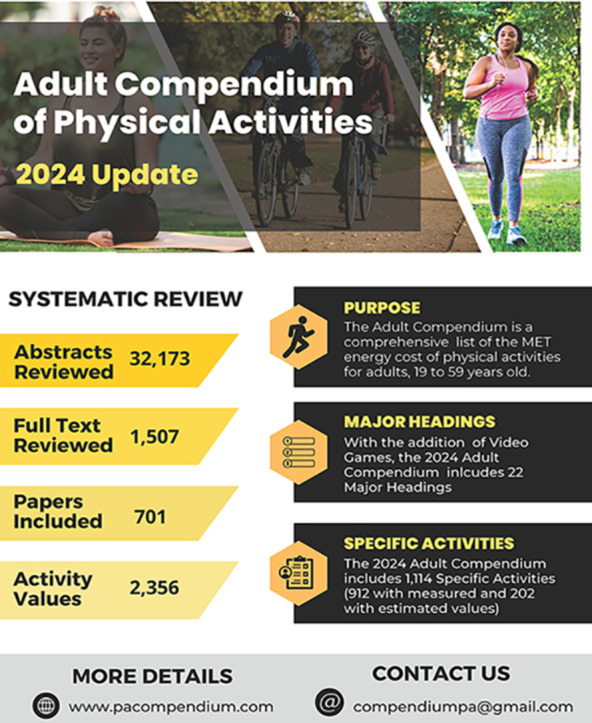
BACKGROUND: The Compendium of Physical Activities was published in 1993 to improve the comparability of energy expenditure values assigned to self-reported physical activity (PA) across studies. The original version was updated in 2000, and again in 2011, and has been widely used to support PA research, practice, and public health guidelines. METHODS: This 2024 update was tailored for adults 19-59 years of age by removing data from those ≥60 years. Using a systematic review and supplementary searches, we identified new activities and their associated measured metabolic equivalent (MET) values (using indirect calorimetry) published since 2011. We replaced estimated METs with measured values when possible. RESULTS: We screened 32,173 abstracts and 1507 full-text papers and extracted 2356 PA energy expenditure values from 701 papers. We added 303 new PAs and adjusted 176 existing MET values and descriptions to reflect the addition of new data and removal of METs for older adults. We added a Major Heading (Video Games). The 2024 Adult Compendium includes 1114 PAs (912 with measured and 202 with estimated values) across 22 Major Headings. CONCLUSION: This comprehensive update and refinement led to the creation of The 2024 Adult Compendium, which has utility across research, public health, education, and healthcare domains, as well as in the development of consumer health technologies. The new website with the complete lists of PAs and supporting resources is available at https://pacompendium.com.
Overview
AI snapshot
Written from the paper’s full text.
TL;DR
The 2024 Adult Compendium of Physical Activities is the third update of the Compendium, providing standardized MET values for 1114 Specific Activity codes across 22 Major Headings for adults aged 19–59 years. It adds 303 new Specific Activity codes, increases measured MET coverage to 912 of 1114 activities (82%), and introduces a new Video games Major Heading.
Key findings
- The 2024 Adult Compendium contains 22 Major Headings and 1114 Specific Activity codes, compared with 821 Specific Activities in the 2011 Compendium.
- Measured MET values now cover 912 PAs (82%) versus 561 of 821 PAs (68%) in 2011; estimated METs comprise 18.5% of the Adult Compendium.
- The update added 303 new Specific Activity codes with measured METs and made 176 changes to MET values or Specific Activity descriptions from the 2011 Compendium.
- The systematic review identified 32,173 abstracts; after removing 10,868 duplicates, 21,137 abstracts were screened, 1507 full-text articles were reviewed, 701 articles were used for data extraction, and 2356 new PA energy expenditure values were incorporated.
Methods
- A research librarian conducted a systematic search for articles and abstracts published from January 2011 through March 2023 using PubMed, Embase, SPORTDiscus, and Scopus, with 22 separate keyword searches pairing Compendium Major Heading activity concepts with energy-cost terms.
- Articles were included if participants had a mean age of 19–59 years, PA energy cost was measured using indirect or direct calorimetry, and articles/abstracts were available in English; exclusions included resting/peak/maximal values only, disability restricting PA, estimated EE from heart rate monitors, motion sensors, or prediction equations, and pregnant or chronic disease participants.
- Data extraction covered participant age and EE data such as METs and VO2; values reported in other units were converted to standard METs using a standardized resting metabolic rate of 3.5 mL/kg/min, and the 2024 Compendium maintained the same 5-digit coding scheme with MET values rounded to 0, 3, 5, and 8.
Limitations
- The paper states that categorizing energy costs of water PAs such as surfing and scuba diving, or live sports such as boxing and American football, remains challenging due to limitations of existing measurement strategies.
- The paper states the 2024 Adult Compendium is intended for non-disabled adults and adults without significant health conditions affecting EE or metabolism, and is limited to adults 19–59 years of age.
- Evident from the text: the Compendium still relies on estimated METs for some Specific Activities, and the paper reports estimated values as 202 in Table 3 but as 207 in the strengths and limitations section, an internal inconsistency in the reported count.
Model-written summary. Check it against the paper before relying on it.
Integrity signals
Registry
Cites
Statistics
Figures
Verification
Claims the paper makes
11 Own interpretation · 11 Own result · 7 No full text of the sources · 6 Partly supported · 6 No basis given · 4 Supported so far · 3 Own method · 2 Sources not found · 1 Supported · 1 Couldn’t confirm · accuracy not yet measured
The sources with a verdict support this claim; the rest weren’t checked yet, have no full text we could read, or their verdicts aren’t rated yet.
In the paper
“RMR is comparatively lower in older adults,20,21”
§ 2024 Adult Compendium of Physical Activities: A third update of the energy costs of human activities > Introduction
What the sources say
- Not checked — no full text of the sourcecites [20] Leal-Martin, 2022, Resting oxygen uptake value of 1 metabolic equivalent of task in older adults: A systematic review and descriptive analysis, Sports Med source
- Supportedcites [21] Pontzer, 2021, Daily energy expenditure through the human life course, Science source
The “Older adults (>60 y)” section reports that basal expenditure begins to decline around age 60 and that adjusted basal expenditure also falls. This supports the claim that resting metabolic rate is comparatively lower in older adults. (LLM, conf=0.93)
plaincorrelational- Asserted: passes — The authors put it forward as true.
- Checkable: passes — It can be checked against evidence.
- Load-bearing: passes — The paper’s conclusions depend on it.
- Based: passes — The paper gives a reason why it holds.
The sources with a verdict support this claim; the rest weren’t checked yet, have no full text we could read, or their verdicts aren’t rated yet.
In the paper
“The need for this additional grouping is based on significant research over the last 15 years that has evaluated a range of video games, from traditional seated handheld controller games27 to interactive gaming requiring upper body28 and lower body movement.29”
§ 2024 Adult Compendium of Physical Activities: A third update of the energy costs of human activities > Discussion > New Major Heading
What the sources say
- Not checked — no full text of the sourcecites [27] Jordan, 2011, Only lower limb controlled interactive computer gaming enables an effective increase in energy expenditure, Eur J Appl Physiol source
- Not checked — no full text of the sourcecites [28] Wu, 2015, Energy expenditure and intensity in healthy young adults during Exergaming, Am J Health Behav source
- Supportedcites [29] Sanders, 2012, Physiologic responses, liking and motivation for playing the same video game on an active versus a traditional, non-active gaming system, Int J Exerc Sci source
Split into 2 atoms — 2 confirmed, 0 partially supported, 0 disputed, 0 misattributed, 0 unverifiable. Expand the claim to see per-atom verdicts.
plaindirect- Asserted: passes — The authors put it forward as true.
- Checkable: passes — It can be checked against evidence.
- Load-bearing: passes — The paper’s conclusions depend on it.
- Based: passes — The paper gives a reason why it holds.
Every source the paper cites for this claim was checked and supports it.
In the paper
“Collectively, the Youth Compendium,19 Adult Compendium, and Older Adult Compendium22 provide MET values for PAs across the lifespan.”
§ 2024 Adult Compendium of Physical Activities: A third update of the energy costs of human activities > Discussion
What the sources say
- Supportedcites [19] Butte, 2018, A Youth Compendium of Physical Activities: Activity codes and metabolic intensities, Med Sci Sports Exerc source
The Discussion states that the Youth Compendium provides METy values for 196 physical activities across four age groups from 6 to 18 years. Citation 19 identifies the Youth Compendium’s contribution to the collective lifespan coverage; it need not establish what the Adult and Older Adult Compendiums contain. (LLM, conf=0.93)
- Supportedcites [22] Willis, 2024, Older Adult Compendium of Physical Activities: Energy costs of human physical activities in adults over 60 years, J Sport Health Sci source
The Introduction describes the Youth Compendium for ages 5–18, the Adult Compendium’s MET values for physical activities, and this paper’s Older Adult Compendium for adults aged 60 and older. Together, these passages support the cited statement that the compendiums provide MET values across the lifespan. (LLM, conf=0.93)
plain- Asserted: passes — The authors put it forward as true.
- Checkable: passes — It can be checked against evidence.
- Load-bearing: unclear — It is unclear whether the paper’s conclusions depend on it.
- Based: passes — The paper gives a reason why it holds.
- Supported
The cited sources support only part of this claim — read each source’s verdict below.
In the paper
“Additionally, significant variation in EE is observed within a game based on the difficulty level, the player's experience, and the effort involved.”
§ 2024 Adult Compendium of Physical Activities: A third update of the energy costs of human activities > Discussion > New Major Heading
What the sources say
- Not checked — no full text of the sourcecites [27] Jordan, 2011, Only lower limb controlled interactive computer gaming enables an effective increase in energy expenditure, Eur J Appl Physiol source
- Not checked — no full text of the sourcecites [28] Wu, 2015, Energy expenditure and intensity in healthy young adults during Exergaming, Am J Health Behav source
- Partly supportedcites [29] Sanders, 2012, Physiologic responses, liking and motivation for playing the same video game on an active versus a traditional, non-active gaming system, Int J Exerc Sci sourceExperimental — accuracy not yet measured
The Results (Gross Heart Rate and V̇O2; page not available) report a significant difference in oxygen consumption when Madden was played on Wii versus PS2, supporting variation between versions of the same game. But the Methods (Protocol; page not available) say all games were played at the least difficult setting, and the paper does not link energy expenditure to difficulty level or player experience. Its discussion of how vigorously participants might play is speculative, not an observed within-game effect of effort. (LLM, conf=0.84)
plaincorrelational- Asserted: passes — The authors put it forward as true.
- Checkable: passes — It can be checked against evidence.
- Load-bearing: passes — The paper’s conclusions depend on it.
- Based: passes — The paper gives a reason why it holds.
The cited sources support only part of this claim — read each source’s verdict below.
In the paper
“Several factors can influence RMR and the EE of PA;38, 39, 40”
§ 2024 Adult Compendium of Physical Activities: A third update of the energy costs of human activities > Discussion > Relative EE and absolute EE
What the sources say
- Partly supportedcites [38] Harris, 1918, A biometric study of human basal metabolism, Proc Natl Acad Sci U S A sourceExperimental — accuracy not yet measured
The Abstract identifies age, weight, stature, sex, food intake, and muscular activity as factors relevant to basal metabolism or its measurement. It does not address factors that influence energy expenditure during physical activity, so that part of the sentence is unsupported by this source. (LLM, conf=0.86)
- Not checked — no full text of the sourcecites [39] Roubenoff, 2000, The effect of gender and body composition method on the apparent decline in lean mass-adjusted resting metabolic rate with age, J Gerontol A Biol Sci Med Sci source
- Not checked — no full text of the sourcecites [40] Herrmann, 2017, The influence of physical characteristics on the resting energy expenditure of youth: A meta-analysis, Am J Hum Biol source
plainconditional- Asserted: passes — The authors put it forward as true.
- Checkable: passes — It can be checked against evidence.
- Load-bearing: passes — The paper’s conclusions depend on it.
- Based: passes — The paper gives a reason why it holds.
- Partly supported
The cited sources support only part of this claim — read each source’s verdict below.
In the paper
“For example, Browning et al.41 reported significantly higher EE (∼8%–15%) in women with obesity (age = 28.5 ± 7.6 years; body mass index = 33.9 ± 3.6 kg/m2) compared to women without obesity (age = 22.8 ± 3.6 years; body mass index = 21.6 ± 2.0 kg/m2) across multiple treadmill speeds and grades.”
§ 2024 Adult Compendium of Physical Activities: A third update of the energy costs of human activities > Discussion > Relative EE and absolute EE
What the sources say
- Partly supportedcites [41] Browning, 2013, Reiser 2nd RF. Obesity does not impair walking economy across a range of speeds and grades, J Appl Physiol (1985) sourceExperimental — accuracy not yet measured
The Results (page not available) report significantly higher gross metabolic rate in participants with obesity across all tested speeds and grades, but the analysis included both women and men rather than reporting this comparison specifically for women. The Results’ approximately 8%–15% figure refers to relative aerobic intensity, not energy expenditure; the Discussion (page not available) reports gross metabolic rate as 35%–50% higher. (LLM, conf=0.90)
plaincorrelational- Asserted: passes — The authors put it forward as true.
- Checkable: passes — It can be checked against evidence.
- Load-bearing: unclear — It is unclear whether the paper’s conclusions depend on it.
- Based: passes — The paper gives a reason why it holds.
- Partly supported
A result the paper reports from its own data — it cites no other source for it, so there is none to check. The quote shows it is in the paper.
In the paper
“Incorporating data from the systematic review added 303 new Specific Activity codes with measured METs (Table 4).”
§ 2024 Adult Compendium of Physical Activities: A third update of the energy costs of human activities > Results
plaindirect- Asserted: passes — The authors put it forward as true.
- Checkable: passes — It can be checked against evidence.
- Load-bearing: passes — The paper’s conclusions depend on it.
- Based: passes — The paper gives a reason why it holds.
A result the paper reports from its own data — it cites no other source for it, so there is none to check. The quote shows it is in the paper.
In the paper
“From these full-text articles, 2356 new PA EE values were incorporated into existing 5-digit Specific Activity codes or used to create new codes.”
§ 2024 Adult Compendium of Physical Activities: A third update of the energy costs of human activities > Results
plain- Asserted: passes — The authors put it forward as true.
- Checkable: passes — It can be checked against evidence.
- Load-bearing: passes — The paper’s conclusions depend on it.
- Based: passes — The paper gives a reason why it holds.
The paper states this without a source or data behind it here, so there is nothing to check it against. The quote shows it is in the paper.
In the paper
“For example, traditional seated handheld controller games are in the new code 22040 (seated, video game, handheld controller; 1.3 METs).”
§ 2024 Adult Compendium of Physical Activities: A third update of the energy costs of human activities > Discussion > New Major Heading
plain- Asserted: passes — The authors put it forward as true.
- Checkable: passes — It can be checked against evidence.
- Load-bearing: unclear — It is unclear whether the paper’s conclusions depend on it.
- Based: passes — The paper gives a reason why it holds.
A result the paper reports from its own data — it cites no other source for it, so there is none to check. The quote shows it is in the paper.
In the paper
“but they now comprise only 18.5% of the Adult Compendium.”
§ 2024 Adult Compendium of Physical Activities: A third update of the energy costs of human activities > Results
plain- Asserted: passes — The authors put it forward as true.
- Checkable: passes — It can be checked against evidence.
- Load-bearing: unclear — It is unclear whether the paper’s conclusions depend on it.
- Based: passes — The paper gives a reason why it holds.
- Probably not a substantial claim. 26
- It may state two separate claims as one. 23
The cited sources support only part of this claim — read each source’s verdict below.
In the paper
“MET-minutes and MET-hours are often used to assess PA dose with various health outcomes.25”
§ 2024 Adult Compendium of Physical Activities: A third update of the energy costs of human activities > Discussion > Utility
What the sources say
- Partly supportedcites [25] LaMonte, 2018, Physical activity and incidence of heart failure in postmenopausal women, JACC Heart Fail sourceExperimental — accuracy not yet measured
The Methods (Physical Activity Assessment; page unavailable) use MET-hours/week to measure physical activity, and the Results relate that measure to heart-failure outcomes. The paper does not establish that MET-minutes are often used or that these measures are used across various health outcomes. (LLM, conf=0.86)
plain- Asserted: passes — The authors put it forward as true.
- Checkable: passes — It can be checked against evidence.
- Load-bearing: fails — The paper’s conclusions may not depend on it.
- Based: passes — The paper gives a reason why it holds.
Probably not a substantial claim. The paper’s conclusions may not depend on it.
- Partly supported
The cited sources support only part of this claim — read each source’s verdict below.
In the paper
“Since RMR changes across the lifespan (dramatically throughout adolescence16,17)”
§ 2024 Adult Compendium of Physical Activities: A third update of the energy costs of human activities > Introduction
What the sources say
- Not checked — no full text of the sourcecites [16] Herrmann, 2017, The influence of physical characteristics on the resting energy expenditure of youth: A meta-analysis, Am J Hum Biol source
- Partly supportedcites [17] Pfeiffer, 2018, Energy cost expression for a Youth Compendium of Physical Activities: Rationale for using age groups, Pediatr Exerc Sci sourceExperimental — accuracy not yet measured
The Introduction says resting energy expenditure per unit of body mass declines with age in children and is higher in children than adults. The Discussion gives a substantial basal metabolic rate difference between an 8-year-old and a 16-year-old. These passages support an age-related change, but they do not establish changes across the entire lifespan or specifically throughout adolescence. (LLM, conf=0.84)
boostedcorrelational- Asserted: passes — The authors put it forward as true.
- Checkable: passes — It can be checked against evidence.
- Load-bearing: passes — The paper’s conclusions depend on it.
- Based: passes — The paper gives a reason why it holds.
It may state two separate claims as one.
The cited sources support only part of this claim — read each source’s verdict below.
In the paper
“Combining questionnaires and device-based measures33 may support public health efforts to further quantify the dose-response of PA and sedentary behaviors for health outcomes, potentially leading to new device-based guidelines for PA and health and guidance for reducing sedentary time throughout the day.14,37”
§ 2024 Adult Compendium of Physical Activities: A third update of the energy costs of human activities > Discussion > New Major Heading
What the sources say
- Partly supportedcites [33] Colley, 2022, How sedentary are Canadian adults? It depends on the measure, Health Rep sourceExperimental — accuracy not yet measured
Split into 2 atoms — 1 confirmed, 1 partially supported, 0 disputed, 0 misattributed, 0 unverifiable. Expand the claim to see per-atom verdicts.
- Partly supportedcites [14] Bull, 2020, World Health Organization 2020 guidelines on physical activity and sedentary behaviour, Br J Sports Med sourceExperimental — accuracy not yet measured
Split into 2 atoms — 1 confirmed, 1 partially supported, 0 disputed, 0 misattributed, 0 unverifiable. Expand the claim to see per-atom verdicts.
- Partly supportedcites [37] Gill, 2023, Potential impact of wearables on physical activity guidelines and interventions: Opportunities and challenges, Br J Sports Med sourceExperimental — accuracy not yet measured
Split into 2 atoms — 0 confirmed, 1 partially supported, 0 disputed, 0 misattributed, 1 unverifiable. Expand the claim to see per-atom verdicts.
hedgedconditional- Asserted: passes — The authors put it forward as true.
- Checkable: fails — It may be too vague to check against evidence.
- Load-bearing: fails — The paper’s conclusions may not depend on it.
- Based: passes — The paper gives a reason why it holds.
Probably not a substantial claim. It may be too vague to check against evidence. The paper’s conclusions may not depend on it. It may state two separate claims as one.
- Partly supported
The cited sources that could be checked couldn’t confirm or dispute this claim.
In the paper
“Since its inception, the Compendium has been used widely to support PA and health research9, 10, 11and to anchor national and international PA guidelines.12, 13, 14”
§ 2024 Adult Compendium of Physical Activities: A third update of the energy costs of human activities > Introduction
What the sources say
- Not matchedcites [9] Jones, 1998, Prevalences of moderate physical activity recommended by the Surgeon General's Report in US adults: National Health Interview Survey, 1990, Arch Family Med
Couldn’t be matched to a paper in Crossref, so it can’t be checked.
- Not checked — no full text of the sourcecites [12] Piepoli, 2017, 2016 European guidelines on cardiovascular disease prevention in clinical practice, Int J Behav Med source
- Could not verifycites [14] Bull, 2020, World Health Organization 2020 guidelines on physical activity and sedentary behaviour, Br J Sports Med sourceExperimental — accuracy not yet measured
The Methods section describes the evidence reviews used to develop the WHO guidelines, but does not say the Compendium was used. Searches for “Compendium of Physical Activities” and MET-related guideline development found definitions of METs in the Introduction, not evidence that the Compendium anchored these or other guidelines. (LLM, conf=0.75)
plaindirect- Asserted: passes — The authors put it forward as true.
- Checkable: passes — It can be checked against evidence.
- Load-bearing: fails — The paper’s conclusions may not depend on it.
- Based: passes — The paper gives a reason why it holds.
Probably not a substantial claim. The paper’s conclusions may not depend on it. It may state two separate claims as one.
- Not matched
The sources with a verdict support this claim; the rest weren’t checked yet, have no full text we could read, or their verdicts aren’t rated yet.
In the paper
“Studies consistently note differences in RMR based on age, sex, height, and body weight or body composition and recommend accounting for these factors to estimate RMR when measured RMR values are unavailable to use as the denominator in computing METs (i.e., relative METs).38,39,42”
§ 2024 Adult Compendium of Physical Activities: A third update of the energy costs of human activities > Discussion > Relative EE and absolute EE
What the sources say
- Supportedcites [38] Harris, 1918, A biometric study of human basal metabolism, Proc Natl Acad Sci U S A source
The passage giving the multiple-regression equations (Abstract) uses sex-specific equations incorporating age, stature, and body weight to predict basal heat production. It says the tables allow the most probable basal metabolism of an unknown subject to be determined. The reference to using that estimate as a MET denominator describes the citing authors’ application, not a recommendation attributed to this paper. (LLM, conf=0.90)
- Not checked — no full text of the sourcecites [39] Roubenoff, 2000, The effect of gender and body composition method on the apparent decline in lean mass-adjusted resting metabolic rate with age, J Gerontol A Biol Sci Med Sci source
- Not checked — no full text of the sourcecites [42] Byrne, 2005, Metabolic equivalent: One size does not fit all, J Appl Physiol (1985) source
boostedcorrelational- Asserted: passes — The authors put it forward as true.
- Checkable: passes — It can be checked against evidence.
- Load-bearing: passes — The paper’s conclusions depend on it.
- Based: passes — The paper gives a reason why it holds.
It may state two separate claims as one.
- Supported
The sources with a verdict support this claim; the rest weren’t checked yet, have no full text we could read, or their verdicts aren’t rated yet.
In the paper
“Kozey et al.43 have proposed a corrected MET to adjust for individual differences in RMR using the Harris-Benedict RMR equation.38”
§ 2024 Adult Compendium of Physical Activities: A third update of the energy costs of human activities > Discussion > Relative EE and absolute EE
What the sources say
- Not checked — no full text of the sourcecites [43] Kozey, 2010, Errors in MET estimates of physical activities using 3.5 mL/kg/min as the baseline oxygen consumption, J Phys Act Health source
- Supportedcites [38] Harris, 1918, A biometric study of human basal metabolism, Proc Natl Acad Sci U S A source
Citation 38 identifies the Harris–Benedict equation used to estimate resting metabolic rate; the separate citation 43 is attached to Kozey et al.'s corrected-MET proposal. The supplied passage (Abstract; page not provided) gives sex-specific equations predicting basal heat production from weight, stature, and age. (LLM, conf=0.92)
plaindirect- Asserted: passes — The authors put it forward as true.
- Checkable: passes — It can be checked against evidence.
- Load-bearing: fails — The paper’s conclusions may not depend on it.
- Based: passes — The paper gives a reason why it holds.
Probably not a substantial claim. The paper’s conclusions may not depend on it.
A result the paper reports from its own data — it cites no other source for it, so there is none to check. The quote shows it is in the paper.
In the paper
“We reviewed 1507 full-text articles, resulting in 701 articles for data extraction.”
§ 2024 Adult Compendium of Physical Activities: A third update of the energy costs of human activities > Results
plaindirect- Asserted: passes — The authors put it forward as true.
- Checkable: passes — It can be checked against evidence.
- Load-bearing: fails — The paper’s conclusions may not depend on it.
- Based: passes — The paper gives a reason why it holds.
Probably not a substantial claim. The paper’s conclusions may not depend on it. It may state two separate claims as one.
A result the paper reports from its own data — it cites no other source for it, so there is none to check. The quote shows it is in the paper.
In the paper
“The 2024 Adult Compendium maintains the same 5-digit coding scheme that contains Major Headings (first 2 digits) and Specific Activity codes (last 3 digits), followed by their associated standard MET value and activity description (Table 1).”
§ 2024 Adult Compendium of Physical Activities: A third update of the energy costs of human activities > Methods > Presentation of the 2024 Adult Compendium
plain- Asserted: passes — The authors put it forward as true.
- Checkable: passes — It can be checked against evidence.
- Load-bearing: fails — The paper’s conclusions may not depend on it.
- Based: passes — The paper gives a reason why it holds.
Probably not a substantial claim. The paper’s conclusions may not depend on it.
A result the paper reports from its own data — it cites no other source for it, so there is none to check. The quote shows it is in the paper.
In the paper
“The systematic review identified 32,173 abstracts.”
§ 2024 Adult Compendium of Physical Activities: A third update of the energy costs of human activities > Results
plain- Asserted: passes — The authors put it forward as true.
- Checkable: passes — It can be checked against evidence.
- Load-bearing: fails — The paper’s conclusions may not depend on it.
- Based: passes — The paper gives a reason why it holds.
Probably not a substantial claim. The paper’s conclusions may not depend on it.
In the paper
“Games with increased effort and complexity and body motion sensing games are assigned Specific Activity code 22200 (active video game, motion sensing game/using upper-body, light-to-moderate effort; 3.0 METs) or Specific Activity code 22360 (conditioning/exercise virtual reality fitness, vigorous-intensity; 9.8 METs).31”
§ 2024 Adult Compendium of Physical Activities: A third update of the energy costs of human activities > Discussion > New Major Heading
What the sources say
- Not checked — no full text of the sourcecites [31] Hu, 2021, Physiological and metabolic requirements, and user-perceived exertion of immersive virtual reality exergaming incorporating an adaptive cable resistance system: An exploratory study, Games Health J source
plain- Asserted: passes — The authors put it forward as true.
- Checkable: passes — It can be checked against evidence.
- Load-bearing: passes — The paper’s conclusions depend on it.
- Based: passes — The paper gives a reason why it holds.
It may state two separate claims as one.
The paper states this without a source or data behind it here, so there is nothing to check it against. The quote shows it is in the paper.
In the paper
“We added 1 new Major Heading (Video games).”
§ 2024 Adult Compendium of Physical Activities: A third update of the energy costs of human activities > Discussion
plain- Asserted: passes — The authors put it forward as true.
- Checkable: passes — It can be checked against evidence.
- Load-bearing: fails — The paper’s conclusions may not depend on it.
- Based: passes — The paper gives a reason why it holds.
Probably not a substantial claim. The paper’s conclusions may not depend on it.
A result the paper reports from its own data — it cites no other source for it, so there is none to check. The quote shows it is in the paper.
In the paper
“The 2024 Adult Compendium contains 22 Major Headings and 1114 Specific Activity codes (Table 2)”
§ 2024 Adult Compendium of Physical Activities: A third update of the energy costs of human activities > Results
plain- Asserted: passes — The authors put it forward as true.
- Checkable: passes — It can be checked against evidence.
- Load-bearing: fails — The paper’s conclusions may not depend on it.
- Based: passes — The paper gives a reason why it holds.
Probably not a substantial claim. The paper’s conclusions may not depend on it. It may state two separate claims as one.
A result the paper reports from its own data — it cites no other source for it, so there is none to check. The quote shows it is in the paper.
In the paper
“After removing duplicates across search databases (n = 10,868 duplicates), 21,137 abstracts were available for screening and review.”
§ 2024 Adult Compendium of Physical Activities: A third update of the energy costs of human activities > Results
plain- Asserted: passes — The authors put it forward as true.
- Checkable: passes — It can be checked against evidence.
- Load-bearing: fails — The paper’s conclusions may not depend on it.
- Based: passes — The paper gives a reason why it holds.
Probably not a substantial claim. The paper’s conclusions may not depend on it.
A result the paper reports from its own data — it cites no other source for it, so there is none to check. The quote shows it is in the paper.
In the paper
“In this update, 912 PAs (82 %) have measured MET values compared to 561 of the 821 PAs (68%) in the 2011 Compendium (Table 3).”
§ 2024 Adult Compendium of Physical Activities: A third update of the energy costs of human activities > Results
plain- Asserted: passes — The authors put it forward as true.
- Checkable: passes — It can be checked against evidence.
- Load-bearing: passes — The paper’s conclusions depend on it.
- Based: passes — The paper gives a reason why it holds.
It may state two separate claims as one.
The paper states this without a source or data behind it here, so there is nothing to check it against. The quote shows it is in the paper.
In the paper
“We also replaced some estimated MET values in the 2011 Compendium with measured values and transferred METs for adults ≥60 years old to the Older Adult Compendium.”
§ 2024 Adult Compendium of Physical Activities: A third update of the energy costs of human activities > Discussion
plain- Asserted: passes — The authors put it forward as true.
- Checkable: passes — It can be checked against evidence.
- Load-bearing: unclear — It is unclear whether the paper’s conclusions depend on it.
- Based: passes — The paper gives a reason why it holds.
It may state two separate claims as one.
The paper states this without a source or data behind it here, so there is nothing to check it against. The quote shows it is in the paper.
In the paper
“The 2024 Adult Compendium of Physical Activities presents the energy costs of 1114 PAs including inactivity, leisure, transportation, sports and conditioning, and in-home and occupational settings.”
§ 2024 Adult Compendium of Physical Activities: A third update of the energy costs of human activities > Abstract
plain- Asserted: passes — The authors put it forward as true.
- Checkable: passes — It can be checked against evidence.
- Load-bearing: passes — The paper’s conclusions depend on it.
- Based: passes — The paper gives a reason why it holds.
It may state two separate claims as one.
The paper states this without a source or data behind it here, so there is nothing to check it against. The quote shows it is in the paper.
In the paper
“Data from over 2000 PAs were identified and included to expand Specific Activity codes, add a new Major Heading, and reduce the frequency of estimated values from 260 in the 2011 update to 207 in this current update.”
§ 2024 Adult Compendium of Physical Activities: A third update of the energy costs of human activities > Discussion > Strengths and limitations
plaindirectn = 2,024- Asserted: passes — The authors put it forward as true.
- Checkable: passes — It can be checked against evidence.
- Load-bearing: passes — The paper’s conclusions depend on it.
- Based: passes — The paper gives a reason why it holds.
It may state two separate claims as one.
In the paper
“A research librarian conducted a comprehensive, systematic search for articles and abstracts published since the 2011 Compendium update,6 specifically from January 2011 through March 2023. Searches were conducted using 4 databases (PubMed, Embase, SPORTDiscus (EBSCOhost), and Scopus). The librarian conducted 22 separate searches”
§ 2024 Adult Compendium of Physical Activities: A third update of the energy costs of human activities > Methods > Search strategy
What the sources say
- Not checked — no full text of the sourcecites [6] Ainsworth, 2011, 2011 Compendium of Physical Activities: A second update of codes and MET values, Med Sci Sports Exerc source
plain- Asserted: passes — The authors put it forward as true.
- Checkable: passes — It can be checked against evidence.
- Load-bearing: passes — The paper’s conclusions depend on it.
- Based: passes — The paper gives a reason why it holds.
Probably not a substantial claim. It may state two separate claims as one.
In the paper
“The first update, published in 2000, included ∼10 years of new data and added 2 Major Headings (Religious activities and Volunteer activities).5”
§ 2024 Adult Compendium of Physical Activities: A third update of the energy costs of human activities > Discussion
What the sources say
- Not checked — no full text of the sourcecites [5] Ainsworth, 2000, Compendium of physical activities: An update of activity codes and MET intensities, Med Sci Sports Exerc source
plain- Asserted: passes — The authors put it forward as true.
- Checkable: passes — It can be checked against evidence.
- Load-bearing: fails — The paper’s conclusions may not depend on it.
- Based: passes — The paper gives a reason why it holds.
Probably not a substantial claim. The paper’s conclusions may not depend on it. It may state two separate claims as one.
In the paper
“The 2018 U.S. PA Guidelines recommend 150–300 min/week of moderate-intensity PA, 75 min/week of vigorous-intensity PA, or a combination of both.”
§ 2024 Adult Compendium of Physical Activities: A third update of the energy costs of human activities > Discussion > Utility
What the sources say
- Not matchedcites [26] 2018
Couldn’t be matched to a paper in Crossref, so it can’t be checked.
plain- Asserted: passes — The authors put it forward as true.
- Checkable: passes — It can be checked against evidence.
- Load-bearing: fails — The paper’s conclusions may not depend on it.
- Based: passes — The paper gives a reason why it holds.
Probably not a substantial claim. The paper’s conclusions may not depend on it.
- Not matched
In the paper
“The Compendium provides a consistent MET value, based whenever possible on published studies of energy cost, for scoring PA questionnaires, allowing for improved comparability across studies.4”
§ 2024 Adult Compendium of Physical Activities: A third update of the energy costs of human activities > Introduction
What the sources say
- Not checked — no full text of the sourcecites [4] Ainsworth, 1993, Compendium of Physical Activities: Classification of energy costs of human physical activities, Med Sci Sports Exerc source
plaindirect- Asserted: passes — The authors put it forward as true.
- Checkable: passes — It can be checked against evidence.
- Load-bearing: passes — The paper’s conclusions depend on it.
- Based: passes — The paper gives a reason why it holds.
It may state two separate claims as one.
What the paper did — it cites no source for this, so there is none to check. The quote shows it is in the paper.
In the paper
“One reviewer (SDH, EAW, BEA, MH, or CLK) independently extracted participant age and EE data (e.g., METs, oxygen uptake (VO2, mL/kg/min)) for identified PAs. A second reviewer (SDH, EAW, or MH) checked the extracted data for accuracy.”
§ 2024 Adult Compendium of Physical Activities: A third update of the energy costs of human activities > Methods > Data extraction
plain- Asserted: passes — The authors put it forward as true.
- Checkable: passes — It can be checked against evidence.
- Load-bearing: fails — The paper’s conclusions may not depend on it.
- Based: passes — The paper gives a reason why it holds.
Probably not a substantial claim. The paper’s conclusions may not depend on it. It may state two separate claims as one.
A conclusion the paper draws from its own results — it cites no other source for it, so there is none to check. The quote shows it is in the paper.
In the paper
“The 2024 Adult Compendium supports these efforts by expanding the range of available Specific Activity codes for sedentary behaviors and PAs, which can be used to quantify PA from self-report methods and provide context to device-based measures.”
§ 2024 Adult Compendium of Physical Activities: A third update of the energy costs of human activities > Discussion > New Major Heading
plaindirect- Asserted: passes — The authors put it forward as true.
- Checkable: passes — It can be checked against evidence.
- Load-bearing: passes — The paper’s conclusions depend on it.
- Based: passes — The paper gives a reason why it holds.
It may state two separate claims as one.
A conclusion the paper draws from its own results — it cites no other source for it, so there is none to check. The quote shows it is in the paper.
In the paper
“The Compendium has maintained relevance for over 30 years, partly due to its evolution as a living document with an expanded and enhanced Specific Activity code list.”
§ 2024 Adult Compendium of Physical Activities: A third update of the energy costs of human activities > Discussion
plainconditional- Asserted: passes — The authors put it forward as true.
- Checkable: passes — It can be checked against evidence.
- Load-bearing: fails — The paper’s conclusions may not depend on it.
- Based: passes — The paper gives a reason why it holds.
Probably not a substantial claim. The paper’s conclusions may not depend on it. It may state two separate claims as one.
A conclusion the paper draws from its own results — it cites no other source for it, so there is none to check. The quote shows it is in the paper.
In the paper
“This intentional separation allows a focused Older Adult Compendium to better reflect this age group's distinctive RMR characteristics.”
§ 2024 Adult Compendium of Physical Activities: A third update of the energy costs of human activities > Discussion
plaindirect- Asserted: passes — The authors put it forward as true.
- Checkable: passes — It can be checked against evidence.
- Load-bearing: passes — The paper’s conclusions depend on it.
- Based: fails — The paper may give no reason why it holds.
Probably not a substantial claim. The paper may give no reason why it holds.
In the paper
“The second update, published in 2011, added over 200 new Specific activities codes and differentiated between measured MET values supported by published research (68% in 2011) and estimated MET values.6”
§ 2024 Adult Compendium of Physical Activities: A third update of the energy costs of human activities > Discussion
What the sources say
- Not checked — no full text of the sourcecites [6] Ainsworth, 2011, 2011 Compendium of Physical Activities: A second update of codes and MET values, Med Sci Sports Exerc source
plain- Asserted: passes — The authors put it forward as true.
- Checkable: passes — It can be checked against evidence.
- Load-bearing: fails — The paper’s conclusions may not depend on it.
- Based: passes — The paper gives a reason why it holds.
Probably not a substantial claim. The paper’s conclusions may not depend on it. It may state two separate claims as one.
In the paper
“This volume of PA is equivalent to ∼500–1000 MET-min/week, which is sufficient to reduce the risks of morbidity and mortality.26”
§ 2024 Adult Compendium of Physical Activities: A third update of the energy costs of human activities > Discussion > Utility
What the sources say
- Not matchedcites [26] 2018
Couldn’t be matched to a paper in Crossref, so it can’t be checked.
plaindirect- Asserted: passes — The authors put it forward as true.
- Checkable: passes — It can be checked against evidence.
- Load-bearing: unclear — It is unclear whether the paper’s conclusions depend on it.
- Based: passes — The paper gives a reason why it holds.
It may state two separate claims as one.
- Not matched
A claim is checked only against the cited paper’s full text, never its abstract, and none is available for its sources.
In the paper
“For example, Nintendo Wii boxing ranges from 2.5 METs during free play30 to over 8.0 METs for vigorous play using an Xbox 360.28”
§ 2024 Adult Compendium of Physical Activities: A third update of the energy costs of human activities > Discussion > New Major Heading
What the sources say
- Not checked — no full text of the sourcecites [30] Naugle, 2019, Improving active gaming's energy expenditure in healthy adults using structured playing instructions for the Nintendo Wii and XBOX Kinect, J Strength Cond Res source
- Not checked — no full text of the sourcecites [28] Wu, 2015, Energy expenditure and intensity in healthy young adults during Exergaming, Am J Health Behav source
plaincorrelational- Asserted: passes — The authors put it forward as true.
- Checkable: passes — It can be checked against evidence.
- Load-bearing: unclear — It is unclear whether the paper’s conclusions depend on it.
- Based: passes — The paper gives a reason why it holds.
It may state two separate claims as one.
What the paper did — it cites no source for this, so there is none to check. The quote shows it is in the paper.
In the paper
“if the database searches identified <1000 articles for an individual search Major Heading (e.g., Music playing), 2 reviewers (SDH, EAW, TVB, MH, CLK, and/or JMS) independently screened all abstracts for eligibility and a third reviewer (SDH or EAW) resolved conflicts.”
§ 2024 Adult Compendium of Physical Activities: A third update of the energy costs of human activities > Methods > Study selection
plain- Asserted: passes — The authors put it forward as true.
- Checkable: passes — It can be checked against evidence.
- Load-bearing: fails — The paper’s conclusions may not depend on it.
- Based: passes — The paper gives a reason why it holds.
Probably not a substantial claim. The paper’s conclusions may not depend on it. It may state two separate claims as one.
What the paper did — it cites no source for this, so there is none to check. The quote shows it is in the paper.
In the paper
“The review methodology was established prior to its initiation.”
§ 2024 Adult Compendium of Physical Activities: A third update of the energy costs of human activities > Methods > Search strategy
plain- Asserted: passes — The authors put it forward as true.
- Checkable: passes — It can be checked against evidence.
- Load-bearing: fails — The paper’s conclusions may not depend on it.
- Based: passes — The paper gives a reason why it holds.
Probably not a substantial claim. The paper’s conclusions may not depend on it.
A claim is checked only against the cited paper’s full text, never its abstract, and none is available for its sources.
In the paper
“The 2024 Adult Compendium of Physical Activities is the third update of the Compendium of Physical Activities, first published in 1993 and previously updated in 2000 and 2011.”
§ 2024 Adult Compendium of Physical Activities: A third update of the energy costs of human activities > Abstract
What the sources say
- Not checked — no full text of the sourcecites [4] Ainsworth, 1993, Compendium of Physical Activities: Classification of energy costs of human physical activities, Med Sci Sports Exerc source
- Not checked — no full text of the sourcecites [5] Ainsworth, 2000, Compendium of physical activities: An update of activity codes and MET intensities, Med Sci Sports Exerc source
- Not checked — no full text of the sourcecites [6] Ainsworth, 2011, 2011 Compendium of Physical Activities: A second update of codes and MET values, Med Sci Sports Exerc source
plain- Asserted: passes — The authors put it forward as true.
- Checkable: passes — It can be checked against evidence.
- Load-bearing: fails — The paper’s conclusions may not depend on it.
- Based: passes — The paper gives a reason why it holds.
Probably not a substantial claim. The paper’s conclusions may not depend on it. It may state two separate claims as one.
A conclusion the paper draws from its own results — it cites no other source for it, so there is none to check. The quote shows it is in the paper.
In the paper
“thus, the Compendium can serve as a starting point for prescribing individual activities but does not reflect precise individual EE values.”
§ 2024 Adult Compendium of Physical Activities: A third update of the energy costs of human activities > Discussion > Relative EE and absolute EE
plain- Asserted: passes — The authors put it forward as true.
- Checkable: passes — It can be checked against evidence.
- Load-bearing: passes — The paper’s conclusions depend on it.
- Based: passes — The paper gives a reason why it holds.
It may state two separate claims as one.
A conclusion the paper draws from its own results — it cites no other source for it, so there is none to check. The quote shows it is in the paper.
In the paper
“Due to the variation in RMR between individuals, relative, standard, and corrected METs understandably differ.”
§ 2024 Adult Compendium of Physical Activities: A third update of the energy costs of human activities > Discussion > Relative EE and absolute EE
plaindirect- Asserted: passes — The authors put it forward as true.
- Checkable: passes — It can be checked against evidence.
- Load-bearing: fails — The paper’s conclusions may not depend on it.
- Based: passes — The paper gives a reason why it holds.
Probably not a substantial claim. The paper’s conclusions may not depend on it.
A conclusion the paper draws from its own results — it cites no other source for it, so there is none to check. The quote shows it is in the paper.
In the paper
“Collectively, the revisions in the 2024 Adult Compendium provide standard MET values for adults to assist researchers, practitioners, and public health specialists in assigning and describing intensity to a wide range of PAs commonly performed in a variety of settings, including inactivity, leisure, transportation, sports and conditioning, and in-home and occupational settings.”
§ 2024 Adult Compendium of Physical Activities: A third update of the energy costs of human activities > Conclusion
plain- Asserted: passes — The authors put it forward as true.
- Checkable: passes — It can be checked against evidence.
- Load-bearing: passes — The paper’s conclusions depend on it.
- Based: passes — The paper gives a reason why it holds.
Probably not a substantial claim.
A conclusion the paper draws from its own results — it cites no other source for it, so there is none to check. The quote shows it is in the paper.
In the paper
“The 2024 Adult Compendium builds upon that utility as a standardized and comprehensive source of broadly described Major Headings and the EE costs associated with 1114 Specific Activity codes.”
§ 2024 Adult Compendium of Physical Activities: A third update of the energy costs of human activities > Conclusion
plaincorrelational- Asserted: passes — The authors put it forward as true.
- Checkable: passes — It can be checked against evidence.
- Load-bearing: passes — The paper’s conclusions depend on it.
- Based: passes — The paper gives a reason why it holds.
Probably not a substantial claim.
A conclusion the paper draws from its own results — it cites no other source for it, so there is none to check. The quote shows it is in the paper.
In the paper
“As with prior versions of the Compendium, the 2024 Adult Compendium is intended for use in non-disabled adults and adults without significant health conditions that affect EE or metabolism (e.g., heart failure patients, patients with chronic obstructive pulmonary disease, pregnant women, adults with Down Syndrome).”
§ 2024 Adult Compendium of Physical Activities: A third update of the energy costs of human activities > Discussion > Strengths and limitations
plain- Asserted: passes — The authors put it forward as true.
- Checkable: passes — It can be checked against evidence.
- Load-bearing: fails — The paper’s conclusions may not depend on it.
- Based: passes — The paper gives a reason why it holds.
Probably not a substantial claim. The paper’s conclusions may not depend on it.
A conclusion the paper draws from its own results — it cites no other source for it, so there is none to check. The quote shows it is in the paper.
In the paper
“For over 30 years, the Compendium has set a global standard used to identify the EE cost of Specific Activity codes ranging from sedentary behaviors to an abundance of PA variations.”
§ 2024 Adult Compendium of Physical Activities: A third update of the energy costs of human activities > Conclusion
plain- Asserted: passes — The authors put it forward as true.
- Checkable: passes — It can be checked against evidence.
- Load-bearing: fails — The paper’s conclusions may not depend on it.
- Based: fails — The paper may give no reason why it holds.
Probably not a substantial claim. The paper’s conclusions may not depend on it. The paper may give no reason why it holds.
A conclusion the paper draws from its own results — it cites no other source for it, so there is none to check. The quote shows it is in the paper.
In the paper
“Categorizing the energy costs of water PAs like surfing and scuba diving or during live sports activities such as boxing, American football, and other team sports continues to be a challenge due to the inherent limitations of existing measurement strategies.”
§ 2024 Adult Compendium of Physical Activities: A third update of the energy costs of human activities > Discussion > Strengths and limitations
plaindirect- Asserted: passes — The authors put it forward as true.
- Checkable: passes — It can be checked against evidence.
- Load-bearing: fails — The paper’s conclusions may not depend on it.
- Based: passes — The paper gives a reason why it holds.
Probably not a substantial claim. The paper’s conclusions may not depend on it.
The paper relies on this without support.
Measured MET values are preferable to estimated MET values for the Compendium.
“continue to replace estimated MET values with measured MET values where available”
“We also replaced some estimated MET values in the 2011 Compendium with measured values”
Self-check
Percentages, sums and reported differences re-computed from the paper’s own numbers.
Each contradiction between two passages listed here was confirmed by an independent check.
Rated minor: it would not touch a result — a value no result rests on, a p-value that stays on the same side of the significance level, or a conflict that is clerical, resolved elsewhere in the paper, or outside its own findings.
In the paper
“Estimated METs have been used when measured METs are unavailable for a Specific Activity (e.g., activities that are unmeasured or challenging to measure, such as surfing, diving, or wrestling), but they now comprise only 18.5% of the Adult Compendium.”
§ 2024 Adult Compendium of Physical Activities: A third update of the energy costs of human activities > Results
Reported 18.5 · recomputed 18.132855
Rated minor: it would not touch a result — a value no result rests on, a p-value that stays on the same side of the significance level, or a conflict that is clerical, resolved elsewhere in the paper, or outside its own findings.
In the paper
§ 2024 Adult Compendium of Physical Activities: A third update of the energy costs of human activities > Discussion > Strengths and limitations
“reduce the frequency of estimated values from 260 in the 2011 update to 207 in this current update.”
§ 2024 Adult Compendium of Physical Activities: A third update of the energy costs of human activities > Results
“| 4 | 2024 | Adult Compendium | 22 | 1114 (912/202) |”
Citations
Cites
World Health Organization 2020 guidelines on physical activity and sedentary behaviour
Bull, F. C., Al-Ansari, S. S., Biddle, S., Borodulin, K., Buman, M. P., Cardon, G., Carty, C., Chaput, J.-P., Chastin, S., Chou, R., et al. (2020) · British Journal of Sports Medicine · doi:10.1136/bjsports-2020-102955 · Cited by 11,657
The Physical Activity Guidelines for Americans
Piercy, K. L., Troiano, R. P., Ballard, R. M., Carlson, S. A., Fulton, J. E., Galuska, D. A., George, S. M., & Olson, R. D. (2018) · JAMA · doi:10.1001/jama.2018.14854 · Cited by 9,755 · cited 1×
“13,14 Most reviewed studies presented PA energy cost data as mL/kg/min or a standard MET using 3.5 mL/kg/min as the denominator.”
MethodInfluentialCompendium of physical activities: an update of activity codes and MET intensities
AINSWORTH, B. E., HASKELL, W. L., WHITT, M. C., IRWIN, M. L., SWARTZ, A. M., STRATH, S. J., O???BRIEN, W. L., BASSETT, D. R., SCHMITZ, K. H., EMPLAINCOURT, P. O., et al. (2000) · Medicine & Science in Sports & Exercise · doi:10.1097/00005768-200009001-00009 · Cited by 8,497
Self-citation2011 Compendium of Physical Activities: A Second Update of Codes and MET Values
AINSWORTH, B. E., HASKELL, W. L., HERRMANN, S. D., MECKES, N., BASSETT, D. R., TUDOR-LOCKE, C., GREER, J. L., VEZINA, J., WHITT-GLOVER, M. C., & LEON, A. S. (2011) · Medicine & Science in Sports & Exercise · doi:10.1249/mss.0b013e31821ece12 · Cited by 6,317
Self-citationCompendium of Physical Activities: Classification of energy costs of human physical activities
AINSWORTH, B. E., HASKELL, W. L., LEON, A. S., JACOBS, D. R., MONTOYE, H. J., SALLIS, J. F., & PAFFENBARGER, R. S. (1993) · Medicine & Science in Sports & Exercise · doi:10.1249/00005768-199301000-00011 · Cited by 4,102
Self-citationPHYSICAL ACTIVITY AS AN INDEX OF HEART ATTACK RISK IN COLLEGE ALUMNI1
PAFFENBARGER, R. S., WING, A. L., & HYDE, R. T. (1978) · American Journal of Epidemiology · doi:10.1093/oxfordjournals.aje.a112608 · Cited by 1,980
A biometric study of human basal metabolism
Harris, J. A., & Benedict, F. G. (1918) · Proceedings of the National Academy of Sciences · doi:10.1073/pnas.4.12.370 · Cited by 1,980 · cited 1×
“38 This adjustment modifies the standard MET to reflect the individual variation in age, sex, height, and body weight.”
A questionnaire for the assessment of leisure time physical activities
Taylor, H. L., Jacobs, D. R., Schucker, B., Knudsen, J., Leon, A. S., & Debacker, G. (1978) · Journal of Chronic Diseases · doi:10.1016/0021-9681(78)90058-9 · Cited by 1,848
Self-citationDevelopment of a Compendium of Energy Expenditures for Youth.
Ridley, K., Ainsworth, B. E., & Olds, T. (2008) · International Journal of Behavioral Nutrition and Physical Activity · doi:10.1186/1479-5868-5-45 · Cited by 622
Self-citationDaily energy expenditure through the human life course
Pontzer, H., Yamada, Y., Sagayama, H., Ainslie, P. N., Andersen, L. F., Anderson, L. J., Arab, L., Baddou, I., Bedu-Addo, K., Blaak, E. E., et al. (2021) · Science · doi:10.1126/science.abe5017 · Cited by 583
Research works printed but not linked: 3
- Jones, 1998, Prevalences of moderate physical activity recommended by the Surgeon General's Report in US adults: National Health Interview Survey, 1990, Arch Family Med, 7, 285
- Balke B. The effect of physical exercise on the metabolic potential, a crucial measure of physical fitness. In: Staley S, Cureton TK, Huelster LJ, Barry AJ, editors. Exercise and fitness. Chicago, IL: The Athletic Institute; 1960;8:141–2.
- Herrmann, 2017, The influence of physical characteristics on the resting energy expenditure of youth: A meta-analysis, Am J Hum Biol, 29, e22944, 10.1002/ajhb.22944 · DOI · Paper page
Cited by
Sorted by citations
Items 301–400 of 478
Association of exercise type and levels with depressive symptoms in a Korean population
Park, J. H., Lim, J.-Y., & Park, H. (2025) · BMC Sports Science Medicine and Rehabilitation · doi:10.1186/s13102-025-01449-z
“However, the speed for typical leisure-time walking, such as strolling (3.2–4 km/h), does not meet the moderate-intensity threshold of 5 km/h [9, 10].”
InfluentialLübbe, D., Gretschel, S., Otto, P., & Elbelt, U. (2025) · Archives of Public Health · doi:10.1186/s13690-025-01773-3
“Specifically, each reported sport was assigned a standard MET value reflecting its average energy cost relative to resting metabolism using the categorization by Herrmann et al. [30], which is displayed in Table 2.”
Ainsworth, B. E., & Cai, Z. (2025) · Journal of sport and health science/Journal of Sport and Health Science · doi:10.1016/j.jshs.2025.101106
“17,18 However, caution should be noted that repeated bouts of VPA may be inappropriate for individuals with heart conditions (e.g., atrial fibrillation, hypertension, coronary artery disease) and lung conditions (exercise-induced asthma, chronic obstructive pulmonary disease (COPD)), as well as…”
Self-citationLara‐Romero, C., Fernández-Gómez, M. A., Martı́n, F., Castilla‐Guerra, L., Funuyet‐Salas, J., Berná, G., Millán-Domínguez, R., & Romero‐Gómez, M. (2025) · Expert Review of Gastroenterology & Hepatology · doi:10.1080/17474124.2025.2584022
“Where, EE: V x I; where V: F (frequency) ×T (time) and I is associated with the Type of PA [43].”
Giurgiu, M., Hysenllari, E., Ottenbacher, J., Ebner‐Priemer, U., & Timm, I. (2025) · Translational Exercise Biomedicine · doi:10.1515/teb-2025-0027
Pirkle, C. M., Thompson, M. D., Rodericks, R., Schmid, S. M., Ching, L. K., Look, M. A., Wu, Y. Y., Phillips, M. M., & Sentell, T. L. (2026) · Journal of Physical Activity and Health · doi:10.1123/jpah.2025-0938
White, D. K., Jakiela, J. T., Liles, S. C., Master, H., Voinier, D., Brunette, M., Copson, J., Bye, T., Schmitt, L., & Thoma, L. M. (2025) · Physical Therapy · doi:10.1093/ptj/pzaf140
Hu, J., Ma, Y., Jia, W., et al. (2025) · BMC Pregnancy and Childbirth · doi:10.1186/s12884-025-08518-8
“All activities were converted to METs (1 MET equals 3.5 mL oxygen consumption per kilogram body weight per minute [20], and the total maternal PA volume (MET-h/week) was categorized into tertile groups for subsequent analysis.”
Influential장애인의 여가무용 활동 참여 저해요인과 촉진요인 탐색*
장, 연., & 진, 주. (2025) · 한국체육학회지 · doi:10.23949/kjpe.2025.9.64.5.26
Piñol-Granadino, N., Carrasco‐Marginet, M., Puigarnau, S., Espasa-Labrador, J., Cebrián‐Ponce, Á., Gravina-Cognetti, F., Darder-Terradas, M., & Solé-Fortó, J. (2025) · Journal of Functional Morphology and Kinesiology · doi:10.3390/jfmk10040482 · Cited by 2
“…total intake was compared to individualized requirements: basal metabolic rate was calculated via the Harris-Benedict equation with a 1.3 activity factor for light daily activity [40], and training-related expenditure was added using MET values from the Compendium of Physical Activities [41].”
InfluentialPeng, C., Liao, K., Fan, Y., Yu, B., Huang, Z., Dou, Q., & Yang, S. (2025) · Calcified Tissue International · doi:10.1007/s00223-025-01466-7
“The MET levels for specific PA were determined using the 2024 Adult Compendium of PA for adults aged 19–59 years and the Older Adults Compendium of PA for individuals aged 60 years and older [31, 32].”
Eynur, A., Gülaç, M., Ünveren, A., Harmancı, H., Karavelioğlu, M. B., & Eynur, B. R. (2025) · BMC Sports Science Medicine and Rehabilitation · doi:10.1186/s13102-025-01497-5
“When examining the MET values of various physical activities, it was found that double-leg jumping rope is slow (<100 jumps/min, 8.8 MET, moderate; 100–120 jumps/min 11.8 7.3 MET [38].”
InfluentialLi, S., Wu, M., Wang, Z., et al. (2025) · Engineering Optimization · doi:10.1080/0305215x.2025.2600325
Vitor, G. B. B., de Oliveira, L. C., Pessôa, R. A. G., et al. (2026) · Systematic Reviews · doi:10.1186/s13643-025-03056-y
“…Activities for Adults was published, providing energy costs for 1,114 physical activities and specifying their intensity in METs, standardized by the resting metabolic rate (1 MET = 3.5 ml · kg ⁻ 1 · min ⁻ 1 or 1 kcal · kg ⁻ 1 · hour ⁻ 1 , corresponding to the energy cost of sitting quietly) [15].”
InfluentialSomrak, K., Hemarachatanon, P., Manunyanon, S., Pechpan, K., Khlongdi, P., Wattanapisit, S., Photia, A., & Wattanapisit, A. (2026) · International Journal of Environmental Research and Public Health · doi:10.3390/ijerph23010087
“The research team would use a self-reported data to interpret the PA occupation based on PA intensity during major work activities using the 2024 Adult Compendium of Physical Activities [19], and meeting PA recommendation by a shorter questionnaire, the Exercise Vital Sign [24–27].”
InfluentialGuo, L., Yu, W., Shao, Y., et al. (2026) · Energy and Buildings · doi:10.1016/j.enbuild.2026.116962
Wright, A. J., Panza, G. A., Fernández, A. B., Robinson, P. F., DeScenza, V. R., Chen, M., Lee, E. C., Guidry, M. A., & Pescatello, L. S. (2026) · Healthcare · doi:10.3390/healthcare14020188
“A.J.W. and RAs will cross reference self-reported frequency, intensity, and time values on the TLFB-E with the 2024 Adult Compendium of Physical Activities [61] and accelerometer data to determine the agreement and verify atypical or unrealistic values.”
Jiang, R., Li, S., Li, Y., Wang, F. F., Pan, J., Xu, Y., Ye, X., Gao, N., & Huang, C. X. (2026) · International Journal of Gynecology & Obstetrics · doi:10.1002/ijgo.70781
“Additionally, based on the 2024 Adult Compendium of Physical Activities, 37 the weekly volume (metabolic equivalents of energy [METs] in min) by intensity, frequency (times per week), and time (min) of exercise per week for each exercise intervention group was calculated.”
Preoperative Assessment and Optimization
Selzer, A. R., & Cloyd, B. H. (2026) · Springer eBooks · doi:10.1007/978-3-032-12007-6_2
Raffi, M., Laffi, A., Meoni, A., et al. (2026) · Biomedicines · doi:10.3390/biomedicines14010231
“Each reported activity was assigned a metabolic equivalent of task (MET) value based on the Adult Compendium of Physical Activities [26].”
Lodge, M. T., Logan, N. E., & Ward‐Ritacco, C. L. (2026) · Translational Journal of the American College of Sports Medicine · doi:10.1249/tjx.0000000000000337
Kise, S. (2026) · Physiotherapy Theory and Practice · doi:10.1080/09593985.2026.2621961
“Metabolic equivalent (MET) values were assigned using the adult compendia of physical activities (Ainsworth et al., 2011; Herrmann et al., 2024).”
From Daily Routines to Cardiovascular Health: The Untapped Potential of Incidental Physical Activity
Huang, Y., Luo, L., Luo, X. W., Zhang, L., & Zhang, C. (2026) · Reviews in Cardiovascular Medicine · doi:10.31083/rcm46408
“The quantification of sporadic, low-volume IPA bouts presents a challenge, as self-report questionnaires (e.g., IPEQ) are prone to overestimating activity intensity [25,47], while wrist-worn accelerometers may underestimate certain activities, such as cycling or weight-bearing tasks [9,24,48].”
Almeida, J. R., Moura, A., Xambre, A. R., et al. (2026) · Ergonomics · doi:10.1080/00140139.2025.2607591
Circumstances and precipitating factors preceding intracranial aneurysm rupture: a systematic review
Macaranas, A. R., Li, O., Mensah, E. O., & Ogilvy, C. S. (2026) · British Journal of Neurosurgery · doi:10.1080/02688697.2026.2624033
Yoga as a form of leisure-time physical activity and pregnancy health outcomes
Thrower, A., Modlin, S. E., Whitaker, K. M., & Gibbs, B. B. (2026) · BMC Pregnancy and Childbirth · doi:10.1186/s12884-026-08659-4 · Cited by 2
“Although some styles of yoga can be considered a form of moderate-intensity LTPA [24], we did not include yoga durations into our LTPA calculation as we hoped to investigate the independent effects of yoga and other LTPA participation.”
Integrating behavioral health into pulmonary medicine: a call to action
Lee, S. Y., Guillen, M., Lantini, R., Bublitz, M. H., Ventetuolo, C. E., & Guthrie, K. M. (2026) · BMC Health Services Research · doi:10.1186/s12913-026-14011-5
“…reflecting functional status based on whether symptoms are experienced in relation to activities of 4 or fewer METs (e.g., eating, dressing) were created [25]: Completely Symptom-free (Level 1; n = 92), Symptom-free at Rest (Level 2; n = 70), and Limited Physical Activity (Levels 3–4; n = 38).”
Singh, H. J., Singh, H. J., Singh, H. D., et al. (2026) · Work · doi:10.1177/10519815261421193
“The statistical analysis was conducted using SPSS software (IBM SPSS Version 27).”
Heidelbach, M. J., Lange, S., Edelhäuser, F., & Cysarz, D. (2026) · Frontiers in Physiology · doi:10.3389/fphys.2026.1733672
Chandralekha, K., Bora, J. K., Virk, A., et al. (2026) · Discover Public Health · doi:10.1186/s12982-026-01640-8
“Although the 2024 Adult Compendium update [7] introduces revised MET estimates, it has not yet been validated for the Indian setting.”
Mendoza, A., da Silva, E. P., Vega‐Oliveros, D. A., de Souza, T. F., Soriano-Vargas, A., Uchida, M., & Rocha, A. (2026) · IEEE Transactions on Cybernetics · doi:10.1109/tcyb.2026.3666726 · Cited by 1
“For HAR datasets, we mapped activity classes to MET values using the adult compendium of physical activities [56].”
Nuuttila, O., Kaikkonen, P., Malinen, T., Sievänen, H. T., Vasankari, T. J., & Kyröläinen, H. (2026) · European Journal of Applied Physiology · doi:10.1007/s00421-026-06157-1 · Cited by 1
“Walking/running speeds were defined according to a compendium of physical activities (Herrmann et al. 2024 ).”
Seafaring in the Shadows: Maritime Traditions of Chalcolithic Cyprus
Klinkenberg, V., & Polidorou, M. (2026) · Journal of Maritime Archaeology · doi:10.1007/s11457-026-09506-5
Muñoz‐Gómez, E., González-Pons, H., Inglés, M., et al. (2026) · Clinical Biomechanics · doi:10.1016/j.clinbiomech.2026.106824
Wang, Y., Zhenguo, H. U., & ZHU, L. (2026) · Landscape Architecture · doi:10.3724/j.fjyl.la20250363
“2 Summary and intensity classification of the LTPA types within the study area [42] LTPA 分类 活动强度 /3.5 mL · kg 1 )听觉信息问卷调查。依据《瑞典声景 质量协议》 [36] 及 Dunbavin 等 [35] 的研究设计了 声源调查表,并在 128 个声学测量点附近发 放。受访者对 3 类共 13 种典型声源(表 3 ) [36] 进行李克特五级评分。为降低个体差异,同点”
InfluentialYen, C.-L., Lim, K.-J., Hung, W.-S., Liao, K., Tsai, T.-S., Ho, W.-B., Lin, C.-Y., Wen, M.-S., & Chen, Y.-J. (2026) · doi:10.2196/preprints.95209
Competitive sports participation in athletes with thoracic aortic aneurysms and dissections
House, K., Toy, Y. A., Erabelli, N., Bhatia, D., & Prakash, S. K. (2026) · JVS-Vascular Insights · doi:10.1016/j.jvsvi.2026.100407
Features of special physical training of karting athletes
Khmelnitska, I. V., & Кардаков, В. О. (2026) · Scientific Journal of National Pedagogical Dragomanov University Series 15 Scientific and pedagogical problems of physical culture (physical culture and sports) · doi:10.31392/udu-nc.series15.2026.03k(203).75
Fridh, M. K., Xing, M., Mirzaei, S., Mizrahi, D., Larsen, H. B., Dixon, S. B., Phillips, N. S., Krull, K. R., Inaba, H., Pui, C., et al. (2026) · Journal of Cancer Survivorship · doi:10.1007/s11764-026-02007-3
Verma, M. C., & Kamat, R. (2026) · Cities & Health · doi:10.1080/23748834.2026.2647238
Andréoli, A., Costantini, E., Megan, Q., et al. (2026) · Journal of Clinical Medicine · doi:10.3390/jcm15072613
“Physical activity was quantified using weekly hours of activity and corresponding MET values based on the Compendium of Physical Activities [18,19].”
Warne, S. J., Brown, L. R., Barker, K., Carstairs, S. A., Cunningham, K. B., Duggal, S., Evans, I., Martin, A., Murray, A., Özakinci, G., et al. (2026) · Research Square · doi:10.21203/rs.3.rs-9181132/v1
Abildso, C. G., Fitzhugh, E. C., Beck, A. M., et al. (2026) · PLoS ONE · doi:10.1371/journal.pone.0345026
“Each type of aerobic PA reported by a respondent is classified in the BRFSS as moderate-or vigorous intensity based on the Compendium of Physical Activities [23] and used to calculate the total minutes of each intensity level per week.”
InfluentialFatigue in hospitalized versus non-hospitalized individuals following COVID-19
Pérez-Gisbert, L., Brea-Gómez, B., Morales-García, C., Sánchez-Martínez, J. A., González-Gutiérrez, M. V., Valenza, M. C., & Torres‐Sánchez, I. (2026) · Respiratory Care Reports · doi:10.1177/30682576261436288
Lammers, C., Hamer, S., Ćurĉić‐Blake, B., van der Zee, E. A., & van Heuvelen, M. J. G. (2026) · Behavioural Brain Research · doi:10.1016/j.bbr.2026.116217 · Cited by 1
Kanrar, S., Sinha, S., Chandra, S., & Adhikari, S. (2025) · International Journal of Kinanthropometry · doi:10.34256/ijk2533
“Individualized energy cost was calculated using the formula: EEE (kcal/min) = MET value × body weight (kg) × duration of play (Herrmann et al., 2024).”
Sree, S., Palanisamy, B., Luke, L. H., Subramanian, P. A., & Sivakumar, S. P. (2026) · Discover Public Health · doi:10.1186/s12982-026-01789-2
Vandecruys, M., Beir, J. D., Renier, M., Claes, J., Ströker, A., Keersmaekers, S., Wyngaert, K. V., Verbeke, F., Nagler, E., Biesen, W. V., et al. (2026) · BMJ Open Sport & Exercise Medicine · doi:10.1136/bmjsem-2025-002993
Nie, L., Liu, M., Chen, Z., Luan, C., Liu, D., Chen, B., Wang, J., & Lei, C. (2026) · Frontiers in Oncology · doi:10.3389/fonc.2026.1741755
“We coded intensity according to the 2024 Adult Compendium of Physical Activities and the American College of Sports Medicine Metabolic Calculation Manual (30, 31).”
Wangari, M., Chen, X., Wang, Q., Zou, F., Wu, Y., & Lin, Y. (2026) · Nutrients · doi:10.3390/nu18091343
“MET scores for all physical activities were directly extracted from the 2024 Adult Compendium of Physical Activities [26].”
Madden, A. M., Soepnel, L. M., Africa, C., Rhoda, J. L., Morar, Z., Lambert, E. V., Gutterman, S., Millard, F., Bolnick, H. J., Davies, J. C., et al. (2026) · BMC Geriatrics · doi:10.1186/s12877-026-07541-4 · Cited by 1
Luo, S., Zhu, Y., Luo, C., Luo, S., Li, Y., Cao, Y., & Zhang, G. (2026) · International Journal of Sport and Exercise Psychology · doi:10.1080/1612197x.2026.2665669
Li, S., Sun, H., Wang, J., Xiong, Z., Xu, F., Zhao, Y. W., Zhao, J., Zhao, Y. W., Yan, L., Yan, A., et al. (2026) · Public Health · doi:10.1016/j.puhe.2026.106318 · Cited by 1
Zeng, B., Chen, J., Wang, H., Kong, Z., Dong, N., & Xie, J. (2026) · Psycho-Oncology · doi:10.1002/pon.70479
Rueda-Córdoba, M., Martín-Olmedo, J. J., Espinar, S., Ruiz, J. R., & Jurado‐Fasoli, L. (2026) · Applied Physiology, Nutrition, and Metabolism · doi:10.1139/apnm-2025-0469
Chang, Y., Wang, L., Wang, H., & Zhan, E. (2026) · Nutrition & Metabolism · doi:10.1186/s12986-026-01129-w · Cited by 1
“The intensity for each exercise type was classified according to the 2024 Compendium of Physical Activities [20], which includes 821 activity-specific codes that encompass nearly all exercise forms.”
Matkin-Hussey, P. A., Baker, D., Cox, G. R., Coffey, V. G., Bowler, A.-L. M., Beable, S., Ogilvie, M., & Black, K. E. (2026) · European Journal of Sport Science · doi:10.1002/ejsc.70186
“Exercise energy expenditure (EEE) was calculated from self‐reported training data using metabolic equivalents (METs) (Herrmann et al. 2024).”
Olfermann, R., Reinhard, I., Benedyk, A., Berhe, O., Rehder, J., Giurgiu, M., Braun, U., Ebner‐Priemer, U., Tost, H., Meyer‐Lindenberg, A., et al. (2026) · International Journal of Behavioral Nutrition and Physical Activity · doi:10.1186/s12966-026-01932-x
“…a pragmatic proxy for NEA because many common non-exercise activities of daily living (e.g., walking, household tasks, gardening, or stair climbing) fall within the light-to-moderate intensity range, with several such activities classified above 3 METs in the Compendium of Physical Activities [38].”
Xiang, Z., Liu, Y., Wang, R., & Chow, K. M. (2026) · International Journal of Nursing Studies · doi:10.1016/j.ijnurstu.2026.105580 · Cited by 3
Dai, Z., Zhang, Y., Wang, Z., Chen, X., & Gao, P. (2026) · Frontiers in Public Health · doi:10.3389/fpubh.2026.1795975 · Cited by 1
“For intensity, we referred to the 2024 Adult Physical Activity Guidelines and selected appropriate coding based on the exercise type and intensity (e.g., percentage heart rate max, rating of perceived exertion) reported in the original studies (25).”
Leiming, D., Huang, M., Zhang, X., & Liu, Q. (2026) · BMC Sports Science Medicine and Rehabilitation · doi:10.1186/s13102-026-01737-2 · Cited by 1
“To compare the relative effectiveness of interventions, the surface exercise duration, frequency, and intensity, expressed as metabolic equivalent task minutes per week (MET-min/ week) [26, 27].”
Willems, M. E. T., Bilgiç, P., Montanari, S., et al. (2026) · Nutrients · doi:10.3390/nu18101631
Pang, B., Li, D., Chen, K., Luo, L., Feng, X., & Wu, J. (2026) · Life · doi:10.3390/life16050843
Li, Y., & Zhang, L. (2026) · Topics in Stroke Rehabilitation · doi:10.1080/10749357.2026.2677641
Demaré, N., Bridier‐Nahmias, A., Carbonnelle, É., Magnan, M., Bellicha, A., Marin, J., Arnault, N., Benallaoua, M., Omar, A. A., Benamouzig, R., et al. (2026) · American Journal of Clinical Nutrition · doi:10.1016/j.ajcnut.2026.101382
The 9+ month marathon: How pregnancy may have shaped human endurance capacities
Ocobock, C. J. (2026) · The Anatomical Record · doi:10.1002/ar.70241
Menezes-Júnior, L. (2026) · Sleep Medicine · doi:10.1016/j.sleep.2026.109051
Xie, J., Liang, Z., Li, M., & Wang, B. (2026) · Complementary Therapies in Medicine · doi:10.1016/j.ctim.2026.103392
Chen, X., Hong, R., Liu, R., Zhou, J., Fu, C., Zeng, J., Zhong, J., Chen, L., Zhong, X., Baima, Y., et al. (2026) · Frontiers in Public Health · doi:10.3389/fpubh.2026.1836977
“For PA, we score based on the AHA-recommended weekly minutes of medium or high-intensity PA, combined with the metabolic equivalent of task (METs-min/week) classifications outlined in the 2024PA Guidelines (22).”
Quan, J., Zhu, L., Chen, Z., Chen, Z., Li, B., & Yu, S. (2026) · BMC Geriatrics · doi:10.1186/s12877-026-07746-7
“This target can be achieved through activities such as slow-paced walking (1.0–1.9 mph) or moderate-intensity stationary cycling (30–50 watts) [53, 54], performed for 60 min per session, approximately 5 times per week.”
Influential(405), W. Z., Yang, Y., Fu, Y., Li, S., Chen, J., Chen, Y., Wang, J., Li, E., Chen, X., & Zou, Z. (2026) · BMC Pregnancy and Childbirth · doi:10.1186/s12884-026-09426-1
Deng, X., Li, Y., Wu, Z., & Wang, Z. (2026) · BMC Musculoskeletal Disorders · doi:10.1186/s12891-026-09953-0
“This metric is particularly meaningful in this context because it integrates intensity, duration, and frequency into a unified measure of exercise dose, enabling heterogeneous AQE protocols to be compared on a common scale [26].”
Kong, X., Wang, X., Li, Z., & Li, X. (2026) · Frontiers in Public Health · doi:10.3389/fpubh.2026.1864607
Looser, V. N., Gerber, M., & Ludyga, S. (2026) · Mental health and physical activity · doi:10.1016/j.mhpa.2026.100798
Kong, K. A. (2026) · PLoS ONE · doi:10.1371/journal.pone.0352382 · Cited by 1
“TPA, particularly walking, is estimated to be 3.5 METs and 4.3 METs in adults aged 15–59 and ≥60, respectively, falling within the low end of the MET range (3.0–6.0) for moderate-intensity PA [1,36,37].”
InfluentialAinsworth, B. E., Tian, H., & Cai, Z. (2026) · Journal of sport and health science/Journal of Sport and Health Science · doi:10.1016/j.jshs.2026.101152
“11 Within the 1.6 ‒ 2.9 MET LPA intensity category, common activities such as household chores, childcare, light gardening, and walking can be timed to quantify time spent in LPA.”
InfluentialSelf-citationJiao, M., Li, Q., Liang, H., Zhang, B., Li, M., Li, J., Harun, M. T., & Wen, F. (2026) · Journal of Neurology · doi:10.1007/s00415-026-13918-7
López, P., Petropoulou, D. M., Radaelli, R., Silveira, C. B., Molinari, T., Muller, C. T., Casara, P., Bettariga, F., Singh, F., Buffart, L. M., et al. (2026) · British Journal of Sports Medicine · doi:10.1136/bjsports-2025-111276 · Cited by 1
Jin, H., Zhang, Y., Sun, Y., & Shao, Y. X. (2026) · BMC Geriatrics · doi:10.1186/s12877-026-07869-x · Cited by 1
“For exercises (e.g., Tai chi, Yoga, Qigong) where numerical intensity parameters are typically not reported, we directly used the standardized METs values assigned to these activities in the Compen-dium of Physical Activities [18].”
Ren, W., Chen, Z., Wang, J., & Yang, S. (2026) · Diabetes Research and Clinical Practice · doi:10.1016/j.diabres.2026.113393
Capacidade discriminatória da Ferramenta Breve de Avaliação da Atividade Física
Macêna, M. D. L., Paula, D. T. D. C., Gama, I. R. D. S., et al. (2026) · Revista Brasileira de Atividade Física & Saúde · doi:10.12820/rbafs.31e0449
Riebe, D. A., Magal, M., Kaminsky, L. A., Ross, R. R., Phillips, S. M., Alhassan, S., Arena, R. A., Behm, D. G., Camhi, S. M., Church, T. S., et al. (2026) · Medicine & Science in Sports & Exercise · doi:10.1249/mss.0000000000003997 · Cited by 2
Petraconi, N., Henrique, J. S., Cardoso, F. D. S., Vital, F. M., Arida, R. M., Martins, C. B., & da Silva, S. G. (2026) · Systematic Reviews · doi:10.1186/s13643-026-03172-3
“…oxygen consumption rate metric, equivalent to 3.5 ml of oxygen per kilogram per minute), where light intensity corresponds to <3.0, moderate to 3.0–6.0, and vigorous to >6.0 METs per minute [6, 42, 50], and relatively by cardiorespiratory capacity percentages (moderate: 40–59%; vigorous: 60–84”
InfluentialLima, S. M., Dash, C., Ahn, J., et al. (2026) · medRxiv · doi:10.64898/2026.06.23.26356372
Benker, P., Hamann, A., Leitzmann, M. F., & Stein, M. J. (2026) · Cancer Causes & Control · doi:10.1007/s10552-026-02197-2
“Weekly activity duration was converted into MET-h/week, applying a factor of 3 for moderate activity and a factor of 6 for vigorous activity [8].”
Activity-Independent Estimation of VO2max from Short-Duration Multimodal Wearable Signals
Saldaña-Aristizábal, L., Rivas-Caicedo, J. L., Niño-Tejada, K., & Patarroyo-Montenegro, J. F. (2026) · Electronics · doi:10.3390/electronics15132843
Wang, Y., He, L., Luo, Y., Qian, Y. P., Yang, J., Zhang, X., & Yin, J. (2026) · Frontiers in Cardiovascular Medicine · doi:10.3389/fcvm.2026.1834010
“Based on the 2024 Compendium of Physical Activities (12), PA intensity was categorized as LPA (MET < 3), MPA (MET 3 – 6), or VPA (MET ≥ 6).”
Thuy, L. N. T., & Huang, Y.-H. (2026) · Uluslararası Türk Spor ve Egzersiz Psikolojisi Dergisi · doi:10.55376/ijtsep.1850129
Wang, J. X., Ma, L., Lin, Q., & Yin, Y. (2026) · PeerJ · doi:10.7717/peerj.21478 · Cited by 2
Metabolic Equivalents as a Foundational Physical Activity Metric: Origins, Validity, and Challenges
Leal‐Martín, J., Sánchez-Martín, C., Keadle, S. K., Mañas, A., Alegre, L. M., & Ara, I. (2026) · Current Sports Medicine Reports · doi:10.1249/jsr.0000000000001355
Wang, Y., Chen, L., Yao, L., Guo, R., Chen, Y., & Shi, R. (2026) · Frontiers in Nutrition · doi:10.3389/fnut.2026.1886129
“The routine was developed with reference to commercial fitness applications (e.g., the Keep platform) and relevant studies on moderate-to-vigorous exercise regimens (32–36), and was guided by consultation with faculty experts from the Department of Physical Education at XX Normal University.”
Kanelli, A. A., Greka, C., & Kalantzi, O. (2026) · Urban Science · doi:10.3390/urbansci10070369
The Right Heart of Elite Male and Female Cyclists: A Comparative Study of Cycling Disciplines
Knights, M., Malhotra, A., Cooper, R., Robinson, S., Ramcharan, T., Maxwell, J., Fekadu, J., Galloway, C. S. L., Place, F., George, K. P., et al. (2026) · Journal of Cardiovascular Development and Disease · doi:10.3390/jcdd13070303 · Cited by 1
Singh, N., Lau, J. D., Bryan, J., Fahoum, K., Brown, T. M., Levitan, E. B., Clarkson, S., Zhang, D. T., Li, H. A., Hashemi, A., et al. (2026) · Journal of the American Heart Association · doi:10.1161/jaha.125.044780
“Physical activity facilities included light/moderate physical activity facilities (based on a metabolic equivalent task value of 1.6–5.9 assigned to each Standard Industrial Classification code per the Compendium of Physical Activities 16 ), vigorous physical activity facilities (>5.9 metabolic equivalent tasks), and…”
InfluentialNie, X., Liu, R., Yan, X., Tian, Y., Al-Dalali, S., Jiang, M., & Ni, X. (2026) · Nutrition · doi:10.1016/j.nut.2026.113350
López, A. M., Leibel, L., Reale, L., Fuentes, E., & Walker, E. M. (2026) · Journal of Integrative and Complementary Medicine · doi:10.1177/27683605261435778
Feng, H., Zhou, P., Xie, Z., Wang, Y., & Wang, X. (2026) · Applied Psychology Health and Well-Being · doi:10.1111/aphw.70187
Zhang, Y., Qi, E., Zhang, Y., et al. (2026) · Sustainability · doi:10.3390/su18147021
Metadata
- Authors
- Herrmann, S. D., Willis, E. A., Ainsworth, B. E., Barreira, T. V., Hastert, M., Kracht, C. L., Schuna, J. M., Cai, Z., Quan, M., Tudor-Locke, C., Whitt-Glover, M. C., & Jacobs, D. R.
- Affiliations
- University of Kansas Medical Center (US)
- University of North Carolina at Chapel Hill (US)
- Shanghai University of Sport (CN)
- Syracuse University (US)
- Pennington Biomedical Research Center (US)
- Oregon State University (US)
- University of North Carolina at Charlotte (US)
- University of Minnesota (US)
- Corresponding author
- Herrmann, Stephen D.
- ORCID
- Venue
- Journal of Sport and Health Science
- Publisher
- Elsevier BV
- Published
- 2024-01
- Volume
- 13
- Issue
- 1
- Pages
- 6-12
- ISSN
- 2213-2961 (ISSN-L)
- 2095-2546
- PMC
- PMC10818145
- OpenAlex
- W4390978076
- Semantic Scholar
- b6b5df3475fce1144b87ee7efa1382c6c8320705
- Cited by
- 576
- References
- 45
- Citations by year
- 2026: 286 · 2025: 225 · 2024: 65
- FWCI
- 38.76
- Type
- journal article
- Language
- en
- Open access
- diamond
- doi.org
- Licence
- Locations
- Journal of sport and health science/Journal of Sport and Health Science (publishedVersion, cc-by-nc-nd)
- PubMed Central (publishedVersion, cc-by-nc-nd)
- PubMed (publishedVersion)
- DOAJ (DOAJ: Directory of Open Access Journals) (submittedVersion, cc-by-sa)
- Topics
- Health Sciences › Medicine › Public Health, Environmental and Occupational Health › Physical Activity and Health
- Health Sciences › Medicine › Physiology (medical) › Cardiovascular and exercise physiology
- Health Sciences › Medicine › Public Health, Environmental and Occupational Health › Obesity, Physical Activity, Diet
- Keywords
- physical activity energy expenditure, Compendium of Physical Activities, adult physical activity, video games, indirect calorimetry, physical activity classification
- MeSH terms
- Aged, Data Collection, Energy Metabolism, Humans, Human Activities, Middle Aged, Exercise
About these checks
Registry, retraction, Cites and statistics results are computed, not judged, with one exception: a printed reference that no index lists is read once by a model before it counts as a citation error. Claims are extracted by a model and kept only when their quote appears verbatim in the text; each cited source is then checked, with a model’s help, for whether it says what the claim relies on. Those verdicts can be wrong — read the claim’s quote and the cited source before relying on one.
A language model drew the claims from the paper on 2026-10-06, under version 3 of the claim definition (model deepseek-v4.1-flash, prompt extract-v3).
A second model labelled each claim on 2026-10-06 (model jev-1.13-20260917, definition revision gold-guideline-v0.2).
Cited sources are checked with a language model’s help (gpt-6-sol).
Statistics and arithmetic are recomputed, not judged.
Confidence bands are shown only for fields calibrated on our annotated test set. None is calibrated yet, so no band is shown.
What counts as a claim ›How we measure confidence ›How we check this ›
Are you an author, or do you see a problem with this page? Request a review
