

The DOI matches its Crossref record; 54 of the 54 references it cites were found in a registry or an index; 4 of the 34 sources its claims cite were checked for support.
Efficacy of ChAdOx1 nCoV-19 (AZD1222) vaccine against SARS-CoV-2 variant of concern 202012/01 (B.1.1.7): an exploratory analysis of a randomised controlled trial
Open accessAbstract
BACKGROUND: A new variant of SARS-CoV-2, B.1.1.7, emerged as the dominant cause of COVID-19 disease in the UK from November, 2020. We report a post-hoc analysis of the efficacy of the adenoviral vector vaccine, ChAdOx1 nCoV-19 (AZD1222), against this variant. METHODS: Volunteers (aged ≥18 years) who were enrolled in phase 2/3 vaccine efficacy studies in the UK, and who were randomly assigned (1:1) to receive ChAdOx1 nCoV-19 or a meningococcal conjugate control (MenACWY) vaccine, provided upper airway swabs on a weekly basis and also if they developed symptoms of COVID-19 disease (a cough, a fever of 37·8°C or higher, shortness of breath, anosmia, or ageusia). Swabs were tested by nucleic acid amplification test (NAAT) for SARS-CoV-2 and positive samples were sequenced through the COVID-19 Genomics UK consortium. Neutralising antibody responses were measured using a live-virus microneutralisation assay against the B.1.1.7 lineage and a canonical non-B.1.1.7 lineage (Victoria). The efficacy analysis included symptomatic COVID-19 in seronegative participants with a NAAT positive swab more than 14 days after a second dose of vaccine. Participants were analysed according to vaccine received. Vaccine efficacy was calculated as 1 - relative risk (ChAdOx1 nCoV-19 vs MenACWY groups) derived from a robust Poisson regression model. This study is continuing and is registered with ClinicalTrials.gov, NCT04400838, and ISRCTN, 15281137. FINDINGS: Participants in efficacy cohorts were recruited between May 31 and Nov 13, 2020, and received booster doses between Aug 3 and Dec 30, 2020. Of 8534 participants in the primary efficacy cohort, 6636 (78%) were aged 18-55 years and 5065 (59%) were female. Between Oct 1, 2020, and Jan 14, 2021, 520 participants developed SARS-CoV-2 infection. 1466 NAAT positive nose and throat swabs were collected from these participants during the trial. Of these, 401 swabs from 311 participants were successfully sequenced. Laboratory virus neutralisation activity by vaccine-induced antibodies was lower against the B.1.1.7 variant than against the Victoria lineage (geometric mean ratio 8·9, 95% CI 7·2-11·0). Clinical vaccine efficacy against symptomatic NAAT positive infection was 70·4% (95% CI 43·6-84·5) for B.1.1.7 and 81·5% (67·9-89·4) for non-B.1.1.7 lineages. INTERPRETATION: ChAdOx1 nCoV-19 showed reduced neutralisation activity against the B.1.1.7 variant compared with a non-B.1.1.7 variant in vitro, but the vaccine showed efficacy against the B.1.1.7 variant of SARS-CoV-2. FUNDING: UK Research and Innovation, National Institute for Health Research (NIHR), Coalition for Epidemic Preparedness Innovations, NIHR Oxford Biomedical Research Centre, Thames Valley and South Midlands NIHR Clinical Research Network, and AstraZeneca.
Overview
AI snapshot
Written from the paper’s full text.
TL;DR
In a post-hoc exploratory analysis of the UK COV002 randomised trial, ChAdOx1 nCoV-19 showed reduced in-vitro neutralisation against the B.1.1.7 variant but retained clinical efficacy against symptomatic COVID-19 caused by B.1.1.7. Vaccine efficacy was 70·4% against symptomatic B.1.1.7 infection versus 81·5% against non-B.1.1.7 lineages.
Key findings
- Clinical vaccine efficacy against symptomatic NAAT-positive COVID-19 was 70·4% (95% CI 43·6–84·5) for B.1.1.7 and 81·5% (67·9–89·4) for non-B.1.1.7 lineages.
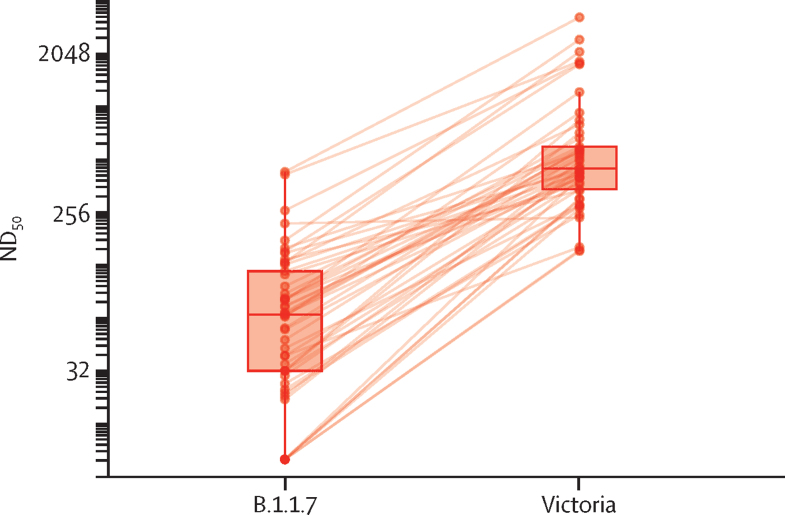
- Neutralising antibody activity was lower against B.1.1.7 than against the Victoria lineage: geometric mean ratio 8·9 (95% CI 7·2–11·0); geometric mean titre 58 (95% CI 44–77) for B.1.1.7 versus 517 (424–631) for Victoria.
- For any NAAT-positive infection, vaccine efficacy was 61·7% (36·7–76·9) against B.1.1.7 and 77·3% (65·4–85·0) against other variants.
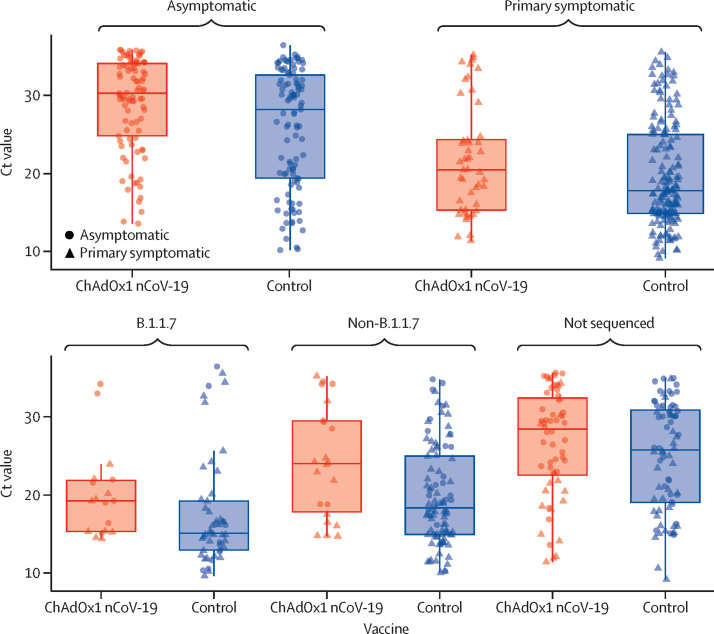
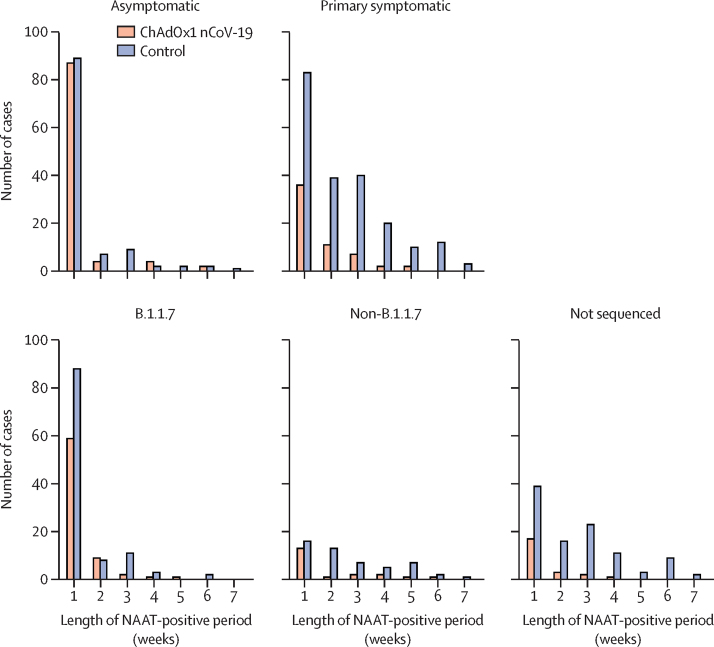
- Vaccinated participants had higher minimum Ct values (median 28·8, IQR 20·5–33·5) than controls (20·2, 15·5–29·6; p<0·0001) and shorter NAAT positivity (median 1·0 week vs 2·0 weeks).
Methods
- Single-blind, multicentre, randomised phase 2/3 trial (COV002) in the UK; 8534 participants in efficacy cohorts, adults aged ≥18 years at 19 sites, randomly assigned 1:1 to ChAdOx1 nCoV-19 or MenACWY control, with a subset receiving a low-dose first dose.
- Participants provided weekly self-collected nose/throat swabs and symptomatic swabs; samples were tested by NAAT and positive samples sequenced through the COVID-19 Genomics UK consortium; neutralising responses were measured by live-virus microneutralisation against B.1.1.7 and Victoria.
- Efficacy analysis included symptomatic COVID-19 in seronegative participants more than 14 days after a second dose; vaccine efficacy was calculated as 1 − relative risk from a robust Poisson regression model with follow-up time offset.
Limitations
- The paper states that sequences could not be obtained from all positive swabs due to logistical constraints, sample size was determined by sequence availability, and there were no hospitalisations or deaths, so efficacy on those endpoints cannot be assessed.
- The paper states that samples with high Ct values (>30) were not routinely sequenced, limiting lineage assessment of low viral load specimens over-represented in asymptomatic participants; heterogeneous sequencing data warrant caution, and false-positive NAAT results could affect unsequenced asymptomatic efficacy estimates.
- The paper states it cannot rule out an 11% reduction in efficacy between B.1.1.7 and non-B.1.1.7 variants; evident from the text, this was an exploratory post-hoc analysis not powered for variant-specific comparisons, with wide and overlapping CIs for asymptomatic/unknown infections.
Model-written summary. Check it against the paper before relying on it.
Integrity signals
Registry
Cites
Statistics
Figures
Verification
Claims the paper makes
38 Own result · 19 Own interpretation · 18 Not checked yet · 15 Own method · 3 Sources not found · 2 Supported · 2 No basis given · 1 Partly supported · accuracy not yet measured
Every source the paper cites for this claim was checked and supports it.
In the paper
“However, a further live coronavirus neutralisation assay showed that sera from BNT162b2 and ChAdOx1 nCoV-19 vaccinees had a 2·0–3·3 times reduction in neutralisation activity against B.1.1.7 compared with the Victoria lineage,44 in keeping with our findings.”
§ Efficacy of ChAdOx1 nCoV-19 (AZD1222) vaccine against SARS-CoV-2 variant of concern 202012/01 (B.1.1.7): an exploratory analysis of a randomised controlled trial > Discussion
What the sources say
- Supportedcites [44] Supasa P Zhou D Dejnirattisai W Reduced neutralization of SARS-CoV-2 B.1.1.7 variant by convalescent and vaccine sera Cell 2021 published online Feb 18. 10.1016/j.cell.2021.02.033 PMC7891044 33743891 source
The Results section (“Neutralization activity of convalescent plasma and vaccine sera”) reports assays comparing B.1.1.7 with Victoria using sera from recipients of both vaccines. It gives 2.1- and 2.5-fold reductions for the AstraZeneca vaccine (ChAdOx1 nCoV-19) and a 3.3-fold reduction for BNT162b2, consistent with the cited approximate range. (LLM, conf=0.93)
plaindirect- Asserted: passes — The authors put it forward as true.
- Checkable: passes — It can be checked against evidence.
- Load-bearing: passes — The paper’s conclusions depend on it.
- Based: passes — The paper gives a reason why it holds.
- Supported
Every source the paper cites for this claim was checked and supports it.
In the paper
“Taken with our recent analysis,46 which showed a 64% reduction in any NAAT-positive result after a single dose of ChAdOx1 nCoV-19”
§ Efficacy of ChAdOx1 nCoV-19 (AZD1222) vaccine against SARS-CoV-2 variant of concern 202012/01 (B.1.1.7): an exploratory analysis of a randomised controlled trial > Discussion
What the sources say
- Supportedcites [46] Voysey M Costa Clemens SA Madhi SA Single-dose administration and the influence of the timing of the booster dose on immunogenicity and efficacy of ChAdOx1 nCoV-19 (AZD1222) vaccine: a pooled analysis of four randomised trials Lancet 397 2021 881 891 33617777 PMC7894131 source
The Results report 63.9% efficacy against any NAAT-positive infection after a single standard dose, matching the claim’s rounded 64%. The estimate covers days 22–90 after vaccination; the paper describes this analysis as exploratory. (LLM, conf=0.93)
plaindirect- Asserted: passes — The authors put it forward as true.
- Checkable: passes — It can be checked against evidence.
- Load-bearing: passes — The paper’s conclusions depend on it.
- Based: passes — The paper gives a reason why it holds.
- Supported
A result the paper reports from its own data — it cites no other source for it, so there is none to check. The quote shows it is in the paper.
In the paper
“For non-B.1.1.7 variant cases, vaccine efficacy was 78·0% (57·7–88·5) in the SD/SD group compared with 87·2% (63·7–95·5) in the LD/SD group.”
§ Efficacy of ChAdOx1 nCoV-19 (AZD1222) vaccine against SARS-CoV-2 variant of concern 202012/01 (B.1.1.7): an exploratory analysis of a randomised controlled trial > Results
plaindirect- Asserted: passes — The authors put it forward as true.
- Checkable: passes — It can be checked against evidence.
- Load-bearing: unclear — It is unclear whether the paper’s conclusions depend on it.
- Based: passes — The paper gives a reason why it holds.
- Rests on an assumption: The meningococcal group A, C, W, and Y conjugate vaccine (MenACWY) used as control does not affect SARS-CoV-2 infection or COVID-19 disease.
A result the paper reports from its own data — it cites no other source for it, so there is none to check. The quote shows it is in the paper.
In the paper
“Vaccine efficacy against the B.1.1.7 variant was 66·7% (95% CI 29·2–84·3) in the SD/SD group and 77·9% (22·5–93·7) in the LD/SD group.”
§ Efficacy of ChAdOx1 nCoV-19 (AZD1222) vaccine against SARS-CoV-2 variant of concern 202012/01 (B.1.1.7): an exploratory analysis of a randomised controlled trial > Results
plaindirectn = 52- Asserted: passes — The authors put it forward as true.
- Checkable: passes — It can be checked against evidence.
- Load-bearing: passes — The paper’s conclusions depend on it.
- Based: passes — The paper gives a reason why it holds.
- Rests on an assumption: The meningococcal group A, C, W, and Y conjugate vaccine (MenACWY) used as control does not affect SARS-CoV-2 infection or COVID-19 disease.
- Rests on an assumption: The sequenced subset of NAAT-positive cases is representative of all NAAT-positive cases with respect to SARS-CoV-2 variant and vaccine group.
A result the paper reports from its own data — it cites no other source for it, so there is none to check. The quote shows it is in the paper.
In the paper
“Vaccine efficacy of ChAdOx1 nCoV-19 was 70·4% (95% CI 43·6 to 84·5) against symptomatic COVID-19 caused by the B.1.1.7 variant and 81·5% (67·9 to 89·4) against symptomatic COVID-19 caused by non-B.1.1.7 variants.”
- Also stated in: § Findings · plain
“Clinical vaccine efficacy against symptomatic NAAT positive infection was 70·4% (95% CI 43·6–84·5) for B.1.1.7 and 81·5% (67·9–89·4) for non-B.1.1.7 lineages.”
§ Efficacy of ChAdOx1 nCoV-19 (AZD1222) vaccine against SARS-CoV-2 variant of concern 202012/01 (B.1.1.7): an exploratory analysis of a randomised controlled trial > Results
plaindirect- Asserted: passes — The authors put it forward as true.
- Checkable: passes — It can be checked against evidence.
- Load-bearing: passes — The paper’s conclusions depend on it.
- Based: passes — The paper gives a reason why it holds.
- Rests on an assumption: The meningococcal group A, C, W, and Y conjugate vaccine (MenACWY) used as control does not affect SARS-CoV-2 infection or COVID-19 disease.
- Rests on an assumption: The sequenced subset of NAAT-positive cases is representative of all NAAT-positive cases with respect to SARS-CoV-2 variant and vaccine group.
- Also stated in: § Findings · plain
A result the paper reports from its own data — it cites no other source for it, so there is none to check. The quote shows it is in the paper.
In the paper
“and were NAAT positive for a longer period of time (p<0·0001; figure 5).”
§ Efficacy of ChAdOx1 nCoV-19 (AZD1222) vaccine against SARS-CoV-2 variant of concern 202012/01 (B.1.1.7): an exploratory analysis of a randomised controlled trial > Results
plaincorrelational- Asserted: passes — The authors put it forward as true.
- Checkable: passes — It can be checked against evidence.
- Load-bearing: unclear — It is unclear whether the paper’s conclusions depend on it.
- Based: passes — The paper gives a reason why it holds.
A result the paper reports from its own data — it cites no other source for it, so there is none to check. The quote shows it is in the paper.
In the paper
“For cases of asymptomatic or unknown symptom infection obtained from weekly self-swabs, vaccine efficacy was higher for non-B.1.1.7 infections (69·7%, 33·0 to 86·3) than for B.1.1.7 (28·9%, −77·1 to 71·4), although fewer cases were available for analysis, so CIs are wide and overlapping.”
§ Efficacy of ChAdOx1 nCoV-19 (AZD1222) vaccine against SARS-CoV-2 variant of concern 202012/01 (B.1.1.7): an exploratory analysis of a randomised controlled trial > Results
plaindirect- Asserted: passes — The authors put it forward as true.
- Checkable: passes — It can be checked against evidence.
- Load-bearing: unclear — It is unclear whether the paper’s conclusions depend on it.
- Based: passes — The paper gives a reason why it holds.
- Rests on an assumption: The meningococcal group A, C, W, and Y conjugate vaccine (MenACWY) used as control does not affect SARS-CoV-2 infection or COVID-19 disease.
A result the paper reports from its own data — it cites no other source for it, so there is none to check. The quote shows it is in the paper.
In the paper
“Between Oct 1, 2020, and Jan 14, 2021, 520 participants developed SARS-CoV-2 infection.”
§ Efficacy of ChAdOx1 nCoV-19 (AZD1222) vaccine against SARS-CoV-2 variant of concern 202012/01 (B.1.1.7): an exploratory analysis of a randomised controlled trial > Abstract > Findings
plainn = 520- Asserted: passes — The authors put it forward as true.
- Checkable: passes — It can be checked against evidence.
- Load-bearing: unclear — It is unclear whether the paper’s conclusions depend on it.
- Based: passes — The paper gives a reason why it holds.
A result the paper reports from its own data — it cites no other source for it, so there is none to check. The quote shows it is in the paper.
In the paper
“Primary symptomatic participants who received ChAdOx1 nCoV-19 had a shorter NAAT-positive period (median 1·0 week, IQR 1·0–2·0) than those who received the control vaccine (2·0 weeks, 1·0–3·0).”
§ Efficacy of ChAdOx1 nCoV-19 (AZD1222) vaccine against SARS-CoV-2 variant of concern 202012/01 (B.1.1.7): an exploratory analysis of a randomised controlled trial > Results
plaincorrelational- Asserted: passes — The authors put it forward as true.
- Checkable: passes — It can be checked against evidence.
- Load-bearing: passes — The paper’s conclusions depend on it.
- Based: passes — The paper gives a reason why it holds.
- Rests on an assumption: The meningococcal group A, C, W, and Y conjugate vaccine (MenACWY) used as control does not affect SARS-CoV-2 infection or COVID-19 disease.
A result the paper reports from its own data — it cites no other source for it, so there is none to check. The quote shows it is in the paper.
In the paper
“For non-B.1.1.7 variant cases, vaccine efficacy was 78·0% (57·7–88·5) in the SD/SD group compared with 87·2% (63·7–95·5) in the LD/SD group.”
§ Efficacy of ChAdOx1 nCoV-19 (AZD1222) vaccine against SARS-CoV-2 variant of concern 202012/01 (B.1.1.7): an exploratory analysis of a randomised controlled trial > Results
plaindirect- Asserted: passes — The authors put it forward as true.
- Checkable: passes — It can be checked against evidence.
- Load-bearing: unclear — It is unclear whether the paper’s conclusions depend on it.
- Based: passes — The paper gives a reason why it holds.
- Rests on an assumption: The meningococcal group A, C, W, and Y conjugate vaccine (MenACWY) used as control does not affect SARS-CoV-2 infection or COVID-19 disease.
- It may state two separate claims as one. 35
- Probably not a substantial claim. 32
The cited sources support only part of this claim — read each source’s verdict below.
In the paper
“In line with previously published data,3, 46 protection was also shown against the non-B.1.1.7 strains, the majority of which were due to the B.1.177 lineage.”
§ Efficacy of ChAdOx1 nCoV-19 (AZD1222) vaccine against SARS-CoV-2 variant of concern 202012/01 (B.1.1.7): an exploratory analysis of a randomised controlled trial > Discussion
What the sources say
- Partly supportedcites [3] Voysey M Clemens SAC Madhi SA Safety and efficacy of the ChAdOx1 nCoV-19 vaccine (AZD1222) against SARS-CoV-2: an interim analysis of four randomised controlled trials in Brazil, South Africa, and the UK Lancet 397 2021 99 111 33306989 PMC7723445 sourceExperimental — accuracy not yet measured
The Results (Table 2; page not available in our copy) report protection against symptomatic COVID-19, with 70·4% overall vaccine efficacy. They do not identify the strains in those cases, so this paper does not establish protection specifically against non-B.1.1.7 strains or that most were B.1.177 (searched: B.1.177 lineage, non-B.1.1.7 strains). (LLM, conf=0.86)
- Partly supportedcites [46] Voysey M Costa Clemens SA Madhi SA Single-dose administration and the influence of the timing of the booster dose on immunogenicity and efficacy of ChAdOx1 nCoV-19 (AZD1222) vaccine: a pooled analysis of four randomised trials Lancet 397 2021 881 891 33617777 PMC7894131 sourceExperimental — accuracy not yet measured
The Results (Table 1; page not available in our copy) report protection against symptomatic COVID-19 overall. They do not report efficacy by B.1.1.7 status or identify B.1.177 as the majority lineage; searches for both lineage terms found no supporting passage. (LLM, conf=0.82)
plaindirect- Asserted: passes — The authors put it forward as true.
- Checkable: passes — It can be checked against evidence.
- Load-bearing: unclear — It is unclear whether the paper’s conclusions depend on it.
- Based: passes — The paper gives a reason why it holds.
It may state two separate claims as one.
- Partly supported
A result the paper reports from its own data — it cites no other source for it, so there is none to check. The quote shows it is in the paper.
In the paper
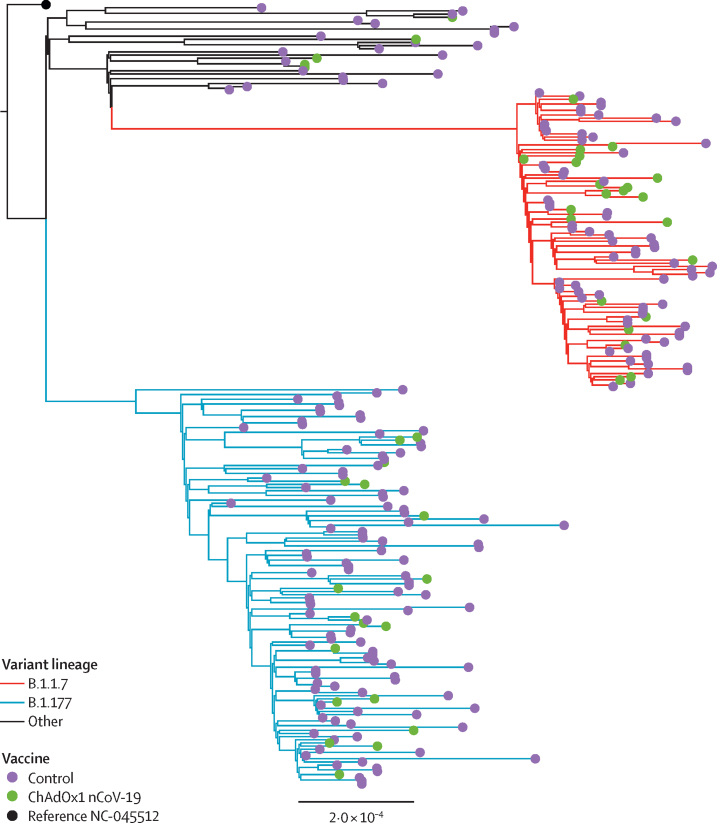
“The majority of cases of non-B.1.1.7 lineage were caused by B.1.177 (figure 2).”
§ Efficacy of ChAdOx1 nCoV-19 (AZD1222) vaccine against SARS-CoV-2 variant of concern 202012/01 (B.1.1.7): an exploratory analysis of a randomised controlled trial > Results
plain- Asserted: passes — The authors put it forward as true.
- Checkable: passes — It can be checked against evidence.
- Load-bearing: fails — The paper’s conclusions may not depend on it.
- Based: passes — The paper gives a reason why it holds.
Probably not a substantial claim. The paper’s conclusions may not depend on it.
A result the paper reports from its own data — it cites no other source for it, so there is none to check. The quote shows it is in the paper.
In the paper
“1466 NAAT positive nose and throat swabs were collected from these participants during the trial.”
§ Efficacy of ChAdOx1 nCoV-19 (AZD1222) vaccine against SARS-CoV-2 variant of concern 202012/01 (B.1.1.7): an exploratory analysis of a randomised controlled trial > Abstract > Findings
plainn = 520- Asserted: passes — The authors put it forward as true.
- Checkable: passes — It can be checked against evidence.
- Load-bearing: fails — The paper’s conclusions may not depend on it.
- Based: passes — The paper gives a reason why it holds.
Probably not a substantial claim. The paper’s conclusions may not depend on it.
A result the paper reports from its own data — it cites no other source for it, so there is none to check. The quote shows it is in the paper.
In the paper
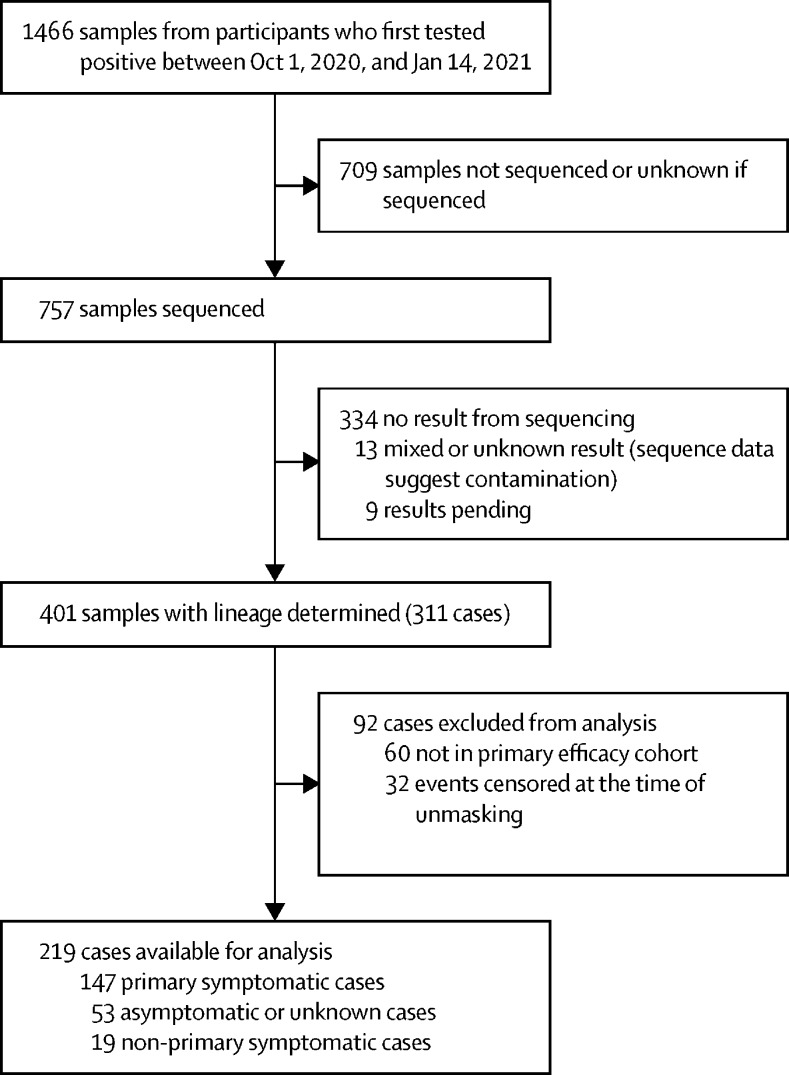
“219 of these cases occurred in participants in the primary efficacy cohort and before unblinding, of which 147 were cases of primary symptomatic COVID-19 and 53 were asymptomatic or had unknown symptoms (figure 1).”
§ Efficacy of ChAdOx1 nCoV-19 (AZD1222) vaccine against SARS-CoV-2 variant of concern 202012/01 (B.1.1.7): an exploratory analysis of a randomised controlled trial > Results
plainn = 219- Asserted: passes — The authors put it forward as true.
- Checkable: passes — It can be checked against evidence.
- Load-bearing: unclear — It is unclear whether the paper’s conclusions depend on it.
- Based: passes — The paper gives a reason why it holds.
It may state two separate claims as one.
A result the paper reports from its own data — it cites no other source for it, so there is none to check. The quote shows it is in the paper.
In the paper
“36 (69%) of 52 cases of primary symptomatic COVID-19 caused by the B.1.1.7 variant occurred in participants who received SD/SD vaccines, and 16 (31%) occurred in participants who received LD/SD vaccines.”
§ Efficacy of ChAdOx1 nCoV-19 (AZD1222) vaccine against SARS-CoV-2 variant of concern 202012/01 (B.1.1.7): an exploratory analysis of a randomised controlled trial > Results
plainn = 52- Asserted: passes — The authors put it forward as true.
- Checkable: passes — It can be checked against evidence.
- Load-bearing: passes — The paper’s conclusions depend on it.
- Based: passes — The paper gives a reason why it holds.
It may state two separate claims as one.
- Rests on an assumption: The sequenced subset of NAAT-positive cases is representative of all NAAT-positive cases with respect to SARS-CoV-2 variant and vaccine group.
A result the paper reports from its own data — it cites no other source for it, so there is none to check. The quote shows it is in the paper.
In the paper
“However, primary symptomatic cases remained NAAT positive for longer, with only 56 (21%) of 269 returning only one positive swab.”
§ Efficacy of ChAdOx1 nCoV-19 (AZD1222) vaccine against SARS-CoV-2 variant of concern 202012/01 (B.1.1.7): an exploratory analysis of a randomised controlled trial > Results
plain- Asserted: passes — The authors put it forward as true.
- Checkable: passes — It can be checked against evidence.
- Load-bearing: unclear — It is unclear whether the paper’s conclusions depend on it.
- Based: passes — The paper gives a reason why it holds.
It may state two separate claims as one.
A result the paper reports from its own data — it cites no other source for it, so there is none to check. The quote shows it is in the paper.
In the paper
“The geometric mean titre is 58 (95% CI 44–77) for B.1.1.7 and 517 (424–631) for Victoria. The geometric mean ratio (Victoria vs B.1.1.7) is 8·9 (95% CI 7·2–11·0).”
§ Efficacy of ChAdOx1 nCoV-19 (AZD1222) vaccine against SARS-CoV-2 variant of concern 202012/01 (B.1.1.7): an exploratory analysis of a randomised controlled trial > Results
plainn = 49- Asserted: passes — The authors put it forward as true.
- Checkable: passes — It can be checked against evidence.
- Load-bearing: passes — The paper’s conclusions depend on it.
- Based: passes — The paper gives a reason why it holds.
It may state two separate claims as one.
A result the paper reports from its own data — it cites no other source for it, so there is none to check. The quote shows it is in the paper.
In the paper
“For primary symptomatic cases for which sequence data were available, 52 (35%) of 147 were due to the B.1.1.7 variant and 95 (65%) were caused by non-B.1.1.7 lineages.”
§ Efficacy of ChAdOx1 nCoV-19 (AZD1222) vaccine against SARS-CoV-2 variant of concern 202012/01 (B.1.1.7): an exploratory analysis of a randomised controlled trial > Results
plain- Asserted: passes — The authors put it forward as true.
- Checkable: passes — It can be checked against evidence.
- Load-bearing: passes — The paper’s conclusions depend on it.
- Based: passes — The paper gives a reason why it holds.
It may state two separate claims as one.
- Rests on an assumption: The sequenced subset of NAAT-positive cases is representative of all NAAT-positive cases with respect to SARS-CoV-2 variant and vaccine group.
A result the paper reports from its own data — it cites no other source for it, so there is none to check. The quote shows it is in the paper.
In the paper
“Of these, 401 swabs from 311 participants were successfully sequenced.”
§ Efficacy of ChAdOx1 nCoV-19 (AZD1222) vaccine against SARS-CoV-2 variant of concern 202012/01 (B.1.1.7): an exploratory analysis of a randomised controlled trial > Abstract > Findings
plainn = 311- Asserted: passes — The authors put it forward as true.
- Checkable: passes — It can be checked against evidence.
- Load-bearing: fails — The paper’s conclusions may not depend on it.
- Based: passes — The paper gives a reason why it holds.
Probably not a substantial claim. The paper’s conclusions may not depend on it.
A result the paper reports from its own data — it cites no other source for it, so there is none to check. The quote shows it is in the paper.
In the paper
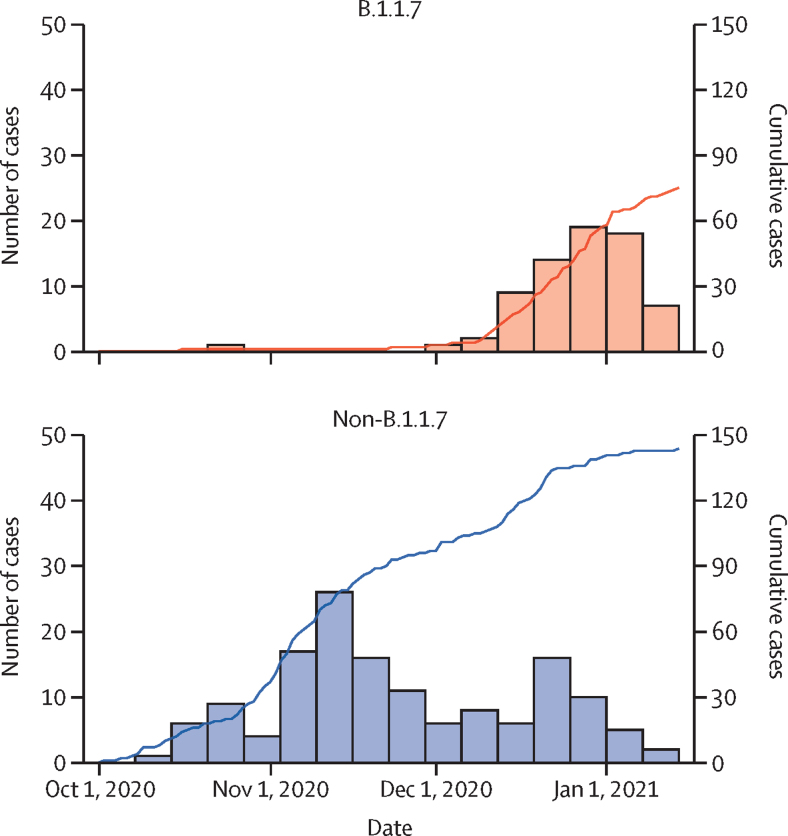
“Cases of B.1.1.7 first arose in late November, 2020, in trial sites in London and formed an increasing proportion of positive swabs during December, 2020, and January, 2021 (figure 3).”
§ Efficacy of ChAdOx1 nCoV-19 (AZD1222) vaccine against SARS-CoV-2 variant of concern 202012/01 (B.1.1.7): an exploratory analysis of a randomised controlled trial > Results
plaincorrelational- Asserted: passes — The authors put it forward as true.
- Checkable: passes — It can be checked against evidence.
- Load-bearing: unclear — It is unclear whether the paper’s conclusions depend on it.
- Based: passes — The paper gives a reason why it holds.
It may state two separate claims as one.
In the paper
“It was higher than our previously published estimate of 27%, which was based on NAAT positivity alone,3 and substantially higher than the efficacy seen in the asymptomatic cases that have not been sequenced (6%), or in those for whom no result from sequencing could be obtained (−27%).”
§ Efficacy of ChAdOx1 nCoV-19 (AZD1222) vaccine against SARS-CoV-2 variant of concern 202012/01 (B.1.1.7): an exploratory analysis of a randomised controlled trial > Discussion
What the sources say
- Not checked yetcites [3] Voysey M Clemens SAC Madhi SA Safety and efficacy of the ChAdOx1 nCoV-19 vaccine (AZD1222) against SARS-CoV-2: an interim analysis of four randomised controlled trials in Brazil, South Africa, and the UK Lancet 397 2021 99 111 33306989 PMC7723445 source
plain- Asserted: passes — The authors put it forward as true.
- Checkable: passes — It can be checked against evidence.
- Load-bearing: passes — The paper’s conclusions depend on it.
- Based: passes — The paper gives a reason why it holds.
It may state two separate claims as one.
A result the paper reports from its own data — it cites no other source for it, so there is none to check. The quote shows it is in the paper.
In the paper
“In our study, individuals who did not report symptoms had lower viral loads than symptomatic individuals and were NAAT positive for a shorter period of time.”
§ Efficacy of ChAdOx1 nCoV-19 (AZD1222) vaccine against SARS-CoV-2 variant of concern 202012/01 (B.1.1.7): an exploratory analysis of a randomised controlled trial > Discussion
plaincorrelational- Asserted: passes — The authors put it forward as true.
- Checkable: passes — It can be checked against evidence.
- Load-bearing: unclear — It is unclear whether the paper’s conclusions depend on it.
- Based: passes — The paper gives a reason why it holds.
It may state two separate claims as one.
A result the paper reports from its own data — it cites no other source for it, so there is none to check. The quote shows it is in the paper.
In the paper
“There were no cases of hospitalisation or death in these trial participants, so we cannot comment on the efficacy of the vaccine on these endpoints.”
§ Efficacy of ChAdOx1 nCoV-19 (AZD1222) vaccine against SARS-CoV-2 variant of concern 202012/01 (B.1.1.7): an exploratory analysis of a randomised controlled trial > Discussion
plain- Asserted: passes — The authors put it forward as true.
- Checkable: passes — It can be checked against evidence.
- Load-bearing: passes — The paper’s conclusions depend on it.
- Based: passes — The paper gives a reason why it holds.
It may state two separate claims as one.
A result the paper reports from its own data — it cites no other source for it, so there is none to check. The quote shows it is in the paper.
In the paper
“No participants in this study had evidence of the novel E484K (Glu484Lys) spike mutation first described in the B1.351 lineage identified in South Africa.”
§ Efficacy of ChAdOx1 nCoV-19 (AZD1222) vaccine against SARS-CoV-2 variant of concern 202012/01 (B.1.1.7): an exploratory analysis of a randomised controlled trial > Discussion
plain- Asserted: passes — The authors put it forward as true.
- Checkable: passes — It can be checked against evidence.
- Load-bearing: fails — The paper’s conclusions may not depend on it.
- Based: passes — The paper gives a reason why it holds.
Probably not a substantial claim. The paper’s conclusions may not depend on it.
None of the sources cited for this claim have been checked yet.
In the paper
“Sera from recipients of the Moderna mRNA-1273 vaccine showed similar neutralising activity against VSV and lentivirus pseudoviruses expressing full-length spike protein from either B.1.1.7 or a Wuhan lineage,42 and this finding was also seen in a live neutralisation assay.43”
§ Efficacy of ChAdOx1 nCoV-19 (AZD1222) vaccine against SARS-CoV-2 variant of concern 202012/01 (B.1.1.7): an exploratory analysis of a randomised controlled trial > Discussion
What the sources say
- Not checked yetcites [42] Wu K Werner AP Moliva JI mRNA-1273 vaccine induces neutralizing antibodies against spike mutants from global SARS-CoV-2 variants bioRxiv 2021 published online Jan 25. 10.1101/2021.01.25.427948 (preprint).
- Not checked yetcites [43] Edara VV Floyd K Lai L Infection and mRNA-1273 vaccine antibodies neutralize SARS-CoV-2 UK variant medRxiv 2021 published online Feb 5. 10.1101/2021.02.02.21250799 (preprint).
plain- Asserted: passes — The authors put it forward as true.
- Checkable: passes — It can be checked against evidence.
- Load-bearing: fails — The paper’s conclusions may not depend on it.
- Based: passes — The paper gives a reason why it holds.
Probably not a substantial claim. The paper’s conclusions may not depend on it. It may state two separate claims as one.
What the paper did — it cites no source for this, so there is none to check. The quote shows it is in the paper.
In the paper
“Cases were excluded if they occurred fewer than 15 days after the second dose of vaccine or occurred in participants who were not seronegative on a SARS-CoV-2 N protein assay at baseline.”
§ Efficacy of ChAdOx1 nCoV-19 (AZD1222) vaccine against SARS-CoV-2 variant of concern 202012/01 (B.1.1.7): an exploratory analysis of a randomised controlled trial > Methods > Statistical analysis
plain- Asserted: passes — The authors put it forward as true.
- Checkable: passes — It can be checked against evidence.
- Load-bearing: passes — The paper’s conclusions depend on it.
- Based: passes — The paper gives a reason why it holds.
Probably not a substantial claim. It may state two separate claims as one.
What the paper did — it cites no source for this, so there is none to check. The quote shows it is in the paper.
In the paper
“Safety data were reviewed regularly by an independent data safety monitoring board.”
§ Efficacy of ChAdOx1 nCoV-19 (AZD1222) vaccine against SARS-CoV-2 variant of concern 202012/01 (B.1.1.7): an exploratory analysis of a randomised controlled trial > Methods > Procedures
plain- Asserted: passes — The authors put it forward as true.
- Checkable: passes — It can be checked against evidence.
- Load-bearing: fails — The paper’s conclusions may not depend on it.
- Based: passes — The paper gives a reason why it holds.
Probably not a substantial claim. The paper’s conclusions may not depend on it.
What the paper did — it cites no source for this, so there is none to check. The quote shows it is in the paper.
In the paper
“This study is registered with ClinicalTrials.gov, NCT04400838, and ISRCTN, 15281137.”
§ Efficacy of ChAdOx1 nCoV-19 (AZD1222) vaccine against SARS-CoV-2 variant of concern 202012/01 (B.1.1.7): an exploratory analysis of a randomised controlled trial > Methods > Statistical analysis
plain- Asserted: passes — The authors put it forward as true.
- Checkable: passes — It can be checked against evidence.
- Load-bearing: fails — The paper’s conclusions may not depend on it.
- Based: passes — The paper gives a reason why it holds.
Probably not a substantial claim. The paper’s conclusions may not depend on it. It may state two separate claims as one.
None of the sources cited for this claim have been checked yet.
In the paper
“However, it should be noted that further mutations in spike protein observed in other novel lineages7, 8 appear to be driven by escape of the virus from the neutralising activity of public antibodies,40, 41 indicating that prevention of transmission might be temporary as the virus adapts to natural or vaccine-induced immunity.”
§ Efficacy of ChAdOx1 nCoV-19 (AZD1222) vaccine against SARS-CoV-2 variant of concern 202012/01 (B.1.1.7): an exploratory analysis of a randomised controlled trial > Discussion
What the sources say
- Not matchedcites [7] Faria NR Morales Claro I Candido D Genomic characterisation of an emergent SARS-CoV-2 lineage in Manaus: preliminary findings https://virological.org/t/genomic-characterisation-of-an-emergent-sars-cov-2-lineage-in-manaus-preliminary-findings/586 January, 2021
Couldn’t be matched to a paper in Crossref, so it can’t be checked.
- Not checked yetcites [8] Tegally H Wilkinson E Giovanetti M Emergence and rapid spread of a new severe acute respiratory syndrome-related coronavirus 2 (SARS-CoV-2) lineage with multiple spike mutations in South Africa medRxiv 2020 published online Dec 22. 10.1101/2020.12.21.20248640 (preprint). source
- Not checked yetcites [40] Wibmer CK Ayres F Hermanus T SARS-CoV-2 501Y.V2 escapes neutralization by South African COVID-19 donor plasma bioRxiv 2021 published online Jan 19. 10.1101/2021.01.18.427166 (preprint). 33654292 source
- Not checked yetcites [41] Wang P Liu L Iketani S Increased resistance of SARS-CoV-2 variants B.1.351 and B.1.1.7 to antibody neutralization bioRxiv 2021 published online Jan 26. 10.1101/2021.01.25.428137 (preprint). source
hedgedconditional- Asserted: passes — The authors put it forward as true.
- Checkable: passes — It can be checked against evidence.
- Load-bearing: unclear — It is unclear whether the paper’s conclusions depend on it.
- Based: passes — The paper gives a reason why it holds.
It may state two separate claims as one.
- Not matched
What the paper did — it cites no source for this, so there is none to check. The quote shows it is in the paper.
In the paper
“COV002 is a single-blind, multicentre, randomised phase 2/3 trial assessing the safety and efficacy of the ChAdOx1 nCoV-19 vaccine.”
§ Efficacy of ChAdOx1 nCoV-19 (AZD1222) vaccine against SARS-CoV-2 variant of concern 202012/01 (B.1.1.7): an exploratory analysis of a randomised controlled trial > Methods > Study design and participants
plain- Asserted: passes — The authors put it forward as true.
- Checkable: passes — It can be checked against evidence.
- Load-bearing: fails — The paper’s conclusions may not depend on it.
- Based: passes — The paper gives a reason why it holds.
Probably not a substantial claim. The paper’s conclusions may not depend on it. It may state two separate claims as one.
What the paper did — it cites no source for this, so there is none to check. The quote shows it is in the paper.
In the paper
“Participants were randomly assigned in a 1:1 ratio to receive standard-dose ChAdOx1 nCoV-19 vaccine (5 × 10¹⁰ viral particles) or a meningococcal group A, C, W, and Y conjugate vaccine (MenACWY) as control.”
§ Efficacy of ChAdOx1 nCoV-19 (AZD1222) vaccine against SARS-CoV-2 variant of concern 202012/01 (B.1.1.7): an exploratory analysis of a randomised controlled trial > Methods > Study design and participants
plain- Asserted: passes — The authors put it forward as true.
- Checkable: passes — It can be checked against evidence.
- Load-bearing: passes — The paper’s conclusions depend on it.
- Based: passes — The paper gives a reason why it holds.
Probably not a substantial claim.
What the paper did — it cites no source for this, so there is none to check. The quote shows it is in the paper.
In the paper
“Baseline demographics in individuals with the B.1.1.7 variant were similar to those with non-B.1.1.7 variants, as were their prime-boost intervals (appendix pp 2–4).”
§ Efficacy of ChAdOx1 nCoV-19 (AZD1222) vaccine against SARS-CoV-2 variant of concern 202012/01 (B.1.1.7): an exploratory analysis of a randomised controlled trial > Results
plain- Asserted: passes — The authors put it forward as true.
- Checkable: passes — It can be checked against evidence.
- Load-bearing: unclear — It is unclear whether the paper’s conclusions depend on it.
- Based: passes — The paper gives a reason why it holds.
It may state two separate claims as one.
None of the sources cited for this claim have been checked yet.
In the paper
“B.1.1.7 has accrued 23 mutations across the genome, including a non-synonymous mutation affecting the spike protein, N501Y (Asn501Tyr), which might increase ACE2 receptor binding affinity,10 the spike deletion 69–70del associated with viral escape in immunocompromised individuals,9 and the non-synonymous mutation P681H (Pro681His) affecting the furin cleavage site between the S1 and S2 subunits of”
§ Efficacy of ChAdOx1 nCoV-19 (AZD1222) vaccine against SARS-CoV-2 variant of concern 202012/01 (B.1.1.7): an exploratory analysis of a randomised controlled trial > Introduction
What the sources say
- Not checked yetcites [9] Rambaut A Loman N Pybus O Preliminary genomic characterisation of an emergent SARS-CoV-2 lineage in the UK defined by a novel set of spike mutations https://virological.org/t/preliminary-genomic-characterisation-of-an-emergent-sars-cov-2-lineage-in-the-uk-defined-by-a-novel-set-of-spike-mutations/563 December, 2020
- Not checked yetcites [10] Starr TN Greaney AJ Hilton SK Deep mutational scanning of SARS-CoV-2 receptor binding domain reveals constraints on folding and ACE2 binding Cell 182 2020 1295 310.e20 32841599 PMC7418704
- Not checked yetcites [11] Kemp SA Datir RP Collier DA Recurrent emergence and transmission of a SARS-CoV-2 spike deletion ΔH69/V70 bioRxiv 2020 published online Dec 15. 10.1101/2020.12.14.422555 (preprint).
plain- Asserted: passes — The authors put it forward as true.
- Checkable: passes — It can be checked against evidence.
- Load-bearing: fails — The paper’s conclusions may not depend on it.
- Based: passes — The paper gives a reason why it holds.
Probably not a substantial claim. The paper’s conclusions may not depend on it. It may state two separate claims as one.
A conclusion the paper draws from its own results — it cites no other source for it, so there is none to check. The quote shows it is in the paper.
In the paper
“The B.1.1.7 variant in the UK arose while there was a low level of population immunity from natural infection and before vaccine programmes had begun, so the variant is likely to have been selected for improved ACE2 receptor binding and transmissibility, rather than as a result of vaccine-induced immunity.”
§ Efficacy of ChAdOx1 nCoV-19 (AZD1222) vaccine against SARS-CoV-2 variant of concern 202012/01 (B.1.1.7): an exploratory analysis of a randomised controlled trial > Introduction
hedgedconditional- Asserted: passes — The authors put it forward as true.
- Checkable: passes — It can be checked against evidence.
- Load-bearing: fails — The paper’s conclusions may not depend on it.
- Based: fails — The paper may give no reason why it holds.
Probably not a substantial claim. The paper’s conclusions may not depend on it. The paper may give no reason why it holds. It may state two separate claims as one.
A conclusion the paper draws from its own results — it cites no other source for it, so there is none to check. The quote shows it is in the paper.
In the paper
“ChAdOx1 nCoV-19 was efficacious against both the B.1.1.7 variant and non-B.1.1.7 variants.”
§ Efficacy of ChAdOx1 nCoV-19 (AZD1222) vaccine against SARS-CoV-2 variant of concern 202012/01 (B.1.1.7): an exploratory analysis of a randomised controlled trial > Introduction
plaindirect- Asserted: passes — The authors put it forward as true.
- Checkable: passes — It can be checked against evidence.
- Load-bearing: passes — The paper’s conclusions depend on it.
- Based: passes — The paper gives a reason why it holds.
It may state two separate claims as one.
- Rests on an assumption: The meningococcal group A, C, W, and Y conjugate vaccine (MenACWY) used as control does not affect SARS-CoV-2 infection or COVID-19 disease.
- Rests on an assumption: The sequenced subset of NAAT-positive cases is representative of all NAAT-positive cases with respect to SARS-CoV-2 variant and vaccine group.
What the paper did — it cites no source for this, so there is none to check. The quote shows it is in the paper.
In the paper
“All samples were processed by laboratory staff who were masked to vaccine allocation.”
§ Efficacy of ChAdOx1 nCoV-19 (AZD1222) vaccine against SARS-CoV-2 variant of concern 202012/01 (B.1.1.7): an exploratory analysis of a randomised controlled trial > Methods > Procedures
plain- Asserted: passes — The authors put it forward as true.
- Checkable: passes — It can be checked against evidence.
- Load-bearing: fails — The paper’s conclusions may not depend on it.
- Based: passes — The paper gives a reason why it holds.
Probably not a substantial claim. The paper’s conclusions may not depend on it.
A conclusion the paper draws from its own results — it cites no other source for it, so there is none to check. The quote shows it is in the paper.
In the paper
“These findings suggest either that lower neutralising antibody titres are sufficient to provide protection or that other mechanisms of immunity could be responsible for protection from disease in vaccinated individuals.”
§ Efficacy of ChAdOx1 nCoV-19 (AZD1222) vaccine against SARS-CoV-2 variant of concern 202012/01 (B.1.1.7): an exploratory analysis of a randomised controlled trial > Discussion
hedgedconditional- Asserted: passes — The authors put it forward as true.
- Checkable: passes — It can be checked against evidence.
- Load-bearing: passes — The paper’s conclusions depend on it.
- Based: passes — The paper gives a reason why it holds.
It may state two separate claims as one.
The paper states this without a source or data behind it here, so there is nothing to check it against. The quote shows it is in the paper.
In the paper
“A new variant of SARS-CoV-2, B.1.1.7, emerged as the dominant cause of COVID-19 disease in the UK from November, 2020.”
§ Efficacy of ChAdOx1 nCoV-19 (AZD1222) vaccine against SARS-CoV-2 variant of concern 202012/01 (B.1.1.7): an exploratory analysis of a randomised controlled trial > Abstract > Background
plain- Asserted: passes — The authors put it forward as true.
- Checkable: passes — It can be checked against evidence.
- Load-bearing: passes — The paper’s conclusions depend on it.
- Based: fails — The paper may give no reason why it holds.
Probably not a substantial claim. The paper may give no reason why it holds.
What the paper did — it cites no source for this, so there is none to check. The quote shows it is in the paper.
In the paper
“All endpoints were reviewed for inclusion by an independent, blinded adjudication committee.”
§ Efficacy of ChAdOx1 nCoV-19 (AZD1222) vaccine against SARS-CoV-2 variant of concern 202012/01 (B.1.1.7): an exploratory analysis of a randomised controlled trial > Methods > Statistical analysis
plain- Asserted: passes — The authors put it forward as true.
- Checkable: passes — It can be checked against evidence.
- Load-bearing: fails — The paper’s conclusions may not depend on it.
- Based: passes — The paper gives a reason why it holds.
Probably not a substantial claim. The paper’s conclusions may not depend on it.
A conclusion the paper draws from its own results — it cites no other source for it, so there is none to check. The quote shows it is in the paper.
In the paper
“Furthermore, vaccination reduced viral load and length of NAAT positivity against both B.1.1.7 and non-B.1.1.7 lineages.”
§ Efficacy of ChAdOx1 nCoV-19 (AZD1222) vaccine against SARS-CoV-2 variant of concern 202012/01 (B.1.1.7): an exploratory analysis of a randomised controlled trial > Introduction
plaindirect- Asserted: passes — The authors put it forward as true.
- Checkable: passes — It can be checked against evidence.
- Load-bearing: passes — The paper’s conclusions depend on it.
- Based: passes — The paper gives a reason why it holds.
It may state two separate claims as one.
- Rests on an assumption: The meningococcal group A, C, W, and Y conjugate vaccine (MenACWY) used as control does not affect SARS-CoV-2 infection or COVID-19 disease.
A conclusion the paper draws from its own results — it cites no other source for it, so there is none to check. The quote shows it is in the paper.
In the paper
“As an increasing proportion of the population is vaccinated, selection of mutations that allow immune evasion may occur, requiring revaccination with antigens derived from the new lineages.”
§ Efficacy of ChAdOx1 nCoV-19 (AZD1222) vaccine against SARS-CoV-2 variant of concern 202012/01 (B.1.1.7): an exploratory analysis of a randomised controlled trial > Discussion
hedgedconditional- Asserted: passes — The authors put it forward as true.
- Checkable: fails — It may be too vague to check against evidence.
- Load-bearing: fails — The paper’s conclusions may not depend on it.
- Based: fails — The paper may give no reason why it holds.
Probably not a substantial claim. It may be too vague to check against evidence. The paper’s conclusions may not depend on it. The paper may give no reason why it holds. It may state two separate claims as one.
What the paper did — it cites no source for this, so there is none to check. The quote shows it is in the paper.
In the paper
“The number of samples available for analysis was not sufficient to power a study to determine whether there was a small difference in efficacy between the B.1.1.7 and non-B.1.1.7 variants; therefore, we cannot rule out an 11% reduction in efficacy.”
§ Efficacy of ChAdOx1 nCoV-19 (AZD1222) vaccine against SARS-CoV-2 variant of concern 202012/01 (B.1.1.7): an exploratory analysis of a randomised controlled trial > Discussion
plain- Asserted: passes — The authors put it forward as true.
- Checkable: passes — It can be checked against evidence.
- Load-bearing: passes — The paper’s conclusions depend on it.
- Based: passes — The paper gives a reason why it holds.
It may state two separate claims as one.
A conclusion the paper draws from its own results — it cites no other source for it, so there is none to check. The quote shows it is in the paper.
In the paper
“Assuming a low false-positive rate of 0·1%, this equates to 200 false-positive swabs, which could skew an attempt to estimate vaccine efficacy.”
§ Efficacy of ChAdOx1 nCoV-19 (AZD1222) vaccine against SARS-CoV-2 variant of concern 202012/01 (B.1.1.7): an exploratory analysis of a randomised controlled trial > Discussion
hedgedconditional- Asserted: passes — The authors put it forward as true.
- Checkable: passes — It can be checked against evidence.
- Load-bearing: passes — The paper’s conclusions depend on it.
- Based: passes — The paper gives a reason why it holds.
Probably not a substantial claim. It may state two separate claims as one.
- The authors state this as an assumption: The false-positive rate in the community testing is 0.1%.
In the paper
“The false-positive rate within Lighthouse Laboratories used for the community testing is unknown, although early estimates based on other historical RNA viral RT-PCR testing suggested rates of 0·8–4·0%.53”
§ Efficacy of ChAdOx1 nCoV-19 (AZD1222) vaccine against SARS-CoV-2 variant of concern 202012/01 (B.1.1.7): an exploratory analysis of a randomised controlled trial > Discussion
What the sources say
- Not checked yetcites [53] Mayers C Baker K Impact of false-positives and false-negatives in the UK's COVID-19 RT-PCR testing programme https://assets.publishing.service.gov.uk/government/uploads/system/uploads/attachment_data/file/895843/S0519_Impact_of_false_positives_and_negatives.pdf June 3, 2020
hedged- Asserted: passes — The authors put it forward as true.
- Checkable: passes — It can be checked against evidence.
- Load-bearing: passes — The paper’s conclusions depend on it.
- Based: passes — The paper gives a reason why it holds.
It may state two separate claims as one.
In the paper
“We have previously shown that ChAdOx1 nCoV-19 elicits robust antibody-dependent monocyte phagocytosis, antibody-dependent neutrophil phagocytosis activity, and antibody-dependent natural killer cell activation after two doses of vaccine,29 at similar levels to those seen in convalescent sera.”
§ Efficacy of ChAdOx1 nCoV-19 (AZD1222) vaccine against SARS-CoV-2 variant of concern 202012/01 (B.1.1.7): an exploratory analysis of a randomised controlled trial > Discussion
What the sources say
- Not checked yetcites [29] Barrett JR Belij-Rammerstorfer S Dold C Phase 1/2 trial of SARS-CoV-2 vaccine ChAdOx1 nCoV-19 with a booster dose induces multifunctional antibody responses Nat Med 27 2021 279 288 33335322 source
boosteddirect- Asserted: passes — The authors put it forward as true.
- Checkable: passes — It can be checked against evidence.
- Load-bearing: passes — The paper’s conclusions depend on it.
- Based: passes — The paper gives a reason why it holds.
It may state two separate claims as one.
A conclusion the paper draws from its own results — it cites no other source for it, so there is none to check. The quote shows it is in the paper.
In the paper
“Different immune mechanisms could also be responsible for the protection afforded by ChAdOx1 nCoV-19.”
§ Efficacy of ChAdOx1 nCoV-19 (AZD1222) vaccine against SARS-CoV-2 variant of concern 202012/01 (B.1.1.7): an exploratory analysis of a randomised controlled trial > Discussion
hedgedconditional- Asserted: passes — The authors put it forward as true.
- Checkable: fails — It may be too vague to check against evidence.
- Load-bearing: fails — The paper’s conclusions may not depend on it.
- Based: passes — The paper gives a reason why it holds.
Probably not a substantial claim. It may be too vague to check against evidence. The paper’s conclusions may not depend on it.
In the paper
“Early national vaccine effectiveness data has shown that a single dose of ChAdOx1 nCoV-19 confers protection from both symptomatic disease and COVID-19-related hospitalisation,47 consistent with the findings presented here.”
§ Efficacy of ChAdOx1 nCoV-19 (AZD1222) vaccine against SARS-CoV-2 variant of concern 202012/01 (B.1.1.7): an exploratory analysis of a randomised controlled trial > Discussion
What the sources say
- Not checked yetcites [47] Lopez Bernal J Andrews A Gower C Early effectiveness of COVID-19 vaccination with BNT162b2 mRNA vaccine and ChAdOx1 adenovirus vector vaccine on symptomatic disease, hospitalisations and mortality in older adults in England medRxiv 2021 published online March 2. 10.1101/2021.03.01.21252652 (preprint).
plaindirect- Asserted: passes — The authors put it forward as true.
- Checkable: passes — It can be checked against evidence.
- Load-bearing: fails — The paper’s conclusions may not depend on it.
- Based: passes — The paper gives a reason why it holds.
Probably not a substantial claim. The paper’s conclusions may not depend on it. It may state two separate claims as one.
In the paper
“T-cell responses are associated with recovery from clinical COVID-19 disease52”
§ Efficacy of ChAdOx1 nCoV-19 (AZD1222) vaccine against SARS-CoV-2 variant of concern 202012/01 (B.1.1.7): an exploratory analysis of a randomised controlled trial > Discussion
What the sources say
- Not matchedcites [52] Peng Y Mentzer AJ Liu G Broad and strong memory CD4+ and CD8+ T cells induced by SARS-CoV-2 in UK convalescent individuals following COVID-19 Nat Immunol 21 2020 1336 1345 32887977 PMC7611020
Couldn’t be matched to a paper in Crossref, so it can’t be checked.
plaincorrelational- Asserted: passes — The authors put it forward as true.
- Checkable: passes — It can be checked against evidence.
- Load-bearing: passes — The paper’s conclusions depend on it.
- Based: passes — The paper gives a reason why it holds.
Probably not a substantial claim.
- Not matched
What the paper did — it cites no source for this, so there is none to check. The quote shows it is in the paper.
In the paper
“Although human error in the receiving and sequencing laboratories and missteps in quality control of data matching between laboratories could have affected data veracity, in most cases multiple swabs were obtained from the same individual over a period of weeks, allowing corroboration of in-host minor variants, and providing certainty of sequence linkage to a given participant.”
§ Efficacy of ChAdOx1 nCoV-19 (AZD1222) vaccine against SARS-CoV-2 variant of concern 202012/01 (B.1.1.7): an exploratory analysis of a randomised controlled trial > Discussion
hedgedconditional- Asserted: passes — The authors put it forward as true.
- Checkable: passes — It can be checked against evidence.
- Load-bearing: unclear — It is unclear whether the paper’s conclusions depend on it.
- Based: passes — The paper gives a reason why it holds.
It may state two separate claims as one.
In the paper
“Antibody-dependent complement deposition and antibody-dependent natural killer cell activation are associated with protection from challenge in animal models.51”
§ Efficacy of ChAdOx1 nCoV-19 (AZD1222) vaccine against SARS-CoV-2 variant of concern 202012/01 (B.1.1.7): an exploratory analysis of a randomised controlled trial > Discussion
What the sources say
- Not checked yetcites [51] Mercado NB Zahn R Wegmann F Single-shot Ad26 vaccine protects against SARS-CoV-2 in rhesus macaques Nature 586 2020 583 588 32731257 PMC7581548 source
plaincorrelational- Asserted: passes — The authors put it forward as true.
- Checkable: passes — It can be checked against evidence.
- Load-bearing: passes — The paper’s conclusions depend on it.
- Based: passes — The paper gives a reason why it holds.
It may state two separate claims as one.
What the paper did — it cites no source for this, so there is none to check. The quote shows it is in the paper.
In the paper
“Only genomes that had no evidence of contamination were included in this analysis, with sequences showing evidence of mixed variant calls at multiple lineage-defining sites being manually excluded.”
§ Efficacy of ChAdOx1 nCoV-19 (AZD1222) vaccine against SARS-CoV-2 variant of concern 202012/01 (B.1.1.7): an exploratory analysis of a randomised controlled trial > Discussion
plain- Asserted: passes — The authors put it forward as true.
- Checkable: passes — It can be checked against evidence.
- Load-bearing: passes — The paper’s conclusions depend on it.
- Based: passes — The paper gives a reason why it holds.
Probably not a substantial claim. It may state two separate claims as one.
A conclusion the paper draws from its own results — it cites no other source for it, so there is none to check. The quote shows it is in the paper.
In the paper
“These observations provide strong support for mass vaccination as a tool to control pandemic coronavirus, when the vaccine is reasonably well matched to the circulating variant.”
§ Efficacy of ChAdOx1 nCoV-19 (AZD1222) vaccine against SARS-CoV-2 variant of concern 202012/01 (B.1.1.7): an exploratory analysis of a randomised controlled trial > Discussion
boosteddirect- Asserted: passes — The authors put it forward as true.
- Checkable: fails — It may be too vague to check against evidence.
- Load-bearing: passes — The paper’s conclusions depend on it.
- Based: passes — The paper gives a reason why it holds.
Probably not a substantial claim. It may be too vague to check against evidence.
A conclusion the paper draws from its own results — it cites no other source for it, so there is none to check. The quote shows it is in the paper.
In the paper
“It is possible that some of the specimens which could not be sequenced were false-positive samples generated by low-level plate contamination or amplicon contamination in the NAAT assay.”
§ Efficacy of ChAdOx1 nCoV-19 (AZD1222) vaccine against SARS-CoV-2 variant of concern 202012/01 (B.1.1.7): an exploratory analysis of a randomised controlled trial > Discussion
hedgedconditional- Asserted: passes — The authors put it forward as true.
- Checkable: passes — It can be checked against evidence.
- Load-bearing: passes — The paper’s conclusions depend on it.
- Based: passes — The paper gives a reason why it holds.
Probably not a substantial claim.
In the paper
“we have previously reported that ChAdOx1 nCoV-19 generates spike-specific T cells that peak at 14 days after priming vaccination.34”
§ Efficacy of ChAdOx1 nCoV-19 (AZD1222) vaccine against SARS-CoV-2 variant of concern 202012/01 (B.1.1.7): an exploratory analysis of a randomised controlled trial > Discussion
What the sources say
- Not checked yetcites [34] Ramasamy MN Minassian AM Ewer KJ Safety and immunogenicity of ChAdOx1 nCoV-19 vaccine administered in a prime-boost regimen in young and old adults (COV002): a single-blind, randomised, controlled, phase 2/3 trial Lancet 396 2021 1979 1993 33220855 PMC7674972 source
plaindirect- Asserted: passes — The authors put it forward as true.
- Checkable: passes — It can be checked against evidence.
- Load-bearing: fails — The paper’s conclusions may not depend on it.
- Based: passes — The paper gives a reason why it holds.
Probably not a substantial claim. The paper’s conclusions may not depend on it.
In the paper
“Preclinical COVID-19 vaccine studies suggest that the development of neutralising antibody is associated with protection from subsequent challenge with live virus.50”
§ Efficacy of ChAdOx1 nCoV-19 (AZD1222) vaccine against SARS-CoV-2 variant of concern 202012/01 (B.1.1.7): an exploratory analysis of a randomised controlled trial > Discussion
What the sources say
- Not checked yetcites [50] van Doremalen N Lambe T Spencer A ChAdOx1 nCoV-19 vaccine prevents SARS-CoV-2 pneumonia in rhesus macaques Nature 586 2020 578 582 32731258 PMC8436420 source
hedgedcorrelational- Asserted: passes — The authors put it forward as true.
- Checkable: passes — It can be checked against evidence.
- Load-bearing: passes — The paper’s conclusions depend on it.
- Based: passes — The paper gives a reason why it holds.
Probably not a substantial claim.
None of the sources cited for this claim have been checked yet.
In the paper
“Previous studies have shown no difference in viral load between symptomatic and asymptomatic individuals.54, 57”
§ Efficacy of ChAdOx1 nCoV-19 (AZD1222) vaccine against SARS-CoV-2 variant of concern 202012/01 (B.1.1.7): an exploratory analysis of a randomised controlled trial > Discussion
What the sources say
- Not checked yetcites [54] Singanayagam A Patel M Charlett A Duration of infectiousness and correlation with RT-PCR cycle threshold values in cases of COVID-19, England, January to May 2020 Euro Surveill 25 2020 2001483 PMC7427302 32794447
- Not checked yetcites [57] Walsh KA Spillane S Comber L The duration of infectiousness of individuals infected with SARS-CoV-2 J Infect 81 2020 847 856 33049331 PMC7547320
plain- Asserted: passes — The authors put it forward as true.
- Checkable: passes — It can be checked against evidence.
- Load-bearing: fails — The paper’s conclusions may not depend on it.
- Based: passes — The paper gives a reason why it holds.
Probably not a substantial claim. The paper’s conclusions may not depend on it.
A conclusion the paper draws from its own results — it cites no other source for it, so there is none to check. The quote shows it is in the paper.
In the paper
“The higher estimate of efficacy against asymptomatic infection in this study from sequenced swabs is less likely to be affected by false-positive results and therefore might be more reliable.”
§ Efficacy of ChAdOx1 nCoV-19 (AZD1222) vaccine against SARS-CoV-2 variant of concern 202012/01 (B.1.1.7): an exploratory analysis of a randomised controlled trial > Discussion
hedgedconditional- Asserted: passes — The authors put it forward as true.
- Checkable: passes — It can be checked against evidence.
- Load-bearing: passes — The paper’s conclusions depend on it.
- Based: passes — The paper gives a reason why it holds.
It may state two separate claims as one.
In the paper
“The E484K mutation appears to result in a lower neutralising ability of mRNA vaccine sera.48”
§ Efficacy of ChAdOx1 nCoV-19 (AZD1222) vaccine against SARS-CoV-2 variant of concern 202012/01 (B.1.1.7): an exploratory analysis of a randomised controlled trial > Discussion
What the sources say
- Not checked yetcites [48] Tada T Dcosta BM Samanovic-Golden M Neutralization of viruses with European, South African, and United States SARS-CoV-2 variant spike proteins by convalescent sera and BNT162b2 mRNA vaccine-elicited antibodies bioRxiv 2021 published online Feb 7. 10.1101/2021.02.05.430003 (preprint). source
hedgedconditional- Asserted: passes — The authors put it forward as true.
- Checkable: passes — It can be checked against evidence.
- Load-bearing: fails — The paper’s conclusions may not depend on it.
- Based: passes — The paper gives a reason why it holds.
Probably not a substantial claim. The paper’s conclusions may not depend on it.
A conclusion the paper draws from its own results — it cites no other source for it, so there is none to check. The quote shows it is in the paper.
In the paper
“Antibodies mediating these functions could have complementarity determining regions that recognise and bind to alternative conformational epitopes on spike protein to those bound by neutralising antibodies, explaining the observed clinical efficacy against B.1.1.7.”
§ Efficacy of ChAdOx1 nCoV-19 (AZD1222) vaccine against SARS-CoV-2 variant of concern 202012/01 (B.1.1.7): an exploratory analysis of a randomised controlled trial > Discussion
hedgedconditional- Asserted: passes — The authors put it forward as true.
- Checkable: passes — It can be checked against evidence.
- Load-bearing: fails — The paper’s conclusions may not depend on it.
- Based: passes — The paper gives a reason why it holds.
Probably not a substantial claim. The paper’s conclusions may not depend on it.
What the paper did — it cites no source for this, so there is none to check. The quote shows it is in the paper.
In the paper
“The sample size for this analysis was determined by sequence availability.”
§ Efficacy of ChAdOx1 nCoV-19 (AZD1222) vaccine against SARS-CoV-2 variant of concern 202012/01 (B.1.1.7): an exploratory analysis of a randomised controlled trial > Discussion
plaindirect- Asserted: passes — The authors put it forward as true.
- Checkable: passes — It can be checked against evidence.
- Load-bearing: fails — The paper’s conclusions may not depend on it.
- Based: passes — The paper gives a reason why it holds.
Probably not a substantial claim. The paper’s conclusions may not depend on it.
What the paper did — it cites no source for this, so there is none to check. The quote shows it is in the paper.
In the paper
“The sequences obtained for this study were generated by multiple sequencing laboratories affiliated with the COVID-19 Genomics UK Consortium, using local infrastructure for library preparation and sequencing, with independent quality control procedures performed at each sequencing site and centrally within COVID-19 Genomics UK.”
§ Efficacy of ChAdOx1 nCoV-19 (AZD1222) vaccine against SARS-CoV-2 variant of concern 202012/01 (B.1.1.7): an exploratory analysis of a randomised controlled trial > Discussion
plain- Asserted: passes — The authors put it forward as true.
- Checkable: passes — It can be checked against evidence.
- Load-bearing: fails — The paper’s conclusions may not depend on it.
- Based: passes — The paper gives a reason why it holds.
Probably not a substantial claim. The paper’s conclusions may not depend on it. It may state two separate claims as one.
In the paper
“Despite the large reduction in measured live neutralising activity against B.1.1.7 virus, the vaccine provided strong protection against B.1.1.7 variant disease, with the lower bound of the 95% CI above the 30% threshold recommended by WHO.45”
§ Efficacy of ChAdOx1 nCoV-19 (AZD1222) vaccine against SARS-CoV-2 variant of concern 202012/01 (B.1.1.7): an exploratory analysis of a randomised controlled trial > Discussion
What the sources say
- Not matchedcites [45] WHO WHO R&D Blueprint: an international randomised trial of candidate vaccines against COVID-19 https://www.who.int/blueprint/priority-diseases/key-action/WHOCOVID-2019_SolidarityVaccineTrial_ExpandedOutline_19April_Web.pdf?ua=1 April 19, 2020
Couldn’t be matched to a paper in Crossref, so it can’t be checked.
boosteddirect- Asserted: passes — The authors put it forward as true.
- Checkable: passes — It can be checked against evidence.
- Load-bearing: passes — The paper’s conclusions depend on it.
- Based: passes — The paper gives a reason why it holds.
It may state two separate claims as one.
- Not matched
In the paper
“We have previously shown that anti-ChAdOx1 vector antibodies do not affect anti-spike antibody responses or spike-specific T-cell responses.34”
§ Efficacy of ChAdOx1 nCoV-19 (AZD1222) vaccine against SARS-CoV-2 variant of concern 202012/01 (B.1.1.7): an exploratory analysis of a randomised controlled trial > Discussion
What the sources say
- Not checked yetcites [34] Ramasamy MN Minassian AM Ewer KJ Safety and immunogenicity of ChAdOx1 nCoV-19 vaccine administered in a prime-boost regimen in young and old adults (COV002): a single-blind, randomised, controlled, phase 2/3 trial Lancet 396 2021 1979 1993 33220855 PMC7674972 source
plain- Asserted: passes — The authors put it forward as true.
- Checkable: passes — It can be checked against evidence.
- Load-bearing: passes — The paper’s conclusions depend on it.
- Based: passes — The paper gives a reason why it holds.
It may state two separate claims as one.
A conclusion the paper draws from its own results — it cites no other source for it, so there is none to check. The quote shows it is in the paper.
In the paper
“However, inflated efficacy against asymptomatic infection could also be caused by lower viral loads in true-positive samples from vaccine recipients, making sequencing more difficult for these samples, thereby lowering the counts in the vaccine group of the study and inflating vaccine efficacy for asymptomatic infections.”
§ Efficacy of ChAdOx1 nCoV-19 (AZD1222) vaccine against SARS-CoV-2 variant of concern 202012/01 (B.1.1.7): an exploratory analysis of a randomised controlled trial > Discussion
hedgedconditional- Asserted: passes — The authors put it forward as true.
- Checkable: passes — It can be checked against evidence.
- Load-bearing: fails — The paper’s conclusions may not depend on it.
- Based: passes — The paper gives a reason why it holds.
Probably not a substantial claim. The paper’s conclusions may not depend on it.
A conclusion the paper draws from its own results — it cites no other source for it, so there is none to check. The quote shows it is in the paper.
In the paper
“The emergence of new lineages of SARS-CoV-2 due to viral mutation and immune and fitness selection is inevitable.”
§ Efficacy of ChAdOx1 nCoV-19 (AZD1222) vaccine against SARS-CoV-2 variant of concern 202012/01 (B.1.1.7): an exploratory analysis of a randomised controlled trial > Discussion
boosteddirect- Asserted: passes — The authors put it forward as true.
- Checkable: fails — It may be too vague to check against evidence.
- Load-bearing: fails — The paper’s conclusions may not depend on it.
- Based: fails — The paper may give no reason why it holds.
Probably not a substantial claim. It may be too vague to check against evidence. The paper’s conclusions may not depend on it. The paper may give no reason why it holds.
What the paper did — it cites no source for this, so there is none to check. The quote shows it is in the paper.
In the paper
“Furthermore, samples with a high Ct value (>30) were not routinely sequenced by several COVID-19 Genomics UK laboratories, thus limiting our ability to assess the lineage of low viral load specimens, which were over-represented in asymptomatic participants.”
§ Efficacy of ChAdOx1 nCoV-19 (AZD1222) vaccine against SARS-CoV-2 variant of concern 202012/01 (B.1.1.7): an exploratory analysis of a randomised controlled trial > Discussion
plaindirect- Asserted: passes — The authors put it forward as true.
- Checkable: passes — It can be checked against evidence.
- Load-bearing: passes — The paper’s conclusions depend on it.
- Based: passes — The paper gives a reason why it holds.
It may state two separate claims as one.
The paper relies on this without support.
The meningococcal group A, C, W, and Y conjugate vaccine (MenACWY) used as control does not affect SARS-CoV-2 infection or COVID-19 disease.
“or a meningococcal group A, C, W, and Y conjugate vaccine (MenACWY) as control”
The paper relies on this without support.
The sequenced subset of NAAT-positive cases is representative of all NAAT-positive cases with respect to SARS-CoV-2 variant and vaccine group.
“Of these, 401 swabs from 311 participants were successfully sequenced.”
The paper relies on this without support.
Vaccine efficacy observed in the trial participants can be generalised to mass vaccination programmes.
“These findings support the ongoing use of ChAdOx1 nCoV-19 in mass vaccination programmes to both prevent symptomatic B.1.1.7 disease and reduce the opportunity for viral transmission.”
The authors state this as an assumption.
The false-positive rate in the community testing is 0.1%.
“Assuming a low false-positive rate of 0·1%, this equates to 200 false-positive swabs, which could skew an attempt to estimate vaccine efficacy.”
The paper relies on this without support.
The Victoria lineage is phylogenetically similar to the original Wuhan outbreak lineage and has only a single mutation in spike protein (S247R; Ser247Arg).
“The Victoria lineage is phylogenetically similar to the original Wuhan outbreak lineage and has only a single mutation in spike protein (S247R; Ser247Arg).”
The paper relies on this without support.
The peptide pools most frequently recognised by vaccine-elicited T cells span amino acids 311–430 and 101–200 of the S1 domain, which are unaffected by the mutations seen in B.1.1.7.
“We have previously shown that the peptide pools most frequently recognised by vaccine-elicited T cells span amino acids 311–430 and 101–200 of the S1 domain, which are unaffected by the mutations seen in B.1.1.7.”
Claims other papers make about this one
Each is checked against this paper’s own text: does it say what the citing paper says it does?
The cited source says what the claim attributes to it.
In the citing paper
“ChAdOx1 maintains efficacy against B.1.1.724,27 but has a major loss in efficacy against mild COVID-19 with the B.1.351 variant.26”
From Impact of SARS-CoV-2 variants on the total CD4+ and CD8+ T cell reactivity in infected or vaccinated individuals (2021) · cites this paper as [24]
In the citing paper
“In general, the impact of B.1.1.7 mutations on neutralizing antibody titers is moderate.15, 16, 17, 18,20,24”
From Impact of SARS-CoV-2 variants on the total CD4+ and CD8+ T cell reactivity in infected or vaccinated individuals (2021) · cites this paper as [24]
In the citing paper
“Current epidemiological evidence is that the BNT162b2 Pfizer/BioNTech COVID-19 vaccine retains its efficacy against B.1.1.7 in the UK24 and in reports from Israel.28,29”
From Impact of SARS-CoV-2 variants on the total CD4+ and CD8+ T cell reactivity in infected or vaccinated individuals (2021) · cites this paper as [24]
In the citing paper
“Conversely, vaccine efficacy against B.1.1.7 is maintained (Wang et al., 2021; Emary et al., 2021; Supasa et al., 2021).”
From Reduced neutralization of SARS-CoV-2 B.1.617 by vaccine and convalescent serum (2021) · cites this paper as Emary et al., 2021
In the citing paper
“These observations may explain why a reduction in neutralization against the viral variant of concern B.1.1.7 is seen in some studies despite the fact the N501Y substitution in the RBD of this variant does not significantly impact binding and neutralizing activity (Emary et al., 2021).”
From SARS-CoV-2 mRNA vaccination induces functionally diverse antibodies to NTD, RBD, and S2 (2021) · cites this paper as Emary et al., 2021
In the citing paper
“In this trial, AZD1222 displayed a non-statistically significant reduction in efficacy against the Alpha variant (70%; 95% confidence interval (CI) 44-85%) compared with earlier variants (82%; 95% CI 68-89%) 213 .”
From The biological and clinical significance of emerging SARS-CoV-2 variants (2021) · cites this paper as [213]
In the citing paper
“In a study of vaccine trial participants, plasma samples were associated with a median reduction in neutralizing activity of ninefold to the Alpha variant compared with an earlier UK variant 213 .”
From The biological and clinical significance of emerging SARS-CoV-2 variants (2021) · cites this paper as [213]
In the citing paper
“Vaccine efficacy was greater than that associated with the ChAdOx1 nCoV-19 vaccine (AstraZeneca) (70.4%) in a smaller phase 2-3 trial.16”
From Safety and Efficacy of NVX-CoV2373 Covid-19 Vaccine (2021) · cites this paper as [16]
Citations
Cites
IQ-TREE: A Fast and Effective Stochastic Algorithm for Estimating Maximum-Likelihood Phylogenies
Nguyen, L.-T., Schmidt, H. A., von Haeseler, A., & Minh, B. Q. (2015) · Molecular Biology and Evolution · doi:10.1093/molbev/msu300 · Cited by 26,046
MAFFT: a novel method for rapid multiple sequence alignment based on fast Fourier transform
Katoh, K. (2002) · Nucleic Acids Research · doi:10.1093/nar/gkf436 · Cited by 17,027
Safety and Efficacy of the BNT162b2 mRNA Covid-19 Vaccine
Polack, F. P., Thomas, S. J., Kitchin, N., Absalon, J., Gurtman, A., Lockhart, S., Perez, J. L., Pérez Marc, G., Moreira, E. D., Zerbini, C., et al. (2020) · New England Journal of Medicine · doi:10.1056/nejmoa2034577 · Cited by 14,592
Efficacy and Safety of the mRNA-1273 SARS-CoV-2 Vaccine
Baden, L. R., El Sahly, H. M., Essink, B., Kotloff, K., Frey, S., Novak, R., Diemert, D., Spector, S. A., Rouphael, N., Creech, C. B., et al. (2021) · New England Journal of Medicine · doi:10.1056/nejmoa2035389 · Cited by 10,119
Voysey, M., Clemens, S. A. C., Madhi, S. A., Weckx, L. Y., Folegatti, P. M., Aley, P. K., Angus, B., Baillie, V. L., Barnabas, S. L., Bhorat, Q. E., et al. (2021) · The Lancet · doi:10.1016/s0140-6736(20)32661-1 · Cited by 4,616
Self-citationTegally, H., Wilkinson, E., Giovanetti, M., Iranzadeh, A., Fonseca, V., Giandhari, J., Doolabh, D., Pillay, S., San, E. J., Msomi, N., et al. (2020) · doi:10.1101/2020.12.21.20248640 · Cited by 2,535 · cited 1×
“However, it should be noted that further mutations in spike protein observed in other novel lineages 7,8 appear to be driven by escape of the virus from the neutralising activity of public antibodies, 40,41 indicating that prevention of transmission might be temporary as the virus adapts to natural…”
Detection of a SARS-CoV-2 variant of concern in South Africa
Tegally, H., Wilkinson, E., Giovanetti, M., Iranzadeh, A., Fonseca, V., Giandhari, J., Doolabh, D., Pillay, S., San, E. J., Msomi, N., et al. (2021) · Nature · doi:10.1038/s41586-021-03402-9 · Cited by 2,510
Folegatti, P. M., Ewer, K. J., Aley, P. K., Angus, B., Becker, S., Belij-Rammerstorfer, S., Bellamy, D., Bibi, S., Bittaye, M., Clutterbuck, E. A., et al. (2020) · The Lancet · doi:10.1016/s0140-6736(20)31604-4 · Cited by 2,419
Self-citationAntibody Resistance of SARS-CoV-2 Variants B.1.351 and B.1.1.7
Wang, P., Nair, M. S., Liu, L., Iketani, S., Luo, Y., Guo, Y., Wang, M., Yu, J., Zhang, B., Kwong, P. D., et al. (2021) · doi:10.1101/2021.01.25.428137 · Cited by 2,328
Antibody resistance of SARS-CoV-2 variants B.1.351 and B.1.1.7
Wang, P., Nair, M. S., Liu, L., Iketani, S., Luo, Y., Guo, Y., Wang, M., Yu, J., Zhang, B., Kwong, P. D., et al. (2021) · Nature · doi:10.1038/s41586-021-03398-2 · Cited by 2,312
Research works printed but not linked: 5
- Bal, 2021, Two-step strategy for the identification of SARS-CoV-2 variant of concern 202012/01 and other variants with spike deletion H69-V70, France, August to December 2020, medRxiv
- Harrington, 2021, Confirmed reinfection with SARS-CoV-2 variant VOC-202012/01, Clin Infect Dis, 10.1093/cid/ciab014 · DOI
- Collier, 2021, Impact of SARS-CoV-2 B.1.1.7 spike variant on neutralisation potency of sera from individuals vaccinated with Pfizer vaccine BNT162b2, medRxiv
- Xie, 2021, Neutralization of N501Y mutant SARS-CoV-2 by BNT162b2 vaccine-elicited sera, bioRxiv
- Lythgoe, 2020, Within-host genomics of SARS-CoV-2, bioRxiv
Cited by
Sorted by citations
SARS-CoV-2 variants, spike mutations and immune escape
Harvey, W. T., Carabelli, A. M., Jackson, B., Gupta, R. K., Thomson, E. C., Harrison, E. M., Ludden, C., Reeve, R., Rambaut, A., COVID-19 Genomics UK (COG-UK) Consortium, et al. (2021) · Nature Reviews Microbiology · doi:10.1038/s41579-021-00573-0 · Cited by 3,528
Self-citationCorrelates of protection against symptomatic and asymptomatic SARS-CoV-2 infection
Feng, S., Phillips, D. J., White, T., Sayal, H., Aley, P. K., Bibi, S., Dold, C., Fuskova, M., Gilbert, S. C., Hirsch, I., et al. (2021) · Nature Medicine · doi:10.1038/s41591-021-01540-1 · Cited by 1,163
Self-citationSafety and Efficacy of NVX-CoV2373 Covid-19 Vaccine
Heath, P. T., Galiza, E. P., Baxter, D. N., Boffito, M., Browne, D., Burns, F., Chadwick, D. R., Clark, R., Cosgrove, C., Galloway, J., et al. (2021) · New England Journal of Medicine · doi:10.1056/nejmoa2107659 · Cited by 1,085
Self-citationTregoning, J. S., Flight, K. E., Higham, S. L., Wang, Z., & Pierce, B. F. (2021) · Nature reviews. Immunology · doi:10.1038/s41577-021-00592-1 · Cited by 1,146
The biological and clinical significance of emerging SARS-CoV-2 variants
Tao, K., Tzou, P. L., Nouhin, J., Gupta, R. K., de Oliveira, T., Kosakovsky Pond, S. L., Fera, D., & Shafer, R. W. (2021) · Nature Reviews Genetics · doi:10.1038/s41576-021-00408-x · Cited by 1,009
Fiolet, T., Kherabi, Y., MacDonald, C.-J., Ghosn, J., & Peiffer-Smadja, N. (2022) · Clinical Microbiology and Infection · doi:10.1016/j.cmi.2021.10.005 · Cited by 911
“[20] UK 1st October 2020 to 14th January 202”
Hall, V. J., Foulkes, S., Saei, A., Andrews, N., Oguti, B., Charlett, A., Wellington, E., Stowe, J., Gillson, N., Atti, A., et al. (2021) · The Lancet · doi:10.1016/s0140-6736(21)00790-x · Cited by 767
Self-citationTarke, A., Sidney, J., Methot, N., Yu, E. D., Zhang, Y., Dan, J. M., Goodwin, B., Rubiro, P., Sutherland, A., Wang, E., et al. (2021) · Cell Reports Medicine · doi:10.1016/j.xcrm.2021.100355 · Cited by 706
Phase 3 Safety and Efficacy of AZD1222 (ChAdOx1 nCoV-19) Covid-19 Vaccine
Falsey, A. R., Sobieszczyk, M. E., Hirsch, I., Sproule, S., Robb, M. L., Corey, L., Neuzil, K. M., Hahn, W., Hunt, J., Mulligan, M. J., et al. (2021) · New England Journal of Medicine · doi:10.1056/nejmoa2105290 · Cited by 670
Self-citationReduced neutralization of SARS-CoV-2 B.1.617 by vaccine and convalescent serum
Liu, C., Ginn, H. M., Dejnirattisai, W., Supasa, P., Wang, B., Tuekprakhon, A., Nutalai, R., Zhou, D., Mentzer, A. J., Zhao, Y., et al. (2021) · Cell · doi:10.1016/j.cell.2021.06.020 · Cited by 669
Self-citationAntibody evasion by the P.1 strain of SARS-CoV-2
Dejnirattisai, W., Zhou, D., Supasa, P., Liu, C., Mentzer, A. J., Ginn, H. M., Zhao, Y., Duyvesteyn, H. M. E., Tuekprakhon, A., Nutalai, R., et al. (2021) · Cell · doi:10.1016/j.cell.2021.03.055 · Cited by 583
Self-citationBarros-Martins, J., Hammerschmidt, S. I., Cossmann, A., Odak, I., Stankov, M. V., Morillas Ramos, G., Dopfer-Jablonka, A., Heidemann, A., Ritter, C., Friedrichsen, M., et al. (2021) · Nature Medicine · doi:10.1038/s41591-021-01449-9 · Cited by 425
COVID-19 vaccine development: milestones, lessons and prospects
Li, M., Wang, H., Tian, L., Pang, Z., Yang, Q., Huang, T., Fan, J., Song, L., Tong, Y., & Fan, H. (2022) · Signal Transduction and Targeted Therapy · doi:10.1038/s41392-022-00996-y · Cited by 478
Structural and functional ramifications of antigenic drift in recent SARS-CoV-2 variants
Yuan, M., Huang, D., Lee, C.-C. D., Wu, N. C., Jackson, A. M., Zhu, X., Liu, H., Peng, L., van Gils, M. J., Sanders, R. W., et al. (2021) · doi:10.1101/2021.02.16.430500 · Cited by 364
Heinz, F. X., & Stiasny, K. (2021) · npj Vaccines · doi:10.1038/s41541-021-00369-6 · Cited by 378
Novel SARS-CoV-2 variants: the pandemics within the pandemic
Boehm, E., Kronig, I., Neher, R. A., Eckerle, I., Vetter, P., & Kaiser, L. (2021) · Clinical Microbiology and Infection · doi:10.1016/j.cmi.2021.05.022 · Cited by 346
Efficacy and safety of COVID-19 vaccines
Graña, C., Ghosn, L., Evrenoglou, T., Jarde, A., Minozzi, S., Bergman, H., Buckley, B. S., Probyn, K., Villanueva, G., Henschke, N., et al. (2022) · Cochrane Database of Systematic Reviews · doi:10.1002/14651858.cd015477 · Cited by 310
Puhach, O., Adea, K., Hulo, N., Sattonnet‐Roche, P., Genecand, C., Iten, A., Jacquérioz, F., Kaiser, L., Vetter, P., Eckerle, I., et al. (2022) · Nature Medicine · doi:10.1038/s41591-022-01816-0 · Cited by 369
Impact of vaccination on new SARS-CoV-2 infections in the United Kingdom
Pritchard, E., Matthews, P. C., Stoesser, N. E., Eyre, D. W., Gethings, O., Vihta, K.-D., Jones, J. W., House, T., VanSteenhouse, H. C., Bell, I., et al. (2021) · Nature Medicine · doi:10.1038/s41591-021-01410-w · Cited by 322
Unadjuvanted intranasal spike vaccine elicits protective mucosal immunity against sarbecoviruses
Mao, T., Israelow, B., Peña-Hernández, M. A., Suberi, A., Zhou, L., Luyten, S., Reschke, M., Dong, H., Homer, R., Saltzman, W. M., et al. (2022) · Science · doi:10.1126/science.abo2523 · Cited by 356
SARS-CoV-2 mRNA vaccination induces functionally diverse antibodies to NTD, RBD, and S2
Amanat, F., Thapa, M., Lei, T., Ahmed, S. M. S., Adelsberg, D. C., Carreño, J. M., Strohmeier, S., Schmitz, A. J., Zafar, S., Zhou, J. Q., et al. (2021) · Cell · doi:10.1016/j.cell.2021.06.005 · Cited by 273
Accelerated COVID-19 vaccine development: milestones, lessons, and prospects
Bok, K., Sitar, S., Graham, B. S., & Mascola, J. R. (2021) · Immunity · doi:10.1016/j.immuni.2021.07.017 · Cited by 254
Zeng, B., Gao, L., Zhou, Q., Yu, K., & Sun, F. (2022) · BMC Medicine · doi:10.1186/s12916-022-02397-y · Cited by 289
“Finally, 33 articles (23 publications [6, 7, 19-22, 30-46] and 10 preprints [47-56]) were included in the present systematic review.”
BackgroundEfficacy, Immunogenicity and Safety of COVID-19 Vaccines: A Systematic Review and Meta-Analysis
Sharif, N., Alzahrani, K. J., Ahmed, S. N., & Dey, S. K. (2021) · Frontiers in Immunology · doi:10.3389/fimmu.2021.714170 · Cited by 230
Overview of the Main Anti-SARS-CoV-2 Vaccines: Mechanism of Action, Efficacy and Safety
Mascellino, M. T., Timoteo, F. D., Angelis, M. D., & Oliva, A. (2021) · Infection and Drug Resistance · doi:10.2147/idr.s315727 · Cited by 265
Ella, R., Reddy, S., Blackwelder, W. C., Potdar, V. A., Yadav, P. D., Sarangi, V., Aileni, V. K., Kanungo, S., Rai, S., Reddy, P., et al. (2021) · The Lancet · doi:10.1016/s0140-6736(21)02000-6 · Cited by 385
Bruxvoort, K. J., Sy, L. S., Qian, L., Ackerson, B. K., Luo, Y., Lee, G. S., Tian, Y., Florea, A., Aragones, M., Tubert, J. E., et al. (2021) · BMJ · doi:10.1136/bmj-2021-068848 · Cited by 230
The Disease Severity and Clinical Outcomes of the SARS-CoV-2 Variants of Concern
Lin, L., Liu, Y., Tang, X., & He, D. (2021) · Frontiers in Public Health · doi:10.3389/fpubh.2021.775224 · Cited by 239
Chi, W.-Y., Li, Y.-D., Huang, H., Chan, T. E. H., Chow, S.-Y., Su, J.-H., Ferrall, L., Hung, C., & Wu, T. ‐. (2022) · Journal of Biomedical Science · doi:10.1186/s12929-022-00853-8 · Cited by 225
COVID-19 Vaccination Hesitancy among Healthcare Workers—A Review
Peterson, C., Lee, B. D., & NUGENT, K. M. (2022) · Vaccines · doi:10.3390/vaccines10060948 · Cited by 232
SARS-COV-2 Variants: Differences and Potential of Immune Evasion
Hirabara, S. M., Serdan, T. D. A., Gorjão, R., Masi, L. N., Pithon‐Curi, T. C., Covas, D. T., Curi, R., & Durigon, E. L. (2022) · Frontiers in Cellular and Infection Microbiology · doi:10.3389/fcimb.2021.781429 · Cited by 220
Adaptive immune determinants of viral clearance and protection in mouse models of SARS-CoV-2
Israelow, B., Mao, T., Klein, J., Song, E., Menasche, B., Omer, S. B., & Iwasaki, A. (2021) · Science Immunology · doi:10.1126/sciimmunol.abl4509 · Cited by 189
Adaptive immune determinants of viral clearance and protection in mouse models of SARS-CoV-2
Israelow, B., Mao, T., Klein, J., Song, E., Menasche, B., Omer, S. B., & Iwasaki, A. (2021) · doi:10.1101/2021.05.19.444825 · Cited by 189
Kremsner, P. G., Ahuad Guerrero, R. A., Arana-Arri, E., Aroca Martinez, G. J., Bonten, M., Chandler, R., Corral, G., De Block, E. J. L., Ecker, L., Gabor, J. J., et al. (2022) · The Lancet Infectious Diseases · doi:10.1016/s1473-3099(21)00677-0 · Cited by 172
Frater, J., Ewer, K., Ogbe, A., Pace, M., Adele, S., Adland, E., Alagaratnam, J., Aley, P. K., Ali, M., Ansari, M. A., et al. (2021) · The Lancet HIV · doi:10.1016/s2352-3018(21)00103-x · Cited by 223
Self-citationTauzin, A., Nayrac, M., Benlarbi, M., Gong, S. Y., Gasser, R., Beaudoin-Bussières, G., Brassard, N., Laumaea, A., Vézina, D., Prévost, J., et al. (2021) · Cell Host & Microbe · doi:10.1016/j.chom.2021.06.001 · Cited by 193
“…July 14, 2021 1145 ll Article central role in SARS-CoV-2 vaccine efficacy (Jackson et al., 2020; Muruato et al., 2020; Polack et al., 2020); however, recent observations suggest that they might not be predictive, on their own, of protection (Emary et al., 2021; Luchsinger and Hillyer, 2021).”
COVID-19: Unmasking Emerging SARS-CoV-2 Variants, Vaccines and Therapeutic Strategies
Raman, R., Patel, K. J., & Ranjan, K. (2021) · Biomolecules · doi:10.3390/biom11070993 · Cited by 194
Mahil, S. K., Bechman, K., Raharja, A., Domingo‐Vila, C., Baudry, D., Brown, M. A., Cope, A. P., Dasandi, T., Graham, C., Lechmere, T., et al. (2021) · The Lancet Rheumatology · doi:10.1016/s2665-9913(21)00212-5 · Cited by 174
An overview of current COVID-19 vaccine platforms
Nagy, A., & Alhatlani, B. Y. (2021) · Computational and Structural Biotechnology Journal · doi:10.1016/j.csbj.2021.04.061 · Cited by 185
Adenovirus vector-based vaccine for infectious diseases
Sakurai, F., Tachibana, M., & Mizuguchi, H. (2022) · Drug Metabolism and Pharmacokinetics · doi:10.1016/j.dmpk.2021.100432 · Cited by 148
Au, W. Y., & Cheung, P. P.-H. (2022) · BMJ · doi:10.1136/bmj-2022-069989 · Cited by 143
Lazarus, R., Baos, S., Cappel-Porter, H., Carson-Stevens, A., Clout, M., Culliford, L., Emmett, S. R., Garstang, J., Gbadamoshi, L., Hallis, B., et al. (2021) · The Lancet · doi:10.1016/s0140-6736(21)02329-1 · Cited by 153
Self-citationKumari, M., Lu, R., Li, M., Huang, J., Hsu, F., Ko, S.-H., Ke, F.-Y., Su, S.-C., Liang, K.-H., Yuan, J. P., et al. (2022) · Journal of Biomedical Science · doi:10.1186/s12929-022-00852-9 · Cited by 166
SARS-CoV-2 Mutations and Their Impact on Diagnostics, Therapeutics and Vaccines
Thakur, S., Sasi, S., Pillai, S. G., Nag, A., Shukla, D., Singhal, R., Phalke, S., & Velu, G. S. K. (2022) · Frontiers in Medicine · doi:10.3389/fmed.2022.815389 · Cited by 167
Yang, Z.-R., Jiang, Y.-W., Li, F.-X., Liu, D., Lin, T.-F., Zhao, Z.-Y., Wei, C., Jin, Q.-Y., Li, X.-M., Jia, Y.-X., et al. (2023) · The Lancet Microbe · doi:10.1016/s2666-5247(22)00390-1 · Cited by 138
Higdon, M., Wahl, B., Jones, C., Rosen, J., Truelove, S., Baidya, A., Nande, A., Shamaeizadeh, P., Walter, K., Feikin, D., et al. (2021) · medRxiv · doi:10.1101/2021.09.17.21263549 · Cited by 122
Self-citationHarder, T., Koch, J., Vygen-Bonnet, S., Külper‐Schiek, W., Pilic, A., Reda, S. A., Scholz, S. M., & Wichmann, O. (2021) · Eurosurveillance · doi:10.2807/1560-7917.es.2021.26.28.2100563 · Cited by 123
Does infection with or vaccination against SARS-CoV-2 lead to lasting immunity?
Milne, G., Hames, T., Scotton, C. J., Gent, N., Johnsen, A., Anderson, R. M., & Ward, T. (2021) · The Lancet Respiratory Medicine · doi:10.1016/s2213-2600(21)00407-0 · Cited by 123
Emerging SARS-CoV-2 Variants of Concern (VOCs): An Impending Global Crisis
Thye, A. Y.-K., Law, J. W., Pusparajah, P., Letchumanan, V., Chan, K., & Lee, L. (2021) · Biomedicines · doi:10.3390/biomedicines9101303 · Cited by 121
Beaudoin-Bussières, G., Chen, Y., Ullah, I., Prévost, J., Tolbert, W. D., Symmes, K., Ding, S., Benlarbi, M., Gong, S. Y., Tauzin, A., et al. (2022) · Cell Reports · doi:10.1016/j.celrep.2022.110368 · Cited by 122
“Moreover, recent studies have shown that, despite a significant loss in neutralizing activity against the B.1.1.7 (Alpha) and B.1.351 (Beta) variants, the AstraZeneca and Pfizer/BioNTech vaccines remain efficacious against these variants (Emary et al., 2021; Pfizer/BioNTech, 2021).”
InfluentialGorman, M. J., Patel, N., Guebre‐Xabier, M., Zhu, A. L., Atyeo, C. G., Pullen, K. M., Loos, C., Goez-Gazi, Y., Carrion, R., Tian, J.-H., et al. (2021) · Cell Reports Medicine · doi:10.1016/j.xcrm.2021.100405 · Cited by 121
Mutations of SARS-CoV-2 spike protein: Implications on immune evasion and vaccine-induced immunity
Mengist, H. M., Kombe, A. J. K., Mekonnen, D. S., Abebaw, A., Getachew, M., & Jin, T. (2021) · Seminars in Immunology · doi:10.1016/j.smim.2021.101533 · Cited by 115
“AZD1222 vaccine was also effective against one of the VOC, B.1.1.7 in the United Kingdom [206] and emerging variants (Zeta, Gamma, and B.1.1.28) in Brazil [207].”
InfluentialCaniels, T., Bontjer, I., van der Straten, K., Poniman, M., Burger, J., Appelman, B., Lavell, H. A. A., Oomen, M., Godeke, G., Valle, C., et al. (2021) · medRxiv · doi:10.1101/2021.05.26.21257441 · Cited by 114
“( 36 , 37 ), while it was virtually ineffective in South Africa where B.1.351 was dominant during the trial ( 38 ).”
InfluentialBager, P., Wohlfahrt, J., Fonager, J., Rasmussen, M., Albertsen, M., Michaelsen, T. Y., Møller, C. H., Ethelberg, S., Legarth, R. A., Button, M. S. F., et al. (2021) · The Lancet Infectious Diseases · doi:10.1016/s1473-3099(21)00290-5 · Cited by 138
Nationwide effectiveness of five SARS-CoV-2 vaccines in Hungary—the HUN-VE study
Vokó, Z., Kiss, Z., Surján, G., Surján, O., Barcza, Z., Pályi, B., Formanek-Balku, E., Molnár, G. A., Herczeg, R., Gyenesei, A., et al. (2021) · Clinical Microbiology and Infection · doi:10.1016/j.cmi.2021.11.011 · Cited by 130
Changing composition of SARS-CoV-2 lineages and rise of Delta variant in England
Mishra, S., Mindermann, S., Sharma, M., Whittaker, C., Mellan, T. A., Wilton, T., Klapsa, D., Mate, R., Fritzsche, M., Zambon, M. C. F. A., et al. (2021) · EClinicalMedicine · doi:10.1016/j.eclinm.2021.101064 · Cited by 109
“Mounting evidence from in vitro [14,30], epidemiological [10,13], and vaccine studies [15,16,31,32] suggests that variants with E484K, T478K, or E484Q mutations may partially evade prior immunity.”
BackgroundChakraborty, C., Bhattacharya, M., & Sharma, A. R. (2022) · Reviews in Medical Virology · doi:10.1002/rmv.2270 · Cited by 111
(2021) · doi:10.1371/journal.pmed.1003769 · Cited by 111
“The emergence of SARS-CoV-2 variants circulating in countries concurrently during some clinical efficacy studies have allowed some vaccines to report efficacy against emerging variants [13,22,28,29].”
BackgroundTherapeutic targets and interventional strategies in COVID-19: mechanisms and clinical studies
Zhou, Y., Xie, Y., Tang, L., Pu, D., Zhu, Y., Liu, J., & Ma, X. (2021) · Signal Transduction and Targeted Therapy · doi:10.1038/s41392-021-00733-x · Cited by 116
SARS-CoV-2 (Covid-19) vaccines structure, mechanisms and effectiveness: A review
Fathizadeh, H., Afshar, S., Masoudi, M. R., Gholizadeh, P., Asgharzadeh, M., Ganbarov, K., Köse, Ş., Yousefi, M., & Kafil, H. S. (2021) · International Journal of Biological Macromolecules · doi:10.1016/j.ijbiomac.2021.08.076 · Cited by 126
Fan, Y., Chan, K., & Hung, I. F. (2021) · Vaccines · doi:10.3390/vaccines9090989 · Cited by 121
“7 lineages of SARS-COV-2 was reported in one article [23].”
BackgroundMethodInfluentialGushchin, V. А., Dolzhikova, I. V., Shchetinin, A. M., Odintsova, A. S., Siniavin, A. E., Nikiforova, M. A., Pochtovyi, A. A., Shidlovskaya, E. V., Kuznetsova, N. A., Burgasova, O., et al. (2021) · Vaccines · doi:10.3390/vaccines9070779 · Cited by 110
“In another study, AstraZeneca vaccine showed nine times VNA reduction in a live virus assay, while the epidemiological decrease of vaccine efficacy was insignificant (not exceeding 11%) [35].”
Naranbhai, V., García-Beltrán, W. F., Chang, C. C., Berrios, C., Thierauf, J., Kirkpatrick, G., Onozato, M. L., Cheng, J., Denis, K. S., Lam, E. C., et al. (2021) · The Journal of Infectious Diseases · doi:10.1093/infdis/jiab593 · Cited by 137
“S recipients utilized the Victoria strain of SARS CoV-2 [14] , a strain that has been noted to be more easily neutralized[18].”
MethodSARS-CoV-2 vaccines: a triumph of science and collaboration
Golob, J. L., Lugogo, N. L., Lauring, A. S., & Lok, A. S.-F. (2021) · JCI Insight · doi:10.1172/jci.insight.149187 · Cited by 113
Variant SARS-CoV-2 mRNA vaccines confer broad neutralization as primary or booster series in mice
(2021) · doi:10.1016/j.vaccine.2021.11.001 · Cited by 101
Self-citationDupont, L., Snell, L. B., Graham, C., Seow, J., Merrick, B., Lechmere, T., Maguire, T. J. A., Hallett, S. R., Pickering, S., Charalampous, T., et al. (2021) · Nature Microbiology · doi:10.1038/s41564-021-00974-0 · Cited by 102
Thiruvengadam, R., Awasthi, A., Medigeshi, G., Bhattacharya, S., Mani, S., Sivasubbu, S., Shrivastava, T., Samal, S., Rathna Murugesan, D., Koundinya Desiraju, B., et al. (2022) · The Lancet Infectious Diseases · doi:10.1016/s1473-3099(21)00680-0 · Cited by 96
An update on COVID-19: SARS-CoV-2 variants, antiviral drugs, and vaccines
Hillary, V. E., & Ceasar, S. A. (2023) · Heliyon · doi:10.1016/j.heliyon.2023.e13952 · Cited by 121
Population impact of SARS-CoV-2 variants with enhanced transmissibility and/or partial immune escape
Bushman, M., Kahn, R., Taylor, B., Lipsitch, M., & Hanage, W. (2021) · medRxiv · doi:10.1101/2021.08.26.21262579 · Cited by 96
“dR1 dt = (1 − φ)γI1S − kRpR1 − (1 − r)(1 + λ)βR1I2 [30]”
BackgroundResultThe real-life impact of vaccination on COVID-19 mortality in Europe and Israel
Jabłońska, K., Aballéa, S., & Toumi, M. (2021) · Public Health · doi:10.1016/j.puhe.2021.07.037 · Cited by 106
Prevention of host-to-host transmission by SARS-CoV-2 vaccines
Mostaghimi, D., Valdez, C. N., Larson, H. T., Kalinich, C. C., & Iwasaki, A. (2021) · The Lancet Infectious Diseases · doi:10.1016/s1473-3099(21)00472-2 · Cited by 97
Role of COVID-19 Vaccines in SARS-CoV-2 Variants
Zhou, Z., Zhu, Y., & Chu, M. (2022) · Frontiers in Immunology · doi:10.3389/fimmu.2022.898192 · Cited by 115
COVID-19 Pandemic and Vaccines Update on Challenges and Resolutions
Khan, W. H., Hashmi, Z., Goel, A., Ahmad, R., Gupta, K., Khan, N., Alam, I., Ahmed, F., & Ansari, M. A. (2021) · Frontiers in Cellular and Infection Microbiology · doi:10.3389/fcimb.2021.690621 · Cited by 105
Will Mutations in the Spike Protein of SARS-CoV-2 Lead to the Failure of COVID-19 Vaccines?
Jia, Z., & Gong, W. (2021) · Journal of Korean Medical Science · doi:10.3346/jkms.2021.36.e124 · Cited by 94
Vaccines for COVID-19: Where do we stand in 2021?
Sharma, K., Koirala, A., Nicolopoulos, K., Chiu, C., Wood, N., & Britton, P. N. (2021) · Paediatric Respiratory Reviews · doi:10.1016/j.prrv.2021.07.001 · Cited by 85
“5) [50] Efficacy asymptomatic infection: 28.”
Halawa, S., Pullamsetti, S. S., Bangham, C. R. M., Stenmark, K. R., Dorfmüller, P., Frid, M. G., BUTROUS, G. S., Morrell, N. W., Pérez, V. D. J., Stuart, D. I., et al. (2021) · Nature Reviews Cardiology · doi:10.1038/s41569-021-00640-2 · Cited by 84
Puhach, O., Adea, K., Hulo, N., Sattonnet-Roche, P., Genecand, C., Iten, A., Bausch, F., Kaiser, L., Vetter, P., Eckerle, I., et al. (2022) · medRxiv · doi:10.1101/2022.01.10.22269010 · Cited by 79
“Similarly, two more studies reported decreased RNA genome copies for vaccine breakthrough infection with pre-VOC and Alpha VOC SARS-CoV-2 (26), but the effect vanished around 6 months post vaccination when Delta VOC was present (28).”
COVID-19 vaccines for low- and middle-income countries
Choi, E. M. (2021) · Transactions of the Royal Society of Tropical Medicine and Hygiene · doi:10.1093/trstmh/trab045 · Cited by 77
Salleh, M. Z., Derrick, J. P., & Deris, Z. Z. (2021) · International Journal of Molecular Sciences · doi:10.3390/ijms22147425 · Cited by 82
“5% efficacy against the other variants [58].”
Fernández‐de‐las‐Peñas, C., Palacios‐Ceña, D., Gómez‐Mayordomo, V., Rodríuez-Jiménez, J., Palacios‐Ceña, M., Velasco, M., Guijarro, C., De-la-Llave-Rincón, A. I., Fuensalida‐Novo, S., Elvira-Martínez, C. M., et al. (2021) · Journal of Infection · doi:10.1016/j.jinf.2021.04.036 · Cited by 79
Philomina J, B., Jolly, B., John, N., Bhoyar, R. C., Majeed, N., Senthivel, V., CP, F., Rophina, M., Vasudevan, B., Imran, M., et al. (2021) · Journal of Infection · doi:10.1016/j.jinf.2021.05.018 · Cited by 62
Clinical development and approval of COVID-19 vaccines
Kalinke, U., Barouch, D. H., Rizzi, R., Lagkadinou, E., Türeci, Ö., Pather, S., & Neels, P. (2022) · Expert Review of Vaccines · doi:10.1080/14760584.2022.2042257 · Cited by 86
Tao, K., Tzou, P. L., Nouhin, J., Bonilla, H. F., Jagannathan, P., & Shafer, R. W. (2021) · Clinical Microbiology Reviews · doi:10.1128/cmr.00109-21 · Cited by 109
Revealing the Threat of Emerging SARS-CoV-2 Mutations to Antibody Therapies
Chen, J., Gao, K., Wang, R., & Wei, G. (2021) · Journal of Molecular Biology · doi:10.1016/j.jmb.2021.167155 · Cited by 72
SARS-CoV-2 variants and COVID-19 vaccines: Current challenges and future strategies
Gong, W., Parkkila, S., Wu, X., & Aspatwar, A. (2022) · International Reviews of Immunology · doi:10.1080/08830185.2022.2079642 · Cited by 75
“%] and 81.5% [67.9%–89.4%], respectively [53].”
InfluentialSex and Gender in COVID-19 Vaccine Research: Substantial Evidence Gaps Remain
Vassallo, A. J., Shajahan, S., Harris, K., Hallam, L., Hockham, C., Womersley, K., Woodward, M., & Sheel, M. (2021) · Frontiers in Global Women s Health · doi:10.3389/fgwh.2021.761511 · Cited by 78
Gupta, N., Kaur, H., Yadav, P., Mukhopadhyay, L., Sahay, R., Kumar, A., Nyayanit, D. A., Shete, A., Patil, S., Majumdar, T., et al. (2021) · Viruses · doi:10.3390/v13091782 · Cited by 67
“7 variant as compared with the ancestral strain was observed during in vitro studies [15,16].”
BackgroundA Systematic Review on COVID-19 Vaccine Strategies, Their Effectiveness, and Issues
Khandker, S. S., Godman, B., Jawad, M. I., Meghla, B. A., Tisha, T. A., Khondoker, M. U., Haq, M. A., Charan, J., Talukder, A. A., Azmuda, N., et al. (2021) · Vaccines · doi:10.3390/vaccines9121387 · Cited by 88
Trimpert, J., Dietert, K., Firsching, T. C., Ebert, N., Thao, T. T. N., Vladimirova, D., Kaufer, S., Labroussaa, F., Abdelgawad, A., Conradie, A. M., et al. (2021) · Cell Reports · doi:10.1016/j.celrep.2021.109493 · Cited by 64
Shao, W., Chen, X., Zheng, C., Liu, H., Wang, G., Zhang, B., Li, Z., & Zhang, W. (2022) · Emerging Microbes & Infections · doi:10.1080/22221751.2022.2122582 · Cited by 74
Jhun, H., Park, H., Hisham, Y., Song, C., & Kim, S. (2021) · Immune Network · doi:10.4110/in.2021.21.e32 · Cited by 65
“little or no susceptibility impact on EUA monoclonal Ab treatments (57).”
BackgroundMethodCo-existence and co-infection of influenza A viruses and coronaviruses: Public health challenges
Yang, J., Gong, Y., Zhang, C., Sun, J., Wong, G., Shi, W., Liu, W., Gao, G. F., & Bi, Y. (2022) · The Innovation · doi:10.1016/j.xinn.2022.100306 · Cited by 58
Efficacy and Effectiveness of SARS-CoV-2 Vaccines: A Systematic Review and Meta-Analysis
Ghazy, R. M., Ashmawy, R., Hamdy, N. A., Elhadi, Y. A. M., Reyad, O. A., el Malawany, D. H., Almaghraby, A. M., Shaaban, R., & Taha, S. H. N. (2022) · Vaccines · doi:10.3390/vaccines10030350 · Cited by 72
“Effectiveness or efficacy of BNT162b2 (Pfizer vaccine) was reported in 15 studies [14,39,42,45–52,54–57] while 6 studies addressed the AstraZeneca vaccine [38,41,43,52,54,57], 6 studies addressed the Moderna vaccine [14,37,51,53,55,56], and the Johnson and Johnson vaccine was studied in one study [30] (Table 1).”
BackgroundMethodmRNA-1273 protects against SARS-CoV-2 beta infection in nonhuman primates
Corbett, K. S., Werner, A. P., Connell, S. O., Gagné, M., Lai, L., Moliva, J. I., Flynn, B. J., Choi, A., Koch, M., Foulds, K. E., et al. (2021) · Nature Immunology · doi:10.1038/s41590-021-01021-0 · Cited by 57
Pritchard, E., Matthews, P., Stoesser, N., Eyre, D., Gethings, O., Vitha, K.-D., Jones, J., House, T., VanSteenhouse, H., Bell, I., et al. (2021) · medRxiv · doi:10.1101/2021.04.22.21255913 · Cited by 61
Bhuyan, P., Medin, J., da Silva, H. G., Yadavalli, M., Shankar, N. K., Mullerova, H., Arnold, M., & Nord, M. (2021) · The Lancet · doi:10.1016/s0140-6736(21)01693-7 · Cited by 60
Vaccine rollout strategies: The case for vaccinating essential workers early
Mulberry, N., Tupper, P. F., Kirwin, E. M., McCabe, C. J., & Colijn, C. (2021) · PLOS Global Public Health · doi:10.1371/journal.pgph.0000020 · Cited by 67
Zhang, Z., Shen, Q., & Chang, H. (2022) · Frontiers in Immunology · doi:10.3389/fimmu.2022.843928 · Cited by 69
Souza, P. F. N., Mesquita, F. P., Amaral, J. L., Landim, P. G. C., Lima, K. R. P., Costa, M. B., Farias, I. R., Belém, M. O., Pinto, Y. O., Moreira, H. H. T., et al. (2022) · International Journal of Biological Macromolecules · doi:10.1016/j.ijbiomac.2022.03.058 · Cited by 67
Metadata
- Authors
- Emary, K. R. W., Golubchik, T., Aley, P. K., Ariani, C. V., Angus, B., Bibi, S., Blane, B., Bonsall, D., Cicconi, P., Charlton, S., Clutterbuck, E. A., Collins, A. M., Cox, T., Darton, T. C., Dold, C., Douglas, A. D., Duncan, C. J. A., Ewer, K. J., Flaxman, A. L., Faust, S. N., Ferreira, D. M., Feng, S., Finn, A., Folegatti, P. M., Fuskova, M., Galiza, E., Goodman, A. L., Green, C. M., Green, C. A., Greenland, M., Hallis, B., Heath, P. T., Hay, J., Hill, H. C., Jenkin, D., Kerridge, S., Lazarus, R., Libri, V., Lillie, P. J., Ludden, C., Marchevsky, N. G., Minassian, A. M., McGregor, A. C., Mujadidi, Y. F., Phillips, D. J., Plested, E., Pollock, K. M., Robinson, H., Smith, A., Song, R., Snape, M. D., Sutherland, R. K., Thomson, E. C., Toshner, M., Turner, D. P. J., Vekemans, J., Villafana, T. L., Williams, C. J., Hill, A. V. S., Lambe, T., Gilbert, S. C., Voysey, M., Ramasamy, M. N., & Pollard, A. J.
- Affiliations
- University of Oxford (GB)
- Wellcome Sanger Institute (GB)
- University of Cambridge (GB)
- Centre for Human Genetics (GB)
- Public Health England (GB)
- Liverpool School of Tropical Medicine (GB)
- Sheffield Teaching Hospitals NHS Foundation Trust (GB)
- Newcastle upon Tyne Hospitals NHS Foundation Trust (GB)
- University Hospital Southampton NHS Foundation Trust (GB)
- University Hospitals Bristol and Weston NHS Foundation Trust (GB)
- St George's, University of London (GB)
- St Thomas' Hospital (GB)
- University Hospitals Birmingham NHS Foundation Trust (GB)
- Queen Elizabeth University Hospital (GB)
- North Bristol NHS Trust (GB)
- National Institute for Health and Care Research (GB)
- London North West Healthcare NHS Trust (GB)
- NIHR Imperial Biomedical Research Centre (GB)
- Western General Hospital (GB)
- Nottingham University Hospitals NHS Trust (GB)
- AstraZeneca (United States) (US)
- Aneurin Bevan University Health Board (GB)
- Corresponding author
- Ramasamy, Maheshi N
- ORCID
- Emary, Katherine R W
- Golubchik, Tanya
- Aley, Parvinder K
- Ariani, Cristina V
- Angus, Brian
- Bibi, Sagida
- Blane, Beth
- Bonsall, David
- Cicconi, Paola
- Charlton, Sue
- Clutterbuck, Elizabeth A
- Collins, Andrea M
- Darton, Thomas C
- Dold, Christina
- Douglas, Alexander D
- Duncan, Christopher J A
- Ewer, Katie J
- Flaxman, Amy L
- Faust, Saul N
- Ferreira, Daniela M
- Feng, Shuo
- Finn, Adam
- Folegatti, Pedro M
- Fuskova, Michelle
- Galiza, Eva
- Goodman, Anna L
- Green, Catherine M
- Green, Christopher A
- Greenland, Melanie
- Hallis, Bassam
- Heath, Paul T
- Hay, Jodie
- Hill, Helen C
- Jenkin, Daniel
- Kerridge, Simon
- Lazarus, Rajeka
- Libri, Vincenzo
- Lillie, Patrick J
- Ludden, Catherine
- Marchevsky, Natalie G
- Minassian, Angela M
- McGregor, Alastair C
- Mujadidi, Yama F
- Phillips, Daniel J
- Plested, Emma
- Pollock, Katrina M
- Robinson, Hannah
- Song, Rinn
- Snape, Matthew D
- Sutherland, Rebecca K
- Thomson, Emma C
- Toshner, Mark
- Turner, David P J
- Vekemans, Johan
- Villafana, Tonya L
- Williams, Christopher J
- Hill, Adrian V S
- Lambe, Teresa
- Gilbert, Sarah C
- Voysey, Merryn
- Ramasamy, Maheshi N
- Pollard, Andrew J
- Venue
- The Lancet
- Publisher
- Elsevier BV
- Published
- 2021-04
- Volume
- 397
- Issue
- 10282
- Pages
- 1351-1362
- ISSN
- 0099-5355 (ISSN-L)
- 0140-6736
- PMC
- PMC8009612
- OpenAlex
- W3152490217
- Cited by
- 603
- References
- 71
- Citations by year
- 2026: 3 · 2025: 19 · 2024: 35 · 2023: 76 · 2022: 211 · 2021: 257
- FWCI
- 45.85
- Type
- journal article
- Language
- en
- Open access
- hybrid
- doi.org
- Licence
- Locations
- The Lancet (publishedVersion, cc-by)
- PubMed Central (publishedVersion, cc-by)
- PubMed (publishedVersion)
- Repository@Nottingham (University of Nottingham) (publishedVersion, cc-by)
- LSTM Online Archive (Liverpool School of Tropical Medicine) (acceptedVersion)
- White Rose Research Online (University of Leeds, The University of Sheffield, University of York) (acceptedVersion)
- ORCA Online Research @Cardiff (Cardiff University) (acceptedVersion)
- Northumbria Research Link (Northumbria University) (acceptedVersion)
- St George's Online Research Archive (St George's University of London) (acceptedVersion)
- ENLIGHTEN (Jurnal Bimbingan dan Konseling Islam) (acceptedVersion, cc-by-sa)
- ePrints Soton (University of Southampton) (acceptedVersion)
- LSHTM Research Online (London School of Hygiene and Tropical Medicine) (acceptedVersion)
- Repository@Nottingham (University of Nottingham) (submittedVersion, cc-by)
- UCL Discovery (University College London) (submittedVersion)
- Bristol Research (University of Bristol) (submittedVersion, cc-by)
- Spiral (Imperial College London) (submittedVersion, cc-by)
- Apollo (University of Cambridge) (submittedVersion, cc-by)
- Apollo (cc-by)
- Funders
- United Kingdom Department of Health and Social Care
- Coalition for Epidemic Preparedness Innovations
- Medical Research Council
- Topics
- Health Sciences › Medicine › Infectious Diseases › SARS-CoV-2 and COVID-19 Research
- Health Sciences › Medicine › Infectious Diseases › COVID-19 Clinical Research Studies
- Physical Sciences › Mathematics › Modeling and Simulation › COVID-19 epidemiological studies
- Keywords
- ChAdOx1 nCoV-19 vaccine, AZD1222, SARS-CoV-2, B.1.1.7 variant, COVID-19 vaccine efficacy, adenovirus vector vaccine, neutralizing antibodies, breakthrough infection, viral load, viral shedding, booster vaccination, post hoc analysis
- MeSH terms
- COVID-19, SARS-CoV-2, COVID-19 Vaccines, COVID-19 Nucleic Acid Testing, ChAdOx1 nCoV-19, Adolescent, Adult, Female, United Kingdom, Humans, Male, Middle Aged, Single-Blind Method, Viral Load, Nucleic Acid Amplification Techniques, Young Adult, Antibodies, Neutralizing, Pandemics
About these checks
Registry, retraction, Cites and statistics results are computed, not judged, with one exception: a printed reference that no index lists is read once by a model before it counts as a citation error. Claims are extracted by a model and kept only when their quote appears verbatim in the text; each cited source is then checked, with a model’s help, for whether it says what the claim relies on. Those verdicts can be wrong — read the claim’s quote and the cited source before relying on one.
A language model drew the claims from the paper on 2026-10-06, under version 3 of the claim definition (model deepseek-v4.1-flash, prompt extract-v3).
A second model labelled each claim on 2026-10-06 (model jev-1.13-20260917, definition revision gold-guideline-v0.2).
Cited sources are checked with a language model’s help (gpt-6-sol).
Statistics and arithmetic are recomputed, not judged.
Confidence bands are shown only for fields calibrated on our annotated test set. None is calibrated yet, so no band is shown.
What counts as a claim ›How we measure confidence ›How we check this ›
Are you an author, or do you see a problem with this page? Request a review
