

High levels of AAV vector integration into CRISPR-induced DNA breaks
Open accessThe DOI matches its Crossref record; 41 of the 41 references it cites were found in a registry or an index.
Abstract
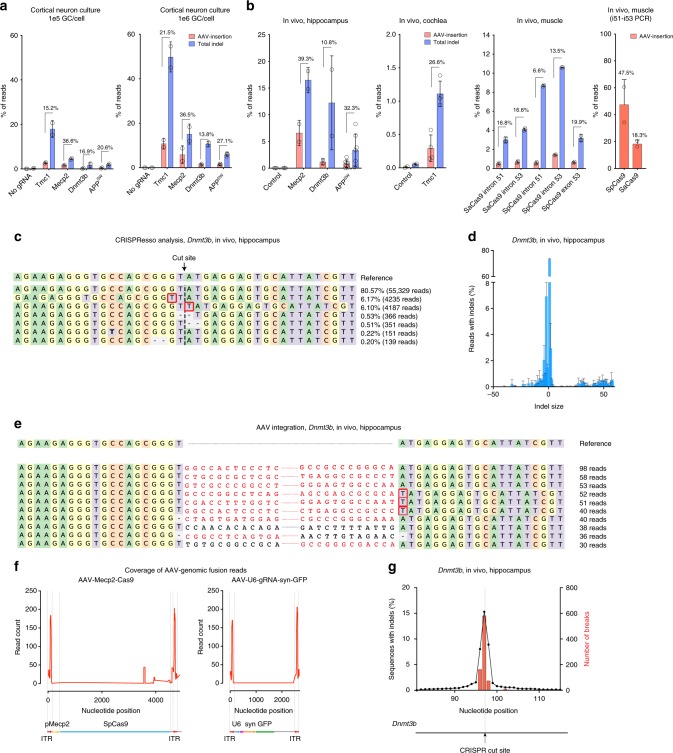
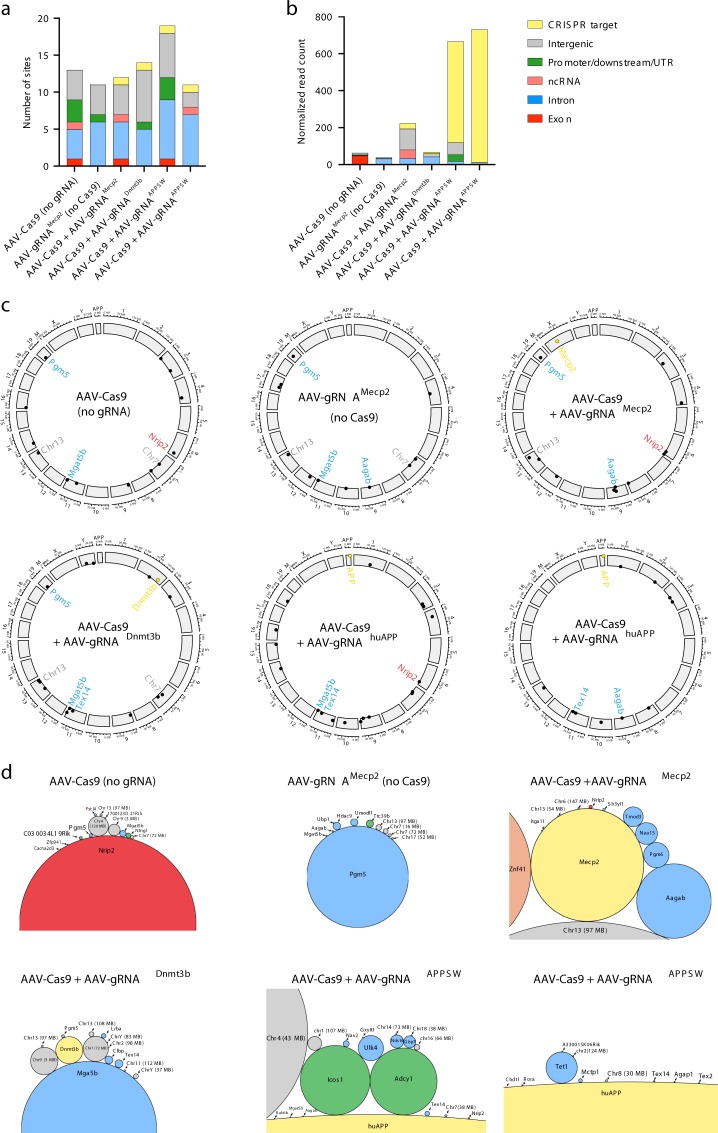
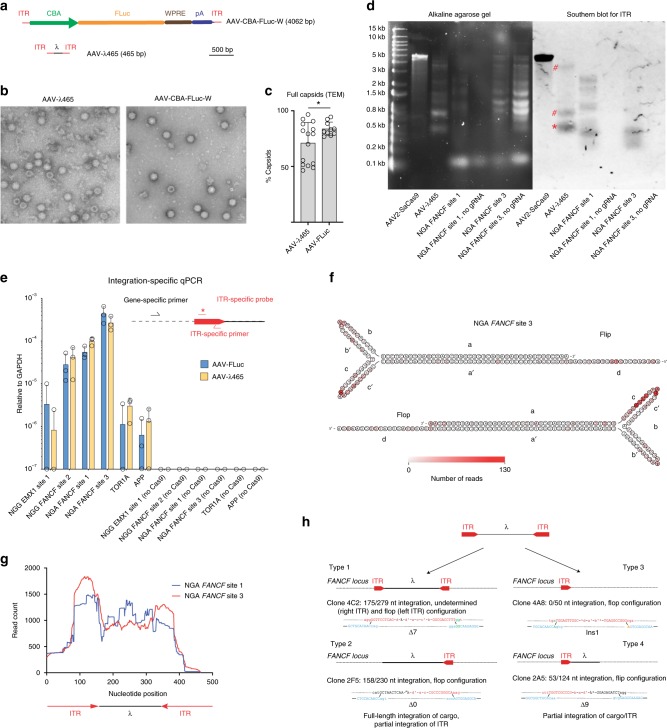
Adeno-associated virus (AAV) vectors have shown promising results in preclinical models, but the genomic consequences of transduction with AAV vectors encoding CRISPR-Cas nucleases is still being examined. In this study, we observe high levels of AAV integration (up to 47%) into Cas9-induced double-strand breaks (DSBs) in therapeutically relevant genes in cultured murine neurons, mouse brain, muscle and cochlea. Genome-wide AAV mapping in mouse brain shows no overall increase of AAV integration except at the CRISPR/Cas9 target site. To allow detailed characterization of integration events we engineer a miniature AAV encoding a 465 bp lambda bacteriophage DNA (AAV-λ465), enabling sequencing of the entire integrated vector genome. The integration profile of AAV-465λ in cultured cells display both full-length and fragmented AAV genomes at Cas9 on-target sites. Our data indicate that AAV integration should be recognized as a common outcome for applications that utilize AAV for genome editing.
Overview
The claims and statistics of this paper haven’t been checked yet.
Free: it reads the open-access text and checks the first 5 claims that cite a source we can check. Create a free account to check every claim.
Integrity signals
Registry
Cites
Statistics
Figures
Verification
Claims the paper makes
The claims and statistics of this paper haven’t been checked yet.
Free: it reads the open-access text and checks the first 5 claims that cite a source we can check. Create a free account to check every claim.
Claims other papers make about this one
Each is checked against this paper’s own text: does it say what the citing paper says it does?
The cited source doesn’t support the claim as written.
In the citing paper
“However, if left active in cells, functional rAAV-CRISPR/Cas9 systems do increase the number of off-target integration events into the genome [218].”
From Recombinant Adeno-Associated Viral Vectors (rAAV)-Vector Elements in Ocular Gene Therapy Clinical Trials and Transgene Expression and Bioactivity Assays (2020) · cites this paper as [218]
Checked by a reasoning model — may be wrong.
Experimental — accuracy not yet measured
Self-check
Percentages, sums and reported differences re-computed from the paper’s own numbers.
The self-check needs the paper’s full text.
Citations
Cites
ANNOVAR: functional annotation of genetic variants from high-throughput sequencing data
Wang, K., Li, M., & Hakonarson, H. (2010) · Nucleic Acids Research · doi:10.1093/nar/gkq603 · Cited by 14,621
Genome engineering using the CRISPR-Cas9 system
Ran, F. A., Hsu, P. D., Wright, J., Agarwala, V., Scott, D. A., & Zhang, F. (2013) · Nature Protocols · doi:10.1038/nprot.2013.143 · Cited by 11,133
High-fidelity CRISPR-Cas9 nucleases with no detectable genome-wide off-target effects
Kleinstiver, B. P., Pattanayak, V., Prew, M. S., Tsai, S. Q., Nguyen, N. T., Zheng, Z., & Joung, J. K. (2016) · Nature · doi:10.1038/nature16526 · Cited by 2,673
Self-citationRationally engineered Cas9 nucleases with improved specificity
Slaymaker, I. M., Gao, L., Zetsche, B., Scott, D. A., Yan, W. X., & Zhang, F. (2016) · Science · doi:10.1126/science.aad5227 · Cited by 2,414
GUIDE-seq enables genome-wide profiling of off-target cleavage by CRISPR-Cas nucleases
Tsai, S. Q., Zheng, Z., Nguyen, N. T., Liebers, M., Topkar, V. V., Thapar, V., Wyvekens, N., Khayter, C., Iafrate, A. J., Le, L. P., et al. (2015) · Nature Biotechnology · doi:10.1038/nbt.3117 · Cited by 2,268
Self-citationDeficiency of methyl-CpG binding protein-2 in CNS neurons results in a Rett-like phenotype in mice
Chen, R. Z., Akbarian, S., Tudor, M., & Jaenisch, R. (2001) · Nature Genetics · doi:10.1038/85906 · Cited by 1,275
Enhanced proofreading governs CRISPR-Cas9 targeting accuracy
Chen, J. S., Dagdas, Y. S., Kleinstiver, B. P., Welch, M. M., Sousa, A. A., Harrington, L. B., Sternberg, S. H., Joung, J. K., Yildiz, A., & Doudna, J. A. (2017) · Nature · doi:10.1038/nature24268 · Cited by 1,168
Self-citationIn vivo genome editing improves muscle function in a mouse model of Duchenne muscular dystrophy
Nelson, C. E., Hakim, C. H., Ousterout, D. G., Thakore, P. I., Moreb, E. A., Rivera, R. M. C., Madhavan, S., Pan, X., Ran, F. A., Yan, W. X., et al. (2016) · Science · doi:10.1126/science.aad5143 · Cited by 1,144
In vivo gene editing in dystrophic mouse muscle and muscle stem cells
Tabebordbar, M., Zhu, K., Cheng, J. K. W., Chew, W. L., Widrick, J. J., Yan, W. X., Maesner, C., Wu, E. Y., Xiao, R., Ran, F. A., et al. (2016) · Science · doi:10.1126/science.aad5177 · Cited by 1,046
Dnmt1 and Dnmt3a maintain DNA methylation and regulate synaptic function in adult forebrain neurons
Feng, J., Zhou, Y., Campbell, S. L., Le, T., Li, E., Sweatt, J. D., Silva, A. J., & Fan, G. (2010) · Nature Neuroscience · doi:10.1038/nn.2514 · Cited by 1,019
Research works printed but not linked: 1
- Miller Daniel G Petek Lisa M Russell David W Adeno-associated virus vectors integrate at chromosome breakage sites Nature Genetics 2004 36 7 767 773 10.1038/ng1380 15208627 · DOI · Paper page
Cited by
Items 101–200 of 445
Advances in CRISPR Delivery Methods: Perspectives and Challenges
Demirci, S., Essawi, K., Germino-Watnick, P., Liu, X., Hakami, W., & Tisdale, J. F. (2022) · The CRISPR Journal · doi:10.1089/crispr.2022.0051 · Cited by 41
“88 That would lead to continuous expression of Cas9 posing a safety concern by augmenting cytotoxicity, immune response, and off-target activity.”
Basic Principles of RNA Interference: Nucleic Acid Types and In Vitro Intracellular Delivery Methods
Isenmann, M., Stoddart, M. J., Schmelzeisen, R., Groß, C., Bella, E. D., & Rothweiler, R. M. (2023) · Micromachines · doi:10.3390/mi14071321 · Cited by 44
Martins, K. M., Breton, C. A., Zheng, Q., Zhang, Z., Latshaw, C., Greig, J. A., & Wilson, J. M. (2023) · Human Gene Therapy · doi:10.1089/hum.2023.134 · Cited by 38
“37,38 Our results indicate that non-site-specific wtAAV and rAAV integrations occur more frequently in locations of DNA damage and likely occur through a similar, passive process involving non-homologous end-joining repair of spontaneous chromosomal DSBs. Mammalian cells have endogenous enzymes that…”
BackgroundOnasemnogene abeparvovec for the treatment of spinal muscular atrophy
McMillan, H. J., Proud, C. M., Farrar, M. A., Alexander, I. E., Muntoni, F., & Servais, L. (2022) · Expert Opinion on Biological Therapy · doi:10.1080/14712598.2022.2066471 · Cited by 39
“city [128–130] and no evidence of genome-wide genotoxicity [128].”
BackgroundMetzger, J. M., Wang, Y., Neuman, S. S., Snow, K. J., Murray, S. A., Lutz, C. M., Bondarenko, V., Felton, J., Gimse, K., Xie, R., et al. (2022) · Biomaterials · doi:10.1016/j.biomaterials.2022.121959 · Cited by 38
Zhang, K., Wan, P., Wang, L., Wang, Z., Tan, F., Li, J., Ma, X., Cen, J., Yuan, X., Liu, Y., et al. (2024) · Cell stem cell · doi:10.1016/j.stem.2024.04.022 · Cited by 39
Gene therapy for cardiac diseases: methods, challenges, and future directions
Grisorio, L., Bongianino, R., Gianeselli, M., & Priori, S. G. (2024) · Cardiovascular Research · doi:10.1093/cvr/cvae207 · Cited by 40
Merlin, J. P. J., & Abrahamse, H. (2024) · Biomedicine & Pharmacotherapy · doi:10.1016/j.biopha.2024.117516 · Cited by 40
In utero delivery of mRNA to the heart, diaphragm and muscle with lipid nanoparticles
Gao, K., Li, J., Song, H., Han, H., Wang, Y., Yin, B., Farmer, D. L., Murthy, N., & Wang, A. (2023) · Bioactive Materials · doi:10.1016/j.bioactmat.2023.02.011 · Cited by 45
Exploring Parkinson-associated kinases for CRISPR/Cas9-based gene editing: beyond alpha-synuclein
Mansour, H. M., & El-Khatib, A. S. (2023) · Ageing Research Reviews · doi:10.1016/j.arr.2023.102114 · Cited by 37
Hadi, M., Allela, O. Q. B., Jabari, M., Jasoor, A. M., Naderloo, O., Yasamineh, S., Gholizadeh, O., & Kalantari, L. (2024) · Virology Journal · doi:10.1186/s12985-024-02286-1 · Cited by 37
“…as relatively secure; however, recent evidence indicating that the potential for AAV vector genomes, when transporting CRISPR components, to incorporate within the host cell at double-strand break sites has prompted apprehensions about their efficacy and their safety over extended period [168].”
BackgroundDelivery Platforms for CRISPR/Cas9 Genome Editing of Glial Cells in the Central Nervous System
Meneghini, V., Peviani, M., Luciani, M., Zambonini, G., & Gritti, A. (2021) · Frontiers in Genome Editing · doi:10.3389/fgeed.2021.644319 · Cited by 41
Homology-directed gene-editing approaches for hematopoietic stem and progenitor cell gene therapy
Azhagiri, M. K. K., Babu, P., Venkatesan, V., & Thangavel, S. (2021) · Stem Cell Research & Therapy · doi:10.1186/s13287-021-02565-6 · Cited by 35
Liver directed adeno‐associated viral vectors to treat metabolic disease
Chuecos, M. A., & Lagor, W. R. (2023) · Journal of Inherited Metabolic Disease · doi:10.1002/jimd.12637 · Cited by 37
“136 These NHEJ insertions compete with correctly repaired alleles through HDR, and can also insert permanent copies of the Cas9 transgene.”
BackgroundTasca, F., Wang, Q., & Gonçalves, M. A. F. V. (2020) · Cells · doi:10.3390/cells9040953 · Cited by 37
“In the case of gene-editing tool delivery through viral vector systems, it is important that vector genomes transporting donor templates or encoding programmable DNA-targeting enzymes are refractory to (i) structural rearrangements [103], (ii) epigenetic silencing mechanisms [106,107], and (iii) capture at chromosomal…”
BackgroundKurgan, G., Turk, R., Li, H., Roberts, N., Rettig, G. R., Jacobi, A. M., Tso, L., Sturgeon, M. L., Mertens, M., Noten, R., et al. (2021) · Molecular Therapy — Methods & Clinical Development · doi:10.1016/j.omtm.2021.03.024 · Cited by 38
“We modeled the dataset with simulated dsDNA donors, since this introduces an additional potential complication of the actual donor sequence being directly ligated into the cleavage site, which is an important event to describe.(4,49) We made all sites have a heterogeneous set of events including non-edited events (15%…”
MethodSingle-swap editing for the correction of common Duchenne muscular dystrophy mutations
Chai, A. C., Chemello, F., Li, H. Z., Nishiyama, T., Chen, K., Zhang, Y., Sanchez‐Ortiz, E., Alomar, A., Xu, L., Liu, N., et al. (2023) · Molecular Therapy — Nucleic Acids · doi:10.1016/j.omtn.2023.04.009 · Cited by 35
“44,45 Adenine base editing overcomes some of these limitations by having more de fi ned editing outcomes (A to G base pair transitions within a de fi ned 5 nt editing window) and no DSB formation, which minimizes potential AAV integration and indel formations.”
CRISPR-based therapeutic genome editing for inherited blood disorders
Levesque, S., & Bauer, D. E. (2025) · Nature Reviews Drug Discovery · doi:10.1038/s41573-025-01236-y · Cited by 39
“Genome editing with AAV donor templates has also been linked to unintended on-target integrations of concatemers and inverted terminal repeats, which are challenging to detect with standard genotyping methods 78,79 .”
Prime Editing for Inherited Retinal Diseases
da Costa, B. L., Levi, S. R., Eulau, E., Tsai, Y.-T., & Quinn, P. M. J. (2021) · Frontiers in Genome Editing · doi:10.3389/fgeed.2021.775330 · Cited by 37
“Further, the chance random integration of virus during viral delivery of CRISPR/Cas components into host genome can be further boosted by the DSB created by conventional CRISPR machinery (Hanlon et al., 2019).”
BackgroundTargeting the Apoa1 locus for liver-directed gene therapy
Giorgi, M. D., Li, A., Hurley, A. E., Barzi, M., Doerfler, A. M., Cherayil, N. A., Smith, H. E., Brown, J. D., Lin, C. Y., Bissig, K., et al. (2021) · Molecular Therapy — Methods & Clinical Development · doi:10.1016/j.omtm.2021.04.011 · Cited by 34
“5%) and that all the ITR regions are detectable at relatively similar read counts.(35) Despite the fact that most of the NHEJ insertion events were shown to not contain the”
BackgroundTherapeutic strategies for autism: targeting three levels of the central dogma of molecular biology
Hong, D., & Iakoucheva, L. M. (2023) · Translational Psychiatry · doi:10.1038/s41398-023-02356-y · Cited by 36
“Since AAVs have been found to integrate within DSBs with high frequency [152], the coupling of CRISPR-Cas9 with AAVs as the delivery vector must”
BackgroundEfficient in vivo editing of OTC-deficient patient-derived primary human hepatocytes
Ginn, S. L., Amaya, A. K., Liao, S. H. Y., Zhu, E., Cunningham, S. C., Lee, M., Hallwirth, C. V., Logan, G. J., Tay, S. S., Cesare, A. J., et al. (2019) · JHEP Reports · doi:10.1016/j.jhepr.2019.100065 · Cited by 36
“Interestingly, the vast majority of insertions were of vector origin with a dominant contribution from the ITR sequences, an observation already reported by others.(42) Irrespective of the nature of these events, the key consequence is the likely disruption of the reading frame and resultant loss of residual OTC funct…”
BackgroundZhu, W., Du, W., Rameshbabu, A. P., Armstrong, A. M., Silver, S., Kim, Y., Wei, W., Shu, Y., Liu, X., Lewis, M. A., et al. (2024) · Science Translational Medicine · doi:10.1126/scitranslmed.adn0689 · Cited by 34
“The integration ratio of AAV varies across different genomic loci, tissues, and cell types (50).”
BackgroundLinthout, S. V., Stellos, K., Giacca, M., Bertero, E., Cannata, A. N., Carrier, L., García‐Pavía, P., Ghigo, A., González, A., Haugaa, K. H., et al. (2024) · European Journal of Heart Failure · doi:10.1002/ejhf.3516 · Cited by 35
CRISPR/Cas9-induced structural variations expand in T lymphocytes in vivo
Wu, J., Zou, Z., Liu, Y., Liu, X., Zhangding, Z., Xu, M., & Hu, J. (2022) · Nucleic Acids Research · doi:10.1093/nar/gkac887 · Cited by 32
“In addition, both large deletions and vector integrations are prevalent during gene editing in vitro (13,24) and in vivo (25,26), which is another potential cause of pathogenesis (15).”
Recent Developments in Gene Therapy for Neovascular Age-Related Macular Degeneration: A Review
Finocchio, L., Zeppieri, M., Gabai, A., Toneatto, G., Spadea, L., & Salati, C. (2023) · Biomedicines · doi:10.3390/biomedicines11123221 · Cited by 34
“For retinal gene supplementation, the optimal selection is the recombinant adeno-associated viral vector (AAV) [113,114].”
BackgroundGenome and base editing for genetic hearing loss
Niggemann, P., György, B., & Chen, Z. (2020) · Hearing Research · doi:10.1016/j.heares.2020.107958 · Cited by 36
“A recent paper indicated high levels of AAV integration into CRISPR-induced double-stranded breaks upon AAV-mediated CRISPR delivery in the inner ear, brain and other tissues (Hanlon et al., 2019).”
BackgroundSelf-citationMeng, X., Jia, R., Zhao, X., Zhang, F., Chen, S., Yu, S., Liu, X., Dou, H., Feng, X., Zhang, J., et al. (2024) · Nature Communications · doi:10.1038/s41467-024-48092-9 · Cited by 33
“When rAAV enters into the host cell, its single-strand genome is converted into double-strand linear DNA, the linear ITRs maybe amore preferable source of DNA for integration into the DSBs than circular plasmids 46 .”
InfluentialBrescia, M., Janssen, J. M., Liu, J., & Gonçalves, M. A. F. V. (2020) · Cells · doi:10.3390/cells9040869 · Cited by 32
“Moreover, consistent with earlier data showing that AAV DNA is prone to homology-independent insertion (“capture”) at random and targeted chromosomal DSBs in vitro [27–29], more recent data indicate that AAV transduction of programmable nucleases leads to high-frequency AAV DNA capture at target sequences in vivo as w…”
ResultAdvances in Alpha-1 Antitrypsin Gene Therapy
Lőrincz, R., & Curiel, D. T. (2020) · American Journal of Respiratory Cell and Molecular Biology · doi:10.1165/rcmb.2020-0159ps · Cited by 33
“The latter has been confirmed in AAV-treated dogs with hemophilia after 10 years of follow-up as well as in murine samples in which AAV-vector sequences have been unintentionally introduced at nucleaseinduced breaks of therapeutically relevant genes (42, 43).”
BackgroundShoop, W. K., Bacman, S. R., Barrera-Paez, J. D., & Moraes, C. T. (2023) · Nature Reviews Methods Primers · doi:10.1038/s43586-023-00200-7 · Cited by 33
Baik, R., Cromer, M. K., Glenn, S. E., Vakulskas, C. A., Chmielewski, K. O., Dudek, A. M., Feist, W. N., Klermund, J., Shipp, S., Cathomen, T., et al. (2024) · Nature Communications · doi:10.1038/s41467-023-43413-w · Cited by 33
“With a signi fi cantly lower MOI of AAV6, it is biologically plausible that the already low frequency of random integrations of the vector genome would decrease further and thereby improve the safety of this approach 49,50 .”
Advances in CRISPR/Cas9 Genome Editing for the Treatment of Muscular Dystrophies
Fatehi, S., Marks, R. M., Rok, M. J., Perillat, L., Ivakine, E. A., & Cohn, R. D. (2023) · Human Gene Therapy · doi:10.1089/hum.2023.059 · Cited by 31
“113,116,117 In a study by the Gersbach group, a humoral and cellular immune response was observed in adult mdx mice when treated by AAV8/9s carrying an Sa Cas9, which was mostly avoided when the same treatment was given to P2 neonates.”
Avallone, M., Pardo, J., Mergiya, T. F., Rájová, J., Räsänen, A., Davidsson, M., Åkerblom, M., Quintino, L., Kumar, D., Bramham, C. R., et al. (2023) · Frontiers in Molecular Neuroscience · doi:10.3389/fnmol.2023.1140785 · Cited by 30
“ITR-containing donors are highly prone to insertion into the genome at double-strand breaks (Hanlon et al., 2019).”
BackgroundKarpov, D. S., Sosnovtseva, A. O., Pylina, S. V., Bastrich, A., Petrova, D. A., Kovalev, M. A., Shuvalova, A. I., Константиновна, Е. А., & Mokrysheva, N. G. (2023) · International Journal of Molecular Sciences · doi:10.3390/ijms242417320 · Cited by 35
“Although no off-target incorporation of AAV has been observed [218], the safety of using AAV for CRISPR/Cas9 delivery in clinical practice remains controversial.”
BackgroundEditing outside the body: Ex vivo gene-modification for β-hemoglobinopathy cellular therapy
Rosanwo, T. O., & Bauer, D. E. (2021) · Molecular Therapy · doi:10.1016/j.ymthe.2021.10.002 · Cited by 35
Targeted intracellular delivery of Cas13 and Cas9 nucleases using bacterial toxin-based platforms
Tian, S., Liu, Y., Appleton, E., Wang, H., Church, G. M., & Dong, M. (2022) · Cell Reports · doi:10.1016/j.celrep.2022.110476 · Cited by 31
“Furthermore, sustained expression of the CRISPR-Cas components in cells increases the chance of off-target cleavage (Hanlon et al., 2019; Vakulskas and Behlke, 2019).”
Yin, J., Fang, K., Gao, Y., Ou, L., Yuan, S., Xin, C., Wu, W., Wu, W., Hong, J., Yang, H., et al. (2022) · Nature Communications · doi:10.1038/s41467-022-35640-4 · Cited by 32
“As the most currently used gene delivery tool in clinical trials, AAV renders gene-edited cells to suffer from high levels of virus-fragment integrations during CRISPR-Cas9 editing in vivo (~50% in edited cells inthis study) 13,14 .”
Efficient and safe therapeutic use of paired Cas9-nickases for primary hyperoxaluria type 1
Torella, L., Klermund, J., Bilbao‐Arribas, M., Tamayo, I., Andrieux, G., Chmielewski, K. O., Vales, Á., Olagüe, C., Moreno, D., Raimondi, I., et al. (2024) · EMBO Molecular Medicine · doi:10.1038/s44321-023-00008-8 · Cited by 31
“…that contain the full-length ITR sequences and other components of the AAV cassette may not be detectable or may be underestimated due to technical limitations resulting from the complex secondary structure of the ITR sequences, as described by Hanlon et al (2019) and Simpson et al (2023).”
Biosafety assessment of delivery systems for clinical nucleic acid therapeutics
Li, Z., Zhang, L., Jiang, K., Zhang, Y., Liu, Y., Hu, G., & Song, J. (2022) · Biosafety and Health · doi:10.1016/j.bsheal.2022.03.003 · Cited by 32
AAV- based vector improvements unrelated to capsid protein modification
Shitik, E. M., Shalik, I. K., & Yudkin, D. V. (2023) · Frontiers in Medicine · doi:10.3389/fmed.2023.1106085 · Cited by 30
“highest number of breakpoints was detected in BB and CC regions of ITRs (33).”
BackgroundGene Therapy Approaches for the Treatment of Hemophilia B
Soroka, A. B., Feoktistova, S. G., Mityaeva, O. N., & Volchkov, P. (2023) · International Journal of Molecular Sciences · doi:10.3390/ijms241310766 · Cited by 30
“One study showed a high frequency of such insertions (up to 47%) in mice after in vivo injection [67].”
BackgroundMicroRNA-122–Mediated Liver Detargeting Enhances the Tissue Specificity of Cardiac Genome Editing
Yang, L., Liu, Z., Chen, G., Chen, Z., Guo, C., Ji, X., Cui, Q., Sun, Y., Hu, X., Zheng, Y., et al. (2024) · Circulation · doi:10.1161/circulationaha.123.065438 · Cited by 29
Application of CRISPR-Cas9-Mediated Genome Editing for the Treatment of Myotonic Dystrophy Type 1
Marsh, S., Hanson, B., Wood, M. J. A., Varela, M. A., & Roberts, T. C. (2020) · Molecular Therapy · doi:10.1016/j.ymthe.2020.10.005 · Cited by 31
Bengtsson, N. E., Tasfaout, H., Hauschka, S. D., & Chamberlain, J. S. (2020) · Molecular Therapy · doi:10.1016/j.ymthe.2020.11.003 · Cited by 29
Self-citationEsposito, F., Dell’Aquila, F., Rhiel, M., Auricchio, S., Chmielewski, K. O., Andrieux, G., Ferla, R., Horrach, P. S., Padmanabhan, A., Cunto, R. D., et al. (2024) · Cell Reports Medicine · doi:10.1016/j.xcrm.2024.101619 · Cited by 32
Prime Editing: A Revolutionary Technology for Precise Treatment of Genetic Disorders
Li, M., Lin, Y., Cheng, Q., & Wei, T. (2025) · Cell Proliferation · doi:10.1111/cpr.13808 · Cited by 33
Ball, J., Bradley, A., Le, A., Tisdale, J. F., & Uchida, N. (2025) · Molecular Therapy · doi:10.1016/j.ymthe.2025.03.016 · Cited by 31
The deLIVERed promises of gene therapy: Past, present, and future of liver-directed gene therapy
Puzzo, F., & Kay, M. A. (2025) · Molecular Therapy · doi:10.1016/j.ymthe.2025.03.041 · Cited by 31
“123 As RNA delivery into the liver had become more routine in the clinic originally as an RNAi therapeutic, 124 CRISPR-Cas9 delivered as messenger RNA (mRNA)/guide RNA (gRNA) complex encapsulated in LNPs 125 or, more recently, pre-assembled CRISPR-Cas9-gRNA ribonucleoprotein complexes 126 have…”
A primer to gene therapy: Progress, prospects, and problems
Zittersteijn, H. A., Gonçalves, M. A. F. V., & Hoeben, R. C. (2020) · Journal of Inherited Metabolic Disease · doi:10.1002/jimd.12270 · Cited by 32
Transcriptional repression of PTEN in neural cells using CRISPR/dCas9 epigenetic editing
Moses, C., Hodgetts, S. I., Nugent, F., Ben-Ary, G., Park, K. K., Blancafort, P., & Harvey, A. R. (2020) · Scientific Reports · doi:10.1038/s41598-020-68257-y · Cited by 31
Strategies for enhanced gene delivery to the central nervous system
Gao, Z. (2024) · Nanoscale Advances · doi:10.1039/d3na01125a · Cited by 29
Exploring the potential of cell-derived vesicles for transient delivery of gene editing payloads
Leandro, K., Rufino‐Ramos, D., Breyne, K., Ianni, E. D., Lopes, S., Nobre, R. J., Kleinstiver, B. P., Perdigão, P. R. L., Breakefield, X. O., & de Almeida, L. P. (2024) · Advanced Drug Delivery Reviews · doi:10.1016/j.addr.2024.115346 · Cited by 28
Self-citationDendrimer Technology in Glioma: Functional Design and Potential Applications
Gaitsch, H., Hersh, A. M., Alomari, S., & Tyler, B. (2023) · Cancers · doi:10.3390/cancers15041075 · Cited by 28
Suñé-Pou, M., Limeres, M. J., Moreno‐Castro, C., Hernández-Munaín, C., Suñé-Negre, J. M., Cuestas, M. L., & Suñé, C. (2020) · Frontiers in Genetics · doi:10.3389/fgene.2020.00731 · Cited by 28
CRISPR/Cas therapeutic strategies for autosomal dominant disorders
Caruso, S. M., Quinn, P. M. J., da Costa, B. L., & Tsang, S. H. (2022) · Journal of Clinical Investigation · doi:10.1172/jci158287 · Cited by 29
“Off-target effects remain a considerable safety concern with DSB approaches, and high levels of adeno-associated virus (AAV) integration have been observed in Cas9-induced DSBs (28, 29).”
BackgroundWang, Q., Capelletti, S., Liu, J., Janssen, J. M., & Gonçalves, M. A. F. V. (2024) · Nucleic Acids Research · doi:10.1093/nar/gkae057 · Cited by 26
“A potentially insidious outcome identified is, however, the prevalent integration of AAV vector DNA at site-specific DSBs, including at Dmd exons 51 and 53 in muscle tissues ( 53 ,54 ).”
Basic Principles and Clinical Applications of CRISPR-Based Genome Editing
Lim, J. M., & Kim, S. (2022) · Yonsei Medical Journal · doi:10.3349/ymj.2022.63.2.105 · Cited by 28
Gallego, C., Gonçalves, M. A. F. V., & Wijnholds, J. (2020) · Frontiers in Neuroscience · doi:10.3389/fnins.2020.00838 · Cited by 27
Progress and challenges in CRISPR-mediated therapeutic genome editing for monogenic diseases
Konishi, C. T., & Long, C. (2021) · Journal of Biomedical Research · doi:10.7555/jbr.34.20200105 · Cited by 28
“AAVs are single-stranded viral vectors capable of delivering genomic payloads to multiple tissues, with minimal immunogenicity[107].”
BackgroundApplications of multiplexed CRISPR–Cas for genome engineering
Cheng, H., Jeong, E., & Cho, S. W. (2025) · Experimental & Molecular Medicine · doi:10.1038/s12276-025-01500-6 · Cited by 32
“Although AAV is expected to have a low risk of viral DNA integration into the host genome, reports suggest that AAV is not entirely free from this threat 78,79 Moreover, the limited packaging capacity of AAV makes AAV less attractive, especially when performing multiplexed editing 80 .”
In vivo CRISPR-Cas9 inhibition of hepatic LDH as treatment of primary hyperoxaluria
Martínez-Turrillas, R., Martín-Mallo, Á., Rodríguez-Diaz, S., Zapata‐Linares, N., Rodríguez-Márquez, P., Martín‐Úriz, P. S., Vilas‐Zornoza, A., Calleja-Cervantes, M. E., SALIDO, E. C., Prósper, F., et al. (2022) · Molecular Therapy — Methods & Clinical Development · doi:10.1016/j.omtm.2022.03.006 · Cited by 25
“To analyze insertions containing AAV sequences, we aligned reads to the reference genome containing the AAV vector sequence as described previously.(32)”
BackgroundMethodNew Editing Tools for Gene Therapy in Inherited Retinal Dystrophies
Pulman, J., Sahel, J.-A., & Dalkara, D. (2022) · The CRISPR Journal · doi:10.1089/crispr.2021.0141 · Cited by 23
CRISPR applications for Duchenne muscular dystrophy: From animal models to potential therapies
Chey, Y. C. J., Arudkumar, J., Aartsma-Rus, A. M., Adikusuma, F., & Thomas, P. Q. (2022) · WIREs Mechanisms of Disease · doi:10.1002/wsbm.1580 · Cited by 28
“Also, the possibility of AAV integration can lead to the long-term expression of CRISPR components and increases the risk of unintended off-targeting (Hanlon et al., 2019).”
BackgroundHigh spontaneous integration rates of end-modified linear DNAs upon mammalian cell transfection
Lim, S., Yocum, R. R., Silver, P. A., & Way, J. C. (2023) · Scientific Reports · doi:10.1038/s41598-023-33862-0 · Cited by 27
“[7-9, 24-28] In comparing the safety of retroviral and AAV-based vector systems, these calculations suggest that the high doses used in AAV therapies may nullify the advantage deriving from the fact that AAV is a “nonintegrating” vector.”
BackgroundGeneration and optimization of off-the-shelf immunotherapeutics targeting TCR-Vβ2+ T cell malignancy
Ren, J., Liao, X., Lewis, J. M., Chang, J., Qu, R., Carlson, K. R., Foss, F. M., & Girardi, M. (2024) · Nature Communications · doi:10.1038/s41467-024-44786-2 · Cited by 26
“Compared to lentiviral-dependent CAR expression that induces random genome integration, AAV-induced precise CAR genome integration combined with CRISPR KO may mitigate potential safety concerns of the lentiviral system for clinical use 32 .”
Revisiting gene delivery to the brain: silencing and editing
Conniot, J., Talebian, S., Simões, S. M. N., Ferreira, L., & Conde, J. (2021) · Biomaterials Science · doi:10.1039/d0bm01278e · Cited by 25
Understanding the Potential of Genome Editing in Parkinson’s Disease
Arango, D., Bittar, A., Esmeral, N. P., Ocasión, C., Muñoz-Camargo, C., Cruz, J. C., Reyes, L. H., & Bloch, N. I. (2021) · International Journal of Molecular Sciences · doi:10.3390/ijms22179241 · Cited by 26
“Furthermore, there are several delivery strategies where the genetic material is directly incorporated into the target tissues by physical means [175,176].”
BackgroundAdvances of Genome Editing with CRISPR/Cas9 in Neurodegeneration: The Right Path towards Therapy
Klinkovskij, A., Shepelev, M. V., Isaakyan, Y. A., Aniskin, D., & Ulasov, I. V. (2023) · Biomedicines · doi:10.3390/biomedicines11123333 · Cited by 27
DNA sonication inverse PCR for genome scale analysis of uncharacterized flanking sequences
Alquezar‐Planas, D. E., Löber, U., Cui, P., Quedenau, C., Chen, W., & Greenwood, A. D. (2020) · Methods in Ecology and Evolution · doi:10.1111/2041-210x.13497 · Cited by 25
Genetically modified organoids for tissue engineering and regenerative medicine
Zhang, Q., Jin, H., Zhu, D., Chen, Y., Fu, M., Lu, S., Qiu, Y., Zhou, G., Yang, G., & Jiang, Z. (2024) · Advances in Colloid and Interface Science · doi:10.1016/j.cis.2024.103337 · Cited by 26
Ricci, R., & Colasante, G. (2021) · Developmental Neuroscience · doi:10.1159/000515845 · Cited by 23
INSERT-seq enables high-resolution mapping of genomically integrated DNA using Nanopore sequencing
Ivančić, D., Mir-Pedrol, J., Jaraba-Wallace, J., Rafel, N., Sánchez-Mejías, A., & Güell, M. (2022) · Genome biology · doi:10.1186/s13059-022-02778-9 · Cited by 23
“Experimental procedures have been reported for the characterisation of Lentiviral (LV) vectors [15–17], rAAV vectors [9,18,19], Transposon delivery [20] or CRISPR/cas9 mediated integration [14], relying on distinct methods such as Lam-PCR [21] and nr-LAM-PCR [22], GUIDE-seq [23] and TLA [24].”
MethodOziolor, E. M., Kumpf, S. W., Qian, J., Gosink, M. M., Sheehan, M. J., Rubitski, D. M., Newman, L., Whiteley, L. O., & Lanz, T. A. (2023) · Molecular Therapy — Methods & Clinical Development · doi:10.1016/j.omtm.2023.04.009 · Cited by 23
“31 AAV delivery of CRISPR cargo is being pursued to enable targeted gene editing for a number of therapeutic targets.”
BackgroundZakas, P. M., Cunningham, S. C., Doherty, A., van Dijk, E. B., Ibraheim, R., Yu, S., Mekonnen, B. D., Lang, B., English, E. J., Sun, G., et al. (2024) · Molecular Therapy · doi:10.1016/j.ymthe.2024.06.021 · Cited by 22
A homology independent sequence replacement strategy in human cells using a CRISPR nuclease
Danner, E. W., Lebedin, M. Y., de la Rosa, K., & Kühn, R. (2021) · Open Biology · doi:10.1098/rsob.200283 · Cited by 23
“Others have recently demonstrated high rates of unintended on- and offtarget integration of AAVs using single primer amplification [49].”
BackgroundTang, N., Zhang, Y., Shen, Z., Yao, Y., & Nair, V. (2021) · The CRISPR Journal · doi:10.1089/crispr.2021.0017 · Cited by 24
A Small Key for a Heavy Door: Genetic Therapies for the Treatment of Hemoglobinopathies
Zittersteijn, H. A., Harteveld, C. L., Klaver-Flores, S., Lankester, A. C., Hoeben, R. C., Staal, F. J. T., & Gonçalves, M. A. F. V. (2021) · Frontiers in Genome Editing · doi:10.3389/fgeed.2020.617780 · Cited by 24
“On the other hand, recent experiments indicate that AAV vector genomes trigger a p53-dependent DNA damage response in HSPCs and, through non-homologous recombination processes, integrate at significant rates at RGN target sites in murine tissues (Hanlon et al., 2019; Nelson et al., 2019; Schiroli et al., 2019).”
BackgroundAulicino, F., Capin, J., & Berger, I. (2020) · Pharmaceutics · doi:10.3390/pharmaceutics12080759 · Cited by 21
“However, pre-existing immune response in humans, undesired integration at CRISPR-produced DSBs [15] or randomly in the genome, impede their future applications as systemic gene delivery vectors.”
BackgroundDu, S. W., Newby, G. A., Salom, D., Gao, F., Menezes, C. R., Suh, S., Choi, E. H., Chen, P. Z., Liu, D. R., & Palczewski, K. (2024) · Proceedings of the National Academy of Sciences · doi:10.1073/pnas.2416827121 · Cited by 20
“…that function by creating double - strand DNA breaks (DSBs) results in highly heterogeneous mixtures of potentially toxic indel outcomes ( 28 ), adeno - associated virus (AAV) integration into the genome ( 29 – 31 ), chromosomal abnormalities, and other undesired cellular consequences of DSBs.”
Bazick, H., Mao, H., Niehaus, J. K., Wolter, J. M., & Zylka, M. J. (2024) · Molecular Therapy · doi:10.1016/j.ymthe.2024.09.032 · Cited by 20
Clinical trials and promising preclinical applications of CRISPR/Cas gene editing
Çerçi, B., Uzay, İ. A., Kara, M. K., & Dinçer, P. (2022) · Life Sciences · doi:10.1016/j.lfs.2022.121204 · Cited by 22
Intrathymic AAV delivery results in therapeutic site-specific integration at TCR loci
Calabria, A., Cipriani, C., Spinozzi, G., Rudilosso, L., Esposito, S., Benedicenti, F., Albertini, A., Pouzolles, M., Luoni, M., Giannelli, S. G., et al. (2023) · Blood · doi:10.1182/blood.2022017378 · Cited by 23
Integration and the risk of liver cancer—Is there a real risk?
Kasimsetty, A., & Sabatino, D. E. (2024) · Journal of Viral Hepatitis · doi:10.1111/jvh.13915 · Cited by 21
“…be achieved in a nuclease-independent manner, relying on natural breaks at the region of interest or can be augmented with the delivery of a targeted nuclease system such as CRISPR/Cas9 to induce precise DSBs. 26,27 In both cases, the viral ITR sequences may not be present in the integrated genome.”
BackgroundAmrani, N., Luk, K., Singh, P., Shipley, M. A., Isik, M., Donadoni, M., Bellizzi, A., Khalili, K., Sariyer, I. K., Neumann, D. M., et al. (2024) · Molecular Therapy — Methods & Clinical Development · doi:10.1016/j.omtm.2024.101303 · Cited by 21
“51 However, the HSV genome does not integrate into the host genome but persists as a circular episomal form during latency.”
Oikemus, S., Pfister, E. L., Sapp, E., Chase, K. O., Kennington, L. A., Hudgens, E. D., Miller, R., Zhu, L. J., Chaudhary, A., Mick, E. O., et al. (2021) · Human Gene Therapy · doi:10.1089/hum.2020.323 · Cited by 20
“28,29 PCR analysis revealed lentiviral and AAV insertions at the human HTT exon 50 locus or the control Rosa26 locus after gRNA delivery (Supplementary Fig.”
Precision gene editing: The power of CRISPR-Cas in modern genetics
Joo, J. H., Lee, S., & Kim, K. P. (2025) · Molecular Therapy — Nucleic Acids · doi:10.1016/j.omtn.2025.102733 · Cited by 25
“111,112 Furthermore, different AAV sero-types exhibit natural tropism for specific tissues, and several sero-types show high affinity for muscle or neuronal cells, which can be leveraged for targeted therapies.”
Immune evasive DNA donors and recombinases license kilobase-scale writing
Tou, C. J., Xie, K., da Silva, J. F., Kalailingam, P., Amar‐Lewis, E., Rufino‐Ramos, D., Sawyer, W., Eller, M. L., Starzyk, J., Majumdar, I. D., et al. (2026) · Nature · doi:10.1038/s41586-026-10241-z · Cited by 20
Self-citationGenetic therapies for neurological disorders
FitzPatrick, L., & Bird, A. P. (2021) · Human Genetics · doi:10.1007/s00439-021-02399-5 · Cited by 21
“programmable nucleases is accumulating evidence that the introduction of DSBs into the genome during editing can lead to integration of the AAV vector into the host genome (Miller et al. 2003, 2004; Anguela et al. 2013; Hanlon et al. 2019; Nelson et al. 2019).”
BackgroundLee, J. H., Oh, H.-K., Choi, B. S., Lee, H. H., Lee, K. J., Kim, U. G., Lee, J., Lee, H.-R., Lee, G. S., Ahn, S. J., et al. (2022) · Molecular Therapy — Nucleic Acids · doi:10.1016/j.omtn.2022.08.002 · Cited by 19
“The AAV trap was designed to encode the hF9 donor bidirectionally(30) (Figure 4B), and studies have suggested that the AAV genome can integrate into the double-strand break site.(31) After randomly dividing the mice, the AAVs-TS-APOC3-CjCas9 and AAV donors (HITI or AAV-trap) were transduced by intravenous injection, a…”
Han, J. P., Lee, Y., Lee, J. H., Chung, H. Y., Lee, G. S., Nam, Y. R., Choi, M., Moon, K., Lee, H., Lee, H., et al. (2023) · Molecular Therapy — Nucleic Acids · doi:10.1016/j.omtn.2023.102050 · Cited by 19
“Similarly, partial AAV sequences can be integrated into DSBs. 42 A primary goal of this study was to downregulate the blood AT concentration by targeting the Serpinc1 locus.”
BackgroundDevelopment of New Genome Editing Tools for the Treatment of Hyperlipidemia
Preta, G. (2023) · Cells · doi:10.3390/cells12202466 · Cited by 20
“AAV-based gene delivery is known to last for years in terminally differentiated cells or exhibits a higher tendency to induce unwanted off-target effects over time [136,137] to trigger an immune response [138].”
BackgroundSingh, K., Fronza, R., Evens, H., Chuah, M., & VandenDriessche, T. (2024) · Molecular Therapy — Methods & Clinical Development · doi:10.1016/j.omtm.2024.101365 · Cited by 19
“27,45 Conceptionally, mapping off-target effects using the S-EPTS/LM-PCR approach resembles the VIVO technique since both strategies exploit the integration of exogenous DNA sequences into CRISPR-induced DSBs. 74 Similarly, our strategy is complementary to the capture of protected double-stranded…”
DNA targeting by compact Cas9d and its resurrected ancestor
Ocampo, R. F., Bravo, J. P. K., Dangerfield, T. L., Nocedal, I., Jirde, S. A., Alexander, L. M., Thomas, N. C., Das, A., Nielson, S., Johnson, K. A., et al. (2025) · Nature Communications · doi:10.1038/s41467-024-55573-4 · Cited by 20
Targeted multi-epitope switching enables straightforward positive/negative selection of CAR T cells
Mosti, L., Langner, L. M., Chmielewski, K. O., Arbuthnot, P. B., Alzubi, J., & Cathomen, T. (2021) · Gene Therapy · doi:10.1038/s41434-021-00220-6 · Cited by 19
Promises and Pitfalls of Next-Generation Treg Adoptive Immunotherapy
Christofi, P., Pantazi, C., Psatha, N., Sakellari, I., Yannaki, E., & Παπαδοπούλου, Α. (2023) · Cancers · doi:10.3390/cancers15245877 · Cited by 18
CRISPR/Cas9 as a Mutagenic Factor
Shumega, A. R., Pavlov, Y. I., Chirinskaite, A. V., Rubel, A. A., Inge-Vechtomov, S. G., & Stepchenkova, E. I. (2024) · International Journal of Molecular Sciences · doi:10.3390/ijms25020823 · Cited by 18
“Thus, AAV-mediated gene editing will likely yield unwanted on-and off-target mutations over time [89,90].”
BackgroundPorreca, I., Blassberg, R. A., Harbottle, J. A., Joubert, B. C., Mielczarek, O., Stombaugh, J., Hemphill, K., Sumner, J., Pazeraitis, D., Touza, J. L., et al. (2024) · Molecular Therapy · doi:10.1016/j.ymthe.2024.06.033 · Cited by 19
Gene editing for duchenne muscular dystrophy: from experimental models to emerging therapies
Haque, U. S., & Yokota, T. (2025) · Degenerative Neurological and Neuromuscular Disease · doi:10.2147/dnnd.s495536 · Cited by 8
“11,211 Lentiviral vectors (LVs) have also been explored as delivery vehicles for CRISPR components in DMD patient-derived myoblasts.”
Genetically Engineering the Nervous System with CRISPR-Cas
Sandoval, A., Elahi, H., & Ploski, J. E. (2020) · eNeuro · doi:10.1523/eneuro.0419-19.2020 · Cited by 19
“However, the long-term expression of AAV-mediated therapies and their potential for genome insertion at DSB sites (Miller et al., 2004; Hanlon et al., 2019), may limit the feasibility of immunosuppressive approaches.”
Background
Metadata
- Authors
- Hanlon, K. S., Kleinstiver, B. P., Garcia, S. P., Zaborowski, M. P., Volak, A., Spirig, S. E., Muller, A., Sousa, A. A., Tsai, S. Q., Bengtsson, N. E., Lööv, C., Ingelsson, M., Chamberlain, J. S., Corey, D. P., Aryee, M. J., Joung, J. K., Breakefield, X. O., Maguire, C. A., & György, B.
- Affiliations
- Harvard University (US)
- Poznan University of Medical Sciences (PL)
- Massachusetts General Hospital (US)
- Institute of Molecular and Clinical Ophthalmology Basel (CH)
- St. Jude Children's Research Hospital (US)
- University of Washington (US)
- Uppsala University (SE)
- Corresponding author
- Maguire, Casey A.
- György, Bence
- ORCID
- Venue
- Nature Communications
- Published
- 2019-09-30
- Volume
- 10
- Issue
- 1
- Pages
- 4439-4439
- ISSN
- 2041-1723 (ISSN-L)
- PMC
- PMC6769011
- OpenAlex
- W2976425815
- Cited by
- 431
- References
- 41
- Citations by year
- 2026: 57 · 2025: 67 · 2024: 75 · 2023: 64 · 2022: 57 · 2021: 59 · 2020: 47 · 2019: 4
- FWCI
- 25.16
- Type
- journal article
- Language
- en
- Open access
- gold
- doi.org
- Licence
- cc-by
- creativecommons.org/licenses/by/4.0 (tdm)
- creativecommons.org/licenses/by/4.0 (vor)
- Locations
- Nature Communications (publishedVersion, cc-by)
- PubMed Central (publishedVersion, cc-by)
- PubMed (publishedVersion)
- Uppsala University Publications (Uppsala University) (submittedVersion, other-oa)
- RePEc: Research Papers in Economics (submittedVersion)
- DOAJ (DOAJ: Directory of Open Access Journals) (submittedVersion)
- DOAJ (DOAJ: Directory of Open Access Journals) (submittedVersion, cc-by-sa)
- Funders
- U.S. Department of Health & Human Services | NIH | Center for Information Technology (R01DC017117)
- Topics
- Life Sciences › Biochemistry, Genetics and Molecular Biology › Genetics › Virus-based gene therapy research
- Life Sciences › Biochemistry, Genetics and Molecular Biology › Molecular Biology › CRISPR and Genetic Engineering
- Life Sciences › Biochemistry, Genetics and Molecular Biology › Molecular Biology › RNA Interference and Gene Delivery
- Keywords
- adeno-associated virus vectors, AAV integration, CRISPR/Cas9, DNA double-strand breaks, genome editing, mouse brain, muscle, cochlea
- MeSH terms
- Gene Editing, Dependovirus, Animals, Brain, Cell Line, Chromosome Mapping, Cochlea, Endonucleases, Genetic Vectors, Humans, Male, Mice, Inbred C57BL, Mice, Transgenic, Muscles, Neurons, Bacteriophage lambda, Genetic Therapy, Virus Integration, Genome, Treatment Outcome, Gene Targeting, Mice, Targeted Gene Repair, DNA Breaks, Clustered Regularly Interspaced Short Palindromic Repeats, CRISPR-Cas Systems
About these checks
Registry, retraction, Cites and statistics results are computed, not judged, with one exception: a printed reference that no index lists is read once by a model before it counts as a citation error. Claims are extracted by a model and kept only when their quote appears verbatim in the text; each cited source is then checked, with a model’s help, for whether it says what the claim relies on. Those verdicts can be wrong — read the claim’s quote and the cited source before relying on one.
Statistics and arithmetic are recomputed, not judged.
Confidence bands are shown only for fields calibrated on our annotated test set. None is calibrated yet, so no band is shown.
What counts as a claim ›How we measure confidence ›How we check this ›
Are you an author, or do you see a problem with this page? Request a review
Data sources
Bibliographic data: Semantic Scholar, OpenAlex, Crossref.
Contains information from the Semantic Scholar Academic Graph Datasets, made available under the ODC Attribution License (ODC-BY 1.0).
Semantic Scholar’s data is described in: Kinney, R., et al. (2023). The Semantic Scholar Open Data Platform. arXiv:2301.10140.
