

High levels of AAV vector integration into CRISPR-induced DNA breaks
Open accessThe DOI matches its Crossref record; 41 of the 41 references it cites were found in a registry or an index.
Abstract
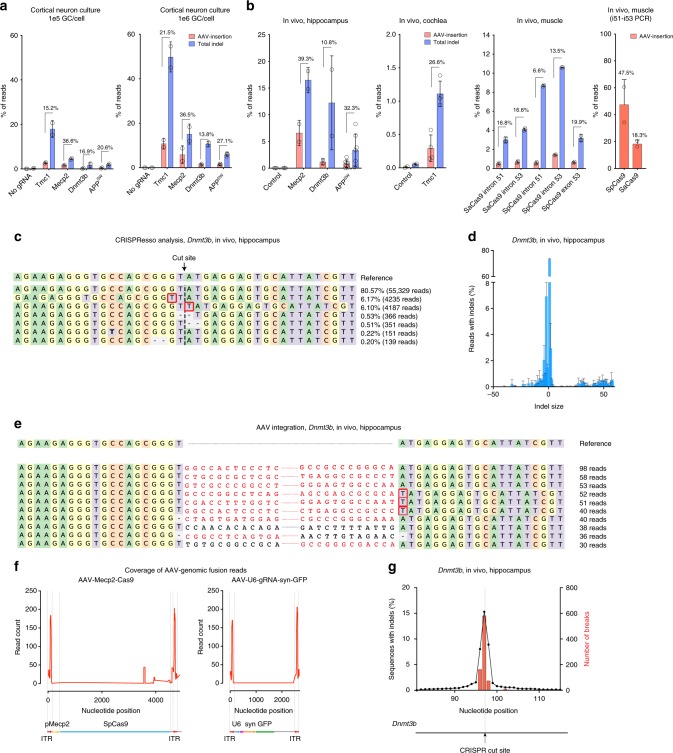
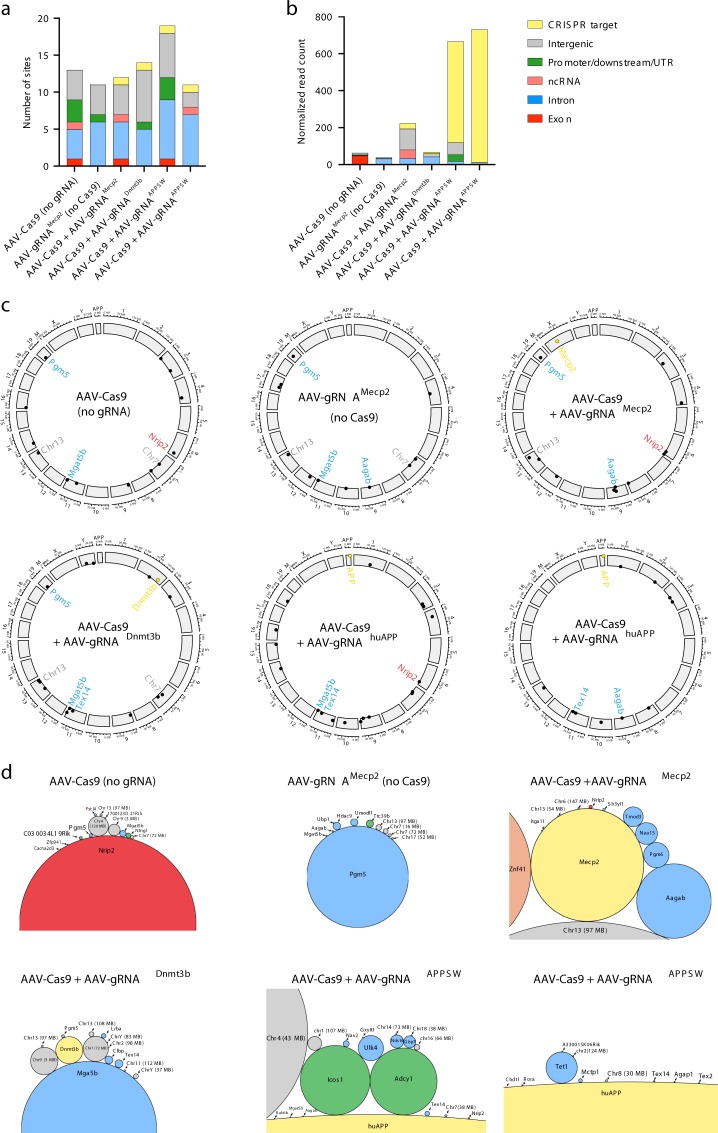
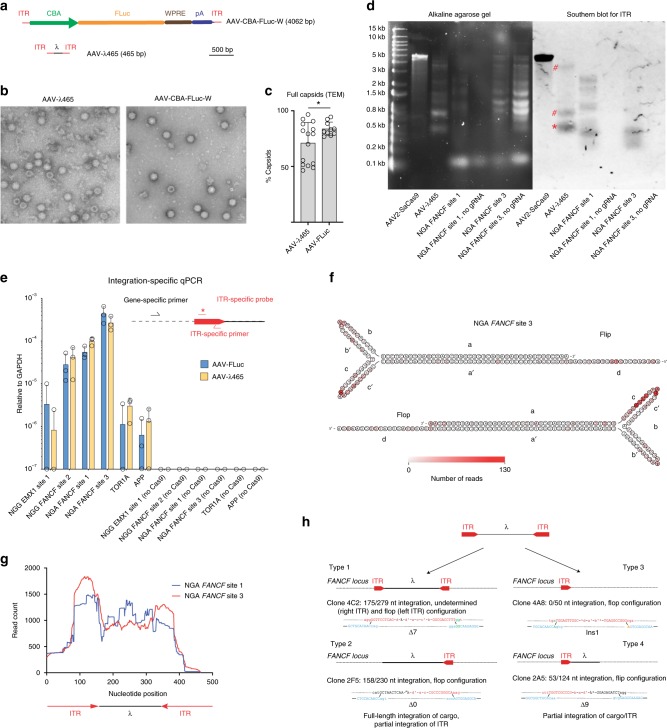
Adeno-associated virus (AAV) vectors have shown promising results in preclinical models, but the genomic consequences of transduction with AAV vectors encoding CRISPR-Cas nucleases is still being examined. In this study, we observe high levels of AAV integration (up to 47%) into Cas9-induced double-strand breaks (DSBs) in therapeutically relevant genes in cultured murine neurons, mouse brain, muscle and cochlea. Genome-wide AAV mapping in mouse brain shows no overall increase of AAV integration except at the CRISPR/Cas9 target site. To allow detailed characterization of integration events we engineer a miniature AAV encoding a 465 bp lambda bacteriophage DNA (AAV-λ465), enabling sequencing of the entire integrated vector genome. The integration profile of AAV-465λ in cultured cells display both full-length and fragmented AAV genomes at Cas9 on-target sites. Our data indicate that AAV integration should be recognized as a common outcome for applications that utilize AAV for genome editing.
Overview
The claims and statistics of this paper haven’t been checked yet.
Free: it reads the open-access text and checks the first 5 claims that cite a source we can check. Create a free account to check every claim.
Integrity signals
Registry
Cites
Statistics
Figures
Verification
Claims the paper makes
The claims and statistics of this paper haven’t been checked yet.
Free: it reads the open-access text and checks the first 5 claims that cite a source we can check. Create a free account to check every claim.
Claims other papers make about this one
Each is checked against this paper’s own text: does it say what the citing paper says it does?
The cited source doesn’t support the claim as written.
In the citing paper
“However, if left active in cells, functional rAAV-CRISPR/Cas9 systems do increase the number of off-target integration events into the genome [218].”
From Recombinant Adeno-Associated Viral Vectors (rAAV)-Vector Elements in Ocular Gene Therapy Clinical Trials and Transgene Expression and Bioactivity Assays (2020) · cites this paper as [218]
Checked by a reasoning model — may be wrong.
Experimental — accuracy not yet measured
Self-check
Percentages, sums and reported differences re-computed from the paper’s own numbers.
The self-check needs the paper’s full text.
Citations
Cites
ANNOVAR: functional annotation of genetic variants from high-throughput sequencing data
Wang, K., Li, M., & Hakonarson, H. (2010) · Nucleic Acids Research · doi:10.1093/nar/gkq603 · Cited by 14,621
Genome engineering using the CRISPR-Cas9 system
Ran, F. A., Hsu, P. D., Wright, J., Agarwala, V., Scott, D. A., & Zhang, F. (2013) · Nature Protocols · doi:10.1038/nprot.2013.143 · Cited by 11,133
High-fidelity CRISPR-Cas9 nucleases with no detectable genome-wide off-target effects
Kleinstiver, B. P., Pattanayak, V., Prew, M. S., Tsai, S. Q., Nguyen, N. T., Zheng, Z., & Joung, J. K. (2016) · Nature · doi:10.1038/nature16526 · Cited by 2,673
Self-citationRationally engineered Cas9 nucleases with improved specificity
Slaymaker, I. M., Gao, L., Zetsche, B., Scott, D. A., Yan, W. X., & Zhang, F. (2016) · Science · doi:10.1126/science.aad5227 · Cited by 2,414
GUIDE-seq enables genome-wide profiling of off-target cleavage by CRISPR-Cas nucleases
Tsai, S. Q., Zheng, Z., Nguyen, N. T., Liebers, M., Topkar, V. V., Thapar, V., Wyvekens, N., Khayter, C., Iafrate, A. J., Le, L. P., et al. (2015) · Nature Biotechnology · doi:10.1038/nbt.3117 · Cited by 2,268
Self-citationDeficiency of methyl-CpG binding protein-2 in CNS neurons results in a Rett-like phenotype in mice
Chen, R. Z., Akbarian, S., Tudor, M., & Jaenisch, R. (2001) · Nature Genetics · doi:10.1038/85906 · Cited by 1,275
Enhanced proofreading governs CRISPR-Cas9 targeting accuracy
Chen, J. S., Dagdas, Y. S., Kleinstiver, B. P., Welch, M. M., Sousa, A. A., Harrington, L. B., Sternberg, S. H., Joung, J. K., Yildiz, A., & Doudna, J. A. (2017) · Nature · doi:10.1038/nature24268 · Cited by 1,168
Self-citationIn vivo genome editing improves muscle function in a mouse model of Duchenne muscular dystrophy
Nelson, C. E., Hakim, C. H., Ousterout, D. G., Thakore, P. I., Moreb, E. A., Rivera, R. M. C., Madhavan, S., Pan, X., Ran, F. A., Yan, W. X., et al. (2016) · Science · doi:10.1126/science.aad5143 · Cited by 1,144
In vivo gene editing in dystrophic mouse muscle and muscle stem cells
Tabebordbar, M., Zhu, K., Cheng, J. K. W., Chew, W. L., Widrick, J. J., Yan, W. X., Maesner, C., Wu, E. Y., Xiao, R., Ran, F. A., et al. (2016) · Science · doi:10.1126/science.aad5177 · Cited by 1,046
Dnmt1 and Dnmt3a maintain DNA methylation and regulate synaptic function in adult forebrain neurons
Feng, J., Zhou, Y., Campbell, S. L., Le, T., Li, E., Sweatt, J. D., Silva, A. J., & Fan, G. (2010) · Nature Neuroscience · doi:10.1038/nn.2514 · Cited by 1,019
Research works printed but not linked: 1
- Miller Daniel G Petek Lisa M Russell David W Adeno-associated virus vectors integrate at chromosome breakage sites Nature Genetics 2004 36 7 767 773 10.1038/ng1380 15208627 · DOI · Paper page
Cited by
Items 301–400 of 445
Harnessing nucleic acid technologies for human health on earth and in space
Sarli, S. L., & Watts, J. K. (2022) · Life Sciences in Space Research · doi:10.1016/j.lssr.2022.08.006 · Cited by 6
“…also been shown to integrate into regulatory elements of liver-specific genes and promote their expression with potential oncogenic consequences (Logan et al. 2017) as well as integrate into sites of induced double-stranded breaks (see gene editing, below) (Hanlon et al. 2019, Nelson et al. 2019).”
CRISPR base editing lowers cholesterol in monkeys
van Kampen, S. J., & van Rooij, E. (2021) · Nature Biotechnology · doi:10.1038/s41587-021-00975-8 · Cited by 6
Long term rescue of Alzheimer’s deficits in vivo by one-time gene-editing of App C-terminusPreprint
Aulston, B. D., Gimse, K., Bazick, H., Kramár, E. A., Pizzo, D. P., Shavarebi, F., Rust, T., Rosa, S. G., Parra‐Rivas, L. A., Sun, J., et al. (2024) · bioRxiv (Cold Spring Harbor Laboratory) · doi:10.1101/2024.06.08.598099 · Cited by 8
“74, 75 Remaining reads were then aligned to an mm10 reference genome (STAR; default parameters) to identify reads containing extra-chromosomal sequence ± 20 bp from the expected Cas9-cleavage site (translocations).”
Efficacious genome editing in infant mice with glycogen storage disease type Ia
Arnson, B., Ilich, E., von Beck, T., Li, S., Brooks, E. D., Gheorghiu, D., He, G., Weinrub, M., Chan, S. Y., Kang, H., et al. (2025) · JCI Insight · doi:10.1172/jci.insight.181760 · Cited by 5
“The Surveyor nuclease assay was used to detect indels introduced at the exon 1/ intron 1 boundary of G6pc by CRISPR/Cas9 and repaired by nonhomologous end-joining (NHEJ).”
InfluentialEnhancement of therapeutic transgene insertion for treatment of murine phenylketonuria
Martinez, M. A., Richards, D. Y., Winn, S. R., Baris, A. M., Vonada, A., Dudley, S., Harper, L., & Harding, C. O. (2025) · Molecular Therapy — Nucleic Acids · doi:10.1016/j.omtn.2025.102813 · Cited by 6
“…insertions, as has been previously shown 17,18 ; and (3) although NHEJ-mediated insertions of fully intact AAV vector genomes into DSBs have been reported, 19 the frequency of these events was insufficient to correct serum Phe concentrations in Dexon1 mice treated with the repair template alone.”
CRISPR–Cas9 Therapeutics in Early Clinical Development: Delivery and Molecular Diagnostics
Rutkowska, A., Strózik, T., Wasiak, T., Ciunowicz, D., Kapelan, N., Szczepaniak, N., Sosnowski, J., Goślińska, W., Bartkowiak, J., Budny-Lewandowska, A., et al. (2026) · Cells · doi:10.3390/cells15070644 · Cited by 5
He, L., Fu, Y., Wang, Z., Zhou, Q., Sun, H., & Wang, H. (2026) · Molecular Therapy · doi:10.1016/j.ymthe.2026.04.032 · Cited by 5
“9,29,30,45 AAV-LIs account for an average of 1.1% of total indels in the single-sgRNA group (Figure 6A).”
InfluentialMechanism of the CRISPR/Cas9 System Specificity in Genome Editing
Kulishova, L. M., Vokhtantsev, I. P., Kim, D. V., & Zharkov, D. O. (2023) · Molecular Biology · doi:10.31857/s0026898423020155 · Cited by 5
ptARgenOM—A Flexible Vector For CRISPR/CAS9 Nonviral Delivery
Radoua, A., Pernon, B., Pernet, N., Jean, C. M., Elmallah, M. I. Y., Guerrache, A., Constantinescu, A. A., Hamou, S. H., Devy, J., & Micheau, O. (2023) · Small Methods · doi:10.1002/smtd.202300069 · Cited by 5
Dou, D., Lu, J., Chen, X., & Zhang, X. (2025) · Pharmaceutical Research · doi:10.1007/s11095-025-03931-2 · Cited by 4
“The liver exhibits a higher AAV integration rate in comparison to the central nervous system; however, AAV integration can take place when active nucleases generate free DNA ends [85].”
Genetic therapies for neurological diseases
Rahim, A. A., Kurian, M. A., Zhou, H., Ferguson, R., Tabrizi, S. J., Lignani, G., Aquilina, K., & Waddington, S. N. (2025) · Pharmacological Reviews · doi:10.1016/j.pharmr.2025.100093 · Cited by 5
“321 ,340 This integration can potentially trigger unpredictable DNA rearrangements with potentially hazardous consequences for clinical translation.”
CRISPR and gene editing technologies for bleeding disorders
VandenDriessche, T., Janssens, M., & Chuah, M. (2025) · Therapeutic Advances in Hematology · doi:10.1177/20406207251387402 · Cited by 4
“69 Thus, vector selection, promoter design, and gRNA specificity must be tailored to minimize systemic exposure and genotoxicity.”
Navigating molecular therapies: The emerging role of mRNA in treating inherited metabolic diseases
Castro-Alpízar, J., Lenderink, M. J., Nieuwenhuis, E. E. S., Kooijmans, S. A. A., & Fuchs, S. A. (2025) · Molecular Genetics and Metabolism · doi:10.1016/j.ymgme.2025.109698 · Cited by 5
RAAVioli: A comprehensive approach to characterizing AAV vector integrations and rearrangements
Cipriani, C., Rudilosso, L., Dalwadi, D. A., Masseroli, M., Grompe, M., Montini, E., Calabria, A., & Cesana, D. (2025) · Molecular Therapy Advances · doi:10.1016/j.omta.2025.201659 · Cited by 5
“12,23,34 These results are in agreement with those obtained from the long-read datasets, 14 where ITRs were the most frequently identified at the junction breakpoints (63%), followed by the transgene coding sequence (15%), WPRE (13%), and promoter sequences (8”
Fabian-Jessing, B. K., Askou, A. L., Jakobsen, T. S., Adsersen, R. L., Lindholm, A. B., Bjerre, A. K. K., Alsing, S., Bek, T., Aagaard, L., & Corydon, T. J. (2026) · Molecular Therapy — Nucleic Acids · doi:10.1016/j.omtn.2026.102833 · Cited by 4
“…VEGF editing has gained interest for the treatment of AMD, 30,32,50,51 concerns about off-target effects, genomic rearrangements, and immunogenicity due to the long-term expression of prokaryotic proteins 52 have prompted the exploration of RNA-based therapies, 53 including CRISPR-Cas13 approaches.”
CRISPR in clinical oncology: translational advances from molecular diagnostics to therapeutics
Grigg, S. E., Shembrey, C., Fareh, M., Blombery, P. A., Corn, J. E., Seymour, J. F., & Casan, J. M. L. (2026) · Nature Reviews Clinical Oncology · doi:10.1038/s41571-026-01179-2 · Cited by 5
“…the vector genomes can integrate at CRISPR-induced DSBs, including at unintended cleavage sites, and vector persistence can prolong Cas expression, increasing cumulative nuclease exposure and therefore the risk of off-target editing, large on-target lesions and chromosomal rearrangements 185 .”
Graves, L. E., Viswanath, L., van Dijk, E. B., Zhu, E., Koyyalamudi, S. R., Wotton, T., Rosser, S. P. A., Srinivasan, S., Ginn, S. L., & Alexander, I. E. (2025) · Molecular Therapy · doi:10.1016/j.ymthe.2025.11.011 · Cited by 4
CRISPR/Cas9 Technology Providing the Therapeutic Landscape of Metastatic Prostate Cancer
Park, J., & Kim, J. (2024) · Pharmaceuticals · doi:10.3390/ph17121589 · Cited by 4
Kayesh, M. E. H., Hashem, M. A., Kohara, M., & Tsukiyama–Kohara, K. (2022) · Frontiers in Microbiology · doi:10.3389/fmicb.2022.953218 · Cited by 4
“However, delivery with dual AAVs requires a high viral dose, which raises potential safety concerns and can reduce the editing potential (Hayashi et al., 2020; Fang et al., 2021).”
BackgroundVergara, X., Schep, R., Medema, R. H., & van Steensel, B. (2022) · DNA repair · doi:10.1016/j.dnarep.2022.103388 · Cited by 4
An Overview of Gene Editing Modalities and Related Non-clinical Testing Considerations
Vats, S., Ballesteros, C., Hung, S., Sparapani, S., Wong, K., Haruna, J., Li, C., & Authier, S. (2023) · International Journal of Toxicology · doi:10.1177/10915818231153996 · Cited by 5
“reported full length and fragmented AAV genome integration (of up to 47%) at CRISPR mediated double strand break sites in the targeted cell cultures of murine neurons, muscle, and cochlea, suggesting that insertion site mutagenesis should be a safety factor to evaluate in AAV based CRISPR-Cas9 therapy.(44) The Central…”
BackgroundBallouhey, O., Bartoli, M., & Lévy, N. (2020) · médecine/sciences · doi:10.1051/medsci/2020081 · Cited by 4
Sckaff, M., Gill, K., Sachdev, A., Birk, A. M., Arogundade, O. A., Watry, H., Keough, K. C., Tsai, Y.-C., Ziegle, J. S., Conklin, B. R., et al. (2022) · bioRxiv (Cold Spring Harbor Laboratory) · doi:10.1101/2022.05.21.492887 · Cited by 5
Jin, X., Wu, X., Song, J., Luo, M., Ye, Q., Ren, C., Li, S., Li, M., Hu, M., An, Y., et al. (2025) · Molecular Therapy · doi:10.1016/j.ymthe.2025.12.012 · Cited by 3
The application of CRISPR-Cas9 system in brain diseases
Miao, Y., Li, C., Su, Y., Peng, T., Wang, J., Liu, S., Ma, C., Li, L., & Wang, Y. (2026) · Nanomedicine · doi:10.1080/17435889.2026.2629031 · Cited by 3
Viral genome editing methods and applications in the CRISPR era
Shin, K., & Kim, E. T. (2026) · Journal of Virology · doi:10.1128/jvi.02048-25 · Cited by 3
“Nevertheless, rAAV is constrained by a packaging limit of ~4.7 kb, carries a low but detectable risk of random integration, and may provoke immune responses to viral proteins (116–119).”
InfluentialmRNA therapy: A novel approach for retinal neurodegenerative diseases
Zhang, B., Tang, J., Zhang, Q., Qiu, Y., Cheng, Y., Yu, S., Liu, L., Xue, J., Liu, X., He, Q., et al. (2026) · Neural Regeneration Research · doi:10.4103/nrr.nrr-d-25-01306 · Cited by 3
Delivery Systems for Therapeutic Genome Editing: Challenges, Innovations, and Future Perspectives
Yang, M., Song, Y., Wang, Z., Chao, K., Li, L., Zhang, X., Duan, X., Yu, C., Xue, R., & Zhao, J. (2026) · MedComm · doi:10.1002/mco2.70791 · Cited by 5
In vivo delivery strategies for therapeutic CRISPR genome editing
Martin, L., Bohinc, J., Recchia, A., Gritti, S., Santilli, G., Zeyland, J., Vidaković, M., Grdović, N., Benabdellah, K., Ortiz-Bueno, M., et al. (2026) · International Journal of Biological Sciences · doi:10.7150/ijbs.133162 · Cited by 3
“Although AAVs have a low tendency for genomic integration when used as a gene augmentation strategy, several groups have showed that significant portion of AAV sequences were integrated into the host genome due to the CRISPR induced DSBs. Hanlon et al. (140) showed that high levels of AAV integration, reaching up to 4…”
Qiu, L., Kumpf, S. W., Oziolor, E. M., Sheehan, M. J., Finley, J. E., Rubitski, D. M., Qian, J., Gosink, M. M., Kopec, A. K., Lanz, T. A., et al. (2025) · Toxicology and Applied Pharmacology · doi:10.1016/j.taap.2025.117229 · Cited by 3
Sentmanat, M. F., Wang, Z. T., Kouranova, E. V., Peters, S., Chan, W. C., Lin, J., Miao, Y., White, J. M., Wallace, M., & Cui, X. (2026) · Nucleic Acids Research · doi:10.1093/nar/gkag237 · Cited by 3
Jia, M. S., Padmaswari, M. H., Burcham, L. A., Agrawal, S., Bulliard, G. N., Stokes, A. L., & Nelson, C. E. (2025) · bioRxiv (Cold Spring Harbor Laboratory) · doi:10.1101/2025.08.01.668007 · Cited by 3
Cell-stereotyped DNA repair outcomes are widespread during genome editingPreprint
Schlapansky, M. F., Schröder, M., Santinha, A. J., Rothgangl, T., Ioannidi, E. I., Cullot, G., Lewków, B., Ortega, G. C., Ahmed, N., Mailänder, D., et al. (2025) · bioRxiv (Cold Spring Harbor Laboratory) · doi:10.1101/2025.10.23.684114 · Cited by 3
Biomineralization of Human Genomic DNA into ZIF-8, a Zeolite-Like Metal-Organic Framework
Shaikhutdinov, I. K., Iliasov, P. V., Limareva, L. V., Sustretov, A. S., Kokorev, D. A., & Sokolov, A. V. (2024) · Современные технологии в медицине · doi:10.17691/stm2024.16.1.01 · Cited by 2
Maniego, J., Swinburne, J. E., Hincks, P. R., Habershon‐Butcher, J., Given, J., & Ryder, E. (2025) · Animal Genetics · doi:10.1111/age.70047 · Cited by 2
Navigating the Hurdles of Intra-Articular AAV Gene Therapy
Li, W., Thornton, O. R., Feng, S. L., & Li, C. (2025) · International Journal of Molecular Sciences · doi:10.3390/ijms262010123 · Cited by 2
“Engineered nucleases such as zinc finger nucleases (ZFNs) and transcription activator-like effector nucleases (TALENs) can induce double-stranded breaks in the cellular genome, which promotes uptake and recombination of AAV-delivered sequences [46].”
CRISPR-based gene therapy for huntington’s disease: current advances and future prospects
Zaheer, A., AboQuella, N. M., Wadan, A. S., Saad, H. A., Kumar, D., Panjwani, S., Rath, S., & Ahmed, S. I. (2025) · Neurogenetics · doi:10.1007/s10048-025-00858-z · Cited by 2
“However, evidence from preclinical studies indicates that immune activation can lead to therapeutic failure or unintended damage to host tissues [76, 85 ].”
Exploration of the potential of genomic editing in the treatment of congenital adrenal hyperplasia
Graves, L. E., Christina, S., Mullany, K., Alexander, I. E., & Falhammar, H. (2025) · Frontiers in Endocrinology · doi:10.3389/fendo.2025.1719376 · Cited by 2
Advances in pharmacological treatment for congenital adrenal hyperplasia
Graves, L. E., & Falhammar, H. (2026) · Current Opinion in Pediatrics · doi:10.1097/mop.0000000000001583 · Cited by 2
Harmonizing standards and resources for the medical genome
Ashley, E. A., Alizadeh, A. A., Armitage, H., Bhatt, A. S., Blumenfeld, Y. J., Carroll, A. W., Chavez, R. M., Giannikopoulos, P., Grove, M. E., Halley, M. C., et al. (2026) · Nature · doi:10.1038/s41586-026-10621-5 · Cited by 2
“Other unwanted editing can occur off target (at sites distinct from the target) for various reasons; for example, in cases in which the guide sequence has complementarity with other loci in the genome, or if a virus is used to deliver reagents and integrates into multiple loci in the genome 67 .”
Ginn, S. L., Doroudian, F., Christina, S., Chan, O. P. Y., Lucas, C. W., Zhu, E., Yang, S. F., Devanapalli, B., Klein, A. H., Scott, S., et al. (2026) · Molecular Therapy · doi:10.1016/j.ymthe.2026.06.044 · Cited by 2
“In addition, based on our results and the observations of others, 49,50 long-term ARCUS nuclease expression would be a likely possibility if the AAV vector containing the editing reagents integrates into the target site or else-where in the genome.”
The future of pediatric gene therapy: CRISPR-Cas9, AI, and personalized medicine
Pan, Y., Ding, J., Wang, W., Xu, D., Fan, J., & Zhang, W. (2026) · Pediatric Research · doi:10.1038/s41390-026-05270-3 · Cited by 2
Transgene Expression in Cultured Cells Using Unpurified Recombinant Adeno-Associated Viral Vectors
Benyamini, B., Esbin, M. N., Whitney, O. N., Walther, N., & Maurer, A. C. (2023) · Journal of Visualized Experiments · doi:10.3791/65572 · Cited by 2
Foss, D. V., & Norris, A. L. (2024) · Elsevier eBooks · doi:10.1016/b978-0-12-817218-6.00011-5 · Cited by 2
Kaufmann, M. M., Hackenberg, M., Pargeter, W. J., Backofen, R., Binder, H., & Cathomen, T. (2026) · Human Gene Therapy · doi:10.1177/10430342261466407 · Cited by 2
Sánchez-Hernández, S., Aguilar-González, A., Guijarro-Albaladejo, B., Maldonado‐Pérez, N., Ramos-Hernández, I., Cortijo-Gutierréz, M., Sanchez-Martin, R. M., Benabdellah, K., & Martín, F. (2020) · Cells · doi:10.3390/cells9061492 · Cited by 2
“In general, the strategies aimed to determine the donor integration sites are based on the combination of PCR and sequencing techniques, being the linear amplification-mediated PCR(LAM-PCR) the most widespread [52,53].”
Lek, A., Ma, K., Woodman, K. G., & Lek, M. (2021) · Human Gene Therapy · doi:10.1089/hum.2020.241 · Cited by 3
“87,88 In this section, we discuss issues of consideration pertaining to CRISPRa in in vivo studies that hinder its capacity for direct human translation.”
Cell-Based Delivery Approaches for DNA-Binding Domains to the Central Nervous System
Deng, P., Halmai, J. A. N. M., Waldo, J. J., & Fink, K. D. (2021) · Current Neuropharmacology · doi:10.2174/1570159x19666210517144044 · Cited by 2
Precision Cas9 Genome Editing in vivo with All-in-one, Self-targeting AAV VectorsPreprint
Ibraheim, R., Tai, P. W. L., Mir, A., Javeed, N., Wang, J., Rodríguez, T., Nelson, S. J., Khokhar, E. S., Mintzer, E., Maitland, S. A., et al. (2020) · bioRxiv (Cold Spring Harbor Laboratory) · doi:10.1101/2020.10.09.333997 · Cited by 3
Editorial: Ex-vivo and in-vivo genome engineering for metabolic and neurometabolic diseases
Colella, P., Meneghini, V., Baldo, G., & Gomez‐Ospina, N. (2023) · Frontiers in Genome Editing · doi:10.3389/fgeed.2023.1248904 · Cited by 2
“Regardless of the approach, offand on-target effects of genome editing need to be carefully evaluated (Hanlon et al., 2019).”
BackgroundAdenoviral delivery of DNA plasmid for RNA silencing: pros and cons
Mokhtari‐Esbuie, F., Gheshlaghi, S., Abraham, J. M., & Harmon, J. W. (2023) · Annals of Translational Medicine · doi:10.21037/atm-23-1646 · Cited by 2
“This raises safety concerns for the DNA approach (11-13).”
BackgroundGene Therapy of Extracellular Vesicles in Cardiovascular and Metabolic Diseases
Kovács, Á. F. (2023) · Advances in experimental medicine and biology · doi:10.1007/978-981-99-1443-2_14 · Cited by 1
Advanced drug delivery systems for enhancing the efficacy of RNA-based therapeutics
Alhabib, N. A., Almaniea, M. A., Alehaidib, S. M., Almansour, M. A., Aldosary, M. S., Almegbel, M. T., Alsubaie, S. A., & Alzahrani, A. M. (2022) · International Journal of Health Sciences · doi:10.53730/ijhs.v6ns10.15029 · Cited by 1
Nair, H. (2024) · Apollo Medicine · doi:10.1177/09760016241290651 · Cited by 2
Decoding retinitis pigmentosa: molecular targets and therapy with focus on pre-mRNA splicing
Banik, P., & Staněk, D. (2025) · Cellular and Molecular Life Sciences · doi:10.1007/s00018-025-05987-0 · Cited by 1
“Therefore, cell transplantation therapy associated with increased AAV genome integration in ani - mal models, raising additional safety concerns [101].”
Shookster, D., Landry, T., Bunner, W., O’Connell, S., Darshan, P., & Hu, H. (2025) · Endocrinology · doi:10.1210/endocr/bqaf182 · Cited by 1
Wu, Z., Liu, H., & Wu, D. (2025) · Medical Oncology · doi:10.1007/s12032-025-03158-6 · Cited by 1
“Current safety optimizations include whole-genome PEM-seq analysis, validating editing specificity and high-fidelity Cas13d (hfCas13d) variants, reducing off-target rates to 0.01% [ 121].”
InfluentialEmerging Gene Therapies for Inherited Arrhythmia Syndromes
Grisorio, L., & Roberts, J. D. (2026) · Canadian Journal of Cardiology · doi:10.1016/j.cjca.2026.01.003 · Cited by 4
Selective deletion of FGFR1 in AgRP neurons impairs energy homeostasis under high-fat diet in mice
Shookster, D., O’Connell, S., Darshan, P., Landry, T., Bunner, W., Jiang, Z., Tong, Q., & Hu, H. (2026) · Molecular Metabolism · doi:10.1016/j.molmet.2026.102332 · Cited by 1
Saylam, E., D'Ambrosio, E. S., Pesco, M. T., & Gushchina, L. V. (2026) · Genes · doi:10.3390/genes17030284 · Cited by 1
“%) into Cas9-induced double-strand breaks (DSBs) are identified [43].”
Leandro, K., Rufino‐Ramos, D., Lopes, S. M., Silva, F. S., Rodrigues‐Santos, P., Silva, A. C., Fernandes, A. R., Henriques, C., Pereira, D., Lobo, D. D., et al. (2026) · Biomaterials · doi:10.1016/j.biomaterials.2026.124119 · Cited by 1
Self-citationLee, S. J., Nam, B.-G., Hong, S.-A., Jo, D. H., Lee, S.-M., Bae, S., & Kim, J. H. (2026) · Gene Therapy · doi:10.1038/s41434-026-00607-3 · Cited by 2
“However, viral vector delivery of CRISPR components raises important safety concerns, including potential immunogenicity, prolonged Cas9 expression, off-target effects, and the risk of unwanted genomic integration [19 – 22].”
In vivo adenine base editing of mutant Galc gene ameliorates Krabbe disease progression
Nam, B.-G., Seo, J., Hong, S.-A., Kim, J., Kang, M., Notario, G. R., Hong, Y., Cho, S., Bae, S., & Cho, S.-R. (2026) · Genome Medicine · doi:10.1186/s13073-026-01620-2 · Cited by 1
“Compared to other viral vectors which have been considered for clinical trials, AAVs have longer periods of expression, which can lead to side effects caused by prolonged Cas9 and nCas9 protein level in target cells [44, 45].”
Bazick, H., James, L. M., & Zylka, M. J. (2026) · Scientific Reports · doi:10.1038/s41598-026-52498-4 · Cited by 1
Kim, J.-H., Cho, H. J., & Lee, H. (2026) · Biochemical and Biophysical Research Communications · doi:10.1016/j.bbrc.2026.154003 · Cited by 1
Naoe, Y., Fujimoto, N., Makita, Y., Li, D., Inukai, N., & Hotta, A. (2026) · Molecular Therapy — Nucleic Acids · doi:10.1016/j.omtn.2026.102958 · Cited by 1
Biomaterial-based ocular drug delivery: strategies, challenges, and future perspectives
Chen, Y., Yang, J., Zhou, K., Chen, Z., & Zhang, J. (2026) · Materials & Design · doi:10.1016/j.matdes.2026.116377 · Cited by 1
Scott, S., Hallwirth, C. V., Sasaki, N., Cunningham, S. C., Zhu, E., Khandekar, N., Kizana, E., Baruteau, J., Gissen, P., Perocheau, D. P. B., et al. (2026) · Molecular Therapy · doi:10.1016/j.ymthe.2026.07.039 · Cited by 1
Dong, S., Gong, F., Thomson, T., Cai, Y., Healy, L., Lu, R. X. Z., Zhou, Z., Xu, Y., Chen, J., Savguira, M., et al. (2026) · Nature Biotechnology · doi:10.1038/s41587-026-03298-8 · Cited by 2
Application of genome editing technology in human gene therapy
Mitani, K. (2020) · Translational and Regulatory Sciences · doi:10.33611/trs.2020-007 · Cited by 2
Vats, N., Girija, S. M., Venugopal, S. K., Taneja, P., & Sarin, S. K. (2020) · F1000Research · doi:10.12688/f1000research.26659.1 · Cited by 1
“Integration of AAV/ Cas9 into Cas9 mediated cut sites is a potentially hazardous consequence of this approach (27, 28).”
BackgroundTherapeutic targeting non-coding RNAs
Ray, R. M., Lazăr, A. D., Balahura, L.-R., Dobranici, A., Costache, M., & Dinescu, S. (2023) · Elsevier eBooks · doi:10.1016/b978-0-323-90406-3.00006-3 · Cited by 2
Reagents and their delivery systems in CRISPR/Cas
Khan, S., Zafar, H., & Ahmad, A. (2024) · Elsevier eBooks · doi:10.1016/b978-0-443-18444-4.00002-8 · Cited by 2
Huntingtin lowering therapeutics
Aronin, N., Sena‐Esteves, M., Khvorova, A., DiFiglia, M., & Brodsky, M. (2024) · Elsevier eBooks · doi:10.1016/b978-0-323-95672-7.00004-2 · Cited by 1
CRISPR Therapies for Alzheimer’s Disease
Sun, J., & Roy, S. (2025) · Springer eBooks · doi:10.1007/978-3-031-89307-0_12 · Cited by 1
Solberg, M. H., Shariatzadeh, M., & Wilson, S. L. (2020) · Engineering Biology · doi:10.1049/enb.2020.0017
“Recently, the development of a prime editing tool including the modification of the genome's specific nucleotides without the introduction of DSBs has offered minimal off-target efficiency in human cells, thus optimising on-target efficacy [64].”
BackgroundMusunuru, K. (2021) · Elsevier eBooks · doi:10.1016/b978-0-12-823484-6.00008-6
Utilizing CRISPR/Cas9 Technologies for in vivo Disease Modeling and Therapy
Badertscher, L., & Porritt, M. J. (2022) · Wiley eBooks · doi:10.1002/9781119671404.ch7
DNA Repair Pathways in the Context of Therapeutic Genome Editing
Wimberger, S., Akrap, N., & Taheri‐Ghahfarokhi, A. (2022) · Wiley eBooks · doi:10.1002/9781119671404.ch13
Breton, C. A., Clark, P., Wang, L., Greig, J. A., & Wilson, J. M. (2020) · BMC Genomics · doi:10.1186/s12864-020-07039-2
Engineering Virus-Like Particles for the Delivery of Genome Editing Enzymes
Rousseau, B. (2022) · Deep Blue (University of Michigan) · doi:10.7302/4609 · Cited by 1
Spinal interneurons and cellular engineering
White, N., & Sakiyama‐Elbert, S. E. (2022) · Elsevier eBooks · doi:10.1016/b978-0-12-819260-3.00004-4
AAV-vectored base editor trans-splicing delivers dystrophin repair
Li, Z., & Gonçalves, M. A. F. V. (2023) · Molecular Therapy — Nucleic Acids · doi:10.1016/j.omtn.2023.05.013
“These experiments demonstrate that AAV/CRISPR-Cas9-based dystrophin restoration can improve striated muscle function in mice; however, a potentially insidious outcome is the identification of prevalent capture of Cas9-encoding AAV at nuclease target sites, including at Dmd exons 51 and 53.(2,3) Moreover, programmable…”
BackgroundBenyamini, B., Esbin, M. N., Whitney, O. N., Walther, N., & Maurer, A. C. (2023) · doi:10.3791/65572-v
Gene therapy: advocacies, perspectives, and ethical provocations
Taliyan, R., Sukhija, R., Kothekar, A., Mishra, A., Nair, P. K. R., & Gurjar, S. (2023) · Elsevier eBooks · doi:10.1016/b978-0-323-91924-1.00013-7 · Cited by 1
Transient CRISPR-Cas delivery for therapeutic gene editing in the retina
Botto, C. (2022) · theses.fr (ABES) · doi:10.70675/b0c6037fz0240z4844z9036z7867f920dadc
Simões, S. M. N., Lino, M. M., Barrera, A., Rebelo, C., Tomatis, F., Vilaça, A., Breunig, C., Neuner, A. M., Peça, J., González, R., et al. (2024) · Angewandte Chemie · doi:10.1002/ange.202401004
Travard, L. (2022) · theses.fr (ABES) · doi:10.70675/2b09a06az97afz4f06z98f0z9965135ad019
Leclerc, D. (2023) · theses.fr (ABES) · doi:10.70675/265eb7f7zf02bz4293z9d8dz266599d45d4a
(2024) · Frontiers research topics · doi:10.3389/978-2-8325-4801-1
Les solutions pour prévenir de la génotoxicité du système CRISPR-Cas9
Prat, F. (2020) · theses.fr (ABES) · doi:10.70675/b43fcab3zc6b2z4ae5zaf1bz218ebd30ffad
Wang, Q., Liu, S.-L., Zhao, W., von Kleeck, R. A., Thomas, M. G., Luther, K. M., Vahramian, Z., Sun, Y., Vyas, K., Moharil, P., et al. (2024) · bioRxiv (Cold Spring Harbor Laboratory) · doi:10.1101/2024.09.24.614725
Preclinical development of viral vector gene therapies
Newman, M. S., Hudry, E., Brassard, J. A., & Cunningham, J. J. (2024) · Elsevier eBooks · doi:10.1016/b978-0-443-13344-2.00003-1
Hidmi, O., Oster, S. K., Shatleh, D., Monin, J., & Aqeilan, R. I. (2025) · Methods in molecular biology · doi:10.1007/978-1-0716-4426-3_7
Adenoviral vectors for gene editing
Rice-Boucher, P. J. (2025) · Elsevier eBooks · doi:10.1016/b978-0-323-89821-8.00025-5
Édition génique par transfert de complexes ribonucléoprotéiques de CRISPR/Cas9 dans la rétine
Malki, H., Pulman, J., & Dalkara, D. (2025) · médecine/sciences · doi:10.1051/medsci/2025091
Στρατηγικές RNA θεραπείας σε μονογονιδιακά νοσήματα
PITTA, P. (2023) · University of Thessaly Institutional Repository (University of Thessaly) · doi:10.26253/heal.uth.39177
Breton, C. A., Clark, P., Wang, L., Greig, J. A., & Wilson, J. M. (2020) · Figshare · doi:10.6084/m9.figshare.11999370
Metadata
- Authors
- Hanlon, K. S., Kleinstiver, B. P., Garcia, S. P., Zaborowski, M. P., Volak, A., Spirig, S. E., Muller, A., Sousa, A. A., Tsai, S. Q., Bengtsson, N. E., Lööv, C., Ingelsson, M., Chamberlain, J. S., Corey, D. P., Aryee, M. J., Joung, J. K., Breakefield, X. O., Maguire, C. A., & György, B.
- Affiliations
- Harvard University (US)
- Poznan University of Medical Sciences (PL)
- Massachusetts General Hospital (US)
- Institute of Molecular and Clinical Ophthalmology Basel (CH)
- St. Jude Children's Research Hospital (US)
- University of Washington (US)
- Uppsala University (SE)
- Corresponding author
- Maguire, Casey A.
- György, Bence
- ORCID
- Venue
- Nature Communications
- Published
- 2019-09-30
- Volume
- 10
- Issue
- 1
- Pages
- 4439-4439
- ISSN
- 2041-1723 (ISSN-L)
- PMC
- PMC6769011
- OpenAlex
- W2976425815
- Cited by
- 431
- References
- 41
- Citations by year
- 2026: 57 · 2025: 67 · 2024: 75 · 2023: 64 · 2022: 57 · 2021: 59 · 2020: 47 · 2019: 4
- FWCI
- 25.16
- Type
- journal article
- Language
- en
- Open access
- gold
- doi.org
- Licence
- cc-by
- creativecommons.org/licenses/by/4.0 (tdm)
- creativecommons.org/licenses/by/4.0 (vor)
- Locations
- Nature Communications (publishedVersion, cc-by)
- PubMed Central (publishedVersion, cc-by)
- PubMed (publishedVersion)
- Uppsala University Publications (Uppsala University) (submittedVersion, other-oa)
- RePEc: Research Papers in Economics (submittedVersion)
- DOAJ (DOAJ: Directory of Open Access Journals) (submittedVersion)
- DOAJ (DOAJ: Directory of Open Access Journals) (submittedVersion, cc-by-sa)
- Funders
- U.S. Department of Health & Human Services | NIH | Center for Information Technology (R01DC017117)
- Topics
- Life Sciences › Biochemistry, Genetics and Molecular Biology › Genetics › Virus-based gene therapy research
- Life Sciences › Biochemistry, Genetics and Molecular Biology › Molecular Biology › CRISPR and Genetic Engineering
- Life Sciences › Biochemistry, Genetics and Molecular Biology › Molecular Biology › RNA Interference and Gene Delivery
- Keywords
- adeno-associated virus vectors, AAV integration, CRISPR/Cas9, DNA double-strand breaks, genome editing, mouse brain, muscle, cochlea
- MeSH terms
- Gene Editing, Dependovirus, Animals, Brain, Cell Line, Chromosome Mapping, Cochlea, Endonucleases, Genetic Vectors, Humans, Male, Mice, Inbred C57BL, Mice, Transgenic, Muscles, Neurons, Bacteriophage lambda, Genetic Therapy, Virus Integration, Genome, Treatment Outcome, Gene Targeting, Mice, Targeted Gene Repair, DNA Breaks, Clustered Regularly Interspaced Short Palindromic Repeats, CRISPR-Cas Systems
About these checks
Registry, retraction, Cites and statistics results are computed, not judged, with one exception: a printed reference that no index lists is read once by a model before it counts as a citation error. Claims are extracted by a model and kept only when their quote appears verbatim in the text; each cited source is then checked, with a model’s help, for whether it says what the claim relies on. Those verdicts can be wrong — read the claim’s quote and the cited source before relying on one.
Statistics and arithmetic are recomputed, not judged.
Confidence bands are shown only for fields calibrated on our annotated test set. None is calibrated yet, so no band is shown.
What counts as a claim ›How we measure confidence ›How we check this ›
Are you an author, or do you see a problem with this page? Request a review
Data sources
Bibliographic data: Semantic Scholar, OpenAlex, Crossref.
Contains information from the Semantic Scholar Academic Graph Datasets, made available under the ODC Attribution License (ODC-BY 1.0).
Semantic Scholar’s data is described in: Kinney, R., et al. (2023). The Semantic Scholar Open Data Platform. arXiv:2301.10140.
