

High levels of AAV vector integration into CRISPR-induced DNA breaks
Open accessThe DOI matches its Crossref record; 41 of the 41 references it cites were found in a registry or an index.
Abstract
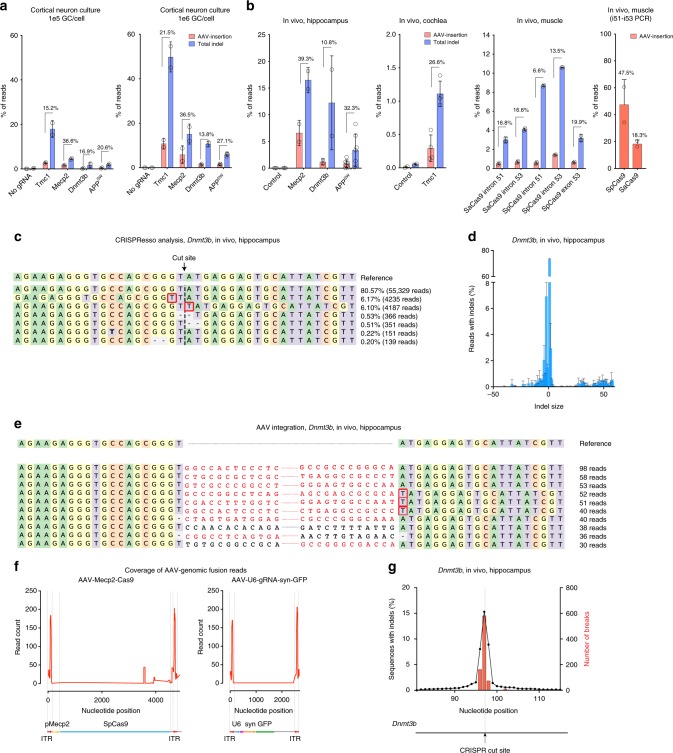
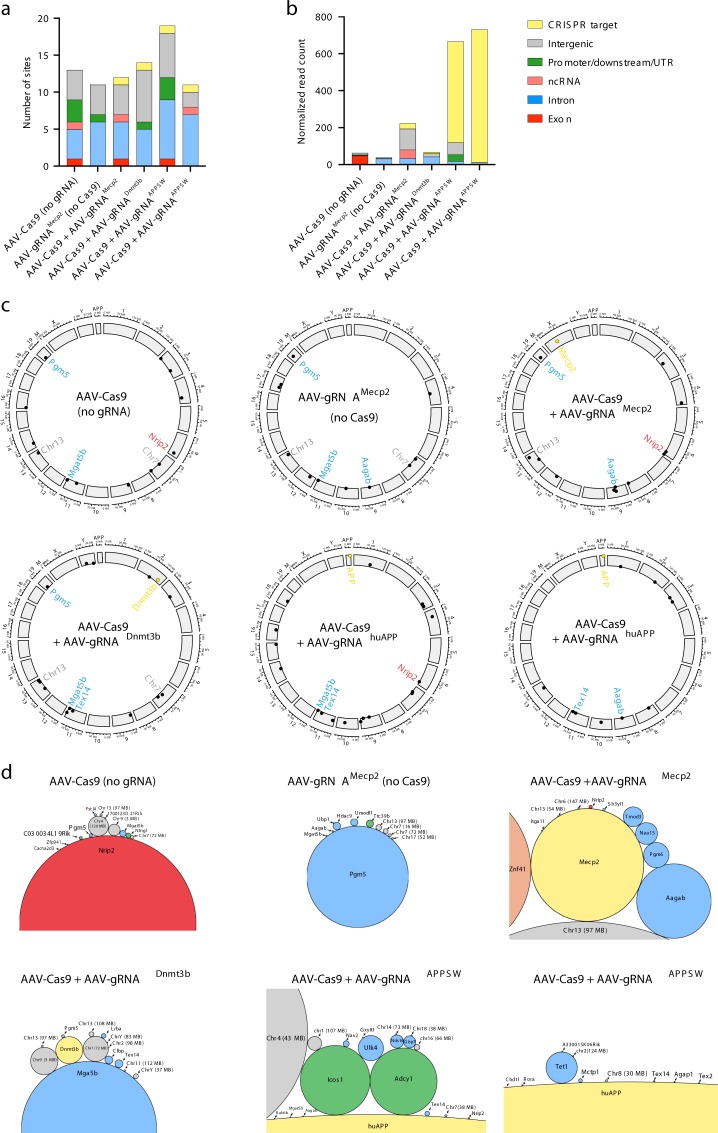
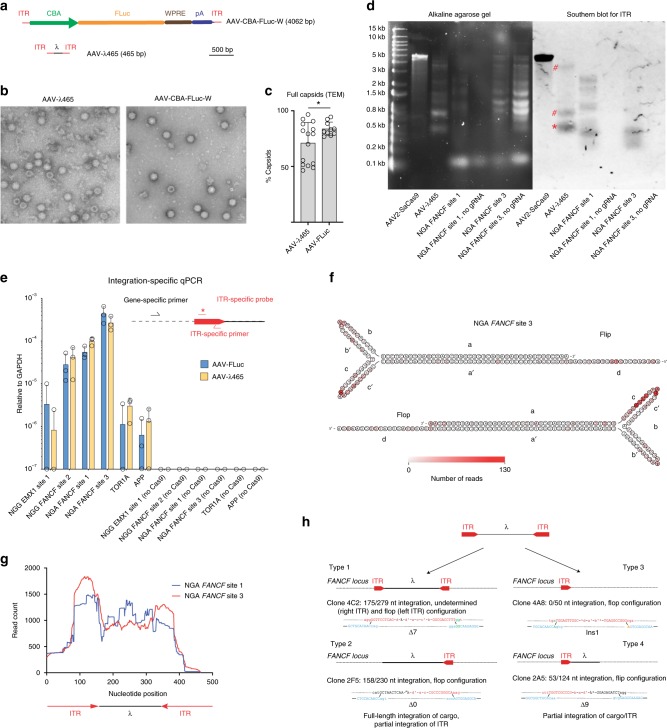
Adeno-associated virus (AAV) vectors have shown promising results in preclinical models, but the genomic consequences of transduction with AAV vectors encoding CRISPR-Cas nucleases is still being examined. In this study, we observe high levels of AAV integration (up to 47%) into Cas9-induced double-strand breaks (DSBs) in therapeutically relevant genes in cultured murine neurons, mouse brain, muscle and cochlea. Genome-wide AAV mapping in mouse brain shows no overall increase of AAV integration except at the CRISPR/Cas9 target site. To allow detailed characterization of integration events we engineer a miniature AAV encoding a 465 bp lambda bacteriophage DNA (AAV-λ465), enabling sequencing of the entire integrated vector genome. The integration profile of AAV-465λ in cultured cells display both full-length and fragmented AAV genomes at Cas9 on-target sites. Our data indicate that AAV integration should be recognized as a common outcome for applications that utilize AAV for genome editing.
Overview
The claims and statistics of this paper haven’t been checked yet.
Free: it reads the open-access text and checks the first 5 claims that cite a source we can check. Create a free account to check every claim.
Integrity signals
Registry
Cites
Statistics
Figures
Verification
Claims the paper makes
The claims and statistics of this paper haven’t been checked yet.
Free: it reads the open-access text and checks the first 5 claims that cite a source we can check. Create a free account to check every claim.
Claims other papers make about this one
Each is checked against this paper’s own text: does it say what the citing paper says it does?
The cited source doesn’t support the claim as written.
In the citing paper
“However, if left active in cells, functional rAAV-CRISPR/Cas9 systems do increase the number of off-target integration events into the genome [218].”
From Recombinant Adeno-Associated Viral Vectors (rAAV)-Vector Elements in Ocular Gene Therapy Clinical Trials and Transgene Expression and Bioactivity Assays (2020) · cites this paper as [218]
Checked by a reasoning model — may be wrong.
Experimental — accuracy not yet measured
Self-check
Percentages, sums and reported differences re-computed from the paper’s own numbers.
The self-check needs the paper’s full text.
Citations
Cites
ANNOVAR: functional annotation of genetic variants from high-throughput sequencing data
Wang, K., Li, M., & Hakonarson, H. (2010) · Nucleic Acids Research · doi:10.1093/nar/gkq603 · Cited by 14,621
Genome engineering using the CRISPR-Cas9 system
Ran, F. A., Hsu, P. D., Wright, J., Agarwala, V., Scott, D. A., & Zhang, F. (2013) · Nature Protocols · doi:10.1038/nprot.2013.143 · Cited by 11,133
High-fidelity CRISPR-Cas9 nucleases with no detectable genome-wide off-target effects
Kleinstiver, B. P., Pattanayak, V., Prew, M. S., Tsai, S. Q., Nguyen, N. T., Zheng, Z., & Joung, J. K. (2016) · Nature · doi:10.1038/nature16526 · Cited by 2,673
Self-citationRationally engineered Cas9 nucleases with improved specificity
Slaymaker, I. M., Gao, L., Zetsche, B., Scott, D. A., Yan, W. X., & Zhang, F. (2016) · Science · doi:10.1126/science.aad5227 · Cited by 2,414
GUIDE-seq enables genome-wide profiling of off-target cleavage by CRISPR-Cas nucleases
Tsai, S. Q., Zheng, Z., Nguyen, N. T., Liebers, M., Topkar, V. V., Thapar, V., Wyvekens, N., Khayter, C., Iafrate, A. J., Le, L. P., et al. (2015) · Nature Biotechnology · doi:10.1038/nbt.3117 · Cited by 2,268
Self-citationDeficiency of methyl-CpG binding protein-2 in CNS neurons results in a Rett-like phenotype in mice
Chen, R. Z., Akbarian, S., Tudor, M., & Jaenisch, R. (2001) · Nature Genetics · doi:10.1038/85906 · Cited by 1,275
Enhanced proofreading governs CRISPR-Cas9 targeting accuracy
Chen, J. S., Dagdas, Y. S., Kleinstiver, B. P., Welch, M. M., Sousa, A. A., Harrington, L. B., Sternberg, S. H., Joung, J. K., Yildiz, A., & Doudna, J. A. (2017) · Nature · doi:10.1038/nature24268 · Cited by 1,168
Self-citationIn vivo genome editing improves muscle function in a mouse model of Duchenne muscular dystrophy
Nelson, C. E., Hakim, C. H., Ousterout, D. G., Thakore, P. I., Moreb, E. A., Rivera, R. M. C., Madhavan, S., Pan, X., Ran, F. A., Yan, W. X., et al. (2016) · Science · doi:10.1126/science.aad5143 · Cited by 1,144
In vivo gene editing in dystrophic mouse muscle and muscle stem cells
Tabebordbar, M., Zhu, K., Cheng, J. K. W., Chew, W. L., Widrick, J. J., Yan, W. X., Maesner, C., Wu, E. Y., Xiao, R., Ran, F. A., et al. (2016) · Science · doi:10.1126/science.aad5177 · Cited by 1,046
Dnmt1 and Dnmt3a maintain DNA methylation and regulate synaptic function in adult forebrain neurons
Feng, J., Zhou, Y., Campbell, S. L., Le, T., Li, E., Sweatt, J. D., Silva, A. J., & Fan, G. (2010) · Nature Neuroscience · doi:10.1038/nn.2514 · Cited by 1,019
Research works printed but not linked: 1
- Miller Daniel G Petek Lisa M Russell David W Adeno-associated virus vectors integrate at chromosome breakage sites Nature Genetics 2004 36 7 767 773 10.1038/ng1380 15208627 · DOI · Paper page
Cited by
Items 401–445 of 445
Breton, C. A., Clark, P. M., Wang, L., Greig, J. A., & Wilson, J. M. (2020) · Figshare · doi:10.6084/m9.figshare.11999367
Breton, C. A., Clark, P., Wang, L., Greig, J. A., & Wilson, J. M. (2020) · Figshare · doi:10.6084/m9.figshare.11999373
Duddy, G., Courtis, K., Horwood, J., Olsen, J., Horsler, H., Hodgson, T., Varsani-Brown, S., Abdullah, A., Denti, L., Lane, H., et al. (2024) · Figshare · doi:10.6084/m9.figshare.25132090
Haplotyp-spezifische Deletionen am Genort des Morbus Best mittels CRISPR/Cas9 Genom-Editierung
Römer, I. (2023) · University of Regensburg Publication Server (University of Regensburg) · doi:10.5283/epub.54182
Hermantara, R., Richmond, L., Taqi, A. F., Chilaka, S., Jeantet, V., Guerrini, I., West, K. L., & West, A. G. (2024) · Figshare · doi:10.6084/m9.figshare.26698220
Happel, L. (2024) · University of Regensburg Publication Server (University of Regensburg) · doi:10.5283/epub.59437
Liver-directed gene editing with crispr-cas9
Singh, K. (2023) · VUBIR (Vrije Universiteit Brussel)
Targeted gene removal by SpCas9 transduced by a protein-RNA complex transduction system NanoMEDIC
Yagi, M., Tomita, C., Hama, M., Krol, R., Gee, P., Hotta, A., & Komano, J. A. (2025) · OpenNano · doi:10.1016/j.onano.2025.100257
Fabry Disease: from iPSCs to Genome Editing
Duarte, A. J. B. (2025) · Portuguese National Funding Agency for Science, Research and Technology (RCAAP Project by FCT)
Long-Term Expression and Safety of AAV1-Mediated PI3Kδ Overexpression in the Adult Rat CortexPreprint
Knight, L. W., Zuzana, P., Mareková, D., Urdzíková, L. M., Jirák, D., Ziółkowska, N., Makovicky, P., de Winter, F., Kwok, J. C. F., Jendelová, P., et al. (2026) · bioRxiv (Cold Spring Harbor Laboratory) · doi:10.64898/2026.01.22.700520
“To date, there is no evidence of tumour formation in the CNS due to AAV1-hSYN mediated gene delivery (Hanlon et al , 2019).”
Radoua, A., Alrustom, B., Wang, J., Bordessoules, M., Chluba, J., Plenchette, S., & Micheau, O. (2026) · Methods in cell biology · doi:10.1016/bs.mcb.2026.02.005
Gene Editing and the Future of Thoroughbred Breeding and Racing
Ryder, E., Given, J., & Hamilton, N. A. (2026) · Drug Testing and Analysis · doi:10.1002/dta.70056
Luo, J., Zhao, F., Lin, S., & Liu, Y. (2026) · Medical Review · doi:10.1515/mr-2025-0082
“In vivo editing increases the potential for unintended modi-fi cations in o ff -target tissues or cell populations [263, 286, 287], necessitating sensitive HTS-based assays to evaluate genome-wide editing outcomes across diverse biological compartments, which is an ongoing technical challenge.”
Li, Z., Wang, X., Liu, J., Janssen, J. M., Hoeben, R. C., & Gonçalves, M. A. F. V. (2026) · Trends in biotechnology · doi:10.1016/j.tibtech.2026.01.006
Génotoxicité des systèmes CRISPR-Cas9.
Cullot, G. (2019) · theses.fr (ABES) · doi:10.70675/cb1809e4zaafbz4fc1z89e9zeb0e5fd69275
A new DMD rat model : from characterization to therapy
Daoud, C. (2022) · theses.fr (ABES) · doi:10.70675/c15a9cf0zea1cz4e15z8a16zfac7e90d08c9
Gonzalez, V. G. (2023) · theses.fr (ABES) · doi:10.70675/f8c09968z97c4z4635za591z74bf90b6fe70 · Cited by 2
Ex vivo gene therapy for β-hemoglobinpathies and metabolic disorders
Laurent, M. (2023) · theses.fr (ABES) · doi:10.70675/ba5c585dzaa79z48d2z9f40zfee1cdd49d32
CRISPR-Cas9-based strategies for enhanced targeted integration
Lacombe, L. (2024) · theses.fr (ABES) · doi:10.70675/9c9d279dz512az4b72z8322zea205cef9b67 · Cited by 1
Synthetic Biology for Diagnosis and Therapy of Genetic Disorders
Zala, D., Banerjee, S., Mehta, A., & Tiwari, A. K. (2026) · Springer eBooks · doi:10.1007/978-981-95-3957-4_43
intmap: fast and flexible mapping of mobile DNA integration for basic and translational research
Bedwell, G. J., Cherepanov, P., & Engelman, A. (2026) · Bioinformatics · doi:10.1093/bioinformatics/btag310
“Certain DNA viruses, such as adenoassociated virus (AAV), can additionally leverage double strand DNA breaks for integration (Miller et al. 2005, Hanlon et al. 2019, Breton et al. 2020, Nguyen et al. 2021, Van Gorder et al. 2023).”
Liu, B., Klatt, D., Harris, C. E., McGuinness, M. K., Brendel, C., & Williams, D. A. (2026) · Nucleic Acids Research · doi:10.1093/nar/gkag500
“Adeno-associated virus-based vectors enable efficient delivery to non-dividing cells and are typically regarded as non-integrating; however, rare but detectable integration events have been reported, particularly in the context of genome editing [ 28–31 ].”
AviTag-seq unifies nucleotide-resolution maps of CRISPR off-targets and AAV vector integrations
Li, J.-X., Zhang, S.-M., Ma, X.-Y., Deng, D.-H., Bai, P.-D., Zhao, J.-J., Gong, A., Shan-Chen, P. A. N. G., Dong, F., Wang, S.-D., et al. (2026) · Communications Biology · doi:10.1038/s42003-026-10298-6
“We postulate that the fl exible, single-stranded, hairpin-structured nature of the AAV ITR allows it to invade or stabilize at single-strand nicks through mechanisms distinct from canonical NHEJ, likely involving local DNA breathing or microhomology-mediated capture 33 – 35 .”
Advances in Gene Therapy for Chronic Granulomatous Disease
Siow, K. M., Tsapogas, P., Pastukhov, O., & Reichenbach, J. (2026) · Springer eBooks · doi:10.1007/978-3-032-21135-4_19
The Journey of Gene Therapy in Sickle Cell Disease: How Molecular Advances Meet Clinical Care
Tardif, M., Saby, M., Forté, S., & Pincez, T. (2026) · Cells · doi:10.3390/cells15100939
Gene editing of hematopoietic stem cells: applications and advances
Li, Q., Wang, H., He, Y., Hong, G., & Bao, G. (2026) · International Journal of Hematology · doi:10.1007/s12185-026-04251-w
“Using Adeno-Associated Virus serotype 6 (AAV6) to deliver HDR templates is a common gene editing approach; however, this method has certain disadvantages: AAV6 still has a certain probability of integration and has cytotoxic effects [44].”
Molecular Engineering of CRISPR Nanomaterials toward Cancer Theranostics
Li, G., Wang, S., & Zhang, J. (2026) · ACS Nano Medicine · doi:10.1021/acsnanomed.6c00121
Galbiati, P., Leclerc, D., Mombled, M., Khan, R., Ralu, M., Bimbi, G., Scalisi, G., Mamchaoui, K., Tedesco, F. S., Albini, S., et al. (2026) · bioRxiv (Cold Spring Harbor Laboratory) · doi:10.64898/2026.07.29.741396
abdelnaby, M., Galiakberova, A. A., & Dashinimaev, E. B. (2026) · International Journal of Molecular Sciences · doi:10.3390/ijms27156846
“When AAV is combined with CRISPR-based genome editing, the risk of vector integration is further elevated at sites of CRISPR-induced double-strand breaks, compounding the genotoxic liability of the combined approach [107,108].”
Coratella, E., Lemmens, M., Oertli, M., Gilbart, Y., Davidsen, K., Bontadelli, L., Bohnert, R., Rigal, J., Bian, J., Alpert, T., et al. (2026) · Molecular Therapy — Nucleic Acids · doi:10.1016/j.omtn.2026.103050
Efficient genome editing in the non-human primate brain using programmable extracellular vesiclesPreprint
Liang, X., Zhou, H., Nizamudeen, Z. A., Kyriakopoulou, E., Evans, A. E., Roudi, S., Estupiñan, H. Y., Rädler, J., Hou, V., Daniel, C. D. W., et al. (2026) · bioRxiv (Cold Spring Harbor Laboratory) · doi:10.64898/2026.08.05.741964
In vivo CAR T-cell generation: delivery platforms, clinical progress, and translational barriers
Huo, T., Yao, H., & Kong, Z. (2026) · Frontiers in Immunology · doi:10.3389/fimmu.2026.1927594 · Cited by 1
“Nevertheless, because HDR depends on cell cycle and DNA repair status, its in vivo editing ef fi ciency remains limited, and low-frequency non-homologous integration events may still occur in theory (112, 118).”
Advancements in CRISPR-based in vivo gene therapy for hemophilia
Zhang, X., Xu, K., Zou, S., Zhu, Z., Teng, S., & Huang, P. (2026) · Frontiers in Genome Editing · doi:10.3389/fgeed.2026.1924733
“…vector elements (promoters, polyA signals, and Cas9 coding sequences) persistently disrupt endogenous gene function and pose oncogenic risks; (3) integration occurs exclusively at on-target breaks without elevating genome-wide background insertion (Hanlon et al., 2019; Bazick et al., 2024).”
Chemically modified CRISPR enzymes for multi-organ genome editing in vivoPreprint
Baehr, C. M., Ressnerova, A., Kang, M. H., Zhao, S., Le, B., Haddad, R. F., Asija, K., Damante, M. A., Sharma, R. K., George, C. A., et al. (2026) · bioRxiv (Cold Spring Harbor Laboratory) · doi:10.64898/2026.09.14.751351
Hillen, A. E. J., Capuano, I., Gega, B., Norata, R., Mombled, M., Laface, I., Zambonini, G., Lomagno, A., Rouillon, M., Giannelli, S. G., et al. (2026) · Molecular Therapy · doi:10.1016/j.ymthe.2026.09.019 · Cited by 1
Choi, J. K. M., & Hotta, A. (2026) · Regenerative Therapy · doi:10.1016/j.reth.2026.101172
“When Cas9 or similar enzymes are combined with an AAV vector, the unintended integration of AAV vector fragments at the Cas9-targeting site can occur at a relatively high frequency[52 – 54].”
Vacca, R., della Volpe, L., Gualandi, N., Shiroshita, K., Carsana, E., Giannetti, K., Gaddoni, C., Benedicenti, F., Gega, B., Arévalo, S., et al. (2026) · Molecular Therapy · doi:10.1016/j.ymthe.2026.09.024 · Cited by 1
Protocol for quantification of AAV-CRISPR-mediated hepatic gene editing in mice
Jarrett, K. E., Baltazar-Nunez, R., Borja, C. A., Calderon, P. J., Lai, R. W., Cheng, A., Paudel, M., Rubert, G. E., Suberski, A., Traina, O. K., et al. (2026) · STAR Protocols · doi:10.1016/j.xpro.2026.104849
Midena, F. (n.d.) · Archivio Istituzionale della Ricerca - Università Vita-Salute San Raffaele
Nano Delivery Systems for In Vivo CRISPR/Cas-Based Gene Therapy: From Vectors to Clinical Outcomes
Chen, R., Zhou, H., Wu, Q., & Gong, C. (2026) · ACS Nano · doi:10.1021/acsnano.6c12154 · Cited by 1
Abbas, B., Abbas, A., Khan, I., & Nazeer, S. (2026) · Clinical Immunology · doi:10.1016/j.clim.2026.110782
From delivery to integration: CRISPR ‐mediated large insert gene editing in primary human T cells
Buttle, B., Verdon, D. J., & Sheppard, H. M. (2026) · Clinical & Translational Immunology · doi:10.1002/cti2.70124
“96,97 Such non-homologous integration may not be an issue for expression of the inserted gene in cases where the rAAV template contains both the gene and promoter sequence.”
CNS targeted AAV gene therapies: Recent advances and clinical insights
Brown, B. P., Lewis, R. W., Jr., & Davidson, B. L. (2026) · Cell Reports Medicine · doi:10.1016/j.xcrm.2026.103118 · Cited by 1
Suryadevara, L., Srinivas, V., Barathidasan, R., Mhaske, S. T., Naik, R. R., Gupta, M. K., & Pramod, R. K. (2026) · Molecular Biology Reports · doi:10.1007/s11033-026-13053-6
“Vector-based delivery can result in AAV vector integration at CRISPR-induced double-stranded DNA breaks [ 8].”
Metadata
- Authors
- Hanlon, K. S., Kleinstiver, B. P., Garcia, S. P., Zaborowski, M. P., Volak, A., Spirig, S. E., Muller, A., Sousa, A. A., Tsai, S. Q., Bengtsson, N. E., Lööv, C., Ingelsson, M., Chamberlain, J. S., Corey, D. P., Aryee, M. J., Joung, J. K., Breakefield, X. O., Maguire, C. A., & György, B.
- Affiliations
- Harvard University (US)
- Poznan University of Medical Sciences (PL)
- Massachusetts General Hospital (US)
- Institute of Molecular and Clinical Ophthalmology Basel (CH)
- St. Jude Children's Research Hospital (US)
- University of Washington (US)
- Uppsala University (SE)
- Corresponding author
- Maguire, Casey A.
- György, Bence
- ORCID
- Venue
- Nature Communications
- Published
- 2019-09-30
- Volume
- 10
- Issue
- 1
- Pages
- 4439-4439
- ISSN
- 2041-1723 (ISSN-L)
- PMC
- PMC6769011
- OpenAlex
- W2976425815
- Cited by
- 431
- References
- 41
- Citations by year
- 2026: 57 · 2025: 67 · 2024: 75 · 2023: 64 · 2022: 57 · 2021: 59 · 2020: 47 · 2019: 4
- FWCI
- 25.16
- Type
- journal article
- Language
- en
- Open access
- gold
- doi.org
- Licence
- cc-by
- creativecommons.org/licenses/by/4.0 (tdm)
- creativecommons.org/licenses/by/4.0 (vor)
- Locations
- Nature Communications (publishedVersion, cc-by)
- PubMed Central (publishedVersion, cc-by)
- PubMed (publishedVersion)
- Uppsala University Publications (Uppsala University) (submittedVersion, other-oa)
- RePEc: Research Papers in Economics (submittedVersion)
- DOAJ (DOAJ: Directory of Open Access Journals) (submittedVersion)
- DOAJ (DOAJ: Directory of Open Access Journals) (submittedVersion, cc-by-sa)
- Funders
- U.S. Department of Health & Human Services | NIH | Center for Information Technology (R01DC017117)
- Topics
- Life Sciences › Biochemistry, Genetics and Molecular Biology › Genetics › Virus-based gene therapy research
- Life Sciences › Biochemistry, Genetics and Molecular Biology › Molecular Biology › CRISPR and Genetic Engineering
- Life Sciences › Biochemistry, Genetics and Molecular Biology › Molecular Biology › RNA Interference and Gene Delivery
- Keywords
- adeno-associated virus vectors, AAV integration, CRISPR/Cas9, DNA double-strand breaks, genome editing, mouse brain, muscle, cochlea
- MeSH terms
- Gene Editing, Dependovirus, Animals, Brain, Cell Line, Chromosome Mapping, Cochlea, Endonucleases, Genetic Vectors, Humans, Male, Mice, Inbred C57BL, Mice, Transgenic, Muscles, Neurons, Bacteriophage lambda, Genetic Therapy, Virus Integration, Genome, Treatment Outcome, Gene Targeting, Mice, Targeted Gene Repair, DNA Breaks, Clustered Regularly Interspaced Short Palindromic Repeats, CRISPR-Cas Systems
About these checks
Registry, retraction, Cites and statistics results are computed, not judged, with one exception: a printed reference that no index lists is read once by a model before it counts as a citation error. Claims are extracted by a model and kept only when their quote appears verbatim in the text; each cited source is then checked, with a model’s help, for whether it says what the claim relies on. Those verdicts can be wrong — read the claim’s quote and the cited source before relying on one.
Statistics and arithmetic are recomputed, not judged.
Confidence bands are shown only for fields calibrated on our annotated test set. None is calibrated yet, so no band is shown.
What counts as a claim ›How we measure confidence ›How we check this ›
Are you an author, or do you see a problem with this page? Request a review
Data sources
Bibliographic data: Semantic Scholar, OpenAlex, Crossref.
Contains information from the Semantic Scholar Academic Graph Datasets, made available under the ODC Attribution License (ODC-BY 1.0).
Semantic Scholar’s data is described in: Kinney, R., et al. (2023). The Semantic Scholar Open Data Platform. arXiv:2301.10140.
