

Professional actors demonstrate variability, not stereotypical expressions, when portraying emotional states in photographs
Open accessThe DOI matches its Crossref record; 93 of the 93 references it cites were found in a registry or an index.
Abstract
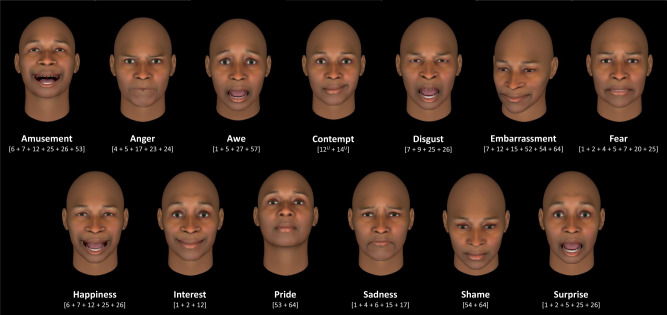
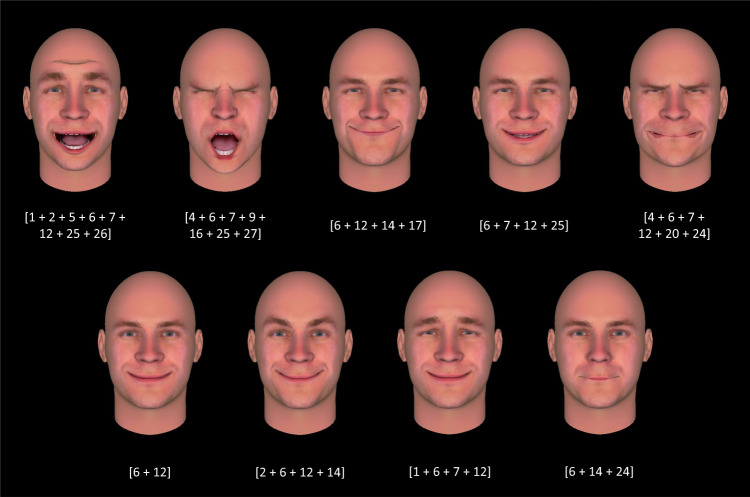
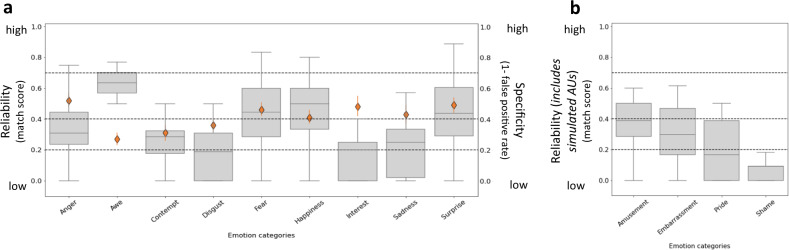
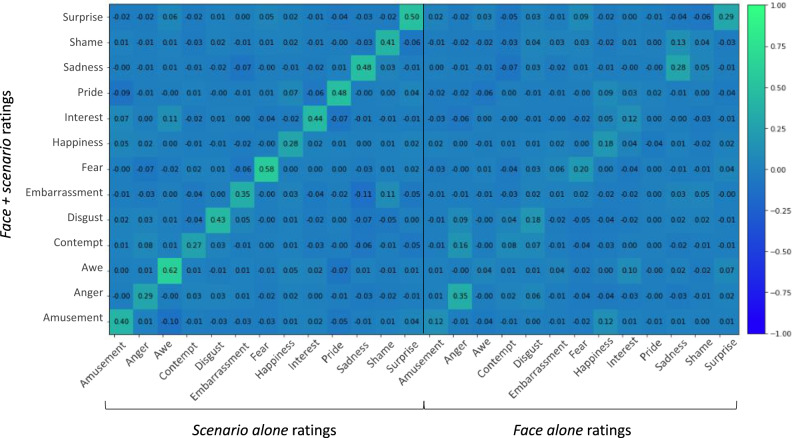
It is long hypothesized that there is a reliable, specific mapping between certain emotional states and the facial movements that express those states. This hypothesis is often tested by asking untrained participants to pose the facial movements they believe they use to express emotions during generic scenarios. Here, we test this hypothesis using, as stimuli, photographs of facial configurations posed by professional actors in response to contextually-rich scenarios. The scenarios portrayed in the photographs were rated by a convenience sample of participants for the extent to which they evoked an instance of 13 emotion categories, and actors’ facial poses were coded for their specific movements. Both unsupervised and supervised machine learning find that in these photographs, the actors portrayed emotional states with variable facial configurations; instances of only three emotion categories (fear, happiness, and surprise) were portrayed with moderate reliability and specificity. The photographs were separately rated by another sample of participants for the extent to which they portrayed an instance of the 13 emotion categories; they were rated when presented alone and when presented with their associated scenarios, revealing that emotion inferences by participants also vary in a context-sensitive manner. Together, these findings suggest that facial movements and perceptions of emotion vary by situation and transcend stereotypes of emotional expressions. Future research may build on these findings by incorporating dynamic stimuli rather than photographs and studying a broader range of cultural contexts.
Overview
The claims and statistics of this paper haven’t been checked yet.
Free: it reads the open-access text and checks the first 5 claims that cite a source we can check. Create a free account to check every claim.
Integrity signals
Registry
Cites
Statistics
Figures
Verification
Claims the paper makes
The claims and statistics of this paper haven’t been checked yet.
Free: it reads the open-access text and checks the first 5 claims that cite a source we can check. Create a free account to check every claim.
Claims other papers make about this one
Each is checked against this paper’s own text: does it say what the citing paper says it does?
The source backs part of the claim, not all of it — or backs it for a different population, condition or comparison.
In the citing paper
“The notion that discrete emotion categories can be reliably identified by specific behavioural patterns and/or physiological features has been seriously called into doubt by the marked variability within instances of the same category as well as similarities across categories.”
From A new science of emotion: implications for functional neurological disorder (2022) · cites this paper as [55]
Experimental — accuracy not yet measuredThe check wasn’t confident either way, so it gives no verdict — never disputed.
In the citing paper
“Even the supposed prototypic brain 'biomarkers' for a given emotion category vary substantially across studies, 65,[72][73][74][75][76] and across subjects within a given study.34,55,63,65,69,[77][78][79][80][81][82][83]”
From A new science of emotion: implications for functional neurological disorder (2022) · cites this paper as [55]
Experimental — accuracy not yet measured
Self-check
Percentages, sums and reported differences re-computed from the paper’s own numbers.
The self-check needs the paper’s full text.
Citations
Cites
SciPy 1.0: fundamental algorithms for scientific computing in Python
Virtanen, P., Gommers, R., Oliphant, T. E., Haberland, M., Reddy, T., Cournapeau, D., Burovski, E., Peterson, P., Weckesser, W., Bright, J., et al. (2020) · Nature Methods · doi:10.1038/s41592-019-0686-2 · Cited by 38,430
The expression of the emotions in man and animals.
Darwin, C. (1872) · J. Murray eBooks · doi:10.1037/10001-000 · Cited by 11,657
SciPy 1.0: fundamental algorithms for scientific computing in Python
Virtanen, P., Gommers, R., Oliphant, T. E., Haberland, M., Reddy, T., Cournapeau, D., Burovski, E., Peterson, P., Weckesser, W., Bright, J., et al. (2019) · Apollo - University of Cambridge Repository · doi:10.17863/cam.64134 · Cited by 10,460
Lucey, P., Cohn, J. F., Kanade, T., Saragih, J., Ambadar, Z., & Matthews, I. (2010) · 2010 IEEE Computer Society Conference on Computer Vision and Pattern Recognition - Workshops · doi:10.1109/cvprw.2010.5543262 · Cited by 4,303
Bayesian t tests for accepting and rejecting the null hypothesis
Rouder, J. N., Speckman, P. L., Sun, D., Morey, R. D., & Iverson, G. (2009) · Psychonomic Bulletin & Review · doi:10.3758/pbr.16.2.225 · Cited by 3,688
The NimStim set of facial expressions: Judgments from untrained research participants.
Tottenham, N., Tanaka, J. W., Leon, A. C., McCarry, T., Nurse, M., Hare, T. A., Marcus, D. J., Westerlund, A., Casey, B., & Nelson, C. (2009) · Psychiatry Research · doi:10.1016/j.psychres.2008.05.006 · Cited by 3,454
Murphy, G. L. (2002) · The MIT Press eBooks · doi:10.7551/mitpress/1602.001.0001 · Cited by 2,505
AffectNet: A Database for Facial Expression, Valence, and Arousal Computing in the Wild
Mollahosseini, A., Hasani, B., & Mahoor, M. H. (2019) · IEEE Transactions on Affective Computing · doi:10.1109/taffc.2017.2740923 · Cited by 2,338
On the universality and cultural specificity of emotion recognition: a meta-analysis
Elfenbein, H. A., & Ambady, N. (2002) · Psychological Bulletin · doi:10.1037/0033-2909.128.2.203 · Cited by 2,049
The Chicago face database: a free stimulus set of faces and norming data
Ma, D. S., Correll, J., & Wittenbrink, B. (2015) · Behavior Research Methods · doi:10.3758/s13428-014-0532-5 · Cited by 1,788
Tooby, J., & Cosmides, L. (1990) · Ethology and Sociobiology · doi:10.1016/0162-3095(90)90017-z · Cited by 1,787
Emotional expressions reconsidered: Challenges to inferring emotion from human facial movements
Barrett, L. F., Adolphs, R., Marsella, S., Martinez, A. M., & Pollak, S. D. (2019) · Psychological Science in the Public Interest · doi:10.1177/1529100619832930 · Cited by 1,748
Self-citationHauser, D. J., & Schwarz, N. (2016) · Behavior Research Methods · doi:10.3758/s13428-015-0578-z · Cited by 1,739
Solving the Emotion Paradox: Categorization and the Experience of Emotion
Barrett, L. F. (2006) · Personality and Social Psychology Review · doi:10.1207/s15327957pspr1001_2 · Cited by 1,669
Self-citationPositive emotions speed recovery from the cardiovascular sequelae of negative emotions
L. Fredrickson, B., & Levenson, R. W. (1998) · Cognition and Emotion · doi:10.1080/026999398379718 · Cited by 1,592
On the bipolarity of positive and negative affect.
Russell, J. A., & Carroll, J. M. (1999) · Psychological Bulletin · doi:10.1037/0033-2909.125.1.3 · Cited by 1,481
The theory of constructed emotion: an active inference account of interoception and categorization
Barrett, L. F. (2016) · Social Cognitive and Affective Neuroscience · doi:10.1093/scan/nsw154 · Cited by 1,426
Self-citationBarrett, L. F., Mesquita, B., Ochsner, K. N., & Gross, J. J. (2007) · Annual Review of Psychology · doi:10.1146/annurev.psych.58.110405.085709 · Cited by 1,425
Self-citationIncreasing Transparency Through a Multiverse Analysis
Steegen, S., Tuerlinckx, F., Gelman, A., & Vanpaemel, W. (2016) · Perspectives on Psychological Science · doi:10.1177/1745691616658637 · Cited by 1,372
Culture and the categorization of emotions.
Russell, J. A. (1991) · Psychological Bulletin · doi:10.1037/0033-2909.110.3.426 · Cited by 1,344
What is Meant by Calling Emotions Basic
Ekman, P., & Cordaro, D. (2011) · Emotion Review · doi:10.1177/1754073911410740 · Cited by 1,340
Karolinska Directed Emotional Faces
Lundqvist, D., Flykt, A., & Öhman, A. (2015) · PsycTESTS Dataset · doi:10.1037/t27732-000 · Cited by 1,313
Emotion in the Human Face: Guidelines for Research and an Integration of Findings
Ekman, P., Friesen, W. V., & Ellsworth, P. C. (1972) · Cited by 1,279
The theory of constructed emotion: an active inference account of interoception and categorization
Barrett, L. F. (2017) · Social Cognitive and Affective Neuroscience · doi:10.1093/scan/nsx060 · Cited by 1,009
Self-citationPiepers, D. W., & Robbins, R. A. (2012) · Frontiers in Psychology · doi:10.3389/fpsyg.2012.00559 · Cited by 927
Barrett, L. F., Mesquita, B., & Gendron, M. (2011) · Current Directions in Psychological Science · doi:10.1177/0963721411422522 · Cited by 921
Self-citationFacial and vocal expressions of emotion
Russell, J. A., Bachorowski, J.-A., & Fernández-Dols, J.-M. (2003) · Annual Review of Psychology · doi:10.1146/annurev.psych.54.101601.145102 · Cited by 873
Compound facial expressions of emotion
Du, S., Tao, Y., & Martinez, A. M. (2014) · Proceedings of the National Academy of Sciences · doi:10.1073/pnas.1322355111 · Cited by 806
Facing Imbalanced Data--Recommendations for the Use of Performance Metrics
Jeni, L. A., Cohn, J. F., & De La Torre, F. (2013) · 2013 Humaine Association Conference on Affective Computing and Intelligent Interaction · doi:10.1109/acii.2013.47 · Cited by 790
Body Cues, Not Facial Expressions, Discriminate Between Intense Positive and Negative Emotions
Aviezer, H., Trope, Y., & Todorov, A. (2012) · Science · doi:10.1126/science.1224313 · Cited by 786
A framework for studying emotions across species
Anderson, D. J., & Adolphs, R. (2014) · Cell · doi:10.1016/j.cell.2014.03.003 · Cited by 691
Cultural similarities and differences in display rules
Matsumoto, D. (1990) · Motivation and Emotion · doi:10.1007/bf00995569 · Cited by 649
See it with feeling: affective predictions during object perception
Barrett, L. F., & Bar, M. (2009) · Philosophical Transactions of the Royal Society B: Biological Sciences · doi:10.1098/rstb.2008.0312 · Cited by 632
Self-citationBenitez-Quiroz, C. F., Srinivasan, R., & Martinez, A. M. (2016) · 2016 IEEE Conference on Computer Vision and Pattern Recognition (CVPR) · doi:10.1109/cvpr.2016.600 · Cited by 607
Do facial expressions signal specific emotions? Judging emotion from the face in context.
Carroll, J. M., & Russell, J. A. (1996) · Journal of Personality and Social Psychology · doi:10.1037//0022-3514.70.2.205 · Cited by 571
Emotional Expression: Advances in Basic Emotion Theory
Keltner, D., Sauter, D., Tracy, J., & Cowen, A. (2019) · Journal of Nonverbal Behavior · doi:10.1007/s10919-019-00293-3 · Cited by 521
The Mechanism of Human Facial Expression
Duchenne de Boulogne, G. B. (1990) · Cambridge University Press eBooks · doi:10.1017/cbo9780511752841 · Cited by 495
IEEE Transactions on Affective Computing
(2023) · IEEE Transactions on Affective Computing · doi:10.1109/t-affc.5165369 · Cited by 492
A FUNCTIONALIST PERSPECTIVE ON THE NATURE OF EMOTION
Campos, J. J., Mumme, D. L., Kermoian, R., & Campos, R. G. (2008) · Monographs of the Society for Research in Child Development · doi:10.1111/j.1540-5834.1994.tb01289.x · Cited by 447
Generalizability of heterogeneous treatment effect estimates across samples
Coppock, A., Leeper, T. J., & Mullinix, K. J. (2018) · Proceedings of the National Academy of Sciences · doi:10.1073/pnas.1808083115 · Cited by 445
Effects of Dynamic Aspects of Facial Expressions: A Review
Krumhuber, E. G., Kappas, A., & Manstead, A. S. R. (2013) · Emotion Review · doi:10.1177/1754073912451349 · Cited by 414
Quintana, D. S., & Williams, D. R. (2018) · BMC Psychiatry · doi:10.1186/s12888-018-1761-4 · Cited by 408
Elfenbein, H. A., Beaupré, M., Lévesque, M., & Hess, U. (2007) · Emotion · doi:10.1037/1528-3542.7.1.131 · Cited by 403
Faces in Context: A Review and Systematization of Contextual Influences on Affective Face Processing
Wieser, M. J., & Brosch, T. (2012) · Frontiers in Psychology · doi:10.3389/fpsyg.2012.00471 · Cited by 402
Haidt, J., & Keltner, D. (1999) · Cognition & Emotion · doi:10.1080/026999399379267 · Cited by 364
Comparison of hierarchical cluster analysis methods by cophenetic correlation
Saraçli, S., Doğan, N., & Doğan, İ. (2013) · Journal of Inequalities and Applications · doi:10.1186/1029-242x-2013-203 · Cited by 354
Universals and cultural variations in 22 emotional expressions across five cultures.
Cordaro, D. T., Sun, R., Keltner, D., Kamble, S., Huddar, N., & McNeil, G. (2018) · Emotion · doi:10.1037/emo0000302 · Cited by 343
What Are Emotion Expressions For?
Shariff, A. F., & Tracy, J. L. (2011) · Current Directions in Psychological Science · doi:10.1177/0963721411424739 · Cited by 322
Ambadar, Z., Cohn, J. F., & Reed, L. I. (2009) · Journal of Nonverbal Behavior · doi:10.1007/s10919-008-0059-5 · Cited by 319
AFFDEX SDK: A Cross-Platform Real-Time Multi-Face Expression Recognition Toolkit
McDuff, D., Mahmoud, A., Mavadati, M., Amr, M., Turcot, J., & Kaliouby, R. E. (2016) · Proceedings of the 2016 CHI Conference Extended Abstracts on Human Factors in Computing Systems · doi:10.1145/2851581.2890247 · Cited by 280
A tutorial on testing hypotheses using the Bayes factor.
Hoijtink, H., Mulder, J., van Lissa, C., & Gu, X. (2019) · Psychological Methods · doi:10.1037/met0000201 · Cited by 234
Facial expressions in Hollywood's protrayal of emotion.
Carroll, J. M., & Russell, J. A. (1997) · Journal of Personality and Social Psychology · doi:10.1037/0022-3514.72.1.164 · Cited by 214
Four not six: Revealing culturally common facial expressions of emotion.
Jack, R. E., Sun, W., Delis, I., Garrod, O. G. B., & Schyns, P. G. (2016) · Journal of Experimental Psychology: General · doi:10.1037/xge0000162 · Cited by 212
Effect of Familiarity on the Processing of Human Faces
Dubois, S., Rossion, B., Schiltz, C., Bodart, J. M., Michel, C., Bruyer, R., & Crommelinck, M. (1999) · NeuroImage · doi:10.1006/nimg.1998.0409 · Cited by 211
Universality reconsidered: Diversity in making meaning of facial expressions
Gendron, M., Crivelli, C., & Barrett, L. F. (2018) · Current Directions in Psychological Science · doi:10.1177/0963721417746794 · Cited by 205
Self-citationRoseman, I. J. (2011) · Emotion Review · doi:10.1177/1754073911410744 · Cited by 200
Toward a Social Psychophysics of Face Communication
Jack, R. E., & Schyns, P. G. (2017) · Annual Review of Psychology · doi:10.1146/annurev-psych-010416-044242 · Cited by 172
Components and recognition of facial expression in the communication of emotion by actors.
Gosselin, P., Kirouac, G., & Doré, F. Y. (1995) · Journal of Personality and Social Psychology · doi:10.1037//0022-3514.68.1.83 · Cited by 163
Deep learning the dynamic appearance and shape of facial action units
Jaiswal, S., & Valstar, M. (2016) · 2016 IEEE Winter Conference on Applications of Computer Vision (WACV) · doi:10.1109/wacv.2016.7477625 · Cited by 157
Aragón, O. R., Clark, M. S., Dyer, R., & Bargh, J. A. (2015) · Psychological Science · doi:10.1177/0956797614561044 · Cited by 154
Forced-choice response format in the study of facial expression
Russell, J. A. (1993) · Motivation and Emotion · doi:10.1007/bf00995206 · Cited by 152
Was Darwin Wrong About Emotional Expressions?
Barrett, L. F. (2011) · Current Directions in Psychological Science · doi:10.1177/0963721411429125 · Cited by 150
Self-citationHussain, S., & Qayyum, A. (2013) · Journal of Inequalities and Applications · doi:10.1186/1029-242x-2013-1 · Cited by 148
Two signals of social rank: Prestige and dominance are associated with distinct nonverbal displays.
Witkower, Z., Tracy, J. L., Cheng, J. T., & Henrich, J. (2020) · Journal of Personality and Social Psychology · doi:10.1037/pspi0000181 · Cited by 143
Facial expressions in Hollywood's protrayal of emotion.
Carroll, J. M., & Russell, J. A. (1997) · Journal of Personality and Social Psychology · doi:10.1037//0022-3514.72.1.164 · Cited by 140
Positive and Negative: Infant Facial Expressions and Emotions
Messinger, D. S. (2002) · Current Directions in Psychological Science · doi:10.1111/1467-8721.00156 · Cited by 138
Children's recognition of disgust in others.
Widen, S. C., & Russell, J. A. (2013) · Psychological Bulletin · doi:10.1037/a0031640 · Cited by 134
Voluntary facial expression of emotion: comparing congenitally blind with normally sighted encoders
Galati, D., Scherer, K. R., & Ricci-Bitti, P. E. (1997) · Journal of Personality and Social Psychology · doi:10.1037/0022-3514.73.6.1363 · Cited by 112
Neutral faces in context: Their emotional meaning and their function
Carrera-Levillain, P., & Dols, J. M. F. (1994) · Journal of Nonverbal Behavior · doi:10.1007/bf02172290 · Cited by 110
VI.—-THE EXPRESSION OF EMOTION
GREEN, O. H. (1970) · Mind · doi:10.1093/mind/lxxix.316.551 · Cited by 108
Heß, U., Blaison, C., & Kafetsios, K. G. (2015) · Journal of Nonverbal Behavior · doi:10.1007/s10919-015-0223-7 · Cited by 101
Durán, J. I., & Fernández-Dols, J.-M. (2021) · Emotion · doi:10.1037/emo0001015 · Cited by 101
Context is more powerful than we think: Contextual cues override facial cues even for valence.
Kayyal, M. H., Widen, S. C., & Russell, J. A. (2015) · Emotion · doi:10.1037/emo0000032 · Cited by 99
Concepts, goals and the control of survival-related behaviors
Feldman Barrett, L., & Finlay, B. L. (2018) · Current Opinion in Behavioral Sciences · doi:10.1016/j.cobeha.2018.10.001 · Cited by 89
Fernández-Dols, J.-M. (2017) · Oxford Scholarship Online · doi:10.1093/acprof:oso/9780190613501.003.0024 · Cited by 85
Promises and challenges of human computational ethology
Mobbs, D., Wise, T., Suthana, N., Guzmán, N., Kriegeskorte, N., & Leibo, J. Z. (2021) · Neuron · doi:10.1016/j.neuron.2021.05.021 · Cited by 82
Scherer, K. R., & Fontaine, J. R. J. (2018) · Cognition & Emotion · doi:10.1080/02699931.2018.1481369 · Cited by 77
de Gelder, B. (2016) · doi:10.1093/acprof:oso/9780195374346.001.0001 · Cited by 63
Tracy, J. L., & Prehn, C. (2012) · Cognition & Emotion · doi:10.1080/02699931.2011.561298 · Cited by 62
A Functionalist Perspective on the Nature of Emotion
Campos, J. J., Mumme, D., Kermoian, R., & Campos, R. G. (1994) · THE JAPANESE JOURNAL OF RESEARCH ON EMOTIONS · doi:10.4092/jsre.2.1 · Cited by 62
Words are a context for mental inference.
Betz, N., Hoemann, K., & Barrett, L. F. (2019) · Emotion · doi:10.1037/emo0000510 · Cited by 53
Self-citationContext facilitates performance on a classic cross-cultural emotion perception task.
Hoemann, K., Crittenden, A. N., Mangola, S. M., Liu, Q., Li, C., Roberson, D. D., Ruark, G. A., Gendron, M., & Barrett, L. F. (2019) · Emotion · doi:10.1037/emo0000501 · Cited by 41
Self-citationLöf, J., Clinton, D. N., Kaldo, V., & Rydén, G. (2018) · BMC Psychiatry · doi:10.1186/s12888-018-1699-6 · Cited by 39
Fast-FACS: A Computer-Assisted System to Increase Speed and Reliability of Manual FACS Coding
la Torre, F. D., Simon, T., Ambadar, Z., & Cohn, J. F. (2011) · Lecture notes in computer science · doi:10.1007/978-3-642-24600-5_9 · Cited by 29
Variations in the facial muscles at the angle of the mouth
Shimada, K., & Gasser, R. F. (1989) · Clinical Anatomy · doi:10.1002/ca.980020302 · Cited by 26
Farahvash, M. R., Abianeh, S. H., Farahvash, B., Farahvash, Y., Yagoobi, A., & Nazparvar, B. (2010) · Aesthetic Surgery Journal · doi:10.1177/1090820x09360703 · Cited by 24
Temporal integration of bodies and faces: united we stand, divided we fall?
Lecker, M., Shoval, R., Aviezer, H., & Eitam, B. (2017) · Visual Cognition · doi:10.1080/13506285.2017.1310164 · Cited by 22
Real-time system for facial emotion detection using GPSO algorithm
Ghandi, B. M., Nagarajan, R., & Desa, H. (2010) · IEEE Symposium on Industrial Electronics & Applications (ISIEA) · doi:10.1109/isiea.2010.5679500 · Cited by 18
Towards Real-Life Facial Expression Recognition Systems
Benţa, K., & Vaida, M.-F. (2015) · Advances in Electrical and Computer Engineering · doi:10.4316/aece.2015.02012 · Cited by 18
Silver, H., & Bilker, W. B. (2015) · Cognitive Neuropsychiatry · doi:10.1080/13546805.2015.1080157 · Cited by 16
Kafetsios, K. G., & Heß, U. (2015) · Cogent Psychology · doi:10.1080/23311908.2015.1005493 · Cited by 15
Facing the past: a history of the face in psychological research on emotion perception
Gendron, M., & Barrett, L. F. (2017) · Dialnet (Universidad de la Rioja) · Cited by 13
Self-citationDurán, J. I., & Dols, J. M. F. (2018) · doi:10.31234/osf.io/65qp7 · Cited by 9
Research works printed but not linked: 9
- Fridlund, A. J. In The Science of Facial Expression (eds Fernández-Dols, J.-M. & Russell, J. A.) 77–92 (Oxford University Press, 2017).
- Ekman, P. & Friesen, W. V. Pictures of Facial Affect (Consulting Psychologists Press, Palo Alto, CA, 1976).
- Schatz, H. & Ornstein, B. J. In Character: Actors Acting (Bulfinch Press, 2006).
- Gendron, M., Mesquita, B. & Barrett, L. F. In Oxford Handbook of Cognitive Psychology (ed. Reisberg, D.) 379–389 (Oxford University Press, 2013).
- Ekman, P. & Friesen, W. V. Facial Action Coding (FACS) Manual (Consulting Psychologists Press, San Francisco, 1984).
- Hess, U. & Hareli, S. In The Science of Facial Expression (eds Fernandez-Dols, J. M. & Russell, J. A.) 375–396 (Oxford University Press, 2017).
- Scarantino, A. In The Psychological Construction of Emotion (eds Russell, J. A. & Barrett, L. F.) 334–376 (Guilford Press, 2015).
- Matsumoto, D., Keltner, D., Shiota, M. N., O’Sullivan, M. & Frank, M. In Handbook of Emotions (eds Michael Lewis, M., Haviland-Jones, J. M., & Barrett, L. F.) 211–234 (Guildford Press, 2008).
- Keltner, D. & Cordaro, D. T. In The Science of Facial Expression (eds Fernández-Dols, J. M. & Russell, J. A.) 57–75 (Oxford University Press, 2015).
Cited by
A new science of emotion: implications for functional neurological disorder
Jungilligens, J., Paredes-Echeverri, S., Popkirov, S., Barrett, L. F., & Perez, D. L. (2022) · Brain · doi:10.1093/brain/awac204 · Cited by 164
Self-citationBarrett, L. F. (2022) · American Psychologist · doi:10.1037/amp0001054 · Cited by 152
“For example, study participants partially scowled about 35% of the time during instances of anger, similar to experienced actors in the Le Mau et al. (2021) study, which suggests that scowling is one expression of anger in certain situations but is not a prototype, because a majority (65”
BackgroundResultInfluentialSelf-citationAllostasis, action and affect in depression: Insights from the theory of constructed emotion
Shaffer, C., Westlin, C., Quigley, K. S., Whitfield-Gabrieli, S., & Barrett, L. F. (2022) · Annual Review of Clinical Psychology · doi:10.1146/annurev-clinpsy-081219-115627 · Cited by 94
Self-citationThe Theory of Constructed Emotion: More Than a Feeling
Barrett, L. F., Atzil, S., Bliss‐Moreau, E., Chanes, L., Gendron, M., Hoemann, K., Katsumi, Y., Kleckner, I. R., Lindquist, K. A., Quigley, K. S., et al. (2025) · Perspectives on Psychological Science · doi:10.1177/17456916251319045 · Cited by 88
“(Barrett, 2017a; Hoemann, Khan et al., 2020; Le Mau et al., 2021; Siegel et al., 2018; Westlin et al., 2023).”
Self-citationThe unbearable (technical) unreliability of automated facial emotion recognition
Cabitza, F., Campagner, A., & Mattioli, M. (2022) · Big Data & Society · doi:10.1177/20539517221129549 · Cited by 73
“Le Mau et al. (2021) similarly highlighted the use of the above-mentioned simple score as well as controversial (although widespread) reliability cutoff values (Barrett et al., 2019) (namely, no reliability for values below 0.2, weak reliability for values between 0.2 and 0.4, moderate reliability…”
BackgroundInfluential
Metadata
- Authors
- Le Mau, T., Hoemann, K., Lyons, S. H., Fugate, J. M. B., Brown, E. N., Gendron, M., & Barrett, L. F.
- Affiliations
- KU Leuven (BE)
- University of Pennsylvania (US)
- University of Massachusetts Dartmouth (US)
- Massachusetts Institute of Technology (US)
- Yale University (US)
- Northeastern University (US)
- Corresponding author
- Barrett, Lisa Feldman
- Venue
- Nature Communications
- Published
- 2021-08-19
- Volume
- 12
- Issue
- 1
- Pages
- 5037-5037
- ISSN
- 2041-1723 (ISSN-L)
- PMC
- PMC8376986
- OpenAlex
- W3193736813
- Cited by
- 74
- References
- 93
- Citations by year
- 2026: 13 · 2025: 14 · 2024: 10 · 2023: 18 · 2022: 19
- FWCI
- 6.18
- Type
- journal article
- Language
- en
- Open access
- gold
- doi.org
- Licence
- cc-by
- creativecommons.org/licenses/by/4.0 (tdm)
- creativecommons.org/licenses/by/4.0 (vor)
- Locations
- Nature Communications (publishedVersion, cc-by)
- Europe PMC (PubMed Central) (publishedVersion, other-oa)
- PubMed Central (publishedVersion, cc-by)
- PubMed (publishedVersion)
- Lirias (submittedVersion, cc-by)
- RePEc: Research Papers in Economics (submittedVersion)
- DOAJ (DOAJ: Directory of Open Access Journals) (submittedVersion, cc-by-sa)
- DSpace@MIT (Massachusetts Institute of Technology) (submittedVersion, cc-by-nc)
- OSF Preprints (OSF Preprints) (submittedVersion)
- Funders
- U.S. Department of Health & Human Services | NIH | National Heart, Lung, and Blood Institute (F31 HL140943-01)
- U.S. Department of Health & Human Services | NIH | National Institute of General Medical Sciences (GM118629)
- JPB Foundation
- U.S. Department of Health & Human Services | NIH | National Institute of Mental Health (5 F32 MH105052, R01-MH113234, R01-MH109464)
- United States Department of Defense | United States Army | Army Research Institute for the Behavioral and Social Sciences (W911NF-16-1-019)
- U.S. Department of Health & Human Services | NIH | National Cancer Institute (U01-CA193632)
- National Science Foundation (Civil, Mechanical, and Manufacturing Innovation Grant 1638234)
- U.S. Department of Health & Human Services | NIH | National Eye Institute (R01-EY020834)
- Topics
- Life Sciences › Neuroscience › Cognitive Neuroscience › Face Recognition and Perception
- Physical Sciences › Computer Science › Artificial Intelligence › Emotion and Mood Recognition
- Social Sciences › Psychology › Experimental and Cognitive Psychology › Evolutionary Psychology and Human Behavior
- Keywords
- emotional facial expressions, facial motion, emotion perception, emotion classification, fear, happiness, surprise
- MeSH terms
- Adult, Emotions, Face, Facial Expression, Fear, Female, Happiness, Humans, Male, Stereotyped Behavior, Visual Perception, Reproducibility of Results, Cluster Analysis
About these checks
Registry, retraction, Cites and statistics results are computed, not judged, with one exception: a printed reference that no index lists is read once by a model before it counts as a citation error. Claims are extracted by a model and kept only when their quote appears verbatim in the text; each cited source is then checked, with a model’s help, for whether it says what the claim relies on. Those verdicts can be wrong — read the claim’s quote and the cited source before relying on one.
Statistics and arithmetic are recomputed, not judged.
Confidence bands are shown only for fields calibrated on our annotated test set. None is calibrated yet, so no band is shown.
What counts as a claim ›How we measure confidence ›How we check this ›
Are you an author, or do you see a problem with this page? Request a review
Data sources
Bibliographic data: Semantic Scholar, OpenAlex, Crossref.
Contains information from the Semantic Scholar Academic Graph Datasets, made available under the ODC Attribution License (ODC-BY 1.0).
Semantic Scholar’s data is described in: Kinney, R., et al. (2023). The Semantic Scholar Open Data Platform. arXiv:2301.10140.
