

Using social and behavioural science to support COVID-19 pandemic response
Open accessThe DOI matches its Crossref record; 257 of the 259 references it cites were found in a registry or an index; 24 of the 89 sources its claims cite were checked for support.
Abstract
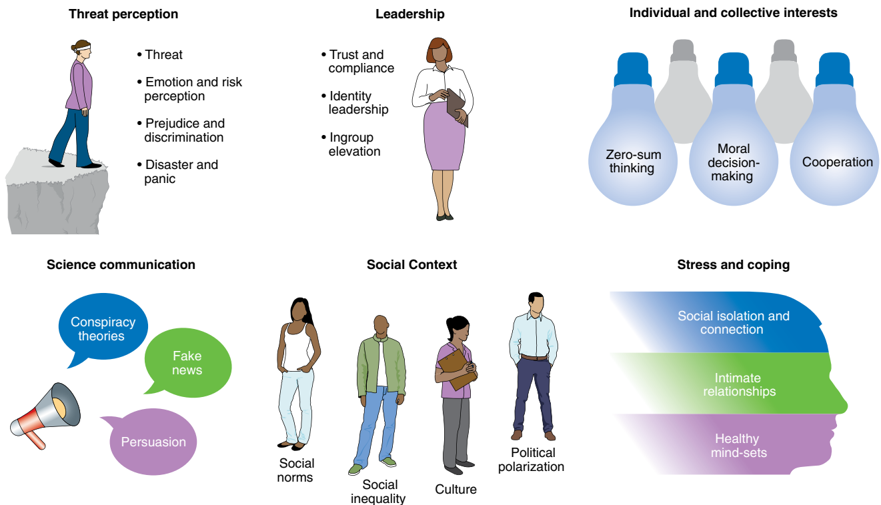
The COVID-19 pandemic represents a massive global health crisis. Because the crisis requires large-scale behaviour change and places significant psychological burdens on individuals, insights from the social and behavioural sciences can be used to help align human behaviour with the recommendations of epidemiologists and public health experts. Here we discuss evidence from a selection of research topics relevant to pandemics, including work on navigating threats, social and cultural influences on behaviour, science communication, moral decision-making, leadership, and stress and coping. In each section, we note the nature and quality of prior research, including uncertainty and unsettled issues. We identify several insights for effective response to the COVID-19 pandemic and highlight important gaps researchers should move quickly to fill in the coming weeks and months.
Overview
CoChat Summary
TL;DR
This perspective argues that social and behavioural science can help align public behaviour with COVID-19 public health recommendations across threat perception, social context, science communication, cooperation, leadership, and stress/coping. It synthesizes prior evidence and policy insights while cautioning that evidence is limited, often drawn from non-pandemic contexts, and in many areas unsettled.
Key findings
- The paper notes the scale of infectious disease threats: the bubonic plague killed approximately 25% of the European population, and by March 2020 COVID-19 had spread to more than 118,000 cases and caused 4,291 deaths in 114 countries. It also notes that 21 countries donated medical supplies to China in February, with China reciprocating widely.
- Fear appeals can change behaviour when people feel capable of dealing with the threat, but produce defensive reactions when people feel helpless; optimism bias can lead people to underestimate personal risk and ignore public health warnings.
- Social norms, inequality, culture, and political polarization shape pandemic behaviour: correcting misperceived norms can help when most people are already doing the desirable behaviour, but descriptive norms can backfire if the behaviour is undesirable unless paired with prescriptive norms.
- Effective communication and leadership may involve credible sources, messages that protect others or align with moral values, prebunking/inoculation against misinformation, accuracy nudges, shared social identity, and leaders modelling prosocial sacrifice; excessive national self-image concerns (“collective narcissism”) can backfire.
Methods
- Design: Perspective/narrative review; no primary data collection or sample. Topics were identified by the corresponding authors as potentially relevant to pandemic response and are explicitly not exhaustive.
- Evidence base: synthesizes prior social and behavioural research on threat perception, social context, science communication, moral decision-making, cooperation, leadership, and stress/coping, drawing on laboratory experiments, correlational studies, field experiments, meta-analyses, and preprints/forthcoming work.
- Analysis: narrative synthesis with policy implications and identified research gaps; no systematic search strategy or quantitative synthesis is reported.
Limitations
- Stated: due to space constraints, the paper provides only a brief summary of each topic; research on these topics is ongoing and in many cases far from settled; there is very little published social science research on the current pandemic, so discussion often draws from different circumstances and evidence quality varies substantially.
- Stated: insights and policy implications should be interpreted with caution.
- Evident: as a perspective rather than a systematic review or empirical study, it does not provide a comprehensive evidence appraisal, and its reliance on preprints and forthcoming sources limits certainty.
Model-written summary. Check it against the paper before relying on it.
Integrity signals
Registry
Cites
Statistics
Figures
Verification
Claims the paper makes
19 Valid · 5 Not valid · 37 Not checked · 13 Own results and interpretations
At least one cited source doesn’t support this claim or points to a different paper, and none confirmed it — see the verdicts below.
In the paper
“For instance, in hypothetical scenarios about deciding whether to go to work while sick, American and British participants reported they would be less willing to stay home when it was uncertain they would infect a co-worker.”
What the sources say
- Disputedcites [176] Kappes, A. et al. Uncertainty about the impact of social decisions increases prosocial behaviour. Nat. Hum. Behav. 2, 573–580 (2018). sourceExperimental — accuracy not yet measured
In the paper’s account of the infectious-disease scenario (Abstract; page not provided), participants facing uncertainty about how severely a co-worker might be affected were more likely to stay home than controls, not less. The paper distinguishes that impact uncertainty from uncertainty about whether a co-worker would be infected. Its Study 6 Methods (page not provided) describe recruitment through AMT, but do not establish the claimed American and British participant groups. (LLM, conf=0.88)
Checked by a reasoning model — may be wrong.
hedgedstates an association- Asserted: passes — The authors put it forward as true.
- Checkable: passes — It can be checked against evidence.
- Load-bearing: passes — The paper’s conclusions depend on it.
- Based: passes — The paper gives a reason why it holds.
- Disputed
The cited sources that could be checked couldn’t confirm or dispute this claim.
In the paper
“Moreover, there is mixed research regarding whether corrections may actually increase belief in the original misinformation 121,124-126 or in other misleading claims that fail to get corrected 127 .”
What the sources say
- Not checked — no full text of the sourcecites [121] Guess, A. & Coppock, A. Does counter-attitudinal information cause backlash? Results from three large survey experiments. Br. J. Polit. Sci. https://doi.org/10.1017/S0007123418000327 (2018). source
- Not matchedcites [124] Wittenberg, C. & Berinsky, A.J. Misinformation and its correction. in Social Media and Democracy: The State of the Field (eds Persily, N. & Tucker, J. A.) (Cambridge University Press, forthcoming).
Its entry has no title and year that we can search by.
- Not checked — no full text of the sourcecites [125] Swire, B. & Ecker, U.K.H. Misinformation and its correction: Cognitive mechanisms and recommendations for mass communication. in Misinformation and Mass Audiences (eds. Southwell, B. G., Thorson, E. A. & Sheble, L.) 195–2011 (University of Texas Press, 2018). source
- Not checked — no full text of the sourcecites [126] Wood, T. & Porter, E. The elusive backfire effect: mass attitudes’ steadfast factual adherence. Polit. Behav. 41, 135–163 (2018). source
- Could not verifycites [127] Pennycook, G., McPhetres, J., Zhang, Y. & Rand, D. Fighting COVID-19 misinformation on social media: Experimental evidence for a scalable accuracy nudge intervention. Preprint at PsyArXiv https://doi.org/10.31234/osf.io/uhbk9 (2020). sourceExperimental — accuracy not yet measured
Citation 127 is attached to the suggestion that corrections may increase belief in other misleading claims that go uncorrected. The Statement of Relevance and Discussion describe an accuracy nudge that improved sharing decisions, not corrections or their effects on belief in uncorrected claims. Searches for correction backfire and uncorrected misinformation found no passage addressing that point; page numbers were unavailable in our copy. (LLM, conf=0.76)
hedgedstates a possible cause- Asserted: passes — The authors put it forward as true.
- Checkable: passes — It can be checked against evidence.
- Load-bearing: passes — The paper’s conclusions depend on it.
- Based: passes — The paper gives a reason why it holds.
The sources with a verdict support this claim; the rest weren’t checked yet, have no full text we could read, or their verdicts aren’t rated yet.
In the paper
“Indeed, laboratory research has found that people prioritize local over global (or international) interests 185,186 .”
What the sources say
- Supportedcites [185] Milinski, M., Hilbe, C., Semmann, D., Sommerfeld, R. & Marotzke, J. Humans choose representatives who enforce cooperation in social dilemmas through extortion. Nat. Commun. 7, 10915 (2016). source
The Results section (‘Voters choose selfish representatives’; page unavailable) reports that participants preferentially re-elected representatives who contributed less to the shared climate account and elected candidates who pledged to contribute less than a fair share. In this simulated international dilemma, that supports the claim that participants favored their own group’s interests over the collective goal; it does not establish that everyone did so. (LLM, conf=0.85)
- Not checked — no full text of the sourcecites [186] Reinders Folmer, C. P. et al. One for all: what representing a group may do to us. J. Exp. Soc. Psychol. 48, 1047–1056 (2012). source
plain- Asserted: passes — The authors put it forward as true.
- Checkable: passes — It can be checked against evidence.
- Load-bearing: passes — The paper’s conclusions depend on it.
- Based: passes — The paper gives a reason why it holds.
- Supported
Every source the paper cites for this claim was checked and supports it.
In the paper
“However, when going to work risked infecting an elderly co-worker who would suffer a serious illness, participants reported they would be more willing to stay home 176 .”
What the sources say
- Supportedcites [176] Kappes, A. et al. Uncertainty about the impact of social decisions increases prosocial behaviour. Nat. Hum. Behav. 2, 573–580 (2018). source
The Study 6 Methods (page not provided) describe a scenario in which going to work could infect an older, vulnerable co-worker who would suffer severely, followed by a rating of willingness to go to work. The reported Study 6 findings (indexed under Abstract; page not provided) say participants given that risk information were significantly more likely to stay home than controls. (LLM, conf=0.92)
hedgedstates a cause- Asserted: passes — The authors put it forward as true.
- Checkable: passes — It can be checked against evidence.
- Load-bearing: passes — The paper’s conclusions depend on it.
- Based: passes — The paper gives a reason why it holds.
- Supported
The sources with a verdict support this claim; the rest weren’t checked yet, have no full text we could read, or their verdicts aren’t rated yet.
In the paper
“Several techniques, such as sanctioning defectors 187 or rewarding cooperators 188 , tend to increase cooperative behaviour in laboratory experiments using economic games.”
What the sources say
- Not checked — no full text of the sourcecites [187] Yamagishi, T. The provision of a sanctioning system as a public good. J. Pers. Soc. Psychol. 51, 110–116 (1986). source
- Supportedcites [188] Rand, D. G., Dreber, A., Ellingsen, T., Fudenberg, D. & Nowak, M. A. Positive interactions promote public cooperation. Science 325, 1272–1275 (2009). source
Citation 188 is attached to rewarding cooperators. The paper’s Abstract reports a laboratory comparison using repeated public goods games and finds that reward maintained public cooperation and, when both reward and punishment were available, increased contributions. (LLM, conf=0.93)
plainstates a cause- Asserted: passes — The authors put it forward as true.
- Checkable: passes — It can be checked against evidence.
- Load-bearing: unclear — It is unclear whether the paper’s conclusions depend on it.
- Based: passes — The paper gives a reason why it holds.
50 more claims · 13 with their cited sources checked
Create a free account to see all 74 claims and to verify the 2 references still open.
- It may state two separate claims as one. 13
- Probably not a substantial claim. 6
Claims other papers make about this one
Each is checked against this paper’s own text: does it say what the citing paper says it does?
The source backs part of the claim, not all of it — or backs it for a different population, condition or comparison.
In the citing paper
“COVID-19 is an international public health crisis, putting substantial burden on medical centers and increasing the psychological toll on health care workers (HCW).”
From Supporting the well-being of health care providers during the COVID-19 pandemic: The CopeColumbia response (2020) · cites this paper as [6]
Experimental — accuracy not yet measuredThe source backs part of the claim, not all of it — or backs it for a different population, condition or comparison.
In the citing paper
“these population-wide measures affected psychological well-being and mental health as well as increased social isolation [68] and loneliness.”
From Psychological correlates of perceived loneliness in college students before and during the COVID-19 stay-at-home period: a longitudinal study (2023) · cites this paper as [68]
Experimental — accuracy not yet measuredThe source backs part of the claim, not all of it — or backs it for a different population, condition or comparison.
In the citing paper
“they may eventually increase the social isolation of students and affect their psychological well-being and mental health [3].”
From Students under lockdown: Comparisons of students’ social networks and mental health before and during the COVID-19 crisis in Switzerland (2020) · cites this paper as [3]
Experimental — accuracy not yet measuredThe source backs part of the claim, not all of it — or backs it for a different population, condition or comparison.
In the citing paper
“effective interventions are hard to scale to a population level (12);”
From Psychological inoculation improves resilience against misinformation on social media (2022) · cites this paper as [12]
Experimental — accuracy not yet measuredThe source backs part of the claim, not all of it — or backs it for a different population, condition or comparison.
In the citing paper
“There is a shortage of studies that test anti-misinformation interventions in an ecologically valid manner, i.e., testing an intervention as consumers would interact with it in online environments (8, 12).”
From Psychological inoculation improves resilience against misinformation on social media (2022) · cites this paper as [12]
Experimental — accuracy not yet measured
6 more claims about this paper
Create a free account to see every claim other papers make about this one.
Citations
Cites
Granovetter, M. S. (1973) · American Journal of Sociology · doi:10.1086/225469 · Cited by 40,491
Zhou, F., Yu, T., Du, R., Fan, G., Liu, Y., Liu, Z., Xiang, J., Wang, Y., Song, B., Gu, X., et al. (2020) · The Lancet · doi:10.1016/s0140-6736(20)30566-3 · Cited by 27,263
The need to belong: Desire for interpersonal attachments as a fundamental human motivation.
Baumeister, R. F., & Leary, M. R. (1995) · Psychological Bulletin · doi:10.1037//0033-2909.117.3.497 · Cited by 23,245
Culture and the self: Implications for cognition, emotion, and motivation.
Markus, H. R., & Kitayama, S. (1991) · Psychological Review · doi:10.1037/0033-295x.98.2.224 · Cited by 21,995
Self-citationThe Psychological Impact of Quarantine and How to Reduce It: Rapid Review of the Evidence
Brooks, S. K., Webster, R. K., Smith, L. E., Woodland, L., Wessely, S., Greenberg, N., & Rubin, G. J. (2020) · doi:10.2139/ssrn.3532534 · Cited by 16,394
The psychological impact of quarantine and how to reduce it: Rapid review of the evidence
Brooks, S. K., Webster, R. K., Smith, L. E., Woodland, L., Wessely, S., Greenberg, N., & Rubin, G. J. (2020) · The Lancet · doi:10.1016/s0140-6736(20)30460-8 · Cited by 16,378
Nudge: improving decisions about health, wealth, and happiness
(2008) · Choice Reviews Online · doi:10.5860/choice.46-0977 · Cited by 11,572
Slovic, P. (1987) · Science · doi:10.1126/science.3563507 · Cited by 9,271
The Elaboration Likelihood Model of Persuasion
Petty, R. E., & Cacioppo, J. T. (1986) · Advances in Experimental Social Psychology · doi:10.1016/s0065-2601(08)60214-2 · Cited by 8,822
Self-citationThe emotional dog and its rational tail: A social intuitionist approach to moral judgment.
Haidt, J. (2001) · Psychological Review · doi:10.1037/0033-295x.108.4.814 · Cited by 8,048
Research works printed but not linked: 3
- Berkowitz, A.D. An overview of the social norms approach. in Changing the Culture of College Drinking: A Socially Situated Health Communication Campaign (eds. Stewart, L. & Lederman, L. C.) 193–214 (Hampton Press, 2005).
- Wittenberg, C. & Berinsky, A.J. Misinformation and its correction. in Social Media and Democracy: The State of the Field (eds Persily, N. & Tucker, J. A.) (Cambridge University Press, forthcoming).
- Ransohoff, K.J. Patients on the Trolley Track: The Moral Cognition of Medical Practitioners and Public Health Professionals. (Harvard Univ. Press, 2011).
Cited by
Items 3,401–3,500 of 5,015
Barbosa, S., Pinilla, C. A. O., León, L. A., & Coronado, A. D. H. (2023) · Avances en Psicología Latinoamericana · doi:10.12804/revistas.urosario.edu.co/apl/a.12151 · Cited by 2
MOTIVATION AND HESITANCY TOWARDS THE COVID-19 VACCINE IN EXPECTING MOTHERS
Samaria, D., & Puspaningrum, N. (2023) · Jurnal Riset Kesehatan · doi:10.31983/jrk.v12i1.9565 · Cited by 2
Gumelar, G. (2023) · JPPP - Jurnal Penelitian dan Pengukuran Psikologi · doi:10.21009/jppp.121.01 · Cited by 3
Attitudinal analysis of vaccination effects to lead endemic phases
Ku, D., Kim, G., Peck, K. R., Park, I. K., Chang, R., Kim, D., & Lee, S. (2023) · Scientific Reports · doi:10.1038/s41598-023-37498-y · Cited by 3
Nowakowska, I., & Zarazińska, A. (2023) · Studies in Psychology Estudios de Psicología · doi:10.1080/02109395.2023.2207300 · Cited by 3
Ithnain, N., Kassim, R., Musa, K. A., Amirudin, N., Suhaimi, S. A., Kaundan, M. K., & Panting, A. J. (2023) · Journal of Education and Health Promotion · doi:10.4103/jehp.jehp_1521_22 · Cited by 2
“[14] In the context of COVID‐19, preventive behavior comprised information on perceived effectiveness and actual acceptance of preventive behavior (to protect oneself and others), to prevent both contracting COVID‐19 and onward transmission, and it composed under three groups: (i) hygiene practices (wearing a face mas…”
BackgroundSocial network, Biden approval, and pediatric COVID‐19 vaccine uptake
Hao, F. (2023) · Sociology Compass · doi:10.1111/soc4.13126 · Cited by 2
Matsunaga, L. H., Aldrich, D. P., Faiad, C., Aoki, T., Tseng, P.-H., & Aida, J. (2023) · Journal of Social and Political Psychology · doi:10.5964/jspp.9819 · Cited by 3
Liu, Y., Wu, Z., Wang, Y., Dong, Z., Sun, Z., & Gan, Y. (2023) · Political Psychology · doi:10.1111/pops.12927 · Cited by 4
Junot, A., Chabanet, P., & Ridde, V. (2023) · Health Psychology and Behavioral Medicine · doi:10.1080/21642850.2023.2252902 · Cited by 2
“…to explain why people participate or not in the COVID-19 prevention programme and adopt or not preventive behaviours (Alagili & Bamashmous, 2021; Bavel et al., 2020; Bechard et al., 2021; Shahnazi et al., 2020; Tong et al., 2020; Walrave et al., 2020; Wong et al., 2021; Yehualashet et al.,…”
Barakat, M. M., & AboulNaga, M. M. (2023) · Innovative renewable energy · doi:10.1007/978-3-031-33148-0_55 · Cited by 3
Navigating economic turmoil: Chilean businesses during COVID-19 lockdowns and vaccine rollouts
Pertuzé, J. A., Montégu, J. P., González, C., Araos, R., & Daza, P. (2023) · Health Policy and Technology · doi:10.1016/j.hlpt.2023.100813 · Cited by 3
Evolving Roles of Public Health Nurses in the Age of Pandemics: A Rapid Review
Sharkiya, S. H. (2023) · Africa Journal of Nursing and Midwifery · doi:10.25159/2520-5293/14054 · Cited by 2
Finding Silver Linings in the Covid-19 Pandemic: A 2-Wave Study in the UK
Bacon, A. M., Charlesford, J. J., Hyland, M. E., Puskas, T., & Hughes, P. (2023) · Psychological Reports · doi:10.1177/00332941231219788 · Cited by 3
“Fears of infection and repeated lockdown conditions have resulted in frustration, boredom and loneliness, as well as worries about prospective fi nancial and employment loss and interruptions to children ’ s education (Brooks et al., 2020; Van Bavel et al., 2020).”
Rajeshkannan, N., Somasundaram, D. J., Kumarendran, B., Kumanan, T., Aloysius, I., Sugirthan, N., Sasikumar, S., & Jegathesan, N. (2024) · Academia Medicine · doi:10.20935/acadmed6172 · Cited by 2
Valenzuela-Fernandez, E. A. L. A. (2023) · International Journal on Recent and Innovation Trends in Computing and Communication · doi:10.17762/ijritcc.v11i9.9111 · Cited by 5
Solitary in Nature: Young adults using urban nature as a safety net during COVID-19 lockdowns
Peterson, R., Barron, S., Rugel, E. J., & Lee, E. (2024) · Wellbeing Space and Society · doi:10.1016/j.wss.2024.100195 · Cited by 5
Leveraging the humanity of randomized controlled trials for actionability
Wong‐Parodi, G., Domingue, S. J., Harrison, T., Herbert, N., Maillard, L., & Lemos, M. C. (2024) · Cell Reports Sustainability · doi:10.1016/j.crsus.2024.100076 · Cited by 7
Thrikkadeeri, K., & Viswanathan, A. (2024) · Ornithological Applications · doi:10.1093/ornithapp/duae024 · Cited by 3
“Social and travel restrictions, in combination with physical and mental distress (Li et al. 2020, Van Bavel et al. 2020), may have led to a decline in the amount of hobbyist as well as systematic birding, and therefore in the quantity of data generated.”
A Social-Ecological Model for Pandemic Management: A Study of Beppu City during COVID-19
ABBADI, H., Aduba, J., & Sawaguchi, M. (2024) · International Journal of Japan Association for Management Systems · doi:10.14790/ijams.16.29 · Cited by 3
Barbosa, S., Sánchez-Mora, J., & Corredor, J. (2024) · Journal of Health Psychology · doi:10.1177/13591053241264932 · Cited by 3
“In this context, behavioral sciences were proposed as an alternative to effectively motivate voluntary vaccination and other healthy behaviors, such as social distancing (Bavel et al., 2020).”
Class differences in gratitude and entitlement drive response to COVID‐19 measures
Wang, Y., Ding, Y., Xie, X., & Guo, Y. (2024) · Asian Journal Of Social Psychology · doi:10.1111/ajsp.12645 · Cited by 2
Assessment of self-satisfaction, happiness, and quality of life (QoL) among adults: An online survey
Dehury, R. K., Gadiraju, P., Singh, P., Vanlalhruaii, C., Dehury, P., Devaraju, K., & Behera, S. (2024) · Journal of Education and Health Promotion · doi:10.4103/jehp.jehp_1528_23 · Cited by 3
Comparative study of the factors that influence Behavioral Intentions in DANA and OVO users
Fahri, F., Afifah, N., Juniwati, J., Purmono, B. B., & Ahmadi, A. (2025) · Journal of Management and Digital Business · doi:10.53088/jmdb.v5i1.1332 · Cited by 5
“This means people follow what others do or feel others will approve of (Bavel et al., 2020).”
Teodorescu, H.-N., & Hagan, M. (2020) · International Conference on Electronics, Computers and Artificial Intelligence (ECAI) · doi:10.1109/ecai50035.2020.9223243 · Cited by 3
Walker, K. A. B. (2020) · Global Reproductive Health · doi:10.1097/grh.0000000000000042 · Cited by 3
Cullen, W., Avramovic, G., Broughan, J., Burke, M.-C., Cotter, A. G., Crowley, D., Downey, J., Duggan, P., Fawsitt, R., Guérandel, A., et al. (2020) · HRB Open Research · doi:10.12688/hrbopenres.13135.1 · Cited by 2
Filho, I. M. D. M., de Sousa, T. V., Lima, T. P., Filha, F. S. S. C., Pereira, M. C., & da Silva, R. M. (2020) · Revista Baiana de Enfermagem · doi:10.18471/rbe.v34.38396 · Cited by 2
“Desde a declaração da Organização Mundial da Saúde (OMS) de que a COVID-19 se tratava de uma emergência global e, especificamente no Brasil, desde a notificação do primeiro caso((3)), essa crise de saúde tem promovido modificações nos relacionamentos interpessoais, seja no ambiente de trabalho seja no lar das pessoas(…”
BackgroundThe obligation of parents with COVID‐19 positivity to stay separated from their children
Çeli̇k, M. Y. (2021) · Journal of Child and Adolescent Psychiatric Nursing · doi:10.1111/jcap.12303 · Cited by 2
Explaining Support for COVID-19 Cell Phone Contact Tracing
Rheault, L., & Musulan, A. (2021) · Canadian Journal of Political Science · doi:10.1017/s0008423921000019 · Cited by 8
Testing children with COVID‐19 symptoms: what are parents’ intentions?
Measey, M., Hoq, M., & Rhodes, A. (2021) · The Medical Journal of Australia · doi:10.5694/mja2.51004 · Cited by 2
Abdullah, Z., Anil, A. A., Dhanashekhar, A. K., Asik, M., Aji, A., & Premnath, P. (2021) · International Journal of Community Medicine and Public Health · doi:10.18203/2394-6040.ijcmph20212004 · Cited by 1
“On the other hand, the corona virus crisis became an ideal breeding ground for speculations and conspiracy thinking.(3) Research over the decades has shown that conspiracy theories increase substantially during a crisis such as a pandemic.”
BackgroundO diamino fluoreto de prata no controle da cárie na primeira infância durante a pandemia da COVID-19
de Sousa, E. T., Crescente, C. L., Soares‐Yoshikawa, A. L., & Nobre‐dos‐Santos, M. (2021) · Research Society and Development · doi:10.33448/rsd-v10i6.15380 · Cited by 6
Perceived stress and possible stressors in the general public in China during the COVID-19 pandemic
Zhang, M., Zhao, X., Liu, Y., & Yang, J. (2021) · Ethics Medicine and Public Health · doi:10.1016/j.jemep.2021.100695 · Cited by 6
“[6] Bavel JJV, Baicker K, Boggio PS, Capraro V, Cichocka A, Cikara M, et al.”
BackgroundInfluentialDukungan Sosial & Student Well-Being pada Siswa yang Menghadapi Pembelajaran Jarak Jauh
Pratama, R. I. (2021) · PAKAR Pendidikan · doi:10.24036/pakar.v18i2.196 · Cited by 8
Korean Nursing Students’ Emotional Response Types to Pandemic: Application of Q-Methodology
Seong, M. (2021) · Healthcare · doi:10.3390/healthcare9081080 · Cited by 2
“In December 2019, a novel coronavirus (SARS-CoV-2) caused an outbreak of coronavirus disease (COVID-19) in Wuhan, China, which then spread worldwide in three months, leading the World Health Organization (WHO) to declare it a global pandemic [1].”
BackgroundResidência Pedagógica e o ensino remoto: desafios e perspectivas na ótica de preceptores
Castro, Í. F. D. A., Sousa, F. D. C., Cipriano, T. H. A. S., da Costa, F. G., Castro, K. D. S., da Costa, V. S., Pires, G. R., & Narzetti, V. R. (2021) · Research Society and Development · doi:10.33448/rsd-v10i11.19359 · Cited by 2
COVID-19 Social Work Scope and Intervention in A Tertiary Care Hospital
Chinnayan, S. (2020) · Advanced Journal of Social Science · doi:10.21467/ajss.7.1.92-95 · Cited by 2
Delay-Induced Periodic Behaviour in Competitive Populations
Aleandri, M., & Minelli, I. G. (2021) · Journal of Statistical Physics · doi:10.1007/s10955-021-02820-3 · Cited by 2
“oices contrary to that of the majority. At the same time, they may adopt irrational behaviours due to social in uence or to an imitation mechanism, adapting their choices to those of their neighbours [4] [24]. ∗Luiss University, Viale Romania, 32, 00197 Rome, Italy, maleandri@luiss.it †Dipartimento di Ingegneria e Sci…”
BackgroundThe Populations' Resilience Toward the Policymaking Discrepancies in the Pandemic Covid-19 Period
Alsaqqa, H. H. (2021) · Frontiers in Public Health · doi:10.3389/fpubh.2021.733519 · Cited by 2
“Furthermore, crises, especially epidemics, create real barriers to efforts to balance individual and collective interests, making it difficult to implement the necessary behavioral strategy to reduce outbreak (27).”
BackgroundCOVID-19 Pandemic Between Severity Facts and Prophylaxis
Liu, H., Zhu, W., Wu, Y., Jiang, C., Huo, L., & Belal, A. (2021) · Natural Product Communications · doi:10.1177/1934578x211041270 · Cited by 2
“Instructions from Government have been widespread in many parts of the world and have shaped communication with the public, raising a number of challenges that have implications both for those seeking care and for those who provide communication.(17) In this paper, we will focus on the critical reflection of these cha…”
BackgroundInfluentialKing, E. J., Rozek, L. S., Lin, A. C., Hicken, A. D., Luong, P. J., Александрова, Е. А., Meylakhs, P. A., Nambunmee, K., & Tardif, T. Z. (2021) · Health Education & Behavior · doi:10.1177/10901981211060327 · Cited by 2
The effect of politician denialist approach on COVID-19 cases and deaths
de Arruda, R. G., de Menezes, T. A., dos Santos, J. M. A., Páez, A., & Lopes, F. (2021) · EconomiA · doi:10.1016/j.econ.2021.11.007 · Cited by 3
Reflections of Health Care Workers on Their In-Hospital Experiences During the Onset of COVID-19
Espino, D. P., Tan, Y., Lador, O. Z., et al. (2022) · Communications in computer and information science · doi:10.1007/978-3-030-93859-8_17 · Cited by 2
Plate, R. C., & Jenkins, A. C. (2022) · Frontiers in Psychology · doi:10.3389/fpsyg.2021.756549 · Cited by 3
Social capital as a factor containing the spread of the SARS-cov-2 flu: Polish case
Bylok, F. (2022) · Cogent Social Sciences · doi:10.1080/23311886.2022.2035940 · Cited by 2
“…is hindered by three groups of factors: a) people underestimate the risk they expose themselves to, b) closing oneself in strict isolation as a means to protect others is against human nature, and c) people, often unwittingly, put themselves and others at risk by their actions (Bavel et al., 2020).”
Background(2022) · Quality - Access to Success · doi:10.47750/qas/23.187.28 · Cited by 2
Solorzano, C. S., Panasiti, M. S., Pucchio, A. D., & Grano, C. (2022) · International Journal of Environmental Research and Public Health · doi:10.3390/ijerph191610153 · Cited by 4
“, protection for oneself) but also on altruistic ones such as reciprocity concerns [28,29].”
BackgroundYusuf, A. O., Olajide-Yusuf, M. A., Pharmacist and Independent Researcher, N., & Olajide, M. F. (2022) · Journal of Social Humanity and Education · doi:10.35912/jshe.v2i4.587 · Cited by 2
Muslim, M., & Zaini, M. A. A. (2021) · TADRIS Jurnal Pendidikan Islam · doi:10.19105/tjpi.v16i2.4431 · Cited by 7
Khadka, S., Usman, M. A., Saleem, M., Ali, M., Rasheed, H., Giri, S., Saeed, H. A., Gupta, R. P., Bajgain, Y., & Shahi, J. (2022) · International Journal of Surgery Global Health · doi:10.1097/gh9.0000000000000092 · Cited by 2
“communication is an urgent requirement as per WHO’s the current report for the quality of life both from the health and social point of view([33]).”
BackgroundSocio-cultural and religious impact of COVID-19 pandemic in Nigeria
Onah, N. G. (2021) · Bible in Africa studies · doi:10.20378/irb-59946 · Cited by 2
Migration and Multiculturalism
Green, E. G. T., & Staerklé, C. (2023) · Oxford University Press eBooks · doi:10.1093/oxfordhb/9780197541296.013.27 · Cited by 15
Flórez, J. F. M., Isaza, I., & Osorio, J. D. G. (2021) · Pensamiento Psicológico · doi:10.11144/javerianacali.ppsi19.epas · Cited by 4
“Asimismo, se interpretó la percepción del riesgo (Bavel et al., 2020; Webster et al., 2020) como el factor que puede propiciar un cambio en las creencias de los sujetos que conduzca al seguimiento de medidas.”
BackgroundAn Experimental Investigation of Resilience Decision-Making in Repeated DisastersPreprint
Dormady, N., Greenbaum, R. T., & Young, K. (2018) · SSRN Electronic Journal · doi:10.2139/ssrn.3134726 · Cited by 2
Ranking the explanatory power of factors associated with worldwide new Covid-19 casesPreprint
Moustakas, A. (2021) · Research Square · doi:10.21203/rs.3.rs-702119/v1 · Cited by 2
“changes within locations in seasons [13-15].”
A Comprehensive Review of the Cross-Disciplinary Impact of COVID-19 in IndiaPreprint
Dhawal, P. P., Kakodkar, S., Pawar, R., Bhome, S., & Barve, S. (2020) · Preprints.org · doi:10.20944/preprints202006.0131.v1 · Cited by 1
Exploratory Analysis of a Social Media Network in Sri Lanka during the COVID-19 Virus OutbreakPreprint
Lenadora, D., Gamage, G., Haputhanthri, D., Meedeniya, D., & Perera, I. (2020) · arXiv (Cornell University) · doi:10.48550/arxiv.2006.07855 · Cited by 9
“an countries spread, and role of counter-hate speech on mitigating the spread. Major social and behavioural changes of people because of the massive global health crisis were analysed by Bavel et al. [25]. In addition, the authors have evaluated how psychological and behavioural science concepts could be used to mitig…”
BackgroundBlanco, N., Stafford, K. A., Lavoie, M.-C. C., et al. (2020) · arXiv (Cornell University) · doi:10.48550/arxiv.2007.02712 · Cited by 2
Urban Sprawl of Covid-19 Epidemic in India: Lessons in the First SemesterPreprint
Gupta, R., Gaur, K., Khedar, R. S., & Dhamija, R. K. (2020) · medRxiv · doi:10.1101/2020.08.17.20176537 · Cited by 3
National Longitudinal Mediators of Psychological Distress During Stringent COVID-19 LockdownPreprint
Bulbulia, J. A., Piven, S. D., Barlow, F. K., Davis, D. E., Greaves, L. M., Highland, B. R., Houkamau, C. A., Milfont, T. L., Osborne, D., Overall, N. C., et al. (2020) · medRxiv · doi:10.1101/2020.09.15.20194829 · Cited by 2
Bir, C., & Widmar, N. O. (2020) · doi:10.21203/rs.3.rs-76463/v1 · Cited by 2
“perception, leadership, individual and collective interests, science communication, social context, and stress and coping [4].”
BackgroundDecline in mitigation readiness facilitated second waves of SARS-CoV-2Preprint
Wirtz, K. (2021) · medRxiv · doi:10.1101/2021.02.10.21251523 · Cited by 2
Persuasive Messaging to Encourage COVID-19 Risk ReductionPreprint
Bokemper, S., Huber, G. A., James, E. K., et al. (2020) · doi:10.21203/rs.3.rs-96261/v1 · Cited by 2
A Game-Theoretic Approach for Hierarchical Policy-Making.Preprint
Jia, F., Mate, A., Li, Z., et al. (2021) · arXiv (Cornell University) · Cited by 2
Fanghella, V., Vu, T., & Mittone, L. (2021) · SSRN Electronic Journal · doi:10.2139/ssrn.3792921 · Cited by 2
“They may act selfishly and even harm others as they perceive more threats and risks (van Bavel et al., 2020) or may behave altruistically as cooperation and norm-governed behaviors are common during the crisis time (Drury, 2018).”
BackgroundUsing Complexity to Calibrate Legal Response to COVID-19Preprint
Malcai, O., & Shur‐Ofry, M. (2021) · SSRN Electronic Journal · doi:10.2139/ssrn.3763376 · Cited by 2
Is Commitment Getting Infected Too? How COVID-19 Stay-Home Orders Influence Workgroup CommitmentPreprint
Stein, D. H., Chatman, J. A., & Schroeder, J. (2021) · PsyArXiv (OSF Preprints) · doi:10.31234/osf.io/mhqbv · Cited by 3
Ye, B., Hu, J., Im, H., Liu, M., Wang, X., & Yang, Q. (2020) · doi:10.31234/osf.io/6q78h · Cited by 2
Identifying resilience factors of distress and paranoia during the COVID-19 pandemicPreprint
Mækelæ, M. J., Reggev, N., Dutra, N. B., Tamayo, R. M., Defelipe, R. P., Klevjer, K., & Pfuhl, G. (2021) · doi:10.31234/osf.io/2e3n5 · Cited by 2
Blessing or Curse of Democracy?: Current Evidence from the Covid-19 PandemicPreprint
Badman, R. P., Wu, Y., Inukai, K., & Akaishi, R. (2021) · RePEc: Research Papers in Economics · doi:10.48550/arxiv.2105.10865 · Cited by 17
Leveraging Evidence-Based Messaging to Prevent the Spread of COVID-19Preprint
O’Hagan, A. M. B., Moss, M. E., & Berkman, E. T. (2021) · PsyArXiv (OSF Preprints) · doi:10.31234/osf.io/thm2w · Cited by 2
Public preferences for the COVID-19 Reopening Policies: An experimental assessmentPreprint
Guidi, M., Martini, S., Betti, G., et al. (2021) · OSF Preprints (OSF Preprints) · doi:10.17605/osf.io/xmf3q · Cited by 2
Avusuglo, W., Bragazzi, N. L., Asgary, A., et al. (2021) · SSRN Electronic Journal · doi:10.2139/ssrn.3922118 · Cited by 2
Ripon, R. K., Mim, S. S., & Mulder, C. L. C. L. (2020) · Research Square · doi:10.21203/rs.3.rs-83106/v1 · Cited by 2
“Aligning behaviors does not have long-term effects (Bavel et al., 2020).”
BackgroundInfluentialBorinca, I., Griffin, S. M., McHugh, C., Bradshaw, D., Jay, S., Roth, J., Quayle, M., McMahon, G., Nightingale, A., Ryan, M., et al. (2021) · Research Square · doi:10.21203/rs.3.rs-923189/v1 · Cited by 4
Social reference cues can reduce misinformation sharing behaviour on social mediaPreprint
Jones, C. M., Diethei, D., Schöning, J., Shrestha, R., Jahnel, T., & Schüz, B. (2021) · PsyArXiv (OSF Preprints) · doi:10.31234/osf.io/v6fc9 · Cited by 3
Umer, H. (2022) · SSRN Electronic Journal · doi:10.2139/ssrn.4007903 · Cited by 2
Vilar-Lluch, S. (2022) · doi:10.5040/9781350232730.ch-010 · Cited by 2
Social capital, collective action, and livelihood resilience : A multidimensional approach
Villamar, J. A. G. (2021) · doi:10.18174/537061 · Cited by 3
Predicting Vaccine Uptake during COVID-19 Crisis: A Motivational ApproachPreprint
Schmitz, M., Luminet, O., Klein, O., et al. (2021) · doi:10.31234/osf.io/3f4pb · Cited by 2
Disentangling material, social, and cognitive determinants of human behavior and beliefsPreprint
Tverskoi, D., Guido, A., Andrighetto, G., et al. (2022) · doi:10.31235/osf.io/z5m9h · Cited by 2
Drouin, O., Claude Montmarquette, A., Prud’homme, A., Fontaine, P., Arnaud, Y., & Silva, R. B. D. (2022) · doi:10.54932/lewn7553 · Cited by 2
Culture, COVID-19, and Collectivism: A Paradox of American Exceptionalism?Preprint
Webster, G. D., Howell, J. L., Losee, J. E., et al. (2020) · doi:10.31234/osf.io/hqcs6 · Cited by 2
Howarth, A., Jeanson, A. L., Abrams, A. E. I., et al. (2020) · doi:10.32942/osf.io/87qh9 · Cited by 2
Experiences and Perceptions of Default NudgesPreprint
Michaelsen, P. (2021) · PsyArXiv (OSF Preprints) · doi:10.31234/osf.io/3jm6a · Cited by 2
Risk Preferences and Risk Perception Affect the Acceptance of Digital Contact TracingPreprint
Albrecht, R., Jarecki, J. B., Meier, D. S., & Rieskamp, J. (2020) · PsyArXiv (OSF Preprints) · doi:10.31234/osf.io/4x5f3 · Cited by 3
Gritzka, S., Angerer, P., & Diebig, M. (2022) · Research Square · doi:10.21203/rs.3.rs-1688799/v1 · Cited by 2
Adam‐Troian, J., Bonetto, É., & Delouvée, S. (2022) · doi:10.31234/osf.io/h3tu5 · Cited by 1
The black box as a control for payoff-based learning in economic gamesPreprint
Burton-Chellew, M. N., & West, S. A. (2022) · doi:10.31235/osf.io/5k4ez · Cited by 2
Du, X., Tan, E. S., Elhan‐Kayalar, Y., et al. (2022) · doi:10.22617/wps220243-2 · Cited by 2
Smith, M. J., Enns, E. A., White, L. A., et al. (2023) · medRxiv · doi:10.1101/2023.01.01.22284075 · Cited by 2
Lenoir, R., & Wong, K. K. (2023) · doi:10.31219/osf.io/fe36p · Cited by 2
Chou, F.-C. B., Chen, Y.-C. C., Kuo, Y.-S. A., et al. (2023) · doi:10.31234/osf.io/46dvn · Cited by 2
Abukhalaf, A. H. I., Naser, A. Y., von Meding, J. K., et al. (2023) · Qeios · doi:10.32388/i02s60 · Cited by 2
Nudging or Nagging: The Perils of PersuasionPreprint
Guido, A., Tverskoi, D., Gavrilets, S., Sánchez, A., & Andrighetto, G. (2023) · SSRN Electronic Journal · doi:10.2139/ssrn.4404960 · Cited by 2
Nudges for People who ThinkPreprint
Szollosi, A., Wang-Ly, N., & Newell, B. R. (2023) · doi:10.31234/osf.io/ravsp · Cited by 2
Steiglechner, P., Smaldino, P. E., Moser, D., et al. (2023) · doi:10.31235/osf.io/ba6k9 · Cited by 2
Editorial: Organizational risk and the COVID ‐19 pandemic
Soane, E., Flin, R. H., Macrae, C., & Reader, T. W. (2023) · Journal of Occupational and Organizational Psychology · doi:10.1111/joop.12460 · Cited by 4
Metadata
- Authors
- Bavel, J. J. V., Baicker, K., Boggio, P. S., Capraro, V., Cichocka, A., Cikara, M., Crockett, M. J., Crum, A. J., Douglas, K. M., Druckman, J. N., Drury, J., Dube, O., Ellemers, N., Finkel, E. J., Fowler, J. H., Gelfand, M., Han, S., Haslam, S. A., Jetten, J., Kitayama, S., Mobbs, D., Napper, L. E., Packer, D. J., Pennycook, G., Peters, E., Petty, R. E., Rand, D. G., Reicher, S. D., Schnall, S., Shariff, A., Skitka, L. J., Smith, S. S., Sunstein, C. R., Tabri, N., Tucker, J. A., Linden, S. V. D., Lange, P. V., Weeden, K. A., Wohl, M. J. A., Zaki, J., Zion, S. R., & Willer, R.
- Affiliations
- New York University (US)
- Universidade Presbiteriana Mackenzie (BR)
- Middlesex University London (GB)
- University of Kent (GB)
- Harvard University (US)
- Yale University (US)
- Stanford University (US)
- Northwestern University (US)
- University of Sussex (GB)
- University of Chicago (US)
- Utrecht University (NL)
- University of California San Diego (US)
- University of Maryland, College Park (US)
- Peking University (CN)
- The University of Queensland (AU)
- University of Michigan (US)
- California Institute of Technology (US)
- Lehigh University (US)
- University of Regina (CA)
- University of Oregon (US)
- The Ohio State University (US)
- Massachusetts Institute of Technology (US)
- University of St Andrews (GB)
- University of Cambridge (GB)
- University of British Columbia (CA)
- University of Illinois Chicago (US)
- University of California, Berkeley (US)
- Carleton University (CA)
- Cornell University (US)
- Corresponding author
- Bavel, Jay J. Van
- Willer, Robb
- ORCID
- Bavel, Jay J. Van
- Baicker, Katherine
- Boggio, Paulo S.
- Capraro, Valerio
- Cichocka, Aleksandra
- Cikara, Mina
- Crockett, Molly J.
- Crum, Alia J.
- Douglas, Karen M.
- Druckman, James N.
- Drury, John
- Ellemers, Naomi
- Finkel, Eli J.
- Fowler, James H.
- Gelfand, Michele
- Han, Shihui
- Haslam, S. Alexander
- Jetten, Jolanda
- Kitayama, Shinobu
- Mobbs, Dean
- Napper, Lucy E.
- Packer, Dominic J.
- Pennycook, Gordon
- Peters, Ellen
- Petty, Richard E.
- Rand, David G.
- Reicher, Stephen D.
- Schnall, Simone
- Shariff, Azim
- Skitka, Linda J.
- Sunstein, Cass R.
- Tabri, Nassim
- Tucker, Joshua A.
- Linden, Sander van der
- Weeden, Kim A.
- Wohl, Michael J. A.
- Zaki, Jamil
- Zion, Sean R.
- Willer, Robb
- Venue
- Nature Human Behaviour
- Published
- 2020-04-30
- Volume
- 4
- Issue
- 5
- Pages
- 460-471
- ISSN
- 2397-3374 (ISSN-L)
- OpenAlex
- W3016902371
- Cited by
- 4,964
- References
- 259
- Citations by year
- 2026: 177 · 2025: 288 · 2024: 483 · 2023: 741 · 2022: 1094 · 2021: 1474 · 2020: 702
- FWCI
- 175.81
- Type
- journal article
- Language
- en
- Open access
- bronze
- doi.org
- Licence
- www.springernature.com/gp/researchers/text-and-data-mining (tdm)
- www.springernature.com/gp/researchers/text-and-data-mining (vor)
- Locations
- Nature Human Behaviour (publishedVersion)
- PubMed (publishedVersion)
- Middlesex University Research Repository (Middlesex University Of London) (acceptedVersion)
- Kent Academic Repository (University of Kent) (acceptedVersion)
- DSpace@MIT (Massachusetts Institute of Technology) (submittedVersion, cc-by-nc-sa)
- Sussex Research Online (University of Sussex) (submittedVersion)
- CaltechAUTHORS (California Institute of Technology) (submittedVersion)
- RePEc: Research Papers in Economics (submittedVersion)
- BOA (University of Milano-Bicocca) (submittedVersion)
- Carleton University's Institutional Repository (MacOdrum Library, Carleton University) (submittedVersion, other-oa)
- Utrecht University Repository (Utrecht University) (submittedVersion)
- Figshare (submittedVersion)
- VU Research Portal (submittedVersion, other-oa)
- Utrecht University Repository (Utrecht University) (submittedVersion, other-oa)
- Data Archiving and Networked Services (DANS) (submittedVersion, other-oa)
- Funders
- U.S. Department of Health and Human Services (2P50 MH094258)
- National Institute of Mental Health (P50MH094258)
- Topics
- Social Sciences › Sociology and Political Science › COVID-19 Prevention and Impact
- Social Sciences › Communication › Communication and COVID-19 Impact
- Physical Sciences › Mathematics › Modeling and Simulation › COVID-19 epidemiological studies
- Keywords
- COVID-19 pandemic, pandemic response, behavior change, science communication, ethical decision-making, leadership, stress coping, psychological burden, public health recommendations
- MeSH terms
- Betacoronavirus, COVID-19, SARS-CoV-2, Adaptation, Psychological, Communicable Disease Control, Decision Making, Humans, Human Activities, Health Knowledge, Attitudes, Practice, Leadership, Pneumonia, Viral, Public Health, Quarantine, Stress, Psychological, Global Health, Coronavirus, Coronavirus Infections, Pandemics, Social Media, Epidemiological Monitoring
About these checks
Registry, retraction, Cites and statistics results are computed, not judged, with one exception: a printed reference that no index lists is read once by a model before it counts as a citation error. Claims are extracted by a model and kept only when their quote appears verbatim in the text; each cited source is then checked, with a model’s help, for whether it says what the claim relies on. Those verdicts can be wrong — read the claim’s quote and the cited source before relying on one.
The claim verdicts this report counts are experimental: their accuracy is not yet measured.
A language model drew the claims from the paper on 2026-10-10, under version 3 of the claim definition (model deepseek-v4.1-flash, prompt extract-v3).
A second model labelled each claim on 2026-10-10 (model jev-1.13-20260917, definition revision gold-guideline-v0.2).
Cited sources are checked with a language model’s help (gpt-6-sol).
Statistics and arithmetic are recomputed, not judged.
Confidence bands are shown only for fields calibrated on our annotated test set. None is calibrated yet, so no band is shown.
What counts as a claim ›How we measure confidence ›How we check this ›
Are you an author, or do you see a problem with this page? Request a review
Data sources
Bibliographic data: Semantic Scholar, OpenAlex, Crossref.
Contains information from the Semantic Scholar Academic Graph Datasets, made available under the ODC Attribution License (ODC-BY 1.0).
Semantic Scholar’s data is described in: Kinney, R., et al. (2023). The Semantic Scholar Open Data Platform. arXiv:2301.10140.
