

Using social and behavioural science to support COVID-19 pandemic response
Open accessThe DOI matches its Crossref record; 257 of the 259 references it cites were found in a registry or an index; 24 of the 89 sources its claims cite were checked for support.
Abstract
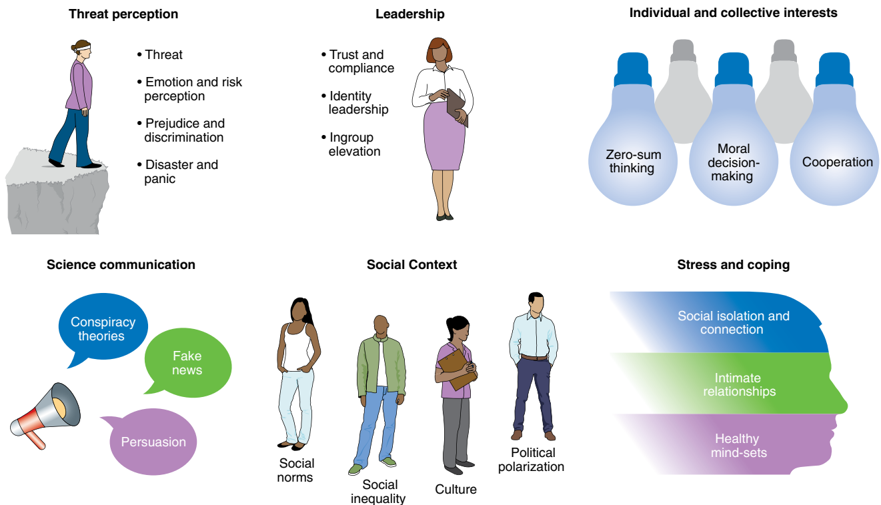
The COVID-19 pandemic represents a massive global health crisis. Because the crisis requires large-scale behaviour change and places significant psychological burdens on individuals, insights from the social and behavioural sciences can be used to help align human behaviour with the recommendations of epidemiologists and public health experts. Here we discuss evidence from a selection of research topics relevant to pandemics, including work on navigating threats, social and cultural influences on behaviour, science communication, moral decision-making, leadership, and stress and coping. In each section, we note the nature and quality of prior research, including uncertainty and unsettled issues. We identify several insights for effective response to the COVID-19 pandemic and highlight important gaps researchers should move quickly to fill in the coming weeks and months.
Overview
CoChat Summary
TL;DR
This perspective argues that social and behavioural science can help align public behaviour with COVID-19 public health recommendations across threat perception, social context, science communication, cooperation, leadership, and stress/coping. It synthesizes prior evidence and policy insights while cautioning that evidence is limited, often drawn from non-pandemic contexts, and in many areas unsettled.
Key findings
- The paper notes the scale of infectious disease threats: the bubonic plague killed approximately 25% of the European population, and by March 2020 COVID-19 had spread to more than 118,000 cases and caused 4,291 deaths in 114 countries. It also notes that 21 countries donated medical supplies to China in February, with China reciprocating widely.
- Fear appeals can change behaviour when people feel capable of dealing with the threat, but produce defensive reactions when people feel helpless; optimism bias can lead people to underestimate personal risk and ignore public health warnings.
- Social norms, inequality, culture, and political polarization shape pandemic behaviour: correcting misperceived norms can help when most people are already doing the desirable behaviour, but descriptive norms can backfire if the behaviour is undesirable unless paired with prescriptive norms.
- Effective communication and leadership may involve credible sources, messages that protect others or align with moral values, prebunking/inoculation against misinformation, accuracy nudges, shared social identity, and leaders modelling prosocial sacrifice; excessive national self-image concerns (“collective narcissism”) can backfire.
Methods
- Design: Perspective/narrative review; no primary data collection or sample. Topics were identified by the corresponding authors as potentially relevant to pandemic response and are explicitly not exhaustive.
- Evidence base: synthesizes prior social and behavioural research on threat perception, social context, science communication, moral decision-making, cooperation, leadership, and stress/coping, drawing on laboratory experiments, correlational studies, field experiments, meta-analyses, and preprints/forthcoming work.
- Analysis: narrative synthesis with policy implications and identified research gaps; no systematic search strategy or quantitative synthesis is reported.
Limitations
- Stated: due to space constraints, the paper provides only a brief summary of each topic; research on these topics is ongoing and in many cases far from settled; there is very little published social science research on the current pandemic, so discussion often draws from different circumstances and evidence quality varies substantially.
- Stated: insights and policy implications should be interpreted with caution.
- Evident: as a perspective rather than a systematic review or empirical study, it does not provide a comprehensive evidence appraisal, and its reliance on preprints and forthcoming sources limits certainty.
Model-written summary. Check it against the paper before relying on it.
Integrity signals
Registry
Cites
Statistics
Figures
Verification
Claims the paper makes
19 Valid · 5 Not valid · 37 Not checked · 13 Own results and interpretations
At least one cited source doesn’t support this claim or points to a different paper, and none confirmed it — see the verdicts below.
In the paper
“For instance, in hypothetical scenarios about deciding whether to go to work while sick, American and British participants reported they would be less willing to stay home when it was uncertain they would infect a co-worker.”
What the sources say
- Disputedcites [176] Kappes, A. et al. Uncertainty about the impact of social decisions increases prosocial behaviour. Nat. Hum. Behav. 2, 573–580 (2018). sourceExperimental — accuracy not yet measured
In the paper’s account of the infectious-disease scenario (Abstract; page not provided), participants facing uncertainty about how severely a co-worker might be affected were more likely to stay home than controls, not less. The paper distinguishes that impact uncertainty from uncertainty about whether a co-worker would be infected. Its Study 6 Methods (page not provided) describe recruitment through AMT, but do not establish the claimed American and British participant groups. (LLM, conf=0.88)
Checked by a reasoning model — may be wrong.
hedgedstates an association- Asserted: passes — The authors put it forward as true.
- Checkable: passes — It can be checked against evidence.
- Load-bearing: passes — The paper’s conclusions depend on it.
- Based: passes — The paper gives a reason why it holds.
- Disputed
The cited sources that could be checked couldn’t confirm or dispute this claim.
In the paper
“Moreover, there is mixed research regarding whether corrections may actually increase belief in the original misinformation 121,124-126 or in other misleading claims that fail to get corrected 127 .”
What the sources say
- Not checked — no full text of the sourcecites [121] Guess, A. & Coppock, A. Does counter-attitudinal information cause backlash? Results from three large survey experiments. Br. J. Polit. Sci. https://doi.org/10.1017/S0007123418000327 (2018). source
- Not matchedcites [124] Wittenberg, C. & Berinsky, A.J. Misinformation and its correction. in Social Media and Democracy: The State of the Field (eds Persily, N. & Tucker, J. A.) (Cambridge University Press, forthcoming).
Its entry has no title and year that we can search by.
- Not checked — no full text of the sourcecites [125] Swire, B. & Ecker, U.K.H. Misinformation and its correction: Cognitive mechanisms and recommendations for mass communication. in Misinformation and Mass Audiences (eds. Southwell, B. G., Thorson, E. A. & Sheble, L.) 195–2011 (University of Texas Press, 2018). source
- Not checked — no full text of the sourcecites [126] Wood, T. & Porter, E. The elusive backfire effect: mass attitudes’ steadfast factual adherence. Polit. Behav. 41, 135–163 (2018). source
- Could not verifycites [127] Pennycook, G., McPhetres, J., Zhang, Y. & Rand, D. Fighting COVID-19 misinformation on social media: Experimental evidence for a scalable accuracy nudge intervention. Preprint at PsyArXiv https://doi.org/10.31234/osf.io/uhbk9 (2020). sourceExperimental — accuracy not yet measured
Citation 127 is attached to the suggestion that corrections may increase belief in other misleading claims that go uncorrected. The Statement of Relevance and Discussion describe an accuracy nudge that improved sharing decisions, not corrections or their effects on belief in uncorrected claims. Searches for correction backfire and uncorrected misinformation found no passage addressing that point; page numbers were unavailable in our copy. (LLM, conf=0.76)
hedgedstates a possible cause- Asserted: passes — The authors put it forward as true.
- Checkable: passes — It can be checked against evidence.
- Load-bearing: passes — The paper’s conclusions depend on it.
- Based: passes — The paper gives a reason why it holds.
The sources with a verdict support this claim; the rest weren’t checked yet, have no full text we could read, or their verdicts aren’t rated yet.
In the paper
“Indeed, laboratory research has found that people prioritize local over global (or international) interests 185,186 .”
What the sources say
- Supportedcites [185] Milinski, M., Hilbe, C., Semmann, D., Sommerfeld, R. & Marotzke, J. Humans choose representatives who enforce cooperation in social dilemmas through extortion. Nat. Commun. 7, 10915 (2016). source
The Results section (‘Voters choose selfish representatives’; page unavailable) reports that participants preferentially re-elected representatives who contributed less to the shared climate account and elected candidates who pledged to contribute less than a fair share. In this simulated international dilemma, that supports the claim that participants favored their own group’s interests over the collective goal; it does not establish that everyone did so. (LLM, conf=0.85)
- Not checked — no full text of the sourcecites [186] Reinders Folmer, C. P. et al. One for all: what representing a group may do to us. J. Exp. Soc. Psychol. 48, 1047–1056 (2012). source
plain- Asserted: passes — The authors put it forward as true.
- Checkable: passes — It can be checked against evidence.
- Load-bearing: passes — The paper’s conclusions depend on it.
- Based: passes — The paper gives a reason why it holds.
- Supported
Every source the paper cites for this claim was checked and supports it.
In the paper
“However, when going to work risked infecting an elderly co-worker who would suffer a serious illness, participants reported they would be more willing to stay home 176 .”
What the sources say
- Supportedcites [176] Kappes, A. et al. Uncertainty about the impact of social decisions increases prosocial behaviour. Nat. Hum. Behav. 2, 573–580 (2018). source
The Study 6 Methods (page not provided) describe a scenario in which going to work could infect an older, vulnerable co-worker who would suffer severely, followed by a rating of willingness to go to work. The reported Study 6 findings (indexed under Abstract; page not provided) say participants given that risk information were significantly more likely to stay home than controls. (LLM, conf=0.92)
hedgedstates a cause- Asserted: passes — The authors put it forward as true.
- Checkable: passes — It can be checked against evidence.
- Load-bearing: passes — The paper’s conclusions depend on it.
- Based: passes — The paper gives a reason why it holds.
- Supported
The sources with a verdict support this claim; the rest weren’t checked yet, have no full text we could read, or their verdicts aren’t rated yet.
In the paper
“Several techniques, such as sanctioning defectors 187 or rewarding cooperators 188 , tend to increase cooperative behaviour in laboratory experiments using economic games.”
What the sources say
- Not checked — no full text of the sourcecites [187] Yamagishi, T. The provision of a sanctioning system as a public good. J. Pers. Soc. Psychol. 51, 110–116 (1986). source
- Supportedcites [188] Rand, D. G., Dreber, A., Ellingsen, T., Fudenberg, D. & Nowak, M. A. Positive interactions promote public cooperation. Science 325, 1272–1275 (2009). source
Citation 188 is attached to rewarding cooperators. The paper’s Abstract reports a laboratory comparison using repeated public goods games and finds that reward maintained public cooperation and, when both reward and punishment were available, increased contributions. (LLM, conf=0.93)
plainstates a cause- Asserted: passes — The authors put it forward as true.
- Checkable: passes — It can be checked against evidence.
- Load-bearing: unclear — It is unclear whether the paper’s conclusions depend on it.
- Based: passes — The paper gives a reason why it holds.
50 more claims · 13 with their cited sources checked
Create a free account to see all 74 claims and to verify the 2 references still open.
- It may state two separate claims as one. 13
- Probably not a substantial claim. 6
Claims other papers make about this one
Each is checked against this paper’s own text: does it say what the citing paper says it does?
The source backs part of the claim, not all of it — or backs it for a different population, condition or comparison.
In the citing paper
“COVID-19 is an international public health crisis, putting substantial burden on medical centers and increasing the psychological toll on health care workers (HCW).”
From Supporting the well-being of health care providers during the COVID-19 pandemic: The CopeColumbia response (2020) · cites this paper as [6]
Experimental — accuracy not yet measuredThe source backs part of the claim, not all of it — or backs it for a different population, condition or comparison.
In the citing paper
“these population-wide measures affected psychological well-being and mental health as well as increased social isolation [68] and loneliness.”
From Psychological correlates of perceived loneliness in college students before and during the COVID-19 stay-at-home period: a longitudinal study (2023) · cites this paper as [68]
Experimental — accuracy not yet measuredThe source backs part of the claim, not all of it — or backs it for a different population, condition or comparison.
In the citing paper
“they may eventually increase the social isolation of students and affect their psychological well-being and mental health [3].”
From Students under lockdown: Comparisons of students’ social networks and mental health before and during the COVID-19 crisis in Switzerland (2020) · cites this paper as [3]
Experimental — accuracy not yet measuredThe source backs part of the claim, not all of it — or backs it for a different population, condition or comparison.
In the citing paper
“effective interventions are hard to scale to a population level (12);”
From Psychological inoculation improves resilience against misinformation on social media (2022) · cites this paper as [12]
Experimental — accuracy not yet measuredThe source backs part of the claim, not all of it — or backs it for a different population, condition or comparison.
In the citing paper
“There is a shortage of studies that test anti-misinformation interventions in an ecologically valid manner, i.e., testing an intervention as consumers would interact with it in online environments (8, 12).”
From Psychological inoculation improves resilience against misinformation on social media (2022) · cites this paper as [12]
Experimental — accuracy not yet measured
6 more claims about this paper
Create a free account to see every claim other papers make about this one.
Citations
Cites
Granovetter, M. S. (1973) · American Journal of Sociology · doi:10.1086/225469 · Cited by 40,491
Zhou, F., Yu, T., Du, R., Fan, G., Liu, Y., Liu, Z., Xiang, J., Wang, Y., Song, B., Gu, X., et al. (2020) · The Lancet · doi:10.1016/s0140-6736(20)30566-3 · Cited by 27,263
The need to belong: Desire for interpersonal attachments as a fundamental human motivation.
Baumeister, R. F., & Leary, M. R. (1995) · Psychological Bulletin · doi:10.1037//0033-2909.117.3.497 · Cited by 23,245
Culture and the self: Implications for cognition, emotion, and motivation.
Markus, H. R., & Kitayama, S. (1991) · Psychological Review · doi:10.1037/0033-295x.98.2.224 · Cited by 21,995
Self-citationThe Psychological Impact of Quarantine and How to Reduce It: Rapid Review of the Evidence
Brooks, S. K., Webster, R. K., Smith, L. E., Woodland, L., Wessely, S., Greenberg, N., & Rubin, G. J. (2020) · doi:10.2139/ssrn.3532534 · Cited by 16,394
The psychological impact of quarantine and how to reduce it: Rapid review of the evidence
Brooks, S. K., Webster, R. K., Smith, L. E., Woodland, L., Wessely, S., Greenberg, N., & Rubin, G. J. (2020) · The Lancet · doi:10.1016/s0140-6736(20)30460-8 · Cited by 16,378
Nudge: improving decisions about health, wealth, and happiness
(2008) · Choice Reviews Online · doi:10.5860/choice.46-0977 · Cited by 11,572
Slovic, P. (1987) · Science · doi:10.1126/science.3563507 · Cited by 9,271
The Elaboration Likelihood Model of Persuasion
Petty, R. E., & Cacioppo, J. T. (1986) · Advances in Experimental Social Psychology · doi:10.1016/s0065-2601(08)60214-2 · Cited by 8,822
Self-citationThe emotional dog and its rational tail: A social intuitionist approach to moral judgment.
Haidt, J. (2001) · Psychological Review · doi:10.1037/0033-295x.108.4.814 · Cited by 8,048
Research works printed but not linked: 3
- Berkowitz, A.D. An overview of the social norms approach. in Changing the Culture of College Drinking: A Socially Situated Health Communication Campaign (eds. Stewart, L. & Lederman, L. C.) 193–214 (Hampton Press, 2005).
- Wittenberg, C. & Berinsky, A.J. Misinformation and its correction. in Social Media and Democracy: The State of the Field (eds Persily, N. & Tucker, J. A.) (Cambridge University Press, forthcoming).
- Ransohoff, K.J. Patients on the Trolley Track: The Moral Cognition of Medical Practitioners and Public Health Professionals. (Harvard Univ. Press, 2011).
Cited by
Items 3,501–3,600 of 5,015
Antonopoulou, V., Ong, M., Meyer, C., Beale, S., Lorencatto, F., Michie, S., Aldridge, R. W., & Hayward, A. C. (2024) · Research Square · doi:10.21203/rs.3.rs-3875563/v1 · Cited by 2
Kroupin, I., & Zeng, T. C. (2024) · PsyArXiv (OSF Preprints) · doi:10.31234/osf.io/mxfcv · Cited by 3
Betsch, C., Eitze, S., Korn, L., Felgendreff, L., Tänzer, A., & Sprengholz, P. (2025) · Scientific Data · doi:10.1038/s41597-025-05275-3 · Cited by 13
A brief history of masks from the 17th-century plague to the ongoing coronavirus pandemic
Carstairs, C. (2020) · The Conversation · doi:10.64628/aam.r6pradvkh · Cited by 2
Humanism and Social Constructionism
Baxter, J. (2021) · Global perspectives on health geography · doi:10.1007/978-3-030-70179-6_8 · Cited by 2
Díez, S. S., & Zlobina, A. (2021) · Journal of Theoretical Social Psychology · doi:10.1002/jts5.117 · Cited by 1
Altınışık, G., & Kabakcı, E. (2022) · Sosyoloji araştırmaları dergisi/Sosyoloji araştırmaları dergisi · doi:10.18490/sosars.1090635 · Cited by 1
Vaccine Hunters and Jostlers May Have Hurt the COVID-19 Vaccination Effort
Möllerström, J., & Thunström, L. (2022) · Scientific Reports · doi:10.1038/s41598-022-10348-z · Cited by 1
Викторовна, Д. И., Багаутдинова, И. В., Токарева, Г. Ф., & Shalina, O. I. (2022) · Springer eBooks · doi:10.1007/978-3-030-92303-7_54 · Cited by 1
Wildlife Health Solutions Depend on Effective Risk Communication
Peters, A. (2022) · Springer eBooks · doi:10.1007/978-3-030-90510-1_25 · Cited by 1
Epidemia oculta: ansiedade, estresse e depressão em profissionais de medicina
Dobrachinski, L., Glier, J. S. P. C., Santos, R. D. S., et al. (2022) · Revista Eletrônica Acervo Saúde · doi:10.25248/reas.e10713.2022 · Cited by 1
Chkoniya, V., Reykowska, D., Ohme, R. K., & Côrte-Real, A. (2022) · Smart innovation, systems and technologies · doi:10.1007/978-981-16-9268-0_35 · Cited by 1
Koinig, I. (2022) · IGI Global eBooks · doi:10.4018/978-1-6684-7145-6.ch016 · Cited by 1
Wirkzusammenhänge zwischen individueller und kollektiver Resilienzförderung
Gilan, D., Helmreich, I., Himbert, M., & Hahad, O. (2022) · Entrepreneurial Management und Standortentwicklung · doi:10.1007/978-3-658-37296-5_3 · Cited by 1
Risk Perception Management Related to COVID-19: A Study of Scenario Planning in Cuba
del Río, S. M. P., Rodríguez, A. L. G., Santiago, D. V., et al. (2022) · Springer eBooks · doi:10.1007/978-3-030-94350-9_122 · Cited by 1
How German and Italian Laypeople Reason about Distributive Shortages during COVID-19
Demel, R., Grassi, F., Rafiee, Y., Waldmann, M. R., & Schacht, A. (2022) · International Journal of Environmental Research and Public Health · doi:10.3390/ijerph191912067 · Cited by 1
“Nevertheless, in the current pandemic, stockpiling has been argued to reflect the psychological need to maintain (or restore) control [52], and might be understood as a form of self-preservation, particularly when potentially facing self-isolation [53].”
BackgroundPapathanassopoulos, S., Αρμενάκης, Α., & Karadimitriou, A. (2022) · Springer studies in media and political communication · doi:10.1007/978-3-031-09230-5_14 · Cited by 1
Epidemic Modeling, Prediction, and Control
Mukherjee, U. K., & Seshadri, S. (2022) · doi:10.1287/educ.2022.0241 · Cited by 2
AlSheddi, M. (2022) · Journal of Educational and Psychological Studies [JEPS] · doi:10.53543/jeps.vol16iss4pp294-307 · Cited by 2
“Here comes the instrumental role of the social researchers in offering informed insights regarding effective crisis management and communication strategies (Van Bavel et al., 2020).”
Ethnography and Values of Character Education at Kompas Academy (Combination of Pencak Sitembak)
Adnyana, K. T., Astra, I. K. B., & Suwiwa, I. G. (2022) · Indonesian Values and Character Education Journal · doi:10.23887/ivcej.v5i2.48182 · Cited by 1
“Other problems that arise can be seen from the increasing cases involving students such as brawls between students, sexual harassment, students fighting against their teachers, bullying cases, and students consuming alcohol, even drugs (Bavel et al., 2020; Fitria & Juwita, 2018).”
BackgroundYoung for Old - COVID-19 Related Intergenerational Prosocial Behavior
Sieverding, T., & Wallis, H. (2022) · Journal of Intergenerational Relationships · doi:10.1080/15350770.2022.2156651 · Cited by 1
“Accordingly, Van Bavel et al. (2020) suggested the shared experience of the COVID-19 pandemic disaster may foster a shared identity and increase concern for others and cooperative behavior in this disaster situation.”
BackgroundCommunicating health and risk information among senior citizens in Bangladesh
Islam, M. A., Sizear, M. I., Akhtar, S., & Huq, M. M. (2023) · International Journal of Public Health Science (IJPHS) · doi:10.11591/ijphs.v12i1.21787 · Cited by 2
Carlini, J., Fry, M., Grace, D., Fox, M. A., & Zimmerman, P.-A. P. (2022) · Health Marketing Quarterly · doi:10.1080/07359683.2022.2160854 · Cited by 1
“Bavel et al. (2020) argues people who are particularly vulnerable may experience more distress during the COVID-19 outbreak and can tend to act selfishly in excessive self-preservation.”
BackgroundFeeling-Into the Civic Body: Affect, Emotions and Moods
Bakir, V., & McStay, A. (2022) · Springer eBooks · doi:10.1007/978-3-031-13551-4_5 · Cited by 3
Mohammad, K., Abrishami, H., Berfer, E., & Saghi, F. K. (2022) · Health Monitor Journal of the Iranian Institute for Health Sciences Research · doi:10.52547/payesh.21.6.615 · Cited by 1
Meral, Y., Yakın, İ., Çarboğa, G., & Bayram, Ö. E. (2024) · Klinik Psikoloji Dergisi · doi:10.57127/kpd.26024438m0000108 · Cited by 1
Nababan, S. A., Sumantri, P., & Hasudungan, A. N. (2023) · East Asian Journal of Multidisciplinary Research · doi:10.55927/eajmr.v2i3.3599 · Cited by 2
Social CRM to Reduce Perceived Risks in Online Purchase Behavior
Conceição, D. L. D. G., Viana, J. A. N., Müylder, C. F. D., Reinhold, O., & Alt, R. (2022) · IEEE/WIC/ACM International Conference on Web Intelligence and Intelligent Agent Technology (WI-IAT) · doi:10.1109/wi-iat55865.2022.00082 · Cited by 2
“Since 2020, the world has been following with unprecedented attention the Covid-19 pandemic, considered a global health crisis [4] requiring significant large-scale behavioral changes and changes in people's everyday lives [5], [6].”
BackgroundRamifications of the digital Divide on Cognitive Development and School Preparedness
DeVincenzo, J. L., Osorio-Godoy, G., & Chandler, T. (2023) · Routledge eBooks · doi:10.4324/9781003274537-3 · Cited by 1
Murashcenkova, N. V. (2023) · Psychology in Russia State of Art · doi:10.11621/pir.2023.0103 · Cited by 1
“The coViD-19 pandemic has given scientists the important task of determining the factors that can preserve the psychological well-being of populations in different countries under the threat of the disease (Bavel et al., 2020).”
Rozmovits, L., Marcinow, M. L., Ormel, I., Tang, T., Mansfield, E. D., Kuluski, K., Marwaha, S., & Law, S. (2023) · Patient Experience Journal · doi:10.35680/2372-0247.1714 · Cited by 1
The Mediating Role of Religious Beliefs in the Relationship between Well-Being and Fear of COVID-19
Nguyen, P. T. H., Son, H., Ly, T. T., Nguyen-Thi, M.-T., Nguyen, X. T. K., Nantachai, G., & Tran-Chi, V.-L. (2022) · International Journal of Mental Health Promotion · doi:10.32604/ijmhp.2023.029235 · Cited by 1
Dua, A., Roshan, R., Nigam, A., Yadav, D., & Chaudhary, J. K. (2023) · Microsphere · doi:10.59118/xlok1140 · Cited by 1
He, Z. (2023) · Advances in Economics Management and Political Sciences · doi:10.54254/2754-1169/26/20230551 · Cited by 2
“The article also indicates that the negative emotions brought up by threats are likely to be contagious and the emotion can aggravate fears so that it can make the threats more imminent [8].”
Corzo-Márquez, A. R., Molina, R. C., López, J. J., et al. (2023) · Ciencias Sociales y Humanidades · doi:10.36829/63chs.v10i1.1570 · Cited by 1
Change in testing for blood glucose during the COVID-19 pandemic, United States 2019–2021
Miyamoto, Y., Saelee, R., Koyama, A. K., Zaganjor, I., Xu, F. Z., Onufrak, S. J., & Pavkov, M. E. (2023) · Diabetes Research and Clinical Practice · doi:10.1016/j.diabres.2023.110985 · Cited by 1
Post-Recovery Sexual Function of Women with COVID-19 and Associated Factors
KAPLAN, Ö., Mucuk, S., Kaplan, A., ŞAHİN, M. G., & Çetinkaya, A. (2023) · Psikiyatride Guncel Yaklasimlar - Current Approaches in Psychiatry · doi:10.18863/pgy.1334857 · Cited by 1
Caycho‐Rodríguez, T., Valencia, P. D., Ventura‐León, J., Carbajal‐León, C., Vilca, L. W., Reyes-Bossio, M. A., Delgado-Campusano, M., Yupanqui-Lorenzo, D. E., Paredes-Ángeles, R., Rojas-Jara, C., et al. (2023) · Psicologia Reflexão e Crítica · doi:10.1186/s41155-023-00277-9 · Cited by 1
“Likewise, the pandemic may change people’s trust in government and institutions, where those faced with an external threat may have greater confidence in government and institutions because they have few additional options (Bavel et al., 2020).”
BackgroundAlasan Kenapa Melakukan Internet Altruistik Behavior?
Aiyuda, N., Nasution, I. N., Magdalena, A. I. P., et al. (2023) · Psikobuletin Buletin Ilmiah Psikologi · doi:10.24014/pib.v4i1.20690 · Cited by 1
Yang, J., Tang, S., & Lou, J. (2023) · The European Physical Journal Plus · doi:10.1140/epjp/s13360-023-04702-x · Cited by 2
“Mitigating the COVID-19 pandemic requires large-scale changes in individual behavior around the world, at least until pharmaceutical interventions are developed and delivered on a large scale [4, 5].”
BackgroundRasizm wobec osób czarnych w Polsce
Bieńkowski, M., Winiewski, M. H., & Ohia-Nowak, M. A. (2024) · Wydawnictwo Liberi Libri eBooks · doi:10.47943/lib.9788363487645.rozdzial03 · Cited by 4
An SIS reaction–diffusion model with spatial/behavioral heterogeneity
Li, L., & Xiao, Y. (2024) · Computational and Applied Mathematics · doi:10.1007/s40314-024-02690-x · Cited by 2
“In particular, during COVID-19 pandemic, behavior changes, such as increasing the frequency of hand washing, wearing masks in public, maintaining social distance and reducing crowd gathering, exhibit significant impacts on mitigating new infections (Bavel et al 2020; Moyles et al 2021; Betsch 2020).”
Stedtnitz, C., Szewach, P., & Johns, R. (2024) · Public Opinion Quarterly · doi:10.1093/poq/nfae010 · Cited by 4
BALCI, U. G., Sofuoğlu, Z., & Merder, D. (2024) · Medicine · doi:10.1097/md.0000000000038505 · Cited by 3
“[33,34] Since the pandemic is a period of intense uncertainty, limited access to reliable information increases belief in conspiracy theories and creates distrust.”
BackgroundMukherjee, S., & Gordils, J. (2024) · Psychological Reports · doi:10.1177/00332941241263750 · Cited by 2
“…and other school-related negative experiences, the unusual nature of the recon fi gured school experience, coupled with the social and economic strains exacerbated by the pandemic, could potentially lead to maladaptive behaviors even during the limited presence in schools (Van Bavel et al., 2020).”
Graton, A., Sarrasin, O., Klein, O., & Schuldt, J. P. (2024) · Analyses of Social Issues and Public Policy · doi:10.1111/asap.12410 · Cited by 2
Using Twitter to fight the COVID-19 pandemic: the case of United States governors
Choi, S., & Eom, S.-J. (2024) · Public Management Review · doi:10.1080/14719037.2024.2396078 · Cited by 1
“…Pandey et al. 2010; Signorini, Segre, and Polgreen 2011), H7N9 (a variant of bird flu; Vos and Buckner 2016), and COVID-19 (Abd-Alrazaq et al. 2020; Bavel et al. 2020; Budhwani and Sun 2020; DePaula 2023; Gao et al. 2020; Grossman et al. 2020; Machmud et al. 2021; Nurmandi et al. 2020; Park, Park,…”
Akbari, B., Wang, J. M., Baghaei‐Yazdi, N., Lahooti, H., & Sherman, J. H. (2024) · Public Health Challenges · doi:10.1002/puh2.70004 · Cited by 1
“Olfactory dysfunction has various implications and consequences, ranging from difficulty detecting dangerous pathogens to hindering social functioning and behaviors [15, 16].”
Lin, Y., Cho, S., Hsieh, Y.-L., Chuang, Y., Hsu, C.-E., Liu, Y.-C., Sung, C.-C., Huang, Y.-H., Ku, W. L., Hsieh, M., et al. (2024) · Frontiers in Psychiatry · doi:10.3389/fpsyt.2024.1402194 · Cited by 1
Cheng, H. (2024) · Frontiers in Public Health · doi:10.3389/fpubh.2024.1384527 · Cited by 2
Patient visit behaviour shapes the virus infection dynamics in hosts
Wang, Y., Li, J., Li, J., Li, W., Yang, C., Liu, X., & Wang, W. (2024) · Physics Letters A · doi:10.1016/j.physleta.2024.129985 · Cited by 1
Duan, W., Wang, J., Ho, M. M., Wong, J. Y. H., Choi, E. P. H., Lok, K. Y. W., & Fong, D. (2024) · European Journal of Psychological Assessment · doi:10.1027/1015-5759/a000854 · Cited by 2
From infodemic to resilience: Exploring COVID‐19 protective measures in armed‐conflict zone
Salim, M., & Wei, J. (2024) · Risk Analysis · doi:10.1111/risa.17670 · Cited by 1
Bhat, S., Mittal, S., Sinha, S., & Dixit, R. (2024) · Cureus · doi:10.7759/cureus.74335 · Cited by 1
“Double vaccinated, 5G boosted!”: Learning Attitudes towards COVID-19 Vaccination from Social Media
Chen, N., Chen, X., Zhong, Z., & Pang, J. (2024) · ACM Transactions on the Web · doi:10.1145/3702654 · Cited by 1
“Newsagents, governments, healthcare professionals and even anti-vaccine activists use social media to spread news, knowledge and suggestions to persuade or dissuade people from getting vaccinated [62].”
Kallunki, V. (2024) · Information Technology and Global Governance · doi:10.1007/978-3-031-66196-9_12 · Cited by 2
Effects of self-protection awareness behavior on epidemic spreading in complex networks
Ding, Y., Yan, G., Pei, H., et al. (2024) · The European Physical Journal B · doi:10.1140/epjb/s10051-024-00816-y · Cited by 1
Risk perception in different COVID-19 stages: The predictive role of cultural orientation
Yang, Q., Wang, Y., & Qiu, X. (2024) · International Journal of Intercultural Relations · doi:10.1016/j.ijintrel.2024.102123 · Cited by 1
Zareef, I., Frescura, A.-M., Dave, S., Uhlik, C., Guan, D., Samhat, H., Ebrahim, M., & Laroche, J. A. (2024) · BMC Public Health · doi:10.1186/s12889-024-20874-2 · Cited by 1
Reda, S. A., Yusuf, Z., Karo, B., Chawla, B. S., Jansen, A., Lange, S., Martinez, J., Meyer, E. D., Neufeind, J., Singh, A. S., et al. (2025) · Journal of Migration and Health · doi:10.1016/j.jmh.2024.100295 · Cited by 3
“The unprecedented and long-lasting impact of the COVID-19 pandemic has highlighted the importance of clearly understanding human behaviors and socio-cultural contexts in infectious disease con-trol and management (Bavel et al., 2020; Michie and West, 2021).”
Behavioural Science and the Irish COVID-19 Response
Delaney, L. D., & Watson, E. (2024) · Cambridge University Press eBooks · doi:10.1017/9781009438438.013 · Cited by 1
Breide, L., Budzinski, O., Grebel, T., & Mendelsohn, J. K. (2025) · European Journal of Law and Economics · doi:10.1007/s10657-025-09832-4 · Cited by 1
“Bavel et al. (2020) name various factors that explain the decreasing baseline hazard rate when the infection rate i increases: policy measures are only effective if the public complies with them.”
Reimagining biosecurity: the ‘one life’ framework for pandemic response in the Caribbean
Douglas, K. O. (2025) · Global Security Health Science and Policy · doi:10.1080/23779497.2025.2452622 · Cited by 1
“The Coronavirus Disease 2019 (COVID-19) pandemic offered explicit evidence of the rapid convergence of the multidisciplinary fields of politics (Barrios & Hochberg, 2020; Grossman et al., 0000), economics (Atkeson, 2020; Baker et al., 2020), sociology (Devakumar et al., 2020; Van Bavel et al., 2020), technological adv…”
Self-citationA game-theoretic approach for hierarchical epidemic control
Jia, F., Mate, A., Li, Z., Jabbari, S., Chakraborty, M., Tambe, M., Wellman, M. P., & Vorobeychik, Y. (2025) · Autonomous Agents and Multi-Agent Systems · doi:10.1007/s10458-025-09697-6 · Cited by 7
“Our work is related to the line of research applying the social and behavioral sciences to the cost-benefit analysis of both centralized and decentralized decision-making under pandemic/epidemic conditions [29].”
Why Risk Perception Matters: Exploring Internet Altruistic Behavior
Hafizah, N., Syahrina, K., Aiyuda, N., & Zikrinawati, K. (2025) · Psikologia Jurnal Psikologi · doi:10.21070/psikologia.v10i1.1875 · Cited by 4
“Hasil temuan ini konsisten dengan penelitian yang dilakukan Bavel et al (2020) menyatakan individu yang menilai risiko dengan benar akan mempengaruhi individu tersebut untuk melakukan bantuan.”
A Global Index to Quantify Discrimination Resulting from COVID-19 Pandemic Response Policies
Rinner, C., Uda, M., & Manwell, L. A. (2025) · International Journal of Environmental Research and Public Health · doi:10.3390/ijerph22040467 · Cited by 1
van der Horst, I. R., Kolk, D., Janssen, M., Bolt, S. R., Smalbrugge, M., Janus, S., Hertog, C. M. P. M., Luijkx, K. G., van Dijk, Y., Landeweer, E. G. M., et al. (2025) · Journal of the American Medical Directors Association · doi:10.1016/j.jamda.2025.105575 · Cited by 1
Tang, Q., Zhang, C., Zhao, Y., Yang, M., Deng, R., Yan, S., & Yao, J. (2025) · Psychology Health & Medicine · doi:10.1080/13548506.2025.2491038 · Cited by 1
“The pandemic and its containment measures have also impacted the mental health of the elderly to some extent (Bavel et al., 2020; Schütz et al., 2021).”
Staycation behaviour across generational cohorts during risky times
Choirisa, S. F., Suhartanto, D., & Arsawan, I. W. E. (2025) · Consumer Behavior in Tourism and Hospitality · doi:10.1108/cbth-07-2024-0224 · Cited by 2
The Sociology of Suicide After COVID-19: Assessment of the Spanish Case
Vilas, E. F., Coca, J. R., González, J. J. L., & Carrera, M. I. (2025) · Behavioral Sciences · doi:10.3390/bs15050606 · Cited by 2
“…be understood not merely as a health emergency but as a disruptive social event 2 comparable to natural disasters, wars, or economic collapses (van Bavel et al., 2020), which alter key patterns of social organization and lead to cascading consequences, including suicide, depression, and…”
Never Assan, N. (2025) · Elsevier eBooks · doi:10.1016/b978-0-443-13525-5.00023-1 · Cited by 2
Leveraging large language models for pandemic preparedness
Dixit, N. M. (2025) · Nature Computational Science · doi:10.1038/s43588-025-00805-w · Cited by 1
Han, J., & Dang, J. (2025) · Asian Journal Of Social Psychology · doi:10.1111/ajsp.70014 · Cited by 3
Gerbecks, J., Yzermans, J. C., Dückers, M., Bosmans, M. W. G., & Baliatsas, C. (2025) · PLoS ONE · doi:10.1371/journal.pone.0323960 · Cited by 2
Shao, W., Mollalo, A., & Tonekaboni, N. H. (2025) · Geospatial health · doi:10.4081/gh.2025.1363 · Cited by 1
Leo, A., & Wilcox, K. C. (2025) · Frontiers in Education · doi:10.3389/feduc.2025.1595192 · Cited by 3
Keskin, G., Gümüşsoy, S., & Gümüş, A. B. (2025) · International Emergency Nursing · doi:10.1016/j.ienj.2025.101646 · Cited by 2
Hidayati, D., & Widayatun, W. (2025) · Sustainable development goals series · doi:10.1007/978-981-96-4182-6_1 · Cited by 2
Mathematical models to characterize the early phase of the COVID-19 pandemic in New Mexico, USA
Vestrand, A., & González‐Parra, G. (2025) · Mathematical Biosciences & Engineering · doi:10.3934/mbe.2025093 · Cited by 1
“Thus, these factors could have affected the spread of SARS-CoV-2 in different ways [10, 30, 78, 79].”
Tejamaya, M., Putri, A. A., Widanarko, B., Wirawan, I. M. A., Kurniawan, B., & Thamrin, Y. (2025) · Safety and Health at Work · doi:10.1016/j.shaw.2025.07.005 · Cited by 4
Siu, J. Y. (2025) · Vaccine · doi:10.1016/j.vaccine.2025.127574 · Cited by 1
Exploring Issues and Challenges Faced by Working Women in COVID-19 in India: A Qualitative Study
Chaudhary, N. S., Mittal, S., Singh, S., & Grover, P. (2025) · South Asian Journal of Human Resources Management · doi:10.1177/23220937251342848 · Cited by 3
The Third Sector of Social Action and Roma People During the COVID-19 Pandemic
Pascual, A. M., Domandzic, M. V. M., Abella, P., et al. (2025) · Social Sciences · doi:10.3390/socsci14090533 · Cited by 1
Cheng, Y., Wang, Y., Huang, W., & Risko, L. (2025) · International Journal of Business Communication · doi:10.1177/23294884251367383 · Cited by 5
Zhou, H., Liu, X., Wu, J., Liao, C., & Zhao, S. (2025) · Frontiers in Psychology · doi:10.3389/fpsyg.2025.1651664 · Cited by 1
Modelling purchase intent through mobile shopping apps in Jordan with Layered Bayesian Networks
Mohammed, A. B., Abbruzzo, A., Qasim, D., Masa’deh, R. M. T., & Almajali, D. (2025) · Cogent Business & Management · doi:10.1080/23311975.2025.2567632 · Cited by 3
“…are similar to previous studies suggesting that people are likely to engage in particular activities if approved by their families or friends (Bavel et al., 2020). likewise, our results suggest that new shoppers will contribute to increasing the purchasing intention of those who are looking…”
InfluentialLife satisfaction across age groups during the Covid-19 pandemic in connection with public support
Chu, V. T., Pham, T. H. L., Ha, T. S., & Nguyen, T. N. A. (2025) · Discover Social Science and Health · doi:10.1007/s44155-025-00287-1 · Cited by 2
Choi, J., & Sugiura, M. (2025) · Personality and Individual Differences · doi:10.1016/j.paid.2025.113524 · Cited by 2
Earle‐Richardson, G. B., Nestor, C., & Prue, C. E. (2025) · Global Health Science and Practice · doi:10.9745/ghsp-d-24-00281 · Cited by 2
Recruiters’ lived experiences in COVID-19 vaccine trials in eThekwini, KwaZulu-Natal
Dewrance, K., & Singh, S. (2025) · Health SA Gesondheid · doi:10.4102/hsag.v30i0.3123 · Cited by 1
“The COVID-19 pandemic was unprecedented, with vaccines developed rapidly amid limited knowledge of transmission, immunity and prevention (Bavel et al. 2020).”
Dickson‐Gómez, J., Krechel, S., Ohlrich, J., Hernandez-Meier, J., & Kostelac, C. A. (2025) · International Journal of Environmental Research and Public Health · doi:10.3390/ijerph22121765 · Cited by 1
“Appointed officials may also receive pressure from elected officials to make decisions based on popular sentiment rather than public health, similar to what was seen in some areas of the US during the COVID-19 pandemic [38].”
Chiu, P. (2025) · The British Journal of Social Work · doi:10.1093/bjsw/bcaf263 · Cited by 1
Ipekci, A. M., Filsinger, M., Buitrago‐García, D., Betancourt, C. I. K., Liwanag, H. J., Frahsa, A., & Low, N. N. (2025) · SSM - Population Health · doi:10.1016/j.ssmph.2025.101891 · Cited by 2
Disease-driven network adaptivity: implications for epidemic dynamics
Saiprasad, V. R., Senthilkumar, D. V., Chandrasekar, V. K., & Kurths, J. (2025) · Journal of The Royal Society Interface · doi:10.1098/rsif.2025.0380 · Cited by 2
No evidence for causal effects of trust in science on intentions for health-related behavior
Wingen, T., Posten, A., & Dohle, S. (2025) · Communications Psychology · doi:10.1038/s44271-025-00375-7 · Cited by 2
“Especially the social and behavioral sciences can provide valuable insights by bridging the gap between scienti fi c recommendations and public compliance 3 .”
InfluentialStructure-based node selection for capturing complex system states
Qin, J.-J., Ji, X., Qi, M., Yan, G. F., & Zhang, X. (2025) · Chaos Solitons & Fractals · doi:10.1016/j.chaos.2025.117760 · Cited by 1
Shots or Shutdowns? Public Preferences for COVID-19 Vaccines and Societal Restrictions in the US
Alfayoumi, I., Genie, M., & Ngorsuraches, S. (2025) · Health Policy and Technology · doi:10.1016/j.hlpt.2025.101152 · Cited by 1
Shen, N., Wang, X., Zhang, H., Xiong, L., & Tang, G. (2025) · Habitat International · doi:10.1016/j.habitatint.2025.103697 · Cited by 1
Chiavenna, C., Leone, L. P., Pin, P., Cucciniello, M., & Melegaro, A. (2025) · Population Health Metrics · doi:10.1186/s12963-025-00437-2 · Cited by 1
“While existing evidence points to the importance of factors such as beliefs, social influence, and risk perception in shaping health outcomes [8], further empirical assessment of their predictive value is essential to substantiate the case for systematically collecting behavioural data as an…”
Сергеевна, А. А., & Pilt, M. (2025) · European Journal of Humour Research · doi:10.7592/ejhr.2025.13.4.1080 · Cited by 2
“Followers of COVID-19 conspiracy theories have been shown to ignore social distancing and health officials’ advice (Bavel et al., 2020, p. 464; Bierwiaczonek et al., 2020; Earnshaw et al., 2020) and to carry negative attitudes toward vaccine science (Bertin et al., 2020).”
Metadata
- Authors
- Bavel, J. J. V., Baicker, K., Boggio, P. S., Capraro, V., Cichocka, A., Cikara, M., Crockett, M. J., Crum, A. J., Douglas, K. M., Druckman, J. N., Drury, J., Dube, O., Ellemers, N., Finkel, E. J., Fowler, J. H., Gelfand, M., Han, S., Haslam, S. A., Jetten, J., Kitayama, S., Mobbs, D., Napper, L. E., Packer, D. J., Pennycook, G., Peters, E., Petty, R. E., Rand, D. G., Reicher, S. D., Schnall, S., Shariff, A., Skitka, L. J., Smith, S. S., Sunstein, C. R., Tabri, N., Tucker, J. A., Linden, S. V. D., Lange, P. V., Weeden, K. A., Wohl, M. J. A., Zaki, J., Zion, S. R., & Willer, R.
- Affiliations
- New York University (US)
- Universidade Presbiteriana Mackenzie (BR)
- Middlesex University London (GB)
- University of Kent (GB)
- Harvard University (US)
- Yale University (US)
- Stanford University (US)
- Northwestern University (US)
- University of Sussex (GB)
- University of Chicago (US)
- Utrecht University (NL)
- University of California San Diego (US)
- University of Maryland, College Park (US)
- Peking University (CN)
- The University of Queensland (AU)
- University of Michigan (US)
- California Institute of Technology (US)
- Lehigh University (US)
- University of Regina (CA)
- University of Oregon (US)
- The Ohio State University (US)
- Massachusetts Institute of Technology (US)
- University of St Andrews (GB)
- University of Cambridge (GB)
- University of British Columbia (CA)
- University of Illinois Chicago (US)
- University of California, Berkeley (US)
- Carleton University (CA)
- Cornell University (US)
- Corresponding author
- Bavel, Jay J. Van
- Willer, Robb
- ORCID
- Bavel, Jay J. Van
- Baicker, Katherine
- Boggio, Paulo S.
- Capraro, Valerio
- Cichocka, Aleksandra
- Cikara, Mina
- Crockett, Molly J.
- Crum, Alia J.
- Douglas, Karen M.
- Druckman, James N.
- Drury, John
- Ellemers, Naomi
- Finkel, Eli J.
- Fowler, James H.
- Gelfand, Michele
- Han, Shihui
- Haslam, S. Alexander
- Jetten, Jolanda
- Kitayama, Shinobu
- Mobbs, Dean
- Napper, Lucy E.
- Packer, Dominic J.
- Pennycook, Gordon
- Peters, Ellen
- Petty, Richard E.
- Rand, David G.
- Reicher, Stephen D.
- Schnall, Simone
- Shariff, Azim
- Skitka, Linda J.
- Sunstein, Cass R.
- Tabri, Nassim
- Tucker, Joshua A.
- Linden, Sander van der
- Weeden, Kim A.
- Wohl, Michael J. A.
- Zaki, Jamil
- Zion, Sean R.
- Willer, Robb
- Venue
- Nature Human Behaviour
- Published
- 2020-04-30
- Volume
- 4
- Issue
- 5
- Pages
- 460-471
- ISSN
- 2397-3374 (ISSN-L)
- OpenAlex
- W3016902371
- Semantic Scholar
- d81abcd7f053b136423f1e7f57928524e8b0e1a0
- Cited by
- 4,964
- References
- 259
- Citations by year
- 2026: 177 · 2025: 288 · 2024: 483 · 2023: 741 · 2022: 1094 · 2021: 1474 · 2020: 702
- FWCI
- 175.81
- Type
- journal article
- Language
- en
- Open access
- bronze
- doi.org
- Licence
- www.springernature.com/gp/researchers/text-and-data-mining (tdm)
- www.springernature.com/gp/researchers/text-and-data-mining (vor)
- Locations
- Nature Human Behaviour (publishedVersion)
- PubMed (publishedVersion)
- Middlesex University Research Repository (Middlesex University Of London) (acceptedVersion)
- Kent Academic Repository (University of Kent) (acceptedVersion)
- DSpace@MIT (Massachusetts Institute of Technology) (submittedVersion, cc-by-nc-sa)
- Sussex Research Online (University of Sussex) (submittedVersion)
- CaltechAUTHORS (California Institute of Technology) (submittedVersion)
- RePEc: Research Papers in Economics (submittedVersion)
- BOA (University of Milano-Bicocca) (submittedVersion)
- Carleton University's Institutional Repository (MacOdrum Library, Carleton University) (submittedVersion, other-oa)
- Utrecht University Repository (Utrecht University) (submittedVersion)
- Figshare (submittedVersion)
- VU Research Portal (submittedVersion, other-oa)
- Utrecht University Repository (Utrecht University) (submittedVersion, other-oa)
- Data Archiving and Networked Services (DANS) (submittedVersion, other-oa)
- Funders
- U.S. Department of Health and Human Services (2P50 MH094258)
- National Institute of Mental Health (P50MH094258)
- Topics
- Social Sciences › Sociology and Political Science › COVID-19 Prevention and Impact
- Social Sciences › Communication › Communication and COVID-19 Impact
- Physical Sciences › Mathematics › Modeling and Simulation › COVID-19 epidemiological studies
- Keywords
- COVID-19 pandemic, pandemic response, behavior change, science communication, ethical decision-making, leadership, stress coping, psychological burden, public health recommendations
- MeSH terms
- Betacoronavirus, COVID-19, SARS-CoV-2, Adaptation, Psychological, Communicable Disease Control, Decision Making, Humans, Human Activities, Health Knowledge, Attitudes, Practice, Leadership, Pneumonia, Viral, Public Health, Quarantine, Stress, Psychological, Global Health, Coronavirus, Coronavirus Infections, Pandemics, Social Media, Epidemiological Monitoring
About these checks
Registry, retraction, Cites and statistics results are computed, not judged, with one exception: a printed reference that no index lists is read once by a model before it counts as a citation error. Claims are extracted by a model and kept only when their quote appears verbatim in the text; each cited source is then checked, with a model’s help, for whether it says what the claim relies on. Those verdicts can be wrong — read the claim’s quote and the cited source before relying on one.
The claim verdicts this report counts are experimental: their accuracy is not yet measured.
A language model drew the claims from the paper on 2026-10-10, under version 3 of the claim definition (model deepseek-v4.1-flash, prompt extract-v3).
A second model labelled each claim on 2026-10-10 (model jev-1.13-20260917, definition revision gold-guideline-v0.2).
Cited sources are checked with a language model’s help (gpt-6-sol).
Statistics and arithmetic are recomputed, not judged.
Confidence bands are shown only for fields calibrated on our annotated test set. None is calibrated yet, so no band is shown.
What counts as a claim ›How we measure confidence ›How we check this ›
Are you an author, or do you see a problem with this page? Request a review
Data sources
Bibliographic data: Semantic Scholar, OpenAlex, Crossref.
Contains information from the Semantic Scholar Academic Graph Datasets, made available under the ODC Attribution License (ODC-BY 1.0).
Semantic Scholar’s data is described in: Kinney, R., et al. (2023). The Semantic Scholar Open Data Platform. arXiv:2301.10140.
