

Using social and behavioural science to support COVID-19 pandemic response
Open accessThe DOI matches its Crossref record; 257 of the 259 references it cites were found in a registry or an index; 24 of the 89 sources its claims cite were checked for support.
Abstract
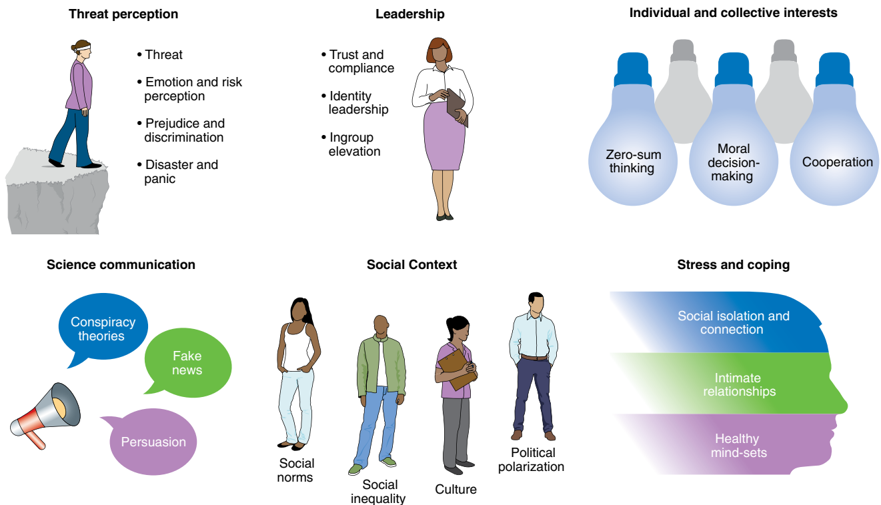
The COVID-19 pandemic represents a massive global health crisis. Because the crisis requires large-scale behaviour change and places significant psychological burdens on individuals, insights from the social and behavioural sciences can be used to help align human behaviour with the recommendations of epidemiologists and public health experts. Here we discuss evidence from a selection of research topics relevant to pandemics, including work on navigating threats, social and cultural influences on behaviour, science communication, moral decision-making, leadership, and stress and coping. In each section, we note the nature and quality of prior research, including uncertainty and unsettled issues. We identify several insights for effective response to the COVID-19 pandemic and highlight important gaps researchers should move quickly to fill in the coming weeks and months.
Overview
CoChat Summary
TL;DR
This perspective argues that social and behavioural science can help align public behaviour with COVID-19 public health recommendations across threat perception, social context, science communication, cooperation, leadership, and stress/coping. It synthesizes prior evidence and policy insights while cautioning that evidence is limited, often drawn from non-pandemic contexts, and in many areas unsettled.
Key findings
- The paper notes the scale of infectious disease threats: the bubonic plague killed approximately 25% of the European population, and by March 2020 COVID-19 had spread to more than 118,000 cases and caused 4,291 deaths in 114 countries. It also notes that 21 countries donated medical supplies to China in February, with China reciprocating widely.
- Fear appeals can change behaviour when people feel capable of dealing with the threat, but produce defensive reactions when people feel helpless; optimism bias can lead people to underestimate personal risk and ignore public health warnings.
- Social norms, inequality, culture, and political polarization shape pandemic behaviour: correcting misperceived norms can help when most people are already doing the desirable behaviour, but descriptive norms can backfire if the behaviour is undesirable unless paired with prescriptive norms.
- Effective communication and leadership may involve credible sources, messages that protect others or align with moral values, prebunking/inoculation against misinformation, accuracy nudges, shared social identity, and leaders modelling prosocial sacrifice; excessive national self-image concerns (“collective narcissism”) can backfire.
Methods
- Design: Perspective/narrative review; no primary data collection or sample. Topics were identified by the corresponding authors as potentially relevant to pandemic response and are explicitly not exhaustive.
- Evidence base: synthesizes prior social and behavioural research on threat perception, social context, science communication, moral decision-making, cooperation, leadership, and stress/coping, drawing on laboratory experiments, correlational studies, field experiments, meta-analyses, and preprints/forthcoming work.
- Analysis: narrative synthesis with policy implications and identified research gaps; no systematic search strategy or quantitative synthesis is reported.
Limitations
- Stated: due to space constraints, the paper provides only a brief summary of each topic; research on these topics is ongoing and in many cases far from settled; there is very little published social science research on the current pandemic, so discussion often draws from different circumstances and evidence quality varies substantially.
- Stated: insights and policy implications should be interpreted with caution.
- Evident: as a perspective rather than a systematic review or empirical study, it does not provide a comprehensive evidence appraisal, and its reliance on preprints and forthcoming sources limits certainty.
Model-written summary. Check it against the paper before relying on it.
Integrity signals
Registry
Cites
Statistics
Figures
Verification
Claims the paper makes
19 Valid · 5 Not valid · 37 Not checked · 13 Own results and interpretations
At least one cited source doesn’t support this claim or points to a different paper, and none confirmed it — see the verdicts below.
In the paper
“For instance, in hypothetical scenarios about deciding whether to go to work while sick, American and British participants reported they would be less willing to stay home when it was uncertain they would infect a co-worker.”
What the sources say
- Disputedcites [176] Kappes, A. et al. Uncertainty about the impact of social decisions increases prosocial behaviour. Nat. Hum. Behav. 2, 573–580 (2018). sourceExperimental — accuracy not yet measured
In the paper’s account of the infectious-disease scenario (Abstract; page not provided), participants facing uncertainty about how severely a co-worker might be affected were more likely to stay home than controls, not less. The paper distinguishes that impact uncertainty from uncertainty about whether a co-worker would be infected. Its Study 6 Methods (page not provided) describe recruitment through AMT, but do not establish the claimed American and British participant groups. (LLM, conf=0.88)
Checked by a reasoning model — may be wrong.
hedgedstates an association- Asserted: passes — The authors put it forward as true.
- Checkable: passes — It can be checked against evidence.
- Load-bearing: passes — The paper’s conclusions depend on it.
- Based: passes — The paper gives a reason why it holds.
- Disputed
The cited sources that could be checked couldn’t confirm or dispute this claim.
In the paper
“Moreover, there is mixed research regarding whether corrections may actually increase belief in the original misinformation 121,124-126 or in other misleading claims that fail to get corrected 127 .”
What the sources say
- Not checked — no full text of the sourcecites [121] Guess, A. & Coppock, A. Does counter-attitudinal information cause backlash? Results from three large survey experiments. Br. J. Polit. Sci. https://doi.org/10.1017/S0007123418000327 (2018). source
- Not matchedcites [124] Wittenberg, C. & Berinsky, A.J. Misinformation and its correction. in Social Media and Democracy: The State of the Field (eds Persily, N. & Tucker, J. A.) (Cambridge University Press, forthcoming).
Its entry has no title and year that we can search by.
- Not checked — no full text of the sourcecites [125] Swire, B. & Ecker, U.K.H. Misinformation and its correction: Cognitive mechanisms and recommendations for mass communication. in Misinformation and Mass Audiences (eds. Southwell, B. G., Thorson, E. A. & Sheble, L.) 195–2011 (University of Texas Press, 2018). source
- Not checked — no full text of the sourcecites [126] Wood, T. & Porter, E. The elusive backfire effect: mass attitudes’ steadfast factual adherence. Polit. Behav. 41, 135–163 (2018). source
- Could not verifycites [127] Pennycook, G., McPhetres, J., Zhang, Y. & Rand, D. Fighting COVID-19 misinformation on social media: Experimental evidence for a scalable accuracy nudge intervention. Preprint at PsyArXiv https://doi.org/10.31234/osf.io/uhbk9 (2020). sourceExperimental — accuracy not yet measured
Citation 127 is attached to the suggestion that corrections may increase belief in other misleading claims that go uncorrected. The Statement of Relevance and Discussion describe an accuracy nudge that improved sharing decisions, not corrections or their effects on belief in uncorrected claims. Searches for correction backfire and uncorrected misinformation found no passage addressing that point; page numbers were unavailable in our copy. (LLM, conf=0.76)
hedgedstates a possible cause- Asserted: passes — The authors put it forward as true.
- Checkable: passes — It can be checked against evidence.
- Load-bearing: passes — The paper’s conclusions depend on it.
- Based: passes — The paper gives a reason why it holds.
The sources with a verdict support this claim; the rest weren’t checked yet, have no full text we could read, or their verdicts aren’t rated yet.
In the paper
“Indeed, laboratory research has found that people prioritize local over global (or international) interests 185,186 .”
What the sources say
- Supportedcites [185] Milinski, M., Hilbe, C., Semmann, D., Sommerfeld, R. & Marotzke, J. Humans choose representatives who enforce cooperation in social dilemmas through extortion. Nat. Commun. 7, 10915 (2016). source
The Results section (‘Voters choose selfish representatives’; page unavailable) reports that participants preferentially re-elected representatives who contributed less to the shared climate account and elected candidates who pledged to contribute less than a fair share. In this simulated international dilemma, that supports the claim that participants favored their own group’s interests over the collective goal; it does not establish that everyone did so. (LLM, conf=0.85)
- Not checked — no full text of the sourcecites [186] Reinders Folmer, C. P. et al. One for all: what representing a group may do to us. J. Exp. Soc. Psychol. 48, 1047–1056 (2012). source
plain- Asserted: passes — The authors put it forward as true.
- Checkable: passes — It can be checked against evidence.
- Load-bearing: passes — The paper’s conclusions depend on it.
- Based: passes — The paper gives a reason why it holds.
- Supported
Every source the paper cites for this claim was checked and supports it.
In the paper
“However, when going to work risked infecting an elderly co-worker who would suffer a serious illness, participants reported they would be more willing to stay home 176 .”
What the sources say
- Supportedcites [176] Kappes, A. et al. Uncertainty about the impact of social decisions increases prosocial behaviour. Nat. Hum. Behav. 2, 573–580 (2018). source
The Study 6 Methods (page not provided) describe a scenario in which going to work could infect an older, vulnerable co-worker who would suffer severely, followed by a rating of willingness to go to work. The reported Study 6 findings (indexed under Abstract; page not provided) say participants given that risk information were significantly more likely to stay home than controls. (LLM, conf=0.92)
hedgedstates a cause- Asserted: passes — The authors put it forward as true.
- Checkable: passes — It can be checked against evidence.
- Load-bearing: passes — The paper’s conclusions depend on it.
- Based: passes — The paper gives a reason why it holds.
- Supported
The sources with a verdict support this claim; the rest weren’t checked yet, have no full text we could read, or their verdicts aren’t rated yet.
In the paper
“Several techniques, such as sanctioning defectors 187 or rewarding cooperators 188 , tend to increase cooperative behaviour in laboratory experiments using economic games.”
What the sources say
- Not checked — no full text of the sourcecites [187] Yamagishi, T. The provision of a sanctioning system as a public good. J. Pers. Soc. Psychol. 51, 110–116 (1986). source
- Supportedcites [188] Rand, D. G., Dreber, A., Ellingsen, T., Fudenberg, D. & Nowak, M. A. Positive interactions promote public cooperation. Science 325, 1272–1275 (2009). source
Citation 188 is attached to rewarding cooperators. The paper’s Abstract reports a laboratory comparison using repeated public goods games and finds that reward maintained public cooperation and, when both reward and punishment were available, increased contributions. (LLM, conf=0.93)
plainstates a cause- Asserted: passes — The authors put it forward as true.
- Checkable: passes — It can be checked against evidence.
- Load-bearing: unclear — It is unclear whether the paper’s conclusions depend on it.
- Based: passes — The paper gives a reason why it holds.
50 more claims · 13 with their cited sources checked
Create a free account to see all 74 claims and to verify the 2 references still open.
- It may state two separate claims as one. 13
- Probably not a substantial claim. 6
Claims other papers make about this one
Each is checked against this paper’s own text: does it say what the citing paper says it does?
The source backs part of the claim, not all of it — or backs it for a different population, condition or comparison.
In the citing paper
“COVID-19 is an international public health crisis, putting substantial burden on medical centers and increasing the psychological toll on health care workers (HCW).”
From Supporting the well-being of health care providers during the COVID-19 pandemic: The CopeColumbia response (2020) · cites this paper as [6]
Experimental — accuracy not yet measuredThe source backs part of the claim, not all of it — or backs it for a different population, condition or comparison.
In the citing paper
“these population-wide measures affected psychological well-being and mental health as well as increased social isolation [68] and loneliness.”
From Psychological correlates of perceived loneliness in college students before and during the COVID-19 stay-at-home period: a longitudinal study (2023) · cites this paper as [68]
Experimental — accuracy not yet measuredThe source backs part of the claim, not all of it — or backs it for a different population, condition or comparison.
In the citing paper
“they may eventually increase the social isolation of students and affect their psychological well-being and mental health [3].”
From Students under lockdown: Comparisons of students’ social networks and mental health before and during the COVID-19 crisis in Switzerland (2020) · cites this paper as [3]
Experimental — accuracy not yet measuredThe source backs part of the claim, not all of it — or backs it for a different population, condition or comparison.
In the citing paper
“effective interventions are hard to scale to a population level (12);”
From Psychological inoculation improves resilience against misinformation on social media (2022) · cites this paper as [12]
Experimental — accuracy not yet measuredThe source backs part of the claim, not all of it — or backs it for a different population, condition or comparison.
In the citing paper
“There is a shortage of studies that test anti-misinformation interventions in an ecologically valid manner, i.e., testing an intervention as consumers would interact with it in online environments (8, 12).”
From Psychological inoculation improves resilience against misinformation on social media (2022) · cites this paper as [12]
Experimental — accuracy not yet measured
6 more claims about this paper
Create a free account to see every claim other papers make about this one.
Citations
Cites
Granovetter, M. S. (1973) · American Journal of Sociology · doi:10.1086/225469 · Cited by 40,491
Zhou, F., Yu, T., Du, R., Fan, G., Liu, Y., Liu, Z., Xiang, J., Wang, Y., Song, B., Gu, X., et al. (2020) · The Lancet · doi:10.1016/s0140-6736(20)30566-3 · Cited by 27,263
The need to belong: Desire for interpersonal attachments as a fundamental human motivation.
Baumeister, R. F., & Leary, M. R. (1995) · Psychological Bulletin · doi:10.1037//0033-2909.117.3.497 · Cited by 23,245
Culture and the self: Implications for cognition, emotion, and motivation.
Markus, H. R., & Kitayama, S. (1991) · Psychological Review · doi:10.1037/0033-295x.98.2.224 · Cited by 21,995
Self-citationThe Psychological Impact of Quarantine and How to Reduce It: Rapid Review of the Evidence
Brooks, S. K., Webster, R. K., Smith, L. E., Woodland, L., Wessely, S., Greenberg, N., & Rubin, G. J. (2020) · doi:10.2139/ssrn.3532534 · Cited by 16,394
The psychological impact of quarantine and how to reduce it: Rapid review of the evidence
Brooks, S. K., Webster, R. K., Smith, L. E., Woodland, L., Wessely, S., Greenberg, N., & Rubin, G. J. (2020) · The Lancet · doi:10.1016/s0140-6736(20)30460-8 · Cited by 16,378
Nudge: improving decisions about health, wealth, and happiness
(2008) · Choice Reviews Online · doi:10.5860/choice.46-0977 · Cited by 11,572
Slovic, P. (1987) · Science · doi:10.1126/science.3563507 · Cited by 9,271
The Elaboration Likelihood Model of Persuasion
Petty, R. E., & Cacioppo, J. T. (1986) · Advances in Experimental Social Psychology · doi:10.1016/s0065-2601(08)60214-2 · Cited by 8,822
Self-citationThe emotional dog and its rational tail: A social intuitionist approach to moral judgment.
Haidt, J. (2001) · Psychological Review · doi:10.1037/0033-295x.108.4.814 · Cited by 8,048
Research works printed but not linked: 3
- Berkowitz, A.D. An overview of the social norms approach. in Changing the Culture of College Drinking: A Socially Situated Health Communication Campaign (eds. Stewart, L. & Lederman, L. C.) 193–214 (Hampton Press, 2005).
- Wittenberg, C. & Berinsky, A.J. Misinformation and its correction. in Social Media and Democracy: The State of the Field (eds Persily, N. & Tucker, J. A.) (Cambridge University Press, forthcoming).
- Ransohoff, K.J. Patients on the Trolley Track: The Moral Cognition of Medical Practitioners and Public Health Professionals. (Harvard Univ. Press, 2011).
Cited by
Items 3,601–3,700 of 5,015
Benameur, T., Saidi, N., Panaro, M. A., & Porro, C. (2025) · Healthcare · doi:10.3390/healthcare14010087 · Cited by 1
“This pandemic has led to a worldwide global health crisis [1].”
Political Trust in Crisis: Can Social Protection Make a Difference?
Boucher, C. (2026) · Political Studies · doi:10.1177/00323217251401089 · Cited by 3
“In this regard, trust was shown to be a determinant of various behaviors during the pandemic, such as vaccine uptake (Bavel et al., 2020), general compliance with governmental measures (Devine et al., 2023), and eventually lower infection rates (Bollyky et al., 2022).”
Topological analysis of COVID-19 wave patterns and policy responses in Europe
Chikore, T. (2026) · Frontiers in Public Health · doi:10.3389/fpubh.2025.1665863
Modelling behaviour in author networks with graphon mean field games
Fabian, T., Fabián, C., Koeppl, H., & Weitin, T. (2026) · Humanities and Social Sciences Communications · doi:10.1057/s41599-025-06482-4 · Cited by 1
“It has been shown that insights inform our societal handling of such health crises at various levels, including threat navigation, science communication, and moral decision-making (Bavel et al. 2020).”
Analysis on an SIS epidemic model with saturated recovery and dynamic behavior changes
Zhang, S., & Xiao, Y. (2026) · Nonlinear Dynamics · doi:10.1007/s11071-025-12014-1 · Cited by 1
Manfredi, P., Laurino, M., Pisaneschi, G., & Landi, A. (2026) · Journal of The Royal Society Interface · doi:10.1098/rsif.2025.0287 · Cited by 2
Hansen, L. H., Jørgensen, F. J., & Petersen, M. B. (2026) · Proceedings of the National Academy of Sciences · doi:10.1073/pnas.2415344123 · Cited by 2
Social Networks as Agents of Student Coping: Al Ain University Reflections on Five Years of COVID-19
Zaitoun, E. A., Jaradat, M. E., Abuhumaidan, Y., Zaitoun, H., & Mustafa, M. (2025) · International Conference on Social Networks Analysis, Management and Security (SNAMS) · doi:10.1109/snams67467.2025.11391044 · Cited by 1
“While online social connections can partially buffer the mental health impacts of isolation, their effects remain modest, underscoring the necessity of integrating social cohesion and emotional support mechanisms into crisis response strategies [20].”
Kabir, K. M. A., Mouri, I. J., & Tanimoto, J. (2026) · Complexity · doi:10.1155/cplx/8500709 · Cited by 2
Lee, J., Ju, S., & Kim, B. J. (2026) · Review of Policy Research · doi:10.1111/ropr.70084 · Cited by 1
Blanco‐Herrero, D., van den Putte, B., & van der Meer, T. G. L. A. (2026) · Information Communication & Society · doi:10.1080/1369118x.2026.2648687 · Cited by 1
Tetteh, E., López, J. D., McGovern, C., Aboagye-Mensah, G., Geng, E., & McKay, V. (2026) · Epidemiologia · doi:10.3390/epidemiologia7020048 · Cited by 1
“In contrast to models that frame social distancing primarily as an individual risk-management strategy [13,23,24], participants frequently described distancing as a relational and moral practice oriented toward protecting vulnerable household members and avoiding strain on healthcare systems.”
InfluentialZiyud, A., Al-Thelaya, K., & Schneider, J. (2026) · Multimodal Technologies and Interaction · doi:10.3390/mti10040043 · Cited by 2
Cui, Z., Wu, S., Ma, H., Zhang, Y., Lin, X., Hou, X., Ren, Y., Feng, Y., & Cao, Y. (2026) · BMC Psychology · doi:10.1186/s40359-026-04721-0 · Cited by 1
“Social norms, collective solidarity, and trust in science have been identified as important pandemic-era social processes [9, 10].”
The impact of dynamic asymmetric activity on the evolution of cooperation
Li, X., Zhang, X., Wang, Z., Xu, Y., & 姜罗罗 (2026) · Physica A Statistical Mechanics and its Applications · doi:10.1016/j.physa.2026.131658 · Cited by 6
Evolutionary branching and consistency in group cooperation
Glaubitz, A., & Fu, F. (2026) · Proceedings of the National Academy of Sciences · doi:10.1073/pnas.2523204123 · Cited by 5
Nadal, C. T., Quesada‐Pallarès, C., Guerra, P., Ahmedi, S., Saz, A., & Bernadó, B. S. (2026) · Journal of Health Psychology · doi:10.1177/13591053261462455 · Cited by 6
Social Networks and Depressive Feelings during the COVID-19 Pandemic in Europe
Uccheddu, D., Mikucka, M., & Rizzi, E. L. (2026) · Social Indicators Research · doi:10.1007/s11205-026-03895-9 · Cited by 1
World-Making: The Potential of Cultural Political Psychology
Power, S. A., Madsen, T., Morton, T. A., & Wagoner, B. (2026) · Theory and history in the human and social sciences · doi:10.1007/978-3-032-26793-1_3 · Cited by 3
AS NOVAS TECNOLOGIAS E A COVID-19: O REPENSAR DA CAPACITAÇÃO DOCENTE
Mendonça, A. A. D. S., & Franco, D. L. (2020) · doi:10.22533/at.ed.76020190811 · Cited by 5
Evolución de la pandemia de COVID-19 en los principales municipios turísticos de México
Damián, A. G. (2020) · Dimensiones Turísticas · doi:10.47557/yoek2594 · Cited by 1
Aksoy, P. (2020) · The journal of academic social science studies/The journal of academic social science · doi:10.29228/jasss.46326 · Cited by 1
Quaranta giorni leadership test: time to transform healthcare
Knawy, B. A., & Kozlakidis, Z. (2020) · BMJ Leader · doi:10.1136/leader-2020-000276 · Cited by 2
Improving compliance with COVID-19 guidance: a workplace field experiment
Arroyos-Calvera, D., Drouvelis, M., Lohse, J., & McDonald, R. (2023) · Behavioural Public Policy · doi:10.1017/bpp.2023.31 · Cited by 10
Jukkala, T., Ферландер, С., Aytar, O., Engdahl, E., Hristova, A., Hopstadius, M., Blasko, A. M., & Misheva, V. (2021) · Sociologisk Forskning · doi:10.37062/sf.58.22256 · Cited by 6
Coutinho, T. V., & Dias, M. R. G. (2020) · Debates em Psiquiatria · doi:10.25118/2236-918x-10-2-5 · Cited by 1
Travelling Racism: Global Forces and Their Impact on Racism
Elias, A., Mansouri, F., & Paradies, Y. (2021) · Springer eBooks · doi:10.1007/978-981-16-2137-6_9 · Cited by 2
Need to investigate COVID-19 beliefs for tailor-made sensitisation campaigns
Sun, M. C., Jeetun, B., Neerunjun, D., & Cheeneebash, J. (2021) · Public Health in Practice · doi:10.1016/j.puhip.2021.100156 · Cited by 1
“[10] highlight that the social and behavioural sciences have a major role to play in promoting healthy behaviour; for instance, focusing on worst-case scenarios, even if they are uncertain, has the potential to encourage people to adopt the relevant preventive measures.”
BackgroundPhillips, P., Darby, I., Phillips, L., et al. (2021) · British Journal of Healthcare Management · doi:10.12968/bjhc.2021.0013 · Cited by 1
Budianto, F., & Nishikori, Y. (2021) · Makara Human Behavior Studies in Asia · doi:10.7454/hubs.asia.4140920 · Cited by 1
“Moreover, Bavel et al. (2020) suggest that intense fear produces a change in behavior only when the individual predicts a change in behavior to be effective.”
BackgroundResultdos Santos, Z. B., & Tiburtino, V. (2021) · Texto Digital · doi:10.5007/1807-9288.2021.e81351 · Cited by 1
Behavioral Insights (BI) for Childhood Development and Effective Public Policies in Latin America
Tomio, A. A., Dottori, M., Hesse, E., Torrente, F. M., Flichtentrei, D., & Ibáñez, A. M. (2020) · BMJ Open · doi:10.1136/bmjopen-2020-047925 · Cited by 1
Uribe, F. L., Arteaga, Ó., Bruchhausen, W., Cheung, G., Cullum, S. J., Fuentes‐García, A., Miranda‐Castillo, C., Kerse, N. M., Kirk, R., Muru‐Lanning, M., et al. (2021) · Sustainability · doi:10.3390/su131810247 · Cited by 2
“However, various aspects influence the extent and speed of behavioral changes including social norms, social inequalities, culture and political polarization [103].”
BackgroundNisar, F., Zeb, S., Oosterhoff, B. J., & Ahmed, S. (2021) · Child & Youth Care Forum · doi:10.1007/s10566-021-09657-7 · Cited by 1
Huai, M., Du, D., Chen, M., & Liang, J. (2021) · Current Psychology · doi:10.1007/s12144-021-02464-2 · Cited by 4
Criticism of the ABI model of trustworthiness
Nooteboom, B. (2021) · Academia Letters · doi:10.20935/al4019 · Cited by 1
Cognitive Dissonance Theory and Policy Towards the Corona Epidemic in Developing Countries
James, J. (2021) · SpringerBriefs in economics · doi:10.1007/978-3-030-88497-0_2 · Cited by 1
Varra, L., & Timolo, M. (2021) · Advances in human resources management and organizational development book series · doi:10.4018/978-1-7998-8189-6.ch004 · Cited by 1
Love Thy Neighbour? Perceived Community Abidance and Private Compliance to COVID-19 Norms in India
Das, U., Sarkhel, P., & Ashraf, S. (2021) · South Asia Economic Journal · doi:10.1177/13915614211053928 · Cited by 2
La ola autoritaria y el extremismo en el mundo durante la pandemia de COVID-19
Valencia, R. M. (2021) · Comillas Journal of International Relations · doi:10.14422/cir.i22.y2021.004 · Cited by 2
The Influence of Metaphorical Frames on Americans’ Adherence to COVID-19 Public Health Guidelines
Singer-Freeman, E., & Thurman, E. (2021) · Journal of Student Research · doi:10.47611/jsrhs.v10i4.1902 · Cited by 1
Will Home Quarantine Eventually Seize us in the Grip of Loneliness; a systematic Review Study
Firoozi, M., & irannejad, E. (2021) · Health Research Journal · doi:10.52547/hrjbaq.6.4.331 · Cited by 2
The impact of the coronavirus pandemic on interest in owning a firearm in the American public
Syropoulos, S., Puschett, E., & Leidner, B. (2020) · Comprehensive Results in Social Psychology · doi:10.1080/23743603.2021.2018931 · Cited by 1
Legislative Architecture and Nudges: Complementary Tools to Increase Legal Order Resilience?
Zorzetto, S. (2022) · Legisprudence library · doi:10.1007/978-3-030-87262-5_11 · Cited by 1
Vu, T. T., Vu, D., Lee, K., Thi, L. N., Minh, N. L., Bao, P. P. D., Diem, N. T. H. T., Xuan, L. N., & Nam, P. T. (2021) · The Open Psychology Journal · doi:10.2174/1874350102114010342 · Cited by 2
Lee, G., & Lee, J. (2021) · Korean Journal of Journalism & Communication Studies · doi:10.20879/kjjcs.2021.65.6.006 · Cited by 1
Bedoya, I. A. V., Gómez, J. M., & Morán-Huertas, A. J. (2022) · Vinculatégica EFAN · doi:10.29105/vtga7.1-84 · Cited by 5
Does lockdown during COVID-19 pandemic destabilize bipolar patients? A prospective study
Gauld, C., Maquet, J., Ruhla, G., Bertrand, A., Pouchon, A., & Polosan, M. (2022) · La Presse Médicale Open · doi:10.1016/j.lpmope.2022.100021 · Cited by 1
“In this case, individuals could uncover inner resources and quickly learn to draw on external resources [11].”
Levers, L. L., & Drozda, N. A. (2022) · Springer Publishing Company eBooks · doi:10.1891/9780826150851.0024 · Cited by 1
Observation of spectators’ mask-wearing behavior at a national basketball tournament
Tran, Y. H., Blackburn, J. L., & Vest, J. R. (2022) · Managing Sport and Leisure · doi:10.1080/23750472.2022.2046492 · Cited by 2
“Behavioral scientists have postulated that both harmful and preventive behaviors may be in fl uenced by social norms and nudges (Bavel et al., 2020).”
BackgroundCoping with COVID-19 Isolation in Kerala, India: A Qualitative Analysis
Jabbar, J., Dharmarajan, S., Ramachandran, A. P., & Jasseer, A. (2022) · ASR Chiang Mai University Journal of Social Sciences and Humanities · doi:10.12982/cmujasr.2021.007 · Cited by 1
Prawo w czasie pandemii COVID-19: analiza wybranych kwestii społeczno-prawnych
Bandoch, J., & Drewek, M. (2022) · Ruch Prawniczy Ekonomiczny i Socjologiczny · doi:10.14746/rpeis.2022.84.1.19 · Cited by 1
Construção e validação de folheto para cuidadores de idosos sobre prevenção da COVID-19
de Oliveira, F., Silveira, H. N. G., Cézar, G. H. R., Rodrigues, R. N., Menezes, A. C., de Araújo, D. D., Andrade, S. N., & Trevisan, D. D. (2021) · Medicina (Ribeirão Preto) · doi:10.11606/issn.2176-7262.rmrp.2021.181681 · Cited by 2
PROBLEMS ENCOUNTERED BY THE BARANGAY FRONT LINERS ON THE ONSET OF THE COVID-19 PANDEMIC
Ayeo-eo, S. P., PAET, E., & Repoyo, L. (2022) · International Journal of Education Humanities and Social Science · doi:10.54922/ijehss.2022.0344 · Cited by 1
PERAN SPIRITUAL INTELLIGENCE MAHASISWA DALAM MEMATUHI PROTOKOL KESEHATAN
Arifin, M. L., Adibah, I. Z., Rijal, M. B., et al. (2021) · Refleksi Edukatika Jurnal Ilmiah Kependidikan · doi:10.24176/re.v12i1.5672 · Cited by 1
Wellbeing: Alternative Policy Perspectives
Besley, T., & Bucelli, I. (2022) · LSE Press eBooks · doi:10.31389/lsepress.well · Cited by 4
Loss, G. J., Fink, G., Bessa, L., & Brentani, A. (2022) · Child Abuse & Neglect · doi:10.1016/j.chiabu.2022.105667 · Cited by 1
COVID-19, “A Gift and a Curse” in Unsettling Times
Anakwe, A., Majee, W., & BeLue, R. (2022) · Family & Community Health · doi:10.1097/fch.0000000000000327 · Cited by 1
Ebron, K. T., & Andenoro, A. C. (2022) · Journal of Leadership Studies · doi:10.1002/jls.21804
Nnabuife, S. O. (2022) · International Journal of Health Sciences · doi:10.53730/ijhs.v6ns2.7852 · Cited by 1
IMMIGRANTS AS VICTIMS OF THE SCAPEGOAT MECHANISM IN THE COVID-19 PANDEMIC
GÜRSOY, M. (2022) · Pamukkale University Journal of Social Sciences Institute · doi:10.30794/pausbed.1032094 · Cited by 1
Yavuzaslan, K. (2022) · Adnan Menderes Üniversitesi Sosyal Bilimler Enstitüsü Dergisi · doi:10.30803/adusobed.1083820 · Cited by 1
Politicization of Pandemic and the Ramifications
Ullah, A. A., & Ferdous, J. (2022) · Springer eBooks · doi:10.1007/978-981-19-1910-7_3 · Cited by 2
Peer public health ambassadors and COVID-19 mitigating behaviors at a public university
Dewa, C. S., Phan, R. Q., Guggenbickler, A. M., et al. (2022) · Journal of American College Health · doi:10.1080/07448481.2022.2093609 · Cited by 1
Role of Hungarian Local Governance in Responding to COVID-19 Crisis
Bouhlel, S. (2021) · Institutiones Administrationis · doi:10.54201/iajas.v1i1.12 · Cited by 1
Conversa Saudável: abordagens sobre novo coronavírus e saúde mental na rádio CBN João Pessoa
Mendes, P. M., & Mendes, L. A. D. C. (2021) · doi:10.29327/561168.1-3 · Cited by 1
Benchmarking of COVID-19 testing facilities: a case in the Philippines
Velos, S. P., Go, M. B., Dayupay, J. P., Golbin, R. A., Cababat, F. G., Quiñanola, H., & Abellana, D. P. (2022) · Journal of Modelling in Management · doi:10.1108/jm2-01-2021-0029 · Cited by 1
Ong, J. E., & As’ari, M. A. (2022) · Journal of Human Centered Technology · doi:10.11113/humentech.v1n2.20 · Cited by 1
Statistical Controversies in Psychological Science
Hales, A. H., & Wood, N. R. (2022) · Springer eBooks · doi:10.1007/978-3-031-04968-2_9 · Cited by 2
Kim, Y.-H., Kim, S.-M., Kim, Y., & Jeong, H. (2022) · Korean Journal of Human Ecology · doi:10.5934/kjhe.2022.31.4.477 · Cited by 1
Analysis of Post-Immunization Incidence of Covid-19 Vaccine in Health Personnel in Mataram City
Khaidir, Y., Sastrawan, S., & Sulaiman, L. (2022) · Mutiara Medika: Jurnal Kedokteran dan Kesehatan · doi:10.18196/mmjkk.v22i2.13466 · Cited by 1
“It is an effort to succeed and accelerate the response to the Covid-19 pandemic.(16) Socialization about the benefits and side effects of the Covid-19 vaccine must continue to be carried out by providing the public with correct information to prevent hoax information currently circulating through various existing medi…”
BackgroundXie, S., Li, W., & Tan, Y. (2022) · Springer eBooks · doi:10.1007/978-3-030-94350-9_72 · Cited by 1
Figueiredo, M. D. C., & Filho, J. M. C. (2022) · Research Society and Development · doi:10.33448/rsd-v11i13.35235 · Cited by 4
Haines, S. T. (2022) · JACCP JOURNAL OF THE AMERICAN COLLEGE OF CLINICAL PHARMACY · doi:10.1002/jac5.1695 · Cited by 1
“we know work and the effects of treatments are too often diminished by negative messages and negative perceptions of providers.(16,17) We all recognize that the incentives in healthcare today are misaligned.”
BackgroundCesur, S., Topçu, M. T., & Kalcioglu, M. T. (2022) · American Journal of Audiology · doi:10.1044/2022_aja-22-00031 · Cited by 1
Çiçek, G., & Işık, Ö. (2022) · Spor Bilimleri Araştırmaları Dergisi · doi:10.25307/jssr.1124156 · Cited by 1
Masquerade of Polish Society—Psychological Determinants of COVID-19 Precautionary Behaviors
Józefacka, N. M., Podstawski, R., Płoszaj, M., et al. (2022) · International Journal of Environmental Research and Public Health · doi:10.3390/ijerph20010129 · Cited by 1
“Research has shown that social approval is associated with prosocial behavior [20], and that in situations of danger or disaster, it influences a strong concern for others, a sense of identity and cooperation, which affects adherence to social norms [21].”
BackgroundKoo, G. H., Johnson, T. J., Lee, T., & Jia, C. (2022) · Mass Communication & Society · doi:10.1080/15205436.2022.2144380 · Cited by 1
GÖKÇEİMAM, P. Ş., Selma Filiz, Y. A. R., & Kumsar, N. A. (2022) · Çukurova medical journal (Online)/Çukurova medical journal · doi:10.17826/cumj.1176773 · Cited by 1
Calderari, E. B., Vianna, F. R. P. M., & Meneghetti, F. K. (2022) · REAd Revista Eletrônica de Administração (Porto Alegre) · doi:10.1590/1413-2311.356.112251 · Cited by 23
Tu-Keefner, F., Hobbs, A., & Bricker, A. (2022) · Journal of Consumer Health on the Internet · doi:10.1080/15398285.2022.2124493 · Cited by 1
“During the COVID-19 pandemic, individuals have needed to identify and access specific, sensible information to help with problem-solving (Bavel et al. 2020; Kopelovich et al. 2021).”
BackgroundConsumer Behavior Analysis at The de' Akur Rantauprapat Coffee Store
Hasibuan, W. J., Pristiyono, P., & Zebua, Y. (2022) · Quantitative Economics and Management Studies · doi:10.35877/454ri.qems1048 · Cited by 1
Analysis of Healthcare Professionals’ and Institutions’ Roles in Twitter Colostomy Information
Hidalgo, P. J. J., Jiménez-Gómez, B., Ruíz-Núñez, C., Segado-Fernández, S., Diez-Villacañas, F., López‐Espuela, F., & Herrera‐Peco, I. (2023) · Healthcare · doi:10.3390/healthcare11020215 · Cited by 2
“Social networks have become a very powerful tool when searching for health-related information or collecting such information [13–15], but is this information correct? Is it based on scientific evidence? Are healthcare professionals, specifically nurses, the ones who generate health information regarding ostomies and…”
BackgroundRais, M., Hartoto, H., & Aryani, F. (2022) · Journal of Educational Science and Technology (EST) · doi:10.26858/est.v8i3.37318 · Cited by 2
Mathematical models and simulations of different scenarios of COVID-19 in Brazil
Lima, M. D. S. C., Silva, A., & Meyer, J. F. D. C. A. (2023) · Revista de Matemática Teoría y Aplicaciones · doi:10.15517/rmta.v30i1.50566 · Cited by 2
“As a measure to control the pandemic, WHO indicated the massive use of masks, hygiene campaigns and the adoption of physical distancing rules between individuals and the use of lockdowns - some of which quite severe [1].”
BackgroundKrzemińska, S. A., & Bąk, E. (2023) · Journal of Education Health and Sport · doi:10.12775/jehs.2023.13.03.025 · Cited by 1
Vildekilde, T., Connelly, J. J., van Houten, C. S., Thestrup, J., Sørensen, J. B., Meyrowitsch, D. W., & Konradsen, F. (2023) · International Journal of Environmental Research and Public Health · doi:10.3390/ijerph20032557 · Cited by 2
“[25] in their review of the social and psychological factors affecting COVID-19 pandemic behavior, “distancing clashes with the deep-seated human instinct to connect with others.”
BackgroundInfluentialAhmed, A., Rauza, R., & Hayat, Q. (2022) · Pakistan Journal of Social Research · doi:10.52567/pjsr.v4i04.915 · Cited by 2
Cotton, A.-M. (2022) · Communication et organisation · doi:10.4000/communicationorganisation.11605 · Cited by 3
Yıldız, E., & Çiftçi, M. Ç. (2023) · Psychogeriatrics · doi:10.1111/psyg.12941 · Cited by 2
Examining the anti-disaster volunteer discourse during the COVID-19 pandemic
Miyamae, R., Daimon, H., & Atsumi, T. (2023) · THE JAPANESE JOURNAL OF EXPERIMENTAL SOCIAL PSYCHOLOGY · doi:10.2130/jjesp.2214 · Cited by 2
Global epidemiology and impact of the SARS-CoV-2 pandemic
Bernal‐Silva, S., Torres‐Díaz, A., & Comas‐García, A. (2023) · Elsevier eBooks · doi:10.1016/b978-0-323-95064-0.00011-7 · Cited by 2
Applications of deep learning in forecasting COVID-19 pandemic and county-level risk warning
Wang, L., Han, S., Stöcker, H., Zhou, K., & Jiang, Y. (2023) · Elsevier eBooks · doi:10.1016/b978-0-323-95064-0.00014-2 · Cited by 2
Self-citationDiagnostic Assessment of Post-COVID-19 Operations for Business Model Reconfiguration Decision
Mtotywa, M. M., & Mtotywa, V. L. (2022) · Journal of Management and Research · doi:10.29145/jmr.92.03 · Cited by 1
“Fear is a common emotional response during a pandemic (Bavel et al., 2020) and threat evaluation has a beneficial effect on adherence to social distancing.”
BackgroundPortes, L. H., Marsico, E. F. C., & Paiva, N. S. (2023) · Revista Brasileira de Cancerologia · doi:10.32635/2176-9745.rbc.2023v69n2.3643 · Cited by 2
Psychiatry clerk reflections on the disruption of their clinical training during COVID-19 pandemic
Algahtani, H. M., Jahrami, H., & Husni, M. (2023) · Arab Gulf Journal of Scientific Research · doi:10.1108/agjsr-05-2022-0054 · Cited by 1
How Do People React to COVID-19 Vaccination? A Corpus-Based Study of Macau Netizens’ Online Comments
Chen, X., Wang, V. X., & Huang, C. (2023) · Lecture notes in computer science · doi:10.1007/978-3-031-28956-9_13 · Cited by 1
Unite and Conquer? Behavioural Pitfalls in Australia’s Response to COVID-19
Elkins, M. (2022) · Springer eBooks · doi:10.1007/978-981-19-5546-4_9 · Cited by 1
A Scoping Review of COVID-19 Pandemic: Information on Social Media
Kaur, J., & Mann, S. K. (2022) · Journal of Global Communication · doi:10.5958/0976-2442.2022.00001.5 · Cited by 1
Job satisfaction during Covid-19 social distancing: The case of teleworkers in Vietnam
Dang, T. K. P. (2023) · Central European Management Journal · doi:10.57030/23364890.cemj.31.2.55 · Cited by 1
“The global public health campaign that aims to halt the spread of the virus calls on people to wash their hands often, to limit the amount of time they spend face-to-face with others, and to always wear masks in public (Van Bavel et al., 2020).”
Background
Metadata
- Authors
- Bavel, J. J. V., Baicker, K., Boggio, P. S., Capraro, V., Cichocka, A., Cikara, M., Crockett, M. J., Crum, A. J., Douglas, K. M., Druckman, J. N., Drury, J., Dube, O., Ellemers, N., Finkel, E. J., Fowler, J. H., Gelfand, M., Han, S., Haslam, S. A., Jetten, J., Kitayama, S., Mobbs, D., Napper, L. E., Packer, D. J., Pennycook, G., Peters, E., Petty, R. E., Rand, D. G., Reicher, S. D., Schnall, S., Shariff, A., Skitka, L. J., Smith, S. S., Sunstein, C. R., Tabri, N., Tucker, J. A., Linden, S. V. D., Lange, P. V., Weeden, K. A., Wohl, M. J. A., Zaki, J., Zion, S. R., & Willer, R.
- Affiliations
- New York University (US)
- Universidade Presbiteriana Mackenzie (BR)
- Middlesex University London (GB)
- University of Kent (GB)
- Harvard University (US)
- Yale University (US)
- Stanford University (US)
- Northwestern University (US)
- University of Sussex (GB)
- University of Chicago (US)
- Utrecht University (NL)
- University of California San Diego (US)
- University of Maryland, College Park (US)
- Peking University (CN)
- The University of Queensland (AU)
- University of Michigan (US)
- California Institute of Technology (US)
- Lehigh University (US)
- University of Regina (CA)
- University of Oregon (US)
- The Ohio State University (US)
- Massachusetts Institute of Technology (US)
- University of St Andrews (GB)
- University of Cambridge (GB)
- University of British Columbia (CA)
- University of Illinois Chicago (US)
- University of California, Berkeley (US)
- Carleton University (CA)
- Cornell University (US)
- Corresponding author
- Bavel, Jay J. Van
- Willer, Robb
- ORCID
- Bavel, Jay J. Van
- Baicker, Katherine
- Boggio, Paulo S.
- Capraro, Valerio
- Cichocka, Aleksandra
- Cikara, Mina
- Crockett, Molly J.
- Crum, Alia J.
- Douglas, Karen M.
- Druckman, James N.
- Drury, John
- Ellemers, Naomi
- Finkel, Eli J.
- Fowler, James H.
- Gelfand, Michele
- Han, Shihui
- Haslam, S. Alexander
- Jetten, Jolanda
- Kitayama, Shinobu
- Mobbs, Dean
- Napper, Lucy E.
- Packer, Dominic J.
- Pennycook, Gordon
- Peters, Ellen
- Petty, Richard E.
- Rand, David G.
- Reicher, Stephen D.
- Schnall, Simone
- Shariff, Azim
- Skitka, Linda J.
- Sunstein, Cass R.
- Tabri, Nassim
- Tucker, Joshua A.
- Linden, Sander van der
- Weeden, Kim A.
- Wohl, Michael J. A.
- Zaki, Jamil
- Zion, Sean R.
- Willer, Robb
- Venue
- Nature Human Behaviour
- Published
- 2020-04-30
- Volume
- 4
- Issue
- 5
- Pages
- 460-471
- ISSN
- 2397-3374 (ISSN-L)
- OpenAlex
- W3016902371
- Semantic Scholar
- d81abcd7f053b136423f1e7f57928524e8b0e1a0
- Cited by
- 4,964
- References
- 259
- Citations by year
- 2026: 177 · 2025: 288 · 2024: 483 · 2023: 741 · 2022: 1094 · 2021: 1474 · 2020: 702
- FWCI
- 175.81
- Type
- journal article
- Language
- en
- Open access
- bronze
- doi.org
- Licence
- www.springernature.com/gp/researchers/text-and-data-mining (tdm)
- www.springernature.com/gp/researchers/text-and-data-mining (vor)
- Locations
- Nature Human Behaviour (publishedVersion)
- PubMed (publishedVersion)
- Middlesex University Research Repository (Middlesex University Of London) (acceptedVersion)
- Kent Academic Repository (University of Kent) (acceptedVersion)
- DSpace@MIT (Massachusetts Institute of Technology) (submittedVersion, cc-by-nc-sa)
- Sussex Research Online (University of Sussex) (submittedVersion)
- CaltechAUTHORS (California Institute of Technology) (submittedVersion)
- RePEc: Research Papers in Economics (submittedVersion)
- BOA (University of Milano-Bicocca) (submittedVersion)
- Carleton University's Institutional Repository (MacOdrum Library, Carleton University) (submittedVersion, other-oa)
- Utrecht University Repository (Utrecht University) (submittedVersion)
- Figshare (submittedVersion)
- VU Research Portal (submittedVersion, other-oa)
- Utrecht University Repository (Utrecht University) (submittedVersion, other-oa)
- Data Archiving and Networked Services (DANS) (submittedVersion, other-oa)
- Funders
- U.S. Department of Health and Human Services (2P50 MH094258)
- National Institute of Mental Health (P50MH094258)
- Topics
- Social Sciences › Sociology and Political Science › COVID-19 Prevention and Impact
- Social Sciences › Communication › Communication and COVID-19 Impact
- Physical Sciences › Mathematics › Modeling and Simulation › COVID-19 epidemiological studies
- Keywords
- COVID-19 pandemic, pandemic response, behavior change, science communication, ethical decision-making, leadership, stress coping, psychological burden, public health recommendations
- MeSH terms
- Betacoronavirus, COVID-19, SARS-CoV-2, Adaptation, Psychological, Communicable Disease Control, Decision Making, Humans, Human Activities, Health Knowledge, Attitudes, Practice, Leadership, Pneumonia, Viral, Public Health, Quarantine, Stress, Psychological, Global Health, Coronavirus, Coronavirus Infections, Pandemics, Social Media, Epidemiological Monitoring
About these checks
Registry, retraction, Cites and statistics results are computed, not judged, with one exception: a printed reference that no index lists is read once by a model before it counts as a citation error. Claims are extracted by a model and kept only when their quote appears verbatim in the text; each cited source is then checked, with a model’s help, for whether it says what the claim relies on. Those verdicts can be wrong — read the claim’s quote and the cited source before relying on one.
The claim verdicts this report counts are experimental: their accuracy is not yet measured.
A language model drew the claims from the paper on 2026-10-10, under version 3 of the claim definition (model deepseek-v4.1-flash, prompt extract-v3).
A second model labelled each claim on 2026-10-10 (model jev-1.13-20260917, definition revision gold-guideline-v0.2).
Cited sources are checked with a language model’s help (gpt-6-sol).
Statistics and arithmetic are recomputed, not judged.
Confidence bands are shown only for fields calibrated on our annotated test set. None is calibrated yet, so no band is shown.
What counts as a claim ›How we measure confidence ›How we check this ›
Are you an author, or do you see a problem with this page? Request a review
Data sources
Bibliographic data: Semantic Scholar, OpenAlex, Crossref.
Contains information from the Semantic Scholar Academic Graph Datasets, made available under the ODC Attribution License (ODC-BY 1.0).
Semantic Scholar’s data is described in: Kinney, R., et al. (2023). The Semantic Scholar Open Data Platform. arXiv:2301.10140.
