

Using social and behavioural science to support COVID-19 pandemic response
Open accessThe DOI matches its Crossref record; 257 of the 259 references it cites were found in a registry or an index; 24 of the 89 sources its claims cite were checked for support.
Abstract
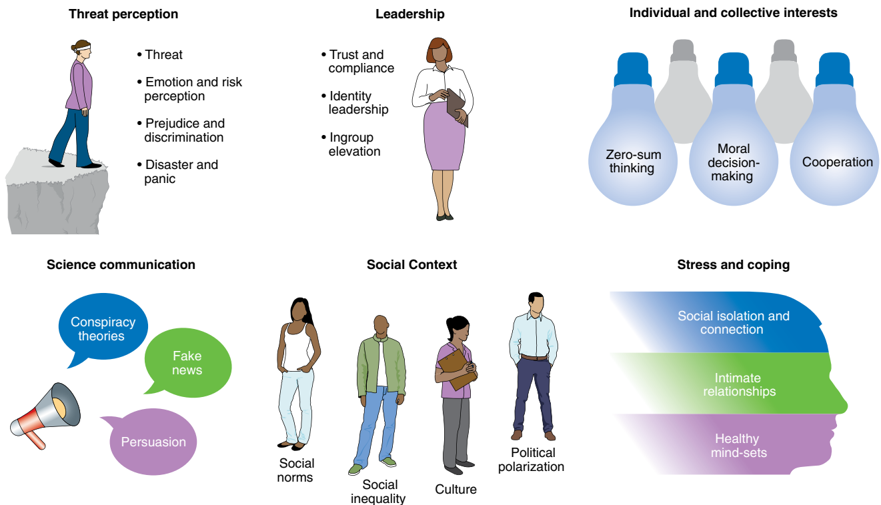
The COVID-19 pandemic represents a massive global health crisis. Because the crisis requires large-scale behaviour change and places significant psychological burdens on individuals, insights from the social and behavioural sciences can be used to help align human behaviour with the recommendations of epidemiologists and public health experts. Here we discuss evidence from a selection of research topics relevant to pandemics, including work on navigating threats, social and cultural influences on behaviour, science communication, moral decision-making, leadership, and stress and coping. In each section, we note the nature and quality of prior research, including uncertainty and unsettled issues. We identify several insights for effective response to the COVID-19 pandemic and highlight important gaps researchers should move quickly to fill in the coming weeks and months.
Overview
CoChat Summary
TL;DR
This perspective argues that social and behavioural science can help align public behaviour with COVID-19 public health recommendations across threat perception, social context, science communication, cooperation, leadership, and stress/coping. It synthesizes prior evidence and policy insights while cautioning that evidence is limited, often drawn from non-pandemic contexts, and in many areas unsettled.
Key findings
- The paper notes the scale of infectious disease threats: the bubonic plague killed approximately 25% of the European population, and by March 2020 COVID-19 had spread to more than 118,000 cases and caused 4,291 deaths in 114 countries. It also notes that 21 countries donated medical supplies to China in February, with China reciprocating widely.
- Fear appeals can change behaviour when people feel capable of dealing with the threat, but produce defensive reactions when people feel helpless; optimism bias can lead people to underestimate personal risk and ignore public health warnings.
- Social norms, inequality, culture, and political polarization shape pandemic behaviour: correcting misperceived norms can help when most people are already doing the desirable behaviour, but descriptive norms can backfire if the behaviour is undesirable unless paired with prescriptive norms.
- Effective communication and leadership may involve credible sources, messages that protect others or align with moral values, prebunking/inoculation against misinformation, accuracy nudges, shared social identity, and leaders modelling prosocial sacrifice; excessive national self-image concerns (“collective narcissism”) can backfire.
Methods
- Design: Perspective/narrative review; no primary data collection or sample. Topics were identified by the corresponding authors as potentially relevant to pandemic response and are explicitly not exhaustive.
- Evidence base: synthesizes prior social and behavioural research on threat perception, social context, science communication, moral decision-making, cooperation, leadership, and stress/coping, drawing on laboratory experiments, correlational studies, field experiments, meta-analyses, and preprints/forthcoming work.
- Analysis: narrative synthesis with policy implications and identified research gaps; no systematic search strategy or quantitative synthesis is reported.
Limitations
- Stated: due to space constraints, the paper provides only a brief summary of each topic; research on these topics is ongoing and in many cases far from settled; there is very little published social science research on the current pandemic, so discussion often draws from different circumstances and evidence quality varies substantially.
- Stated: insights and policy implications should be interpreted with caution.
- Evident: as a perspective rather than a systematic review or empirical study, it does not provide a comprehensive evidence appraisal, and its reliance on preprints and forthcoming sources limits certainty.
Model-written summary. Check it against the paper before relying on it.
Integrity signals
Registry
Cites
Statistics
Figures
Verification
Claims the paper makes
19 Valid · 5 Not valid · 37 Not checked · 13 Own results and interpretations
At least one cited source doesn’t support this claim or points to a different paper, and none confirmed it — see the verdicts below.
In the paper
“For instance, in hypothetical scenarios about deciding whether to go to work while sick, American and British participants reported they would be less willing to stay home when it was uncertain they would infect a co-worker.”
What the sources say
- Disputedcites [176] Kappes, A. et al. Uncertainty about the impact of social decisions increases prosocial behaviour. Nat. Hum. Behav. 2, 573–580 (2018). sourceExperimental — accuracy not yet measured
In the paper’s account of the infectious-disease scenario (Abstract; page not provided), participants facing uncertainty about how severely a co-worker might be affected were more likely to stay home than controls, not less. The paper distinguishes that impact uncertainty from uncertainty about whether a co-worker would be infected. Its Study 6 Methods (page not provided) describe recruitment through AMT, but do not establish the claimed American and British participant groups. (LLM, conf=0.88)
Checked by a reasoning model — may be wrong.
hedgedstates an association- Asserted: passes — The authors put it forward as true.
- Checkable: passes — It can be checked against evidence.
- Load-bearing: passes — The paper’s conclusions depend on it.
- Based: passes — The paper gives a reason why it holds.
- Disputed
The cited sources that could be checked couldn’t confirm or dispute this claim.
In the paper
“Moreover, there is mixed research regarding whether corrections may actually increase belief in the original misinformation 121,124-126 or in other misleading claims that fail to get corrected 127 .”
What the sources say
- Not checked — no full text of the sourcecites [121] Guess, A. & Coppock, A. Does counter-attitudinal information cause backlash? Results from three large survey experiments. Br. J. Polit. Sci. https://doi.org/10.1017/S0007123418000327 (2018). source
- Not matchedcites [124] Wittenberg, C. & Berinsky, A.J. Misinformation and its correction. in Social Media and Democracy: The State of the Field (eds Persily, N. & Tucker, J. A.) (Cambridge University Press, forthcoming).
Its entry has no title and year that we can search by.
- Not checked — no full text of the sourcecites [125] Swire, B. & Ecker, U.K.H. Misinformation and its correction: Cognitive mechanisms and recommendations for mass communication. in Misinformation and Mass Audiences (eds. Southwell, B. G., Thorson, E. A. & Sheble, L.) 195–2011 (University of Texas Press, 2018). source
- Not checked — no full text of the sourcecites [126] Wood, T. & Porter, E. The elusive backfire effect: mass attitudes’ steadfast factual adherence. Polit. Behav. 41, 135–163 (2018). source
- Could not verifycites [127] Pennycook, G., McPhetres, J., Zhang, Y. & Rand, D. Fighting COVID-19 misinformation on social media: Experimental evidence for a scalable accuracy nudge intervention. Preprint at PsyArXiv https://doi.org/10.31234/osf.io/uhbk9 (2020). sourceExperimental — accuracy not yet measured
Citation 127 is attached to the suggestion that corrections may increase belief in other misleading claims that go uncorrected. The Statement of Relevance and Discussion describe an accuracy nudge that improved sharing decisions, not corrections or their effects on belief in uncorrected claims. Searches for correction backfire and uncorrected misinformation found no passage addressing that point; page numbers were unavailable in our copy. (LLM, conf=0.76)
hedgedstates a possible cause- Asserted: passes — The authors put it forward as true.
- Checkable: passes — It can be checked against evidence.
- Load-bearing: passes — The paper’s conclusions depend on it.
- Based: passes — The paper gives a reason why it holds.
The sources with a verdict support this claim; the rest weren’t checked yet, have no full text we could read, or their verdicts aren’t rated yet.
In the paper
“Indeed, laboratory research has found that people prioritize local over global (or international) interests 185,186 .”
What the sources say
- Supportedcites [185] Milinski, M., Hilbe, C., Semmann, D., Sommerfeld, R. & Marotzke, J. Humans choose representatives who enforce cooperation in social dilemmas through extortion. Nat. Commun. 7, 10915 (2016). source
The Results section (‘Voters choose selfish representatives’; page unavailable) reports that participants preferentially re-elected representatives who contributed less to the shared climate account and elected candidates who pledged to contribute less than a fair share. In this simulated international dilemma, that supports the claim that participants favored their own group’s interests over the collective goal; it does not establish that everyone did so. (LLM, conf=0.85)
- Not checked — no full text of the sourcecites [186] Reinders Folmer, C. P. et al. One for all: what representing a group may do to us. J. Exp. Soc. Psychol. 48, 1047–1056 (2012). source
plain- Asserted: passes — The authors put it forward as true.
- Checkable: passes — It can be checked against evidence.
- Load-bearing: passes — The paper’s conclusions depend on it.
- Based: passes — The paper gives a reason why it holds.
- Supported
Every source the paper cites for this claim was checked and supports it.
In the paper
“However, when going to work risked infecting an elderly co-worker who would suffer a serious illness, participants reported they would be more willing to stay home 176 .”
What the sources say
- Supportedcites [176] Kappes, A. et al. Uncertainty about the impact of social decisions increases prosocial behaviour. Nat. Hum. Behav. 2, 573–580 (2018). source
The Study 6 Methods (page not provided) describe a scenario in which going to work could infect an older, vulnerable co-worker who would suffer severely, followed by a rating of willingness to go to work. The reported Study 6 findings (indexed under Abstract; page not provided) say participants given that risk information were significantly more likely to stay home than controls. (LLM, conf=0.92)
hedgedstates a cause- Asserted: passes — The authors put it forward as true.
- Checkable: passes — It can be checked against evidence.
- Load-bearing: passes — The paper’s conclusions depend on it.
- Based: passes — The paper gives a reason why it holds.
- Supported
The sources with a verdict support this claim; the rest weren’t checked yet, have no full text we could read, or their verdicts aren’t rated yet.
In the paper
“Several techniques, such as sanctioning defectors 187 or rewarding cooperators 188 , tend to increase cooperative behaviour in laboratory experiments using economic games.”
What the sources say
- Not checked — no full text of the sourcecites [187] Yamagishi, T. The provision of a sanctioning system as a public good. J. Pers. Soc. Psychol. 51, 110–116 (1986). source
- Supportedcites [188] Rand, D. G., Dreber, A., Ellingsen, T., Fudenberg, D. & Nowak, M. A. Positive interactions promote public cooperation. Science 325, 1272–1275 (2009). source
Citation 188 is attached to rewarding cooperators. The paper’s Abstract reports a laboratory comparison using repeated public goods games and finds that reward maintained public cooperation and, when both reward and punishment were available, increased contributions. (LLM, conf=0.93)
plainstates a cause- Asserted: passes — The authors put it forward as true.
- Checkable: passes — It can be checked against evidence.
- Load-bearing: unclear — It is unclear whether the paper’s conclusions depend on it.
- Based: passes — The paper gives a reason why it holds.
50 more claims · 13 with their cited sources checked
Create a free account to see all 74 claims and to verify the 2 references still open.
- It may state two separate claims as one. 13
- Probably not a substantial claim. 6
Claims other papers make about this one
Each is checked against this paper’s own text: does it say what the citing paper says it does?
The source backs part of the claim, not all of it — or backs it for a different population, condition or comparison.
In the citing paper
“COVID-19 is an international public health crisis, putting substantial burden on medical centers and increasing the psychological toll on health care workers (HCW).”
From Supporting the well-being of health care providers during the COVID-19 pandemic: The CopeColumbia response (2020) · cites this paper as [6]
Experimental — accuracy not yet measuredThe source backs part of the claim, not all of it — or backs it for a different population, condition or comparison.
In the citing paper
“these population-wide measures affected psychological well-being and mental health as well as increased social isolation [68] and loneliness.”
From Psychological correlates of perceived loneliness in college students before and during the COVID-19 stay-at-home period: a longitudinal study (2023) · cites this paper as [68]
Experimental — accuracy not yet measuredThe source backs part of the claim, not all of it — or backs it for a different population, condition or comparison.
In the citing paper
“they may eventually increase the social isolation of students and affect their psychological well-being and mental health [3].”
From Students under lockdown: Comparisons of students’ social networks and mental health before and during the COVID-19 crisis in Switzerland (2020) · cites this paper as [3]
Experimental — accuracy not yet measuredThe source backs part of the claim, not all of it — or backs it for a different population, condition or comparison.
In the citing paper
“effective interventions are hard to scale to a population level (12);”
From Psychological inoculation improves resilience against misinformation on social media (2022) · cites this paper as [12]
Experimental — accuracy not yet measuredThe source backs part of the claim, not all of it — or backs it for a different population, condition or comparison.
In the citing paper
“There is a shortage of studies that test anti-misinformation interventions in an ecologically valid manner, i.e., testing an intervention as consumers would interact with it in online environments (8, 12).”
From Psychological inoculation improves resilience against misinformation on social media (2022) · cites this paper as [12]
Experimental — accuracy not yet measured
6 more claims about this paper
Create a free account to see every claim other papers make about this one.
Citations
Cites
Granovetter, M. S. (1973) · American Journal of Sociology · doi:10.1086/225469 · Cited by 40,491
Zhou, F., Yu, T., Du, R., Fan, G., Liu, Y., Liu, Z., Xiang, J., Wang, Y., Song, B., Gu, X., et al. (2020) · The Lancet · doi:10.1016/s0140-6736(20)30566-3 · Cited by 27,263
The need to belong: Desire for interpersonal attachments as a fundamental human motivation.
Baumeister, R. F., & Leary, M. R. (1995) · Psychological Bulletin · doi:10.1037//0033-2909.117.3.497 · Cited by 23,245
Culture and the self: Implications for cognition, emotion, and motivation.
Markus, H. R., & Kitayama, S. (1991) · Psychological Review · doi:10.1037/0033-295x.98.2.224 · Cited by 21,995
Self-citationThe Psychological Impact of Quarantine and How to Reduce It: Rapid Review of the Evidence
Brooks, S. K., Webster, R. K., Smith, L. E., Woodland, L., Wessely, S., Greenberg, N., & Rubin, G. J. (2020) · doi:10.2139/ssrn.3532534 · Cited by 16,394
The psychological impact of quarantine and how to reduce it: Rapid review of the evidence
Brooks, S. K., Webster, R. K., Smith, L. E., Woodland, L., Wessely, S., Greenberg, N., & Rubin, G. J. (2020) · The Lancet · doi:10.1016/s0140-6736(20)30460-8 · Cited by 16,378
Nudge: improving decisions about health, wealth, and happiness
(2008) · Choice Reviews Online · doi:10.5860/choice.46-0977 · Cited by 11,572
Slovic, P. (1987) · Science · doi:10.1126/science.3563507 · Cited by 9,271
The Elaboration Likelihood Model of Persuasion
Petty, R. E., & Cacioppo, J. T. (1986) · Advances in Experimental Social Psychology · doi:10.1016/s0065-2601(08)60214-2 · Cited by 8,822
Self-citationThe emotional dog and its rational tail: A social intuitionist approach to moral judgment.
Haidt, J. (2001) · Psychological Review · doi:10.1037/0033-295x.108.4.814 · Cited by 8,048
Research works printed but not linked: 3
- Berkowitz, A.D. An overview of the social norms approach. in Changing the Culture of College Drinking: A Socially Situated Health Communication Campaign (eds. Stewart, L. & Lederman, L. C.) 193–214 (Hampton Press, 2005).
- Wittenberg, C. & Berinsky, A.J. Misinformation and its correction. in Social Media and Democracy: The State of the Field (eds Persily, N. & Tucker, J. A.) (Cambridge University Press, forthcoming).
- Ransohoff, K.J. Patients on the Trolley Track: The Moral Cognition of Medical Practitioners and Public Health Professionals. (Harvard Univ. Press, 2011).
Cited by
Items 4,601–4,700 of 5,015
Wang, Y., Yan, Z., Wang, D., et al. (2022) · Figshare · doi:10.6084/m9.figshare.19881550
Data on COVID-19-related Research Questions Spanning Diverse Disciplinary and National Contexts
Blask, K., Maehler, D. B., & Kerwer, M. (2024) · Journal of Open Psychology Data · doi:10.5334/jopd.111
Wang, Y., He, Q., & Li, X. (2024) · Health Communication · doi:10.1080/10410236.2024.2335424
“When people have a heightened sense of social risk and hold those who pose such risks accountable, they are also likely to self-regulate, monitor their own behaviors, and adhere more closely to pandemic con-trol guidelines (Bavel et al., 2020; Festinger, 1957; Inzlicht et al., 2006).”
Wand, H. C., Moodley, J., Reddy, T., et al. (2024) · Advances in Public Health · doi:10.1155/2024/6673623
Hansen, L. H., Jørgensen, F. J., & Petersen, M. B. (2024) · doi:10.31234/osf.io/t72dw
Nyambe, H. K., Li, X., & Xiong, M. (2024) · International Journal of Science and Research Archive · doi:10.30574/ijsra.2024.11.2.0595
Research on a Class of Infectious Disease Model with Information Effects Based on Data Driven
梁, 媛. (2024) · Operations Research and Fuzziology · doi:10.12677/orf.2024.142171
Measuring is knowing? Eliciting preferences in the general population
Bokern, P. (2024) · Research Publications (Maastricht University) · doi:10.26481/dis.20240529pb
Communal Sharing as the Foundation of Solidarity Action in Youth Organization
Jayanti, M., Minza, W. M., & Nurdiyanto, F. A. (2024) · Jurnal Psikologi · doi:10.22146/jpsi.80984 · Cited by 2
“Ideally, solidarity action happens in the long term because inter-individual partnership and collaboration within the community are needed to mitigate the crisis caused by the pandemic (Bavel et al., 2020).”
BackgroundFrozen discourse: how screenshots hinder depolarization on social media
Harel, T. O. (2024) · Information Communication & Society · doi:10.1080/1369118x.2024.2346530 · Cited by 1
“Specifically, scholars have largely over-looked the question of how interactions between opposing partisans on social media in contexts that are thought to mitigate AP, such as external threats (Van Bavel et al., 2020), might affect (de)polarization.”
Adaptation of SME-s in the Face of COVIDI-19, Albanian RealityPreprint
Çinaj, V., & Ribaj, A. (2024) · SSRN Electronic Journal · doi:10.2139/ssrn.4775873
Kauser, R., & Qamar, A. H. (2021) · PJPPRP · doi:10.62663/pjpprp.v12i2.38
“The huge number of casualties around the globe also suggests a dire need to study this risk perception in public regarding this infectious disease (van Bavel et al., 2020).”
BackgroundHealth benefits and emerging models of floral health tourism
Wang, S. (2024) · International Journal of Research Studies in Education · doi:10.5861/ijrse.2024.24020
Adam‐Troian, J., Bonetto, É., & Delouvée, S. (2024) · International Review of Social Psychology · doi:10.5334/irsp.802 · Cited by 1
Rotondi, V., Babazadeh, M., Landolfi, G., Luciani, M., Uccella, L., Dell’Oca, S., Rosselli, M., Botturi, L., & Zufferey, M. C. (2024) · Frontiers in Public Health · doi:10.3389/fpubh.2024.1368056
Kim, E.-J., & Byun, M. (2024) · Medicina · doi:10.3390/medicina60050827 · Cited by 2
“To promote compliance with social distancing measures, emphasis was placed on educational campaigns to promote public awareness, clear communication of public health guidelines, and the implementation of policies and regulations [35,36].”
BackgroundCasteltrione, I. (2024) · European Journal of Health Communication · doi:10.47368/ejhc.2024.105
Racism, Stigma, and the COVID-19 Pandemic
Chae, D. H., Chung, K. W., Cunningham, D. J., Martz, C. D., & Cunningham, M. (2024) · Oxford University Press eBooks · doi:10.1093/oso/9780197625217.003.0005 · Cited by 1
Seeing Opposites: How Partisan Counter-Projection Fuels False PolarizationPreprint
Knowles, E. D., Mogami, M., & Yudkin, D. A. (2024) · OSF Preprints (OSF Preprints) · doi:10.31219/osf.io/7kcnh
Turismo, patrimonio y experiencia de la educación interprofesional en Camagüey, Cuba
Chaos, M. T., & Morales, R. A. (2023) · PatryTer · doi:10.26512/patryter.v7i13.42809
Customer Behavioral Shifts as a Result of the COVID-19 Pandemic: Are They “Sticky”?Preprint
Xu, Y., Bahrami, M., & Pentland, A. (2024) · SocArXiv (OSF Preprints) · doi:10.31235/osf.io/jk7q9 · Cited by 1
Development of Plate in (Physical Literacy Assessment Tool and Evaluation) Physical Education
Sargento, L. M. J. U. (2024) · International Journal of Research Publications · doi:10.47119/ijrp1001491520246487
“The recent COVID-19 pandemic is an enormous global health emergency (Bavel et al., 2020) and a rapidly spreading pandemic (Bentlage et al., 2020).”
News Consumption and the Illiberal Public Sphere During the COVID-19 Pandemic
Štětka, V., & Mihelj, S. (2024) · Springer eBooks · doi:10.1007/978-3-031-54489-7_8
El-Alameey, I. R., Aljohani, G. A., Alharbi, R., Shuwaykan, R. A., Almutairi, A. E., & Shokr, A. A. (2024) · Journal of The Arab Society for Medical Research · doi:10.4103/jasmr.jasmr_29_23
Matuk, C. F., d’Anjou, B., Mansukhani, P., Porteous, F., Burgas, K., Zerwas, F. K., Shevchenko, Y., & Dikker, S. (2024) · ACM International Conference on Interaction Design and Children (IDC) · doi:10.1145/3628516.3659369 · Cited by 2
Psychological factors of emotional burnout of emergency medical workers in COVID-19 pandemic
Завязкіна, Н., Бурлачук, Л. Ф., Didenko, S. V., Lysenko, I. P., & OVCHAR, K. (2024) · Minerva Psychiatry · doi:10.23736/s2724-6612.22.02387-9
Nudge interventions promoting hand hygiene: a large-scale field experiment in an industrial plant
Costa, S., Disli, M., Duyck, W., & Dirix, N. (2024) · Journal of Public Health · doi:10.1007/s10389-024-02304-0 · Cited by 1
“Next to the medical approach, it became clear that human behavior is a vital factor to temper a pandemic by an infectious virus like COVID-19 (Bavel et al. 2020).”
InfluentialPujianto, H., Sarsono, Pawenang, S., & Sudarwati (2024) · RELEVANCE Journal of Management and Business · doi:10.22515/relevance.v7i1.9053
“…detrimental hospitable and cognitive impacts (Dubey et al., 2020), aspects of the global economy and monetary demands (Ali, Alam, & Rizvi, 2020; Bavel et al., 2020; Shanaev, Shuraeva, & Ghimire, 2020) are additionally hampered by the circumstance of COVID-19 outbreak prevention measures…”
BackgroundChina's cultural tightness and stock price crash risk
Hu, J. (2026) · Pacific-Basin Finance Journal · doi:10.1016/j.pacfin.2026.103344 · Cited by 1
La préparation mentale face aux catastrophes naturelles
Jehel, L., & Guidère, M. (2024) · Médecine de Catastrophe - Urgences Collectives · doi:10.1016/j.pxur.2024.06.002
Fake news e o repertório contemporâneo de ação política
Mendonça, R. F., Freitas, V. G., Aggio, C. D. O., & Santos, N. (2023) · Editora UFMG eBooks · doi:10.7476/9786588592335.0011
Attraction by pairwise coherence explains the emergence of ideological sorting
Zimmerman, F., Pedraza, L., Navajas, J., & Balenzuela, P. (2024) · PNAS Nexus · doi:10.1093/pnasnexus/pgae263 · Cited by 1
“Polarization drives hatred among family members (6), enables the spread of misinformation (7, 8 ), promotes the segregation of societies, and reduces the chances of coherently responding to large-scale crises, as recently demon - strated by the COVID-19 pandemic (9 – 11).”
BackgroundSaputra, R., Nuraida, Suhardita, K., Oktasari, M., & Folastri, S. (2024) · Journal of Affective Disorders · doi:10.1016/j.jad.2024.07.042
OECD (2023) · Educational research and innovation · doi:10.1787/7f1290ac-it
Role of pandemic in driving adoption of artificial intelligence in healthcare industry
Oumaihka, K. (2024) · Computer Science & IT Research Journal · doi:10.51594/csitrj.v5i7.1358
The importance of the incubation time distribution in compartmental epidemiological models
Rozan, E., Kuperman, M. N., & Bouzat, S. (2024) · Physica A Statistical Mechanics and its Applications · doi:10.1016/j.physa.2024.129998
“This empathetic approach is vital in maintaining social cohesion and mental well-being during periods of crisis [2, 3, 4].”
BackgroundProlonged COVID-19's Double Impact: Stress and Male Fertility
Alkireidmi, M. A., Kaleem, M., Naqvi, S., Al-Abbasi, F. A., Kamal, M. A., & Anwar, F. (2024) · Coronaviruses · doi:10.2174/0126667975316497240725102111
Evolving Marketing Trends in the Era of COVID-19: A Shifted Landscape
Willie, M. M. (2024) · Sustainable development · doi:10.5772/intechopen.112018
Alhugbani, H. F. (2024) · Advances in Applied Sociology · doi:10.4236/aasoci.2024.148027
Tracking the Development of COVID-19-related PsyArXiv Preprints
Wulf, M., Yesilada, M., Holford, D. L., Abels, C. M., Radosevic, M., Stuchlý, E., Taylor, K. S., Ye, S., Saxena, G., El-Halaby, G., et al. (2024) · Collabra Psychology · doi:10.1525/collabra.121378
“Heeding advice from epidemiologists and public health experts necessitates significant behavioural changes (Hargreaves & Davey, 2020) and puts considerable psychological strain on people (Van Bavel et al., 2020).”
BackgroundKim, H. H. (2024) · Journal of Community & Applied Social Psychology · doi:10.1002/casp.2868
You Want to Foster Creative Behavior? Try Behavioral Sciences Models
Bonetto, É., Naczaj, D., & Arciszewski, T. (2024) · Creativity Theories – Research – Applications · doi:10.2478/ctra-2024-0006 · Cited by 1
Social Cognition Today and Tomorrow
Hugenberg, K., Carlston, D. E., & Johnson, K. L. (2024) · Oxford University Press eBooks · doi:10.1093/oxfordhb/9780197763414.013.41
Motivation to Purchase Decisions Through TikTok Shop
Susanti, A. S., & Rochmaniah, A. (2024) · Academia Open · doi:10.21070/acopen.9.2024.4817
TARAKÇI, E., & Can, E. (2024) · Lecture notes in networks and systems · doi:10.1007/978-3-031-67192-0_70
Study on Experiences of Fitness Freaks during the Period of Lockdown Due to COVID-19
Parmar, V. S. (2024) · International Journal of Physical Education & Sports Sciences · doi:10.29070/h9dpa484
Salahshouri, A., Araban, M., Heydarabadi, A. B., Hatamzadeh, N., Jasemzadeh, M., & Mohamadian, H. (2024) · The Open Public Health Journal · doi:10.2174/0118749445340225240904061656
Kim, K., & Wallander, J. L. (2024) · Children s Health Care · doi:10.1080/02739615.2024.2405216 · Cited by 3
“Moreover, stay-at-home orders or lockdowns in 2020 provided a unique context that provided opportunities for family members to communicate and interact with each other in forced proximity (Van Bavel et al., 2020).”
Yavari, R., Zayeri, F., Mohammadi, N. K., & Zali, A. (2024) · Payesh (Health Monitor) Journal · doi:10.61186/payesh.23.4.615
Valandro, G. S., Rodrigues, G. D. R., & Marin, A. H. (2024) · The Family Journal · doi:10.1177/10664807241283039
Wakene, A. D., Cooper, L. N., Hanna, J. J., Perl, T. M., Lehmann, C. U., & Medford, R. J. (2024) · Antimicrobial Stewardship & Healthcare Epidemiology · doi:10.1017/ash.2024.379 · Cited by 2
Oyejide, A. O., Besharati, S. N., Alcock, S., Schiöth, H. B., & Brooks, S. J. (2024) · Research Square · doi:10.21203/rs.3.rs-5083107/v1
Beyond Biosecurity: Face Masks as Merchandise and Status Symbols in the COVID-19 Era
Bangani, Z., Mamimine, P. W., Tsvere, M., & Odmell, C. (2024) · Open Journal of Social Sciences · doi:10.4236/jss.2024.129032
Hamer, K., Boczkowska, M., Kaniasty, K. Z., Górska, P., Baran, M., & Urbańska, B. (2024) · Journal of Social and Political Psychology · doi:10.5964/jspp.12589 · Cited by 1
“Because infectious diseases have caused the greatest human death toll in history (Van Bavel et al., 2020), feelings of being threatened by the COVID-19 pandemic were not surprising.”
BackgroundBélanger‐Gravel, A., Lavoie, K., Desroches, S., Barnett, T. A., Paquette, M.-C., Therrien, F., & Gauvin, L. I. (2024) · Canadian Journal of Public Health · doi:10.17269/s41997-024-00948-9
“This need became particularly evident during the COVID-19 pandemic in which population adherence to preventive measures (a set of behaviours) was at the core of the strategy to limit the propagation of the virus (van Bavel et al., 2020).”
Kim, H., Jun, J., Kim, J., Oh, K., Park, M., & Rhayun, S. O. N. G. (2024) · Asian Journal of Human Services · doi:10.14391/ajhs.27.19
Affiliation in times of pandemics: Determinants and consequences
Dezecache, G., Chevalère, J., Martinelli, N. N., Gil, S., Belletier, C., Droit‐Volet, S., & Huguet, P. (2024) · PLoS ONE · doi:10.1371/journal.pone.0306310
Dishonesty is linked with the spread of infectious diseases
Martini, C. A., Bos, B., Drupp, M. A., et al. (2024) · Economics Letters · doi:10.1016/j.econlet.2024.112046
Avancha, K. M. (2024) · SSRN Electronic Journal · doi:10.2139/ssrn.5006611
Khadka, S., Hashmi, F. K., Gupta, R. P., & Aryal, P. (2024) · International Journal of Surgery Global Health · doi:10.1097/gh9.0000000000000500
(2024) · Elsevier eBooks · doi:10.1016/b978-0-443-23565-8.09996-8
Anisman, H., Hayley, S. P., & Kusnecov, A. W. (2024) · Elsevier eBooks · doi:10.1016/b978-0-443-23565-8.00007-7
An overview to sustainable smart habitat for combating COVID-19
Dhadse, G. D., & Danao, K. R. (2024) · Discover Cities · doi:10.1007/s44327-024-00028-0
“To Be or Not to Be?” Qualitative Research upon and during a Pandemic Outbreak
Gabay, G. (2024) · Cambridge University Press eBooks · doi:10.1017/9781009072021.005
Does Entrepreneurial Leadership Influence Employees' Emotional Wellbeing During Crisis?
Sisodia, S., & Jan, S. (2024) · Advances in psychology, mental health, and behavioral studies (APMHBS) book series · doi:10.4018/979-8-3693-3673-1.ch008
Public Perception of the COVID-19 Pandemic and Protective Measures in Nigeria
Mbah, P. T., & Kim, D. K. (2024) · Communicatio · doi:10.1080/02500167.2024.2405900
“Severity Bavel et al. (2020) defined severity in threat appraisal as an individual’s perception of the negative consequences of a threat.”
Parents’ Social Representations about distance learning for children during the COVID-19 pandemic
Araújo, M. H. P. D. O., de Alexandre, M. E. S., de Amorim, B. M. O., et al. (2024) · Estudos de Psicologia (Campinas) · doi:10.1590/1982-0275202441e220060
Ma, M. Z. (2024) · Social and Personality Psychology Compass · doi:10.1111/spc3.70023 · Cited by 1
Navigating ethical horizon: A dive into metaverse and analytics of things in healthcare system
Jasrotia, S. S., Kamila, M. K., & Kushwaha, P. S. (2024) · Elsevier eBooks · doi:10.1016/b978-0-443-24049-2.00001-7 · Cited by 1
Culture as an Anchor for Responses to the Pandemic
Gopal, B., Charles, D. Y., & Jhala, S. (2024) · Springer eBooks · doi:10.1007/978-981-99-7802-1_32
Kleber, J., Hartl, B., Hofmann, E. B., & Gölly, K. I. (2024) · Analyses of Social Issues and Public Policy · doi:10.1111/asap.12441
Selenko, E., Hootegem, A. V., Shoss, M. K., & Witte, H. D. (2024) · Scandinavian Journal of Work and Organizational Psychology · doi:10.16993/sjwop.278 · Cited by 1
The impact of cognitive bias about infectious diseases on social well-being
Pestow, R. (2024) · Frontiers in Epidemiology · doi:10.3389/fepid.2024.1418336
How Is Fake News Spread? An Analysis of the Dissemination Process: Actors, Channels, and Motives
Iufereva, A. (2024) · Proceedings of the International Conference on AI Research. · doi:10.34190/icair.4.1.3054 · Cited by 2
“The period of COVID-19 also was noticed by spreading fake news about the virus and its negative consequences (Van Bavel et al., 2020; Pennycook et al., 2020).”
Realizing the Promise of Diverse and Interdisciplinary Team Science
Tepper, S. J., & Lewis, N. A. (2024) · Cambridge University Press eBooks · doi:10.1017/9781009170123.005
The Romance of Research Methods
Banaji, M. R. (2024) · Cambridge University Press eBooks · doi:10.1017/9781009170123.002
Empirical Chapters (Case Studies)
Curle, S. M., & Pun, J. (2024) · Cambridge University Press eBooks · doi:10.1017/9781009425407.009
Questionnaire Survey in Researching EMI
Yu, Q. J. (2024) · Cambridge University Press eBooks · doi:10.1017/9781009425407.016
The Concept of COVID-19 Preventive Behaviors from Iranian Men’s Perspective: A Qualitative Study
Asadi, Z. S., Juyani, A. K., Kazemi-Galougahi, M. H., & Abouee‐Mehrizi, A. (2024) · Jundishapur Journal of Health Sciences · doi:10.5812/jjhs-153898
Dayı, A., Alaybeyoğlu, H. N., & Koruk, S. (2024) · Dokuz Eylül Üniversitesi Tıp Fakültesi Dergisi · doi:10.18614/deutip.1356283
Fear of Getting COVID-19 from the Vaccine
Edwards, J. T. (2024) · Risk, systems and decisions · doi:10.1007/978-3-031-74062-6_20
Kraege, V., Dumans-Louis, C., Maglieri, C., Bochatay, S., Durand, M., Garnier, A., Selby, K. J., & von Plessen, C. (2025) · Interactive Journal of Medical Research · doi:10.2196/55636
Health symptoms and associated factors in times of a pandemic: a population-based study
Gerbecks, J., Plevier, C., Yzermans, J., et al. (2025) · Archives of Public Health · doi:10.1186/s13690-024-01492-1
Karadağ, Ö., Akkaya, E. E., Mirzeoğlu, A. D., & Atli, K. (2025) · CBÜ Beden Eğitimi ve Spor Bilimleri Dergisi · doi:10.33459/cbubesbd.1544147 · Cited by 1
Delay discounting predicts COVID-19 vaccine booster willingness
Halilova, J. G., Fynes‐Clinton, S., Terao, C. M., Addis, D. R., & Rosenbaum, R. S. (2025) · Cognitive Research Principles and Implications · doi:10.1186/s41235-024-00609-y · Cited by 1
Analysing stickiness related to changes in Customer Behaviour Due to the COVID-19 PandemicPreprint
Meenal, B. (2025) · Research Square · doi:10.21203/rs.3.rs-5883260/v1
Political Transition, Erosion of Trust, and Health-Protecting Behaviors
Mon, S. O., & Yamada, K. (2025) · International Journal of Public Administration · doi:10.1080/01900692.2024.2447059
“Bavel et al. (2020) report that the lack of trust in public health officials led to adverse impacts on compliance with COVID-related instructions from the government and health officials.”
Shim, K., & Zhang, D. (2025) · COVID · doi:10.3390/covid5020014
Health Behaviours and Policies during Covid-19
Costa‐Font, J. (2024) · Cambridge University Press eBooks · doi:10.1017/9781009438438.016
What Have We Learned from Behavioural Economics for the COVID-19 Response?
Galizzi, M. M., Luptáková, V., Macis, M., & Thode, S. (2024) · Cambridge University Press eBooks · doi:10.1017/9781009438438.004 · Cited by 1
Psychological and Behavioural Aspects of the COVID-19 Pandemic: Systematic Evidence and Takeaways
Kourtidis, P., Sternberg, H., Steinert, J., Büthe, T., Veltri, G., Fasolo, B., & Galizzi, M. M. (2024) · Cambridge University Press eBooks · doi:10.1017/9781009438438.012
Evidence from Experiments and Behavioural Insights
Galizzi, M. M. (2024) · Cambridge University Press eBooks · doi:10.1017/9781009438438.003
COVID-19, Autism, and Isolation: Good Practices for Continuity of Care During the Pandemic
Gómez, J. L. C., Gatica‐Bahamonde, G., Ruggieri, V. L., Román-Urrestarazu, A., & van Kessel, R. (2025) · Social Work in Public Health · doi:10.1080/19371918.2025.2449966
“One of the common consequences of the pandemic has been the implementation of lockdowns or other isolation measures that have forced the population to be very flexible and creative in replacing habits (Bavel et al., 2020).”
Randler, C., Jokimäki, J., Kalb, N., Salvo, M. D., Barbosa, R. D. A., Kaisanlahti‐Jokimäki, M., Tsai, J., Ortiz‐Pulido, R., & Tryjanowski, P. (2025) · Social Science Research · doi:10.1016/j.ssresearch.2025.103145 · Cited by 1
Yıldız, D., Lucas, C. H., & Davison, A. (2025) · Geoforum · doi:10.1016/j.geoforum.2025.104215 · Cited by 2
Puzzling Regional Factors of Divorce: the Case of Postcommunist Czechia and Slovakia
Garajová, A., & Bleha, B. (2025) · Spatial Demography · doi:10.1007/s40980-024-00134-y
“Furthermore, there also exist a large number of unpredictable factors that can have a considerable impact on changes in the number of divorces such as epidemics (Balzarini et al. 2021; Bavel et al., 2020; Pietromonaco & 2021).”
Dubash, S., & Brett, G. (2025) · The American Sociologist · doi:10.1007/s12108-025-09647-5
“From the early days of the COVID-19 outbreak, it became clear that understanding and managing the pandemic was necessarily an interdisciplinary affair, which is reflected in the co-citation patterns of COVID-19 research (Bavel et al., 2020; Zhao et al., 2022).”
Breen, J., & Purser, G. (2025) · Labor Studies Journal · doi:10.1177/0160449x241310414
“…the need to counter misinformation by “ identifying sources (for example, religious or community leaders) that are credible to different audiences to share public health messages ” and to prioritize the development of a “ shared sense of identity or purpose ” (Van Bavel et al. 2020, 462).”
Wang, X., Xia, B., Chen, Q., Skitmore, M., & Liu, H. (2025) · Frontiers in Public Health · doi:10.3389/fpubh.2024.1454287 · Cited by 5
Metadata
- Authors
- Bavel, J. J. V., Baicker, K., Boggio, P. S., Capraro, V., Cichocka, A., Cikara, M., Crockett, M. J., Crum, A. J., Douglas, K. M., Druckman, J. N., Drury, J., Dube, O., Ellemers, N., Finkel, E. J., Fowler, J. H., Gelfand, M., Han, S., Haslam, S. A., Jetten, J., Kitayama, S., Mobbs, D., Napper, L. E., Packer, D. J., Pennycook, G., Peters, E., Petty, R. E., Rand, D. G., Reicher, S. D., Schnall, S., Shariff, A., Skitka, L. J., Smith, S. S., Sunstein, C. R., Tabri, N., Tucker, J. A., Linden, S. V. D., Lange, P. V., Weeden, K. A., Wohl, M. J. A., Zaki, J., Zion, S. R., & Willer, R.
- Affiliations
- New York University (US)
- Universidade Presbiteriana Mackenzie (BR)
- Middlesex University London (GB)
- University of Kent (GB)
- Harvard University (US)
- Yale University (US)
- Stanford University (US)
- Northwestern University (US)
- University of Sussex (GB)
- University of Chicago (US)
- Utrecht University (NL)
- University of California San Diego (US)
- University of Maryland, College Park (US)
- Peking University (CN)
- The University of Queensland (AU)
- University of Michigan (US)
- California Institute of Technology (US)
- Lehigh University (US)
- University of Regina (CA)
- University of Oregon (US)
- The Ohio State University (US)
- Massachusetts Institute of Technology (US)
- University of St Andrews (GB)
- University of Cambridge (GB)
- University of British Columbia (CA)
- University of Illinois Chicago (US)
- University of California, Berkeley (US)
- Carleton University (CA)
- Cornell University (US)
- Corresponding author
- Bavel, Jay J. Van
- Willer, Robb
- ORCID
- Bavel, Jay J. Van
- Baicker, Katherine
- Boggio, Paulo S.
- Capraro, Valerio
- Cichocka, Aleksandra
- Cikara, Mina
- Crockett, Molly J.
- Crum, Alia J.
- Douglas, Karen M.
- Druckman, James N.
- Drury, John
- Ellemers, Naomi
- Finkel, Eli J.
- Fowler, James H.
- Gelfand, Michele
- Han, Shihui
- Haslam, S. Alexander
- Jetten, Jolanda
- Kitayama, Shinobu
- Mobbs, Dean
- Napper, Lucy E.
- Packer, Dominic J.
- Pennycook, Gordon
- Peters, Ellen
- Petty, Richard E.
- Rand, David G.
- Reicher, Stephen D.
- Schnall, Simone
- Shariff, Azim
- Skitka, Linda J.
- Sunstein, Cass R.
- Tabri, Nassim
- Tucker, Joshua A.
- Linden, Sander van der
- Weeden, Kim A.
- Wohl, Michael J. A.
- Zaki, Jamil
- Zion, Sean R.
- Willer, Robb
- Venue
- Nature Human Behaviour
- Published
- 2020-04-30
- Volume
- 4
- Issue
- 5
- Pages
- 460-471
- ISSN
- 2397-3374 (ISSN-L)
- OpenAlex
- W3016902371
- Semantic Scholar
- d81abcd7f053b136423f1e7f57928524e8b0e1a0
- Cited by
- 4,964
- References
- 259
- Citations by year
- 2026: 177 · 2025: 288 · 2024: 483 · 2023: 741 · 2022: 1094 · 2021: 1474 · 2020: 702
- FWCI
- 175.81
- Type
- journal article
- Language
- en
- Open access
- bronze
- doi.org
- Licence
- www.springernature.com/gp/researchers/text-and-data-mining (tdm)
- www.springernature.com/gp/researchers/text-and-data-mining (vor)
- Locations
- Nature Human Behaviour (publishedVersion)
- PubMed (publishedVersion)
- Middlesex University Research Repository (Middlesex University Of London) (acceptedVersion)
- Kent Academic Repository (University of Kent) (acceptedVersion)
- DSpace@MIT (Massachusetts Institute of Technology) (submittedVersion, cc-by-nc-sa)
- Sussex Research Online (University of Sussex) (submittedVersion)
- CaltechAUTHORS (California Institute of Technology) (submittedVersion)
- RePEc: Research Papers in Economics (submittedVersion)
- BOA (University of Milano-Bicocca) (submittedVersion)
- Carleton University's Institutional Repository (MacOdrum Library, Carleton University) (submittedVersion, other-oa)
- Utrecht University Repository (Utrecht University) (submittedVersion)
- Figshare (submittedVersion)
- VU Research Portal (submittedVersion, other-oa)
- Utrecht University Repository (Utrecht University) (submittedVersion, other-oa)
- Data Archiving and Networked Services (DANS) (submittedVersion, other-oa)
- Funders
- U.S. Department of Health and Human Services (2P50 MH094258)
- National Institute of Mental Health (P50MH094258)
- Topics
- Social Sciences › Sociology and Political Science › COVID-19 Prevention and Impact
- Social Sciences › Communication › Communication and COVID-19 Impact
- Physical Sciences › Mathematics › Modeling and Simulation › COVID-19 epidemiological studies
- Keywords
- COVID-19 pandemic, pandemic response, behavior change, science communication, ethical decision-making, leadership, stress coping, psychological burden, public health recommendations
- MeSH terms
- Betacoronavirus, COVID-19, SARS-CoV-2, Adaptation, Psychological, Communicable Disease Control, Decision Making, Humans, Human Activities, Health Knowledge, Attitudes, Practice, Leadership, Pneumonia, Viral, Public Health, Quarantine, Stress, Psychological, Global Health, Coronavirus, Coronavirus Infections, Pandemics, Social Media, Epidemiological Monitoring
About these checks
Registry, retraction, Cites and statistics results are computed, not judged, with one exception: a printed reference that no index lists is read once by a model before it counts as a citation error. Claims are extracted by a model and kept only when their quote appears verbatim in the text; each cited source is then checked, with a model’s help, for whether it says what the claim relies on. Those verdicts can be wrong — read the claim’s quote and the cited source before relying on one.
The claim verdicts this report counts are experimental: their accuracy is not yet measured.
A language model drew the claims from the paper on 2026-10-10, under version 3 of the claim definition (model deepseek-v4.1-flash, prompt extract-v3).
A second model labelled each claim on 2026-10-10 (model jev-1.13-20260917, definition revision gold-guideline-v0.2).
Cited sources are checked with a language model’s help (gpt-6-sol).
Statistics and arithmetic are recomputed, not judged.
Confidence bands are shown only for fields calibrated on our annotated test set. None is calibrated yet, so no band is shown.
What counts as a claim ›How we measure confidence ›How we check this ›
Are you an author, or do you see a problem with this page? Request a review
Data sources
Bibliographic data: Semantic Scholar, OpenAlex, Crossref.
Contains information from the Semantic Scholar Academic Graph Datasets, made available under the ODC Attribution License (ODC-BY 1.0).
Semantic Scholar’s data is described in: Kinney, R., et al. (2023). The Semantic Scholar Open Data Platform. arXiv:2301.10140.
