

Using social and behavioural science to support COVID-19 pandemic response
Open accessThe DOI matches its Crossref record; 257 of the 259 references it cites were found in a registry or an index; 24 of the 89 sources its claims cite were checked for support.
Abstract
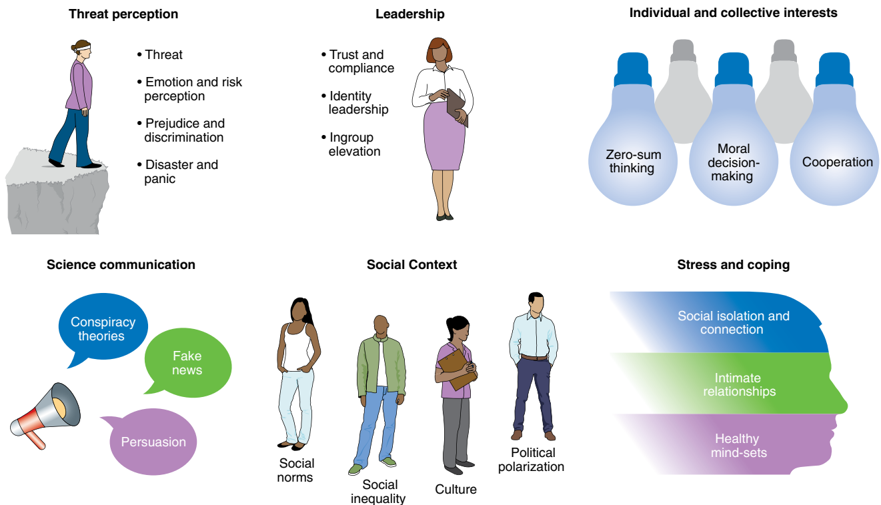
The COVID-19 pandemic represents a massive global health crisis. Because the crisis requires large-scale behaviour change and places significant psychological burdens on individuals, insights from the social and behavioural sciences can be used to help align human behaviour with the recommendations of epidemiologists and public health experts. Here we discuss evidence from a selection of research topics relevant to pandemics, including work on navigating threats, social and cultural influences on behaviour, science communication, moral decision-making, leadership, and stress and coping. In each section, we note the nature and quality of prior research, including uncertainty and unsettled issues. We identify several insights for effective response to the COVID-19 pandemic and highlight important gaps researchers should move quickly to fill in the coming weeks and months.
Overview
CoChat Summary
TL;DR
This perspective argues that social and behavioural science can help align public behaviour with COVID-19 public health recommendations across threat perception, social context, science communication, cooperation, leadership, and stress/coping. It synthesizes prior evidence and policy insights while cautioning that evidence is limited, often drawn from non-pandemic contexts, and in many areas unsettled.
Key findings
- The paper notes the scale of infectious disease threats: the bubonic plague killed approximately 25% of the European population, and by March 2020 COVID-19 had spread to more than 118,000 cases and caused 4,291 deaths in 114 countries. It also notes that 21 countries donated medical supplies to China in February, with China reciprocating widely.
- Fear appeals can change behaviour when people feel capable of dealing with the threat, but produce defensive reactions when people feel helpless; optimism bias can lead people to underestimate personal risk and ignore public health warnings.
- Social norms, inequality, culture, and political polarization shape pandemic behaviour: correcting misperceived norms can help when most people are already doing the desirable behaviour, but descriptive norms can backfire if the behaviour is undesirable unless paired with prescriptive norms.
- Effective communication and leadership may involve credible sources, messages that protect others or align with moral values, prebunking/inoculation against misinformation, accuracy nudges, shared social identity, and leaders modelling prosocial sacrifice; excessive national self-image concerns (“collective narcissism”) can backfire.
Methods
- Design: Perspective/narrative review; no primary data collection or sample. Topics were identified by the corresponding authors as potentially relevant to pandemic response and are explicitly not exhaustive.
- Evidence base: synthesizes prior social and behavioural research on threat perception, social context, science communication, moral decision-making, cooperation, leadership, and stress/coping, drawing on laboratory experiments, correlational studies, field experiments, meta-analyses, and preprints/forthcoming work.
- Analysis: narrative synthesis with policy implications and identified research gaps; no systematic search strategy or quantitative synthesis is reported.
Limitations
- Stated: due to space constraints, the paper provides only a brief summary of each topic; research on these topics is ongoing and in many cases far from settled; there is very little published social science research on the current pandemic, so discussion often draws from different circumstances and evidence quality varies substantially.
- Stated: insights and policy implications should be interpreted with caution.
- Evident: as a perspective rather than a systematic review or empirical study, it does not provide a comprehensive evidence appraisal, and its reliance on preprints and forthcoming sources limits certainty.
Model-written summary. Check it against the paper before relying on it.
Integrity signals
Registry
Cites
Statistics
Figures
Verification
Claims the paper makes
19 Valid · 5 Not valid · 37 Not checked · 13 Own results and interpretations
At least one cited source doesn’t support this claim or points to a different paper, and none confirmed it — see the verdicts below.
In the paper
“For instance, in hypothetical scenarios about deciding whether to go to work while sick, American and British participants reported they would be less willing to stay home when it was uncertain they would infect a co-worker.”
What the sources say
- Disputedcites [176] Kappes, A. et al. Uncertainty about the impact of social decisions increases prosocial behaviour. Nat. Hum. Behav. 2, 573–580 (2018). sourceExperimental — accuracy not yet measured
In the paper’s account of the infectious-disease scenario (Abstract; page not provided), participants facing uncertainty about how severely a co-worker might be affected were more likely to stay home than controls, not less. The paper distinguishes that impact uncertainty from uncertainty about whether a co-worker would be infected. Its Study 6 Methods (page not provided) describe recruitment through AMT, but do not establish the claimed American and British participant groups. (LLM, conf=0.88)
Checked by a reasoning model — may be wrong.
hedgedstates an association- Asserted: passes — The authors put it forward as true.
- Checkable: passes — It can be checked against evidence.
- Load-bearing: passes — The paper’s conclusions depend on it.
- Based: passes — The paper gives a reason why it holds.
- Disputed
The cited sources that could be checked couldn’t confirm or dispute this claim.
In the paper
“Moreover, there is mixed research regarding whether corrections may actually increase belief in the original misinformation 121,124-126 or in other misleading claims that fail to get corrected 127 .”
What the sources say
- Not checked — no full text of the sourcecites [121] Guess, A. & Coppock, A. Does counter-attitudinal information cause backlash? Results from three large survey experiments. Br. J. Polit. Sci. https://doi.org/10.1017/S0007123418000327 (2018). source
- Not matchedcites [124] Wittenberg, C. & Berinsky, A.J. Misinformation and its correction. in Social Media and Democracy: The State of the Field (eds Persily, N. & Tucker, J. A.) (Cambridge University Press, forthcoming).
Its entry has no title and year that we can search by.
- Not checked — no full text of the sourcecites [125] Swire, B. & Ecker, U.K.H. Misinformation and its correction: Cognitive mechanisms and recommendations for mass communication. in Misinformation and Mass Audiences (eds. Southwell, B. G., Thorson, E. A. & Sheble, L.) 195–2011 (University of Texas Press, 2018). source
- Not checked — no full text of the sourcecites [126] Wood, T. & Porter, E. The elusive backfire effect: mass attitudes’ steadfast factual adherence. Polit. Behav. 41, 135–163 (2018). source
- Could not verifycites [127] Pennycook, G., McPhetres, J., Zhang, Y. & Rand, D. Fighting COVID-19 misinformation on social media: Experimental evidence for a scalable accuracy nudge intervention. Preprint at PsyArXiv https://doi.org/10.31234/osf.io/uhbk9 (2020). sourceExperimental — accuracy not yet measured
Citation 127 is attached to the suggestion that corrections may increase belief in other misleading claims that go uncorrected. The Statement of Relevance and Discussion describe an accuracy nudge that improved sharing decisions, not corrections or their effects on belief in uncorrected claims. Searches for correction backfire and uncorrected misinformation found no passage addressing that point; page numbers were unavailable in our copy. (LLM, conf=0.76)
hedgedstates a possible cause- Asserted: passes — The authors put it forward as true.
- Checkable: passes — It can be checked against evidence.
- Load-bearing: passes — The paper’s conclusions depend on it.
- Based: passes — The paper gives a reason why it holds.
The sources with a verdict support this claim; the rest weren’t checked yet, have no full text we could read, or their verdicts aren’t rated yet.
In the paper
“Indeed, laboratory research has found that people prioritize local over global (or international) interests 185,186 .”
What the sources say
- Supportedcites [185] Milinski, M., Hilbe, C., Semmann, D., Sommerfeld, R. & Marotzke, J. Humans choose representatives who enforce cooperation in social dilemmas through extortion. Nat. Commun. 7, 10915 (2016). source
The Results section (‘Voters choose selfish representatives’; page unavailable) reports that participants preferentially re-elected representatives who contributed less to the shared climate account and elected candidates who pledged to contribute less than a fair share. In this simulated international dilemma, that supports the claim that participants favored their own group’s interests over the collective goal; it does not establish that everyone did so. (LLM, conf=0.85)
- Not checked — no full text of the sourcecites [186] Reinders Folmer, C. P. et al. One for all: what representing a group may do to us. J. Exp. Soc. Psychol. 48, 1047–1056 (2012). source
plain- Asserted: passes — The authors put it forward as true.
- Checkable: passes — It can be checked against evidence.
- Load-bearing: passes — The paper’s conclusions depend on it.
- Based: passes — The paper gives a reason why it holds.
- Supported
Every source the paper cites for this claim was checked and supports it.
In the paper
“However, when going to work risked infecting an elderly co-worker who would suffer a serious illness, participants reported they would be more willing to stay home 176 .”
What the sources say
- Supportedcites [176] Kappes, A. et al. Uncertainty about the impact of social decisions increases prosocial behaviour. Nat. Hum. Behav. 2, 573–580 (2018). source
The Study 6 Methods (page not provided) describe a scenario in which going to work could infect an older, vulnerable co-worker who would suffer severely, followed by a rating of willingness to go to work. The reported Study 6 findings (indexed under Abstract; page not provided) say participants given that risk information were significantly more likely to stay home than controls. (LLM, conf=0.92)
hedgedstates a cause- Asserted: passes — The authors put it forward as true.
- Checkable: passes — It can be checked against evidence.
- Load-bearing: passes — The paper’s conclusions depend on it.
- Based: passes — The paper gives a reason why it holds.
- Supported
The sources with a verdict support this claim; the rest weren’t checked yet, have no full text we could read, or their verdicts aren’t rated yet.
In the paper
“Several techniques, such as sanctioning defectors 187 or rewarding cooperators 188 , tend to increase cooperative behaviour in laboratory experiments using economic games.”
What the sources say
- Not checked — no full text of the sourcecites [187] Yamagishi, T. The provision of a sanctioning system as a public good. J. Pers. Soc. Psychol. 51, 110–116 (1986). source
- Supportedcites [188] Rand, D. G., Dreber, A., Ellingsen, T., Fudenberg, D. & Nowak, M. A. Positive interactions promote public cooperation. Science 325, 1272–1275 (2009). source
Citation 188 is attached to rewarding cooperators. The paper’s Abstract reports a laboratory comparison using repeated public goods games and finds that reward maintained public cooperation and, when both reward and punishment were available, increased contributions. (LLM, conf=0.93)
plainstates a cause- Asserted: passes — The authors put it forward as true.
- Checkable: passes — It can be checked against evidence.
- Load-bearing: unclear — It is unclear whether the paper’s conclusions depend on it.
- Based: passes — The paper gives a reason why it holds.
50 more claims · 13 with their cited sources checked
Create a free account to see all 74 claims and to verify the 2 references still open.
- It may state two separate claims as one. 13
- Probably not a substantial claim. 6
Claims other papers make about this one
Each is checked against this paper’s own text: does it say what the citing paper says it does?
The source backs part of the claim, not all of it — or backs it for a different population, condition or comparison.
In the citing paper
“COVID-19 is an international public health crisis, putting substantial burden on medical centers and increasing the psychological toll on health care workers (HCW).”
From Supporting the well-being of health care providers during the COVID-19 pandemic: The CopeColumbia response (2020) · cites this paper as [6]
Experimental — accuracy not yet measuredThe source backs part of the claim, not all of it — or backs it for a different population, condition or comparison.
In the citing paper
“these population-wide measures affected psychological well-being and mental health as well as increased social isolation [68] and loneliness.”
From Psychological correlates of perceived loneliness in college students before and during the COVID-19 stay-at-home period: a longitudinal study (2023) · cites this paper as [68]
Experimental — accuracy not yet measuredThe source backs part of the claim, not all of it — or backs it for a different population, condition or comparison.
In the citing paper
“they may eventually increase the social isolation of students and affect their psychological well-being and mental health [3].”
From Students under lockdown: Comparisons of students’ social networks and mental health before and during the COVID-19 crisis in Switzerland (2020) · cites this paper as [3]
Experimental — accuracy not yet measuredThe source backs part of the claim, not all of it — or backs it for a different population, condition or comparison.
In the citing paper
“effective interventions are hard to scale to a population level (12);”
From Psychological inoculation improves resilience against misinformation on social media (2022) · cites this paper as [12]
Experimental — accuracy not yet measuredThe source backs part of the claim, not all of it — or backs it for a different population, condition or comparison.
In the citing paper
“There is a shortage of studies that test anti-misinformation interventions in an ecologically valid manner, i.e., testing an intervention as consumers would interact with it in online environments (8, 12).”
From Psychological inoculation improves resilience against misinformation on social media (2022) · cites this paper as [12]
Experimental — accuracy not yet measured
6 more claims about this paper
Create a free account to see every claim other papers make about this one.
Citations
Cites
Granovetter, M. S. (1973) · American Journal of Sociology · doi:10.1086/225469 · Cited by 40,491
Zhou, F., Yu, T., Du, R., Fan, G., Liu, Y., Liu, Z., Xiang, J., Wang, Y., Song, B., Gu, X., et al. (2020) · The Lancet · doi:10.1016/s0140-6736(20)30566-3 · Cited by 27,263
The need to belong: Desire for interpersonal attachments as a fundamental human motivation.
Baumeister, R. F., & Leary, M. R. (1995) · Psychological Bulletin · doi:10.1037//0033-2909.117.3.497 · Cited by 23,245
Culture and the self: Implications for cognition, emotion, and motivation.
Markus, H. R., & Kitayama, S. (1991) · Psychological Review · doi:10.1037/0033-295x.98.2.224 · Cited by 21,995
Self-citationThe Psychological Impact of Quarantine and How to Reduce It: Rapid Review of the Evidence
Brooks, S. K., Webster, R. K., Smith, L. E., Woodland, L., Wessely, S., Greenberg, N., & Rubin, G. J. (2020) · doi:10.2139/ssrn.3532534 · Cited by 16,394
The psychological impact of quarantine and how to reduce it: Rapid review of the evidence
Brooks, S. K., Webster, R. K., Smith, L. E., Woodland, L., Wessely, S., Greenberg, N., & Rubin, G. J. (2020) · The Lancet · doi:10.1016/s0140-6736(20)30460-8 · Cited by 16,378
Nudge: improving decisions about health, wealth, and happiness
(2008) · Choice Reviews Online · doi:10.5860/choice.46-0977 · Cited by 11,572
Slovic, P. (1987) · Science · doi:10.1126/science.3563507 · Cited by 9,271
The Elaboration Likelihood Model of Persuasion
Petty, R. E., & Cacioppo, J. T. (1986) · Advances in Experimental Social Psychology · doi:10.1016/s0065-2601(08)60214-2 · Cited by 8,822
Self-citationThe emotional dog and its rational tail: A social intuitionist approach to moral judgment.
Haidt, J. (2001) · Psychological Review · doi:10.1037/0033-295x.108.4.814 · Cited by 8,048
Research works printed but not linked: 3
- Berkowitz, A.D. An overview of the social norms approach. in Changing the Culture of College Drinking: A Socially Situated Health Communication Campaign (eds. Stewart, L. & Lederman, L. C.) 193–214 (Hampton Press, 2005).
- Wittenberg, C. & Berinsky, A.J. Misinformation and its correction. in Social Media and Democracy: The State of the Field (eds Persily, N. & Tucker, J. A.) (Cambridge University Press, forthcoming).
- Ransohoff, K.J. Patients on the Trolley Track: The Moral Cognition of Medical Practitioners and Public Health Professionals. (Harvard Univ. Press, 2011).
Cited by
Items 4,301–4,400 of 5,015
The development of compliance behavioral imperatives in public for management of covid-19
Agarwal, M., Parsad, C., & Sharma, S. (2022) · Psychology Health & Medicine · doi:10.1080/13548506.2022.2125164
“When combined with public health measures (Bavel et al., 2020), a variety of human behaviour responses, such as frequent hand washing, wearing masks, regularly sanitizing living spaces, and so on, play a more effective role in preventing the transmission of contagious diseases (Lau et al., 2003).”
BackgroundRisk Creep: Learning Under High Uncertainty Leads to a Creeping Tolerance for RiskPreprint
Logg, J. M., Tinsley, C. H., & Leitao, M. (2025) · SSRN Electronic Journal · doi:10.2139/ssrn.4219931
localcovid19now: processing and mapping COVID-19 case data at subnational scalesPreprint
Beckett, S. J., Brandel-Tanis, F., Nguyen, Q., Chande, A. T., Rishishwar, L., Andris, C., & Weitz, J. S. (2022) · doi:10.31219/osf.io/fg6vw
The impact of COVID-19 safety interventions on creating a controlled environment on campus
Mahmood, S., Haider, S. I., Shahbaz, H., Noorali, A. A., Afzal, N., Jiwani, A., Zaki, S., Khan, U. I., Ajani, K., Tariq, M., et al. (2022) · Frontiers in Public Health · doi:10.3389/fpubh.2022.962478
“While initially this pictorial display was helpful, later it could have been replaced by a better alternative, for example, more interactive virtual content offering updated information would get better engagement or infographics depicting a selection of topics from the social and behavioral sciences relevant during a…”
BackgroundMahmood, Q. K., Sohail, M. M., Akbar, M. S., Qureshi, W. A., Zakar, R., & Fischer, F. (2022) · Research Square · doi:10.21203/rs.3.rs-1987704/v1
The Mediating Role of Religious Beliefs in the Relationship between Well-Being and Fear of COVID-19Preprint
Nguyen, P. T. H., Huynh, S. V., Ly, T. T., Thi, M. T. N., Nguyen, X. T. K., Nantachai, G., & Tran-Chi, V.-L. (2022) · SSRN Electronic Journal · doi:10.31219/osf.io/y5zs2
Jung, K. (2022) · Public Administration Quarterly · doi:10.37808/paq.46.4.5
“Scientific research suggests how social and cultural behaviors matter critically to the response to COVID - 19 (Van Bavel et al., 2020).”
BackgroundA Multidisciplinary Perspective on COVID-19 Exit StrategiesPreprint
Dablander, F., Blanken, T. F., Tanis, C. C., Breed, R., Coffeng, L. E., Crommelin, D. T., Edeling, W. N., Gautier, P. A., de Graaf, B., Gugole, F., et al. (2022) · PsyArXiv (OSF Preprints) · doi:10.31234/osf.io/3jz8e
The Complex Role of Anxiety in Public Engagement
Rocque, R., Cameron, L., & Mauro, I. J. (2022) · doi:10.1093/oso/9780197622674.003.0009
The impact of the COVID-19 pandemic on individuals and their intra- and intergroup relationsPreprint
Borinca, I., Gomides, M. R. D. A., & Mustafa, S. (2022) · PsyArXiv (OSF Preprints) · doi:10.31234/osf.io/wtsm9
Shakil, M., Fatima, S., Muazzam, A., Amjad, M., & Javed, S. (2022) · Journal of Ambient Intelligence and Humanized Computing · doi:10.1007/s12652-022-04421-8
“Trust in the Government leads to compliance in following health policies such as quarantine, COVID testing, social distancing, and other measures (Van Bavel 2020).”
Peng, C., Hu, H., Yuan, G., et al. (2022) · Research Square · doi:10.21203/rs.3.rs-2182692/v1
Barbato, M. T., Fernández, A. M., Galán, C. F., Gonzalez, W. R., & Quezada, P. V. (2022) · Journal of Advanced Research in Social Sciences · doi:10.33422/jarss.v5i4.801
Pasaribu, N. R., & Ristianti, N. S. (2022) · Jurnal Teknik Sipil dan Perencanaan · doi:10.15294/jtsp.v24i2.36449
“During quarantine at home due to the COVID-19 pandemic, on average there was a threefold increase in the use of open spaces for recreation in all age groups of the population [1, 2, 3].”
BackgroundMa, Z., Nan, X., van Weert, J. C. M., Ou, M., & Ho, S. S. (2022) · Wiley eBooks · doi:10.1002/9781119678816.iehc0897
Nwikpo, M. N., Eluemuno, A. I., Obedjemurho, I. U., & Onah, T. A. (2022) · European Journal of Humanities and Social Sciences · doi:10.24018/ejsocial.2022.2.6.333
“Van Bavel, J., Baicker, C., Willer, R. (2020).”
BackgroundInfluentialA country-based review in COVID-19 related research developments
Modak, N. M., Sinha, S., & Sana, S. S. (2022) · RAIRO - Operations Research · doi:10.1051/ro/2022199
“[5] published their paper in Nature Human Behaviour receiving 1154 citations.”
BackgroundSpatial variations in COVID-19 risk perception and coping mechanism in Pakistan
Rana, I. A., Bhatti, S. S., Aḥmad, J., Aslam, A. B., & Jamshed, A. (2022) · Spatial Information Research · doi:10.1007/s41324-022-00498-7
Smittebeskyttende adfærd under anden bølge af covid-19 pandemien i Danmark
Jørgensen, F. J., & Petersen, M. B. (2022) · Politica · doi:10.7146/politica.v54i4.134832
“For at forstå hvordan man bedst påvirker borgernes adfærd via kommunikation, er det således nødvendigt at forstå psykologien, der ligger til grund for adfærdsændringer (Bavel et al., 2020; Bonell et al., 2020).”
BackgroundA Field Experiment Using Social Media Ads to Encourage COVID-19 VaccinationPreprint
Çat, O., Chang, J., Hlatky, R., Li, H., & Nielson, D. (2022) · Research Square · doi:10.21203/rs.3.rs-2319578/v1
Evaluation of the Fear of Covid-19 and Hygiene Behaviors of Municipal Employees
Tümer, A., GÜLLÜ, F. N., Durak, M., & Dönmez, S. (2022) · Karaelmas İş Sağlığı ve Güvenliği Dergisi · doi:10.33720/kisgd.1128988
Povezanost med pogostostjo uporabe virov informacij o covidu-19 in nagnjenostjo k teorijam zarot
Žagar, J., Rehberger, M., & Vrdelja, M. (2022) · Revija za zdravstvene vede · doi:10.55707/jhs.v9i2.128 · Cited by 1
Kersebaum, D., Sendel, M., Fabig, S., Sachau, J., Lassen, J., Rehm, S., Forstenpointner, J., Rümenapp, J., Vollert, J., Hüllemann, P., et al. (2022) · Medicine · doi:10.1097/md.0000000000032054
The Effects of the COVID-19 Pandemic on the Parenting of Infants: A Couples Study
Anikiej‐Wiczenbach, P., & Kaźmierczak, M. (2022) · International Journal of Environmental Research and Public Health · doi:10.3390/ijerph192416883 · Cited by 1
Transforming perception of space in the pandemic agenda: from real space to virtual space
(2022) · A/Z ITU journal of Faculty of Architecture · doi:10.5505/itujfa.2022.62447
Godisela, K. K., Muthenna, P., & Shalini, T. (2021) · The Indian Journal of Nutrition and Dietetics · doi:10.21048/ijnd.2021.58.4.27990
Apart, but together: Voices of women academics working from home
Crocco, O. S., Grenier, R. S., & Kemp, D. H. (2022) · New Horizons in Adult Education and Human Resource Development · doi:10.1002/nha3.20365 · Cited by 1
Impact of the COVID-19 Pandemic on Construction Workers in West Java
Ryandika, R., Meifrinaldi, M., Pribadi, K. S., Martek, I., & Chan, T. (2022) · Journal of Construction in Developing Countries · doi:10.21315/jcdc-02-22-0029
Reflections on a Cross-Border Collaborative Research Effort During COVID-19
Todd, M. F., Grimes, C., Moayerian, N., Poets, D., & Stephenson, M. O., Jr. (2022) · Community Change · doi:10.21061/cc.v4i1.a.37
Percepciones de los factores de riesgo asociados al contagio del coronavirus en adultos mayores
Flores-Pereyra, G. R., Girón, N. M. M., & Malvaceda-Espinoza, E. (2021) · Revista de Salud Pública · doi:10.15446/rsap.v23n6.95509
The Social Pandemic from SARS-CoV-2 among Italian University Students: A Pilot StudyPreprint
Russo, C., Giordano, G., & Marsico, G. (2022) · SSRN Electronic Journal · doi:10.2139/ssrn.4116841 · Cited by 3
Nonconceptual Mindfulness: Navigating Crisis Preparedness for Crisis Management
Vu, M. C., & Nguyen, L. A. (2022) · Palgrave studies in workplace spirituality and fulfillment · doi:10.1007/978-3-031-09540-5_2
Post-lockdown clinics 2: ‘You're gonna need a bigger boat’
Howard, N., & Tromans, C. (2020) · Optician · doi:10.12968/opti.2020.7.8292
Wilson, S. (2021) · Policy Press eBooks · doi:10.51952/9781447341192.bm002
Tingkat Kesadaran Masyarakat Akan Pentingnya Beraktivitas Fisik Selama Pandemi Covid-19
Soniawan, V., Adnan, A., Haryanto, J., Lesmana, H. S., Arifan, I., Purnomo, E., & Pratama, D. S. (2021) · Jurnal Performa Olahraga · doi:10.24036/jpo291019 · Cited by 9
Liu, J., Lu, C., & Lu, S. (2022) · Healthcare · doi:10.3390/healthcare11010119
“In terms of the COVID-19 pandemic, the use of the Internet can cause negative emotions such as fear and anxiety, which can prompt individuals to take action to reduce their health threats [49].”
BackgroundHealth Behavioral Change Interventions in Caregivers: The Prolepsis Project
Christou, A., & Christodoulou-Fella, M. (2023) · Springer eBooks · doi:10.1007/978-3-031-16745-4_11
Parental knowledge level regarding vaccination against COVID-19 in children under 18 years of age
Marín-Mundo, L., Galeano, F., Lovera, D., & de Cuéllar, C. M. (2022) · Revista del Instituto de Medicina Tropical · doi:10.18004/imt/2022.17.2.7 · Cited by 1
Kay, M. J., Kay, S. A., Cheetham, F., & Hu, H. (2023) · Journal of the Association for Consumer Research · doi:10.1086/724177
“Many noted that physical distancing “clashes with the deep-seated human instinct to connect with others” (Van Bavel et al. 2020).”
BackgroundBlackburn, A. M., Han, H., Jeftić, A., Stöckli, S., Gelpí, R., Acosta-Ortiz, A., Travaglino, G. A., Alvarado, R., Lacko, D., Milfont, T. L., et al. (2023) · doi:10.31234/osf.io/75jq2
Understanding The Impact of COVID-19 on Early Childhood Development
Antony, E. (2022) · Psych-Talk · doi:10.53841/bpstalk.2022.1.102.30
Decision support techniques in public health policy formulation: bibliometric analysisPreprint
Jalabe, D. J., Olivares-Cerpa, F. D. J., Jervis-Pinzon, C. A., & Arteta-Olivares, N. X. (2023) · Research Square · doi:10.21203/rs.3.rs-2399509/v1
RESIDENTS SUPPORT FOR TOURISM IN POST-PANDEMIC TIME – A CASE STUDY OF VRNJAČKA BANJA
Đorđević, N., & Milićević, S. (2022) · doi:10.52370/tisc22501nd
Exploring Permanency of Pandemic Influenced Changes in Habitual Consumption Behaviour
Titus, R., Valera, S., & Sengupta, D. (2023) · Arab Economic and Business Journal · doi:10.38039/2214-4625.1024
localcovid19now: processing and mapping COVID-19 case data at subnational scales
Beckett, S. J., Brandel-Tanis, F., Nguyen, Q., Chande, A. T., Rishishwar, L., Andris, C., & Weitz, J. S. (2023) · The Journal of Open Source Software · doi:10.21105/joss.04898
Three years on, COVID-19 is still relevant
Rhodes, R. E., & Hamilton, K. (2022) · Psychology and Health · doi:10.1080/08870446.2022.2159345
“…of the virus, while other countries have begun to engage in post-pandemic recovery actions. despite the disruption and uncertainty, understanding of and intervening on human behaviour has had an important role in nearly all aspects of the CoVid-19 pandemic (e.g., Bavel et al., 2020; Betsch, 2020).”
BackgroundCorlett, J. (2022) · On the Horizon The International Journal of Learning Futures · doi:10.1108/oth-07-2022-0039
Distanciamento Social no Brasil: Questões Sociodemográficas e a COVID-19
Iwaya, G. H., Cardoso, J. G., da Silva, P. M. M., et al. (2022) · Revista organizações em contexto/Organizações em Contexto · doi:10.15603/1982-8756/roc.v18n36p347-375
Silva, F. D. S. E. (2022) · Revista de Estudos Empíricos em Direito · doi:10.19092/reed.v10.642
Arfan, M. R., & Salami, D. M. (2021) · SANGKéP Jurnal Kajian Sosial Keagamaan · doi:10.20414/sangkep.v4i1.2807
Christensen, S. H., & Gleibs, I. H. (2023) · Scandinavian Journal of Psychology · doi:10.1111/sjop.12903
Ahmed, A., Imran, M., Fatima, S., Khan, H. W., Naqvi, S. R. A., & Siddiqi, A. (2022) · Pakistan Journal of Pathology · doi:10.55629/pakjpathol.v33i4.735
Alhugbani, H. F. (2022) · MOspace Institutional Repository (University of Missouri) · doi:10.32469/10355/94047
Is Society caught up in a Death Spiral? Modelling Societal Demise and its ReversalPreprint
Schippers, M. C., Ioannidis, J. P. A., & Luijks, M. (2023) · SSRN Electronic Journal · doi:10.2139/ssrn.4352765
What Does the Pandemic Mean for Evaluation?
Furubo, J.-E. (2023) · Routledge eBooks · doi:10.4324/9781003376316-2
The Dynamics of Changes in the Personal Resources of Pedagogy Students During COVID-19 Pandemic
Kulawska, E. (2022) · Lubelski Rocznik Pedagogiczny · doi:10.17951/lrp.2022.41.3.83-100
O’Connor, C. (2022) · Psychology Teaching Review · doi:10.53841/bpsptr.2022.28.1.5
Uporabljati ali ne uporabljati
Trkman, M. (2023) · Fakulteta za družbene vede eBooks · doi:10.51936/9789612950361 · Cited by 1
Saputra, M., & Untari, S. (2022) · Advances in Social Science, Education and Humanities Research/Advances in social science, education and humanities research · doi:10.2991/978-2-494069-63-3_16
Students’ Perceptions of Online Physical Education in Indonesian Elementary School
Yudaparmita, G. N. A., Kanca, I. N., Dharmadi, M. A., & Sudiana, I. K. (2022) · doi:10.2991/978-2-494069-79-4_13 · Cited by 1
McCall, T., Lumbi, S. L., Rinderhagen, M., et al. (2023) · International Journal of Environmental Research and Public Health · doi:10.3390/ijerph20043363
“That also includes pandemic-associated health and financial impacts [8].”
BackgroundInfluentialAvila, R. C. M., Fixsen, A. M., & Nadarzynski, T. (2022) · Graduate Student Journal of Psychology · doi:10.52214/gsjp.v18i.10926 · Cited by 1
Sandoval, L. A. P., & Camacho, D. F. V. (2022) · Index de Enfermería · doi:10.58807/indexenferm20224945
“En esta medida, el docente universitario debe considerar al estudiante como gestor del conocimiento y del cambio, que sabe y que pueda dar mucho más.(20) En los entornos de aprendizaje, el docente como mentor, facilitador y cooperador, debe apoyarse de metodologías y estrategias de enseñanza que promuevan el análisis,…”
BackgroundIndividual Differences and Changes in Personality During the COVID-19 PandemicPreprint
Rudolph, C. W., & Zacher, H. (2023) · doi:10.31234/osf.io/2643b
Hussein, A. J., Salman, F. D., Hussein, M. J., Hussein, M. J., Hussein, A. J., & Kamel, J. H. (2023) · Acta Scientific Medical Sciences · doi:10.31080/asms.2023.07.1495
Pro-health measures as a creator of new behavior norms and attitudes
Fałek, P., Adamczyk, T., Fałek, A., & Burdan, F. (2023) · Folia Medica Cracoviensia · doi:10.24425/fmc.2022.144081 · Cited by 3
Hernández, R., Ortega, P. J., Sohler, N., & Marrara, S. (2023) · Revista de Estudos AntiUtilitaristas e PosColoniais · doi:10.51359/2179-7501.2022.253928
Medical students' perceptions of coronavirus disease
Arbab, L. S. (2023) · World Journal of Advanced Research and Reviews · doi:10.30574/wjarr.2023.17.2.0332
“Behavioral change depends on an individual's knowledge, sense of the risk, and willingness to modify their own attitude [5].”
Moving forward beyond politics of COVID-19 vaccines development
Otenyo, E. E. (2023) · Elsevier eBooks · doi:10.1016/b978-0-443-18570-0.00002-6
COVID-19 and early responses of Pakistan to mitigate the pandemic: A quick review
NAWAZ, A. (2022) · SINDH UNIVERSITY RESEARCH JOURNAL -SCIENCE SERIES · doi:10.26692/https://doi.org/10.26692/surj.v54i2.5802 · Cited by 1
Ercan, F., Işık, M. A., Şahin, S. S., Altun, E., İnce, D. K., & Demir, S. (2023) · Current Psychology · doi:10.1007/s12144-023-04522-3 · Cited by 3
Li, S., Li, K., & Li, J. (2023) · Psychology Research and Behavior Management · doi:10.2147/prbm.s401420 · Cited by 2
An agent-based model for COVID-19 and its interventions and impact in different social phenomena
Siller, M., Palomo-Briones, G. A., Durán-Polanco, L., & Aleman, F. (2023) · Elsevier eBooks · doi:10.1016/b978-0-323-95064-0.00009-9 · Cited by 1
Apakah Mahasiswa Nyaman Dengan Pembelajaran Daring?
Hardiantiningsih, H., & Widodo, A. (2022) · Jurnal Keguruan dan Ilmu Pendidikan · doi:10.47178/jkip.v11i1.1496
Kasem, K., Hashem, H., & Ezzat, M. M. (2023) · Benha Medical Journal · doi:10.21608/bmfj.2023.193375.1760
Anderson, I., & Kuswanto, K. (2022) · Jurnal Civics Media Kajian Kewarganegaraan · doi:10.21831/jc.v19i2.53007
Ganvir, S., Nikhade, N. S., Sidhaye, A. S., Vate, C. N., & Shastri, K. R. (2023) · Journal of Indira Gandhi Institute Of Medical Sciences · doi:10.4103/jigims.jigims_25_21
Fahmi, A. B. (2023) · Jurnal Psikologi Sosial · doi:10.7454/jps.2023.07
“Pandemi COVID-19 merupakan masalah kesehatan yang kompleks dan membutuhkan respon berupa perubahan perilaku yang bersifat individual (Bavel et al., 2020).”
Backgroundzolghadri, S., Rafezi, Z., goudarzi, N. H., & eskandarian, F. (2022) · Journal of Research in Behavioural Sciences · doi:10.52547/rbs.20.1.160
Essel, E. A. (2021) · Health & New Media Research · doi:10.22720/hnmr.2020.5.1.091 · Cited by 3
The relationship between social distancing and interpersonal communication through pandemic COVID-19
Ibrahim, N. Z. M., Ibrahim, M. S., Hamid, A. S. A., & Anuar, A. Z. A. (2023) · AIP conference proceedings · doi:10.1063/5.0116337
¿Nueva era: D.C-19? Preocupaciones de profesores universitarios y desafíos de la nueva normalidad.
Rivero, B. M. G. (2022) · Masquedós - Revista de Extensión Universitaria · doi:10.58313/masquedos.2022.v7.n8.191
COVID-19 Through a Cultural Lens
Sharan, P. (2022) · Indian Journal of Social Psychiatry · doi:10.4103/ijsp.ijsp_227_22
STRESS IN THE WORK OF PARAMEDICS DURING THE COVID-19 PANDEMIC
Marczewski, K. P., Gospodarczyk, N. J., Gospodarczyk, A. Z., Galle, D., Tkocz, M. T., & Sosada, K. A. (2022) · Emergency Medical Service · doi:10.36740/emems202204107
Alvi, M., & Ehsan, N. (2023) · Pakistan Journal of Humanities and Social Sciences · doi:10.52131/pjhss.2023.1102.0399
“When this happens, community leaders need to establish norms to guide citizens away from actions that are no longer acceptable in society (Bavel et al., 2020).”
BackgroundRyukei, M. O. R. I., Araki, M., Parady, G., et al. (2023) · Journal of Japan Society of Civil Engineers Ser D3 (Infrastructure Planning and Management) · doi:10.2208/jscejipm.78.5_i_515
Identification of Covid 19 chain disconnection based on health belief model
Hanik, U., & Setiyowati, E. (2023) · AIP conference proceedings · doi:10.1063/5.0123953
Lulu, P. M., Atim, F., Ronald, K., Wakula, F. L., & Okiria, J. C. (2023) · medRxiv · doi:10.1101/2023.05.16.23290042
Anxiety Against Covid-19 With A Planning Family Acceptor Visit
Lesdianti, K., Kusumawaty, I., Hindun, S., et al. (2022) · Journal of Maternal and Child Health Sciences (JMCHS) · doi:10.36086/maternalandchild.v2i2.1426
“berdampak signifikan pada kesehatan mental, fisik serta kualitas hidup setiap individu [5], [6].”
BackgroundThe Fear of the COVID-19 Pandemic and Its Relation to Religion
Krzos, B. M. (2023) · Collectanea Theologica · doi:10.21697/ct.2023.93.2.08
Cotrina, A. D. R. Z., Huarcaya, S. S. L., Castañeda-Cruzado, C. G., et al. (2023) · Escola Anna Nery · doi:10.1590/2177-9465-ean-2022-0459es
Milenković, J., Lakić, D., & Bogavac‐Stanojević, N. (2023) · Sustainability · doi:10.3390/su15118584
Cotrina, A. D. R. Z., Huarcaya, S. S. L., Castañeda-Cruzado, C. G., et al. (2023) · Escola Anna Nery · doi:10.1590/2177-9465-ean-2022-0459en
Principal Policy Formulation Models Of Learning During Covid-19
Muslim, M., Sholihah, A. M., & Rahmi, E. (2022) · Thufuli Jurnal Ilmiah Pendidikan Islam Anak Usia Dini · doi:10.33474/thufuli.v4i2.18922
Aviram, N. F., Hasan‐Aslih, S., & Halperin, E. (2023) · Heliyon · doi:10.1016/j.heliyon.2023.e16629 · Cited by 2
“Pandemics may improve intergroup relations by inducing the feeling of sharing the same global traumatizing experience and uniting against a common natural enemy [20,57,58].”
Bresson, M., & Guibentif, P. (2023) · Actes · doi:10.52983/zmey3171
Metadata
- Authors
- Bavel, J. J. V., Baicker, K., Boggio, P. S., Capraro, V., Cichocka, A., Cikara, M., Crockett, M. J., Crum, A. J., Douglas, K. M., Druckman, J. N., Drury, J., Dube, O., Ellemers, N., Finkel, E. J., Fowler, J. H., Gelfand, M., Han, S., Haslam, S. A., Jetten, J., Kitayama, S., Mobbs, D., Napper, L. E., Packer, D. J., Pennycook, G., Peters, E., Petty, R. E., Rand, D. G., Reicher, S. D., Schnall, S., Shariff, A., Skitka, L. J., Smith, S. S., Sunstein, C. R., Tabri, N., Tucker, J. A., Linden, S. V. D., Lange, P. V., Weeden, K. A., Wohl, M. J. A., Zaki, J., Zion, S. R., & Willer, R.
- Affiliations
- New York University (US)
- Universidade Presbiteriana Mackenzie (BR)
- Middlesex University London (GB)
- University of Kent (GB)
- Harvard University (US)
- Yale University (US)
- Stanford University (US)
- Northwestern University (US)
- University of Sussex (GB)
- University of Chicago (US)
- Utrecht University (NL)
- University of California San Diego (US)
- University of Maryland, College Park (US)
- Peking University (CN)
- The University of Queensland (AU)
- University of Michigan (US)
- California Institute of Technology (US)
- Lehigh University (US)
- University of Regina (CA)
- University of Oregon (US)
- The Ohio State University (US)
- Massachusetts Institute of Technology (US)
- University of St Andrews (GB)
- University of Cambridge (GB)
- University of British Columbia (CA)
- University of Illinois Chicago (US)
- University of California, Berkeley (US)
- Carleton University (CA)
- Cornell University (US)
- Corresponding author
- Bavel, Jay J. Van
- Willer, Robb
- ORCID
- Bavel, Jay J. Van
- Baicker, Katherine
- Boggio, Paulo S.
- Capraro, Valerio
- Cichocka, Aleksandra
- Cikara, Mina
- Crockett, Molly J.
- Crum, Alia J.
- Douglas, Karen M.
- Druckman, James N.
- Drury, John
- Ellemers, Naomi
- Finkel, Eli J.
- Fowler, James H.
- Gelfand, Michele
- Han, Shihui
- Haslam, S. Alexander
- Jetten, Jolanda
- Kitayama, Shinobu
- Mobbs, Dean
- Napper, Lucy E.
- Packer, Dominic J.
- Pennycook, Gordon
- Peters, Ellen
- Petty, Richard E.
- Rand, David G.
- Reicher, Stephen D.
- Schnall, Simone
- Shariff, Azim
- Skitka, Linda J.
- Sunstein, Cass R.
- Tabri, Nassim
- Tucker, Joshua A.
- Linden, Sander van der
- Weeden, Kim A.
- Wohl, Michael J. A.
- Zaki, Jamil
- Zion, Sean R.
- Willer, Robb
- Venue
- Nature Human Behaviour
- Published
- 2020-04-30
- Volume
- 4
- Issue
- 5
- Pages
- 460-471
- ISSN
- 2397-3374 (ISSN-L)
- OpenAlex
- W3016902371
- Semantic Scholar
- d81abcd7f053b136423f1e7f57928524e8b0e1a0
- Cited by
- 4,964
- References
- 259
- Citations by year
- 2026: 177 · 2025: 288 · 2024: 483 · 2023: 741 · 2022: 1094 · 2021: 1474 · 2020: 702
- FWCI
- 175.81
- Type
- journal article
- Language
- en
- Open access
- bronze
- doi.org
- Licence
- www.springernature.com/gp/researchers/text-and-data-mining (tdm)
- www.springernature.com/gp/researchers/text-and-data-mining (vor)
- Locations
- Nature Human Behaviour (publishedVersion)
- PubMed (publishedVersion)
- Middlesex University Research Repository (Middlesex University Of London) (acceptedVersion)
- Kent Academic Repository (University of Kent) (acceptedVersion)
- DSpace@MIT (Massachusetts Institute of Technology) (submittedVersion, cc-by-nc-sa)
- Sussex Research Online (University of Sussex) (submittedVersion)
- CaltechAUTHORS (California Institute of Technology) (submittedVersion)
- RePEc: Research Papers in Economics (submittedVersion)
- BOA (University of Milano-Bicocca) (submittedVersion)
- Carleton University's Institutional Repository (MacOdrum Library, Carleton University) (submittedVersion, other-oa)
- Utrecht University Repository (Utrecht University) (submittedVersion)
- Figshare (submittedVersion)
- VU Research Portal (submittedVersion, other-oa)
- Utrecht University Repository (Utrecht University) (submittedVersion, other-oa)
- Data Archiving and Networked Services (DANS) (submittedVersion, other-oa)
- Funders
- U.S. Department of Health and Human Services (2P50 MH094258)
- National Institute of Mental Health (P50MH094258)
- Topics
- Social Sciences › Sociology and Political Science › COVID-19 Prevention and Impact
- Social Sciences › Communication › Communication and COVID-19 Impact
- Physical Sciences › Mathematics › Modeling and Simulation › COVID-19 epidemiological studies
- Keywords
- COVID-19 pandemic, pandemic response, behavior change, science communication, ethical decision-making, leadership, stress coping, psychological burden, public health recommendations
- MeSH terms
- Betacoronavirus, COVID-19, SARS-CoV-2, Adaptation, Psychological, Communicable Disease Control, Decision Making, Humans, Human Activities, Health Knowledge, Attitudes, Practice, Leadership, Pneumonia, Viral, Public Health, Quarantine, Stress, Psychological, Global Health, Coronavirus, Coronavirus Infections, Pandemics, Social Media, Epidemiological Monitoring
About these checks
Registry, retraction, Cites and statistics results are computed, not judged, with one exception: a printed reference that no index lists is read once by a model before it counts as a citation error. Claims are extracted by a model and kept only when their quote appears verbatim in the text; each cited source is then checked, with a model’s help, for whether it says what the claim relies on. Those verdicts can be wrong — read the claim’s quote and the cited source before relying on one.
The claim verdicts this report counts are experimental: their accuracy is not yet measured.
A language model drew the claims from the paper on 2026-10-10, under version 3 of the claim definition (model deepseek-v4.1-flash, prompt extract-v3).
A second model labelled each claim on 2026-10-10 (model jev-1.13-20260917, definition revision gold-guideline-v0.2).
Cited sources are checked with a language model’s help (gpt-6-sol).
Statistics and arithmetic are recomputed, not judged.
Confidence bands are shown only for fields calibrated on our annotated test set. None is calibrated yet, so no band is shown.
What counts as a claim ›How we measure confidence ›How we check this ›
Are you an author, or do you see a problem with this page? Request a review
Data sources
Bibliographic data: Semantic Scholar, OpenAlex, Crossref.
Contains information from the Semantic Scholar Academic Graph Datasets, made available under the ODC Attribution License (ODC-BY 1.0).
Semantic Scholar’s data is described in: Kinney, R., et al. (2023). The Semantic Scholar Open Data Platform. arXiv:2301.10140.
