

Using social and behavioural science to support COVID-19 pandemic response
Open accessThe DOI matches its Crossref record; 257 of the 259 references it cites were found in a registry or an index; 24 of the 89 sources its claims cite were checked for support.
Abstract
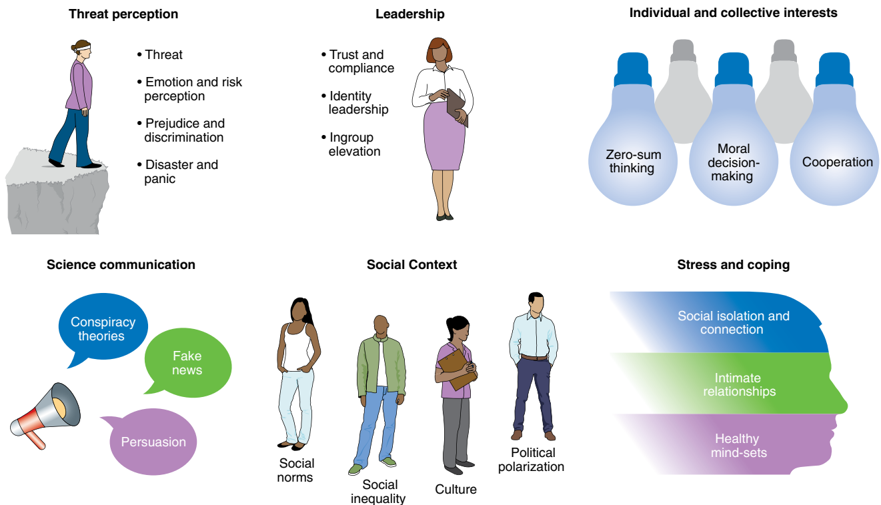
The COVID-19 pandemic represents a massive global health crisis. Because the crisis requires large-scale behaviour change and places significant psychological burdens on individuals, insights from the social and behavioural sciences can be used to help align human behaviour with the recommendations of epidemiologists and public health experts. Here we discuss evidence from a selection of research topics relevant to pandemics, including work on navigating threats, social and cultural influences on behaviour, science communication, moral decision-making, leadership, and stress and coping. In each section, we note the nature and quality of prior research, including uncertainty and unsettled issues. We identify several insights for effective response to the COVID-19 pandemic and highlight important gaps researchers should move quickly to fill in the coming weeks and months.
Overview
CoChat Summary
TL;DR
This perspective argues that social and behavioural science can help align public behaviour with COVID-19 public health recommendations across threat perception, social context, science communication, cooperation, leadership, and stress/coping. It synthesizes prior evidence and policy insights while cautioning that evidence is limited, often drawn from non-pandemic contexts, and in many areas unsettled.
Key findings
- The paper notes the scale of infectious disease threats: the bubonic plague killed approximately 25% of the European population, and by March 2020 COVID-19 had spread to more than 118,000 cases and caused 4,291 deaths in 114 countries. It also notes that 21 countries donated medical supplies to China in February, with China reciprocating widely.
- Fear appeals can change behaviour when people feel capable of dealing with the threat, but produce defensive reactions when people feel helpless; optimism bias can lead people to underestimate personal risk and ignore public health warnings.
- Social norms, inequality, culture, and political polarization shape pandemic behaviour: correcting misperceived norms can help when most people are already doing the desirable behaviour, but descriptive norms can backfire if the behaviour is undesirable unless paired with prescriptive norms.
- Effective communication and leadership may involve credible sources, messages that protect others or align with moral values, prebunking/inoculation against misinformation, accuracy nudges, shared social identity, and leaders modelling prosocial sacrifice; excessive national self-image concerns (“collective narcissism”) can backfire.
Methods
- Design: Perspective/narrative review; no primary data collection or sample. Topics were identified by the corresponding authors as potentially relevant to pandemic response and are explicitly not exhaustive.
- Evidence base: synthesizes prior social and behavioural research on threat perception, social context, science communication, moral decision-making, cooperation, leadership, and stress/coping, drawing on laboratory experiments, correlational studies, field experiments, meta-analyses, and preprints/forthcoming work.
- Analysis: narrative synthesis with policy implications and identified research gaps; no systematic search strategy or quantitative synthesis is reported.
Limitations
- Stated: due to space constraints, the paper provides only a brief summary of each topic; research on these topics is ongoing and in many cases far from settled; there is very little published social science research on the current pandemic, so discussion often draws from different circumstances and evidence quality varies substantially.
- Stated: insights and policy implications should be interpreted with caution.
- Evident: as a perspective rather than a systematic review or empirical study, it does not provide a comprehensive evidence appraisal, and its reliance on preprints and forthcoming sources limits certainty.
Model-written summary. Check it against the paper before relying on it.
Integrity signals
Registry
Cites
Statistics
Figures
Verification
Claims the paper makes
19 Valid · 5 Not valid · 37 Not checked · 13 Own results and interpretations
At least one cited source doesn’t support this claim or points to a different paper, and none confirmed it — see the verdicts below.
In the paper
“For instance, in hypothetical scenarios about deciding whether to go to work while sick, American and British participants reported they would be less willing to stay home when it was uncertain they would infect a co-worker.”
What the sources say
- Disputedcites [176] Kappes, A. et al. Uncertainty about the impact of social decisions increases prosocial behaviour. Nat. Hum. Behav. 2, 573–580 (2018). sourceExperimental — accuracy not yet measured
In the paper’s account of the infectious-disease scenario (Abstract; page not provided), participants facing uncertainty about how severely a co-worker might be affected were more likely to stay home than controls, not less. The paper distinguishes that impact uncertainty from uncertainty about whether a co-worker would be infected. Its Study 6 Methods (page not provided) describe recruitment through AMT, but do not establish the claimed American and British participant groups. (LLM, conf=0.88)
Checked by a reasoning model — may be wrong.
hedgedstates an association- Asserted: passes — The authors put it forward as true.
- Checkable: passes — It can be checked against evidence.
- Load-bearing: passes — The paper’s conclusions depend on it.
- Based: passes — The paper gives a reason why it holds.
- Disputed
The cited sources that could be checked couldn’t confirm or dispute this claim.
In the paper
“Moreover, there is mixed research regarding whether corrections may actually increase belief in the original misinformation 121,124-126 or in other misleading claims that fail to get corrected 127 .”
What the sources say
- Not checked — no full text of the sourcecites [121] Guess, A. & Coppock, A. Does counter-attitudinal information cause backlash? Results from three large survey experiments. Br. J. Polit. Sci. https://doi.org/10.1017/S0007123418000327 (2018). source
- Not matchedcites [124] Wittenberg, C. & Berinsky, A.J. Misinformation and its correction. in Social Media and Democracy: The State of the Field (eds Persily, N. & Tucker, J. A.) (Cambridge University Press, forthcoming).
Its entry has no title and year that we can search by.
- Not checked — no full text of the sourcecites [125] Swire, B. & Ecker, U.K.H. Misinformation and its correction: Cognitive mechanisms and recommendations for mass communication. in Misinformation and Mass Audiences (eds. Southwell, B. G., Thorson, E. A. & Sheble, L.) 195–2011 (University of Texas Press, 2018). source
- Not checked — no full text of the sourcecites [126] Wood, T. & Porter, E. The elusive backfire effect: mass attitudes’ steadfast factual adherence. Polit. Behav. 41, 135–163 (2018). source
- Could not verifycites [127] Pennycook, G., McPhetres, J., Zhang, Y. & Rand, D. Fighting COVID-19 misinformation on social media: Experimental evidence for a scalable accuracy nudge intervention. Preprint at PsyArXiv https://doi.org/10.31234/osf.io/uhbk9 (2020). sourceExperimental — accuracy not yet measured
Citation 127 is attached to the suggestion that corrections may increase belief in other misleading claims that go uncorrected. The Statement of Relevance and Discussion describe an accuracy nudge that improved sharing decisions, not corrections or their effects on belief in uncorrected claims. Searches for correction backfire and uncorrected misinformation found no passage addressing that point; page numbers were unavailable in our copy. (LLM, conf=0.76)
hedgedstates a possible cause- Asserted: passes — The authors put it forward as true.
- Checkable: passes — It can be checked against evidence.
- Load-bearing: passes — The paper’s conclusions depend on it.
- Based: passes — The paper gives a reason why it holds.
The sources with a verdict support this claim; the rest weren’t checked yet, have no full text we could read, or their verdicts aren’t rated yet.
In the paper
“Indeed, laboratory research has found that people prioritize local over global (or international) interests 185,186 .”
What the sources say
- Supportedcites [185] Milinski, M., Hilbe, C., Semmann, D., Sommerfeld, R. & Marotzke, J. Humans choose representatives who enforce cooperation in social dilemmas through extortion. Nat. Commun. 7, 10915 (2016). source
The Results section (‘Voters choose selfish representatives’; page unavailable) reports that participants preferentially re-elected representatives who contributed less to the shared climate account and elected candidates who pledged to contribute less than a fair share. In this simulated international dilemma, that supports the claim that participants favored their own group’s interests over the collective goal; it does not establish that everyone did so. (LLM, conf=0.85)
- Not checked — no full text of the sourcecites [186] Reinders Folmer, C. P. et al. One for all: what representing a group may do to us. J. Exp. Soc. Psychol. 48, 1047–1056 (2012). source
plain- Asserted: passes — The authors put it forward as true.
- Checkable: passes — It can be checked against evidence.
- Load-bearing: passes — The paper’s conclusions depend on it.
- Based: passes — The paper gives a reason why it holds.
- Supported
Every source the paper cites for this claim was checked and supports it.
In the paper
“However, when going to work risked infecting an elderly co-worker who would suffer a serious illness, participants reported they would be more willing to stay home 176 .”
What the sources say
- Supportedcites [176] Kappes, A. et al. Uncertainty about the impact of social decisions increases prosocial behaviour. Nat. Hum. Behav. 2, 573–580 (2018). source
The Study 6 Methods (page not provided) describe a scenario in which going to work could infect an older, vulnerable co-worker who would suffer severely, followed by a rating of willingness to go to work. The reported Study 6 findings (indexed under Abstract; page not provided) say participants given that risk information were significantly more likely to stay home than controls. (LLM, conf=0.92)
hedgedstates a cause- Asserted: passes — The authors put it forward as true.
- Checkable: passes — It can be checked against evidence.
- Load-bearing: passes — The paper’s conclusions depend on it.
- Based: passes — The paper gives a reason why it holds.
- Supported
The sources with a verdict support this claim; the rest weren’t checked yet, have no full text we could read, or their verdicts aren’t rated yet.
In the paper
“Several techniques, such as sanctioning defectors 187 or rewarding cooperators 188 , tend to increase cooperative behaviour in laboratory experiments using economic games.”
What the sources say
- Not checked — no full text of the sourcecites [187] Yamagishi, T. The provision of a sanctioning system as a public good. J. Pers. Soc. Psychol. 51, 110–116 (1986). source
- Supportedcites [188] Rand, D. G., Dreber, A., Ellingsen, T., Fudenberg, D. & Nowak, M. A. Positive interactions promote public cooperation. Science 325, 1272–1275 (2009). source
Citation 188 is attached to rewarding cooperators. The paper’s Abstract reports a laboratory comparison using repeated public goods games and finds that reward maintained public cooperation and, when both reward and punishment were available, increased contributions. (LLM, conf=0.93)
plainstates a cause- Asserted: passes — The authors put it forward as true.
- Checkable: passes — It can be checked against evidence.
- Load-bearing: unclear — It is unclear whether the paper’s conclusions depend on it.
- Based: passes — The paper gives a reason why it holds.
50 more claims · 13 with their cited sources checked
Create a free account to see all 74 claims and to verify the 2 references still open.
- It may state two separate claims as one. 13
- Probably not a substantial claim. 6
Claims other papers make about this one
Each is checked against this paper’s own text: does it say what the citing paper says it does?
The source backs part of the claim, not all of it — or backs it for a different population, condition or comparison.
In the citing paper
“COVID-19 is an international public health crisis, putting substantial burden on medical centers and increasing the psychological toll on health care workers (HCW).”
From Supporting the well-being of health care providers during the COVID-19 pandemic: The CopeColumbia response (2020) · cites this paper as [6]
Experimental — accuracy not yet measuredThe source backs part of the claim, not all of it — or backs it for a different population, condition or comparison.
In the citing paper
“these population-wide measures affected psychological well-being and mental health as well as increased social isolation [68] and loneliness.”
From Psychological correlates of perceived loneliness in college students before and during the COVID-19 stay-at-home period: a longitudinal study (2023) · cites this paper as [68]
Experimental — accuracy not yet measuredThe source backs part of the claim, not all of it — or backs it for a different population, condition or comparison.
In the citing paper
“they may eventually increase the social isolation of students and affect their psychological well-being and mental health [3].”
From Students under lockdown: Comparisons of students’ social networks and mental health before and during the COVID-19 crisis in Switzerland (2020) · cites this paper as [3]
Experimental — accuracy not yet measuredThe source backs part of the claim, not all of it — or backs it for a different population, condition or comparison.
In the citing paper
“effective interventions are hard to scale to a population level (12);”
From Psychological inoculation improves resilience against misinformation on social media (2022) · cites this paper as [12]
Experimental — accuracy not yet measuredThe source backs part of the claim, not all of it — or backs it for a different population, condition or comparison.
In the citing paper
“There is a shortage of studies that test anti-misinformation interventions in an ecologically valid manner, i.e., testing an intervention as consumers would interact with it in online environments (8, 12).”
From Psychological inoculation improves resilience against misinformation on social media (2022) · cites this paper as [12]
Experimental — accuracy not yet measured
6 more claims about this paper
Create a free account to see every claim other papers make about this one.
Citations
Cites
Granovetter, M. S. (1973) · American Journal of Sociology · doi:10.1086/225469 · Cited by 40,491
Zhou, F., Yu, T., Du, R., Fan, G., Liu, Y., Liu, Z., Xiang, J., Wang, Y., Song, B., Gu, X., et al. (2020) · The Lancet · doi:10.1016/s0140-6736(20)30566-3 · Cited by 27,263
The need to belong: Desire for interpersonal attachments as a fundamental human motivation.
Baumeister, R. F., & Leary, M. R. (1995) · Psychological Bulletin · doi:10.1037//0033-2909.117.3.497 · Cited by 23,245
Culture and the self: Implications for cognition, emotion, and motivation.
Markus, H. R., & Kitayama, S. (1991) · Psychological Review · doi:10.1037/0033-295x.98.2.224 · Cited by 21,995
Self-citationThe Psychological Impact of Quarantine and How to Reduce It: Rapid Review of the Evidence
Brooks, S. K., Webster, R. K., Smith, L. E., Woodland, L., Wessely, S., Greenberg, N., & Rubin, G. J. (2020) · doi:10.2139/ssrn.3532534 · Cited by 16,394
The psychological impact of quarantine and how to reduce it: Rapid review of the evidence
Brooks, S. K., Webster, R. K., Smith, L. E., Woodland, L., Wessely, S., Greenberg, N., & Rubin, G. J. (2020) · The Lancet · doi:10.1016/s0140-6736(20)30460-8 · Cited by 16,378
Nudge: improving decisions about health, wealth, and happiness
(2008) · Choice Reviews Online · doi:10.5860/choice.46-0977 · Cited by 11,572
Slovic, P. (1987) · Science · doi:10.1126/science.3563507 · Cited by 9,271
The Elaboration Likelihood Model of Persuasion
Petty, R. E., & Cacioppo, J. T. (1986) · Advances in Experimental Social Psychology · doi:10.1016/s0065-2601(08)60214-2 · Cited by 8,822
Self-citationThe emotional dog and its rational tail: A social intuitionist approach to moral judgment.
Haidt, J. (2001) · Psychological Review · doi:10.1037/0033-295x.108.4.814 · Cited by 8,048
Research works printed but not linked: 3
- Berkowitz, A.D. An overview of the social norms approach. in Changing the Culture of College Drinking: A Socially Situated Health Communication Campaign (eds. Stewart, L. & Lederman, L. C.) 193–214 (Hampton Press, 2005).
- Wittenberg, C. & Berinsky, A.J. Misinformation and its correction. in Social Media and Democracy: The State of the Field (eds Persily, N. & Tucker, J. A.) (Cambridge University Press, forthcoming).
- Ransohoff, K.J. Patients on the Trolley Track: The Moral Cognition of Medical Practitioners and Public Health Professionals. (Harvard Univ. Press, 2011).
Cited by
Items 4,401–4,500 of 5,015
Préambule – Présentation de la méthode
Bansard, E., & Bonnaire, A. (2023) · Actes · doi:10.52983/ffyi5905
Commentaire 2 : Faut-il une crise pour sensibiliser le grand public au travail en SHS ?
Chakraverty, C. (2023) · Actes · doi:10.52983/qzbx9936
Commentaire 1 : Prolongements et notes critiques sur l’analyse extensive
Orset, C. (2023) · Actes · doi:10.52983/lxgm4740
La construction de la Covid-19 par les SHS – Étude qualitative
Bansard, E. (2023) · Actes · doi:10.52983/rtkr8158
Fabrique d'un projet en temps de crise
Danon-Szmydt, M., Danon-Szmydt, M., Hodroj, Y., et al. (2023) · Actes · doi:10.52983/xkhm1301
Bresson, M., & Guibentif, P. (2023) · Actes · doi:10.52983/gyqv1249
Contribuer au débat sur les échelles territoriales de gouvernance – Synthèse de la session 5
Vasilescu, I. (2023) · Actes · doi:10.52983/vvyu9040
Conclusion générale – Au delà du choc Covid-19
Guibentif, P., & Bresson, M. (2023) · Actes · doi:10.52983/liyf3909
Rousselot, F. (2023) · Actes · doi:10.52983/nzol9194
Se saisir de la crise sanitaire comme d’un révélateur – Synthèse de la session 7
Vincensini, C. (2023) · Actes · doi:10.52983/vtyd6058
Interroger le discours de l’État – Synthèse de la session 4
Bessy, C. (2023) · Actes · doi:10.52983/yvco2152
Les enjeux politiques d'une transformation des savoirs
Commaille, J. (2023) · Actes · doi:10.52983/bquf9890
Défendre des principes – Synthèse de la session 8
Maurel, L. (2023) · Actes · doi:10.52983/cnoz6326
Rendre compte de l'impact sur les modes de vie – Synthèse de la session 3
Didry, C. (2023) · Actes · doi:10.52983/bswv7607
La mise en scène des sciences par temps de Covid-19
Klein, É. (2023) · Actes · doi:10.52983/aiqf6260
Préambule – Un débat académique dans le contexte Paris-Saclay
Bansard, E., & Bonnaire, A. (2023) · Actes · doi:10.52983/kxes9171
Recomposer les rapports entre science, pouvoir et opinion dans le laboratoire-monde
Bensaude‐Vincent, B. (2023) · Actes · doi:10.52983/phka6410
Préambule – Mobiliser l'analyse et le débat public
Bresson, M., & Guibentif, P. (2023) · Actes · doi:10.52983/vidm4641
Préambule – Mise en débat académique et dans l’espace public
Bansard, E. (2023) · Actes · doi:10.52983/juiz3125
Les conditions pour une "science vivante"
Thibault, F. (2023) · Actes · doi:10.52983/jojk3713
Après le choc Covid-19 : Temps d'un indispensable retour réflexif, en particulier pour les SHS
Guibentif, P. (2023) · Actes · doi:10.52983/fsuo6985
Izdebski, Z., Kozakiewicz, A., Michniewicz, S., Białorudzki, M., & Mazur, J. (2023) · Journal of Health Inequalities · doi:10.5114/jhi.2023.127535 · Cited by 1
“The social impact of the pandemic has undoubtedly extended to intra-family relationships, while many people were in sudden, forced closeness to their closest family [3].”
BackgroundMethodAbdul-Rahaman, N. (2023) · Psychology Research and Behavior Management · doi:10.2147/prbm.s408064
“The transition to remote teaching and learning restricted doctoral students’ access to supervisors, colleagues, and university facilities such as laboratories, libraries, and classrooms, affecting students’ wellbeing.(4,5) Student wellbeing is the absence of stress, increased engagement in the classroom, and heightene…”
BackgroundSchweitzer, S., Shen, P., & Siebert, J. U. (2023) · SSRN Electronic Journal · doi:10.2139/ssrn.4465082
BIOETHICS AMIDST THE COVID-19 PANDEMICPreprint
Lea, M. (2023) · doi:10.31219/osf.io/zkemb
da Cruz, J. S., de Oliveira, J. C., & Brandão, T. P. (2023) · RECIMA21 - Revista Científica Multidisciplinar · doi:10.47820/recima21.v4i6.3280
Os Enfermeiros face à COVID-19: conhecimentos, atitudes e perceção de risco
Martins, C., Lima, L., & Bastos, C. (2023) · Revista de Investigação & Inovação em Saúde · doi:10.37914/riis.v6.243
Varol, T. (2023) · Research Publications (Maastricht University) · doi:10.26481/dis.20230629tv · Cited by 1
Moroń, M., & Smołkowska-Jędo, W. (2023) · Psychology Research and Practice · doi:10.37155/2972-3086-0201-1
Pagliaro, S., Gkinopoulos, T., & Pacilli, M. G. (2023) · Group Processes & Intergroup Relations · doi:10.1177/13684302231179677 · Cited by 2
“…functions of morality could be used to foster behaviors to reduce COVID-19 transmissions (e.g., Pagliaro et al., 2021; Plohl & Musil, 2021; van Bavel et al., 2020); to promote vaccination through communication framed in terms of moral issues (e.g., Larson, 2020; Zhang et al., 2023); to…”
BackgroundAntropausia y comportamiento humano: aportes desde una neurociencia educacional situada
Bacigalupe, M. D. L. Á. (2022) · Pensando Psicología · doi:10.16925/2382-3984.2022.01.01
Baiq Dewi Asyura, D. M., Saimi, S., & Khalik, L. A. (2022) · JMM (Jurnal Masyarakat Mandiri) · doi:10.31764/jmm.v6i1.6520 · Cited by 1
Ansiedad, comportamientos preventivos y percepciones frente al COVID-19 en Perú
Monge-Rodríguez, F., & Alvarado-Yepez, A. J. (2023) · Revista Argentina de Ciencias del Comportamiento ( RACC ) · doi:10.32348/1852.4206.v15.n1.36590 · Cited by 1
Factors Influencing COVID-19 Prevention Behavior: A Community-based Cross-sectional Study
Ernawaty, E., & Dherindri, N. B. (2023) · Open Access Macedonian Journal of Medical Sciences · doi:10.3889/oamjms.2023.8813 · Cited by 1
“The circulated rumor, hoax, and conspiracies about COVID-19 could affects public’s trust toward the government that may lead to negative effects on the preventive behavior thus, key opinion leader held an importance role as a local voice that can amplify the public health messages and help to build trust that needed t…”
BackgroundDíaz‐Valerio, S. (2023) · eDiss (Georg-August-Universität Göttingen) · doi:10.53846/goediss-9957
Schrödter, M., & Thalheim, V. (2023) · Sozialer Sinn · doi:10.1515/sosi-2023-0001
“Abschreckung sollte demnach mit der Stärkung von Überzeugungen bei den Adressat:innen einhergehen, so dass sie das Gefühl bekommen, der Gefahr handlungsmächtig etwas entgegensetzen zu können (so auch Van Bavel et al. 2020: 461; empirisch für Deutschland: Kojan et al. 2022).”
BackgroundKodak, B., & Oduor, J. A. (2023) · International Journal of Scientific Research and Management (IJSRM) · doi:10.18535/ijsrm/v11i06.com01
Jun, T., & Chin, T. A. (2023) · International Journal of Academic Research in Business and Social Sciences · doi:10.6007/ijarbss/v13-i6/17469
“Changing habits of human behavior is widely seen as a key margin to contain the Covid19 pandemic (Bavel et al., 2020).”
BackgroundHarris, G. F., & Bodas, M. (2023) · Research Square · doi:10.21203/rs.3.rs-3121075/v1
Liu, Y., & Horta, H. (2023) · Springer eBooks · doi:10.1007/978-3-031-26393-4_12
Students’ perception and challenges of learning the English subjects through online classes
Universiti Teknologi, M. A. R. A., Mohammad, S. H. S., & Joseph, S. N. R. (2023) · International Journal on e-Learning and Higher Education · doi:10.24191/ijelhe.v18n2.1823
Promoting Positive Youth Development through the Volunteer Programme in the Case of NEET Youth
Chauke, T. A. (2023) · Commonwealth Youth and Development · doi:10.25159/2663-6549/11445
Measuring Trust in Government Amid COVID-19 Pandemic and the Russian-Ukraine War
Azab, N., & Elsherif, M. (2023) · Lecture notes in networks and systems · doi:10.1007/978-981-99-3243-6_56 · Cited by 1
Utami, D. K. I., Dewi, P. R., Budiarsa, I. G. N. K., & Karang, A. A. S. I. (2023) · Romanian Journal of Neurology · doi:10.37897/rjn.2023.2.2
Liderança em Tempos de Crise: Refl exos da Pandemia de COVID-19 sob a Perspectiva de Gênero
Silva, L. C. O. (2023) · Cadernos de Psicologia · doi:10.9788/cp2023.2-04 · Cited by 1
The Robustness of Preferences During a CrisisPreprint
Bokern, P., Linde, J., Riedl, A. M., & Werner, P. (2023) · SSRN Electronic Journal · doi:10.2139/ssrn.4524429
Pandemia de Covid-19 e Relações Verbais em Redes Sociais
Oliveira, J. M. S., Sampaio, I. F., Mota, F. M. B., Marfil, C. L. O., & Vasconcelos, L. A. (2023) · Cadernos de Psicologia · doi:10.9788/cp2023.2-09 · Cited by 2
Laužikas, M., & Mačiukaitė-Žvinienė, S. (2023) · Springer eBooks · doi:10.1007/978-3-031-31883-2_5
Predictors of Intention to Maintain COVID-19 Standard Operating Procedures (SOPS) among Students
Kasirye, F., Ssemuddu, I., Radwan, H., & Wok, S. (2023) · International Journal of Academic Research in Business and Social Sciences · doi:10.6007/ijarbss/v13-i13/17948
İşbir, G. G., Turner, J. D., & Gabbianelli, R. (2023) · Current Psychology · doi:10.1007/s12144-023-04878-6
“Although technological applications were used in maintaining social relations during the pandemic, women could not benefit from face-to-face interaction and support (Bavel et al., 2020).”
Impact of Social Media on Indian Politics after Covid-19 Pandemic
Tiwari, B., & Singh, B. (2023) · Integrated Journal for Research in Arts and Humanities · doi:10.55544/ijrah.3.3.17 · Cited by 2
Newell, B. R., & Shanks, D. R. (2023) · The MIT Press eBooks · doi:10.7551/mitpress/14922.003.0016
EMOTIONAL REGULATION AND DISTRESS DURING THE SOCIAL ISOLATION OF THE COVID-19 IN BRAZIL
Cerqueira-Santos, E., Faro, A., Lisboa, W., Ferreira, D. C. S., & Delabrida, Z. N. C. (2023) · Psicologia Saúde & Doenças · doi:10.15309/23psd240106
“In this sample the emotional suppression strategy plays a negative role in increasing stress and depression, validating the hypothesis that tension, fear and bad news about the pandemic need effective emotional moderators (Van Bavel et al., 2020).”
Cane, T. P. C. (2023) · Social Work and Social Welfare · doi:10.25082/swsw.2023.01.001
“In some studies, prosocial behaviour such as altruism in the time of a pandemic may continue to exist although due to people’s defensive systems and fear of contracting a contagious virus might result in altruistic behaviours continuum depending on whether people see themselves as able to deal with the threat of a dis…”
BackgroundAlsswey, A., Malak, M. Z., & El-Qirem, F. A. (2023) · New Review of Hypermedia and Multimedia · doi:10.1080/13614568.2023.2246423
“Thus, identifying the perspectives of social media users on the current health interventions and regulations can offer decisionmakers new insights into people’s expectations of the quality of these measures and services during pandemic disasters (Al-Shdayfat et al., 2022; Bavel et al., 2020; Pedrosa et al., 2020; Sele…”
BackgroundCasas, D. G., Barbé, A. D., García, E. M., & Gálvez-Nieto, J. L. (2023) · International Social Work · doi:10.1177/00208728231190183 · Cited by 1
“COVID-19 has caused personal, emotional, and social losses, and will continue to significantly affect the usual forms of social relationships (Van Bavel et al., 2020).”
Xiao-lin, L., & Miao, X. (2023) · International Journal of Mental Health Promotion · doi:10.32604/ijmhp.2023.030232
OECD (2023) · Educational research and innovation · doi:10.1787/78e95928-en
Share of the public research budget allocated to educational R&D, 2020
OECD (2023) · Educational research and innovation · doi:10.1787/39dff7f7-en
OECD (2023) · Educational research and innovation · doi:10.1787/eada3827-en
Distribution of public educational R&D budget across OECD countries
OECD (2023) · Educational research and innovation · doi:10.1787/f697994b-en
Share of countries/regions’ output in total educational research output, 1995-2020
OECD (2023) · Educational research and innovation · doi:10.1787/244f91ac-en
OECD (2023) · Educational research and innovation · doi:10.1787/59e183f2-en
Educational research outputs in the world, 1995-2020
OECD (2023) · Educational research and innovation · doi:10.1787/0c15924a-en
Evolution of the share of quantitative educational research output based on the two studies
OECD (2023) · Educational research and innovation · doi:10.1787/39945d19-en
Public research budget for education, 2020
OECD (2023) · Educational research and innovation · doi:10.1787/475f0b6b-en
Share of educational research outputs in the total research output, 1995-2020
OECD (2023) · Educational research and innovation · doi:10.1787/ab879bf3-en
OECD (2023) · Educational research and innovation · doi:10.1787/8db95262-en
Anil, S., Sriram, A., & Hari, S. (2023) · Indian Journal of Social Psychiatry · doi:10.4103/ijsp.ijsp_286_21
Skąd bierze się niechęć do obcych? O grupowych identyfikacjach Polaków
Puchała, D., & Bilewicz, M. (2023) · Nauka · doi:10.24425/nauka.2023.146064 · Cited by 2
Leisure and free time during social isolation in Brazil: psychosocial perspective
Martins, J. C. D. O., de Moraes, L. D., Barbosa, F. W. D. S., Costa, Í. M., & Melo, C. D. F. (2023) · Contribuciones a las Ciencias Sociales · doi:10.55905/revconv.16n.8-281
“In relation to Brazil, as well as other less developed countries, certain particularities call our attention: the climate of insecurity in health management, the fear and concern that affects everyone contributes to the desperate search to understand this complex problem (Lins et al., 2020; Martins et al., 2021), thus…”
InfluentialRarity-Expertise Valuation: The Role of Domain Knowledge in the World of Big ExperimentationPreprint
Iliev, R. (2023) · PsyArXiv (OSF Preprints) · doi:10.31234/osf.io/ewz4m
Liu, J., Gong, R., Cheng, L., & Aló, R. (2023) · International Conference on Computer Communications and Networks (ICCCN) · doi:10.1109/icccn58024.2023.10230101 · Cited by 1
“People’s behavior can indicate and affect people’s health [43], [44], [48].”
BackgroundLa pandemia de COVID-19 como individuo biológico: un nuevo modelo teórico.
Ricote, D., & Maeso, I. (2023) · Astrágalo Cultura de la Arquitectura y la Ciudad · doi:10.12795/astragalo.2023.i32.09
In or out? The paradox of exclusionary mechanisms in keeping cooperation going
Fernandes, C. A. D. M. (2023) · University of Groningen research database (University of Groningen / Centre for Information Technology) · doi:10.33612/diss.768055223 · Cited by 18
Farolfi, S., Jourdain, D., Mungatana, E. D., Nicholls, N., Willinger, M., & Yitbarek, E. A. (2023) · Development Southern Africa · doi:10.1080/0376835x.2023.2252462
“Public health campaigns widely emphasise how one ’ s actions impact the well-being of others (Van Bavel et al., 2020).”
BackgroundMethodPsychology of Religion and Pandemic COVID-19 in KP, Islamic Republic of Pakistan
Riaz, H. (2023) · International Journal of Linguistics and Culture · doi:10.52700/ijlc.v4i1.186 · Cited by 1
“Appeal to fear may compel people to change their behaviour in order to make ‘defensive responses’ (Bavel et al., 2020).”
BackgroundPriyadharshini, C., Saranya, P., & Karthikeyan, K. (2023) · AIP conference proceedings · doi:10.1063/5.0168907
Helion, C., Ulichney, V., Smith, D. V., & Jarcho, J. M. (2023) · PLoS ONE · doi:10.1371/journal.pone.0291329 · Cited by 1
“To further assess Covid-related knowledge at a time in which it was still novel and wherein it could be challenging for the public to delineate between accurate and inaccurate information [21], participants were asked to read each of the following statements, and to indicate the extent to which they believed these sta…”
BackgroundChina's Cultural Tightness and Stock Price Crash RiskPreprint
Hu, J. (2023) · SSRN Electronic Journal · doi:10.2139/ssrn.4570225
Deck, J., Gilpin, K., Nichols, R., et al. (2023) · Open Journal of Social Sciences · doi:10.4236/jss.2023.119017
Dilcen, H. Y., Bulut, E., ÖNAL, Y., Yılmaz, F., & TAŞKAYA, Z. (2023) · Turkiye Klinikleri Journal of Nursing Sciences · doi:10.5336/nurses.2022-90681
Jungkunz, S. (2023) · Springer eBooks · doi:10.1007/978-3-031-22747-9_8
Showkat, S. (2023) · Journal of Ecophysiology and Occupational Health · doi:10.18311/jeoh/2023/34181
Russo, V., Marconi, L., Cecconi, F., & Maretti, M. (2023) · SSRN Electronic Journal · doi:10.2139/ssrn.4561249
Kurniawan, G. I. (2023) · Advances in economics, business and management research/Advances in Economics, Business and Management Research · doi:10.2991/978-94-6463-234-7_98
COVID-19 pandemic on cultural tours and cultural tourists in Turkey
Coşkun, O., & Akgündüz, Y. (2023) · Anatolia · doi:10.1080/13032917.2023.2263458
“Fear of getting infected, which is observed in people during the COVID-19 pandemic, significantly impacts consumer behaviour (Bavel et al., 2020).”
Reflections shaped by the COVID-19 pandemic for medical education in China, and globally
Carmo, M. (2023) · Advances in education and educational trends · doi:10.36315/2023eadviii22 · Cited by 1
Level of Fear due to the COVID-19 Pandemic in Residents of the Los Olivos District of North Lima
Meneses-Claudio, B., Marín, A. R. C., Saberbein-Muñoz, J., Salinas-Cruz, M., & Quesada-Aramburu, T. (2023) · Salud Ciencia y Tecnología · doi:10.56294/saludcyt2023535
Epidemiología sociocultural de la crisis del COVID-19
Plaza, R. G. (2023) · Gredos (University of Salamanca) · doi:10.14201/gredos.153227
Ou, X., Lai, D. W. L., Huang, Z., & Lee, H. H. Y. (2023) · Interdisciplinary Nursing Research · doi:10.1097/nr9.0000000000000033
“…have indicated the importance of having trustworthy health information, authorities, and community support for managing COVID-19-associated anxieties, as well as providing guidance regarding the lifestyle adaptations that are essential, particularly for older adults during the pandemic 8,10,12 .”
BackgroundZoabi, D., Abado, E., Shamay‐Tsoory, S., et al. (2023) · Research Square · doi:10.21203/rs.3.rs-3373672/v1
Teaching during Pandemics: Managing Teacher Anxiety
Martin, W. M., & Lopez, Y. P. (2023) · College Teaching · doi:10.1080/87567555.2023.2266855 · Cited by 1
“Fear is a hallmark emotional reaction to COVID-19 (Van Bavel et al. 2020) and infection related anxiety has become a significant concern for teachers (Wakui et al. 2021).”
Shift handover qualification in obstetric unit during the pandemic period: reinventions and learning
Bär, K. A., Xavier, T. A., Martelli, G. M., Benedetti, F. J., Troncoso, M. P., & Costenaro, R. G. S. (2023) · Revista gaúcha de enfermagem · doi:10.1590/1983-1447.2023.20220288.en
“In the same proportion, there were correlated factors associated with fear of contracting the disease, concern for their own well-being and that of their family members, among other problems (4–6) .”
BackgroundMukherjee, S. (2023) · Innovations · doi:10.54882/7320237316711
“This even enforced individuals to be mentally depressed about their probable fate (Bavel et al., 2020; Pfefferbaum & North, 2020; Restubog et al., 2020; Sher, 2020a).”
BackgroundACCEPTANCE OF COVID-19 VACCINATION AMONG STUDENTS OF HEALTH SCIENCES CHITTOOR ANDHRA PRADESH INDIA
Jeeragyal, D. P., Basti, B. D., & B, S. (2023) · Asian Journal of Pharmaceutical and Clinical Research · doi:10.22159/ajpcr.2023.v16i10.48768 · Cited by 1
“To accept the vaccine, the public should know about its safety and effectiveness [11].”
Background
Metadata
- Authors
- Bavel, J. J. V., Baicker, K., Boggio, P. S., Capraro, V., Cichocka, A., Cikara, M., Crockett, M. J., Crum, A. J., Douglas, K. M., Druckman, J. N., Drury, J., Dube, O., Ellemers, N., Finkel, E. J., Fowler, J. H., Gelfand, M., Han, S., Haslam, S. A., Jetten, J., Kitayama, S., Mobbs, D., Napper, L. E., Packer, D. J., Pennycook, G., Peters, E., Petty, R. E., Rand, D. G., Reicher, S. D., Schnall, S., Shariff, A., Skitka, L. J., Smith, S. S., Sunstein, C. R., Tabri, N., Tucker, J. A., Linden, S. V. D., Lange, P. V., Weeden, K. A., Wohl, M. J. A., Zaki, J., Zion, S. R., & Willer, R.
- Affiliations
- New York University (US)
- Universidade Presbiteriana Mackenzie (BR)
- Middlesex University London (GB)
- University of Kent (GB)
- Harvard University (US)
- Yale University (US)
- Stanford University (US)
- Northwestern University (US)
- University of Sussex (GB)
- University of Chicago (US)
- Utrecht University (NL)
- University of California San Diego (US)
- University of Maryland, College Park (US)
- Peking University (CN)
- The University of Queensland (AU)
- University of Michigan (US)
- California Institute of Technology (US)
- Lehigh University (US)
- University of Regina (CA)
- University of Oregon (US)
- The Ohio State University (US)
- Massachusetts Institute of Technology (US)
- University of St Andrews (GB)
- University of Cambridge (GB)
- University of British Columbia (CA)
- University of Illinois Chicago (US)
- University of California, Berkeley (US)
- Carleton University (CA)
- Cornell University (US)
- Corresponding author
- Bavel, Jay J. Van
- Willer, Robb
- ORCID
- Bavel, Jay J. Van
- Baicker, Katherine
- Boggio, Paulo S.
- Capraro, Valerio
- Cichocka, Aleksandra
- Cikara, Mina
- Crockett, Molly J.
- Crum, Alia J.
- Douglas, Karen M.
- Druckman, James N.
- Drury, John
- Ellemers, Naomi
- Finkel, Eli J.
- Fowler, James H.
- Gelfand, Michele
- Han, Shihui
- Haslam, S. Alexander
- Jetten, Jolanda
- Kitayama, Shinobu
- Mobbs, Dean
- Napper, Lucy E.
- Packer, Dominic J.
- Pennycook, Gordon
- Peters, Ellen
- Petty, Richard E.
- Rand, David G.
- Reicher, Stephen D.
- Schnall, Simone
- Shariff, Azim
- Skitka, Linda J.
- Sunstein, Cass R.
- Tabri, Nassim
- Tucker, Joshua A.
- Linden, Sander van der
- Weeden, Kim A.
- Wohl, Michael J. A.
- Zaki, Jamil
- Zion, Sean R.
- Willer, Robb
- Venue
- Nature Human Behaviour
- Published
- 2020-04-30
- Volume
- 4
- Issue
- 5
- Pages
- 460-471
- ISSN
- 2397-3374 (ISSN-L)
- OpenAlex
- W3016902371
- Semantic Scholar
- d81abcd7f053b136423f1e7f57928524e8b0e1a0
- Cited by
- 4,964
- References
- 259
- Citations by year
- 2026: 177 · 2025: 288 · 2024: 483 · 2023: 741 · 2022: 1094 · 2021: 1474 · 2020: 702
- FWCI
- 175.81
- Type
- journal article
- Language
- en
- Open access
- bronze
- doi.org
- Licence
- www.springernature.com/gp/researchers/text-and-data-mining (tdm)
- www.springernature.com/gp/researchers/text-and-data-mining (vor)
- Locations
- Nature Human Behaviour (publishedVersion)
- PubMed (publishedVersion)
- Middlesex University Research Repository (Middlesex University Of London) (acceptedVersion)
- Kent Academic Repository (University of Kent) (acceptedVersion)
- DSpace@MIT (Massachusetts Institute of Technology) (submittedVersion, cc-by-nc-sa)
- Sussex Research Online (University of Sussex) (submittedVersion)
- CaltechAUTHORS (California Institute of Technology) (submittedVersion)
- RePEc: Research Papers in Economics (submittedVersion)
- BOA (University of Milano-Bicocca) (submittedVersion)
- Carleton University's Institutional Repository (MacOdrum Library, Carleton University) (submittedVersion, other-oa)
- Utrecht University Repository (Utrecht University) (submittedVersion)
- Figshare (submittedVersion)
- VU Research Portal (submittedVersion, other-oa)
- Utrecht University Repository (Utrecht University) (submittedVersion, other-oa)
- Data Archiving and Networked Services (DANS) (submittedVersion, other-oa)
- Funders
- U.S. Department of Health and Human Services (2P50 MH094258)
- National Institute of Mental Health (P50MH094258)
- Topics
- Social Sciences › Sociology and Political Science › COVID-19 Prevention and Impact
- Social Sciences › Communication › Communication and COVID-19 Impact
- Physical Sciences › Mathematics › Modeling and Simulation › COVID-19 epidemiological studies
- Keywords
- COVID-19 pandemic, pandemic response, behavior change, science communication, ethical decision-making, leadership, stress coping, psychological burden, public health recommendations
- MeSH terms
- Betacoronavirus, COVID-19, SARS-CoV-2, Adaptation, Psychological, Communicable Disease Control, Decision Making, Humans, Human Activities, Health Knowledge, Attitudes, Practice, Leadership, Pneumonia, Viral, Public Health, Quarantine, Stress, Psychological, Global Health, Coronavirus, Coronavirus Infections, Pandemics, Social Media, Epidemiological Monitoring
About these checks
Registry, retraction, Cites and statistics results are computed, not judged, with one exception: a printed reference that no index lists is read once by a model before it counts as a citation error. Claims are extracted by a model and kept only when their quote appears verbatim in the text; each cited source is then checked, with a model’s help, for whether it says what the claim relies on. Those verdicts can be wrong — read the claim’s quote and the cited source before relying on one.
The claim verdicts this report counts are experimental: their accuracy is not yet measured.
A language model drew the claims from the paper on 2026-10-10, under version 3 of the claim definition (model deepseek-v4.1-flash, prompt extract-v3).
A second model labelled each claim on 2026-10-10 (model jev-1.13-20260917, definition revision gold-guideline-v0.2).
Cited sources are checked with a language model’s help (gpt-6-sol).
Statistics and arithmetic are recomputed, not judged.
Confidence bands are shown only for fields calibrated on our annotated test set. None is calibrated yet, so no band is shown.
What counts as a claim ›How we measure confidence ›How we check this ›
Are you an author, or do you see a problem with this page? Request a review
Data sources
Bibliographic data: Semantic Scholar, OpenAlex, Crossref.
Contains information from the Semantic Scholar Academic Graph Datasets, made available under the ODC Attribution License (ODC-BY 1.0).
Semantic Scholar’s data is described in: Kinney, R., et al. (2023). The Semantic Scholar Open Data Platform. arXiv:2301.10140.
