

Using social and behavioural science to support COVID-19 pandemic response
Open accessThe DOI matches its Crossref record; 257 of the 259 references it cites were found in a registry or an index; 24 of the 89 sources its claims cite were checked for support.
Abstract
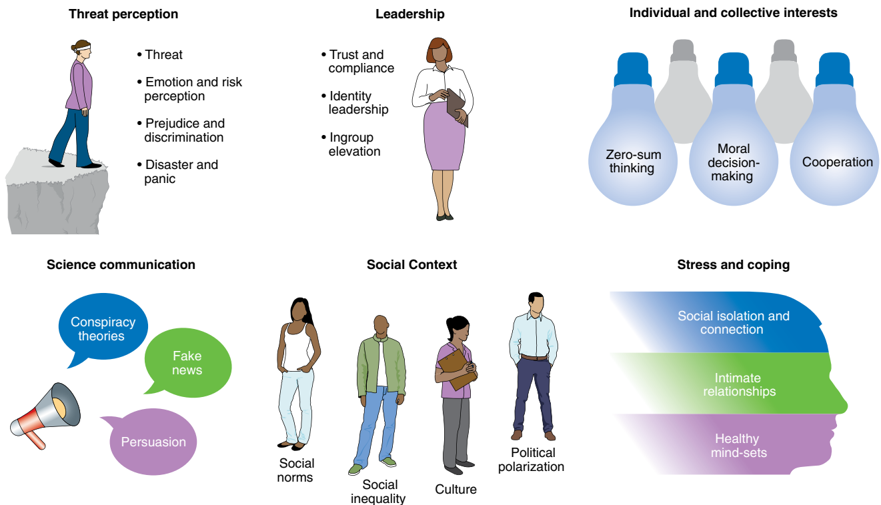
The COVID-19 pandemic represents a massive global health crisis. Because the crisis requires large-scale behaviour change and places significant psychological burdens on individuals, insights from the social and behavioural sciences can be used to help align human behaviour with the recommendations of epidemiologists and public health experts. Here we discuss evidence from a selection of research topics relevant to pandemics, including work on navigating threats, social and cultural influences on behaviour, science communication, moral decision-making, leadership, and stress and coping. In each section, we note the nature and quality of prior research, including uncertainty and unsettled issues. We identify several insights for effective response to the COVID-19 pandemic and highlight important gaps researchers should move quickly to fill in the coming weeks and months.
Overview
CoChat Summary
TL;DR
This perspective argues that social and behavioural science can help align public behaviour with COVID-19 public health recommendations across threat perception, social context, science communication, cooperation, leadership, and stress/coping. It synthesizes prior evidence and policy insights while cautioning that evidence is limited, often drawn from non-pandemic contexts, and in many areas unsettled.
Key findings
- The paper notes the scale of infectious disease threats: the bubonic plague killed approximately 25% of the European population, and by March 2020 COVID-19 had spread to more than 118,000 cases and caused 4,291 deaths in 114 countries. It also notes that 21 countries donated medical supplies to China in February, with China reciprocating widely.
- Fear appeals can change behaviour when people feel capable of dealing with the threat, but produce defensive reactions when people feel helpless; optimism bias can lead people to underestimate personal risk and ignore public health warnings.
- Social norms, inequality, culture, and political polarization shape pandemic behaviour: correcting misperceived norms can help when most people are already doing the desirable behaviour, but descriptive norms can backfire if the behaviour is undesirable unless paired with prescriptive norms.
- Effective communication and leadership may involve credible sources, messages that protect others or align with moral values, prebunking/inoculation against misinformation, accuracy nudges, shared social identity, and leaders modelling prosocial sacrifice; excessive national self-image concerns (“collective narcissism”) can backfire.
Methods
- Design: Perspective/narrative review; no primary data collection or sample. Topics were identified by the corresponding authors as potentially relevant to pandemic response and are explicitly not exhaustive.
- Evidence base: synthesizes prior social and behavioural research on threat perception, social context, science communication, moral decision-making, cooperation, leadership, and stress/coping, drawing on laboratory experiments, correlational studies, field experiments, meta-analyses, and preprints/forthcoming work.
- Analysis: narrative synthesis with policy implications and identified research gaps; no systematic search strategy or quantitative synthesis is reported.
Limitations
- Stated: due to space constraints, the paper provides only a brief summary of each topic; research on these topics is ongoing and in many cases far from settled; there is very little published social science research on the current pandemic, so discussion often draws from different circumstances and evidence quality varies substantially.
- Stated: insights and policy implications should be interpreted with caution.
- Evident: as a perspective rather than a systematic review or empirical study, it does not provide a comprehensive evidence appraisal, and its reliance on preprints and forthcoming sources limits certainty.
Model-written summary. Check it against the paper before relying on it.
Integrity signals
Registry
Cites
Statistics
Figures
Verification
Claims the paper makes
19 Valid · 5 Not valid · 37 Not checked · 13 Own results and interpretations
At least one cited source doesn’t support this claim or points to a different paper, and none confirmed it — see the verdicts below.
In the paper
“For instance, in hypothetical scenarios about deciding whether to go to work while sick, American and British participants reported they would be less willing to stay home when it was uncertain they would infect a co-worker.”
What the sources say
- Disputedcites [176] Kappes, A. et al. Uncertainty about the impact of social decisions increases prosocial behaviour. Nat. Hum. Behav. 2, 573–580 (2018). sourceExperimental — accuracy not yet measured
In the paper’s account of the infectious-disease scenario (Abstract; page not provided), participants facing uncertainty about how severely a co-worker might be affected were more likely to stay home than controls, not less. The paper distinguishes that impact uncertainty from uncertainty about whether a co-worker would be infected. Its Study 6 Methods (page not provided) describe recruitment through AMT, but do not establish the claimed American and British participant groups. (LLM, conf=0.88)
Checked by a reasoning model — may be wrong.
hedgedstates an association- Asserted: passes — The authors put it forward as true.
- Checkable: passes — It can be checked against evidence.
- Load-bearing: passes — The paper’s conclusions depend on it.
- Based: passes — The paper gives a reason why it holds.
- Disputed
The cited sources that could be checked couldn’t confirm or dispute this claim.
In the paper
“Moreover, there is mixed research regarding whether corrections may actually increase belief in the original misinformation 121,124-126 or in other misleading claims that fail to get corrected 127 .”
What the sources say
- Not checked — no full text of the sourcecites [121] Guess, A. & Coppock, A. Does counter-attitudinal information cause backlash? Results from three large survey experiments. Br. J. Polit. Sci. https://doi.org/10.1017/S0007123418000327 (2018). source
- Not matchedcites [124] Wittenberg, C. & Berinsky, A.J. Misinformation and its correction. in Social Media and Democracy: The State of the Field (eds Persily, N. & Tucker, J. A.) (Cambridge University Press, forthcoming).
Its entry has no title and year that we can search by.
- Not checked — no full text of the sourcecites [125] Swire, B. & Ecker, U.K.H. Misinformation and its correction: Cognitive mechanisms and recommendations for mass communication. in Misinformation and Mass Audiences (eds. Southwell, B. G., Thorson, E. A. & Sheble, L.) 195–2011 (University of Texas Press, 2018). source
- Not checked — no full text of the sourcecites [126] Wood, T. & Porter, E. The elusive backfire effect: mass attitudes’ steadfast factual adherence. Polit. Behav. 41, 135–163 (2018). source
- Could not verifycites [127] Pennycook, G., McPhetres, J., Zhang, Y. & Rand, D. Fighting COVID-19 misinformation on social media: Experimental evidence for a scalable accuracy nudge intervention. Preprint at PsyArXiv https://doi.org/10.31234/osf.io/uhbk9 (2020). sourceExperimental — accuracy not yet measured
Citation 127 is attached to the suggestion that corrections may increase belief in other misleading claims that go uncorrected. The Statement of Relevance and Discussion describe an accuracy nudge that improved sharing decisions, not corrections or their effects on belief in uncorrected claims. Searches for correction backfire and uncorrected misinformation found no passage addressing that point; page numbers were unavailable in our copy. (LLM, conf=0.76)
hedgedstates a possible cause- Asserted: passes — The authors put it forward as true.
- Checkable: passes — It can be checked against evidence.
- Load-bearing: passes — The paper’s conclusions depend on it.
- Based: passes — The paper gives a reason why it holds.
The sources with a verdict support this claim; the rest weren’t checked yet, have no full text we could read, or their verdicts aren’t rated yet.
In the paper
“Indeed, laboratory research has found that people prioritize local over global (or international) interests 185,186 .”
What the sources say
- Supportedcites [185] Milinski, M., Hilbe, C., Semmann, D., Sommerfeld, R. & Marotzke, J. Humans choose representatives who enforce cooperation in social dilemmas through extortion. Nat. Commun. 7, 10915 (2016). source
The Results section (‘Voters choose selfish representatives’; page unavailable) reports that participants preferentially re-elected representatives who contributed less to the shared climate account and elected candidates who pledged to contribute less than a fair share. In this simulated international dilemma, that supports the claim that participants favored their own group’s interests over the collective goal; it does not establish that everyone did so. (LLM, conf=0.85)
- Not checked — no full text of the sourcecites [186] Reinders Folmer, C. P. et al. One for all: what representing a group may do to us. J. Exp. Soc. Psychol. 48, 1047–1056 (2012). source
plain- Asserted: passes — The authors put it forward as true.
- Checkable: passes — It can be checked against evidence.
- Load-bearing: passes — The paper’s conclusions depend on it.
- Based: passes — The paper gives a reason why it holds.
- Supported
Every source the paper cites for this claim was checked and supports it.
In the paper
“However, when going to work risked infecting an elderly co-worker who would suffer a serious illness, participants reported they would be more willing to stay home 176 .”
What the sources say
- Supportedcites [176] Kappes, A. et al. Uncertainty about the impact of social decisions increases prosocial behaviour. Nat. Hum. Behav. 2, 573–580 (2018). source
The Study 6 Methods (page not provided) describe a scenario in which going to work could infect an older, vulnerable co-worker who would suffer severely, followed by a rating of willingness to go to work. The reported Study 6 findings (indexed under Abstract; page not provided) say participants given that risk information were significantly more likely to stay home than controls. (LLM, conf=0.92)
hedgedstates a cause- Asserted: passes — The authors put it forward as true.
- Checkable: passes — It can be checked against evidence.
- Load-bearing: passes — The paper’s conclusions depend on it.
- Based: passes — The paper gives a reason why it holds.
- Supported
The sources with a verdict support this claim; the rest weren’t checked yet, have no full text we could read, or their verdicts aren’t rated yet.
In the paper
“Several techniques, such as sanctioning defectors 187 or rewarding cooperators 188 , tend to increase cooperative behaviour in laboratory experiments using economic games.”
What the sources say
- Not checked — no full text of the sourcecites [187] Yamagishi, T. The provision of a sanctioning system as a public good. J. Pers. Soc. Psychol. 51, 110–116 (1986). source
- Supportedcites [188] Rand, D. G., Dreber, A., Ellingsen, T., Fudenberg, D. & Nowak, M. A. Positive interactions promote public cooperation. Science 325, 1272–1275 (2009). source
Citation 188 is attached to rewarding cooperators. The paper’s Abstract reports a laboratory comparison using repeated public goods games and finds that reward maintained public cooperation and, when both reward and punishment were available, increased contributions. (LLM, conf=0.93)
plainstates a cause- Asserted: passes — The authors put it forward as true.
- Checkable: passes — It can be checked against evidence.
- Load-bearing: unclear — It is unclear whether the paper’s conclusions depend on it.
- Based: passes — The paper gives a reason why it holds.
50 more claims · 13 with their cited sources checked
Create a free account to see all 74 claims and to verify the 2 references still open.
- It may state two separate claims as one. 13
- Probably not a substantial claim. 6
Claims other papers make about this one
Each is checked against this paper’s own text: does it say what the citing paper says it does?
The source backs part of the claim, not all of it — or backs it for a different population, condition or comparison.
In the citing paper
“COVID-19 is an international public health crisis, putting substantial burden on medical centers and increasing the psychological toll on health care workers (HCW).”
From Supporting the well-being of health care providers during the COVID-19 pandemic: The CopeColumbia response (2020) · cites this paper as [6]
Experimental — accuracy not yet measuredThe source backs part of the claim, not all of it — or backs it for a different population, condition or comparison.
In the citing paper
“these population-wide measures affected psychological well-being and mental health as well as increased social isolation [68] and loneliness.”
From Psychological correlates of perceived loneliness in college students before and during the COVID-19 stay-at-home period: a longitudinal study (2023) · cites this paper as [68]
Experimental — accuracy not yet measuredThe source backs part of the claim, not all of it — or backs it for a different population, condition or comparison.
In the citing paper
“they may eventually increase the social isolation of students and affect their psychological well-being and mental health [3].”
From Students under lockdown: Comparisons of students’ social networks and mental health before and during the COVID-19 crisis in Switzerland (2020) · cites this paper as [3]
Experimental — accuracy not yet measuredThe source backs part of the claim, not all of it — or backs it for a different population, condition or comparison.
In the citing paper
“effective interventions are hard to scale to a population level (12);”
From Psychological inoculation improves resilience against misinformation on social media (2022) · cites this paper as [12]
Experimental — accuracy not yet measuredThe source backs part of the claim, not all of it — or backs it for a different population, condition or comparison.
In the citing paper
“There is a shortage of studies that test anti-misinformation interventions in an ecologically valid manner, i.e., testing an intervention as consumers would interact with it in online environments (8, 12).”
From Psychological inoculation improves resilience against misinformation on social media (2022) · cites this paper as [12]
Experimental — accuracy not yet measured
6 more claims about this paper
Create a free account to see every claim other papers make about this one.
Citations
Cites
Granovetter, M. S. (1973) · American Journal of Sociology · doi:10.1086/225469 · Cited by 40,491
Zhou, F., Yu, T., Du, R., Fan, G., Liu, Y., Liu, Z., Xiang, J., Wang, Y., Song, B., Gu, X., et al. (2020) · The Lancet · doi:10.1016/s0140-6736(20)30566-3 · Cited by 27,263
The need to belong: Desire for interpersonal attachments as a fundamental human motivation.
Baumeister, R. F., & Leary, M. R. (1995) · Psychological Bulletin · doi:10.1037//0033-2909.117.3.497 · Cited by 23,245
Culture and the self: Implications for cognition, emotion, and motivation.
Markus, H. R., & Kitayama, S. (1991) · Psychological Review · doi:10.1037/0033-295x.98.2.224 · Cited by 21,995
Self-citationThe Psychological Impact of Quarantine and How to Reduce It: Rapid Review of the Evidence
Brooks, S. K., Webster, R. K., Smith, L. E., Woodland, L., Wessely, S., Greenberg, N., & Rubin, G. J. (2020) · doi:10.2139/ssrn.3532534 · Cited by 16,394
The psychological impact of quarantine and how to reduce it: Rapid review of the evidence
Brooks, S. K., Webster, R. K., Smith, L. E., Woodland, L., Wessely, S., Greenberg, N., & Rubin, G. J. (2020) · The Lancet · doi:10.1016/s0140-6736(20)30460-8 · Cited by 16,378
Nudge: improving decisions about health, wealth, and happiness
(2008) · Choice Reviews Online · doi:10.5860/choice.46-0977 · Cited by 11,572
Slovic, P. (1987) · Science · doi:10.1126/science.3563507 · Cited by 9,271
The Elaboration Likelihood Model of Persuasion
Petty, R. E., & Cacioppo, J. T. (1986) · Advances in Experimental Social Psychology · doi:10.1016/s0065-2601(08)60214-2 · Cited by 8,822
Self-citationThe emotional dog and its rational tail: A social intuitionist approach to moral judgment.
Haidt, J. (2001) · Psychological Review · doi:10.1037/0033-295x.108.4.814 · Cited by 8,048
Research works printed but not linked: 3
- Berkowitz, A.D. An overview of the social norms approach. in Changing the Culture of College Drinking: A Socially Situated Health Communication Campaign (eds. Stewart, L. & Lederman, L. C.) 193–214 (Hampton Press, 2005).
- Wittenberg, C. & Berinsky, A.J. Misinformation and its correction. in Social Media and Democracy: The State of the Field (eds Persily, N. & Tucker, J. A.) (Cambridge University Press, forthcoming).
- Ransohoff, K.J. Patients on the Trolley Track: The Moral Cognition of Medical Practitioners and Public Health Professionals. (Harvard Univ. Press, 2011).
Cited by
Items 4,201–4,300 of 5,015
de Souza-Neto, V. R. (2022) · Thesis Commons (OSF Preprints) · doi:10.31237/osf.io/3waz9 · Cited by 2
It's moral: judgments in everyday life
Demel, R. (2022) · eDiss (Georg-August-Universität Göttingen) · doi:10.53846/goediss-9090
Pengaruh General Trust terhadap Perilaku Kooperatif dalam Penerapan Protokol Kesehatan
Ginanjar, Y., & Rosiana, D. (2022) · Bandung Conference Series Psychology Science · doi:10.29313/bcsps.v2i1.960
Pengaruh Institutional Trust terhadap Perilaku Kooperatif dalam Konteks Penerapan Protokol Kesehatan
Krisnasari, A., & Rosiana, D. (2022) · Bandung Conference Series Psychology Science · doi:10.29313/bcsps.v2i1.1352
Gkinopoulos, T., Elbaek-Trielsen, C., & Mitkidis, P. (2022) · SSRN Electronic Journal · doi:10.2139/ssrn.4062454 · Cited by 1
Pengaruh Insitusional Trust terhadap Perilaku Kooperatif dalam Penerapan Protokol Kesehatan
Arlianda, E., & Rosiana, D. (2022) · Bandung Conference Series Psychology Science · doi:10.29313/bcsps.v2i1.1161 · Cited by 1
Pengaruh Institutional Trust terhadap Perilaku Kooperatif dalam Konteks Penerapan Protokol Kesehatan
Asmalda, S., & Rosiana, D. (2022) · Bandung Conference Series Psychology Science · doi:10.29313/bcsps.v2i1.957
Religion, Politics and COVID-19 Risk Perception Among Urban Residents in MalawiPreprint
Mbeya, R. A., Chilanga, E., Dzimbiri, M., Mwanjawala, P., & Keller, A. (2022) · Research Square · doi:10.21203/rs.3.rs-1471771/v1
Kusztor, A., Alemany-González, M., Tsuchiya, N., & Koizumi, A. (2022) · F1000Research · doi:10.12688/f1000research.111280.1
Omerović, H., Ćibo, N., Obradović, Z., Omerović, Đ., Tanović, E., & Rovčanin, E. (2022) · Journal of Health Sciences · doi:10.17532/jhsci.2022.1647 · Cited by 1
“Recommendation of a friend/ family member 6 (7) 7 (6)”
BackgroundProtective motivators and precautionary behaviors against COVID-19 in Turkey
Türen, U., Gökmen, Y., Erdem, H., & Kalkın, G. (2022) · Health Promotion International · doi:10.1093/heapro/daac037
“During an epidemic or pandemic, increased risk perceptions and awareness of the public can make positive contributions to the implementation of precautionary measures (Van Bavel et al., 2020).”
BackgroundA Survey on Behavioral Change During the COVID-19 Outbreak in India
Rizvi, T., Bhonsle, D., Rahangdale, R., et al. (2022) · Advances in medical technologies and clinical practice book series · doi:10.4018/978-1-7998-9831-3.ch009
Analysis and Comparison of Psychological Constraints Among Various Countries During COVID-19
Rizvi, T., Bhonsle, D., & Uzma, R. (2022) · Advances in medical technologies and clinical practice book series · doi:10.4018/978-1-7998-9831-3.ch012
Does Oxford Government Response Tracker Explain the SARS-CoV-2 Morbidity and Mortality (Preprint)Preprint
Kishore, K., Jaswal, V., Pandey, A. K., et al. (2022) · doi:10.2196/preprints.38371
Taghia, J., Kulyk, V., İckin, S., et al. (2022) · Research Square · doi:10.21203/rs.3.rs-1369613/v1
Liability of Foreignness, Natural Disasters, and Corporate Philanthropy: A Commentary
Mithani, M. A. (2022) · JIBS special collections · doi:10.1007/978-3-030-80383-4_16
Covid-19 and Coping Strategies of Homeowners and Tenants in DhakaPreprint
Haque, A., Mostak, M. S., & Roy, P. (2022) · SSRN Electronic Journal · doi:10.2139/ssrn.4021687
Community Curiosity on COVID-19 Based on Google Trends in Indonesia: An Infodemic Study
Widyasari, V., Putra, K. T., & Wang, J. (2022) · Journal of Consumer Health on the Internet · doi:10.1080/15398285.2021.2015744
“Several strategies have been proposed to be useful for supporting the pandemic response, providing information for evidence-based methods, finding effective messages for attitude change, and appealing to social consensus (van Bavel et al. 2020).”
BackgroundLives Versus Livelihoods in the Middle Ages: The Impact of the Plague on Markets over 400 YearsPreprint
Madsen, J. B., Robertson, P. E., & Ye, L. (2022) · SSRN Electronic Journal · doi:10.2139/ssrn.4014066
“…also contributes to the recent literature on COVID-19 that seeks to understand its economic effects and, particularly, the extent of voluntary social distancing responses (for e.g. Brooks et al., 2020; Van Bavel et al., 2020; IMF, 2020; Rojas et al., 2020; Gupta, 2020b, and; Chetty et al., 2020).”
BackgroundInfluentialMiura, A. (2021) · TRENDS IN THE SCIENCES · doi:10.5363/tits.26.12_14
Taneri, A., & Mutlu, D. (2022) · European Journal of Educational Sciences · doi:10.19044/ejes.v9no1a11 · Cited by 1
Gilano, G., Lakew, S., Hailu, T., Tekabe, B., Sako, S., & Feleke, T. (2022) · Ethiopian Journal of Health Sciences · doi:10.4314/ejhs.v32i1.2
“1) while a number of studies were confirmed consistent findings (29, 30).”
ResultBhanot, D., & Verma, S. K. (2022) · Current Psychology · doi:10.1007/s12144-021-02265-7
“This brings serious repercussions to overall health and wellbeing of the stigmatized (Bavel et al., 2020; Ham & van den Bos, 2008; Sutton et al., 2013) in the form of threats to identity (Crocker et al., 1998; Miller & Major, 2000), diminished self-esteem (Berger et al., 1977; Ridgeway & Walker,…”
BackgroundCovid -19 Salgını: Beck’in Risk Toplumuna Kısa Bir Ziyaret Mi Yoksa Kalıcı Yerleşim Mi!
ÇELİK, Ö. (2022) · Hacettepe Üniversitesi Edebiyat Fakültesi Dergisi · doi:10.32600/huefd.903406 · Cited by 1
Anxiety increases the willingness to be exposed to COVID-19 risk among young adults in FrancePreprint
Étilé, F., & Geoffard, P. (2020) · Research Square · doi:10.21203/rs.3.rs-105842/v2
(Re)Inventar a intervenção social em contexto de pandemias
Machado, I., & Melo, S. (2020) · Faculdade de Letras da Universidade do Porto eBooks · doi:10.21747/978-989-8969-56-9/cad4
Practical behavioural solutions to COVID-19: Changing the role of behavioural science in crisesPreprint
Tanis, C. C., Nauta, F. H., Boersma, M. J., et al. (2021) · doi:10.31234/osf.io/q349k
López, J. A. P., Alvarado, M. G. G., & Rojas-Russell, M. E. (2020) · doi:10.2196/preprints.23439
The Effects of Pre-Response Before COVID-19 Outbreak on Strategic Decision MakingPreprint
Jung, J. H., Kim, D.-W., & Jung, I. H. (2020) · Research Square · doi:10.21203/rs.3.rs-78153/v1
Doren, N. V., Mahlobo, C. T., & Roeser, R. W. (2021) · doi:10.31234/osf.io/h26t7
Britwum, K., Catrone, R. G., Smith, G., et al. (2020) · doi:10.31234/osf.io/gw3cd
ANXIETY INCREASES THE WILLINGNESS TO BE EXPOSED TO COVID-19 RISK AMONG YOUNG ADULTS IN FRANCEPreprint
Étilé, F., & Geoffard, P. (2020) · PsyArXiv (OSF Preprints) · doi:10.31234/osf.io/5ntzc
ANXIETY LEVELS AMONG HEALTHCARE PROFESSIONALS DURING COVID- 19 PANDEMIC: A MULTIFACTORIAL STUDY
(2021) · International Journal of Biology Pharmacy and Allied Sciences · doi:10.31032/ijbpas/2021/10.3.5422
Developing natural language processing instruments to study sociotechnical systemsPreprint
Lab, S. (2021) · OSF Preprints (OSF Preprints) · doi:10.31219/osf.io/zrbd4
Campbell, L. F., & Barnwell, S. S. (2021) · Elsevier eBooks · doi:10.1016/b978-0-12-818697-8.00140-0
Ahn, H., Choi, M. H., Jang, H., Jeong, S. H., & Park, Q. (2020) · doi:10.2196/preprints.26761
Motivation: Theory/Human Model
Cabras, E., & von Humboldt, S. (2020) · Springer eBooks · doi:10.1007/978-3-319-69892-2_77-2
Kim, J., Jang, D. H., & Jang, W. M. (2022) · Frontiers in Public Health · doi:10.3389/fpubh.2022.887201
“It impacted the general public of South Korea; as an infectious disease epidemic, it is classified in South Korea as a social disaster, and various studies have examined its social dimensions (20, 21).”
BackgroundKristiningsih, K., & Soebandhi, S. (2022) · Matrik Jurnal Manajemen Strategi Bisnis dan Kewirausahaan · doi:10.24843/matrik:jmbk.2022.v16.i01.p02
Shifting in Community Response Regarding Emergency Condition in The Era of COVID-19 Pandemic
Ose, M. I. (2022) · Gaceta Médica de Caracas · doi:10.47307/gmc.2022.130.s1.41
“As the COVID-19 pandemic crisis requires large-scale behavioural change and places a significant psychological burden on individuals, insights from the social and behavioural sciences can be used to help align human behaviour with the recommendations of epidemiologists and public health experts (27).”
BackgroundAnalysis of male persons did slightly more infected than female persons with COVID-19
Verma, V. K., & Malpani, K. (2022) · International Journal of Health Sciences · doi:10.53730/ijhs.v6ns2.8589
Anxiety among students of Islamic University of Gaza at the time of COVID-19 pandemic
Abu‐El‐Noor, M. K. (2022) · IUG Journal of Natural Studies · doi:10.33976/iugns.30.2/2022/1
The return of MRSA in a post pandemic world
Stefanile, A. (2022) · International journal of applied research · doi:10.22271/allresearch.2022.v8.i5e.9789
TÜRKİYE'DE YAŞAYAN KADINLARIN PANDEMİ SÜRECİNDE E-KOMPULSİF SATIN ALMA DAVRANIŞLARI
TANRIKULU, E. (2022) · Journal of Research in Business · doi:10.54452/jrb.984448 · Cited by 2
Kultursensible Serious Games zur SARS-CoV-2 Infektionsprävention: Studienkonzept und PraxisPreprint
Sipar, D., Bücheler, L., Haug, F., Haug, J., Comteße, H., Pryss, R. C., Rosner, R., & Frick, U. (2022) · OSF Preprints (OSF Preprints) · doi:10.31219/osf.io/j6qub
Gomez, A., & Cristofori, I. (2022) · L’éducation en débats analyse comparée · doi:10.51186/journals/ed.2022.12-1.e863
Wójta-Kempa, M., Wolska-Zogata, I., & Jarynowski, A. K. (2022) · doi:10.31235/osf.io/2j9fw
Science is coming closer: Manipulating psychological distance to COVID-19 vaccinationPreprint
Erhan, E. (2022) · PsyArXiv (OSF Preprints) · doi:10.31234/osf.io/h8vf4
The level of Health Literacy of Residents in Suzhou, China: a three-wave cross-sectional study
Zhang, J., Ma, Y., Dong, H., Huang, Q., & Sun, H. (2022) · China Population and Development Studies · doi:10.1007/s42379-022-00109-w
Entrepreneur’s psychological safety under pandemic restrictions
Vynoslavska, O., & Kononets, M. (2022) · Організаційна психологія Економічна психологія · doi:10.31108/2.2022.1.25.4
Dalvi, H., Bhat, A., Jain, H., Singh, S. B., & Srivastava, S. (2022) · Elsevier eBooks · doi:10.1016/b978-0-323-85156-5.00019-5
“This has caused a major change in psychological behavior of individuals with accelerated negative emotions of stress, anxiety, fear, and distress associated with the pandemic situation [40].”
BackgroundCOVID-19 Pandemic and University Students’ Use and Acceptance of Online Learning
Poulová, P., Klímová, B., & Nunvářová, J. (2022) · Lecture notes in computer science · doi:10.1007/978-3-031-08939-8_22 · Cited by 1
Exploring Public Trust on State Initiatives During the COVID-19 Pandemic
Tan, A. S., Estuar, M. R. J. E., Co, N. A., Tan, H. C., Abao, R. P., & Aureus, J. P. (2022) · Lecture notes in computer science · doi:10.1007/978-3-031-05061-9_46
The Politicized Pandemic: Ideological Polarization and the Behavioral Response to COVID-19Preprint
Grimalda, G. F., Murtin, F., Pipke, D., Putterman, L. G., & Sutter, M. (2022) · SSRN Electronic Journal · doi:10.2139/ssrn.4114563
COVID-19 Conspiracy Theories in Canada: Know, Crack, Knock
Travica, B. (2022) · Informing Science and IT Education Conference · doi:10.28945/4977
Public Tasks During Contagious Disease Pandemics: A Rights-Based Perspective
Steigleder, K., & Keyserlingk, J. G. (2022) · The International Library of Bioethics · doi:10.1007/978-3-030-99692-5_8 · Cited by 1
Culture, Policy Obedience, and Virus Spread: Evidence from Anti-COVID Efforts in the United StatesPreprint
Fu, W., Kuo, Y.-M., Chen, C., & Wu, Y. (2022) · SSRN Electronic Journal · doi:10.2139/ssrn.4097271
LEARNING MANAGEMENT SYSTEM AS COVID 19 RISK MITIGATION
Wafa, A., Muhammad, M., & Shofia, S. (2021) · MANAGERE Indonesian Journal of Educational Management · doi:10.52627/ijeam.v3i3.174
“Like a house, a designer can fill the house as completely as possible so that every activity is carried out without going back and forth outside the house (Bavel et al., 2020).”
BackgroundVoices Unheard in the Time of Pandemic: A Narrative Inquiry
Aquino, J. M., & Burac, R. B. (2021) · International Multidisciplinary Research Journal · doi:10.54476/iimrj219
Spatial Behavior Analysis of Covid-19 Health Protocol Violation By Traders Along Pasar Ciluar Street
Ragawardhana, W. A., Sumadio, W., & Zubair, A. (2021) · Jurnal Pembangunan Wilayah dan Kota · doi:10.14710/pwk.v17i4.37955
Public Perceptions Towards Corona Virus (COVID-19) Infection in Maiduguri Borno State, Nigeria
Mukhtar, F., Ibrahim, M. D., & Lawan, A. M. (2021) · Journal of Global Social Sciences · doi:10.31039/jgss.v2i8.13
Sanders, D. M. W., Cowell, R. A., Castillo, J., et al. (2022) · Memory · doi:10.1080/09658211.2022.2098338
“For example, the spread of misinformation and false news stories is an issue made prominent by the 2016 US presidential election and further intensified during the national response to the COVID-19 pandemic (Bavel et al., 2020; Lazer et al., 2018).”
BackgroundKurniawati, E. M., & Rahmawati, N. A. (2022) · F1000Research · doi:10.12688/f1000research.122237.1 · Cited by 5
Overview of coronavirus pandemic
Sainz, L. A., Ibáñez-Navarro, A., Morante‐Ruiz, M., Bilbao, J. S.-V., Tapetado, G. R. D. L., Sarría‐Santamera, A., & Quintana‐Díaz, M. (2022) · Elsevier eBooks · doi:10.1016/b978-0-323-91172-6.00013-3
Vulnerability to COVID-19 Infection in Milwaukee
Xu, Z., & LOGAN, J. R. (2022) · International Journal of Applied Geospatial Research · doi:10.4018/ijagr.304890
The Covid-19 pandemic on television and public health communication strategies in Portugal
Cunha, I. F., Martins, C., & Cabrera, A. (2021) · Portuguese National Funding Agency for Science, Research and Technology (RCAAP Project by FCT)
Tempos de pandemia pedem novas práticas de comunicação no trabalho dos Agentes Comunitários de Saúde
de Sousa, M. F., de Sousa, J. K. L. L., & Mendonça, A. V. M. (2021) · doi:10.29327/561168.1-7 · Cited by 2
Rocha, C. M. F., Mattioni, F. C., Lena, M. S., Vieira, L. A., & Brochier, L. S. B. (2021) · doi:10.29327/561168.1-4 · Cited by 1
Comunicação em Saúde e a pandemia do Covid-19 no Brasil e no mundo: uma revisão sistemática
Diniz, T. C., & Drummond, A. M. A. (2021) · doi:10.29327/561168.1-1
Qualidade da informação em saúde na web na pandemia: uma análise de sites institucionais
da Costa, L. D., de Andrade, N. F., dos Santos, P. V. F. P., de Sousa, M. F., & Mendonça, A. V. M. (2021) · doi:10.29327/561168.1-6
Signos televisivos uruguaios na era da covid-19
Andacht, F. (2021) · doi:10.29327/561168.1-8
Demirliçakmak, B., & Sarı, A. Ç. (2022) · Türk Psikoloji Yazıları · doi:10.31828/tpy1301996120220223m000045 · Cited by 1
Managing Business Continuity in the COVID-19 Era: Case of a Manufacturing Company in Thailand
Mak, C. W., & Pruetipibultham, O. (2022) · Advances in human resources management and organizational development book series · doi:10.4018/978-1-7998-9840-5.ch016
Impact of corona virus crisis management among Libyan population
khpiza, H. A. (2022) · International Journal of Health Sciences · doi:10.53730/ijhs.v6ns5.9749
“Public health organizations focused their resources on investigating and managing epidemics as quickly as possible (34).”
BackgroundĐỘNG CƠ HỌC TẬP VÀ Ý ĐỊNH CHUYỂN NGÀNH CỦA SINH VIÊN DU LỊCH TRONG BỐI CẢNH COVID-19
Phượng, L. T. (2022) · TNU Journal of Science and Technology · doi:10.34238/tnu-jst.5438
Consumer’s Online Shopping in COVID-19 Pandemic: Evidence from Vietnam
Tuan, N. V., & Khoi, B. H. (2022) · Studies in systems, decision and control · doi:10.1007/978-3-030-97273-8_42
Modesto, J. G., Keller, V. N., Rodrigues, C. M. L., & Lopes, J. L. S. (2022) · Investigación Tecnología e Innovación · doi:10.53591/iti.v14i16.1439
“…that psychologists develop an understanding of the social and psychological processes underlying people’s prevention behaviors regarding COVID-19 (Bavel et al., 2020). e present research aimed to assess the influence of false beliefs about COVID-19 (oen perpetuated via fake news) and belief in…”
BackgroundInfluentialAnamoa-Pokoo, S., Urzha, O. A., Sika-Bright, S., & Badasu, D. M. (2022) · Cogent Education · doi:10.1080/2331186x.2022.2095883
“ASMs now spend more time in the new culture of harnessing technology to obtain social services (Bavel et al., 2020).”
BackgroundNew Order And Solidarity Action In Facing Covid-19 (Students Experience)
Rahmaniah, A., & Sari, U. A. (2022) · J-PIPS (Jurnal Pendidikan Ilmu Pengetahuan Sosial) · doi:10.18860/jpips.v8i2.15478
Clinical update of medications associated with QT prolongation among COVID-19 patients
Herbert, E., & Fournier, D. (2022) · The European Research Journal · doi:10.18621/eurj.1102545
“without loved ones and its sudden change in normality [2].”
BackgroundTailored Leadership as a Post-COVID-19 Opportunity for Enhanced Performance
Melton, R. M., & Brooks, K. B. (2022) · Advances in logistics, operations, and management science book series · doi:10.4018/978-1-6684-4358-3.ch006 · Cited by 1
Post-COVID-19 Non-Commuting Intentions in Nanjing, China: A Hybrid Latent Class Modeling ApproachPreprint
Ma, X., Zhang, S., He, M., et al. (2022) · SSRN Electronic Journal · doi:10.2139/ssrn.4164504
Dehghani, S., Pooladi, A., Nouri, B., & Valiee, S. (2022) · Jundishapur Journal of Health Sciences · doi:10.5812/jjhs-128095
“reported that one of the solutions to reduce people’s opposition to preventive measures is publishing health messages that do not imply fear or obligation (36, 37).”
BackgroundCOVID-19 Misinformation and Polarization on Twitter: #StayHome, #Plandemic, and Health Communication
Godard, R., & Holtzman, S. (2022) · IGI Global eBooks · doi:10.4018/978-1-6684-7145-6.ch014 · Cited by 1
Law, Economics, and Compliance in the Times of COVID-19: A Behavioural Perspective
Teichman, D. (2022) · Economic analysis of law in European legal scholarship · doi:10.1007/978-3-030-95876-3_1 · Cited by 1
‘Riding Out the Pandemic’: Brand Communication on Social Media and Consumer EngagementPreprint
Kaushik, K., Mishra, A., & Cyr, D. (2022) · SSRN Electronic Journal · doi:10.2139/ssrn.4073508
Parents' anxiety and stress about their children returning to school during the Pandemic of Coviod19
khalifa, S. (2022) · Port Said Scientific Journal of Nursing · doi:10.21608/pssjn.2022.83876.1122
Kristiyono, J., Permatasari, D. B. A., Ekantoro, J., & Roosinda, F. W. (2022) · Masyarakat Kebudayaan dan Politik · doi:10.20473/mkp.v35i32022.380-395 · Cited by 2
Charania, Z. A., & Gopal, B. (2021) · Applied Research Journal of Humanities and Social Sciences · doi:10.47721/arjhss20210402019 · Cited by 1
Perwita, F., & Tejamaya, M. (2022) · PREPOTIF Jurnal Kesehatan Masyarakat · doi:10.31004/prepotif.v6i1.3710 · Cited by 1
“Perilaku manusia secara fundamental dapat mempengaruhi penyebaran penyakit pandemi (Epstein et al., 2008; Funk et al., 2009); Reluga, 2020; Bavel et al., 2020).”
BackgroundIndonesian Worker’s Risk Perceptions Analysis of COVID-19
Robbi, D., Ayub, M., & Budi, S. (2022) · Jurnal Teknik Informatika dan Sistem Informasi · doi:10.28932/jutisi.v8i2.5056
Elif, K. A. Y. A., & GÜNGÖR, S. (2022) · International Journal of Management and Administration · doi:10.29064/ijma.1125060 · Cited by 1
United as One_PreprintPreprint
Bukowski, M., de Lemus, S., Potoczek, A., Sankaran, S., Petkanopoulou, K., Montañés, P., Chryssochoou, X., & Tausch, N. (2022) · doi:10.31234/osf.io/zs6xf
Measurement of Panic Buying in Individual and Social Level
Saleem, T., Ali, S. A., & Arafat, S. M. Y. (2022) · Springer eBooks · doi:10.1007/978-3-031-10278-3_11
Kham, S., & Nhem, S. (2022) · Emerald Group Publishing Limited eBooks · doi:10.1108/978-1-80382-311-920221012
Cognitive-emotional coping mechanisms accessed by students in the current pandemic context
Rus, M., Sandu, M. L., Dodu, A. A., & Filipov, A. M. (2022) · Technium Social Sciences Journal · doi:10.47577/tssj.v35i1.7280
Ninguém é uma ilha: um estudo sobre Solidão, Qualidade de Vida e Coping em Jovens Brasileiros
Prado, V. L. D. O. (2022) · Digital Library of Theses and Dissertations (Universidade de São Paulo) · doi:10.11606/d.47.2022.tde-06092022-090749 · Cited by 1
Tarín, S. M., Piña, T., & Domínguez, M. (2022) · Estudios sobre el Mensaje Periodístico · doi:10.5209/esmp.80735 · Cited by 1
Grillo, T. L. H., Henderson, T., & Ward, A. F. (2022) · SSRN Electronic Journal · doi:10.2139/ssrn.4190692
Metadata
- Authors
- Bavel, J. J. V., Baicker, K., Boggio, P. S., Capraro, V., Cichocka, A., Cikara, M., Crockett, M. J., Crum, A. J., Douglas, K. M., Druckman, J. N., Drury, J., Dube, O., Ellemers, N., Finkel, E. J., Fowler, J. H., Gelfand, M., Han, S., Haslam, S. A., Jetten, J., Kitayama, S., Mobbs, D., Napper, L. E., Packer, D. J., Pennycook, G., Peters, E., Petty, R. E., Rand, D. G., Reicher, S. D., Schnall, S., Shariff, A., Skitka, L. J., Smith, S. S., Sunstein, C. R., Tabri, N., Tucker, J. A., Linden, S. V. D., Lange, P. V., Weeden, K. A., Wohl, M. J. A., Zaki, J., Zion, S. R., & Willer, R.
- Affiliations
- New York University (US)
- Universidade Presbiteriana Mackenzie (BR)
- Middlesex University London (GB)
- University of Kent (GB)
- Harvard University (US)
- Yale University (US)
- Stanford University (US)
- Northwestern University (US)
- University of Sussex (GB)
- University of Chicago (US)
- Utrecht University (NL)
- University of California San Diego (US)
- University of Maryland, College Park (US)
- Peking University (CN)
- The University of Queensland (AU)
- University of Michigan (US)
- California Institute of Technology (US)
- Lehigh University (US)
- University of Regina (CA)
- University of Oregon (US)
- The Ohio State University (US)
- Massachusetts Institute of Technology (US)
- University of St Andrews (GB)
- University of Cambridge (GB)
- University of British Columbia (CA)
- University of Illinois Chicago (US)
- University of California, Berkeley (US)
- Carleton University (CA)
- Cornell University (US)
- Corresponding author
- Bavel, Jay J. Van
- Willer, Robb
- ORCID
- Bavel, Jay J. Van
- Baicker, Katherine
- Boggio, Paulo S.
- Capraro, Valerio
- Cichocka, Aleksandra
- Cikara, Mina
- Crockett, Molly J.
- Crum, Alia J.
- Douglas, Karen M.
- Druckman, James N.
- Drury, John
- Ellemers, Naomi
- Finkel, Eli J.
- Fowler, James H.
- Gelfand, Michele
- Han, Shihui
- Haslam, S. Alexander
- Jetten, Jolanda
- Kitayama, Shinobu
- Mobbs, Dean
- Napper, Lucy E.
- Packer, Dominic J.
- Pennycook, Gordon
- Peters, Ellen
- Petty, Richard E.
- Rand, David G.
- Reicher, Stephen D.
- Schnall, Simone
- Shariff, Azim
- Skitka, Linda J.
- Sunstein, Cass R.
- Tabri, Nassim
- Tucker, Joshua A.
- Linden, Sander van der
- Weeden, Kim A.
- Wohl, Michael J. A.
- Zaki, Jamil
- Zion, Sean R.
- Willer, Robb
- Venue
- Nature Human Behaviour
- Published
- 2020-04-30
- Volume
- 4
- Issue
- 5
- Pages
- 460-471
- ISSN
- 2397-3374 (ISSN-L)
- OpenAlex
- W3016902371
- Semantic Scholar
- d81abcd7f053b136423f1e7f57928524e8b0e1a0
- Cited by
- 4,964
- References
- 259
- Citations by year
- 2026: 177 · 2025: 288 · 2024: 483 · 2023: 741 · 2022: 1094 · 2021: 1474 · 2020: 702
- FWCI
- 175.81
- Type
- journal article
- Language
- en
- Open access
- bronze
- doi.org
- Licence
- www.springernature.com/gp/researchers/text-and-data-mining (tdm)
- www.springernature.com/gp/researchers/text-and-data-mining (vor)
- Locations
- Nature Human Behaviour (publishedVersion)
- PubMed (publishedVersion)
- Middlesex University Research Repository (Middlesex University Of London) (acceptedVersion)
- Kent Academic Repository (University of Kent) (acceptedVersion)
- DSpace@MIT (Massachusetts Institute of Technology) (submittedVersion, cc-by-nc-sa)
- Sussex Research Online (University of Sussex) (submittedVersion)
- CaltechAUTHORS (California Institute of Technology) (submittedVersion)
- RePEc: Research Papers in Economics (submittedVersion)
- BOA (University of Milano-Bicocca) (submittedVersion)
- Carleton University's Institutional Repository (MacOdrum Library, Carleton University) (submittedVersion, other-oa)
- Utrecht University Repository (Utrecht University) (submittedVersion)
- Figshare (submittedVersion)
- VU Research Portal (submittedVersion, other-oa)
- Utrecht University Repository (Utrecht University) (submittedVersion, other-oa)
- Data Archiving and Networked Services (DANS) (submittedVersion, other-oa)
- Funders
- U.S. Department of Health and Human Services (2P50 MH094258)
- National Institute of Mental Health (P50MH094258)
- Topics
- Social Sciences › Sociology and Political Science › COVID-19 Prevention and Impact
- Social Sciences › Communication › Communication and COVID-19 Impact
- Physical Sciences › Mathematics › Modeling and Simulation › COVID-19 epidemiological studies
- Keywords
- COVID-19 pandemic, pandemic response, behavior change, science communication, ethical decision-making, leadership, stress coping, psychological burden, public health recommendations
- MeSH terms
- Betacoronavirus, COVID-19, SARS-CoV-2, Adaptation, Psychological, Communicable Disease Control, Decision Making, Humans, Human Activities, Health Knowledge, Attitudes, Practice, Leadership, Pneumonia, Viral, Public Health, Quarantine, Stress, Psychological, Global Health, Coronavirus, Coronavirus Infections, Pandemics, Social Media, Epidemiological Monitoring
About these checks
Registry, retraction, Cites and statistics results are computed, not judged, with one exception: a printed reference that no index lists is read once by a model before it counts as a citation error. Claims are extracted by a model and kept only when their quote appears verbatim in the text; each cited source is then checked, with a model’s help, for whether it says what the claim relies on. Those verdicts can be wrong — read the claim’s quote and the cited source before relying on one.
The claim verdicts this report counts are experimental: their accuracy is not yet measured.
A language model drew the claims from the paper on 2026-10-10, under version 3 of the claim definition (model deepseek-v4.1-flash, prompt extract-v3).
A second model labelled each claim on 2026-10-10 (model jev-1.13-20260917, definition revision gold-guideline-v0.2).
Cited sources are checked with a language model’s help (gpt-6-sol).
Statistics and arithmetic are recomputed, not judged.
Confidence bands are shown only for fields calibrated on our annotated test set. None is calibrated yet, so no band is shown.
What counts as a claim ›How we measure confidence ›How we check this ›
Are you an author, or do you see a problem with this page? Request a review
Data sources
Bibliographic data: Semantic Scholar, OpenAlex, Crossref.
Contains information from the Semantic Scholar Academic Graph Datasets, made available under the ODC Attribution License (ODC-BY 1.0).
Semantic Scholar’s data is described in: Kinney, R., et al. (2023). The Semantic Scholar Open Data Platform. arXiv:2301.10140.
