

Using social and behavioural science to support COVID-19 pandemic response
Open accessThe DOI matches its Crossref record; 257 of the 259 references it cites were found in a registry or an index; 24 of the 89 sources its claims cite were checked for support.
Abstract
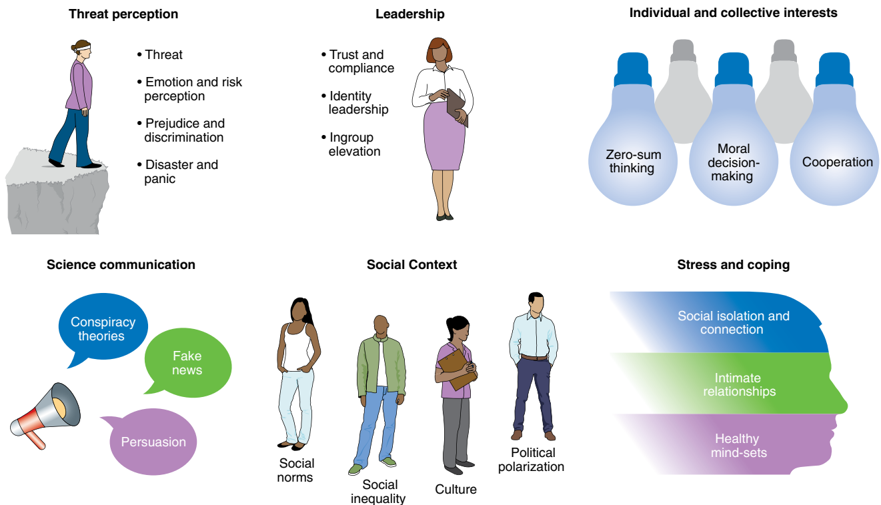
The COVID-19 pandemic represents a massive global health crisis. Because the crisis requires large-scale behaviour change and places significant psychological burdens on individuals, insights from the social and behavioural sciences can be used to help align human behaviour with the recommendations of epidemiologists and public health experts. Here we discuss evidence from a selection of research topics relevant to pandemics, including work on navigating threats, social and cultural influences on behaviour, science communication, moral decision-making, leadership, and stress and coping. In each section, we note the nature and quality of prior research, including uncertainty and unsettled issues. We identify several insights for effective response to the COVID-19 pandemic and highlight important gaps researchers should move quickly to fill in the coming weeks and months.
Overview
CoChat Summary
TL;DR
This perspective argues that social and behavioural science can help align public behaviour with COVID-19 public health recommendations across threat perception, social context, science communication, cooperation, leadership, and stress/coping. It synthesizes prior evidence and policy insights while cautioning that evidence is limited, often drawn from non-pandemic contexts, and in many areas unsettled.
Key findings
- The paper notes the scale of infectious disease threats: the bubonic plague killed approximately 25% of the European population, and by March 2020 COVID-19 had spread to more than 118,000 cases and caused 4,291 deaths in 114 countries. It also notes that 21 countries donated medical supplies to China in February, with China reciprocating widely.
- Fear appeals can change behaviour when people feel capable of dealing with the threat, but produce defensive reactions when people feel helpless; optimism bias can lead people to underestimate personal risk and ignore public health warnings.
- Social norms, inequality, culture, and political polarization shape pandemic behaviour: correcting misperceived norms can help when most people are already doing the desirable behaviour, but descriptive norms can backfire if the behaviour is undesirable unless paired with prescriptive norms.
- Effective communication and leadership may involve credible sources, messages that protect others or align with moral values, prebunking/inoculation against misinformation, accuracy nudges, shared social identity, and leaders modelling prosocial sacrifice; excessive national self-image concerns (“collective narcissism”) can backfire.
Methods
- Design: Perspective/narrative review; no primary data collection or sample. Topics were identified by the corresponding authors as potentially relevant to pandemic response and are explicitly not exhaustive.
- Evidence base: synthesizes prior social and behavioural research on threat perception, social context, science communication, moral decision-making, cooperation, leadership, and stress/coping, drawing on laboratory experiments, correlational studies, field experiments, meta-analyses, and preprints/forthcoming work.
- Analysis: narrative synthesis with policy implications and identified research gaps; no systematic search strategy or quantitative synthesis is reported.
Limitations
- Stated: due to space constraints, the paper provides only a brief summary of each topic; research on these topics is ongoing and in many cases far from settled; there is very little published social science research on the current pandemic, so discussion often draws from different circumstances and evidence quality varies substantially.
- Stated: insights and policy implications should be interpreted with caution.
- Evident: as a perspective rather than a systematic review or empirical study, it does not provide a comprehensive evidence appraisal, and its reliance on preprints and forthcoming sources limits certainty.
Model-written summary. Check it against the paper before relying on it.
Integrity signals
Registry
Cites
Statistics
Figures
Verification
Claims the paper makes
19 Valid · 5 Not valid · 37 Not checked · 13 Own results and interpretations
At least one cited source doesn’t support this claim or points to a different paper, and none confirmed it — see the verdicts below.
In the paper
“For instance, in hypothetical scenarios about deciding whether to go to work while sick, American and British participants reported they would be less willing to stay home when it was uncertain they would infect a co-worker.”
What the sources say
- Disputedcites [176] Kappes, A. et al. Uncertainty about the impact of social decisions increases prosocial behaviour. Nat. Hum. Behav. 2, 573–580 (2018). sourceExperimental — accuracy not yet measured
In the paper’s account of the infectious-disease scenario (Abstract; page not provided), participants facing uncertainty about how severely a co-worker might be affected were more likely to stay home than controls, not less. The paper distinguishes that impact uncertainty from uncertainty about whether a co-worker would be infected. Its Study 6 Methods (page not provided) describe recruitment through AMT, but do not establish the claimed American and British participant groups. (LLM, conf=0.88)
Checked by a reasoning model — may be wrong.
hedgedstates an association- Asserted: passes — The authors put it forward as true.
- Checkable: passes — It can be checked against evidence.
- Load-bearing: passes — The paper’s conclusions depend on it.
- Based: passes — The paper gives a reason why it holds.
- Disputed
The cited sources that could be checked couldn’t confirm or dispute this claim.
In the paper
“Moreover, there is mixed research regarding whether corrections may actually increase belief in the original misinformation 121,124-126 or in other misleading claims that fail to get corrected 127 .”
What the sources say
- Not checked — no full text of the sourcecites [121] Guess, A. & Coppock, A. Does counter-attitudinal information cause backlash? Results from three large survey experiments. Br. J. Polit. Sci. https://doi.org/10.1017/S0007123418000327 (2018). source
- Not matchedcites [124] Wittenberg, C. & Berinsky, A.J. Misinformation and its correction. in Social Media and Democracy: The State of the Field (eds Persily, N. & Tucker, J. A.) (Cambridge University Press, forthcoming).
Its entry has no title and year that we can search by.
- Not checked — no full text of the sourcecites [125] Swire, B. & Ecker, U.K.H. Misinformation and its correction: Cognitive mechanisms and recommendations for mass communication. in Misinformation and Mass Audiences (eds. Southwell, B. G., Thorson, E. A. & Sheble, L.) 195–2011 (University of Texas Press, 2018). source
- Not checked — no full text of the sourcecites [126] Wood, T. & Porter, E. The elusive backfire effect: mass attitudes’ steadfast factual adherence. Polit. Behav. 41, 135–163 (2018). source
- Could not verifycites [127] Pennycook, G., McPhetres, J., Zhang, Y. & Rand, D. Fighting COVID-19 misinformation on social media: Experimental evidence for a scalable accuracy nudge intervention. Preprint at PsyArXiv https://doi.org/10.31234/osf.io/uhbk9 (2020). sourceExperimental — accuracy not yet measured
Citation 127 is attached to the suggestion that corrections may increase belief in other misleading claims that go uncorrected. The Statement of Relevance and Discussion describe an accuracy nudge that improved sharing decisions, not corrections or their effects on belief in uncorrected claims. Searches for correction backfire and uncorrected misinformation found no passage addressing that point; page numbers were unavailable in our copy. (LLM, conf=0.76)
hedgedstates a possible cause- Asserted: passes — The authors put it forward as true.
- Checkable: passes — It can be checked against evidence.
- Load-bearing: passes — The paper’s conclusions depend on it.
- Based: passes — The paper gives a reason why it holds.
The sources with a verdict support this claim; the rest weren’t checked yet, have no full text we could read, or their verdicts aren’t rated yet.
In the paper
“Indeed, laboratory research has found that people prioritize local over global (or international) interests 185,186 .”
What the sources say
- Supportedcites [185] Milinski, M., Hilbe, C., Semmann, D., Sommerfeld, R. & Marotzke, J. Humans choose representatives who enforce cooperation in social dilemmas through extortion. Nat. Commun. 7, 10915 (2016). source
The Results section (‘Voters choose selfish representatives’; page unavailable) reports that participants preferentially re-elected representatives who contributed less to the shared climate account and elected candidates who pledged to contribute less than a fair share. In this simulated international dilemma, that supports the claim that participants favored their own group’s interests over the collective goal; it does not establish that everyone did so. (LLM, conf=0.85)
- Not checked — no full text of the sourcecites [186] Reinders Folmer, C. P. et al. One for all: what representing a group may do to us. J. Exp. Soc. Psychol. 48, 1047–1056 (2012). source
plain- Asserted: passes — The authors put it forward as true.
- Checkable: passes — It can be checked against evidence.
- Load-bearing: passes — The paper’s conclusions depend on it.
- Based: passes — The paper gives a reason why it holds.
- Supported
Every source the paper cites for this claim was checked and supports it.
In the paper
“However, when going to work risked infecting an elderly co-worker who would suffer a serious illness, participants reported they would be more willing to stay home 176 .”
What the sources say
- Supportedcites [176] Kappes, A. et al. Uncertainty about the impact of social decisions increases prosocial behaviour. Nat. Hum. Behav. 2, 573–580 (2018). source
The Study 6 Methods (page not provided) describe a scenario in which going to work could infect an older, vulnerable co-worker who would suffer severely, followed by a rating of willingness to go to work. The reported Study 6 findings (indexed under Abstract; page not provided) say participants given that risk information were significantly more likely to stay home than controls. (LLM, conf=0.92)
hedgedstates a cause- Asserted: passes — The authors put it forward as true.
- Checkable: passes — It can be checked against evidence.
- Load-bearing: passes — The paper’s conclusions depend on it.
- Based: passes — The paper gives a reason why it holds.
- Supported
The sources with a verdict support this claim; the rest weren’t checked yet, have no full text we could read, or their verdicts aren’t rated yet.
In the paper
“Several techniques, such as sanctioning defectors 187 or rewarding cooperators 188 , tend to increase cooperative behaviour in laboratory experiments using economic games.”
What the sources say
- Not checked — no full text of the sourcecites [187] Yamagishi, T. The provision of a sanctioning system as a public good. J. Pers. Soc. Psychol. 51, 110–116 (1986). source
- Supportedcites [188] Rand, D. G., Dreber, A., Ellingsen, T., Fudenberg, D. & Nowak, M. A. Positive interactions promote public cooperation. Science 325, 1272–1275 (2009). source
Citation 188 is attached to rewarding cooperators. The paper’s Abstract reports a laboratory comparison using repeated public goods games and finds that reward maintained public cooperation and, when both reward and punishment were available, increased contributions. (LLM, conf=0.93)
plainstates a cause- Asserted: passes — The authors put it forward as true.
- Checkable: passes — It can be checked against evidence.
- Load-bearing: unclear — It is unclear whether the paper’s conclusions depend on it.
- Based: passes — The paper gives a reason why it holds.
50 more claims · 13 with their cited sources checked
Create a free account to see all 74 claims and to verify the 2 references still open.
- It may state two separate claims as one. 13
- Probably not a substantial claim. 6
Claims other papers make about this one
Each is checked against this paper’s own text: does it say what the citing paper says it does?
The source backs part of the claim, not all of it — or backs it for a different population, condition or comparison.
In the citing paper
“COVID-19 is an international public health crisis, putting substantial burden on medical centers and increasing the psychological toll on health care workers (HCW).”
From Supporting the well-being of health care providers during the COVID-19 pandemic: The CopeColumbia response (2020) · cites this paper as [6]
Experimental — accuracy not yet measuredThe source backs part of the claim, not all of it — or backs it for a different population, condition or comparison.
In the citing paper
“these population-wide measures affected psychological well-being and mental health as well as increased social isolation [68] and loneliness.”
From Psychological correlates of perceived loneliness in college students before and during the COVID-19 stay-at-home period: a longitudinal study (2023) · cites this paper as [68]
Experimental — accuracy not yet measuredThe source backs part of the claim, not all of it — or backs it for a different population, condition or comparison.
In the citing paper
“they may eventually increase the social isolation of students and affect their psychological well-being and mental health [3].”
From Students under lockdown: Comparisons of students’ social networks and mental health before and during the COVID-19 crisis in Switzerland (2020) · cites this paper as [3]
Experimental — accuracy not yet measuredThe source backs part of the claim, not all of it — or backs it for a different population, condition or comparison.
In the citing paper
“effective interventions are hard to scale to a population level (12);”
From Psychological inoculation improves resilience against misinformation on social media (2022) · cites this paper as [12]
Experimental — accuracy not yet measuredThe source backs part of the claim, not all of it — or backs it for a different population, condition or comparison.
In the citing paper
“There is a shortage of studies that test anti-misinformation interventions in an ecologically valid manner, i.e., testing an intervention as consumers would interact with it in online environments (8, 12).”
From Psychological inoculation improves resilience against misinformation on social media (2022) · cites this paper as [12]
Experimental — accuracy not yet measured
6 more claims about this paper
Create a free account to see every claim other papers make about this one.
Citations
Cites
Granovetter, M. S. (1973) · American Journal of Sociology · doi:10.1086/225469 · Cited by 40,491
Zhou, F., Yu, T., Du, R., Fan, G., Liu, Y., Liu, Z., Xiang, J., Wang, Y., Song, B., Gu, X., et al. (2020) · The Lancet · doi:10.1016/s0140-6736(20)30566-3 · Cited by 27,263
The need to belong: Desire for interpersonal attachments as a fundamental human motivation.
Baumeister, R. F., & Leary, M. R. (1995) · Psychological Bulletin · doi:10.1037//0033-2909.117.3.497 · Cited by 23,245
Culture and the self: Implications for cognition, emotion, and motivation.
Markus, H. R., & Kitayama, S. (1991) · Psychological Review · doi:10.1037/0033-295x.98.2.224 · Cited by 21,995
Self-citationThe Psychological Impact of Quarantine and How to Reduce It: Rapid Review of the Evidence
Brooks, S. K., Webster, R. K., Smith, L. E., Woodland, L., Wessely, S., Greenberg, N., & Rubin, G. J. (2020) · doi:10.2139/ssrn.3532534 · Cited by 16,394
The psychological impact of quarantine and how to reduce it: Rapid review of the evidence
Brooks, S. K., Webster, R. K., Smith, L. E., Woodland, L., Wessely, S., Greenberg, N., & Rubin, G. J. (2020) · The Lancet · doi:10.1016/s0140-6736(20)30460-8 · Cited by 16,378
Nudge: improving decisions about health, wealth, and happiness
(2008) · Choice Reviews Online · doi:10.5860/choice.46-0977 · Cited by 11,572
Slovic, P. (1987) · Science · doi:10.1126/science.3563507 · Cited by 9,271
The Elaboration Likelihood Model of Persuasion
Petty, R. E., & Cacioppo, J. T. (1986) · Advances in Experimental Social Psychology · doi:10.1016/s0065-2601(08)60214-2 · Cited by 8,822
Self-citationThe emotional dog and its rational tail: A social intuitionist approach to moral judgment.
Haidt, J. (2001) · Psychological Review · doi:10.1037/0033-295x.108.4.814 · Cited by 8,048
Research works printed but not linked: 3
- Berkowitz, A.D. An overview of the social norms approach. in Changing the Culture of College Drinking: A Socially Situated Health Communication Campaign (eds. Stewart, L. & Lederman, L. C.) 193–214 (Hampton Press, 2005).
- Wittenberg, C. & Berinsky, A.J. Misinformation and its correction. in Social Media and Democracy: The State of the Field (eds Persily, N. & Tucker, J. A.) (Cambridge University Press, forthcoming).
- Ransohoff, K.J. Patients on the Trolley Track: The Moral Cognition of Medical Practitioners and Public Health Professionals. (Harvard Univ. Press, 2011).
Cited by
Items 4,901–5,000 of 5,015
Arenas, A. J., Cogollo, M. R., & González‐Parra, G. (2026) · Nonlinear Dynamics · doi:10.1007/s11071-026-12363-5
Impacts of global resource allocation on the epidemic spreading in metapopulation networks
Zhang, K., Cheng, C., Qi, Y., & Kong, C. (2026) · Nonlinear science. · doi:10.1016/j.nls.2026.100134
The COVID-19 Pandemic and Anti-Vaccination Actors: A Sociological Approach
Ruzzeddu, M. (2026) · Springer eBooks · doi:10.1007/978-3-658-50204-1_4
Wang, Y., Li, W., Ji, G., Guo, C., Wang, S., Qiao, Y., Rui, Y., Zhu, H., Yan, Z., & Zhang, Y. (2026) · Developments in the Built Environment · doi:10.1016/j.dibe.2026.100921 · Cited by 1
COVID vaccination and economic game decisions: The role of analytical thinking
Zher-Wen, Z.-W., & Yu, R. (2026) · Human Vaccines & Immunotherapeutics · doi:10.1080/21645515.2026.2654307
“Combating a pandemic requires large-scale cooperation 1–4 in complying with health and safety measures, including getting vaccinated to prevent the spread of infections.”
The evolution and impact of group collaboration in crisis response
Zhang, A., Kong, D., Lai, J., Zhang, G., Li, J., Wang, Y., Li, Y., & González, M. C. (2026) · Communications Physics · doi:10.1038/s42005-026-02588-6 · Cited by 2
Brewer, R., Almirol, E. A., Meyer, M. N., Tong, L., Hodge, S. E., Carter, C. C., Arnold, S., Vasquez, L., Dawdani, A., Webb, J., et al. (2026) · Journal of Urban Health · doi:10.1007/s11524-026-01070-6
Pashapour, H., Ghaffari, M., Nikfarjam, A., Kavousi, A., & Karami, M. (2026) · Globalization and Health · doi:10.1186/s12992-026-01208-w
“Additionally, travelers’ behavioral and cultural factors, such as resistance to health protocols, misinformation, and lack of awareness, significantly affect control efforts [13, 14].”
Karampampas, S. (2026) · Frontiers in Political Science · doi:10.3389/fpos.2026.1825934
Brás, G. R. (2026) · Education + Training · doi:10.1108/et-09-2024-0422
Gao, J., Windett, J. H., Radford, B. J., Ademu, L., & Racine, E. F. (2026) · doi:10.2196/preprints.96677
Shein, P. P., Saiful, J. A., Li, Y., Syarkowi, A., Normi, Y. M., Gayatri, Y., Winata, S. G., Asmawi, A. A., Anas, M., Tsai, W.-L., et al. (2026) · Humanities and Social Sciences Communications · doi:10.1057/s41599-026-06942-5
“This requires information sources that are widely trusted and consumed (Collis et al., 2022), ensuring that the information to be conveyed is both scienti fi cally sound and effectively delivered (Van Bavel et al., 2020).”
Attention, Awareness, and Mental Health: An Overlooked Triangle in Everyday Life
Samraz, Z. (2026) · Journal of Professional & Applied Psychology · doi:10.52053/jpap.v7i1.496
“Research conducted during and after the COVID-19 pandemic shows notable declines in sustained attention and a rise in attentional fatigue across various populations, including those without prior mental health issues (Bavel et al., 2020; Huckins et al., 2020).”
Phillips, R., Wood, F., Torrens‐Burton, A., Glennan, C., Sellars, P., Lowe, S., Caffoor, A., Hallingberg, B., Gillespie, D., Shepherd, V., et al. (2026) · PLoS ONE · doi:10.64898/2026.04.16.26351013
Sivakumar, S., Shukla, A., Ghosh, P., Shanmugam, S. K., Rajalakshmi, R., & Selvaraju, P. (2026) · Lecture notes in networks and systems · doi:10.1007/978-3-032-18349-1_26
Między rutyną a zmianą: praktyki społeczne pracowników fabryki w czasie pandemii COVID-19
Skiba, R., Węziak‐Białowolska, D., & McNeely, E. (2026) · Kultura i Społeczeństwo · doi:10.35757/kis.2026.70.1.7
JEYOON, C., & Sugiura, M. (2026) · Progress in Disaster Science · doi:10.1016/j.pdisas.2026.100684
Kim, S., Kim, W., & Feiock, R. C. (2026) · Administrative Sciences · doi:10.3390/admsci16050198
Xu, Y., Wu, S., Jiang, L., & Wang, S. (2026) · Health Education & Behavior · doi:10.1177/10901981261442434
Aviacijos paslaugas teikiančių organizacijų pokyčių valdymo sprendimai
Leonavičiūtė, V. (2026) · doi:10.20334/2026-025-m
Assessing the Impact of Vaccination Strategies on COVID-19 Dynamics Via Time-varying Copulas
Ahdika, A., Fakhruddin, M., & Swastika, P. V. (2026) · Acta Biotheoretica · doi:10.1007/s10441-026-09523-w
“It could lead to a non-intuitive positive dependency, increasing the virus’s transmission and thereby increasing the number of cases despite high vaccination rates (Betsch et al. 2020; Bavel et al. 2020 ; Harper et al. 2021).”
Alnahar, S. A., Alquraan, M., & El-Osta, A. A. R. (2026) · International Journal of Environmental Research and Public Health · doi:10.3390/ijerph23050590
“Health behaviour scholars argue that authoritative mandates and restrictions are more influential in guiding health behaviour than knowledge and awareness [15,22,66,67].”
Huflejt-Łukasik, M., Szuster, A., Pastwa, M., Wielgopolan, A., Karwowska, D., Haletska, I., Klimanska, M. B., & Imbir, K. K. (2026) · International Journal of Environmental Research and Public Health · doi:10.3390/ijerph23050606
Coupled spreading dynamics in information–physical–social multilayer system
Pang, B., Zhou, Y., Wang, R., & Tang, M. (2026) · Chaos Solitons & Fractals · doi:10.1016/j.chaos.2026.118460
Giancaspero, S., & Mazza, A. (2026) · Advances in Science, Technology & Innovation/Advances in science, technology & innovation · doi:10.1007/978-3-032-07255-9_23
Communicating expert consensus increases personal support for COVID-19 mitigation policiesPreprint
van der Linden, S., & Kerr, J. R. (2024) · OSF Preprints (OSF Preprints)
Self-citationPetersen, M. B., Böhm, R., Sassenrath, C., Pfattheicher, S., & Nockur, L. (2024) · OSF Preprints (OSF Preprints)
Rahman, R. A., & Baum, J. (2023) · OSF Preprints (OSF Preprints)
Yanagi, I., Kubo, Y., & Okada, I. (2023) · OSF Preprints (OSF Preprints)
Hassan, G. D., & Abdi, Y. H. (2026) · Journal of Clinical Virology Plus · doi:10.1016/j.jcvp.2026.100255
Simulating population compliance with pandemic interventions using large language modelsPreprint
Liu, R., Jong, C., Li, H., Cao, Y., Yao, Q., Yamana, T. K., Pei, S., & Du, H. (2026) · medRxiv · doi:10.64898/2026.05.12.26352942 · Cited by 2
“Their success, however, depends on behavioral responses that vary across social, economic, and cultural contexts 1 .”
Liu, F., Wang, Y. B., & Xu, W. (2026) · Frontiers in Public Health · doi:10.3389/fpubh.2026.1834066
Harvey, J. A., Gonnerman, M. B., Yin, S., Kent, C. M., Cullen, J. A., Sullivan, J. D., Dain, J. B., Hill, N. J., Prosser, D. J., & Mullinax, J. M. (2026) · Wildlife Monographs · doi:10.1002/wmon.70015 · Cited by 2
National ethics and public compliance in Indonesia: evidence from two policy cases
Ludigdo, U., Mashuri, A., & Hasanah, N. (2026) · Cogent Psychology · doi:10.1080/23311908.2026.2672802
Hems, N. (2026) · Essentials · doi:10.1007/978-3-662-73363-9_3
Vaccine Demand: Theory and Evidence on Psychological and Social Drivers
Ferris, L. J., & Hornsey, M. J. (2026) · Springer eBooks · doi:10.1007/978-981-95-8349-2_9
Turning the tide on panic buying: how resale opportunities reduce product demand
Kong, D., Huang, L., & Xiao, Y. (2026) · Marketing Letters · doi:10.1007/s11002-026-09825-6
“When individuals perceive threat, they adopt a survival-oriented mindset characterized by heightened risk aversion, resource vigilance, and self-protective prioritization (Bavel et al., 2020; Kahneman & Tversky, 1979).”
Lee, E. H., Choi, M., Park, H., et al. (2026) · Journal of Korean Medical Science · doi:10.3346/jkms.2026.41.e227
Zeng, J., & Cao, Y. (2026) · Higher Education · doi:10.1007/s10734-026-01686-2
Analyzing freedom: Understanding swiss COVID-19 narratives through NLP analysis
Spitale, G., Germani, F., Fritschi, F., Merten, S., & Biller-Andorno, N. (2026) · Social Sciences & Humanities Open · doi:10.1016/j.ssaho.2026.102865 · Cited by 1
Flores, J. D. (2026) · Frontiers in Political Science · doi:10.3389/fpos.2026.1779500
Interdependence explains how and when crises impact social cohesion
Koster, J., Lang, M., & Lange, P. A. M. V. (2026) · Communications Psychology · doi:10.1038/s44271-026-00471-2 · Cited by 1
“These fi ndingssuggestthatsocialcohesionoftenisanimportantfacilitatorofearlycollectivemobilizationduringCOVID-19,whichismostlyinlinewithearly theoreticalwork 38 .”
Self-citationXu, Y., Dong, D., Liu, Z., & Li, S. (2026) · Journal of Contingencies and Crisis Management · doi:10.1111/1468-5973.70171 · Cited by 1
Mensah, M. A., Kwasi, E., Abdulmawjood, M., & Oyibo, K. (2026) · ACM Conference on User Modeling, Adaptation and Personalization (UMAP) · doi:10.1145/3774935.3806188
Klanšček, H. J., Rehberger, M., Čolaković, A. B., Sinkó, M., Lavtar, D., & Grom, A. H. (2026) · Slovenian Journal of Public Health · doi:10.2478/sjph-2026-0013
Haq, M. A. U., Jing, W., Ghouri, A. M., Luong, N. T., Le, M. T. H., Taha, S., & Akhtar, P. (2026) · International Journal of Politics Culture and Society · doi:10.1007/s10767-026-09584-2 · Cited by 1
欧阳辉祥, Wan, C., & Fischer, R. D. (2026) · PLoS ONE · doi:10.1371/journal.pone.0350996
Religion in Shaping Public Health During the COVID-19 Pandemic Across US Counties
Hajilo, M., Steel, S., & James, W. L. (2026) · Society · doi:10.1007/s12115-026-01233-w · Cited by 1
Public Health System Credibility and Firm-Level Financial Risk: A Panel Data Analysis
Zhou, C., & Tang, C. (2026) · INQUIRY The Journal of Health Care Organization Provision and Financing · doi:10.1177/00469580261454925
Identifying memory mechanisms in Bayesian models of behavioural change during epidemics
Mao, Y., Deardon, R., & Deeth, L. E. (2026) · Epidemics · doi:10.1016/j.epidem.2026.100927 · Cited by 1
Bulut, H., & Samuel, R. (2026) · Social Justice Research · doi:10.1007/s11211-026-00475-7
“In addition, the overlap between the COVID-19 pandemic and its economic impact and the floods could cre - ate a compounding crisis effect, exacerbating feelings of insecurity and competition for resources (van Bavel et al., 2020 ).”
A post-PHEIC review of cultural awareness in the COVID-19 response
Ha, K. (2026) · Public health reviews · doi:10.3389/phrs.2026.1608243
Lande-Brenner, A., Ecker, U. K. H., & Mayo, R. (2026) · Scientific Reports · doi:10.1038/s41598-026-54720-9
Why do people comply with health guidelines in a competing information environment?
Yu, J., Bekerian, D. A., & Khandelwal, R. (2026) · PLoS ONE · doi:10.1371/journal.pone.0352421
Yogev, D., Santos, M. R., & Gomez, R. (2025) · Relations industrielles · doi:10.7202/1126020ar
Shafqat, S., Shahbaz, Z., Ajaz, R., & Ahmad, H. S. (2026) · Bio Communications · doi:10.71320/bcs.0019
“Public health communication during outbreaks has at times reinforced harmful associations between specific ethnic, occupational, or geographic communities and disease risk, contributing to discrimination, social exclusion, and reduced engagement with health services (Bavel et al., 2020).”
Le, R., Zou, Y., & Li, N. (2026) · Journal of Hospitality and Tourism Management · doi:10.1016/j.jhtm.2026.101502
Ciccone, N. W., & Maier, A. M. (2026) · Proceedings of the Design Society · doi:10.1017/pds.2026.10530
“Improved awareness and the following of guidelines about preventive measures has already been proven to reduce transmission rates, to reduce the financial burden on society, and most importantly to save lives (Bavel et al., 2020).”
InfluentialUnmasking the Backfire Effect: An Exploration of Resistance to Fact-Checking in the Digital Age
Li, J., & Chang, X. (2026) · Information Systems Frontiers · doi:10.1007/s10796-026-10780-w
“In times of hot topics, people are often bombarded with vast amounts of information, and their ability to verify the accuracy of this information can be limited (Bavel et al., 2020 ; Rathore & Farooq, 2020 ).”
What are behavioral sciences? Epistemic boundaries and paradigms from a Delphi study
Leme, G. A., Alves, D. D. S., & Serafim, M. P. (2026) · Social Science Information · doi:10.1177/05390184261461510 · Cited by 1
“More recently, studies (Van Bavel et al., 2020) illustrate moments of intensified visibility and application, particularly in the context of the COVID-19 pandemic (see Supplementary Material).”
A Comprehensive Multi-parameter Sensitivity Analysis of Deterministic SEIR Models
Durairaj, K., jayakumar, S., Arumugam, M., et al. (2026) · doi:10.1109/icietsd68684.2026.11584827
Decolonizing Psychological Science and Practice in Africa: Barriers and Bridges
Adjei, S. B. (2026) · Community psychology · doi:10.1007/978-3-032-15816-1_2
Xu, W., & Li, N. (2026) · Frontiers in Public Health · doi:10.3389/fpubh.2026.1875500
In Search of a Culprit: Conspiracy Theories, Hermetic Semiosis, and Scapegoating
Stano, S. (2026) · Palgrave Studies in European Political Sociology · doi:10.1007/978-3-032-13933-7_3
Modeling Infectious Disease Transmission Dynamics with Policy-Informed Behavioral Responses
Pathak, W., Pokharel, G., & Hossain, S. (2026) · Springer eBooks · doi:10.1007/978-3-032-30665-4_48
Mousoulidou, M., Damianou, N.-A., Christodoulou, A., Taxitari, L., & Zamba, K. (2026) · COVID · doi:10.3390/covid6070125
Japan's health system toward 2040: structural challenges and a renewed social contract
Yamasaki, L., Sakamoto, H., Hashimoto, H., Kondo, N., Kunii, O., Tsugawa, Y., Abe, S. K., Ezoe, S., Egawa, S., Guinto, R., et al. (2026) · The Lancet Regional Health - Western Pacific · doi:10.1016/j.lanwpc.2026.101920 · Cited by 4
“Behavioural science-informed risk communication 59 should be integrated into government crisis management.”
Jackson, J. C., Pieper, D. J., & Gelfand, M. J. (2021) · OSF Preprints (OSF Preprints)
Self-citationOcchibove, F., Marin, C., Whitehead, T., O’Mahony, K., Zanet, S., & Brož, L. (2026) · EFSA Supporting Publications · doi:10.2903/sp.efsa.2026.en-10254
Activity feedback and hyperedge overlap shape bistability in higher-order networks
Anonymous, Hu, Y., Li, X., Wang, X., Yang, L., & Jia, Y. (2026) · Physical review. E · doi:10.1103/cnmt-5cxk
The Politics of Communicating Health Risks: Framing the Coronavirus Pandemic in a Polarized Society
Jebril, N., & Bouzidi, M. E. (2026) · Health Communication · doi:10.1080/10410236.2026.2693954
Yang, Y., Cui, Y., Liu, G., & Duan, J. (2026) · Frontiers in Public Health · doi:10.3389/fpubh.2026.1873402
“However, empirical evidence consistently shows that compliance is shaped less by individual risk calculus and more by social norms, trust in institutions, and perceived fairness (16, 17).”
Mejia, C. (2026) · Springer eBooks · doi:10.1007/978-981-95-7020-1_10
Xu, Y., Liu, Q., & Liang, J. (2026) · Frontiers in Public Health · doi:10.3389/fpubh.2026.1827389 · Cited by 1
(2026) · Elsevier eBooks · doi:10.1016/b978-0-44-355525-1.00020-5
The biology, epidemiology, psychological, economic, and governance aspects of pandemics
Lazebnik, T. (2026) · Elsevier eBooks · doi:10.1016/b978-0-44-355525-1.00008-4
Community Radio: Critical Participation and Voice in Health Communication
Essel, E. A., & Govender, E. (2026) · Palgrave studies in communication for social change · doi:10.1007/978-3-032-17141-2_4
Opportunities and risks of big data for the methods and culture of psychological science
Ibasco, G. C., Götz, F. M., Clark, L., & Tracy, J. L. (2026) · Nature Reviews Psychology · doi:10.1038/s44159-026-00603-9 · Cited by 1
Abbas, H. A. (2026) · SSRN Electronic Journal · doi:10.2139/ssrn.7239507
Torales, J. C., Filho, L. C. R., Estigarribia, G., Barrios, I., O’Higgins, M. G., Ventriglio, A., & Castaldelli-Maia, J. M. (2026) · Frontiers in Public Health · doi:10.3389/fpubh.2026.1930193 · Cited by 1
“In crises, communication does more than transmit information; it shapes risk perception, emotional engagement, institutional trust, and collective efficacy (34, 35, 41, 42).”
InfluentialSanders, J. G., Boer, M., Dekker, M. R., Klanšček, H. J., Rowan, H., Deegan, A., Falcon, M. G., Romay‐Barja, M., Sinkó, M., Rehberger, M., et al. (2026) · Research Square · doi:10.21203/rs.3.rs-10420052/v1 · Cited by 2
Smeele, N. V. R., Waltz, C., Schreijer, A. J. M., & Dykstra, P. A. (2026) · The European Journal of Health Economics · doi:10.1007/s10198-026-01985-6
Intragroup Judgements of Norm Violators Under the Threat of COVID-19
Sinclair-Thompson, A., & Hunter, J. A. (2026) · Behavioral Sciences · doi:10.3390/bs16081382
“When threats of this nature are encountered, group-and social identity-based processes typically become paramount (e.g., Jetten et al., 2020; Packer et al., 2021; Van Bavel et al., 2020).”
He, R., Luo, X., & Sun, G.-Q. (2026) · Nonlinear Dynamics · doi:10.1007/s11071-026-12936-4
2. A conceptual cartography: Four ideal-typical roles for ethicists
Brom, F. W. A. (2026) · Open Book Publishers · doi:10.11647/obp.0541.02
Moreira, R. S. L., Stavale, R., de Oliveira, É. G., & Domenico, E. B. L. D. (2026) · International Journal of Africa Nursing Sciences · doi:10.1016/j.ijans.2026.101158
Syngelakis, A. I., Tsakalou, C., Solomou, M. M., Charalambous, C., Toska, A. G., & Γούλα, Α. Β. (2026) · Cureus · doi:10.7759/cureus.114642
The Development of Cyberchondria Amid the Pandemic: An Autoregressive Cross-Lagged Model
Kim, H. K., Zheng, H., & Chen, M. (2026) · Health Communication · doi:10.1080/10410236.2026.2720129 · Cited by 1
Hybride Krisenkommunikation: Grundfunktionen multimodaler Pandemiekommunikation und ihre Wirksamkeit
Bucher, H.-J., Boy, B., & Mayer, J. (2026) · Springer eBooks · doi:10.1007/978-3-658-47239-9_35-1
Ala, S. M. F., Galvão, A. M., & Baptista, G. (2026) · IGI Global eBooks · doi:10.4018/979-8-3373-7670-7.ch008
Factors Affecting Reluctance to Malaysian Adults’ COVID-19 Vaccine Booster Doses
Rahman, N. A., Vasudevan, H., Madon, H. D., et al. (2026) · Buletin Ilmu Kebidanan dan Keperawatan · doi:10.56741/bikk.v5i02.2467
Behavioral profiling for compliance: the role of legitimacy, norms, and prior conduct
Assouline, M., Slater, J., Feldman, Y., & Gilead, M. (2026) · Policy and Society · doi:10.1093/polsoc/puag022
AI-enabled health communication to address misinformation on social media: a mini review
Hu, Y. (2026) · Frontiers in Communication · doi:10.3389/fcomm.2026.1907956
Refining the role of behavioural and social sciences in pandemic response post-COVID-19
Graso, M., Aquino, K. F., Baral, S., Berg, N., Clark, C. J., Conway, L. G., Dolan, P. J., Grover, S. L., Fousiani, K., Kitz, C. C., et al. (2026) · Nature Human Behaviour · doi:10.1038/s41562-026-02506-4 · Cited by 1
Yates, J., Davidson, C. A., Burke, S. M., Orchard, T. R., & Mantler, T. (2026) · The Family Journal · doi:10.1177/10664807261483692
Zhu, L. (2026) · Frontiers in Public Health · doi:10.3389/fpubh.2026.1911656
Attanasi, G., Ciucani, C., Morone, A., Morone, P., & Tiranzoni, P. (2026) · Journal of Risk and Uncertainty · doi:10.1007/s11166-026-09507-8
Metadata
- Authors
- Bavel, J. J. V., Baicker, K., Boggio, P. S., Capraro, V., Cichocka, A., Cikara, M., Crockett, M. J., Crum, A. J., Douglas, K. M., Druckman, J. N., Drury, J., Dube, O., Ellemers, N., Finkel, E. J., Fowler, J. H., Gelfand, M., Han, S., Haslam, S. A., Jetten, J., Kitayama, S., Mobbs, D., Napper, L. E., Packer, D. J., Pennycook, G., Peters, E., Petty, R. E., Rand, D. G., Reicher, S. D., Schnall, S., Shariff, A., Skitka, L. J., Smith, S. S., Sunstein, C. R., Tabri, N., Tucker, J. A., Linden, S. V. D., Lange, P. V., Weeden, K. A., Wohl, M. J. A., Zaki, J., Zion, S. R., & Willer, R.
- Affiliations
- New York University (US)
- Universidade Presbiteriana Mackenzie (BR)
- Middlesex University London (GB)
- University of Kent (GB)
- Harvard University (US)
- Yale University (US)
- Stanford University (US)
- Northwestern University (US)
- University of Sussex (GB)
- University of Chicago (US)
- Utrecht University (NL)
- University of California San Diego (US)
- University of Maryland, College Park (US)
- Peking University (CN)
- The University of Queensland (AU)
- University of Michigan (US)
- California Institute of Technology (US)
- Lehigh University (US)
- University of Regina (CA)
- University of Oregon (US)
- The Ohio State University (US)
- Massachusetts Institute of Technology (US)
- University of St Andrews (GB)
- University of Cambridge (GB)
- University of British Columbia (CA)
- University of Illinois Chicago (US)
- University of California, Berkeley (US)
- Carleton University (CA)
- Cornell University (US)
- Corresponding author
- Bavel, Jay J. Van
- Willer, Robb
- ORCID
- Bavel, Jay J. Van
- Baicker, Katherine
- Boggio, Paulo S.
- Capraro, Valerio
- Cichocka, Aleksandra
- Cikara, Mina
- Crockett, Molly J.
- Crum, Alia J.
- Douglas, Karen M.
- Druckman, James N.
- Drury, John
- Ellemers, Naomi
- Finkel, Eli J.
- Fowler, James H.
- Gelfand, Michele
- Han, Shihui
- Haslam, S. Alexander
- Jetten, Jolanda
- Kitayama, Shinobu
- Mobbs, Dean
- Napper, Lucy E.
- Packer, Dominic J.
- Pennycook, Gordon
- Peters, Ellen
- Petty, Richard E.
- Rand, David G.
- Reicher, Stephen D.
- Schnall, Simone
- Shariff, Azim
- Skitka, Linda J.
- Sunstein, Cass R.
- Tabri, Nassim
- Tucker, Joshua A.
- Linden, Sander van der
- Weeden, Kim A.
- Wohl, Michael J. A.
- Zaki, Jamil
- Zion, Sean R.
- Willer, Robb
- Venue
- Nature Human Behaviour
- Published
- 2020-04-30
- Volume
- 4
- Issue
- 5
- Pages
- 460-471
- ISSN
- 2397-3374 (ISSN-L)
- OpenAlex
- W3016902371
- Semantic Scholar
- d81abcd7f053b136423f1e7f57928524e8b0e1a0
- Cited by
- 4,964
- References
- 259
- Citations by year
- 2026: 177 · 2025: 288 · 2024: 483 · 2023: 741 · 2022: 1094 · 2021: 1474 · 2020: 702
- FWCI
- 175.81
- Type
- journal article
- Language
- en
- Open access
- bronze
- doi.org
- Licence
- www.springernature.com/gp/researchers/text-and-data-mining (tdm)
- www.springernature.com/gp/researchers/text-and-data-mining (vor)
- Locations
- Nature Human Behaviour (publishedVersion)
- PubMed (publishedVersion)
- Middlesex University Research Repository (Middlesex University Of London) (acceptedVersion)
- Kent Academic Repository (University of Kent) (acceptedVersion)
- DSpace@MIT (Massachusetts Institute of Technology) (submittedVersion, cc-by-nc-sa)
- Sussex Research Online (University of Sussex) (submittedVersion)
- CaltechAUTHORS (California Institute of Technology) (submittedVersion)
- RePEc: Research Papers in Economics (submittedVersion)
- BOA (University of Milano-Bicocca) (submittedVersion)
- Carleton University's Institutional Repository (MacOdrum Library, Carleton University) (submittedVersion, other-oa)
- Utrecht University Repository (Utrecht University) (submittedVersion)
- Figshare (submittedVersion)
- VU Research Portal (submittedVersion, other-oa)
- Utrecht University Repository (Utrecht University) (submittedVersion, other-oa)
- Data Archiving and Networked Services (DANS) (submittedVersion, other-oa)
- Funders
- U.S. Department of Health and Human Services (2P50 MH094258)
- National Institute of Mental Health (P50MH094258)
- Topics
- Social Sciences › Sociology and Political Science › COVID-19 Prevention and Impact
- Social Sciences › Communication › Communication and COVID-19 Impact
- Physical Sciences › Mathematics › Modeling and Simulation › COVID-19 epidemiological studies
- Keywords
- COVID-19 pandemic, pandemic response, behavior change, science communication, ethical decision-making, leadership, stress coping, psychological burden, public health recommendations
- MeSH terms
- Betacoronavirus, COVID-19, SARS-CoV-2, Adaptation, Psychological, Communicable Disease Control, Decision Making, Humans, Human Activities, Health Knowledge, Attitudes, Practice, Leadership, Pneumonia, Viral, Public Health, Quarantine, Stress, Psychological, Global Health, Coronavirus, Coronavirus Infections, Pandemics, Social Media, Epidemiological Monitoring
About these checks
Registry, retraction, Cites and statistics results are computed, not judged, with one exception: a printed reference that no index lists is read once by a model before it counts as a citation error. Claims are extracted by a model and kept only when their quote appears verbatim in the text; each cited source is then checked, with a model’s help, for whether it says what the claim relies on. Those verdicts can be wrong — read the claim’s quote and the cited source before relying on one.
The claim verdicts this report counts are experimental: their accuracy is not yet measured.
A language model drew the claims from the paper on 2026-10-10, under version 3 of the claim definition (model deepseek-v4.1-flash, prompt extract-v3).
A second model labelled each claim on 2026-10-10 (model jev-1.13-20260917, definition revision gold-guideline-v0.2).
Cited sources are checked with a language model’s help (gpt-6-sol).
Statistics and arithmetic are recomputed, not judged.
Confidence bands are shown only for fields calibrated on our annotated test set. None is calibrated yet, so no band is shown.
What counts as a claim ›How we measure confidence ›How we check this ›
Are you an author, or do you see a problem with this page? Request a review
Data sources
Bibliographic data: Semantic Scholar, OpenAlex, Crossref.
Contains information from the Semantic Scholar Academic Graph Datasets, made available under the ODC Attribution License (ODC-BY 1.0).
Semantic Scholar’s data is described in: Kinney, R., et al. (2023). The Semantic Scholar Open Data Platform. arXiv:2301.10140.
