

Using social and behavioural science to support COVID-19 pandemic response
Open accessThe DOI matches its Crossref record; 257 of the 259 references it cites were found in a registry or an index; 24 of the 89 sources its claims cite were checked for support.
Abstract
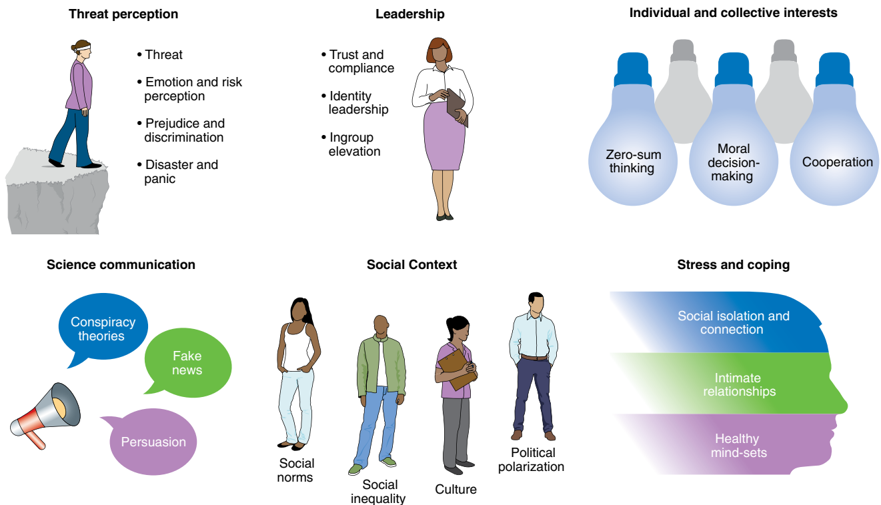
The COVID-19 pandemic represents a massive global health crisis. Because the crisis requires large-scale behaviour change and places significant psychological burdens on individuals, insights from the social and behavioural sciences can be used to help align human behaviour with the recommendations of epidemiologists and public health experts. Here we discuss evidence from a selection of research topics relevant to pandemics, including work on navigating threats, social and cultural influences on behaviour, science communication, moral decision-making, leadership, and stress and coping. In each section, we note the nature and quality of prior research, including uncertainty and unsettled issues. We identify several insights for effective response to the COVID-19 pandemic and highlight important gaps researchers should move quickly to fill in the coming weeks and months.
Overview
CoChat Summary
TL;DR
This perspective argues that social and behavioural science can help align public behaviour with COVID-19 public health recommendations across threat perception, social context, science communication, cooperation, leadership, and stress/coping. It synthesizes prior evidence and policy insights while cautioning that evidence is limited, often drawn from non-pandemic contexts, and in many areas unsettled.
Key findings
- The paper notes the scale of infectious disease threats: the bubonic plague killed approximately 25% of the European population, and by March 2020 COVID-19 had spread to more than 118,000 cases and caused 4,291 deaths in 114 countries. It also notes that 21 countries donated medical supplies to China in February, with China reciprocating widely.
- Fear appeals can change behaviour when people feel capable of dealing with the threat, but produce defensive reactions when people feel helpless; optimism bias can lead people to underestimate personal risk and ignore public health warnings.
- Social norms, inequality, culture, and political polarization shape pandemic behaviour: correcting misperceived norms can help when most people are already doing the desirable behaviour, but descriptive norms can backfire if the behaviour is undesirable unless paired with prescriptive norms.
- Effective communication and leadership may involve credible sources, messages that protect others or align with moral values, prebunking/inoculation against misinformation, accuracy nudges, shared social identity, and leaders modelling prosocial sacrifice; excessive national self-image concerns (“collective narcissism”) can backfire.
Methods
- Design: Perspective/narrative review; no primary data collection or sample. Topics were identified by the corresponding authors as potentially relevant to pandemic response and are explicitly not exhaustive.
- Evidence base: synthesizes prior social and behavioural research on threat perception, social context, science communication, moral decision-making, cooperation, leadership, and stress/coping, drawing on laboratory experiments, correlational studies, field experiments, meta-analyses, and preprints/forthcoming work.
- Analysis: narrative synthesis with policy implications and identified research gaps; no systematic search strategy or quantitative synthesis is reported.
Limitations
- Stated: due to space constraints, the paper provides only a brief summary of each topic; research on these topics is ongoing and in many cases far from settled; there is very little published social science research on the current pandemic, so discussion often draws from different circumstances and evidence quality varies substantially.
- Stated: insights and policy implications should be interpreted with caution.
- Evident: as a perspective rather than a systematic review or empirical study, it does not provide a comprehensive evidence appraisal, and its reliance on preprints and forthcoming sources limits certainty.
Model-written summary. Check it against the paper before relying on it.
Integrity signals
Registry
Cites
Statistics
Figures
Verification
Claims the paper makes
19 Valid · 5 Not valid · 37 Not checked · 13 Own results and interpretations
At least one cited source doesn’t support this claim or points to a different paper, and none confirmed it — see the verdicts below.
In the paper
“For instance, in hypothetical scenarios about deciding whether to go to work while sick, American and British participants reported they would be less willing to stay home when it was uncertain they would infect a co-worker.”
What the sources say
- Disputedcites [176] Kappes, A. et al. Uncertainty about the impact of social decisions increases prosocial behaviour. Nat. Hum. Behav. 2, 573–580 (2018). sourceExperimental — accuracy not yet measured
In the paper’s account of the infectious-disease scenario (Abstract; page not provided), participants facing uncertainty about how severely a co-worker might be affected were more likely to stay home than controls, not less. The paper distinguishes that impact uncertainty from uncertainty about whether a co-worker would be infected. Its Study 6 Methods (page not provided) describe recruitment through AMT, but do not establish the claimed American and British participant groups. (LLM, conf=0.88)
Checked by a reasoning model — may be wrong.
hedgedstates an association- Asserted: passes — The authors put it forward as true.
- Checkable: passes — It can be checked against evidence.
- Load-bearing: passes — The paper’s conclusions depend on it.
- Based: passes — The paper gives a reason why it holds.
- Disputed
The cited sources that could be checked couldn’t confirm or dispute this claim.
In the paper
“Moreover, there is mixed research regarding whether corrections may actually increase belief in the original misinformation 121,124-126 or in other misleading claims that fail to get corrected 127 .”
What the sources say
- Not checked — no full text of the sourcecites [121] Guess, A. & Coppock, A. Does counter-attitudinal information cause backlash? Results from three large survey experiments. Br. J. Polit. Sci. https://doi.org/10.1017/S0007123418000327 (2018). source
- Not matchedcites [124] Wittenberg, C. & Berinsky, A.J. Misinformation and its correction. in Social Media and Democracy: The State of the Field (eds Persily, N. & Tucker, J. A.) (Cambridge University Press, forthcoming).
Its entry has no title and year that we can search by.
- Not checked — no full text of the sourcecites [125] Swire, B. & Ecker, U.K.H. Misinformation and its correction: Cognitive mechanisms and recommendations for mass communication. in Misinformation and Mass Audiences (eds. Southwell, B. G., Thorson, E. A. & Sheble, L.) 195–2011 (University of Texas Press, 2018). source
- Not checked — no full text of the sourcecites [126] Wood, T. & Porter, E. The elusive backfire effect: mass attitudes’ steadfast factual adherence. Polit. Behav. 41, 135–163 (2018). source
- Could not verifycites [127] Pennycook, G., McPhetres, J., Zhang, Y. & Rand, D. Fighting COVID-19 misinformation on social media: Experimental evidence for a scalable accuracy nudge intervention. Preprint at PsyArXiv https://doi.org/10.31234/osf.io/uhbk9 (2020). sourceExperimental — accuracy not yet measured
Citation 127 is attached to the suggestion that corrections may increase belief in other misleading claims that go uncorrected. The Statement of Relevance and Discussion describe an accuracy nudge that improved sharing decisions, not corrections or their effects on belief in uncorrected claims. Searches for correction backfire and uncorrected misinformation found no passage addressing that point; page numbers were unavailable in our copy. (LLM, conf=0.76)
hedgedstates a possible cause- Asserted: passes — The authors put it forward as true.
- Checkable: passes — It can be checked against evidence.
- Load-bearing: passes — The paper’s conclusions depend on it.
- Based: passes — The paper gives a reason why it holds.
The sources with a verdict support this claim; the rest weren’t checked yet, have no full text we could read, or their verdicts aren’t rated yet.
In the paper
“Indeed, laboratory research has found that people prioritize local over global (or international) interests 185,186 .”
What the sources say
- Supportedcites [185] Milinski, M., Hilbe, C., Semmann, D., Sommerfeld, R. & Marotzke, J. Humans choose representatives who enforce cooperation in social dilemmas through extortion. Nat. Commun. 7, 10915 (2016). source
The Results section (‘Voters choose selfish representatives’; page unavailable) reports that participants preferentially re-elected representatives who contributed less to the shared climate account and elected candidates who pledged to contribute less than a fair share. In this simulated international dilemma, that supports the claim that participants favored their own group’s interests over the collective goal; it does not establish that everyone did so. (LLM, conf=0.85)
- Not checked — no full text of the sourcecites [186] Reinders Folmer, C. P. et al. One for all: what representing a group may do to us. J. Exp. Soc. Psychol. 48, 1047–1056 (2012). source
plain- Asserted: passes — The authors put it forward as true.
- Checkable: passes — It can be checked against evidence.
- Load-bearing: passes — The paper’s conclusions depend on it.
- Based: passes — The paper gives a reason why it holds.
- Supported
Every source the paper cites for this claim was checked and supports it.
In the paper
“However, when going to work risked infecting an elderly co-worker who would suffer a serious illness, participants reported they would be more willing to stay home 176 .”
What the sources say
- Supportedcites [176] Kappes, A. et al. Uncertainty about the impact of social decisions increases prosocial behaviour. Nat. Hum. Behav. 2, 573–580 (2018). source
The Study 6 Methods (page not provided) describe a scenario in which going to work could infect an older, vulnerable co-worker who would suffer severely, followed by a rating of willingness to go to work. The reported Study 6 findings (indexed under Abstract; page not provided) say participants given that risk information were significantly more likely to stay home than controls. (LLM, conf=0.92)
hedgedstates a cause- Asserted: passes — The authors put it forward as true.
- Checkable: passes — It can be checked against evidence.
- Load-bearing: passes — The paper’s conclusions depend on it.
- Based: passes — The paper gives a reason why it holds.
- Supported
The sources with a verdict support this claim; the rest weren’t checked yet, have no full text we could read, or their verdicts aren’t rated yet.
In the paper
“Several techniques, such as sanctioning defectors 187 or rewarding cooperators 188 , tend to increase cooperative behaviour in laboratory experiments using economic games.”
What the sources say
- Not checked — no full text of the sourcecites [187] Yamagishi, T. The provision of a sanctioning system as a public good. J. Pers. Soc. Psychol. 51, 110–116 (1986). source
- Supportedcites [188] Rand, D. G., Dreber, A., Ellingsen, T., Fudenberg, D. & Nowak, M. A. Positive interactions promote public cooperation. Science 325, 1272–1275 (2009). source
Citation 188 is attached to rewarding cooperators. The paper’s Abstract reports a laboratory comparison using repeated public goods games and finds that reward maintained public cooperation and, when both reward and punishment were available, increased contributions. (LLM, conf=0.93)
plainstates a cause- Asserted: passes — The authors put it forward as true.
- Checkable: passes — It can be checked against evidence.
- Load-bearing: unclear — It is unclear whether the paper’s conclusions depend on it.
- Based: passes — The paper gives a reason why it holds.
50 more claims · 13 with their cited sources checked
Create a free account to see all 74 claims and to verify the 2 references still open.
- It may state two separate claims as one. 13
- Probably not a substantial claim. 6
Claims other papers make about this one
Each is checked against this paper’s own text: does it say what the citing paper says it does?
The source backs part of the claim, not all of it — or backs it for a different population, condition or comparison.
In the citing paper
“COVID-19 is an international public health crisis, putting substantial burden on medical centers and increasing the psychological toll on health care workers (HCW).”
From Supporting the well-being of health care providers during the COVID-19 pandemic: The CopeColumbia response (2020) · cites this paper as [6]
Experimental — accuracy not yet measuredThe source backs part of the claim, not all of it — or backs it for a different population, condition or comparison.
In the citing paper
“these population-wide measures affected psychological well-being and mental health as well as increased social isolation [68] and loneliness.”
From Psychological correlates of perceived loneliness in college students before and during the COVID-19 stay-at-home period: a longitudinal study (2023) · cites this paper as [68]
Experimental — accuracy not yet measuredThe source backs part of the claim, not all of it — or backs it for a different population, condition or comparison.
In the citing paper
“they may eventually increase the social isolation of students and affect their psychological well-being and mental health [3].”
From Students under lockdown: Comparisons of students’ social networks and mental health before and during the COVID-19 crisis in Switzerland (2020) · cites this paper as [3]
Experimental — accuracy not yet measuredThe source backs part of the claim, not all of it — or backs it for a different population, condition or comparison.
In the citing paper
“effective interventions are hard to scale to a population level (12);”
From Psychological inoculation improves resilience against misinformation on social media (2022) · cites this paper as [12]
Experimental — accuracy not yet measuredThe source backs part of the claim, not all of it — or backs it for a different population, condition or comparison.
In the citing paper
“There is a shortage of studies that test anti-misinformation interventions in an ecologically valid manner, i.e., testing an intervention as consumers would interact with it in online environments (8, 12).”
From Psychological inoculation improves resilience against misinformation on social media (2022) · cites this paper as [12]
Experimental — accuracy not yet measured
6 more claims about this paper
Create a free account to see every claim other papers make about this one.
Citations
Cites
Granovetter, M. S. (1973) · American Journal of Sociology · doi:10.1086/225469 · Cited by 40,491
Zhou, F., Yu, T., Du, R., Fan, G., Liu, Y., Liu, Z., Xiang, J., Wang, Y., Song, B., Gu, X., et al. (2020) · The Lancet · doi:10.1016/s0140-6736(20)30566-3 · Cited by 27,263
The need to belong: Desire for interpersonal attachments as a fundamental human motivation.
Baumeister, R. F., & Leary, M. R. (1995) · Psychological Bulletin · doi:10.1037//0033-2909.117.3.497 · Cited by 23,245
Culture and the self: Implications for cognition, emotion, and motivation.
Markus, H. R., & Kitayama, S. (1991) · Psychological Review · doi:10.1037/0033-295x.98.2.224 · Cited by 21,995
Self-citationThe Psychological Impact of Quarantine and How to Reduce It: Rapid Review of the Evidence
Brooks, S. K., Webster, R. K., Smith, L. E., Woodland, L., Wessely, S., Greenberg, N., & Rubin, G. J. (2020) · doi:10.2139/ssrn.3532534 · Cited by 16,394
The psychological impact of quarantine and how to reduce it: Rapid review of the evidence
Brooks, S. K., Webster, R. K., Smith, L. E., Woodland, L., Wessely, S., Greenberg, N., & Rubin, G. J. (2020) · The Lancet · doi:10.1016/s0140-6736(20)30460-8 · Cited by 16,378
Nudge: improving decisions about health, wealth, and happiness
(2008) · Choice Reviews Online · doi:10.5860/choice.46-0977 · Cited by 11,572
Slovic, P. (1987) · Science · doi:10.1126/science.3563507 · Cited by 9,271
The Elaboration Likelihood Model of Persuasion
Petty, R. E., & Cacioppo, J. T. (1986) · Advances in Experimental Social Psychology · doi:10.1016/s0065-2601(08)60214-2 · Cited by 8,822
Self-citationThe emotional dog and its rational tail: A social intuitionist approach to moral judgment.
Haidt, J. (2001) · Psychological Review · doi:10.1037/0033-295x.108.4.814 · Cited by 8,048
Research works printed but not linked: 3
- Berkowitz, A.D. An overview of the social norms approach. in Changing the Culture of College Drinking: A Socially Situated Health Communication Campaign (eds. Stewart, L. & Lederman, L. C.) 193–214 (Hampton Press, 2005).
- Wittenberg, C. & Berinsky, A.J. Misinformation and its correction. in Social Media and Democracy: The State of the Field (eds Persily, N. & Tucker, J. A.) (Cambridge University Press, forthcoming).
- Ransohoff, K.J. Patients on the Trolley Track: The Moral Cognition of Medical Practitioners and Public Health Professionals. (Harvard Univ. Press, 2011).
Cited by
Items 4,701–4,800 of 5,015
Wang, Y. F., Zhang, X., & Zhong, Y. (2025) · International Journal of Intercultural Relations · doi:10.1016/j.ijintrel.2025.102150 · Cited by 3
Noor, Z., & Moore, P. L. (2025) · Journal of Health and Human Services Administration · doi:10.1177/10793739251322423 · Cited by 1
Evaluation of the ACT Program Training for Psychologists and Social Workers
Lawrenz, P., Linhares, I. Z., Soares, G. F., et al. (2025) · Universitas Psychologica · doi:10.11144/javeriana.upsy22.eapt
“The virus, identified in late 2019 in the city of Wuhan (China), spread rapidly around the world and became a massive global health crisis (Bavel et al., 2020).”
How Social Media Affects the Success of Public Health Initiatives
Beyari, H., & Alrusaini, O. A. (2025) · Springer eBooks · doi:10.1007/978-981-96-2516-1_25
Entscheidungstheoretische Grundlagen der Führung in Krisen
Klein, D. N. (2025) · Weiterbildung und Forschung der SRH Fernhochschule - the mobile university · doi:10.1007/978-3-658-45943-7_4 · Cited by 1
Dasgupta, P. S. (2024) · Cambridge University Press eBooks · doi:10.1017/9781009494359.029
(2025) · Duke University Press eBooks · doi:10.1215/9781478059936-005
(2025) · Duke University Press eBooks · doi:10.1215/9781478059936-004
Unliving Rats and Undead Immigrants
(2025) · Duke University Press eBooks · doi:10.1215/9781478059936-007
(2025) · Duke University Press eBooks · doi:10.1215/9781478059936-006
(2025) · Duke University Press eBooks · doi:10.1215/9781478059936-001
(2025) · Duke University Press eBooks · doi:10.1215/9781478059936-002
(2025) · Duke University Press eBooks · doi:10.1215/9781478059936-003
(2025) · Duke University Press eBooks · doi:10.1215/9781478059936-010
(2025) · Duke University Press eBooks · doi:10.1215/9781478059936-009
(2025) · Duke University Press eBooks · doi:10.1215/9781478059936-008
Ahmad, S. F., & Irshad, M. (2025) · Journal of Information Communication and Ethics in Society · doi:10.1108/jices-09-2024-0140 · Cited by 2
Mwangi, S. W., Muasya, G., & Wachira, W. (2025) · African Multidisciplinary Journal of Research · doi:10.71064/spu.amjr.1.1.2025.372 · Cited by 2
Villaseñor, C. E., Vieites, A. R., & García, M. M. F. (2025) · Journal of International Migration and Integration / Revue de l integration et de la migration internationale · doi:10.1007/s12134-025-01257-x · Cited by 2
“Van Bavel et al. (2020) discuss how pandemics trigger threat perception mechanisms, fostering negative attitudes towards outgroups.”
Pennington-Gray, L. A., & Lee, S. (2025) · Journal of Policy Research in Tourism Leisure and Events · doi:10.1080/19407963.2025.2489411
“It is shaped by broader social and political dynamics, where political identities infuse emotional significance into public health measures, leading to polarized responses to crises (Van Bavel et al., 2020).”
Dissemination of health information disorders: Consequences, diagnosis methods and coping strategies
Zalpour, A., Geraei, E., Hashemian, M., & Zare‐Farashbandi, F. (2024) · Journal of Health Administration · doi:10.61186/jha.27.1.5
“The development of public education programs, as noted by Okan et al. [12], can empower individuals to critically evaluate health information and make informed decisions.”
Kwon, R. H., & Jung, M. (2025) · 보건교육·건강증진학회지 · doi:10.14367/kjhep.2025.42.1.83
Beyond dyadic interaction and shared experience: Rethinking social connections
Chou, F.-C. B., & Chen, P.-H. A. (2025) · The Psychology of learning and motivation/The psychology of learning and motivation · doi:10.1016/bs.plm.2025.03.002 · Cited by 2
An Investigation of Pre-COVID-19 and COVID-19 Pandemic Freshmen Student Retention Factors
O’Donnell, J. B., & Sauer, P. L. (2024) · The BRC Academy Journal of Business · doi:10.15239/j.brcacadjb.2025.14.01.ja02
“The disruption of academic life had a negative impact on student mental health (Van Bavel et al., 2020) increasing the need for college support services.”
Sabbata, K. D., Comoretto, R. I., Clari, M., Conti, A., Wami, W. M., Brenner, R., Balistreri, M., Klaassen, P., Willems, D. L., Putri, A. I., et al. (2025) · Journal of Ethics and Emerging Technologies · doi:10.55613/jeet.v35i1.177
“Indeed, recent literature shows that the value dimension of policies and measures such as those put in place to manage COVID-19 and their ethical and political acceptability can be considered one of the most influential elements in shaping views, choices, behaviours and compliance with such policies (Gelfand et al., 2…”
Culture, ESG, and Real Environmental Performance: Evidence from ChinaPreprint
Hu, J., Kong, D., Kercher, K., et al. (2025) · SSRN Electronic Journal · doi:10.2139/ssrn.5194084
INSTITUTIONAL APPROACHES TO HEALTH CRISES: A REVIEW OF GLOBAL PRACTICES
Getsova, Z. (2025) · PROBLEMS of Infectious and Parasitic Diseases · doi:10.58395/hcm0af59
“However, according to Bavel and his colleagues, when coping mechanisms are not available in human capital, such psychological manipulations trigger a defensive response in the individual who feels helpless [107].”
Impact of COVID-19 on nurses’ mental health in Thohoyandou area, Limpopo province
Makananisa, M., Baloyi, V., Madzhie, M., & Chueng, M. J. (2025) · International Journal of Business Ecosystem and Strategy (2687-2293) · doi:10.36096/ijbes.v7i2.773 · Cited by 1
Introduction: Nudging Public Policy
Einfeld, C. (2025) · Springer eBooks · doi:10.1007/978-3-031-83305-2_1
Antecedents and consequences of individual absorptive capacity in times of crisis
de Sousa, R. C. F., da Costa, P. R., da Silva, L. F., Ruas, R. L., & Dias, C. N. (2025) · RAM. Revista de Administração Mackenzie · doi:10.1590/1678-6971/eramd250399
Uricher, R., Nakayama, M., & Uchida, Y. (2025) · Journal of Applied Social Psychology · doi:10.1111/jasp.13103 · Cited by 2
Pendampingan Pasien Isolasi Mandiri melalui Pemberdayaan Mahasiswa di Masa Kritis Pandemi Covid-19
Nugraheni, E. S., Ritunga, I., & Sekarputri, C. H. (2025) · Jurnal LeECOM (Leverage Engagement Empowerment of Community) · doi:10.37715/leecom.v7i1.5576
Human Resource Management During Global Disruptions: Lessons from the COVID-19 Pandemic
(2025) · International Journal of Computer Applications Technology and Research · doi:10.7753/ijcatr0912.1006
Yin, G., Jiang, Y., & Xie, Y. (2025) · International Social Science Journal · doi:10.1111/issj.12586
Summers, C., Curtis, K., Taylor, A., Kaura, A., & Panesar, A. (2025) · doi:10.2196/preprints.78315
Salter, L.-C., Seage, C. H., Phillips, R., Brown, S. L., & James, D. H. (2025) · Research Square · doi:10.21203/rs.3.rs-6413155/v1
Rethinking Post-COVID-19 Behavioral Science: Old Questions, New Insights
Daovisan, H., Mamom, J., Choowan, P., & Suwanwong, C. (2025) · Behavioral Sciences · doi:10.3390/bs15060831
Farazmand, A., Danaeefard, H., Abbasi, T., & Ghanbari, A. (2025) · Public Organization Review · doi:10.1007/s11115-025-00868-3
“…and regions, imposition of curfews, health education initiatives, physical distancing measures, disease surveillance, legal sanctions for violations, closure of educational institutions, implementation of virtual learning, geographic tracking, and vaccination campaigns (Van Bavel et al., 2020 ).”
Fear of Death, Analyst Forecasts, and Market BehaviorPreprint
Chen, Y., Ke, J. (., Kumar, A., Ning, B., & Zhang, S. (2025) · SSRN Electronic Journal · doi:10.2139/ssrn.5295916
Moutinho, M., Ferreira, T. B., & Cunha, C. A. C. (2025) · Journal of Psychopathology and Behavioral Assessment · doi:10.1007/s10862-025-10223-x
“This increase may be attributed to the complexity of organizational changes and individual practices in response to public health guidelines and post-pandemic workplace demands (Bavel et al., 2020).”
Muhiddin, S., Saefudin, M. A., Afifah, Y., & Thontowi, H. B. (2024) · Interaksi Jurnal Ilmu Komunikasi · doi:10.14710/interaksi.13.2.404-438
Zoabi, D., Abado, E., Shamay‐Tsoory, S., & Peled‐Avron, L. (2025) · Social Cognitive and Affective Neuroscience · doi:10.1093/scan/nsaf064 · Cited by 1
“All ordinary social behaviors, such as meeting with friends and family members, hugging and shaking hands suddenly became unacceptable and less prevalent (Bavel et al., 2020).”
BackgroundAlobaydullah, A., LaJoie, A. S., Thomas, S. D., Fumey, R., & Alsaleem, A. (2025) · Frontiers in Public Health · doi:10.3389/fpubh.2025.1588931
“Initially, the lack of effective vaccines and medications forced health organizations such as the U. S. Centers for Disease Control and Prevention (CDC) and the World Health Organization (WHO) to rely on the use of Non-Pharmaceutical Interventions (NPIs) to attenuate the spread of COVID-19 (5, 6).”
Managing Paradoxes of Creativity and Innovation: Fusing Eastern and Western Perspectives
Miron‐Spektor, E. (2025) · Oxford University Press eBooks · doi:10.1093/9780197801901.003.0004 · Cited by 1
Perilaku sosial dan ekonomi masyarakat pasca pandemi covid-19 di kota Bontang
Roy, J. (2023) · INOVASI · doi:10.30872/jinv.v19i4.2638
Impacts of relaxed mask policies on COVID-19 epidemics: a modeling study in South Korea
Park, J., Ha, J., Chu, S., Chun, A. Y., & Min, K. (2026) · BMC Infectious Diseases · doi:10.1186/s12879-026-13395-3
“…and the absence of an explicit compartment for hybrid or age-specific immune responses, which were instead approximated at the population level, as well as external factors including real-time transmission dynamics [37], behavioral adaptation [38], and seasonal variation in virus spread [39].”
Wang, R., Luo, Y., Wang, Y., Zhang, L., & Wu, H. (2026) · Cognitive Affective & Behavioral Neuroscience · doi:10.3758/s13415-026-01413-5 · Cited by 2
“It is delightful that researchers in the field have made some effort along this line (Bavel et al., 2020; Doell et al., 2023; Luo et al., 2021; Wang & van den Berg, 2021).”
Takas, E., & Gardikiotis, A. (2025) · Journal of Greek Media & Culture · doi:10.1386/jgmc_00108_1
Tan, Y., Huang, R., & Sun, Y. (2025) · Humanities and Social Sciences Communications · doi:10.1057/s41599-025-05420-8
Peters, G.-J., Kwaśnicka, D., ten Hoor, G. A., Crutzen, R., Varol, T., Warner, L. M., Algargoosh, M., Ali, E. E., Anwar, M., Asih, S. R., et al. (2025) · Behavior Research Methods · doi:10.3758/s13428-025-02743-x
“Tools like the proposed one can be used during future pandemics along with other behavioural interventions (Van Bavel et al., 2020).”
InfluentialTurizm Sektörü Çalışanlarının Demografik Özelliklerinin Örgütsel Sinizm Açısından İncelenmesi
Gedik, İ. A., & Kıngır, S. (2025) · Kent Akademisi · doi:10.35674/kent.1688739
BİREYLERİN COVID-19 SONRASI PANDEMİ KORKUSU VE YAŞAM TATMİNİ DÜZEYLERİNİN ARAŞTIRILMASI
Akça, B., Gökhan, A. B. A., & Bulut, A. (2025) · Sağlık ve Sosyal Refah Araştırmaları Dergisi · doi:10.55050/sarad.1640008
Demographic Attributes and Attitudes of COVID-19-skeptics in Russia
Соколов, Б. О., Afanasyeva, Y. A., & Zavadskaya, M. (2025) · Problems of Post-Communism · doi:10.1080/10758216.2025.2519019
Distrust Deficits, Government Effectiveness and Coronavirus Financing
Seiferling, M. (2025) · Public Finance Review · doi:10.1177/10911421251356655
“The results from a survey of twelve papers suggested that compliance was higher where there was higher levels of trust in those delivering the guidelines and policy messages along with their political af fi l-iation (Van Bavel et al. 2020; Devine et al. 2021; Goldstein and Wiedemann 2022).”
Taba, M., Fajardo, M. A., Ferguson, E. M., et al. (2025) · medRxiv · doi:10.1101/2025.07.21.25331954
Sentiment Analysis During COVID-19 Using Machine-Learning Techniques
Arora, H. V., Singh, N., & Singh, R. P. (2025) · Transactions on computer systems and networks · doi:10.1007/978-981-96-5269-3_5
Choi, J., & Sugiura, M. (2025) · SSRN Electronic Journal · doi:10.2139/ssrn.5369560
Ohyama, K., Isumi, A., Doi, S. K., & Okada, S. (2025) · Medicine · doi:10.1097/md.0000000000043614
Buitrago, E. G., García, E. G., & Yelo, B. A. G. (2025) · International Journal of Educational Research · doi:10.1016/j.ijer.2025.102723 · Cited by 1
Liu, S., & Wang, L. (2025) · Early Intervention in Psychiatry · doi:10.1111/eip.70075
Level of fear due to the COVID-19 pandemic in residents of the district of Los Olivos in North Lima
Romero-Alva, N., & Zapana-Ruiz, J. A. (2022) · South Health and Policy · doi:10.56294/shp202241
Gootjes, F. C., de Wit, J. B. F., Kroese, F. M., Stok, F. M., & de Ridder, D. T. D. (2025) · Journal of Community & Applied Social Psychology · doi:10.1002/casp.70165
Psychological and Philosophical Aspects of Pandemics and Related Health Behaviors
Lazzari, C. G., & Rabottini, M. (2025) · IGI Global eBooks · doi:10.4018/979-8-3373-1992-6.ch006
Analysing the sentiment-based variation in finance ministers’ communication
Mahambare, V., Gupta, A., & Dhanaraj, S. (2025) · Quality & Quantity · doi:10.1007/s11135-025-02324-2
An Identity-based Approach to Polarization and Public HealthPreprint
Pillai, R. M., Globig, L. K., Rathje, S., Sternisko, A., Thériault, R., & Bavel, J. J. V. (2025) · PsyArXiv (OSF Preprints) · doi:10.31234/osf.io/5z6r7_v2
Self-citationDionne, K.-E., Malas, K., Manent, M., & Reeves, S. (2025) · BMJ Leader · doi:10.1136/leader-2024-000977
Zino, L., Ambrosino, L., Rizzo, A., & Cao, M. (2025) · Lecture notes in control and information sciences · doi:10.1007/978-3-031-82681-8_18
We’re sick of COVID. So government messaging needs to change if it’s to cut through
Sofija, E., & Bernard, N. (2021) · The Conversation · doi:10.64628/aa.5px4hag99
Stoop, N., Verpoorten, M., Collart, L., et al. (2024) · doi:10.64628/aaj.e6dvwgghq
Stoop, N., Verpoorten, M., Collart, L., et al. (2024) · doi:10.64628/aaj.w455cr5r4
How to prevent COVID-19 ‘superspreader’ events indoors this winter
Wainer, G. (2020) · The Conversation · doi:10.64628/aam.tqtm45fd6
‘A mí no me va a pasar’: ¿qué nos lleva a incumplir las normas COVID-19?
Ortuño, R. B., & Delgado, C. (2020) · The Conversation · doi:10.64628/aao.n4hngqcjt
Coninck, D. D., Elewyck, P. V., Poels, K., & d’Haenens, L. (2025) · Communications · doi:10.1515/commun-2024-0159
“Trust is a fundamental element of human relationships, nurturing cooperative interactions and relying on shared expectations (Jennings et al., 2021; Van Bavel et al., 2020).”
The Strategies of Indigenous Community in Dealing with the Pandemic
Afriansyah, A., Hidayati, I., & Rohman, M. S. (2025) · Quality of life in Asia · doi:10.1007/978-981-96-4222-9_5 · Cited by 1
Szpakow, A., Juříková, J., Pokorná, A., et al. (2025) · Bratislavské lekárske listy/Bratislava medical journal · doi:10.1007/s44411-025-00282-7
“While some recent literature suggests that war or crisis can increase empathy or solidarity among affected populations [24], our results do not allow for causal inference.”
Harutyunyan, T. L., Hayrumyan, V., Aslanyan, L., Sedrakyan, T., & Sargsyan, Z. (2025) · BMC Public Health · doi:10.1186/s12889-025-24235-5 · Cited by 1
YÖNETİM, KAMU SAĞLIĞI VE FİNANS: COVID-19 AŞI KAMPANYALARINI ANLAMAK İÇİN TEORİK BİR ÇERÇEVE
Uçkaç, B. C. (2025) · Akademik Hassasiyetler · doi:10.58884/akademik-hassasiyetler.1660050
Consumo de noticias generadas por IA: impacto emocional e atencional en estudiantes universitarios
Villalba, V., Franganillo, J. F., Lopezosa, C., Sánchez, L., & Calderón, C. (2025) · Revista de Comunicación · doi:10.26441/rc24.2-2025-3843
Implementing a health empowerment model on COVID-19 preventive behaviors in Iranian men
Abouee‐Mehrizi, A., Kazemi-Galougahi, M. H., Juyani, A. K., et al. (2025) · Global Health Promotion · doi:10.1177/17579759251353182
Life-Course Development from Prenatal Environment through Childhood to Adulthood
Kanazawa, S. (2025) · Cambridge University Press eBooks · doi:10.1017/9781009363914.010
The Childhood Roots of Vaccine Hesitance and Resistance: A Five-Decade Cohort Study
Moffitt, T. E., Caspi, A., & Poulton, R. (2025) · Cambridge University Press eBooks · doi:10.1017/9781009363914.012
Panizzon, M., & Janissek-Muniz, R. (2025) · SSRN Electronic Journal · doi:10.2139/ssrn.5472636
Yao, Q. H., Ashcroft-Jones, S., Pei, S., & Ruggeri, K. (2025) · medRxiv · doi:10.1101/2025.09.08.25335351
Lyons, P., Winters, M., Jalloh, M. F., et al. (2025) · Global Health Action · doi:10.1080/16549716.2025.2555046
Lyu, T., Yan, R., Zhao, Y., Wang, J., Zhang, X., Hong, Z., & Huang, X. (2025) · Frontiers in Public Health · doi:10.3389/fpubh.2025.1647494
Hussein, M., Ali, E.-S., Kamal, Y., Elhouni, A., Ems, E. L. M., Eltayeb, Y., Saeed, A. A., & Fahal, A. H. (2025) · Transactions of the Royal Society of Tropical Medicine and Hygiene · doi:10.1093/trstmh/traf103 · Cited by 1
Feng, C., Zhang, S., Jiang, Z., & Dong, S. (2025) · Australasian Marketing Journal (AMJ) · doi:10.1177/14413582251374709 · Cited by 1
“Prior research suggests that such digital expressions reflect stable psychological and social traits, which can be used to predict real-life behaviours including those related to crises (e.g. Kosinski et al., 2016; Van Bavel et al., 2020).”
Historia de las epidemias de sarampión en Colombia: un conteo incompleto
Amaya-Castellanos, C. I., Ortega, F., & Idrovo, Á. J. (2025) · Biomédica · doi:10.7705/biomedica.7650
“Se sabe que aquellas poblaciones con mayores desventajas económicas y desigualdades sociales, incluidas las étnicas, suelen presentar desconfianza frente a las instituciones y una baja adopción de medidas preventivas (91).”
Cross-country comparison of COVID-19 spread: Insights from India, Malaysia, and Thailand
Simon, F., Jose, S. A., Rashid, U. K., Shafi, M. A., & Jirawattanapanit, A. (2025) · AIP conference proceedings · doi:10.1063/5.0290078
Zachreson, C., Miller, J. C., & Savulescu, J. (2025) · Interface Focus · doi:10.1098/rsfs.2025.0046
Nguyen, L. T.-P., & Ho, T. Q. (2025) · Environment Development and Sustainability · doi:10.1007/s10668-025-06768-2
Ahlatcıoğlu, E. N., & Sayar, G. H. (2025) · Sosyal sağlık dergisi. · doi:10.69514/sosyalsaglik.1678253
University scientific coproduction becomes more social in economic crisis
Azagra‐Caro, J. M., & Yegros, A. (2024) · Research Evaluation · doi:10.1093/reseval/rvaf041
Nasihah, S. A., Subekti, H., Isnawati, I., & Ilhami, F. B. (2025) · Multidisciplinary Reviews · doi:10.31893/multirev.2026131
Offeddu, V., Colosi, E., Lucchini, L., Leone, L. P., Chiavenna, C., Balsamo, D., D’Agnese, E., Bonacina, F., Cucciniello, M., Trentini, F., et al. (2025) · medRxiv · doi:10.1101/2025.10.07.25337410
Georgiadis, E. M., Bertollo, M., Biondi, S., Conti, C., Davis, H., Kauffeldt, B., Mitsiou, E., Panoulas, O., & Serventi, E. (2025) · Journal of Sport Psychology in Action · doi:10.1080/21520704.2025.2570208
Syngelakis, A. I., Tsakalou, C., Solomou, M. M., et al. (2025) · Research Square · doi:10.21203/rs.3.rs-7474617/v1
Zhang, Y., & Li, X. (2025) · Journal of Health Psychology · doi:10.1177/13591053251382443 · Cited by 1
“Theoretically, it extends crisis behavior models and complements the dominant focus on risk perception, efficacy, and compliance (Van Bavel et al., 2020).”
Influential
Metadata
- Authors
- Bavel, J. J. V., Baicker, K., Boggio, P. S., Capraro, V., Cichocka, A., Cikara, M., Crockett, M. J., Crum, A. J., Douglas, K. M., Druckman, J. N., Drury, J., Dube, O., Ellemers, N., Finkel, E. J., Fowler, J. H., Gelfand, M., Han, S., Haslam, S. A., Jetten, J., Kitayama, S., Mobbs, D., Napper, L. E., Packer, D. J., Pennycook, G., Peters, E., Petty, R. E., Rand, D. G., Reicher, S. D., Schnall, S., Shariff, A., Skitka, L. J., Smith, S. S., Sunstein, C. R., Tabri, N., Tucker, J. A., Linden, S. V. D., Lange, P. V., Weeden, K. A., Wohl, M. J. A., Zaki, J., Zion, S. R., & Willer, R.
- Affiliations
- New York University (US)
- Universidade Presbiteriana Mackenzie (BR)
- Middlesex University London (GB)
- University of Kent (GB)
- Harvard University (US)
- Yale University (US)
- Stanford University (US)
- Northwestern University (US)
- University of Sussex (GB)
- University of Chicago (US)
- Utrecht University (NL)
- University of California San Diego (US)
- University of Maryland, College Park (US)
- Peking University (CN)
- The University of Queensland (AU)
- University of Michigan (US)
- California Institute of Technology (US)
- Lehigh University (US)
- University of Regina (CA)
- University of Oregon (US)
- The Ohio State University (US)
- Massachusetts Institute of Technology (US)
- University of St Andrews (GB)
- University of Cambridge (GB)
- University of British Columbia (CA)
- University of Illinois Chicago (US)
- University of California, Berkeley (US)
- Carleton University (CA)
- Cornell University (US)
- Corresponding author
- Bavel, Jay J. Van
- Willer, Robb
- ORCID
- Bavel, Jay J. Van
- Baicker, Katherine
- Boggio, Paulo S.
- Capraro, Valerio
- Cichocka, Aleksandra
- Cikara, Mina
- Crockett, Molly J.
- Crum, Alia J.
- Douglas, Karen M.
- Druckman, James N.
- Drury, John
- Ellemers, Naomi
- Finkel, Eli J.
- Fowler, James H.
- Gelfand, Michele
- Han, Shihui
- Haslam, S. Alexander
- Jetten, Jolanda
- Kitayama, Shinobu
- Mobbs, Dean
- Napper, Lucy E.
- Packer, Dominic J.
- Pennycook, Gordon
- Peters, Ellen
- Petty, Richard E.
- Rand, David G.
- Reicher, Stephen D.
- Schnall, Simone
- Shariff, Azim
- Skitka, Linda J.
- Sunstein, Cass R.
- Tabri, Nassim
- Tucker, Joshua A.
- Linden, Sander van der
- Weeden, Kim A.
- Wohl, Michael J. A.
- Zaki, Jamil
- Zion, Sean R.
- Willer, Robb
- Venue
- Nature Human Behaviour
- Published
- 2020-04-30
- Volume
- 4
- Issue
- 5
- Pages
- 460-471
- ISSN
- 2397-3374 (ISSN-L)
- OpenAlex
- W3016902371
- Semantic Scholar
- d81abcd7f053b136423f1e7f57928524e8b0e1a0
- Cited by
- 4,964
- References
- 259
- Citations by year
- 2026: 177 · 2025: 288 · 2024: 483 · 2023: 741 · 2022: 1094 · 2021: 1474 · 2020: 702
- FWCI
- 175.81
- Type
- journal article
- Language
- en
- Open access
- bronze
- doi.org
- Licence
- www.springernature.com/gp/researchers/text-and-data-mining (tdm)
- www.springernature.com/gp/researchers/text-and-data-mining (vor)
- Locations
- Nature Human Behaviour (publishedVersion)
- PubMed (publishedVersion)
- Middlesex University Research Repository (Middlesex University Of London) (acceptedVersion)
- Kent Academic Repository (University of Kent) (acceptedVersion)
- DSpace@MIT (Massachusetts Institute of Technology) (submittedVersion, cc-by-nc-sa)
- Sussex Research Online (University of Sussex) (submittedVersion)
- CaltechAUTHORS (California Institute of Technology) (submittedVersion)
- RePEc: Research Papers in Economics (submittedVersion)
- BOA (University of Milano-Bicocca) (submittedVersion)
- Carleton University's Institutional Repository (MacOdrum Library, Carleton University) (submittedVersion, other-oa)
- Utrecht University Repository (Utrecht University) (submittedVersion)
- Figshare (submittedVersion)
- VU Research Portal (submittedVersion, other-oa)
- Utrecht University Repository (Utrecht University) (submittedVersion, other-oa)
- Data Archiving and Networked Services (DANS) (submittedVersion, other-oa)
- Funders
- U.S. Department of Health and Human Services (2P50 MH094258)
- National Institute of Mental Health (P50MH094258)
- Topics
- Social Sciences › Sociology and Political Science › COVID-19 Prevention and Impact
- Social Sciences › Communication › Communication and COVID-19 Impact
- Physical Sciences › Mathematics › Modeling and Simulation › COVID-19 epidemiological studies
- Keywords
- COVID-19 pandemic, pandemic response, behavior change, science communication, ethical decision-making, leadership, stress coping, psychological burden, public health recommendations
- MeSH terms
- Betacoronavirus, COVID-19, SARS-CoV-2, Adaptation, Psychological, Communicable Disease Control, Decision Making, Humans, Human Activities, Health Knowledge, Attitudes, Practice, Leadership, Pneumonia, Viral, Public Health, Quarantine, Stress, Psychological, Global Health, Coronavirus, Coronavirus Infections, Pandemics, Social Media, Epidemiological Monitoring
About these checks
Registry, retraction, Cites and statistics results are computed, not judged, with one exception: a printed reference that no index lists is read once by a model before it counts as a citation error. Claims are extracted by a model and kept only when their quote appears verbatim in the text; each cited source is then checked, with a model’s help, for whether it says what the claim relies on. Those verdicts can be wrong — read the claim’s quote and the cited source before relying on one.
The claim verdicts this report counts are experimental: their accuracy is not yet measured.
A language model drew the claims from the paper on 2026-10-10, under version 3 of the claim definition (model deepseek-v4.1-flash, prompt extract-v3).
A second model labelled each claim on 2026-10-10 (model jev-1.13-20260917, definition revision gold-guideline-v0.2).
Cited sources are checked with a language model’s help (gpt-6-sol).
Statistics and arithmetic are recomputed, not judged.
Confidence bands are shown only for fields calibrated on our annotated test set. None is calibrated yet, so no band is shown.
What counts as a claim ›How we measure confidence ›How we check this ›
Are you an author, or do you see a problem with this page? Request a review
Data sources
Bibliographic data: Semantic Scholar, OpenAlex, Crossref.
Contains information from the Semantic Scholar Academic Graph Datasets, made available under the ODC Attribution License (ODC-BY 1.0).
Semantic Scholar’s data is described in: Kinney, R., et al. (2023). The Semantic Scholar Open Data Platform. arXiv:2301.10140.
