

Using social and behavioural science to support COVID-19 pandemic response
Open accessThe DOI matches its Crossref record; 257 of the 259 references it cites were found in a registry or an index; 24 of the 89 sources its claims cite were checked for support.
Abstract
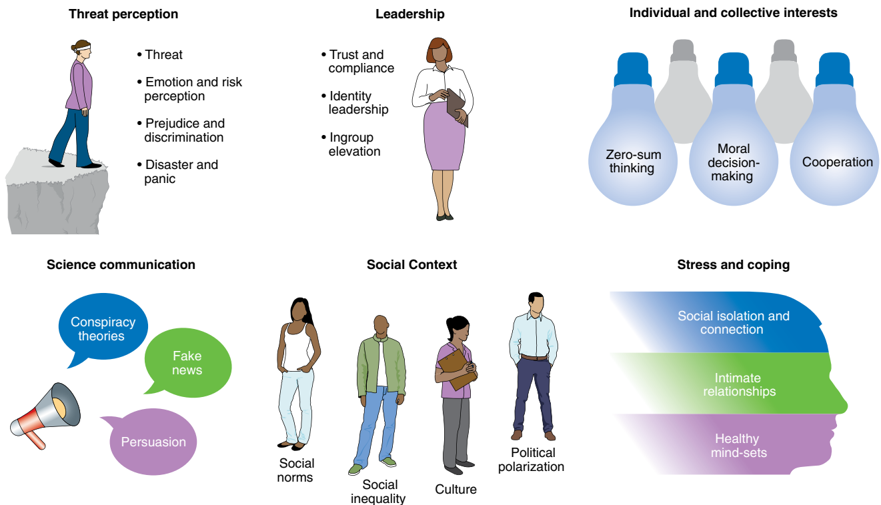
The COVID-19 pandemic represents a massive global health crisis. Because the crisis requires large-scale behaviour change and places significant psychological burdens on individuals, insights from the social and behavioural sciences can be used to help align human behaviour with the recommendations of epidemiologists and public health experts. Here we discuss evidence from a selection of research topics relevant to pandemics, including work on navigating threats, social and cultural influences on behaviour, science communication, moral decision-making, leadership, and stress and coping. In each section, we note the nature and quality of prior research, including uncertainty and unsettled issues. We identify several insights for effective response to the COVID-19 pandemic and highlight important gaps researchers should move quickly to fill in the coming weeks and months.
Overview
CoChat Summary
TL;DR
This perspective argues that social and behavioural science can help align public behaviour with COVID-19 public health recommendations across threat perception, social context, science communication, cooperation, leadership, and stress/coping. It synthesizes prior evidence and policy insights while cautioning that evidence is limited, often drawn from non-pandemic contexts, and in many areas unsettled.
Key findings
- The paper notes the scale of infectious disease threats: the bubonic plague killed approximately 25% of the European population, and by March 2020 COVID-19 had spread to more than 118,000 cases and caused 4,291 deaths in 114 countries. It also notes that 21 countries donated medical supplies to China in February, with China reciprocating widely.
- Fear appeals can change behaviour when people feel capable of dealing with the threat, but produce defensive reactions when people feel helpless; optimism bias can lead people to underestimate personal risk and ignore public health warnings.
- Social norms, inequality, culture, and political polarization shape pandemic behaviour: correcting misperceived norms can help when most people are already doing the desirable behaviour, but descriptive norms can backfire if the behaviour is undesirable unless paired with prescriptive norms.
- Effective communication and leadership may involve credible sources, messages that protect others or align with moral values, prebunking/inoculation against misinformation, accuracy nudges, shared social identity, and leaders modelling prosocial sacrifice; excessive national self-image concerns (“collective narcissism”) can backfire.
Methods
- Design: Perspective/narrative review; no primary data collection or sample. Topics were identified by the corresponding authors as potentially relevant to pandemic response and are explicitly not exhaustive.
- Evidence base: synthesizes prior social and behavioural research on threat perception, social context, science communication, moral decision-making, cooperation, leadership, and stress/coping, drawing on laboratory experiments, correlational studies, field experiments, meta-analyses, and preprints/forthcoming work.
- Analysis: narrative synthesis with policy implications and identified research gaps; no systematic search strategy or quantitative synthesis is reported.
Limitations
- Stated: due to space constraints, the paper provides only a brief summary of each topic; research on these topics is ongoing and in many cases far from settled; there is very little published social science research on the current pandemic, so discussion often draws from different circumstances and evidence quality varies substantially.
- Stated: insights and policy implications should be interpreted with caution.
- Evident: as a perspective rather than a systematic review or empirical study, it does not provide a comprehensive evidence appraisal, and its reliance on preprints and forthcoming sources limits certainty.
Model-written summary. Check it against the paper before relying on it.
Integrity signals
Registry
Cites
Statistics
Figures
Verification
Claims the paper makes
19 Valid · 5 Not valid · 37 Not checked · 13 Own results and interpretations
At least one cited source doesn’t support this claim or points to a different paper, and none confirmed it — see the verdicts below.
In the paper
“For instance, in hypothetical scenarios about deciding whether to go to work while sick, American and British participants reported they would be less willing to stay home when it was uncertain they would infect a co-worker.”
What the sources say
- Disputedcites [176] Kappes, A. et al. Uncertainty about the impact of social decisions increases prosocial behaviour. Nat. Hum. Behav. 2, 573–580 (2018). sourceExperimental — accuracy not yet measured
In the paper’s account of the infectious-disease scenario (Abstract; page not provided), participants facing uncertainty about how severely a co-worker might be affected were more likely to stay home than controls, not less. The paper distinguishes that impact uncertainty from uncertainty about whether a co-worker would be infected. Its Study 6 Methods (page not provided) describe recruitment through AMT, but do not establish the claimed American and British participant groups. (LLM, conf=0.88)
Checked by a reasoning model — may be wrong.
hedgedstates an association- Asserted: passes — The authors put it forward as true.
- Checkable: passes — It can be checked against evidence.
- Load-bearing: passes — The paper’s conclusions depend on it.
- Based: passes — The paper gives a reason why it holds.
- Disputed
The cited sources that could be checked couldn’t confirm or dispute this claim.
In the paper
“Moreover, there is mixed research regarding whether corrections may actually increase belief in the original misinformation 121,124-126 or in other misleading claims that fail to get corrected 127 .”
What the sources say
- Not checked — no full text of the sourcecites [121] Guess, A. & Coppock, A. Does counter-attitudinal information cause backlash? Results from three large survey experiments. Br. J. Polit. Sci. https://doi.org/10.1017/S0007123418000327 (2018). source
- Not matchedcites [124] Wittenberg, C. & Berinsky, A.J. Misinformation and its correction. in Social Media and Democracy: The State of the Field (eds Persily, N. & Tucker, J. A.) (Cambridge University Press, forthcoming).
Its entry has no title and year that we can search by.
- Not checked — no full text of the sourcecites [125] Swire, B. & Ecker, U.K.H. Misinformation and its correction: Cognitive mechanisms and recommendations for mass communication. in Misinformation and Mass Audiences (eds. Southwell, B. G., Thorson, E. A. & Sheble, L.) 195–2011 (University of Texas Press, 2018). source
- Not checked — no full text of the sourcecites [126] Wood, T. & Porter, E. The elusive backfire effect: mass attitudes’ steadfast factual adherence. Polit. Behav. 41, 135–163 (2018). source
- Could not verifycites [127] Pennycook, G., McPhetres, J., Zhang, Y. & Rand, D. Fighting COVID-19 misinformation on social media: Experimental evidence for a scalable accuracy nudge intervention. Preprint at PsyArXiv https://doi.org/10.31234/osf.io/uhbk9 (2020). sourceExperimental — accuracy not yet measured
Citation 127 is attached to the suggestion that corrections may increase belief in other misleading claims that go uncorrected. The Statement of Relevance and Discussion describe an accuracy nudge that improved sharing decisions, not corrections or their effects on belief in uncorrected claims. Searches for correction backfire and uncorrected misinformation found no passage addressing that point; page numbers were unavailable in our copy. (LLM, conf=0.76)
hedgedstates a possible cause- Asserted: passes — The authors put it forward as true.
- Checkable: passes — It can be checked against evidence.
- Load-bearing: passes — The paper’s conclusions depend on it.
- Based: passes — The paper gives a reason why it holds.
The sources with a verdict support this claim; the rest weren’t checked yet, have no full text we could read, or their verdicts aren’t rated yet.
In the paper
“Indeed, laboratory research has found that people prioritize local over global (or international) interests 185,186 .”
What the sources say
- Supportedcites [185] Milinski, M., Hilbe, C., Semmann, D., Sommerfeld, R. & Marotzke, J. Humans choose representatives who enforce cooperation in social dilemmas through extortion. Nat. Commun. 7, 10915 (2016). source
The Results section (‘Voters choose selfish representatives’; page unavailable) reports that participants preferentially re-elected representatives who contributed less to the shared climate account and elected candidates who pledged to contribute less than a fair share. In this simulated international dilemma, that supports the claim that participants favored their own group’s interests over the collective goal; it does not establish that everyone did so. (LLM, conf=0.85)
- Not checked — no full text of the sourcecites [186] Reinders Folmer, C. P. et al. One for all: what representing a group may do to us. J. Exp. Soc. Psychol. 48, 1047–1056 (2012). source
plain- Asserted: passes — The authors put it forward as true.
- Checkable: passes — It can be checked against evidence.
- Load-bearing: passes — The paper’s conclusions depend on it.
- Based: passes — The paper gives a reason why it holds.
- Supported
Every source the paper cites for this claim was checked and supports it.
In the paper
“However, when going to work risked infecting an elderly co-worker who would suffer a serious illness, participants reported they would be more willing to stay home 176 .”
What the sources say
- Supportedcites [176] Kappes, A. et al. Uncertainty about the impact of social decisions increases prosocial behaviour. Nat. Hum. Behav. 2, 573–580 (2018). source
The Study 6 Methods (page not provided) describe a scenario in which going to work could infect an older, vulnerable co-worker who would suffer severely, followed by a rating of willingness to go to work. The reported Study 6 findings (indexed under Abstract; page not provided) say participants given that risk information were significantly more likely to stay home than controls. (LLM, conf=0.92)
hedgedstates a cause- Asserted: passes — The authors put it forward as true.
- Checkable: passes — It can be checked against evidence.
- Load-bearing: passes — The paper’s conclusions depend on it.
- Based: passes — The paper gives a reason why it holds.
- Supported
The sources with a verdict support this claim; the rest weren’t checked yet, have no full text we could read, or their verdicts aren’t rated yet.
In the paper
“Several techniques, such as sanctioning defectors 187 or rewarding cooperators 188 , tend to increase cooperative behaviour in laboratory experiments using economic games.”
What the sources say
- Not checked — no full text of the sourcecites [187] Yamagishi, T. The provision of a sanctioning system as a public good. J. Pers. Soc. Psychol. 51, 110–116 (1986). source
- Supportedcites [188] Rand, D. G., Dreber, A., Ellingsen, T., Fudenberg, D. & Nowak, M. A. Positive interactions promote public cooperation. Science 325, 1272–1275 (2009). source
Citation 188 is attached to rewarding cooperators. The paper’s Abstract reports a laboratory comparison using repeated public goods games and finds that reward maintained public cooperation and, when both reward and punishment were available, increased contributions. (LLM, conf=0.93)
plainstates a cause- Asserted: passes — The authors put it forward as true.
- Checkable: passes — It can be checked against evidence.
- Load-bearing: unclear — It is unclear whether the paper’s conclusions depend on it.
- Based: passes — The paper gives a reason why it holds.
50 more claims · 13 with their cited sources checked
Create a free account to see all 74 claims and to verify the 2 references still open.
- It may state two separate claims as one. 13
- Probably not a substantial claim. 6
Claims other papers make about this one
Each is checked against this paper’s own text: does it say what the citing paper says it does?
The source backs part of the claim, not all of it — or backs it for a different population, condition or comparison.
In the citing paper
“COVID-19 is an international public health crisis, putting substantial burden on medical centers and increasing the psychological toll on health care workers (HCW).”
From Supporting the well-being of health care providers during the COVID-19 pandemic: The CopeColumbia response (2020) · cites this paper as [6]
Experimental — accuracy not yet measuredThe source backs part of the claim, not all of it — or backs it for a different population, condition or comparison.
In the citing paper
“these population-wide measures affected psychological well-being and mental health as well as increased social isolation [68] and loneliness.”
From Psychological correlates of perceived loneliness in college students before and during the COVID-19 stay-at-home period: a longitudinal study (2023) · cites this paper as [68]
Experimental — accuracy not yet measuredThe source backs part of the claim, not all of it — or backs it for a different population, condition or comparison.
In the citing paper
“they may eventually increase the social isolation of students and affect their psychological well-being and mental health [3].”
From Students under lockdown: Comparisons of students’ social networks and mental health before and during the COVID-19 crisis in Switzerland (2020) · cites this paper as [3]
Experimental — accuracy not yet measuredThe source backs part of the claim, not all of it — or backs it for a different population, condition or comparison.
In the citing paper
“effective interventions are hard to scale to a population level (12);”
From Psychological inoculation improves resilience against misinformation on social media (2022) · cites this paper as [12]
Experimental — accuracy not yet measuredThe source backs part of the claim, not all of it — or backs it for a different population, condition or comparison.
In the citing paper
“There is a shortage of studies that test anti-misinformation interventions in an ecologically valid manner, i.e., testing an intervention as consumers would interact with it in online environments (8, 12).”
From Psychological inoculation improves resilience against misinformation on social media (2022) · cites this paper as [12]
Experimental — accuracy not yet measured
6 more claims about this paper
Create a free account to see every claim other papers make about this one.
Citations
Cites
Granovetter, M. S. (1973) · American Journal of Sociology · doi:10.1086/225469 · Cited by 40,491
Zhou, F., Yu, T., Du, R., Fan, G., Liu, Y., Liu, Z., Xiang, J., Wang, Y., Song, B., Gu, X., et al. (2020) · The Lancet · doi:10.1016/s0140-6736(20)30566-3 · Cited by 27,263
The need to belong: Desire for interpersonal attachments as a fundamental human motivation.
Baumeister, R. F., & Leary, M. R. (1995) · Psychological Bulletin · doi:10.1037//0033-2909.117.3.497 · Cited by 23,245
Culture and the self: Implications for cognition, emotion, and motivation.
Markus, H. R., & Kitayama, S. (1991) · Psychological Review · doi:10.1037/0033-295x.98.2.224 · Cited by 21,995
Self-citationThe Psychological Impact of Quarantine and How to Reduce It: Rapid Review of the Evidence
Brooks, S. K., Webster, R. K., Smith, L. E., Woodland, L., Wessely, S., Greenberg, N., & Rubin, G. J. (2020) · doi:10.2139/ssrn.3532534 · Cited by 16,394
The psychological impact of quarantine and how to reduce it: Rapid review of the evidence
Brooks, S. K., Webster, R. K., Smith, L. E., Woodland, L., Wessely, S., Greenberg, N., & Rubin, G. J. (2020) · The Lancet · doi:10.1016/s0140-6736(20)30460-8 · Cited by 16,378
Nudge: improving decisions about health, wealth, and happiness
(2008) · Choice Reviews Online · doi:10.5860/choice.46-0977 · Cited by 11,572
Slovic, P. (1987) · Science · doi:10.1126/science.3563507 · Cited by 9,271
The Elaboration Likelihood Model of Persuasion
Petty, R. E., & Cacioppo, J. T. (1986) · Advances in Experimental Social Psychology · doi:10.1016/s0065-2601(08)60214-2 · Cited by 8,822
Self-citationThe emotional dog and its rational tail: A social intuitionist approach to moral judgment.
Haidt, J. (2001) · Psychological Review · doi:10.1037/0033-295x.108.4.814 · Cited by 8,048
Research works printed but not linked: 3
- Berkowitz, A.D. An overview of the social norms approach. in Changing the Culture of College Drinking: A Socially Situated Health Communication Campaign (eds. Stewart, L. & Lederman, L. C.) 193–214 (Hampton Press, 2005).
- Wittenberg, C. & Berinsky, A.J. Misinformation and its correction. in Social Media and Democracy: The State of the Field (eds Persily, N. & Tucker, J. A.) (Cambridge University Press, forthcoming).
- Ransohoff, K.J. Patients on the Trolley Track: The Moral Cognition of Medical Practitioners and Public Health Professionals. (Harvard Univ. Press, 2011).
Cited by
Items 4,801–4,900 of 5,015
Nudging or Nagging: The Perils of Persuasion
Guido, A., Tverskoi, D., Gavrilets, S., Sánchez, Á., & Andrighetto, G. (2024) · Journal of Economic Behavior & Organization · doi:10.1016/j.jebo.2025.107293
Rochira, A., Fasanelli, R., Prati, G., Gatti, F., Gattino, S., Marzana, D., Procentese, F., & Simone, E. D. (2025) · Journal of Health Psychology · doi:10.1177/13591053251375321 · Cited by 1
“Given the pandemic’s extensive impact across social, occupational, economic, and cultural domains (e.g. Bavel et al., 2020), society faces a persistent sense of threat, infection anxiety, and uncertainty about unknown factors.”
Qu, H., Li, K., Rui, J., Chen, Q., Li, T., Guo, X., Guan, X., & Chen, T. (2025) · BMJ Open · doi:10.1136/bmjopen-2024-093519 · Cited by 1
What's next for the psychology of science rejection?
Rutjens, B. T., van der Lee, R., & Sutton, R. M. (2025) · Current Opinion in Psychology · doi:10.1016/j.copsyc.2025.102217
The spread of mind: psychological contagion in theory and critique
Houran, J., Dagnall, N., Sapkota, R. P., & Lange, R. (2025) · Frontiers in Psychology · doi:10.3389/fpsyg.2025.1631927 · Cited by 6
Building Vaccine Readiness for Future Pandemics: Insights from COVID-19 Vaccine Intent and Uptake
Guidry, J. P. D., Laestadius, L. I., Miller, C. A., Stevens, M., Burton, C. W., Carlyle, K. E., & Perrin, P. B. (2025) · Vaccines · doi:10.3390/vaccines13121201 · Cited by 1
“Messaging strategies that evolve alongside public perception and emphasize collective benefit and social responsibility may prove more durable in sustaining uptake [54].”
Adda, R. B., & Pwayirane, C. (2025) · medRxiv · doi:10.1101/2025.11.26.25341108
Wearing Masks Generates Approach Motivation in Times of COVID-19Preprint
Liu, J., Yang, J., & Hu, Z. (2025) · Research Square · doi:10.21203/rs.3.rs-8017396/v1
Zils, L., Metag, J., Mede, N. G., & Schäfer, M. S. (2025) · Public Understanding of Science · doi:10.1177/09636625251400658
Huang, R., Zou, Y., Zhou, L., & Jiang, T. (2025) · Frontiers in Public Health · doi:10.3389/fpubh.2025.1686843
Estadilla, C. D. S., Uyheng, J., de Lara-Tuprio, E. P., Teng, T. R. Y., Macalalag, J. M. R., & Estuar, M. R. J. E. (2021) · Figshare · doi:10.6084/m9.figshare.15139541
Bélanger‐Gravel, A., Janezic, I., Desroches, S., Paquette, M.-C., Therrien, F., Barnett, T. A., Lavoie, K., & Gauvin, L. I. (2023) · Figshare · doi:10.6084/m9.figshare.22877545
Khadka, S., Saleem, M., Usman, M., Hashmi, F. K., Tariq, F., Zaheer, W., Imon, S., Inam, A., Gupta, R. P., & Aryal, P. (2024) · Figshare · doi:10.6084/m9.figshare.26575826
Herrero-Arias, R., Halbostad, I. V., & Diaz, E. (2024) · Figshare · doi:10.6084/m9.figshare.26669223
Additional file 2 of From science to politics: COVID-19 information fatigue on YouTube
Shi, C.-F., So, M. C., Stelmach, S., Earn, A., Earn, D. J. D., & Dushoff, J. G. (2022) · Figshare · doi:10.6084/m9.figshare.19642132
Hendricks, B., Quinn, T. D., Price, B. S., Dotson, T., Claydon, E. A., & Miller, R. (2023) · Figshare · doi:10.6084/m9.figshare.24257499
Additional file 6 of From science to politics: COVID-19 information fatigue on YouTube
Shi, C.-F., So, M. C., Stelmach, S., Earn, A., Earn, D. J. D., & Dushoff, J. G. (2022) · Figshare · doi:10.6084/m9.figshare.19642144
Youssef, D., Bleibel, L., & Abboud, E. (2024) · Figshare · doi:10.6084/m9.figshare.26596892
Khadka, S., Saleem, M., Usman, M., Hashmi, F. K., Tariq, F., Zaheer, W., Imon, S., Inam, A., Gupta, R. P., & Aryal, P. (2024) · Figshare · doi:10.6084/m9.figshare.26575823
Berendes, S., Mounier‐Jack, S., Ojo-Aromokudu, O., Ivory, A., Tucker, J. D., Larson, H. J., & Free, C. (2023) · Figshare · doi:10.6084/m9.figshare.23730728
Self-citationCalabrese, C. R., Xue, H., & Zhang, J. (2024) · Figshare · doi:10.6084/m9.figshare.27140920
Greene, C. M., & Murphy, G. (2020) · Figshare · doi:10.6084/m9.figshare.13336321
Caycho-Rodríguez, T., Valencia, P. D., Ventura-León, J., Carbajal-León, C., Vilca, L. W., Reyes-Bossio, M., Delgado-Campusano, M., Yupanqui-Lorenzo, D. E., Paredes-Angeles, R., Rojas-Jara, C., et al. (2024) · Figshare · doi:10.6084/m9.figshare.26637309
Additional file 3 of From science to politics: COVID-19 information fatigue on YouTube
Shi, C.-F., So, M. C., Stelmach, S., Earn, A., Earn, D. J. D., & Dushoff, J. G. (2022) · Figshare · doi:10.6084/m9.figshare.19642135
Berendes, S., Mounier‐Jack, S., Ojo-Aromokudu, O., Ivory, A., Tucker, J. D., Larson, H. J., & Free, C. (2023) · Figshare · doi:10.6084/m9.figshare.23730731
Self-citationAdditional file 1 of From science to politics: COVID-19 information fatigue on YouTube
Shi, C.-F., So, M. C., Stelmach, S., Earn, A., Earn, D. J. D., & Dushoff, J. G. (2022) · Figshare · doi:10.6084/m9.figshare.19642126
Falla-Aliabadi, S., Heydari, A., Fatemi, F., Yoshany, N., Lotfi, M. H., Sarsangi, A., & Hanna, F. (2023) · Figshare · doi:10.6084/m9.figshare.22608209
Additional file 4 of From science to politics: COVID-19 information fatigue on YouTube
Shi, C.-F., So, M. C., Stelmach, S., Earn, A., Earn, D. J. D., & Dushoff, J. G. (2022) · Figshare · doi:10.6084/m9.figshare.19642138
Post, R. A. J., Regis, M., Zhan, Z., et al. (2021) · Figshare · doi:10.6084/m9.figshare.14129342
Berendes, S., Mounier‐Jack, S., Ojo-Aromokudu, O., Ivory, A., Tucker, J. D., Larson, H. J., & Free, C. (2023) · Figshare · doi:10.6084/m9.figshare.23730734
Self-citationPedron, S., Laxy, M., Radon, K., Gleut, R. L., Castelletti, N., Noller, J. M. G., Diefenbach, M. N., Hölscher, M., Leidl, R., & Schwettmann, L. (2024) · Figshare · doi:10.6084/m9.figshare.26588736
Lombardo, C., Guo, L., Solomon, S., Crepaz‐Keay, D., McDaid, S., Thorpe, L. N., Martin, S., John, A., Morton, A., Davidson, G., et al. (2023) · Figshare · doi:10.6084/m9.figshare.24171991
Mussio, I., & de Oliveira, A. C. M. (2022) · Figshare · doi:10.6084/m9.figshare.20423777
Bélanger‐Gravel, A., Janezic, I., Desroches, S., Paquette, M.-C., Therrien, F., Barnett, T. A., Lavoie, K., & Gauvin, L. I. (2023) · Figshare · doi:10.6084/m9.figshare.22877548
Davis, A., Munari, S. C., Doyle, J., Sutton, B., Cheng, A., Hellard, M., & Gibbs, L. (2022) · Figshare · doi:10.6084/m9.figshare.21192070
Fawole, O. I., Bello, S., Adebowale, A. S., Bamgboye, E. A., Salawu, M. M., Afolabi, R. F., Dairo, M. D., Namale, A., Kiwanuka, S. N., Monje, F., et al. (2023) · Figshare · doi:10.6084/m9.figshare.22790438
Stoddard, M., Egeren, D. V., Johnson, K. E., Rao, S., Furgeson, J., White, D. E., Nolan, R. P., Hochberg, N. S., & Chakravarty, A. (2021) · Figshare · doi:10.6084/m9.figshare.14524726
Berendes, S., Mounier‐Jack, S., Ojo-Aromokudu, O., Ivory, A., Tucker, J. D., Larson, H. J., & Free, C. (2023) · Figshare · doi:10.6084/m9.figshare.23730725
Self-citationAdditional file 5 of From science to politics: COVID-19 information fatigue on YouTube
Shi, C.-F., So, M. C., Stelmach, S., Earn, A., Earn, D. J. D., & Dushoff, J. G. (2022) · Figshare · doi:10.6084/m9.figshare.19642141
Urbán, R., Paksi, B., Miklósi, Á., Saunders, J. B., & Demetrovics, Z. (2021) · Figshare · doi:10.6084/m9.figshare.15071275
Birhanu, Z., Ambelu, A., Fufa, D., Mecha, M., Zeynudin, A., Abafita, J., Belay, A., Doyore, F., Oljira, L., Wako, E. B., et al. (2021) · Figshare · doi:10.6084/m9.figshare.14677135
Lombardo, C., Guo, L., Solomon, S., Crepaz‐Keay, D., McDaid, S., Thorpe, L. N., Martin, S., John, A., Morton, A., Davidson, G., et al. (2023) · Figshare · doi:10.6084/m9.figshare.24171994
Marchi, M., Magarini, F. M., Chiarenza, A., Galeazzi, G. M., Paloma, V., Garrido, R., Ioannidi, E., Vassilikou, K., de Matos, M. G., Gaspar, T., et al. (2022) · Figshare · doi:10.6084/m9.figshare.19746416
Lombardo, C., Guo, L., Solomon, S., Crepaz‐Keay, D., McDaid, S., Thorpe, L. N., Martin, S., John, A., Morton, A., Davidson, G., et al. (2023) · Figshare · doi:10.6084/m9.figshare.24171997
Correlates of Health-Protective Behavior During the Initial Days of the COVID-19 Outbreak in NorwayPreprint
Faasse, K., Schubert, T. W., Zickfeld, J., Grahe, J., & Herting, A. K. (2020) · OSF Preprints (OSF Preprints)
Bernecker, K., Brandstaetter-Morawietz, V., & Kukowski, C. (2021) · OSF Preprints (OSF Preprints)
Wang, Y., & Egan, R. L. (2022) · OSF Preprints (OSF Preprints)
Développement et validation d’une mesure des croyances conspirationnistes en santé publique
Ngueutsa, R., Messanga, G. A., Boua, M., Tchagneno, C. L. G., Etoundi, J.-C., Wassouo, E., Kubiszewski, V., & Lheureux, F. (2025) · Pratiques Psychologiques · doi:10.1016/j.prps.2025.09.003
Burden of Viral Diseases on the Psychosocial Well-Being of Africans
Shenge, N. A. (2025) · Springer eBooks · doi:10.1007/978-3-032-09613-5_14
development of the COVID-19 Risk Assessment Tool
Peters, G. J., Kwaśnicka, D., ten Hoor, G. A., Crutzen, R., Varol, T., Warner, L. M., Algargoosh, M., Ali, E. E., Anwar, M., Asih, S. R., et al. (2025) · Portuguese National Funding Agency for Science, Research and Technology (RCAAP Project by FCT)
Kobayashi, T., Murakami, M., & Miura, A. (2025) · Vaccine X · doi:10.1016/j.jvacx.2025.100766 · Cited by 2
How did political ideology affect public support for COVID-19 policy measures in South Korea?
Parasian, S., Kim, H. Y., & Choi, J.-W. (2025) · International Review of Public Administration · doi:10.1080/12294659.2025.2600116
“In particular, from the perspective of political ideology, individuals may prefer information that aligns with their ideological leanings, potentially distorting the information they receive (Bavel et al., 2020).”
InfluentialAnálise do Comportamento, intervenções não-farmacológicas e COVID-19: uma revisão de escopo
Fonseca, S. D. A., Rufino, L., & Xavier, D. (2025) · Revista Brasileira de Terapia Comportamental e Cognitiva · doi:10.31505/rbtcc.v27i1.2054
“A pandemia de COVID-19 exigiu mudan-ças comportamentais em larga-escala, com enorme impacto no bem-estar e qualidade de vidas dos indi-víduos (Bavel et al., 2020).”
InfluentialWang, D., Wang, Y., Gressani, O., Chen, J., Tao, Y., Wang, H., Li, S., Chen, D., Lau, E. H. Y., Zhao, Y., et al. (2025) · medRxiv · doi:10.64898/2025.12.17.25342513
Li, W., Ishiyama, A., & Yuki, M. (2025) · Journal of Cross-Cultural Psychology · doi:10.1177/00220221251393620
“However, we are cautious about interpreting this finding considering that we conducted the study during the COVID-19 pandemic, a hard time when people’s minds and social behaviors were substantially affected and changed (e.g., Bavel et al., 2020).”
Analyzing the impact of the sentiment of Covid-19 news on bitcoin through transformer-based models
Morampudi, M. K., Swain, C. K., Prabhagar, M. V., & Sundar, R. (2025) · Quality & Quantity · doi:10.1007/s11135-025-02547-3
An Age-Distributed Immuno-Epidemiological Model with Information-Based Vaccination Decision
Ghosh, S., Banerjee, M., & Volpert, V. A. (2025) · Mathematics · doi:10.3390/math14010162
“This can inform the development of more effective public health interventions that take into account the social and psychological factors that influence people’s behavior [23, 24].”
ONTOLOJİK GÜVENLİK YAKLAŞIMINDA “ÖTEKİ” İNŞASI: NATO-RUSYA FEDERASYONU ARASINDA KİMLİKSEL GERİLİM
Gündoğdu, P. Ç. (2025) · Giresun Üniversitesi İktisadi ve İdari Bilimler Dergisi · doi:10.46849/guiibd.1803539
Literature Study of Healthy Living Behavior New Habits After Covid-19 Pandemic
Riyadi, A. L., Kriswanto, E. S., & Gusdernawati, A. (2025) · Proceedings in Technology Transfer · doi:10.1007/978-981-96-8249-2_65
Managing Vaccine Hesitancy Among Adults and Elderly People
Lopalco, P. L., Nuccetelli, F., & Gabellone, V. (2026) · Springer eBooks · doi:10.1007/978-3-032-09163-5_5
Viral Objects: Masks and Sanitizers
Joshi, I. A., & Venkatesan, S. (2026) · Springer eBooks · doi:10.1007/978-3-031-91191-0_2
Psychological Mechanisms of Collective Mental Time Travel During the COVID-19 Pandemic
Dönerkayalı, C., Watson, L. A., & Öner, S. (2025) · Springer eBooks · doi:10.1007/978-3-032-03895-1_3
Estimating the economic burden of COVID-19 survivors in Punjab, Pakistan
Abbas, S., Nasir, J. A., & Sherwani, R. A. K. (2026) · PLoS ONE · doi:10.1371/journal.pone.0337995
“This finding is also supported by [13,44–47].”
Mabhanda, W., & Chihwai, P. (2026) · Springer eBooks · doi:10.1007/978-981-95-3210-0_9
Structural Divides Shape the Nonlinear Nature of Human Mobility in COVID-19Preprint
Kulathunge, M., Edirisinghe, L., Mapa, I., Godaliyadda, R. I., Ekanayake, P., Karnik, N. S., Dharmaratne, S. D., Herath, V. R., & Ekanayake, J. B. (2026) · Research Square · doi:10.21203/rs.3.rs-8482833/v1
The Cost of Flexibility: Stake-Dependent Temptation and the Demand for CommitmentPreprint
Zhang, X., Wu, W., Tu, Y., He, H., & Jin, S. (2026) · SSRN Electronic Journal · doi:10.2139/ssrn.6065123
Strict norms and perceived cultural tightness have distinct societal consequencesPreprint
Eriksson, K., Vartanova, I., Strimling, P., & Haas, B. W. (2026) · Research Square · doi:10.21203/rs.3.rs-8538560/v1
Muasya, G., Wachira, W., & Mwangi, S. W. (2024) · African Multidisciplinary Journal of Research · doi:10.71064/spu.amjr.8.ii.2023.252
“These allegations against these people could be true or untrue (Van Bavel et al, 2020; Van Prooijen & Douglas, 2018).”
Antonopoulou, V., Ong, M., Meyer, C., Beale, S., Lorencatto, F., Michie, S., Aldridge, R. W., & Hayward, A. C. (2026) · Discover Public Health · doi:10.1186/s12982-026-01375-6 · Cited by 3
“Using behavioural science theories and frameworks can be very helpful for guiding investigation of the factors influencing the enactment (or maintenance) of PPBs and for designing effective public health interventions [50].”
Hrubos‐Strøm, H. (2026) · Springer eBooks · doi:10.1007/978-3-032-10057-3_5
How to communicate evidence against catchy erroneous arguments?
Magid, A., Nitzan, D., Marchandise, C., et al. (2026) · European Journal of Public Health · doi:10.1093/eurpub/ckag003
The Neuroeconomics of Social Influence and Contagion
Su, Z., & Lockwood, P. L. (2026) · Springer eBooks · doi:10.1007/978-3-032-02925-6_26 · Cited by 1
Party Preferences as a Polarizing Factor During the COVID-19 crisis? The Evidence From Panel Survey
Cirhan, T., & Stauber, J. (2026) · Political Studies Review · doi:10.1177/14789299251410829 · Cited by 1
Gedik, İ. A., & Kıngır, S. (2025) · Kent Akademisi
Adapting mobility: insights from COVID-19 impact on east asian regions
Sun, X., Song, W., & Wei, Y. (2026) · Humanities and Social Sciences Communications · doi:10.1057/s41599-026-06662-w · Cited by 1
O’Neill, G. A., Byrne, P. J., & Doyle, F. M. (2024) · International Journal of Social and Psychological Aspects of Healthcare · doi:10.51847/15ydrgiobw
Nawaz, S., Mitchell, M., Linden, T., & Bhowmik, J. (2026) · Social Sciences & Humanities Open · doi:10.1016/j.ssaho.2026.102559 · Cited by 1
Self-organized social distancing
Buijsrogge, A., Brethouwer, J.-T., van de Rijt, A., & Lindelauf, R. H. A. (2026) · Journal of Mathematical Sociology · doi:10.1080/0022250x.2025.2513240 · Cited by 1
“Sociologists have found such restrictions to have had significant negative impact on societal cohesion (Bavel et al., 2020; Bol, 2020; Ward, 2020).”
Coupled spreading dynamics in an information–physical–social multilayer systemPreprint
Pang, B., Zhou, Y., Wang, R., et al. (2026) · SSRN Electronic Journal · doi:10.2139/ssrn.6303944
Bono, G., Duffy, T., Hescox, J., Tomczyk, J., & Reil, K. (2026) · Trends in Higher Education · doi:10.3390/higheredu5010025
“Factors that played into this included being forced to isolate in a home with an abusive parent or partner, having no access to other people or groups who could mitigate conflicts, and suffering from the financial fallout of the pandemic [16,17].”
Community Perceptions on Social Media and COVID-19: Insights from a Thematic Analysis
Imran, D., Shah, M. W., & Khalil, I. A. (2024) · Journal of Regional Studies Review · doi:10.62843/jrsr/2024.3a171
Concert time in crisis: Rethinking temporal structuring and decision-making under pressure
Ivanaj, V., & Ruffo, O. I. (2026) · Journal of General Management · doi:10.1177/03063070261432488
Does digital transformation enhance ESG performance? Empirical evidence from French listed companies
Ghnimi, H., & Hermi, S. (2026) · Managerial Finance · doi:10.1108/mf-07-2025-0527
How to make big changes in the face of a challenge
Rickenbach, T. M. (2026) · Elsevier eBooks · doi:10.1016/b978-0-443-32928-9.00004-6
Dijital Çağda Gıda Riskinin Algılanması: Tüketici Yorumlarının Risk Toplumu Temelli Tematik Analizi
ÖZGÜR, H. O. (2026) · Hacettepe Üniversitesi Edebiyat Fakültesi Dergisi · doi:10.32600/huefd.1687807
Hwang, J. (2026) · PLoS ONE · doi:10.1371/journal.pone.0344209
“In the pandemic context, such trust was closely linked to prevailing public opinion, government communication, and media narratives [19,35,36].”
Public health system credibility and corporate financial risk: behavioral channels from China
Zhou, C., & Tang, C. (2026) · Frontiers in Public Health · doi:10.3389/fpubh.2026.1791324
Tan, Z., & He, B. (2026) · BMC Psychology · doi:10.1186/s40359-026-04417-5
“When a public health emergency occurs, people have a strong need to seek information and widely collect and share relevant information through the internet and social media [3, 66].”
Scapegoating Jews During the COVID-19 Pandemic
Cohen, J. E. (2023) · Journal of Religion & Society · doi:10.64667/istm9747
“Still, while belief in COVID-19 conspiracies and political orientations affect attitudes and behavior toward COVID-19 and government COVID-19 policies, we know little about the sources and/or effects of the many different COVID-19 conspiracy beliefs (Bavel et al. 2020).”
Xu, Y., Liu, Q., & Liang, J. (2026) · Research Square · doi:10.21203/rs.3.rs-7765355/v1
Kim, S. Y., Kim, G., Park, S., Kim, C., Jang, D. H., Joe, D. H., & Jang, W. M. (2026) · PLoS ONE · doi:10.1371/journal.pone.0345621
Metadata
- Authors
- Bavel, J. J. V., Baicker, K., Boggio, P. S., Capraro, V., Cichocka, A., Cikara, M., Crockett, M. J., Crum, A. J., Douglas, K. M., Druckman, J. N., Drury, J., Dube, O., Ellemers, N., Finkel, E. J., Fowler, J. H., Gelfand, M., Han, S., Haslam, S. A., Jetten, J., Kitayama, S., Mobbs, D., Napper, L. E., Packer, D. J., Pennycook, G., Peters, E., Petty, R. E., Rand, D. G., Reicher, S. D., Schnall, S., Shariff, A., Skitka, L. J., Smith, S. S., Sunstein, C. R., Tabri, N., Tucker, J. A., Linden, S. V. D., Lange, P. V., Weeden, K. A., Wohl, M. J. A., Zaki, J., Zion, S. R., & Willer, R.
- Affiliations
- New York University (US)
- Universidade Presbiteriana Mackenzie (BR)
- Middlesex University London (GB)
- University of Kent (GB)
- Harvard University (US)
- Yale University (US)
- Stanford University (US)
- Northwestern University (US)
- University of Sussex (GB)
- University of Chicago (US)
- Utrecht University (NL)
- University of California San Diego (US)
- University of Maryland, College Park (US)
- Peking University (CN)
- The University of Queensland (AU)
- University of Michigan (US)
- California Institute of Technology (US)
- Lehigh University (US)
- University of Regina (CA)
- University of Oregon (US)
- The Ohio State University (US)
- Massachusetts Institute of Technology (US)
- University of St Andrews (GB)
- University of Cambridge (GB)
- University of British Columbia (CA)
- University of Illinois Chicago (US)
- University of California, Berkeley (US)
- Carleton University (CA)
- Cornell University (US)
- Corresponding author
- Bavel, Jay J. Van
- Willer, Robb
- ORCID
- Bavel, Jay J. Van
- Baicker, Katherine
- Boggio, Paulo S.
- Capraro, Valerio
- Cichocka, Aleksandra
- Cikara, Mina
- Crockett, Molly J.
- Crum, Alia J.
- Douglas, Karen M.
- Druckman, James N.
- Drury, John
- Ellemers, Naomi
- Finkel, Eli J.
- Fowler, James H.
- Gelfand, Michele
- Han, Shihui
- Haslam, S. Alexander
- Jetten, Jolanda
- Kitayama, Shinobu
- Mobbs, Dean
- Napper, Lucy E.
- Packer, Dominic J.
- Pennycook, Gordon
- Peters, Ellen
- Petty, Richard E.
- Rand, David G.
- Reicher, Stephen D.
- Schnall, Simone
- Shariff, Azim
- Skitka, Linda J.
- Sunstein, Cass R.
- Tabri, Nassim
- Tucker, Joshua A.
- Linden, Sander van der
- Weeden, Kim A.
- Wohl, Michael J. A.
- Zaki, Jamil
- Zion, Sean R.
- Willer, Robb
- Venue
- Nature Human Behaviour
- Published
- 2020-04-30
- Volume
- 4
- Issue
- 5
- Pages
- 460-471
- ISSN
- 2397-3374 (ISSN-L)
- OpenAlex
- W3016902371
- Semantic Scholar
- d81abcd7f053b136423f1e7f57928524e8b0e1a0
- Cited by
- 4,964
- References
- 259
- Citations by year
- 2026: 177 · 2025: 288 · 2024: 483 · 2023: 741 · 2022: 1094 · 2021: 1474 · 2020: 702
- FWCI
- 175.81
- Type
- journal article
- Language
- en
- Open access
- bronze
- doi.org
- Licence
- www.springernature.com/gp/researchers/text-and-data-mining (tdm)
- www.springernature.com/gp/researchers/text-and-data-mining (vor)
- Locations
- Nature Human Behaviour (publishedVersion)
- PubMed (publishedVersion)
- Middlesex University Research Repository (Middlesex University Of London) (acceptedVersion)
- Kent Academic Repository (University of Kent) (acceptedVersion)
- DSpace@MIT (Massachusetts Institute of Technology) (submittedVersion, cc-by-nc-sa)
- Sussex Research Online (University of Sussex) (submittedVersion)
- CaltechAUTHORS (California Institute of Technology) (submittedVersion)
- RePEc: Research Papers in Economics (submittedVersion)
- BOA (University of Milano-Bicocca) (submittedVersion)
- Carleton University's Institutional Repository (MacOdrum Library, Carleton University) (submittedVersion, other-oa)
- Utrecht University Repository (Utrecht University) (submittedVersion)
- Figshare (submittedVersion)
- VU Research Portal (submittedVersion, other-oa)
- Utrecht University Repository (Utrecht University) (submittedVersion, other-oa)
- Data Archiving and Networked Services (DANS) (submittedVersion, other-oa)
- Funders
- U.S. Department of Health and Human Services (2P50 MH094258)
- National Institute of Mental Health (P50MH094258)
- Topics
- Social Sciences › Sociology and Political Science › COVID-19 Prevention and Impact
- Social Sciences › Communication › Communication and COVID-19 Impact
- Physical Sciences › Mathematics › Modeling and Simulation › COVID-19 epidemiological studies
- Keywords
- COVID-19 pandemic, pandemic response, behavior change, science communication, ethical decision-making, leadership, stress coping, psychological burden, public health recommendations
- MeSH terms
- Betacoronavirus, COVID-19, SARS-CoV-2, Adaptation, Psychological, Communicable Disease Control, Decision Making, Humans, Human Activities, Health Knowledge, Attitudes, Practice, Leadership, Pneumonia, Viral, Public Health, Quarantine, Stress, Psychological, Global Health, Coronavirus, Coronavirus Infections, Pandemics, Social Media, Epidemiological Monitoring
About these checks
Registry, retraction, Cites and statistics results are computed, not judged, with one exception: a printed reference that no index lists is read once by a model before it counts as a citation error. Claims are extracted by a model and kept only when their quote appears verbatim in the text; each cited source is then checked, with a model’s help, for whether it says what the claim relies on. Those verdicts can be wrong — read the claim’s quote and the cited source before relying on one.
The claim verdicts this report counts are experimental: their accuracy is not yet measured.
A language model drew the claims from the paper on 2026-10-10, under version 3 of the claim definition (model deepseek-v4.1-flash, prompt extract-v3).
A second model labelled each claim on 2026-10-10 (model jev-1.13-20260917, definition revision gold-guideline-v0.2).
Cited sources are checked with a language model’s help (gpt-6-sol).
Statistics and arithmetic are recomputed, not judged.
Confidence bands are shown only for fields calibrated on our annotated test set. None is calibrated yet, so no band is shown.
What counts as a claim ›How we measure confidence ›How we check this ›
Are you an author, or do you see a problem with this page? Request a review
Data sources
Bibliographic data: Semantic Scholar, OpenAlex, Crossref.
Contains information from the Semantic Scholar Academic Graph Datasets, made available under the ODC Attribution License (ODC-BY 1.0).
Semantic Scholar’s data is described in: Kinney, R., et al. (2023). The Semantic Scholar Open Data Platform. arXiv:2301.10140.
