

Using social and behavioural science to support COVID-19 pandemic response
Open accessThe DOI matches its Crossref record; 257 of the 259 references it cites were found in a registry or an index; 24 of the 89 sources its claims cite were checked for support.
Abstract
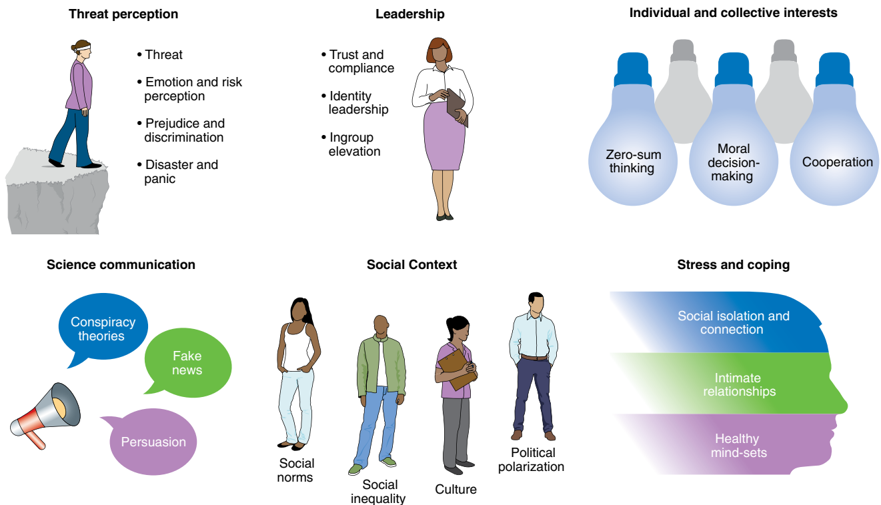
The COVID-19 pandemic represents a massive global health crisis. Because the crisis requires large-scale behaviour change and places significant psychological burdens on individuals, insights from the social and behavioural sciences can be used to help align human behaviour with the recommendations of epidemiologists and public health experts. Here we discuss evidence from a selection of research topics relevant to pandemics, including work on navigating threats, social and cultural influences on behaviour, science communication, moral decision-making, leadership, and stress and coping. In each section, we note the nature and quality of prior research, including uncertainty and unsettled issues. We identify several insights for effective response to the COVID-19 pandemic and highlight important gaps researchers should move quickly to fill in the coming weeks and months.
Overview
CoChat Summary
TL;DR
This perspective argues that social and behavioural science can help align public behaviour with COVID-19 public health recommendations across threat perception, social context, science communication, cooperation, leadership, and stress/coping. It synthesizes prior evidence and policy insights while cautioning that evidence is limited, often drawn from non-pandemic contexts, and in many areas unsettled.
Key findings
- The paper notes the scale of infectious disease threats: the bubonic plague killed approximately 25% of the European population, and by March 2020 COVID-19 had spread to more than 118,000 cases and caused 4,291 deaths in 114 countries. It also notes that 21 countries donated medical supplies to China in February, with China reciprocating widely.
- Fear appeals can change behaviour when people feel capable of dealing with the threat, but produce defensive reactions when people feel helpless; optimism bias can lead people to underestimate personal risk and ignore public health warnings.
- Social norms, inequality, culture, and political polarization shape pandemic behaviour: correcting misperceived norms can help when most people are already doing the desirable behaviour, but descriptive norms can backfire if the behaviour is undesirable unless paired with prescriptive norms.
- Effective communication and leadership may involve credible sources, messages that protect others or align with moral values, prebunking/inoculation against misinformation, accuracy nudges, shared social identity, and leaders modelling prosocial sacrifice; excessive national self-image concerns (“collective narcissism”) can backfire.
Methods
- Design: Perspective/narrative review; no primary data collection or sample. Topics were identified by the corresponding authors as potentially relevant to pandemic response and are explicitly not exhaustive.
- Evidence base: synthesizes prior social and behavioural research on threat perception, social context, science communication, moral decision-making, cooperation, leadership, and stress/coping, drawing on laboratory experiments, correlational studies, field experiments, meta-analyses, and preprints/forthcoming work.
- Analysis: narrative synthesis with policy implications and identified research gaps; no systematic search strategy or quantitative synthesis is reported.
Limitations
- Stated: due to space constraints, the paper provides only a brief summary of each topic; research on these topics is ongoing and in many cases far from settled; there is very little published social science research on the current pandemic, so discussion often draws from different circumstances and evidence quality varies substantially.
- Stated: insights and policy implications should be interpreted with caution.
- Evident: as a perspective rather than a systematic review or empirical study, it does not provide a comprehensive evidence appraisal, and its reliance on preprints and forthcoming sources limits certainty.
Model-written summary. Check it against the paper before relying on it.
Integrity signals
Registry
Cites
Statistics
Figures
Verification
Claims the paper makes
19 Valid · 5 Not valid · 37 Not checked · 13 Own results and interpretations
At least one cited source doesn’t support this claim or points to a different paper, and none confirmed it — see the verdicts below.
In the paper
“For instance, in hypothetical scenarios about deciding whether to go to work while sick, American and British participants reported they would be less willing to stay home when it was uncertain they would infect a co-worker.”
What the sources say
- Disputedcites [176] Kappes, A. et al. Uncertainty about the impact of social decisions increases prosocial behaviour. Nat. Hum. Behav. 2, 573–580 (2018). sourceExperimental — accuracy not yet measured
In the paper’s account of the infectious-disease scenario (Abstract; page not provided), participants facing uncertainty about how severely a co-worker might be affected were more likely to stay home than controls, not less. The paper distinguishes that impact uncertainty from uncertainty about whether a co-worker would be infected. Its Study 6 Methods (page not provided) describe recruitment through AMT, but do not establish the claimed American and British participant groups. (LLM, conf=0.88)
Checked by a reasoning model — may be wrong.
hedgedstates an association- Asserted: passes — The authors put it forward as true.
- Checkable: passes — It can be checked against evidence.
- Load-bearing: passes — The paper’s conclusions depend on it.
- Based: passes — The paper gives a reason why it holds.
- Disputed
The cited sources that could be checked couldn’t confirm or dispute this claim.
In the paper
“Moreover, there is mixed research regarding whether corrections may actually increase belief in the original misinformation 121,124-126 or in other misleading claims that fail to get corrected 127 .”
What the sources say
- Not checked — no full text of the sourcecites [121] Guess, A. & Coppock, A. Does counter-attitudinal information cause backlash? Results from three large survey experiments. Br. J. Polit. Sci. https://doi.org/10.1017/S0007123418000327 (2018). source
- Not matchedcites [124] Wittenberg, C. & Berinsky, A.J. Misinformation and its correction. in Social Media and Democracy: The State of the Field (eds Persily, N. & Tucker, J. A.) (Cambridge University Press, forthcoming).
Its entry has no title and year that we can search by.
- Not checked — no full text of the sourcecites [125] Swire, B. & Ecker, U.K.H. Misinformation and its correction: Cognitive mechanisms and recommendations for mass communication. in Misinformation and Mass Audiences (eds. Southwell, B. G., Thorson, E. A. & Sheble, L.) 195–2011 (University of Texas Press, 2018). source
- Not checked — no full text of the sourcecites [126] Wood, T. & Porter, E. The elusive backfire effect: mass attitudes’ steadfast factual adherence. Polit. Behav. 41, 135–163 (2018). source
- Could not verifycites [127] Pennycook, G., McPhetres, J., Zhang, Y. & Rand, D. Fighting COVID-19 misinformation on social media: Experimental evidence for a scalable accuracy nudge intervention. Preprint at PsyArXiv https://doi.org/10.31234/osf.io/uhbk9 (2020). sourceExperimental — accuracy not yet measured
Citation 127 is attached to the suggestion that corrections may increase belief in other misleading claims that go uncorrected. The Statement of Relevance and Discussion describe an accuracy nudge that improved sharing decisions, not corrections or their effects on belief in uncorrected claims. Searches for correction backfire and uncorrected misinformation found no passage addressing that point; page numbers were unavailable in our copy. (LLM, conf=0.76)
hedgedstates a possible cause- Asserted: passes — The authors put it forward as true.
- Checkable: passes — It can be checked against evidence.
- Load-bearing: passes — The paper’s conclusions depend on it.
- Based: passes — The paper gives a reason why it holds.
The sources with a verdict support this claim; the rest weren’t checked yet, have no full text we could read, or their verdicts aren’t rated yet.
In the paper
“Indeed, laboratory research has found that people prioritize local over global (or international) interests 185,186 .”
What the sources say
- Supportedcites [185] Milinski, M., Hilbe, C., Semmann, D., Sommerfeld, R. & Marotzke, J. Humans choose representatives who enforce cooperation in social dilemmas through extortion. Nat. Commun. 7, 10915 (2016). source
The Results section (‘Voters choose selfish representatives’; page unavailable) reports that participants preferentially re-elected representatives who contributed less to the shared climate account and elected candidates who pledged to contribute less than a fair share. In this simulated international dilemma, that supports the claim that participants favored their own group’s interests over the collective goal; it does not establish that everyone did so. (LLM, conf=0.85)
- Not checked — no full text of the sourcecites [186] Reinders Folmer, C. P. et al. One for all: what representing a group may do to us. J. Exp. Soc. Psychol. 48, 1047–1056 (2012). source
plain- Asserted: passes — The authors put it forward as true.
- Checkable: passes — It can be checked against evidence.
- Load-bearing: passes — The paper’s conclusions depend on it.
- Based: passes — The paper gives a reason why it holds.
- Supported
Every source the paper cites for this claim was checked and supports it.
In the paper
“However, when going to work risked infecting an elderly co-worker who would suffer a serious illness, participants reported they would be more willing to stay home 176 .”
What the sources say
- Supportedcites [176] Kappes, A. et al. Uncertainty about the impact of social decisions increases prosocial behaviour. Nat. Hum. Behav. 2, 573–580 (2018). source
The Study 6 Methods (page not provided) describe a scenario in which going to work could infect an older, vulnerable co-worker who would suffer severely, followed by a rating of willingness to go to work. The reported Study 6 findings (indexed under Abstract; page not provided) say participants given that risk information were significantly more likely to stay home than controls. (LLM, conf=0.92)
hedgedstates a cause- Asserted: passes — The authors put it forward as true.
- Checkable: passes — It can be checked against evidence.
- Load-bearing: passes — The paper’s conclusions depend on it.
- Based: passes — The paper gives a reason why it holds.
- Supported
The sources with a verdict support this claim; the rest weren’t checked yet, have no full text we could read, or their verdicts aren’t rated yet.
In the paper
“Several techniques, such as sanctioning defectors 187 or rewarding cooperators 188 , tend to increase cooperative behaviour in laboratory experiments using economic games.”
What the sources say
- Not checked — no full text of the sourcecites [187] Yamagishi, T. The provision of a sanctioning system as a public good. J. Pers. Soc. Psychol. 51, 110–116 (1986). source
- Supportedcites [188] Rand, D. G., Dreber, A., Ellingsen, T., Fudenberg, D. & Nowak, M. A. Positive interactions promote public cooperation. Science 325, 1272–1275 (2009). source
Citation 188 is attached to rewarding cooperators. The paper’s Abstract reports a laboratory comparison using repeated public goods games and finds that reward maintained public cooperation and, when both reward and punishment were available, increased contributions. (LLM, conf=0.93)
plainstates a cause- Asserted: passes — The authors put it forward as true.
- Checkable: passes — It can be checked against evidence.
- Load-bearing: unclear — It is unclear whether the paper’s conclusions depend on it.
- Based: passes — The paper gives a reason why it holds.
50 more claims · 13 with their cited sources checked
Create a free account to see all 74 claims and to verify the 2 references still open.
- It may state two separate claims as one. 13
- Probably not a substantial claim. 6
Claims other papers make about this one
Each is checked against this paper’s own text: does it say what the citing paper says it does?
The source backs part of the claim, not all of it — or backs it for a different population, condition or comparison.
In the citing paper
“COVID-19 is an international public health crisis, putting substantial burden on medical centers and increasing the psychological toll on health care workers (HCW).”
From Supporting the well-being of health care providers during the COVID-19 pandemic: The CopeColumbia response (2020) · cites this paper as [6]
Experimental — accuracy not yet measuredThe source backs part of the claim, not all of it — or backs it for a different population, condition or comparison.
In the citing paper
“these population-wide measures affected psychological well-being and mental health as well as increased social isolation [68] and loneliness.”
From Psychological correlates of perceived loneliness in college students before and during the COVID-19 stay-at-home period: a longitudinal study (2023) · cites this paper as [68]
Experimental — accuracy not yet measuredThe source backs part of the claim, not all of it — or backs it for a different population, condition or comparison.
In the citing paper
“they may eventually increase the social isolation of students and affect their psychological well-being and mental health [3].”
From Students under lockdown: Comparisons of students’ social networks and mental health before and during the COVID-19 crisis in Switzerland (2020) · cites this paper as [3]
Experimental — accuracy not yet measuredThe source backs part of the claim, not all of it — or backs it for a different population, condition or comparison.
In the citing paper
“effective interventions are hard to scale to a population level (12);”
From Psychological inoculation improves resilience against misinformation on social media (2022) · cites this paper as [12]
Experimental — accuracy not yet measuredThe source backs part of the claim, not all of it — or backs it for a different population, condition or comparison.
In the citing paper
“There is a shortage of studies that test anti-misinformation interventions in an ecologically valid manner, i.e., testing an intervention as consumers would interact with it in online environments (8, 12).”
From Psychological inoculation improves resilience against misinformation on social media (2022) · cites this paper as [12]
Experimental — accuracy not yet measured
6 more claims about this paper
Create a free account to see every claim other papers make about this one.
Citations
Cites
Granovetter, M. S. (1973) · American Journal of Sociology · doi:10.1086/225469 · Cited by 40,491
Zhou, F., Yu, T., Du, R., Fan, G., Liu, Y., Liu, Z., Xiang, J., Wang, Y., Song, B., Gu, X., et al. (2020) · The Lancet · doi:10.1016/s0140-6736(20)30566-3 · Cited by 27,263
The need to belong: Desire for interpersonal attachments as a fundamental human motivation.
Baumeister, R. F., & Leary, M. R. (1995) · Psychological Bulletin · doi:10.1037//0033-2909.117.3.497 · Cited by 23,245
Culture and the self: Implications for cognition, emotion, and motivation.
Markus, H. R., & Kitayama, S. (1991) · Psychological Review · doi:10.1037/0033-295x.98.2.224 · Cited by 21,995
Self-citationThe Psychological Impact of Quarantine and How to Reduce It: Rapid Review of the Evidence
Brooks, S. K., Webster, R. K., Smith, L. E., Woodland, L., Wessely, S., Greenberg, N., & Rubin, G. J. (2020) · doi:10.2139/ssrn.3532534 · Cited by 16,394
The psychological impact of quarantine and how to reduce it: Rapid review of the evidence
Brooks, S. K., Webster, R. K., Smith, L. E., Woodland, L., Wessely, S., Greenberg, N., & Rubin, G. J. (2020) · The Lancet · doi:10.1016/s0140-6736(20)30460-8 · Cited by 16,378
Nudge: improving decisions about health, wealth, and happiness
(2008) · Choice Reviews Online · doi:10.5860/choice.46-0977 · Cited by 11,572
Slovic, P. (1987) · Science · doi:10.1126/science.3563507 · Cited by 9,271
The Elaboration Likelihood Model of Persuasion
Petty, R. E., & Cacioppo, J. T. (1986) · Advances in Experimental Social Psychology · doi:10.1016/s0065-2601(08)60214-2 · Cited by 8,822
Self-citationThe emotional dog and its rational tail: A social intuitionist approach to moral judgment.
Haidt, J. (2001) · Psychological Review · doi:10.1037/0033-295x.108.4.814 · Cited by 8,048
Research works printed but not linked: 3
- Berkowitz, A.D. An overview of the social norms approach. in Changing the Culture of College Drinking: A Socially Situated Health Communication Campaign (eds. Stewart, L. & Lederman, L. C.) 193–214 (Hampton Press, 2005).
- Wittenberg, C. & Berinsky, A.J. Misinformation and its correction. in Social Media and Democracy: The State of the Field (eds Persily, N. & Tucker, J. A.) (Cambridge University Press, forthcoming).
- Ransohoff, K.J. Patients on the Trolley Track: The Moral Cognition of Medical Practitioners and Public Health Professionals. (Harvard Univ. Press, 2011).
Cited by
Items 4,501–4,600 of 5,015
Gritzka, S., Angerer, P., & Diebig, M. (2023) · Journal of Occupational and Environmental Medicine · doi:10.1097/jom.0000000000002997 · Cited by 2
Atasever, G., Kıyıcı, F., Aksakal, D., & Kıvanç, C. (2023) · Research in Sport Education and Sciences · doi:10.5152/jpess.2023.23072
Ansiedade na Pandemia de COVID-19 no Brasil: Um Estudo Longitudinal
Martins, R. C., Almeida, T. R. D. C., Demenech, L. M., & Silva Lucas, N. (2023) · Cadernos de Psicologia · doi:10.9788/cp2023.2-12 · Cited by 4
O Potencial da Pesquisa em Psicologia para o Desenvolvimento de Tecnologias
Feitosa, M. Â. G. (2023) · Cadernos de Psicologia · doi:10.9788/cp2023.3-02
Pandemi Döneminde Üniversite Öğrencilerinin İyilik Halleri
Owen, F. K., & KAYMAK, D. A. (2023) · Milli Eğitim Dergisi · doi:10.37669/milliegitim.1178457 · Cited by 1
Moving from Offline to Online: How COVID-19 Affected Research in the Social and Behavioral Sciences
Binder, A., Matthes, J., Domahidi, E., & Bachl, M. (2023) · American Behavioral Scientist · doi:10.1177/00027642231205761 · Cited by 1
“The pandemic brought a myriad of new (and exciting) research questions, and social and behavioral sciences were certainly much needed (Bavel et al., 2020).”
A Double-Edged-Sword Approach to Fighting Pandemics: Patent Waivers and Incentives to Innovate
Kostka, K., & Kovač, M. (2023) · Review of European and Comparative Law · doi:10.31743/recl.15503
Gallus, S., Mosconi, G., Stival, C., Amerio, A., Bertolini, G., Bosetti, C., d’Oro, L. C., Fanucchi, T., Iacoviello, L., Lugo, A., et al. (2023) · Aging Clinical and Experimental Research · doi:10.1007/s40520-023-02586-6 · Cited by 1
“During the pandemic, the risk of developing severe and fatal forms of COVID-19, financial insecurity, and uncertainty about the future may have fostered feelings of hopelessness in older adults leading to a deterioration in their physical and mental wellbeing [49].”
Skrip, L., Weller, M., Dukuly, S., et al. (2023) · Research Square · doi:10.21203/rs.3.rs-3469188/v1
Salahshouri, A., Araban, M., Heydarabadi, A. B., Hatamzadeh, N., Jasemzadeh, M., & Mohamadian, H. (2023) · doi:10.2196/preprints.54031
Rocha, J. Q. S., Caputo, E. L., Petry, L., Vieira, Y. P., Duro, S. M. S., & Saes, M. D. O. (2023) · Research Square · doi:10.21203/rs.3.rs-3486355/v1
Ternovski, J., Jilke, S., Keppeler, F., & Vogel, D. (2023) · OSF Preprints (OSF Preprints) · doi:10.31219/osf.io/k5uap
Online Regulative Coping Strategies to Alleviate Loneliness
Wardani, R., Adelina, I., Ginting, H., & Garliah, L. (2023) · Pedagogika International Conference on Educational Innovation (PICEI) · doi:10.4108/eai.15-9-2022.2335910
“The outbreak of COVID-19 pandemic in the last month of 2019 has led to global public policies campaigning for efforts to limit the spread of the virus, one of which is physical or social distancing [1].”
BackgroundA Typology of Family Functioning at The Beginning of The COVID-19 Pandemic
Pramono, F., & Lubis, D. P. (2023) · Journal of Family Sciences · doi:10.29244/jfs.vi.50097 · Cited by 2
“These findings support the opinion of Bavel, et al. (2020) that families can increase social connectedness, no one feels alone at home, and they also carry out social interactions online with other people outside the home.”
ResultRole of Enhancing Aerobic Capacity in Countering COVID-19-induced Liver Injury in Elderlies
Mohamed, A. A., Abdallah, A. A., & Jan, Y. (2023) · Endocrine Metabolic & Immune Disorders - Drug Targets · doi:10.2174/0118715303250788231018080821
Viskupič, F., & Wiltse, D. L. (2023) · Open Health · doi:10.1515/ohe-2023-0013
Does One Person Make a Difference? Many-One Effects in Judgments of Prosocial ActionPreprint
Lewis, J., Srna, S., Salu, J., Morrissey, E., Allen, C., Wilks, M., Winter, C. K., & Caviola, L. (2023) · PsyArXiv (OSF Preprints) · doi:10.31234/osf.io/bkcne
Lyons, P., Winters, M., Jalloh, M. F., et al. (2023) · medRxiv · doi:10.1101/2023.11.14.23298507
Culture as an Anchor for Responses to the Pandemic
Gopal, B., Charles, D. Y., & Jhala, S. (2023) · Springer eBooks · doi:10.1007/978-981-16-9859-0_32-1
Wójta-Kempa, M., Wolska-Zogata, I., & Jarynowski, A. K. (2022) · E-methodology · doi:10.15503/emet.2021.35.47
Gomez, M. L., Azam, T., Edward, J., Bowman, H. E., & Williams, L. B. (2022) · PubMed Central · doi:10.13023/jah.0402.05 · Cited by 1
“10 Social norms have been described as “ customary codes of behavior in a group or culture, together with the beliefs about what those codes mean.”
BackgroundAisyaroh, S. H., & Yudhastuti, R. (2023) · Media Gizi Kesmas · doi:10.20473/mgk.v12i2.2023.920-926
Antecedents to Reliance on Artificial Intelligence and Predictive Modeling
Randall, W. (2023) · University of North Texas Digital Library (University of North Texas) · doi:10.12794/metadc2137357
Faraz, F., Abraham, J., Nashori, F., Wijaya, H. E., Sofia, N., Rabbani, M. D. R., Pramastyaningtyas, A. D. A., & Wulandari, A. P. J. (2023) · Environment and Social Psychology · doi:10.54517/esp.v9i1.1899
Znaczenie czynników behawioralnych w zarządzaniu kryzysowym
Czerwonka, M., Siembida, J., & Staniszewska, A. (2023) · Studia i Prace Kolegium Zarządzania i Finansów / Szkoła Główna Handlowa · doi:10.33119/sip.2023.192.10
Rodríguez, P. V. C. (2023) · IEEE Colombian Conference on Communications and Computing (COLCOM) · doi:10.1109/colcom59909.2023.10334253
Wei, H., Lu, L., Xu, Y., Lü, X., Zhang, Y., Zhang, X., & Huang, Z. (2023) · Research Square · doi:10.21203/rs.3.rs-3674274/v1
Saskia, F. M., Salsabila, A., Intansari, A. P. D., et al. (2023) · Jurnal Farmasi Komunitas · doi:10.20473/jfk.v10i2.33027
“…di Amerika menyebutkan bahwa populasi dengan pendapatan ekonomi rendah cenderung kurang berpartisipasi dalam penerapan physical distancing (Bergquist, Otten dan Sarich, 2020) dikarenakan terpaksa menggunakan transportasi umum, sehingga sulit untuk menghindari kerumunan orang (Bavel et al., 2020).”
BackgroundBonanno, G., & Veneziano, V. (2023) · Discover Sustainability · doi:10.1007/s43621-023-00172-4
“Longer periods of self-quarantine can indeed worsen mental conditions and cause posttraumatic stress symptoms and other psychological disorders [21, 22].”
BackgroundModulating social learning-induced evaluation updating during human sleepPreprint
Chen, D., Xia, T., Yao, Z., Zhang, L., & Hu, X. (2023) · bioRxiv (Cold Spring Harbor Laboratory) · doi:10.1101/2023.12.11.571114
Chanda, B., Sukamani, D., Pokhrel, S., et al. (2023) · SCITECH Nepal · doi:10.3126/scitech.v17i1.60494
How Will Collective-Level Dynamics Influence the Spread of COVID-19?
Kitayama, S. (2023) · Oxford University Press eBooks · doi:10.1093/oso/9780197615133.003.0016 · Cited by 1
Self-citationParty Polarization and COVID-19
Lin, J. A.-J., & Druckman, J. N. (2023) · Oxford University Press eBooks · doi:10.1093/oso/9780197615133.003.0015
Self-citationPast Victimization and Responses to the COVID-19 Pandemic
Bilewicz, M., & Babińska, M. (2023) · Oxford University Press eBooks · doi:10.1093/oso/9780197615133.003.0031
Collective Resilience and the COVID-19 Experience
Cocking, C., Ntontis, E., Vestergren, S., & Luzynska, K. (2023) · Oxford University Press eBooks · doi:10.1093/oso/9780197615133.003.0021 · Cited by 1
Fake News and the COVID-19 Pandemic
van der Linden, S., & Roozenbeek, J. (2023) · Oxford University Press eBooks · doi:10.1093/oso/9780197615133.003.0036
Self-citationOn the Ethics of Social Science Research During a Pandemic
Schoenegger, P., & Pummer, T. (2023) · Oxford University Press eBooks · doi:10.1093/oso/9780197615133.003.0042
Gjoneska, B. (2023) · Oxford University Press eBooks · doi:10.1093/oso/9780197615133.003.0009
Wójcik, A. D., & Cypryańska, M. (2023) · Oxford University Press eBooks · doi:10.1093/oso/9780197615133.003.0040
You Want to Foster Creative Behavior? Try Behavioral Sciences ModelsPreprint
Bonetto, É., Naczaj, D., & Arciszewski, T. (2023) · doi:10.31234/osf.io/mtgh3
Mental Images of Nurses with and without Patient with COVID-19: A Metaphor Study
Moran, M., Özdemir, F. E., Demir, Z. G. Y., & Yılmaz, M. (2023) · Indian Journal of Psychiatric Nursing · doi:10.4103/iopn.iopn_69_22
Gabrielle, F. F., ElShahawi, H. H., Ghamry, R. H. E., & Basha, M. Y. (2023) · Middle East Current Psychiatry · doi:10.1186/s43045-023-00381-7
Pandemide Sağlık Çalışanlarının Bireysel İş Yükü Algısının İşe Bağlı Gerginlik Düzeyine Etkisi
İlgin, V. E., Yayla, A. Ç., BUDAK, M., TORAMAN, R. L., & Özer, N. (2023) · Celal Bayar Üniversitesi Sağlık Bilimleri Enstitüsü Dergisi · doi:10.34087/cbusbed.1312260
Role of pandemic‐related experiences and maternal psychological distress in maternal rejection
İplikçi, A. B., İlgün, Y., Sanli, A. M., SÖZEN, E. A., Şahin-Acar, B., Doğan, A., Tahiroğlu, D., & Berument, S. K. (2023) · Family Relations · doi:10.1111/fare.12984 · Cited by 1
Sinan, M., Leng, J., Ahmed, A., Hasin, F., Akbar, J., Abdul, A., & Bao, J. (2023) · SSRN Electronic Journal · doi:10.2139/ssrn.4668686
(UN)CERTAINTIES AND EPISTEMIC MODALITY IN ENGLISH SCIENTIFIC ARTICLES ON COVID-19
Zulkarnain, N. A., Wahid, R., & Jan, J. M. (2023) · Journal of Language and Communication · doi:10.47836/jlc.10.02.08
Sinaei, M., Saberi, M., Tabatabaee, S. S., Moradi, M., Bavandi, F., & Raesi, R. (2023) · The Open Public Health Journal · doi:10.2174/0118749445274531231123063858
Ndzinisa, N., & Govender, E. (2024) · Springer eBooks · doi:10.1007/978-3-031-41237-0_15
Behavioral Changes Among Community After Covid 19 Pandemic
Al-Muhaimeed, M., Alissa, H., Alomaim, D., Alhussain, R., Alsubaie, N., AlKaud, A., Alam, A., Azaben, M., & Kofi, M. A. (2024) · Acta Scientific Medical Sciences · doi:10.31080/asms.2024.07.1729
Using survey experiment pretesting to support future pandemic responsePreprint
Tappin, B. M., & Hewitt, L. (2024) · doi:10.31234/osf.io/9nyze
LEARNING MANAGEMENT SYSTEM AS COVID 19 RISK MITIGATION
Aliwafa, A., Muhammad, M., & Shofiya, S. (2021) · MANAGERE Indonesian Journal of Educational Management · doi:10.52627/managere.v3i3.74
Meaning of life and death during COVID-19 pandemic: A cultural and religious narratives
Buqa, W. (2024) · HTS Teologiese Studies / Theological Studies · doi:10.4102/hts.v80i2.9258
Gomes, N. L. P., Guimarães, C. E. T., Lage, E. F. R., Paes, G. T., Filho, J. S. P., Rodrigues, K. L. T., Nascimento, L., Ferreira, R. S. S., Chaves, E. C. R., & de Mendonça, M. H. R. (2024) · Revista Eletrônica Acervo Saúde · doi:10.25248/reas.e14345.2024 · Cited by 1
Identyfikacje Polaków i ich konsekwencje
Puchała, D., & Bilewicz, M. (2024) · Wydawnictwo Liberi Libri eBooks · doi:10.47943/lib.9788363487645.rozdzial10 · Cited by 13
Polski Sondaż Uprzedzeń 2021: metodologia badania
Bulska, D., & Świderska, A. (2024) · Wydawnictwo Liberi Libri eBooks · doi:10.47943/lib.9788363487645.rozdzial12 · Cited by 12
Fatalistyczny brak kontroli jako reakcja na pandemię COVID-19
Soral, W. (2024) · Wydawnictwo Liberi Libri eBooks · doi:10.47943/lib.9788363487645.rozdzial09 · Cited by 12
Toruńczyk‐Ruiz, S., & Cárdenas, D. (2024) · Wydawnictwo Liberi Libri eBooks · doi:10.47943/lib.9788363487645.rozdzial11 · Cited by 12
Emocja wstrętu a postawy międzygrupowe
Świderska, A., & Hansen, K. (2024) · Wydawnictwo Liberi Libri eBooks · doi:10.47943/lib.9788363487645.rozdzial07 · Cited by 12
Bulska, D., Winiewski, M. H., & Bilewicz, M. (2024) · Wydawnictwo Liberi Libri eBooks · doi:10.47943/lib.9788363487645.rozdzial00
Polacy o Żydach i Romach – dostępność i zmiany kulturowych treści stereotypu
Winiewski, M. H. (2024) · Wydawnictwo Liberi Libri eBooks · doi:10.47943/lib.9788363487645.rozdzial02
Obawy Polaków i Polek a postawy wobec grup obcych
Bulska, D. (2024) · Wydawnictwo Liberi Libri eBooks · doi:10.47943/lib.9788363487645.rozdzial06
Ideologiczne podstawy emocjonalnych reakcji na nieszczęścia grup obcych
Wypych, M. (2024) · Wydawnictwo Liberi Libri eBooks · doi:10.47943/lib.9788363487645.rozdzial08
Salahshouri, A., Araban, M., Heydarabadi, A. B., Hatamzadeh, N., Jasemzadeh, M., & Mohamadian, H. (2023) · JMIR Formative Research · doi:10.2196/54031
Du, R., Gould, S. J., & Yang, P. (2024) · Journal of International Consumer Marketing · doi:10.1080/08961530.2023.2291686 · Cited by 2
“Strict rules help the nation cooperate to survive many natural or ecological disasters in history (Bavel et al. 2020).”
BackgroundBrown, D., Uddin, M., Al-Hossami, E., Janies, D. A., Shaikh, S., & Cheng, Z. (2024) · ASEE Annual Conference & Exposition · doi:10.18260/1-2--41892
Elmaskaya, A. N., & Yur, F. (2023) · Pharmacy & Pharmacology International Journal · doi:10.15406/ppij.2023.11.00421
Natanael, Y., Fridayanti, F., Ansori, M. R., Salsabilla, R., & Haq, R. R. (2023) · MOTIVA JURNAL PSIKOLOGI · doi:10.31293/mv.v6i2.6760 · Cited by 3
القضاة, ح. ص., السبحي, ن. ع., & حوباني, م. أ. (2023) · مجلة العلوم الإقتصادية و الإدارية و القانونية · doi:10.26389/ajsrp.d270123
(2022) · Student Journal of Occupational Therapy · doi:10.46409/001.cryb7978
Liu, Z., Zheng, T., & Zhang, J. (2023) · International Conference on Data Science and Information Technology (DSIT) · doi:10.1109/dsit60026.2023.00053
“Online rumors are social opinion presented in a particular way [1], and their spread cannot be ignored in scope and speed [2], especially in sudden events with increasingly far-reaching effects, gradually developing into potential hazards of sudden public health events, hindering the construction…”
BackgroundPsychological Impact of COVID-19 on individuals: Through Active Choices and Passive Adaption
Fang, J., Lau, C. K. M., & Cheng, Y. (2024) · Frontiers research topics · doi:10.3389/978-2-8325-4481-5
Zhai, Y., & Carney, J. V. (2024) · Cambridge Prisms Global Mental Health · doi:10.1017/gmh.2024.12.pr9
Zhai, Y. (2023) · Cambridge Prisms Global Mental Health · doi:10.1017/gmh.2024.12.pr7
Zhai, Y., & Carney, J. V. (2023) · Cambridge Prisms Global Mental Health · doi:10.1017/gmh.2024.12.pr5
Zhai, Y., & Carney, J. V. (2023) · Cambridge Prisms Global Mental Health · doi:10.1017/gmh.2024.12.pr6
Zhai, Y. (2023) · Cambridge Prisms Global Mental Health · doi:10.1017/gmh.2024.12.pr4
Zhai, Y., & Carney, J. V. (2023) · Cambridge Prisms Global Mental Health · doi:10.1017/gmh.2024.12.pr2
Zhai, Y., & Carney, J. V. (2023) · Cambridge Prisms Global Mental Health · doi:10.1017/gmh.2024.12.pr3
Zhai, Y. (2023) · Cambridge Prisms Global Mental Health · doi:10.1017/gmh.2024.12.pr1
Crisis Management During the Pandemic
Sheng, E. L. (2024) · Sustainable development goals series · doi:10.1007/978-981-99-9134-1_4 · Cited by 1
Behavioral Insights for Better Public Communication in Health Crisis
Villarraga-Orjuela, A., Macias, P. J. H., Acosta, S. M. R., et al. (2023) · Ensayos de Economía · doi:10.15446/ede.v33n63.103215
Sternberg, H., Steinert, J., & Büthe, T. (2024) · Health Economics · doi:10.1002/hec.4807 · Cited by 3
Nurrika, D., Nurmeilis, Anggraeni, Y., Alkaff, R. N., & Sukmayanti, Z. (2023) · Medical Technology and Public Health Journal · doi:10.33086/mtphj.v7i2.4939
Zhang, H., Wu, Y., Lin, B., Tan, J., Xie, X., Liang, Z., Luo, P., & Feng, Z. (2024) · Research Square · doi:10.21203/rs.3.rs-3948864/v1
Swapna, H. R., Madaan, G., Kulkarni, A., Mahajan, R. D., Mahajan, D. A., & Pandey, D. (2024) · Advances in logistics, operations, and management science book series · doi:10.4018/979-8-3693-3593-2.ch017
Giovanetti, I., Dimopoulou, M.-N., & Pavlopoulos, V. (2022) · ScholarWorks - GVSU (Grand Valley State University) · doi:10.4087/swvz6421
Xenophobia vs. Patriotism: Where is my Home? – Proceedings
Klicperova-Baker, M., & Friedlmeier, W. (2022) · ScholarWorks - GVSU (Grand Valley State University) · doi:10.4087/lair9145
Toscani, G. (2024) · Research Square · doi:10.21203/rs.3.rs-4016292/v1
RetractedIndividual Disgust and Collective Anxiety: A Two-Layer Framework of the Behavioral Immune SystemPreprint
Yin, B., Zheng, B., & Ye, Y. (2024) · PsyArXiv (OSF Preprints) · doi:10.31234/osf.io/a3f9p
Blazek, E. S., & Bucher, A. (2024) · JMIR Formative Research · doi:10.2196/50181 · Cited by 1
Babapouragadham, S., Khairuddin, J. B., & Vafa, M. A. (2024) · doi:10.61838/kman.jayps.5.3.4 · Cited by 1
(2024) · Frontiers research topics · doi:10.3389/978-2-8325-4665-9
A review of the most influential research papers on COVID-19: An excerpt with comments and insights
Sinha, S., Modak, N. M., & Sana, S. S. (2024) · Yugoslav journal of operations research · doi:10.2298/yjor231215006s
Santos, R. R., Santos, O., & de Matos, M. G. (2022) · The Psychologist Practice & Research Journal · doi:10.33525/pprj.v5i1.143
“Both horizontal (interpersonal) and vertical (in institutions) trust (Chan, 2021), have been identified as critical factors for the adoption of protective health behaviors (Bavel et al., 2020; Devine et al., 2021).”
BackgroundSaleem, A., & Tariq, U. (2024) · Infectious diseases News Opinions Training · doi:10.33029/2305-3496-2024-13-1-27-34
Acconito, C., Rovelli, K., & Angioletti, L. (2024) · Neuropsychological Trends · doi:10.7358/neur-2024-035-acco · Cited by 2
Pseudociências e os Desafios Atuais Impostos ao Ensino de Ciências
de Souza, D. V. L., & de Oliveira, I. M. (2024) · Educação & Realidade · doi:10.1590/2175-6236121157vs01 · Cited by 5
Watson, D., Baralle, N. L., Alagil, J., Anil, K., Ciccognani, S., Dewar-Haggart, R., Fearn, S., Groot, J., Knowles, K., Meagher, C., et al. (2022) · Figshare · doi:10.6084/m9.figshare.19174562
Metadata
- Authors
- Bavel, J. J. V., Baicker, K., Boggio, P. S., Capraro, V., Cichocka, A., Cikara, M., Crockett, M. J., Crum, A. J., Douglas, K. M., Druckman, J. N., Drury, J., Dube, O., Ellemers, N., Finkel, E. J., Fowler, J. H., Gelfand, M., Han, S., Haslam, S. A., Jetten, J., Kitayama, S., Mobbs, D., Napper, L. E., Packer, D. J., Pennycook, G., Peters, E., Petty, R. E., Rand, D. G., Reicher, S. D., Schnall, S., Shariff, A., Skitka, L. J., Smith, S. S., Sunstein, C. R., Tabri, N., Tucker, J. A., Linden, S. V. D., Lange, P. V., Weeden, K. A., Wohl, M. J. A., Zaki, J., Zion, S. R., & Willer, R.
- Affiliations
- New York University (US)
- Universidade Presbiteriana Mackenzie (BR)
- Middlesex University London (GB)
- University of Kent (GB)
- Harvard University (US)
- Yale University (US)
- Stanford University (US)
- Northwestern University (US)
- University of Sussex (GB)
- University of Chicago (US)
- Utrecht University (NL)
- University of California San Diego (US)
- University of Maryland, College Park (US)
- Peking University (CN)
- The University of Queensland (AU)
- University of Michigan (US)
- California Institute of Technology (US)
- Lehigh University (US)
- University of Regina (CA)
- University of Oregon (US)
- The Ohio State University (US)
- Massachusetts Institute of Technology (US)
- University of St Andrews (GB)
- University of Cambridge (GB)
- University of British Columbia (CA)
- University of Illinois Chicago (US)
- University of California, Berkeley (US)
- Carleton University (CA)
- Cornell University (US)
- Corresponding author
- Bavel, Jay J. Van
- Willer, Robb
- ORCID
- Bavel, Jay J. Van
- Baicker, Katherine
- Boggio, Paulo S.
- Capraro, Valerio
- Cichocka, Aleksandra
- Cikara, Mina
- Crockett, Molly J.
- Crum, Alia J.
- Douglas, Karen M.
- Druckman, James N.
- Drury, John
- Ellemers, Naomi
- Finkel, Eli J.
- Fowler, James H.
- Gelfand, Michele
- Han, Shihui
- Haslam, S. Alexander
- Jetten, Jolanda
- Kitayama, Shinobu
- Mobbs, Dean
- Napper, Lucy E.
- Packer, Dominic J.
- Pennycook, Gordon
- Peters, Ellen
- Petty, Richard E.
- Rand, David G.
- Reicher, Stephen D.
- Schnall, Simone
- Shariff, Azim
- Skitka, Linda J.
- Sunstein, Cass R.
- Tabri, Nassim
- Tucker, Joshua A.
- Linden, Sander van der
- Weeden, Kim A.
- Wohl, Michael J. A.
- Zaki, Jamil
- Zion, Sean R.
- Willer, Robb
- Venue
- Nature Human Behaviour
- Published
- 2020-04-30
- Volume
- 4
- Issue
- 5
- Pages
- 460-471
- ISSN
- 2397-3374 (ISSN-L)
- OpenAlex
- W3016902371
- Semantic Scholar
- d81abcd7f053b136423f1e7f57928524e8b0e1a0
- Cited by
- 4,964
- References
- 259
- Citations by year
- 2026: 177 · 2025: 288 · 2024: 483 · 2023: 741 · 2022: 1094 · 2021: 1474 · 2020: 702
- FWCI
- 175.81
- Type
- journal article
- Language
- en
- Open access
- bronze
- doi.org
- Licence
- www.springernature.com/gp/researchers/text-and-data-mining (tdm)
- www.springernature.com/gp/researchers/text-and-data-mining (vor)
- Locations
- Nature Human Behaviour (publishedVersion)
- PubMed (publishedVersion)
- Middlesex University Research Repository (Middlesex University Of London) (acceptedVersion)
- Kent Academic Repository (University of Kent) (acceptedVersion)
- DSpace@MIT (Massachusetts Institute of Technology) (submittedVersion, cc-by-nc-sa)
- Sussex Research Online (University of Sussex) (submittedVersion)
- CaltechAUTHORS (California Institute of Technology) (submittedVersion)
- RePEc: Research Papers in Economics (submittedVersion)
- BOA (University of Milano-Bicocca) (submittedVersion)
- Carleton University's Institutional Repository (MacOdrum Library, Carleton University) (submittedVersion, other-oa)
- Utrecht University Repository (Utrecht University) (submittedVersion)
- Figshare (submittedVersion)
- VU Research Portal (submittedVersion, other-oa)
- Utrecht University Repository (Utrecht University) (submittedVersion, other-oa)
- Data Archiving and Networked Services (DANS) (submittedVersion, other-oa)
- Funders
- U.S. Department of Health and Human Services (2P50 MH094258)
- National Institute of Mental Health (P50MH094258)
- Topics
- Social Sciences › Sociology and Political Science › COVID-19 Prevention and Impact
- Social Sciences › Communication › Communication and COVID-19 Impact
- Physical Sciences › Mathematics › Modeling and Simulation › COVID-19 epidemiological studies
- Keywords
- COVID-19 pandemic, pandemic response, behavior change, science communication, ethical decision-making, leadership, stress coping, psychological burden, public health recommendations
- MeSH terms
- Betacoronavirus, COVID-19, SARS-CoV-2, Adaptation, Psychological, Communicable Disease Control, Decision Making, Humans, Human Activities, Health Knowledge, Attitudes, Practice, Leadership, Pneumonia, Viral, Public Health, Quarantine, Stress, Psychological, Global Health, Coronavirus, Coronavirus Infections, Pandemics, Social Media, Epidemiological Monitoring
About these checks
Registry, retraction, Cites and statistics results are computed, not judged, with one exception: a printed reference that no index lists is read once by a model before it counts as a citation error. Claims are extracted by a model and kept only when their quote appears verbatim in the text; each cited source is then checked, with a model’s help, for whether it says what the claim relies on. Those verdicts can be wrong — read the claim’s quote and the cited source before relying on one.
The claim verdicts this report counts are experimental: their accuracy is not yet measured.
A language model drew the claims from the paper on 2026-10-10, under version 3 of the claim definition (model deepseek-v4.1-flash, prompt extract-v3).
A second model labelled each claim on 2026-10-10 (model jev-1.13-20260917, definition revision gold-guideline-v0.2).
Cited sources are checked with a language model’s help (gpt-6-sol).
Statistics and arithmetic are recomputed, not judged.
Confidence bands are shown only for fields calibrated on our annotated test set. None is calibrated yet, so no band is shown.
What counts as a claim ›How we measure confidence ›How we check this ›
Are you an author, or do you see a problem with this page? Request a review
Data sources
Bibliographic data: Semantic Scholar, OpenAlex, Crossref.
Contains information from the Semantic Scholar Academic Graph Datasets, made available under the ODC Attribution License (ODC-BY 1.0).
Semantic Scholar’s data is described in: Kinney, R., et al. (2023). The Semantic Scholar Open Data Platform. arXiv:2301.10140.
