

The mutational constraint spectrum quantified from variation in 141,456 humans
Open accessPublished version of a preprint
The DOI matches its Crossref record; 53 of the 53 references it cites were found in a registry or an index.
Abstract
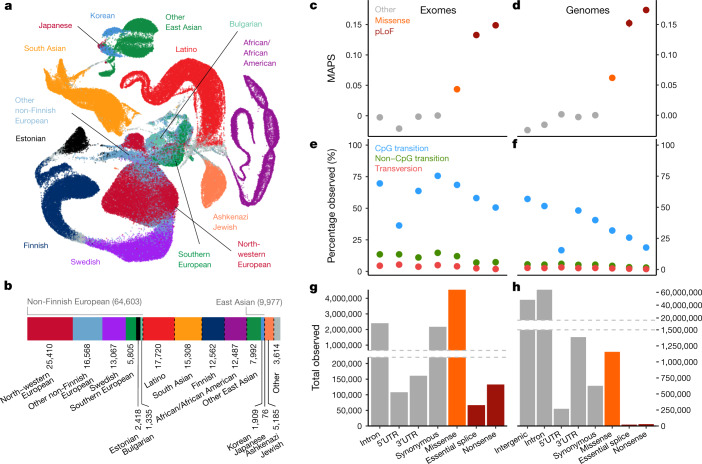
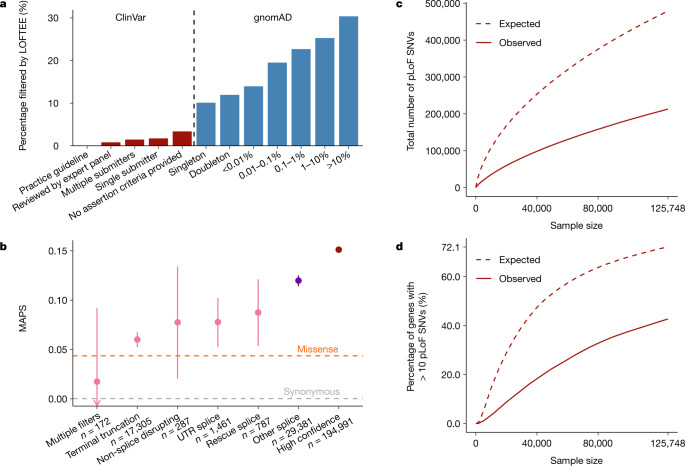
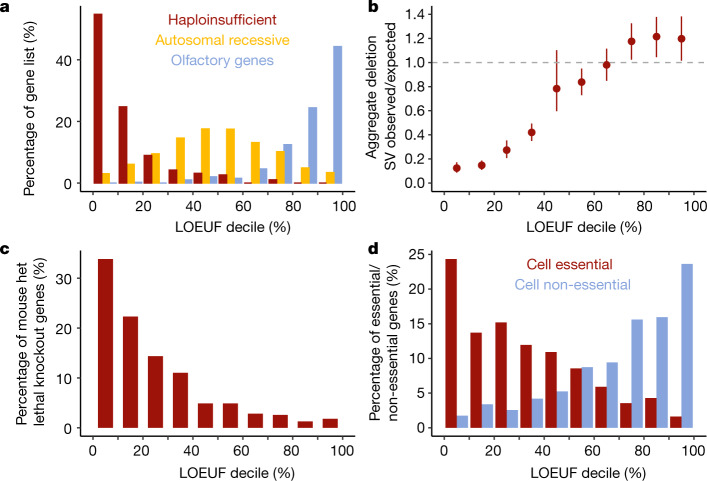
Genetic variants that inactivate protein-coding genes are a powerful source of information about the phenotypic consequences of gene disruption: genes that are crucial for the function of an organism will be depleted of such variants in natural populations, whereas non-essential genes will tolerate their accumulation. However, predicted loss-of-function variants are enriched for annotation errors, and tend to be found at extremely low frequencies, so their analysis requires careful variant annotation and very large sample sizes 1 . Here we describe the aggregation of 125,748 exomes and 15,708 genomes from human sequencing studies into the Genome Aggregation Database (gnomAD). We identify 443,769 high-confidence predicted loss-of-function variants in this cohort after filtering for artefacts caused by sequencing and annotation errors. Using an improved model of human mutation rates, we classify human protein-coding genes along a spectrum that represents tolerance to inactivation, validate this classification using data from model organisms and engineered human cells, and show that it can be used to improve the power of gene discovery for both common and rare diseases.
Overview
The claims and statistics of this paper haven’t been checked yet.
Free: it reads the open-access text and checks the first 5 claims that cite a source we can check. Create a free account to check every claim.
Integrity signals
Registry
Cites
Statistics
Figures
Verification
Claims the paper makes
The claims and statistics of this paper haven’t been checked yet.
Free: it reads the open-access text and checks the first 5 claims that cite a source we can check. Create a free account to check every claim.
Claims other papers make about this one
Each is checked against this paper’s own text: does it say what the citing paper says it does?
The source backs part of the claim, not all of it — or backs it for a different population, condition or comparison.
In the citing paper
“Earlier schizophrenia sequencing studies have established that ultra-rare and de novo mutations contribute to risk as a category, and have prioritized disease-relevant tissues and processes, specifically observing an enrichment in neuronal genes and synaptic processes9,11,19–23.”
From Rare coding variants in ten genes confer substantial risk for schizophrenia (2022) · cites this paper as [23]
Experimental — accuracy not yet measuredThe source backs part of the claim, not all of it — or backs it for a different population, condition or comparison.
In the citing paper
“According to the gnomAD database (Karczewski et al, 2020), the loss-of-function observed/expected upper bound fraction (LOEUF) indicates that SALL4 is depleted of inactivating variants and under purifying selection (LOEUF = 0.101).”
From Structure of SALL4 zinc finger domain reveals link between AT-rich DNA binding and Okihiro syndrome (2023) · cites this paper as Karczewski et al, 2020
Experimental — accuracy not yet measuredThe source backs part of the claim, not all of it — or backs it for a different population, condition or comparison.
In the citing paper
“Based on gnomAD (Karczewski et al. 2020), DOCK4 has a reduced amount of missense and null variants compared to its size of 1,966 amino acids (pLI = 1, Z score = 1.67) in a population without severe, early-onset phenotypes, indicating a mild constraint.”
From Heterozygous loss-of-function variants in DOCK4 cause neurodevelopmental delay and microcephaly (2024) · cites this paper as Karczewski et al. 2020
Experimental — accuracy not yet measuredThe source backs part of the claim, not all of it — or backs it for a different population, condition or comparison.
In the citing paper
“All variants were prioritized considering allele frequency in gnomAD v4.0.0 (Karczewski et al. 2020) below 1%, impact on protein function via different in silico programs (CADD (Rentzsch et al. 2021), REVEL (Ioannidis et al. 2016), MutPred2 (Pejaver et al. 2020) and Metadome (Wiel et al. 2019)) and involvement of candidate genes in neuronal processes.”
From Heterozygous loss-of-function variants in DOCK4 cause neurodevelopmental delay and microcephaly (2024) · cites this paper as Karczewski et al. 2020
Experimental — accuracy not yet measuredThe source backs part of the claim, not all of it — or backs it for a different population, condition or comparison.
In the citing paper
“Owing to the scarcity of reported loss-of-function (LoF) variants, with only 17 cases (allele frequency: ~7E-7) in the Genome Aggregation Database (gnomAD) from healthy subjects100, the WASF1 gene exhibits exceptionally high intolerance to such mutations.”
From The WAVE complex in developmental and adulthood brain disorders (2025) · cites this paper as [100]
Experimental — accuracy not yet measured
20 more claims about this paper
Create a free account to see every claim other papers make about this one.
Self-check
Percentages, sums and reported differences re-computed from the paper’s own numbers.
The self-check needs the paper’s full text.
Citations
Cites
UMAP: Uniform Manifold Approximation and Projection
McInnes, L., Healy, J., Saul, N., & Großberger, L. (2018) · Journal of Open Source Software · doi:10.21105/joss.00861 · Cited by 9,826
Analysis of protein-coding genetic variation in 60,706 humans
Exome Aggregation Consortium, Lek, M., Karczewski, K. J., Minikel, E. V., Samocha, K. E., Banks, E., Fennell, T., O’Donnell-Luria, A. H., Ware, J. S., Hill, A. J., et al. (2016) · Nature · doi:10.1038/nature19057 · Cited by 9,587
Self-citationVan der Auwera, G. A., Carneiro, M. O., Hartl, C., Poplin, R., del Angel, G., Levy‐Moonshine, A., Jordan, T., Shakir, K., Roazen, D., Thibault, J., et al. (2013) · Current Protocols in Bioinformatics · doi:10.1002/0471250953.bi1110s43 · Cited by 6,687
Self-citationGenetic effects on gene expression across human tissues
GTEx Consortium (2017) · Nature · doi:10.1038/nature24277 · Cited by 4,036
Self-citationSequence Variations in PCSK9, Low LDL, and Protection against Coronary Heart Disease
Cohen, J. C., Boerwinkle, E., Mosley, T. H., & Hobbs, H. H. (2006) · New England Journal of Medicine · doi:10.1056/nejmoa054013 · Cited by 3,181
Clinical use of current polygenic risk scores may exacerbate health disparities
Martin, A. R., Kanai, M., Kamatani, Y., Okada, Y., Neale, B. M., & Daly, M. J. (2019) · Nature Genetics · doi:10.1038/s41588-019-0379-x · Cited by 2,821
Self-citationCurrent clinical use of polygenic scores will risk exacerbating health disparities
Martin, A. R., Kanai, M., Kamatani, Y., Okada, Y., Neale, B. M., & Daly, M. J. (2018) · doi:10.1101/441261 · Cited by 2,813
Self-citationPartitioning heritability by functional annotation using genome-wide association summary statistics
ReproGen Consortium, Finucane, H. K., Schizophrenia Working Group of the Psychiatric Genomics Consortium, The RACI Consortium, Bulik-Sullivan, B., Gusev, A., Trynka, G., Reshef, Y., Loh, P.-R., Anttila, V., et al. (2015) · Nature Genetics · doi:10.1038/ng.3404 · Cited by 2,604
Self-citationPatterns and rates of exonic de novo mutations in autism spectrum disorders
Neale, B. M., Kou, Y., Liu, L., Ma’ayan, A., Samocha, K. E., Sabo, A., Lin, C.-F., Stevens, C., Wang, L.-S., Makarov, V., et al. (2012) · Nature · doi:10.1038/nature11011 · Cited by 1,734
Self-citationDe novo mutations in schizophrenia implicate synaptic networks
Fromer, M., Pocklington, A. J., Kavanagh, D. H., Williams, H. J., Dwyer, S., Gormley, P., Georgieva, L., Rees, E., Palta, P., Ruderfer, D. M., et al. (2014) · Nature · doi:10.1038/nature12929 · Cited by 1,617
Self-citation
Cited by
Items 301–400 of 1,234
Loss-or gain-of-function mutations in ACOX1 cause axonal loss via different mechanisms
Chung, H.-L., Wangler, M. F., Marcogliese, P. C., Jo, J., Ravenscroft, T. A., Zuo, Z., Duraine, L., Sadeghzadeh, S., Li-Kroeger, D., Schmidt, R. E., et al. (2020) · Neuron · doi:10.1016/j.neuron.2020.02.021 · Cited by 154
Leiding, J. W., Vogel, T. P., Santarlas, V. G. J., Mhaskar, R. S., Smith, M. R., Carisey, A. F., Vargas‐Hernández, A., Silva‐Carmona, M., Heeg, M., Rensing‐Ehl, A., et al. (2022) · Journal of Allergy and Clinical Immunology · doi:10.1016/j.jaci.2022.09.002 · Cited by 154
Dawed, A. Y., Mari, A., Brown, A., McDonald, T. J., Li, L., Wang, S., Hong, M.-G., Sharma, S., Robertson, N. R., Mahajan, A., et al. (2023) · The Lancet Diabetes & Endocrinology · doi:10.1016/s2213-8587(22)00340-0 · Cited by 131
Self-citationThe Estonian Biobank’s journey from biobanking to personalized medicine
Milani, L. A., Alver, M., Laur, S., Reisberg, S., Haller, T., Aasmets, O., Abner, E., Alavere, H., Allik, A., Annilo, T., et al. (2025) · Nature Communications · doi:10.1038/s41467-025-58465-3 · Cited by 157
“The low Mendelian error rates observed in 14,063 genotypedtriosemphasizethehighqualityofthegenotypingdataand robust post-genotyping quality control procedures.”
Self-citationPartners, C. M. A., Bào, Y., Zhang, Z., Zhao, W., Xiao, J., Song, S., He, S., Zhang, G., Li, Y., Zhao, G., et al. (2025) · Nucleic Acids Research · doi:10.1093/nar/gkaf1172 · Cited by 160
Self-citationMassively parallel functional testing of MSH2 missense variants conferring Lynch syndrome risk
Jia, X., Burugula, B. B., Chen, V., Lemons, R. M., Jayakody, S., Maksutova, M., & Kitzman, J. O. (2021) · The American Journal of Human Genetics · doi:10.1016/j.ajhg.2020.12.003 · Cited by 133
“We observe that adult populations are significantly depleted for deleterious missense MSH2 mutations, akin to what is observed for whole-gene deletions and truncating point variants in MMR genes.(22,23) These data provide a uniformly generated set of functional evidence, calibrated against known standards of pathogeni…”
BackgroundKumar, P., Gupta, S., & Das, B. C. (2023) · Translational Oncology · doi:10.1016/j.tranon.2023.101827 · Cited by 153
Human TBK1 deficiency leads to autoinflammation driven by TNF-induced cell death
Taft, J., Markson, M., Legarda, D., Patel, R., Chan, M., Malle, L., Richardson, A., Gruber, C., Martín-Fernández, M., Mancini, G. M. S., et al. (2021) · Cell · doi:10.1016/j.cell.2021.07.026 · Cited by 151
Singh, T., Neale, B. M., & Daly, M. J. (2020) · doi:10.1101/2020.09.18.20192815 · Cited by 980
“After extracting SCHEMA samples from this callset, we performed quality control steps to ensure high quality of sequence data, exclude contaminated samples, identify parent-proband trios and other related individuals, and infer global ancestries (Supplementary Methods, Figure 1B, Figures S1-7, Table S2).”
BackgroundMethodInfluentialSelf-citationHuman T-bet Governs Innate and Innate-like Adaptive IFN-γ Immunity against Mycobacteria
Yang, R., Mele, F., Worley, L., Langlais, D., Rosain, J., Benhsaien, I., Elarabi, H., Croft, C. A., Doisne, J., Zhang, P., et al. (2020) · Cell · doi:10.1016/j.cell.2020.10.046 · Cited by 150
Assessing performance of pathogenicity predictors using clinically relevant variant datasets
Gunning, A. C., Fryer, V., Fasham, J., Crosby, A. H., Ellard, S., Baple, E. L., & Wright, C. F. (2021) · Journal of Medical Genetics · doi:10.1136/jmedgenet-2020-107003 · Cited by 133
Human IRF1 governs macrophagic IFN-γ immunity to mycobacteria
Rosain, J., Neehus, A., Manry, J., Yang, R., Pen, J. L., Daher, W., Liu, Z., Chan, Y., Tahuil, N., Türel, Ö., et al. (2023) · Cell · doi:10.1016/j.cell.2022.12.038 · Cited by 148
The contributions of rare inherited and polygenic risk to ASD in multiplex families
Cirnigliaro, M., Chang, T. S., Arteaga, S. A., Pérez‐Cano, L., Ruzzo, E. K., Gordon, A., Bicks, L. K., Jung, J.-Y., Lowe, J. K., Wall, D. P., et al. (2023) · Proceedings of the National Academy of Sciences · doi:10.1073/pnas.2215632120 · Cited by 152
“We also defined constrained genes using the LOEUF score 0.35 (58) ( SI Appendix ) and obtained variant burden comparison results consistent with those based on pLI ( SI Appendix , Fig.”
InfluentialKerner, G., Neehus, A., Philippot, Q., Bohlen, J., Rinchai, D., Kerrouche, N., Puel, A., Zhang, S., Boisson‐Dupuis, S., Abel, L., et al. (2023) · Cell Genomics · doi:10.1016/j.xgen.2022.100248 · Cited by 150
Classification of GBA1 Variants in Parkinson's Disease: The GBA1 ‐PD Browser
Parlar, S. C., Grenn, F. P., Kim, J. J., Blauwendraat, C., & Gan‐Or, Z. (2023) · Movement Disorders · doi:10.1002/mds.29314 · Cited by 147
“L444P.(2,26) These different variants also represent different categories of variants, classified based on their effect in GD.”
BackgroundRodin, R. E., Dou, Y., Kwon, M., Sherman, M. A., D’Gama, A. M., Doan, R. N., Rento, L. M., Girskis, K. M., Bohrson, C. L., Kim, S. N., et al. (2021) · Nature Neuroscience · doi:10.1038/s41593-020-00765-6 · Cited by 124
Classification of KRAS -Activating Mutations and the Implications for Therapeutic Intervention
Johnson, C., Burkhart, D. L., & Haigis, K. M. (2022) · Cancer Discovery · doi:10.1158/2159-8290.cd-22-0035 · Cited by 121
An atlas of protein homo-oligomerization across domains of life
Schweke, H., Pacesa, M., Levin, T., Goverde, C. A., Kumar, P., Duhoo, Y., Dornfeld, L. J., Dubreuil, B., Georgeon, S., Ovchinnikov, S., et al. (2024) · Cell · doi:10.1016/j.cell.2024.01.022 · Cited by 144
Zhou, Y., & Lauschke, V. M. (2022) · The Pharmacogenomics Journal · doi:10.1038/s41397-022-00288-2 · Cited by 144
“Variant frequency data from a total of 141,614 individuals were derived from the aggregated publicly available sequencing resource gnomAD [13].”
MethodTsuo, K., Zhou, W., Wang, Y., Kanai, M., Namba, S., Gupta, R., Majara, L., Nkambule, L. L., Morisaki, T., Okada, Y., et al. (2022) · Cell Genomics · doi:10.1016/j.xgen.2022.100212 · Cited by 145
Self-citationAn atlas of protein homo-oligomerization across domains of life
Schweke, H., Levin, T., Pacesa, M., Goverde, C. A., Kumar, P., Duhoo, Y., Dornfeld, L. J., Dubreuil, B., Georgeon, S., Ovchinnikov, S., et al. (2023) · doi:10.1101/2023.06.09.544317 · Cited by 144
Huber, C. D., Kim, B. Y., & Lohmueller, K. E. (2020) · PLOS Genetics · doi:10.1371/journal.pgen.1008827 · Cited by 127
Self-citationGenomic Profiling of Lung Adenocarcinoma in Never-Smokers
Devarakonda, S., Li, Y., Rodrigues, F. M., Sankararaman, S., Kadara, H. N., Goparaju, C., Lanc, I., Pepin, K., Waqar, S. N., Morgensztern, D., et al. (2021) · Journal of Clinical Oncology · doi:10.1200/jco.21.01691 · Cited by 146
“Deidentified data are provided in the Data Supplement.”
InfluentialLeveraging base-pair mammalian constraint to understand genetic variation and human disease
Sullivan, P. F., Meadows, J. R. S., Gazal, S., Phan, B. N., Li, X., Genereux, D. P., Dong, M. X., Bianchi, M., Andrews, G., Sakthikumar, S., et al. (2023) · Science · doi:10.1126/science.abn2937 · Cited by 120
“First, given its widespread use, we compared fracCdsCons to the inverse-scored LOEUF (3) and found Spearman’s r = −0.”
InfluentialSelf-citationGenetics of hypertrophic cardiomyopathy: established and emerging implications for clinical practice
Lopes, L. R., Ho, C. Y., & Elliot, P. M. (2024) · European Heart Journal · doi:10.1093/eurheartj/ehae421 · Cited by 144
“9 These approaches have resulted in the discovery of variants in non-sarcomere genes with moderate to strong association with HCM, including JPH2 (junctophilin), 10 CSRP3 (cysteine and glycine-rich protein 3), 11 FHOD3 (formin homology 2 domain containing 3), 12 ALPK3 (alpha-protein kinase 3), 13…”
BackgroundHardy-Weinberg Equilibrium in the Large Scale Genomic Sequencing Era
Abramovs, N., Brass, A., & Tassabehji, M. (2020) · Frontiers in Genetics · doi:10.3389/fgene.2020.00210 · Cited by 142
Amantadine disrupts lysosomal gene expression: A hypothesis for COVID19 treatment
Smieszek, S. P., Przychodzen, B. P., & Polymeropoulos, M. H. (2020) · International Journal of Antimicrobial Agents · doi:10.1016/j.ijantimicag.2020.106004 · Cited by 143
Cortical organoids model early brain development disrupted by 16p11.2 copy number variants in autism
Urresti, J., Zhang, P., Moran-Losada, P., Yu, N.-K., Negraes, P. D., Trujillo, C. A., Antaki, D., Amar, M., Chau, K., Pramod, A. B., et al. (2021) · Molecular Psychiatry · doi:10.1038/s41380-021-01243-6 · Cited by 139
Sequencing and characterizing short tandem repeats in the human genome
Tanudisastro, H. A., Deveson, I. W., Dashnow, H., & MacArthur, D. G. (2024) · Nature Reviews Genetics · doi:10.1038/s41576-024-00692-3 · Cited by 145
“Following the completion of the Human Genome Project 3 , an abundance of high-throughput whole-exome and whole-genome sequencing (WGS) data has been generated 25,26 .”
InfluentialSelf-citationPredicting functional effects of missense variants in voltage-gated sodium and calcium channels
Heyne, H. O., Baez-Nieto, D., Iqbal, S., Palmer, D. S., Brunklaus, A., May, P., Collaborative, E., Johannesen, K. M., Lauxmann, S., Lemke, J. R., et al. (2020) · Science Translational Medicine · doi:10.1126/scitranslmed.aay6848 · Cited by 140
Self-citationMitochondrial Diseases: A Diagnostic Revolution
Schon, K. R., Ratnaike, T. E., van den Ameele, J., Horváth, R., & Chinnery, P. F. (2020) · Trends in Genetics · doi:10.1016/j.tig.2020.06.009 · Cited by 140
Brandes, N., Linial, N., & Linial, M. (2020) · Genome biology · doi:10.1186/s13059-020-02089-x · Cited by 140
Schöneberg, T., & Liebscher, I. (2021) · Pharmacological Reviews · doi:10.1124/pharmrev.120.000011 · Cited by 120
“Large exome sequencing studies [collected and curated in Genome Aggregation Database (gnomAD), (Karczewski et al., 2020)] verified a higher frequency of the intact allele in Asian populations (3.”
BackgroundMethodInfluentialCarrier screening for recessive disorders
Antonarakis, S. E. (2019) · Nature Reviews Genetics · doi:10.1038/s41576-019-0134-2 · Cited by 140
Universal annotation of the human genome through integration of over a thousand epigenomic datasets
Vu, H., & Ernst, J. (2022) · Genome Biology · doi:10.1186/s13059-021-02572-z · Cited by 128
“We 361 calculated enrichments of full-stack states with genetic variants sequenced in 15,708 genomes from 362 unrelated individuals in the GNOMAD database stratified by minor allele frequencies (MAFs) [47].”
MethodSignificant sparse polygenic risk scores across 813 traits in UK Biobank
Tanigawa, Y., Qian, J., Venkataraman, G., Justesen, J. M., Li, R., Tibshirani, R., Hastie, T., & Rivas, M. A. (2022) · PLOS Genetics · doi:10.1371/journal.pgen.1010105 · Cited by 138
“1) as described before [46,49]; (6) We manually investigated the cluster plots for a subset of variants and removed 11 variants that have unreliable genotype calls [46].”
MethodExploring human genomic diversity with gnomAD
Koch, L. (2020) · Nature Reviews Genetics · doi:10.1038/s41576-020-0255-7 · Cited by 137
Reference flow: reducing reference bias using multiple population genomes
Chen, N.-C., Solomon, B., Mun, T., Iyer, S., & Langmead, B. (2021) · Genome biology · doi:10.1186/s13059-020-02229-3 · Cited by 139
Chou, J. S., Platt, C. D., Habiballah, S. B., Nguyen, A. A., Elkins, M., Weeks, S., Peters, Z., Day‐Lewis, M., Novak, T., Armant, M. A., et al. (2021) · Journal of Allergy and Clinical Immunology · doi:10.1016/j.jaci.2021.06.024 · Cited by 138
Zhang, P., Luo, H., Li, Y., Wang, Y., Wang, J., Zheng, Y., Niu, Y., Shi, Y., Zhou, H., Song, T., et al. (2021) · Cell Reports · doi:10.1016/j.celrep.2021.110017 · Cited by 139
Herpes simplex encephalitis in a patient with a distinctive form of inherited IFNAR1 deficiency
Bastard, P., Manry, J., Chen, J., Rosain, J., Seeleuthner, Y., AbuZaitun, O., Lorenzo, L., Khan, T., Hasek, M. L., Hernandez, N., et al. (2021) · Journal of Clinical Investigation · doi:10.1172/jci139980 · Cited by 138
Effective variant filtering and expected candidate variant yield in studies of rare human disease
Pedersen, B. S., Brown, J. M., Dashnow, H., Wallace, A. D., Velinder, M., Tristani-Firouzi, M., Schiffman, J. D., Tvrdik, T., Mao, R., Best, D. H., et al. (2021) · npj Genomic Medicine · doi:10.1038/s41525-021-00227-3 · Cited by 122
Aging is associated with a systemic length-associated transcriptome imbalance
Stoeger, T., Grant, R. A., McQuattie-Pimentel, A. C., Anekalla, K. R., Liu, S. S., Tejedor-Navarro, H., Singer, B. D., Abdala-Valencia, H., Schwake, M., Tetreault, M.-P., et al. (2022) · Nature Aging · doi:10.1038/s43587-022-00317-6 · Cited by 119
Suszyńska, M., Ratajska, M., & Kozłowski, P. (2020) · Journal of Ovarian Research · doi:10.1186/s13048-020-00654-3 · Cited by 136
Cif, L., Demailly, D., Lin, J., Barwick, K. E., Sá, M., Abela, L., Malhotra, S., Chong, W. K., Steel, D., Sanchis‐Juan, A., et al. (2020) · Brain · doi:10.1093/brain/awaa304 · Cited by 136
“1 (Karczewski et al., 2020).”
MethodSelf-citationMiyazawa, K., Ito, K., Ito, M., Zou, Z., Kubota, M., Nomura, S., Matsunaga, H., Koyama, S., Ieki, H., Akiyama, M., et al. (2023) · Nature Genetics · doi:10.1038/s41588-022-01284-9 · Cited by 136
A new genomic framework to categorize pediatric acute myeloid leukemia
Umeda, M., Ma, J., Westover, T., Ni, Y., Song, G., Maciaszek, J. L., Rusch, M., Rahbarinia, D., Foy, S. G., Huang, B. J., et al. (2024) · Nature Genetics · doi:10.1038/s41588-023-01640-3 · Cited by 136
Genomic Sequencing for Newborn Screening: Results of the NC NEXUS Project
Roman, T. S., Crowley, S. B., Roche, M. I., Foreman, A. K. M., O’Daniel, J. M., Seifert, B. A., Lee, K., Brandt, A., Gustafson, C. E., DeCristo, D. M., et al. (2020) · The American Journal of Human Genetics · doi:10.1016/j.ajhg.2020.08.001 · Cited by 137
Iqbal, S., Pérez-Palma, E., Jespersen, J. B., May, P., Hoksza, D., Heyne, H. O., Ahmed, S. S., Rifat, Z. T., Rahman, M. S., Lage, K., et al. (2020) · Proceedings of the National Academy of Sciences · doi:10.1073/pnas.2002660117 · Cited by 119
“…(“pathogenic”) and benign (“population”) variants has been collected in multiple databases such as Online Mendelian Inher-itance in Man (OMIM) (4), Human Gene Mutation Database (HGMD) (5), ClinVar (6), Exome Aggregation Consortium (ExAC) (3), and Genome Aggregation Database (gnomAD) (7).”
Self-citationseqr : A web‐based analysis and collaboration tool for rare disease genomics
Pais, L. S., Snow, H., Weisburd, B., Zhang, S., Baxter, S. M., DiTroia, S. P., O’Heir, E., England, E. M., Chao, K. R., Lemire, G., et al. (2022) · Human Mutation · doi:10.1002/humu.24366 · Cited by 135
“It stores thousands of sample IDs with family pedigrees, phenotype information using the human phenotype ontology (HPO) format, additional sample metadata, and quality metrics.”
MethodInfluentialSelf-citationGenome-wide identification of the genetic basis of amyotrophic lateral sclerosis
Zhang, S., Cooper-Knock, J., Weimer, A. K., Shi, M., Moll, T., Marshall, J. N. G., Harvey, C., Nezhad, H. G., Franklin, J., Souza, C. D. S., et al. (2022) · Neuron · doi:10.1016/j.neuron.2021.12.019 · Cited by 116
“1), RefMap genes are intolerant to LoF mutations as measured by the o/e score (Karczewski et al., 2020) (p = 4.”
The expanding diagnostic toolbox for rare genetic diseases
Kernohan, K. D., & Boycott, K. M. (2024) · Nature Reviews Genetics · doi:10.1038/s41576-023-00683-w · Cited by 139
Fayer, S., Horton, C., Dines, J. N., Rubin, A. F., Richardson, M. E., McGoldrick, K., Hernandez, F., Pesaran, T., Karam, R., Shirts, B. H., et al. (2021) · The American Journal of Human Genetics · doi:10.1016/j.ajhg.2021.11.001 · Cited by 111
Insights on variant analysis in silico tools for pathogenicity prediction
Garcia, F. A. D. O., de Andrade, E. S., & Palmero, E. I. (2022) · Frontiers in Genetics · doi:10.3389/fgene.2022.1010327 · Cited by 137
“Another important source of information is GnomAD (Karczewski et al., 2020), a database containing 125,748 exome sequences and OPEN ACCESS”
BackgroundPan-cancer proteogenomics connects oncogenic drivers to functional states
Li, Y., Porta‐Pardo, E., Tokheim, C. J., Bailey, M. H., Yaron, T. M., Stathias, V., Geffen, Y., Imbach, K. J., Cao, S., Anand, S. K., et al. (2023) · Cell · doi:10.1016/j.cell.2023.07.014 · Cited by 136
Self-citationComputational analysis of cancer genome sequencing data
Cortés‐Ciriano, I., Gulhan, D., Lee, J. J.-K., Melloni, G. E. M., & Park, P. J. (2021) · Nature Reviews Genetics · doi:10.1038/s41576-021-00431-y · Cited by 134
“…annotated single-nucleotide polymorphisms (SNPs) found in dbSNP 63 (the NCBI (National Center for Biotechnology Information) database of genetic variation) as well as additional population variants in a large set of exomes or genomes such as those in the Genome Aggregation Database (gnomAD) 64 .”
BackgroundMapping the human genetic architecture of COVID-19 by worldwide meta-analysis
Initiative, T. C.-1. H. G., & Ganna, A. (2021) · medRxiv · doi:10.1101/2021.03.10.21252820 · Cited by 103
Self-citationZhao, X., Collins, R. L., Lee, W.-P., Weber, A. M., Jun, Y., Zhu, Q., Weisburd, B., Huang, Y., Audano, P. A., Wang, H., et al. (2021) · The American Journal of Human Genetics · doi:10.1016/j.ajhg.2021.03.014 · Cited by 132
Self-citationGenome-wide meta-analysis for Alzheimer’s disease cerebrospinal fluid biomarkers
Jansen, I. E., van der Lee, S. J., Gomez-Fonseca, D., de Rojas, I., Dalmasso, M. C., Grenier-Boley, B., Zettergren, A., Mishra, A., Ali, M., Andrade, V., et al. (2022) · Acta Neuropathologica · doi:10.1007/s00401-022-02454-z · Cited by 132
Longitudinal dynamics of clonal hematopoiesis identifies gene-specific fitness effects
Robertson, N. A., Latorre-Crespo, E., Terradas-Terradas, M., Lemos-Portela, J., Purcell, A. C., Livesey, B. J., Hillary, R. F., Murphy, L., Fawkes, A., MacGillivray, L., et al. (2022) · Nature Medicine · doi:10.1038/s41591-022-01883-3 · Cited by 132
Updated benchmarking of variant effect predictors using deep mutational scanning
Livesey, B. J., & Marsh, J. A. (2023) · Molecular Systems Biology · doi:10.15252/msb.202211474 · Cited by 108
Lagou, V., Jiang, L., Ulrich, A., Zudina, L., González, K. S. G., Balkhiyarova, Z., Faggian, A., Maina, J. G., Chen, S., Todorov, P. V., et al. (2023) · Nature Genetics · doi:10.1038/s41588-023-01462-3 · Cited by 134
Self-citationGenotyping, sequencing and analysis of 140,000 adults from Mexico City
Ziyatdinov, A., Torres, J., Alegre-Díaz, J., Backman, J., Mbatchou, J. S., Turner, M., Gaynor, S. M., Joseph, T., Zou, Y., Liu, D., et al. (2023) · Nature · doi:10.1038/s41586-023-06595-3 · Cited by 133
“(Table 1, Supplementary Table 2 and Methods), and 1.4 million were specific to the MCPS cohort when compared with variants discovered by the UK Biobank exome sequencing study 8 , TOPMed 11 and gnomAD 12 (Supplementary Table 3).”
ResultInfluentialSelf-citationThe effect of LRRK2 loss-of-function variants in humans
Whiffin, N., Armean, I. M., Kleinman, A., Marshall, J. L., Minikel, E. V., Goodrich, J. K., Quaife, N. M., Cole, J. B., Wang, Q., Karczewski, K. J., et al. (2020) · Nature Medicine · doi:10.1038/s41591-020-0893-5 · Cited by 124
Self-citationCDKN2A Alterations and Response to Immunotherapy in Solid Tumors
Adib, E., Nassar, A. H., Akl, E. W., Alaiwi, S. A., Nuzzo, P. V., Mouhieddine, T. H., Sonpavde, G., Haddad, R. I., Mouw, K. W., Giannakis, M., et al. (2021) · Clinical Cancer Research · doi:10.1158/1078-0432.ccr-21-0575 · Cited by 132
“In the IMvigor210 cohort, putative germline variants were filtered out using the gnomAD (50) at a frequency ≥0.”
MethodHuman genetic diversity alters off-target outcomes of therapeutic gene editing
Cancellieri, S., Zeng, J., Lin, L. Y., Tognon, M., Nguyen, M. A., Lin, J., Bombieri, N., Maitland, S. A., Ciuculescu, M.-F., Katta, V., et al. (2022) · Nature Genetics · doi:10.1038/s41588-022-01257-y · Cited by 134
Identification of pathogenic missense mutations using protein stability predictors
Gerasimavicius, L., Liu, X., & Marsh, J. A. (2020) · Scientific Reports · doi:10.1038/s41598-020-72404-w · Cited by 111
de Bruijn, S. E., Fiorentino, A., Ottaviani, D., Fanucchi, S., Melo, U. S., Corral-Serrano, J. C., Mulders, T. W. F., Georgiou, M., Rivolta, C., Pontikos, N., et al. (2020) · The American Journal of Human Genetics · doi:10.1016/j.ajhg.2020.09.002 · Cited by 131
“The SVs result in ectopic interactions between EPHA4 (MIM: 602188) limb enhancers and the neighboring developmental genes that are normally insulated, driving ectopic expression in the limb.(14) Similarly, the deletion of a CTCF site located between the Xist (MIM: 314670) and Tsix (MIM: 300181) TADs on the X chromosom…”
BackgroundDe novo variants in neurodevelopmental disorders—experiences from a tertiary care center
Brunet, T., Jech, R., Brügger, M., Kovacs, R., Alhaddad, B., Leszinski, G. S., Riedhammer, K. M., Westphal, D. S., Mahle, I., Mayerhanser, K., et al. (2021) · Clinical Genetics · doi:10.1111/cge.13946 · Cited by 130
“1 to evaluate gene tolerance to loss-of-function or missense variants.(25) As recommended by gnomAD, we used pLI > 0.”
Age-dependent impact of the major common genetic risk factor for COVID-19 on severity and mortality
Nakanishi, T., Pigazzini, S., Degenhardt, F., Cordioli, M., Butler‐Laporte, G., Maya‐Miles, D., Jiménez, B. N., Bouysran, Y., Niemi, M., Palom, A., et al. (2021) · Journal of Clinical Investigation · doi:10.1172/jci152386 · Cited by 130
Self-citationWill variants of uncertain significance still exist in 2030?
Fowler, D. M., & Rehm, H. L. (2024) · The American Journal of Human Genetics · doi:10.1016/j.ajhg.2023.11.005 · Cited by 105
Kalogeropulou, A. F., Purlyte, E., Tonelli, F., Lange, S. M., Wightman, M., Prescott, A. R., Padmanabhan, S., Sammler, E., & Alessi, D. R. (2022) · Biochemical Journal · doi:10.1042/bcj20220161 · Cited by 129
GROUP Investigators, Rees, E., Han, J., Morgan, J., Carrera, N., Escott-Price, V., Pocklington, A. J., Duffield, M., Hall, L. S., Legge, S. E., et al. (2020) · Nature Neuroscience · doi:10.1038/s41593-019-0565-2 · Cited by 129
Self-citationIdentification of constrained sequence elements across 239 primate genomes
Kuderna, L. F. K., Ulirsch, J. C., Rashid, S., Ameen, M., Sundaram, L., Hickey, G., Cox, A. J., Gao, H., Kumar, A., Aguet, F., et al. (2024) · Nature · doi:10.1038/s41586-023-06798-8 · Cited by 129
“Using the gnomAD cohort of 141,456 human individuals 45 , we found that predicted target genes of primate-specific elements had significantly fewer loss-of-function mutations than expected ( P < 10 −300 ; Fig.”
Intellectual disability genomics: current state, pitfalls and future challenges
Maia, N., Sá, M. J. N., Pires, M. M., de Brouwer, A. P. M., & Jorge, P. (2021) · BMC Genomics · doi:10.1186/s12864-021-08227-4 · Cited by 131
“Variant frequency Variants causing uncommon and severe conditions usually are rare among the general population, and therefore variants with a frequency ≥ 1% (based on SNPs – Ensembl [100], dbSNP [101] and gnomAD [102], for SNVs and small indels, Database of Genomic Variants (DGV) [103] or DECIPHER [104] in case of CN…”
BackgroundDreßler, L., Bortolomeazzi, M., Keddar, M. R., Mišetić, H., Giulia, S., Acha‐Sagredo, A., Montorsi, L., Wijewardhane, N., Repana, D., Nulsen, J., et al. (2022) · Genome biology · doi:10.1186/s13059-022-02607-z · Cited by 131
“A total of 32,558 germline SVs for 14,158 genes were derived using 15,708 samples from gnomAD [54] v.”
BackgroundMethodInfluentialDuncan, C. J. A., Thompson, B. J., Chen, R., Rice, G. I., Gothe, F., Young, D. F., Lovell, S. C., Shuttleworth, V. G., Brocklebank, V., Corner, B., et al. (2019) · Science Immunology · doi:10.1126/sciimmunol.aav7501 · Cited by 117
Massively parallel characterization of CYP2C9 variant enzyme activity and abundance
Amorosi, C. J., Chiasson, M. A., McDonald, M. G., Wong, L. H., Sitko, K. A., Boyle, G. E., Kowalski, J. P., Rettie, A. E., Fowler, D. M., & Dunham, M. J. (2021) · The American Journal of Human Genetics · doi:10.1016/j.ajhg.2021.07.001 · Cited by 129
de Marvao, A., McGurk, K. A., Zheng, S. L., Thanaj, M., Bai, W., Duan, J., Biffi, C., Mazzarotto, F., Statton, B., Dawes, T. J. W., et al. (2021) · Journal of the American College of Cardiology · doi:10.1016/j.jacc.2021.07.017 · Cited by 124
“001 in the UKBB and the Genome Aggregation Database) (23) in any of 25 genes that may cause or mimic HCM.”
BackgroundInfluentialSelf-citationCompendium of human transcription factor effector domains
Soto, L. F., Li, Z., Santoso, C. S., Berenson, A., Ho, I., Shen, V. X., Yuan, S., & Fuxman Bass, J. I. (2022) · Molecular Cell · doi:10.1016/j.molcel.2021.11.007 · Cited by 114
Keller, C. G., Shin, Y., Monteys, A. M., Renaud, N., Beibel, M., Teider, N., Peters, T., Faller, T., St-Cyr, S., Knehr, J., et al. (2022) · Nature Communications · doi:10.1038/s41467-022-28653-6 · Cited by 119
Medullary Thyroid Cancer: Updates and Challenges
Gild, M. L., Clifton-Bligh, R. J., Wirth, L. J., & Robinson, B. G. (2023) · Endocrine Reviews · doi:10.1210/endrev/bnad013 · Cited by 128
A deep catalogue of protein-coding variation in 983,578 individuals
Sun, K. Y., Bai, X., Chen, S., Bao, S., Zhang, C., Kapoor, M., Backman, J., Joseph, T., Maxwell, E., Mitra, G., et al. (2024) · Nature · doi:10.1038/s41586-024-07556-0 · Cited by 127
“…ancestry in the RGC-ME dataset, as compared with 35,000 in gnomAD genomes (v.3.1.2), 53,000 in gnomAD exomes (v.2.1.1), and 91,000 in TOPMed Freeze 8, indicating that RGC-ME represents a large increase in the number of individuals of non-EUR ancestry in datasets of genetic variation 4,8 (Fig.”
BackgroundMethodInfluentialSelf-citationGabrielaitė, M., Torp, M. H., Rasmussen, M. S., Andreu‐Sánchez, S., Vieira, F. G., Pedersen, C. B., Kinalis, S., Madsen, M. B., Kodama, M., Demircan, G. S., et al. (2021) · Cancers · doi:10.3390/cancers13246283 · Cited by 129
Post-translational control of beige fat biogenesis by PRDM16 stabilization
Wang, Q., Li, H., Tajima, K., Verkerke, A. R. P., Taxin, Z. H., Hou, Z.-S., Cole, J. B., Li, F., Wong, J., Abe, I., et al. (2022) · Nature · doi:10.1038/s41586-022-05067-4 · Cited by 127
Self-citationMendelian inheritance revisited: dominance and recessiveness in medical genetics
Zschocke, J., Byers, P. H., & Wilkie, A. O. M. (2023) · Nature Reviews Genetics · doi:10.1038/s41576-023-00574-0 · Cited by 123
Site-saturation mutagenesis of 500 human protein domains
Beltran, A., Jiang, X., Shen, Y., & Lehner, B. (2025) · Nature · doi:10.1038/s41586-024-08370-4 · Cited by 126
“Missense variants in nearly 5,000 of these proteins cause Mendelian diseases 2 , however the functional consequences of nearly all missense variants in nearly all proteins are unknown 3–5 .”
BackgroundMobiDetails: online DNA variants interpretation
Baux, D., Goethem, C. V., Ardouin, O., Guignard, T., Bergougnoux, A., Koenig, M., & Roux, A. (2020) · European Journal of Human Genetics · doi:10.1038/s41431-020-00755-z · Cited by 130
“Several external links can be used to directly access the hg19/hg38 UCSC genome browser, 1000 genomes browser, gnomAD [9], Intervar [18], ClinVar [19], dbSNP [13], or RegulomeDB [20] web page of the variant of interest.”
BackgroundMethodGenetics of multiple sclerosis: lessons from polygenicity
Goris, A., Vandebergh, M., McCauley, J. L., Saarela, J., & Cotsapas, C. J. (2022) · The Lancet Neurology · doi:10.1016/s1474-4422(22)00255-1 · Cited by 129
Is ‘likely pathogenic’ really 90% likely? Reclassification data in ClinVar
Harrison, S. M., & Rehm, H. L. (2019) · Genome Medicine · doi:10.1186/s13073-019-0688-9 · Cited by 125
Characterization of circulating breast cancer cells with tumorigenic and metastatic capacity
Koch, C., Kuske, A., Joosse, S. A., Yigit, G., Sflomos, G., Thaler, S., Smit, D. J., Werner, S., Borgmann, K., Gärtner, S., et al. (2020) · EMBO Molecular Medicine · doi:10.15252/emmm.201911908 · Cited by 124
“Moreover, these cells have the potential to be exploited as monitoring markers and might function as a blood-based biopsy guiding personalized treatment decisions (Keller & Pantel, 2019; Pantel & Alix-Panabieres, 2019).”
BackgroundLi, H., Sisoudiya, S. D., Martin‐Giacalone, B. A., Khayat, M. M., Dugan‐Perez, S., Marquez-Do, D. A., Scheurer, M. E., Muzny, D. M., Boerwinkle, E., Gibbs, R. A., et al. (2020) · JNCI Journal of the National Cancer Institute · doi:10.1093/jnci/djaa204 · Cited by 125
Martin, A. R., Atkinson, E. G., Chapman, S. B., Stevenson, A., Stroud, R. E., Abebe, T., Akena, D. H., Alemayehu, M., Ashaba, F. K., Atwoli, L., et al. (2021) · The American Journal of Human Genetics · doi:10.1016/j.ajhg.2021.03.012 · Cited by 126
Self-citationYang, S. Y. C., Lien, S. C., Wang, B. X., Clouthier, D., Hanna, Y., Cirlan, I., Zhu, K., Bruce, J. P., Ghamrasni, S. E., Iafolla, M. A. J., et al. (2021) · Nature Communications · doi:10.1038/s41467-021-25432-7 · Cited by 126
Translational genomics of osteoarthritis in 1,962,069 individuals
Hatzikotoulas, K., Southam, L., Stefánsdóttir, L., Boer, C. G., McDonald, M., Pett, J. P., Park, Y., Tuerlings, M., Mulders, R., Barysenka, A., et al. (2025) · Nature · doi:10.1038/s41586-025-08771-z · Cited by 131
“We filtered out LOF variants predicted by the Loss-Of-Function Transcript Effect Estimator 70 (LOFTEE; https://github. com/konradjk/loftee) not to be likely to be truly LOF (for example, near the end of the transcript) and used only high-confidence LOF variants.”
Single-cell genomics meets human genetics
Cuomo, A. S. E., Nathan, A., Raychaudhuri, S., MacArthur, D. G., & Powell, J. E. (2023) · Nature Reviews Genetics · doi:10.1038/s41576-023-00599-5 · Cited by 124
Solve-RD: systematic pan-European data sharing and collaborative analysis to solve rare diseases
Zurek, B., Ellwanger, K., Vissers, L. E. L. M., Schüle, R., Synofzik, M., Töpf, A., de Voer, R. M., Laurie, S., Matalonga, L., Gilissen, C., et al. (2021) · European Journal of Human Genetics · doi:10.1038/s41431-021-00859-0 · Cited by 125
Expanding ACMG variant classification guidelines into a general framework
Masson, E., Zou, W., Génin, E., Cooper, D. N., Gac, G. L., Fichou, Y., Pu, N., Rebours, V., Férec, C., Liao, Z., et al. (2022) · Human Genomics · doi:10.1186/s40246-022-00407-x · Cited by 125
“The o/e score is an indicator of LoF intolerance devised by Karczewski and colleagues [47], low o/e values being indicative of strong intolerance.”
Molecular mechanisms of metabotropic GABA B receptor function
Shaye, H., Stauch, B., Gati, C., & Cherezov, V. (2021) · Science Advances · doi:10.1126/sciadv.abg3362 · Cited by 121
Qatar genome: Insights on genomics from the Middle East
Mbarek, H., Gandhi, G. D., Selvaraj, S., Al‐Muftah, W., Badji, R. M., Al-Sarraj, Y. A., Saad, C., Darwish, D., Alvi, M. A., Fadl, T., et al. (2022) · Human Mutation · doi:10.1002/humu.24336 · Cited by 123
“For instance, the latest version of gnomAD database (3.1) contains data from only 158 Middle-eastern genomes (Karczewski et al., 2020).”
BackgroundInfluential
Metadata
- Authors
- Karczewski, K. J., Francioli, L. C., Tiao, G., Cummings, B. B., Alföldi, J., Wang, Q., Collins, R. L., Laricchia, K. M., Ganna, A., Birnbaum, D. P., Gauthier, L. D., Brand, H., Solomonson, M., Watts, N. A., Rhodes, D., Singer-Berk, M., England, E. M., Seaby, E. G., Kosmicki, J. A., Walters, R. K., Tashman, K., Farjoun, Y., Banks, E., Poterba, T., Wang, A., Seed, C., Whiffin, N., Chong, J. X., Samocha, K. E., Pierce-Hoffman, E., Zappala, Z., O’Donnell-Luria, A. H., Minikel, E. V., Weisburd, B., Lek, M., Ware, J. S., Vittal, C., Armean, I. M., Bergelson, L., Cibulskis, K., Connolly, K. M., Covarrubias, M., Donnelly, S., Ferriera, S., Gabriel, S., Gentry, J., Gupta, N., Jeandet, T., Kaplan, D., Llanwarne, C., Munshi, R., Novod, S., Petrillo, N., Roazen, D., Ruano-Rubio, V., Saltzman, A., Schleicher, M., Soto, J., Tibbetts, K., Tolonen, C., Wade, G., Talkowski, M. E., Genome Aggregation Database Consortium, Aguilar Salinas, C. A., Ahmad, T., Albert, C. M., Ardissino, D., Atzmon, G., Barnard, J., Beaugerie, L., Benjamin, E. J., Boehnke, M., Bonnycastle, L. L., Bottinger, E. P., Bowden, D. W., Bown, M. J., Chambers, J. C., Chan, J. C., Chasman, D., Cho, J., Chung, M. K., Cohen, B., Correa, A., Dabelea, D., Daly, M. J., Darbar, D., Duggirala, R., Dupuis, J., Ellinor, P. T., Elosua, R., Erdmann, J., Esko, T., Färkkilä, M., Florez, J., Franke, A., Getz, G., Glaser, B., Glatt, S. J., Goldstein, D., Gonzalez, C., Groop, L., Haiman, C., Hanis, C., Harms, M., Hiltunen, M., Holi, M. M., Hultman, C. M., Kallela, M., Kaprio, J., Kathiresan, S., Kim, B.-J., Kim, Y. J., Kirov, G., Kooner, J., Koskinen, S., Krumholz, H. M., Kugathasan, S., Kwak, S. H., Laakso, M., Lehtimäki, T., Loos, R. J. F., Lubitz, S. A., Ma, R. C. W., MacArthur, D. G., Marrugat, J., Mattila, K. M., McCarroll, S., McCarthy, M. I., McGovern, D., McPherson, R., Meigs, J. B., Melander, O., Metspalu, A., Neale, B. M., Nilsson, P. M., O’Donovan, M. C., Ongur, D., Orozco, L., Owen, M. J., Palmer, C. N. A., Palotie, A., Park, K. S., Pato, C., Pulver, A. E., Rahman, N., Remes, A. M., Rioux, J. D., Ripatti, S., Roden, D. M., Saleheen, D., Salomaa, V., Samani, N. J., Scharf, J., Schunkert, H., Shoemaker, M. B., Sklar, P., Soininen, H., Sokol, H., Spector, T., Sullivan, P. F., Suvisaari, J., Tai, E. S., Teo, Y. Y., Tiinamaija, T., Tsuang, M., Turner, D., Tusie-Luna, T., Vartiainen, E., Vawter, M. P., Ware, J. S., Watkins, H., Weersma, R. K., Wessman, M., Wilson, J. G., Xavier, R. J., Neale, B. M., Daly, M. J., & MacArthur, D. G.
- Affiliations
- Broad Institute (US)
- Queen Mary University of London (GB)
- University of Washington (US)
- Wellcome Sanger Institute (GB)
- Yale University (US)
- Peninsula College of Medicine and Dentistry (GB)
- Brigham and Women's Hospital (US)
- University of Parma (IT)
- Albert Einstein College of Medicine (US)
- Cleveland Clinic (US)
- Sorbonne Université (FR)
- Boston University (US)
- University of Michigan (US)
- National Institutes of Health (US)
- Wake Forest University Health Sciences (US)
- University of Leicester (GB)
- Imperial College Healthcare NHS Trust (GB)
- Chinese University of Hong Kong (HK)
- Icahn School of Medicine at Mount Sinai (US)
- Harvard University (US)
- University of Mississippi Medical Center (US)
- Colorado School of Public Health (US)
- University of Illinois Chicago (US)
- Texas Biomedical Research Institute (US)
- German Centre for Cardiovascular Research (DE)
- University of Helsinki (FI)
- SUNY Upstate Medical University (US)
- Columbia University Irving Medical Center (US)
- Lund University (SE)
- The University of Texas Health Science Center at Houston (US)
- Columbia University (US)
- University of Eastern Finland (FI)
- Helsinki University Hospital (FI)
- Karolinska Institutet (SE)
- Korea National Institute of Health (KR)
- Cardiff University (GB)
- Finnish Institute for Health and Welfare (FI)
- Emory University (US)
- Seoul National University (KR)
- Tampere University (FI)
- Centro de Investigación en Red en Enfermedades Cardiovasculares (ES)
- Centre for Human Genetics (GB)
- Cedars-Sinai Medical Center (US)
- Ottawa Heart Institute (CA)
- University of Tartu (EE)
- National Institute of Genomic Medicine (MX)
- University of Dundee (GB)
- University of Southern California (US)
- Johns Hopkins University (US)
- Institute of Cancer Research (GB)
- Oulu University Hospital (FI)
- Montreal Heart Institute (CA)
- Vanderbilt University Medical Center (US)
- Center for Non-Communicable Diseases (PK)
- Deutsches Herzzentrum München (DE)
- Vanderbilt University (US)
- Massachusetts General Hospital (US)
- King's College London (GB)
- University of North Carolina at Chapel Hill (US)
- National University of Singapore (SG)
- University of California San Diego (US)
- Hebrew University of Jerusalem (IL)
- University of California, Irvine (US)
- University of Oxford (GB)
- University Medical Center Groningen (NL)
- Institute for Molecular Medicine Finland (FI)
- Corresponding author
- Karczewski, Konrad J.
- ORCID
- Karczewski, Konrad J.
- Francioli, Laurent C.
- Tiao, Grace
- Cummings, Beryl B.
- Alföldi, Jessica
- Wang, Qingbo
- Collins, Ryan L.
- Laricchia, Kristen M.
- Ganna, Andrea
- Brand, Harrison
- Solomonson, Matthew
- Rhodes, Daniel
- Seaby, Eleanor G.
- Kosmicki, Jack A.
- Walters, Raymond K.
- Tashman, Katherine
- Farjoun, Yossi
- Banks, Eric
- Poterba, Timothy
- Whiffin, Nicola
- Chong, Jessica X.
- Samocha, Kaitlin E.
- Zappala, Zachary
- O’Donnell-Luria, Anne H.
- Minikel, Eric Vallabh
- Weisburd, Ben
- Lek, Monkol
- Armean, Irina M.
- Cibulskis, Kristian
- Donnelly, Stacey
- Gabriel, Stacey
- Gupta, Namrata
- Saltzman, Andrea
- Talkowski, Michael E.
- Ahmad, Tariq
- Albert, Christine M.
- Ardissino, Diego
- Atzmon, Gil
- Barnard, John
- Beaugerie, Laurent
- Benjamin, Emelia J.
- Boehnke, Michael
- Bonnycastle, Lori L.
- Bowden, Donald W.
- Bown, Matthew J.
- Chambers, John C.
- Chan, Juliana C.
- Chasman, Daniel
- Cho, Judy
- Chung, Mina K.
- Cohen, Bruce
- Correa, Adolfo
- Dabelea, Dana
- Darbar, Dawood
- Duggirala, Ravindranath
- Dupuis, Josée
- Ellinor, Patrick T.
- Erdmann, Jeanette
- Esko, Tõnu
- Färkkilä, Martti
- Getz, Gad
- Glatt, Stephen J.
- Goldstein, David
- Groop, Leif
- Hanis, Craig
- Harms, Matthew
- Hiltunen, Mikko
- Holi, Matti M.
- Hultman, Christina M.
- Kallela, Mikko
- Kaprio, Jaakko
- Kathiresan, Sekar
- Kim, Bong-Jo
- Kim, Young Jin
- Kirov, George
- Kooner, Jaspal
- Krumholz, Harlan M.
- Kugathasan, Subra
- Kwak, Soo Heon
- Laakso, Markku
- Lehtimäki, Terho
- Loos, Ruth J. F.
- Lubitz, Steven A.
- Marrugat, Jaume
- McCarroll, Steven
- McCarthy, Mark I.
- McGovern, Dermot
- McPherson, Ruth
- Meigs, James B.
- Melander, Olle
- Metspalu, Andres
- Nilsson, Peter M.
- O’Donovan, Michael C.
- Orozco, Lorena
- Owen, Michael J.
- Palmer, Colin N. A.
- Palotie, Aarno
- Park, Kyong Soo
- Pato, Carlos
- Rahman, Nazneen
- Rioux, John D.
- Ripatti, Samuli
- Roden, Dan M.
- Saleheen, Danish
- Salomaa, Veikko
- Samani, Nilesh J.
- Scharf, Jeremiah
- Schunkert, Heribert
- Shoemaker, Moore B.
- Sklar, Pamela
- Soininen, Hilkka
- Sokol, Harry
- Spector, Tim
- Sullivan, Patrick F.
- Suvisaari, Jaana
- Tai, E. Shyong
- Tsuang, Ming
- Turner, Dan
- Vartiainen, Erkki
- Vawter, Marquis P.
- Watkins, Hugh
- Weersma, Rinse K.
- Wilson, James G.
- Xavier, Ramnik J.
- Venue
- Nature
- Published
- 2020-05-27
- Volume
- 581
- Issue
- 7809
- Pages
- 434-443
- ISSN
- 0028-0836 (ISSN-L)
- 1476-4687
- PMC
- PMC7334197
- OpenAlex
- W3029661147
- Cited by
- 9,434
- References
- 51
- Citations by year
- 2026: 1027 · 2025: 1275 · 2024: 1531 · 2023: 1631 · 2022: 1774 · 2021: 1613 · 2020: 573
- FWCI
- 833.03
- Type
- journal article
- Language
- en
- Update notices
- Open access
- hybrid
- doi.org
- Licence
- cc-by
- creativecommons.org/licenses/by/4.0 (tdm)
- creativecommons.org/licenses/by/4.0 (vor)
- Locations
- Nature (publishedVersion, cc-by)
- PubMed Central (publishedVersion, cc-by)
- PubMed (publishedVersion)
- University of Groningen research database (University of Groningen / Centre for Information Technology) (publishedVersion, cc-by)
- National University of Singapore (submittedVersion, cc-by)
- HAL (submittedVersion)
- Discovery Research Portal (University of Dundee) (submittedVersion, other-oa)
- ePrints Soton (University of Southampton) (submittedVersion)
- Työväentutkimus Vuosikirja (submittedVersion)
- Lund University Publications (Lund University) (submittedVersion)
- Spiral (Imperial College London) (submittedVersion, cc-by)
- Tampere University Institutional Repository (Tampere University) (submittedVersion, cc-by)
- Funders
- National Science Foundation
- Sanofi
- Massachusetts General Hospital
- BioMarin Pharmaceutical
- Wellcome Trust (107469/Z/15/Z)
- Broad Institute
- British Heart Foundation (RG/18/10/33842, CS/14/2/30841)
- University of Oxford
- Rosetrees Trust
- Schweizerischer Nationalfonds zur Förderung der Wissenschaftlichen Forschung (177853)
- Rijksuniversiteit Groningen
- Hebrew University of Jerusalem
- Samfundet Folkhälsan
- Universitair Medisch Centrum Groningen
- National Institutes of Health (MH115957, HG006493, UL1TR001863)
- University of California, San Diego
- University of California, Irvine
- Sanofi Genzyme
- Instituto de Investigaciones Biomédicas, Universidad Nacional Autónoma de México
- National Institute on Aging
- National Heart, Lung, and Blood Institute (HG006493)
- National Institute of Mental Health (R01MH085548, R56MH115957, MH115957, R01MH115957)
- National Human Genome Research Institute (HG006493, HG008956, HG008900, UM1HG008900, phs000178, UM1HG006493, U24HG008956, T32HG002295)
- National Cancer Institute
- National Institute of General Medical Sciences (F32GM115208, R01GM104371, GM115208)
- National Institute of Diabetes and Digestive and Kidney Diseases (U54DK105566)
- National Center for Advancing Translational Sciences
- Eunice Kennedy Shriver National Institute of Child Health and Human Development (HD081256, R01HD081256)
- Common Fund
- Topics
- Life Sciences › Biochemistry, Genetics and Molecular Biology › Genetics › Genomics and Rare Diseases
- Life Sciences › Biochemistry, Genetics and Molecular Biology › Genetics › Genetic Associations and Epidemiology
- Life Sciences › Biochemistry, Genetics and Molecular Biology › Genetics › Evolution and Genetic Dynamics
- Keywords
- loss-of-function mutations, protein-coding genes, gene essentiality, disease gene discovery, rare diseases, common diseases
- MeSH terms
- Proprotein Convertase 9, Whole Genome Sequencing, Exome Sequencing, Loss of Function Mutation, Adult, Brain, Cardiovascular Diseases, Female, Humans, Male, RNA, Messenger, Genetic Variation, Reproducibility of Results, Cohort Studies, Genome, Human, Genetic Predisposition to Disease, Genes, Essential, Databases, Genetic, Genome-Wide Association Study, Exome, Mutation Rate
About these checks
Registry, retraction, Cites and statistics results are computed, not judged, with one exception: a printed reference that no index lists is read once by a model before it counts as a citation error. Claims are extracted by a model and kept only when their quote appears verbatim in the text; each cited source is then checked, with a model’s help, for whether it says what the claim relies on. Those verdicts can be wrong — read the claim’s quote and the cited source before relying on one.
Statistics and arithmetic are recomputed, not judged.
Confidence bands are shown only for fields calibrated on our annotated test set. None is calibrated yet, so no band is shown.
What counts as a claim ›How we measure confidence ›How we check this ›
Are you an author, or do you see a problem with this page? Request a review
Data sources
Bibliographic data: Semantic Scholar, OpenAlex, Crossref.
Contains information from the Semantic Scholar Academic Graph Datasets, made available under the ODC Attribution License (ODC-BY 1.0).
Semantic Scholar’s data is described in: Kinney, R., et al. (2023). The Semantic Scholar Open Data Platform. arXiv:2301.10140.
