

The mutational constraint spectrum quantified from variation in 141,456 humans
Open accessPublished version of a preprint
The DOI matches its Crossref record; 53 of the 53 references it cites were found in a registry or an index.
Abstract
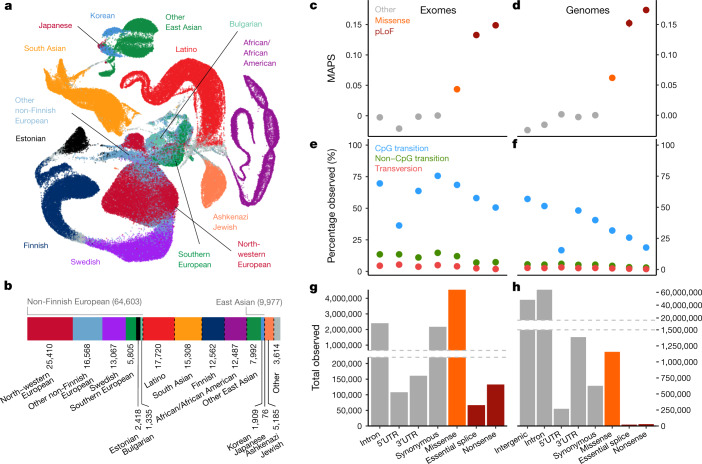
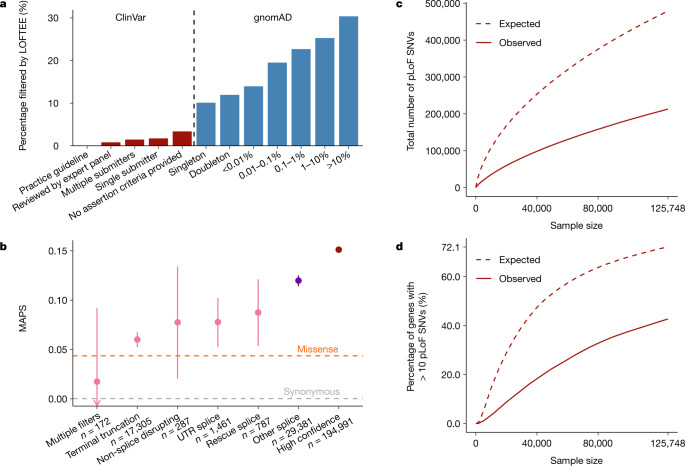
Genetic variants that inactivate protein-coding genes are a powerful source of information about the phenotypic consequences of gene disruption: genes that are crucial for the function of an organism will be depleted of such variants in natural populations, whereas non-essential genes will tolerate their accumulation. However, predicted loss-of-function variants are enriched for annotation errors, and tend to be found at extremely low frequencies, so their analysis requires careful variant annotation and very large sample sizes 1 . Here we describe the aggregation of 125,748 exomes and 15,708 genomes from human sequencing studies into the Genome Aggregation Database (gnomAD). We identify 443,769 high-confidence predicted loss-of-function variants in this cohort after filtering for artefacts caused by sequencing and annotation errors. Using an improved model of human mutation rates, we classify human protein-coding genes along a spectrum that represents tolerance to inactivation, validate this classification using data from model organisms and engineered human cells, and show that it can be used to improve the power of gene discovery for both common and rare diseases.
Overview
The claims and statistics of this paper haven’t been checked yet.
Free: it reads the open-access text and checks the first 5 claims that cite a source we can check. Create a free account to check every claim.
Integrity signals
Registry
Cites
Statistics
Figures
Verification
Claims the paper makes
The claims and statistics of this paper haven’t been checked yet.
Free: it reads the open-access text and checks the first 5 claims that cite a source we can check. Create a free account to check every claim.
Claims other papers make about this one
Each is checked against this paper’s own text: does it say what the citing paper says it does?
The source backs part of the claim, not all of it — or backs it for a different population, condition or comparison.
In the citing paper
“Earlier schizophrenia sequencing studies have established that ultra-rare and de novo mutations contribute to risk as a category, and have prioritized disease-relevant tissues and processes, specifically observing an enrichment in neuronal genes and synaptic processes9,11,19–23.”
From Rare coding variants in ten genes confer substantial risk for schizophrenia (2022) · cites this paper as [23]
Experimental — accuracy not yet measuredThe source backs part of the claim, not all of it — or backs it for a different population, condition or comparison.
In the citing paper
“According to the gnomAD database (Karczewski et al, 2020), the loss-of-function observed/expected upper bound fraction (LOEUF) indicates that SALL4 is depleted of inactivating variants and under purifying selection (LOEUF = 0.101).”
From Structure of SALL4 zinc finger domain reveals link between AT-rich DNA binding and Okihiro syndrome (2023) · cites this paper as Karczewski et al, 2020
Experimental — accuracy not yet measuredThe source backs part of the claim, not all of it — or backs it for a different population, condition or comparison.
In the citing paper
“Based on gnomAD (Karczewski et al. 2020), DOCK4 has a reduced amount of missense and null variants compared to its size of 1,966 amino acids (pLI = 1, Z score = 1.67) in a population without severe, early-onset phenotypes, indicating a mild constraint.”
From Heterozygous loss-of-function variants in DOCK4 cause neurodevelopmental delay and microcephaly (2024) · cites this paper as Karczewski et al. 2020
Experimental — accuracy not yet measuredThe source backs part of the claim, not all of it — or backs it for a different population, condition or comparison.
In the citing paper
“All variants were prioritized considering allele frequency in gnomAD v4.0.0 (Karczewski et al. 2020) below 1%, impact on protein function via different in silico programs (CADD (Rentzsch et al. 2021), REVEL (Ioannidis et al. 2016), MutPred2 (Pejaver et al. 2020) and Metadome (Wiel et al. 2019)) and involvement of candidate genes in neuronal processes.”
From Heterozygous loss-of-function variants in DOCK4 cause neurodevelopmental delay and microcephaly (2024) · cites this paper as Karczewski et al. 2020
Experimental — accuracy not yet measuredThe source backs part of the claim, not all of it — or backs it for a different population, condition or comparison.
In the citing paper
“Owing to the scarcity of reported loss-of-function (LoF) variants, with only 17 cases (allele frequency: ~7E-7) in the Genome Aggregation Database (gnomAD) from healthy subjects100, the WASF1 gene exhibits exceptionally high intolerance to such mutations.”
From The WAVE complex in developmental and adulthood brain disorders (2025) · cites this paper as [100]
Experimental — accuracy not yet measured
20 more claims about this paper
Create a free account to see every claim other papers make about this one.
Self-check
Percentages, sums and reported differences re-computed from the paper’s own numbers.
The self-check needs the paper’s full text.
Citations
Cites
UMAP: Uniform Manifold Approximation and Projection
McInnes, L., Healy, J., Saul, N., & Großberger, L. (2018) · Journal of Open Source Software · doi:10.21105/joss.00861 · Cited by 9,826
Analysis of protein-coding genetic variation in 60,706 humans
Exome Aggregation Consortium, Lek, M., Karczewski, K. J., Minikel, E. V., Samocha, K. E., Banks, E., Fennell, T., O’Donnell-Luria, A. H., Ware, J. S., Hill, A. J., et al. (2016) · Nature · doi:10.1038/nature19057 · Cited by 9,587
Self-citationVan der Auwera, G. A., Carneiro, M. O., Hartl, C., Poplin, R., del Angel, G., Levy‐Moonshine, A., Jordan, T., Shakir, K., Roazen, D., Thibault, J., et al. (2013) · Current Protocols in Bioinformatics · doi:10.1002/0471250953.bi1110s43 · Cited by 6,687
Self-citationGenetic effects on gene expression across human tissues
GTEx Consortium (2017) · Nature · doi:10.1038/nature24277 · Cited by 4,036
Self-citationSequence Variations in PCSK9, Low LDL, and Protection against Coronary Heart Disease
Cohen, J. C., Boerwinkle, E., Mosley, T. H., & Hobbs, H. H. (2006) · New England Journal of Medicine · doi:10.1056/nejmoa054013 · Cited by 3,181
Clinical use of current polygenic risk scores may exacerbate health disparities
Martin, A. R., Kanai, M., Kamatani, Y., Okada, Y., Neale, B. M., & Daly, M. J. (2019) · Nature Genetics · doi:10.1038/s41588-019-0379-x · Cited by 2,821
Self-citationCurrent clinical use of polygenic scores will risk exacerbating health disparities
Martin, A. R., Kanai, M., Kamatani, Y., Okada, Y., Neale, B. M., & Daly, M. J. (2018) · doi:10.1101/441261 · Cited by 2,813
Self-citationPartitioning heritability by functional annotation using genome-wide association summary statistics
ReproGen Consortium, Finucane, H. K., Schizophrenia Working Group of the Psychiatric Genomics Consortium, The RACI Consortium, Bulik-Sullivan, B., Gusev, A., Trynka, G., Reshef, Y., Loh, P.-R., Anttila, V., et al. (2015) · Nature Genetics · doi:10.1038/ng.3404 · Cited by 2,604
Self-citationPatterns and rates of exonic de novo mutations in autism spectrum disorders
Neale, B. M., Kou, Y., Liu, L., Ma’ayan, A., Samocha, K. E., Sabo, A., Lin, C.-F., Stevens, C., Wang, L.-S., Makarov, V., et al. (2012) · Nature · doi:10.1038/nature11011 · Cited by 1,734
Self-citationDe novo mutations in schizophrenia implicate synaptic networks
Fromer, M., Pocklington, A. J., Kavanagh, D. H., Williams, H. J., Dwyer, S., Gormley, P., Georgieva, L., Rees, E., Palta, P., Ruderfer, D. M., et al. (2014) · Nature · doi:10.1038/nature12929 · Cited by 1,617
Self-citation
Cited by
Items 801–900 of 1,234
Mao, D., Reuter, C. M., Ruzhnikov, M. R. Z., Beck, A. E., Farrow, E., Emrick, L., Rosenfeld, J. A., Mackenzie, K. M., Robak, L. A., Wheeler, M. T., et al. (2020) · The American Journal of Human Genetics · doi:10.1016/j.ajhg.2020.02.016 · Cited by 70
Buonocore, F., Maharaj, A. V., Qamar, Y., Koehler, K., Suntharalingham, J. P., Chan, L. F., Ferraz‐de‐Souza, B., Hughes, C. R., Lin, L., Prasad, R., et al. (2021) · Journal of the Endocrine Society · doi:10.1210/jendso/bvab086 · Cited by 72
Butler‐Laporte, G., Povysil, G., Kosmicki, J. A., Cirulli, E. T., Drivas, T. G., Furini, S., Saad, C., Schmidt, A., Olszewski, P., Korotko, U., et al. (2022) · PLoS Genetics · doi:10.1371/journal.pgen.1010367 · Cited by 71
“We defined MAFs based on a combination of gnomAD [24] MAF annotations, and of cohort-specific common variant exclusion lists.”
MethodSelf-citationGenetics and functions of the retinoic acid pathway, with special emphasis on the eye
Thompson, B. S., Katsanis, N., Apostolopoulos, N., Thompson, D. C., Nebert, D. W., & Vasiliou, V. (2019) · Human Genomics · doi:10.1186/s40246-019-0248-9 · Cited by 70
Identifying genetic modifiers of age-associated penetrance in X-linked dystonia-parkinsonism
Laabs, B., Klein, C., Pozojevic, J., Domingo, A., Brüggemann, N., Grütz, K., Rosales, R. L., Jamora, R. D. G., Saranza, G., Diesta, C. C. E., et al. (2021) · Nature Communications · doi:10.1038/s41467-021-23491-4 · Cited by 69
Self-citationGardner, E. J., Kentistou, K. A., Stankovic, S., Lockhart, S. M., Wheeler, E., Day, F. R., Kerrison, N. D., Wareham, N. J., Langenberg, C., O’Rahilly, S., et al. (2022) · Cell Genomics · doi:10.1016/j.xgen.2022.100208 · Cited by 69
Dynamic spatiotemporal determinants modulate GPCR:G protein coupling selectivity and promiscuity
Sandhu, M., Cho, A., Ma, N., Mukhaleva, E., Namkung, Y., Lee, S., Ghosh, S., Lee, J. H., Gloriam, D. E. I., Laporte, S. A., et al. (2022) · Nature Communications · doi:10.1038/s41467-022-34055-5 · Cited by 69
Biological and pharmacological functions of the FGF19- and FGF21-coreceptor beta klotho
Aaldijk, A. S., Verzijl, C. R. C., Jonker, J. W., & Struik, D. (2023) · Frontiers in Endocrinology · doi:10.3389/fendo.2023.1150222 · Cited by 70
“The Genome Aggregation Database (gnomAD), comprised of aggregated data from 125,748 exomes and 15,708 genomes, reports 980 germline KLB gene variants, counting 251 synonymous, 477 missense, and 12 loss-of-function (LoF) variants (17).”
BackgroundRaidt, J., Loges, N. T., Olbrich, H., Wallmeier, J., Pennekamp, P., & Omran, H. (2023) · La Presse Médicale · doi:10.1016/j.lpm.2023.104171 · Cited by 72
The frequency of pathogenic variation in the All of Us cohort reveals ancestry-driven disparities
Venner, E., Patterson, K., Kalra, D., Wheeler, M. M., Chen, Y., Kalla, S. E., Yuan, B., Karnes, J. H., Walker, K., Smith, J. D., et al. (2024) · Communications Biology · doi:10.1038/s42003-023-05708-y · Cited by 70
Self-citationMich, J. K., Ryu, J., Wei, A. D., Gore, B. B., Guo, R., Bard, A. M., Martinez, R. A., Luber, E. M., Liu, J., Bishaw, Y. M., et al. (2025) · Science Translational Medicine · doi:10.1126/scitranslmed.adn5603 · Cited by 71
Chau, C. H., van Doorn, R., van Poppelen, N. M., van der Stoep, N., Mensenkamp, A. R., Sijmons, R. H., van Paassen, B. W., van den Ouweland, A. M. W., Naus, N. C., van der Hout, A. H., et al. (2019) · Cancers · doi:10.3390/cancers11081114 · Cited by 70
Wang, J., Rousseau, J., Kim, E., Ehresmann, S., Cheng, Y.-T., Duraine, L., Zuo, Z., Park, Y.-J., Li‐Kroeger, D., Bi, W., et al. (2019) · The American Journal of Human Genetics · doi:10.1016/j.ajhg.2019.11.002 · Cited by 70
Homozygous STXBP1 variant causes encephalopathy and gain-of-function in synaptic transmission
Lammertse, H. C. A., van Berkel, A. A., Iacomino, M., Toonen, R. F. G., Striano, P., Gambardella, A., Verhage, M., & Zara, F. (2019) · Brain · doi:10.1093/brain/awz391 · Cited by 69
Ancestry-specific predisposing germline variants in cancer
Oak, N., Cherniack, A. D., Mashl, R. J., TCGA Analysis Network, Hirsch, F. R., Ding, L., Beroukhim, R., Gumus, Z. H., Plon, S. E., & Huang, K. (2020) · Genome Medicine · doi:10.1186/s13073-020-00744-3 · Cited by 69
Amplification-free long-read sequencing reveals unforeseen CRISPR-Cas9 off-target activity
Höijer, I., Johansson, J., Gudmundsson, S., Chin, C.-S., Bunikis, I., Häggqvist, S., Emmanouilidou, A., Wilbe, M., den Hoed, M., Bondeson, M.-L., et al. (2020) · Genome biology · doi:10.1186/s13059-020-02206-w · Cited by 70
Exome variant discrepancies due to reference-genome differences
Li, H., Dawood, M., Khayat, M. M., Farek, J. R., Jhangiani, S. N., Khan, Z. M., Mitani, T., Coban-Akdemir, Z., Lupski, J. R., Venner, E., et al. (2021) · The American Journal of Human Genetics · doi:10.1016/j.ajhg.2021.05.011 · Cited by 61
Rodríguez‐Ubreva, J., Arutyunyan, A., Bonder, M. J., Molina, L. D. P., Clark, S. J., de la Calle‐Fabregat, C., García‐Alonso, L., Handfield, L., Ciudad, L., Andrés‐León, E., et al. (2022) · Nature Communications · doi:10.1038/s41467-022-29450-x · Cited by 71
Exploiting the GTEx resources to decipher the mechanisms at GWAS loci
Barbeira, A. N., Bonazzola, R., Gamazon, E. R., Liang, Y., Park, Y., Kim-Hellmuth, S., Wang, G., Jiang, Z., Zhou, D., Hormozdiari, F., et al. (2019) · bioRxiv (Cold Spring Harbor Laboratory) · doi:10.1101/814350 · Cited by 69
Cross-protein transfer learning substantially improves disease variant prediction
(2023) · doi:10.1186/s13059-023-03024-6 · Cited by 68
“Tens of millions of missense variants may exist in the human population, and the vast majority of these have unknown consequences [1, 2].”
BackgroundMethodGleadall, N., Veldhuisen, B., Gollub, J., Butterworth, A. S., Ord, J., Penkett, C. J., Timmer, T. C., Sauer, C. M., van der Bolt, N., Brown, C. J., et al. (2020) · Blood Advances · doi:10.1182/bloodadvances.2020001894 · Cited by 68
Johnson, B., Creason, A., Stommel, J. M., Keck, J. M., Parmar, S. S., Betts, C. B., Blucher, A., Boniface, C. T., Bucher, E., Burlingame, E. A., et al. (2022) · Cell Reports Medicine · doi:10.1016/j.xcrm.2022.100525 · Cited by 68
“1) germline reference resource were used to filter out technical sequencing artifacts and common polymorphisms, respectively.(89) All analysis tools were run using an OHSU Galaxy instance (v17.”
MethodInterpreting protein variant effects with computational predictors and deep mutational scanning
Livesey, B. J., & Marsh, J. A. (2022) · Disease Models & Mechanisms · doi:10.1242/dmm.049510 · Cited by 60
“This wealth of data has helped identify thousands of human genetic variants in the population (Karczewski et al., 2020).”
Michaud, V., Lasseaux, E., Green, D. J., Gerrard, D. T., Plaisant, C., Fitzgerald, T. W., Birney, E., Arveiler, B., Black, G. C. M., & Sergouniotis, P. I. (2022) · Nature Communications · doi:10.1038/s41467-022-31392-3 · Cited by 72
Álvarez‐Álvarez, M. M., Biayna, J., & Supek, F. (2022) · Nature Communications · doi:10.1038/s41467-022-32285-1 · Cited by 68
Influences of rare copy-number variation on human complex traits
Hujoel, M. L. A., Sherman, M. A., Barton, A. R., Mukamel, R. E., Sankaran, V. G., Terao, C., & Loh, P. (2022) · Cell · doi:10.1016/j.cell.2022.09.028 · Cited by 68
Kim, Y. J., Moon, S., Hwang, M. Y., Han, S., Jang, H.-M., Kong, J., Shin, D. M., Yoon, K., Kim, S., Lee, J.-E., et al. (2022) · Nature Communications · doi:10.1038/s41467-022-34163-2 · Cited by 68
Self-citationWakeling, M. N., Owens, N. D. L., Hopkinson, J. R., Johnson, M. B., Houghton, J., Dastamani, A., Flaxman, C. S., Wyatt, R. C., Hewat, T. I., Hopkins, J. J., et al. (2022) · Nature Genetics · doi:10.1038/s41588-022-01204-x · Cited by 70
Spinal cord extracts of amyotrophic lateral sclerosis spread TDP-43 pathology in cerebral organoids
Tamaki, Y., Ross, J. P., Alipour, P., Castonguay, C.-E., Li, B., Catoire, H., Rochefort, D. L., Urushitani, M., Takahashi, R., Sonnen, J. A., et al. (2023) · PLoS Genetics · doi:10.1371/journal.pgen.1010606 · Cited by 68
“0 [26] minor allele frequency less than 0.001) protein-altering variants within the coding regions of genes with previously reported association with ALS were considered.”
InfluentialTissue-specific enhancer–gene maps from multimodal single-cell data identify causal disease alleles
Sakaue, S., Weinand, K., Isaac, S., Dey, K. K., Jagadeesh, K. A., Kanai, M., Watts, G. F. M., Zhu, Z., Accelerating Medicines Partnership® RA/SLE Program and Network, Albrecht, J., et al. (2024) · Nature Genetics · doi:10.1038/s41588-024-01682-1 · Cited by 69
“We assessed mutational constraint based on the absence of deleterious variants within human populations, including the probability of being loss-of-function intolerant (pLI) 69 and the loss-of-function observed/ expected upper bound fraction (LOEUF) 70 .”
InfluentialGenetic links between ovarian ageing, cancer risk and de novo mutation rates
Stankovic, S., Shekari, S., Huang, Q. Q., Gardner, E. J., Ivarsdottir, E. V., Owens, N. D. L., Mavaddat, N., Azad, A., Hawkes, G., Kentistou, K. A., et al. (2024) · Nature · doi:10.1038/s41586-024-07931-x · Cited by 68
“To test a range of variant annotation categories for MAF 0.1%, we created dummy genotype files for high confidence PTVs as defined by LOFTEE, missense variants with CADD ≥ 25, and damaging variants that included both high confidence PTVs and missense variants with CADD ≥ 25.”
MethodInfluentialAdvancing long-read nanopore genome assembly and accurate variant calling for rare disease detection
Negi, S., Stenton, S. L., Berger, S., Canigiula, P., McNulty, B., Violich, I., Gardner, J. M. V., Hillaker, T. L., O’Rourke, S. M., O’Leary, M., et al. (2025) · The American Journal of Human Genetics · doi:10.1016/j.ajhg.2025.01.002 · Cited by 68
Self-citationYoo, S., Kim, C.-U., Kim, H. L., Kim, S., Shin, J.-Y., Kim, N., Yang, J. S. W., Lo, K. W., Cho, B., Matsuda, F., et al. (2019) · Genome Medicine · doi:10.1186/s13073-019-0677-z · Cited by 68
Choi, E., Cho, Y., Hur, E., Jang, S., Kim, N., Park, H., Lee, J., Lee, K., Kim, S., Hwang, S., et al. (2021) · Haematologica · doi:10.3324/haematol.2020.270553 · Cited by 68
Tsai, P.-Y., Lee, M.-S., Jadhav, U., Naqvi, I., Madha, S., Adler, A., Mistry, M., Naumenko, S., Lewis, C. A., Hitchcock, D. S., et al. (2021) · Proceedings of the National Academy of Sciences · doi:10.1073/pnas.2003014118 · Cited by 68
Cross-protein transfer learning substantially improves disease variant prediction
Jagota, M., Ye, C., Albors, C., Rastogi, R., Koehl, A., Ioannidis, N., & Song, Y. S. (2022) · doi:10.1101/2022.11.15.516532 · Cited by 68
Abildgaard, A. B., Stein, A., Nielsen, S. V., Schultz-Knudsen, K., Papaleo, E., Shrikhande, A., Hoffmann, E. R., Bernstein, I., Gerdes, A.-M., Takahashi, M., et al. (2019) · eLife · doi:10.7554/elife.49138 · Cited by 61
Faùndes, V., Jennings, M. D., Crilly, S., Legraie, S., Withers, S. E., Cuvertino, S., Davies, S. J., Douglas, A. G. L., Fry, A. E., Harrison, V., et al. (2021) · Nature Communications · doi:10.1038/s41467-021-21053-2 · Cited by 68
Vorsteveld, E. E., Hoischen, A., & van der Made, C. I. (2021) · Clinical Reviews in Allergy & Immunology · doi:10.1007/s12016-021-08838-5 · Cited by 69
Understanding the genetics of adult-onset dilated cardiomyopathy: what a clinician needs to know
Tayal, U., Ware, J. S., Lakdawala, N. K., Heymans, S. R. B., & Prasad, S. K. (2021) · European Heart Journal · doi:10.1093/eurheartj/ehab286 · Cited by 67
Self-citationAn emerging spectrum of variants and clinical features in KCNMA1-linked channelopathy
Miller, J. P., Moldenhauer, H. J., Keros, S., & Meredith, A. L. (2021) · Channels · doi:10.1080/19336950.2021.1938852 · Cited by 68
“disease-linked variants were reported [73,110,111].”
Duan, Y., Tao, Y., Qu, Z., Chen, Y., Miranda, A., Zhou, X., Lok, K.-C., Chen, Y., Fu, A. K. Y., Gradinaru, V., et al. (2021) · Nature Biomedical Engineering · doi:10.1038/s41551-021-00759-0 · Cited by 69
A year of COVID-19 GWAS results from the GRASP portal reveals potential genetic risk factors
Thibord, F., Chan, M. V., Chen, M., & Johnson, A. D. (2022) · Human Genetics and Genomics Advances · doi:10.1016/j.xhgg.2022.100095 · Cited by 68
Marcogliese, P. C., Deal, S. L., Andrews, J. C., Harnish, J. M., Bhavana, V. H., Graves, H. K., Jangam, S. V., Luo, X., Liu, N., Bei, D., et al. (2022) · Cell Reports · doi:10.1016/j.celrep.2022.110517 · Cited by 67
“By overlapping these 920 Drosophila genes with available fly lines containing Minos -mediated integration cassette (MiMIC) transposons within coding introns that permit targeting of all annotated protein isoforms (‘‘gold’’; 1,732 insertions; Nagarkar-Jaiswal et al., 2015; Venken et al., 2011), we identified reagents for…”
InfluentialSelf-citationDirect detection of natural selection in Bronze Age Britain
Mathieson, I., & Terhorst, J. (2022) · Genome Research · doi:10.1101/gr.276862.122 · Cited by 66
“In gnomAD [39], 322 rs4690044 has a MAF of 0.”
Păun, O., Tan, Y. X., Patel, H., Strohbuecker, S., Ghanate, A. D., Gigli, C. C., Llorian, M., Gerontogianni, L., Goldstone, R. J., Ang, S., et al. (2023) · Genes & Development · doi:10.1101/gad.350269.122 · Cited by 67
“1.1 database), with no observed homozygotes (Karczewski et al. 2020).”
InfluentialWartewig, T., Daniels, J., Schulz, M., Hameister, E., Joshi, A., Park, J., Morrish, E., Venkatasubramani, A. V., Cernilogar, F. M., van Heijster, F. H. A., et al. (2023) · Nature Cancer · doi:10.1038/s43018-023-00635-7 · Cited by 68
“For quality control, we excluded calls with discordant log 2 read ratios and delta B allele frequency or high-frequency calls in gnomAD, as previously described 77–79 .”
MethodKomura, K., Hirosuna, K., Tokushige, S., Tsujino, T., Nishimura, K., Ishida, M., Hayashi, T., Ura, A., Ohno, T., Yamazaki, S., et al. (2023) · Molecular Cancer · doi:10.1186/s12943-023-01897-6 · Cited by 67
“0, an integrative germline dataset of 71,702 individuals (mostly Western population), was utilized for the control [10].”
MethodThe genetic relationships between brain structure and schizophrenia
Stauffer, E.-M., Bethlehem, R. A. I., Dorfschmidt, L., Won, H., Warrier, V., & Bullmore, E. T. (2023) · Nature Communications · doi:10.1038/s41467-023-43567-7 · Cited by 68
“[48] using 455 logistic regression after accounting for log transformed gene length as a covariate.”
MethodResultCell-type-resolved mosaicism reveals clonal dynamics of the human forebrain
Chung, C., Yang, X., Hevner, R. F., Kennedy, K. L., Vong, K. I., Liu, Y., Patel, A. M., Nedunuri, R., Barton, S. T., Noël, G. P. J. C., et al. (2024) · Nature · doi:10.1038/s41586-024-07292-5 · Cited by 67
Rare coding variant analysis for human diseases across biobanks and ancestries
Jurgens, S. J., Wang, X., Choi, S. H., Weng, L.-C. C., Koyama, S., Pirruccello, J. P., Nguyen, T. T. H., Smadbeck, P., Jang, D., Chaffin, M. D., et al. (2024) · Nature Genetics · doi:10.1038/s41588-024-01894-5 · Cited by 68
“In each dataset, variants were annotated using dbNSFP (v.4.2a for MGB and v.4.3a for UKB and AoU 72 ) and the loss-of-function transcript effect estimator (LOFTEE 25 ) plug-in implemented in the variant effect predictor (VEP; v.105) 73 (https://github.com/konradjk/loftee).”
InfluentialSelf-citationAlDubayan, S. H., Conway, J. R., Camp, S. Y., Witkowski, L., Kofman, E. R., Reardon, B. M., Han, S., Moore, N., Elmarakeby, H., Salari, K., et al. (2020) · JAMA · doi:10.1001/jama.2020.20457 · Cited by 67
Seuma, M., Faure, A. J., Badia, M., Lehner, B., & Bolognesi, B. (2021) · eLife · doi:10.7554/elife.63364 · Cited by 60
Jee, H., Huang, Z., Baxter, S. M., Huang, Y., Taylor, M. L., Henderson, L. A., Rosenzweig, S., Sharma, A., Chambers, E. P., Hershfield, M. S., et al. (2021) · Journal of Allergy and Clinical Immunology · doi:10.1016/j.jaci.2021.04.034 · Cited by 67
Self-citationLi, J., Lei, W., Zhang, P., Rapaport, F., Seeleuthner, Y., Lyu, B., Asano, T., Rosain, J., Hammadi, B., Zhang, Y., et al. (2021) · The Journal of Experimental Medicine · doi:10.1084/jem.20210566 · Cited by 67
Stengel, A., Baer, C. R., Walter, W., Meggendorfer, M., Kern, W., Haferlach, T., & Haferlach, C. (2021) · Blood Advances · doi:10.1182/bloodadvances.2021004668 · Cited by 67
Comparison of tumor-informed and tumor-naïve sequencing assays for ctDNA detection in breast cancer
Santonja, A., Cooper, W. N., Eldridge, M. D., Edwards, P. A. W., Morris, J. A., Edwards, A. R., Zhao, H., Heider, K., Couturier, D., Vijayaraghavan, A., et al. (2023) · EMBO Molecular Medicine · doi:10.15252/emmm.202216505 · Cited by 66
“Variants present within the gnomAD germline resource (Karczewski et al, 2020) or in a pooled panel of normals (compiled by calling germline variants from WGS data derived from buffy coat of a cohort of 200 breast cancer patients) were removed.”
Jacquinet, A., Boujemla, B., Fasquelle, C., Thiry, J., Josse, C., Lumaka, A. Z., Brischoux‐Boucher, E., Dubourg, C., David, V., Pasquier, L., et al. (2020) · Clinical Genetics · doi:10.1111/cge.13769 · Cited by 66
Portelli, S., Olshansky, M., Rodrigues, C. H. M., D’Souza, E. N., Myung, Y., Silk, M. A., Alavi, A., Pires, D. E. V., & Ascher, D. B. (2020) · Nature Genetics · doi:10.1038/s41588-020-0693-3 · Cited by 67
The role of junctophilin proteins in cellular function
Lehnart, S. E., & Wehrens, X. H. T. (2022) · Physiological Reviews · doi:10.1152/physrev.00024.2021 · Cited by 67
“9% (100/3,426) of South Asian chromosomes (190).”
High-throughput characterization of the role of non-B DNA motifs on promoter function
Georgakopoulos‐Soares, I., Victorino, J., Parada, G. E., Agarwal, V., Zhao, J., Wong, H. Y., Umar, M. I., Elor, O., Muhwezi, A., An, J., et al. (2022) · Cell Genomics · doi:10.1016/j.xgen.2022.100111 · Cited by 66
Respiratory viral infections in otherwise healthy humans with inherited IRF7 deficiency
Campbell, T. M., Liu, Z., Zhang, Q., Moncada‐Vélez, M., Covill, L., Zhang, P., Darazam, I. A., Bastard, P., Bizien, L., Bucciol, G., et al. (2022) · The Journal of Experimental Medicine · doi:10.1084/jem.20220202 · Cited by 67
“2; Karczewski et al., 2020).”
Lischka, A., Laššuthová, P., Çakar, A., Record, C. J., Lent, J. V., Baets, J., Dohrn, M. F., Senderek, J., Lampert, A., Bennett, D., et al. (2022) · Nature Reviews Disease Primers · doi:10.1038/s41572-022-00365-7 · Cited by 66
Rare loss of function variants in the hepatokine gene INHBE protect from abdominal obesity
Deaton, A. M., Dubey, A., Ward, L. D., Dornbos, P., Flannick, J., AMP-T2D-GENES Consortium, Yee, E., Ticau, S., Noetzli, L., Parker, M. M., et al. (2022) · Nature Communications · doi:10.1038/s41467-022-31757-8 · Cited by 57
Foksinska, A., Crowder, C. M., Crouse, A. B., Henrikson, J., Byrd, W. E., Rosenblatt, G., Patton, M. J., He, K., Tran-Nguyen, T. K., Zheng, M., et al. (2022) · Frontiers in Artificial Intelligence · doi:10.3389/frai.2022.910216 · Cited by 66
Penetrance of pathogenic genetic variants associated with premature ovarian insufficiency
Shekari, S., Stankovic, S., Gardner, E. J., Hawkes, G., Kentistou, K. A., Beaumont, R. N., Mörseburg, A., Wood, A. R., Prague, J., Mishra, G. D., et al. (2023) · Nature Medicine · doi:10.1038/s41591-023-02405-5 · Cited by 67
“%) have limited evidence of being under strong selective constraint (pLI ≤ 0.9) as assessed by gnomAD 24 , which further supports that these genes are unlikely to play an important role for reproductive success.”
BackgroundMethodInfluentialWorldwide Incidence of Ocular Melanoma and Correlation With Pigmentation-Related Risk Factors
Wu, M., Yavuzyiğitoğlu, S., Brosens, E., Ramdas, W. D., Kılıç, E., & on behalf of the Rotterdam Ocular Melanoma Study Group (ROMS) (2023) · Investigative Ophthalmology & Visual Science · doi:10.1167/iovs.64.13.45 · Cited by 67
“60 In order to analyze the pigmentation-related SNPs, we opted for the 1KGP dataset, 52 where we could access a sufficient number of allele frequencies of specific SNPs from 26 populations rather than the gnomAD database 61 with only 9 populations.”
MethodTo kill a microRNA: emerging concepts in target-directed microRNA degradation
Buhagiar, A. F., & Kleaveland, B. (2024) · Nucleic Acids Research · doi:10.1093/nar/gkae003 · Cited by 66
“Unsurprisingly, ZSWIM8 is highly constrained against missense mutations and is predicted to be dosage sensitive ( 48 ,49 ), although no disease associations have been re-ported.”
BackgroundMulti-ancestry genome-wide association study of kidney cancer identifies 63 susceptibility regions
Purdue, M. P., Dutta, D., Machiela, M. J., Gorman, B. R., Winter, T., Okuhara, D. Y., Cleland, S., Ferreiro-Iglesias, A., Scheet, P. A., Liu, A., et al. (2024) · Nature Genetics · doi:10.1038/s41588-024-01725-7 · Cited by 68
Jurgens, S. J., Rämö, J. T., Kramarenko, D. R., Wijdeveld, L. F. J. M., Haas, J., Chaffin, M. D., Garnier, S., Gaziano, L., Weng, L.-C. C., Lipov, A., et al. (2024) · Nature Genetics · doi:10.1038/s41588-024-01975-5 · Cited by 67
Self-citationSpectrum of K V 2.1 Dysfunction in KCNB1 ‐Associated Neurodevelopmental Disorders
Kang, S. K., Vanoye, C. G., Misra, S. N., Echevarria-Cooper, D. M., Calhoun, J. D., O'Connor, J. B., Fabre, K. L., McKnight, D., Demmer, L., Goldenberg, P. C., et al. (2019) · Annals of Neurology · doi:10.1002/ana.25607 · Cited by 69
DGCR8 microprocessor defect characterizes familial multinodular goiter with schwannomatosis
Rivera, B., Nadaf, J., Fahiminiya, S., Apellániz-Ruiz, M., Saskin, A., Chong, A., Sharma, S., Wagener, R., Revil, T., Condello, V., et al. (2020) · Journal of Clinical Investigation · doi:10.1172/jci130206 · Cited by 66
FLNC truncations cause arrhythmogenic right ventricular cardiomyopathy
Brun, F., Gigli, M., Graw, S. L., Judge, D. P., Merlo, M., Murray, B. A., Calkins, H. G., Sinagra, G., Taylor, M. R. G., Mestroni, L., et al. (2020) · Journal of Medical Genetics · doi:10.1136/jmedgenet-2019-106394 · Cited by 66
The population genomics of adaptive loss of function
Monroe, J. G., McKay, J., Weigel, D., & Flood, P. J. (2021) · Heredity · doi:10.1038/s41437-021-00403-2 · Cited by 66
Chalazan, B., Mol, D., Darbar, F. A., Ornelas-Loredo, A., Al-Azzam, B., Chen, Y., Tofovic, D., Sridhar, A., Alzahrani, Z., Ellinor, P., et al. (2021) · JAMA Cardiology · doi:10.1001/jamacardio.2021.0994 · Cited by 63
Self-citationFadaie, Z., Whelan, L., Ben‐Yosef, T., Dockery, A., Corradi, Z., Gilissen, C., Haer‐Wigman, L., Corominas, J., Astuti, G., de Rooij, L. P. M. H., et al. (2021) · npj Genomic Medicine · doi:10.1038/s41525-021-00261-1 · Cited by 66
Promoting the genomic revolution in Africa through the Nigerian 100K Genome Project
Fatumo, S., Yakubu, A., Oyedele, O., Popoola, J., Attipoe, D. A., Eze-Echesi, G., Modibbo, F. Z., Ado-Wanka, N., 54gene Team, Osakwe, Y., et al. (2022) · Nature Genetics · doi:10.1038/s41588-022-01071-6 · Cited by 66
Self-citationA catalog of homoplasmic and heteroplasmic mitochondrial DNA variants in humans
Bolze, A., Mendez, F., White, S., Tanudjaja, F., Isaksson, M., Jiang, R., Rossi, A. D., Cirulli, E. T., Rashkin, M., Metcalf, W. J., et al. (2019) · bioRxiv (Cold Spring Harbor Laboratory) · doi:10.1101/798264 · Cited by 49
Paralog dependency indirectly affects the robustness of human cells
Dandage, R., & Landry, C. R. (2019) · Molecular Systems Biology · doi:10.15252/msb.20198871 · Cited by 65
Kröll‐Hermi, A., Ebstein, F., Stoetzel, C., Geoffroy, V., Schaefer, E., Scheidecker, S., Bär, S., Takamiya, M., Kawakami, K., Zieba, B. A., et al. (2020) · EMBO Molecular Medicine · doi:10.15252/emmm.201911861 · Cited by 65
Thompson, B. S., Davidson, E. A., Liu, W., Nebert, D. W., Bruford, E. A., Zhao, H., Dermitzakis, E. T., Thompson, D. C., & Vasiliou, V. (2020) · Human Genetics · doi:10.1007/s00439-020-02212-9 · Cited by 66
Jarvis, L. B., Rainbow, D. B., Coppard, V., Howlett, S., Georgieva, Z. G., Davies, J. L., Mullay, H. K., Hester, J., Ashmore, T., van den Bosch, A. M. R., et al. (2021) · Communications Biology · doi:10.1038/s42003-021-02721-x · Cited by 242
Barba, C., Blümcke, I., Winawer, M. R., Hartlieb, T., Kang, H., Grisotto, L., Chipaux, M., Bien, C. G., Splítková, B., Porter, B. E., et al. (2022) · Neurology · doi:10.1212/wnl.0000000000201471 · Cited by 65
“However, all centers involved in the study have a high level of expertise in epilepsy and EEG interpretation, with regular training and adoption of international recommendations.(22,25,27,45) Finally, there was no standardization in timing and methods of cognitive assessment between centers, whichmight have partly inf…”
BackgroundDashnow, H., Pedersen, B. S., Hiatt, L., Brown, J., Beecroft, S. J., Ravenscroft, G., LaCroix, A. J., Lamont, P. J., Roxburgh, R. H., Rodrigues, M. J., et al. (2022) · Genome biology · doi:10.1186/s13059-022-02826-4 · Cited by 64
Systematic investigation of allelic regulatory activity of schizophrenia-associated common variants
McAfee, J. C., Lee, S., Lee, J., Bell, J., Krupa, O., Davis, J. E., Insigne, K. D., Bond, M. L., Zhao, N., Boyle, A. P., et al. (2023) · Cell Genomics · doi:10.1016/j.xgen.2023.100404 · Cited by 66
Rare copy-number variants as modulators of common disease susceptibility
Auwerx, C., Lepamets, M., Sadler, M. C., Tesio, N., Ojavee, S. E., Clark, C. J., Mägi, R., Esko, T., Metspalu, A., Milani, L. A., et al. (2024) · Genome Medicine · doi:10.1186/s13073-023-01265-5 · Cited by 66
Self-citationZhao, Y., Chukanova, M., Kentistou, K. A., Fairhurst-Hunter, Z., Siegert, A. M., Jia, R., Dowsett, G. K. C., Gardner, E. J., Lawler, K., Day, F. R., et al. (2024) · Nature Genetics · doi:10.1038/s41588-024-01694-x · Cited by 65
“The remaining variants underwent annotation using Ensembl Variant Effect Predictor (VEP v104) 41 with the ‘-everything’ flag and additional plugins for REVEL 14 , CADD 42 and LOFTEE 43 .”
MethodInfluentialSelf-citationGenome-wide association testing beyond SNPs
Harris, L. W., McDonagh, E. M., Zhang, X., Fawcett, K. A., Foreman, A., Daneck, P., Sergouniotis, P. I., Parkinson, H., Mazzarotto, F., Inouye, M., et al. (2024) · Nature Reviews Genetics · doi:10.1038/s41576-024-00778-y · Cited by 67
Association between plausible genetic factors and weight loss from GLP1-RA and bariatric surgery
German, J., Cordioli, M., Tozzo, V., Urbut, S., Arumäe, K., Smit, R. A. J., Lee, J., Li, J. H., Janucik, A., Ding, Y., et al. (2025) · Nature Medicine · doi:10.1038/s41591-025-03645-3 · Cited by 65
Self-citationSperm sequencing reveals extensive positive selection in the male germline
Neville, M. D. C., Lawson, A. R. J., Sanghvi, R., Abascal, F., Pham, M. H., Cagan, A., Nicola, P. A., Bayzetinova, T., Baez‐Ortega, A., Roberts, K., et al. (2025) · Nature · doi:10.1038/s41586-025-09448-3 · Cited by 65
“To assess how selection shapes germline variants in the population, we analysed dN/dS ratios across allele frequencies in gnomAD 48 (Fig.”
Massive centriole production can occur in the absence of deuterosomes in multiciliated cells
Mercey, O., Levine, M. S., LoMastro, G. M., Rostaing, P., Brotslaw, E. J., Gomez, V., Kumar, A., Spassky, N., Mitchell, B. J., Meunier, A., et al. (2019) · Nature Cell Biology · doi:10.1038/s41556-019-0427-x · Cited by 66
Post, K. L., Belmadani, M., Ganguly, P., Meili, F., Dingwall, R., McDiarmid, T. A., Meyers, W. M., Herrington, C., Young, B. P., Callaghan, D. B., et al. (2020) · Nature Communications · doi:10.1038/s41467-020-15943-0 · Cited by 62
Novel manifestations of immune dysregulation and granule defects in gray platelet syndrome
Sims, M. C., Mayer, L., Collins, J., Bariana, T. K., Mégy, K., Lavenu‐Bombled, C., Seyres, D., Kollipara, L., Burden, F., Greene, D., et al. (2020) · Blood · doi:10.1182/blood.2019004776 · Cited by 66
de Faria, D. O. S., Groen, S. L. M. I. ‘., Hoogeveen‐Westerveld, M., Niño, M. Y., van der Ploeg, A. T., Bergsma, A. J., & Pijnappel, W. W. M. P. (2020) · Human Mutation · doi:10.1002/humu.24148 · Cited by 65
KDM5A mutations identified in autism spectrum disorder using forward genetics
Hayek, L. E., Tuncay, İ. O., Nijem, N., Russell, J. L., Ludwig, S. M., Kaur, K. J., Li, X., Anderton, P. D., Tang, M., Gerard, A., et al. (2020) · eLife · doi:10.7554/elife.56883 · Cited by 66
Widespread haploid-biased gene expression enables sperm-level natural selection
Bhutani, K., Stansifer, K., Ticau, S., Bojic, L. A., Villani, A., Slisz, J. K., Cremers, C. M., Roy, C., Donovan, J., Fiske, B. P., et al. (2021) · Science · doi:10.1126/science.abb1723 · Cited by 65
“We found that genes with the most loss-offunction intolerance (24) were enriched for GIMs relative to controls (P = 0.”
BackgroundResultLevin, M. G., Zuber, V., Walker, V. M., Klarin, D., Lynch, J., Malik, R., Aday, A. W., Bottolo, L., Pradhan, A. D., Dichgans, M., et al. (2021) · Circulation · doi:10.1161/circulationaha.121.053797 · Cited by 65
The evolution of hematopoietic cells under cancer therapy
Pich, O., Cortes-Bullich, A., Muiños, F., Pratcorona, M., Gonzalez-Perez, A., & Lopez-Bigas, N. (2021) · Nature Communications · doi:10.1038/s41467-021-24858-3 · Cited by 60
Attraction-Repulsion Spectrum in Neighbor EmbeddingsPreprint
Böhm, J. N., Berens, P., & Kobak, D. (2020) · arXiv (Cornell University) · doi:10.48550/arxiv.2007.08902 · Cited by 79
“, 2019; Kobak and Berens, 2019) or population genomics (Diaz-Papkovich et al., 2019; Karczewski et al., 2020), but the choice of the method is often done without a solid understanding of why the results may be different or what trade-offs are at play.”
BackgroundMethodAssembly and annotation of an Ashkenazi human reference genome
Shumate, A., Zimin, A. V., Sherman, R. M., Puiu, D., Wagner, J. M., Olson, N. D., Pertea, M., Salit, M. L., Zook, J. M., & Salzberg, S. L. (2020) · Genome Biology · doi:10.1186/s13059-020-02047-7 · Cited by 58
“Comparison against common Ashkenazi variants To examine the extent to which Ash1 contains known, common Ashkenazi variants (relative to GRCh38), we examined SNVs reported at high frequency in an Ashkenazi population from the Genome Aggregation Database (gnomAD) [18].”
Background
Metadata
- Authors
- Karczewski, K. J., Francioli, L. C., Tiao, G., Cummings, B. B., Alföldi, J., Wang, Q., Collins, R. L., Laricchia, K. M., Ganna, A., Birnbaum, D. P., Gauthier, L. D., Brand, H., Solomonson, M., Watts, N. A., Rhodes, D., Singer-Berk, M., England, E. M., Seaby, E. G., Kosmicki, J. A., Walters, R. K., Tashman, K., Farjoun, Y., Banks, E., Poterba, T., Wang, A., Seed, C., Whiffin, N., Chong, J. X., Samocha, K. E., Pierce-Hoffman, E., Zappala, Z., O’Donnell-Luria, A. H., Minikel, E. V., Weisburd, B., Lek, M., Ware, J. S., Vittal, C., Armean, I. M., Bergelson, L., Cibulskis, K., Connolly, K. M., Covarrubias, M., Donnelly, S., Ferriera, S., Gabriel, S., Gentry, J., Gupta, N., Jeandet, T., Kaplan, D., Llanwarne, C., Munshi, R., Novod, S., Petrillo, N., Roazen, D., Ruano-Rubio, V., Saltzman, A., Schleicher, M., Soto, J., Tibbetts, K., Tolonen, C., Wade, G., Talkowski, M. E., Genome Aggregation Database Consortium, Aguilar Salinas, C. A., Ahmad, T., Albert, C. M., Ardissino, D., Atzmon, G., Barnard, J., Beaugerie, L., Benjamin, E. J., Boehnke, M., Bonnycastle, L. L., Bottinger, E. P., Bowden, D. W., Bown, M. J., Chambers, J. C., Chan, J. C., Chasman, D., Cho, J., Chung, M. K., Cohen, B., Correa, A., Dabelea, D., Daly, M. J., Darbar, D., Duggirala, R., Dupuis, J., Ellinor, P. T., Elosua, R., Erdmann, J., Esko, T., Färkkilä, M., Florez, J., Franke, A., Getz, G., Glaser, B., Glatt, S. J., Goldstein, D., Gonzalez, C., Groop, L., Haiman, C., Hanis, C., Harms, M., Hiltunen, M., Holi, M. M., Hultman, C. M., Kallela, M., Kaprio, J., Kathiresan, S., Kim, B.-J., Kim, Y. J., Kirov, G., Kooner, J., Koskinen, S., Krumholz, H. M., Kugathasan, S., Kwak, S. H., Laakso, M., Lehtimäki, T., Loos, R. J. F., Lubitz, S. A., Ma, R. C. W., MacArthur, D. G., Marrugat, J., Mattila, K. M., McCarroll, S., McCarthy, M. I., McGovern, D., McPherson, R., Meigs, J. B., Melander, O., Metspalu, A., Neale, B. M., Nilsson, P. M., O’Donovan, M. C., Ongur, D., Orozco, L., Owen, M. J., Palmer, C. N. A., Palotie, A., Park, K. S., Pato, C., Pulver, A. E., Rahman, N., Remes, A. M., Rioux, J. D., Ripatti, S., Roden, D. M., Saleheen, D., Salomaa, V., Samani, N. J., Scharf, J., Schunkert, H., Shoemaker, M. B., Sklar, P., Soininen, H., Sokol, H., Spector, T., Sullivan, P. F., Suvisaari, J., Tai, E. S., Teo, Y. Y., Tiinamaija, T., Tsuang, M., Turner, D., Tusie-Luna, T., Vartiainen, E., Vawter, M. P., Ware, J. S., Watkins, H., Weersma, R. K., Wessman, M., Wilson, J. G., Xavier, R. J., Neale, B. M., Daly, M. J., & MacArthur, D. G.
- Affiliations
- Broad Institute (US)
- Queen Mary University of London (GB)
- University of Washington (US)
- Wellcome Sanger Institute (GB)
- Yale University (US)
- Peninsula College of Medicine and Dentistry (GB)
- Brigham and Women's Hospital (US)
- University of Parma (IT)
- Albert Einstein College of Medicine (US)
- Cleveland Clinic (US)
- Sorbonne Université (FR)
- Boston University (US)
- University of Michigan (US)
- National Institutes of Health (US)
- Wake Forest University Health Sciences (US)
- University of Leicester (GB)
- Imperial College Healthcare NHS Trust (GB)
- Chinese University of Hong Kong (HK)
- Icahn School of Medicine at Mount Sinai (US)
- Harvard University (US)
- University of Mississippi Medical Center (US)
- Colorado School of Public Health (US)
- University of Illinois Chicago (US)
- Texas Biomedical Research Institute (US)
- German Centre for Cardiovascular Research (DE)
- University of Helsinki (FI)
- SUNY Upstate Medical University (US)
- Columbia University Irving Medical Center (US)
- Lund University (SE)
- The University of Texas Health Science Center at Houston (US)
- Columbia University (US)
- University of Eastern Finland (FI)
- Helsinki University Hospital (FI)
- Karolinska Institutet (SE)
- Korea National Institute of Health (KR)
- Cardiff University (GB)
- Finnish Institute for Health and Welfare (FI)
- Emory University (US)
- Seoul National University (KR)
- Tampere University (FI)
- Centro de Investigación en Red en Enfermedades Cardiovasculares (ES)
- Centre for Human Genetics (GB)
- Cedars-Sinai Medical Center (US)
- Ottawa Heart Institute (CA)
- University of Tartu (EE)
- National Institute of Genomic Medicine (MX)
- University of Dundee (GB)
- University of Southern California (US)
- Johns Hopkins University (US)
- Institute of Cancer Research (GB)
- Oulu University Hospital (FI)
- Montreal Heart Institute (CA)
- Vanderbilt University Medical Center (US)
- Center for Non-Communicable Diseases (PK)
- Deutsches Herzzentrum München (DE)
- Vanderbilt University (US)
- Massachusetts General Hospital (US)
- King's College London (GB)
- University of North Carolina at Chapel Hill (US)
- National University of Singapore (SG)
- University of California San Diego (US)
- Hebrew University of Jerusalem (IL)
- University of California, Irvine (US)
- University of Oxford (GB)
- University Medical Center Groningen (NL)
- Institute for Molecular Medicine Finland (FI)
- Corresponding author
- Karczewski, Konrad J.
- ORCID
- Karczewski, Konrad J.
- Francioli, Laurent C.
- Tiao, Grace
- Cummings, Beryl B.
- Alföldi, Jessica
- Wang, Qingbo
- Collins, Ryan L.
- Laricchia, Kristen M.
- Ganna, Andrea
- Brand, Harrison
- Solomonson, Matthew
- Rhodes, Daniel
- Seaby, Eleanor G.
- Kosmicki, Jack A.
- Walters, Raymond K.
- Tashman, Katherine
- Farjoun, Yossi
- Banks, Eric
- Poterba, Timothy
- Whiffin, Nicola
- Chong, Jessica X.
- Samocha, Kaitlin E.
- Zappala, Zachary
- O’Donnell-Luria, Anne H.
- Minikel, Eric Vallabh
- Weisburd, Ben
- Lek, Monkol
- Armean, Irina M.
- Cibulskis, Kristian
- Donnelly, Stacey
- Gabriel, Stacey
- Gupta, Namrata
- Saltzman, Andrea
- Talkowski, Michael E.
- Ahmad, Tariq
- Albert, Christine M.
- Ardissino, Diego
- Atzmon, Gil
- Barnard, John
- Beaugerie, Laurent
- Benjamin, Emelia J.
- Boehnke, Michael
- Bonnycastle, Lori L.
- Bowden, Donald W.
- Bown, Matthew J.
- Chambers, John C.
- Chan, Juliana C.
- Chasman, Daniel
- Cho, Judy
- Chung, Mina K.
- Cohen, Bruce
- Correa, Adolfo
- Dabelea, Dana
- Darbar, Dawood
- Duggirala, Ravindranath
- Dupuis, Josée
- Ellinor, Patrick T.
- Erdmann, Jeanette
- Esko, Tõnu
- Färkkilä, Martti
- Getz, Gad
- Glatt, Stephen J.
- Goldstein, David
- Groop, Leif
- Hanis, Craig
- Harms, Matthew
- Hiltunen, Mikko
- Holi, Matti M.
- Hultman, Christina M.
- Kallela, Mikko
- Kaprio, Jaakko
- Kathiresan, Sekar
- Kim, Bong-Jo
- Kim, Young Jin
- Kirov, George
- Kooner, Jaspal
- Krumholz, Harlan M.
- Kugathasan, Subra
- Kwak, Soo Heon
- Laakso, Markku
- Lehtimäki, Terho
- Loos, Ruth J. F.
- Lubitz, Steven A.
- Marrugat, Jaume
- McCarroll, Steven
- McCarthy, Mark I.
- McGovern, Dermot
- McPherson, Ruth
- Meigs, James B.
- Melander, Olle
- Metspalu, Andres
- Nilsson, Peter M.
- O’Donovan, Michael C.
- Orozco, Lorena
- Owen, Michael J.
- Palmer, Colin N. A.
- Palotie, Aarno
- Park, Kyong Soo
- Pato, Carlos
- Rahman, Nazneen
- Rioux, John D.
- Ripatti, Samuli
- Roden, Dan M.
- Saleheen, Danish
- Salomaa, Veikko
- Samani, Nilesh J.
- Scharf, Jeremiah
- Schunkert, Heribert
- Shoemaker, Moore B.
- Sklar, Pamela
- Soininen, Hilkka
- Sokol, Harry
- Spector, Tim
- Sullivan, Patrick F.
- Suvisaari, Jaana
- Tai, E. Shyong
- Tsuang, Ming
- Turner, Dan
- Vartiainen, Erkki
- Vawter, Marquis P.
- Watkins, Hugh
- Weersma, Rinse K.
- Wilson, James G.
- Xavier, Ramnik J.
- Venue
- Nature
- Published
- 2020-05-27
- Volume
- 581
- Issue
- 7809
- Pages
- 434-443
- ISSN
- 0028-0836 (ISSN-L)
- 1476-4687
- PMC
- PMC7334197
- OpenAlex
- W3029661147
- Cited by
- 9,434
- References
- 51
- Citations by year
- 2026: 1027 · 2025: 1275 · 2024: 1531 · 2023: 1631 · 2022: 1774 · 2021: 1613 · 2020: 573
- FWCI
- 833.03
- Type
- journal article
- Language
- en
- Update notices
- Open access
- hybrid
- doi.org
- Licence
- cc-by
- creativecommons.org/licenses/by/4.0 (tdm)
- creativecommons.org/licenses/by/4.0 (vor)
- Locations
- Nature (publishedVersion, cc-by)
- PubMed Central (publishedVersion, cc-by)
- PubMed (publishedVersion)
- University of Groningen research database (University of Groningen / Centre for Information Technology) (publishedVersion, cc-by)
- National University of Singapore (submittedVersion, cc-by)
- HAL (submittedVersion)
- Discovery Research Portal (University of Dundee) (submittedVersion, other-oa)
- ePrints Soton (University of Southampton) (submittedVersion)
- Työväentutkimus Vuosikirja (submittedVersion)
- Lund University Publications (Lund University) (submittedVersion)
- Spiral (Imperial College London) (submittedVersion, cc-by)
- Tampere University Institutional Repository (Tampere University) (submittedVersion, cc-by)
- Funders
- National Science Foundation
- Sanofi
- Massachusetts General Hospital
- BioMarin Pharmaceutical
- Wellcome Trust (107469/Z/15/Z)
- Broad Institute
- British Heart Foundation (RG/18/10/33842, CS/14/2/30841)
- University of Oxford
- Rosetrees Trust
- Schweizerischer Nationalfonds zur Förderung der Wissenschaftlichen Forschung (177853)
- Rijksuniversiteit Groningen
- Hebrew University of Jerusalem
- Samfundet Folkhälsan
- Universitair Medisch Centrum Groningen
- National Institutes of Health (MH115957, HG006493, UL1TR001863)
- University of California, San Diego
- University of California, Irvine
- Sanofi Genzyme
- Instituto de Investigaciones Biomédicas, Universidad Nacional Autónoma de México
- National Institute on Aging
- National Heart, Lung, and Blood Institute (HG006493)
- National Institute of Mental Health (R01MH085548, R56MH115957, MH115957, R01MH115957)
- National Human Genome Research Institute (HG006493, HG008956, HG008900, UM1HG008900, phs000178, UM1HG006493, U24HG008956, T32HG002295)
- National Cancer Institute
- National Institute of General Medical Sciences (F32GM115208, R01GM104371, GM115208)
- National Institute of Diabetes and Digestive and Kidney Diseases (U54DK105566)
- National Center for Advancing Translational Sciences
- Eunice Kennedy Shriver National Institute of Child Health and Human Development (HD081256, R01HD081256)
- Common Fund
- Topics
- Life Sciences › Biochemistry, Genetics and Molecular Biology › Genetics › Genomics and Rare Diseases
- Life Sciences › Biochemistry, Genetics and Molecular Biology › Genetics › Genetic Associations and Epidemiology
- Life Sciences › Biochemistry, Genetics and Molecular Biology › Genetics › Evolution and Genetic Dynamics
- Keywords
- loss-of-function mutations, protein-coding genes, gene essentiality, disease gene discovery, rare diseases, common diseases
- MeSH terms
- Proprotein Convertase 9, Whole Genome Sequencing, Exome Sequencing, Loss of Function Mutation, Adult, Brain, Cardiovascular Diseases, Female, Humans, Male, RNA, Messenger, Genetic Variation, Reproducibility of Results, Cohort Studies, Genome, Human, Genetic Predisposition to Disease, Genes, Essential, Databases, Genetic, Genome-Wide Association Study, Exome, Mutation Rate
About these checks
Registry, retraction, Cites and statistics results are computed, not judged, with one exception: a printed reference that no index lists is read once by a model before it counts as a citation error. Claims are extracted by a model and kept only when their quote appears verbatim in the text; each cited source is then checked, with a model’s help, for whether it says what the claim relies on. Those verdicts can be wrong — read the claim’s quote and the cited source before relying on one.
Statistics and arithmetic are recomputed, not judged.
Confidence bands are shown only for fields calibrated on our annotated test set. None is calibrated yet, so no band is shown.
What counts as a claim ›How we measure confidence ›How we check this ›
Are you an author, or do you see a problem with this page? Request a review
Data sources
Bibliographic data: Semantic Scholar, OpenAlex, Crossref.
Contains information from the Semantic Scholar Academic Graph Datasets, made available under the ODC Attribution License (ODC-BY 1.0).
Semantic Scholar’s data is described in: Kinney, R., et al. (2023). The Semantic Scholar Open Data Platform. arXiv:2301.10140.
