

The mutational constraint spectrum quantified from variation in 141,456 humans
Open accessPublished version of a preprint
The DOI matches its Crossref record; 53 of the 53 references it cites were found in a registry or an index.
Abstract
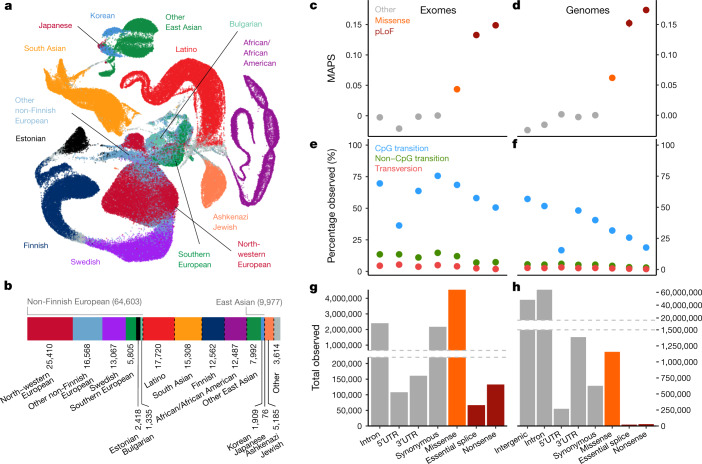
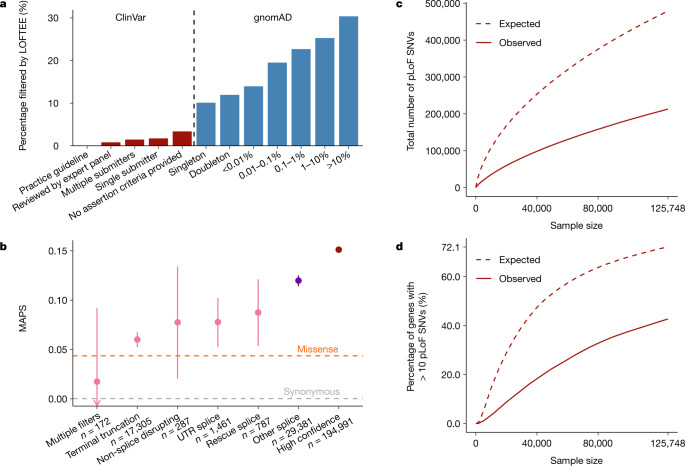
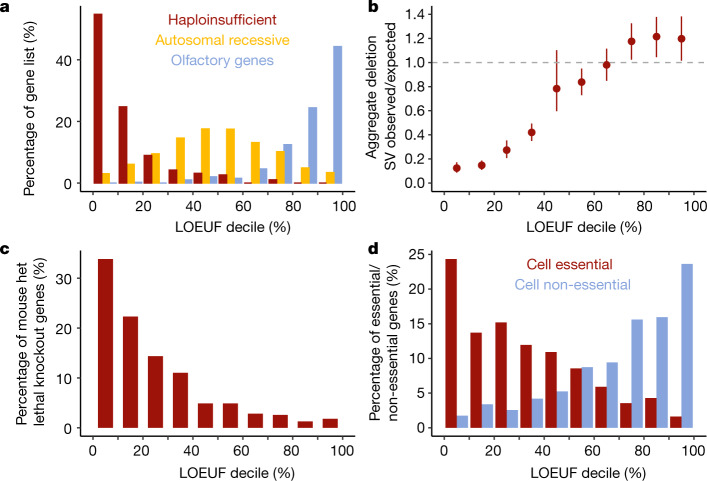
Genetic variants that inactivate protein-coding genes are a powerful source of information about the phenotypic consequences of gene disruption: genes that are crucial for the function of an organism will be depleted of such variants in natural populations, whereas non-essential genes will tolerate their accumulation. However, predicted loss-of-function variants are enriched for annotation errors, and tend to be found at extremely low frequencies, so their analysis requires careful variant annotation and very large sample sizes 1 . Here we describe the aggregation of 125,748 exomes and 15,708 genomes from human sequencing studies into the Genome Aggregation Database (gnomAD). We identify 443,769 high-confidence predicted loss-of-function variants in this cohort after filtering for artefacts caused by sequencing and annotation errors. Using an improved model of human mutation rates, we classify human protein-coding genes along a spectrum that represents tolerance to inactivation, validate this classification using data from model organisms and engineered human cells, and show that it can be used to improve the power of gene discovery for both common and rare diseases.
Overview
The claims and statistics of this paper haven’t been checked yet.
Free: it reads the open-access text and checks the first 5 claims that cite a source we can check. Create a free account to check every claim.
Integrity signals
Registry
Cites
Statistics
Figures
Verification
Claims the paper makes
The claims and statistics of this paper haven’t been checked yet.
Free: it reads the open-access text and checks the first 5 claims that cite a source we can check. Create a free account to check every claim.
Claims other papers make about this one
Each is checked against this paper’s own text: does it say what the citing paper says it does?
The source backs part of the claim, not all of it — or backs it for a different population, condition or comparison.
In the citing paper
“Earlier schizophrenia sequencing studies have established that ultra-rare and de novo mutations contribute to risk as a category, and have prioritized disease-relevant tissues and processes, specifically observing an enrichment in neuronal genes and synaptic processes9,11,19–23.”
From Rare coding variants in ten genes confer substantial risk for schizophrenia (2022) · cites this paper as [23]
Experimental — accuracy not yet measuredThe source backs part of the claim, not all of it — or backs it for a different population, condition or comparison.
In the citing paper
“According to the gnomAD database (Karczewski et al, 2020), the loss-of-function observed/expected upper bound fraction (LOEUF) indicates that SALL4 is depleted of inactivating variants and under purifying selection (LOEUF = 0.101).”
From Structure of SALL4 zinc finger domain reveals link between AT-rich DNA binding and Okihiro syndrome (2023) · cites this paper as Karczewski et al, 2020
Experimental — accuracy not yet measuredThe source backs part of the claim, not all of it — or backs it for a different population, condition or comparison.
In the citing paper
“Based on gnomAD (Karczewski et al. 2020), DOCK4 has a reduced amount of missense and null variants compared to its size of 1,966 amino acids (pLI = 1, Z score = 1.67) in a population without severe, early-onset phenotypes, indicating a mild constraint.”
From Heterozygous loss-of-function variants in DOCK4 cause neurodevelopmental delay and microcephaly (2024) · cites this paper as Karczewski et al. 2020
Experimental — accuracy not yet measuredThe source backs part of the claim, not all of it — or backs it for a different population, condition or comparison.
In the citing paper
“All variants were prioritized considering allele frequency in gnomAD v4.0.0 (Karczewski et al. 2020) below 1%, impact on protein function via different in silico programs (CADD (Rentzsch et al. 2021), REVEL (Ioannidis et al. 2016), MutPred2 (Pejaver et al. 2020) and Metadome (Wiel et al. 2019)) and involvement of candidate genes in neuronal processes.”
From Heterozygous loss-of-function variants in DOCK4 cause neurodevelopmental delay and microcephaly (2024) · cites this paper as Karczewski et al. 2020
Experimental — accuracy not yet measuredThe source backs part of the claim, not all of it — or backs it for a different population, condition or comparison.
In the citing paper
“Owing to the scarcity of reported loss-of-function (LoF) variants, with only 17 cases (allele frequency: ~7E-7) in the Genome Aggregation Database (gnomAD) from healthy subjects100, the WASF1 gene exhibits exceptionally high intolerance to such mutations.”
From The WAVE complex in developmental and adulthood brain disorders (2025) · cites this paper as [100]
Experimental — accuracy not yet measured
20 more claims about this paper
Create a free account to see every claim other papers make about this one.
Self-check
Percentages, sums and reported differences re-computed from the paper’s own numbers.
The self-check needs the paper’s full text.
Citations
Cites
UMAP: Uniform Manifold Approximation and Projection
McInnes, L., Healy, J., Saul, N., & Großberger, L. (2018) · Journal of Open Source Software · doi:10.21105/joss.00861 · Cited by 9,826
Analysis of protein-coding genetic variation in 60,706 humans
Exome Aggregation Consortium, Lek, M., Karczewski, K. J., Minikel, E. V., Samocha, K. E., Banks, E., Fennell, T., O’Donnell-Luria, A. H., Ware, J. S., Hill, A. J., et al. (2016) · Nature · doi:10.1038/nature19057 · Cited by 9,587
Self-citationVan der Auwera, G. A., Carneiro, M. O., Hartl, C., Poplin, R., del Angel, G., Levy‐Moonshine, A., Jordan, T., Shakir, K., Roazen, D., Thibault, J., et al. (2013) · Current Protocols in Bioinformatics · doi:10.1002/0471250953.bi1110s43 · Cited by 6,687
Self-citationGenetic effects on gene expression across human tissues
GTEx Consortium (2017) · Nature · doi:10.1038/nature24277 · Cited by 4,036
Self-citationSequence Variations in PCSK9, Low LDL, and Protection against Coronary Heart Disease
Cohen, J. C., Boerwinkle, E., Mosley, T. H., & Hobbs, H. H. (2006) · New England Journal of Medicine · doi:10.1056/nejmoa054013 · Cited by 3,181
Clinical use of current polygenic risk scores may exacerbate health disparities
Martin, A. R., Kanai, M., Kamatani, Y., Okada, Y., Neale, B. M., & Daly, M. J. (2019) · Nature Genetics · doi:10.1038/s41588-019-0379-x · Cited by 2,821
Self-citationCurrent clinical use of polygenic scores will risk exacerbating health disparities
Martin, A. R., Kanai, M., Kamatani, Y., Okada, Y., Neale, B. M., & Daly, M. J. (2018) · doi:10.1101/441261 · Cited by 2,813
Self-citationPartitioning heritability by functional annotation using genome-wide association summary statistics
ReproGen Consortium, Finucane, H. K., Schizophrenia Working Group of the Psychiatric Genomics Consortium, The RACI Consortium, Bulik-Sullivan, B., Gusev, A., Trynka, G., Reshef, Y., Loh, P.-R., Anttila, V., et al. (2015) · Nature Genetics · doi:10.1038/ng.3404 · Cited by 2,604
Self-citationPatterns and rates of exonic de novo mutations in autism spectrum disorders
Neale, B. M., Kou, Y., Liu, L., Ma’ayan, A., Samocha, K. E., Sabo, A., Lin, C.-F., Stevens, C., Wang, L.-S., Makarov, V., et al. (2012) · Nature · doi:10.1038/nature11011 · Cited by 1,734
Self-citationDe novo mutations in schizophrenia implicate synaptic networks
Fromer, M., Pocklington, A. J., Kavanagh, D. H., Williams, H. J., Dwyer, S., Gormley, P., Georgieva, L., Rees, E., Palta, P., Ruderfer, D. M., et al. (2014) · Nature · doi:10.1038/nature12929 · Cited by 1,617
Self-citation
Cited by
Items 901–1,000 of 1,233
Sevim Bayrak, C., Stein, D., Jain, A., Chaudhary, K., Nadkarni, G. N., Van Vleck, T. T., Puel, A., Boisson-Dupuis, S., Okada, S., Stenson, P. D., et al. (2021) · The American Journal of Human Genetics · doi:10.1016/j.ajhg.2021.10.007 · Cited by 53
Immunogenicity of Anti-SARS-CoV-2 Vaccines in Common Variable Immunodeficiency
Arroyo‐Sánchez, D., Cabrera-Marante, Ó., Laguna‐Goya, R., Almendro-Vázquez, P., Carretero, O., Gil‐Etayo, F. J., Suàrez-Fernández, P., Pérez‐Romero, P., de Frías, E. R., Serrano, A., et al. (2021) · Journal of Clinical Immunology · doi:10.1007/s10875-021-01174-5 · Cited by 64
Prevalence of Fabry disease-causing variants in the UK Biobank
Gilchrist, M., Casanova, F., Tyrrell, J., Cannon, S. J., Wood, A. R., Fife, N., Young, K., Oram, R. A., & Weedon, M. N. (2022) · Journal of Medical Genetics · doi:10.1136/jmg-2022-108523 · Cited by 64
TP53 mutations in functional corticotroph tumors are linked to invasion and worse clinical outcome
Perez‐Rivas, L. G., Simon, J., Albani, A., Tang, S., Roeber, S., Assié, G., Deutschbein, T., Faßnacht, M., Gadelha, M. R., Hermus, A. R., et al. (2022) · Acta Neuropathologica Communications · doi:10.1186/s40478-022-01437-1 · Cited by 65
“714 in Latino/admixed American in gnomAD [31]) without any association with clinical features [50].”
BackgroundMethodCalmodulin Mutations in Human Disease
Hussey, J. W., Limpitikul, W. B., & Dick, I. E. (2023) · Channels · doi:10.1080/19336950.2023.2165278 · Cited by 65
“D3N 3 Uncertain Gnomad([75]) 19–47109087-G-A Benign tolerated T6S 2 Uncertain Gnomad([75]) 2–47397890-G-C Benign tolerated I10T 3 Uncertain Gnomad([75]) 14–90866433-A-G Benign deleterious I10V 1 Uncertain Gnomad([75]) 19–47109109-T-C Benign tolerated K14E 2 Uncertain Gnomad([75]) 2–47389796-T-C Benign deleterious K14R…”
BackgroundPharmacogenomics Beyond Single Common Genetic Variants: The Way Forward
Lauschke, V. M., Zhou, Y., & Ingelman‐Sundberg, M. (2023) · The Annual Review of Pharmacology and Toxicology · doi:10.1146/annurev-pharmtox-051921-091209 · Cited by 65
Meiotic DNA breaks drive multifaceted mutagenesis in the human germ line
Hinch, R., Donnelly, P., & Hinch, A. G. (2023) · Science · doi:10.1126/science.adh2531 · Cited by 64
“We used whole-genome polymorphism data provided by gnomAD, comprising over 70,000 genomes from several global populations (45).”
MethodFigueroa, K. P., Groß, C., Buena‐Atienza, E., Paul, S., Gandelman, M., Kakar, N., Sturm, M., Casadei, N., Admard, J., Park, J., et al. (2024) · Nature Genetics · doi:10.1038/s41588-024-01719-5 · Cited by 64
“In a stringent multisample analysis, we searched for potential protein-altering variants with a minor allele frequency (MAF) < 0.1% in both gnomAD 38 and an in-house database (>20,000 exome and genome sequencing datasets from unrelated phenotypes).”
InfluentialCRISPR activation for SCN2A-related neurodevelopmental disorders
Tamura, S., Nelson, A. D., Spratt, P. W. E., Hamada, E. C., Zhou, X., Kyoung, H., Li, Z., Arnould, C., Barskyi, V., Krupkin, B., et al. (2025) · Nature · doi:10.1038/s41586-025-09522-w · Cited by 65
Accurate somatic small variant discovery for multiple sequencing technologies with DeepSomatic
Park, J., Cook, D. E., Chang, P.-C., Kolesnikov, A., Brambrink, L., Mier, J. C., Gardner, J. M. V., McNulty, B., Sacco, S., Keşküş, A. G., et al. (2025) · Nature Biotechnology · doi:10.1038/s41587-025-02839-x · Cited by 64
“On FFPE WES data, within a limited benchmark set of 152 SNV and indel variants, we report 45, 72 and 230 errors (false positives + false negatives) for DeepSomatic’s FFPE_WES model, ClairS and Strelka2, respectively (Fig.”
Self-citationLoss of MANF Causes Childhood-Onset Syndromic Diabetes Due to Increased Endoplasmic Reticulum Stress
Montaser, H., Patel, K. A., Balboa, D., Ibrahim, H., Lithovius, V., Näätänen, A., Chandra, V., Demir, K., Acar, S., Ben-Omran, T., et al. (2021) · Diabetes · doi:10.2337/db20-1174 · Cited by 61
Johansson, P. A., Brattås, P. L., Douse, C. H., Hsieh, P., Adami, A., Pontis, J., Grassi, D., Garza, R., Sozzi, E., Cataldo, R., et al. (2022) · Cell Stem Cell · doi:10.1016/j.stem.2021.09.008 · Cited by 60
Roston, T. M., Wei, J., Guo, W., Li, Y., Zhong, X., Wang, R., Estillore, J. P., Peltenburg, P. J., Rosés‐Noguer, F., Till, J. A., et al. (2021) · JAMA Cardiology · doi:10.1001/jamacardio.2021.4458 · Cited by 64
Baysac, K., Sun, G., Nakano, H., Schmitz, E. G., Cruz, A. C., Fisher, C., Bailey, A. C., Abbott, J. K., Aldave Becerra, J. C., Allenspach, E. J., et al. (2024) · Journal of Allergy and Clinical Immunology · doi:10.1016/j.jaci.2023.08.036 · Cited by 63
Quantifying constraint in the human mitochondrial genome
Lake, N. J., Ma, K., Liu, W., Battle, S. L., Laricchia, K. M., Tiao, G., Puiu, D., Ng, K. K., Cohen, J., Compton, A. G., et al. (2024) · Nature · doi:10.1038/s41586-024-08048-x · Cited by 63
Self-citationYazar, M., & Özbek, P. (2021) · OMICS A Journal of Integrative Biology · doi:10.1089/omi.2020.0141 · Cited by 64
Ten challenges for clinical translation in psychiatric genetics
Derks, E. M., Thorp, J. G., & Gerring, Z. F. (2022) · Nature Genetics · doi:10.1038/s41588-022-01174-0 · Cited by 65
Large-scale rare variant burden testing in Parkinson's disease
Makarious, M. B., Lake, J., Pitz, V., Ye Fu, A., Guidubaldi, J. L., Solsberg, C. W., Bandres-Ciga, S., Leonard, H. L., Kim, J. J., Billingsley, K. J., et al. (2023) · Brain · doi:10.1093/brain/awad214 · Cited by 57
Improved detection of aberrant splicing with FRASER 2.0 and the intron Jaccard index
Scheller, I. F., Lutz, K., Mertes, C., Yépez, V. A., & Gagneur, J. (2023) · The American Journal of Human Genetics · doi:10.1016/j.ajhg.2023.10.014 · Cited by 64
Genetic modifiers of rare variants in monogenic developmental disorder loci
Kingdom, R., Beaumont, R. N., Wood, A. R., Weedon, M. N., & Wright, C. F. (2024) · Nature Genetics · doi:10.1038/s41588-024-01710-0 · Cited by 64
“We identified carriers of rare (allele count ≤ 5) pLoF 33 or deleterious missense (REVEL > 0.7) 34 variants in any of 599 genes from the Developmental Disorders Geneotype-to-Phenotype Database (DDG2P; Supplementary Table 1) 22,35 in which damaging rare variants are a known cause of autosomal…”
InfluentialIn vivo base editing extends lifespan of a humanized mouse model of prion disease
An, M., Davis, J. R., Levy, J. M., Serack, F. E., Harvey, J. W., Brauer, P. P., Pirtle, C. P., Berríos, K. N., Newby, G. A., Yeh, W.-H., et al. (2025) · Nature Medicine · doi:10.1038/s41591-024-03466-w · Cited by 66
“Furthermore, humans with heterozygous R1058H CNTNAP1 exist in the global population at a frequency of 1/20,000 while it is further enriched https://doi.org/10.1038/s41591-024-03466-w in the South Asian population to 1/10,000 in the gnomAD database 40,41 .”
InfluentialSelf-citationRowe, C. A., & Wright, C. F. (2019) · Journal of Community Genetics · doi:10.1007/s12687-019-00443-6 · Cited by 64
Synaptic processes and immune-related pathways implicated in Tourette syndrome
Tsetsos, F., Yu, D., Sul, J. H., Huang, A. Y., Illmann, C., Osiecki, L., Darrow, S. M., Hirschtritt, M. E., Greenberg, E., Müller‐Vahl, K., et al. (2021) · Translational Psychiatry · doi:10.1038/s41398-020-01082-z · Cited by 63
Self-citationAlcohol use and cardiometabolic risk in the UK Biobank: A Mendelian randomization study
Lankester, J., Zanetti, D., Ingelsson, E., & Assimes, T. L. (2021) · PLoS ONE · doi:10.1371/journal.pone.0255801 · Cited by 63
“We included all non-related individuals of European descent (for sample independence and to avoid population stratification) in the UK Biobank for our MR analyses.”
InfluentialQuantifying constraint in the human mitochondrial genome
Lake, N. J., Liu, W., Battle, S. L., Laricchia, K. M., Tiao, G., Puiu, D., Compton, A. G., Cowie, S., Christodoulou, J., Thorburn, D. R., et al. (2022) · doi:10.1101/2022.12.16.520778 · Cited by 63
Self-citationSaturation genome editing maps the functional spectrum of pathogenic VHL alleles
Buckley, M., Terwagne, C., Ganner, A., Cubitt, L., Brewer, R., Kim, D.-K., Kajba, C. M., Forrester, N., Dace, P., De Jonghe, J., et al. (2024) · Nature Genetics · doi:10.1038/s41588-024-01800-z · Cited by 62
“For example, among n = 119 SNVs seen at least five times in total across the UK Biobank (UKB) 38 , gnomAD 39 and TOPMed 40 databases, no SNV scored below −0.40 (mean = −0.03, s.d. = 0.14).”
InfluentialTACI deficiency — a complex system out of balance
Salzer, U., & Grimbacher, B. (2021) · Current Opinion in Immunology · doi:10.1016/j.coi.2021.06.004 · Cited by 62
FIVEx: an interactive eQTL browser across public datasets
Kwong, A. M., Boughton, A. P., Wang, M., VandeHaar, P., Boehnke, M., Abecasis, G. R., & Kang, H. M. (2021) · Bioinformatics · doi:10.1093/bioinformatics/btab614 · Cited by 62
Self-citationRoyer‐Bertrand, B., Cisarova, K. V., Niel, F., Mittaz‐Crettol, L., Fodstad, H., & Superti‐Furga, A. (2021) · Genes · doi:10.3390/genes12091427 · Cited by 62
Diagnostic yield and clinical relevance of expanded genetic testing for cancer patients
Ceyhan‐Birsoy, O., Jayakumaran, G., Kemel, Y. M., Misyura, M., Aypar, U., Jairam, S., Yang, C., Li, Y., Mehta, N. N., Maio, A., et al. (2022) · Genome Medicine · doi:10.1186/s13073-022-01101-2 · Cited by 63
“All variants with < 1% population frequency in the Genome Aggregation Database (gnomAD) [27] were reviewed and interpreted.”
Lee, J., Lee, J., Jeon, S., Lee, J.-H., Jang, I., Yang, J. O., Park, S., Lee, B.-W., Choi, J., Choi, B., et al. (2022) · Experimental & Molecular Medicine · doi:10.1038/s12276-022-00871-4 · Cited by 63
Self-citationOliveira, T. C. D., Secolin, R., & Lopes‐Cendes, Í. (2023) · Frontiers in Genetics · doi:10.3389/fgene.2023.1091269 · Cited by 62
“The use of human genomic data has grown in recent decades, generating unique knowledge about the biology of different populations (1000 Genomes Project Consortium et al., 2015; Mallick et al., 2016; Karczewski et al., 2020).”
BackgroundHigh-dimensional phenotyping to define the genetic basis of cellular morphology
Tegtmeyer, M., Arora, J., Asgari, S., Cimini, B. A., Nadig, A., Peirent, E. R., Liyanage, D., Way, G. P., Weisbart, E., Nathan, A., et al. (2024) · Nature Communications · doi:10.1038/s41467-023-44045-w · Cited by 60
Self-citationSun, Q., Rowland, B., Chen, J. C., Mikhaylova, A. V., Avery, C. L., Peters, U., Lundin, J. I., Matise, T. C., Buyske, S. G., Tao, R., et al. (2024) · Nature Communications · doi:10.1038/s41467-024-45135-z · Cited by 63
Barbitoff, Y. A., Николаевна, Х. Д., Pomerantseva, E. A., Slepchenkov, A. V., Zubashenko, N. A., Миронова, И. В., Kaimonov, V., Polev, D. E., Tsay, V. V., Glotov, A. S., et al. (2024) · National Science Review · doi:10.1093/nsr/nwae326 · Cited by 65
“…significant advances of our ability to assess variant effects came from global rese-quencing projects such as 10 0 0 Genomes project [4 ], the Exome Aggregation Consortium (E x AC, [5 ]), Genome Aggregation Database (gnomAD, [6 ]), and National Heart, Blood, and Lung Institute (NHLBI) TopMed [7 ].”
BackgroundSzot, J. O., Campagnolo, C., Cao, Y., Iyer, K. R., Cuny, H., Drysdale, T. A., Flores-Daboub, J. A., Bi, W., Westerfield, L. E., Liu, P., et al. (2019) · The American Journal of Human Genetics · doi:10.1016/j.ajhg.2019.12.006 · Cited by 62
Friederich, M. W., Elias, A. F., Küster, A., Laugwitz, L., Larson, A. A., Landry, A. P., Ellwood-Digel, L., Mirsky, D. M., Dimmock, D., Haven, J., et al. (2020) · Journal of Inherited Metabolic Disease · doi:10.1002/jimd.12232 · Cited by 62
Tissue-specific genetic features inform prediction of drug side effects in clinical trials
Duffy, Á., Verbanck, M., Dobbyn, A. L., Won, H., Rein, J. L., Forrest, I. S., Nadkarni, G. N., Rocheleau, G., & Do, R. (2020) · Science Advances · doi:10.1126/sciadv.abb6242 · Cited by 62
den Hoed, J., de Boer, E., Voisin, N., Dingemans, A. J. M., Guex, N., Wiel, L., Nellåker, C., Amudhavalli, S. M., Banka, S., Béna, F., et al. (2021) · The American Journal of Human Genetics · doi:10.1016/j.ajhg.2021.01.007 · Cited by 62
DIAPH1 Variants in Non–East Asian Patients With Sporadic Moyamoya Disease
Kundishora, A. J., Peters, S. T., Pinard, A., Durán, D., Panchagnula, S., Barak, T., Miyagishima, D. F., Dong, W., Smith, H. L., Ocken, J., et al. (2021) · JAMA Neurology · doi:10.1001/jamaneurol.2021.1681 · Cited by 63
Indexing All Life’s Known Biological SequencesPreprint
Karasikov, M., Mustafa, H., Danciu, D., Zimmermann, M., Barber, C., Rätsch, G., & Kahles, A. (2020) · bioRxiv (Cold Spring Harbor Laboratory) · doi:10.1101/2020.10.01.322164 · Cited by 62
“…present in the raw data and how this affects alignment sensitivity relative to classical linear alignment tools, we re-aligned raw reads from 10 randomly picked GTEx samples [34] back to a graph index containing all GTEx sequences as well as genomic variation present in the gnomAD database [29].”
BackgroundInfluentialSaturation Genome Editing Resolves the Functional Spectrum of Pathogenic VHL Alleles
Buckley, M., Kajba, C. M., Forrester, N., Terwagne, C., Sawyer, C., Shepherd, S. T. C., Jonghe, J. D., Dace, P., Turajlic, S., & Findlay, G. M. (2023) · doi:10.1101/2023.06.10.542698 · Cited by 62
Tissue-specific genes as an underutilized resource in drug discovery
Ryaboshapkina, M., & Hammar, M. (2019) · Scientific Reports · doi:10.1038/s41598-019-43829-9 · Cited by 62
Ward, L. D., Tu, H.-C., Quenneville, C. B., Tsour, S., Flynn-Carroll, A. O., Parker, M. M., Deaton, A. M., Haslett, P. A. J., Lotta, L. A., Verweij, N., et al. (2021) · Nature Communications · doi:10.1038/s41467-021-24563-1 · Cited by 59
“Concealed cardiomyopathy” as a cause of previously unexplained sudden cardiac arrest
Isbister, J. C., Nowak, N., Butters, A., Yeates, L., Gray, B. R., Sy, R. W., Ingles, J., Bagnall, R. D., & Semsarian, C. (2020) · International Journal of Cardiology · doi:10.1016/j.ijcard.2020.09.031 · Cited by 61
Structural genetics of circulating variants affecting the SARS-CoV-2 spike/human ACE2 complex
Ortuso, F., Mercatelli, D., Guzzi, P. H., & Giorgi, F. M. (2021) · Journal of Biomolecular Structure and Dynamics · doi:10.1080/07391102.2021.1886175 · Cited by 61
Xiao, Q., & Lauschke, V. M. (2021) · npj Genomic Medicine · doi:10.1038/s41525-021-00203-x · Cited by 62
Implication of Heterozygous Variants in Genes of the Leptin–Melanocortin Pathway in Severe Obesity
Courbage, S., Poitou, C., Beyec, J. L., Karsenty, A., Lemale, J., Pelloux, V., Lacorte, J., Carel, J., Lecomte, N., Storey, C., et al. (2021) · The Journal of Clinical Endocrinology & Metabolism · doi:10.1210/clinem/dgab404 · Cited by 61
Alder, J. K., Sutton, R. M., Iasella, C. J., Nouraie, M. S., Koshy, R., Hannan, S. J., Chan, E. G., Chen, X., Zhang, Y., Brown, M. J., et al. (2021) · The Journal of Heart and Lung Transplantation · doi:10.1016/j.healun.2021.11.008 · Cited by 61
Li, L., Chen, Z., von Scheidt, M., Li, S., Steiner, A., Güldener, U., Koplev, S., Ma, A., Hao, K., Pan, C., et al. (2022) · Basic Research in Cardiology · doi:10.1007/s00395-022-00917-8 · Cited by 61
Self-citationDPP9 deficiency: An inflammasomopathy that can be rescued by lowering NLRP1/IL-1 signaling
Harapas, C. R., Robinson, K. S., Lay, K., Wong, J., Traspas, R. M., Nabavizadeh, N., Raas‐Rothschild, A., Boisson, B., Drutman, S. B., Laohamonthonkul, P., et al. (2022) · Science Immunology · doi:10.1126/sciimmunol.abi4611 · Cited by 61
Greater genetic diversity is needed in human pluripotent stem cell models
Ghosh, S. D., Nehme, R., & Barrett, L. E. (2022) · Nature Communications · doi:10.1038/s41467-022-34940-z · Cited by 61
“…European (blue) and Asian (green) ancestries are reported in human genomic studies, including Bergstrom et al. 2020 (Human Genome Diversity Project (HGDP))37, Karczewski et al. 2020 (gnomAD)38 and Smedley et al. 2021 (100,000 Genomes Pilot)39. b Key recommendations toward expanding hPSCdiversity.”
BackgroundAdua, S. J., Estape, A. A., Zhao, M., Qi, B., Liu, Z. Z., Kravitz, C. J., Hulme, H., Strittmatter, N., López‐Giráldez, F., Chande, S., et al. (2022) · Nature Communications · doi:10.1038/s41467-022-34889-z · Cited by 61
Cargo selection in endoplasmic reticulum–to–Golgi transport and relevant diseases
Tang, V. T., & Ginsburg, D. (2023) · Journal of Clinical Investigation · doi:10.1172/jci163838 · Cited by 62
“gous SEC24B missense variants were reported in 4 of 163 cases of neural tube defects (NTDs) in one study (90), these and other missense variants are present in unaffected individuals in the Genome Aggregation Database (gnomAD) (91), arguing against a significant association of heterozygous SEC24B mutations with NTDs.”
BackgroundPintacuda, G., Hsu, Y.-H. H., Tsafou, K., Li, K. W., Martín, J. M., Riseman, J., Biagini, J. C., Ching, J. K. T., Mena, D., Gonzalez‐Lozano, M. A., et al. (2023) · Cell Genomics · doi:10.1016/j.xgen.2022.100250 · Cited by 61
Świetlik, E. M., Greene, D., Zhu, N., Mégy, K., Cogliano, M., Rajaram, S., Pandya, D., Tilly, T., Lutz, K. A., Welch, C. L., et al. (2020) · Circulation Genomic and Precision Medicine · doi:10.1161/circgen.120.003155 · Cited by 61
Identification of a missense variant in SPDL1 associated with idiopathic pulmonary fibrosis
Dhindsa, R. S., Mattsson, J., Nag, A., Wang, Q., Wain, L. V., Allen, R., Wigmore, E. M., Ibanez, K., Vitsios, D., Deevi, S. V. V., et al. (2021) · Communications Biology · doi:10.1038/s42003-021-01910-y · Cited by 56
Self-citationSASH3variants cause a novel form of X-linked combined immunodeficiency with immune dysregulation
Delmonte, O. M., Bergerson, J., Kawai, T., Kuehn, H. S., McDermott, D. H., Cortese, I. C. M., Zimmermann, M. T., Dobbs, K., Bosticardo, M., Fink, D. L., et al. (2021) · Blood · doi:10.1182/blood.2020008629 · Cited by 61
Clinico-genetic findings in 509 frontotemporal dementia patients
Wagner, M., Lorenz, G., Volk, A. E., Brunet, T., Edbauer, D., Berutti, R., Zhao, C., Anderl‐Straub, S., Bertram, L., Danek, A., et al. (2021) · Molecular Psychiatry · doi:10.1038/s41380-021-01271-2 · Cited by 61
Integrating 730,947 exome sequences with clinical literature improves gene discoveryPreprint
Guez, J., Goodrich, J. K., Moldovan, M. A., Chao, K. R., Kar, P., Panchal, R., Wilson, M. W., Laricchia, K. M., Rohlicek, G., Biba, D., et al. (2026) · medRxiv · doi:10.64898/2026.03.23.26349081 · Cited by 67
“For pLoF variants, we previously developed LOFTEE (Loss-Of-Function Transcript Effect Estimator) 1 to predict which variants trigger nonsense-mediated decay (NMD), which proved instrumental for predicting variants causing loss-of-function, although false positives revealed by manual curation remain…”
InfluentialSelf-citationPilot study of bempegaldesleukin in combination with nivolumab in patients with metastatic sarcoma
D’Angelo, S. P., Richards, A. L., Conley, A. P., Woo, H. J., Dickson, M. A., Gounder, M., Kelly, C., Keohan, M. L., Movva, S., Thornton, K., et al. (2022) · Nature Communications · doi:10.1038/s41467-022-30874-8 · Cited by 60
Self-citationMallack, E. J., Gao, K., Engelen, M., & Kemp, S. (2022) · Cells · doi:10.3390/cells11020283 · Cited by 67
Hack, R. J., Gravesteijn, G., Cerfontaine, M. N., Santcroos, M. A., Gatti, L., Kopczak, A., Bersano, A., Duering, M., Rutten, J. W., & Lesnik Oberstein, S. A. J. (2023) · Brain · doi:10.1093/brain/awac486 · Cited by 60
BiallelicPI4KAvariants cause a novel neurodevelopmental syndrome with hypomyelinating leukodystrophy
Verdura, E., Rodríguez‐Palmero, A., Vélez-Santamaría, V., Planas‐Serra, L., de la Calle, I., Raspall‐Chaure, M., Roubertie, A., Benkirane, M., Saettini, F., Pavinato, L., et al. (2021) · Brain · doi:10.1093/brain/awab124 · Cited by 60
“00031, and the pRec value was 1, indicating that biallelic deleterious variants in this gene are pathogenic.(18) All identified variants were ultra-rare with minor allele frequencies (MAF) 50.”
BackgroundA population-specific reference panel for improved genotype imputation in African Americans
O’Connell, J., Yun, T., Moreno, M. E., Li, H., Litterman, N. K., Kolesnikov, A., Noblin, E. S., Chang, P.-C., Shastri, A. J., Dorfman, E. H., et al. (2021) · Communications Biology · doi:10.1038/s42003-021-02777-9 · Cited by 60
Anticoagulant SERPINs: Endogenous Regulators of Hemostasis and Thrombosis
Grover, S. P., & Mackman, N. (2022) · Frontiers in Cardiovascular Medicine · doi:10.3389/fcvm.2022.878199 · Cited by 60
“Although there have been no reports on individuals with congenital PCI deficiency, available evidence from the whole exome sequencing database gnomAD indicates that predicted loss of function variants are present at the expected frequency (197).”
BackgroundJia, X., Zhang, S., Tan, S., Du, B., He, M. L., Qin, H., Chen, J., Duan, X., Luo, J., Chen, F., et al. (2022) · Science Advances · doi:10.1126/sciadv.abo7112 · Cited by 61
The structure, function, and pharmacology of MRGPRs
Cao, C., & Roth, B. L. (2023) · Trends in Pharmacological Sciences · doi:10.1016/j.tips.2023.02.002 · Cited by 60
Clonal evolution during metastatic spread in high-risk neuroblastoma
Gundem, G., Levine, M. F., Roberts, S. S., Cheung, I. Y., Medina-Martinez, J. S., Feng, Y., Ossa, J. A., Chadoutaud, L., Rita, M., Asimomitis, G., et al. (2023) · Nature Genetics · doi:10.1038/s41588-023-01395-x · Cited by 61
South Asian medical cohorts reveal strong founder effects and high rates of homozygosity
Wall, J. D., Sathirapongsasuti, J. F., Gupta, R. K., Rasheed, A., Radha, V., Belsare, S., Menon, R., Phalke, S., Mittal, A., Fang, J. Z., et al. (2023) · Nature Communications · doi:10.1038/s41467-023-38766-1 · Cited by 62
Self-citationAtrial Fibrillation and Clonal Hematopoiesis in TET2 and ASXL1
Saadatagah, S., Naderian, M., Uddin, M. M., Dikilitas, O., Niroula, A., Schuermans, A., Selvin, E., Hoogeveen, R. C., Matsushita, K., Nambi, V., et al. (2024) · JAMA Cardiology · doi:10.1001/jamacardio.2024.0459 · Cited by 62
Guidance for estimating penetrance of monogenic disease-causing variants in population cohorts
Wright, C. F., Sharp, L. N., Jackson, L. M., Murray, A., Ware, J. S., MacArthur, D. G., Rehm, H. L., Patel, K., & Weedon, M. N. (2024) · Nature Genetics · doi:10.1038/s41588-024-01842-3 · Cited by 61
“Although nonsense and frameshifting variants are usually predicted to result in truncated or absent protein products, in practice, many of these variants evade nonsense-mediated decay and may still produce a functional protein 30,49 .”
Self-citationSpecificity, length and luck drive gene rankings in association studies
Spence, J. P., Mostafavi, H., Ota, M., Milind, N., Gjorgjieva, T., Smith, C. J., Simons, Y. B., Sella, G., & Pritchard, J. K. (2025) · Nature · doi:10.1038/s41586-025-09703-7 · Cited by 61
“As a proxy for μL , we downloaded the expected number of segregating LoFs for each gene as calculated in gnomAD (v2) 79 from ref.”
Hoefflin, R., Lazarou, A., Hess, M. E., Reiser, M., Wehrle, J., Metzger, P., Frey, A. V., Becker, H., Aumann, K., Berner, K., et al. (2021) · Cancers · doi:10.3390/cancers13051151 · Cited by 61
“1% (MAF, minor allele frequency) in the Genome Aggregation Database (gnomAD) [27] are reported.”
BackgroundMarinakis, N. M., Svingou, M., Veltra, D., Kekou, K., Sofocleous, C., Tilemis, F., Kosma, K., Tsoutsou, E., Fryssira, H., & Traeger‐Synodinos, J. (2021) · American Journal of Medical Genetics Part A · doi:10.1002/ajmg.a.62338 · Cited by 60
Findlay, G. M. (2021) · Human Molecular Genetics · doi:10.1093/hmg/ddab219 · Cited by 56
“5% of possible synonymous SNVs occur at all (2).”
PPIL4 is essential for brain angiogenesis and implicated in intracranial aneurysms in humans
Barak, T., Ristori, E., Ercan‐Sencicek, A. G., Miyagishima, D. F., Nelson-Williams, C. J., Dong, W., Jin, S. C., Prendergast, A. E., Armero, W., Henegariu, O., et al. (2021) · Nature Medicine · doi:10.1038/s41591-021-01572-7 · Cited by 61
Choudhury, A., Brandenburg, J., Chikowore, T., Sengupta, D., Boua, P. R., Crowther, N. J., Agongo, G., Asiki, G., Gómez-Olivé, F. X., Kisiangani, I., et al. (2022) · Nature Communications · doi:10.1038/s41467-022-30098-w · Cited by 60
Akbari, A., Barton, A. R., Gazal, S., Li, Z., Kariminejad, M., Perry, A., Zeng, Y., Mittnik, A., Patterson, N. J., Mah, M., et al. (2024) · bioRxiv (Cold Spring Harbor Laboratory) · doi:10.1101/2024.09.14.613021 · Cited by 59
Molecular Diagnosis and Genetic Counseling of Cystic Fibrosis and Related Disorders: New Challenges
Bienvenu, T., Lopez, M., & Girodon, E. (2020) · Genes · doi:10.3390/genes11060619 · Cited by 60
“Data from the general population, globally and in specific population groups, are available on large reference datasets such as gnomAD [65].”
BackgroundGenetic and environmental determinants of diastolic heart function
Thanaj, M., Mielke, J., McGurk, K. A., Bai, W., Savioli, N., de Marvao, A., Meyer, H. V., Zeng, L., Sohler, F., Lumbers, R. T., et al. (2022) · Nature Cardiovascular Research · doi:10.1038/s44161-022-00048-2 · Cited by 59
Self-citationCharacterization of CYP2D6 Pharmacogenetic Variation in Sub‐Saharan African Populations
Twesigomwe, D., Drögemöller, B. I., Wright, G. E. B., Adebamowo, C., Agongo, G., Boua, P. R., Matshaba, M., Paximadis, M., Ramsay, M., Simo, G., et al. (2022) · Clinical Pharmacology & Therapeutics · doi:10.1002/cpt.2749 · Cited by 58
ECFS standards of care on CFTR-related disorders: Diagnostic criteria of CFTR dysfunction
Sermet‐Gaudelus, I., Girodon, E., Vermeulen, F. L., Solomon, G. M., Melotti, P., Graeber, S. Y., Bronsveld, I., Rowe, S. M., Wilschanski, M., Tümmler, B., et al. (2022) · Journal of Cystic Fibrosis · doi:10.1016/j.jcf.2022.09.005 · Cited by 59
Lynall, M.-E., Soskic, B., Hayhurst, J. D., Schwartzentruber, J., Levey, D. F., Pathak, G. A., Polimanti, R. A., Gelernter, J. E., Stein, M. B., Trynka, G., et al. (2022) · Nature Communications · doi:10.1038/s41467-022-33885-7 · Cited by 61
Truncating Variants in RFC1 in Cerebellar Ataxia, Neuropathy, and Vestibular Areflexia Syndrome
Ronco, R., Perini, C., Curró, R., Dominik, N., Facchini, S., Gennari, A., Simone, R., Stuart, S., Nagy, S., Vegezzi, E., et al. (2022) · Neurology · doi:10.1212/wnl.0000000000201486 · Cited by 59
Integrative genetic analysis illuminates ALS heritability and identifies risk genes
Megat, S., Mora, N., Sanogo, J., Roman, O., Catanese, A., Alami, N. O., Freischmidt, A., Mingaj, X., de Calbiac, H., Muratet, F., et al. (2023) · Nature Communications · doi:10.1038/s41467-022-35724-1 · Cited by 59
Comprehensive de novo mutation discovery with HiFi long-read sequencing
Küçük, E., van der Sanden, B. P. G. H., O’Gorman, L., Kwint, M. P., Derks, R. C., Wenger, A. M., Lambert, C. C., Chakraborty, S., Baybayan, P. A., Rowell, W. J., et al. (2023) · Genome Medicine · doi:10.1186/s13073-023-01183-6 · Cited by 58
FH Variant Pathogenicity Promotes Purine Salvage Pathway Dependence in Kidney Cancer
Wilde, B. R., Chakraborty, N., Matulionis, N., Hernandez, S., Ueno, D., Gee, M. E., Esplin, E. D., Ouyang, K., Nykamp, K., Shuch, B. M., et al. (2023) · Cancer Discovery · doi:10.1158/2159-8290.cd-22-0874 · Cited by 60
Causal modelling of gene effects from regulators to programs to traits
Ota, M., Spence, J. P., Zeng, T., Dann, E., Milind, N., Marson, A., & Pritchard, J. K. (2025) · Nature · doi:10.1038/s41586-025-09866-3 · Cited by 60
“One unexpected result from our model was the finding that the effects of program regulators on a trait may be strongly discordant from the effect of program genes on the same trait.”
Emerging Methods and Resources for Biological Interrogation of Neuropsychiatric Polygenic Signal
Uffelmann, E., & Posthuma, D. (2021) · Biological Psychiatry · doi:10.1016/j.biopsych.2020.05.022 · Cited by 56
Literature Review of BARD1 as a Cancer Predisposing Gene with a Focus on Breast and Ovarian Cancers
Alenezi, W. M., Fierheller, C. T., Recio, N., & Tonin, P. N. (2020) · Genes · doi:10.3390/genes11080856 · Cited by 60
“In studies of ≥500 cancer cases, the prevalence of potentially pathogenic BARD1 variants ranged from 0.18–0.53% [11,47], 0.67–0.9% [13,22], and 0.07–0.23% [37,63] in BC, TNBC and OC cases, respectively.”
BackgroundResultInfluentialAdvances in Genomics for Drug Development
Spreafico, R., Soriaga, L. B., Grosse, J., Virgin, H. W., & Telenti, A. (2020) · Genes · doi:10.3390/genes11080942 · Cited by 61
“Here, the analysis centered around the value of knowing the tolerance to mutation or essentiality of a gene for predicting the druggability of a target [10].”
BackgroundHulshof, E. C., Deenen, M. J., Guchelaar, H., & Gelderblom, H. A. J. (2020) · European Journal of Cancer · doi:10.1016/j.ejca.2020.09.007 · Cited by 62
Park, J., Lucas, A. M., Zhang, X., Chaudhary, K., Cho, J. H., Nadkarni, G., Dobbyn, A., Chittoor, G., Josyula, N. S., Katz, N., et al. (2021) · Nature Medicine · doi:10.1038/s41591-020-1133-8 · Cited by 58
Self-citationMotelow, J. E., Povysil, G., Dhindsa, R. S., Stanley, K. E., Allen, A. S., Feng, Y. A., Howrigan, D. P., Abbott, L. E., Tashman, K. C., Cerrato, F. E., et al. (2021) · The American Journal of Human Genetics · doi:10.1016/j.ajhg.2021.04.009 · Cited by 62
Self-citationFilamin C Cardiomyopathy Variants Cause Protein and Lysosome Accumulation
Agarwal, R., Paulo, J. A., Toepfer, C. N., Ewoldt, J. K., Sundaram, S., Chopra, A., Zhang, Q., Gorham, J., DePalma, S. R., Chen, C. S., et al. (2021) · Circulation Research · doi:10.1161/circresaha.120.317076 · Cited by 59
Oncomine™ Comprehensive Assay v3 vs. Oncomine™ Comprehensive Assay Plus
Vestergaard, L. K., Oliveira, D. V. N. P., Poulsen, T. S., Høgdall, C. K., & Høgdall, E. V. S. (2021) · Cancers · doi:10.3390/cancers13205230 · Cited by 60
“Benign and Germline Variant Filtering Considering that samples were not normal- and tumor-matched, we inferred potential germline variants based on “1000 Genomes” and “GnomAD/ExAc” databases [21].”
BackgroundMerkle, F. T., Ghosh, S. D., Genovese, G., Handsaker, R. E., Kashin, S., Meyer, D., Karczewski, K. J., O’Dushlaine, C. T., Pato, C. N., Pato, M. T., et al. (2022) · Cell stem cell · doi:10.1016/j.stem.2022.01.011 · Cited by 59
“, 2014), and genes in which inactivating heterozygous mutations are under strong negative selective pressure and are therefore likely to cause dominant disease as identified using the loss-of-function observed/expected upper bound fraction (LOEUF) metric from studies of human genome variation (Karczewski et al., 2020).”
BackgroundSelf-citationThe Next 500 Years: Engineering Life to Reach New Worlds
Mason, C. E. (2021) · The MIT Press eBooks · doi:10.7551/mitpress/12585.001.0001 · Cited by 60
Coyote-Maestas, W., Nedrud, D., He, Y., & Schmidt, D. (2022) · eLife · doi:10.7554/elife.76903 · Cited by 56
Metadata
- Authors
- Karczewski, K. J., Francioli, L. C., Tiao, G., Cummings, B. B., Alföldi, J., Wang, Q., Collins, R. L., Laricchia, K. M., Ganna, A., Birnbaum, D. P., Gauthier, L. D., Brand, H., Solomonson, M., Watts, N. A., Rhodes, D., Singer-Berk, M., England, E. M., Seaby, E. G., Kosmicki, J. A., Walters, R. K., Tashman, K., Farjoun, Y., Banks, E., Poterba, T., Wang, A., Seed, C., Whiffin, N., Chong, J. X., Samocha, K. E., Pierce-Hoffman, E., Zappala, Z., O’Donnell-Luria, A. H., Minikel, E. V., Weisburd, B., Lek, M., Ware, J. S., Vittal, C., Armean, I. M., Bergelson, L., Cibulskis, K., Connolly, K. M., Covarrubias, M., Donnelly, S., Ferriera, S., Gabriel, S., Gentry, J., Gupta, N., Jeandet, T., Kaplan, D., Llanwarne, C., Munshi, R., Novod, S., Petrillo, N., Roazen, D., Ruano-Rubio, V., Saltzman, A., Schleicher, M., Soto, J., Tibbetts, K., Tolonen, C., Wade, G., Talkowski, M. E., Genome Aggregation Database Consortium, Aguilar Salinas, C. A., Ahmad, T., Albert, C. M., Ardissino, D., Atzmon, G., Barnard, J., Beaugerie, L., Benjamin, E. J., Boehnke, M., Bonnycastle, L. L., Bottinger, E. P., Bowden, D. W., Bown, M. J., Chambers, J. C., Chan, J. C., Chasman, D., Cho, J., Chung, M. K., Cohen, B., Correa, A., Dabelea, D., Daly, M. J., Darbar, D., Duggirala, R., Dupuis, J., Ellinor, P. T., Elosua, R., Erdmann, J., Esko, T., Färkkilä, M., Florez, J., Franke, A., Getz, G., Glaser, B., Glatt, S. J., Goldstein, D., Gonzalez, C., Groop, L., Haiman, C., Hanis, C., Harms, M., Hiltunen, M., Holi, M. M., Hultman, C. M., Kallela, M., Kaprio, J., Kathiresan, S., Kim, B.-J., Kim, Y. J., Kirov, G., Kooner, J., Koskinen, S., Krumholz, H. M., Kugathasan, S., Kwak, S. H., Laakso, M., Lehtimäki, T., Loos, R. J. F., Lubitz, S. A., Ma, R. C. W., MacArthur, D. G., Marrugat, J., Mattila, K. M., McCarroll, S., McCarthy, M. I., McGovern, D., McPherson, R., Meigs, J. B., Melander, O., Metspalu, A., Neale, B. M., Nilsson, P. M., O’Donovan, M. C., Ongur, D., Orozco, L., Owen, M. J., Palmer, C. N. A., Palotie, A., Park, K. S., Pato, C., Pulver, A. E., Rahman, N., Remes, A. M., Rioux, J. D., Ripatti, S., Roden, D. M., Saleheen, D., Salomaa, V., Samani, N. J., Scharf, J., Schunkert, H., Shoemaker, M. B., Sklar, P., Soininen, H., Sokol, H., Spector, T., Sullivan, P. F., Suvisaari, J., Tai, E. S., Teo, Y. Y., Tiinamaija, T., Tsuang, M., Turner, D., Tusie-Luna, T., Vartiainen, E., Vawter, M. P., Ware, J. S., Watkins, H., Weersma, R. K., Wessman, M., Wilson, J. G., Xavier, R. J., Neale, B. M., Daly, M. J., & MacArthur, D. G.
- Affiliations
- Broad Institute (US)
- Queen Mary University of London (GB)
- University of Washington (US)
- Wellcome Sanger Institute (GB)
- Yale University (US)
- Peninsula College of Medicine and Dentistry (GB)
- Brigham and Women's Hospital (US)
- University of Parma (IT)
- Albert Einstein College of Medicine (US)
- Cleveland Clinic (US)
- Sorbonne Université (FR)
- Boston University (US)
- University of Michigan (US)
- National Institutes of Health (US)
- Wake Forest University Health Sciences (US)
- University of Leicester (GB)
- Imperial College Healthcare NHS Trust (GB)
- Chinese University of Hong Kong (HK)
- Icahn School of Medicine at Mount Sinai (US)
- Harvard University (US)
- University of Mississippi Medical Center (US)
- Colorado School of Public Health (US)
- University of Illinois Chicago (US)
- Texas Biomedical Research Institute (US)
- German Centre for Cardiovascular Research (DE)
- University of Helsinki (FI)
- SUNY Upstate Medical University (US)
- Columbia University Irving Medical Center (US)
- Lund University (SE)
- The University of Texas Health Science Center at Houston (US)
- Columbia University (US)
- University of Eastern Finland (FI)
- Helsinki University Hospital (FI)
- Karolinska Institutet (SE)
- Korea National Institute of Health (KR)
- Cardiff University (GB)
- Finnish Institute for Health and Welfare (FI)
- Emory University (US)
- Seoul National University (KR)
- Tampere University (FI)
- Centro de Investigación en Red en Enfermedades Cardiovasculares (ES)
- Centre for Human Genetics (GB)
- Cedars-Sinai Medical Center (US)
- Ottawa Heart Institute (CA)
- University of Tartu (EE)
- National Institute of Genomic Medicine (MX)
- University of Dundee (GB)
- University of Southern California (US)
- Johns Hopkins University (US)
- Institute of Cancer Research (GB)
- Oulu University Hospital (FI)
- Montreal Heart Institute (CA)
- Vanderbilt University Medical Center (US)
- Center for Non-Communicable Diseases (PK)
- Deutsches Herzzentrum München (DE)
- Vanderbilt University (US)
- Massachusetts General Hospital (US)
- King's College London (GB)
- University of North Carolina at Chapel Hill (US)
- National University of Singapore (SG)
- University of California San Diego (US)
- Hebrew University of Jerusalem (IL)
- University of California, Irvine (US)
- University of Oxford (GB)
- University Medical Center Groningen (NL)
- Institute for Molecular Medicine Finland (FI)
- Corresponding author
- Karczewski, Konrad J.
- ORCID
- Karczewski, Konrad J.
- Francioli, Laurent C.
- Tiao, Grace
- Cummings, Beryl B.
- Alföldi, Jessica
- Wang, Qingbo
- Collins, Ryan L.
- Laricchia, Kristen M.
- Ganna, Andrea
- Brand, Harrison
- Solomonson, Matthew
- Rhodes, Daniel
- Seaby, Eleanor G.
- Kosmicki, Jack A.
- Walters, Raymond K.
- Tashman, Katherine
- Farjoun, Yossi
- Banks, Eric
- Poterba, Timothy
- Whiffin, Nicola
- Chong, Jessica X.
- Samocha, Kaitlin E.
- Zappala, Zachary
- O’Donnell-Luria, Anne H.
- Minikel, Eric Vallabh
- Weisburd, Ben
- Lek, Monkol
- Armean, Irina M.
- Cibulskis, Kristian
- Donnelly, Stacey
- Gabriel, Stacey
- Gupta, Namrata
- Saltzman, Andrea
- Talkowski, Michael E.
- Ahmad, Tariq
- Albert, Christine M.
- Ardissino, Diego
- Atzmon, Gil
- Barnard, John
- Beaugerie, Laurent
- Benjamin, Emelia J.
- Boehnke, Michael
- Bonnycastle, Lori L.
- Bowden, Donald W.
- Bown, Matthew J.
- Chambers, John C.
- Chan, Juliana C.
- Chasman, Daniel
- Cho, Judy
- Chung, Mina K.
- Cohen, Bruce
- Correa, Adolfo
- Dabelea, Dana
- Darbar, Dawood
- Duggirala, Ravindranath
- Dupuis, Josée
- Ellinor, Patrick T.
- Erdmann, Jeanette
- Esko, Tõnu
- Färkkilä, Martti
- Getz, Gad
- Glatt, Stephen J.
- Goldstein, David
- Groop, Leif
- Hanis, Craig
- Harms, Matthew
- Hiltunen, Mikko
- Holi, Matti M.
- Hultman, Christina M.
- Kallela, Mikko
- Kaprio, Jaakko
- Kathiresan, Sekar
- Kim, Bong-Jo
- Kim, Young Jin
- Kirov, George
- Kooner, Jaspal
- Krumholz, Harlan M.
- Kugathasan, Subra
- Kwak, Soo Heon
- Laakso, Markku
- Lehtimäki, Terho
- Loos, Ruth J. F.
- Lubitz, Steven A.
- Marrugat, Jaume
- McCarroll, Steven
- McCarthy, Mark I.
- McGovern, Dermot
- McPherson, Ruth
- Meigs, James B.
- Melander, Olle
- Metspalu, Andres
- Nilsson, Peter M.
- O’Donovan, Michael C.
- Orozco, Lorena
- Owen, Michael J.
- Palmer, Colin N. A.
- Palotie, Aarno
- Park, Kyong Soo
- Pato, Carlos
- Rahman, Nazneen
- Rioux, John D.
- Ripatti, Samuli
- Roden, Dan M.
- Saleheen, Danish
- Salomaa, Veikko
- Samani, Nilesh J.
- Scharf, Jeremiah
- Schunkert, Heribert
- Shoemaker, Moore B.
- Sklar, Pamela
- Soininen, Hilkka
- Sokol, Harry
- Spector, Tim
- Sullivan, Patrick F.
- Suvisaari, Jaana
- Tai, E. Shyong
- Tsuang, Ming
- Turner, Dan
- Vartiainen, Erkki
- Vawter, Marquis P.
- Watkins, Hugh
- Weersma, Rinse K.
- Wilson, James G.
- Xavier, Ramnik J.
- Venue
- Nature
- Published
- 2020-05-27
- Volume
- 581
- Issue
- 7809
- Pages
- 434-443
- ISSN
- 0028-0836 (ISSN-L)
- 1476-4687
- PMC
- PMC7334197
- OpenAlex
- W3029661147
- Cited by
- 9,434
- References
- 51
- Citations by year
- 2026: 1027 · 2025: 1275 · 2024: 1531 · 2023: 1631 · 2022: 1774 · 2021: 1613 · 2020: 573
- FWCI
- 833.03
- Type
- journal article
- Language
- en
- Update notices
- Open access
- hybrid
- doi.org
- Licence
- cc-by
- creativecommons.org/licenses/by/4.0 (tdm)
- creativecommons.org/licenses/by/4.0 (vor)
- Locations
- Nature (publishedVersion, cc-by)
- PubMed Central (publishedVersion, cc-by)
- PubMed (publishedVersion)
- University of Groningen research database (University of Groningen / Centre for Information Technology) (publishedVersion, cc-by)
- National University of Singapore (submittedVersion, cc-by)
- HAL (submittedVersion)
- Discovery Research Portal (University of Dundee) (submittedVersion, other-oa)
- ePrints Soton (University of Southampton) (submittedVersion)
- Työväentutkimus Vuosikirja (submittedVersion)
- Lund University Publications (Lund University) (submittedVersion)
- Spiral (Imperial College London) (submittedVersion, cc-by)
- Tampere University Institutional Repository (Tampere University) (submittedVersion, cc-by)
- Funders
- National Science Foundation
- Sanofi
- Massachusetts General Hospital
- BioMarin Pharmaceutical
- Wellcome Trust (107469/Z/15/Z)
- Broad Institute
- British Heart Foundation (RG/18/10/33842, CS/14/2/30841)
- University of Oxford
- Rosetrees Trust
- Schweizerischer Nationalfonds zur Förderung der Wissenschaftlichen Forschung (177853)
- Rijksuniversiteit Groningen
- Hebrew University of Jerusalem
- Samfundet Folkhälsan
- Universitair Medisch Centrum Groningen
- National Institutes of Health (MH115957, HG006493, UL1TR001863)
- University of California, San Diego
- University of California, Irvine
- Sanofi Genzyme
- Instituto de Investigaciones Biomédicas, Universidad Nacional Autónoma de México
- National Institute on Aging
- National Heart, Lung, and Blood Institute (HG006493)
- National Institute of Mental Health (R01MH085548, R56MH115957, MH115957, R01MH115957)
- National Human Genome Research Institute (HG006493, HG008956, HG008900, UM1HG008900, phs000178, UM1HG006493, U24HG008956, T32HG002295)
- National Cancer Institute
- National Institute of General Medical Sciences (F32GM115208, R01GM104371, GM115208)
- National Institute of Diabetes and Digestive and Kidney Diseases (U54DK105566)
- National Center for Advancing Translational Sciences
- Eunice Kennedy Shriver National Institute of Child Health and Human Development (HD081256, R01HD081256)
- Common Fund
- Topics
- Life Sciences › Biochemistry, Genetics and Molecular Biology › Genetics › Genomics and Rare Diseases
- Life Sciences › Biochemistry, Genetics and Molecular Biology › Genetics › Genetic Associations and Epidemiology
- Life Sciences › Biochemistry, Genetics and Molecular Biology › Genetics › Evolution and Genetic Dynamics
- Keywords
- loss-of-function mutations, protein-coding genes, gene essentiality, disease gene discovery, rare diseases, common diseases
- MeSH terms
- Proprotein Convertase 9, Whole Genome Sequencing, Exome Sequencing, Loss of Function Mutation, Adult, Brain, Cardiovascular Diseases, Female, Humans, Male, RNA, Messenger, Genetic Variation, Reproducibility of Results, Cohort Studies, Genome, Human, Genetic Predisposition to Disease, Genes, Essential, Databases, Genetic, Genome-Wide Association Study, Exome, Mutation Rate
About these checks
Registry, retraction, Cites and statistics results are computed, not judged, with one exception: a printed reference that no index lists is read once by a model before it counts as a citation error. Claims are extracted by a model and kept only when their quote appears verbatim in the text; each cited source is then checked, with a model’s help, for whether it says what the claim relies on. Those verdicts can be wrong — read the claim’s quote and the cited source before relying on one.
Statistics and arithmetic are recomputed, not judged.
Confidence bands are shown only for fields calibrated on our annotated test set. None is calibrated yet, so no band is shown.
What counts as a claim ›How we measure confidence ›How we check this ›
Are you an author, or do you see a problem with this page? Request a review
Data sources
Bibliographic data: Semantic Scholar, OpenAlex, Crossref.
Contains information from the Semantic Scholar Academic Graph Datasets, made available under the ODC Attribution License (ODC-BY 1.0).
Semantic Scholar’s data is described in: Kinney, R., et al. (2023). The Semantic Scholar Open Data Platform. arXiv:2301.10140.
