

The mutational constraint spectrum quantified from variation in 141,456 humans
Open accessPublished version of a preprint
The DOI matches its Crossref record; 53 of the 53 references it cites were found in a registry or an index.
Abstract
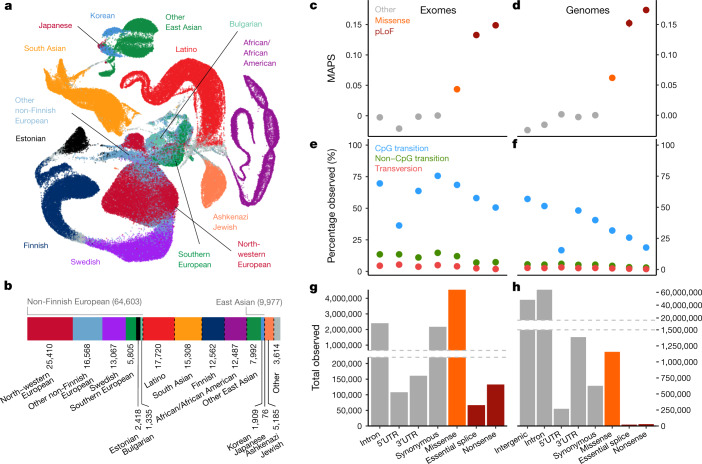
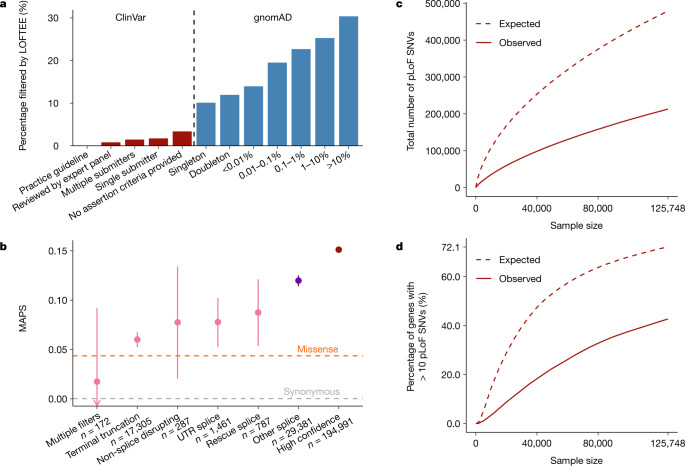
Genetic variants that inactivate protein-coding genes are a powerful source of information about the phenotypic consequences of gene disruption: genes that are crucial for the function of an organism will be depleted of such variants in natural populations, whereas non-essential genes will tolerate their accumulation. However, predicted loss-of-function variants are enriched for annotation errors, and tend to be found at extremely low frequencies, so their analysis requires careful variant annotation and very large sample sizes 1 . Here we describe the aggregation of 125,748 exomes and 15,708 genomes from human sequencing studies into the Genome Aggregation Database (gnomAD). We identify 443,769 high-confidence predicted loss-of-function variants in this cohort after filtering for artefacts caused by sequencing and annotation errors. Using an improved model of human mutation rates, we classify human protein-coding genes along a spectrum that represents tolerance to inactivation, validate this classification using data from model organisms and engineered human cells, and show that it can be used to improve the power of gene discovery for both common and rare diseases.
Overview
The claims and statistics of this paper haven’t been checked yet.
Free: it reads the open-access text and checks the first 5 claims that cite a source we can check. Create a free account to check every claim.
Integrity signals
Registry
Cites
Statistics
Figures
Verification
Claims the paper makes
The claims and statistics of this paper haven’t been checked yet.
Free: it reads the open-access text and checks the first 5 claims that cite a source we can check. Create a free account to check every claim.
Claims other papers make about this one
Each is checked against this paper’s own text: does it say what the citing paper says it does?
The source backs part of the claim, not all of it — or backs it for a different population, condition or comparison.
In the citing paper
“Earlier schizophrenia sequencing studies have established that ultra-rare and de novo mutations contribute to risk as a category, and have prioritized disease-relevant tissues and processes, specifically observing an enrichment in neuronal genes and synaptic processes9,11,19–23.”
From Rare coding variants in ten genes confer substantial risk for schizophrenia (2022) · cites this paper as [23]
Experimental — accuracy not yet measuredThe source backs part of the claim, not all of it — or backs it for a different population, condition or comparison.
In the citing paper
“According to the gnomAD database (Karczewski et al, 2020), the loss-of-function observed/expected upper bound fraction (LOEUF) indicates that SALL4 is depleted of inactivating variants and under purifying selection (LOEUF = 0.101).”
From Structure of SALL4 zinc finger domain reveals link between AT-rich DNA binding and Okihiro syndrome (2023) · cites this paper as Karczewski et al, 2020
Experimental — accuracy not yet measuredThe source backs part of the claim, not all of it — or backs it for a different population, condition or comparison.
In the citing paper
“Based on gnomAD (Karczewski et al. 2020), DOCK4 has a reduced amount of missense and null variants compared to its size of 1,966 amino acids (pLI = 1, Z score = 1.67) in a population without severe, early-onset phenotypes, indicating a mild constraint.”
From Heterozygous loss-of-function variants in DOCK4 cause neurodevelopmental delay and microcephaly (2024) · cites this paper as Karczewski et al. 2020
Experimental — accuracy not yet measuredThe source backs part of the claim, not all of it — or backs it for a different population, condition or comparison.
In the citing paper
“All variants were prioritized considering allele frequency in gnomAD v4.0.0 (Karczewski et al. 2020) below 1%, impact on protein function via different in silico programs (CADD (Rentzsch et al. 2021), REVEL (Ioannidis et al. 2016), MutPred2 (Pejaver et al. 2020) and Metadome (Wiel et al. 2019)) and involvement of candidate genes in neuronal processes.”
From Heterozygous loss-of-function variants in DOCK4 cause neurodevelopmental delay and microcephaly (2024) · cites this paper as Karczewski et al. 2020
Experimental — accuracy not yet measuredThe source backs part of the claim, not all of it — or backs it for a different population, condition or comparison.
In the citing paper
“Owing to the scarcity of reported loss-of-function (LoF) variants, with only 17 cases (allele frequency: ~7E-7) in the Genome Aggregation Database (gnomAD) from healthy subjects100, the WASF1 gene exhibits exceptionally high intolerance to such mutations.”
From The WAVE complex in developmental and adulthood brain disorders (2025) · cites this paper as [100]
Experimental — accuracy not yet measured
20 more claims about this paper
Create a free account to see every claim other papers make about this one.
Self-check
Percentages, sums and reported differences re-computed from the paper’s own numbers.
The self-check needs the paper’s full text.
Citations
Cites
UMAP: Uniform Manifold Approximation and Projection
McInnes, L., Healy, J., Saul, N., & Großberger, L. (2018) · Journal of Open Source Software · doi:10.21105/joss.00861 · Cited by 9,826
Analysis of protein-coding genetic variation in 60,706 humans
Exome Aggregation Consortium, Lek, M., Karczewski, K. J., Minikel, E. V., Samocha, K. E., Banks, E., Fennell, T., O’Donnell-Luria, A. H., Ware, J. S., Hill, A. J., et al. (2016) · Nature · doi:10.1038/nature19057 · Cited by 9,587
Self-citationVan der Auwera, G. A., Carneiro, M. O., Hartl, C., Poplin, R., del Angel, G., Levy‐Moonshine, A., Jordan, T., Shakir, K., Roazen, D., Thibault, J., et al. (2013) · Current Protocols in Bioinformatics · doi:10.1002/0471250953.bi1110s43 · Cited by 6,687
Self-citationGenetic effects on gene expression across human tissues
GTEx Consortium (2017) · Nature · doi:10.1038/nature24277 · Cited by 4,036
Self-citationSequence Variations in PCSK9, Low LDL, and Protection against Coronary Heart Disease
Cohen, J. C., Boerwinkle, E., Mosley, T. H., & Hobbs, H. H. (2006) · New England Journal of Medicine · doi:10.1056/nejmoa054013 · Cited by 3,181
Clinical use of current polygenic risk scores may exacerbate health disparities
Martin, A. R., Kanai, M., Kamatani, Y., Okada, Y., Neale, B. M., & Daly, M. J. (2019) · Nature Genetics · doi:10.1038/s41588-019-0379-x · Cited by 2,821
Self-citationCurrent clinical use of polygenic scores will risk exacerbating health disparities
Martin, A. R., Kanai, M., Kamatani, Y., Okada, Y., Neale, B. M., & Daly, M. J. (2018) · doi:10.1101/441261 · Cited by 2,813
Self-citationPartitioning heritability by functional annotation using genome-wide association summary statistics
ReproGen Consortium, Finucane, H. K., Schizophrenia Working Group of the Psychiatric Genomics Consortium, The RACI Consortium, Bulik-Sullivan, B., Gusev, A., Trynka, G., Reshef, Y., Loh, P.-R., Anttila, V., et al. (2015) · Nature Genetics · doi:10.1038/ng.3404 · Cited by 2,604
Self-citationPatterns and rates of exonic de novo mutations in autism spectrum disorders
Neale, B. M., Kou, Y., Liu, L., Ma’ayan, A., Samocha, K. E., Sabo, A., Lin, C.-F., Stevens, C., Wang, L.-S., Makarov, V., et al. (2012) · Nature · doi:10.1038/nature11011 · Cited by 1,734
Self-citationDe novo mutations in schizophrenia implicate synaptic networks
Fromer, M., Pocklington, A. J., Kavanagh, D. H., Williams, H. J., Dwyer, S., Gormley, P., Georgieva, L., Rees, E., Palta, P., Ruderfer, D. M., et al. (2014) · Nature · doi:10.1038/nature12929 · Cited by 1,617
Self-citation
Cited by
Items 401–500 of 1,234
Álvarez-Quilón, A., Wojtaszek, J. L., Mathieu, M., Patel, T., Appel, C. D., Hustedt, N., Rossi, S. E., Wallace, B. D., Setiaputra, D., Adam, S., et al. (2020) · Molecular Cell · doi:10.1016/j.molcel.2020.05.021 · Cited by 122
DNA Mismatch Repair and its Role in Huntington’s Disease
Iyer, R. R., & Pluciennik, A. (2021) · Journal of Huntington s Disease · doi:10.3233/jhd-200438 · Cited by 124
“The ratios of observed versus expected genome variants for each of the genes was derived from the gnomAD database [211], and are reflective of how tolerant a gene is to genetic variation.”
MethodThe genetic structure of the Turkish population reveals high levels of variation and admixture
Kars, M. E., Başak, A. N., Onat, O. E., Bilgüvar, K., Choi, J., Itan, Y., Çağlar, C., Palvadeau, R. J., Casanova, J., Cooper, D. N., et al. (2021) · Proceedings of the National Academy of Sciences · doi:10.1073/pnas.2026076118 · Cited by 124
“2019Oct24 tool using the data from dbnsfp35a, which includes PolyPhen-2, SIFT, CADD, and GERP++ scores, gnomAD, 1000GP, the NHBLI GO Exome Sequencing Project (ESP) Exome variant server and GME databases (4, 12, 14, 41, 42).”
MethodConstitutively active SARM1 variants that induce neuropathy are enriched in ALS patients
Bloom, A. J., Mao, X., Strickland, A., Sasaki, Y., Milbrandt, J., & DiAntonio, A. (2022) · Molecular Neurodegeneration · doi:10.1186/s13024-021-00511-x · Cited by 115
Diagnostic guidelines for familial hemophagocytic lymphohistiocytosis revisited
Henter, J., Sieni, E., Eriksson, J. A., Bergsten, E., Myrberg, I. H., Canna, S., Coniglio, M. L., Cron, R. Q., Kernan, K. F., Kumar, A. R., et al. (2024) · Blood · doi:10.1182/blood.2024025077 · Cited by 127
Yuan, K., Longchamps, R. J., Pardiñas, A. F., Yu, M., Chen, T., Lin, S., Chen, Y., Lam, M., Liu, R., Xia, Y., et al. (2024) · Nature Genetics · doi:10.1038/s41588-024-01870-z · Cited by 124
“29 –38, Supplementary Tables 17 and 18, and Supplementary Note).”
InfluentialSelf-citationFriligkou, E., Løkhammer, S., Cabrera‐Mendoza, B., Shen, J., He, J., Deiana, G., Zanoaga, M. D., Asgel, Z., Pilcher, A., Lascio, L. D., et al. (2024) · Nature Genetics · doi:10.1038/s41588-024-01908-2 · Cited by 124
Nassar, A. H., Adib, E., Abou Alaiwi, S., El Zarif, T., Groha, S., Akl, E. W., Nuzzo, P. V., Mouhieddine, T. H., Perea-Chamblee, T., Taraszka, K., et al. (2022) · Cancer Cell · doi:10.1016/j.ccell.2022.08.022 · Cited by 121
Forkhead Transcription Factors in Health and Disease
Herman, L., Todeschini, A., & Veitia, R. A. (2020) · Trends in Genetics · doi:10.1016/j.tig.2020.11.003 · Cited by 122
Accelerated identification of disease-causing variants with ultra-rapid nanopore genome sequencing
Goenka, S. D., Gorzynski, J. E., Shafin, K., Fisk, D. G., Pesout, T., Jensen, T. D., Monlong, J., Chang, P.-C., Baid, G., Bernstein, J. A., et al. (2022) · Nature Biotechnology · doi:10.1038/s41587-022-01221-5 · Cited by 116
Genome-wide analysis of somatic noncoding mutation patterns in cancer
Dietlein, F., Wang, A. B., Fagre, C. R., Tang, A., Besselink, N. J. M., Cuppen, E. P. J. G., Li, C., Sunyaev, S. R., Neal, J. T., & Allen, E. M. V. (2022) · Science · doi:10.1126/science.abg5601 · Cited by 124
Self-citationDeciphering the impact of genomic variation on function
IGVF Consortium, Writing group (ordered by contribution), Engreitz, J. M., Lawson, H. A., Singh, H., Starita, L. M., Hon, G. C., Carter, H., Sahni, N., Reddy, T. E., et al. (2024) · Nature · doi:10.1038/s41586-024-07510-0 · Cited by 88
Self-citationTEAD family transcription factors in development and disease
Currey, L., Thor, S., & Piper, M. (2021) · Development · doi:10.1242/dev.196675 · Cited by 120
Human and mouse essentiality screens as a resource for disease gene discovery
Cacheiro, P., Muñoz-Fuentes, V., Murray, S. A., Dickinson, M. E., Bucan, M., Nutter, L. M. J., Peterson, K. A., Haselimashhadi, H., Flenniken, A. M., Morgan, H., et al. (2020) · Nature Communications · doi:10.1038/s41467-020-14284-2 · Cited by 106
Annotating and prioritizing genomic variants using the Ensembl Variant Effect Predictor—A tutorial
Hunt, S. E., Moore, B., Amode, R., Armean, I. M., Lemos, D., Mushtaq, A., Parton, A., Schuilenburg, H., Szpak, M., Thormann, A., et al. (2021) · Human Mutation · doi:10.1002/humu.24298 · Cited by 120
“Allele frequencies from the Genome Aggregation Database (gnomAD; Karczewski et al., 2020) and 1000 Genomes Project (1000 Genomes Project Consortium et al., 2015) are currently available.”
BackgroundSelf-citationHanssen, F., Garcia, M., Folkersen, L., Pedersen, A., Lescai, F., Jodoin, S., Miller, E., Seybold, M., Wacker, O., Smith, N. H., et al. (2024) · NAR Genomics and Bioinformatics · doi:10.1093/nargab/lqae031 · Cited by 123
CBIPM Genomics Team, Abul-Husn, N. S., Regeneron Genetics Center, Soper, E. R., Odgis, J. A., Cullina, S., Bobo, D., Moscati, A., Rodriguez, J. E., Loos, R. J. F., et al. (2020) · Genome Medicine · doi:10.1186/s13073-019-0691-1 · Cited by 106
Self-citationGPN-MSA: an alignment-based DNA language model for genome-wide variant effect prediction
Benegas, G., Albors, C., Aw, A. J., Ye, C., & Song, Y. S. (2023) · doi:10.1101/2023.10.10.561776 · Cited by 118
“GPN-MSA outperforms other genome-wide variant effect predictors, as well as methods (pLI [33] and hs [34]) specifically designed for gene essentiality prediction (Figure 2g).”
Machine learning enables new insights into genetic contributions to liver fat accumulation
Haas, M. E., Pirruccello, J. P., Friedman, S. N., Wang, M., Emdin, C. A., Ajmera, V. H., Simon, T. G., Homburger, J. R., Guo, X., Budoff, M., et al. (2021) · Cell Genomics · doi:10.1016/j.xgen.2021.100066 · Cited by 118
Self-citationSeabrook, A., Harris, J. E., Velosa, S. B., Kim, E., McInerney-Leo, A. M., Dwight, T., Hockings, J. I., Hockings, N. G., Kirk, J., Leo, P. J., et al. (2020) · The Journal of Clinical Endocrinology & Metabolism · doi:10.1210/clinem/dgaa957 · Cited by 118
Evolution of DNA methylation in the human brain
Jeong, H., Mendizabal, I., Berto, S., Chatterjee, P., Layman, T. S., Usui, N., Toriumi, K., Douglas, C., Singh, D., Huh, I., et al. (2021) · Nature Communications · doi:10.1038/s41467-021-21917-7 · Cited by 119
Accelerating Medicines Partnership: Parkinson's Disease. Genetic Resource
Iwaki, H., Leonard, H. L., Makarious, M. B., Bookman, M., Landin, B., Vismer, D., Casey, B., Gibbs, J. R., Hernandez, D. G., Blauwendraat, C., et al. (2021) · Movement Disorders · doi:10.1002/mds.28549 · Cited by 116
“These variants are known to be enriched in the Ashkenazi Jewish population (AJ).(15) We plotted the AJ reference with the study data sets, and it was indeed overlapped on a cluster of participants, especially those of genetically enriched cohorts (Supplemental Materials).”
Barbitoff, Y. A., Abasov, R., Tvorogova, V. E., Glotov, A. S., & Predeus, A. V. (2022) · BMC Genomics · doi:10.1186/s12864-022-08365-3 · Cited by 96
Cross-Ancestry Investigation of Venous Thromboembolism Genomic Predictors
Thibord, F., Klarin, D. M., Brody, J. A., Chen, M., Levin, M. G., Chasman, D. I., Goode, E. L., Hveem, K., Teder‐Laving, M., Martínez-Pérez, Á., et al. (2022) · Circulation · doi:10.1161/circulationaha.122.059675 · Cited by 119
Self-citationLandmarks of human embryonic development inscribed in somatic mutations
Bizzotto, S., Dou, Y., Ganz, J., Doan, R. N., Kwon, M., Bohrson, C. L., Kim, S. N., Bae, T., Abyzov, A., NIMH Brain Somatic Mosaicism Network, et al. (2021) · Science · doi:10.1126/science.abe1544 · Cited by 117
New Diagnostic Approaches for Undiagnosed Rare Genetic Diseases
Hartley, T., Lemire, G., Kernohan, K. D., Howley, H. E. A., Adams, D. R., & Boycott, K. M. (2020) · Annual Review of Genomics and Human Genetics · doi:10.1146/annurev-genom-083118-015345 · Cited by 117
Immunodeficiency and bone marrow failure with mosaic and germline TLR8 gain of function
Aluri, J., Bach, A., Kaviany, S., Paracatu, L. C., Kitcharoensakkul, M., Walkiewicz, M. A., Putnam, C. D., Shinawi, M. S., Saucier, N., Rizzi, E. M., et al. (2020) · Blood · doi:10.1182/blood.2020009620 · Cited by 119
Defining mitochondrial protein functions through deep multiomic profiling
Rensvold, J. W., Shishkova, E., Sverchkov, Y., Miller, I. J., Cetinkaya, A., Pyle, A., Manicki, M., Brademan, D. R., Alanay, Y., Raiman, J., et al. (2022) · Nature · doi:10.1038/s41586-022-04765-3 · Cited by 112
Modeling Human TBX5 Haploinsufficiency Predicts Regulatory Networks for Congenital Heart Disease
Kathiriya, I. S., Rao, K. S., Iacono, G., Devine, W. P., Blair, A. P., Hota, S. K., Lai, M. H., Garay, B. I., Thomas, R., Gong, H. Z., et al. (2021) · Developmental Cell · doi:10.1016/j.devcel.2020.11.020 · Cited by 116
“mutations of TBX5 are not observed in the genome aggregation database of exomes and genomes from large-scale sequencing projects (Karczewski et al., 2020) and is presumed to cause fetal demise.”
BackgroundValue of systematic genetic screening of patients with amyotrophic lateral sclerosis
Shepheard, S. R., Parker, M. D., Cooper-Knock, J., Verber, N. S., Tuddenham, L., Heath, P., Beauchamp, N., Place, E., Sollars, E. S. A., Turner, M. R., et al. (2021) · Journal of Neurology, Neurosurgery & Psychiatry · doi:10.1136/jnnp-2020-325014 · Cited by 116
TEC Monitoring by Using Satellite Positioning Systems
Jakowski, N. (1996) · elib (German Aerospace Center) · Cited by 117
Genetic regulatory variation in populations informs transcriptome analysis in rare disease
Mohammadi, P., Castel, S. E., Cummings, B. B., Einson, J., Sousa, C., Hoffman, P., Donkervoort, S., Jiang, Z., Mohassel, P., Foley, A. R., et al. (2019) · Science · doi:10.1126/science.aay0256 · Cited by 108
Self-citationHuntington’s Disease Pathogenesis: Two Sequential Components
Hong, E. P., MacDonald, M. E., Wheeler, V. C., Jones, L., Holmans, P., Orth, M., Monckton, D. G., Long, J. D., Kwak, S., Gusella, J. F., et al. (2021) · Journal of Huntington s Disease · doi:10.3233/jhd-200427 · Cited by 116
“rological or neurodegenerative manifestations [57].”
Self-citationBergquist, T., Stenton, S. L., Nadeau, E. A. W., Byrne, A. B., Greenblatt, M. S., Harrison, S. M., Tavtigian, S. V., O’Donnell‐Luria, A., Biesecker, L. G., Radivojac, P., et al. (2025) · Genetics in Medicine · doi:10.1016/j.gim.2025.101402 · Cited by 118
Self-citationBernstein, N., Spencer Chapman, M., Nyamondo, K., Chen, Z., Williams, N., Mitchell, E., Campbell, P. J., Cohen, R. L., & Nangalia, J. (2024) · Nature Genetics · doi:10.1038/s41588-024-01755-1 · Cited by 115
“We used 1000 Genomes, ExAC and gnomAD to remove sequencing artifacts and common germline single-nucleotide polymorphisms (SNPs) 57–59 .”
COVID-19 and Genetic Variants of Protein Involved in the SARS-CoV-2 Entry into the Host Cells
Latini, A., Agolini, E., Novelli, A., Borgiani, P., Giannini, R., Gravina, P., Smarrazzo, A., Dauri, M., Andreoni, M., Rogliani, P., et al. (2020) · Genes · doi:10.3390/genes11091010 · Cited by 114
“The variants frequencies detected in our examined cohort for the BSG and DPP4 genes were not statistically different with respect to the frequencies listed in the GnomAD database [15] for the European non-Finnish population [16].”
ResultThe context-specific role of germline pathogenicity in tumorigenesis
Srinivasan, P., Bandlamudi, C., Jonsson, P., Kemel, Y. M., Chavan, S. S., Richards, A. L., Penson, A. V., Bielski, C. M., Fong, C. J., Syed, A., et al. (2021) · Nature Genetics · doi:10.1038/s41588-021-00949-1 · Cited by 114
Autism risk in offspring can be assessed through quantification of male sperm mosaicism
Breuss, M. W., Antaki, D., George, R. D., Kleiber, M. L., James, K. N., Ball, L., Hong, O., Mitra, I., Yang, X., Wirth, S. A., et al. (2019) · Nature Medicine · doi:10.1038/s41591-019-0711-0 · Cited by 113
Rhapsody: predicting the pathogenicity of human missense variants
Ponzoni, L., Peñaherrera, D. A., Oltvai, Z. N., & Bahar, I. (2020) · Bioinformatics · doi:10.1093/bioinformatics/btaa127 · Cited by 101
Epilepsy Syndromes in the First Year of Life and Usefulness of Genetic Testing for Precision Therapy
Bayat, A., Bayat, M., Rubboli, G., & Møller, R. S. (2021) · Genes · doi:10.3390/genes12071051 · Cited by 98
“For this aim, several factors are taken into consideration: Segregation (as a CNV inherited from a healthy parent is less likely to be disease causing); presence of the CNV in the general population using gnomAD [76] or in affected subjects using gene variant databases such as ClinVar [77]; based on the function of ge…”
MethodGenetic Screening for TLR7 Variants in Young and Previously Healthy Men With Severe COVID-19
Solanich, X., Vargas‐Parra, G., van der Made, C. I., Simons, A., Schuurs-Hoeijmakers, J. H. M., Antolí, A., Valle, J. D., Rocamora-Blanch, G., Setién, F., Esteller, M., et al. (2021) · Frontiers in Immunology · doi:10.3389/fimmu.2021.719115 · Cited by 117
“(Trp933Arg) in patient 13, were not previously reported in our in-house databases nor in the population database gnomAD (15).”
A comprehensive spatio-cellular map of the human hypothalamus
Tadross, J. A., Steuernagel, L., Dowsett, G. K. C., Kentistou, K. A., Lundh, S., Porniece, M., Klemm, P., Rainbow, K., Hvid, H., Kania, K., et al. (2025) · Nature · doi:10.1038/s41586-024-08504-8 · Cited by 112
“Variants were then annotated with the ENSEMBL Variant Effect Predictor (VEP) 64 v.10448 with the ‘everything’ flag and the LOFTEE plugin 65 and prioritized a single MANE v.0.97 or VEP canonical ENSEMBL transcript and most damaging consequence as defined by VEP defaults.”
InfluentialEstimating prevalence for limb-girdle muscular dystrophy based on public sequencing databases
Liu, W., Pajusalu, S., Lake, N. J., Zhou, G., Ioannidis, N. M., Mittal, P., Johnson, N. E., Weihl, C. C., Williams, B. A., Albrecht, D. E., et al. (2019) · Genetics in Medicine · doi:10.1038/s41436-019-0544-8 · Cited by 113
Self-citationRees, E., Creeth, H., Hwu, H., Chen, W. J., Tsuang, M. T., Glatt, S. J., Rey, R., Kirov, G., Walters, J., Holmans, P., et al. (2021) · Nature Communications · doi:10.1038/s41467-021-25532-4 · Cited by 113
Self-citationThe genetic architecture of sporadic and multiple consecutive miscarriage
Laisk, T., Soares, A. L. G., Ferreira, T., Painter, J. N., Censin, J. C., Laber, S., Bacelis, J., Chen, C.-Y., Lepamets, M., Lin, K., et al. (2020) · Nature Communications · doi:10.1038/s41467-020-19742-5 · Cited by 111
Self-citationBergom, C. R., West, C., Higginson, D. S., Abazeed, M. E., Arun, B., Bentzen, S. M., Bernstein, J. L., Evans, J. D., Gerber, N. K., Kerns, S. L., et al. (2019) · International Journal of Radiation Oncology*Biology*Physics · doi:10.1016/j.ijrobp.2019.07.026 · Cited by 111
Wyrwoll, M. J., Temel, Ş. G., Nagirnaja, L., Oud, M. S., Lopes, A. M., van der Heijden, G. W., Heald, J. S., Rotte, N., Wistuba, J., Wöste, M., et al. (2020) · The American Journal of Human Genetics · doi:10.1016/j.ajhg.2020.06.010 · Cited by 112
Cleary, J. M., Raghavan, S., Wu, Q., Li, Y. Y., Spurr, L. F., Gupta, H. V., Rubinson, D. A., Fetter, I. J., Hornick, J. L., Nowak, J. A., et al. (2021) · Cancer Discovery · doi:10.1158/2159-8290.cd-20-1669 · Cited by 116
“0 (61), or were annotated as benign or likely benign in the ClinVar database (doi 10.”
BackgroundSplicing in the Diagnosis of Rare Disease: Advances and Challenges
Lord, J., & Baralle, D. (2021) · Frontiers in Genetics · doi:10.3389/fgene.2021.689892 · Cited by 111
“This likely contributes to the popularity of the Alamut software (Interactive Biosoftware, Rouen, France) in clinical laboratories, which enables the integrated analysis of multiple types of variation by drawing on multiple external sources of data, including gnomAD (Karczewski et al., 2020), ClinVar (Landrum et al.”
MethodLi, Y., Zhou, H., Chen, X., Zheng, Y., Kang, Q., Hao, D., Zhang, L., Song, T., Luo, H., Hao, Y., et al. (2021) · Genomics Proteomics & Bioinformatics · doi:10.1016/j.gpb.2021.09.002 · Cited by 112
“gnomAD3 [42,58], and NyuWa [59] were collected.”
Genomic answers for children: Dynamic analyses of >1000 pediatric rare disease genomes
Cohen, A. S. A., Farrow, E., Abdelmoity, A. T., Alaimo, J. T., Amudhavalli, S. M., Anderson, J. T., Bansal, L. R., Bartik, L. E., Baybayan, P. A., Belden, B., et al. (2022) · Genetics in Medicine · doi:10.1016/j.gim.2022.02.007 · Cited by 111
Bolton, K. L., Chen, D., Corona, R. I., Fu, Z., Murali, R., Köbel, M., Tazi, Y., Cunningham, J. M., Chan, I. C. C., Wiley, B. J., et al. (2022) · Clinical Cancer Research · doi:10.1158/1078-0432.ccr-21-3817 · Cited by 114
“We considered mutations to be true if they: (i) passed at least two variant callers; (ii) were present at a variant allele fraction of greater than 2%; (iii) were present in gNOMAD (25) whole-exome sequencing data with a maximum population frequency of less than 0.”
BackgroundMono- and biallelic variant effects on disease at biobank scale
Heyne, H., Karjalainen, J. M., Karczewski, K. J., Lemmelä, S. M., Zhou, W., FinnGen, Havulinna, A. S., Kurki, M., Rehm, H. L., Palotie, A. V., et al. (2023) · Nature · doi:10.1038/s41586-022-05420-7 · Cited by 111
Self-citationThe Singapore National Precision Medicine Strategy
Wong, E., Bertin, N., Hebrard, M., Tirado-Magallanes, R., Bellis, C., Lim, W. K., Chua, C. Y., Tong, P. M. L., Chua, R., Mak, K. S. W., et al. (2023) · Nature Genetics · doi:10.1038/s41588-022-01274-x · Cited by 111
Self-citationInsights from complex trait fine-mapping across diverse populations
Kanai, M., Ulirsch, J. C., Karjalainen, J., Kurki, M., Karczewski, K. J., Fauman, E., Wang, Q. S., Jacobs, H., Aguet, F., Ardlie, K. G., et al. (2021) · medRxiv · doi:10.1101/2021.09.03.21262975 · Cited by 97
“The pLoF category represents stop-gained, splice site disrupting, and frameshift variants predicted as high-confidence by LOFTEE 69 .”
Self-citationOncoVar: an integrated database and analysis platform for oncogenic driver variants in cancers
Wang, T., Ruan, S., Zhao, X., Shi, X., Teng, H., Zhong, J., You, M., Xia, K., Sun, Z., & Mao, F. (2021) · Nucleic Acids Research · doi:10.1093/nar/gkaa1033 · Cited by 98
“org) have been widely used as a resource for allele frequency estimates in the context of rare disease, which can improve power for disease gene discovery and exploring the biological impact of genetic variation (41,42).”
MethodSeixas, S., & Marques, P. (2021) · The Application of Clinical Genetics · doi:10.2147/tacg.s257511 · Cited by 111
The individual and global impact of copy-number variants on complex human traits
Auwerx, C., Lepamets, M., Sadler, M. C., Patxot, M., Stojanov, M., Baud, D., Mägi, R., Esko, T., Metspalu, A., Milani, L. A., et al. (2022) · The American Journal of Human Genetics · doi:10.1016/j.ajhg.2022.02.010 · Cited by 112
Self-citationVan Hout, C. V., Tachmazidou, I., Backman, J. D., Hoffman, J. X., Ye, B., Pandey, A. K., Gonzaga-Jauregui, C., Khalid, S., Liu, D., Banerjee, N., et al. (2019) · doi:10.1101/572347 · Cited by 110
De novo detection of somatic mutations in high-throughput single-cell profiling data sets
Muyas, F., Sauer, C. M., Valle-Inclán, J. E., Li, R., Rahbari, R., Mitchell, T. J., Hormoz, S., & Cortés-Ciriano, I. (2024) · Nature Biotechnology · doi:10.1038/s41587-023-01863-z · Cited by 109
“Candidate mutations overlapping known RNA-editing sites or single-nucleotide polymorphisms (SNPs) with population frequencies greater than 1% in the gnomAD 25 database are also filtered out.”
Hulshof, E. C., Deenen, M. J., Nijenhuis, M., Soree, B., de Boer‐Veger, N. J., Buunk, A., Houwink, E. J. F., Risselada, A., Rongen, G. A. P. J. M., van Schaik, R. H. N., et al. (2022) · European Journal of Human Genetics · doi:10.1038/s41431-022-01243-2 · Cited by 111
Fan, S., Spence, J. P., Feng, Y., Hansen, M. E. B., Terhorst, J., Beltrame, M. H., Ranciaro, A., Hirbo, J. B., Beggs, W. R., Thomas, N., et al. (2023) · Cell · doi:10.1016/j.cell.2023.01.042 · Cited by 111
Patel, A. P., Wang, M., Fahed, A. C., Mason-Suares, H., Brockman, D., Pelletier, R., Amr, S., Machini, K., Hawley, M., Witkowski, L., et al. (2020) · JAMA Network Open · doi:10.1001/jamanetworkopen.2020.3959 · Cited by 104
Self-citationBreast Cancer Organoids Model Patient-Specific Response to Drug Treatment
Campaner, E., Zannini, A., Santorsola, M., Bonazza, D., Bottin, C., Cancila, V., Tripodo, C., Bortul, M., Zanconati, F., Schoeftner, S., et al. (2020) · Cancers · doi:10.3390/cancers12123869 · Cited by 92
“allele frequency (AF), from whole-exome or whole-genome sequencing of very large numbers of samples into the Genome Aggregation Database (gnomAD) [49], were used to exclude potential germline variants.”
BackgroundGoodrich, J. K., Singer-Berk, M., Son, R., Sveden, A., Wood, J., England, E., Cole, J. B., Weisburd, B., Watts, N., Caulkins, L., et al. (2021) · Nature Communications · doi:10.1038/s41467-021-23556-4 · Cited by 100
Self-citationPhenotypic effects of genetic variants associated with autism
Rolland, T., Cliquet, F., Anney, R., Moreau, C. A., Traut, N., Mathieu, A., Huguet, G., Duan, J., Warrier, V., Portalier, S., et al. (2023) · Nature Medicine · doi:10.1038/s41591-023-02408-2 · Cited by 108
“4 and Methods) 2,25,26 .”
InfluentialNg, B., Cook, S. A., & Schafer, S. (2020) · Experimental & Molecular Medicine · doi:10.1038/s12276-020-00531-5 · Cited by 102
Bi, W. L., Nayak, L., Meredith, D. M., Driver, J., Du, Z., Hoffman, S. E., Li, Y. Y., Lee, E. Q., Beroukhim, R., Rinne, M. L., et al. (2021) · Neuro-Oncology · doi:10.1093/neuonc/noab118 · Cited by 107
Pathogenic SPTBN1 variants cause an autosomal dominant neurodevelopmental syndrome
Cousin, M. A., Creighton, B. A., Breau, K. A., Spillmann, R. C., Torti, E. E., Dontu, S., Tripathi, S., Ajit, D., Edwards, R. J., Afriyie, S., et al. (2021) · Nature Genetics · doi:10.1038/s41588-021-00886-z · Cited by 107
Umeda, M., Ma, J., Huang, B. J., Hagiwara, K., Westover, T., Abdelhamed, S., Barajas, J. M., Thomas, M. E., Walsh, M. P., Song, G., et al. (2022) · Blood Cancer Discovery · doi:10.1158/2643-3230.bcd-21-0160 · Cited by 107
Discovering the drivers of clonal hematopoiesis
Pich, O., Reyes-Salazar, I., Gonzalez-Perez, A., & Lopez-Bigas, N. (2022) · Nature Communications · doi:10.1038/s41467-022-31878-0 · Cited by 96
Jahn, A., Rump, A., Widmann, T. J., Heining, C., Horak, P., Hutter, B., Paramasivam, N., Uhrig, S., Gieldon, L., Drukewitz, S., et al. (2022) · Annals of Oncology · doi:10.1016/j.annonc.2022.07.008 · Cited by 107
Rules and mechanisms governing G protein coupling selectivity of GPCRs
Masuho, I., Kise, R., Gainza, P., Von Moo, E., Li, X., Tany, R., Wakasugi-Masuho, H., Correia, B. E., & Martemyanov, K. A. (2023) · Cell Reports · doi:10.1016/j.celrep.2023.113173 · Cited by 87
“For 284 non-olfactory class A GPCRs in the genome aggregation database (gnomAD) from 141,456 human subjects, 48 we found 13,422 unique MVs with a mean of 50 rare (frequency <2”
An ancestral recombination graph of human, Neanderthal, and Denisovan genomes
Schaefer, N. K., Shapiro, B., & Green, R. E. (2021) · Science Advances · doi:10.1126/sciadv.abc0776 · Cited by 106
Ralph, P. L., Thornton, K., & Kelleher, J. (2020) · Genetics · doi:10.1534/genetics.120.303253 · Cited by 107
ClassifyCNV: a tool for clinical annotation of copy-number variants
Gurbich, T. A., & Ilinsky, V. V. (2020) · Scientific Reports · doi:10.1038/s41598-020-76425-3 · Cited by 106
Chauhan, P. S., Chen, K. Y., Babbra, R. K., Feng, W., Pejovic, N., Nallicheri, A., Harris, P. K. W., Dienstbach, K., Atkocius, A., Maguire, L., et al. (2021) · PLoS Medicine · doi:10.1371/journal.pmed.1003732 · Cited by 106
“0001 in the Genome Aggregation Database (gnomAD) were also filtered out [41].”
MethodAn Integrated Taxonomy for Monogenic Inflammatory Bowel Disease
Bolton, C., Smillie, C. S., Pandey, S., Elmentaite, R., Wei, G., Argmann, C., Aschenbrenner, D., James, K. R., McGovern, D. P. B., Macchi, M., et al. (2022) · Gastroenterology · doi:10.1053/j.gastro.2021.11.014 · Cited by 98
Self-citationA de novo paradigm for male infertility
Oud, M. S., Smits, R., Smith, H. E., Mastrorosa, F. K., Holt, G. S., Houston, B. J., de Vries, P. F., Alobaidi, B., Batty, L. E., Ismail, H., et al. (2022) · Nature Communications · doi:10.1038/s41467-021-27132-8 · Cited by 108
Guiding the global evolution of cytogenetic testing for hematologic malignancies
Akkari, Y. M. N., Baughn, L. B., Dubuc, A. M., Smith, A. C., Mallo, M., Cin, P. D., Díez‐Campelo, M., Gallego, M. S., Granada, I., Haase, D. T., et al. (2022) · Blood · doi:10.1182/blood.2021014309 · Cited by 107
Genetic analysis of right heart structure and function in 40,000 people
Pirruccello, J. P., Achille, P. D., Nauffal, V., Nekoui, M., Friedman, S. F., Klarqvist, M. D. R., Chaffin, M. D., Weng, L.-C. C., Cunningham, J. W., Khurshid, S. S., et al. (2022) · Nature Genetics · doi:10.1038/s41588-022-01090-3 · Cited by 106
Self-citationAmplification is the primary mode of gene-by-sex interaction in complex human traits
Zhu, C., Ming, M. J., Cole, J. M., Edge, M. D., Kirkpatrick, M., & Harpak, A. (2023) · Cell Genomics · doi:10.1016/j.xgen.2023.100297 · Cited by 108
Prokopenko, D., Morgan, S. L., Mullin, K., Hofmann, O., Chapman, B., Kirchner, R., (ADNI), A. D. N. I., Amberkar, S., Wohlers, I., Lange, C., et al. (2021) · Alzheimer's & Dementia · doi:10.1002/alz.12319 · Cited by 105
“encodes Calsyntenin 2, which modulates calcium-mediated postsynaptic signaling in the brain.”
Closing in on Mechanisms of Open Neural Tube Defects
Lee, S., & Gleeson, J. G. (2020) · Trends in Neurosciences · doi:10.1016/j.tins.2020.04.009 · Cited by 105
Genotype–Phenotype Relations in Primary Familial Brain Calcification: Systematic MDSGene Review
Balck, A., Schaake, S., Kuhnke, N., Domingo, A., Madoev, H., Margolesky, J. H., Dobričić, V., Alvarez‐Fischer, D., Laabs, B., Kasten, M., et al. (2021) · Movement Disorders · doi:10.1002/mds.28753 · Cited by 105
Shah, R. A., Asatryan, B., Dabbagh, G. S., Aung, N., Khanji, M. Y., Lopes, L. R., van Duijvenboden, S., Holmes, A. M., Muser, D., Landstrom, A. P., et al. (2022) · Circulation · doi:10.1161/circulationaha.121.058143 · Cited by 106
Meta-analysis fine-mapping is often miscalibrated at single-variant resolution
Kanai, M., Elzur, R., Zhou, W., Zhou, W., Kanai, M., Wu, K.-H., Rasheed, H., Tsuo, K., Hirbo, J. B., Wang, Y., et al. (2022) · Cell Genomics · doi:10.1016/j.xgen.2022.100210 · Cited by 108
Self-citationPredicting Functional Effects of Synonymous Variants: A Systematic Review and Perspectives
Zeng, Z., & Bromberg, Y. (2019) · Frontiers in Genetics · doi:10.3389/fgene.2019.00914 · Cited by 105
Lincoln, S. E., Hambuch, T., Zook, J. M., Bristow, S. L., Hatchell, K., Truty, R., Kennemer, M., Shirts, B. H., Fellowes, A., Chowdhury, S., et al. (2021) · Genetics in Medicine · doi:10.1038/s41436-021-01187-w · Cited by 91
Self-citationSchon, K. R., Horváth, R., Wei, W., Calabrese, C., Tucci, A., Ibáñez, K., Ratnaike, T. E., Pitceathly, R. D. S., Bugiardini, E., Quinlivan, R. C. M., et al. (2021) · BMJ · doi:10.1136/bmj-2021-066288 · Cited by 105
Mirshahi, U. L., Colclough, K., Wright, C. F., Wood, A. R., Beaumont, R. N., Tyrrell, J., Laver, T. W., Stahl, R. C., Golden, A. M., Goehringer, J., et al. (2022) · The American Journal of Human Genetics · doi:10.1016/j.ajhg.2022.09.014 · Cited by 107
New SNCA mutation and structures of α-synuclein filaments from juvenile-onset synucleinopathy
Yang, Y., Garringer, H. J., Shi, Y., Lövestam, S., Peak‐Chew, S., Zhang, X., Kotecha, A., Bacioglu, M., Koto, A., Takao, M., et al. (2023) · Acta Neuropathologica · doi:10.1007/s00401-023-02550-8 · Cited by 105
Applications of long-read sequencing to Mendelian genetics
Mastrorosa, F. K., Miller, D. E., & Eichler, E. E. (2023) · Genome Medicine · doi:10.1186/s13073-023-01194-3 · Cited by 104
“…particular variant and the tolerance to mutation of many of the genes being accessed for the first time are unknown (e.g., there are no pLI [probability of being loss-of-function intolerant] [141] or LOEUF [loss-of-function observed/expected upper bound fraction] [142] scores for duplicate genes).”
BackgroundGenome-wide association study of long COVID
Lammi, V., Nakanishi, T., Jones, S. E., Andrews, S. J., Karjalainen, J. M., Cortés, B., O’Brien, H., Ochoa-Guzmán, A., Fulton‐Howard, B., Broberg, M. E., et al. (2025) · Nature Genetics · doi:10.1038/s41588-025-02100-w · Cited by 105
Data-driven consideration of genetic disorders for global genomic newborn screening programs
Minten, T., Bick, S., Adelson, S. M., Gehlenborg, N., Amendola, L. M., Boemer, F., Coffey, A. J., Encina, N., Ferlini, A., Kirschner, J., et al. (2025) · Genetics in Medicine · doi:10.1016/j.gim.2025.101443 · Cited by 104
Lee, D. S. M., Ghanem, L. R., & Barash, Y. (2020) · Nature Communications · doi:10.1038/s41467-020-14404-y · Cited by 102
Genetic Variation in Enhancers Modifies Cardiomyopathy Gene Expression and Progression
Gacita, A. M., Fullenkamp, D. E., Ohiri, J. C., Pottinger, T. D., Puckelwartz, M. J., Nóbrega, M. A., & McNally, E. M. (2021) · Circulation · doi:10.1161/circulationaha.120.050432 · Cited by 103
TIGER: The gene expression regulatory variation landscape of human pancreatic islets
Alonso, L., Piron, A., Morán, I., Guindo-Martínez, M., Bonàs‐Guarch, S., Atla, G., Miguel-Escalada, I., Royo, R., Puiggròs, M., Garcia-Hurtado, X., et al. (2021) · Cell Reports · doi:10.1016/j.celrep.2021.109807 · Cited by 104
“2 (Karczewski et al., 2020), c) epigenomic marks from islet DNA-methylation sites (Hall et al.”
BackgroundSelf-citationXu, X., Jin, K., Bais, A. S., Zhu, W., Yagi, H., Feinstein, T. N., Nguyen, P. K., Criscione, J. D., Liu, X., Beutner, G., et al. (2022) · Cell stem cell · doi:10.1016/j.stem.2022.03.003 · Cited by 103
Single duplex DNA sequencing with CODEC detects mutations with high sensitivity
Bae, J. H., Liu, R., Roberts, E., Nguyen, E., Tabrizi, S., Rhoades, J., Blewett, T., Xiong, K., Gydush, G., Shea, D., et al. (2023) · Nature Genetics · doi:10.1038/s41588-023-01376-0 · Cited by 104
Metadata
- Authors
- Karczewski, K. J., Francioli, L. C., Tiao, G., Cummings, B. B., Alföldi, J., Wang, Q., Collins, R. L., Laricchia, K. M., Ganna, A., Birnbaum, D. P., Gauthier, L. D., Brand, H., Solomonson, M., Watts, N. A., Rhodes, D., Singer-Berk, M., England, E. M., Seaby, E. G., Kosmicki, J. A., Walters, R. K., Tashman, K., Farjoun, Y., Banks, E., Poterba, T., Wang, A., Seed, C., Whiffin, N., Chong, J. X., Samocha, K. E., Pierce-Hoffman, E., Zappala, Z., O’Donnell-Luria, A. H., Minikel, E. V., Weisburd, B., Lek, M., Ware, J. S., Vittal, C., Armean, I. M., Bergelson, L., Cibulskis, K., Connolly, K. M., Covarrubias, M., Donnelly, S., Ferriera, S., Gabriel, S., Gentry, J., Gupta, N., Jeandet, T., Kaplan, D., Llanwarne, C., Munshi, R., Novod, S., Petrillo, N., Roazen, D., Ruano-Rubio, V., Saltzman, A., Schleicher, M., Soto, J., Tibbetts, K., Tolonen, C., Wade, G., Talkowski, M. E., Genome Aggregation Database Consortium, Aguilar Salinas, C. A., Ahmad, T., Albert, C. M., Ardissino, D., Atzmon, G., Barnard, J., Beaugerie, L., Benjamin, E. J., Boehnke, M., Bonnycastle, L. L., Bottinger, E. P., Bowden, D. W., Bown, M. J., Chambers, J. C., Chan, J. C., Chasman, D., Cho, J., Chung, M. K., Cohen, B., Correa, A., Dabelea, D., Daly, M. J., Darbar, D., Duggirala, R., Dupuis, J., Ellinor, P. T., Elosua, R., Erdmann, J., Esko, T., Färkkilä, M., Florez, J., Franke, A., Getz, G., Glaser, B., Glatt, S. J., Goldstein, D., Gonzalez, C., Groop, L., Haiman, C., Hanis, C., Harms, M., Hiltunen, M., Holi, M. M., Hultman, C. M., Kallela, M., Kaprio, J., Kathiresan, S., Kim, B.-J., Kim, Y. J., Kirov, G., Kooner, J., Koskinen, S., Krumholz, H. M., Kugathasan, S., Kwak, S. H., Laakso, M., Lehtimäki, T., Loos, R. J. F., Lubitz, S. A., Ma, R. C. W., MacArthur, D. G., Marrugat, J., Mattila, K. M., McCarroll, S., McCarthy, M. I., McGovern, D., McPherson, R., Meigs, J. B., Melander, O., Metspalu, A., Neale, B. M., Nilsson, P. M., O’Donovan, M. C., Ongur, D., Orozco, L., Owen, M. J., Palmer, C. N. A., Palotie, A., Park, K. S., Pato, C., Pulver, A. E., Rahman, N., Remes, A. M., Rioux, J. D., Ripatti, S., Roden, D. M., Saleheen, D., Salomaa, V., Samani, N. J., Scharf, J., Schunkert, H., Shoemaker, M. B., Sklar, P., Soininen, H., Sokol, H., Spector, T., Sullivan, P. F., Suvisaari, J., Tai, E. S., Teo, Y. Y., Tiinamaija, T., Tsuang, M., Turner, D., Tusie-Luna, T., Vartiainen, E., Vawter, M. P., Ware, J. S., Watkins, H., Weersma, R. K., Wessman, M., Wilson, J. G., Xavier, R. J., Neale, B. M., Daly, M. J., & MacArthur, D. G.
- Affiliations
- Broad Institute (US)
- Queen Mary University of London (GB)
- University of Washington (US)
- Wellcome Sanger Institute (GB)
- Yale University (US)
- Peninsula College of Medicine and Dentistry (GB)
- Brigham and Women's Hospital (US)
- University of Parma (IT)
- Albert Einstein College of Medicine (US)
- Cleveland Clinic (US)
- Sorbonne Université (FR)
- Boston University (US)
- University of Michigan (US)
- National Institutes of Health (US)
- Wake Forest University Health Sciences (US)
- University of Leicester (GB)
- Imperial College Healthcare NHS Trust (GB)
- Chinese University of Hong Kong (HK)
- Icahn School of Medicine at Mount Sinai (US)
- Harvard University (US)
- University of Mississippi Medical Center (US)
- Colorado School of Public Health (US)
- University of Illinois Chicago (US)
- Texas Biomedical Research Institute (US)
- German Centre for Cardiovascular Research (DE)
- University of Helsinki (FI)
- SUNY Upstate Medical University (US)
- Columbia University Irving Medical Center (US)
- Lund University (SE)
- The University of Texas Health Science Center at Houston (US)
- Columbia University (US)
- University of Eastern Finland (FI)
- Helsinki University Hospital (FI)
- Karolinska Institutet (SE)
- Korea National Institute of Health (KR)
- Cardiff University (GB)
- Finnish Institute for Health and Welfare (FI)
- Emory University (US)
- Seoul National University (KR)
- Tampere University (FI)
- Centro de Investigación en Red en Enfermedades Cardiovasculares (ES)
- Centre for Human Genetics (GB)
- Cedars-Sinai Medical Center (US)
- Ottawa Heart Institute (CA)
- University of Tartu (EE)
- National Institute of Genomic Medicine (MX)
- University of Dundee (GB)
- University of Southern California (US)
- Johns Hopkins University (US)
- Institute of Cancer Research (GB)
- Oulu University Hospital (FI)
- Montreal Heart Institute (CA)
- Vanderbilt University Medical Center (US)
- Center for Non-Communicable Diseases (PK)
- Deutsches Herzzentrum München (DE)
- Vanderbilt University (US)
- Massachusetts General Hospital (US)
- King's College London (GB)
- University of North Carolina at Chapel Hill (US)
- National University of Singapore (SG)
- University of California San Diego (US)
- Hebrew University of Jerusalem (IL)
- University of California, Irvine (US)
- University of Oxford (GB)
- University Medical Center Groningen (NL)
- Institute for Molecular Medicine Finland (FI)
- Corresponding author
- Karczewski, Konrad J.
- ORCID
- Karczewski, Konrad J.
- Francioli, Laurent C.
- Tiao, Grace
- Cummings, Beryl B.
- Alföldi, Jessica
- Wang, Qingbo
- Collins, Ryan L.
- Laricchia, Kristen M.
- Ganna, Andrea
- Brand, Harrison
- Solomonson, Matthew
- Rhodes, Daniel
- Seaby, Eleanor G.
- Kosmicki, Jack A.
- Walters, Raymond K.
- Tashman, Katherine
- Farjoun, Yossi
- Banks, Eric
- Poterba, Timothy
- Whiffin, Nicola
- Chong, Jessica X.
- Samocha, Kaitlin E.
- Zappala, Zachary
- O’Donnell-Luria, Anne H.
- Minikel, Eric Vallabh
- Weisburd, Ben
- Lek, Monkol
- Armean, Irina M.
- Cibulskis, Kristian
- Donnelly, Stacey
- Gabriel, Stacey
- Gupta, Namrata
- Saltzman, Andrea
- Talkowski, Michael E.
- Ahmad, Tariq
- Albert, Christine M.
- Ardissino, Diego
- Atzmon, Gil
- Barnard, John
- Beaugerie, Laurent
- Benjamin, Emelia J.
- Boehnke, Michael
- Bonnycastle, Lori L.
- Bowden, Donald W.
- Bown, Matthew J.
- Chambers, John C.
- Chan, Juliana C.
- Chasman, Daniel
- Cho, Judy
- Chung, Mina K.
- Cohen, Bruce
- Correa, Adolfo
- Dabelea, Dana
- Darbar, Dawood
- Duggirala, Ravindranath
- Dupuis, Josée
- Ellinor, Patrick T.
- Erdmann, Jeanette
- Esko, Tõnu
- Färkkilä, Martti
- Getz, Gad
- Glatt, Stephen J.
- Goldstein, David
- Groop, Leif
- Hanis, Craig
- Harms, Matthew
- Hiltunen, Mikko
- Holi, Matti M.
- Hultman, Christina M.
- Kallela, Mikko
- Kaprio, Jaakko
- Kathiresan, Sekar
- Kim, Bong-Jo
- Kim, Young Jin
- Kirov, George
- Kooner, Jaspal
- Krumholz, Harlan M.
- Kugathasan, Subra
- Kwak, Soo Heon
- Laakso, Markku
- Lehtimäki, Terho
- Loos, Ruth J. F.
- Lubitz, Steven A.
- Marrugat, Jaume
- McCarroll, Steven
- McCarthy, Mark I.
- McGovern, Dermot
- McPherson, Ruth
- Meigs, James B.
- Melander, Olle
- Metspalu, Andres
- Nilsson, Peter M.
- O’Donovan, Michael C.
- Orozco, Lorena
- Owen, Michael J.
- Palmer, Colin N. A.
- Palotie, Aarno
- Park, Kyong Soo
- Pato, Carlos
- Rahman, Nazneen
- Rioux, John D.
- Ripatti, Samuli
- Roden, Dan M.
- Saleheen, Danish
- Salomaa, Veikko
- Samani, Nilesh J.
- Scharf, Jeremiah
- Schunkert, Heribert
- Shoemaker, Moore B.
- Sklar, Pamela
- Soininen, Hilkka
- Sokol, Harry
- Spector, Tim
- Sullivan, Patrick F.
- Suvisaari, Jaana
- Tai, E. Shyong
- Tsuang, Ming
- Turner, Dan
- Vartiainen, Erkki
- Vawter, Marquis P.
- Watkins, Hugh
- Weersma, Rinse K.
- Wilson, James G.
- Xavier, Ramnik J.
- Venue
- Nature
- Published
- 2020-05-27
- Volume
- 581
- Issue
- 7809
- Pages
- 434-443
- ISSN
- 0028-0836 (ISSN-L)
- 1476-4687
- PMC
- PMC7334197
- OpenAlex
- W3029661147
- Cited by
- 9,434
- References
- 51
- Citations by year
- 2026: 1027 · 2025: 1275 · 2024: 1531 · 2023: 1631 · 2022: 1774 · 2021: 1613 · 2020: 573
- FWCI
- 833.03
- Type
- journal article
- Language
- en
- Update notices
- Open access
- hybrid
- doi.org
- Licence
- cc-by
- creativecommons.org/licenses/by/4.0 (tdm)
- creativecommons.org/licenses/by/4.0 (vor)
- Locations
- Nature (publishedVersion, cc-by)
- PubMed Central (publishedVersion, cc-by)
- PubMed (publishedVersion)
- University of Groningen research database (University of Groningen / Centre for Information Technology) (publishedVersion, cc-by)
- National University of Singapore (submittedVersion, cc-by)
- HAL (submittedVersion)
- Discovery Research Portal (University of Dundee) (submittedVersion, other-oa)
- ePrints Soton (University of Southampton) (submittedVersion)
- Työväentutkimus Vuosikirja (submittedVersion)
- Lund University Publications (Lund University) (submittedVersion)
- Spiral (Imperial College London) (submittedVersion, cc-by)
- Tampere University Institutional Repository (Tampere University) (submittedVersion, cc-by)
- Funders
- National Science Foundation
- Sanofi
- Massachusetts General Hospital
- BioMarin Pharmaceutical
- Wellcome Trust (107469/Z/15/Z)
- Broad Institute
- British Heart Foundation (RG/18/10/33842, CS/14/2/30841)
- University of Oxford
- Rosetrees Trust
- Schweizerischer Nationalfonds zur Förderung der Wissenschaftlichen Forschung (177853)
- Rijksuniversiteit Groningen
- Hebrew University of Jerusalem
- Samfundet Folkhälsan
- Universitair Medisch Centrum Groningen
- National Institutes of Health (MH115957, HG006493, UL1TR001863)
- University of California, San Diego
- University of California, Irvine
- Sanofi Genzyme
- Instituto de Investigaciones Biomédicas, Universidad Nacional Autónoma de México
- National Institute on Aging
- National Heart, Lung, and Blood Institute (HG006493)
- National Institute of Mental Health (R01MH085548, R56MH115957, MH115957, R01MH115957)
- National Human Genome Research Institute (HG006493, HG008956, HG008900, UM1HG008900, phs000178, UM1HG006493, U24HG008956, T32HG002295)
- National Cancer Institute
- National Institute of General Medical Sciences (F32GM115208, R01GM104371, GM115208)
- National Institute of Diabetes and Digestive and Kidney Diseases (U54DK105566)
- National Center for Advancing Translational Sciences
- Eunice Kennedy Shriver National Institute of Child Health and Human Development (HD081256, R01HD081256)
- Common Fund
- Topics
- Life Sciences › Biochemistry, Genetics and Molecular Biology › Genetics › Genomics and Rare Diseases
- Life Sciences › Biochemistry, Genetics and Molecular Biology › Genetics › Genetic Associations and Epidemiology
- Life Sciences › Biochemistry, Genetics and Molecular Biology › Genetics › Evolution and Genetic Dynamics
- Keywords
- loss-of-function mutations, protein-coding genes, gene essentiality, disease gene discovery, rare diseases, common diseases
- MeSH terms
- Proprotein Convertase 9, Whole Genome Sequencing, Exome Sequencing, Loss of Function Mutation, Adult, Brain, Cardiovascular Diseases, Female, Humans, Male, RNA, Messenger, Genetic Variation, Reproducibility of Results, Cohort Studies, Genome, Human, Genetic Predisposition to Disease, Genes, Essential, Databases, Genetic, Genome-Wide Association Study, Exome, Mutation Rate
About these checks
Registry, retraction, Cites and statistics results are computed, not judged, with one exception: a printed reference that no index lists is read once by a model before it counts as a citation error. Claims are extracted by a model and kept only when their quote appears verbatim in the text; each cited source is then checked, with a model’s help, for whether it says what the claim relies on. Those verdicts can be wrong — read the claim’s quote and the cited source before relying on one.
Statistics and arithmetic are recomputed, not judged.
Confidence bands are shown only for fields calibrated on our annotated test set. None is calibrated yet, so no band is shown.
What counts as a claim ›How we measure confidence ›How we check this ›
Are you an author, or do you see a problem with this page? Request a review
Data sources
Bibliographic data: Semantic Scholar, OpenAlex, Crossref.
Contains information from the Semantic Scholar Academic Graph Datasets, made available under the ODC Attribution License (ODC-BY 1.0).
Semantic Scholar’s data is described in: Kinney, R., et al. (2023). The Semantic Scholar Open Data Platform. arXiv:2301.10140.
