

The mutational constraint spectrum quantified from variation in 141,456 humans
Open accessPublished version of a preprint
The DOI matches its Crossref record; 53 of the 53 references it cites were found in a registry or an index.
Abstract
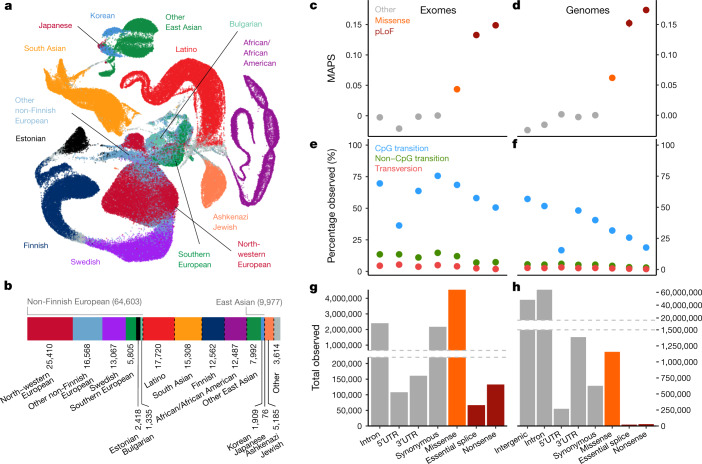
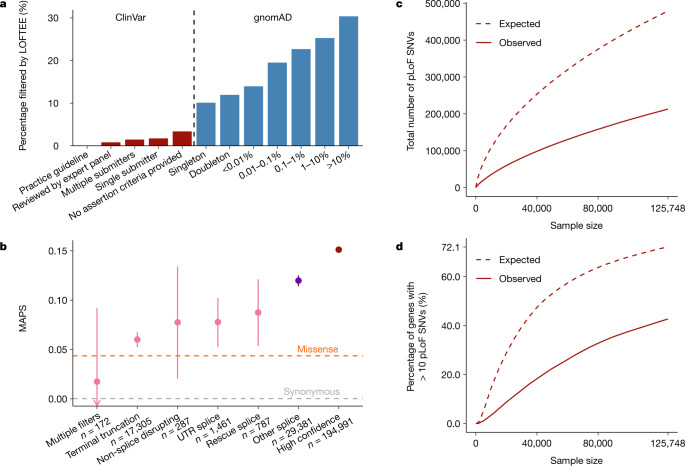
Genetic variants that inactivate protein-coding genes are a powerful source of information about the phenotypic consequences of gene disruption: genes that are crucial for the function of an organism will be depleted of such variants in natural populations, whereas non-essential genes will tolerate their accumulation. However, predicted loss-of-function variants are enriched for annotation errors, and tend to be found at extremely low frequencies, so their analysis requires careful variant annotation and very large sample sizes 1 . Here we describe the aggregation of 125,748 exomes and 15,708 genomes from human sequencing studies into the Genome Aggregation Database (gnomAD). We identify 443,769 high-confidence predicted loss-of-function variants in this cohort after filtering for artefacts caused by sequencing and annotation errors. Using an improved model of human mutation rates, we classify human protein-coding genes along a spectrum that represents tolerance to inactivation, validate this classification using data from model organisms and engineered human cells, and show that it can be used to improve the power of gene discovery for both common and rare diseases.
Overview
The claims and statistics of this paper haven’t been checked yet.
Free: it reads the open-access text and checks the first 5 claims that cite a source we can check. Create a free account to check every claim.
Integrity signals
Registry
Cites
Statistics
Figures
Verification
Claims the paper makes
The claims and statistics of this paper haven’t been checked yet.
Free: it reads the open-access text and checks the first 5 claims that cite a source we can check. Create a free account to check every claim.
Claims other papers make about this one
Each is checked against this paper’s own text: does it say what the citing paper says it does?
The source backs part of the claim, not all of it — or backs it for a different population, condition or comparison.
In the citing paper
“Earlier schizophrenia sequencing studies have established that ultra-rare and de novo mutations contribute to risk as a category, and have prioritized disease-relevant tissues and processes, specifically observing an enrichment in neuronal genes and synaptic processes9,11,19–23.”
From Rare coding variants in ten genes confer substantial risk for schizophrenia (2022) · cites this paper as [23]
Experimental — accuracy not yet measuredThe source backs part of the claim, not all of it — or backs it for a different population, condition or comparison.
In the citing paper
“According to the gnomAD database (Karczewski et al, 2020), the loss-of-function observed/expected upper bound fraction (LOEUF) indicates that SALL4 is depleted of inactivating variants and under purifying selection (LOEUF = 0.101).”
From Structure of SALL4 zinc finger domain reveals link between AT-rich DNA binding and Okihiro syndrome (2023) · cites this paper as Karczewski et al, 2020
Experimental — accuracy not yet measuredThe source backs part of the claim, not all of it — or backs it for a different population, condition or comparison.
In the citing paper
“Based on gnomAD (Karczewski et al. 2020), DOCK4 has a reduced amount of missense and null variants compared to its size of 1,966 amino acids (pLI = 1, Z score = 1.67) in a population without severe, early-onset phenotypes, indicating a mild constraint.”
From Heterozygous loss-of-function variants in DOCK4 cause neurodevelopmental delay and microcephaly (2024) · cites this paper as Karczewski et al. 2020
Experimental — accuracy not yet measuredThe source backs part of the claim, not all of it — or backs it for a different population, condition or comparison.
In the citing paper
“All variants were prioritized considering allele frequency in gnomAD v4.0.0 (Karczewski et al. 2020) below 1%, impact on protein function via different in silico programs (CADD (Rentzsch et al. 2021), REVEL (Ioannidis et al. 2016), MutPred2 (Pejaver et al. 2020) and Metadome (Wiel et al. 2019)) and involvement of candidate genes in neuronal processes.”
From Heterozygous loss-of-function variants in DOCK4 cause neurodevelopmental delay and microcephaly (2024) · cites this paper as Karczewski et al. 2020
Experimental — accuracy not yet measuredThe source backs part of the claim, not all of it — or backs it for a different population, condition or comparison.
In the citing paper
“Owing to the scarcity of reported loss-of-function (LoF) variants, with only 17 cases (allele frequency: ~7E-7) in the Genome Aggregation Database (gnomAD) from healthy subjects100, the WASF1 gene exhibits exceptionally high intolerance to such mutations.”
From The WAVE complex in developmental and adulthood brain disorders (2025) · cites this paper as [100]
Experimental — accuracy not yet measured
20 more claims about this paper
Create a free account to see every claim other papers make about this one.
Self-check
Percentages, sums and reported differences re-computed from the paper’s own numbers.
The self-check needs the paper’s full text.
Citations
Cites
UMAP: Uniform Manifold Approximation and Projection
McInnes, L., Healy, J., Saul, N., & Großberger, L. (2018) · Journal of Open Source Software · doi:10.21105/joss.00861 · Cited by 9,826
Analysis of protein-coding genetic variation in 60,706 humans
Exome Aggregation Consortium, Lek, M., Karczewski, K. J., Minikel, E. V., Samocha, K. E., Banks, E., Fennell, T., O’Donnell-Luria, A. H., Ware, J. S., Hill, A. J., et al. (2016) · Nature · doi:10.1038/nature19057 · Cited by 9,587
Self-citationVan der Auwera, G. A., Carneiro, M. O., Hartl, C., Poplin, R., del Angel, G., Levy‐Moonshine, A., Jordan, T., Shakir, K., Roazen, D., Thibault, J., et al. (2013) · Current Protocols in Bioinformatics · doi:10.1002/0471250953.bi1110s43 · Cited by 6,687
Self-citationGenetic effects on gene expression across human tissues
GTEx Consortium (2017) · Nature · doi:10.1038/nature24277 · Cited by 4,036
Self-citationSequence Variations in PCSK9, Low LDL, and Protection against Coronary Heart Disease
Cohen, J. C., Boerwinkle, E., Mosley, T. H., & Hobbs, H. H. (2006) · New England Journal of Medicine · doi:10.1056/nejmoa054013 · Cited by 3,181
Clinical use of current polygenic risk scores may exacerbate health disparities
Martin, A. R., Kanai, M., Kamatani, Y., Okada, Y., Neale, B. M., & Daly, M. J. (2019) · Nature Genetics · doi:10.1038/s41588-019-0379-x · Cited by 2,821
Self-citationCurrent clinical use of polygenic scores will risk exacerbating health disparities
Martin, A. R., Kanai, M., Kamatani, Y., Okada, Y., Neale, B. M., & Daly, M. J. (2018) · doi:10.1101/441261 · Cited by 2,813
Self-citationPartitioning heritability by functional annotation using genome-wide association summary statistics
ReproGen Consortium, Finucane, H. K., Schizophrenia Working Group of the Psychiatric Genomics Consortium, The RACI Consortium, Bulik-Sullivan, B., Gusev, A., Trynka, G., Reshef, Y., Loh, P.-R., Anttila, V., et al. (2015) · Nature Genetics · doi:10.1038/ng.3404 · Cited by 2,604
Self-citationPatterns and rates of exonic de novo mutations in autism spectrum disorders
Neale, B. M., Kou, Y., Liu, L., Ma’ayan, A., Samocha, K. E., Sabo, A., Lin, C.-F., Stevens, C., Wang, L.-S., Makarov, V., et al. (2012) · Nature · doi:10.1038/nature11011 · Cited by 1,734
Self-citationDe novo mutations in schizophrenia implicate synaptic networks
Fromer, M., Pocklington, A. J., Kavanagh, D. H., Williams, H. J., Dwyer, S., Gormley, P., Georgieva, L., Rees, E., Palta, P., Ruderfer, D. M., et al. (2014) · Nature · doi:10.1038/nature12929 · Cited by 1,617
Self-citation
Cited by
Items 1,001–1,100 of 1,235
Variant‐level matching for diagnosis and discovery: Challenges and opportunities
Rodrigues, E. D. S., Griffith, S., Martin, R. P., Antonescu, C. M., Posey, J. E., Coban‐Akdemir, Z., Jhangiani, S. N., Doheny, K. F., Lupski, J. R., Valle, D. L., et al. (2022) · Human Mutation · doi:10.1002/humu.24359 · Cited by 58
“The algorithm that decides similarity is defined by the database being queried.”
Self-citationArrhythmia Variant Associations and Reclassifications in the eMERGE-III Sequencing Study
Glazer, A. M., Davogustto, G., Shaffer, C. M., Vanoye, C. G., Desai, R. R., Farber‐Eger, E. H., Dikilitas, O., Shang, N., Pacheco, J. A., Yang, T., et al. (2021) · Circulation · doi:10.1161/circulationaha.121.055562 · Cited by 59
Self-citationWhole‐genome sequencing identifies new candidate genes for nonobstructive azoospermia
Malcher, A., Stokowy, T., Berman, A. J., Olszewska, M., Jędrzejczak, P., Sielski, D., Nowakowski, A., Rozwadowska, N., Yatsenko, A. N., & Kurpisz, M. K. (2022) · Andrology · doi:10.1111/andr.13269 · Cited by 58
Heritable defects in telomere and mitotic function selectively predispose to sarcomas
Ballinger, M. L., Pattnaik, S., Mundra, P. A., Zaheed, M., Rath, E. M., Priestley, P., Baber, J., Ray-Coquard, I. L., Isambert, N., Causeret, S., et al. (2023) · Science · doi:10.1126/science.abj4784 · Cited by 58
Liu, Z., Reino, E. J. G., Harschnitz, O., Guo, H., Chan, Y., Khobrekar, N. V., Hasek, M. L., Dobbs, K., Rinchai, D., Materna, M., et al. (2023) · Science Immunology · doi:10.1126/sciimmunol.ade2860 · Cited by 59
“Only one homozygous carrier each was found for the R422* and P493fs9* variants among the 141,456 sequenced individuals from the gnomAD database (41).”
BackgroundJiang, T. T., Fang, L., & Wang, K. (2023) · The Innovation · doi:10.1016/j.xinn.2023.100487 · Cited by 42
Yankee, T. N., Oh, S., Winchester, E. W., Wilderman, A. S., Robinson, K. R., Gordon, T., Rosenfeld, J. A., VanOudenhove, J., Scott, D. A., Leslie, E. J., et al. (2023) · Nature Communications · doi:10.1038/s41467-023-40363-1 · Cited by 59
Prevalence and characteristics of genetic disease in adult kidney stone formers
Anderegg, M. A., Olinger, E. G., Bargagli, M., Geraghty, R. M., Taylor, L., Nater, A., Bruggmann, R., Sayer, J. A., Vogt, B., Schaller, A., et al. (2024) · Nephrology Dialysis Transplantation · doi:10.1093/ndt/gfae074 · Cited by 58
“After filtering for predicted consequences and Genome Aggregation Database (gno-mAD; https://gnomad.broadinstitute.org/) minor allele frequency ( < 1% in all populations) [27 ], variants in 34 genes [10 , 17 –19 , 28 ] previously implicated in Mendelian kidney stone disease were examined (Fig.”
MethodPredicting mean ribosome load for 5’UTR of any length using deep learning
Karollus, A., Avsec, Ž., & Gagneur, J. (2021) · PLOS Computational Biology · doi:10.1371/journal.pcbi.1008982 · Cited by 57
Comprehensive characterization of PTEN mutational profile in a series of 34,129 colorectal cancers
Serebriiskii, I. G., Pavlov, V., Tricarico, R., Andrianov, G., Nicolas, E., Parker, M. I., Newberg, J., Frampton, G., Meyer, J. E., & Golemis, E. A. (2022) · Nature Communications · doi:10.1038/s41467-022-29227-2 · Cited by 55
A comprehensive map of human glucokinase variant activity
Gersing, S., Cagiada, M., Gebbia, M., Gjesing, A. P., Coté, A. G., Seesankar, G., Li, R., Tabet, D., Weile, J., Stein, A., et al. (2023) · Genome Biology · doi:10.1186/s13059-023-02935-8 · Cited by 55
Spatiotemporal dynamics of clonal selection and diversification in normal endometrial epithelium
Yamaguchi, M., Nakaoka, H., Suda, K., Yoshihara, K., Ishiguro, T., Yachida, N., Saito, K., Ueda, H., Sugino, K., Mori, Y., et al. (2022) · Nature Communications · doi:10.1038/s41467-022-28568-2 · Cited by 54
Stein, D., Kars, M. E., Wu, Y., Bayrak, Ç. S., Stenson, P. D., Cooper, D. N., Schlessinger, A., & Itan, Y. (2023) · Genome Medicine · doi:10.1186/s13073-023-01261-9 · Cited by 53
“1 [17] exome sequences (Fig.”
BackgroundMethodInfluentialProtVar: mapping and contextualizing human missense variation
Stephenson, J. D., Totoo, P., Burke, D. F., Jänes, J., Beltrao, P., & Martin, M. J. (2024) · Nucleic Acids Research · doi:10.1093/nar/gkae413 · Cited by 53
“This includes data from Ensembl ( 29 ), COSMIC, ClinVar, GnomAD ( 30 ) and other sources.”
MethodStein, D., Sevim Bayrak, Ç., Wu, Y., Kars, M. E., Stenson, P. D., Cooper, D. N., Schlessinger, A., & Itan, Y. (2022) · doi:10.1101/2022.06.08.495288 · Cited by 53
Kizilkaya, H. S., Sørensen, K. V., Kibsgaard, C. J., Gasbjerg, L. S., Hauser, A. S., Sparre-Ulrich, A. H., Grarup, N., & Rosenkilde, M. M. (2021) · Frontiers in Cell and Developmental Biology · doi:10.3389/fcell.2021.749607 · Cited by 52
Succinic Semialdehyde Dehydrogenase Deficiency: An Update
Didiasova, M., Banning, A., Brennenstuhl, H., Jung-Klawitter, S., Cinquemani, C., Opladen, T., & Tikkanen, R. (2020) · Cells · doi:10.3390/cells9020477 · Cited by 52
Association of APOE With Primary Open-Angle Glaucoma Suggests a Protective Effect for APOE ε4
Margeta, M. A., Letcher, S. M., Igo, R. P., Cooke Bailey, J. N., Pasquale, L. R., Haines, J. L., Butovsky, O., Wiggs, J. L., & for the NEIGHBORHOOD consortium (2020) · Investigative Opthalmology & Visual Science · doi:10.1167/iovs.61.8.3 · Cited by 51
A mutational atlas for Parkin proteostasis
Clausen, L., Voutsinos, V., Cagiada, M., Johansson, K. E., Grønbæk-Thygesen, M., Nariya, S., Powell, R. L., Have, M. K. N., Oestergaard, V. H., Stein, A., et al. (2024) · Nature Communications · doi:10.1038/s41467-024-45829-4 · Cited by 51
“We first compared the Parkin variant effects with the allele frequency of the PRKN variants reported in the >140,000 human exomes available through the Genome Aggregation Database (gnomAD) (Karczewski et al., 2020).”
Elucidation of the genetic causes of bicuspid aortic valve disease
Gehlen, J., Stundl, A., Debiec, R., Fontana, F., Krane, M., Sharipova, D., Nelson, C. P., Al-Kassou, B., Giel, A.-S., Sinning, J.-M., et al. (2023) · Cardiovascular Research · doi:10.1093/cvr/cvac099 · Cited by 51
Self-citationAssociation of African Ancestry–Specific APOE Missense Variant R145C With Risk of Alzheimer Disease
Le Guen, Y., Raulin, A.-C., Logue, M. W., Sherva, R., Belloy, M. E., Eger, S. J., Chen, A., Kennedy, G., Kuchenbecker, L., O’Leary, J. P., et al. (2023) · JAMA · doi:10.1001/jama.2023.0268 · Cited by 50
Cary, G. A., Wiley, J. C., Gockley, J., Keegan, S., Amirtha Ganesh, S. S., Heath, L., Butler, R. R., Mangravite, L. M., Logsdon, B. A., Longo, F. M., et al. (2024) · Alzheimer's & Dementia: Translational Research & Clinical Interventions · doi:10.1002/trc2.12461 · Cited by 49
Deciphering the impact of genetic variation on human polyadenylation using APARENT2
Linder, J., Koplik, S. E., Kundaje, A., & Seelig, G. (2022) · Genome Biology · doi:10.1186/s13059-022-02799-4 · Cited by 49
“8 million PAS variants observed in gnomAD [50].”
BackgroundMatreyek, K. A., Stephany, J. J., Ahler, E., & Fowler, D. M. (2021) · Genome Medicine · doi:10.1186/s13073-021-00984-x · Cited by 48
Rates and Patterns of Clonal Oncogenic Mutations in the Normal Human Brain
Ganz, J., Maury, E. A., Becerra, B., Bizzotto, S., Doan, R. N., Kenny, C. J., Shin, T., Kim, J., Zhou, Z., Ligon, K. L., et al. (2022) · Cancer Discovery · doi:10.1158/2159-8290.cd-21-0245 · Cited by 48
“58), they occurred in more than three individuals from our cohort, the call quality score was less than 200, they were found in homopolymeric regions greater than 1 in length, they were covered by fewer than two different MIPs, they had fewer than 12 alternate reads covering the variant, a…”
Inherited Retinal Diseases Due to RPE65 Variants: From Genetic Diagnostic Management to Therapy
Aoun, M., Passerini, I., Chiurazzi, P., Karali, M., De Rienzo, I., Sartor, G., Murro, V., Filimonova, N., Seri, M., & Banfi, S. (2021) · International Journal of Molecular Sciences · doi:10.3390/ijms22137207 · Cited by 47
“The Genome Aggregation Database (gnomAD) entry for RPE65 contains 120 synonymous single-nucleotide variants (SNVs), 284 missense SNVs and 24 SNVs marked as “putative loss-of-function” [56].”
BackgroundHuman CRY1 variants associate with attention deficit/hyperactivity disorder
Onat, O. E., Kars, M. E., Gül, Ş., Bilguvar, K., Wu, Y., Özhan, A., Aydın, C., Başak, A. N., Trusso, M. A., Goracci, A., et al. (2020) · Journal of Clinical Investigation · doi:10.1172/jci135500 · Cited by 47
Leitão, E., Schröder, C., Parenti, I., Dalle, C., Rastetter, A., Kühnel, T., Kuechler, A., Kaya, S., Gérard, B., Schaefer, E., et al. (2022) · Nature Communications · doi:10.1038/s41467-022-34264-y · Cited by 47
Vitobello, A., Mazel, B., Lelianova, V. G., Zangrandi, A., Petitto, E., Suckling, J., Salpietro, V., Meyer, R., Elbracht, M., Kurth, I., et al. (2022) · The American Journal of Human Genetics · doi:10.1016/j.ajhg.2022.06.011 · Cited by 46
Structure and interactions of the endogenous human Commander complex
Laulumaa, S., Kumpula, E.-P., Huiskonen, J. T., & Varjosalo, M. (2024) · Nature Structural & Molecular Biology · doi:10.1038/s41594-024-01246-1 · Cited by 46
“2d and 7a) are listed as ‘pathogenic’ for RSS in GnomAD database 65 .”
Structure and Interactions of the Endogenous Human Commander Complex
Laulumaa, S., Kumpula, E.-P., Huiskonen, J. T., & Varjosalo, M. (2023) · doi:10.1101/2023.04.03.535349 · Cited by 46
High-resolution functional mapping of RAD51C by saturation genome editing
Olvera-León, R., Zhang, F., Offord, V., Zhao, Y., Tan, H. K., Gupta, P., Pal, T., Robles-Espinoza, C. D., Arriaga-González, F. G., Matsuyama, L. S. A. S., et al. (2024) · Cell · doi:10.1016/j.cell.2024.08.039 · Cited by 44
“…potentially to be included in the forthcoming updated ACMG-AMP framework, by which we had increased our benignity truthset to 1509 variants, the predictive likelihood ratios towards pathogenicity and benignity were respectively 33 and 31, again equating to ‘strong’ evidence for PS3 and BS3.”
BackgroundERIC recommendations for TP53 mutation analysis in chronic lymphocytic leukemia—2024 update
Malcikova, J., Pavlova, S., Baliakas, P., Chatzikonstantinou, T., Tausch, E., Catherwood, M., Rossi, D., Soussi, T., Tichy, B., Kater, A. P., et al. (2024) · Leukemia · doi:10.1038/s41375-024-02267-x · Cited by 44
Chemparathy, A., Le Guen, Y., Chen, S., Lee, E.-G., Leong, L., Gorzynski, J. E., Jensen, T. D., Ferrasse, A., Xu, G., Xiang, H., et al. (2024) · Neuron · doi:10.1016/j.neuron.2024.01.008 · Cited by 43
Wang, Q. S., Hasegawa, T., Namkoong, H., Saiki, R., Edahiro, R., Sonehara, K., Tanaka, H., Azekawa, S., Chubachi, S., Takahashi, Y., et al. (2024) · Nature Genetics · doi:10.1038/s41588-024-01896-3 · Cited by 43
Self-citationDeep structured learning for variant prioritization in Mendelian diseases
(2023) · doi:10.1038/s41467-023-39306-7 · Cited by 43
The role of common genetic variation in presumed monogenic epilepsies
Campbell, C., Leu, C., Feng, Y.-C. A., Wolking, S., Moreau, C., Ellis, C., Ganesan, S., Martins, H., Oliver, K., Boothman, I., et al. (2022) · eBioMedicine · doi:10.1016/j.ebiom.2022.104098 · Cited by 42
Gerasimavicius, L., Livesey, B. J., & Marsh, J. A. (2023) · Protein Science · doi:10.1002/pro.4688 · Cited by 41
Satterfield, B. A., Dikilitas, O., Safarova, M. S., Clarke, S. L., Tcheandjieu, C., Zhu, X., Bastarache, L., Larson, E. B., Justice, A. E., Shang, N., et al. (2021) · Circulation: Genomic and Precision Medicine · doi:10.1161/circgen.120.003354 · Cited by 40
Contribution of APOE Genetic Variants to Dyslipidemia
Bea, A. M., Larrea-Sebal, A., Marco-Benedi, V., Uribe, K. B., Galicia-Garcia, U., Lamiquiz-Moneo, I., Laclaustra, M., Moreno-Franco, B., Fernandez-Corredoira, P., Olmos, S., et al. (2023) · Arteriosclerosis, Thrombosis, and Vascular Biology · doi:10.1161/atvbaha.123.318977 · Cited by 40
Identifying common transcriptome signatures of cancer by interpreting deep learning models
Jha, A., Quesnel-Vallières, M., Wang, D., Thomas-Tikhonenko, A., Lynch, K. W., & Barash, Y. (2022) · Genome Biology · doi:10.1186/s13059-022-02681-3 · Cited by 39
Complement inhibitors for age-related macular degeneration
Tzoumas, N., Riding, G., Williams, M. A., & Steel, D. H. (2023) · Cochrane Database of Systematic Reviews · doi:10.1002/14651858.cd009300.pub3 · Cited by 38
Rovelet-Lecrux, A., Feuillette, S., Miguel, L., Schramm, C., Pernet, S., Quenez, O., Ségalas-Milazzo, I., Guilhaudis, L., Rousseau, S., Riou, G., et al. (2021) · Acta Neuropathologica Communications · doi:10.1186/s40478-021-01294-4 · Cited by 38
“1 [32]) missense SORL1 variants and classified them into Mis 0, 1 2 or 3 categories depending on the number of bioinformatics tools predicting the variant to be deleterious or not among Polyphen-2, SIFT and Mutation Taster.”
MethodNCKAP1 Disruptive Variants Lead to a Neurodevelopmental Disorder with Core Features of Autism
Guo, H., Zhang, Q., Dai, R., Yu, B., Hoekzema, K., Tan, J., Tan, S., Jia, X., Chung, W. K., Hernan, R., et al. (2020) · The American Journal of Human Genetics · doi:10.1016/j.ajhg.2020.10.002 · Cited by 38
A minimal role for synonymous variation in human disease
Dhindsa, R. S., Wang, Q., Vitsios, D., Burren, O. S., Hu, F., DiCarlo, J. E., Kruglyak, L., MacArthur, D. G., Hurles, M. E., & Petrovski, S. (2022) · The American Journal of Human Genetics · doi:10.1016/j.ajhg.2022.10.016 · Cited by 38
Self-citationGlobal Assessment of Mendelian Stroke Genetic Prevalence in 101 635 Individuals From 7 Ethnic Groups
Grami, N., Chong, M., Lali, R., Mohammadi-Shemirani, P., Henshall, D. E., Rannikmäe, K., & Paré, G. (2020) · Stroke · doi:10.1161/strokeaha.119.028840 · Cited by 38
Ebstein, F., Küry, S., Most, V., Rosenfelt, C., Scott-Boyer, M.-P., van Woerden, G. M., Besnard, T., Papendorf, J. J., Studencka-Turski, M., Wang, T., et al. (2023) · Science Translational Medicine · doi:10.1126/scitranslmed.abo3189 · Cited by 36
50,000 years of evolutionary history of India: Impact on health and disease variation
Kerdoncuff, E., Skov, L., Patterson, N., Banerjee, J., Khobragade, P., Chakrabarti, S. S., Chakrawarty, A., Chatterjee, P., Dhar, M., Gupta, M., et al. (2025) · Cell · doi:10.1016/j.cell.2025.04.027 · Cited by 36
Self-citationHuman genetics uncovers MAP3K15 as an obesity-independent therapeutic target for diabetes
Nag, A., Dhindsa, R. S., Mitchell, J., Vasavda, C., Harper, A. R., Vitsios, D., Ahnmark, A., Bilican, B., Madeyski-Bengtson, K., Zarrouki, B., et al. (2022) · Science Advances · doi:10.1126/sciadv.add5430 · Cited by 36
Self-citationKaplanis, J., Samocha, K. E., Wiel, L., Zhang, Z., Arvai, K. J., Eberhardt, R. Y., Gallone, G., Lelieveld, S. H., Martin, H. C., McRae, J. F., et al. (2019) · doi:10.1101/797787 · Cited by 36
Self-citationInterpreting the molecular mechanisms of disease variants in human transmembrane proteins
Tiemann, J. K. S., Zschach, H., Lindorff-Larsen, K., & Stein, A. (2023) · Biophysical Journal · doi:10.1016/j.bpj.2022.12.031 · Cited by 35
A novel age-informed approach for genetic association analysis in Alzheimer’s disease
Initiative, F. T. A. D. N., Le Guen, Y., Belloy, M. E., Napolioni, V., Eger, S. J., Kennedy, G., Tao, R., He, Z., & Greicius, M. D. (2021) · Alzheimer's Research & Therapy · doi:10.1186/s13195-021-00808-5 · Cited by 35
MutationExplorer : a webserver for mutation of proteins and 3D visualization of energetic impacts
Philipp, M., Moth, C. W., Ristic, N., Tiemann, J. K. S., Seufert, F., Panfilova, A., Meiler, J., Hildebrand, P. W., Stein, A., Wiegreffe, D., et al. (2024) · Nucleic Acids Research · doi:10.1093/nar/gkae301 · Cited by 35
“The most frequently observed changes in proteins are missense mutations, where one amino acid is substituted by another ( 3 ).”
BackgroundInfluentialInterpreting the molecular mechanisms of disease variants in human transmembrane proteins
Tiemann, J. K. S., Zschach, H., Lindorff-Larsen, K., & Stein, A. (2022) · doi:10.1101/2022.07.12.499731 · Cited by 35
Tzoumas, N., Hallam, D., Harris, C. L., Lako, M., Kavanagh, D., & Steel, D. H. W. (2021) · Survey of Ophthalmology · doi:10.1016/j.survophthal.2020.10.008 · Cited by 33
Kloske, C. M., Belloy, M. E., Blue, E. E., Bowman, G. R., Carrillo, M. C., Chen, X., Chiba‐Falek, O., Davis, A. A., Paolo, G. D., Garretti, F., et al. (2024) · Alzheimer's & Dementia · doi:10.1002/alz.13877 · Cited by 33
Chrystal, P. W., Lambacher, N. J., Doucette, L. P., Bellingham, J., Schiff, E. R., Noel, N. C. L., Li, C., Tsiropoulou, S., Casey, G. A., Zhai, Y., et al. (2022) · Nature Communications · doi:10.1038/s41467-022-33820-w · Cited by 31
A 3D structural SARS-CoV-2–human interactome to explore genetic and drug perturbations
Wierbowski, S. D., Liang, S., Liu, Y., Chen, Y., Gupta, S., Andre, N. M., Lipkin, S. M., Whittaker, G. R., & Yu, H. (2021) · Nature Methods · doi:10.1038/s41592-021-01318-w · Cited by 32
“We used a mutation scanning pipeline in PyRosetta 59,60 to predict the impact of six missense variants reported in gnomAD 61 that occur on the S–ACE2 interface (Fig.”
MethodJoint genotypic and phenotypic outcome modeling improves base editing variant effect quantification
Ryu, J., Barkal, S., Yu, T., Jankowiak, M., Zhou, Y., Francoeur, M., Phan, Q. V., Li, Z., Tognon, M., Brown, L., et al. (2023) · doi:10.1101/2023.09.08.23295253 · Cited by 32
Computed cancer interactome explains the effects of somatic mutations in cancers
Zhang, J., Pei, J., Durham, J., Bos, T., & Cong, Q. (2022) · Protein Science · doi:10.1002/pro.4479 · Cited by 31
“As a control, we analyzed the distribution of single amino acid variations (SAVs) among human populations in these PPI interfaces using data from the Genome Aggregation Database (gnomAD).(53) We filtered out high-frequency SAVs (see Section 3) because they are likely neutral.”
MethodNew Approaches for Targeting PCSK9: Small-Interfering Ribonucleic Acid and Genome Editing
Oostveen, R. F., Khera, A. V., Kathiresan, S., Stroes, E. S. G., Fitzgerald, K., Harms, M. J., Oakes, B. L., & Kastelein, J. J. P. (2023) · Arteriosclerosis, Thrombosis, and Vascular Biology · doi:10.1161/atvbaha.122.317963 · Cited by 31
Dawood, M., Fayer, S., Pendyala, S., Post, M., Kalra, D., Patterson, K., Venner, E., Muffley, L. A., Fowler, D. M., Rubin, A. F., et al. (2024) · Genome Medicine · doi:10.1186/s13073-024-01392-7 · Cited by 31
“Individual assignment was based on genetic ancestry labels reported by the respective data-base [9, 25, 26].”
InfluentialWagner, M., Skorobogatko, Y., Pode-Shakked, B., Powell, C. M., Alhaddad, B., Seibt, A., Barel, O., Heimer, G., Hoffmann, C., Demmer, L. A., et al. (2020) · The American Journal of Human Genetics · doi:10.1016/j.ajhg.2020.01.002 · Cited by 31
Accurate and robust protein sequence design with CarbonDesign
Ren, M., Yu, C., Bu, D., & Zhang, H. (2024) · Nature Machine Intelligence · doi:10.1038/s42256-024-00838-2 · Cited by 30
A pseudoautosomal glycosylation disorder prompts the revision of dolichol biosynthesis
Wilson, M. P., Kentache, T., Althoff, C. R., Schulz, C., de Bettignies, G., Mateu Cabrera, G., Cimbalistiene, L., Burnyte, B., Yoon, G., Costain, G., et al. (2024) · Cell · doi:10.1016/j.cell.2024.04.041 · Cited by 30
(2024) · doi:10.1038/s41592-024-02409-0 · Cited by 29
“…itself from UniProt feature/variant viewer 45 , RCSB 3D-sequence viewer 46 and DECIPHER 48 sequence/ structure viewers by simultaneously mapping variants from the largest population variant 9,12 and multiple disease variant databases 10,11 as separate tracks alongside protein feature tracks.”
Somatic mutations alter the differentiation outcomes of iPSC-derived neurons
Puigdevall, P., Jerber, J., Danecek, P., Castellano, S., & Kilpinen, H. (2023) · Cell Genomics · doi:10.1016/j.xgen.2023.100280 · Cited by 29
Kwon, S., Safer, J., Nguyen, D. T., Hoksza, D., May, P., Arbesfeld, J. A., Rubin, A. F., Campbell, A. J., Burgin, A., & Iqbal, S. (2024) · doi:10.1101/2024.01.02.573913 · Cited by 29
de Boer, E., Ockeloen, C. W., Kampen, R. A., Hampstead, J. E., Dingemans, A. J. M., Rots, D., Lütje, L., Ashraf, T., Baker, R., Barat-Houari, M., et al. (2022) · Genetics in Medicine · doi:10.1016/j.gim.2022.06.007 · Cited by 28
(2021) · doi:10.1101/2021.12.20.21267971 · Cited by 28
Kobren, S. N., Baldridge, D., Velinder, M., Krier, J. B., LeBlanc, K., Esteves, C., Pusey, B. N., Züchner, S., Blue, E., Lee, H., et al. (2021) · Genetics in Medicine · doi:10.1038/s41436-020-01084-8 · Cited by 27
Self-citationHeidemann, B. E., Koopal, C., Baass, A., Defesche, J. C., Zuurbier, L., Mulder, M. T., Roeters van Lennep, J. E., Riksen, N. P., Boot, C., Marais, A. D., et al. (2022) · Clinical Genetics · doi:10.1111/cge.14185 · Cited by 27
“Leu72Pro variant and website of Gnomad.(33,34)”
MethodInfluentialRare Genetic Variants in LDLR , APOB , and PCSK9 Are Associated With Aortic Stenosis
Rämö, J. T., Jurgens, S. J., Kany, S., Choi, S. H., Wang, X., Smirnov, A. N., Friedman, S. F., Maddah, M., Khurshid, S., Ellinor, P. T., et al. (2024) · Circulation · doi:10.1161/circulationaha.124.070982 · Cited by 26
“22 We also identified likely damaging missense variants in the same genes by using predictions from AlphaMissense (Google DeepMind, London, United Kingdom).”
Self-citationDevelopment of multiplexed orthogonal base editor (MOBE) systems
Cowan, Q. T., Gu, S., Gu, W., Ranzau, B. L., Simonson, T. S., & Komor, A. C. (2025) · Nature Biotechnology · doi:10.1038/s41587-024-02240-0 · Cited by 26
“Specifically, while 787 million genetic variants have been reported in the Genome Aggregation Database 3 , less than 0.5% have a clinical interpretation in ClinVar 4 .”
InfluentialStructural basis for receptor selectivity and inverse agonism in S1P5 receptors
Lyapina, E., Marin, E., Gusach, A., Orekhov, P., Gerasimov, A., Luginina, A., Vakhrameev, D., Ergasheva, M., Kovaleva, M., Khusainov, G., et al. (2022) · Nature Communications · doi:10.1038/s41467-022-32447-1 · Cited by 26
Structural basis for receptor selectivity and inverse agonism in S1P 5 receptors
Lyapina, E., Marin, E., Gusach, A., Orekhov, P., Gerasimov, A., Luginina, A., Vakhrameev, D., Ergasheva, M., Kovaleva, M., Khusainov, G., et al. (2022) · doi:10.1101/2022.02.25.480536 · Cited by 26
A next-generation human genome sequence
Church, D. M. (2022) · Science · doi:10.1126/science.abo5367 · Cited by 25
Beecroft, S. J., Ayala, M., McGillivray, G., Nanda, V., Agolini, E., Novelli, A., Digilio, M. C., Dotta, A., Carrozzo, R., Clayton, J., et al. (2021) · Human Mutation · doi:10.1002/humu.24179 · Cited by 25
Unique structural features govern the activity of a human mitochondrial AAA+ disaggregase, Skd3
Cupo, R. R., Rizo, A. N., Braun, G. A., Tse, E., Chuang, E., Gupta, K., Southworth, D. R., & Shorter, J. (2022) · Cell Reports · doi:10.1016/j.celrep.2022.111408 · Cited by 25
Pennica, C., Hanna, G., Islam, S. A., Sternberg, M. J. E., & David, A. (2023) · Journal of Molecular Biology · doi:10.1016/j.jmb.2023.168060 · Cited by 25
“26 In order to identify missense variants occurring at a PPI site, we extracted 16,609 high resolution (≤2.5 Å) X-ray crystal structures of human dimers and multimers from the Protein Data Bank (PDB).”
InfluentialHuman-specific gene expansions contribute to brain evolution
(2025) · doi:10.1016/j.cell.2025.06.037 · Cited by 25
Shimelis, H., Oetjens, M. T., Walsh, L. K., Wain, K. E., Znidarsic, M., Myers, S. M., Finucane, B. M., Ledbetter, D. H., & Martin, C. L. (2023) · American Journal of Psychiatry · doi:10.1176/appi.ajp.22010062 · Cited by 25
Identifying therapeutic drug targets using bidirectional effect genes
Estrada, K., Froelich, S., Wuster, A., Bauer, C. R., Sterling, T., Clark, W. T., Ru, Y., Trinidad, M., Nguyen, H. P., Luu, A. R., et al. (2021) · Nature Communications · doi:10.1038/s41467-021-21843-8 · Cited by 25
(2023) · doi:10.1101/2023.01.24.525222 · Cited by 25
Unique structural features govern the activity of a human mitochondrial AAA+ disaggregase, Skd3
Cupo, R. R., Rizo, A. N., Braun, G. A., Tse, E., Chuang, E., Southworth, D. R., & Shorter, J. (2022) · doi:10.1101/2022.02.17.480866 · Cited by 25
Human-specific gene expansions contribute to brain evolution
Soto, D. C., Uribe-Salazar, J. M., Kaya, G., Valdarrago, R., Sekar, A., Haghani, N. K., Hino, K., La, G., Mariano, N. A. F., Ingamells, C., et al. (2024) · doi:10.1101/2024.09.26.615256 · Cited by 25
The evolutionary history of human spindle genes includes back-and-forth gene flow with Neandertals
Peyrégne, S., Kelso, J., Peter, B. M., & Pääbo, S. (2022) · eLife · doi:10.7554/elife.75464 · Cited by 24
HEM1 Actin Immunodysregulatory Disorder: Genotypes, Phenotypes, and Future Directions
Cook, S., Lenardo, M. J., & Freeman, A. F. (2022) · Journal of Clinical Immunology · doi:10.1007/s10875-022-01327-0 · Cited by 24
“33), suggesting there is selection against HEM1 LoF [26].”
BackgroundInfluentialBuffering of genetic dominance by allele-specific protein complex assembly
Badonyi, M., & Marsh, J. A. (2023) · Science Advances · doi:10.1126/sciadv.adf9845 · Cited by 24
Kock, K. H., Kimes, P. K., Gisselbrecht, S. S., Inukai, S., Phanor, S. K., Anderson, J. T., Ramakrishnan, G., Lipper, C. H., Song, D., Kurland, J. V., et al. (2024) · Nature Communications · doi:10.1038/s41467-024-47396-0 · Cited by 24
“To explore the range of HD missense variants across human populations, we inspected the gnomAD database 18 for variants across the exome and genome sequences of 141,456 individuals and found 4,719 unique variants across 221 HDs (Fig.”
A spectrum of nonsense-mediated mRNA decay efficiency along the degree of mutational constraint
Kim, Y.-G., Kang, H., Lee, B., Jang, H.-J., Park, J.-H., Ha, C., Park, H., & Kim, J.-W. (2024) · Communications Biology · doi:10.1038/s42003-024-07136-y · Cited by 24
Li, Z., Gaudreault, N., Arsenault, B. J., Mathieu, P., Bossé, Y., & Thériault, S. (2020) · Communications Biology · doi:10.1038/s42003-020-01210-x · Cited by 23
KCNT2‐Related Disorders: Phenotypes, Functional, and Pharmacological Properties
Cioclu, M. C., Mosca, I., Ambrosino, P., Puzo, D., Bayat, A., Wortmann, S. B., Koch, J., Strehlow, V., Shirai, K., Matsumoto, N., et al. (2023) · Annals of Neurology · doi:10.1002/ana.26662 · Cited by 23
“23 Instead, the pLI score should be used with caution when interpreting missense variants, as functional studies (including those herein described) are critically needed to determine whether these will produce GoF or LoF changes at the protein level, and several examples exist in the literature of…”
Characterizing glucokinase variant mechanisms using a multiplexed abundance assay
Gersing, S., Schulze, T. K., Cagiada, M., Stein, A., Roth, F. P., Lindorff-Larsen, K., & Hartmann-Petersen, R. (2024) · Genome Biology · doi:10.1186/s13059-024-03238-2 · Cited by 23
“The common variant D217N [35] and a catalytically inactive variant D205H [17, 36] grew similar to wild-type GCK (Fig.”
Kierczak, M., Rafati, N., Höglund, J., Gourlé, H., Lo Faro, V., Schmitz, D., Ek, W. E., Gyllensten, U., Enroth, S., Ekman, D., et al. (2022) · Nature Communications · doi:10.1038/s41467-022-30208-8 · Cited by 22
Fawzy, M., & Marsh, J. A. (2024) · Scientific Reports · doi:10.1038/s41598-024-76202-6 · Cited by 22
“We combined both pathogenic and likely pathogenic variants as “pathogenic” but excluded any variant present in ClinVar from the gnomAD dataset.”
Background(2024) · doi:10.1101/2024.06.12.598724 · Cited by 22
Seligson, N. D., Chen, J. L., Goodrich, A. C., Van Tine, B. A., Campbell, J. D., Richards, A. L., Antonescu, C. R., Liebner, D. A., Milhem, M. M., Streicher, H., et al. (2024) · Journal for ImmunoTherapy of Cancer · doi:10.1136/jitc-2024-009472 · Cited by 21
González-del Pozo, M., Fernández-Suárez, E., Bravo-Gil, N., Méndez-Vidal, C., Martín-Sánchez, M., Rodríguez-de la Rúa, E., Ramos-Jiménez, M., Morillo-Sánchez, M. J., Borrego, S., & Antiñolo, G. (2022) · npj Genomic Medicine · doi:10.1038/s41525-022-00286-0 · Cited by 21
Metadata
- Authors
- Karczewski, K. J., Francioli, L. C., Tiao, G., Cummings, B. B., Alföldi, J., Wang, Q., Collins, R. L., Laricchia, K. M., Ganna, A., Birnbaum, D. P., Gauthier, L. D., Brand, H., Solomonson, M., Watts, N. A., Rhodes, D., Singer-Berk, M., England, E. M., Seaby, E. G., Kosmicki, J. A., Walters, R. K., Tashman, K., Farjoun, Y., Banks, E., Poterba, T., Wang, A., Seed, C., Whiffin, N., Chong, J. X., Samocha, K. E., Pierce-Hoffman, E., Zappala, Z., O’Donnell-Luria, A. H., Minikel, E. V., Weisburd, B., Lek, M., Ware, J. S., Vittal, C., Armean, I. M., Bergelson, L., Cibulskis, K., Connolly, K. M., Covarrubias, M., Donnelly, S., Ferriera, S., Gabriel, S., Gentry, J., Gupta, N., Jeandet, T., Kaplan, D., Llanwarne, C., Munshi, R., Novod, S., Petrillo, N., Roazen, D., Ruano-Rubio, V., Saltzman, A., Schleicher, M., Soto, J., Tibbetts, K., Tolonen, C., Wade, G., Talkowski, M. E., Genome Aggregation Database Consortium, Aguilar Salinas, C. A., Ahmad, T., Albert, C. M., Ardissino, D., Atzmon, G., Barnard, J., Beaugerie, L., Benjamin, E. J., Boehnke, M., Bonnycastle, L. L., Bottinger, E. P., Bowden, D. W., Bown, M. J., Chambers, J. C., Chan, J. C., Chasman, D., Cho, J., Chung, M. K., Cohen, B., Correa, A., Dabelea, D., Daly, M. J., Darbar, D., Duggirala, R., Dupuis, J., Ellinor, P. T., Elosua, R., Erdmann, J., Esko, T., Färkkilä, M., Florez, J., Franke, A., Getz, G., Glaser, B., Glatt, S. J., Goldstein, D., Gonzalez, C., Groop, L., Haiman, C., Hanis, C., Harms, M., Hiltunen, M., Holi, M. M., Hultman, C. M., Kallela, M., Kaprio, J., Kathiresan, S., Kim, B.-J., Kim, Y. J., Kirov, G., Kooner, J., Koskinen, S., Krumholz, H. M., Kugathasan, S., Kwak, S. H., Laakso, M., Lehtimäki, T., Loos, R. J. F., Lubitz, S. A., Ma, R. C. W., MacArthur, D. G., Marrugat, J., Mattila, K. M., McCarroll, S., McCarthy, M. I., McGovern, D., McPherson, R., Meigs, J. B., Melander, O., Metspalu, A., Neale, B. M., Nilsson, P. M., O’Donovan, M. C., Ongur, D., Orozco, L., Owen, M. J., Palmer, C. N. A., Palotie, A., Park, K. S., Pato, C., Pulver, A. E., Rahman, N., Remes, A. M., Rioux, J. D., Ripatti, S., Roden, D. M., Saleheen, D., Salomaa, V., Samani, N. J., Scharf, J., Schunkert, H., Shoemaker, M. B., Sklar, P., Soininen, H., Sokol, H., Spector, T., Sullivan, P. F., Suvisaari, J., Tai, E. S., Teo, Y. Y., Tiinamaija, T., Tsuang, M., Turner, D., Tusie-Luna, T., Vartiainen, E., Vawter, M. P., Ware, J. S., Watkins, H., Weersma, R. K., Wessman, M., Wilson, J. G., Xavier, R. J., Neale, B. M., Daly, M. J., & MacArthur, D. G.
- Affiliations
- Broad Institute (US)
- Queen Mary University of London (GB)
- University of Washington (US)
- Wellcome Sanger Institute (GB)
- Yale University (US)
- Peninsula College of Medicine and Dentistry (GB)
- Brigham and Women's Hospital (US)
- University of Parma (IT)
- Albert Einstein College of Medicine (US)
- Cleveland Clinic (US)
- Sorbonne Université (FR)
- Boston University (US)
- University of Michigan (US)
- National Institutes of Health (US)
- Wake Forest University Health Sciences (US)
- University of Leicester (GB)
- Imperial College Healthcare NHS Trust (GB)
- Chinese University of Hong Kong (HK)
- Icahn School of Medicine at Mount Sinai (US)
- Harvard University (US)
- University of Mississippi Medical Center (US)
- Colorado School of Public Health (US)
- University of Illinois Chicago (US)
- Texas Biomedical Research Institute (US)
- German Centre for Cardiovascular Research (DE)
- University of Helsinki (FI)
- SUNY Upstate Medical University (US)
- Columbia University Irving Medical Center (US)
- Lund University (SE)
- The University of Texas Health Science Center at Houston (US)
- Columbia University (US)
- University of Eastern Finland (FI)
- Helsinki University Hospital (FI)
- Karolinska Institutet (SE)
- Korea National Institute of Health (KR)
- Cardiff University (GB)
- Finnish Institute for Health and Welfare (FI)
- Emory University (US)
- Seoul National University (KR)
- Tampere University (FI)
- Centro de Investigación en Red en Enfermedades Cardiovasculares (ES)
- Centre for Human Genetics (GB)
- Cedars-Sinai Medical Center (US)
- Ottawa Heart Institute (CA)
- University of Tartu (EE)
- National Institute of Genomic Medicine (MX)
- University of Dundee (GB)
- University of Southern California (US)
- Johns Hopkins University (US)
- Institute of Cancer Research (GB)
- Oulu University Hospital (FI)
- Montreal Heart Institute (CA)
- Vanderbilt University Medical Center (US)
- Center for Non-Communicable Diseases (PK)
- Deutsches Herzzentrum München (DE)
- Vanderbilt University (US)
- Massachusetts General Hospital (US)
- King's College London (GB)
- University of North Carolina at Chapel Hill (US)
- National University of Singapore (SG)
- University of California San Diego (US)
- Hebrew University of Jerusalem (IL)
- University of California, Irvine (US)
- University of Oxford (GB)
- University Medical Center Groningen (NL)
- Institute for Molecular Medicine Finland (FI)
- Corresponding author
- Karczewski, Konrad J.
- ORCID
- Karczewski, Konrad J.
- Francioli, Laurent C.
- Tiao, Grace
- Cummings, Beryl B.
- Alföldi, Jessica
- Wang, Qingbo
- Collins, Ryan L.
- Laricchia, Kristen M.
- Ganna, Andrea
- Brand, Harrison
- Solomonson, Matthew
- Rhodes, Daniel
- Seaby, Eleanor G.
- Kosmicki, Jack A.
- Walters, Raymond K.
- Tashman, Katherine
- Farjoun, Yossi
- Banks, Eric
- Poterba, Timothy
- Whiffin, Nicola
- Chong, Jessica X.
- Samocha, Kaitlin E.
- Zappala, Zachary
- O’Donnell-Luria, Anne H.
- Minikel, Eric Vallabh
- Weisburd, Ben
- Lek, Monkol
- Armean, Irina M.
- Cibulskis, Kristian
- Donnelly, Stacey
- Gabriel, Stacey
- Gupta, Namrata
- Saltzman, Andrea
- Talkowski, Michael E.
- Ahmad, Tariq
- Albert, Christine M.
- Ardissino, Diego
- Atzmon, Gil
- Barnard, John
- Beaugerie, Laurent
- Benjamin, Emelia J.
- Boehnke, Michael
- Bonnycastle, Lori L.
- Bowden, Donald W.
- Bown, Matthew J.
- Chambers, John C.
- Chan, Juliana C.
- Chasman, Daniel
- Cho, Judy
- Chung, Mina K.
- Cohen, Bruce
- Correa, Adolfo
- Dabelea, Dana
- Darbar, Dawood
- Duggirala, Ravindranath
- Dupuis, Josée
- Ellinor, Patrick T.
- Erdmann, Jeanette
- Esko, Tõnu
- Färkkilä, Martti
- Getz, Gad
- Glatt, Stephen J.
- Goldstein, David
- Groop, Leif
- Hanis, Craig
- Harms, Matthew
- Hiltunen, Mikko
- Holi, Matti M.
- Hultman, Christina M.
- Kallela, Mikko
- Kaprio, Jaakko
- Kathiresan, Sekar
- Kim, Bong-Jo
- Kim, Young Jin
- Kirov, George
- Kooner, Jaspal
- Krumholz, Harlan M.
- Kugathasan, Subra
- Kwak, Soo Heon
- Laakso, Markku
- Lehtimäki, Terho
- Loos, Ruth J. F.
- Lubitz, Steven A.
- Marrugat, Jaume
- McCarroll, Steven
- McCarthy, Mark I.
- McGovern, Dermot
- McPherson, Ruth
- Meigs, James B.
- Melander, Olle
- Metspalu, Andres
- Nilsson, Peter M.
- O’Donovan, Michael C.
- Orozco, Lorena
- Owen, Michael J.
- Palmer, Colin N. A.
- Palotie, Aarno
- Park, Kyong Soo
- Pato, Carlos
- Rahman, Nazneen
- Rioux, John D.
- Ripatti, Samuli
- Roden, Dan M.
- Saleheen, Danish
- Salomaa, Veikko
- Samani, Nilesh J.
- Scharf, Jeremiah
- Schunkert, Heribert
- Shoemaker, Moore B.
- Sklar, Pamela
- Soininen, Hilkka
- Sokol, Harry
- Spector, Tim
- Sullivan, Patrick F.
- Suvisaari, Jaana
- Tai, E. Shyong
- Tsuang, Ming
- Turner, Dan
- Vartiainen, Erkki
- Vawter, Marquis P.
- Watkins, Hugh
- Weersma, Rinse K.
- Wilson, James G.
- Xavier, Ramnik J.
- Venue
- Nature
- Published
- 2020-05-27
- Volume
- 581
- Issue
- 7809
- Pages
- 434-443
- ISSN
- 0028-0836 (ISSN-L)
- 1476-4687
- PMC
- PMC7334197
- OpenAlex
- W3029661147
- Cited by
- 9,434
- References
- 51
- Citations by year
- 2026: 1027 · 2025: 1275 · 2024: 1531 · 2023: 1631 · 2022: 1774 · 2021: 1613 · 2020: 573
- FWCI
- 833.03
- Type
- journal article
- Language
- en
- Update notices
- Open access
- hybrid
- doi.org
- Licence
- cc-by
- creativecommons.org/licenses/by/4.0 (tdm)
- creativecommons.org/licenses/by/4.0 (vor)
- Locations
- Nature (publishedVersion, cc-by)
- PubMed Central (publishedVersion, cc-by)
- PubMed (publishedVersion)
- University of Groningen research database (University of Groningen / Centre for Information Technology) (publishedVersion, cc-by)
- National University of Singapore (submittedVersion, cc-by)
- HAL (submittedVersion)
- Discovery Research Portal (University of Dundee) (submittedVersion, other-oa)
- ePrints Soton (University of Southampton) (submittedVersion)
- Työväentutkimus Vuosikirja (submittedVersion)
- Lund University Publications (Lund University) (submittedVersion)
- Spiral (Imperial College London) (submittedVersion, cc-by)
- Tampere University Institutional Repository (Tampere University) (submittedVersion, cc-by)
- Funders
- National Science Foundation
- Sanofi
- Massachusetts General Hospital
- BioMarin Pharmaceutical
- Wellcome Trust (107469/Z/15/Z)
- Broad Institute
- British Heart Foundation (RG/18/10/33842, CS/14/2/30841)
- University of Oxford
- Rosetrees Trust
- Schweizerischer Nationalfonds zur Förderung der Wissenschaftlichen Forschung (177853)
- Rijksuniversiteit Groningen
- Hebrew University of Jerusalem
- Samfundet Folkhälsan
- Universitair Medisch Centrum Groningen
- National Institutes of Health (MH115957, HG006493, UL1TR001863)
- University of California, San Diego
- University of California, Irvine
- Sanofi Genzyme
- Instituto de Investigaciones Biomédicas, Universidad Nacional Autónoma de México
- National Institute on Aging
- National Heart, Lung, and Blood Institute (HG006493)
- National Institute of Mental Health (R01MH085548, R56MH115957, MH115957, R01MH115957)
- National Human Genome Research Institute (HG006493, HG008956, HG008900, UM1HG008900, phs000178, UM1HG006493, U24HG008956, T32HG002295)
- National Cancer Institute
- National Institute of General Medical Sciences (F32GM115208, R01GM104371, GM115208)
- National Institute of Diabetes and Digestive and Kidney Diseases (U54DK105566)
- National Center for Advancing Translational Sciences
- Eunice Kennedy Shriver National Institute of Child Health and Human Development (HD081256, R01HD081256)
- Common Fund
- Topics
- Life Sciences › Biochemistry, Genetics and Molecular Biology › Genetics › Genomics and Rare Diseases
- Life Sciences › Biochemistry, Genetics and Molecular Biology › Genetics › Genetic Associations and Epidemiology
- Life Sciences › Biochemistry, Genetics and Molecular Biology › Genetics › Evolution and Genetic Dynamics
- Keywords
- loss-of-function mutations, protein-coding genes, gene essentiality, disease gene discovery, rare diseases, common diseases
- MeSH terms
- Proprotein Convertase 9, Whole Genome Sequencing, Exome Sequencing, Loss of Function Mutation, Adult, Brain, Cardiovascular Diseases, Female, Humans, Male, RNA, Messenger, Genetic Variation, Reproducibility of Results, Cohort Studies, Genome, Human, Genetic Predisposition to Disease, Genes, Essential, Databases, Genetic, Genome-Wide Association Study, Exome, Mutation Rate
About these checks
Registry, retraction, Cites and statistics results are computed, not judged, with one exception: a printed reference that no index lists is read once by a model before it counts as a citation error. Claims are extracted by a model and kept only when their quote appears verbatim in the text; each cited source is then checked, with a model’s help, for whether it says what the claim relies on. Those verdicts can be wrong — read the claim’s quote and the cited source before relying on one.
Statistics and arithmetic are recomputed, not judged.
Confidence bands are shown only for fields calibrated on our annotated test set. None is calibrated yet, so no band is shown.
What counts as a claim ›How we measure confidence ›How we check this ›
Are you an author, or do you see a problem with this page? Request a review
Data sources
Bibliographic data: Semantic Scholar, OpenAlex, Crossref.
Contains information from the Semantic Scholar Academic Graph Datasets, made available under the ODC Attribution License (ODC-BY 1.0).
Semantic Scholar’s data is described in: Kinney, R., et al. (2023). The Semantic Scholar Open Data Platform. arXiv:2301.10140.
