

A synergistic mindsets intervention protects adolescents from stress
Open accessPublished version of a preprint
The DOI matches its Crossref record; 80 of the 82 references it cites were found in a registry or an index.
Abstract
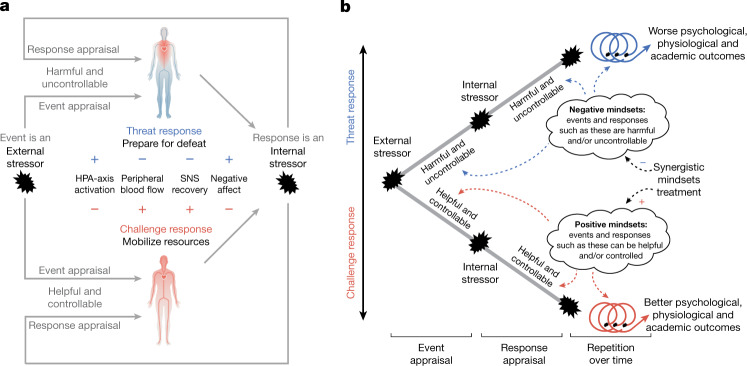
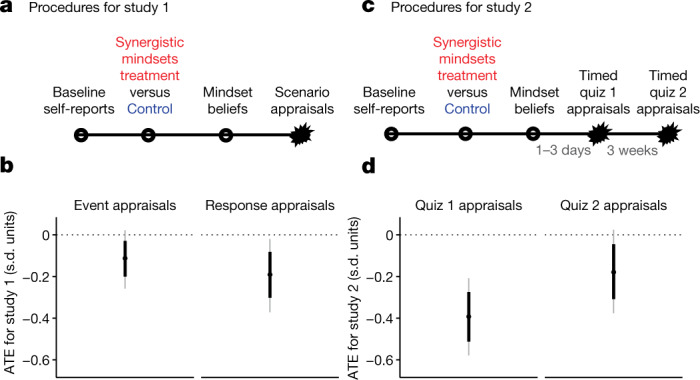
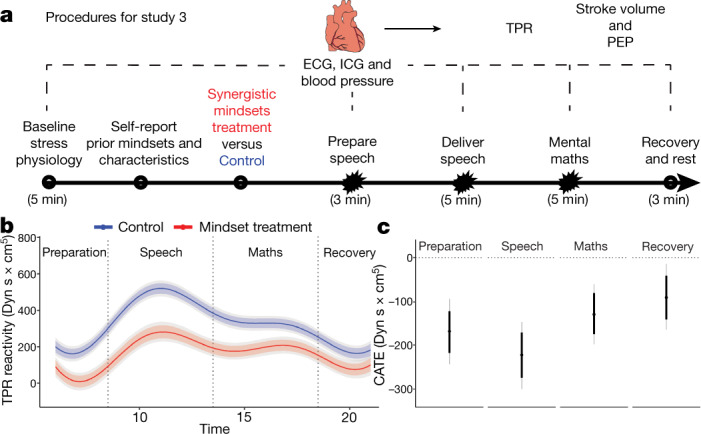
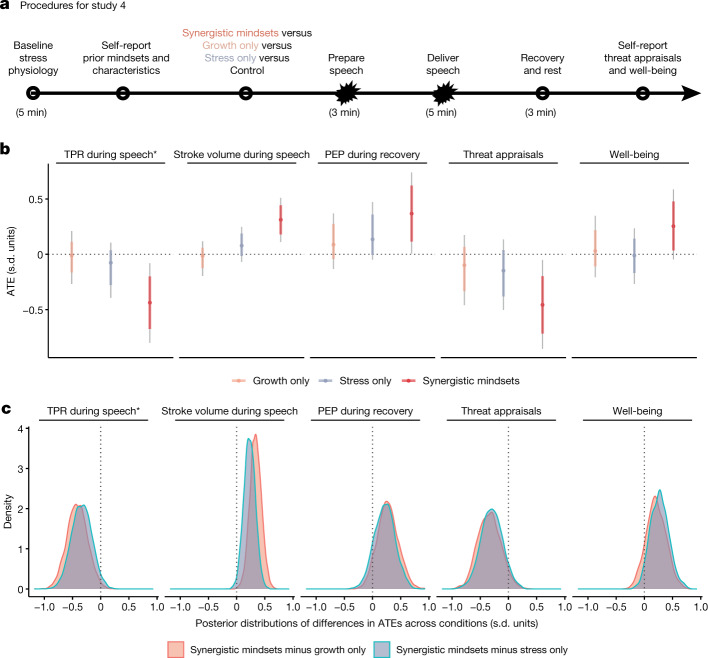
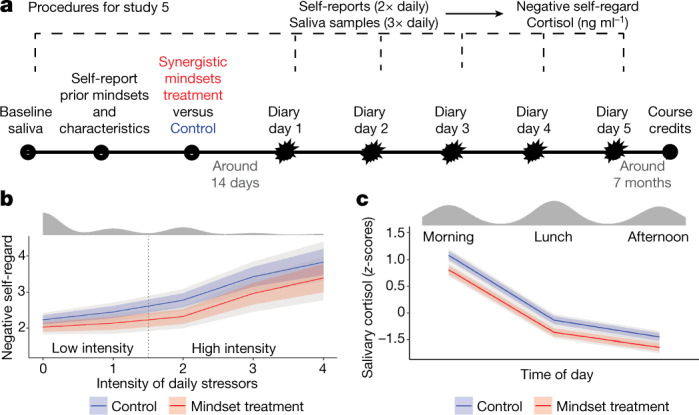
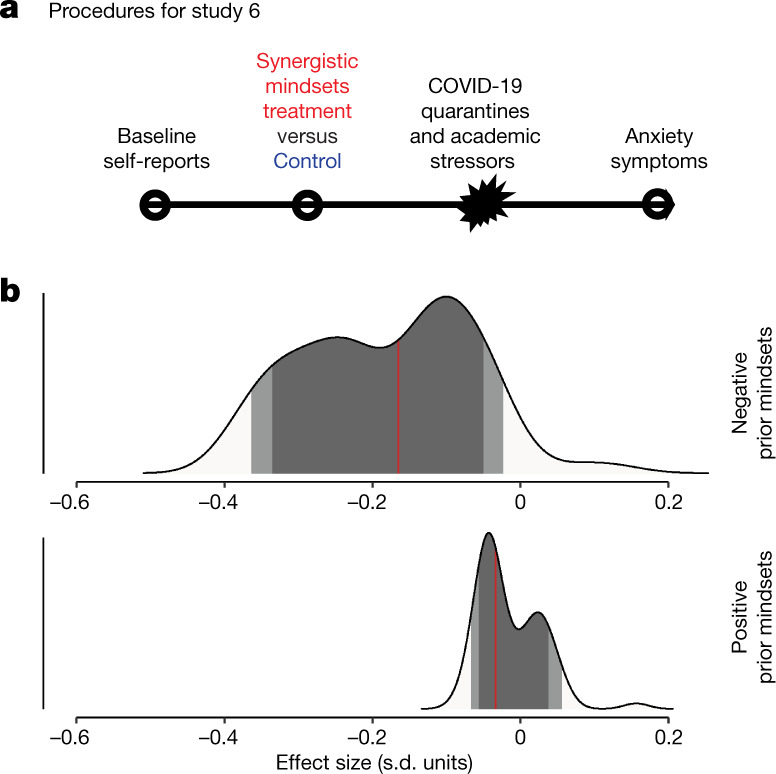
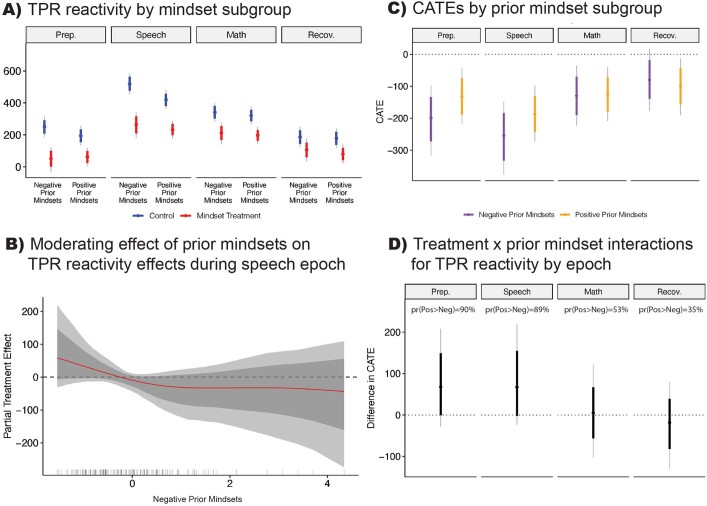
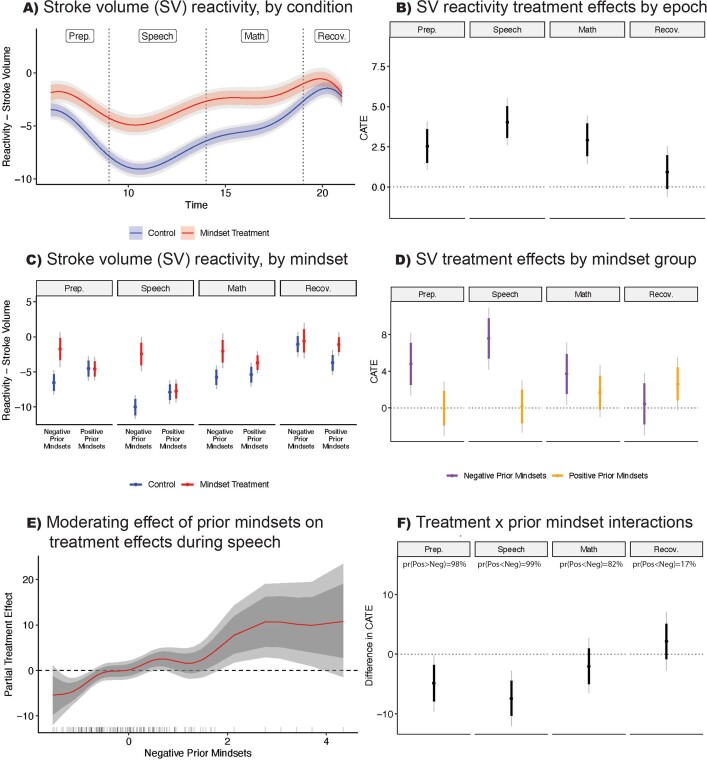
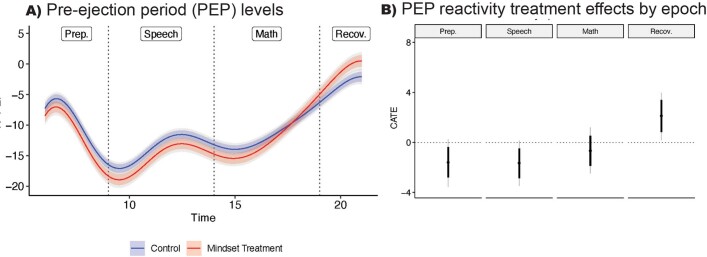
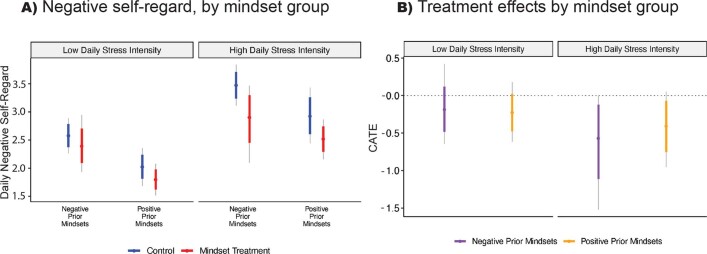
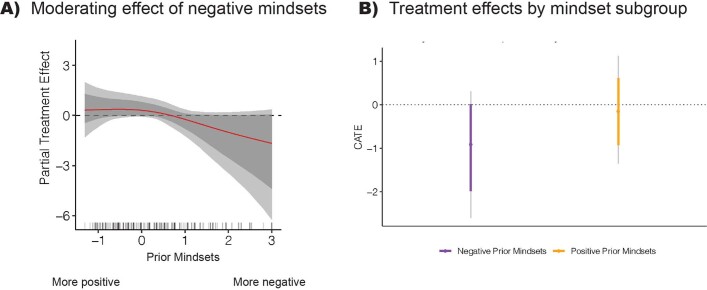
Social-evaluative stressors—experiences in which people feel they could be judged negatively—pose a major threat to adolescent mental health 1–3 and can cause young people to disengage from stressful pursuits, resulting in missed opportunities to acquire valuable skills. Here we show that replicable benefits for the stress responses of adolescents can be achieved with a short (around 30-min), scalable 'synergistic mindsets' intervention. This intervention, which is a self-administered online training module, synergistically targets both growth mindsets 4 (the idea that intelligence can be developed) and stress-can-be-enhancing mindsets 5 (the idea that one’s physiological stress response can fuel optimal performance). In six double-blind, randomized, controlled experiments that were conducted with secondary and post-secondary students in the United States, the synergistic mindsets intervention improved stress-related cognitions (study 1, n = 2,717; study 2, n = 755), cardiovascular reactivity (study 3, n = 160; study 4, n = 200), daily cortisol levels (study 5, n = 118 students, n = 1,213 observations), psychological well-being (studies 4 and 5), academic success (study 5) and anxiety symptoms during the 2020 COVID-19 lockdowns (study 6, n = 341). Heterogeneity analyses (studies 3, 5 and 6) and a four-cell experiment (study 4) showed that the benefits of the intervention depended on addressing both mindsets—growth and stress—synergistically. Confidence in these conclusions comes from a conservative, Bayesian machine-learning statistical method for detecting heterogeneous effects 6 . Thus, our research has identified a treatment for adolescent stress that could, in principle, be scaled nationally at low cost.
Overview
The claims and statistics of this paper haven’t been checked yet.
Free: it reads the open-access text and checks the first 5 claims that cite a source we can check. Create a free account to check every claim.
Integrity signals
Registry
Cites
Statistics
Figures
Verification
Claims the paper makes
The claims and statistics of this paper haven’t been checked yet.
Free: it reads the open-access text and checks the first 5 claims that cite a source we can check. Create a free account to check every claim.
Claims other papers make about this one
Each is checked against this paper’s own text: does it say what the citing paper says it does?
The cited source says what the claim attributes to it.
In the citing paper
“Several studies reported reduced anxiety [19,47,54,55,59-62,66-68].”
The cited source says what the claim attributes to it.
In the citing paper
“The impact on anxiety was more prominent in some studies for the treatment group than for the control group [19,59-61,66,68].”
The cited source says what the claim attributes to it.
In the citing paper
“Several studies found increased well-being [47,57,60,65,67,68].”
The cited source says what the claim attributes to it.
In the citing paper
“Furthermore, synergistic mindset interventions more effectively promote adolescent mental health than each individual component (Yeager et al., 2022).”
From A single session online training reduces intolerance of uncertainty and improves mental health in emerging adults. (2025) · cites this paper as Yeager et al., 2022
Self-check
Percentages, sums and reported differences re-computed from the paper’s own numbers.
The self-check needs the paper’s full text.
Citations
Cites
A Brief Measure for Assessing Generalized Anxiety Disorder: The GAD-7
Spitzer, R. L., Kroenke, K., Williams, J. B. W., & Löwe, B. (2006) · Archives of Internal Medicine · doi:10.1001/archinte.166.10.1092 · Cited by 31,765
Journal of personality and social psychology
Armstrong, J. S. (1988) · International Journal of Forecasting · doi:10.1016/0169-2070(88)90126-4 · Cited by 10,485
The American Psychological Association
Langfeld, H. S. (1919) · Science · doi:10.1126/science.49.1254.51 · Cited by 7,475
Kirschbaum, C., Pirke, K.-M., & Hellhammer, D. H. (2008) · Neuropsychobiology · doi:10.1159/000119004 · Cited by 6,093
Dickerson, S. S., & Kemeny, M. E. (2004) · Psychological Bulletin · doi:10.1037/0033-2909.130.3.355 · Cited by 5,881
Emotion regulation: current status and future prospects
Gross, J. J. (2015) · Psychological Inquiry · doi:10.1080/1047840x.2014.940781 · Cited by 5,229
Self-citationOur future: a Lancet commission on adolescent health and wellbeing
Patton, G. C., Sawyer, S. M., Santelli, J. S., Ross, D. A., Afifi, R., Allen, N. B., Arora, M., Azzopardi, P., Baldwin, W., Bonell, C., et al. (2016) · The Lancet · doi:10.1016/s0140-6736(16)00579-1 · Cited by 3,785
Understanding adolescence as a period of social–affective engagement and goal flexibility
Crone, E. A., & Dahl, R. E. (2012) · Nature Reviews Neuroscience · doi:10.1038/nrn3313 · Cited by 2,507
Thapar, A., Collishaw, S., Pine, D. S., & Thapar, A. K. (2012) · The Lancet · doi:10.1016/s0140-6736(11)60871-4 · Cited by 2,365
Yeager, D. S., & Dweck, C. S. (2012) · Educational Psychologist · doi:10.1080/00461520.2012.722805 · Cited by 2,334
Self-citationThe Nature, Effects, and Relief of Mathematics Anxiety
Hembree, R. (1990) · Journal for Research in Mathematics Education · doi:10.2307/749455 · Cited by 1,979
Aronson, J., Fried, C. B., & Good, C. (2002) · Journal of Experimental Social Psychology · doi:10.1006/jesp.2001.1491 · Cited by 1,889
Journal of Experimental Social Psychology
(1965) · Nature · doi:10.1038/2061099b0 · Cited by 1,883
Pine, D. S., Cohen, P., Gurley, D., Brook, J., & Ma, Y. (1998) · Archives of General Psychiatry · doi:10.1001/archpsyc.55.1.56 · Cited by 1,753
BART: Bayesian additive regression trees
Chipman, H. A., George, E. I., & McCulloch, R. E. (2010) · The Annals of Applied Statistics · doi:10.1214/09-aoas285 · Cited by 1,542
A national experiment reveals where a growth mindset improves achievement
Yeager, D. S., Hanselman, P., Walton, G. M., Murray, J. S., Crosnoe, R., Muller, C., Tipton, E., Schneider, B., Hulleman, C. S., Hinojosa, C. P., et al. (2019) · Nature · doi:10.1038/s41586-019-1466-y · Cited by 1,513
Self-citationCurrent Directions in Psychological Science
(2009) · Current Directions in Psychological Science · doi:10.1111/(issn)1467-8721 · Cited by 1,463
Social-Psychological Interventions in Education: They’re Not Magic
Yeager, D. S., & Walton, G. M. (2011) · Review of Educational Research · doi:10.3102/0034654311405999 · Cited by 1,345
Self-citationStrategy of prevention: lessons from cardiovascular disease.
Rose, G. (1981) · BMJ · doi:10.1136/bmj.282.6279.1847 · Cited by 1,302
Interpreting Effect Sizes of Education Interventions
Kraft, M. (2019) · Annenberg Institute for School Reform at Brown University · doi:10.26300/8pjp-2z74 · Cited by 1,286
Interpreting effect sizes of education interventions
Kraft, M. A. (2020) · Educational Researcher · doi:10.3102/0013189x20912798 · Cited by 1,281
Mindsets: A View From Two Eras
Dweck, C. S., & Yeager, D. S. (2019) · Perspectives on Psychological Science · doi:10.1177/1745691618804166 · Cited by 1,259
Self-citationImportance of investing in adolescence from a developmental science perspective
Dahl, R. E., Allen, N. B., Wilbrecht, L., & Suleiman, A. B. (2018) · Nature · doi:10.1038/nature25770 · Cited by 1,196
Methodological Guidelines for Impedance Cardiography
Sherwood(Chair), A., Allen, M. T., Fahrenberg, J., Kelsey, R. M., Lovallo, W. R., & van Doornen, L. J. P. (1990) · Psychophysiology · doi:10.1111/j.1469-8986.1990.tb02171.x · Cited by 1,169
Skills, education, and the rise of earnings inequality among the “other 99 percent”
Autor, D. H. (2014) · Science · doi:10.1126/science.1251868 · Cited by 1,160
The Strategy of Preventive Medicine
Rose, G. (1993) · doi:10.1093/oso/9780192624864.001.0001 · Cited by 1,069
Stress, sensitive periods and maturational events in adolescent depression
Andersen, S. L., & Teicher, M. H. (2008) · Trends in Neurosciences · doi:10.1016/j.tins.2008.01.004 · Cited by 1,005
Mind-Set Interventions Are a Scalable Treatment for Academic Underachievement
Paunesku, D., Walton, G. M., Romero, C., Smith, E. N., Yeager, D. S., & Dweck, C. S. (2015) · Psychological Science · doi:10.1177/0956797615571017 · Cited by 981
Self-citationRethinking stress: The role of mindsets in determining the stress response.
Crum, A. J., Salovey, P., & Achor, S. (2013) · Journal of Personality and Social Psychology · doi:10.1037/a0031201 · Cited by 979
Williams, K. D. (2009) · Advances in Experimental Social Psychology · doi:10.1016/s0065-2601(08)00406-1 · Cited by 908
Adam, E. K., Quinn, M. E., Tavernier, R., McQuillan, M. T., Dahlke, K. A., & Gilbert, K. E. (2017) · Psychoneuroendocrinology · doi:10.1016/j.psyneuen.2017.05.018 · Cited by 905
What can be learned from growth mindset controversies?
Yeager, D. S., & Dweck, C. S. (2020) · American Psychologist · doi:10.1037/amp0000794 · Cited by 868
Self-citationMolden, D. C., & Dweck, C. S. (2006) · American Psychologist · doi:10.1037/0003-066x.61.3.192 · Cited by 861
Yeager, D. S., Romero, C., Paunesku, D., Hulleman, C. S., Schneider, B., Hinojosa, C., Lee, H. Y., O'Brien, J., Flint, K., Roberts, A., et al. (2016) · Journal of Educational Psychology · doi:10.1037/edu0000098 · Cited by 691
Self-citationPerspectives on Psychological Science
Blase, A. E. K. A. S. L. (2011) · APS observer · Cited by 628
Reducing implicit racial preferences: II. Intervention effectiveness across time
Lai, C. K., Skinner, A. L., Cooley, E., Murrar, S., Brauer, M., Devos, T., Calanchini, J., Xiao, Y. J., Pedram, C., Marshburn, C. K., et al. (2016) · Journal of Experimental Psychology: General · doi:10.1037/xge0000179 · Cited by 624
Stan: A Probabilistic Programming Language for Bayesian Inference and Optimization
Gelman, A., Lee, D., & Guo, J. (2015) · Journal of Educational and Behavioral Statistics · doi:10.3102/1076998615606113 · Cited by 540
Behavioural science is unlikely to change the world without a heterogeneity revolution
Bryan, C. J., Tipton, E., & Yeager, D. S. (2021) · Nature Human Behaviour · doi:10.1038/s41562-021-01143-3 · Cited by 537
Self-citationWhy Interventions to Influence Adolescent Behavior Often Fail but Could Succeed
Yeager, D. S., Dahl, R. E., & Dweck, C. S. (2018) · Perspectives on Psychological Science · doi:10.1177/1745691617722620 · Cited by 512
Self-citationUsing Network Analysis to Identify Central Symptoms of Adolescent Depression
Mullarkey, M. C., Marchetti, I., & Beevers, C. G. (2019) · Journal of Clinical Child & Adolescent Psychology · doi:10.1080/15374416.2018.1437735 · Cited by 484
Mind over matter: reappraising arousal improves cardiovascular and cognitive responses to stress
Jamieson, J. P., Nock, M. K., & Mendes, W. B. (2012) · Journal of Experimental Psychology: General · doi:10.1037/a0025719 · Cited by 444
Self-citationHemodynamics of Blood Pressure Responses During Active and Passive Coping
Sherwood, A., Dolan, C. A., & Light, K. C. (1990) · Psychophysiology · doi:10.1111/j.1469-8986.1990.tb03189.x · Cited by 414
Aronson, E. (1999) · American Psychologist · doi:10.1037/h0088188 · Cited by 344
Why Beliefs About Emotion Matter: An Emotion-Regulation Perspective
Ford, B. Q., & Gross, J. J. (2019) · Current Directions in Psychological Science · doi:10.1177/0963721418806697 · Cited by 337
Self-citationHahn, P. R., Murray, J. S., & Carvalho, C. M. (2020) · Bayesian Analysis · doi:10.1214/19-ba1195 · Cited by 304
Self-citationWalton, G. M., & Yeager, D. S. (2020) · Current Directions in Psychological Science · doi:10.1177/0963721420904453 · Cited by 298
Self-citationKassai, R., Futo, J., Demetrovics, Z., & Takacs, Z. K. (2019) · Psychological Bulletin · doi:10.1037/bul0000180 · Cited by 294
The Promise of Adolescence: Realizing Opportunity for All Youth
Committee on the Neurobiological and Socio-behavioral Science of Adolescent Development and Its Applications, Board on Children, Y., Education, D. O. B. A. S. S. A., Division, H. A. M., & National Academies of Sciences, E. (2019) · National Academies Press eBooks · doi:10.17226/25388 · Cited by 281
Improving Acute Stress Responses: The Power of Reappraisal
Jamieson, J. P., Mendes, W. B., & Nock, M. K. (2013) · Current Directions in Psychological Science · doi:10.1177/0963721412461500 · Cited by 273
Self-citationOptimizing stress responses with reappraisal and mindset interventions: an integrated model
Jamieson, J. P., Crum, A. J., Goyer, J. P., Marotta, M. E., & Akinola, M. (2018) · Anxiety, Stress, & Coping · doi:10.1080/10615806.2018.1442615 · Cited by 265
Self-citationFeiss, R., Dolinger, S. B., Merritt, M., Reiche, E., Martin, K., Yanes, J. A., Thomas, C. M., & Pangelinan, M. (2019) · Journal of Youth and Adolescence · doi:10.1007/s10964-019-01085-0 · Cited by 252
Need threat can motivate performance after ostracism
Jamieson, J. P., Harkins, S. G., & Williams, K. D. (2010) · Personality and Social Psychology Bulletin · doi:10.1177/0146167209358882 · Cited by 192
Self-citationOptimizing stress: An integrated intervention for regulating stress responses.
Crum, A. J., Jamieson, J. P., & Akinola, M. (2020) · Emotion · doi:10.1037/emo0000670 · Cited by 190
Self-citationBayesian Additive Regression Trees: A Review and Look Forward
Hill, J., Linero, A., & Murray, J. (2020) · Annual Review of Statistics and Its Application · doi:10.1146/annurev-statistics-031219-041110 · Cited by 189
Self-citationFitting In, Standing Out: Navigating the Social Challenges of High School to Get an Education
Crosnoe, R. (2011) · doi:10.1017/cbo9780511793264 · Cited by 186
A values-alignment intervention protects adolescents from the effects of food marketing
Bryan, C. J., Yeager, D. S., & Hinojosa, C. P. (2019) · Nature Human Behaviour · doi:10.1038/s41562-019-0586-6 · Cited by 183
Self-citationComparison of salivary cortisol as measured by different immunoassays and tandem mass spectrometry
Miller, R., Plessow, F., Rauh, M., Gröschl, M., & Kirschbaum, C. (2013) · Psychoneuroendocrinology · doi:10.1016/j.psyneuen.2012.04.019 · Cited by 181
Socioeconomic Status and Health in Adolescents: The Role of Stress Interpretations
Chen, E., Langer, D. A., Raphaelson, Y. E., & Matthews, K. A. (2004) · Child Development · doi:10.1111/j.1467-8624.2004.00724.x · Cited by 178
Yeager, D. S., Lee, H. Y., & Jamieson, J. P. (2016) · Psychological Science · doi:10.1177/0956797616649604 · Cited by 136
Self-citationvan Loon, A. W. G., Creemers, H. E., Beumer, W. Y., Okorn, A., Vogelaar, S., Saab, N., Miers, A. C., Westenberg, P. M., & Asscher, J. J. (2020) · Journal of Youth and Adolescence · doi:10.1007/s10964-020-01201-5 · Cited by 128
Changing stress mindsets with a novel imagery intervention: A randomized controlled trial.
Keech, J. J., Hagger, M. S., & Hamilton, K. (2021) · Emotion · doi:10.1037/emo0000678 · Cited by 119
Rege, M., Hanselman, P., Solli, I. F., Dweck, C. S., Ludvigsen, S., Bettinger, E., Crosnoe, R., Muller, C., Walton, G., Duckworth, A., et al. (2021) · American Psychologist · doi:10.1037/amp0000647 · Cited by 117
Self-citationGelman, A. (2015) · Journal of Management · doi:10.1177/0149206314525208 · Cited by 115
Capitalizing on Appraisal Processes to Improve Affective Responses to Social Stress
Jamieson, J. P., Hangen, E. J., Lee, H. Y., & Yeager, D. S. (2018) · Emotion Review · doi:10.1177/1754073917693085 · Cited by 111
Self-citationLarge-Scale Replication Projects in Contemporary Psychological Research
McShane, B. B., Tackett, J. L., Böckenholt, U., & Gelman, A. (2019) · The American Statistician · doi:10.1080/00031305.2018.1505655 · Cited by 104
Neurobiological Concomitants of Motivational States
Mendes, W. B., & Park, J. (2014) · Advances in motivation science · doi:10.1016/bs.adms.2014.09.001 · Cited by 98
A Biopsychosocial Approach to Arousal Regulation
Blascovich, J. (1992) · Journal of Social and Clinical Psychology · doi:10.1521/jscp.1992.11.3.213 · Cited by 87
The Influence of Stressors on the Development of Psychopathology
Grant, K. E., McMahon, S. D., Carter, J. S., Carleton, R. A., Adam, E. K., & Chen, E. (2014) · Springer eBooks · doi:10.1007/978-1-4614-9608-3_11 · Cited by 74
Comparison of Impedance Cardiographic Measurements using Band and Spot Electrodes
Sherwood, A., Royal, S. A., Hutcheson, J. S., & Turner, J. R. (1992) · Psychophysiology · doi:10.1111/j.1469-8986.1992.tb02051.x · Cited by 63
De Voogd, E. L., Wiers, R. W., & Salemink, E. (2017) · Behaviour Research and Therapy · doi:10.1016/j.brat.2017.02.006 · Cited by 60
Jamieson, J. P., Black, A. E., Pelaia, L. E., Gravelding, H., Gordils, J., & Reis, H. T. (2021) · Journal of Experimental Psychology General · doi:10.1037/xge0000893 · Cited by 57
Self-citationBART with targeted smoothing: An analysis of patient-specific stillbirth risk
Starling, J. E., Murray, J. S., Carvalho, C. M., Bukowski, R. K., & Scott, J. G. (2020) · The Annals of Applied Statistics · doi:10.1214/19-aoas1268 · Cited by 57
Self-citationSocial-evaluative threat: Stress response stages and influences of biological sex and neuroticism
Poppelaars, E. S., Klackl, J., Pletzer, B. A., Wilhelm, F. H., & Jonas, E. (2019) · Psychoneuroendocrinology · doi:10.1016/j.psyneuen.2019.104378 · Cited by 49
Calvete, E., Fernández-Gonzalez, L., Orue, I., Echezarraga, A., Royuela-Colomer, E., Cortazar, N., Muga, J., Longa, M., & Yeager, D. S. (2019) · Journal of Abnormal Child Psychology · doi:10.1007/s10802-019-00538-1 · Cited by 39
Self-citationReeves, S. L., Henderson, M. D., Cohen, G. L., Steingut, R. R., Hirschi, Q., & Yeager, D. S. (2021) · Journal of Personality and Social Psychology · doi:10.1037/pspa0000246 · Cited by 34
Self-citationYeager, D. S., Krosnick, J. A., Visser, P. S., Holbrook, A. L., & Tahk, A. M. (2019) · Journal of Personality and Social Psychology · doi:10.1037/pspa0000171 · Cited by 33
Self-citationSeo, E., Lee, H. Y., Jamieson, J. P., Reis, H. T., Josephs, R. A., Beevers, C. G., & Yeager, D. S. (2021) · Development and Psychopathology · doi:10.1017/s0954579420001832 · Cited by 28
Self-citationStarling, J. E., Murray, J. S., Lohr, P. A., Aiken, A. R. A., Carvalho, C. M., & Scott, J. G. (2021) · The Annals of Applied Statistics · doi:10.1214/20-aoas1438 · Cited by 18
Self-citationKaufman, T. M. L., Lee, H. Y., Benner, A. D., & Yeager, D. S. (2020) · Journal of Research on Adolescence · doi:10.1111/jora.12558 · Cited by 15
Self-citationChan, M., Miller, G. E., & Chen, E. (2016) · Health Psychology · doi:10.1037/hea0000308 · Cited by 11
Starling, J. E., Murray, J. S., Lohr, P. A., Aiken, A. R. A., Carvalho, C. M., & Scott, J. G. (2019) · arXiv (Cornell University) · doi:10.48550/arxiv.1905.09405 · Cited by 7
Self-citationRege, M. S., Hanselman, P., Solli, I. C. F., Dweck, C. S., Ludvigsen, S., Bettinger, E., Crosnoe, R. L., Muller, C., Walton, G. M., Duckworth, A., et al. (2020) · NORA - Norwegian Open Research Archives · Cited by 1
Self-citation
Research works printed but not linked: 4
- American Psychological Association. Stress in America 2021: One Year Later, a New Wave of Pandemic Health Concerns. American Psychological Association https://www.apa.org/news/press/releases/stress/2021/one-year-pandemic-stress (2021).
- Pope, D. C. Doing School: How We Are Creating a Generation of Stressed-Out, Materialistic, and Miseducated Students (Yale University Press, 2001).
- Blascovich, J. & Mendes, W. B. in Handbook of Social Psychology (eds Fiske, S. T., Gilbert, D. T. & Lindzey, G.) 194–227 (John Wiley & Sons, 2010).
- Grant, K. E. et al. in Handbook of Developmental Psychopathology (eds Lewis, M. & Rudolph, K. D.) 205–223 (Springer, 2014).
Cited by
Using large language models in psychology
Demszky, D., Yang, D., Yeager, D. S., Bryan, C. J., Clapper, M., Chandhok, S., Eichstaedt, J. C., Hecht, C., Jamieson, J., Johnson, M., et al. (2023) · Nature Reviews Psychology · doi:10.1038/s44159-023-00241-5 · Cited by 369
“However they are generally not what research on stress shows is helpful or what might be most appropriate given the context 21,22 .”
BackgroundSelf-citationSocial media mindsets: a new approach to understanding social media use and psychological well-being
Lee, A. Y., & Hancock, J. T. (2023) · Journal of Computer-Mediated Communication · doi:10.1093/jcmc/zmad048 · Cited by 82
The Future of Emotion Regulation Research: Broadening Our Field of View
Petrova, K., & Gross, J. J. (2023) · Affective Science · doi:10.1007/s42761-023-00222-0 · Cited by 107
“…viewing a bad grade on an exam as a result of “ simply not being a math person” may help alleviate negative emotions in the moment but come at the steep cost of reduced motivation, poorer academic performance, and lower well-being later down the line (Jamieson et al., 2022; Yeager et al., 2022).”
Self-citationThurik, R., Benzari, A., Fisch, C. O., Mukerjee, J., & Torrès, O. (2023) · Entrepreneurship and Regional Development · doi:10.1080/08985626.2023.2165713 · Cited by 79
“Moreover, given that ICT induced stress is probably not different from generic stress, mindset training and intervention may prove helpful (Yeager et al. 2022). burnout (Benzari et al. 2022).”
BackgroundZhao, S., Zhang, Y., Cheng, Y., Zhang, H., Xie, M., Chen, P., & Lin, D. (2023) · Journal of Youth and Adolescence · doi:10.1007/s10964-023-01788-5 · Cited by 82
“gleaned from a recent intervention study (Yeager et al., 2022), which found that a synergistic mindset intervention”
Background
Metadata
- Authors
- Yeager, D. S., Bryan, C. J., Gross, J. J., Murray, J. S., Krettek Cobb, D., H. F. Santos, P., Gravelding, H., Johnson, M., & Jamieson, J. P.
- Affiliations
- The University of Texas at Austin (US)
- Stanford University (US)
- University of Rochester (US)
- Corresponding author
- Bryan, Christopher J.
- ORCID
- Venue
- Nature
- Published
- 2022-07-06
- Volume
- 607
- Issue
- 7919
- Pages
- 512-520
- ISSN
- 0028-0836 (ISSN-L)
- 1476-4687
- PMC
- PMC9258473
- OpenAlex
- W4284675830
- Cited by
- 225
- References
- 75
- Citations by year
- 2026: 62 · 2025: 61 · 2024: 53 · 2023: 39 · 2022: 9
- FWCI
- 61.92
- Type
- journal article
- Language
- en
- Open access
- hybrid
- doi.org
- Licence
- cc-by
- creativecommons.org/licenses/by/4.0 (tdm)
- creativecommons.org/licenses/by/4.0 (vor)
- Locations
- Nature (publishedVersion, cc-by)
- Research Square (acceptedVersion, cc-by)
- PubMed Central (publishedVersion, cc-by)
- PubMed (publishedVersion)
- PubMed Central (submittedVersion, cc-by)
- RePEc: Research Papers in Economics (submittedVersion)
- Funders
- National Science Foundation (P2CHD042849, 1761179, 2046896)
- University of Rochester
- University of Texas at Austin (P2CHD042849)
- National Institutes of Health
- Eunice Kennedy Shriver National Institute of Child Health and Human Development (R01HD084772, P2CHD042849)
- Topics
- Social Sciences › Psychology › Developmental and Educational Psychology › Student Stress and Coping
- Social Sciences › Psychology › Experimental and Cognitive Psychology › Anxiety, Depression, Psychometrics, Treatment, Cognitive Processes
- Social Sciences › Psychology › Clinical Psychology › Mindfulness and Compassion Interventions
- Keywords
- growth mindset, social-evaluative stress, adolescent stress, stress response, cardiovascular reactivity, cortisol, psychological well-being, academic performance, anxiety, COVID-19 lockdown, treatment effect heterogeneity, Bayesian learning
About these checks
Registry, retraction, Cites and statistics results are computed, not judged, with one exception: a printed reference that no index lists is read once by a model before it counts as a citation error. Claims are extracted by a model and kept only when their quote appears verbatim in the text; each cited source is then checked, with a model’s help, for whether it says what the claim relies on. Those verdicts can be wrong — read the claim’s quote and the cited source before relying on one.
Statistics and arithmetic are recomputed, not judged.
Confidence bands are shown only for fields calibrated on our annotated test set. None is calibrated yet, so no band is shown.
What counts as a claim ›How we measure confidence ›How we check this ›
Are you an author, or do you see a problem with this page? Request a review
Data sources
Bibliographic data: Semantic Scholar, OpenAlex, Crossref.
Contains information from the Semantic Scholar Academic Graph Datasets, made available under the ODC Attribution License (ODC-BY 1.0).
Semantic Scholar’s data is described in: Kinney, R., et al. (2023). The Semantic Scholar Open Data Platform. arXiv:2301.10140.
