

High-fidelity parallel entangling gates on a neutral-atom quantum computer
Open accessThe DOI matches its Crossref record; 101 of the 101 references it cites were found in a registry or an index.
Abstract
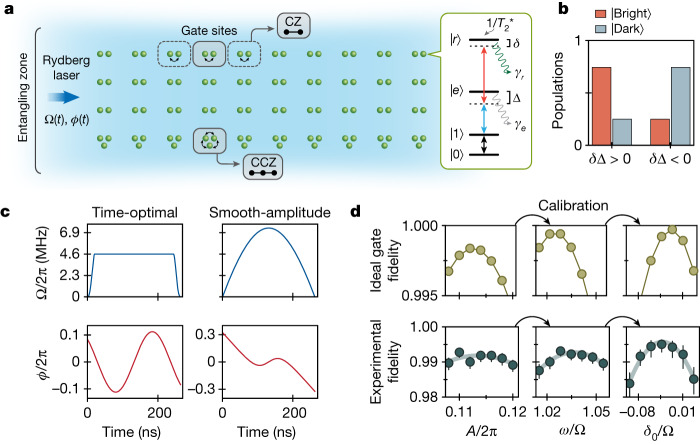
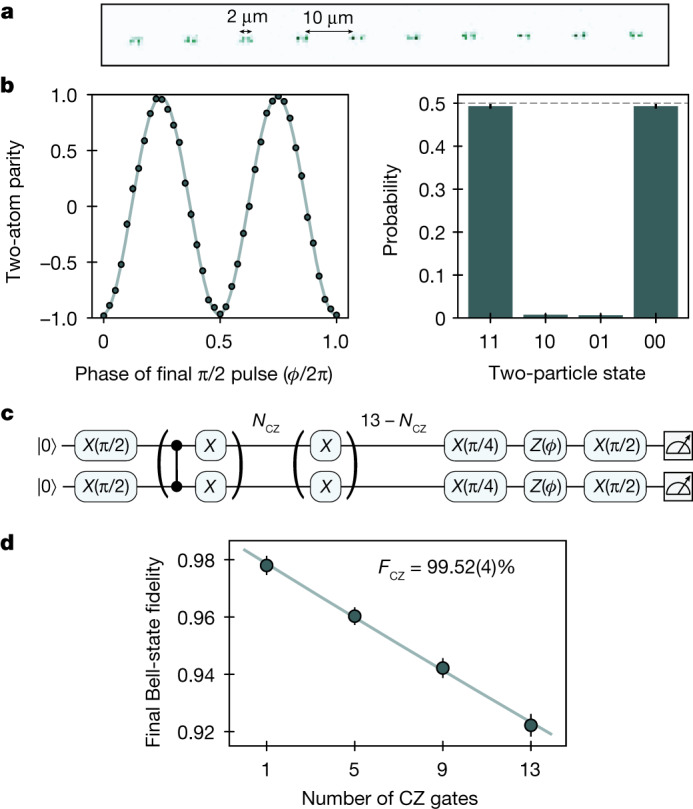
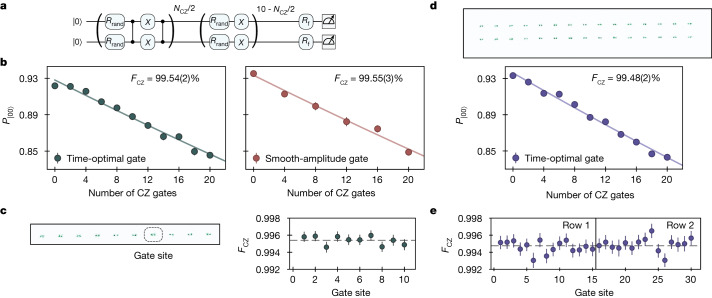
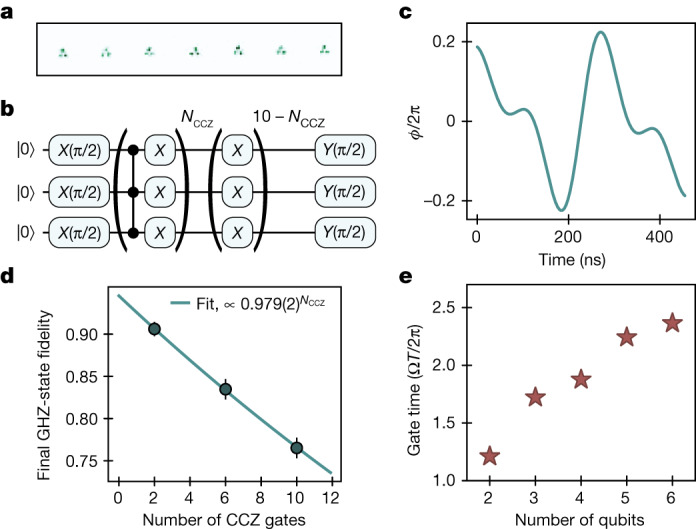
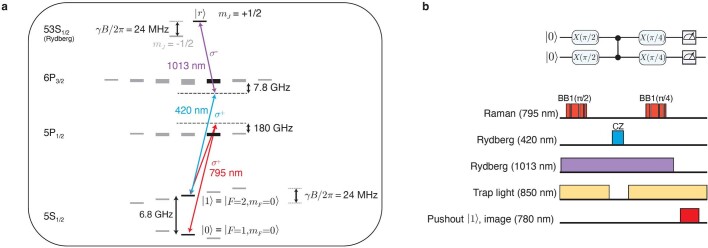
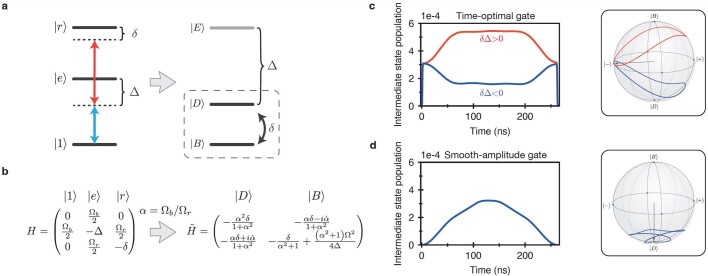
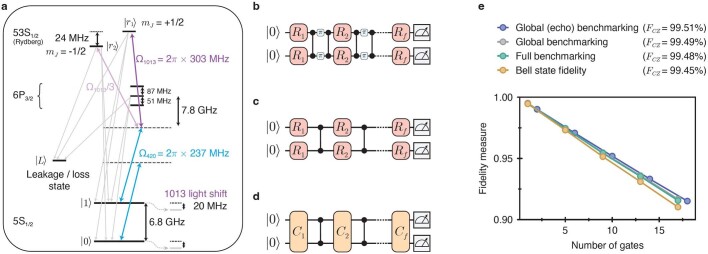
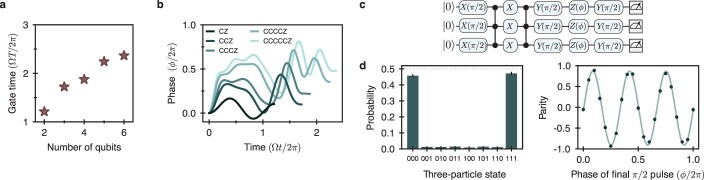
The ability to perform entangling quantum operations with low error rates in a scalable fashion is a central element of useful quantum information processing 1 . Neutral-atom arrays have recently emerged as a promising quantum computing platform, featuring coherent control over hundreds of qubits 2,3 and any-to-any gate connectivity in a flexible, dynamically reconfigurable architecture 4 . The main outstanding challenge has been to reduce errors in entangling operations mediated through Rydberg interactions 5 . Here we report the realization of two-qubit entangling gates with 99.5% fidelity on up to 60 atoms in parallel, surpassing the surface-code threshold for error correction 6,7 . Our method uses fast, single-pulse gates based on optimal control 8 , atomic dark states to reduce scattering 9 and improvements to Rydberg excitation and atom cooling. We benchmark fidelity using several methods based on repeated gate applications 10,11 , characterize the physical error sources and outline future improvements. Finally, we generalize our method to design entangling gates involving a higher number of qubits, which we demonstrate by realizing low-error three-qubit gates 12,13 . By enabling high-fidelity operation in a scalable, highly connected system, these advances lay the groundwork for large-scale implementation of quantum algorithms 14 , error-corrected circuits 7 and digital simulations 15 .
Overview
The claims and statistics of this paper haven’t been checked yet.
Free: it reads the open-access text and checks the first 5 claims that cite a source we can check. Create a free account to check every claim.
Integrity signals
Registry
Cites
Statistics
Figures
Verification
Claims the paper makes
The claims and statistics of this paper haven’t been checked yet.
Free: it reads the open-access text and checks the first 5 claims that cite a source we can check. Create a free account to check every claim.
Claims other papers make about this one
Each is checked against this paper’s own text: does it say what the citing paper says it does?
The source backs part of the claim, not all of it — or backs it for a different population, condition or comparison.
In the citing paper
“Using logical-level control and a zoned architecture in reconfigurable neutral-atom arrays7, our system combines high two-qubit gate fidelities8, arbitrary connectivity7,9, as well as fully programmable single-qubit rotations and mid-circuit readout10–15.”
From Logical quantum processor based on reconfigurable atom arrays (2024) · cites this paper as [8]
Experimental — accuracy not yet measuredThe source backs part of the claim, not all of it — or backs it for a different population, condition or comparison.
In the citing paper
“Averaged over the five computation logicals, we find that, by using the fault-tolerant initialization (postselecting on the ancilla logical flag not detecting errors) our |0L⟩ initialization fidelity is , exceeding both our physical qubit |0⟩ initialization fidelity (99.32(4)% (ref. 8)) and physical two-qubit gate fidelity (99.5% (ref. 8)).”
From Logical quantum processor based on reconfigurable atom arrays (2024) · cites this paper as [8]
Experimental — accuracy not yet measuredThe source backs part of the claim, not all of it — or backs it for a different population, condition or comparison.
In the citing paper
“Although ref. 8 seems to find some small cross-talk seemingly originating from decay into Rydberg P states, this should be considerably suppressed in the practical operation here owing to the approximately 200 μs duration between gates, during which time Rydberg atoms should either fly away or decay back to the ground state.”
From Logical quantum processor based on reconfigurable atom arrays (2024) · cites this paper as [8]
Experimental — accuracy not yet measuredThe source backs part of the claim, not all of it — or backs it for a different population, condition or comparison.
In the citing paper
“Even though the tail of the top-hat Rydberg excitation beams is only suppressed to about 10% intensity, the two-photon drive is far off-resonant owing to the approximately 20 MHz 1013 light shift detuning that is present for the entangling-zone atoms8.”
From Logical quantum processor based on reconfigurable atom arrays (2024) · cites this paper as [8]
Experimental — accuracy not yet measuredThe source backs part of the claim, not all of it — or backs it for a different population, condition or comparison.
In the citing paper
“We ensure that, in our dynamical decoupling, we have an odd number of π pulses between CZ gates (whenever possible), as this echoes out both systematic and spurious contributions to the single-qubit phase7,8.”
From Logical quantum processor based on reconfigurable atom arrays (2024) · cites this paper as [8]
Experimental — accuracy not yet measured
5 more claims about this paper
Create a free account to see every claim other papers make about this one.
Self-check
Percentages, sums and reported differences re-computed from the paper’s own numbers.
The self-check needs the paper’s full text.
Citations
Cites
Quantum Computing in the NISQ era and beyond
Preskill, J. (2018) · Quantum · doi:10.22331/q-2018-08-06-79 · Cited by 8,830
Fault-tolerant quantum computation by anyons
Kitaev, A. Y. (2003) · Annals of Physics · doi:10.1016/s0003-4916(02)00018-0 · Cited by 7,238 · cited 1×
“A thorough error budget is presented along with explanations of routes to further pushing gates to the regime of F>0.999 to make the system capable of reaching future fault tolerant performance.”
BackgroundInfluentialSurface codes: Towards practical large-scale quantum computation
Fowler, A. G., Mariantoni, M., Martinis, J. M., & Cleland, A. N. (2012) · Physical Review A · doi:10.1103/physreva.86.032324 · Cited by 3,059
Observation of electromagnetically induced transparency
Boller, K.-J., Imamoğlu, A., & Harris, S. E. (1991) · Physical Review Letters · doi:10.1103/physrevlett.66.2593 · Cited by 3,058 · cited 2×
“I was also particularly interested in their analysis of correlations between the sites, with this again being the first time sufficiently large ensembles have been used combined with repeated gate applications to really show how errors and correlations build in the system.”
BackgroundMethodSuperconducting quantum circuits at the surface code threshold for fault tolerance
Barends, R., Kelly, J., Megrant, A., Veitia, A., Sank, D., Jeffrey, E., White, T. C., Mutus, J., Fowler, A. G., Campbell, B., et al. (2014) · Nature · doi:10.1038/nature13171 · Cited by 1,733
Fast Quantum Gates for Neutral Atoms
Jaksch, D., Cirac, J. I., Zoller, P., Rolston, S. L., Côté, R., & Lukin, M. D. (2000) · Physical Review Letters · doi:10.1103/physrevlett.85.2208 · Cited by 1,540
Self-citationPredicting many properties of a quantum system from very few measurements
Huang, H.-Y., Kueng, R., & Preskill, J. (2020) · Nature Physics · doi:10.1038/s41567-020-0932-7 · Cited by 1,240
NMR techniques for quantum control and computation
Vandersypen, L. M. K., & Chuang, I. L. (2005) · Reviews of Modern Physics · doi:10.1103/revmodphys.76.1037 · Cited by 1,217
Suppressing quantum errors by scaling a surface code logical qubit
Google Quantum, A. I., Acharya, R., Aleiner, I., Allen, R., Andersen, T. I., Ansmann, M., Arute, F., Arya, K., Asfaw, A., Atalaya, J., et al. (2023) · Nature · doi:10.1038/s41586-022-05434-1 · Cited by 1,103 · cited 2×
“This protocol has the advantage of populating atomic dark states which do not contain population in the intermediate state used for the two-photon excitation to the Rydberg state, thereby reducing spontaneous emission.”
BackgroundQuantum phases of matter on a 256-atom programmable quantum simulator
Ebadi, S., Wang, T. T., Levine, H., Keesling, A., Semeghini, G., Omran, A., Bluvstein, D., Samajdar, R., Pichler, H., Ho, W. W., et al. (2021) · Nature · doi:10.1038/s41586-021-03582-4 · Cited by 995
Self-citation
Research works printed but not linked: 7
- Kalinowski M Maskara N Lukin MD Non-Abelian Floquet spin liquids in a digital Rydberg simulator Phys. Rev. X 2023 13 031008
- Shende VV Markov IL On the CNOT-cost of TOFFOLI gates Quantum Inf. Comput. 2009 9 461 486
- Ma S Universal gate operations on nuclear spin qubits in an optical tweezer array of 171Yb atoms Phys. Rev. X 2022 12 021028
- Brown MO Thiele T Kiehl C Hsu T-W Regal CA Gray-molasses optical-tweezer loading: controlling collisions for scaling atom-array assembly Phys. Rev. X 2019 9 011057
- Chang, T. H., Wang, T. N., Jen, H. H. & Chen, Y. C. High-fidelity Rydberg control-Z gates with time-optimal pulses. Preprint at https://arxiv.org/abs/2303.16395 (2023). · arXiv
- Khazali M Mølmer K Fast multiqubit gates by adiabatic evolution in interacting excited-state manifolds of Rydberg atoms and superconducting circuits Phys. Rev. X 2020 10 021054
- Singh K Anand S Pocklington A Kemp JT Bernien H Dual-element, two-dimensional atom array with continuous-mode operation Phys. Rev. X 2022 12 011040
Cited by
Items 901–973 of 973
Optimizing Atom Transport, Gate-Count and Depth with Parity TwinePreprint
Kazemi, J., Fellner, M., Valencia-Tortora, R. J., Schuler, M., & Lechner, W. (2026) · arXiv (Cornell University) · doi:10.48550/arxiv.2609.03583
“Consequently, the T 2 value reported in Table I represents the effective coherence time achieved under these sequences [51].”
D-CTC Fixed Point Categorization: Prevalence of Non-Uniqueness and Physical Selections
Gifford, H. (2026) · Brock University Digital Repository (Brock University)
Relaxing Coherence Requirements on Laser Sources for Nanoscopy through Optical Fiber TechniquePreprint
Xin, K., Hou, M., Yang, A., Gelléri, M., Lee, H.-K., Failla, A. V., Lu, J., Zeng, X., Bonn, M., Lægsgaard, J., et al. (2026) · arXiv (Cornell University) · doi:10.48550/arxiv.2609.04924
Spectral Core-Tail Architecture for Locally Certified Gibbs-State PreparationPreprint
Li, R.-H. (2026) · arXiv (Cornell University) · doi:10.48550/arxiv.2609.09291
Microwave-Field Sensing via Rydberg Entangling-Gate Dynamics
Song, Y. X., Cao, C. Z., Qin, G. Q., Han, J. Z., & Xue, M. (2026) · Chinese Physics B · doi:10.1088/1674-1056/aea53b
Loss-correcting fault-tolerant quantum computing architecture for neutral atomsPreprint
Sharma, S., Hirano, Y., Goban, A., Yamasaki, H., Sunami, S., & Murali, P. (2026) · arXiv (Cornell University) · doi:10.48550/arxiv.2609.10079
“The error rates of existing platforms are in the range of 10 − 4 – 10 − 3 [5] per operation [6], whereas the error rates required by practical applications range from 10 − 12 to 10 − 6 [7] per operation.”
Constant-depth global shadow estimationPreprint
Zhang, Q., You, Z., Qin, D., Li, X., Eisert, J., & Zhou, Y. (2026) · arXiv (Cornell University) · doi:10.48550/arxiv.2609.10408
Finite-blockade dynamics of a three-qubit ccz gate in neutral-atom arraysPreprint
Banger, P., & Wasan, A. (2026) · arXiv (Cornell University) · doi:10.48550/arxiv.2609.11159
An exchange-assisted entangling gate between 87Rb and 171Yb Rydberg atomsPreprint
Wang, H., Huang, E., Jing, M.-R., Yao, H.-S., Wang, X., & Liu, J.-G. (2026) · arXiv (Cornell University) · doi:10.48550/arxiv.2609.11730
High-fidelity conditional-squeezing gate in superconducting circuits via refocusing
Schiaffino, R., Lombardo, F., & Paz, J. P. (2026) · Physical Review A · doi:10.1103/mqt6-fh7c
Ueno, Y., Sunami, S., Hinokuma, T., Suzuki, Y., Goban, A., Yamasaki, H., Tanimoto, T., & Byun, I. (2026) · arXiv (Cornell University) · doi:10.48550/arxiv.2609.14478
“2) Control hardware: We adopt the state-of-the-art selective laser operations and their latency values for shuttling-free ESM [1], [11], [12], [20], [26], [34], [35], [38]–[41].”
InfluentialHigh Connectivity and Tunable Long Range Coupling in Superconducting Circuit Devices
Marinelli, B. (2026) · eScholarship (California Digital Library)
A Programmable Rydberg Quantum Bus for Nonlocal ConnectivityPreprint
Jin, X., Yang, F., Li, W., & Shao, X. Q. (2026) · arXiv (Cornell University) · doi:10.48550/arxiv.2609.18447
Scalable entanglement distribution using encoded hybrid repeater chainsPreprint
Haldar, S., Guha, S., Towsley, D., & Rozpędek, F. (2026) · arXiv (Cornell University) · doi:10.48550/arxiv.2609.19783
“Ion-trap [38] and neutral-atom [39] based quantum memories fit this description well.”
FT-Weave: Real-Time Compilation Framework for Reconfigurable Fault-Tolerant Quantum ArchitecturesPreprint
Lin, W.-H., Kornjača, M., Zhao, C., Wang, S.-T., & Cong, J. (2026) · arXiv (Cornell University) · doi:10.48550/arxiv.2609.20573
“Neutral-atom platforms are particularly well suited to this model because they ∗ Contact author: wlin@quera.com support flexible qubit arrangements and dynamic con-trol [14, 19, 20].”
Neutral atom quantum computing for materials science and quantum chemistryPreprint
Pritchard, J. D. (2026) · arXiv (Cornell University) · doi:10.48550/arxiv.2609.20464
“Recent advances in gate fidelity [45–49], combined with the ability to dynamically reconfigure qubits whilst maintaining coherence [50] have lead to pioneering demonstrations of quantum error correction and transverse operations with logical qubits [50–55].”
InfluentialFast Unitary Preparation of Surface-Code Logical States on Neutral-Atom HardwarePreprint
Schmid, L., & Wille, R. (2026) · arXiv (Cornell University) · doi:10.48550/arxiv.2609.20183
“The latter offer a specific, highly parallel operation set of global Rydberg CZ layers [9] and collective, order-preserving row and column moves of atoms held in acousto-optic-deflector (AOD) tweezers [10], and a preparation scheme matched to these capabilities has been missing.”
Fast Single-Atom Preparation in Optical Tweezers via Rydberg Blockade
Li, Y., Hughes, V. W., Peper, M., Bao, Y., Li, C., Bissenali, S., & Thompson, J. D. (2026) · PRX Quantum · doi:10.1103/8t3p-x6s7
Fan, Q.-M., Yang, P.-F., Chang, H.-B., Xu, D.-L., Ren, C.-Y., Ren, P.-L., Wang, Z.-H., Zhang, P.-F., Li, G., & Zhang, T.-C. (2026) · Optics & Laser Technology · doi:10.1016/j.optlastec.2026.116446
Structured Hamiltonian Learning for Multiqubit Conditional Phase GatesPreprint
Deng, X.-H. (2026) · arXiv (Cornell University) · doi:10.48550/arxiv.2609.27629
“Neutral-atom arrays provide parallel controlled-phase gates and native multiqubit entangling operations [14, 15].”
Orbit-qubit quantum processor of ultracold atoms
He, M.-G., Zhang, W.-Y., Yuan, Z.-S., & Pan, J.-W. (2026) · Physical Review Letters · doi:10.1103/fxpf-vzxx · Cited by 1
Hoyt, A. C., Wu, C., Kan, S., Garner, S. R., Chatterjee, A., Rebar, D. J., Tubman, N. M., Klymko, K., Liu, C., Li, A., et al. (2026) · arXiv (Cornell University) · doi:10.48550/arxiv.2609.29018
Floquet quantum gates with ion-enhanced Rydberg blockade
Anonymous, Han, J. Z., Shi, J.-C., Huang, Z., & Su, S. (2026) · Physical Review A · doi:10.1103/247k-6zy1
Spin-exchange interactions between circular Rydberg atoms over long timesPreprint
Hernández, A. D., Creutzer, G., Young, A., Kassid, A., Machu, Y., Raimond, J., Brune, M., & Sayrin, C. (2026) · arXiv (Cornell University) · doi:10.48550/arxiv.2609.37766
“However, the interaction time, i.e., the maximum accumulated time during which an atom interacts with its neighbours, has been limited to a few microseconds only [11, 12].”
Akhtar, M. A. K. (2026) · SSRN Electronic Journal · doi:10.2139/ssrn.7543198
Layer codes as quantum memories: syndrome extraction, thresholds and idle robustnessPreprint
Sun, Z., & Cai, Z.-Y. (2026) · arXiv (Cornell University) · doi:10.48550/arxiv.2609.39522
Defect-Aware Parallel Atom Reloading Protocol for Neutral-Atom Quantum ComputersPreprint
Aoyama, K., & Ino, F. (2026) · arXiv (Cornell University) · doi:10.48550/arxiv.2609.38939
“5% [24], which is equivalent to an error rate of 0 .”
Fast and high-fidelity adiabatic control of the Rydberg atom using an auxiliary pulse
Ren, Y., Liu, P., Hu, X., Guo, A.-L., & Wu, H. (2026) · Chinese Journal of Physics · doi:10.1016/j.cjph.2026.09.034
Quantum Computing-Based Methods for Electronic Structure in Industrial Chemistry Applications
Tarocco, F. (n.d.) · Archivio Istituzionale della Ricerca - Università degli Studi dell Aquila
Design of time-optimal multi-qubit gates using Lie-theoretic methods
Bubulis, R. (2026) · TU/e Research Portal
Pan, X.-X., Zhao, Y., Supiyeva, Z., & Abbas, Q. (2026) · Frontiers in Chemistry · doi:10.3389/fchem.2026.1951078
Zhang, T., Nie, X.-T., & Chen, L.-H. (2026) · arXiv (Cornell University) · doi:10.48550/arxiv.2610.06961
“In such systems, strong van der Waals interactions and programmable geometries enable rich many-body physics [25–28], while high-fidelity site-resolved readout provides access to full spatial measurement outcomes [29].”
High-Fidelity Inter-Species Rydberg Gates with Two-Photon DrivingPreprint
Wang, S., & Singh, K. (2026) · arXiv (Cornell University) · doi:10.48550/arxiv.2610.08926
“So far, the discussion of high-fidelity gates based on quantum optimal control in neutral-atom platforms has been primarily limited to single-species arrays [26, 30].”
InfluentialPhotonic Chips for Universal Quantum Computing: Retrospective and ProspectivePreprint
Wang, W., Fang, M., Yu, H., Li, S., Tang, Z., Cai, H., Chin, L.-K., van Loock, P., Su, D., & Liu, A.-Q. 刘. (2026) · arXiv (Cornell University) · doi:10.48550/arxiv.2610.11321
Self-citationError correction and quantum information spreading on sparse random graphsPreprint
Cemin, G., Bukov, M., & Solfanelli, A. (2026) · arXiv (Cornell University) · doi:10.48550/arxiv.2610.12597
A Photonic Integrated Light Generation, Control, and Delivery Engine for Creating Cold AtomsPreprint
Isichenko, A., Ruiz, C., Zhong, C., Montifiore, N., Harding, S. J., Song, M.-T., Liu, C.-H., Indukuri, N., Nelson, K. D., & Blumenthal, D. (2026) · arXiv (Cornell University) · doi:10.48550/arxiv.2610.17918
Avoiding Defects within Heavy-Hexagon ArchitecturePreprint
Kim, H., & Kwon, Y. (2026) · arXiv (Cornell University) · doi:10.48550/arxiv.2610.14778
A compact six-beam 3D magneto-optical trap based on multifunctional metasurface chipsPreprint
Qing, C., Sun, H.-J., Liu, Y.-Z., Liao, Y., Li, Y.-Z., Zhang, D.-K., Feng, X., & Huang, Y.-D. (2026) · arXiv (Cornell University) · doi:10.48550/arxiv.2610.19504
Programmable all-to-all entangling gates for cavity-coupled atomsPreprint
Crookes, A., Yuen, B., & Demetriadou, A. (2026) · arXiv (Cornell University) · doi:10.48550/arxiv.2610.22220
Hoare, D. J., Dunniece, P., Rodewald, J., Voges, K. K., & Tarbutt, M. R. (2026) · arXiv (Cornell University) · doi:10.48550/arxiv.2610.21609
Two-photon Landau–Zener–Stückelberg–Majorana effect in interacting Rydberg atoms
Gao, Y., Song, P.-Y., Chen, R., Wang, Y., Su, S.-L., & Wu, J.-L. (2026) · Optics Letters · doi:10.1364/ol.613294
Adiabatic controlled-$Z$ gate for neutral atoms with Förster-enhanced Rydberg dressingPreprint
Thapliyal, D., & Wasan, A. (2026) · arXiv (Cornell University) · doi:10.48550/arxiv.2610.24755
End-to-End Optimization of Partial Fault Tolerance in Neutral-Atom ArraysPreprint
Veroni, S., Deger, A., & Daley, A. (2026) · arXiv (Cornell University) · doi:10.48550/arxiv.2610.26471
“[76], or an approximation thereof [56–61].”
InfluentialQuantum computing for plasma physics in magnetic-confinement fusionPreprint
Zhu, C., Xu, S., Zhang, Y., Liang, Y., & Yue, Y. (2026) · arXiv (Cornell University) · doi:10.48550/arxiv.2610.25885
Suominen, H., Kundu, S., Kivijärvi, H., Tuohino, S., Tuokkola, M., Forsbom, E., Chand, M., Vadimov, V., Vijay, R., & Möttönen, M. (2026) · arXiv (Cornell University) · doi:10.48550/arxiv.2610.28057
“Hence, in recent years, significant efforts have been made to improve hardware performance through, for example, device design, fabrication methods, and new material platforms [2–8], optimized control techniques [7– 14], and novel qubit types [15–18].”
NEAT: A Neutral-Atom Transpiler for Joint Mapping and Scheduling of Syndrome Extraction Circuits
Gao, D.-C., Zhang, K., Li, S., Ying, S.-G., Liu, F.-M., & Chen, J.-X. (2026) · Design Automation Conference · doi:10.1145/3770743.3804083
Self-citationChen, H.-Z., & Cai, Z.-N. (2026) · arXiv (Cornell University) · doi:10.48550/arxiv.2610.29372
“This tradeoff may be useful for neutral-atom quantum processors, where large qubit arrays and programmable connectivity offer resources for representing the effective bath [1, 10].”
Distributed Fault-Tolerant Quantum Computing: From Vision to Reality
Babaie, S., Grzenda, S., Yang, L., & Qiao, C. (2026) · Entropy · doi:10.3390/e28111173
Baradziej, S. (2026) · Frontiers in Computer Science · doi:10.3389/fcomp.2026.1914634
Bell-pair distillation under imperfect operationsPreprint
Kinyó, A., Kiss, T., & Kálmán, O. (2026) · arXiv (Cornell University) · doi:10.48550/arxiv.2610.35699
Analog Quantum Experiments Meet Automatic Differentiation - from Programs to AtomsPreprint
Shi, Y., Liu, P.-Y., & Peng, Y.-X. (2026) · arXiv (Cornell University) · doi:10.48550/arxiv.2610.36167
Correlation-sensitive magic-state distillation from spin-squeezed neutral atomsPreprint
Wang, X., Guo, R., Li, X., Feng, M., Wang, H., Bai, Z., & Zhang, Y. (2026) · arXiv (Cornell University) · doi:10.48550/arxiv.2610.36963
“For neutral atoms, assembly and programmable geometry [38–40], coherent transport [41, 42], Raman driving [43], parallel entan-gling gates [44, 45], and time-optimal gate designs [46] combine with midcircuit cavity measurements and protected readout [47–49].”
Rubidium-Referenced Frequency-Doubled Pockels Laser with High-Speed Electro-Optic TuningPreprint
Chen, X., Li, M., Shi, X., Zhou, L., Yang, R., Zhao, M., Dhyani, V., Mohanraj, S. S., Wu, G., Hao, H., et al. (2026) · arXiv (Cornell University) · doi:10.48550/arxiv.2610.37279
Nguyen, T. T., Que, J. A., & Grotjahn, R. (2026) · Journal of Chemical Physics · doi:10.1063/5.0356718
Bonilauri, I., Lacalle, E., Alegre, E. F., Pastor, F. M., & Fernández, B. M. (2024) · Buleria (Universidad de León)
NAKO: A Benchmarking Framework for Evaluating and Diagnosing Neutral-Atom Quantum CompilersPreprint
Sun, W., Wang, Z., Li, X., Zheng, D., Yu, L., Chen, G., & Yang, G. (2026) · arXiv (Cornell University) · doi:10.48550/arxiv.2610.39296
“…No. 2006, Xiyuan Ave., Chengdu, Sichuan 611731, China (e-mail: 202222120303@std.uestc.edu.cn; 202312081614@std.uestc.edu.cn; guowu@uestc.edu.cn). advanced their computational capabilities [4]–[7], while coherent transport enables entangled qubits to move between interaction configurations [8].”
Pulse-Informed Physical Placement for Parallel Two-Qubit Gates in Qubit ArraysPreprint
Qamar, S., Zhuang, W.-F., Riaz, B., & 钱, P. 鹏. Q. (2026) · arXiv (Cornell University) · doi:10.48550/arxiv.2610.38604
“…pairs were achieved early on, large-scale parallel gates have only recently been demonstrated on different platforms such as neutral atom arrays [8–10], superconducting circuits [11–13, 34] Recent measurements further show that residual couplings across superconducting qubit arrays can possess…”
High-Fidelity Universal Quantum Gates in a Cryogenic Atom ArrayPreprint
Jin, J., Seo, D., Shi, Y., Lu, Y., Thompson, J. D., & Bakr, W. (2026) · arXiv (Cornell University) · doi:10.48550/arxiv.2610.40329
Model-Based Fast Calibration for a Nitrogen Vacancy Center QPUPreprint
Sjolander, T. F., Rossignolo, M., Bianchet, L. C., Hegde, S. S., Roy, A. S., Lippert, T., & Jattana, M. (2026) · arXiv (Cornell University) · doi:10.48550/arxiv.2611.01288
Qubrio: High-Performance Quantum Compilation via Multi-Agent LLM CollaborationPreprint
Ruan, J., Cui, Z., Hu, Z., Yu, Z., Fang, X., Guan, Y., Ludmir, J., Weinberg, P. E., Luo, X., Wang, S., et al. (2026) · arXiv (Cornell University) · doi:10.48550/arxiv.2611.02269
Enhanced shortcuts to adiabaticity in an interacting giant-atom-atomic-waveguide systemPreprint
Sun, R.-J., Wang, Z.-H., & Ruschhaupt, A. (2026) · arXiv (Cornell University) · doi:10.48550/arxiv.2611.00601
MagicFlow: Breaking the Magic State Bottleneck for Scalable Fault-Tolerant Quantum Computing
Wang, M., & Nair, P. J. (2027) · International Conference on Architectural Support for Programming Languages and Operating Systems (ASPLOS) · doi:10.1145/3845814.3850030
High-fidelity quantum gate learning via physics-informed neural networksPreprint
Fabra, L., Susa, C. E., Montoya, A., & Norambuena, A. (2026) · arXiv (Cornell University) · doi:10.48550/arxiv.2611.03851
Reopening the one clean qubit case of a semi-grand challengePreprint
Mansell, C. (2026) · arXiv (Cornell University) · doi:10.48550/arxiv.2611.05046
Srinivas, K., Santhosh, V. A., E.Gurumoorthi, Giridhar, B., & K.Aarathi (2026) · Computer and decision making. · doi:10.1922/comdem.v3i6s.18925
Quantum circuit simulation of many-body localization in 1D Aubry–André–Hubbard model
Park, J., Lee, Y., & Hong, S. (2026) · Current Applied Physics · doi:10.1016/j.cap.2026.11.003
Logically Augmented Quantum LDPC Codes: Construction and Hierarchical DecodingPreprint
Rabeti, S., Shirke, A., Dimitrova, I., & Mahdavifar, H. (2026) · arXiv (Cornell University) · doi:10.48550/arxiv.2611.07062
Certifying the Rydberg-exposure limit of a globally driven controlled-Z gatePreprint
Zhao, Y.-S., Wang, H., Jing, M.-R., Ni, Z.-Y., Yao, H.-S., Wang, X., Wang, J.-H., & Liu, J.-G. (2026) · arXiv (Cornell University) · doi:10.48550/arxiv.2611.07388
A Universal Fault-Tolerant Quantum Computing Architecture with Globally Driven Atom ArraysPreprint
Zhang, Z., Cao, S., Yu, X., Chen, Y., Min, Y., Li, Y., Yu, Z., Feng, L., & Li, X. (2026) · arXiv (Cornell University) · doi:10.48550/arxiv.2611.12098
Adaptive Protocol for R\'enyi Entropy EstimationPreprint
Niu, M., Teoh, Y., Melko, R., & Islam, R. (2026) · arXiv (Cornell University) · doi:10.48550/arxiv.2611.10330
Unified architecture for arbitrary two-qubit gates with neutral atomsPreprint
Mostaan, N., Schmelcher, P., & Mukherjee, R. (2026) · arXiv (Cornell University) · doi:10.48550/arxiv.2611.12779
Babu, A., & Goswami, M. (2026) · Research Square · doi:10.21203/rs.3.rs-11679320/v1
Chen, W.-B., Fang, D., Wang, C.-X., Zhang, C.-H., Huang, Y.-F., Li, C.-F., Guo, G.-C., & Cui, J.-M. (2026) · Chinese Optics Letters (COL) · doi:10.3788/col202624.112701
Metadata
- Authors
- Evered, S. J., Bluvstein, D., Kalinowski, M., Ebadi, S., Manovitz, T., Zhou, H., Li, S. H., Geim, A. A., Wang, T. T., Maskara, N., Levine, H., Semeghini, G., Greiner, M., Vuletić, V., & Lukin, M. D.
- Affiliations
- Harvard University (US)
- Massachusetts Institute of Technology (US)
- Corresponding author
- Lukin, Mikhail D.
- ORCID
- Venue
- Nature
- Published
- 2023-10-11
- Volume
- 622
- Issue
- 7982
- Pages
- 268-272
- ISSN
- 0028-0836 (ISSN-L)
- 1476-4687
- PMC
- PMC10567572
- OpenAlex
- W4387542025
- Semantic Scholar
- 531874012fede3c01f44f2d81bfb926c0a25c9aa
- Cited by
- 522
- References
- 97
- Citations by year
- 2026: 134 · 2025: 229 · 2024: 138 · 2023: 21
- FWCI
- 60.51
- Type
- journal article
- Language
- en
- Open access
- hybrid
- doi.org
- Licence
- cc-by
- creativecommons.org/licenses/by/4.0 (tdm)
- creativecommons.org/licenses/by/4.0 (vor)
- Locations
- Nature (publishedVersion, cc-by)
- PubMed Central (publishedVersion, cc-by)
- PubMed (publishedVersion)
- arXiv (Cornell University) (submittedVersion)
- OSTI OAI (U.S. Department of Energy Office of Scientific and Technical Information) (submittedVersion)
- FIU - Digital Commons (Florida International University) (submittedVersion)
- Florida International University Digital Commons (Florida International University) (submittedVersion, cc-by)
- RePEc: Research Papers in Economics (submittedVersion)
- arXiv (Cornell University)
- Funders
- National Science Foundation (1745303, W911NF-20-1-0082)
- U.S. Department of Energy (DESC0021013, DESC0021110, 7568717)
- Defense Advanced Research Projects Agency (W911NF2010021)
- National Defense Science and Engineering Graduate
- Multidisciplinary University Research Initiative (W911NF2010082)
- Center for Ultracold Atoms, Massachusetts Institute of Technology
- Army Research Office (W911NF-20-1-0082, W911NF)
- Topics
- Physical Sciences › Physics and Astronomy › Atomic and Molecular Physics, and Optics › Cold Atom Physics and Bose-Einstein Condensates
- Physical Sciences › Computer Science › Artificial Intelligence › Quantum Computing Algorithms and Architecture
- Physical Sciences › Physics and Astronomy › Atomic and Molecular Physics, and Optics › Quantum Information and Cryptography
- Keywords
- neutral atom quantum computing, entangling gates, Rydberg interactions, gate fidelity, three-qubit gates, optimal control, dark states, atom cooling, Rydberg excitation, error sources, scalable quantum hardware
About these checks
Registry, retraction, Cites and statistics results are computed, not judged, with one exception: a printed reference that no index lists is read once by a model before it counts as a citation error. Claims are extracted by a model and kept only when their quote appears verbatim in the text; each cited source is then checked, with a model’s help, for whether it says what the claim relies on. Those verdicts can be wrong — read the claim’s quote and the cited source before relying on one.
Statistics and arithmetic are recomputed, not judged.
Confidence bands are shown only for fields calibrated on our annotated test set. None is calibrated yet, so no band is shown.
What counts as a claim ›How we measure confidence ›How we check this ›
Are you an author, or do you see a problem with this page? Request a review
Data sources
Bibliographic data: Semantic Scholar, OpenAlex, Crossref.
Contains information from the Semantic Scholar Academic Graph Datasets, made available under the ODC Attribution License (ODC-BY 1.0).
Semantic Scholar’s data is described in: Kinney, R., et al. (2023). The Semantic Scholar Open Data Platform. arXiv:2301.10140.
