

High-fidelity parallel entangling gates on a neutral-atom quantum computer
Open accessThe DOI matches its Crossref record; 101 of the 101 references it cites were found in a registry or an index.
Abstract
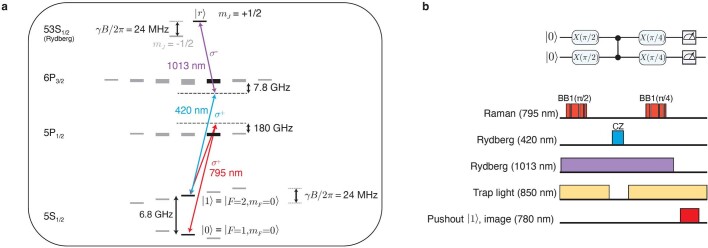
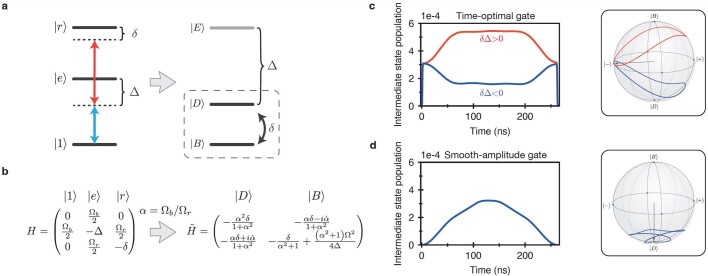
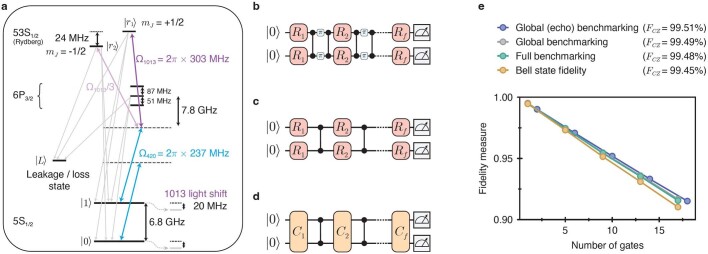
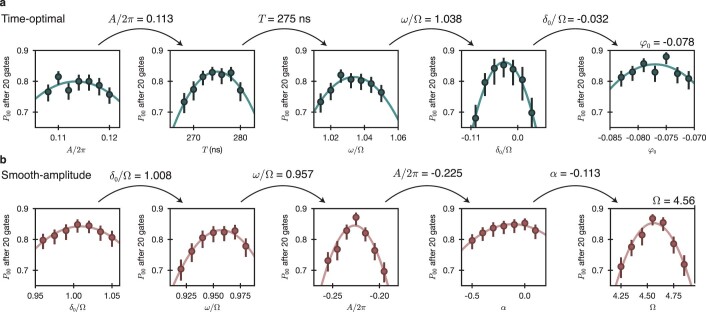
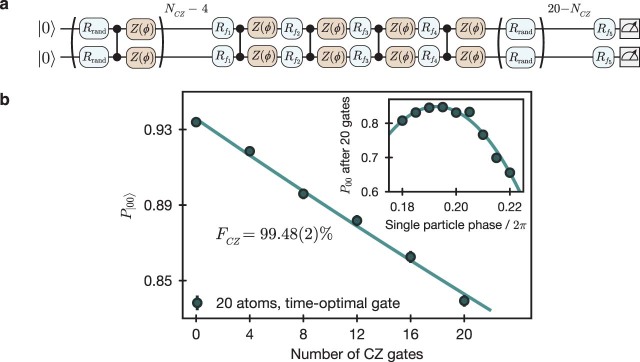
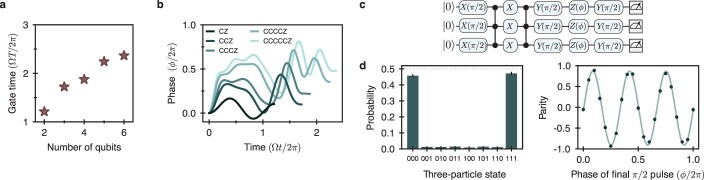
The ability to perform entangling quantum operations with low error rates in a scalable fashion is a central element of useful quantum information processing 1 . Neutral-atom arrays have recently emerged as a promising quantum computing platform, featuring coherent control over hundreds of qubits 2,3 and any-to-any gate connectivity in a flexible, dynamically reconfigurable architecture 4 . The main outstanding challenge has been to reduce errors in entangling operations mediated through Rydberg interactions 5 . Here we report the realization of two-qubit entangling gates with 99.5% fidelity on up to 60 atoms in parallel, surpassing the surface-code threshold for error correction 6,7 . Our method uses fast, single-pulse gates based on optimal control 8 , atomic dark states to reduce scattering 9 and improvements to Rydberg excitation and atom cooling. We benchmark fidelity using several methods based on repeated gate applications 10,11 , characterize the physical error sources and outline future improvements. Finally, we generalize our method to design entangling gates involving a higher number of qubits, which we demonstrate by realizing low-error three-qubit gates 12,13 . By enabling high-fidelity operation in a scalable, highly connected system, these advances lay the groundwork for large-scale implementation of quantum algorithms 14 , error-corrected circuits 7 and digital simulations 15 .
Overview
The claims and statistics of this paper haven’t been checked yet.
Free: it reads the open-access text and checks the first 5 claims that cite a source we can check. Create a free account to check every claim.
Integrity signals
Registry
Cites
Statistics
Figures
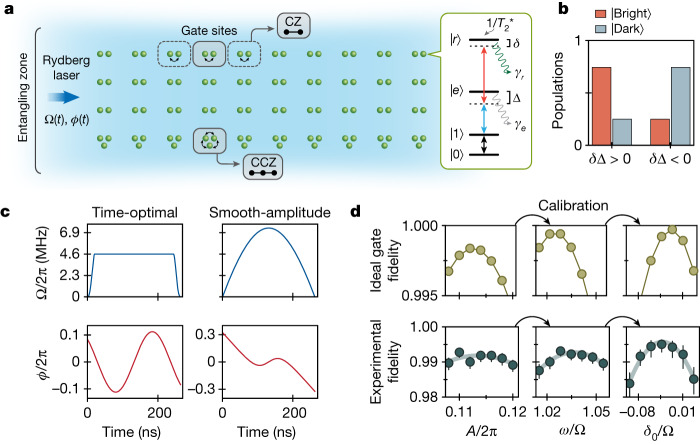
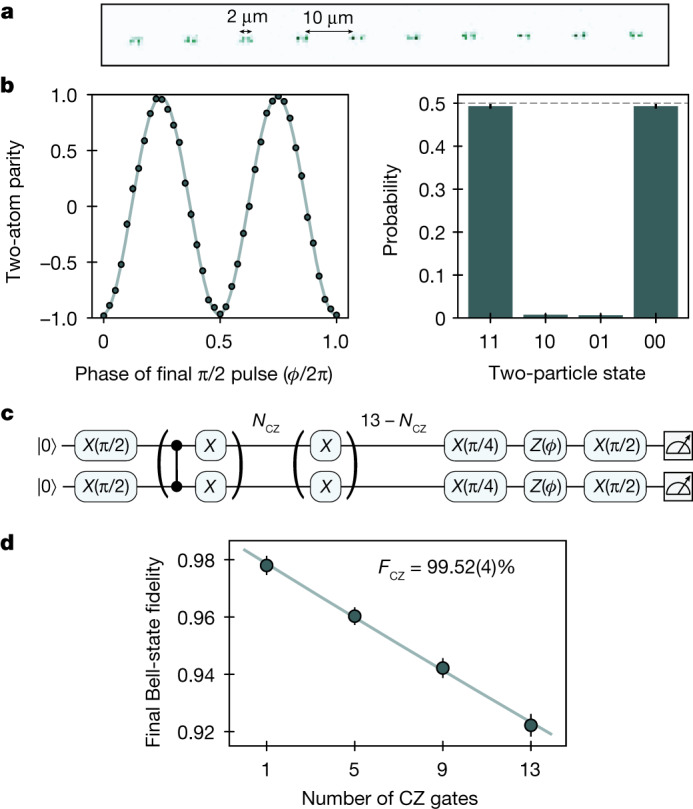
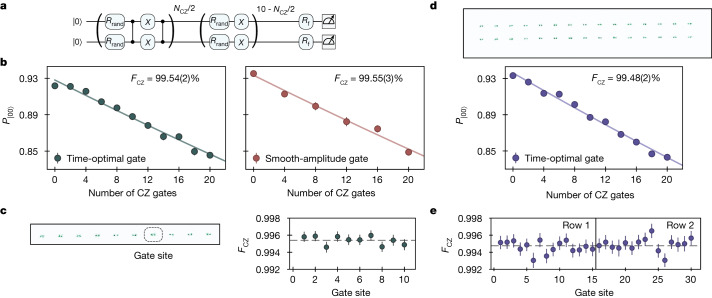
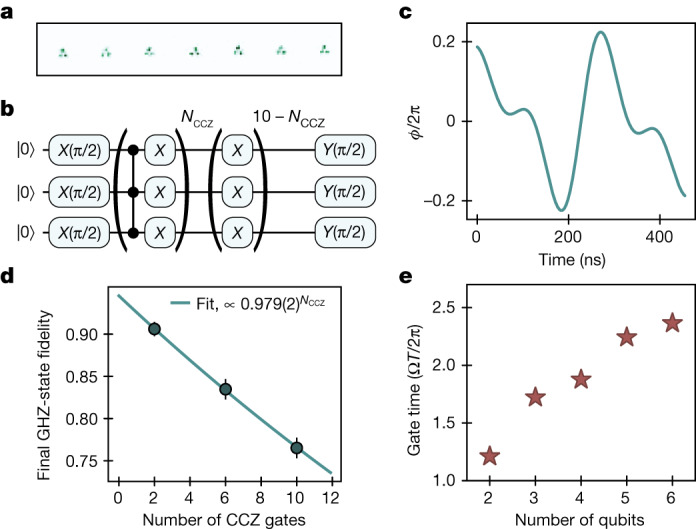
Verification
Claims the paper makes
The claims and statistics of this paper haven’t been checked yet.
Free: it reads the open-access text and checks the first 5 claims that cite a source we can check. Create a free account to check every claim.
Claims other papers make about this one
Each is checked against this paper’s own text: does it say what the citing paper says it does?
The source backs part of the claim, not all of it — or backs it for a different population, condition or comparison.
In the citing paper
“Using logical-level control and a zoned architecture in reconfigurable neutral-atom arrays7, our system combines high two-qubit gate fidelities8, arbitrary connectivity7,9, as well as fully programmable single-qubit rotations and mid-circuit readout10–15.”
From Logical quantum processor based on reconfigurable atom arrays (2024) · cites this paper as [8]
Experimental — accuracy not yet measuredThe source backs part of the claim, not all of it — or backs it for a different population, condition or comparison.
In the citing paper
“Averaged over the five computation logicals, we find that, by using the fault-tolerant initialization (postselecting on the ancilla logical flag not detecting errors) our |0L⟩ initialization fidelity is , exceeding both our physical qubit |0⟩ initialization fidelity (99.32(4)% (ref. 8)) and physical two-qubit gate fidelity (99.5% (ref. 8)).”
From Logical quantum processor based on reconfigurable atom arrays (2024) · cites this paper as [8]
Experimental — accuracy not yet measuredThe source backs part of the claim, not all of it — or backs it for a different population, condition or comparison.
In the citing paper
“Although ref. 8 seems to find some small cross-talk seemingly originating from decay into Rydberg P states, this should be considerably suppressed in the practical operation here owing to the approximately 200 μs duration between gates, during which time Rydberg atoms should either fly away or decay back to the ground state.”
From Logical quantum processor based on reconfigurable atom arrays (2024) · cites this paper as [8]
Experimental — accuracy not yet measuredThe source backs part of the claim, not all of it — or backs it for a different population, condition or comparison.
In the citing paper
“Even though the tail of the top-hat Rydberg excitation beams is only suppressed to about 10% intensity, the two-photon drive is far off-resonant owing to the approximately 20 MHz 1013 light shift detuning that is present for the entangling-zone atoms8.”
From Logical quantum processor based on reconfigurable atom arrays (2024) · cites this paper as [8]
Experimental — accuracy not yet measuredThe source backs part of the claim, not all of it — or backs it for a different population, condition or comparison.
In the citing paper
“We ensure that, in our dynamical decoupling, we have an odd number of π pulses between CZ gates (whenever possible), as this echoes out both systematic and spurious contributions to the single-qubit phase7,8.”
From Logical quantum processor based on reconfigurable atom arrays (2024) · cites this paper as [8]
Experimental — accuracy not yet measured
5 more claims about this paper
Create a free account to see every claim other papers make about this one.
Self-check
Percentages, sums and reported differences re-computed from the paper’s own numbers.
The self-check needs the paper’s full text.
Citations
Cites
Quantum Computing in the NISQ era and beyond
Preskill, J. (2018) · Quantum · doi:10.22331/q-2018-08-06-79 · Cited by 8,830
Fault-tolerant quantum computation by anyons
Kitaev, A. Y. (2003) · Annals of Physics · doi:10.1016/s0003-4916(02)00018-0 · Cited by 7,238 · cited 1×
“A thorough error budget is presented along with explanations of routes to further pushing gates to the regime of F>0.999 to make the system capable of reaching future fault tolerant performance.”
BackgroundInfluentialSurface codes: Towards practical large-scale quantum computation
Fowler, A. G., Mariantoni, M., Martinis, J. M., & Cleland, A. N. (2012) · Physical Review A · doi:10.1103/physreva.86.032324 · Cited by 3,059
Observation of electromagnetically induced transparency
Boller, K.-J., Imamoğlu, A., & Harris, S. E. (1991) · Physical Review Letters · doi:10.1103/physrevlett.66.2593 · Cited by 3,058 · cited 2×
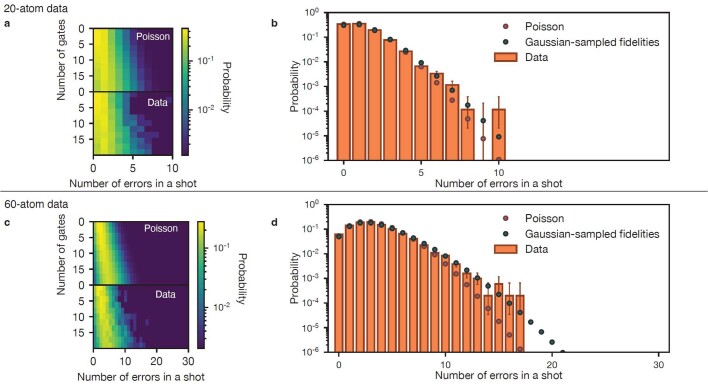
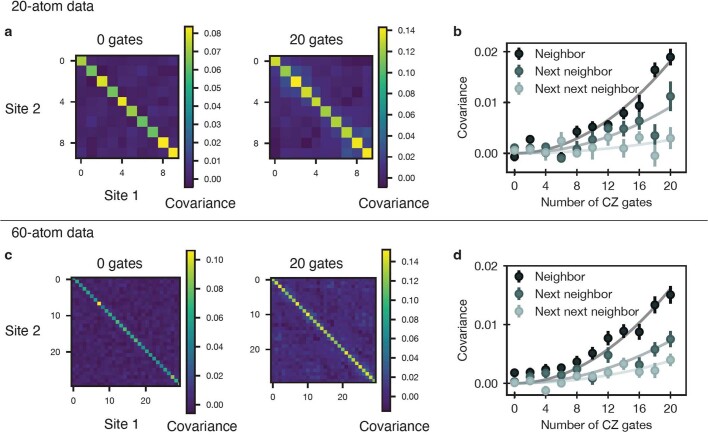
“I was also particularly interested in their analysis of correlations between the sites, with this again being the first time sufficiently large ensembles have been used combined with repeated gate applications to really show how errors and correlations build in the system.”
BackgroundMethodSuperconducting quantum circuits at the surface code threshold for fault tolerance
Barends, R., Kelly, J., Megrant, A., Veitia, A., Sank, D., Jeffrey, E., White, T. C., Mutus, J., Fowler, A. G., Campbell, B., et al. (2014) · Nature · doi:10.1038/nature13171 · Cited by 1,733
Fast Quantum Gates for Neutral Atoms
Jaksch, D., Cirac, J. I., Zoller, P., Rolston, S. L., Côté, R., & Lukin, M. D. (2000) · Physical Review Letters · doi:10.1103/physrevlett.85.2208 · Cited by 1,540
Self-citationPredicting many properties of a quantum system from very few measurements
Huang, H.-Y., Kueng, R., & Preskill, J. (2020) · Nature Physics · doi:10.1038/s41567-020-0932-7 · Cited by 1,240
NMR techniques for quantum control and computation
Vandersypen, L. M. K., & Chuang, I. L. (2005) · Reviews of Modern Physics · doi:10.1103/revmodphys.76.1037 · Cited by 1,217
Suppressing quantum errors by scaling a surface code logical qubit
Google Quantum, A. I., Acharya, R., Aleiner, I., Allen, R., Andersen, T. I., Ansmann, M., Arute, F., Arya, K., Asfaw, A., Atalaya, J., et al. (2023) · Nature · doi:10.1038/s41586-022-05434-1 · Cited by 1,103 · cited 2×
“This protocol has the advantage of populating atomic dark states which do not contain population in the intermediate state used for the two-photon excitation to the Rydberg state, thereby reducing spontaneous emission.”
BackgroundQuantum phases of matter on a 256-atom programmable quantum simulator
Ebadi, S., Wang, T. T., Levine, H., Keesling, A., Semeghini, G., Omran, A., Bluvstein, D., Samajdar, R., Pichler, H., Ho, W. W., et al. (2021) · Nature · doi:10.1038/s41586-021-03582-4 · Cited by 995
Self-citation
Research works printed but not linked: 7
- Kalinowski M Maskara N Lukin MD Non-Abelian Floquet spin liquids in a digital Rydberg simulator Phys. Rev. X 2023 13 031008
- Shende VV Markov IL On the CNOT-cost of TOFFOLI gates Quantum Inf. Comput. 2009 9 461 486
- Ma S Universal gate operations on nuclear spin qubits in an optical tweezer array of 171Yb atoms Phys. Rev. X 2022 12 021028
- Brown MO Thiele T Kiehl C Hsu T-W Regal CA Gray-molasses optical-tweezer loading: controlling collisions for scaling atom-array assembly Phys. Rev. X 2019 9 011057
- Chang, T. H., Wang, T. N., Jen, H. H. & Chen, Y. C. High-fidelity Rydberg control-Z gates with time-optimal pulses. Preprint at https://arxiv.org/abs/2303.16395 (2023). · arXiv
- Khazali M Mølmer K Fast multiqubit gates by adiabatic evolution in interacting excited-state manifolds of Rydberg atoms and superconducting circuits Phys. Rev. X 2020 10 021054
- Singh K Anand S Pocklington A Kemp JT Bernien H Dual-element, two-dimensional atom array with continuous-mode operation Phys. Rev. X 2022 12 011040
Cited by
Items 801–900 of 973
Magneto-Optical Trapping and Control for a Neutral Atom Quantum Computer
Hu, B. (2025) · ResearchWorks at the University of Washington (University of Washington)
Novel approaches for quantum technologies with atoms and photons in free space
Romeu, D. G. (2024) · UPCommons institutional repository (Universitat Politècnica de Catalunya) · doi:10.5821/dissertation-2117-455327
Toward Scalable Quantum Computing: A Comparative Review of Qubit Platforms
Zhang, Y. (2025) · International Conference on Communication Technology and Information Technology (ICCTIT) · doi:10.1109/icctit68197.2025.11406484
“Moreover, neutral-atom platforms are particularly well suited for surface-code QEC, with recent progress demonstrating two-qubit entangling gates with 99.5% fidelity on up to 60 atoms in parallel [51].”
InfluentialEfficient Characterization and Manipulation of States of Light
Mansouri, A. (2026) · doi:10.20381/ruor-31788
Λ -enhanced gray-molasses cooling of Rb 85 atoms in tweezers using the D 2 line
van Rensburg, D. J., Venderbosch, R., van der Werf, Y., Mellado, J. P., Venderbosch, M., Lous, R. S., Vredenbregt, E. J. D., & Kokkelmans, S. J. J. M. F. (2026) · Physical Review A · doi:10.1103/tyxj-hb4l
Cavity-Free Distributed Quantum Computing with Rydberg Ensembles via Collective EnhancementPreprint
Shahbaz, M., & Ullah, A. (2026) · arXiv (Cornell University) · doi:10.48550/arxiv.2603.14854
“This effect has enabled high-fidelity two-qubit gates [23–27], multi-particle entangled states [28– 30], and programmable quantum simulators [31, 32].”
Yan, G., Wang, Y., & Yan, J. (2026) · Proceedings of the AAAI Conference on Artificial Intelligence · doi:10.1609/aaai.v40i32.39967
Kibble-Zurek Mechanism in the Open Quantum Rabi ModelPreprint
Pirozzi, T., Bello, G. D., Cataudella, V., Perroni, C. A., & Filippis, G. D. (2026) · arXiv (Cornell University) · doi:10.48550/arxiv.2603.16709
From MOT to BEC using a single crossed-wire pairPreprint
Wilson, J. M., Stickney, J., Fonta, F., White, J., Kasch, B. L., Olson, S. E., & Squires, M. B. (2026) · arXiv (Cornell University) · doi:10.48550/arxiv.2603.17119
Dressed-state master equation for two strongly coupled two-level atoms with long-lived entanglementPreprint
Villalobos-Ramirez, A., & Torres, J. M. (2026) · arXiv (Cornell University) · doi:10.48550/arxiv.2603.22238
Su, X., Liang, M., Zhang, T., Zhao, Z., Yin, P., Yang, Y., Dai, W., Luo, X., Li, X., & You, L. (2026) · Physical Review Applied · doi:10.1103/vjzm-f13w
Stabilized entanglement between floating-electron-based qubits
Xie, J.-K., Cao, R.-T., Ren, Y.-L., Ma, S.-L., Zhang, R., & Fu-li, L. (2026) · Physical Review A · doi:10.1103/pk3b-lj7n
Hardware-Aware Compilation for Different Quantum Computing Platforms
Schmid, L., Schoenberger, D., Stade, Y., Burgholzer, L., & Wille, R. (2026) · Springer eBooks · doi:10.1007/978-3-032-09303-5_5
Few-body Förster resonances in Rydberg atoms for the implementation of quantum computing
Ashkarin, I. N. (2023) · theses.fr (ABES) · doi:10.70675/eebef4cdzf16dz4fbcz9077z90e6d536c474
Optimizing gate pulses and circuits of Rydberg quantum computers with artificial evolution
Ley, T. (2025) · theses.fr (ABES) · doi:10.70675/7d93fccbzb3e6z4c9az8efaz74557fd5e6ca
Classical Simulation Techniques for Photonic Quantum Computing
Kolarovszki, Z. (2025) · Eötvös Loránd Tudományegyetem · doi:10.15476/elte.2025.159
Generation and characterization of Gaussian and non-Gaussian states of light
Tripier-Mondancin, N. (2025) · theses.fr (ABES) · doi:10.70675/3971cd62z3efez43ffz9382zca0f72886fbc
Coherent Rydberg excitation of single atoms using a pulsed fiber amplifier
Zhang, Y., Wang, Y., Xu, C.-L., Wang, Y.-B., & 许, P. 鹏. X. (2026) · Chinese Physics B · doi:10.1088/1674-1056/ae5db3
The, J. V. G., Santos, V. O., & Gharabaghi, B. (2026) · Journal of Cybersecurity and Privacy · doi:10.3390/jcp6020071
“In this context, it would be possible to implement factorization algorithms more efficiently for more complex circuits [28,71].”
Noise-Robust Ultrafast Entanglement Generation in Rydberg Atoms via Quantum Optimal ControlPreprint
Ahmad, T. (2026) · arXiv (Cornell University) · doi:10.48550/arxiv.2604.12361
“Recent experiments have demonstrated two-qubit gate fi-delities above 99.5% [1, 2] and fault-tolerant architectures with up to 448 atoms [3].”
InfluentialWachi, Y., Norimatsu, T., Kanno, Y., Ogawa, T., Akiyama, S., Tsuchiya, R., & Mizuno, H. (2026) · IEICE Transactions on Electronics · doi:10.1587/transele.2025ctp0001
Quantum Routing Beyond Pathfinding: Multipartite Entanglement ComplementationPreprint
Chen, S., Cacciapuoti, A. S., & Caleffi, M. (2026) · arXiv (Cornell University) · doi:10.48550/arxiv.2604.13834
“Single-and two-qubit gate fidelities in superconducting and trapped-ion systems typically exceed 99% [39], [52], [53], while neutral-atom platforms report two-qubit fidelities around 99.5% [54].”
InfluentialQuantum control methods for neutral atoms
Singh, J. (2026) · Kölner Universitäts PublikationsServer (Universität zu Köln)
Scaling quantum compilation with graph rewriting
Mondada, L. (2025) · Oxford University Research Archive (ORA) (University of Oxford) · doi:10.5287/ora-pvky10dbm
Loss-biased fault-tolerant quantum error correctionPreprint
Pecorari, L., Brennen, G., Kondov, S., & Pupillo, G. (2026) · arXiv (Cornell University) · doi:10.48550/arxiv.2604.21876
Tikhonov-regularised projected gradient flow for equality-constrained bilinear quantum controlPreprint
Ahmad, T. (2026) · arXiv (Cornell University) · doi:10.48550/arxiv.2604.26625
Calcul et simulation quantiques avec des matrices d'atomes de Rydberg
Lahaye, T. (2026) · Reflets de la physique · doi:10.1051/refdp/202684007
Xiaofeng, W. A. N. G. (2026) · Acta Physica Sinica · doi:10.7498/aps.75.20260364
Experimental realization of tradeoff between local resources and total correlation
Dai, Y., Wang, Z.-Y., Zhao, X.-Z., Yu, X.-L., & Zhang, C.-J. (2026) · Physical Review Research · doi:10.1103/dpjr-2xz5
Robust W-state preparation based on composite pulses implemented by the GRAPE algorithm
He, K.-J., Shi, Z., & Xia, Y. (2026) · Laser Physics Letters · doi:10.1088/1612-202x/ae631b
Block Permutation Routing on Ramanujan Hypergraphs for Fault-Tolerant Quantum ComputingPreprint
Courtney, J. M. (2026) · arXiv (Cornell University) · doi:10.48550/arxiv.2605.05036
A unified local light-shifts encoding for solving optimization problems on a Rydberg annealer
Goswami, K., & Schmelcher, P. (2026) · International Journal of Modern Physics D · doi:10.1142/s0218271826420022
Sustaining high-fidelity quantum logic in neutral-atom circuits via mid-circuit operationsPreprint
Lu, C., Lin, R., Li, Y., Zheng, L., Hu, T.-R., Chen, S.-Y., Wu, H. B., Zhang, Y., Cheng, H., Deng, Y.-H., et al. (2026) · Research Square · doi:10.21203/rs.3.rs-9334007/v1
Error-resilient quantum computation in Rydberg atoms by geometric optimization
Liang, Y., Zhou, T., Song, P.-Y., Wu, J., & Xue, Z. (2026) · Physical Review Applied · doi:10.1103/6x8r-5gj1
Bian, K., Wen, Z., & Dahlsten, O. C. O. (2026) · arXiv (Cornell University) · doi:10.48550/arxiv.2605.16998
Ali, M., Majeed, A., Alessa, N., Nisar, K., Abdel-Aty, A., & Ali, A. (2026) · International Journal of Theoretical Physics · doi:10.1007/s10773-026-06365-7
Towards automatic evaluation of circuit fault-tolerance
Mondol, A. (2026) · Aaltodoc (Aalto University)
Arrays of Individually Addressed Ultracold Atoms as Physical Platform for Quantum Computing
Beterov, I. I., Yakshina, E. A., Betleni, P. I., Gromyko, V. V., Suliman, G., Farouk, A. M., Khorsova, I. V., Spirin, S. A., Tretyakov, D. B., Entin, V. M., et al. (2026) · Bulletin of the Russian Academy of Sciences Physics · doi:10.1134/s1062873826700450
Wei, Y., Li, C., Liu, Y.-M., Jiao, Y., Li, W., & Shao, X. (2026) · Physical Review A · doi:10.1103/hhg3-ldvf
“For an off-resonant two-photon process, the corresponding intermediate-state scattering rate can be estimated as [53, 59, 88] γ where Ω ′ p ( t ) and Ω ′ c ( t ) are the single-photon Rabi frequencies of the auxiliary fields used to realize the effective CD coupling, ∆ is the single-photon detuning,…”
Quantum computation and simulation using Rydberg parity gates
Rej, S. S., Ray, S., & Deb, B. (2026) · Physica Scripta · doi:10.1088/1402-4896/ae7912 · Cited by 1
“…have proposed and demonstrated several techniques to realize quantum gates based on Rydberg blockade [5–9] and antiblockade [10–13], techniques using dark states [14–19], time-optimal global pulse [20–22], analytically shaped pulse [23], adiabatic and non-adiabatic passage [18, 19, 24–30], etc.”
Universal Dynamical Scaling of Strong-to-Weak Spontaneous Symmetry Breaking in Open Quantum SystemsPreprint
Shu, C., Zhang, K., Luo, Z.-X., You, Y., & Sun, K. (2026) · Research Square · doi:10.21203/rs.3.rs-9877971/v1
Liu, C.-W., Nie, S., Banerjee, E., Davidson, M. A., Reynolds, N., Miller, A. L., & Burgers, A. P. (2026) · arXiv (Cornell University) · doi:10.48550/arxiv.2606.08453
Measurement-Free Toric-Code Memory in Array Globally Controlled Rydberg ArrayPreprint
Wang, H.-Q., Zhao, Y.-S., Deng, X.-H., & Liu, J.-G. (2026) · arXiv (Cornell University) · doi:10.48550/arxiv.2606.12030
“5% [5, 6], and most recently ∼ 99 .”
Fast Adiabatic Quantum Gates via Hyperfine Intermediate StatesPreprint
Fan, J.-Y., Zhao, X.-D., Zhang, M.-Q., Xie, F.-S., & Qian, J. (2026) · arXiv (Cornell University) · doi:10.48550/arxiv.2606.11655
Multiple Topological Haldane Phases for Symmetry-Protected Quantum Information ProcessingPreprint
D'Elia, J. P. G., D’Amico, I., & Paiva, T. (2026) · arXiv (Cornell University) · doi:10.48550/arxiv.2606.12685
Iukhnovets, I. V., Bychkova, O. V., Bobrov, I. B., Gordeev, A. P., Goloshchapov, M. Y., Struchalin, G. I., & Straupe, S. S. (2026) · arXiv (Cornell University) · doi:10.48550/arxiv.2606.13975
General circuit mapping algorithm for neutral atom quantum computersPreprint
Gentil, N., Lous, R. S., & Todri‐Sanial, A. (2026) · arXiv (Cornell University) · doi:10.48550/arxiv.2606.20503
“5 s [27].”
Enhancing quantum processor capabilities during idle timesPreprint
Dür, W. (2026) · arXiv (Cornell University) · doi:10.48550/arxiv.2606.20841
Optimal control for Rydberg multi-qubit operations
Khazali, M., Abedi, H., & Mølmer, K. (2025) · npj Quantum Information · doi:10.1038/s41534-026-01288-x · Cited by 1
“The system evolves within one of two closed subspaces, depending on whether the control qubit is in the | 0 c ⟩ or | 1 c ⟩ state, as depicted in Fig.”
Cavity-mediated probabilistic magic $T$-gate injectionPreprint
Cocciaretto, S., Menta, R., & Giovannetti, V. (2026) · arXiv (Cornell University) · doi:10.48550/arxiv.2606.30628
“Specifically, multi-qubit Ry-dberg gates [38, 39] already demonstrate the kind of collective entangling operations that would be needed to couple a logical qubit to a cavity mode.”
EZCache: A Hierarchical Memory System for Zoned Neutral Atom Quantum Computers
Zhong, J., Deng, Y.-X., Jiang, H., & Feng, J. (2026) · International Conference on Supercomputing · doi:10.1145/3797905.3807838
Shallow Unitary Circuits for Kramers-Wannier DualitiesPreprint
Cheng, Y., & Liu, S. (2026) · arXiv (Cornell University) · doi:10.48550/arxiv.2607.01624
Structure-Aware Compilation for Scalable Neutral-Atom Quantum ComputingPreprint
Dong, D., Zou, F., Chen, H., Zhu, G., & Li, Y. (2026) · arXiv (Cornell University) · doi:10.48550/arxiv.2607.01787
Courtney, J. M. (2026) · arXiv (Cornell University) · doi:10.48550/arxiv.2607.06177
Macroscopic position-position entanglement by photon recoil in Rydberg atomsPreprint
Shi, X.-F. (2026) · arXiv (Cornell University) · doi:10.48550/arxiv.2607.07167
AtomFlow: An End-to-End FPGA-Based Control Architecture for Neutral Atom Quantum ComputersPreprint
Guo, X., Winklmann, J., Chea, V., & Schulz, M. (2026) · arXiv.org · doi:10.48550/arxiv.2607.11490
“Among these, NAs are increasingly recognized as a leading candidate for large-scale quantum processors, mainly due to their long coherence times [7], good scalability [8], and flexible connectivity between atoms [9].”
Geometric Qubits in Programmable Atomic TrimersPreprint
Garaud, J., & Niemi, A. J. (2026) · arXiv (Cornell University) · doi:10.48550/arxiv.2607.16846
“Switchable couplings between trimers can be generated by transient access to Rydberg states, either through short resonant pulses [7, 12, 13] or through off-resonant dressing in tweezer arrays [8–11].”
Refined coherent control of atomic qubits via a wave-function approach conditioned on no-decay
Anonymous (2026) · Physical Review A · doi:10.1103/zt89-smxw
Metrology for Quantum Hardware Standardization—Charting a Pathway: A Strategic Review
Kaneko, N. (2026) · IEEJ Transactions on Electrical and Electronic Engineering · doi:10.1002/tee.70379 · Cited by 1
Dobariya, A. R., Gohil, J., Anghelescu, P., Ionescu, V., & Enescu, M. C. (2026) · European Conference on Artificial Intelligence · doi:10.1109/ecai69016.2026.11613609
“…neutral atom systems will emerge with more than 280 qubits and native long-range entanglement (entry 18, Table I), which will bring fresh opportunities for solving graph problems with a non-planar architecture that was unattainable by superconducting processors due to low qubit connectivity [15].”
InfluentialARGON: A GNN-Empowered Compilation Framework for Scalable Neutral Atom ComputingPreprint
Sun, W., Li, X., Wang, Z., Yu, L., Chen, G., & Yang, G. R. (2026) · arXiv (Cornell University) · doi:10.48550/arxiv.2607.21216
“As physical implementations progress toward larger and more reliable architectures, neutral atom (NA) architectures offer compelling microarchitectural solutions to the fundamental scaling and operational bottlenecks of quantum processing [5, 7, 12, 13].”
InfluentialRydberg-Mediated Nonlinear Quantum Optics
He, Y.-H., Li, C.-C., Shen, X., Bai, J.-X., Shi, X., Li, L., Jiao, Y.-C., & Zhao, J. (2026) · Chinese Physics B · doi:10.1088/1674-1056/ae9073
Multiplexed storage and interaction of Rydberg spinwaves via the gradient echo memory protocolPreprint
Niewelt, B., Kurzyna, S., Kasza, B., Wasilewski, W., & Parniak, M. (2026) · arXiv (Cornell University) · doi:10.48550/arxiv.2607.22466
Pulse engineering via projection of response functions at infinite nonlinear orderPreprint
Kley, L., & Mathey, L. (2026) · arXiv (Cornell University) · doi:10.48550/arxiv.2607.24725
“In particular, the implementation of quantum gates with high precision is essential for scalable quantum computation on various platforms [8–13].”
High-fidelity multiqubit gates with Rydberg atoms via level-crossing-free Rapid adiabatic passagePreprint
Zhang, Y., Wang, X., Bai, Z., Zhao, X., & Wang, T. (2026) · arXiv (Cornell University) · doi:10.48550/arxiv.2607.26745
Self-citationEfficient atom rearrangements for quantum error correction primitives with a single AODPreprint
Hartweg, T., Orioli, A. P., Perrin, H., & Crew, S. (2026) · arXiv (Cornell University) · doi:10.48550/arxiv.2607.28149
“Neutral atom quantum processors are a leading platform for fault-tolerant quantum computation that has recently demonstrated high-fidelity operations [1–6], high qubit numbers [7–9] and basic primitives of quantum error correction (QEC) [10–17].”
Matchgate Benchmarking for Rydberg Atom Quantum Processors
Kim, M. (2026) · Applied Sciences · doi:10.3390/app16157614
Fault-tolerant quantum computing with a microwave Cat BusPreprint
Chen, Y., Yu, X., Min, Y., Zhang, Z., Cao, S., & Li, X. (2026) · arXiv (Cornell University) · doi:10.48550/arxiv.2608.01111
“Assuming state-of-the-art parameters g = 2 π × 1 MHz [38], Ω = 2 π × 17 MHz [41, 42] and α = 3, the total gate time is T gate ≈ 142 ns.”
Compiler Framework for 3D Neutral-Atom Quantum ComputersPreprint
Huang, C., Zhang, Z., Zhang, Z., Lv, X., & Liang, Z. (2026) · arXiv (Cornell University) · doi:10.48550/arxiv.2608.01316
“Neutral-atom quantum computers offer large qubit arrays, long coherence times [1], and high-fidelity Rydberg interactions [2], [3].”
InfluentialFast Quantum Interconnects via Neutral Atom EnsemblesPreprint
Zeytinoǧlu, S., Xu, W., & Pohl, T. (2026) · arXiv (Cornell University) · doi:10.48550/arxiv.2608.05147
Sampled-detuning optimal control for robust entanglement generation in dipole-coupled atoms
Fan, L., & Guo, Y. (2026) · Journal of Physics B Atomic Molecular and Optical Physics · doi:10.1088/1361-6455/ae965c
Motional refocusing for trap-off Rydberg gatesPreprint
Sagi, Y., Firstenberg, O., Davidson, N., & Raz, G. (2026) · arXiv (Cornell University) · doi:10.48550/arxiv.2608.04812
“For the dark window we take T = 1 µ s, comprising the entan-gling pulse sequence ( ∼ 0.3–0.5 µ s [7, 20]) and switching margins, so ω r T = 0 .”
InfluentialPreprint arXiv:2606.27249 Submitted on 25 Jun 2026Preprint
Schiffer, B. F., Monroe, C., Zoller, P., & Cirac, J. (2026) · MPG.PuRe (Max Planck Society)
Bell nonlocality with directly generated telecom-band spin–photon entanglement
Huang, D.-Y., Wang, J., Zhou, X.-L., Shen, Z.-M., He, S.-J., Huang, Q.-Y., Liu, Y.-J., Chen, Y.-S., Jiang, Q., Li, C.-F., et al. (2026) · Nature Communications · doi:10.1038/s41467-026-79099-z
Wang, P., Lu, B.-H., Wang, T.-L., Zhang, S., Chen, Z.-Y., Zhang, H.-F., Zhao, R.-Z., Yang, X.-Y., Zhao, Z.-Y., Zhang, Z.-Z., et al. (2025) · Physical Review Letters · doi:10.1103/zywf-twfv
“— Scalable quantum information processing requires high-fidelity operations within increasingly complex many-body systems [1–3].”
Self-citationProposal of a waveguide-integrated optical nanolens for near-field single-atom trapping
Anonymous, 冯, 剑., Wang, L.-X., Xu, L., Chen, G.-J., Xu, X., Wang, Y., Xiang, G., & Zou, C. (2026) · Physical Review A · doi:10.1103/cnwj-cfvy
Dynamical Crossover in Landau$-$Zener Tunneling in Dissipative Rydberg LatticesPreprint
Solomon, I., & Dasgupta, R. (2026) · arXiv (Cornell University) · doi:10.48550/arxiv.2608.10639
Zhang, Y., Bai, Z., Zhao, X., Fan, H., Wang, X., & Wang, T. (2026) · arXiv (Cornell University) · doi:10.48550/arxiv.2608.13090
Self-citationDesigning robust molecular spins for quantum technologies with theoretical chemistry
Krogmeier, T. J., Venkatesh, P., Fahrenbruch, M. Z., Schlimgen, A. W., Montoya-Castillo, A., & Head-Marsden, K. (2026) · Annual reports in computational chemistry · doi:10.48550/arxiv.2608.13744
Optimized EIT-Based Multi-Target CNOT^k Gates in Heteronuclear Rydberg Atom ArraysPreprint
Zhou, Z., Sheng, X., Xu, P., & Cui, J. (2026) · arXiv (Cornell University) · doi:10.48550/arxiv.2608.15033
Boschero, J. C., Oancea, R. A., Mazzarella, L., Doeleman, H. M., & Cramer, S. (2026) · Entropy · doi:10.3390/e28080924
“At the same time, Rydberg platforms exhibit characteristic physical noise processes, including spontaneous decay, off-resonant scattering, laser phase noise, dephasing, atom loss, and measurement assignment errors [20–22].”
InfluentialSound and Efficient Certification of High-Quality Qubit Operations: Theory and ExperimentPreprint
Miklin, N., Nöller, J., Martínez, J., Vieira, L. B., Poschinger, U., Schmidt‐Kaler, F., & Gachechiladze, M. (2026) · arXiv · doi:10.48550/arxiv.2608.17005 · Cited by 1
“These SPAM errors are often larger than the gate errors one aims to certify [2, 4, 10–14].”
Li, X.-Y., Peng, Y.-F., & Wang, Y. (2026) · arXiv (Cornell University) · doi:10.48550/arxiv.2608.17331
“0046 [6].”
Lie-algebra-assisted quantum simulation and quantum optimal control via high-order Magnus expansions
dos Santos, R. F., & Kokkelmans, S. (2025) · Physical Review A · doi:10.1103/jmrn-t4jw
“Quantum optimal control of multi-qubit gates on this platform is a subject of ongoing research [28, 66–71].”
InfluentialSelf-Correcting Toric-Code Memory in a Globally Controlled Rydberg ArrayPreprint
Wang, H., Zhao, Y., Deng, X., & Liu, J.-G. (2026) · Research Square · doi:10.21203/rs.3.rs-9979461/v1
Observables and Anti-Hermitian Generators in Time-Dependent Unitary Coupled Cluster TheoryPreprint
Mosquera, M. A. (2026) · arXiv (Cornell University) · doi:10.48550/arxiv.2608.20194
Architecture and Compilation Co-Design for High-Rate Quantum Product Codes on Neutral Atom ArraysPreprint
Liu, A., Lin, W.-H., Tan, D., Xu, Q., & Cong, J. (2026) · arXiv.org · doi:10.48550/arxiv.2608.20164
“005 is the current CZ gate infidelity demonstrated in [10].”
Toward Scalable and Efficient Quantum Computing Systems
Zhang, H. (2026) · eScholarship (California Digital Library)
Satisfying Quantum Codes: Physics-Informed and Hardware-Aware Code Design with SAT SolversPreprint
DalFavero, B., Watkins, W. M., LaBorde, M. L., Russo, V., Egger, E., Quiroz, G., & LaRose, R. (2026) · arXiv (Cornell University) · doi:10.48550/arxiv.2608.23460
Universal Spin-Position Coupled Rydberg InteractionsPreprint
Li, C.-S., & Zhai, H. (2026) · arXiv (Cornell University) · doi:10.48550/arxiv.2608.23694 · Cited by 1
“These interactions underpin the realization of two-qubit CZ gates [3– 7] and enable the discovery of novel quantum many-body phases, including quantum many-body scars [8–12] and quantum spin liquids [13–17].”
Experimental determination of the D 1 magic wavelength for K 40
Anonymous, Kopelevitch, D., Stern, A., & Sagi, Y. (2026) · Physical Review A · doi:10.1103/54dn-1yck
Two-photon quantum gate based on highly coherent Rydberg-mediated photonic nonlinearity
Anonymous, Ma, R., Dong, B., & Zhang, Y.-C. (2026) · Physical Review A · doi:10.1103/z4qp-lzt9
Noise-Robust Hybrid Quantum Neural Networks
Gil, J. R. (2026) · The Scholarship East Carolina University's Institutional Repository (East Carolina University)
Kobayashi, F., Kusano, T., Fazio, N., & Nakamura, Y. (2026) · arXiv (Cornell University) · doi:10.48550/arxiv.2608.27568
High-bandwidth coherence cloning using optical-phase-locking feedforward
Anonymous, Hua, Z.-X., Chao, Y.-X., & Tey, M. K. (2026) · Physical Review Applied · doi:10.1103/p8h6-qc1l
Overcoming Stark-shift constraints in phase-controlled Rydberg two-qubit gates
Anonymous, Carrasco, S. C., Malinovsky, V. S., Shin, S., & Chang, B. Y. (2026) · Physical Review A · doi:10.1103/qn5y-77d4
Chiral Color Ice: Exact Local Handedness Constraints and M\"obius Zero Modes in Frustrated MagnetsPreprint
Kránitz, P., Iqbal, Y., & Penc, K. (2026) · arXiv (Cornell University) · doi:10.48550/arxiv.2608.30802
“(3.13), so exponentiating or measuring a single tetrahedron term reduces to a four-qubit controlled-phase primitive conjugated by a fixed local basis change, a gate class now demonstrated with high fidelity in neutral-atom arrays [72].”
InfluentialPorath, D. B., Bechar, J., Azses, D., & Jarach, Y. (2026) · arXiv (Cornell University) · doi:10.48550/arxiv.2609.02428
“It also differs from many matter-based architectures, where connectivity relies on local interactions or qubit transport [18, 19, 20, 21, 22, 23, 24, 25, 26, 27, 28, 29].”
Ultra-Precise Quantum Projective Designs in Constant DepthPreprint
Zhang, Q., Chen, J., You, Z., & Zhou, Y. (2026) · arXiv (Cornell University) · doi:10.48550/arxiv.2609.03925
“This structure is also naturally compatible with platforms supporting long-range en-tangling interactions, such as trapped-ion and Rydberg-atom architectures [34–36].”
Metadata
- Authors
- Evered, S. J., Bluvstein, D., Kalinowski, M., Ebadi, S., Manovitz, T., Zhou, H., Li, S. H., Geim, A. A., Wang, T. T., Maskara, N., Levine, H., Semeghini, G., Greiner, M., Vuletić, V., & Lukin, M. D.
- Affiliations
- Harvard University (US)
- Massachusetts Institute of Technology (US)
- Corresponding author
- Lukin, Mikhail D.
- ORCID
- Venue
- Nature
- Published
- 2023-10-11
- Volume
- 622
- Issue
- 7982
- Pages
- 268-272
- ISSN
- 0028-0836 (ISSN-L)
- 1476-4687
- PMC
- PMC10567572
- OpenAlex
- W4387542025
- Semantic Scholar
- 531874012fede3c01f44f2d81bfb926c0a25c9aa
- Cited by
- 522
- References
- 97
- Citations by year
- 2026: 134 · 2025: 229 · 2024: 138 · 2023: 21
- FWCI
- 60.51
- Type
- journal article
- Language
- en
- Open access
- hybrid
- doi.org
- Licence
- cc-by
- creativecommons.org/licenses/by/4.0 (tdm)
- creativecommons.org/licenses/by/4.0 (vor)
- Locations
- Nature (publishedVersion, cc-by)
- PubMed Central (publishedVersion, cc-by)
- PubMed (publishedVersion)
- arXiv (Cornell University) (submittedVersion)
- OSTI OAI (U.S. Department of Energy Office of Scientific and Technical Information) (submittedVersion)
- FIU - Digital Commons (Florida International University) (submittedVersion)
- Florida International University Digital Commons (Florida International University) (submittedVersion, cc-by)
- RePEc: Research Papers in Economics (submittedVersion)
- arXiv (Cornell University)
- Funders
- National Science Foundation (1745303, W911NF-20-1-0082)
- U.S. Department of Energy (DESC0021013, DESC0021110, 7568717)
- Defense Advanced Research Projects Agency (W911NF2010021)
- National Defense Science and Engineering Graduate
- Multidisciplinary University Research Initiative (W911NF2010082)
- Center for Ultracold Atoms, Massachusetts Institute of Technology
- Army Research Office (W911NF-20-1-0082, W911NF)
- Topics
- Physical Sciences › Physics and Astronomy › Atomic and Molecular Physics, and Optics › Cold Atom Physics and Bose-Einstein Condensates
- Physical Sciences › Computer Science › Artificial Intelligence › Quantum Computing Algorithms and Architecture
- Physical Sciences › Physics and Astronomy › Atomic and Molecular Physics, and Optics › Quantum Information and Cryptography
- Keywords
- neutral atom quantum computing, entangling gates, Rydberg interactions, gate fidelity, three-qubit gates, optimal control, dark states, atom cooling, Rydberg excitation, error sources, scalable quantum hardware
About these checks
Registry, retraction, Cites and statistics results are computed, not judged, with one exception: a printed reference that no index lists is read once by a model before it counts as a citation error. Claims are extracted by a model and kept only when their quote appears verbatim in the text; each cited source is then checked, with a model’s help, for whether it says what the claim relies on. Those verdicts can be wrong — read the claim’s quote and the cited source before relying on one.
Statistics and arithmetic are recomputed, not judged.
Confidence bands are shown only for fields calibrated on our annotated test set. None is calibrated yet, so no band is shown.
What counts as a claim ›How we measure confidence ›How we check this ›
Are you an author, or do you see a problem with this page? Request a review
Data sources
Bibliographic data: Semantic Scholar, OpenAlex, Crossref.
Contains information from the Semantic Scholar Academic Graph Datasets, made available under the ODC Attribution License (ODC-BY 1.0).
Semantic Scholar’s data is described in: Kinney, R., et al. (2023). The Semantic Scholar Open Data Platform. arXiv:2301.10140.
