

High-fidelity parallel entangling gates on a neutral-atom quantum computer
Open accessThe DOI matches its Crossref record; 101 of the 101 references it cites were found in a registry or an index.
Abstract
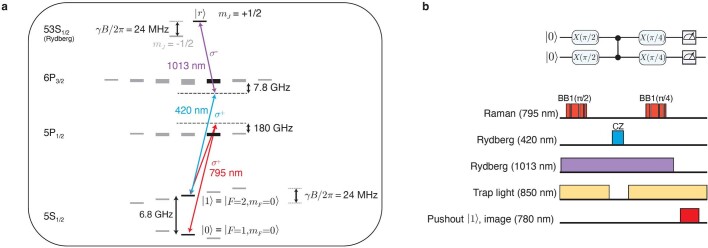
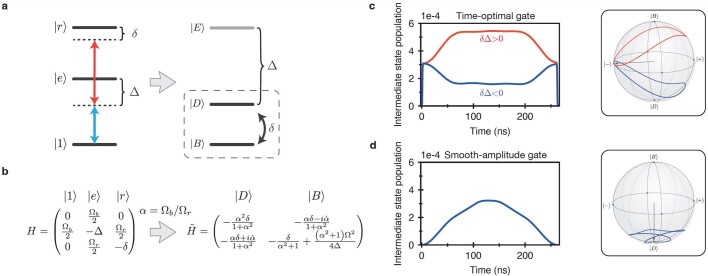
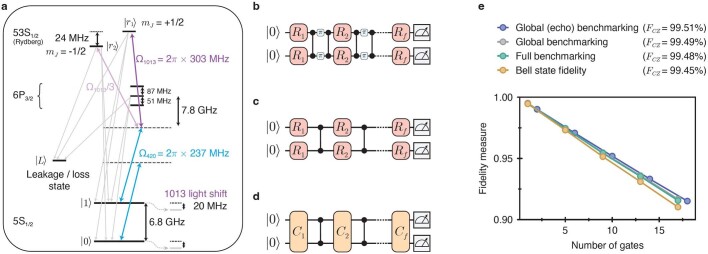
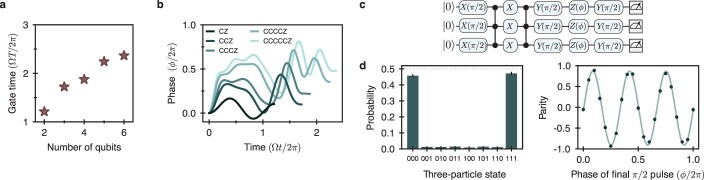
The ability to perform entangling quantum operations with low error rates in a scalable fashion is a central element of useful quantum information processing 1 . Neutral-atom arrays have recently emerged as a promising quantum computing platform, featuring coherent control over hundreds of qubits 2,3 and any-to-any gate connectivity in a flexible, dynamically reconfigurable architecture 4 . The main outstanding challenge has been to reduce errors in entangling operations mediated through Rydberg interactions 5 . Here we report the realization of two-qubit entangling gates with 99.5% fidelity on up to 60 atoms in parallel, surpassing the surface-code threshold for error correction 6,7 . Our method uses fast, single-pulse gates based on optimal control 8 , atomic dark states to reduce scattering 9 and improvements to Rydberg excitation and atom cooling. We benchmark fidelity using several methods based on repeated gate applications 10,11 , characterize the physical error sources and outline future improvements. Finally, we generalize our method to design entangling gates involving a higher number of qubits, which we demonstrate by realizing low-error three-qubit gates 12,13 . By enabling high-fidelity operation in a scalable, highly connected system, these advances lay the groundwork for large-scale implementation of quantum algorithms 14 , error-corrected circuits 7 and digital simulations 15 .
Overview
The claims and statistics of this paper haven’t been checked yet.
Free: it reads the open-access text and checks the first 5 claims that cite a source we can check. Create a free account to check every claim.
Integrity signals
Registry
Cites
Statistics
Figures
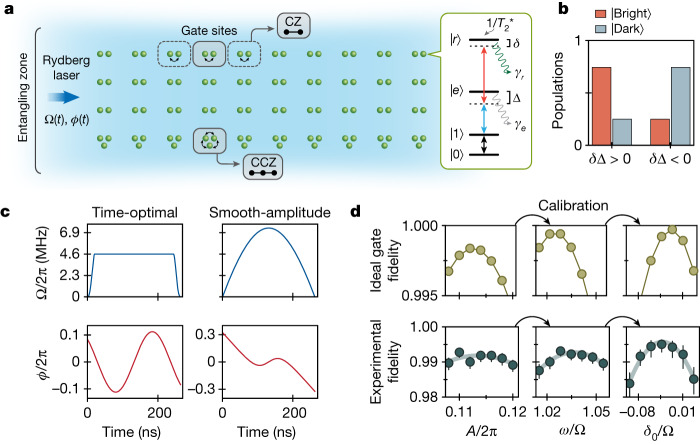
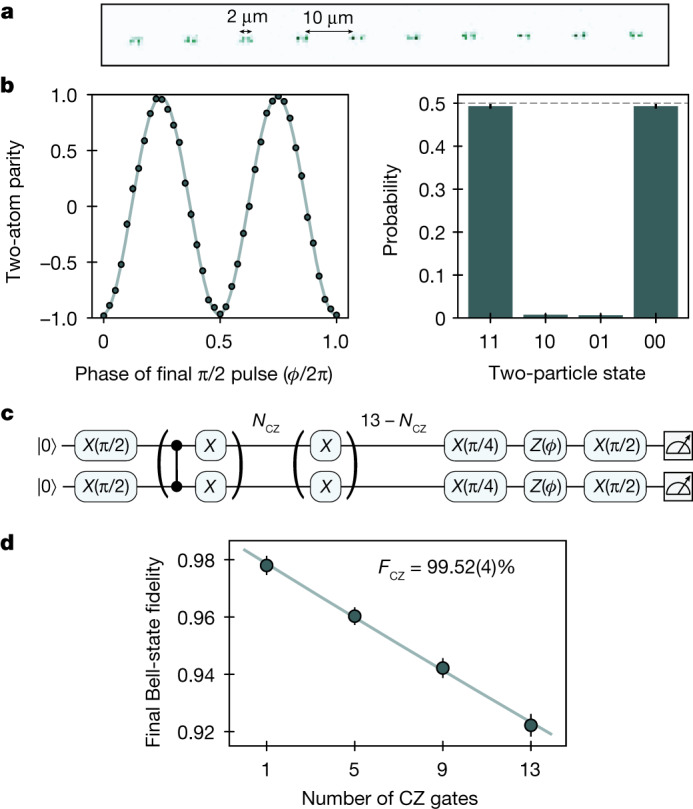
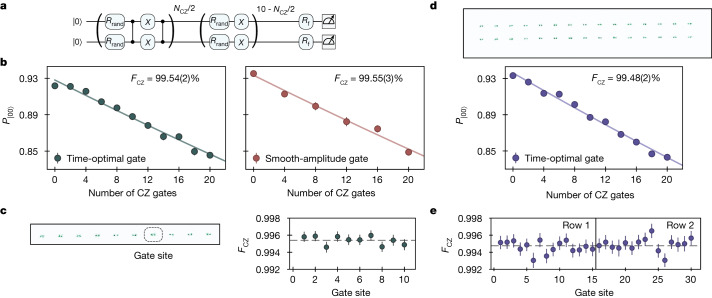
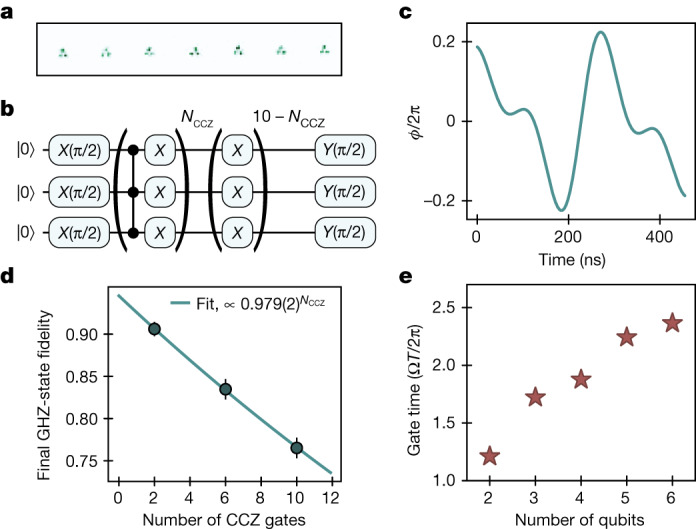
Verification
Claims the paper makes
The claims and statistics of this paper haven’t been checked yet.
Free: it reads the open-access text and checks the first 5 claims that cite a source we can check. Create a free account to check every claim.
Claims other papers make about this one
Each is checked against this paper’s own text: does it say what the citing paper says it does?
The source backs part of the claim, not all of it — or backs it for a different population, condition or comparison.
In the citing paper
“Using logical-level control and a zoned architecture in reconfigurable neutral-atom arrays7, our system combines high two-qubit gate fidelities8, arbitrary connectivity7,9, as well as fully programmable single-qubit rotations and mid-circuit readout10–15.”
From Logical quantum processor based on reconfigurable atom arrays (2024) · cites this paper as [8]
Experimental — accuracy not yet measuredThe source backs part of the claim, not all of it — or backs it for a different population, condition or comparison.
In the citing paper
“Averaged over the five computation logicals, we find that, by using the fault-tolerant initialization (postselecting on the ancilla logical flag not detecting errors) our |0L⟩ initialization fidelity is , exceeding both our physical qubit |0⟩ initialization fidelity (99.32(4)% (ref. 8)) and physical two-qubit gate fidelity (99.5% (ref. 8)).”
From Logical quantum processor based on reconfigurable atom arrays (2024) · cites this paper as [8]
Experimental — accuracy not yet measuredThe source backs part of the claim, not all of it — or backs it for a different population, condition or comparison.
In the citing paper
“Although ref. 8 seems to find some small cross-talk seemingly originating from decay into Rydberg P states, this should be considerably suppressed in the practical operation here owing to the approximately 200 μs duration between gates, during which time Rydberg atoms should either fly away or decay back to the ground state.”
From Logical quantum processor based on reconfigurable atom arrays (2024) · cites this paper as [8]
Experimental — accuracy not yet measuredThe source backs part of the claim, not all of it — or backs it for a different population, condition or comparison.
In the citing paper
“Even though the tail of the top-hat Rydberg excitation beams is only suppressed to about 10% intensity, the two-photon drive is far off-resonant owing to the approximately 20 MHz 1013 light shift detuning that is present for the entangling-zone atoms8.”
From Logical quantum processor based on reconfigurable atom arrays (2024) · cites this paper as [8]
Experimental — accuracy not yet measuredThe source backs part of the claim, not all of it — or backs it for a different population, condition or comparison.
In the citing paper
“We ensure that, in our dynamical decoupling, we have an odd number of π pulses between CZ gates (whenever possible), as this echoes out both systematic and spurious contributions to the single-qubit phase7,8.”
From Logical quantum processor based on reconfigurable atom arrays (2024) · cites this paper as [8]
Experimental — accuracy not yet measured
5 more claims about this paper
Create a free account to see every claim other papers make about this one.
Self-check
Percentages, sums and reported differences re-computed from the paper’s own numbers.
The self-check needs the paper’s full text.
Citations
Cites
Quantum Computing in the NISQ era and beyond
Preskill, J. (2018) · Quantum · doi:10.22331/q-2018-08-06-79 · Cited by 8,830
Fault-tolerant quantum computation by anyons
Kitaev, A. Y. (2003) · Annals of Physics · doi:10.1016/s0003-4916(02)00018-0 · Cited by 7,238 · cited 1×
“A thorough error budget is presented along with explanations of routes to further pushing gates to the regime of F>0.999 to make the system capable of reaching future fault tolerant performance.”
BackgroundInfluentialSurface codes: Towards practical large-scale quantum computation
Fowler, A. G., Mariantoni, M., Martinis, J. M., & Cleland, A. N. (2012) · Physical Review A · doi:10.1103/physreva.86.032324 · Cited by 3,059
Observation of electromagnetically induced transparency
Boller, K.-J., Imamoğlu, A., & Harris, S. E. (1991) · Physical Review Letters · doi:10.1103/physrevlett.66.2593 · Cited by 3,058 · cited 2×
“I was also particularly interested in their analysis of correlations between the sites, with this again being the first time sufficiently large ensembles have been used combined with repeated gate applications to really show how errors and correlations build in the system.”
BackgroundMethodSuperconducting quantum circuits at the surface code threshold for fault tolerance
Barends, R., Kelly, J., Megrant, A., Veitia, A., Sank, D., Jeffrey, E., White, T. C., Mutus, J., Fowler, A. G., Campbell, B., et al. (2014) · Nature · doi:10.1038/nature13171 · Cited by 1,733
Fast Quantum Gates for Neutral Atoms
Jaksch, D., Cirac, J. I., Zoller, P., Rolston, S. L., Côté, R., & Lukin, M. D. (2000) · Physical Review Letters · doi:10.1103/physrevlett.85.2208 · Cited by 1,540
Self-citationPredicting many properties of a quantum system from very few measurements
Huang, H.-Y., Kueng, R., & Preskill, J. (2020) · Nature Physics · doi:10.1038/s41567-020-0932-7 · Cited by 1,240
NMR techniques for quantum control and computation
Vandersypen, L. M. K., & Chuang, I. L. (2005) · Reviews of Modern Physics · doi:10.1103/revmodphys.76.1037 · Cited by 1,217
Suppressing quantum errors by scaling a surface code logical qubit
Google Quantum, A. I., Acharya, R., Aleiner, I., Allen, R., Andersen, T. I., Ansmann, M., Arute, F., Arya, K., Asfaw, A., Atalaya, J., et al. (2023) · Nature · doi:10.1038/s41586-022-05434-1 · Cited by 1,103 · cited 2×
“This protocol has the advantage of populating atomic dark states which do not contain population in the intermediate state used for the two-photon excitation to the Rydberg state, thereby reducing spontaneous emission.”
BackgroundQuantum phases of matter on a 256-atom programmable quantum simulator
Ebadi, S., Wang, T. T., Levine, H., Keesling, A., Semeghini, G., Omran, A., Bluvstein, D., Samajdar, R., Pichler, H., Ho, W. W., et al. (2021) · Nature · doi:10.1038/s41586-021-03582-4 · Cited by 995
Self-citation
Research works printed but not linked: 7
- Kalinowski M Maskara N Lukin MD Non-Abelian Floquet spin liquids in a digital Rydberg simulator Phys. Rev. X 2023 13 031008
- Shende VV Markov IL On the CNOT-cost of TOFFOLI gates Quantum Inf. Comput. 2009 9 461 486
- Ma S Universal gate operations on nuclear spin qubits in an optical tweezer array of 171Yb atoms Phys. Rev. X 2022 12 021028
- Brown MO Thiele T Kiehl C Hsu T-W Regal CA Gray-molasses optical-tweezer loading: controlling collisions for scaling atom-array assembly Phys. Rev. X 2019 9 011057
- Chang, T. H., Wang, T. N., Jen, H. H. & Chen, Y. C. High-fidelity Rydberg control-Z gates with time-optimal pulses. Preprint at https://arxiv.org/abs/2303.16395 (2023). · arXiv
- Khazali M Mølmer K Fast multiqubit gates by adiabatic evolution in interacting excited-state manifolds of Rydberg atoms and superconducting circuits Phys. Rev. X 2020 10 021054
- Singh K Anand S Pocklington A Kemp JT Bernien H Dual-element, two-dimensional atom array with continuous-mode operation Phys. Rev. X 2022 12 011040
Cited by
Items 201–300 of 973
Robust suppression of high-frequency laser phase noise by adaptive Pound-Drever-Hall feedforward
Chao, Y.-X., Hua, Z.-X., Liang, X.-H., Yue, Z.-P., Chen, J., You, L., & Tey, M. K. (2025) · Physical Review Applied · doi:10.1103/physrevapplied.23.l011005 · Cited by 18
Bosonic quantum error correction with neutral atoms in optical dipole traps
Bohnmann, L. H., Locher, D. F., Zeiher, J., & Müller, M. (2025) · Physical Review A · doi:10.1103/physreva.111.022432 · Cited by 17
Efficient Preparation of Entangled States in Cavity QED with Grover’s Algorithm
Nagib, O., Saffman, M. E., & Mølmer, K. (2025) · Physical Review Letters · doi:10.1103/3fzf-wsr2 · Cited by 18
“9% ) [45, 46], the main error contribution in the Grover unitary [Eqs.”
Single-shot preparation of hypergraph product codes via dimension jump
Hong, Y.-F. (2024) · Quantum · doi:10.22331/q-2025-10-07-1879 · Cited by 11
“Despite their geometrical non-locality, certain LDPC codes show feasible promise in platforms capable of long-range connectivity such as those based on trapped ions [31–33] and neutral atoms [11, 34–36], with recent experimental demonstrations showcasing their performance [37–39].”
Efficient compilation of quantum circuits using multi-qubit gates
Nemirovsky, J., Chuchem, M., & Shapira, Y. (2026) · Quantum Science and Technology · doi:10.1088/2058-9565/ae36cc · Cited by 17
Proposal for practical Rydberg quantum gates using a native two-photon excitation
Li, R., Qian, J., & Zhang, W. (2023) · Quantum Science and Technology · doi:10.1088/2058-9565/ace0d5 · Cited by 17
Protected quantum gates using qubit doublons in dynamical optical lattices
Kiefer, Y., Zhu, Z.-J., Fischer, L., Jele, S., Gächter, M., Bisson, G., Viebahn, K., & Esslinger, T. (2025) · Nature · doi:10.1038/s41586-026-10285-1 · Cited by 14
“A competing approach towards non-local connectivity is moving qubits, for instance, using atoms in steerable tweezers 40,41 , but this leads to overheads due to the necessary empty space between the qubits.”
Extended Rydberg Lifetimes in a Cryogenic Atom Array
Jin, J., Shi, Y., Alaoui, Y. A., Deng, J., Lu, Y., Thompson, J. D., & Bakr, W. (2026) · PRX Quantum · doi:10.1103/96bx-rjwz · Cited by 16
Efficient Quantum Algorithms for Testing Symmetries of Open Quantum Systems
Bandyopadhyay, R., Rubin, A., Radulaski, M., & Wilde, M. M. (2023) · Open systems & information dynamics · doi:10.1142/s1230161223500178 · Cited by 9
“…the nearest-neighbor connectivity can be supported by the Google Sycamore superconducting architecture [2], while the beyond-the-nearest-neighbor interaction and multi-qubit interactions can be implemented using QuEra Aquila [76] and recent neutral atom quantum hardware advances [20], respectively.”
MethodHamilton-Jacobi-Bellman equations for Rydberg-blockade processes
Fromonteil, C., Tricarico, R., Cesa, F., & Pichler, H. (2024) · Physical Review Research · doi:10.1103/physrevresearch.6.033333 · Cited by 17
Enhanced measurement of neutral-atom qubits with machine learning
Phuttitarn, L., Becker, B. M., Chinnarasu, R., Graham, T. M., & Saffman, M. E. (2024) · Physical Review Applied · doi:10.1103/physrevapplied.22.024011 · Cited by 17
Kam, C., & Hu, X. (2024) · npj Quantum Information · doi:10.1038/s41534-024-00924-8 · Cited by 16
“Currently, there are multiple approaches to quantum computing, based superconducting circuits 1,2 , trapped ions 3,4 , trapped neutral atoms 5,6 , electron spins in semiconductor 7 – 11 , and photonic systems 12 – 14 .”
Plane-selective manipulations of nuclear spin qubits in a three-dimensional optical tweezer array
Kusano, T., Nakamura, Y., Yokoyama, R., Ozawa, N., Shibata, K., Takano, T., Takasu, Y., & Takahashi, Y. (2025) · Physical Review Research · doi:10.1103/physrevresearch.7.l022045 · Cited by 16
Parity-controlled gate in a two-dimensional neutral-atom array
Guo, F.-Q., Su, S., Li, W., & Shao, X. (2025) · Physical Review A · doi:10.1103/physreva.111.022420 · Cited by 16
A cavity QED system with defect-free single-atom array strongly coupled to an optical cavity
Wang, Z., Guan, S.-J., Teng, G., Yang, P., Zhang, P., Li, G., & Zhang, T. (2025) · Quantum Frontiers · doi:10.1007/s44214-025-00083-7 · Cited by 18
Randomized benchmarking with leakage errors
Chen, Y.-H., & Baldwin, C. H. (2025) · Physical Review Research · doi:10.1103/j8sz-6ws9 · Cited by 12
Quantum low-density parity-check codes for erasure-biased atomic quantum processors
Pecorari, L., & Pupillo, G. (2025) · Physical Review A · doi:10.1103/mgkt-ctv8 · Cited by 16
Quantum Simulation of Two-Dimensional U(1) Gauge Theory in Rydberg and Rydberg-Dressed Atom Arrays
Zhou, Z., Zheng, Y. Q., Liu, C., Chen, Y., & Zhang, X. (2025) · Chinese Physics Letters · doi:10.1088/0256-307x/42/5/053705 · Cited by 16
Explainable quantum regression algorithm with encoded data structure
Wang, C. C. J., Perkkola, F., Salmenperä, I., de Griend, A. M.-V., & Nurminen, J. K. (2026) · Quantum Machine Intelligence · doi:10.48550/arxiv.2307.03334 · Cited by 17
“For Rydberg atoms, research on MS gates for two-atom and multi-atom systems is still in its infancy [21, 22, 30].”
An integrated photonics platform for high-speed, ultrahigh-extinction, many-channel quantum controlPreprint
Zhao, M., Singh, M., Singh, A., Thoreen, H., DeAngelo, R., Dominguez, D., Leenheer, A. J., Peyskens, F., Lukin, A., Englund, D. R., et al. (2025) · arXiv (Cornell University) · doi:10.48550/arxiv.2508.09920 · Cited by 16
Nonadiabatic Holonomic Quantum Computation Based on Rydberg Ground State Blockade
Su, S., 王, C. 琛. W., 宋, P.-Y. 佩. S., & 陈, G. 刚. C. (2024) · Chinese Physics Letters · doi:10.1088/0256-307x/41/4/040302 · Cited by 15
Xue, M., Xu, S., Li, X., & Li, X. (2024) · Physical Review A · doi:10.1103/physreva.110.032619 · Cited by 16
Efficient Decoupling of a Nonlinear Qubit Mode from Its Environment
Pfeiffer, F., Werninghaus, M., Schweizer, C., Bruckmoser, N., Koch, L., Glaser, N. J., Huber, G. B. P., Bunch, D., Haslbeck, F. X., Knudsen, M., et al. (2024) · Physical Review X · doi:10.1103/physrevx.14.041007 · Cited by 15
Direct probe of topology and geometry of quantum states on the IBM Q quantum processor
Chen, T., Ding, H.-T., Shen, R.-Z., Zhu, S.-L., & Gong, J. (2024) · Physical review B · doi:10.1103/physrevb.110.205402 · Cited by 8
Satellite-assisted quantum communication with single photon sources and atomic memories
Tubío, V. D., Badás, M., van Dam, J., Sørensen, A. S., & Borregaard, J. (2026) · Physical Review Research · doi:10.1103/z1vn-11m5 · Cited by 15
ZAP: Zoned Architecture and Performant Compiler for Field-Programmable Atom Array
Huang, C., Zhao, X., Xu, H., Zhuang, W.-F., Hu, M., Liu, D. E., & Wang, J. B. (2026) · IEEE Transactions on Quantum Engineering · doi:10.1109/tqe.2026.3696707 · Cited by 16
“Driven by the advances in laser technology, neutral atom arrays have recently emerged as a leading platform for scalable quantum computing [12], [13], [14], [15], [16], demonstrating systems with thousands of physical qubits [17] and high-fidelity gate operations [18].”
Entangled States from Sparsely Coupled Spins for Metrology with Neutral Atoms
Kuriyattil, S., Poggi, P. M., Pritchard, J. D., Kombe, J., & Daley, A. J. (2025) · Physical Review Letters · doi:10.1103/h6sr-yxgw · Cited by 15
On-chip high-dimensional entangled photon sources
Kaur, T., Peace, D., & Romero, J. (2025) · Journal of Optics · doi:10.1088/2040-8986/ada0c5 · Cited by 16
“In contrast, the success probability scales favorably with dimensionality, with only a small increase in d boosting the success probability above p = 0.8, and approaching p = 1 when ancillary photons are used.”
InfluentialUniversal Quantum Computation via Scalable Measurement-Free Error Correction
Veroni, S., Paler, A., & Giudice, G. (2025) · PRX Quantum · doi:10.1103/lkk1-v6wp · Cited by 15
“Furthermore, neutral atoms provide an ideal platform for the implementation of such protocols, as native CCZ operations have been demonstrated [87].”
Optimized quantum circuit partitioning across multiple quantum processors
Kaur, E., Shapourian, H., Zhao, J., Kilzer, M., Kompella, R. R., & Nejabati, R. (2025) · Quantum Computing, Communication, and Simulation · doi:10.1117/12.3042502 · Cited by 15
Fault-tolerant interfaces for modular quantum computing on diverse qubit platforms
Marqversen, F. K., Baranes, G., Sirotin, M. A., & Borregaard, J. (2026) · Physical Review Research · doi:10.1103/ds45-fm9n · Cited by 15
Taming Recoil Effect in Cavity-Assisted Quantum Interconnects
Kikura, S., Inoue, R., Yamasaki, H., Goban, A., & Sunami, S. (2025) · PRX Quantum · doi:10.1103/njh8-q7gb · Cited by 12
“However, currently, this HEG rate significantly lags behind the local gate operations of atomic qubits such as fast Raman gates [21, 22] and Rydberg gates [23, 24], which reach near 10 − 3 infidelity and MHz-order operation [25, 26].”
Fault-Tolerant Stabilizer Measurements in Surface Codes with Three-Qubit Gates
Old, J., Tasler, S., Hartmann, M. J., & Müller, M. (2025) · Physical Review Letters · doi:10.1103/sblg-fbq4 · Cited by 16
“Most architectures, however, also allow for native implementation of multi-qubit gates, e.g. using Rydberg blockade in neutral atoms [21, 22], multi-qubit Mølmer-Sørensen gates in trapped ions [23] or optimized gate sequences for the control Hamiltonians of solid-state based platforms [24, 25] -…”
Entangling quantum logic gates in neutral atoms via the microwave-driven spin-flip blockade
Buchemmavari, V., Omanakuttan, S., Jau, Y., & Deutsch, I. (2024) · Physical Review A · doi:10.1103/physreva.109.012615 · Cited by 15
Ham, B. S. (2023) · Scientific Reports · doi:10.1038/s41598-024-52125-0 · Cited by 12
“Quantum mechanics has been developed based on the wave-particle duality [1] of a single particle over the last century, resulting in various quantum technologies in computing [2-4], communications [5-7], and sensing areas [8-10].”
Wang, F.-R., Cooper, N., He, Y.-F., Hopton, B., Johnson, D., Zhao, P., Tuck, C., Hague, R., Fromhold, T., Wildman, R., et al. (2024) · Quantum Science and Technology · doi:10.1088/2058-9565/ad8678 · Cited by 8
“Growing understanding of fundamental quantum processes offers benefits in multiple sectors, from medicine [1, 2] and sensing applications [3–5], positioning and security [6, 7] to quantum computing [8].”
Measurement and feedforward correction of the fast phase noise of lasers
Denecker, T., Chew, Y. T., Guillemant, O., Watanabe, G., Tomita, T., Ohmori, K., & de Léséleuc, S. (2025) · Physical Review A · doi:10.1103/physreva.111.042614 · Cited by 14
Emergent Holographic Forces from Tensor Networks and Criticality
Sahay, R., Lukin, M. D., & Cotler, J. S. (2025) · Physical Review X · doi:10.1103/physrevx.15.021078 · Cited by 14
Self-citationLearning Topological States from Randomized Measurements Using Variational Tensor-Network Tomography
Teng, Y., Samajdar, R., Kirk, K. V., Wilde, F., Sachdev, S., Eisert, J., Sweke, R., & Najafi, K. (2025) · PRX Quantum · doi:10.1103/qm7q-w9qj · Cited by 14
“Single-qubit rotations on physical qubits have high fidelities [64].”
Opportunities in full-stack design of low-overhead fault-tolerant quantum computation
Zhou, H., Cain, M., & Lukin, M. D. (2025) · Nature Computational Science · doi:10.1038/s43588-025-00895-6 · Cited by 15
“For example, in current neutral-atom hardware, hundreds of atoms can be translated in parallel and then entangled in large batches without increasing the classical control complexity 49,56 (Fig.”
Self-citationCircuit compression for 2D quantum dynamicsPreprint
D’Anna, M., Zhang, Y., Wiersema, R., Rudolph, M. S., & Carrasquilla, J. (2025) · arXiv (Cornell University) · doi:10.48550/arxiv.2507.01883 · Cited by 14
Multi-controlled Phase Gate Synthesis with ZX-calculus applied to Neutral Atom Hardware
Staudacher, K., Schmid, L., Zeiher, J., Wille, R., & Kranzlmüller, D. (2024) · QPL · doi:10.4204/eptcs.406.5 · Cited by 11
“Besides dynamic connectivity with atom rearrangements [7, 8, 46] and favorable properties regarding scalability and large-scale control [6, 8, 19, 35,38], this technology offers native support for multi-controlled gates such as C n P, and CZ n [12,14,16, 21, 22, 34].”
BackgroundQuantum technologies with Rydberg atoms
Barik, S. K., Thakur, A., Jindal, Y., Silpa, B. S., & Roy, S. (2024) · Frontiers in Quantum Science and Technology · doi:10.3389/frqst.2024.1426216 · Cited by 13
Dark Spin-Cat States as Biased Qubits
Kruckenhauser, A., Yuan, M., Zheng, H., Mamaev, M., Zeng, P., Mao, X., Xu, Q., Zache, T. V., Jiang, L., van Bijnen, R., et al. (2025) · Physical Review Letters · doi:10.1103/w9zh-jwsx · Cited by 13
Detection of mode-intrinsic quantum entanglement
Lopetegui, C. E., Isoard, M., Treps, N., & Walschaers, M. (2025) · Optica Quantum · doi:10.1364/opticaq.560594 · Cited by 13
Multi-qubit Rydberg gates between distant atoms
Delakouras, A., Doultsinos, G., & Petrosyan, D. (2026) · Quantum · doi:10.22331/q-2026-01-28-1990 · Cited by 14
“In our protocol, as in most other schemes [18, 19, 20, 21, 22, 23, 24, 23], the atoms encode qubits in a pair of long-lived hyperfine ground state sublevels | 0 ⟩ , | 1 ⟩ .”
InfluentialProbing Dipolar Interactions between Rydberg Atoms and Ultracold Polar Molecules.
Zhu, L.-B., Luke, J., Shaham, R., Liu, Y.-X., & Ni, K.-K. (2025) · Physical Review Letters · doi:10.1103/48rk-sxfs · Cited by 8
“Cold atoms and molecules are one of the leading platforms as both have been used to demonstrate gates [5–7], simulate Hamilto-nians [8, 9], and prepare quantum phases [10–13].”
State preparation with parallel-sequential circuits
Wei, Z.-Y., & Malz, D. (2026) · Quantum · doi:10.22331/q-2026-04-21-2079 · Cited by 13
“To mitigate this break, we allow sequential segments to overlap, such that adjacent segments share a region of q gates (highlighted in red; q = 2 in the figure).”
Toward Self-Correcting Quantum Codes for Neutral Atom Arrays
Guo, J., Hong, Y., Kaufman, A. M., & Lucas, A. (2026) · PRX Quantum · doi:10.1103/mfmt-fwkg · Cited by 13
“This noise model closely resembles the actual physical noise observed in recent hardware experiments involving trapped ions [67] and neutral atoms [68].”
In Situ Benchmarking of Fault-Tolerant Quantum Circuits: Clifford Circuits
Anonymous, Hangleiter, D., Bluvstein, D., Lukin, M. D., & Gullans, M. J. (2026) · PRX Quantum · doi:10.1103/ghn4-8y96 · Cited by 13
Self-citationEfficient quantum circuits for machine learning activation functions including constant T-depth ReLU
Zi, W., Wang, S., Kim, H., Sun, X., Chattopadhyay, A., & Rebentrost, P. (2024) · Physical Review Research · doi:10.1103/physrevresearch.6.043048 · Cited by 13
Recoil-free Quantum Gates with Optical QubitsPreprint
Zhang, Z., Damme, L. V., Rossignolo, M., Festa, L., Melchner, M., Eberhard, R., Tsevas, D., Mours, K. P., Reches, E., Zeiher, J., et al. (2024) · arXiv (Cornell University) · doi:10.48550/arxiv.2408.04622 · Cited by 13
“Can the same ultranarrow optical transitions be used to define a qubit for quantum computing applications which is competitive in terms of speed and fidelity with other atomic qubit implementations [12–15] in trapped ions [16–19] and neutral atoms [20–27]?”
BackgroundDiagnosing Quantum Circuits: Noise Robustness, Trainability, and ExpressibilityPreprint
Shao, Y., Chen, Z., Wei, Z., & Liu, Z. (2025) · arXiv (Cornell University) · doi:10.48550/arxiv.2509.11307 · Cited by 13
“These bottlenecks are naturally the prime targets for noise-reduction techniques, such as QEM [47–49] or enhanced quantum control [34–37 , 50 ].”
Efficient fault-tolerant code switching via one-way transversal CNOT gates
Heußen, S., & Hilder, J. (2025) · Quantum · doi:10.22331/q-2025-09-03-1846 · Cited by 12
“We now briefly discuss some implications from limited connectivity between physical qubits in the most prevalent types of quantum computing hardware.”
Qubit Movement-Optimized Program Generation on Zoned Neutral Atom Processors
Jang, E., Kim, Y., Kim, H., Choi, S., Huang, Y.-P., & Ro, W. (2025) · IEEE/ACM International Symposium on Code Generation and Optimization · doi:10.1145/3696443.3708937 · Cited by 11
“Another version that implements the proposed gate protocol with the time-optimal CPHASE gate [20] instead of the adiabatic gate is detailed in Appendix C.”
InfluentialVariational quantum metrology with the Loschmidt echo
Liu, R., Wu, Z., Yang, X., Li, Y., Zhou, H., Li, Z., Chen, Y., Yuan, H., & Peng, X. (2025) · National Science Review · doi:10.1093/nsr/nwaf091 · Cited by 12
Self-citationCompact arbitrary optical waveform modulator with digital feedback
Yang, S., Masella, G., Moeini, V., Bellahsene, A., Li, C., Bienaimé, T., & Whitlock, S. (2025) · Physical Review Applied · doi:10.1103/physrevapplied.23.054009 · Cited by 12
Singh, H., Bertels, L. W., Claudino, D., Economou, S. E., Barnes, E., Bauman, N. P., Kowalski, K., & Mayhall, N. J. (2025) · Journal of Chemical Theory and Computation · doi:10.1021/acs.jctc.5c00896 · Cited by 12
“…computation, often referred to as the noisy, intermediate-scale quantum (NISQ) era, 4 is characterized by hardware platforms with tens to thousands of physical qubits, 5,6 a lack of robust error correction, 7–9 short coherence times, 10 imperfect gate controls, 11,12 and limited qubit connectivity.”
Do mixed states exhibit deep thermalisation?
Sherry, A., & Roy, S. (2025) · Physical review. B./Physical review. B · doi:10.1103/x397-3nk5 · Cited by 5
Patra, A., V., A., Sai Shankar, P., Bhat, R., V, R., Maitra, R., & Jaiganesh, G. (2025) · Journal of Chemical Physics · doi:10.1063/5.0338676 · Cited by 11
“This ensures that any deviation in correlation energy arises solely from the embedding and sampling procedure, thereby providing a rigorous validation of the ability of DMET-SQD to reproduce DMET-FCI correlation within the scope of the present study.”
Near-term fermionic simulation with subspace noise tailored quantum error mitigation
Papič, M., Algaba, M. G., Godínez, C. E., de Vega, I., Auer, A., Šimkovic, F., & Calzona, A. (2026) · npj Quantum Information · doi:10.1038/s41534-026-01248-5 · Cited by 12
“To put the fidelity requirements into perspective, current large-scale processors, have been able to achieve a median two-qubit fidelity of 99.86% with trapped ions [78], 99.67% with superconducting qubits [79] and 99.50% with neutral atom platforms [80].”
InfluentialThree-Photon Laser Excitation of Single Rydberg Rubidium Atoms in an Optical Dipole Trap
Beterov, I. I., Yakshina, E. A., Tretyakov, D. B., Al’yanova, N. V., Skvortsova, D. A., Suliman, G., Zagirov, T. R., Entin, V. M., & Ryabtsev, I. I. (2023) · Journal of Experimental and Theoretical Physics · doi:10.1134/s1063776123080101 · Cited by 12
Acousto-optic lens for 3D shuttling of atoms in a neutral atom quantum computerPreprint
Guo, Z. J., van Herk, R., Vredenbregt, E. J. D., & Kokkelmans, S. J. J. M. F. (2025) · arXiv (Cornell University) · doi:10.48550/arxiv.2510.09398 · Cited by 12
“Having a large tweezer separation also results in longer transport distances and potentially a lower atom survival ∗ z.guo1@tue.nl chance [2, 10].”
Sustaining high-fidelity quantum logic in neutral-atom circuits via mid-circuit operationsPreprint
Lin, R., Li, Y., Zheng, L., Hu, T.-R., Chen, S.-Y., Wu, H.-M., Zhang, Y.-C., Cheng, H.-W., Deng, Y.-H., Wu, Z., et al. (2026) · arXiv (Cornell University) · doi:10.48550/arxiv.2603.01612 · Cited by 12
“Although neutral-atom arrays have recently demonstrated high-fidelity two-qubit gates 5–10 and early-stage logical quantum processors 11–16 , sustaining such high performance across deep, repetitive circuits remains a formidable challenge due to cumulative motional heating and atom loss.”
Trapping 11,000 Atoms in a Tweezer Array Generated by a Single MetasurfacePreprint
Wang, Y.-Q., Zhang, Z.-C., Zhang, T., Liao, Y., Wang, H., Tian, Y., Ji, B.-Y., Wu, Y.-J., Ma, L.-M., Qing, C., et al. (2026) · arXiv (Cornell University) · doi:10.48550/arxiv.2606.02715 · Cited by 9
Designer Codes from GALA: Compact, Self-Dual, and Rate-1/2 QEC on Reconfigurable Atom ArraysPreprint
Yang, W., Duckering, C., & Dua, A. (2026) · arXiv (Cornell University) · doi:10.48550/arxiv.2608.07431 · Cited by 10
“…0.506 12 S 4 ⋉ C 414 F : bax [10 , 4 , 4 , 12] , x [12 , 12 , 0 , 12] , x [1 , 3 , 1 , 11] , x [9 , 9 , 5 , 9] , x [1 , 9 , 1 , 13] , cbax [4 , 10 , 9 , 1] G : x 13 , x [12 , 9 , 9 , 9] , c 2 bax [9 , 11 , 5 , 5] , abax [3 , 0 , 6 , 13] , x 0 , x [7 , 13 , 13 , 13] [[480 , 240 , 10]] 0.500 8 S 3 ×…”
InfluentialEntanglement-enhanced quantum metrology with neutral atom arrays
Shen, H., & Zhang, J. (2025) · National Science Review · doi:10.1093/nsr/nwaf149 · Cited by 11
Optimal State Preparation for Logical Arrays on Zoned Neutral Atom Quantum Computers
Stade, Y., Schmid, L., Burgholzer, L., & Wille, R. (2024) · Design, Automation and Test in Europe · doi:10.23919/date64628.2025.10993241 · Cited by 12
“The required trap transfers take about 100 times longer than other operations on this architecture [9], [20].”
iSWAP gate with polar molecules: Robustness criteria for entangling operations
Bergonzoni, M., Jandura, S., & Pupillo, G. (2025) · Physical Review A · doi:10.1103/q9sd-rfp6 · Cited by 11
Task-Driven Device Fingerprinting for Quantum Cloud Platforms via Modeling QNN Outcomes Under Noise
Li, T.-T., Zhao, Z.-M., & Yin, J.-W. (2025) · IEEE Transactions on Information Forensics and Security · doi:10.1109/tifs.2025.3620985 · Cited by 11
“IBM quantum processors are used here as one test case, but the framework can also work with other platforms like ion traps [55], photonic systems [9], or other quantum platforms [56] where user-level outputs are available.”
Coniq: Enabling Concatenated Quantum Error Correction on Neutral Atom Arrays
Liu, P., Xu, M., Zhou, H.-Y., Wang, H., Acar, U. A., & Shi, Y. (2025) · International Conference on Quantum Computing and Engineering · doi:10.1109/qce65121.2025.00073 · Cited by 9
“Neutral atom arrays offer numerous advantages for fault-tolerant quantum computing: recent experiments demonstrate their long coherence times, impressive scalability, and low-error operations [24], [6], [17], [10].”
Self-citationMultiqubit Rydberg Gates for Quantum Error Correction
Locher, D. F., Old, J., Brechtelsbauer, K., Holschbach, J., Büchler, H. P., Weber, S., & Müller, M. (2026) · PRX Quantum · doi:10.1103/j8fm-24cf · Cited by 11
“We now briefly comment on some differences of our pulse optimization scheme and the method gradient ascent pulse engineering (GRAPE), used in many recent works on two-and multiqubit Rydberg gates [18, 23, 26, 45].”
InfluentialContractive unitary and classical shadow tomography
Wu, Y., Wang, C., Yao, J., Zhai, H., You, Y., & Zhang, P. (2026) · npj Quantum Information · doi:10.1038/s41534-026-01227-w · Cited by 11
Long-range C C Φ gates via radio-frequency-induced Förster resonances
Ashkarin, I. N., Lepoutre, S., Pillet, P., Beterov, I. I., Ryabtsev, I. I., & Cheinet, P. (2025) · Physical Review Research · doi:10.1103/physrevresearch.7.013034 · Cited by 12
Baspin, N., & Williamson, D. J. (2026) · Quantum · doi:10.22331/q-2026-04-24-2083 · Cited by 10
“This has quickly become a topic of interest as recent hardware developments have raised the possibility of architectures with connectivity that is neither local Euclidean, nor all-to-all [40, 41, 42, 43].”
Quantum gates between distant atoms mediated by a Rydberg excitation antiferromagnet
Doultsinos, G., & Petrosyan, D. (2025) · Physical Review Research · doi:10.1103/physrevresearch.7.023246 · Cited by 10
“995 have been experimentally achieved [15–17], approaching the benchmarks set by error correcting codes.”
Preparing Greenberger-Horne-Zeilinger states on ground levels of neutral atoms
Jin, Z.-Y., & Jing, J. (2025) · Physical Review A · doi:10.1103/c47j-cw46 · Cited by 10
“Our protocol is superior to the existing schemes in the number of steps for preparing the maximally entangled states on the ground levels of neutral atoms [44, 76].”
InfluentialGraph coloring via quantum optimization on a Rydberg-qudit atom array
Angkhanawin, T., Deger, A., Pritchard, J. D., & Adams, C. S. (2026) · Quantum Science and Technology · doi:10.1088/2058-9565/ae3b6d · Cited by 10
Defect-free arrays at the thousand-atom scale in a 4-K cryogenic environment
Lim, D., Mamann, H., Pichard, G., Bourachot, L., Lindberg, A., Hamot, C., Bars, H. L., Fasola, F., Tan, S.-C., Cournez, G., et al. (2026) · PRX Quantum · doi:10.1103/45t1-vl5y · Cited by 9
High-Efficiency Loading of 2400 Ytterbium Atoms in Optical Tweezer Arrays
Anonymous, Chen, C., Zhou, L., Xie, X., Jiang, C., Ding, Z., Wu, F., Yang, F., Wang, G., Gong, Q., et al. (2026) · Physical Review Letters · doi:10.1103/bp6k-8zmd · Cited by 12
Engineering Discrete Local Dynamics in Globally Driven Dual-Species Atom Arrays
Cesa, F., Fini, A. D., Korbany, D. A., Tricarico, R., Bernien, H., Pichler, H., & Piroli, L. (2026) · PRX Quantum · doi:10.1103/r726-r5xr · Cited by 11
Li, X. X., Li, D. X., & Shao, X. (2024) · Physical Review A · doi:10.1103/physreva.109.042604 · Cited by 10
“However, such CZ gate operations cannot be performed simultaneously, but step by step.”
BackgroundStrain-concentration for fast, compact photonic modulation and non-volatile memory
Wen, Y. H., Heim, D., Zimmermann, M., Shugayev, R., Dong, M., Leenheer, A. J., Gilbert, G. N., Heuck, M., Eichenfield, M., & Englund, D. R. (2024) · Optica · doi:10.1364/optica.529094 · Cited by 10
Motion-insensitive time-optimal control of optical qubits
Damme, L. V., Zhang, Z., Devra, A., Glaser, S. J., & Alberti, A. (2025) · Quantum Science and Technology · doi:10.1088/2058-9565/add61c · Cited by 10
“In practice, this limit is mostly relevant for optical clock applications [10], which aim at high resolution spectroscopy, and possibly less relevant for quantum computing applications, as very small Rabi frequencies would lead to very slow quantum gates. which are infinite in number.”
Hyperbolic Quantum ProcessorPreprint
Narimanov, E., & Demler, E. (2024) · arXiv (Cornell University) · doi:10.48550/arxiv.2412.14098 · Cited by 6
“…fundamentally separates the proposed here approach from the existing alternatives, from superconducting [7] to trapped ions [8] to neutral atoms,[9] is that, being essentially a silicon - based optoelectronic chip, the Hyperbolic Quantum Processor offers a direct pathway to the high-density…”
Dual-type dual-element atom arrays for quantum information processingPreprint
Zhang, Z., Arunseangroj, J., & Xu, W. (2025) · arXiv (Cornell University) · doi:10.48550/arxiv.2503.16896 · Cited by 10
“A key advantage of our scheme is its direct extensibility to multi-qubit gates without requiring additional recali-bration, as required by some previous methods [13, 75].”
InfluentialObservation of feedback-directed quantum dynamics in large-scale quantum processorsPreprint
Shen, R., & Lee, C. H. (2026) · arXiv (Cornell University) · doi:10.48550/arxiv.2604.11900 · Cited by 10
“9 ].”
Simulating Condensed Matter Physics on Quantum HardwarePreprint
Shen, R., Chen, T., Tai, T., Koh, J. M., Ghaemi, P., & Lee, C. H. (2026) · arXiv (Cornell University) · doi:10.48550/arxiv.2606.02721 · Cited by 12
Electric field control for experiments with atoms in Rydberg states
Panja, A., Wang, Y., Wang, X., Wang, J., Subhankar, S., & Liang, Q. (2024) · AIP Advances · doi:10.1063/5.0239165 · Cited by 8
“However, this extreme sensitivity also makes Ryd-berg atoms vulnerable to stray electric fields, which can be detrimental in Rydberg-interaction mediated quantum computation and quantum simulation experiments 8,9 .”
BackgroundAverting Multi-Qubit Burst Errors in Surface Code Magic State Factories
Chadwick, J. D., Kang, C., Viszlai, J., Lin, S. F., & Chong, F. T. (2024) · IEEE International Conference on Quantum Computing and Engineering (QCE) · doi:10.1109/qce60285.2024.00128 · Cited by 10
“In this work, we additionally consider [[11 , 1 , 4]] and [[17 , 1 , 5]] codes [57] when necessary to guarantee operation under higher rates of cosmic ray impacts.”
MethodIndividual-atom control in an array through phase modulation
Wang, G., Xu, W., Li, C., Vuletić, V., & Cappellaro, P. (2025) · Physical Review Applied · doi:10.1103/physrevapplied.23.024072 · Cited by 9
Self-citationLaser, Offspring and Powerful Enabler of Quantum Science
Haroche, S. (2025) · PRX Quantum · doi:10.1103/prxquantum.6.010102 · Cited by 9
Interleaved Logical Qubits in Atom Arrays
Viszlai, J., Lin, S. F., Dangwal, S., Bradley, C. E., Ramesh, V., Baker, J. M., Bernien, H., & Chong, F. T. (2025) · IEEE International Symposium on High-Performance Computer Architecture (HPCA) · doi:10.1109/hpca61900.2025.00030 · Cited by 9
“Recentexperimental work using zoned addressing in single-species arrays has demonstrated two-qubit gate fidelities of 99.5%, with a pathway charted to reaching 99.9% and beyond [21].”
InfluentialParametrized multiqubit gates for neutral-atom quantum platforms
Mohan, M., de Hond, J., & Kokkelmans, S. J. J. M. F. (2025) · Physical Review Applied · doi:10.1103/physrevapplied.23.054074 · Cited by 10
Electro‐Optic‐Locked, Frequency‐Agile Integrated Pockels Laser Driving Ultra‐Precise Ranging
Wu, Y., Shao, S., Han, X., Xue, Q., Yang, S., Chen, H., & Chen, M. (2025) · Laser & Photonics Review · doi:10.1002/lpor.202500245 · Cited by 9
Quantum-enabled optical large-baseline interferometry: applications, protocols and feasibility
Huang, Z., Titov, O. A., Schmidt, M. K., Pope, B. J. S., Brennen, G. K., Oi, D. K. L., & Kok, P. (2025) · Advances in Physics X · doi:10.1080/23746149.2025.2597311 · Cited by 9
“• neutral-atoms : two-qubit gates via Rydberg blockade with error 5 × 10 − 3 and gate time 250ns [52]; Ref.”
Mode Multiplexing for Scalable Cavity-Enhanced Operations in Neutral-Atom Arrays
Aqua, Z., Peters, M. L., Spierings, D., Wang, G., Bytyqi, E., Propson, T., & Vuletić, V. (2026) · PRX Quantum · doi:10.1103/4c33-b1dv · Cited by 9
Self-citationRobust control and entanglement of qudits in neutral atom arrays
Burshtein, A., Fraenkel, S., Goldstein, M., & Finkelstein, R. (2025) · Physical Review Research · doi:10.1103/4xcd-wyxx · Cited by 13
“Ryd-berg strong We assume a perfect Ryd-berg blockade (infinitely interaction) between the Rydberg levels of the two atoms; the effect of imperfect blockade can be compensated through minor calibration [26].”
InfluentialDoppler-free Rydberg spectroscopy in a warm vapor
Glick, J., Anderson, B. E., Nunley, T. N., Bingaman, J., Liu, J. J., Meyer, D. H., & Kunz, P. (2025) · Physical Review A · doi:10.1103/qzwk-2g33 · Cited by 9
Fully convolutional 3D neural network decoders for surface codes with syndrome circuit noise
Gicev, S., Hollenberg, L. C. L., & Usman, M. (2026) · Quantum Science and Technology · doi:10.1088/2058-9565/ae5fc9 · Cited by 9
“The simplification process does, however, come at the one time cost of increased computational demands during training, as searching for and applying simplification operations requires comparable operations to vectorised simulation.”
Metadata
- Authors
- Evered, S. J., Bluvstein, D., Kalinowski, M., Ebadi, S., Manovitz, T., Zhou, H., Li, S. H., Geim, A. A., Wang, T. T., Maskara, N., Levine, H., Semeghini, G., Greiner, M., Vuletić, V., & Lukin, M. D.
- Affiliations
- Harvard University (US)
- Massachusetts Institute of Technology (US)
- Corresponding author
- Lukin, Mikhail D.
- ORCID
- Venue
- Nature
- Published
- 2023-10-11
- Volume
- 622
- Issue
- 7982
- Pages
- 268-272
- ISSN
- 0028-0836 (ISSN-L)
- 1476-4687
- PMC
- PMC10567572
- OpenAlex
- W4387542025
- Semantic Scholar
- 531874012fede3c01f44f2d81bfb926c0a25c9aa
- Cited by
- 522
- References
- 97
- Citations by year
- 2026: 134 · 2025: 229 · 2024: 138 · 2023: 21
- FWCI
- 60.51
- Type
- journal article
- Language
- en
- Open access
- hybrid
- doi.org
- Licence
- cc-by
- creativecommons.org/licenses/by/4.0 (tdm)
- creativecommons.org/licenses/by/4.0 (vor)
- Locations
- Nature (publishedVersion, cc-by)
- PubMed Central (publishedVersion, cc-by)
- PubMed (publishedVersion)
- arXiv (Cornell University) (submittedVersion)
- OSTI OAI (U.S. Department of Energy Office of Scientific and Technical Information) (submittedVersion)
- FIU - Digital Commons (Florida International University) (submittedVersion)
- Florida International University Digital Commons (Florida International University) (submittedVersion, cc-by)
- RePEc: Research Papers in Economics (submittedVersion)
- arXiv (Cornell University)
- Funders
- National Science Foundation (1745303, W911NF-20-1-0082)
- U.S. Department of Energy (DESC0021013, DESC0021110, 7568717)
- Defense Advanced Research Projects Agency (W911NF2010021)
- National Defense Science and Engineering Graduate
- Multidisciplinary University Research Initiative (W911NF2010082)
- Center for Ultracold Atoms, Massachusetts Institute of Technology
- Army Research Office (W911NF-20-1-0082, W911NF)
- Topics
- Physical Sciences › Physics and Astronomy › Atomic and Molecular Physics, and Optics › Cold Atom Physics and Bose-Einstein Condensates
- Physical Sciences › Computer Science › Artificial Intelligence › Quantum Computing Algorithms and Architecture
- Physical Sciences › Physics and Astronomy › Atomic and Molecular Physics, and Optics › Quantum Information and Cryptography
- Keywords
- neutral atom quantum computing, entangling gates, Rydberg interactions, gate fidelity, three-qubit gates, optimal control, dark states, atom cooling, Rydberg excitation, error sources, scalable quantum hardware
About these checks
Registry, retraction, Cites and statistics results are computed, not judged, with one exception: a printed reference that no index lists is read once by a model before it counts as a citation error. Claims are extracted by a model and kept only when their quote appears verbatim in the text; each cited source is then checked, with a model’s help, for whether it says what the claim relies on. Those verdicts can be wrong — read the claim’s quote and the cited source before relying on one.
Statistics and arithmetic are recomputed, not judged.
Confidence bands are shown only for fields calibrated on our annotated test set. None is calibrated yet, so no band is shown.
What counts as a claim ›How we measure confidence ›How we check this ›
Are you an author, or do you see a problem with this page? Request a review
Data sources
Bibliographic data: Semantic Scholar, OpenAlex, Crossref.
Contains information from the Semantic Scholar Academic Graph Datasets, made available under the ODC Attribution License (ODC-BY 1.0).
Semantic Scholar’s data is described in: Kinney, R., et al. (2023). The Semantic Scholar Open Data Platform. arXiv:2301.10140.
