

High-fidelity parallel entangling gates on a neutral-atom quantum computer
Open accessThe DOI matches its Crossref record; 101 of the 101 references it cites were found in a registry or an index.
Abstract
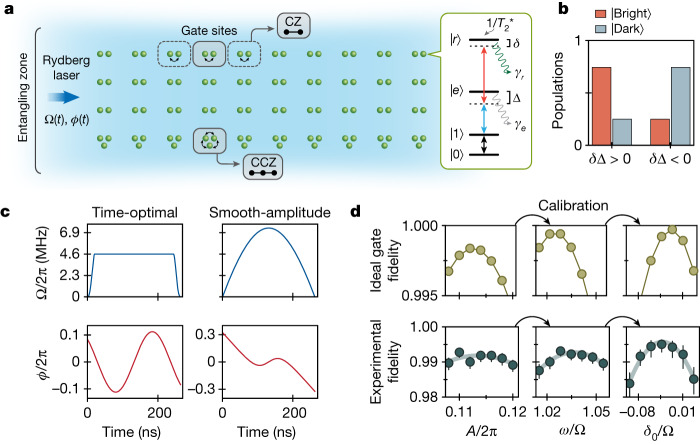
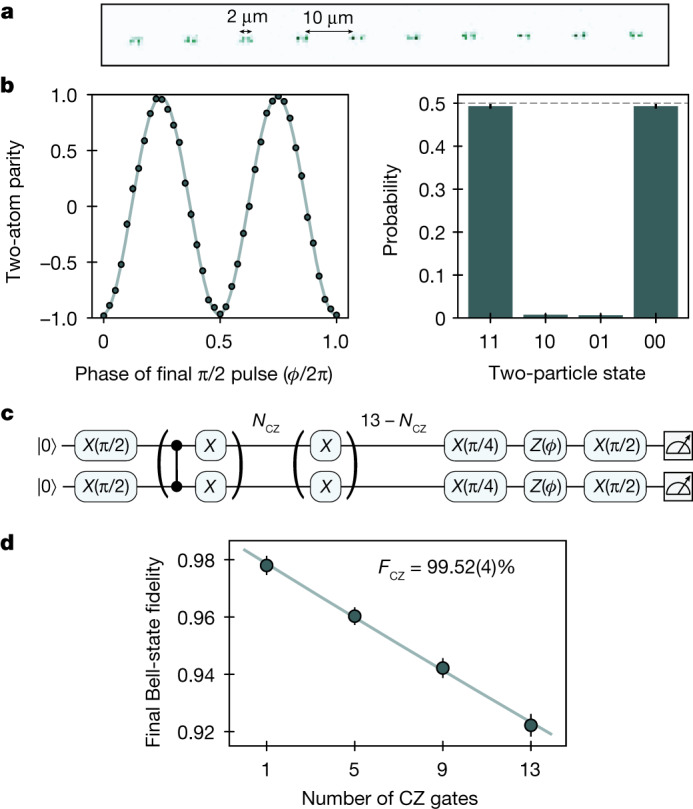
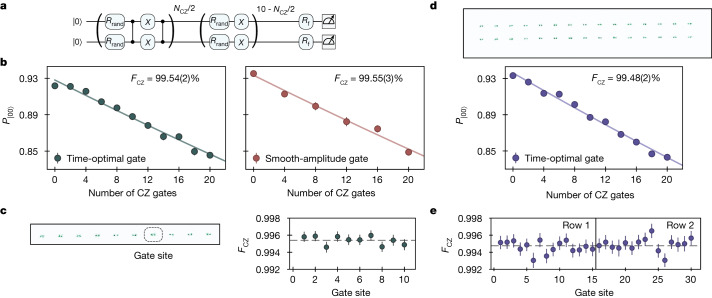
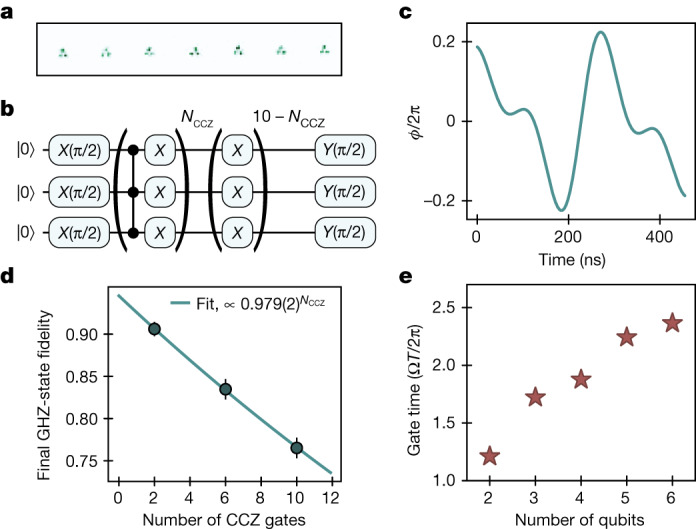
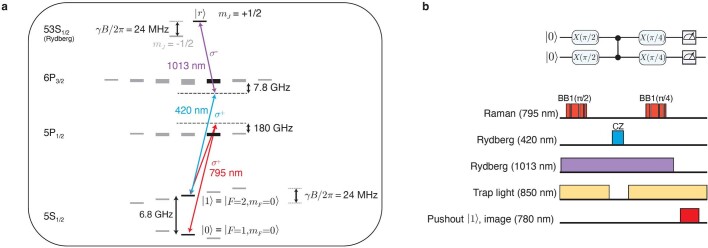
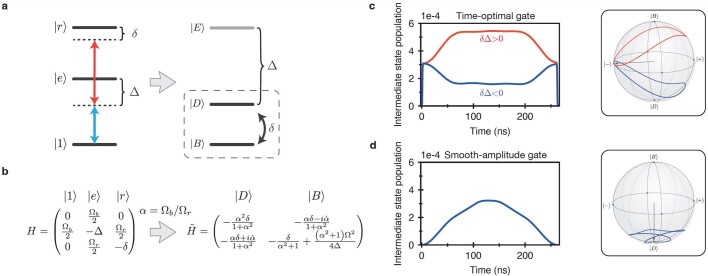
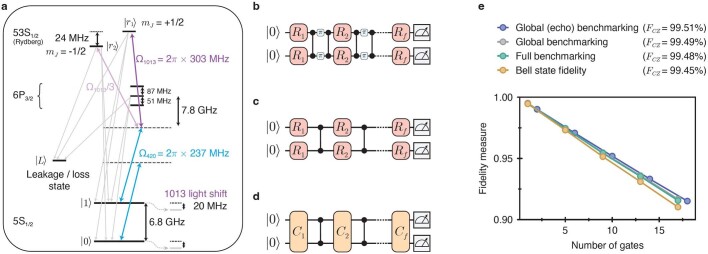
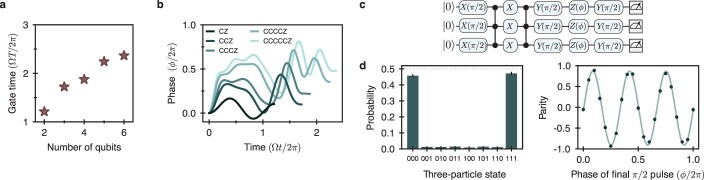
The ability to perform entangling quantum operations with low error rates in a scalable fashion is a central element of useful quantum information processing 1 . Neutral-atom arrays have recently emerged as a promising quantum computing platform, featuring coherent control over hundreds of qubits 2,3 and any-to-any gate connectivity in a flexible, dynamically reconfigurable architecture 4 . The main outstanding challenge has been to reduce errors in entangling operations mediated through Rydberg interactions 5 . Here we report the realization of two-qubit entangling gates with 99.5% fidelity on up to 60 atoms in parallel, surpassing the surface-code threshold for error correction 6,7 . Our method uses fast, single-pulse gates based on optimal control 8 , atomic dark states to reduce scattering 9 and improvements to Rydberg excitation and atom cooling. We benchmark fidelity using several methods based on repeated gate applications 10,11 , characterize the physical error sources and outline future improvements. Finally, we generalize our method to design entangling gates involving a higher number of qubits, which we demonstrate by realizing low-error three-qubit gates 12,13 . By enabling high-fidelity operation in a scalable, highly connected system, these advances lay the groundwork for large-scale implementation of quantum algorithms 14 , error-corrected circuits 7 and digital simulations 15 .
Overview
The claims and statistics of this paper haven’t been checked yet.
Free: it reads the open-access text and checks the first 5 claims that cite a source we can check. Create a free account to check every claim.
Integrity signals
Registry
Cites
Statistics
Figures
Verification
Claims the paper makes
The claims and statistics of this paper haven’t been checked yet.
Free: it reads the open-access text and checks the first 5 claims that cite a source we can check. Create a free account to check every claim.
Claims other papers make about this one
Each is checked against this paper’s own text: does it say what the citing paper says it does?
The source backs part of the claim, not all of it — or backs it for a different population, condition or comparison.
In the citing paper
“Using logical-level control and a zoned architecture in reconfigurable neutral-atom arrays7, our system combines high two-qubit gate fidelities8, arbitrary connectivity7,9, as well as fully programmable single-qubit rotations and mid-circuit readout10–15.”
From Logical quantum processor based on reconfigurable atom arrays (2024) · cites this paper as [8]
Experimental — accuracy not yet measuredThe source backs part of the claim, not all of it — or backs it for a different population, condition or comparison.
In the citing paper
“Averaged over the five computation logicals, we find that, by using the fault-tolerant initialization (postselecting on the ancilla logical flag not detecting errors) our |0L⟩ initialization fidelity is , exceeding both our physical qubit |0⟩ initialization fidelity (99.32(4)% (ref. 8)) and physical two-qubit gate fidelity (99.5% (ref. 8)).”
From Logical quantum processor based on reconfigurable atom arrays (2024) · cites this paper as [8]
Experimental — accuracy not yet measuredThe source backs part of the claim, not all of it — or backs it for a different population, condition or comparison.
In the citing paper
“Although ref. 8 seems to find some small cross-talk seemingly originating from decay into Rydberg P states, this should be considerably suppressed in the practical operation here owing to the approximately 200 μs duration between gates, during which time Rydberg atoms should either fly away or decay back to the ground state.”
From Logical quantum processor based on reconfigurable atom arrays (2024) · cites this paper as [8]
Experimental — accuracy not yet measuredThe source backs part of the claim, not all of it — or backs it for a different population, condition or comparison.
In the citing paper
“Even though the tail of the top-hat Rydberg excitation beams is only suppressed to about 10% intensity, the two-photon drive is far off-resonant owing to the approximately 20 MHz 1013 light shift detuning that is present for the entangling-zone atoms8.”
From Logical quantum processor based on reconfigurable atom arrays (2024) · cites this paper as [8]
Experimental — accuracy not yet measuredThe source backs part of the claim, not all of it — or backs it for a different population, condition or comparison.
In the citing paper
“We ensure that, in our dynamical decoupling, we have an odd number of π pulses between CZ gates (whenever possible), as this echoes out both systematic and spurious contributions to the single-qubit phase7,8.”
From Logical quantum processor based on reconfigurable atom arrays (2024) · cites this paper as [8]
Experimental — accuracy not yet measured
5 more claims about this paper
Create a free account to see every claim other papers make about this one.
Self-check
Percentages, sums and reported differences re-computed from the paper’s own numbers.
The self-check needs the paper’s full text.
Citations
Cites
Quantum Computing in the NISQ era and beyond
Preskill, J. (2018) · Quantum · doi:10.22331/q-2018-08-06-79 · Cited by 8,830
Fault-tolerant quantum computation by anyons
Kitaev, A. Y. (2003) · Annals of Physics · doi:10.1016/s0003-4916(02)00018-0 · Cited by 7,238 · cited 1×
“A thorough error budget is presented along with explanations of routes to further pushing gates to the regime of F>0.999 to make the system capable of reaching future fault tolerant performance.”
BackgroundInfluentialSurface codes: Towards practical large-scale quantum computation
Fowler, A. G., Mariantoni, M., Martinis, J. M., & Cleland, A. N. (2012) · Physical Review A · doi:10.1103/physreva.86.032324 · Cited by 3,059
Observation of electromagnetically induced transparency
Boller, K.-J., Imamoğlu, A., & Harris, S. E. (1991) · Physical Review Letters · doi:10.1103/physrevlett.66.2593 · Cited by 3,058 · cited 2×
“I was also particularly interested in their analysis of correlations between the sites, with this again being the first time sufficiently large ensembles have been used combined with repeated gate applications to really show how errors and correlations build in the system.”
BackgroundMethodSuperconducting quantum circuits at the surface code threshold for fault tolerance
Barends, R., Kelly, J., Megrant, A., Veitia, A., Sank, D., Jeffrey, E., White, T. C., Mutus, J., Fowler, A. G., Campbell, B., et al. (2014) · Nature · doi:10.1038/nature13171 · Cited by 1,733
Fast Quantum Gates for Neutral Atoms
Jaksch, D., Cirac, J. I., Zoller, P., Rolston, S. L., Côté, R., & Lukin, M. D. (2000) · Physical Review Letters · doi:10.1103/physrevlett.85.2208 · Cited by 1,540
Self-citationPredicting many properties of a quantum system from very few measurements
Huang, H.-Y., Kueng, R., & Preskill, J. (2020) · Nature Physics · doi:10.1038/s41567-020-0932-7 · Cited by 1,240
NMR techniques for quantum control and computation
Vandersypen, L. M. K., & Chuang, I. L. (2005) · Reviews of Modern Physics · doi:10.1103/revmodphys.76.1037 · Cited by 1,217
Suppressing quantum errors by scaling a surface code logical qubit
Google Quantum, A. I., Acharya, R., Aleiner, I., Allen, R., Andersen, T. I., Ansmann, M., Arute, F., Arya, K., Asfaw, A., Atalaya, J., et al. (2023) · Nature · doi:10.1038/s41586-022-05434-1 · Cited by 1,103 · cited 2×
“This protocol has the advantage of populating atomic dark states which do not contain population in the intermediate state used for the two-photon excitation to the Rydberg state, thereby reducing spontaneous emission.”
BackgroundQuantum phases of matter on a 256-atom programmable quantum simulator
Ebadi, S., Wang, T. T., Levine, H., Keesling, A., Semeghini, G., Omran, A., Bluvstein, D., Samajdar, R., Pichler, H., Ho, W. W., et al. (2021) · Nature · doi:10.1038/s41586-021-03582-4 · Cited by 995
Self-citation
Research works printed but not linked: 7
- Kalinowski M Maskara N Lukin MD Non-Abelian Floquet spin liquids in a digital Rydberg simulator Phys. Rev. X 2023 13 031008
- Shende VV Markov IL On the CNOT-cost of TOFFOLI gates Quantum Inf. Comput. 2009 9 461 486
- Ma S Universal gate operations on nuclear spin qubits in an optical tweezer array of 171Yb atoms Phys. Rev. X 2022 12 021028
- Brown MO Thiele T Kiehl C Hsu T-W Regal CA Gray-molasses optical-tweezer loading: controlling collisions for scaling atom-array assembly Phys. Rev. X 2019 9 011057
- Chang, T. H., Wang, T. N., Jen, H. H. & Chen, Y. C. High-fidelity Rydberg control-Z gates with time-optimal pulses. Preprint at https://arxiv.org/abs/2303.16395 (2023). · arXiv
- Khazali M Mølmer K Fast multiqubit gates by adiabatic evolution in interacting excited-state manifolds of Rydberg atoms and superconducting circuits Phys. Rev. X 2020 10 021054
- Singh K Anand S Pocklington A Kemp JT Bernien H Dual-element, two-dimensional atom array with continuous-mode operation Phys. Rev. X 2022 12 011040
Cited by
Items 401–500 of 973
Dynamical spatial light modulation in the ultraviolet spectral range
Ammenwerth, M., Timme, H., Giardini, V., Tao, R., Gyger, F., Lib, O., Berndt, D., Kourkoulos, D., Rom, T., Bloch, I., et al. (2025) · Physical Review Applied · doi:10.1103/ltnk-w67h · Cited by 3
Low-Crosstalk, Silicon-Fabricated Optical Waveguides for Laser Delivery to Matter Qubits
Craft, C. L., Barton, N. J., Klug, A., Scalzi, K., Wildemann, I., Asagodu, P., Broz, J. D., Porto, N. L., Macalík, M., Rizzo, A. J., et al. (2024) · Physical Review Applied · doi:10.1103/jgks-dss2 · Cited by 5
“…quantum bits (qubits) are promising hosts of quantum information because these quantum memories (e.g., trapped ions [1–3], neutral atoms [4–6], nitrogen-vacancy centers [7,8], and quantum dots [9]) can possess long coherence times [10–12], have high-fidelity single-qubit control and two-qubit…”
Benchmarking the algorithmic performance of near-term neutral atom processorsPreprint
McInroy, K., Pearson, N., & Pritchard, J. D. (2024) · arXiv (Cornell University) · doi:10.48550/arxiv.2402.02127 · Cited by 6
“…and high-quality qubits [34], capable of implementing high fidelity single-qubit [35, 36], two-qubit [37] and multi-qubit gate operations [37, 38, 39] in parallel by exploiting the strong long-range interactions between highly excited Ryd-berg states to provide controllable couplings…”
BackgroundInfluentialQuantum Algorithm to Prepare Quasi-Stationary StatesPreprint
Garratt, S., & Choi, S. (2024) · arXiv (Cornell University) · doi:10.48550/arxiv.2407.07893 · Cited by 4
Leclerc, L. (2024) · theses.fr (ABES) · doi:10.70675/32faa185z82bfz4c67zb03az298d70f5b818 · Cited by 6
Can TCOs Transform Cavity-QED?Preprint
Wang, W., Fomra, D., Agrawal, A. K., Lezec, H. J., & Britton, J. (2025) · arXiv (Cornell University) · doi:10.48550/arxiv.2506.02501 · Cited by 6
Quantum criticality and nonequilibrium dynamics on a Lieb lattice of Rydberg atomsPreprint
Hirsbrunner, M. R., Kornjača, M., Samajdar, R., Darbha, S., Hamdan, M., Balewski, J., Rrapaj, E., Wang, S.-T., Camps, D., Liu, F.-L., et al. (2025) · arXiv (Cornell University) · doi:10.48550/arxiv.2508.05737 · Cited by 3
“These systems offer exceptional control over quantum states, functioning as both coherent analog simulators [3, 4] and gate-based quantum computers [5, 6].”
Takahata, M., Keloth, J., Yamamoto, T., Harada, K.-I., Miki, S., & Aoki, T. (2026) · arXiv (Cornell University) · doi:10.48550/arxiv.2603.21812 · Cited by 6
Correlated Atom Loss as a Resource for Quantum Error CorrectionPreprint
Perrin, H., Roger, G., & Pupillo, G. (2026) · arXiv (Cornell University) · doi:10.48550/arxiv.2603.24237 · Cited by 6
“Neutral-atom quantum processors have emerged as a leading architecture for large-scale fault-tolerant quantum computing [1–13].”
InfluentialEnergy efficiency of quantum computersPreprint
Carrasco-Codina, M., Escofet, P., Hilaire, P., Soret, A., Nerenberg, S., Champain, V., Milburn, G. J., Theophilo, K., Li, S. H., Bautista, I., et al. (2026) · arXiv (Cornell University) · doi:10.48550/arxiv.2605.15090 · Cited by 6
Self-citationFast Nondestructive Readout for High-Clock-Rate Atom Array Quantum ProcessorPreprint
Lu, C., Zengxu, Z.-Q., You, C., Wang, Q., Li, Z., Ji, Y., An, D., Yu, C., Liu, J., He, Z.-M., et al. (2026) · Research Square · doi:10.21203/rs.3.rs-10572399/v1 · Cited by 6
Design of fast Rydberg blockade SWAP gates with synthetic modulated driving
Wang, X., Sheng, T., & Sun, Y. (2025) · Photonics Research · doi:10.1364/prj.550203 · Cited by 5
Optimization of error signal lineshape for modulation-free robust laser frequency stabilization
Yadav, P., Ghosh, A., Singh, N., Yadav, V. K., Singh, D., Singh, K., & Santra, B. (2025) · Physica Scripta · doi:10.1088/1402-4896/adbf70 · Cited by 5
Regulatory Challenges and Opportunities of Export Controls on Quantum Computing
Davis, P. A. E., Aboy, M., & Minssen, T. (2026) · Perspectives in law, business and innovation · doi:10.1007/978-981-95-8371-3_6 · Cited by 5
Error-resilient geometric entangling gates in Rydberg atoms
Liang, Y., Tian, X.-D., Ji, L., & Xue, Z. (2025) · Physical Review Applied · doi:10.1103/dq7w-7hnl · Cited by 5
Geometric gates in atomic arrays without Rydberg blockade
Ming, Y., Fu, Z.-X., & Du, Y.-X. (2025) · Physical Review A · doi:10.1103/tmr4-gtnl · Cited by 5
Metamaterials in superconducting and cryogenic quantum technologies
Krasnok, A. (2026) · Applied Physics Reviews · doi:10.1063/5.0282013 · Cited by 5
Filtered One-Shot Training for Quantum Architecture Search
Son, S. B., Chen, S. Y.-C., Kim, J., & Park, S. (2025) · ACM International Conference on Information and Knowledge Management (CIKM) · doi:10.1145/3746252.3760950 · Cited by 5
All-to-all connectivity of Rydberg-atom-based quantum processors with messenger qubits
Dudinets, I. V., Straupe, S. S., Fedorov, A. K., & Lychkovskiy, O. V. (2026) · Physical Review A · doi:10.1103/6bsx-k4m6 · Cited by 5
“45, 47, 54–57].”
Neutral-atom quantum computation using multi-qubit geometric gates via adiabatic passage
Rej, S. S., & Deb, B. (2026) · New Journal of Physics · doi:10.1088/1367-2630/ae390c · Cited by 5
Entropic barriers and the kinetic suppression of topological defects
Tsao, Y.-L., & Luo, Z.-X. (2026) · Physical review B · doi:10.1103/nx6h-ylfq · Cited by 3
Constraints on phantom codes from automorphism group bounds
Anonymous (2026) · Physical Review Letters · doi:10.1103/m79r-w9dr · Cited by 5
Quantum dynamics of a fully blockaded Rydberg atom ensemble
Wild, D. S., Drăgoi, S., McElhanney, C., Wurtz, J., & Wang, S.-T. (2024) · Physical Review A · doi:10.1103/physreva.109.043111 · Cited by 5
“The Ryd-berg blockade realizes an effective multi-atom interaction, which can be used to directly implement few-qubit gates without a decomposition into two-qubit gates [25–30].”
MethodInertial geometric quantum logic gates
Turyansky, D., Ovdat, O., Dann, R., Aqua, Z., Kosloff, R., Dayan, B., & Pick, A. (2023) · Physical Review Applied · doi:10.1103/physrevapplied.21.054033 · Cited by 7
“Presently, the record fidelity stands at 99.99% for single-qubit gates [5, 6], 99.5% for two-qubit gates using hyperfine qubits [7, 8], and 99% for qubits combining hyperfine and Rydberg levels [9].”
MethodInfluentialMukherjee, K., Biedermann, G. W., & Lewis-Swan, R. J. (2024) · Physical Review A · doi:10.1103/physreva.110.053320 · Cited by 5
Comparison of Two Optimization Methods for a Rydberg Quantum Gate
Bosch, L. S. Y., & Wimberger, S. (2025) · Annals of Physics · doi:10.1002/andp.202500163 · Cited by 3
Implementation of magic state injection within heavy-hexagon architectures
Kim, H., Choi, W., & Kwon, Y. (2025) · Quantum Information Processing · doi:10.1007/s11128-025-05004-0 · Cited by 5
Fast nuclear-spin gates and electrons-nuclei entanglement of neutral atoms in weak magnetic fields
Shi, X.-F. (2022) · Frontiers of Physics · doi:10.1007/s11467-023-1332-0 · Cited by 4
Li, D., Xu, B., Qin, K., Jia, X. H., Zhao, C., Zhou, Y., & Xu, Z. (2025) · Photonics · doi:10.3390/photonics12030204 · Cited by 5
Biasing quantum trajectories for enhanced sensing
Ilias, T. (2025) · Physical Review A · doi:10.1103/physreva.111.042432 · Cited by 5
Speed limits of two-qubit gates with quditsPreprint
Basyildiz, B., Jameson, C., & Gong, Z. (2023) · arXiv (Cornell University) · doi:10.48550/arxiv.2312.09218 · Cited by 5
Analysis and Suppression of Errors in Quantum Random Access Memory under Extended Noise ModelsPreprint
Mehta, R., Lee, G., & Jiang, L. (2024) · arXiv (Cornell University) · doi:10.48550/arxiv.2412.10318 · Cited by 5
Practical Use Cases of Neutral Atoms Quantum ComputersPreprint
Grotti, M., Marzella, S., Bettonte, G., Ottaviani, D., & Ercolessi, E. (2025) · arXiv (Cornell University) · doi:10.48550/arxiv.2510.18732 · Cited by 5
“In subsequent works [65], this value has been further improved to 99.5%, reaching also a 97.9% fidelity GHZ state preparation with the CCZ gate.”
InfluentialIbe, Y., Hirano, Y., Ozu, Y., Kawakubo, T., & Fujii, K. (2025) · arXiv (Cornell University) · doi:10.48550/arxiv.2510.18652 · Cited by 5
“Although SPAM errors can exceed gate errors on some platforms, including superconducting devices, representative trapped-ion and neutral-atom experiments report SPAM or readout errors comparable to or smaller than two-qubit-gate errors [33, 34].”
Demonstration of measurement-free universal fault-tolerant quantum computationPreprint
Butt, F., Pogorelov, I., Freund, R., Steiner, A., Meyer, M., Monz, T., & Müller, M. (2025) · Research Square · doi:10.21203/rs.3.rs-7092911/v1 · Cited by 5
Hamiltonian Dynamics Learning: A Scalable Approach to Quantum Process CharacterizationPreprint
Wu, Y., Zhang, Y., Wang, C., & Yuan, X. (2025) · arXiv (Cornell University) · doi:10.48550/arxiv.2503.24171 · Cited by 5
“Taking this metric difference to the whole system, we finally have (J4) Corollary 6.”
InfluentialFundamental error bound for entanglement generation between interacting Rydberg atomsPreprint
Doultsinos, G., Delakouras, A., & Petrosyan, D. (2025) · arXiv (Cornell University) · doi:10.48550/arxiv.2512.13379 · Cited by 5
Quantum Graph States: Bridging Classical Theory and Quantum Innovation, Workshop SummaryPreprint
Chitambar, E., Goodenough, K., Gühne, O., McCarty, R., Perdrix, S., Scarola, V. W., Sun, S., & Zhang, Q. (2025) · arXiv (Cornell University) · doi:10.48550/arxiv.2508.04823 · Cited by 5
Keskin, B., Afradi, C., Lovis, S., Palesi, M., Escofet, P., Almudéver, C. G., & Charbon, E. (2025) · arXiv (Cornell University) · doi:10.48550/arxiv.2511.21885 · Cited by 5
Fang, X., Ruan, J., Prabhu, S., Li, A., Humble, T., Tullsen, D. M., & Ding, Y. (2026) · arXiv (Cornell University) · doi:10.48550/arxiv.2601.10144 · Cited by 5
“Conversely, NA platforms [8], [9], [34], [59] feature massive scalability (over 6,000 qubits [24], [66]) and reconfigurable all-to-all connectivity, but operate with significantly slower gate times ( 0 .”
Interaction-resolved decomposition of multi-qubit unitaries via computational-basis phasesPreprint
Baran, B., Calarco, T., Mueller, M., & Motzoi, F. (2026) · arXiv (Cornell University) · doi:10.48550/arxiv.2602.18375 · Cited by 5
“…become a central tool for engineering high-performance operations across a wide range of quantum hardware platforms, including trapped ions [2], neutral-atom arrays [3–5], superconducting circuits [6–10], and solid-state spin qubits such as nitrogen-vacancy centers and related platforms [11–13].”
Spin-Cat Qubit with Biased Noise in an Optical Tweezer ArrayPreprint
Kusano, T., Shibata, K., Yeh, C.-H., Saito, K., Nakamura, Y., Yokoyama, R., Kashimoto, T., Takano, T., Takasu, Y., Takagi, R., et al. (2026) · arXiv · doi:10.48550/arxiv.2602.22883 · Cited by 5
“ˆ R ( cat ) x ˆ R ( ˆ R ( 0 Additionally, optical tweezer array platforms, offering scalability [1–12], high-fidelity gates [44–49], and all-to-all connectivity [34], have primarily been focusing on two-level systems.”
InfluentialHigh-fidelity neutral atom gates leveraging low-rank Hessian optimizationPreprint
Liu, G.-Y., Bornet, G., Kurdak, D., Xiao, M., Li, C.-Y., Zhang, B., & Thompson, J. D. (2026) · arXiv (Cornell University) · doi:10.48550/arxiv.2606.05060 · Cited by 5
“[16, 17].”
InfluentialAll-optical Raman control of ultracold atomic hyperfine states using the pulsed jump protocol
Jian, X.-X., Zheng, Z.-J., Jiang, J., Zhou, L., Shu, C., & He, J. (2025) · Physical Review A · doi:10.1103/j86x-bpp5 · Cited by 4
Jansohn, C., Londoño, A., Li, Y., Nguyen, H. M., Berman, P. R., & Kuzmich, A. (2025) · Physical Review A · doi:10.1103/43wm-383m · Cited by 5
Benchmarking non-Clifford gates using Pauli twirling
Ye, H., Liu, G., & Ma, X. (2026) · Physical Review A · doi:10.1103/539p-qt5w · Cited by 4
Tackling the Challenges of Adding Pulse-level Support to a Heterogeneous HPCQC Software Stack
Echavarria, J., Farooqi, M. N., Devra, A., Lujan, S., Damme, L. V., Ahmed, H., Letras, M., Kaya, E., Vetter, A., Werninghaus, M., et al. (2025) · International Conference for High Performance Computing, Networking, Storage and Analysis (SC) · doi:10.1145/3731599.3767552 · Cited by 4
Partial projected ensembles and spatiotemporal structure of information scrambling
Mandal, S., Claeys, P. W., & Roy, S. (2025) · Physical review B · doi:10.1103/h2q2-yfqs · Cited by 9
Single-operation Rydberg phase gates via dynamic population suppression
Carrasco, S. C., Chathanathil, J., Malinovskaya, S. A., Sola, I. R., & Malinovsky, V. S. (2026) · npj Quantum Information · doi:10.1038/s41534-026-01329-5 · Cited by 4
High-fidelity nonadiabatic dark state gates for neutral atoms
Mostaan, N., Goswami, K., Schmelcher, P., & Mukherjee, R. (2026) · Physical Review A · doi:10.1103/83pk-rzhz · Cited by 4
Enhancing ground-state interaction strength of neutral atoms via Floquet stroboscopic dynamics
Wei, Y., Artoni, M., la Rocca, G., Wu, J.-H., & Shao, X.-Q. (2025) · Physical Review A · doi:10.1103/7zjs-73qm · Cited by 4
“Compared to the complexity and strong interactions inherent in Rydberg states, the symmetric collective state of ground states provides a more precise and stable quantum platform, making it particularly promising for applications in quantum computing and quantum simulation [70–73].”
Stark Many-Body Localization-Induced Quantum Mpemba Effect
Zhang, Y.-R., Li, H.-Z., Huang, X., Zhao, Y.-J., & Zhong, J.-X. (2026) · Entropy · doi:10.3390/e28030348 · Cited by 4
Quantum Technology Governance I: Law and Regulation
Aboy, M., Compagnucci, M. C., & Minssen, T. (2026) · Perspectives in law, business and innovation · doi:10.1007/978-981-95-8371-3 · Cited by 5
Efficient Entanglement Purification Circuit Design for Dual-Species Atom Arrays
Anonymous, Dilley, D., Gonzales, A., Hahn, T. A., White, R., Arnon-Friedman, R., Bernien, H., Saleem, Z. H., & Jiang, L. (2026) · PRX Quantum · doi:10.1103/6j15-7mty · Cited by 4
“Moreover, dual-species Rydberg atom arrays naturally support native multi-qubit gates [31,37], providing significant flexibility for quantum circuit designs adaptable to various qubit connectivities [32,38,39].”
Hamiltonian expressibility for ansatz selection in variational quantum algorithms
Brozzi, F., Turati, G., Dacrema, M. F., Caruso, F., & Cremonesi, P. (2026) · Quantum Machine Intelligence · doi:10.1007/s42484-026-00407-3 · Cited by 4
“Both assumptions are realistic and commonly observed in current quantum hardware (L¨oschnauer et al. 2024; Shi 2022; AbuGhanem 2025; Evered et al. 2023).”
Permutation-invariant Holstein-Primakoff spin codes for local and collective noise
Omanakuttan, S., Thurtell, T. G., Forbes, A. K., Buchemmavari, V., & Baragiola, B. Q. (2026) · Physical Review A · doi:10.1103/vrxx-bqlg · Cited by 4
Minimizing readout-induced noise for early fault-tolerant quantum computers
Zheng, Y., & Kanno, K. (2023) · Physical Review Research · doi:10.1103/physrevresearch.6.023129 · Cited by 3
Solving quantum chemistry problems on quantum computers
Liegener, K., Morsch, O., & Pupillo, G. (2024) · Physics today · doi:10.1063/pt.qoys.tiuw · Cited by 3
Weaver: A Retargetable Compiler Framework for FPQA Quantum Architectures
Kırmemiş, O., Romão, F., Giortamis, E., & Bhatotia, P. (2025) · Proceedings of the CGO/Proceedings of the ... CGO · doi:10.1145/3696443.3708965 · Cited by 4
Continuous-variable multiplexed quantum repeater networks
Li, P.-P., Munro, W., Nemoto, K., & Piparo, N. (2024) · Quantum Science and Technology · doi:10.1088/2058-9565/adc500 · Cited by 2
“The measurements and the CZ gates on the atoms are reachable with the state-of-the-art technologies [60–62].”
Quantum computing architecture with trapped ion crystals and fast Rydberg gates
Bao, H., Vogel, J., Poschinger, U., & Schmidt‐Kaler, F. (2025) · Physical Review Research · doi:10.1103/physrevresearch.7.023035 · Cited by 4
Zhang, L., Yang, F., Mølmer, K., & Pohl, T. (2025) · Optica Quantum · doi:10.1364/opticaq.545710 · Cited by 4
Seneviratne, A., Walters, P., & Wang, F. (2025) · The Journal of Chemical Physics · doi:10.1063/5.0258227 · Cited by 4
Schmidt, M., Kole, A., Wichette, L., Drechsler, R., Kirchner, F., & Mounzer, E. (2025) · IEEE Transactions on Quantum Engineering · doi:10.1109/tqe.2025.3610800 · Cited by 4
Coherence enhancement of Rydberg polaritons
Shi, X.-F., Lu, Y., Jiao, Y.-C., & Zhao, J.-M. (2025) · Physical Review Applied · doi:10.1103/z6dc-zrnh · Cited by 3
Multiobjective optimization for robust holonomic quantum gates
Zhang, M. L., & Qian, J. (2025) · Physical Review A · doi:10.1103/xhm9-g914 · Cited by 4
Optimal compilation strategies for QFT circuits in neutral-atom quantum computing
Gao, D.-C., Li, Y.-M., Ying, S.-G., & Li, S. (2025) · Scientific Reports · doi:10.1038/s41598-025-32572-z · Cited by 4
“Single-qubit operations are performed using Raman laser pulses 27–29 , while multi-qubit gates are implemented through the Rydberg blockade mechanism 30,31 .”
Self-citationHeralded photonic graph states with inefficient quantum emitters
Gold, M., Lin, J., Chitambar, E., & Goldschmidt, E. A. (2026) · npj Quantum Information · doi:10.1038/s41534-026-01181-7 · Cited by 4
Improving Quantum Machine Learning via Heat-Bath Algorithmic Cooling
Rodríguez-Briones, N. A., & Park, D. K. (2026) · PRX Quantum · doi:10.1103/24n3-tskj · Cited by 4
Anonymous, Yu, S.-Y., Peng, S.-R., Sheng, J., Yi, S., Xu, P., Gong, S.-S., Shi, T., & Cui, J. (2026) · Physical review. B./Physical review. B · doi:10.1103/m24h-p5j6 · Cited by 5
Quadrupole excitation of atoms with tightly focused Laguerre-Gaussian beams
Mashhadi, L., & Shayeganrad, G. (2024) · Optics Express · doi:10.1364/oe.500848 · Cited by 4
“Even minor intensity fluctuations can lead to unwanted heating of the atom, degrading the fidelity of the transitions [47].”
Crosstalk-mitigated microelectronic control for optically active spins
Weng, H., Rarity, J., Balram, K. C., & Smith, J. A. (2026) · Physical Review Applied · doi:10.1103/stgn-ysxr · Cited by 4
Simple tunable phase-locked lasers for quantum technologies
Agnew, N., Lowit, D., & Arnold, A. S. (2024) · EPJ Quantum Technology · doi:10.1140/epjqt/s40507-026-00516-9 · Cited by 2
Progress and Prospects in the Field of Quantum Computing
Beterov, I. I. (2024) · Optoelectronics Instrumentation and Data Processing · doi:10.3103/s8756699024700043 · Cited by 4
“In [34], a precision more than 99.5 % was demonstrated for two-qubit gates in the case of their parallel execution for 60 rubidium atoms.”
InfluentialFast nuclear-spin entangling gates compatible with large-scale atomic arrays
Shi, X.-F., & Lu, Y. (2023) · Physical Review A · doi:10.1103/physreva.110.012610 · Cited by 4
Restrictions of microwave electrometry due to nonlocal interactions in Rydberg atoms
Wang, B.-B., Zhang, X.-J., & Wu, J. (2024) · Physical Review Applied · doi:10.1103/physrevapplied.22.024034 · Cited by 1
The quest for a practical quantum advantage or the importance of applications for quantum computing
Lorenz, J. M. (2024) · Modern Physics Letters A · doi:10.1142/s0217732324300064 · Cited by 4
Atom-Atom entanglement generation via collective states of atomic rings
Ron, N. A., Carmi, M., & Bekenstein, R. (2024) · Physical Review Research · doi:10.1103/physrevresearch.6.l042051 · Cited by 6
Optical Nanotweezers Based on All-Dielectric Resonant Structures
Xu, H., Xie, X., Chen, S., Fu, Y., Zhang, Y., Yuan, X., & Min, C. (2025) · Advanced Devices & Instrumentation · doi:10.34133/adi.0078 · Cited by 4
Quantum computation based on capture-and-release dynamics
Zhang, S.-Y., Wei, J.-F., Song, P.-Y., Yan, L.-L., Kinos, A., Su, S.-L., & Chen, G. (2025) · Physical Review A · doi:10.1103/physreva.111.012604 · Cited by 3
Geometrical approach to logical qubit fidelities of neutral atom Calderbank–Shor–Steane codes
Postema, J. J., & Kokkelmans, S. J. J. M. F. (2025) · Academia quantum. · doi:10.20935/acadquant7467 · Cited by 4
Fast entangling quantum gates with almost-resonant modulated driving
Fan, X.-Y., Wang, X., & Sun, Y. (2024) · Fundamental Research · doi:10.1016/j.fmre.2024.07.002 · Cited by 3
“…transitions [ 17– 20 ], scaling up the cold atom array [ 21–26 ] and the impressive experimental efforts of ORMD Rydberg blockade gate [ 9,27 ], the cold atom qubit platform will find important applications in quantum precision measurement [ 28–31 ] as well as running essential quantum…”
Pseudochaotic many-body dynamics as a pseudorandom state generator
Lee, W., Kwon, H., & Cho, G. Y. (2024) · Nature Communications · doi:10.1038/s41467-025-62081-6 · Cited by 4
“This makes our algorithms highly efficient for tasks such as classical shadow tomography [34], benchmarking quantum circuits [61], and even studying black holes [62–65].”
Coherent and non-unitary errors in ZZ-generated gates
Müller, T., Stollenwerk, T., Headley, D., Epping, M., & Wilhelm, F. K. (2024) · Quantum Science and Technology · doi:10.1088/2058-9565/ad9be2 · Cited by 4
“Evered et al [37] report a similar gate fidelity of 99.5% for CZ gates on a neutral atom quantum device, rather than superconducting hardware.”
InfluentialQuantum Gate Optimization for Rydberg Architectures in the Weak-Coupling LimitPreprint
Heimann, N., Broers, L., Pintul, N., Petersen, T., Sponselee, K., Ilin, A., Becker, C., & Mathey, L. (2023) · arXiv (Cornell University) · doi:10.48550/arxiv.2306.08691 · Cited by 4
Variational method for learning Quantum Channels via Stinespring Dilation on neutral atom systemsPreprint
Visser, L. Y., de Keijzer, R., Tse, O. T. C., & Kokkelmans, S. J. J. M. F. (2023) · arXiv (Cornell University) · doi:10.48550/arxiv.2309.10593 · Cited by 4
Distributed Quantum Computation via Entanglement Forging and TeleportationPreprint
Jin, T., Xu, K. D., & Fan, H. (2024) · arXiv (Cornell University) · doi:10.48550/arxiv.2409.02509 · Cited by 4
“Recently, the remarkable progress in quantum error correction codes has declared that the level of noise in the state-of-art experimental techniques is close to the threshold of fault-tolerant quantum computation [3–5].”
BackgroundProtomon: A Multimode Qubit in the Fluxonium MoleculePreprint
Kumar, S., You, X., Croot, X., Zhao, T.-P., Chen, D., Sussman, S., Premkumar, A., Bryon, J., Koch, J., & Houck, A. (2024) · arXiv (Cornell University) · doi:10.48550/arxiv.2411.16648 · Cited by 4
“Although many physical qubit platforms have achieved this error threshold [1–5], further improvement in coherence time is necessary to significantly reduce the overhead in fault-tolerant quantum computing, specifically reducing the number of physical qubits required to encode a logical qubit [6].”
Phase shadow: A noise-tolerant path to global quantum property estimationPreprint
Zhang, Q., Qin, D., Zhou, Y., Feng, X., Eisert, J., & Zhou, Y. (2025) · arXiv (Cornell University) · doi:10.48550/arxiv.2507.13237 · Cited by 4
“5% (as demonstrated in recent Rydberg atom arrays [34, 51]), the sampling overhead due to variance scaling is approximately a factor of 10 2 (cid:0) 10 3 scale.”
InfluentialGeometry-driven transitions in sparse long-range spin models with cold atomsPreprint
Gunning, A., Deger, A., Kuriyattil, S., & Daley, A. (2025) · arXiv (Cornell University) · doi:10.48550/arxiv.2512.08709 · Cited by 4
Phase-Stable Hologram Updates for Large-Scale Neutral-Atom Array ReconfigurationPreprint
Huang, E., Huang, J., Yao, H., Wang, X., & Liu, J.-G. (2026) · arXiv (Cornell University) · doi:10.48550/arxiv.2604.04600 · Cited by 4
“…and quantum information processing [11–15], including high-fidelity parallel entangling gates, continuous operation of thousand-qubit-scale arrays, programmable studies of nonequilibrium and topological many-body physics, and the exploration of fault-tolerant neutral-atom architectures [16–20].”
Many-Body Physics with Rydberg Atoms: Quantum Simulation and Non-equilibrium DynamicsPreprint
Bai, Z., Chen, C., Yang, F., & Li, W. (2026) · arXiv (Cornell University) · doi:10.48550/arxiv.2607.11038 · Cited by 4
Provably Efficient Self-Calibrating Quantum Fault TolerancePreprint
Gong, W., & Hu, H.-Y. (2026) · arXiv (Cornell University) · doi:10.48550/arxiv.2608.05686 · Cited by 4
Invited: Coping with Interconnects
Cong, J. (2025) · International Symposium on Physical Design · doi:10.1145/3698364.3712622 · Cited by 3
Enhanced microwave electrometry in weakly interacting Rydberg atoms using a modified formula
wang, B., Yan, D., & Wu, J. (2025) · Optics Express · doi:10.1364/oe.554472 · Cited by 3
Yamada, S., Kobayashi, T., Takahata, M., Nitta, H., Isobe, H., Kawakami, T., Yamanaka, S., Okumura, M., & Yamaguchi, K. (2025) · Chemistry · doi:10.3390/chemistry7050164 · Cited by 3
In vacuum metasurface for optical microtrap array
Li, D., Liao, Q., Xu, B., Zentgraf, T., Castañeda, E. N., Zhou, Y., Qin, K., Xu, Z., Shen, H., & Huang, L. (2025) · Optics Express · doi:10.1364/oe.580201 · Cited by 3
Single-gate, multipartite entanglement on a room-temperature quantum register
Minnella, J. D., Ouellet, M., Klein, A. R., & Bassett, L. (2025) · Nature Nanotechnology · doi:10.1038/s41565-026-02254-6 · Cited by 4
“With a fidelity of 0.92(4), the four-qubit parallel entangling gate is comparable with the state of the art in highly engineered quantum computing systems such as trapped ions 35 and neutral atoms 36 .”
InfluentialSearch Smarter, Not Harder: A Scalable, High-Quality Zoned Neutral Atom Compiler
Stade, Y., Burgholzer, L., & Wille, R. (2025) · Design Automation Conference · doi:10.1145/3770743.3804136 · Cited by 6
“Two-qubit operations such as the controlled phase gate (CZ gate), the common native entangling operation on neutral atom architectures, are realized by the Rydberg blockade mechanism [2, 11].”
Fast native three-qubit gates and fault-tolerant quantum error correction with trapped Rydberg ions
Bolsmann, K., Guedes, T. L. M., Li, W., Wilkinson, J. W. P., Lesanovsky, I., & Müller, M. (2026) · Quantum Science and Technology · doi:10.1088/2058-9565/ae6fe4 · Cited by 3
Metadata
- Authors
- Evered, S. J., Bluvstein, D., Kalinowski, M., Ebadi, S., Manovitz, T., Zhou, H., Li, S. H., Geim, A. A., Wang, T. T., Maskara, N., Levine, H., Semeghini, G., Greiner, M., Vuletić, V., & Lukin, M. D.
- Affiliations
- Harvard University (US)
- Massachusetts Institute of Technology (US)
- Corresponding author
- Lukin, Mikhail D.
- ORCID
- Venue
- Nature
- Published
- 2023-10-11
- Volume
- 622
- Issue
- 7982
- Pages
- 268-272
- ISSN
- 0028-0836 (ISSN-L)
- 1476-4687
- PMC
- PMC10567572
- OpenAlex
- W4387542025
- Semantic Scholar
- 531874012fede3c01f44f2d81bfb926c0a25c9aa
- Cited by
- 522
- References
- 97
- Citations by year
- 2026: 134 · 2025: 229 · 2024: 138 · 2023: 21
- FWCI
- 60.51
- Type
- journal article
- Language
- en
- Open access
- hybrid
- doi.org
- Licence
- cc-by
- creativecommons.org/licenses/by/4.0 (tdm)
- creativecommons.org/licenses/by/4.0 (vor)
- Locations
- Nature (publishedVersion, cc-by)
- PubMed Central (publishedVersion, cc-by)
- PubMed (publishedVersion)
- arXiv (Cornell University) (submittedVersion)
- OSTI OAI (U.S. Department of Energy Office of Scientific and Technical Information) (submittedVersion)
- FIU - Digital Commons (Florida International University) (submittedVersion)
- Florida International University Digital Commons (Florida International University) (submittedVersion, cc-by)
- RePEc: Research Papers in Economics (submittedVersion)
- arXiv (Cornell University)
- Funders
- National Science Foundation (1745303, W911NF-20-1-0082)
- U.S. Department of Energy (DESC0021013, DESC0021110, 7568717)
- Defense Advanced Research Projects Agency (W911NF2010021)
- National Defense Science and Engineering Graduate
- Multidisciplinary University Research Initiative (W911NF2010082)
- Center for Ultracold Atoms, Massachusetts Institute of Technology
- Army Research Office (W911NF-20-1-0082, W911NF)
- Topics
- Physical Sciences › Physics and Astronomy › Atomic and Molecular Physics, and Optics › Cold Atom Physics and Bose-Einstein Condensates
- Physical Sciences › Computer Science › Artificial Intelligence › Quantum Computing Algorithms and Architecture
- Physical Sciences › Physics and Astronomy › Atomic and Molecular Physics, and Optics › Quantum Information and Cryptography
- Keywords
- neutral atom quantum computing, entangling gates, Rydberg interactions, gate fidelity, three-qubit gates, optimal control, dark states, atom cooling, Rydberg excitation, error sources, scalable quantum hardware
About these checks
Registry, retraction, Cites and statistics results are computed, not judged, with one exception: a printed reference that no index lists is read once by a model before it counts as a citation error. Claims are extracted by a model and kept only when their quote appears verbatim in the text; each cited source is then checked, with a model’s help, for whether it says what the claim relies on. Those verdicts can be wrong — read the claim’s quote and the cited source before relying on one.
Statistics and arithmetic are recomputed, not judged.
Confidence bands are shown only for fields calibrated on our annotated test set. None is calibrated yet, so no band is shown.
What counts as a claim ›How we measure confidence ›How we check this ›
Are you an author, or do you see a problem with this page? Request a review
Data sources
Bibliographic data: Semantic Scholar, OpenAlex, Crossref.
Contains information from the Semantic Scholar Academic Graph Datasets, made available under the ODC Attribution License (ODC-BY 1.0).
Semantic Scholar’s data is described in: Kinney, R., et al. (2023). The Semantic Scholar Open Data Platform. arXiv:2301.10140.
