

High-fidelity parallel entangling gates on a neutral-atom quantum computer
Open accessThe DOI matches its Crossref record; 101 of the 101 references it cites were found in a registry or an index.
Abstract
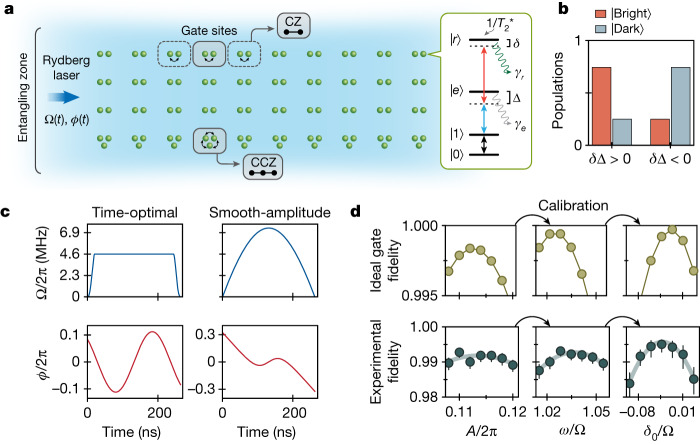
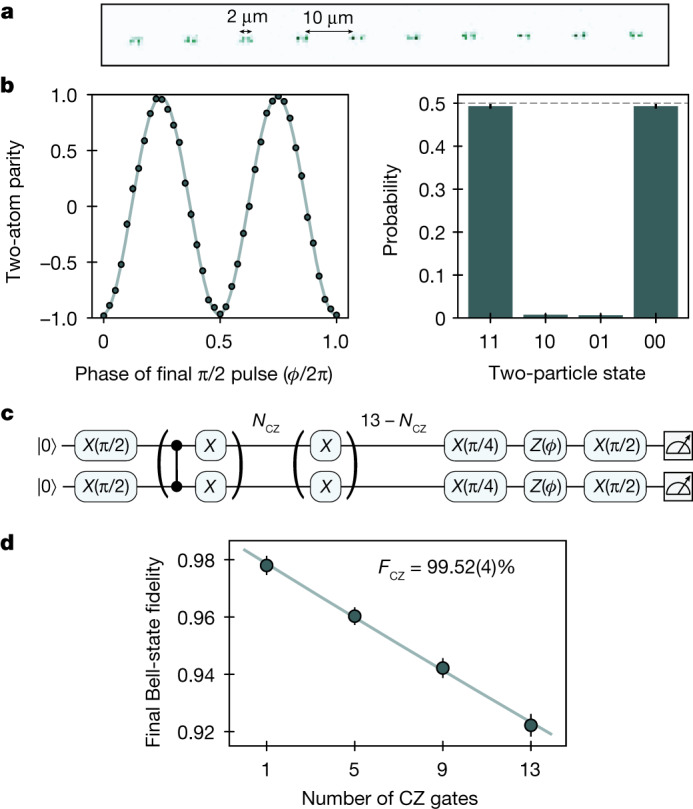
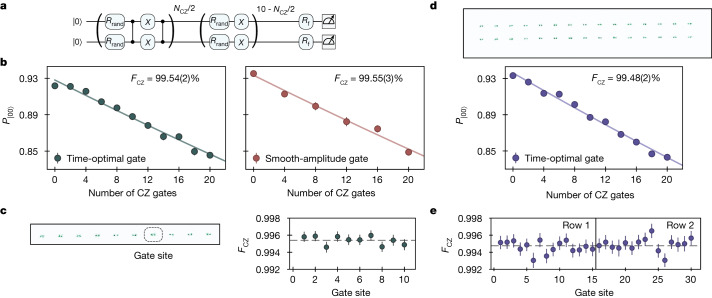
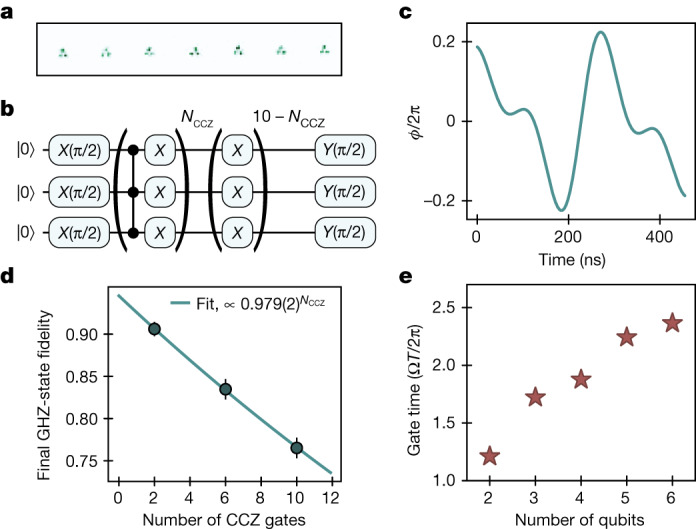
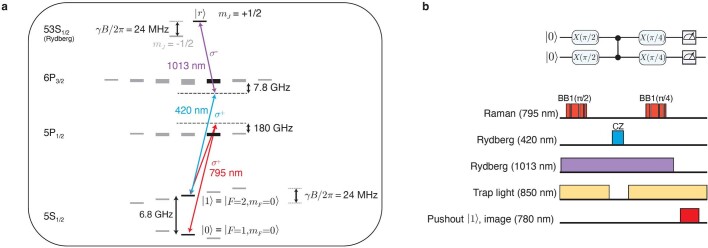
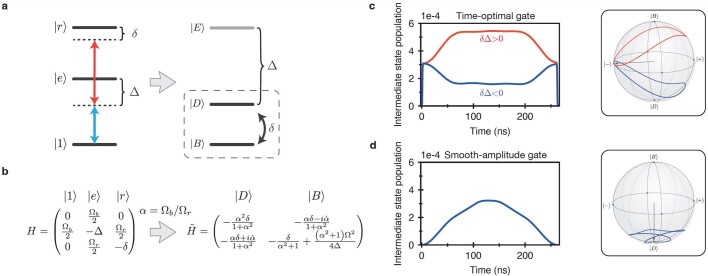
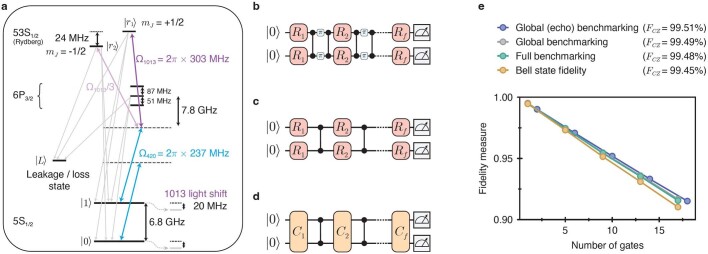
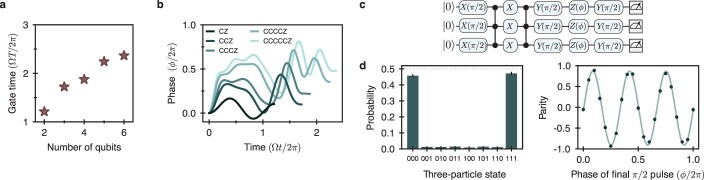
The ability to perform entangling quantum operations with low error rates in a scalable fashion is a central element of useful quantum information processing 1 . Neutral-atom arrays have recently emerged as a promising quantum computing platform, featuring coherent control over hundreds of qubits 2,3 and any-to-any gate connectivity in a flexible, dynamically reconfigurable architecture 4 . The main outstanding challenge has been to reduce errors in entangling operations mediated through Rydberg interactions 5 . Here we report the realization of two-qubit entangling gates with 99.5% fidelity on up to 60 atoms in parallel, surpassing the surface-code threshold for error correction 6,7 . Our method uses fast, single-pulse gates based on optimal control 8 , atomic dark states to reduce scattering 9 and improvements to Rydberg excitation and atom cooling. We benchmark fidelity using several methods based on repeated gate applications 10,11 , characterize the physical error sources and outline future improvements. Finally, we generalize our method to design entangling gates involving a higher number of qubits, which we demonstrate by realizing low-error three-qubit gates 12,13 . By enabling high-fidelity operation in a scalable, highly connected system, these advances lay the groundwork for large-scale implementation of quantum algorithms 14 , error-corrected circuits 7 and digital simulations 15 .
Overview
The claims and statistics of this paper haven’t been checked yet.
Free: it reads the open-access text and checks the first 5 claims that cite a source we can check. Create a free account to check every claim.
Integrity signals
Registry
Cites
Statistics
Figures
Verification
Claims the paper makes
The claims and statistics of this paper haven’t been checked yet.
Free: it reads the open-access text and checks the first 5 claims that cite a source we can check. Create a free account to check every claim.
Claims other papers make about this one
Each is checked against this paper’s own text: does it say what the citing paper says it does?
The source backs part of the claim, not all of it — or backs it for a different population, condition or comparison.
In the citing paper
“Using logical-level control and a zoned architecture in reconfigurable neutral-atom arrays7, our system combines high two-qubit gate fidelities8, arbitrary connectivity7,9, as well as fully programmable single-qubit rotations and mid-circuit readout10–15.”
From Logical quantum processor based on reconfigurable atom arrays (2024) · cites this paper as [8]
Experimental — accuracy not yet measuredThe source backs part of the claim, not all of it — or backs it for a different population, condition or comparison.
In the citing paper
“Averaged over the five computation logicals, we find that, by using the fault-tolerant initialization (postselecting on the ancilla logical flag not detecting errors) our |0L⟩ initialization fidelity is , exceeding both our physical qubit |0⟩ initialization fidelity (99.32(4)% (ref. 8)) and physical two-qubit gate fidelity (99.5% (ref. 8)).”
From Logical quantum processor based on reconfigurable atom arrays (2024) · cites this paper as [8]
Experimental — accuracy not yet measuredThe source backs part of the claim, not all of it — or backs it for a different population, condition or comparison.
In the citing paper
“Although ref. 8 seems to find some small cross-talk seemingly originating from decay into Rydberg P states, this should be considerably suppressed in the practical operation here owing to the approximately 200 μs duration between gates, during which time Rydberg atoms should either fly away or decay back to the ground state.”
From Logical quantum processor based on reconfigurable atom arrays (2024) · cites this paper as [8]
Experimental — accuracy not yet measuredThe source backs part of the claim, not all of it — or backs it for a different population, condition or comparison.
In the citing paper
“Even though the tail of the top-hat Rydberg excitation beams is only suppressed to about 10% intensity, the two-photon drive is far off-resonant owing to the approximately 20 MHz 1013 light shift detuning that is present for the entangling-zone atoms8.”
From Logical quantum processor based on reconfigurable atom arrays (2024) · cites this paper as [8]
Experimental — accuracy not yet measuredThe source backs part of the claim, not all of it — or backs it for a different population, condition or comparison.
In the citing paper
“We ensure that, in our dynamical decoupling, we have an odd number of π pulses between CZ gates (whenever possible), as this echoes out both systematic and spurious contributions to the single-qubit phase7,8.”
From Logical quantum processor based on reconfigurable atom arrays (2024) · cites this paper as [8]
Experimental — accuracy not yet measured
5 more claims about this paper
Create a free account to see every claim other papers make about this one.
Self-check
Percentages, sums and reported differences re-computed from the paper’s own numbers.
The self-check needs the paper’s full text.
Citations
Cites
Quantum Computing in the NISQ era and beyond
Preskill, J. (2018) · Quantum · doi:10.22331/q-2018-08-06-79 · Cited by 8,830
Fault-tolerant quantum computation by anyons
Kitaev, A. Y. (2003) · Annals of Physics · doi:10.1016/s0003-4916(02)00018-0 · Cited by 7,238 · cited 1×
“A thorough error budget is presented along with explanations of routes to further pushing gates to the regime of F>0.999 to make the system capable of reaching future fault tolerant performance.”
BackgroundInfluentialSurface codes: Towards practical large-scale quantum computation
Fowler, A. G., Mariantoni, M., Martinis, J. M., & Cleland, A. N. (2012) · Physical Review A · doi:10.1103/physreva.86.032324 · Cited by 3,059
Observation of electromagnetically induced transparency
Boller, K.-J., Imamoğlu, A., & Harris, S. E. (1991) · Physical Review Letters · doi:10.1103/physrevlett.66.2593 · Cited by 3,058 · cited 2×
“I was also particularly interested in their analysis of correlations between the sites, with this again being the first time sufficiently large ensembles have been used combined with repeated gate applications to really show how errors and correlations build in the system.”
BackgroundMethodSuperconducting quantum circuits at the surface code threshold for fault tolerance
Barends, R., Kelly, J., Megrant, A., Veitia, A., Sank, D., Jeffrey, E., White, T. C., Mutus, J., Fowler, A. G., Campbell, B., et al. (2014) · Nature · doi:10.1038/nature13171 · Cited by 1,733
Fast Quantum Gates for Neutral Atoms
Jaksch, D., Cirac, J. I., Zoller, P., Rolston, S. L., Côté, R., & Lukin, M. D. (2000) · Physical Review Letters · doi:10.1103/physrevlett.85.2208 · Cited by 1,540
Self-citationPredicting many properties of a quantum system from very few measurements
Huang, H.-Y., Kueng, R., & Preskill, J. (2020) · Nature Physics · doi:10.1038/s41567-020-0932-7 · Cited by 1,240
NMR techniques for quantum control and computation
Vandersypen, L. M. K., & Chuang, I. L. (2005) · Reviews of Modern Physics · doi:10.1103/revmodphys.76.1037 · Cited by 1,217
Suppressing quantum errors by scaling a surface code logical qubit
Google Quantum, A. I., Acharya, R., Aleiner, I., Allen, R., Andersen, T. I., Ansmann, M., Arute, F., Arya, K., Asfaw, A., Atalaya, J., et al. (2023) · Nature · doi:10.1038/s41586-022-05434-1 · Cited by 1,103 · cited 2×
“This protocol has the advantage of populating atomic dark states which do not contain population in the intermediate state used for the two-photon excitation to the Rydberg state, thereby reducing spontaneous emission.”
BackgroundQuantum phases of matter on a 256-atom programmable quantum simulator
Ebadi, S., Wang, T. T., Levine, H., Keesling, A., Semeghini, G., Omran, A., Bluvstein, D., Samajdar, R., Pichler, H., Ho, W. W., et al. (2021) · Nature · doi:10.1038/s41586-021-03582-4 · Cited by 995
Self-citation
Research works printed but not linked: 7
- Kalinowski M Maskara N Lukin MD Non-Abelian Floquet spin liquids in a digital Rydberg simulator Phys. Rev. X 2023 13 031008
- Shende VV Markov IL On the CNOT-cost of TOFFOLI gates Quantum Inf. Comput. 2009 9 461 486
- Ma S Universal gate operations on nuclear spin qubits in an optical tweezer array of 171Yb atoms Phys. Rev. X 2022 12 021028
- Brown MO Thiele T Kiehl C Hsu T-W Regal CA Gray-molasses optical-tweezer loading: controlling collisions for scaling atom-array assembly Phys. Rev. X 2019 9 011057
- Chang, T. H., Wang, T. N., Jen, H. H. & Chen, Y. C. High-fidelity Rydberg control-Z gates with time-optimal pulses. Preprint at https://arxiv.org/abs/2303.16395 (2023). · arXiv
- Khazali M Mølmer K Fast multiqubit gates by adiabatic evolution in interacting excited-state manifolds of Rydberg atoms and superconducting circuits Phys. Rev. X 2020 10 021054
- Singh K Anand S Pocklington A Kemp JT Bernien H Dual-element, two-dimensional atom array with continuous-mode operation Phys. Rev. X 2022 12 011040
Cited by
Items 701–800 of 973
Floquet circuits inspired by holographic matrix modelsPreprint
Ma, Y., & Lucas, A. (2026) · arXiv (Cornell University) · doi:10.48550/arxiv.2603.26874
“Sec-ondly, high-fidelity Clifford gates are an active goal of experimental research in atomic physics [42–44] , in particular in studies of neutral atom quantum computing using mobile optical tweezer arrays.”
Optimized quantum gates for neutral atom quantum computers
Jandura, S. (2024) · theses.fr (ABES) · doi:10.70675/39309d78zdd0dz40b3zb51bzd8461b14c490 · Cited by 1
Mesure non destructive et manipulation locales d’atomes de Rydberg circulaires en pinces optiques
Machu, Y. (2024) · theses.fr (ABES) · doi:10.70675/4b24ac2czad2az4933za785z8fde0d9c251c · Cited by 1
Lipaei, A. F., Khaleghian, E., Göral, G., Lin, Z., Aslan, S., & Müstecaplıoğlu, Ö. E. (2026) · arXiv (Cornell University) · doi:10.48550/arxiv.2604.11314 · Cited by 1
Fast measurement of neutral atoms with a multi-atom gatePreprint
Vaknin, Y., Finkelstein, R., Firstenberg, O., & Retzker, A. (2026) · arXiv (Cornell University) · doi:10.48550/arxiv.2604.13158 · Cited by 1
High-performance cellular automaton decoders for quantum repetition and toric codePreprint
Winter, D., Guedes, T. L. M., & Müller, M. (2026) · arXiv (Cornell University) · doi:10.48550/arxiv.2604.21866 · Cited by 1
Composite quantum gates simultaneously compensated for multiple errorsPreprint
Tochev, H., & Vitanov, N. V. (2026) · arXiv (Cornell University) · doi:10.48550/arxiv.2604.21594 · Cited by 1
Pulse Quality Optimisation in Quantum Optimal ControlPreprint
Lewis, D., & Wiersema, R. (2026) · arXiv (Cornell University) · doi:10.48550/arxiv.2604.25768 · Cited by 1
“Control protocols for full unitary dynamics, as well as simpler state-preparation tasks, have been designed for a wide range of systems and are now routinely used in quantum hardware [2–6].”
Kan, S., Harkness, A., Du, Z., Rofougaran, R., Garner, S. R., Liu, C., Mao, Y., & Stein, S. (2026) · arXiv (Cornell University) · doi:10.48550/arxiv.2605.04049 · Cited by 1
Analytical two-pulse control of universal single-qubit gates in rotational ultracold NaCs moleculesPreprint
Chen, Q., Luo, H., Guo, J.-K., Hong, Q.-Q., Fan, L., & Shu, C. (2026) · arXiv (Cornell University) · doi:10.48550/arxiv.2605.03461 · Cited by 1
Intelligent Optimal Control of Rydberg Gates with Incremental-Update Deep Reinforcement LearningPreprint
Cai, Y., Zhang, H., Zhang, K., & Qian, J. (2026) · arXiv (Cornell University) · doi:10.48550/arxiv.2605.04628 · Cited by 1
“2, two trapped 87 Rb atoms (denoted by the subscripts c for con-trol atom and t for target atom, respectively) are both modeled as four-level systems as in [5].”
Rydberg state engineering of trapped ionsPreprint
Thomm, R., Shankar, V., Kuk, N., Mallweger, M., Straka, I., & Hennrich, M. (2026) · arXiv (Cornell University) · doi:10.48550/arxiv.2605.30483 · Cited by 1
“Rydberg excitation in atomic systems is a powerful tool for quantum simulation [1–5], quantum information processing [6–9] and quantum sensing [10–14].”
Kan, S., Harkness, A., Du, Z., Rofougaran, R., Garner, S. R., Liu, C., Mao, Y., & Stein, S. (2026) · Research Square · doi:10.21203/rs.3.rs-9657542/v1 · Cited by 1
Interaction geometry and ground-state properties of sparse quantum lattice modelsPreprint
Gunning, A., Schmid, S., Liu, Z., Kuriyattil, S., Deger, A., & Daley, A. J. (2026) · arXiv (Cornell University) · doi:10.48550/arxiv.2606.20387 · Cited by 1
Quantum computer architecture with ions in tweezer arraysPreprint
Schiffer, B. F., Monroe, C., Zoller, P., & Cirac, J. (2026) · arXiv (Cornell University) · doi:10.48550/arxiv.2606.27249 · Cited by 1
“High-fidelity entangling gates are mediated by laser excitation to Rydberg levels, and the resulting van der Waals interactions enable fast operations on a timescale set by the Rydberg interaction [20–23].”
BRIDGE: Lazy-Move Compilation for Dual-Species Neutral-Atom Quantum ComputersPreprint
Huang, C.-K., Wang, J.-B., Zhang, Z.-M., Zhong, M., Fu, Z., Liang, Z.-D., Sun, Y., & Liu, D. E. (2026) · arXiv (Cornell University) · doi:10.48550/arxiv.2606.31833 · Cited by 1
“The single-and two-qubit gate fidelities, handover fidelity, and coherence time are set to values demonstrated on current neutral-atom hardware [13], [20]–[22], and the dual-species Rb-Cs substrate follows demonstrated two-element arrays [5], [17].”
Quantum simulation of gauge theories on dynamical spacetimes via Floquet-induced matrix modelsPreprint
Buckley-Bonanno, S., Eckstein, N. I., & Yelin, S. F. (2026) · arXiv (Cornell University) · doi:10.48550/arxiv.2607.04040 · Cited by 2
Huang, H., Gu, Y., Huang, C., Zhao, X., Hu, M.-J., Liu, D. E., & Wang, J. (2026) · arXiv (Cornell University) · doi:10.48550/arxiv.2607.08212 · Cited by 1
Plaquette: A hardware-aware design platform for fault-tolerant quantum computersPreprint
Vendrell, R. C., López, C. D., Dhand, I., Kapoor, K., Laureti, D., Massaro, M., Nayak, P., Ogloblin, I., Plenio, M. B., Kumar, S. P., et al. (2026) · arXiv (Cornell University) · doi:10.48550/arxiv.2607.08767 · Cited by 2
“…driven near its anharmonicity leaks into its third level [7, 8]; a neutral-atom Rydberg gate scatters through an intermediate electronic state [9, 10]; a trapped ion or a neutral atom heats as its motional mode absorbs phonons [11, 12]; a spin qubit in silicon leaks into nearby valley states…”
Randomized Quantum Optimal ControlPreprint
Kim, L., Riberi, F., Baca, K., & Marvian, M. (2026) · arXiv (Cornell University) · doi:10.48550/arxiv.2607.10946 · Cited by 2
“QOC has become a key tool for implementing high-fidelity gates across quantum computing platforms [18–24].”
Parallel analog quantum simulation in homogeneous quantum gasesPreprint
Hernández-Rajkov, D., Terenzi, A., Fernández, M. F., Grani, N., Inguscio, M., del Pace, G., & Roati, G. (2026) · arXiv (Cornell University) · doi:10.48550/arxiv.2607.14977 · Cited by 1
Robust logical Bell nonlocality based on quantum error correction codesPreprint
Zhang, Q., Ying, J.-W., Liu, C., Zhou, L., & Sheng, Y.-B. (2026) · arXiv (Cornell University) · doi:10.48550/arxiv.2607.19728
Enabling Neutral Atom Integration: Redesigning Device Models for Universal Quantum EcosystemsPreprint
Stade, Y., Burgholzer, L., Schmid, L., & Wille, R. (2026) · arXiv.org · doi:10.48550/arxiv.2607.20616 · Cited by 1
“This setup—featuring better coherence times [28], [35] compared to the monolithic device in Ex.”
Photo-ionization Compensation of Stray Electric Fields for Cold Rydberg AtomsPreprint
Chen, Z.-Y., Fu, Z.-X., He, Z.-R., Cheng, S.-A., Liang, J.-H., Zhang, S.-C., Du, Y.-X., & Li, C. (2026) · arXiv (Cornell University) · doi:10.48550/arxiv.2608.04660 · Cited by 1
Mid-circuit ground-state cooling and ancilla readout in the $\textit{omg}$ architecturePreprint
Brudney, S., Burns, C., Gregory, G. J., Ritchie, E. R., Wineland, D. J., Allcock, D. T. C., & O'Reilly, J. (2026) · arXiv (Cornell University) · doi:10.48550/arxiv.2608.13181 · Cited by 1
Detuning- and Stark-robust Rydberg gatesPreprint
Bataille, E., Nomura, G., & Endres, M. (2026) · arXiv (Cornell University) · doi:10.48550/arxiv.2608.27426
“[12]), in which case no correction is required.”
Detuning-robust Rydberg entangling gates from echoed pulsesPreprint
Jia, Z., Yu, Y., Hu, X., Li, L., Zheng, J., Monroe, C., & Covey, J. P. (2026) · arXiv (Cornell University) · doi:10.48550/arxiv.2608.26446 · Cited by 1
Efficient Quantum Error Correction from Three Dimensional Qubit ControlPreprint
Wu, K. Y., Kwon, O., & Parsons, M. F. (2026) · arXiv (Cornell University) · doi:10.48550/arxiv.2609.04459 · Cited by 1
Geometry Dependence of Error Thresholds in Two-Dimensional Toric CodesPreprint
Lessing, D., Langheld, A., Krämer, C., Koziol, J. A., & Schmidt, K. P. (2026) · arXiv (Cornell University) · doi:10.48550/arxiv.2609.07579 · Cited by 1
“…processors have emerged as a particularly promising architecture for realizing topological stabilizer codes [27] owing to their excellent coherence properties, high-fidelity gate operations [28], and the ability to dynamically rearrange atoms into arbitrary two-dimensional geometries [29,30].”
A dual-region ytterbium tweezer apparatus with an in-vacuum nanofiber cavityPreprint
Hashimoto, S., Ozawa, H., Hisai, Y., Aoki, T., & Inoue, R. (2026) · arXiv (Cornell University) · doi:10.48550/arxiv.2609.25245 · Cited by 1
Qubit CSS codes with Universal Transversal GatesPreprint
Dua, A., Holmes, A. A., Gullans, M. J., & Albert, V. V. (2026) · arXiv (Cornell University) · doi:10.48550/arxiv.2610.06730 · Cited by 1
“A three-qubit native gate fails as often as a CNOT, which is optimistic, since demonstrated three-atom gates are less accurate than two-qubit gates [88, 89].”
Kuriyattil, S., Kombe, J., Daley, A. J., & Poggi, P. M. (2026) · arXiv (Cornell University) · doi:10.48550/arxiv.2610.28462 · Cited by 1
Protocol for nearly deterministic parity projection on two photonic qubits
Liu, C., Frantzeskakis, R., Economou, S. E., & Barnes, E. (2024) · Physical Review Research · doi:10.1103/physrevresearch.6.043143
Leung, K. H. (2023) · Springer theses · doi:10.1007/978-3-031-47647-1_1
Liu, Y., Wang, Z., Guan, S.-J., Wang, Q.-X., Zhang, P., Li, G., & Zhang, T. (2024) · Acta Physica Sinica · doi:10.7498/aps.73.20240135
On Purported Physical Realizations of So-called Quantum Information TechnologiesPreprint
Li, G.-L. (2024) · Qeios · doi:10.32388/vdh0dt
On Purported Physical Realizations of So-called Quantum Information TechnologiesPreprint
Li, G.-L. (2024) · Qeios · doi:10.32388/vdh0dt.2
Hybrid Integrated Photonic Arbitrary Waveform Generator for Single-Atom Control
Bankwitz, J. R., Jung, E., Schultzen, P., Pradip, R., McRae, L., Varri, A., Ma, X.-Y., Lenzini, F., Blatt, S., Zeiher, J., et al. (2024) · Scalable Uncertainty Management · doi:10.1109/sum60964.2024.10614571
“Among the various platforms explored, neutral atom quantum computing has emerged as a promising avenue [1], [2].”
BackgroundOn Purported Physical Realizations of So-called Quantum Information TechnologiesPreprint
Li, G.-L. (2024) · Qeios · doi:10.32388/vdh0dt.3
On Purported Physical Realizations of So-called Quantum Information TechnologiesPreprint
Li, G.-L. (2024) · Qeios · doi:10.32388/vdh0dt.4
Embedded Complexity and Quantum Circuit VolumePreprint
Ma, X., Du, Z., & Liu, Z.-W. (2024) · Research Square · doi:10.21203/rs.3.rs-5001631/v1
On Purported Physical Realizations of So-called Quantum Information TechnologiesPreprint
Li, G.-L. (2024) · Qeios · doi:10.32388/vdh0dt.5
Long-Lifetime Optical Trapping of a 40Ca+ Ion
Chen, Z. L., 王, M. 淼. W., Zhang, B., Zhang, H., 马, Z. 子. M., Hu, R., Huang, Y., Gao, K., & Guan, H. (2024) · Chinese Physics Letters · doi:10.1088/0256-307x/41/11/113701
On Purported Physical Realizations of So-called Quantum Information TechnologiesPreprint
Li, G.-L. (2024) · Qeios · doi:10.32388/vdh0dt.6
Full-stack control system for ultracold Rydberg atom quantum computers and simulators
Morgado, M. (2024) · theses.fr (ABES) · doi:10.70675/7167d192z0d6fz4a56z8675zebc27d8e972e
Opinion: The simplest quantum computerPreprint
Tahan, C. (2024) · arXiv (Cornell University) · doi:10.48550/arxiv.2412.18726
Quantum Resources for Pure Thermal Shadows
Sharma, A., & Obenland, K. (2024) · IEEE International Conference on Quantum Computing and Engineering (QCE) · doi:10.1109/qce60285.2024.00052
“Even with a high-performance two-qubit gate fidelity like 99.5% [8], performing this many Fig.”
BackgroundInfluentialResearch on quantum compilation of neutral atom quantum computing platformPreprint
Xu, C. (2025) · arXiv (Cornell University) · doi:10.48550/arxiv.2501.05266
On-the-Spot Loading of Single-Atom TrapsPreprint
IJspeert, M., Holland, N., Yuen, B., & Kuhn, A. (2025) · arXiv (Cornell University) · doi:10.48550/arxiv.2501.06162
“They furthermore enable fully programmable single-qubit rotations [12] and are shown to yield a high readout and two-qubit gate fidelity [13].”
Quantum Robust Control for Time-Varying Noises Based on Adversarial Learning
Ji, H.-T., Kuang, S., Dong, D., & Chen, C. (2024) · IEEE International Conference on Systems, Man and Cybernetics · doi:10.1109/smc54092.2024.10831431
Where analogue and digital meet
Schymik, K. (2025) · Nature Physics · doi:10.1038/s41567-024-02755-y
Microwave-activated quantum state transfer and entanglement generation among five to seven qubits
Qi, Z.-H., Sun, Z.-H., & Xu, P. (2025) · Laser Physics Letters · doi:10.1088/1612-202x/adaddc
“Among the various microscopic physical systems proposed for quantum computing, the most widely accepted include trapped ions [4, 5], nuclear magnetic resonance [6], neutral atoms [7], and superconducting quantum systems [8].”
Quantum-computing technology that makes qubits from atoms wins mega investment.
Gibney, E. (2025) · Nature · doi:10.1038/d41586-025-00451-2
Proposal for the high-dimensional quantum computation in ladder-shaped atomic tweezer arrays
Deng, X., Peng, G., Xiang, D., Xu, X., Cao, L., & Hu, Z.-K. (2025) · Quantum Frontiers · doi:10.1007/s44214-025-00077-5
Isolated atoms, but entangled.
Pupillo, G., & Brennen, G. (2025) · Science · doi:10.1126/science.adw2572
Expansion Dynamics of Rydberg-Dressed Ultracold Fermi Gas
Wu, M.-M., Bao, X., Yu, S.-X., Deng, S.-J., & Wu, H.-B. (2025) · Photonics · doi:10.3390/photonics12040350
Transportable and Ultra-Stable Laser System for 133Cs Rydberg Excitation
Xu, Z.-X., Zhao, C.-T., & Li, D.-H. (2025) · Photonics · doi:10.3390/photonics12060559
Bounding the sample fluctuation for pure-state certification with local random measurement
Chen, L., & Zhang, P. (2025) · Physical Review A · doi:10.1103/8zth-7n97
“State-of-the-art experimental platforms, such as Ryd-berg atom arrays [2–12], have enabled the development of quantum processors with hundreds of qubits.”
Toward a Universal Quantum Computing Cloud: Characteristics and Requirements
Lương, Q. N., PHAM, V. D., Nguyen, R. N., Nguyen, H. Q., Dinh, T., & SHARIFF, A. (2025) · HAL · doi:10.5281/zenodo.16921160
Fast and robust detection of single Rydberg excitations in mesoscopic ensembles
Schmidt, S., Thielmann, A., Niederprum, T., & Ott, H. (2025) · Physical Review A · doi:10.1103/964l-npcf
“…groundbreaking progress such as the simulation of quantum spin models with hundreds of atoms [6, 7], realization of high fidelity quantum gates [8–11] and implementation of quantum algorithms [12, 13] has already been demonstrated, with recent findings underlining its scalability by achieving…”
Fault-Tolerant Optical Quantum Computation using 3D Hybrid Cluster StatesPreprint
Du, P.-L. (2025) · arXiv (Cornell University) · doi:10.48550/arxiv.2503.14988
“Various physical platforms have been explored for QC, including optics[4, 5], superconductors[6, 7], trapped ions[8, 9], and neutral-atoms[10, 11].”
State-space gradient descent and metastability in quantum systemsPreprint
Zhu, S., & Tong, Y. (2025) · arXiv (Cornell University) · doi:10.48550/arxiv.2505.09729
“Recent studies show that Rydberg atom arrays can achieve high-fidelity quantum gates, such as CZ and Toffoli, suitable for gate-based quantum computing [45, 46].”
Magneto-optical-trap loading in a large optical-access experiment
Gaudesius, M., Lee, J. M., Kraft, L., Gordon, J., & Biedermann, G. (2025) · Physical Review A · doi:10.1103/n8p5-b876
“Moreover, it provides a broad optical access to the scientific region of study, allowing for the realization of high NA optical tweezers and opening more laser pathways for atom array manipulation, as highly desired in Rydberg-atom based simulation and computing [16, 17, 20, 21].”
Du, Y. (2025) · arXiv (Cornell University) · doi:10.48550/arxiv.2506.15487
Aruna, A. V. M. B., & Begum, M. S. (2025) · Communications in computer and information science · doi:10.1007/978-3-032-05144-8_23
From Wavefunctional Entanglement to Entangled Wavefunctional Degrees of FreedomPreprint
Bhattacharya, A. (2025) · arXiv (Cornell University) · doi:10.48550/arxiv.2507.04650
“…73]—which is a generalized notion of quantum nonlocality and plays an essential role, for example, in magic state distillation protocols [74, 75]—have been collectively suggested [73] as fundamental sources of scalable quantum computational advantage [21, 76, 77] over their classical counterparts.”
DYNAMO: Dynamic Neutral Atom Multi-programming Optimizer Towards Quantum Operating SystemsPreprint
Sun, W., Li, X., Wang, Z., Chen, G., Yu, L., & Yang, G. (2025) · arXiv (Cornell University)
Deep Learning for Absorption-Image AnalysisPreprint
Morrey, J., Peterson, I., Leonard, R. H., Wilson, J. M., Fonta, F., Squires, M. B., & Olson, S. E. (2025) · arXiv (Cornell University) · doi:10.48550/arxiv.2506.04517
Painted loading: a toolkit for loading spatially large optical tweezer arrays
Walker, M. J., Moriya, R., Segal, J., Gallagher, L. A. P., Hill, M., Leroux, F., Xu, Z., & Jones, M. P. A. (2026) · Quantum Science and Technology · doi:10.1088/2058-9565/ae34e3
Cold atomic ensembles as quantum antennas for distributed networks of single-atom arrays
Lin, X., Mei, Y., & Zhang, C. (2026) · Physical Review A · doi:10.48550/arxiv.2508.08439
Zhang, Y., Zhao, J., Jia, Y.-G., Shen, X.-M., Xiong, F., & Ma, Y. (2026) · Expert systems with applications · doi:10.1016/j.eswa.2025.130616
Hybrid quantum neural network models for fruit quality assessment
Khairi, D. U., Ahsan, K., Ali, S. Z., Alhalabi, W., Albaradei, S., & Anwar, M. S. (2025) · PLoS ONE · doi:10.1371/journal.pone.0332528
“As summarized in Table 2, recent literature highlights that while CNOT and CZ gates are logically similar, their physical implementations yield significant differences in fidelity and noise resilience across various hardware platforms [31–37].”
Engineering resonating kagome dimers in Rydberg-atom arrays
Wang, X., & Mueller, E. J. (2026) · Physical Review A · doi:10.1103/tkql-3pkg
(2025) · Novosibirsk State University eBooks · doi:10.25205/thesispuha-2025
Tanasanchai, N., Srakeaw, K., Udommai, P., & Anukool, W. (2025) · ScienceAsia · doi:10.2306/scienceasia1513-1874.2025.s025
TOWARDS HYBRID QUANTUM NETWORKING: INTERFACING ION TRAPS WITH NEUTRAL ATOM SYSTEMS
Romanoff, B. (2025) · University Libraries (University of Maryland) · doi:10.13016/ha73-hxod
Fast entangling gates enabled by micromotion in trapped-ion quantum processors
Grosser, P. (2024) · ANU Open Research (Australian National University) · doi:10.25911/jw8b-x806
Hamilton-Jacobi-Bellman equations for Rydberg-blockade processes
Fromonteil, C., Tricarico, R., Cesa, F., & Pichler, H. (2024) · Zenodo (CERN European Organization for Nuclear Research) · doi:10.5281/zenodo.11073101
Erzeugung photonischer Graph-Zustände mit Einzelatomen in einem optischen Resonator
Thomas, R. P., Rempe, G., & München, T. U. (2024)
Tarkkojen alkeisoperaatioiden implementointi suprajohtavissa kvanttitietokoneissa
Hyyppä, E. (2024) · Aaltodoc (Aalto University)
Controlled manipulation of excitations for Rydberg Atomtronics
Perciavalle, F. (2025) · Electronic Theses and Dissertations Repository (University of Pisa)
Hartung, L., Rempe, G., & München, T. U. (2024)
Improving Quantum Protocols in the Presence of Noise
Shlosberg, A. (2024) · CU Scholar (University of Colorado Boulder)
FOULDS, S. (2023) · Durham e-Theses (Durham University)
Sharma, M. (2025) · RWTH Publications (RWTH Aachen) · doi:10.18154/rwth-2025-06868
Quadratic Quantum Speedup for Finding Independent Set of a GraphPreprint
Zhao, X., Ge, P., You, L., & Wu, B. (2025) · arXiv (Cornell University) · doi:10.48550/arxiv.2510.26395
Near-term quantum computation with neutral atoms:From electronic states, to gates and algorithms
Mohan, M. (2025) · TU/e Research Portal
Multipartite quantum clock synchronization via collective symmetric states
Keskin, U., Maranò, S., Conti, A., Shin, H., Lindsey, W. C., & Win, M. Z. (2026) · Quantum Science and Technology · doi:10.1088/2058-9565/aeac82
極低温動作MOSFETの界面特性についての実験的研究 (本文)
シタカタ, シ., Shitakata, S., & 下方, 駿. (2025) · Institutional Repositories DataBase (IRDB)
Pound–Drever–Hall locking of a 780 nm laser using an on-chip Mach-Zehnder interferometer
Wei, N., Zhang, Y., Song, H.-Y., Yang, Y., Dong, N., Xu, Z., Wei, R., Wang, B., He, J.-J., & Wang, J. (2026) · Chinese Optics Letters (COL) · doi:10.3788/col202624.021304
Hybrid Atom Tweezer Array of Nuclear Spin and Optical Clock Qubits
Nakamura, Y. (2026) · Springer theses · doi:10.1007/978-981-95-2836-3_6
Yttebium Atoms and Rydberg States
Nakamura, Y. (2026) · Springer theses · doi:10.1007/978-981-95-2836-3_3
Nakamura, Y. (2026) · Springer theses · doi:10.1007/978-981-95-2836-3_7
Nakamura, Y. (2026) · Springer theses · doi:10.1007/978-981-95-2836-3_1
Connecting quantum computing and machine learning to improve quantum simulation and optimization
Cruz, P. M. Q. (2025) · Portuguese National Funding Agency for Science, Research and Technology (RCAAP Project by FCT)
Narrow-linewidth hybrid-integrated self-injection locked laser at 1015.75 nm
Zhang, H.-F., Wu, Y.-L., Yang, S., Chen, H.-W., Wang, H., & Chen, M.-H. (2025) · Asia Communications and Photonics conference and Exhibition · doi:10.1109/acp66871.2025.11350723
“Particularly, atomic quantum array based on Rubidium atoms shows great potential for practical applications [2].”
Eusse, J., Vasquez, E., Rivlin, T., & Agudelo, E. (2026) · arXiv (Cornell University) · doi:10.48550/arxiv.2601.20619
Kawakami, T., Yamada, S., Taniguchi, M., & Yamaguchi, K. (2026) · Quantum Reports · doi:10.3390/quantum8010010
Quantum Mechanics Primer for Non-physicists
Singh, M. S. I., & Rawal, B. S. (2026) · Springer eBooks · doi:10.1007/978-981-95-2498-3_1
Metadata
- Authors
- Evered, S. J., Bluvstein, D., Kalinowski, M., Ebadi, S., Manovitz, T., Zhou, H., Li, S. H., Geim, A. A., Wang, T. T., Maskara, N., Levine, H., Semeghini, G., Greiner, M., Vuletić, V., & Lukin, M. D.
- Affiliations
- Harvard University (US)
- Massachusetts Institute of Technology (US)
- Corresponding author
- Lukin, Mikhail D.
- ORCID
- Venue
- Nature
- Published
- 2023-10-11
- Volume
- 622
- Issue
- 7982
- Pages
- 268-272
- ISSN
- 0028-0836 (ISSN-L)
- 1476-4687
- PMC
- PMC10567572
- OpenAlex
- W4387542025
- Semantic Scholar
- 531874012fede3c01f44f2d81bfb926c0a25c9aa
- Cited by
- 522
- References
- 97
- Citations by year
- 2026: 134 · 2025: 229 · 2024: 138 · 2023: 21
- FWCI
- 60.51
- Type
- journal article
- Language
- en
- Open access
- hybrid
- doi.org
- Licence
- cc-by
- creativecommons.org/licenses/by/4.0 (tdm)
- creativecommons.org/licenses/by/4.0 (vor)
- Locations
- Nature (publishedVersion, cc-by)
- PubMed Central (publishedVersion, cc-by)
- PubMed (publishedVersion)
- arXiv (Cornell University) (submittedVersion)
- OSTI OAI (U.S. Department of Energy Office of Scientific and Technical Information) (submittedVersion)
- FIU - Digital Commons (Florida International University) (submittedVersion)
- Florida International University Digital Commons (Florida International University) (submittedVersion, cc-by)
- RePEc: Research Papers in Economics (submittedVersion)
- arXiv (Cornell University)
- Funders
- National Science Foundation (1745303, W911NF-20-1-0082)
- U.S. Department of Energy (DESC0021013, DESC0021110, 7568717)
- Defense Advanced Research Projects Agency (W911NF2010021)
- National Defense Science and Engineering Graduate
- Multidisciplinary University Research Initiative (W911NF2010082)
- Center for Ultracold Atoms, Massachusetts Institute of Technology
- Army Research Office (W911NF-20-1-0082, W911NF)
- Topics
- Physical Sciences › Physics and Astronomy › Atomic and Molecular Physics, and Optics › Cold Atom Physics and Bose-Einstein Condensates
- Physical Sciences › Computer Science › Artificial Intelligence › Quantum Computing Algorithms and Architecture
- Physical Sciences › Physics and Astronomy › Atomic and Molecular Physics, and Optics › Quantum Information and Cryptography
- Keywords
- neutral atom quantum computing, entangling gates, Rydberg interactions, gate fidelity, three-qubit gates, optimal control, dark states, atom cooling, Rydberg excitation, error sources, scalable quantum hardware
About these checks
Registry, retraction, Cites and statistics results are computed, not judged, with one exception: a printed reference that no index lists is read once by a model before it counts as a citation error. Claims are extracted by a model and kept only when their quote appears verbatim in the text; each cited source is then checked, with a model’s help, for whether it says what the claim relies on. Those verdicts can be wrong — read the claim’s quote and the cited source before relying on one.
Statistics and arithmetic are recomputed, not judged.
Confidence bands are shown only for fields calibrated on our annotated test set. None is calibrated yet, so no band is shown.
What counts as a claim ›How we measure confidence ›How we check this ›
Are you an author, or do you see a problem with this page? Request a review
Data sources
Bibliographic data: Semantic Scholar, OpenAlex, Crossref.
Contains information from the Semantic Scholar Academic Graph Datasets, made available under the ODC Attribution License (ODC-BY 1.0).
Semantic Scholar’s data is described in: Kinney, R., et al. (2023). The Semantic Scholar Open Data Platform. arXiv:2301.10140.
