

High-fidelity parallel entangling gates on a neutral-atom quantum computer
Open accessThe DOI matches its Crossref record; 101 of the 101 references it cites were found in a registry or an index.
Abstract
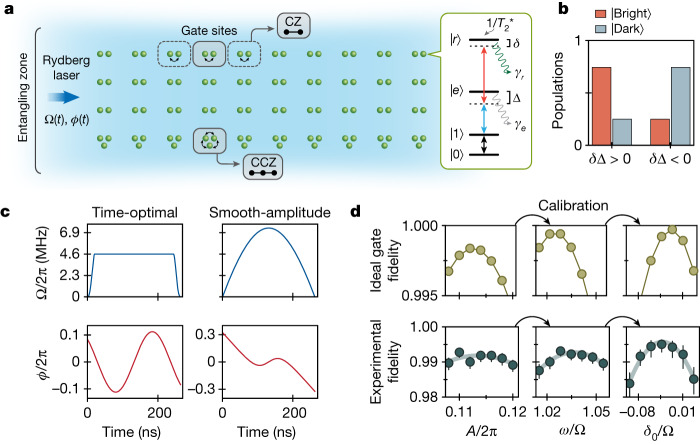
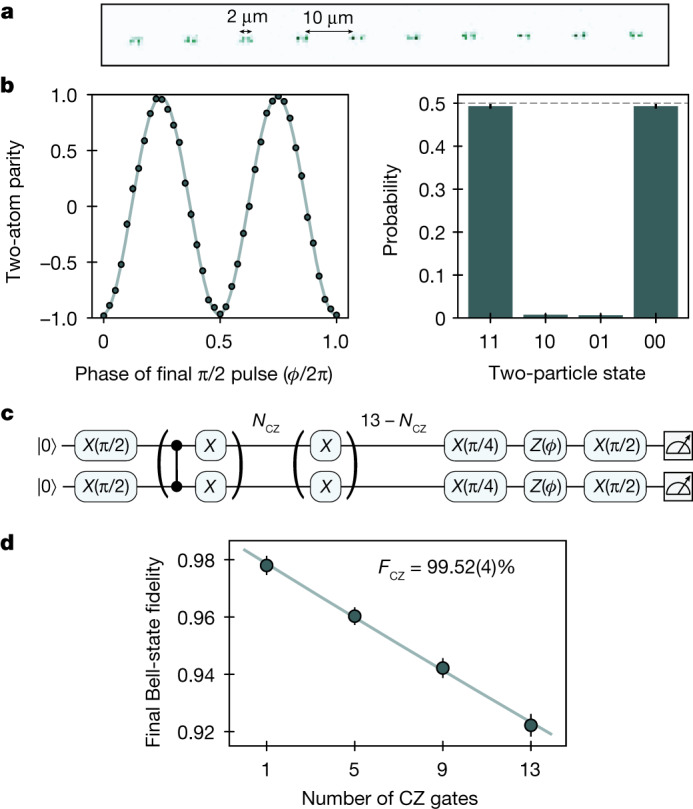
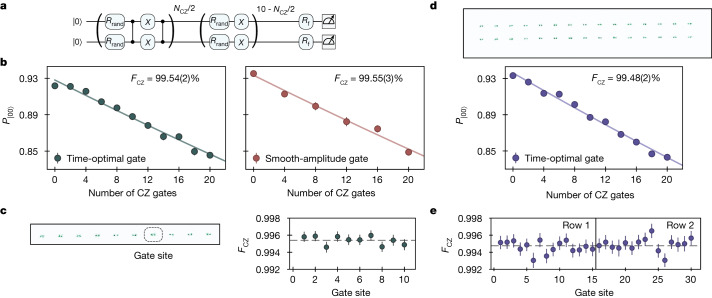
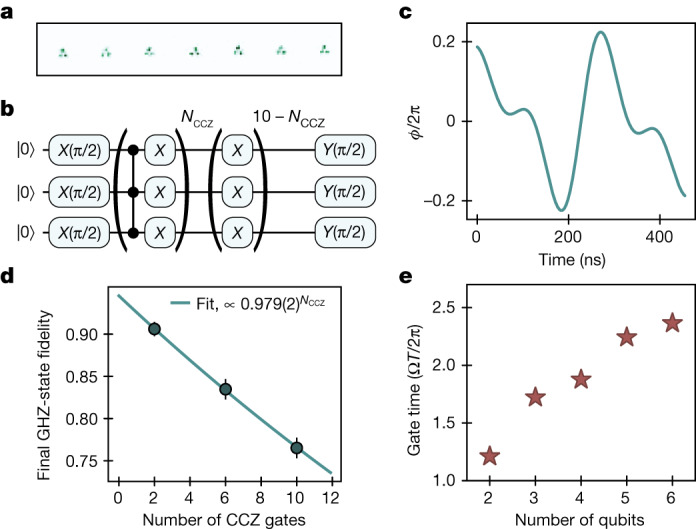
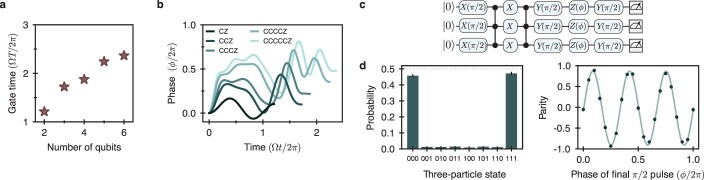
The ability to perform entangling quantum operations with low error rates in a scalable fashion is a central element of useful quantum information processing 1 . Neutral-atom arrays have recently emerged as a promising quantum computing platform, featuring coherent control over hundreds of qubits 2,3 and any-to-any gate connectivity in a flexible, dynamically reconfigurable architecture 4 . The main outstanding challenge has been to reduce errors in entangling operations mediated through Rydberg interactions 5 . Here we report the realization of two-qubit entangling gates with 99.5% fidelity on up to 60 atoms in parallel, surpassing the surface-code threshold for error correction 6,7 . Our method uses fast, single-pulse gates based on optimal control 8 , atomic dark states to reduce scattering 9 and improvements to Rydberg excitation and atom cooling. We benchmark fidelity using several methods based on repeated gate applications 10,11 , characterize the physical error sources and outline future improvements. Finally, we generalize our method to design entangling gates involving a higher number of qubits, which we demonstrate by realizing low-error three-qubit gates 12,13 . By enabling high-fidelity operation in a scalable, highly connected system, these advances lay the groundwork for large-scale implementation of quantum algorithms 14 , error-corrected circuits 7 and digital simulations 15 .
Overview
The claims and statistics of this paper haven’t been checked yet.
Free: it reads the open-access text and checks the first 5 claims that cite a source we can check. Create a free account to check every claim.
Integrity signals
Registry
Cites
Statistics
Figures
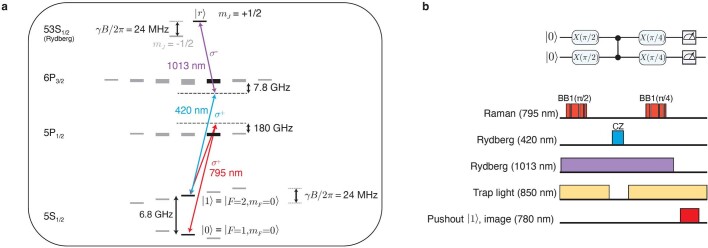
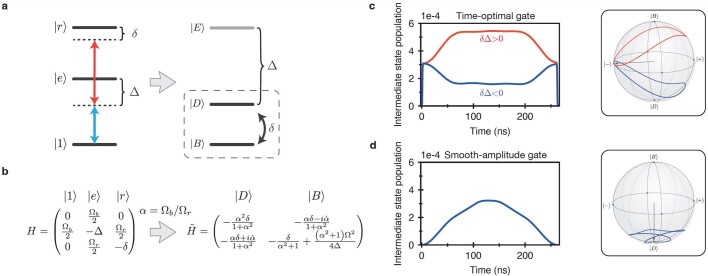
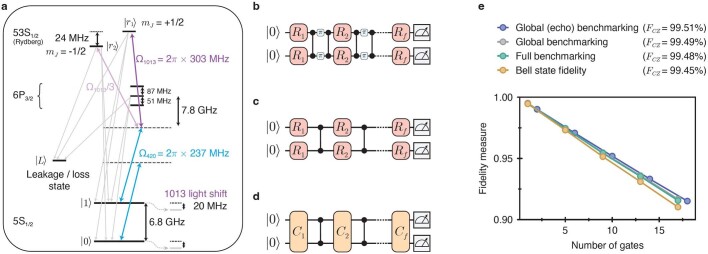
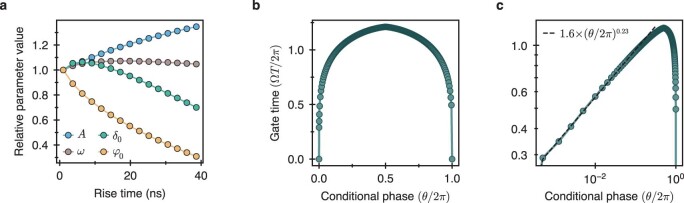
Verification
Claims the paper makes
The claims and statistics of this paper haven’t been checked yet.
Free: it reads the open-access text and checks the first 5 claims that cite a source we can check. Create a free account to check every claim.
Claims other papers make about this one
Each is checked against this paper’s own text: does it say what the citing paper says it does?
The source backs part of the claim, not all of it — or backs it for a different population, condition or comparison.
In the citing paper
“Using logical-level control and a zoned architecture in reconfigurable neutral-atom arrays7, our system combines high two-qubit gate fidelities8, arbitrary connectivity7,9, as well as fully programmable single-qubit rotations and mid-circuit readout10–15.”
From Logical quantum processor based on reconfigurable atom arrays (2024) · cites this paper as [8]
Experimental — accuracy not yet measuredThe source backs part of the claim, not all of it — or backs it for a different population, condition or comparison.
In the citing paper
“Averaged over the five computation logicals, we find that, by using the fault-tolerant initialization (postselecting on the ancilla logical flag not detecting errors) our |0L⟩ initialization fidelity is , exceeding both our physical qubit |0⟩ initialization fidelity (99.32(4)% (ref. 8)) and physical two-qubit gate fidelity (99.5% (ref. 8)).”
From Logical quantum processor based on reconfigurable atom arrays (2024) · cites this paper as [8]
Experimental — accuracy not yet measuredThe source backs part of the claim, not all of it — or backs it for a different population, condition or comparison.
In the citing paper
“Although ref. 8 seems to find some small cross-talk seemingly originating from decay into Rydberg P states, this should be considerably suppressed in the practical operation here owing to the approximately 200 μs duration between gates, during which time Rydberg atoms should either fly away or decay back to the ground state.”
From Logical quantum processor based on reconfigurable atom arrays (2024) · cites this paper as [8]
Experimental — accuracy not yet measuredThe source backs part of the claim, not all of it — or backs it for a different population, condition or comparison.
In the citing paper
“Even though the tail of the top-hat Rydberg excitation beams is only suppressed to about 10% intensity, the two-photon drive is far off-resonant owing to the approximately 20 MHz 1013 light shift detuning that is present for the entangling-zone atoms8.”
From Logical quantum processor based on reconfigurable atom arrays (2024) · cites this paper as [8]
Experimental — accuracy not yet measuredThe source backs part of the claim, not all of it — or backs it for a different population, condition or comparison.
In the citing paper
“We ensure that, in our dynamical decoupling, we have an odd number of π pulses between CZ gates (whenever possible), as this echoes out both systematic and spurious contributions to the single-qubit phase7,8.”
From Logical quantum processor based on reconfigurable atom arrays (2024) · cites this paper as [8]
Experimental — accuracy not yet measured
5 more claims about this paper
Create a free account to see every claim other papers make about this one.
Self-check
Percentages, sums and reported differences re-computed from the paper’s own numbers.
The self-check needs the paper’s full text.
Citations
Cites
Quantum Computing in the NISQ era and beyond
Preskill, J. (2018) · Quantum · doi:10.22331/q-2018-08-06-79 · Cited by 8,830
Fault-tolerant quantum computation by anyons
Kitaev, A. Y. (2003) · Annals of Physics · doi:10.1016/s0003-4916(02)00018-0 · Cited by 7,238 · cited 1×
“A thorough error budget is presented along with explanations of routes to further pushing gates to the regime of F>0.999 to make the system capable of reaching future fault tolerant performance.”
BackgroundInfluentialSurface codes: Towards practical large-scale quantum computation
Fowler, A. G., Mariantoni, M., Martinis, J. M., & Cleland, A. N. (2012) · Physical Review A · doi:10.1103/physreva.86.032324 · Cited by 3,059
Observation of electromagnetically induced transparency
Boller, K.-J., Imamoğlu, A., & Harris, S. E. (1991) · Physical Review Letters · doi:10.1103/physrevlett.66.2593 · Cited by 3,058 · cited 2×
“I was also particularly interested in their analysis of correlations between the sites, with this again being the first time sufficiently large ensembles have been used combined with repeated gate applications to really show how errors and correlations build in the system.”
BackgroundMethodSuperconducting quantum circuits at the surface code threshold for fault tolerance
Barends, R., Kelly, J., Megrant, A., Veitia, A., Sank, D., Jeffrey, E., White, T. C., Mutus, J., Fowler, A. G., Campbell, B., et al. (2014) · Nature · doi:10.1038/nature13171 · Cited by 1,733
Fast Quantum Gates for Neutral Atoms
Jaksch, D., Cirac, J. I., Zoller, P., Rolston, S. L., Côté, R., & Lukin, M. D. (2000) · Physical Review Letters · doi:10.1103/physrevlett.85.2208 · Cited by 1,540
Self-citationPredicting many properties of a quantum system from very few measurements
Huang, H.-Y., Kueng, R., & Preskill, J. (2020) · Nature Physics · doi:10.1038/s41567-020-0932-7 · Cited by 1,240
NMR techniques for quantum control and computation
Vandersypen, L. M. K., & Chuang, I. L. (2005) · Reviews of Modern Physics · doi:10.1103/revmodphys.76.1037 · Cited by 1,217
Suppressing quantum errors by scaling a surface code logical qubit
Google Quantum, A. I., Acharya, R., Aleiner, I., Allen, R., Andersen, T. I., Ansmann, M., Arute, F., Arya, K., Asfaw, A., Atalaya, J., et al. (2023) · Nature · doi:10.1038/s41586-022-05434-1 · Cited by 1,103 · cited 2×
“This protocol has the advantage of populating atomic dark states which do not contain population in the intermediate state used for the two-photon excitation to the Rydberg state, thereby reducing spontaneous emission.”
BackgroundQuantum phases of matter on a 256-atom programmable quantum simulator
Ebadi, S., Wang, T. T., Levine, H., Keesling, A., Semeghini, G., Omran, A., Bluvstein, D., Samajdar, R., Pichler, H., Ho, W. W., et al. (2021) · Nature · doi:10.1038/s41586-021-03582-4 · Cited by 995
Self-citation
Research works printed but not linked: 7
- Kalinowski M Maskara N Lukin MD Non-Abelian Floquet spin liquids in a digital Rydberg simulator Phys. Rev. X 2023 13 031008
- Shende VV Markov IL On the CNOT-cost of TOFFOLI gates Quantum Inf. Comput. 2009 9 461 486
- Ma S Universal gate operations on nuclear spin qubits in an optical tweezer array of 171Yb atoms Phys. Rev. X 2022 12 021028
- Brown MO Thiele T Kiehl C Hsu T-W Regal CA Gray-molasses optical-tweezer loading: controlling collisions for scaling atom-array assembly Phys. Rev. X 2019 9 011057
- Chang, T. H., Wang, T. N., Jen, H. H. & Chen, Y. C. High-fidelity Rydberg control-Z gates with time-optimal pulses. Preprint at https://arxiv.org/abs/2303.16395 (2023). · arXiv
- Khazali M Mølmer K Fast multiqubit gates by adiabatic evolution in interacting excited-state manifolds of Rydberg atoms and superconducting circuits Phys. Rev. X 2020 10 021054
- Singh K Anand S Pocklington A Kemp JT Bernien H Dual-element, two-dimensional atom array with continuous-mode operation Phys. Rev. X 2022 12 011040
Cited by
Items 601–700 of 973
Fault-tolerant logical state construction based on cavity-QED networkPreprint
Asaoka, R., Suzuki, Y., & Tokunaga, Y. (2025) · arXiv (Cornell University) · doi:10.48550/arxiv.2503.11500 · Cited by 2
Efficient construction of fault-tolerant neutral-atom cluster statesPreprint
Stewart, L. M., Baranes, G., Ramette, J., Sinclair, J., & Vuletić, V. (2025) · arXiv (Cornell University) · doi:10.48550/arxiv.2507.20009 · Cited by 2
“Existing proposals for neutral-atom quantum computing platforms typically employ deterministic Rydberg-based entangling gates to implement error correction through circuit-based or measurement-based models [23, 46].”
Self-citationLayout Synthesis for Quantum Computing
Tan, B. (2024) · eScholarship (California Digital Library) · Cited by 2
Miessen, A. (2025) · arXiv (Cornell University) · doi:10.48550/arxiv.2508.21504 · Cited by 2
Rydberg atom parity gate based on dark state resonancesPreprint
Rej, S. S., Ray, S., & Deb, B. (2026) · arXiv (Cornell University) · doi:10.48550/arxiv.2601.06665 · Cited by 2
“…have proposed and demonstrated several techniques to realize quantum gates based on Rydberg blockade [1– 5] and antiblockade [6–9], techniques using dark states [10–14], time-optimal global pulse [15–17], analytically shaped pulse [18], adiabatic and non-adiabatic passage [14, 19–25], etc.”
Kakizaki, T. (2026) · arXiv (Cornell University) · doi:10.48550/arxiv.2601.18743 · Cited by 2
“Such nonlo-cality has become increasingly feasible in recent years, as demonstrated by experimental advances using ion traps [18–20] and neutral-atom platforms [21–23].”
Feasibility of satellite-augmented global quantum repeater networksPreprint
Dawar, M., Paillet, C., Vyas, N., Thain, A., Guilherme, R. H., & Riedinger, R. (2026) · arXiv.org · doi:10.48550/arxiv.2603.11127 · Cited by 1
Preparation and characterization of correlated spin states using a Rydberg quantum simulator
Emperauger, G. (2025) · theses.fr (ABES) · doi:10.70675/74c2687fz4374z49daza36aze26063a8a438 · Cited by 2
An Algorithm for Fast Assembling Large-Scale Defect-Free Atom ArraysPreprint
Zhang, T., Li, X., Zhai, H., & Chen, L.-H. (2026) · arXiv.org · doi:10.48550/arxiv.2604.08669 · Cited by 2
“…use the task of assembling the initial atom array to illustrate the power of our algorithm, it can be directly generalized to other tasks that require dynamic atom rearrangement, such as performing non-local parallel gate operations [4–6] or encoding quantum low-density parity-check codes [31, 32].”
Hybrid physical/logical zero-noise extrapolation with limited logical executionsPreprint
Валерьевич, Б. Д., & Pogosov, W. V. (2026) · arXiv (Cornell University) · doi:10.48550/arxiv.2604.15014 · Cited by 2
“This runtime saving can be particularly valuable for hardware platforms where long physical execution times are themselves a bottleneck [32– 35].”
Near-deterministic loading of optical tweezer arrays via repulsive barricade potentials
Baldock, A. C., Matthies, A. J., Caldwell, L., & Williams, H. J. (2026) · Physical Review Research · doi:10.48550/arxiv.2604.22406 · Cited by 2
Permutation Routing on Ramanujan Hypergraphs with Applications to Neutral Atom Quantum ArchitecturesPreprint
Courtney, J. M. (2026) · arXiv (Cornell University) · doi:10.48550/arxiv.2605.02498 · Cited by 2
Evidence of Quantum Machine Learning Advantage with Tens of Noisy QubitsPreprint
Danaci, O., Patel, Y. J., Molteni, R., van Nieuwenburg, E., Dunjko, V., & Krzywda, J. A. (2026) · arXiv (Cornell University) · doi:10.48550/arxiv.2605.21346 · Cited by 3
Designing Quantum Control Protocols via Vibe-Function Reasoning with Large Language ModelsPreprint
Zhao, Y., Wang, H., Liu, X., Song, X., He, J., Song, L., Ji, Y., Deng, K., Zhang, R., Han, J., et al. (2026) · arXiv (Cornell University) · doi:10.48550/arxiv.2605.26021 · Cited by 2
Emergent Self-Similar Quantum Revivals in Spiral DrivesPreprint
Zhou, X.-C., Mo, L.-H., Zhao, H.-Z., & Lapierre, B. (2026) · arXiv (Cornell University) · doi:10.48550/arxiv.2606.05288 · Cited by 2
“The robustness of our findings against generic perturbations also implies that they are experimentally realizable on quantum simulators, e.g., superconducting qubit [66–68], trapped-ion [69–71] and Rydberg-atom platforms [72–74].”
High-performance gates on trapped ion qubits using counterpropagating pulse-shaped laser beamsPreprint
Piliouras, E., Amer, H., Clark, S., Revelle, M., Tortorici, E., Chow, M. N. H., Ruzic, B., Lobser, D., McFarland, B., Yale, C. G., et al. (2026) · arXiv (Cornell University) · doi:10.48550/arxiv.2606.15672 · Cited by 2
Imperceptible measurement deviations can fake high-dimensional entanglementPreprint
Moreno, J., Svegborn, E., Morelli, S., Hiekkamäki, M., Kopf, L., Fickler, R., & Tavakoli, A. (2026) · arXiv (Cornell University) · doi:10.48550/arxiv.2606.20396 · Cited by 2
Unleashing Emergent Fermions with Rydberg Atom SimulatorsPreprint
Wang, H., Li, X., Liu, S., Gu, Y., & Li, C. (2026) · arXiv (Cornell University) · doi:10.48550/arxiv.2606.19444 · Cited by 2
A Three-Layer Architecture for Fault-Tolerant Quantum ComputingPreprint
Wang, Z., You, Z., Huang, Y., Li, T., Li, Y., Yuan, X., & Yao, Y. (2026) · arXiv (Cornell University) · doi:10.48550/arxiv.2606.22418 · Cited by 2
Lex, V. (2026) · Research Square · doi:10.21203/rs.3.rs-9825475/v1 · Cited by 2
Kiermeyer, T., Heydenreich, T., Damme, L. V., Hohenemser, S., Marquardt, F., & Glaser, S. (2026) · arXiv (Cornell University) · doi:10.48550/arxiv.2606.24507 · Cited by 2
“In particular, these methods have proven essential in a wide range of hardware platforms, including superconducting qubits [15, 16], trapped ions [17, 18], NMR [11, 19] and Nitrogen-vacancy (NV) centers [20].”
Blueprint for a fault-tolerant compound photon-atom quantum architecturePreprint
Arwas, G., Azoury, D., Azses, D., Bechler, O., Porath, D. B., Dayan, B., Dentelski, D., Jarach, Y., Kandel, N., Landau, A., et al. (2026) · arXiv (Cornell University) · doi:10.48550/arxiv.2606.30385 · Cited by 2
Phase-Altered Interleaved Randomized Benchmarking for Compiled Non-Clifford GatesPreprint
Grigorova, S. K., Vitanov, N. V., & Torosov, B. T. (2026) · arXiv (Cornell University) · doi:10.48550/arxiv.2606.30327 · Cited by 2
Complementary 3D color codes for transversal quantum logicPreprint
Butt, F., Colmenárez, L., Weilandt, E., Peham, T., Wille, R., & Müller, M. (2026) · arXiv (Cornell University) · doi:10.48550/arxiv.2607.05107 · Cited by 2
“For example, highly parallel operations available in neutral-atom architectures [8, 41] could substantially reduce the circuit depth, as each layer of the round-robin gate and stabilizer extraction circuits based on Steane-type QEC may be implemented in a single parallelized step.”
Biased-noise qubits: a guide to efficient fault-tolerance using the hierarchy of errorsPreprint
Ruiz, D., Guillaud, J., Vuillot, C., & Mirrahimi, M. (2026) · arXiv (Cornell University) · doi:10.48550/arxiv.2607.20143 · Cited by 2
“This is also commonly observed for neutral atoms [52] and trapped ions [53–55].”
Protocols of coherent motion control for an interaction-driven Rydberg gatePreprint
Magro, V., Adamczyk, W., & de Léséleuc, S. (2026) · arXiv (Cornell University) · doi:10.48550/arxiv.2607.23090 · Cited by 2
“Experimental progress has so far been dominated by the blockade gate, whose fidelity has now reached the range of 99.5 to 99.9% [3–9] through continued suppression of technical noise sources, in particular electric-field fluctuations affecting the Rydberg states, phase and intensity noise of the…”
InfluentialEfficient Lindbladian Learning from Constant-Time Pauli ResponsesPreprint
Song, J., Zhang, Y., Yuan, X., & Wu, Y. (2026) · arXiv (Cornell University) · doi:10.48550/arxiv.2607.25795 · Cited by 2
Validation and calibration of quantum hardware through the many-body quantum Mpemba effectPreprint
Campaioli, F., Avesani, M., Raz, O., Moessner, R., & Teza, G. (2026) · arXiv (Cornell University) · doi:10.48550/arxiv.2608.01788 · Cited by 2
Neutral Atom Quantum Computing: Principles, Routes, Progress, and ChallengesPreprint
Wang, J., Wang, Z., Li, L., Wang, F., Liang, S., & Yan, K. (2026) · arXiv (Cornell University) · doi:10.48550/arxiv.2608.05010 · Cited by 2
Thakur, P., Dilley, D., & Saleem, Z. (2026) · arXiv (Cornell University) · doi:10.48550/arxiv.2609.26736 · Cited by 2
“Additionally, using multi-qubit entangling gates for quantum error correction is a growing research direction as shown in neutral-atom arrays [52], trapped ions [53], and superconducting qubits [54].”
Depth-Optimal Quantum CompilationPreprint
Vasconcelos, F. (2026) · arXiv (Cornell University) · doi:10.48550/arxiv.2609.34659 · Cited by 2
PPVM: A Circuit Simulation Framework for Digital Twins of Quantum ProcessorsPreprint
Luo, X.-Z., Plankensteiner, D., Wu, K.-H., Patterson, R., Schuckert, A., Rubies-Bigorda, O., Ismail, R., Colina, J., Fruitwala, N., Lykov, D., et al. (2026) · arXiv (Cornell University) · doi:10.48550/arxiv.2610.18225 · Cited by 3
“Such asymmetries can occur in neutral-atom gate implementations [36, 37] and can be important for accurately modeling loss processes and studying effects such as post-selection bias.”
Borodulina, A. V., Melnikov, A. R., Bochkin, G. A., Fedin, M. V., Fel’dman, E. B., & Veber, S. L. (2024) · The Journal of Physical Chemistry Letters · doi:10.1021/acs.jpclett.4c01782 · Cited by 1
Goto, H. (2024) · Journal of the Atomic Energy Society of Japan · doi:10.3327/jaesjb.66.4_185 · Cited by 1
Analysis of Heralded Higher-Fidelity Two-Qubit Entangling Gates with Self-Correction
Sun, Y. (2025) · Chinese Physics Letters · doi:10.1088/0256-307x/42/7/070602 · Cited by 1
Computational Renaissance and Quantum Horizons: New Directions for Cybersecurity
Bedi, P., Das, S., Goyal, S. B., Rajawat, A. S., & Kumar, V. G. (2025) · Springer eBooks · doi:10.1007/978-981-96-4948-8_5 · Cited by 1
High-fidelity and robust single-qubit gate on a neutral atom using transitionless quantum driving
Liu, P.-C., Guo, A.-L., Wu, H., Feng, G.-P., Song, T., Guo, L., Li, B., Xie, Q., Xiong, Z.-Y., Dong, Y., et al. (2025) · Zhongguó wùli xuékan · doi:10.1016/j.cjph.2025.09.008 · Cited by 1
Transfer of quantum-enhanced information through a many-body system
Wysocki, P., Płodzień, M., & Chwedeńczuk, J. (2025) · Physical Review A · doi:10.1103/3z4c-svn1 · Cited by 1
JIA, 贾. Y.-M., LI, 李. D.-H., & XU, 徐. Z.-X. (2025) · Acta Sinica Quantum Optica · doi:10.3788/jqo20253103.1002 · Cited by 1
Bin, L., Chen, L., Yang, Z.-Q., Zhang, D.-X., Ni, J.-H., Kang, Y., Zhong, Z.-R., Su, Q.-P., & Yang, C.-P. (2025) · Chinese Optics Letters (COL) · doi:10.3788/col202523.112701 · Cited by 1
Thapliyal, D., Das, I. K., & Wasan, A. (2025) · Physical Review A · doi:10.1103/4pzb-9nlg · Cited by 1
Entanglement of mechanical oscillators mediated by a Rydberg tweezer chain
Wind, C., Nill, C., Gamper, J., Germer, S., Mauth, V., Alt, W., Lesanovsky, I., & Hofferberth, S. (2025) · Physical Review A · doi:10.1103/qqf3-wx7m · Cited by 1
“A further pathway for boosting oscillator entanglement is to introduce time-dependent coherent coupling protocols, as in Rydberg atom tweezer quantum simulators and computers [44, 45].”
Replacement-type quantum gates
Ginzel, F., Kazemi, J., Torggler, V., & Lechner, W. (2026) · Physical Review A · doi:10.1103/frwk-cb6n · Cited by 1
“This can be achieved by positioning atoms within the blockade radius and employing optimal control techniques to shape the driving fields for implementing a desired unitary operation (see, for example, [118–120].”
Adaptable Route to Fast Coherent State Transport via Bang-Bang-Bang Protocols
Yu, Y., Lee, H.-L., Chung, S.-H., Hsu, T., Lin, G.-D., Chen, Y.-C., & Jen, H. H. (2026) · Physical Review Letters · doi:10.1103/g22y-z8h3 · Cited by 1
Keller, T., Kikura, S., Asaoka, R., Suzuki, Y., Tokunaga, Y., & Aoki, T. (2026) · Journal of the Optical Society of America B · doi:10.1364/josab.578833 · Cited by 1
Astolfi, F. A., Jandura, S., & Pupillo, G. (2025) · Physical Review Research · doi:10.1103/2w2v-hpst · Cited by 1
Fan, Q., Yang, P., Xu, D., Ren, C., Ren, P., Wang, Z., Zhang, P., Li, G., & Zhang, T. (2026) · Optics Express · doi:10.1364/oe.580705 · Cited by 2
Qubits in second quantization in fermionic simulators
Ghoshal, A., de Gois, C., Hansenne, K., Gühne, O., & Nguyen, H.-C. (2026) · Physical Review A · doi:10.1103/rwr7-4nfd · Cited by 1
ZHAO, 赵. C.-T., JIA, 贾. X., LI, 李. D.-H., & XU, 徐. Z.-X. (2025) · Acta Sinica Quantum Optica · doi:10.3788/jqo20253104.1001 · Cited by 1
Quantum Intelligence: Accelerating Big Data Analysis with Quantum Computing
Ahmad, M., Jamil, M. A., Jillani, F., Ahmad, R., Khalid, M., Razzaq, A., & Qadri, S. (2026) · Studies in big data · doi:10.1007/978-3-032-00586-1_5 · Cited by 1
A System Architecture for Low Latency Multiprogramming Quantum Computing
Zhao, Y., Chen, Y., Chang, K., Li, H., Li, B., Han, Y., & Wang, Y. (2026) · ACM Transactions on Architecture and Code Optimization · doi:10.1145/3845611 · Cited by 1
“As shown in Figure 13, the fidelity of single-and multi-program execution remain at very similar level, verifying the effectiveness of our solution.”
Atomtronic routing of dipolar bosons in a four-well star potential
Wilsmann, K. W., Ymai, L. H., Neto, G. S., & Foerster, A. (2026) · Physical Review A · doi:10.1103/w64w-wzt4 · Cited by 1
Experimental study of magnetically insensitive transitions in an ultracold Fermi gas of 40
Shan, B., Huang, L.-H., Yang, Y.-J., Zhao, Y.-H., Shen, J.-H., Ye, Z.-X., Chen, L.-C., Meng, Z.-M., Wang, P.-J., Han, W.-F., et al. (2026) · Physical Review A · doi:10.1103/jk8m-snjw
“Furthermore, in arrays of neutral atoms, magnetically insensitive states can serve as robust qubit encodings, enabling long-lived quantum information storage [8], high-fidelity parallel entangling gates [9], and scalable logical quantum processors [10].”
Linear Array of Blue-Detuned Optical Nanotraps in a Dielectric Nanohole
Климов, В. В. (2025) · Journal of Experimental and Theoretical Physics Letters · doi:10.1134/s0021364025608681 · Cited by 1
Generating large-scale Greenberger-Horne-Zeilinger–like states in lattice spin systems
Zhang, X.-C., Chen, Y.-F., & Liu, Y.-C. (2026) · Physical Review A · doi:10.1103/nt1d-76lq
Optimized ancillary drive for fast Rydberg entangling gates
Li, R., Zhang, M. L., & Qian, J. (2026) · Physical Review A · doi:10.1103/mckj-4vtm · Cited by 1
“[31], the conventional two-photon transition between | 1 i and | r i is driven by using two ex-ternal laser fields Ω 1 and Ω 2 , respectively detuned by ∆ and δ .”
Квантовые вычисления на перспективных платформах
Beterov, I. I., Чэнь, Ц., & Ложкина, Е. А. (2026) · Информационные и математические технологии в науке и управлении · doi:10.25729/esi.2026.41.1.001 · Cited by 1
Universal relations in long-range quantum spin chains
Sun, N. G., Feng, L., & Zhang, P. (2026) · Physical Review A · doi:10.1103/4nf5-q435 · Cited by 1
“Notable examples include trapped-ion systems [37–42], Rydberg atom arrays [43–53], and solid-state NMR systems [54–58].”
Ion-atom two-qubit quantum gate based on phonon blockade
Mudli, S., & Deb, B. (2026) · Physica Scripta · doi:10.1088/1402-4896/ae6bd9 · Cited by 1
“1 Introduction Among quantum computing platforms, superconducting circuit QED [1, 2, 3, 4], trapped ions [5, 6, 7, 8] and neutral atoms [9, 10, 11, 12, 13, 14] are the forerunners as they have long qubit coherence times and allow precise control over their quantum states.”
Simulations of Brownian thermal noise for arbitrarily shaped metasurfaces
Gaedtke, M., Shelling, L., Talele, S., & Kroker, S. (2026) · Photonics Europe · doi:10.1117/12.3099029 · Cited by 1
All-optical robust generation of two-excitation Bell states in a two-atom system
Yu, G., Lu, G.-B., & Fan, L.-B. (2026) · Acta Physica Sinica · doi:10.7498/aps.75.20260481
Floquet-engineered selective sideband control in driven two-qubit systems
Abd-Rabbou, M., Altuijri, R., Matoog, R. T., & Abdel-Aty, A. (2026) · Chaos, Solitons & Fractals · doi:10.1016/j.chaos.2026.118745
A study of qubit modalities in contemporary quantum computing
Govindankutty, A. (2026) · Discover Quantum Science · doi:10.1007/s44464-026-00033-9 · Cited by 1
“Gate speeds in neutral-atom platforms are typically faster than those in trapped-ion systems but slower than the nanosecond-scale operations of superconducting qubits [182, 183].”
Quantum optimal control of the Dicke manifold in dipolar Rydberg atom arrays
Anonymous, Buchemmavari, V., Poggi, P. M., & Deutsch, I. (2026) · Physical Review A · doi:10.1103/y9rl-cjym · Cited by 1
“998 for a 14-qubit GHZ state, better than current physical Rydberg two-qubit gates [63, 64].”
Lu, J., Han, J.-Z., Huang, J.-D., Qian, Y., Yan, Y.-N., & Huang, Z.-G. (2025) · Physical Review Applied · doi:10.1103/sqwc-554s · Cited by 1
“These systematic errors continue to limit gate fidelities across diverse leading platforms, ranging from superconducting circuits [2, 3] and trapped ions [4] to neutral atom systems [5], necessitating robust control protocols that are resilient to hardware instabilities.”
Scalable subsystem-optimized robust control for parallel quantum gates
Yang, X., Liu, R., & Li, J. (2026) · Physical Review A · doi:10.1103/qdlj-d839 · Cited by 1
One-step implementation of multiqubit controlled–controlled-Z gates with Rydberg atoms
Li, Y., Lin, Z.-P., Zhao, X.-Y., Chen, Y.-H., & Xia, Y. (2023) · Laser Physics Letters · doi:10.1088/1612-202x/ace70b · Cited by 1
Квантовые компьютеры и ультрахолодные атомы, "Природа"
Beterov, I. I. (2023) · Priroda · doi:10.7868/s0032874x23040014 · Cited by 1
Hamiltonian-reconstruction distance as a success metric for the variational quantum eigensolver
Moon, L. J. I., Sohoni, M. M., Shimizu, M. A., Viswanathan, P., Zhang, K., Kim, E.-A., & McMahon, P. L. (2026) · Quantum Science and Technology · doi:10.1088/2058-9565/ae528d · Cited by 1
“Importantly, this correlation persists even at realistic NISQ-level gate fidelities [52, 53], as seen in figures 4(a-ii).”
Portfolio optimization based on quantum linear algorithm
Guo, Z., Song, T., & Lin, G. (2024) · Physica Scripta · doi:10.1088/1402-4896/ad5c1d · Cited by 1
Feng, T., Yang, P.-F., Fan, Q.-M., Ren, C.-Y., Zhang, P.-F., Li, G., & Zhang, T.-C. (2024) · Acta Optica Sinica · doi:10.3788/aos240573 · Cited by 1
Liu, L., Li, W., Wang, J. P., Zhao, R. C., & Ji, Y. (2025) · Journal of the Optical Society of America B · doi:10.1364/josab.541577 · Cited by 1
Probing complex decoherence processes in materials for quantum applications
Liu, A., Day, M. W., & Cundiff, S. T. (2025) · Applied Physics Letters · doi:10.1063/5.0275665 · Cited by 1
Bits to Qubits: A Comparative Study of Memory Management in Classical and Quantum Systems
Lamichhane, P., & Rawat, D. B. (2025) · IEEE Access · doi:10.1109/access.2025.3627127 · Cited by 1
“In [97], authors demonstrated high-fidelity parallel entangling gates with 99.5% fidelity across up to 60 qubits, advancing neutral-atom quantum computing.”
InfluentialCompilation of Qcrank Encoding Algorithm for a Dynamically Programmable Qubit Array Processor
Balewski, J. T., Lin, W.-H., Mitra, A., Kornjača, M., Ostermann, S., Lopes, P. L. S., Tan, D. B., & Cong, J. (2025) · IEEE International Conference on Quantum Computing and Engineering (QCE) · doi:10.1109/qce65121.2025.00219 · Cited by 2
“…these include (i) mid-circuit qubits connectivity reconfiguration [1], (ii) the ability to create distinct functional zones [4], and (iii) a high degree of operational parallelization enabled by various strategies for the simultaneous addressing of multiple qubits via global laser beams [2].”
Transport and information in open quantum systemsPreprint
Poulsen, K. (2024) · arXiv (Cornell University) · doi:10.48550/arxiv.2401.13292 · Cited by 1
On Einstein-Bohr Debate and Bell’s TheoremPreprint
Li, G.-L. (2024) · Qeios · doi:10.32388/zhkxem · Cited by 1
A Mathematical Framework for the Problem of Security for Cognition in NeurotechnologyPreprint
Bagley, B. A., & Petritsch, C. K. (2024) · arXiv (Cornell University) · doi:10.48550/arxiv.2403.07945 · Cited by 1
AQM: A Refresh of the Abstract Qubit Model for Quantum Computing Co-designPreprint
Liu, C., Stein, S. A., Zheng, M., Ang, J., & Li, A. (2024) · arXiv (Cornell University) · doi:10.48550/arxiv.2403.11329 · Cited by 1
“Fast and high-fidelity two-10 qubit gate operations are achieved [92, 93, 117, 98, 81, 118, 119, 12].”
BackgroundQUBO Formulations for Variation of Domination ProblemPreprint
Pan, H., & Lü, C. (2024) · arXiv (Cornell University) · doi:10.48550/arxiv.2410.21277 · Cited by 1
Quantum Optimization-Based Route Compression for Efficient Navigation SystemsPreprint
Sotobayashi, S., Minato, Y., & Tomono, T. (2025) · arXiv (Cornell University) · doi:10.48550/arxiv.2504.03227 · Cited by 1
“While much of the research surrounding quantum computers is focused on hardware-related topics such as those with superconductors, neutral atoms, and semiconductors, there have also been many software-related proposals for quantum algorithms [22, 9, 27].”
Time-domain interferences as the source of electron-ion entanglement in Rabi-dressed photoemissionPreprint
Rico, L., Berkane, M., Dubois, J., Caillat, J., Taïeb, R., & Lévêque, C. (2025) · arXiv (Cornell University) · doi:10.48550/arxiv.2507.05850 · Cited by 1
Schreiber, F. J., Kramer, M. J., Nietner, A., & Eisert, J. (2025) · arXiv.org · doi:10.48550/arxiv.2511.09647 · Cited by 1
Old, J., Bechar, J., Müller, M., & Heußen, S. (2025) · JuSER (Forschungszentrum Jülich) · doi:10.34734/fzj-2025-05063 · Cited by 1
Lazy Quantum Walks with Native Multiqubit GatesPreprint
Foulds, S., & Kendon, V. (2025) · arXiv (Cornell University) · doi:10.48550/arxiv.2511.21608 · Cited by 1
“Neutral atom quantum processors presents a viable route to scalable quantum computing due to its dynamically reconfigurable qubit arrays [20], native multiqubit gates [21, 22], high quality identical qubits [23, 24], and high fidelity single-qubit and two-qubit gates [21, 25, 26].”
InfluentialA Quantum Algorithm with Polylogarithmic Depth per Trotter Step for the Extended Hubbard ModelPreprint
Wang, Y., Nibbi, M., Luo, M., Le, I. N. M., Chen, Y.-B., Cirac, J., & Mendl, C. (2025) · arXiv (Cornell University) · doi:10.48550/arxiv.2512.03898
“Moreover, long-range operations can also be realized by shuttling the target quantum register to the same region and then applying only local gates [50–53], as illustrated in Appendix D.”
Quantum Advantage on Blockchain Technologies
Kearney, J. J. (2025) · Kent Academic Repository (University of Kent) · doi:10.22024/unikent/01.02.110944 · Cited by 1
Hardware-Efficient Rydberg Atomic Quantum Solvers for NP ProblemsPreprint
Cao, S., & Li, X. (2025) · arXiv (Cornell University) · doi:10.48550/arxiv.2507.22686 · Cited by 1
Mitra, A. (2024) · arXiv (Cornell University) · doi:10.48550/arxiv.2406.05291 · Cited by 1
Novel exploitation of cold atom experimental techniques for the development of Quantum Technologies
Johnson, D. (2024) · Nottingham ePrints (University of Nottingham) · Cited by 1
Ramette, J. (2024) · DSpace@MIT (Massachusetts Institute of Technology) · Cited by 1
Exact Relation Between Wehrl-Rényi Entropy and Many-Body EntanglementPreprint
Zhang, P., Xu, C., & Zhang, P. (2025) · arXiv (Cornell University) · doi:10.48550/arxiv.2509.16036 · Cited by 1
“…properties of N -quibt systems with all-to-all connectivity, including theoretical models such as Brownian circuits [15–18], the Sachdev–Ye–Kitaev model (and its variants) [19–22], quantum p -spin models [23–29], as well as experimental platforms like reconfigurable Rydberg atom arrays [30– 40].”
Dual Species Atom Arrays for Quantum Simulation and Computation
Wang, K. (2024) · Digital Access to Scholarship at Harvard (DASH) (Harvard University) · Cited by 1
Density-dependent clock spectroscopy in arbitrary arrays of mesoscopic 88Sr ensembles
WALKER, M. (2025) · Durham e-Theses (Durham University) · Cited by 1
Quantum phases in Fermi Hubbard systems with tunable frustration
Xu, M. (2024) · Digital Access to Scholarship at Harvard (DASH) (Harvard University) · Cited by 1
Dispersive Microwave Sensing for Quantum Computing with Floating ElectronsPreprint
Tian, Y. (2026) · arXiv (Cornell University) · doi:10.48550/arxiv.2601.21313 · Cited by 1
Quantum Computing Meets Large Language Models: Insights, Challenges, and Future DirectionsPreprint
Gadekallu, T. R., Fang, K., Feng, H., Wang, W., Xia, Y., Cai, J., Zeydan, E., Bhattacharya, P., de Alwis, C., & Liyanage, M. (2026) · doi:10.36227/techrxiv.177004376.69666864/v1 · Cited by 1
HALO: A Fine-Grained Resource Sharing Quantum Operating SystemPreprint
Ye, J. Z., Wang, J., Qiao, Y., & Palsberg, J. (2026) · arXiv (Cornell University) · doi:10.48550/arxiv.2602.07191 · Cited by 1
“Despite the tradeoff, we expect that HALO ’s performance will keep increasing with the improvement of quantum hardware towards fault-tolerance in the next few years [5,18].”
A Physics-Informed Neuro-Fuzzy Framework for Quantum Error AttributionPreprint
Hassan, M. R., & Kaabouch, N. (2026) · arXiv.org · doi:10.48550/arxiv.2602.21253 · Cited by 1
“However, certain bugs (e.g., missing entangling gates) can either increase or decrease entropy depending on the circuit [61, 62].”
Strategies for adiabatic state preparation of quantum many-body systems
van Vreumingen, D. (2025) · Centrum Wiskunde & Informatica (CWI), the national research institute for mathematics and computer science in the Netherlands · Cited by 1
Metadata
- Authors
- Evered, S. J., Bluvstein, D., Kalinowski, M., Ebadi, S., Manovitz, T., Zhou, H., Li, S. H., Geim, A. A., Wang, T. T., Maskara, N., Levine, H., Semeghini, G., Greiner, M., Vuletić, V., & Lukin, M. D.
- Affiliations
- Harvard University (US)
- Massachusetts Institute of Technology (US)
- Corresponding author
- Lukin, Mikhail D.
- ORCID
- Venue
- Nature
- Published
- 2023-10-11
- Volume
- 622
- Issue
- 7982
- Pages
- 268-272
- ISSN
- 0028-0836 (ISSN-L)
- 1476-4687
- PMC
- PMC10567572
- OpenAlex
- W4387542025
- Semantic Scholar
- 531874012fede3c01f44f2d81bfb926c0a25c9aa
- Cited by
- 522
- References
- 97
- Citations by year
- 2026: 134 · 2025: 229 · 2024: 138 · 2023: 21
- FWCI
- 60.51
- Type
- journal article
- Language
- en
- Open access
- hybrid
- doi.org
- Licence
- cc-by
- creativecommons.org/licenses/by/4.0 (tdm)
- creativecommons.org/licenses/by/4.0 (vor)
- Locations
- Nature (publishedVersion, cc-by)
- PubMed Central (publishedVersion, cc-by)
- PubMed (publishedVersion)
- arXiv (Cornell University) (submittedVersion)
- OSTI OAI (U.S. Department of Energy Office of Scientific and Technical Information) (submittedVersion)
- FIU - Digital Commons (Florida International University) (submittedVersion)
- Florida International University Digital Commons (Florida International University) (submittedVersion, cc-by)
- RePEc: Research Papers in Economics (submittedVersion)
- arXiv (Cornell University)
- Funders
- National Science Foundation (1745303, W911NF-20-1-0082)
- U.S. Department of Energy (DESC0021013, DESC0021110, 7568717)
- Defense Advanced Research Projects Agency (W911NF2010021)
- National Defense Science and Engineering Graduate
- Multidisciplinary University Research Initiative (W911NF2010082)
- Center for Ultracold Atoms, Massachusetts Institute of Technology
- Army Research Office (W911NF-20-1-0082, W911NF)
- Topics
- Physical Sciences › Physics and Astronomy › Atomic and Molecular Physics, and Optics › Cold Atom Physics and Bose-Einstein Condensates
- Physical Sciences › Computer Science › Artificial Intelligence › Quantum Computing Algorithms and Architecture
- Physical Sciences › Physics and Astronomy › Atomic and Molecular Physics, and Optics › Quantum Information and Cryptography
- Keywords
- neutral atom quantum computing, entangling gates, Rydberg interactions, gate fidelity, three-qubit gates, optimal control, dark states, atom cooling, Rydberg excitation, error sources, scalable quantum hardware
About these checks
Registry, retraction, Cites and statistics results are computed, not judged, with one exception: a printed reference that no index lists is read once by a model before it counts as a citation error. Claims are extracted by a model and kept only when their quote appears verbatim in the text; each cited source is then checked, with a model’s help, for whether it says what the claim relies on. Those verdicts can be wrong — read the claim’s quote and the cited source before relying on one.
Statistics and arithmetic are recomputed, not judged.
Confidence bands are shown only for fields calibrated on our annotated test set. None is calibrated yet, so no band is shown.
What counts as a claim ›How we measure confidence ›How we check this ›
Are you an author, or do you see a problem with this page? Request a review
Data sources
Bibliographic data: Semantic Scholar, OpenAlex, Crossref.
Contains information from the Semantic Scholar Academic Graph Datasets, made available under the ODC Attribution License (ODC-BY 1.0).
Semantic Scholar’s data is described in: Kinney, R., et al. (2023). The Semantic Scholar Open Data Platform. arXiv:2301.10140.
