

High-fidelity parallel entangling gates on a neutral-atom quantum computer
Open accessThe DOI matches its Crossref record; 101 of the 101 references it cites were found in a registry or an index.
Abstract
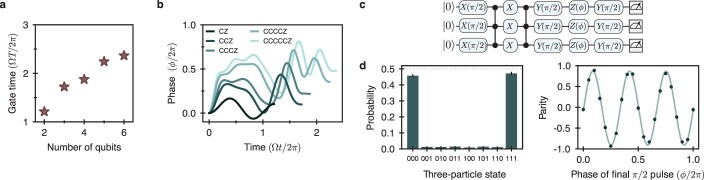
The ability to perform entangling quantum operations with low error rates in a scalable fashion is a central element of useful quantum information processing 1 . Neutral-atom arrays have recently emerged as a promising quantum computing platform, featuring coherent control over hundreds of qubits 2,3 and any-to-any gate connectivity in a flexible, dynamically reconfigurable architecture 4 . The main outstanding challenge has been to reduce errors in entangling operations mediated through Rydberg interactions 5 . Here we report the realization of two-qubit entangling gates with 99.5% fidelity on up to 60 atoms in parallel, surpassing the surface-code threshold for error correction 6,7 . Our method uses fast, single-pulse gates based on optimal control 8 , atomic dark states to reduce scattering 9 and improvements to Rydberg excitation and atom cooling. We benchmark fidelity using several methods based on repeated gate applications 10,11 , characterize the physical error sources and outline future improvements. Finally, we generalize our method to design entangling gates involving a higher number of qubits, which we demonstrate by realizing low-error three-qubit gates 12,13 . By enabling high-fidelity operation in a scalable, highly connected system, these advances lay the groundwork for large-scale implementation of quantum algorithms 14 , error-corrected circuits 7 and digital simulations 15 .
Overview
The claims and statistics of this paper haven’t been checked yet.
Free: it reads the open-access text and checks the first 5 claims that cite a source we can check. Create a free account to check every claim.
Integrity signals
Registry
Cites
Statistics
Figures
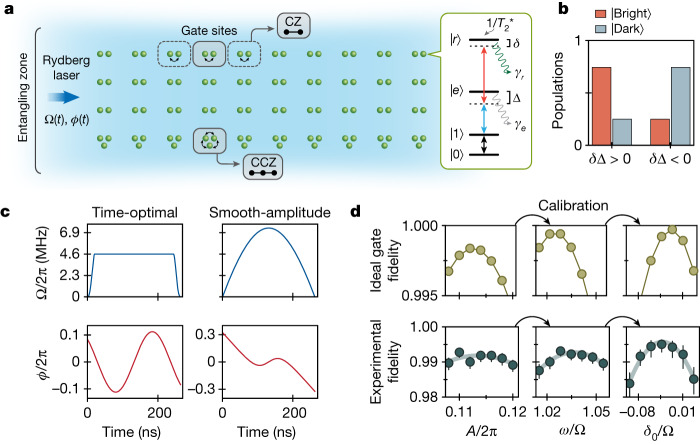
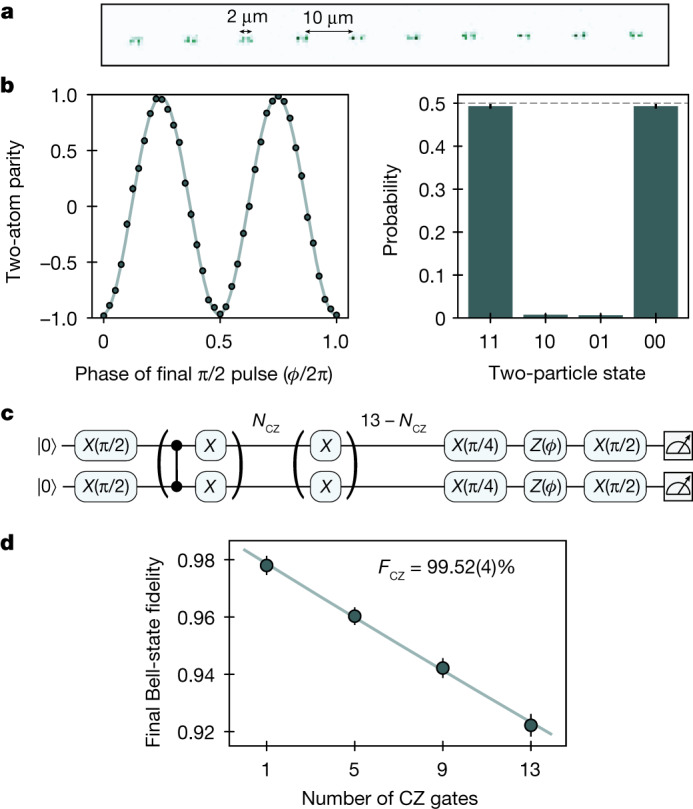
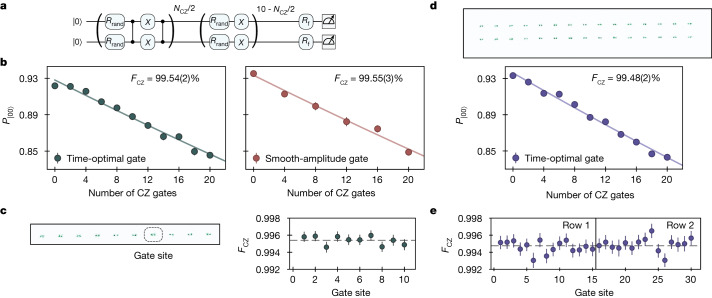
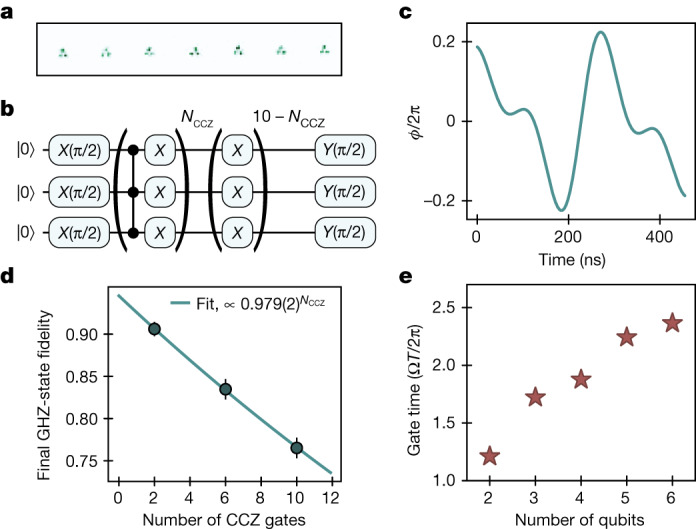
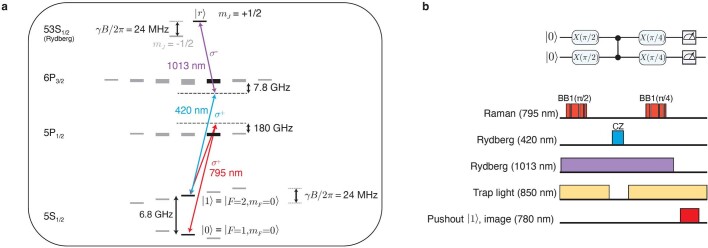
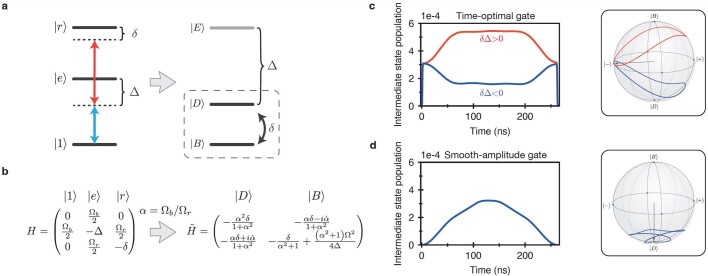
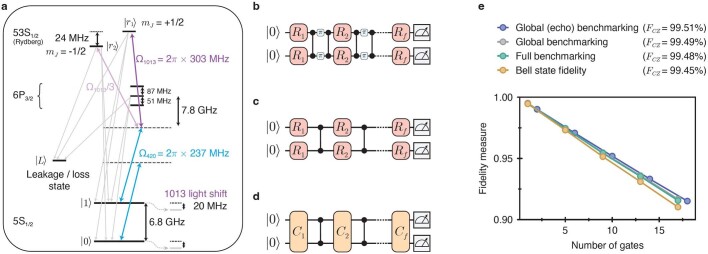
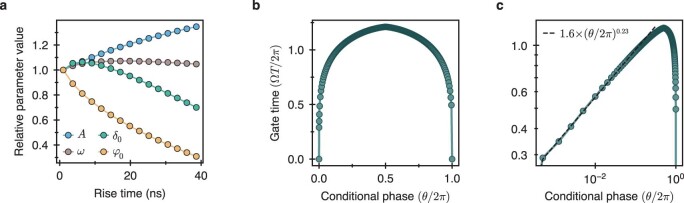
Verification
Claims the paper makes
The claims and statistics of this paper haven’t been checked yet.
Free: it reads the open-access text and checks the first 5 claims that cite a source we can check. Create a free account to check every claim.
Claims other papers make about this one
Each is checked against this paper’s own text: does it say what the citing paper says it does?
The source backs part of the claim, not all of it — or backs it for a different population, condition or comparison.
In the citing paper
“Using logical-level control and a zoned architecture in reconfigurable neutral-atom arrays7, our system combines high two-qubit gate fidelities8, arbitrary connectivity7,9, as well as fully programmable single-qubit rotations and mid-circuit readout10–15.”
From Logical quantum processor based on reconfigurable atom arrays (2024) · cites this paper as [8]
Experimental — accuracy not yet measuredThe source backs part of the claim, not all of it — or backs it for a different population, condition or comparison.
In the citing paper
“Averaged over the five computation logicals, we find that, by using the fault-tolerant initialization (postselecting on the ancilla logical flag not detecting errors) our |0L⟩ initialization fidelity is , exceeding both our physical qubit |0⟩ initialization fidelity (99.32(4)% (ref. 8)) and physical two-qubit gate fidelity (99.5% (ref. 8)).”
From Logical quantum processor based on reconfigurable atom arrays (2024) · cites this paper as [8]
Experimental — accuracy not yet measuredThe source backs part of the claim, not all of it — or backs it for a different population, condition or comparison.
In the citing paper
“Although ref. 8 seems to find some small cross-talk seemingly originating from decay into Rydberg P states, this should be considerably suppressed in the practical operation here owing to the approximately 200 μs duration between gates, during which time Rydberg atoms should either fly away or decay back to the ground state.”
From Logical quantum processor based on reconfigurable atom arrays (2024) · cites this paper as [8]
Experimental — accuracy not yet measuredThe source backs part of the claim, not all of it — or backs it for a different population, condition or comparison.
In the citing paper
“Even though the tail of the top-hat Rydberg excitation beams is only suppressed to about 10% intensity, the two-photon drive is far off-resonant owing to the approximately 20 MHz 1013 light shift detuning that is present for the entangling-zone atoms8.”
From Logical quantum processor based on reconfigurable atom arrays (2024) · cites this paper as [8]
Experimental — accuracy not yet measuredThe source backs part of the claim, not all of it — or backs it for a different population, condition or comparison.
In the citing paper
“We ensure that, in our dynamical decoupling, we have an odd number of π pulses between CZ gates (whenever possible), as this echoes out both systematic and spurious contributions to the single-qubit phase7,8.”
From Logical quantum processor based on reconfigurable atom arrays (2024) · cites this paper as [8]
Experimental — accuracy not yet measured
5 more claims about this paper
Create a free account to see every claim other papers make about this one.
Self-check
Percentages, sums and reported differences re-computed from the paper’s own numbers.
The self-check needs the paper’s full text.
Citations
Cites
Quantum Computing in the NISQ era and beyond
Preskill, J. (2018) · Quantum · doi:10.22331/q-2018-08-06-79 · Cited by 8,830
Fault-tolerant quantum computation by anyons
Kitaev, A. Y. (2003) · Annals of Physics · doi:10.1016/s0003-4916(02)00018-0 · Cited by 7,238 · cited 1×
“A thorough error budget is presented along with explanations of routes to further pushing gates to the regime of F>0.999 to make the system capable of reaching future fault tolerant performance.”
BackgroundInfluentialSurface codes: Towards practical large-scale quantum computation
Fowler, A. G., Mariantoni, M., Martinis, J. M., & Cleland, A. N. (2012) · Physical Review A · doi:10.1103/physreva.86.032324 · Cited by 3,059
Observation of electromagnetically induced transparency
Boller, K.-J., Imamoğlu, A., & Harris, S. E. (1991) · Physical Review Letters · doi:10.1103/physrevlett.66.2593 · Cited by 3,058 · cited 2×
“I was also particularly interested in their analysis of correlations between the sites, with this again being the first time sufficiently large ensembles have been used combined with repeated gate applications to really show how errors and correlations build in the system.”
BackgroundMethodSuperconducting quantum circuits at the surface code threshold for fault tolerance
Barends, R., Kelly, J., Megrant, A., Veitia, A., Sank, D., Jeffrey, E., White, T. C., Mutus, J., Fowler, A. G., Campbell, B., et al. (2014) · Nature · doi:10.1038/nature13171 · Cited by 1,733
Fast Quantum Gates for Neutral Atoms
Jaksch, D., Cirac, J. I., Zoller, P., Rolston, S. L., Côté, R., & Lukin, M. D. (2000) · Physical Review Letters · doi:10.1103/physrevlett.85.2208 · Cited by 1,540
Self-citationPredicting many properties of a quantum system from very few measurements
Huang, H.-Y., Kueng, R., & Preskill, J. (2020) · Nature Physics · doi:10.1038/s41567-020-0932-7 · Cited by 1,240
NMR techniques for quantum control and computation
Vandersypen, L. M. K., & Chuang, I. L. (2005) · Reviews of Modern Physics · doi:10.1103/revmodphys.76.1037 · Cited by 1,217
Suppressing quantum errors by scaling a surface code logical qubit
Google Quantum, A. I., Acharya, R., Aleiner, I., Allen, R., Andersen, T. I., Ansmann, M., Arute, F., Arya, K., Asfaw, A., Atalaya, J., et al. (2023) · Nature · doi:10.1038/s41586-022-05434-1 · Cited by 1,103 · cited 2×
“This protocol has the advantage of populating atomic dark states which do not contain population in the intermediate state used for the two-photon excitation to the Rydberg state, thereby reducing spontaneous emission.”
BackgroundQuantum phases of matter on a 256-atom programmable quantum simulator
Ebadi, S., Wang, T. T., Levine, H., Keesling, A., Semeghini, G., Omran, A., Bluvstein, D., Samajdar, R., Pichler, H., Ho, W. W., et al. (2021) · Nature · doi:10.1038/s41586-021-03582-4 · Cited by 995
Self-citation
Research works printed but not linked: 7
- Kalinowski M Maskara N Lukin MD Non-Abelian Floquet spin liquids in a digital Rydberg simulator Phys. Rev. X 2023 13 031008
- Shende VV Markov IL On the CNOT-cost of TOFFOLI gates Quantum Inf. Comput. 2009 9 461 486
- Ma S Universal gate operations on nuclear spin qubits in an optical tweezer array of 171Yb atoms Phys. Rev. X 2022 12 021028
- Brown MO Thiele T Kiehl C Hsu T-W Regal CA Gray-molasses optical-tweezer loading: controlling collisions for scaling atom-array assembly Phys. Rev. X 2019 9 011057
- Chang, T. H., Wang, T. N., Jen, H. H. & Chen, Y. C. High-fidelity Rydberg control-Z gates with time-optimal pulses. Preprint at https://arxiv.org/abs/2303.16395 (2023). · arXiv
- Khazali M Mølmer K Fast multiqubit gates by adiabatic evolution in interacting excited-state manifolds of Rydberg atoms and superconducting circuits Phys. Rev. X 2020 10 021054
- Singh K Anand S Pocklington A Kemp JT Bernien H Dual-element, two-dimensional atom array with continuous-mode operation Phys. Rev. X 2022 12 011040
Cited by
Items 101–200 of 973
Zhu, C., Wu, X., Yang, Z., Wang, J., Wu, A., Zheng, S., & Wang, X. (2025) · arXiv (Cornell University) · doi:10.48550/arxiv.2505.16891 · Cited by 42
CMOS compatibility of semiconductor spin qubits
Stuyck, N. D., Saraiva, A., Gilbert, W., Pardo, J. C., Li, R., Escott, C. C., Greve, K. D., Voinigescu, S. P., Reilly, D. J., & Dzurak, A. S. (2026) · Nature Reviews Electrical Engineering · doi:10.1038/s44287-026-00283-w · Cited by 42
“Qubit modalities under investigation include semiconductor spin qubits, superconducting qubits, photonic circuits, neutral atoms 19,31 and trapped ions, among others 32,33 .”
Key issues review: useful autonomous quantum machines
Guzmán, J. A. M., Erker, P., Gasparinetti, S., Huber, M., & Halpern, N. Y. (2024) · Reports on Progress in Physics · doi:10.1088/1361-6633/ad8803 · Cited by 39
“The steady-state COP is ˙ Q T / ˙ Q H [74].”
Coupler-Assisted Leakage Reduction for Scalable Quantum Error Correction with Superconducting Qubits
Yang, X., Chu, J., Guo, Z., Huang, W., Liang, Y., Liu, J., Qiu, J., Sun, X., Tao, Z., Zhang, J., et al. (2024) · Physical Review Letters · doi:10.1103/physrevlett.133.170601 · Cited by 40
High Optical Access Cryogenic System for Rydberg Atom Arrays with a 3000-Second Trap Lifetime
Zhang, Z., Hsu, T., Tan, T. Y., Slichter, D. H., Kaufman, A. M., Marinelli, M., & Regal, C. A. (2025) · PRX Quantum · doi:10.1103/prxquantum.6.020337 · Cited by 40
“Improving the lifetime to values limited only by spontaneous decay will add to strategies in place to address errors and loss arising from short Rydberg lifetimes, such as increasing Rydberg Rabi frequencies [19,23] and erasure conversion [39–42].”
Complete three-dimensional vector polarimetry with a Rydberg-atom rf electrometer
Elgee, P. K., Cox, K. C., Hill, J. C., Kunz, P. D., & Meyer, D. H. (2024) · Physical Review Applied · doi:10.1103/physrevapplied.22.064012 · Cited by 38
Hybrid Atom Tweezer Array of Nuclear Spin and Optical Clock Qubits
Nakamura, Y., Kusano, T., Yokoyama, R., Saito, K., Higashi, K., Ozawa, N., Takano, T., Takasu, Y., & Takahashi, Y. (2024) · Physical Review X · doi:10.1103/physrevx.14.041062 · Cited by 39
“After these improvements and incorporating the recent development of high-fidelity two-qubit gates [13–17], we believe that the dual-Yb system is a good candidate for implementing mid-circuit measurements and facilitating quantum error correction.”
Fault-Tolerant Compiling of Classically Hard Instantaneous Quantum Polynomial Circuits on Hypercubes
Hangleiter, D., Kalinowski, M., Bluvstein, D., Cain, M., Maskara, N., Gao, X., Kubica, A., Lukin, M. D., & Gullans, M. J. (2025) · PRX Quantum · doi:10.1103/prxquantum.6.020338 · Cited by 39
“In order to maximize hardware efficiency, we focus on the capabilities of the recently realized logical quantum processor [27] that is based on reconfigurable arrays of neutral atoms in optical tweezers [28–30].”
InfluentialSelf-citationQuantum Codes with Addressable and Transversal Non-Clifford GatesPreprint
He, Z., Vaikuntanathan, V., Wills, A., & Zhang, R. (2025) · arXiv (Cornell University) · doi:10.48550/arxiv.2502.01864 · Cited by 38
Comparative study of quantum error correction strategies for the heavy-hexagonal lattice
Benito, C., López, E., Peropadre, B., & Bermúdez, A. (2025) · Quantum · doi:10.22331/q-2025-02-06-1623 · Cited by 37
Quantum Adiabatic Optimization with Rydberg Arrays: Localization Phenomena and Encoding Strategies
Bombieri, L., Zeng, Z., Tricarico, R., Lin, R., Notarnicola, S., Cain, M., Lukin, M. D., & Pichler, H. (2025) · PRX Quantum · doi:10.1103/prxquantum.6.020306 · Cited by 39
Self-citationCircuit Decompositions and Scheduling for Neutral Atom Devices with Limited Local Addressability
Nottingham, N., Perlin, M. A., Shah, D., White, R., Bernien, H., Chong, F. T., & Baker, J. M. (2024) · IEEE International Conference on Quantum Computing and Engineering (QCE) · doi:10.1109/qce60285.2024.00105 · Cited by 37
“Error rates are chosen to reflect values from recent experimental work [14], [23], [25].”
InfluentialEnabling photonic integrated 3D magneto-optical traps for quantum sciences and applications
Blumenthal, D. J., Isichenko, A., & Chauhan, N. (2024) · Optica Quantum · doi:10.1364/opticaq.532260 · Cited by 37
Optimized measurement-free and fault-tolerant quantum error correction for neutral atoms
Veroni, S., Müller, M., & Giudice, G. (2024) · Physical Review Research · doi:10.1103/physrevresearch.6.043253 · Cited by 36
High-Fidelity Electron Spin Gates for Scaling Diamond Quantum Registers
Joas, T., Ferlemann, F., Sailer, R., Vetter, P. J., Zhang, J., Said, R. S., Teraji, T., Onoda, S., Calarco, T., Genov, G. T., et al. (2025) · Physical Review X · doi:10.1103/physrevx.15.021069 · Cited by 37
Transversal Architecture for Megaquop-Scale Quantum Simulation with Neutral Atoms
Ismail, R., Chen, I.-C., Zhao, C., Weiss, R., Liu, F., Zhou, H., Wang, S.-T., Sornborger, A. T., & Kornjača, M. (2026) · PRX Quantum · doi:10.1103/j2fw-ccmy · Cited by 35
“The reconfigurable long-range connectivity [3, 8, 40, 43], together with correlated decoding [44], allows for fast implementations of fold-transversal logical Clifford gates [26, 45].”
InfluentialSelf-citationDynamic Cooling on Contemporary Quantum Computers
Oftelie, L. B., Pasquale, A. D., & Campisi, M. (2024) · PRX Quantum · doi:10.1103/prxquantum.5.030309 · Cited by 34
“…of Figure 5 shows an enlargement of the low-𝑇 behaviour of ¯ 𝑤 and marks state-of-the-art values for qubits on various contemporary quantum computers [33], including superconducting qubits (black circle) [34], neutral atom qubits (white triangle) [35], and trapped ion qubits (black crosss) [36].”
BackgroundPhoton Number-Resolving Quantum Reservoir Computing
Nerenberg, S., Neill, O. D., Marcucci, G., & Faccio, D. (2024) · Optica Quantum · doi:10.1364/opticaq.553294 · Cited by 27
Lall, D., Agarwal, A., Zhang, W., Lindoy, L. P., Lindström, T., Webster, S., Hall, S., Chancellor, N., Wallden, P., García−Patrón, R., et al. (2025) · doi:10.59161/azye8097 · Cited by 33
A cavity-array microscope for parallel single-atom interfacing
Shaw, A. L., Soper, A., Shadmany, D., Kumar, A., Palm, L., Koh, D.-Y., Kaxiras, V., Taneja, L., Jaffe, M., Schuster, D., et al. (2026) · Nature · doi:10.1038/s41586-025-10035-9 · Cited by 34
Fault-Tolerant One-Bit Addition with the Smallest Interesting Colour Code
Wang, Y., Simsek, S., Gatterman, T. M., Gerber, J. A., Gilmore, K., Gresh, D., Hewitt, N., Horst, C. V., Matheny, M., Mengle, T., et al. (2023) · arXiv · doi:10.48550/arxiv.2309.09893 · Cited by 32
“To reconstruct S X = X ⊗ 8 , we use a flag-based circuit to non-destructively measure X ⊗ 4 on the opposite face and take the parity of the five measurement outputs to reconstruct the stabilizer eigenvalue.”
Shi, W., Sun, X.-Z., Zhang, Z.-L., Chen, J.-Y., Du, Y.-H., Ruan, J.-Q., Ding, Y.-B., Wang, L., Huangfu, Y.-G., & Xu, Z. (2025) · IEEE Transactions on Transportation Electrification · doi:10.1109/tte.2025.3542021 · Cited by 26
“However, as the number of quantum gates increases, the fidelity of quantum operations decreases, resulting in a higher error rate in the real quantum computer [37].”
Long-range-enhanced surface codes
Hong, Y., Marinelli, M., Kaufman, A. M., & Lucas, A. (2024) · Physical Review A · doi:10.1103/physreva.110.022607 · Cited by 33
“…of physical qubits, an LRESC can reach the break-even point – where the collective logical qubit is more stable than a single isolated qubit – once one-and two-qubit operations are achieved with just above 99.9% fidelity, which in many platforms is near-term [13, 14] or within reach [43– 45].”
BackgroundInfluentialFast Entangling Gates for Rydberg Atoms via Resonant Dipole-Dipole Interaction
Giudici, G., Veroni, S., Giudice, G., Pichler, H., & Zeiher, J. (2025) · PRX Quantum · doi:10.1103/5d8p-3hm1 · Cited by 31
Stade, Y., Schmid, L., Burgholzer, L., & Wille, R. (2024) · IEEE International Conference on Quantum Computing and Engineering (QCE) · doi:10.1109/qce60285.2024.00098 · Cited by 33
“Thus, a transversal operation on a logical qubit can be applied to all corresponding atoms in parallel.”
Individual solid-state nuclear spin qubits with coherence exceeding seconds
O'Sullivan, J., Travesedo, J., Pallegoix, L., Huang, Z.-Y. W., Hogan, P., May, A., Yavkin, B., Lin, S., Liu, R.-B., Chanelière, T., et al. (2024) · Nature Physics · doi:10.1038/s41567-025-03049-7 · Cited by 22
“Instead, we use stimulated Raman transitions, which have been demonstrated in a variety of systems such as quantum dots 32 , trapped ions 33 , neutral atoms 34 and Sn vacancies in diamond 35 .”
Simulating fully gauge-fixed SU(2) Hamiltonian dynamics on digital quantum computers
Froland, H., Grabowska, D. M., & Li, Z. (2026) · Physical review. D/Physical review. D. · doi:10.48550/arxiv.2512.22782 · Cited by 31
Atomic Quantum Technologies for Quantum Matter and Fundamental Physics Applications
Malo, J. Y., Lepori, L., Gentini, L., & Chiofalo, M. L. (2024) · Technologies · doi:10.3390/technologies12050064 · Cited by 32
Schmid, L., Park, S., Kang, S., & Wille, R. (2023) · Design Automation Conference · doi:10.1145/3649329.3655959 · Cited by 32
“…have emerged as a compelling choice for universal quantum computing [8, 9, 18, 19], showcasing a broad spectrum of computational capabilities that encompass high-fidelity, long-range interactions between qubits with native multi-qubit gate support [7, 8, 10], and remarkable scalability [3, 16].”
BackgroundMethodEfficient and Universal Neural-Network Decoder for Stabilizer-Based Quantum Error CorrectionPreprint
Hu, G., Ouyang, W., Lu, C., Chen, L., & Zhong, H.-S. (2025) · arXiv (Cornell University) · doi:10.48550/arxiv.2502.19971 · Cited by 31
Song, P.-Y., Wei, J.-F., Xu, P., Yan, L.-L., Feng, M., Su, S.-L., & Chen, G. (2024) · Physical Review A · doi:10.1103/physreva.109.022613 · Cited by 19
Li, Z., Fu, H., Isogawa, T., Silva, C., & Chuang, I. L. (2026) · PRX Quantum · doi:10.1103/xk9x-3741 · Cited by 30
Efficient fault-tolerant implementations of non-Clifford gates with reconfigurable atom arrays
Wang, Y., Wang, Y., Chen, Y.-A., Zhang, W., Zhang, T., Hu, J., Chen, W., Gu, Y., & Liu, Z.-W. (2024) · npj Quantum Information · doi:10.1038/s41534-024-00945-3 · Cited by 30
Probing Hilbert space fragmentation with strongly interacting Rydberg atoms
Yang, F., Yarloo, H., Zhang, H.-C., Mølmer, K., & Nielsen, A. E. B. (2024) · Physical review B · doi:10.1103/physrevb.111.144313 · Cited by 29
“The rapid progresses in Rydberg tweezer array setups, including the individual addressability and the improved atomic coherence [67], have enabled quantum simulation of many-body dynamics with single-site resolution at an intermediately long time scale.”
Entangling Four Logical Qubits beyond Break-Even in a Nonlocal Code
Hong, Y., Durso-Sabina, E., Hayes, D., & Lucas, A. (2024) · Physical Review Letters · doi:10.1103/physrevlett.133.180601 · Cited by 29
“The long-range-enhanced surface code [26] underlying our methods will be scalable to larger trapped-ion QCCD processors [30– 33] as well as to neutral atom arrays [8, 34–37] for the foreseeable future.”
MethodScheme to Detect the Strong-to-Weak Symmetry Breaking via Randomized Measurements
Sun, N. G., Zhang, P., & Feng, L. (2025) · Physical Review Letters · doi:10.1103/7p5x-7yqb · Cited by 29
“This model is highly relevant to many state-of-the-art quantum devices, including Rydberg atom arrays [60–70] and trapped ion systems [71–75].”
Realization of a Fast Triple-Magic All-Optical Qutrit in ^{88}Sr.
Ammenwerth, M., Timme, H., Gyger, F., Tao, R., Bloch, I., & Zeiher, J. (2024) · Physical Review Letters · doi:10.1103/4kdl-xcwz · Cited by 17
Counterdiabatic Driving with Performance Guarantees
Finžgar, J. R., Notarnicola, S., Cain, M., Lukin, M. D., & Sels, D. (2025) · Physical Review Letters · doi:10.1103/pqhl-nbtk · Cited by 29
Self-citationDigital–analog quantum learning on Rydberg atom arrays
Lu, J. Z., Jiao, L., Wolinski, K., Kornjača, M., Hu, H.-Y., Cantu, S., Liu, F., Yelin, S. F., & Wang, S.-T. (2024) · Quantum Science and Technology · doi:10.1088/2058-9565/ad9177 · Cited by 29
Measurement-free, scalable, and fault-tolerant universal quantum computing
Butt, F., Locher, D. F., Brechtelsbauer, K., Büchler, H. P., & Müller, M. (2025) · Science Advances · doi:10.1126/sciadv.adv2590 · Cited by 28
“The implementation of natively supported multi-qubit gates [27] could further mitigate hardware limita-7 tions.”
InfluentialHigh-fidelity collisional quantum gates with fermionic atoms
Bojović, P., Hilker, T., Wang, S., Obermeyer, J., Barendregt, M., Tell, D., Chalopin, T., Preiss, P. M., Bloch, I., & Franz, T. (2026) · Nature · doi:10.1038/s41586-026-10356-3 · Cited by 29
“Current state-of-the-art neutral atom platforms report two-qubit gate fidelities in the range of 99.4%– 99.8% [7, 9, 21, 24, 27], often using fidelity metrics comparable to those employed in this work.”
InfluentialError-Corrected Fermionic Quantum Processors with Neutral Atoms
Ott, R., González-Cuadra, D., Zache, T. V., Zoller, P., Kaufman, A. M., & Pichler, H. (2025) · Physical Review Letters · doi:10.1103/zkpl-hh28 · Cited by 27
Universal Dynamics with Globally Controlled Analog Quantum SimulatorsPreprint
Hu, H.-Y., Gomez, A. M., Chen, L., Trowbridge, A., Goldschmidt, A. J., Manchester, Z. R., Chong, F. T., Jaffe, A., & Yelin, S. F. (2025) · arXiv (Cornell University) · doi:10.48550/arxiv.2508.19075 · Cited by 27
Efficient quantum circuit compilation for near-term quantum advantage
Guo, Y., & Yang, S. (2025) · EPJ Quantum Technology · doi:10.1140/epjqt/s40507-025-00368-9 · Cited by 27
“…gates employed in a variety of quantum processors, including the CZ gate used in IBM’s Heron and Google’s Willow processors [38], as well as in neutral-atom quantum computers [55]; the ECR gate utilized in IBM’s Eagle processor [42]; and the Mølmer–Sørensen (MS) gate in ion-trap systems [56].”
Mixed State Deep Thermalization.
Yu, X.-H., Ho, W.-W., & Kos, P. (2025) · Physical Review Letters · doi:10.1103/t6zs-3f8k · Cited by 18
Technologies for modulation of visible light and their applications
Park, S., Notaros, M., Mohanty, A., Kim, D., Notaroš, J., & Mouradian, S. (2024) · Progress in Quantum Electronics · doi:10.1016/j.pquantelec.2024.100534 · Cited by 26
PARALLAX: A Compiler for Neutral Atom Quantum Computers under Hardware Constraints
Ludmir, J., & Patel, T. (2024) · International Conference for High Performance Computing, Networking, Storage and Analysis (SC) · doi:10.1109/sc41406.2024.00079 · Cited by 26
“In contrast, CZ gates exhibit a significantly higher operational error rate, around 0.5% [12].”
InfluentialInteracting Circular Rydberg Atoms Trapped in Optical Tweezers
Méhaignerie, P., Machu, Y., Hernández, A. D., Creutzer, G., Papoular, D., Raimond, J., Sayrin, C., & Brune, M. (2024) · PRX Quantum · doi:10.1103/prxquantum.6.010353 · Cited by 16
“Analog and digital Rydberg-based quantum computation strongly benefits from a dynamic control over the strength of the interaction [45–48], that we demonstrate here by tuning the orientation and strength of the electric field.”
High-Speed Quantum Radio-Frequency-Over-Light Communication.
Liang, S.-C., Cheng, J.-L., Qin, J.-L., Li, J., Shi, Y., Yan, Z.-H., Jia, X.-J., Xie, C., & Peng, K. (2024) · Physical Review Letters · doi:10.1103/physrevlett.132.140802 · Cited by 12
“Quantum physics not only promotes the emergence of a variety of novel and rapidly advancing technologies but also has the capability of combining with classic technologies, leading to the realization of extraordinary functionalities [1–5].”
BackgroundUniversal scaling laws for correlated decay of many-body quantum systems
Mok, W.-K., Poddar, A., Sierra, E., Rusconi, C. C., Preskill, J., & Asenjo-Garcia, A. (2024) · Nature Physics · doi:10.1038/s41567-026-03448-4 · Cited by 24
“59 would reach a gate error of ε ≈ 0.3%, with collective decay contributing one-third (0.1”
InfluentialProbing Curved Spacetime with a Distributed Atomic Processor Clock
Covey, J. P., Pikovski, I., & Borregaard, J. (2025) · PRX Quantum · doi:10.1103/q188-b1cr · Cited by 26
“…atom-atom coherence of optical clock qubits [47, 48] as well as the demonstrated Rydberg-mediated gate fi-delities of ∼ 0.995 across several different qubit encodings [44–46, 77, 78], we anticipate that it may be feasible to realize ∼ 100-atom GHZ states in each node with fidelity above ∼ 0.5.”
InfluentialStrong-to-weak symmetry breaking and entanglement transitions
Chen, L., Sun, N. G., & Zhang, P. (2025) · Physical review. B./Physical review. B · doi:10.1103/physrevb.111.l060304 · Cited by 25
Auxiliary-Free Replica Shadows: Efficient Estimation of Multiple Nonlinear Quantum Properties
Liu, Q. Y., Li, Z., Yuan, X., Zhu, H., & Zhou, Y. (2026) · Physical Review Letters · doi:10.1103/5khs-7dyz · Cited by 25
“Second, one needs long-range CNOTs which are realizable in systems like ion-trap [88] and optical-tweezer platforms [89], but would be challenging for the ones with the nearest-neighbour architecture, like superconducting-qubit system [24, 90].”
Farouk, A., Beterov, I., Xu, P., Bergamini, S., & Ryabtsev, I. (2022) · Photonics · doi:10.3390/photonics10111280 · Cited by 19
“A substantial improvement of two-qubit gate fidelity in quantum registers based on single trapped atoms has been recently demonstrated [6–9].”
BackgroundQuantum dimer models with Rydberg gadgets
Zeng, Z., Giudici, G., & Pichler, H. (2025) · Physical Review Research · doi:10.1103/physrevresearch.7.l012006 · Cited by 24
Digital-analog quantum convolutional neural networks for image classification
Simen, A., Flores-Garrigós, C., Hegade, N. N., Montalban, I., Vives‐Gilabert, Y., Michon, E., Zhang, Q., Solano, E., & Martín‐Guerrero, J. D. (2024) · Physical Review Research · doi:10.1103/physrevresearch.6.l042060 · Cited by 24
“These devices have been used for studying combinatorial optimization problems [23, 24], quantum simulations [25], learning tasks [16], among others [21].”
Variational Simulation of the Lipkin-Meshkov-Glick Model on a Neutral Atom Quantum Computer
Chinnarasu, R., Poole, C., Phuttitarn, L., Noori, A., Graham, T., Coppersmith, S. N., Balantekin, A. B., & Saffman, M. E. (2025) · PRX Quantum · doi:10.1103/prxquantum.6.020350 · Cited by 23
“1(1)% using symmetric interleaved randomized benchmarking [24] as described in Appendix G. Subsequent to completion of the VQE experiments, the gate parameters were further optimized to reach F CZ = 98 .”
InfluentialLogical multi-qubit entanglement with dual-rail superconducting qubits
Huang, W., Sun, X., Zhang, J., Guo, Z., Huang, P., Liang, Y., Liu, Y., Sun, D., Wang, Z., Xiong, Y., et al. (2026) · Nature Physics · doi:10.1038/s41567-026-03211-9 · Cited by 24
Universal Global Gates for a Fine-Structure Qubit in Strontium-88.
Tao, R., Lib, O., Gyger, F., Timme, H., Ammenwerth, M., Bloch, I., & Zeiher, J. (2025) · Physical Review Letters · doi:10.1103/gj3b-5ngl · Cited by 20
“[11] for its insensitivity to single-qubit phase.”
High-fidelity Rydberg controlled-Z gates with optimized pulses
Chang, T. H., Wang, T.-I., Jen, H. H., & Chen, Y.-C. (2023) · New Journal of Physics · doi:10.1088/1367-2630/ad0fa9 · Cited by 23
Self-citationTailoring dynamical codes for biased noise: the X3Z3 Floquet code
Setiawan, F., & McLauchlan, C. (2025) · npj Quantum Information · doi:10.1038/s41534-025-01074-1 · Cited by 23
“…advantage of the temporal dimension, Floquet codes 6 – 20 , or more generally dynamical codes 21 – 23 , form a large class of quantum error-correcting codes, which can achieve competitive fault-tolerant performance 6,8 – 17 while reducing the weights of check measurements performed for the error…”
Transversal surface-code game with reconfigurable qubitsPreprint
Sunami, S., Goban, A., & Yamasaki, H. (2025) · arXiv (Cornell University) · doi:10.48550/arxiv.2506.18979 · Cited by 23
“The fidelity is currently above 99.5 % [43–47] and is expected to reach 99.9 % with better excitation protocols and improved laser systems [43, 44, 46, 48].”
InfluentialQuantum Cellular Automata on a Dual-Species Rydberg ProcessorPreprint
White, R., Ramesh, V., Impertro, A., Anand, S., Cesa, F., Giudici, G., Iadecola, T., Pichler, H., & Bernien, H. (2026) · arXiv (Cornell University) · doi:10.48550/arxiv.2601.16257 · Cited by 23
“This uniform intensity would also help with the coherence of our Ry-dberg states, as would improved intensity stability and optimal pulse control [43].”
Engineering quantum criticality and dynamics on an analog-digital simulatorPreprint
Geim, A., Koyluoglu, N. U., Evered, S. J., Sahay, R., Li, S. H., Xu, M.-Q., Bluvstein, D., Gjonbalaj, N. O., Maskara, N., Kalinowski, M., et al. (2026) · arXiv (Cornell University) · doi:10.48550/arxiv.2602.18555 · Cited by 22
“These parameters are also compatible with high-fidelity two-qubit gates [68].”
Self-citationPowerMove: Optimizing Compilation for Neutral Atom Quantum Computers with Zoned Architecture
Ruan, J., Fang, X., Zhang, H., Li, A., Humble, T. S., & Ding, Y. (2025) · International Conference on Architectural Support for Programming Languages and Operating Systems (ASPLOS) · doi:10.1145/3676642.3736128 · Cited by 23
Quantum Mpemba effect in long-ranged U(1)-symmetric random circuits
Li, H.-Z., Lee, C. H., Liu, S., Zhang, S., & Zhong, J. (2026) · Physical review. B./Physical review. B · doi:10.1103/l4xx-plmv · Cited by 22
High-tolerance antiblockade SWAP gates using optimal pulse drivings
Li, W.-X., Wu, J.-L., Su, S.-L., & Qian, J. (2024) · Physical Review A · doi:10.1103/physreva.109.012608 · Cited by 1
Interspecies Förster resonances for Rb-Cs Rydberg d -states for enhanced multi-qubit gate fidelities
Ireland, P. M., Walker, D. M., & Pritchard, J. D. (2024) · Physical Review Research · doi:10.1103/physrevresearch.6.013293 · Cited by 22
Quantum Communication Networks Enhanced by Distributed Quantum Memories
Meng, X., Piparo, N. L., Nemoto, K., & Kovács, I. A. (2025) · Quantum · doi:10.22331/q-2025-12-15-1948 · Cited by 22
Dissipative stabilization of high-dimensional GHZ states for neutral atoms
Zhao, Y., Yang, Y.-Q., Li, W., & Shao, X. (2024) · Applied Physics Letters · doi:10.1063/5.0192602 · Cited by 21
“52 53–70 By incorporating the inherent advantages of neutral atoms into the modified uncon-ventional Rydberg pumping, as outlined in the supplementary material, we can effectively stabilize the system within a high-dimensional GHZ state throughout multiple pump and dissipation cycles.”
MethodCoulomb Interaction-Driven Entanglement of Electrons on Helium
Beysengulov, N. R., Schøyen, Ø. S., Bilek, S. D., Flaten, J. B., Leinonen, O., Hjorth-Jensen, M., Pollanen, J., Kristiansen, H. E., Stewart, Z. J., Weidman, J. D., et al. (2024) · PRX Quantum · doi:10.1103/prxquantum.5.030324 · Cited by 21
Quantum Cellular Automata for Quantum Error Correction and Density Classification
Guedes, T. L. M., Winter, D., & Müller, M. (2024) · Physical Review Letters · doi:10.1103/physrevlett.133.150601 · Cited by 21
“—Dynamically reconfigurable 2D arrays of neutral atoms allow for the parallelization of 2-and 3-qubit high-fidelity entangling gates [67–71].”
Predicting arbitrary state properties from single Hamiltonian quench dynamics
Liu, Z.-H., Hao, Z.-H., & Hu, H.-Y. (2023) · Physical Review Research · doi:10.1103/physrevresearch.6.043118 · Cited by 19
Taming Rydberg Decay with Measurement-Based Quantum Computation
Yu, C., Chen, Z., Deng, Y., Lu, C., Chen, M., & Pan, J.-W. (2026) · Physical Review Letters · doi:10.1103/msbj-fxw7 · Cited by 21
Quantum simulation of dynamical gauge theories in periodically driven Rydberg atom arraysPreprint
Feldmeier, J., Maskara, N., Köylüoğlu, N. U., & Lukin, M. D. (2024) · arXiv (Cornell University) · doi:10.48550/arxiv.2408.02733 · Cited by 21
Self-citationQuantum computation via Floquet tailored Rydberg interactions
Wu, J., Wu, J.-L., Guo, F., Liu, B.-W., Su, S.-L., Song, X.-K., Ye, L., & Wang, D. (2025) · npj Quantum Information · doi:10.1038/s41534-025-01068-z · Cited by 16
“The excitation process from the ground state ∣ 1 i to the Rydberg state ∣ r i can be achieved via a two-photon mechanism in 87 Rb atoms 6,7,88 .”
Qubit Syndrome Measurements with a High-Fidelity Rb-Cs Rydberg Gate
Miles, J. A., Lichtman, M., Scott, A. M., Scott, J., Norrell, S. A., Bedalov, M. J., Belknap, D. A., Cole, D. C., Eubanks, S. Y., Gillette, M., et al. (2026) · Physical Review Letters · doi:10.1103/pvjm-jxd2 · Cited by 21
“Introduction – Neutral atom arrays have scaled to more qubits than any other modality [1], and have demonstrated single-species entangling operations with fidelities well above 99% with four different atomic elements [2– 6].”
Realization of a Cavity-Coupled Rydberg Array
Santis, J. D., Dura-Kovács, B., Öncü, M., Bouscal, A., Vasileiadis, D., & Zeiher, J. (2026) · Physical Review X · doi:10.1103/jgdt-d61y · Cited by 20
“…on neutral-atom arrays has become a central focus in the field, with break-throughs in the realization of high-fidelity gates in different species and qubit implementations [24–28], excellent scalability of the array sizes [29–33] and first demonstrations of logical qubits and circuits [34–38].”
Surface code stabilizer measurements for Rydberg atoms
Jandura, S., Pecorari, L., & Pupillo, G. (2026) · Physical Review Research · doi:10.1103/2jk3-wdfz · Cited by 20
“Similar to the TO pulse [29], this pulse requires a continuous variation of the laser phase with time only, while the amplitude is kept fixed at Ω max , which is expected to be experimentally advantageous [13].”
Heisenberg-limited Bayesian phase estimation with low-depth digital quantum circuits
Direkci, S., Finkelstein, R., Endres, M., & Gefen, T. (2026) · npj Quantum Information · doi:10.1038/s41534-025-01177-9 · Cited by 20
Bravo-Montes, J. A., Bastante, M., Botella, G., Barrio, A. A. D., & García-Herrero, F. (2024) · EPJ Quantum Technology · doi:10.1140/epjqt/s40507-024-00284-4 · Cited by 21
Observation of quantum information collapse-and-revival in a strongly-interacting Rydberg atom array
Xiang, D.-S., Zhang, Y.-W., Liu, H.-X., Zhou, P., Yuan, D., Zhang, K., Zhang, S.-Y., Xu, B., Liu, L., Li, Y., et al. (2026) · Nature Communications · doi:10.1038/s41467-026-73520-3 · Cited by 20
Quantum Ruzsa Divergence to Quantify Magic
Bu, K., Gu, W., & Jaffe, A. (2025) · IEEE Transactions on Information Theory · doi:10.1109/tit.2025.3543276 · Cited by 20
“It can be implemented with a constant-depth quantum circuit with 2-qudit gates, which may be realizable in the neutral-atom platform [32].”
An Architecture for Improved Surface Code Connectivity in Neutral AtomsPreprint
Viszlai, J., Lin, S. F., Dangwal, S., Baker, J. M., & Chong, F. T. (2023) · arXiv (Cornell University) · doi:10.48550/arxiv.2309.13507 · Cited by 20
Strategic Plan for Neutral Atom Quantum ComputationPreprint
Menssen, A. J., Wang, T. T., Gullans, M. J., Manovitz, T., Taylor, J. M., Cong, J., Sinclair, J., Aqua, Z., Blumenthal, D. J., Ataides, J. P. B., et al. (2026) · arXiv (Cornell University) · doi:10.48550/arxiv.2607.21554 · Cited by 22
Self-citationRole of Matter Interactions in Superradiant Phenomena.
Mendonça, J. P., Jachymski, K., & Wang, Y. (2025) · Physical Review Letters · doi:10.1103/z8gv-7yyk · Cited by 16
A fiber array architecture for atom quantum computing
Li, X., Hou, J., Wang, J.-C., Wang, G., He, X., Zhou, F., Wang, Y., Liu, M., Wang, J., Xu, P., et al. (2025) · Nature Communications · doi:10.1038/s41467-025-64738-8 · Cited by 20
Routing-Aware Placement for Zoned Neutral Atom-based Quantum Computing
Stade, Y., Lin, W.-H., Cong, J., & Wille, R. (2025) · 2025 IEEE/ACM International Conference On Computer Aided Design (ICCAD) · doi:10.1109/iccad66269.2025.11240721 · Cited by 20
“However, isolated atoms still experience an imperfect identity operation as they are still excited to the Rydberg state, leading to Rydberg decay—a significant source of errors [21].”
InfluentialZhang, Y.-Q., Yang, Y., Martin, W. R., Lin, K., Wang, Z., Lu, C.-C., Jiang, W.-W., Nussinov, R., Loscalzo, J., Guan, Q., et al. (2025) · Advancement of science · doi:10.1002/advs.202513641 · Cited by 15
Matching Generalized-Bicycle Codes to Neutral Atoms for Low-Overhead Fault-Tolerance
Viszlai, J., Yang, W., Lin, S. F., Liu, J., Nottingham, N., Baker, J. M., & Chong, F. T. (2025) · IEEE International Conference on Quantum Computing and Engineering (QCE) · doi:10.1109/qce65121.2025.00080 · Cited by 21
“The decoherence time is modeled as the two-qubit gate time, which we estimate as 262 ns based on recent experiments [18].”
InfluentialNon-Clifford Gates between Stabilizer Codes via Non-Abelian Topological Order
Sajith, R., Song, Z., Roberts, B., Menon, V., & Li, Y. (2026) · PRX Quantum · doi:10.1103/qttm-y8t1 · Cited by 19
Theory of quantum error mitigation for non-Clifford gates
Layden, D., Mitchell, B., & Siva, K. (2026) · Quantum · doi:10.22331/q-2026-02-10-2003 · Cited by 20
High-Power Clock Laser Spectrally Tailored for High-Fidelity Quantum State Engineering
Yan, L., Lannig, S., Milner, W. R., Frankel, M. N., Lewis, B., Lee, D., Kim, K., & Ye, J. (2025) · Physical Review X · doi:10.1103/qw53-8b8r · Cited by 19
“Neutral-atom-based qubit arrays, which are more easily scalable, are approaching competitive fidelities [8 – 17].”
Resilience of the surface code to error bursts
Tan, S. J. S., Pattison, C. A., McEwen, M., & Preskill, J. P. (2026) · Physical Review A · doi:10.1103/vwtl-hwfx · Cited by 22
“Here, we describe the control method of a particular neutral atom quantum computing experiment reported on in [34], but one can expect similar error mechanisms to be present in other experiments.”
InfluentialBuffer-atom-mediated quantum logic gates with off-resonant modulated driving
Sun, Y. (2024) · Science China Physics Mechanics and Astronomy · doi:10.1007/s11433-024-2478-8 · Cited by 18
Computation with quantum Reed-Muller codes and their mapping onto 2D atom arraysPreprint
Gong, A., & Renes, J. M. (2024) · arXiv (Cornell University) · doi:10.48550/arxiv.2410.23263 · Cited by 18
“This platform is known for the ability to implement parallel CNOT gates [30], [43], perfect for the transversal CNOT gates needed in encoding and error detection and correction.”
BackgroundVelocity-Enabled Quantum Computing with Neutral AtomsPreprint
Lib, O., Timme, H., Ammenwerth, M., Gyger, F., Tao, R., Sun, S., Bloch, I., & Zeiher, J. (2026) · arXiv (Cornell University) · doi:10.48550/arxiv.2603.15561 · Cited by 18
“In the main text, we discussed the generation of the | 01 ⟩ L state in a [[4 , 2 , 2]] error-detection code using a flying ancilla.”
InfluentialMinimal-Clifford shadow estimation by mutually unbiased bases
Zhang, Q., Liu, Q., & Zhou, Y. (2024) · Physical Review Applied · doi:10.1103/physrevapplied.21.064001 · Cited by 17
Why consider quantum instead classical pattern recognition techniques?
Barreto, A. G., Fanchini, F. F., Papa, J. P., & de Albuquerque, V. H. C. (2024) · Applied Soft Computing · doi:10.1016/j.asoc.2024.112096 · Cited by 18
DasAtom: A Divide-and-Shuttle Atom Approach to Quantum Circuit Transformation
Huang, Y., Gao, D., Ying, S., & Li, S. (2025) · IEEE Transactions on Computer-Aided Design of Integrated Circuits and Systems · doi:10.1109/tcad.2025.3532818 · Cited by 18
“Various architectures have been proposed for NAQC [5], [6], [39], [40], each with distinct features.”
Self-citation
Metadata
- Authors
- Evered, S. J., Bluvstein, D., Kalinowski, M., Ebadi, S., Manovitz, T., Zhou, H., Li, S. H., Geim, A. A., Wang, T. T., Maskara, N., Levine, H., Semeghini, G., Greiner, M., Vuletić, V., & Lukin, M. D.
- Affiliations
- Harvard University (US)
- Massachusetts Institute of Technology (US)
- Corresponding author
- Lukin, Mikhail D.
- ORCID
- Venue
- Nature
- Published
- 2023-10-11
- Volume
- 622
- Issue
- 7982
- Pages
- 268-272
- ISSN
- 0028-0836 (ISSN-L)
- 1476-4687
- PMC
- PMC10567572
- OpenAlex
- W4387542025
- Semantic Scholar
- 531874012fede3c01f44f2d81bfb926c0a25c9aa
- Cited by
- 522
- References
- 97
- Citations by year
- 2026: 134 · 2025: 229 · 2024: 138 · 2023: 21
- FWCI
- 60.51
- Type
- journal article
- Language
- en
- Open access
- hybrid
- doi.org
- Licence
- cc-by
- creativecommons.org/licenses/by/4.0 (tdm)
- creativecommons.org/licenses/by/4.0 (vor)
- Locations
- Nature (publishedVersion, cc-by)
- PubMed Central (publishedVersion, cc-by)
- PubMed (publishedVersion)
- arXiv (Cornell University) (submittedVersion)
- OSTI OAI (U.S. Department of Energy Office of Scientific and Technical Information) (submittedVersion)
- FIU - Digital Commons (Florida International University) (submittedVersion)
- Florida International University Digital Commons (Florida International University) (submittedVersion, cc-by)
- RePEc: Research Papers in Economics (submittedVersion)
- arXiv (Cornell University)
- Funders
- National Science Foundation (1745303, W911NF-20-1-0082)
- U.S. Department of Energy (DESC0021013, DESC0021110, 7568717)
- Defense Advanced Research Projects Agency (W911NF2010021)
- National Defense Science and Engineering Graduate
- Multidisciplinary University Research Initiative (W911NF2010082)
- Center for Ultracold Atoms, Massachusetts Institute of Technology
- Army Research Office (W911NF-20-1-0082, W911NF)
- Topics
- Physical Sciences › Physics and Astronomy › Atomic and Molecular Physics, and Optics › Cold Atom Physics and Bose-Einstein Condensates
- Physical Sciences › Computer Science › Artificial Intelligence › Quantum Computing Algorithms and Architecture
- Physical Sciences › Physics and Astronomy › Atomic and Molecular Physics, and Optics › Quantum Information and Cryptography
- Keywords
- neutral atom quantum computing, entangling gates, Rydberg interactions, gate fidelity, three-qubit gates, optimal control, dark states, atom cooling, Rydberg excitation, error sources, scalable quantum hardware
About these checks
Registry, retraction, Cites and statistics results are computed, not judged, with one exception: a printed reference that no index lists is read once by a model before it counts as a citation error. Claims are extracted by a model and kept only when their quote appears verbatim in the text; each cited source is then checked, with a model’s help, for whether it says what the claim relies on. Those verdicts can be wrong — read the claim’s quote and the cited source before relying on one.
Statistics and arithmetic are recomputed, not judged.
Confidence bands are shown only for fields calibrated on our annotated test set. None is calibrated yet, so no band is shown.
What counts as a claim ›How we measure confidence ›How we check this ›
Are you an author, or do you see a problem with this page? Request a review
Data sources
Bibliographic data: Semantic Scholar, OpenAlex, Crossref.
Contains information from the Semantic Scholar Academic Graph Datasets, made available under the ODC Attribution License (ODC-BY 1.0).
Semantic Scholar’s data is described in: Kinney, R., et al. (2023). The Semantic Scholar Open Data Platform. arXiv:2301.10140.
